-
rover'
APwiFfw' /11
ar,
_Tr. Prim!
!WV
Re! istered at the G.P.O., Perth, for transmission by post as a newspaper.
SUITS
Consult with our advertisers for
HAND TAILORED,
E 5 - 5-0 Samples and SAL. Forms Free.
MdEAN & KEATING
all
LADIES' & TAILORS. Note the Address: 569a HAY STREET, PERTH (Opp. Criterion Hotel). Established 42 Years.
your Requirements
Tel: B4594.
3d.
3d. PERTH, THURSDAY, MARCH 27, 1941.
NO. 2,965.
We Must Co-operate Wit
SIXTY-EIGHTH YEAR.
nited States
Mr Paul McGuire Addresses Australian -American Association A new order was bound to come cut of the present crisis, and in the
task of post-war reconstruction it was essential that the British and American peoples should work in close co-operation, said Mr. Paul McGuire, the well-known Australian Catholic author and lecturer, in an address at the largely -attended inaugural meeting of the AustraMr. McG,iirs lian -American Association at the City Hall, Brisbane. has just completed an extensive tour of the United States and Eugave his audience a clear perception of the rope, and his address things which British and Americans had in common. Two and a half years ago, when he had spoken to a Brisbane audience, he had prophesied war, said Mr. McOn that occasion he had felt Guire. a little grim, as he had just come from Europe, and was feeling the effect of all Now the war was he had seen there. an actual fact, but his mood was not One knew now, not only the so grim. dangers to be faced, but the ability of There was the people to "take it." a new hope that we should come out victorious, and also that a new order would come, in which all the people would be able to live lives of reasonable Such a new liberty and security. order might come out of the appalling crisis of to-day. But they had to face up to the enormity of the task ahead of them.
It was plain that in the present crisis the' -'wanted the help of America, and it Tduld be stupid and dishonest to Every Australian ignore that fact. owed it to Australia that they should make an effort to establish, with America, a system of order that would secure to their children a heritage in their own land. Post -War Problems. But the war was not the only thing in their minds, said Mr. McGuire. They were thinking also of the problems of the post-war world. That world was going to be a pretty hard one, whoever won the war. They were not going to come through the war without great social and economic changes, that were bound to affect their whole way of life. But even restricting the task to the immediate problems of coping with disease, of re-employment, of trade, of repatriation-they would be faced with an enormous task, and one in which they needed the full cooperation of the Australian people and the Americans. World Union. It should be obvious by now that some sort of world union was inevitable. They were not going back into the anarchy and excessive nationalism
For Value and Service
In science, in
education, in trade, in culture, they were moving towards a world that was growing knit; that was in a sense one comunity. They must therefore hake an expression of the political order to correspond with that economic and culHitler had his ''new tural order. order"; they, too, must recognise that they could not keep on as they had been going; they had to try to draw peoples together so that the nations could live together in order, peace and security. And with all the talk of "new orders," the only possible order for them was that one which meant a free association of free peoples. History had given two examples of such an association: first in that extraordinary experiment which was called the British colonies, and again, amongst all the peoples who, drawn from a hundred countries, went to form It was in the the American nation. experiences of the British Commonwealth of Nations and the American nation that the real hope of a wider and larger world order la's-, for while, as he had said, the world was growing closer, if they wanted to form a community, they had to start with people who were already of like minds, and it was plain to the keen observer that the British and American peoples were of that type. They should recognise, then, that the co-operation of those two peoples was the first basis of the new system; they had to work for it, and work hard, both in Australia and America. At the Australian end, their first task was to form a strong body of instructed and educated people, who would beat down prejudices that existed, and would begin to think clearly about the work of co-operation. They had to face the fact that prejudice did still persist among themselves. Such prejudice was almost always irrational, and they had to fight against it. But, on the other hand, it was necessary to recognise also the things in which the
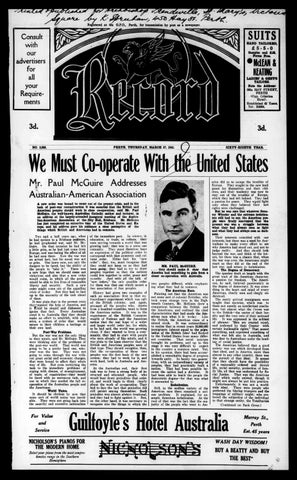
MR. PAUL McGUIRE. they should make it clear that America had something to gain from a closer co-operation with Australia. .
.
.
two peoples differed, while emphasising what they had in common. The American Race. Pointing out that the American was not some sort of colonial Britisher, who took some strange turn in the Eighteenth Century, Mr. McGuire drew a comparison between the British and the Americans, and outlined the chief characteristics that had made the American race what it is to -day. Like the British, the American came of a mixed stock. It was extraordinary to realise that in recent years 32,000,000 immigrants (almost equal to the population of the British Isles) had flocked to the United States from many different countries. That racial mixture brought its problems, and up to this stage it was very difficult to expect in the country a common mind. Yet, in his oponion, there had been accomplished a remarkable degree of progress towards unity. In barely two generations, with an extraordinary variety of peoples, they had practically built a nation. That had been possible because the nation had a doctrine. It had been able to teach the people the democratic dogma-for that was what it amounted to. Isolationism. Still, in the endless variety of the American race there remained a serious problem. It explained, for example, American isolationism. At the root of that was the fact that the majority of the people who went to Am-
Guilloyle's Hotel Australia
NICHOLSON'S PIANOS FOR THE MODERN HOME Select your piano from the most comprehensive range in the Southern
Hemisphere
of the immediate past.
erica did so to escape the troubles of Europe. They sought in the new land peace for themselves and their children, and their tendency was now to stay out of the troubles of Europe, which they had left behind. They had a passion for peace. They would fight only when they believed their last rights were challenged. But he was sure that whatever Senator Wheeler and the extreme isolationists still had to say, the American people were firmly convinicedi that the present war was a struggle between what they had always seen as light and what they had always seen as darkness. Their interests coincided with our interests, but there was a need for Australians to make every effort to see why America had stood out, and not to judge rashly. And they should look beyond the war, and think of the future, for there was a chance that, when the war was over, the Americans might react as they did at the end of the last war, and return to isolationism. The Dogma of Democracy. The speaker dealt at length with the great trait of the American character, a passion for freedom. The American, he said, believed passionately in the dogma of democracy. It was something in the heart and mind of every American, clearly seen and clearly understood. The newly arrived immigrants were taught that doctrine, which was to them not merely an intellectual conelusion, hut almost what the Crown was to the British-the centre of their loyalty and the very core of their national' life. It was expressed in the noblest of phrases: "Men are created equal, and endowed by their Creator with certain inalienable rights." That meant something, and expressed something of what was felt also in Australia, and was dear to Australians under the heading of social justice. The American believed that a good society was one which developed from that ideal, and in America, more than almost in any other country, there was the pursuit of that ideal. It meant that they should have the possibility of a reasonably ordered and decent life, social security, protection of family life, all that was understood by Social Justice. That was the American ideal which really existed, though it might not always be put into practice. Unfortunately, it was not a worldwide ideal. There were people who preferred the blaring trumpets and the trappings of military might; who preferred the subjection of the individual to that strange entity, the Totalitarian (Continued on Back Cover.)
Murray St., Perth Est. 45 years
WASH DAY WISDOM! BUY A BEATTY AND BUY
THE BEST"