7;
Chesterton Bookshop
Kelly and Rodoreda
and VERITAS LI, RARY
36 PIER STREET. Superior Stocks of Second-Hand Books Bought and Sold. School Text Books a Specialty. The Library has an Up-to-Date Selection of Fiction, Valuable Works of Catholic Reference and Catholic Periodicals. TIIE LOWEST SUBSCRIPTION RATES IN TOWN. JOIN NOW.
Official Organ of the Archdiocese of Perth ESTABLISHED
1 ,74
PERTH, SATURDAY, JANUARY
NO. 2,963.
16,
1937.
Late of JOHN DYNON & CO. CECENA, GLASS AND PLATED WARE IMPORTERS. OTLEY PLACE, Off MURRAY. STREET (Rear of Savoy Hotel). Convents, Colleges, Institutions and Schools Specially Catered for. Price Lists and Catalogue on A pplication. 'Phone B9651.
SIXTY-THIRD YEAR.
Henry's Character and Physical Appearance Final Reflections on England's Loss of Faith Physical Appearance. He excelled during all the early part of his life in physical first-rate e xercises; he was a good a wrestler, good rider, a shot, and until disease ha." quite wrecked his physique he could fatigue. A endure a good deal l)ig red-headed, broad -faced man with a sparse heard, somewhat pale eyes set far apart in a face a t first ruddy, later rattle: pasty. He had an exaggerated fear of death and, what was inexcusable in a King of his generation, he would never risk his body in battle. He was terrified of epidemics, which were frequent in t he crowded. ill-drained towns of t hat ep4 )ch. and he took precautions. often absurd, to avoid any chance of infection. There were moments when the fear of death \ vas a positive monomania with him. I le was exceedingly intelligent anI well trained in theology, to which he had first been directed when , as a b(w. it was not thought that he would evi-nRing and he was destined bv his ultimately father to become He Archbishop of Canterbury. was also well-read, could speak and even think in French. as was the custom in the better-instructed upper class of his time in all \ vestent countries and especially in England. It must be remembered that within a hundred years of his birth the English upper class spoke French only. English had only recently become the common tongue. Dealings With Men. But though he was intelligent. in the sense of being able to follow a logical process clearly or t o draw up a consecutive plan or t o analyse intellectual proposi'ions such as are presented by theological or political discussion, he was a bad judge of men. He could see indeed well enough that this man or that was working hard and producing results. but he blundered badly whenever he tried to frame a foreign policy for himself; also he was 'very hesitant—perhaps because he half consciously recognised his incompetence in dealing. with a complicated situation. It \vas Wolsey who conducted his early foreign policy entirely: it was Cromwell who later worked his breach with Rome: it was Seymour who, at the end of his life, determined what sort of will he should leave and how the succession to his throne should he arranged. He was emotional after a fashion, and especially sensitive to music; he was even a good practical musician himself and something of a poet and he composed a few songs which are not without merit, as well as other set pieces of harmony, notably two Masses to which are
to Boulogne—his sudden changot and his violent laws and ges never he word; sense of the into the depth of anything he edicts showed a crazy lack of undertook to study or became balance. — ; he possessor of it. Attitude Towards Religion. Next we must specially insist But the second characteristic. upon the effect which time had most incongruous with such a upon his character—time and character but undoubtedly predisease combined. At some date sent, was a strong attachment to which we cannot exactly deter- the religious traditions in which mine, but certainly early in his he had been brought up. This life. probably well before his was the only fixed thing in him t wenty-fourth year, he contract- approaching •a principle. He ed syphillis. Thenceforward he destroyed or allowed to be degradually became a man deter- stroyed the monastic institu-i iorating- more and more in body _ tions, winch are the bulwark and mind : he long retained his t he ( 'hurch: he quarrelled ,aor physical activity and to the eticl broke with the Papacy, which Js his mental activity. but he was the principle of unity in tfte more warped on the spiritual side Church (though in his time a until at last he became some- principle confused and often thing of a monster—callous to debated) : but he did have a fi xed t he sufferings of others and cap- emotional attachment to the able of almost any cruelty in ac- practices of the Faith, and he tion. While on the physical side never got out of what may be his health went all to pieces es- called the atmosphere of these For pecially towards the end. He had a constant practices. y ears the chief symptom of his devotion to the Sacrament of the t roubles was a running ulcer in Altar and no little of his severthe leg. and for the last quarter ity appeared in his treatment of if his reign he had become so anyone who denied the Real huge, unwieldiv and corrupt in Presence. He insisted on the t Yerson that he could hardly celibacy of the clergy, on the move. In the final years, though maintenance of full ritual in the he was only a little over fifty, he liturgy and all ecclesiastical dishad to be trundled about and his cipline under the episcopacy. enormous bulk lifted in and out which he formally maintained. of a chair. At last he could not 1 have said that this side of (wen sign his name; it had to be him may appear incongruous di-me for him with a stamp. But with all the rest, and it is cere ven to the very end he retained tainly strange in our modern t hat sort of energy which takes eyes, but it is not so difficult to its expression in violence. understand if we put ourselves Extreme Selfishness. in the position of *Is office and T wo last things must be men- his time sincere in tioned about him, the first of these feclinftvi'. but his sincerity which is very generally appreci- was reinforced by his . vanity ated. the second of which is too and his constant insistence upon The first is his political power. He thought often forgotten. selfishness, nf heresy under its aspect of rethat his extreme which grew upon him with the bellion, he disliked its variety y ears, as selfishness always does and its anarchic quality because in selfish men, probably passed he lived bN- centralised despota t last the boundary of sanity, ism which he had inherited as a and this showed itself especially sixteenth century King. and that in the horrible acts of cruelty in very emotionalism which led him the last part of his career. There to his excesses of all kinds was had been plenty of cruelty in capabl.e of reinforcing him in hint when his character first be- t hose personal. habits of worship gan to deteriorate after Cather- which did not clash with his poliine lost her influence over him tical objects. and after his disease had begun Role in History. to work ; but there were other There, as it seems to me, is the political or personal reasons for There is it. while later it was often mere- outline of the man. lv wanton and he would express, his character as a whole in all in the orders he gave, a sort of its lack of proportion and, as he grotesqueness. hellish savagery and greed of developed ,its suffering and gloat over the None could be better suited to agonies of his victims—such as produce the ill effects which it t hose of the unfortunate Friar did produce. If the evil powers Forest whom he had roasted had had to choose their instrument. assigning to it the right over a slow fire—and he mixed up horrors of this sort with the proportions of violence and weakidea of grandeur. He seemed to ness. incomprehension, passion. think that they enhanced his and the rest, they could hardly stature in the eves of his con- have framed a tool more serviceHe able to their hands than that temporaries and subjects. came at last to rule by terror. which did—without full intenand the extravagance of his later tion—effect the main tragedy in policy—stich as the expedition the modern history of Europe.
(By HILAIRE BELLOC.)
given his name but which are perhaps from his own hand. He was very vain—vain of his athletics in early life; exceedingly touchy about his dignity and his majesty as a King. His feelings were here in comic contrast with the way in ‘yhich he was always
oq
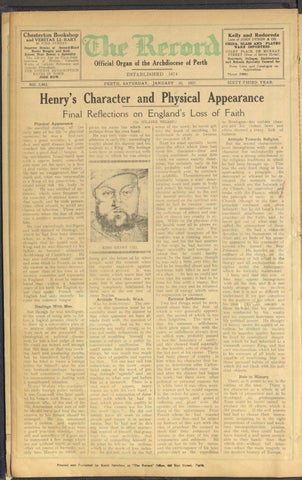
K ING HENRY VIII. 01101111i11111111111111W11110111111111111111111111111111111111111:1111
being got the better of by other p opie. until the moment when the regular explosion against It was their control arrived. t his vanity which made him fall a victim to more than one woman, but it also prevented his being completely infatuated by them save in the one case of A nne Bovlen. Attitude Towards Work. \ Vas he industrious? The ans\\ er to this question must be as carefully sized as the answer to that other question we have already dealt with, the question of Just as he was his strength. certainly not really strong, so he was not really industrious in the sense of troubling himself to master a subject or a policy by He application. concentrated could never force himself to do things, he was much too much the slave of appetite and caprice Yet one may call him for that. industrious in the more superficial sense of the word, of getting through "agenda" and attending to what was put before him as a monarch. There is a many papers. vast mass . of drawn up with his own hand, a great deal of annotation of documents with which he had to deal. which prove this quality in One cannot use for him him. t he word lazy.Tie did not simply leave all work to other people and forget it in amusements. but he had not in this any more than in other matters that control of himself, that grasp , er his own activities, that ,y p ower of compelling himself to do what he felt to be tedious. which is the mark of true industry: he did not work in the full
Printed and Publakied by Keith Spry ban at "The Record" Offset, 460 Hay Street
'Polk.