11-11-411-11--4,41.-111.-14.111-4
ell111110P'
CITY EDITION
tt)er NO. 2,922.
PERTH, SATURDAY, APRIL 4, 1936.
PRICE THREEPENCE.
THE MYSTERIOUS KINGDOM OF PRESTER JOHN The Ethiopian Schism Bears Witness to the Truth •
Catholics a Small Minority in Schismatic Territory
A
BYSSINIA, the mysterious Ethiopian Kingdom of Prester John, is of unique interest for its past history, and for the promise of its future place in the development of Africa. The Portuguese believed that this mythical priest King was African, and thought they had found him in Abyssinia. The name Prester John according to the best authorities, was due to a tnisrendering by European travellers of the usual salutation of the Abyssinians to the Negus or Emperor. The name would, therefore, be common to all its Emperors—just as the words Pharoah or Kaiser were applied. The Switzerland of Africa.
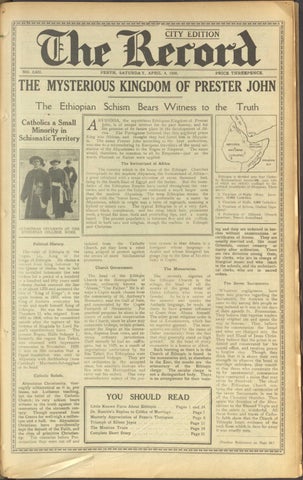
A BYSSINIAN STUDENTS AT THE ETIIIOPIAN COLLEGE, ROME.
Political History. The- ruler of Ethiopia is the the Negus, of i.e., King K ings of Ethiopia. He claims a , iescent front King Solomon by the Queen of Sheba, but in fact t he so-called Solomonic line was hroken for a period of a hundred a hundred and fifty years until ckuna Amlak restored the line Iii or about 1270 and assumed the t itle of "King of Kings"; it was again broken in 1855, when the King of Amhara overcame his rivals and made himself King of Ethiopia. He was the famous Theodore II, who reigned from 1855 to 1868, when he committed suicide after the capture of his fortress of Magdala• by Lord Na The pier's expeditionary force. present Negus, Haile Selassie I., formerly the regent Ras Tafari, was crowned with impressive ceremonies in November, 1929. It was on this occasion that a Papal deputation was sent to Abyssinia with Archbishop (now Caridnal) ..Marchetti-Selvaggiani at its head. Catholic Beliefs. Abyssinian Christianity, thoroughly schismatical as it is, professes, not Lutheran teaching, but the belief of the Catholic Church; its very schism bears witness to the truth against the innovators of the sixteenth cenThough separated from tury. the Centre for well-nigh a millenium and a half, the Abyssinian providentally Christians have kept the deposit of the Faith, and the rites of primitive ChristianTen centuries before Proity. testantism they were cut off and
The country which is the home of the Ethiopic Churches corresponds to the modern Abyssinia, the Switzerland of Africa— a great tableland with a mean elevation of seven thousand feet, lying to the South-East of Egypt and the Sudan. But the boundaries of the Ethiopian Empire have varied throughout the centuries, and in the past the Empire embraced a int.ch larger area than the modern Abyssinia. The term Ethiopian means the people with the "burnt faces," and is preferable as a name to Abyssinian, which in origin was a term of reproach, meaning a hybrid or mixed race. The typical Ethopian is of a very dark, almost black, complexion, and has crisp black hair, prominent teeth, a broad flat nose, thick and protruding lips, and a scanty beard. The present populaticn is between five and six m illion, mixed in both race and religion, though the nucleus is Ethiopic and Christian.
Catholic the isolated from Church, yet they form a rebel camp arrayed in protest against the errors of ,more fundamental protesters.
sent system is that Abuna is a foreigner whose language is Arabic and whose liturgical lan guage (up to the time of his election) is Coptic.
Church Government.
The Monasteries.
The head of the Ethiopic Church is the Metropolitan of Aksum, ordinarily known as "Abuna," "Our Father." He is always a Coptic monk, chosen from the community of St. Anthony's Monastery, near the Gulf of Suez, and consecrated by the Coptic For Patriarch of Alexandria. practical purposes he alone is the source of order and consecration in the Church, since he alone may consecrate bishops, ordain priests, anoint the Negus at his coronation, dispense from vows, and exordinary jurisdiction. ercise Until recently he had no suffragans, but in 1929, as a result of negotiations Lndertaken by the Ras Tafari, five Ethiopians were consecrated bishops. They are not ordinaries in the accepted sense, but auxiliary bishops who live with the Metropolitan and carry out his orders. One very unsatisfactory aspect of 'the pre-
The secunda dignitas of the Ethiopic Church is the echage, the head of all the monks of . the great order of Dabra Libanos, who lives at Gondar. As he is a native of the country and speaks the Amharic language, he tends at times to have greater influence at Court than Abuna himself. The other great religious order is that of .Ewostatewos, which has no superior general. The monasteries are called by the name of Daber (mountain) from the fact that they generally stand on high groLnd.. At the head of every monastery is a komos or abbot. Such learning as there is in the Church of Ethiopic is found in the monasteries and, as elsewhere in the East, the monks are the aristocracy of the Ethiopic clergy. The secular clergy is not a distinguished body. There is no arrangement for their train-
YOU SHOULD READ Little Known Facts About Ethiopia . . . . . Pages 1 and 24 Dr. Rumble's Replies to Critics of Marriage . . . . Page 7 Masterly Appreciation of Francis Thompson . . Page 9 Triumph of Eileen Joyce . . . Page 11 The Mexican Truce . . . Page 14 Complete Short Story . . . . Page 21
• ( ABYSSINIA (
• A00 IS ABABA
BRITISH "..SOMAt HAND!
\\.(ETHIOPIA)
2
s I
/ ‘9. 0cf`e'
Ethiopia is divided into four Catholic Ecclesiastical territoritt, only two f which are strictly confined to the Political boundaries of Abyssinia. These are:1. Vicariate of Calla (Mons. Jarosseaul. 10,000 Catholics. 2. Vicariate of Kaffa. 4,000 Catholics. 3. Vicariate of Eritrea (Italian Capuchims). 4. Prefecture of Djibouti (French Lazarists), French Somaliland.
ing and they are ordained in batches without examinations or c ertificates of fitness. They are usually married and, like most Orientals, cannot remarry or marry after ordination. There are two divisions among them, lay clerks, who are in charge of liturgical music and who teach in the schools, and the ecclesiastical clerks, who are in sacred orders. The Seven Sacraments. Whatever negligences have crept into practice regarding the Sacraments, the doctrine is the same to-day among this people so long isolated as it was in the days of their apostle St. Frumentius. They believe that baptism washes away original sin and opens the wav to heaven. They believe that by consecration the bread and wine are changed into the Body and Blood of Jesus Christ. They believe that the priest is ordained and consecrated for his sacred office, and receives power to forgive sins. Though they think that it is above their own strength to observe the bond of m arriage unbroken, they consider that those who consecrate the tie by sacramental communion have contracted a union that may never he dissolved. The ritLal of the Ethiopian Church contains the rites and ceremonies of the seven Sacraments, in use in all the Christian churches. Then again the devotion of the Abyssinians to the Blessed Virgin and t o the saints is wonderful. All these forms and traces of Catholic faith show that the Church of Ethiopia hears evidence of the rock from which in days far away ct- was cruelly torn. ( Further References on Page 24.)
.....„,..._
••••-••••-••-•41.--4a4.--4,4,-...--00-4.6.-04.-...--.0•-•••-••--4a4.--oe.-••-•410-.0-00.-••••-14. 14. -•••-••••.--.••...e.-••-••-••-•4