ft"
eg11/10'
CITY EDITION
“ )Or
NO. 2,915.
PERTH, SATURDAY, FEBRUARY 15, 1936.
PRICE THREEPENCE.
PLENARY COUNCIL FOR ENGLAND AND WALES First of Its Kind For 63 Years FORMER SYNODS AND PERSONALITIES RECALLED
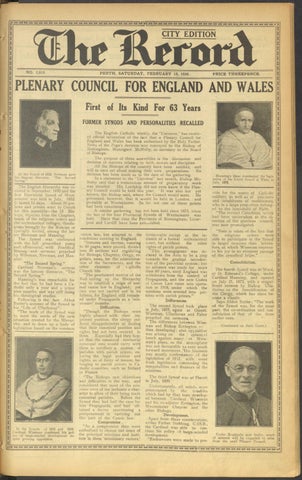
A t the Synod of 1852, Newman gave his famous discourse, "The Second
The English Hierarchy was restored in September, 1850' and the first Provincial Synod of Westminster was held in July, 1852. It lasted 13 days. About 50 prelates and priests went to Oscott fur this assembly—the 13 BisIn bps, deputies from the Chapters, heads of the religious orders and the ecclesiastical colleges, theologians 'brought by the Bishops or specially invited, among the latter Newman and Manning. The Synod was celebrated with the full prescribed pomp and Oremonial, with Pontifical Masse, and sermons preached by Wiseman, Newman. and Man"The Second Spring." Cardinal Newtnan's sermon w as the famous discourse, "The Second Spring." Manning's was remarkable for the fact that he had been a Catholic only a year and a priest nine months, and was still doing his theological studies. Following is the late Abbot Butler's account.of the Synod in his "Life of Ullathorne": "The work of the Synod was to meet the needs of the new situation created by the Hierarchy. and to draw up a body of legislation based on the common
In the Synods of 1855 and 1859, Cardinal Wiseman continued his policy of large-minded development decpite growing opposition
The English Catholic weekly, the "Universe," has received official intimation of the fact that a Plenary Council for England and Wales has been authorised by the Holy Father. News of the Pope's decision was conveyed to the Bishop of Nottingham, Monsignor McNulty, as secretary to the Board of Bishops. The purpose of these assemblies is the discussion and decision of matters relating to faith, morals and discipline. All the Bishops of the country have been notified, and will at once set about making their own preparations. No decision has been made as to the date of the gathering. In a statement to the - Universe" last month, Bishop McNulty said that a tremendous amount of preparatory work was entailed. His Lordship did not even know if the Plenary Council would be held this year. It was also not yet known, the Bishop said, where the Council would meet. He presumed, however, that it w ould be held in London, and probably at Westminster. So far not one of these points had been considered. A similar gathering has not been held since 1873, when the last of the four Provincial Synods of Westminster was held. Since that time the Provinces of Birmingham, Liverpool and Cardiff have been estamished. canon law, but adapted to the conditions existing in England. "Statutes and decreeE, running to 60 pages, were passed, divided into 30 sections and regulating for Bishops, Chapters, clergy, regulars, nuns, for the administration of the Sacraments, and the other elements of t atholic Church life. "The proclaimed motive of the Bull setting up the Hierarchy was to establish a reign of normal canon law in England; yet this was not carried out in its fulness, for England still remained under Propaganda as a 'missionary' country. Difficulties. "Though the Bishops were highly pleased with their improved position, the clergy suffered disappointment at finding that their canonical position and rights had not been secured to them. Especially had they hoped that the canonical territorial episcopal sees would carry with them as corollary a system of parishes with parish priests, enjoying the legal position and rights, as of fixity of tenure, belonging to parish priests in Catholic countries, such as Ireland or France. "The Bishops saw objections and difficulties in the way, and considered that most of the missions were of too inchoate a character to allow of their being made canonical parishes. Before the Synod they had laid the case before Propaganda, and had obtained a decree sanctioning a postponement in carrying out this -part of the Canon law. Compromise . "As a compromise they were authorised to choose out some of the principal missions and institute in them 'missionary rectors,'
irremovable except at the instance of a formal ecclesiastical court, but without other the rights of parish priests. "This arrangement was declared in the Acts to be a step towards the gradual introduction of the parochial system; but no advance was made for more than 60 years, until England was w ithdrawn from the control of Propaganda, and the new Codex of Canon Law came into operation in 1918, under which the missions were erected into parishes with parish priests." Differences. The second Synod took place in July, 1855, again at Oscott. 'Wiseman, Ullathorhe and Faber preached the sermons. The differences between Wiseman and Bishop Errington w' then developing; also ori.osition was arising on the eptscol.z; bench against many ot Wiseman's plans, so the atny3spliere was not favourable 1,3 very much forward movement- Tie business was mostly confirmatory ei the legislation of 1852. with some fresh legislation concerning the temporalities and finances of the missions. The third Synod was at Oscott in July, 1859. Unfortunately, all minds were preoccupied hy the thimbles which had by that time developed between Cardinal Wiseman and his co-adjutor Errington, the W estminster Chanter and the other Bishops. Development. Apart from these contryoversies. writes Father Stebbing. C.SS.R., the Cardinal was able to continue his policy large-minded development. "Endeavours were made to pro-
Manning's ideas dominated the legislation of the fourth Synod of Ware, in July, 1873.
vide for the wants of Catli)lic soldiers, as well as of pris mers and inhabitants of workhouses, who in a large proportion belonged to the household of Faith. "The revised Catechism, xvi,ich had been undertaken at tl-e direction of the previous cluncil, was now promulgated. "Note is taken of the fact that religious the orders were able to participate in the Synod in larger measure than heretofore, at which Wiseman expresses his joy in an eloquent passage of the synodical letter." Consolidation. The fourth Synod was at 'Ware, at St. Edmund's College, under Cardinal Manning, and opened on July 21, 1873, with a magnificent sermon by Bishop Ullathorne on the Sanctification of the Clergy, which has since become a classic. Says Abbot Butler: "The work of the Synod was, for the most part, the co-ordination and consolidation of that of the three earlier ones. ( Continued on Back Cover.) •
Under England's new leader. much of interest will be expected to arise from the next Plenary Council. 4114.--4040-41.1111. 41.41.-0411.-411