NO. 2,908.
elb..trer
PRICE THREEPENCE.
PERTH, SATURDAY, DECEMBER 28, 1935.
1 935-A CATHOLIC LOOKS BACKWAKDS The aspect of the year 1935 is opened dark. It ndoubtedly u uncertainty ot deal good with a as to the outcome of the Saar elections—it closes with much inure uncertainty as to the outNever become of Sanctions. fore has Society presented such a spectacle of groups and nations that seems at odds beyond all And if hope of reconciliation. all human beings are interested in this—it must be absorbing, or even fascinating, to the Powers of Darkness who specialise in the tactical advantages which conflicting forces present. The historian of the future will find it difficult, perhaps quite beyond his powers, should he endeavour to explain—as he probably will— the maze of contradictory facts, bobbing up like so many hideous, grinning imps, with which contemporary society is confronted. He may have to content himself with a mere chronicle of events, or abnormal psychology is hardly the function of the historian, and there may await, for those who are interested in the "Higher A nalysis." a rich field of investigation. W hilst it would be sheer folly to seek to pierce the future— those purblind eyes of ours are far too unreliable—yet, as Catho• iics, we may face the new yew and find compensation for our worries and cares in the fact that many idols, which in the days of Prosperity had assumed proportions of almost dogmatic grandeur, have now shrunk to littleness—or even to nothingness. It w as taken for granted, tor instance, that Christianity had been left behind in a progressive age. It was even said of the \vonderful nineteenth century that it killed Christianity, and many funeral sermons have been tittered over the deceased. One is, therefore, urged to ask L 1( question : "What of the Twentieth Century, the third decade of which is half-way through? ' 14 all the laws of Progress and Evoluti011-1 couple these two 1)ecattse of their dynamic characteristics—the Millennium, if not ;1ctually reached, should be in ight. The nineteenth century w itnessed development the of an industrial economy— mevitable product of the Reformation. The magic of mass Production—implying, of course, °le making of fabulous fortunes --crept in early in the Twentieth Century. It never did occur to those (and they were a small number) who developed this eco'only and profited by it, that the liird decade of the Twentieth Century w ould show that mass consumption was essential to its I.naintenance. The Millennium is iarther off than ever--and the industrial system has received that 111.°st crushing of all refutations— it does not work. You cannot 'Prily the doctrine of the strug!ile for life and the survival of .`4e fittest to the social sphere Ivi. thout latei tolent creating sooner or repercussions, as happen
The Year's Grim Retrospect WHAT THE WORLD CAN HOPE
FOR
(By PAUL BRENNAN). t.:(1, for instance, in Russia. Now pre-war Russia was not a Protestant nation, but it was very much a Protestant experiment— thanks to the sojourns of Peter the Great amongst Protestant nations. He had a predilection for Berlin, and an obsession for Nordic principles, so much so that he determined to organise Russia— to make it Nordic. His cities were modelled on Berlin—and the creation of St. Petersburg signified the advent of the industrial era in Russia. Whatever the predilections and obsessions of Peter the Great, the Russian people certainly faltered and f umbled under the experiment. They were, therefore, easy victims to the Bolshevik usurpation which so soon succeeded the collapse of the Russian armies in the Great War. In July, 1891, Cardinal Manning wrote for the "Dublin Review" a summary of Pope Leo's f amous Encyclical (Rerum Noyarum), which had been presented to the world two months earThe Cardinal's article is lier. now published by the Catholic Truth Society, under the title, "A Pope on Capital and Labour." He wrote: "For three centuries the world has been in revolt against the Church and has thrown off the first principles from which it
sprang; they are: faith, indissoluble matrimony, Christian education, obedience to the Head ot the Christian world. . . ." Much ink has been spilt on the great cleavage which occurred four centuries ago. Catholics will agree with Manning's allusien to it as a "revolt against the Church." Those who are steeped in the Protestant tradition see it as a "glorious Reformation," and point to the wonderful achievements of the Protestant c ountries—commercial greatness — colonial expansion—the industrial era—financial triumphs --big navies, etc. Even Matthew Arnold, writing some sixty-live years ago, permits himself to say that somebody is struck "as anyone may well be struck, with the superior freedom, order, stability, and religious earnestness, of the Protestant nations against the Catholic." One wonders what his opinion would be to-day. The ‘vorld has .altered considerably since those words were written, and now the nations of Protestant culture—far rn.)re so than the Catholic nations—are in desperate straits. The experiment of four centuries ago was one whose main results were the Worship of Success and the relegation of Poverty to a criminal status. Before the Reformation, that is to say, in -
I
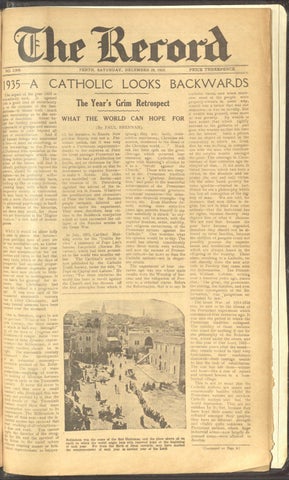
Bethlehem was the scene of the first Christmas, and the place above all on earth to which the world might look with renewed hope at the beginning For from the Birth of Jesus onwards, men have marked of each year. the commencement of each year as another year of the Lord.
Catholic times, and when moreover most of the people were property-Owners in some way, wealth was a factor that was not unknown—it was no novelty. But it wealth was praised, even more By wealth is so was poverty. here meant that which rightly accrued to the gatherer of just gam who wasted neither his time Such a person nor his talents. was an object of respect in. the c ommunity in which he lived. he was nothing in compariB But son with the man who distributed his surplus wealth amongst the -poor. The cleavage in Christendom of four centuries ago destroyed all that. It did more. It raised Success, which had been a virtue, to the absolute and supreme ,the one and only virtue. On the other hand, poverty became ignoble—criminal in fact. Hence we see a philosophy which has lost all conception of the dignity of man. We are told, for instance, that men ditfer in degree, but not in kind from other animals—that the individual has no rights, because Society may deprive him of what it chooses. We are told that because the poor have become degraded, therefore they should not be allowed to raise families, because the children of paupers could not possibly possess the superioi moral and intellectual attributes which are always found in the offspring of the wealthy. These ideas, revolting to a Catholic, result directly trom the new attitude to Poverty that came with the Reformation. The Protestant, William Cobden, writing over a hundred years ago, stated that: "Ihe great, the prominent, the staring, the horrible, and evei durable consequence of the Reformation,- was "pauperism established by law." The Great War of 1914-1918 may be said to be the climax of the Protestant experiment which c ommenced four centuries ago. It w as also the period at which the Protestant tradition collapsed. The stability of those nations, w ho stand for nothing if not for the philosophy of the Reformation, wilted under the strain, and to this year of Our Lord, 1935— seventeen years after the event— they remain rocked to their very f oundations, their confidence shattered----their courage unable to face the task of rehabilation. The war has left them—winner and loser—like a row of ruined and tattered houses in a bombarded village. This is not to mean that the Catholic nations are sound and economically healthy whilst the Protestant nations are stricken. Catholic nations also feel the w orld depression. They are not stricken by it; but, because they have kept their assets well distributed amongst their peoples, they have an inherent strength and vitality quite unknown to Protestant nations, where huge industrial areas—now largely depressed areas—were allowed to develop. ( Continued on Page 8.)