Thr E,e,rer -01,••--..•-•••-••
••-••-.••-•••-••-•.- ..-
-.4,-•••-•
PERTH, SATURDAY, AUGUST 31, 1935.
NO. 2,890.
`.0000-4.0.--1,0-.
-..W-
PRICE THREEPENCE.
TOUR OF VIENNA BOY CHORISTERS •
•
•
•
•
•
•
•
•::•It•11• ,.•• .
.
.
. ..I•1I•1I•1I•1I•11•41
Famous Liturgicai Choir Founded 437 Years THE FUNCTION OF CHURCH MUSIC "Remo, The Italian liner from Fremantle in arrived .,ich .. rope on Saturday, en route to carried an unusual :Ibourne, . freight in the unique indeed .1 .a band ui eighteen niustrian lads.. who ha; e European and world-iieved I in a novel fle as choristers. of tont,: costume pleasing blue trousers. navy coal.s rh brass buttons, and round tie sailor caps. they were Idled together on an upper is .sk of the liner excitedly theil of impressions their Hsing visit to Australia and of ir anticipations of their stay V aried Repertoire. Their genial Rector, Rt. Rev. Asignur Schnitt, in a brief inview, gave some interesting cts about the history of the and of the nature of tlytir The voices oi . ertainnient. Choir are alto and soprano. their cnoral work will be ,Iplemented by buy soloists. air programmes will cover a Ic and unique range, including ins and liturgical music et .. 15th. and 16th. centuries, opttas (in costume) by Mozart, tyden, Schubert and other , ters, Austrian folk songs, . ennese waltzes, i asses and Jo spirituals. Especial interest. • [ t is many years since a boys' Ir visited this . country, and visit of the Viennese liovs' should hold especial in:est for Westralians, in view the fact that it is one of the ,st notable musical attractions the world to-day, and by rea1 also of our particular inter, in boys' choral work which is aroused and sustained by the it record of the choir of St. tricks Boys' - School. Added this is the compelling thought caat: with the revival of the litur, movement, this Choir Vill ( )vide Australia first hand with '‘ e beauty and Skill of the lurch's traditional music which • +die mind of the Church to estore The Rolthroughout the world. Y Father recently gave eloq of the'l\IL, expression to the worth 'ork of this Choir. when he the Pvresented them recently at atican, in souvenir, vhich 1N,er . a inscribed the w ords: • 'Their °ices are like flutes, and sweet as _ • aradise, "lose of angels in • I)istinguished History of 437 Years. Th„ it;c , " 14.7"lese Boys' Choir had attal'euh°11 14-98. when it to ed the Imperial 'ha . , ad • .:esidence .1acent to the Royal Aimed b".1 'Vienna. It \vas Y the Emperor. Maxilia ' inrtant and has played an imPart in the religious and
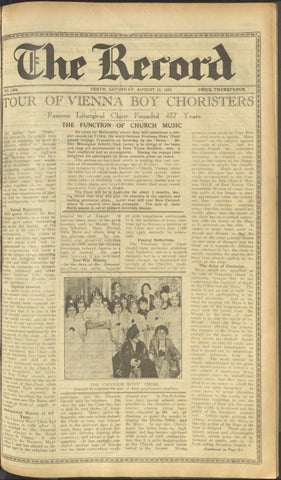
En route for Melbourne, where they will commence a concert season on Friday, the world-famous Viennese Boys' Choir passed through Fremantle on Saturday by the "Remo.Rt. Rev. Monsignor Schnitt, their rector, is in charge of the boys, and they are accompanied by Herr Victor Gomboz, who is their conductor and an accompanist. During the voyage they delighted the passengers by three concerts given on board. The section of the Choir which is making this tour consists of 18 members, of an average age of 10 years. One section remains to sing in the Emperor's Church, Vienna, while the other has of recent years toured the world several times since the Nvar and won universal applause. The present Choir conies to Australia with freshly -garnered laurels won in the United States and Great Britain, where their most recent appearance took place in March. The Choir will be in Australia for about 3 months, during which time they will give 150 concerts in the capitals and leading provincial cities. Later they will tour New Zealand, where 90 concerts have been arranged. The date of their Perth season is not at present definitely known.
protests were made by Pope Pius X.. who wrote a special "Motu Proprio” on the subject, against And the this state of affairs. present Pontiff has reiterated the Church's objection to theatricalism in Church music. A nd so the return to the liturgical forms is slowly but steadily progressing. Al uch good work in this direction has been already accomplished in the Eastern States by Rev. Dom S. Moreno. 0.S.B., of New Norcia. The lamentable divorce of music from the spirit of the liturgy is readily appreciated when one considers that outsiders illor instructed Catholics. entering many churches to-day, would not readily- guess that the music of At ed with tumultuous enthusiasm. the choir has an essential connecmusical life of Europe. various times, many of the great It is the ambition of every Aus- tion with the action of the Mass masters, such as Mozart, Hay- trian lad to become a member of as It proceeds on the altar. It den. Schubert, Hans Ritcher, this Choir and more than 1,000 seems in many cases quite reFelix Motti and others, sang in boys apply annually for admis- moved and distant. so that the Its con- sion. this glorious choir. priest at the altar appears intent Passing Reflections. tinuity • was preserved unbroken on one train of thought and the The Viennese Boys' Choir choir on a down to 1918. when the Socialist completely different Revolution reduced Austria to a should claim particular attention one, whereas in fact the choir is Six years from Catholics, not as a musical m erely repeating the state of turmoil. prayers that later. him ever, it was re-formed. curiosity, but as a survival (and have been already spoken by the likely enough. an inspiration for priest at Post-War History. the altar. revival) of Church's the tradiEmperor. of days the the In The Arise of Confusion. the Choir was under Imperial tional music rendered in the trq.Many people are appalled at the idea of Gregorian chant or plainsong, because they do not u nderstand the function of music in the Office and the Mass. The music is not an end in itself, hut a means of participating in thi s acred mysteries. Just as the ideal for praying the Mass is for every one of the congregation to pray with the priest from the M issal. so the ideal of choii m usic is to sing the words of the Missal. Since the Mass is a c ommunity- offering (as witness the prayers of the Canon in the plural), so the music in which t hese words are clothed should be simple, so that all could take part, and more importantlyso that it should not, by adornment, distract attention from' the w ords. The music should be c learly subordinated. to the great and sacred prayers of which it is the vehiclit of expression. Many C( mposers. have so embellished .;aered music that they have exalted it to an extent in which the THE VIENNESE BOYS' CHOIR. w ords are quite secondary. In Dressed in costume for one of their programme numbers. some cases, by actual alteration In Pre-Reforma- or addition • to the words, or by patronage. and the Emperor ditional way. But tion days special schools were irrelevant repetition to suit the himself paid its expenses. e xigencies of their art, the sense since the war, the Choir has had attached to the churches or mon- of the xvords is (lestn)yed and the asteries wherein young nanboys fi of means own to find its spirit of the liturgical prayers Hence, under the were educated in the art of cial support. l ost. Others again prolong the assist chanting to the forbade monks in which R epublic, the ride v arious sections of the Mass, Divine singing the relaxed, Office and was tour, to Choir so the that and in the post-war days it has the Mass. In our -days Church altar the action of the Mass at the is delayed. These are obm ade three touys of Great Bri- music has fallen from its high viously and become has serious and objectionable estate, other epnfused (among America and tain defects, which arise out of igc ountries), and earned a high re- with music of such ornamentanorance quite tion that or vanity, and so far it is inappropriate conrecently has It putation. cluded another tour of Europe to the Church and much better from aiding devotion, impede it. Strong (Continued on Page 11.) and has been everywhere receiy- suited to the theatre.