Utt 'Rtrera PERTH, SATURDAY, AUGUST
NO. 2,887.
PRICE THREEPENCE.
10, 1935.
The Solemn Devofiori 01
uararaf9 Ore
• TEN Intense Mocleni i\ioyement Towards Eucharistic riornagr feaOne of the most striking the is to-day Catholicism of tures Catholics to increased devotion of Two Sacrament. Blessed the last the within movements great responsible century were chiefly for this. One was the inauguration of the Eucharistic Congressby the French Maid of Tours, Marie Tamisier, which have increased to tremendous proportions since the first pilgrimage to kvignon in 1873. By this means, Catholics have been emboldened to pay public homage to the Blessed Sacrament. and these Congresses have assisted in a wonderful manner in deepening , the faith of the masses. The other movement came from the Father of Christendom himself — the saintly Pope Pius X. This year, Catholics throughout the universal Church, and the children particularly, will celebrate the 25th. anniversary of the decree "Quam Singulari," which encouraged frequent and daily reception of Holy Communion and admitted children of tender age to the Eucharistic Banquet. One of the most popular forms Eucharistic devotion is that of Quarant Ore ,or Forty Hours' . xposition of the Blessed Sacraent. A solemn "Mass of Ex sition" marks the commencecut of this devotion, and at the iid of the forty hours another "Mass of Deposition- is celebrated. Both these Masses are usu-11y accompanied by a procession oi the Blessed Sacrament and the chanting of the Litanies of the Saints. The devotion of the Forty Hours, though its precise origin is uncertain, began in • Milan in the year 1537, and within two years Was iTni,d,t_ gifpernce endowed with a Papal by Pope Paul III. actice continuous prayer and adoration before the Blessed Sacrament exposed spread rapidly and was g-reatly, encotrby St. Philip Neri and St. Iaged gnatius L Under the special direction of the Oratorian Fathers,, a. particularly of theii tshaiendtlevvo'ntand iishop, Juvenai cina. to assti_ and began . elaborate ritual i that which sm its solemnity to(lay. It is interesting to note, too, that his this hay, - - been t devotion appear to acred con heinspiration of those which certs, the memoi v of s ”perpetuated in the ‘`nratorioc if our greatest Posers The vu Ice wh.Tote of the approbaerl f lcu the devotion receirroni varn i lis Popes is that of anxiet dolt. 3 f or the peace of C•ristenthe sec Ilence, even to da-, on • . the ° day of the r 'mos •ttion Ma sum., ss nr 0. acc "Pro Pace" is -tin he orclinQ- to the .ri(s. T Popes met the b (15 •• " . "0.-
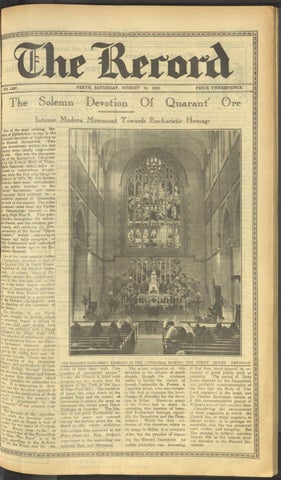
THE BLESSED SACRAMENT EXPOSED IN THE CATHEDRAL DURING THE FORTY
cords of their time with "the practice of unwearied pray en." To-day the Church is faced with dangers not less deadly than :he menace of the Turk in the days of Pope Paul III. The tradition of peace has come down to the present Pope and the means of preserving it remain the same. as witnesses the recent great Peace The hisTriduum at Lourdes. tory of one great Eucharistic devotion for peace and concord among the nations gives the lie direct to the recent maliciots f abrications that appeared in the Press about the Holy Father's c onnivance at the impending war between Italy and Abyssinia.
1.4.• -4/4/- -140- AINP-111.4.-N-
The actual originator of this devotion is the subject of much dispute, though the evidence seems to favour the claims of Joseph Piantanida da Fermo• a, Capuchin priest, who was certainly the first to organise the interchange of churches for the devotion in Milan. However, many of the Orders had • a share in spreading this practice of beautiful Eucharistic homage, especially the Barnabites and the DomWhile the first eviinicans. dences of this devotion relate to its usage in Milan. it is certainly older, but the practice of exposing the Blessed Sacrament for public adoration was becoming,
4110-40411.- 41141111.--411011110-1100.
HOURS
DEVOTION
at that time, more general on occasions of great public peril or calamity. The period of forty hours selected for the Exposition was probably commemorative of the time that the Body of Our Lord remained in the tomb, and St. Charles Borromeo speaks as if this commemorative prayer of 40 hours was of very ancient date. Considering the environment of sheer paganism in which the Church has, in many quarters, to labour to-day, it is perhaps remarkable that She has preserved such virility and integrity. But Her success is without question largely due to the intense modern devotion to the Blessed Sacrament.