eRercor
PERTH, SATURDAY, JULY 20, 1935.
O. 2,884.
PRICE THREEPENCE.
Bede Ile Venerable.. Fatther of Eng isk Learning R
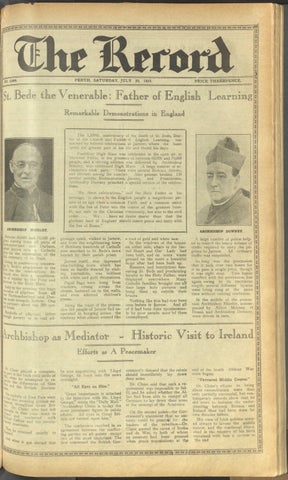
ARCHBISHOP
Demonstrations in Engiana
The 1,200th. anniversary of the death of St.' Bede, Doctor ut the Church and Father. of English Learning, was marked by historic celebrations at Jarrow, where the Saint spent the greater part of his life and closed his days. Pontifical High Mass was celebrated in the open air, at Dement Fields, in the presence of between 60,000 and 70,000 people, and a stirring address was delivered by Archbishop tlinsley, ‘vau celebrated High Mass. A large number of ecclesiastics took part. There were several Bishops, Abbots, and Divines among the number. Also present besides 150 -ecular priests, Redemptorists, Jesuits, Franciscans. and . 1rchbishop Downey preached a special sermon at the celebrations. - • B y these celebrations," said the Holy Father in his message, "is shown 'to the English people a magnificent picture of an age when a common Faith and a common union with the See of Peter was the source of the greatest benefit, not only to the Christian community, but also to the civil order. . . . We . . . have no desire dearer than that the glorious land of England should renew peace and unity with the See of Rome." aniSLEY.
Between 60,000 and 70,000 pilgrims, coining from all parts of orthumberland and Durham, turned Jarrow into a Catholic town for the of the Uth, centenarycelebration of St. Bede. Owing to controversy concerning St. Bede's attachment to the Holy See the celebrations developed also into a manifestattoi of loyalty to the Pope and devotion to the Holy Mass. Early in the concourse of inornimz this huge pilgrims from all over Northumberland and Durllam made towards Jarrow. One IS company alone ran 260 speial buses. Hundreds of Pili;rims, either through poverty or in real pil-
A
ARCHBISHOP DOWNEY.
grimage spirit, walked to Jarrow, and from the neighbouring town of Hebburn hundreds of Catholic men marched to St. Bede's town headed by their parish priest. Jarrow itself, that depressed ship-building town which has been so hardly treated by visiting- journalists, was brilliant with white and gold decorations. Papal flags were hung from the windows, strung across streets, fastened on to the walls, children's and even adorned prams. Along the route of the procession the people of Jarrow had cooperated in hanging across the r oadway what almost seemed like
his..a0p as Mediator
a roof of gold and white lace. In the windows of the houses on either side, altars to the Sacred Heart and Our Lady had been built, and on some waste ground on the route a beautiful lai-ge altar had been built up. Banners, and inscriptions honouring St. Bede and proclaiming loyalty to the Holy Father, were displayed everywhere. Many Catholic families brought out all their large holy pictures and hung them up outside their houses. Nothing like this had ever been And all seen before in Jarrow. of it had been done spontaneously by poor people. most 'of them tinemployed.
.1 large number of police helped to control the heavy volume of traffic required to carry the pilAll ordinary grims to Jarrow. traffic was suspended. So long was the procession that it took over two hours for it to pass a single point, though Two bands it was eight deep. marched with the procession, but again owing to its enormous length, several different hymns were being sting at the same time without causing confusion. In the middle of the procession Archbishop Hinsley, accompanied by Abbot Mooney of Douai, and Archbishop Downey, were driven in cars.
Hisforic Visit to Ireland
Eifforfs as A Peacemaker
1
Dr. Clune ,'"us part in theplayed a conspict,Irish civil strife of 1 , when he attempted to re`Incile the r ein and differences of Sinn the British Govern' ent.
The exploits of Sinn Fein were that time arousing intense exit.ernent l. Dr.throughout Great BriClune, who had left flistralia in that year, went to ,I.,'/eilal_ild and with ir,cnael Collins conferred and his revolu'llarY 11 associates. . i,,i p Then he 'ngland returned quietly to when it got
abroad that -4B4,--.••—•411.
ernment's demand that the rebels should immediately lay down their arms. Dr. Clune said that such a re"All Eyes on Him." quirement was impossible to fulwhether the Al" Great importance is attached fil, and he asked to compel all able lies had been Lloyd Mr. with to the interview their arms down to lay Germans George," wrote the "Daily Mail." Armistice inomeilt of the at the "Archbishop Chine is to-day the most prominent figure in public On the second point —the GovAll eyes in Great Bri- ernment's statement th at no amaff airs. tain are turned upon him." nesty could be grant+ for the of the rebellion—Dr. leaders The conference resulted in an the cases of Botha quoted Clune conflictthe agreement between whom ing parties on all points except and de Wet, to both of granted been had amnesty an t wo of the most important. The Ott first concerned the British Gov- when ileace negotiations at
he was negotiating with Lloyd George, he leapt into the news overnight.
11011.-00-4040-4.0. -gre•-•41*-411.-.0.-00410-4Pi
end of the South African War were begun. "Favoured Middle Course." Dr. Clune's efforts to bring about reconciliation were thus only partially successful, but contemporary records show that he did more to increase the understanding between Britain and Ireland than had been done for t wo decades before. His view of Irish politics seemed always to favour the middle course, and the continual bloodshed in the country of his birth remained with him a sorrow to the end. . 4041;:4110.--10
11.11.