I.
Thr Address
Box J633, G.P.O. NO. 2,879.
litrora
OFFICIAL ORGAN OF THE ARCHDIOCESE OF A CATHOLIC WEEKLY
.
. PRICE
PERTH.
THREEPENCE
R egistered at the G.P.O., Perth for Transmission by Post as a Newspaper.
PERTH, SATURDAY, JUNE 15, 1935.
Ring
Phone B5447 SIXTY-FIRST YEAR.
"Greatest and Most Permanent ,' Spiritual Power
Canadian Statesman's Striking Appeal to Nations Given unanimous approval by the Canadian House of Commons, the motion of Henri Bourassa that Canada renounce war 4s _a means of s(!t cling international problem brought from the, veteran Montreal journalist vigorous plea that the nations of the world admit the Pope to take part in their deliberations. Eighty years Mr. Bourassa said. "Glad.' 1IC realised the necessity for a !a\N- of nations even though it was imperfect compared with the unity of Christendom as it existed in the Middle Ages. Tie realised, although he did not say so expressly, that in spite of religious schisms, Christianity remb.ined the one great basis of social order, or as another great Protestant statesman had said a half a century previous. Burke in his r eflections on the French Revolution: Whatever may be our creed and sectari-,m views, we must acknowledge that the Pope r emains the head of Christianity. Now if that was the opinion of a great Christian statesmen, as Gladstone was described by Lord Salisbury after his death. can we not take cognisance of it and act . somewhat accordingly? But what did we do? We tacitly acquiesced in the secret treaty concluded in London in April. 1913, by which England, France and Russia decided to exclude the Pope from all their deliberations on the affairs of this world ,\Vh3r? Because in those days the talian that theGovernment was afraid Pope might raise the question of temporal power. Now ' that difficulty has disappeared, because the peace With Holy See has made the Italian Govern ment. Is there any reason which remains for the temporal rrulers of the soa ..e neci • L..nrist Christian nations to go on their excludint), the Pope from from counsels? I do not sav their 'aY from government, I do not their policies, because 11° sane Catholic to-day and no Pope would claim any such power similar •• to that which the Pap .4cY \ exercised in tile Middle Tes: the Political and-situa t.ion, religious, social. is entirely different surely there is no m an,h_however sincere a Protestant may av be no -matter how ;fi' \,iuri,sactni ovfan' enemy i y he may be to Was the rule of the Papacy years ago, or even \\;atilittinlred Was sixty years ago when Gladst Vat; "e himself denounced the .can •• • . will eno uuu vattcantsm. who t admit, if he has a mind judicleTIT to overcome his preory se„, at the Papacy and the innTal remain the greatest f orce there is in the world
Admit Holy Father to Peace Sessions
members I heard quoting the Pope's Encyclicals and making use of them to foster what they considered to be social reforms. A moment ago I said that we cannot sieve any problem in America without the co-operation of the Government of the United States. Likewise do I assert that the world cannot solve its problems without the co-operation of the greatest and most permanent spiritual power which exists." POPE PIUS X.
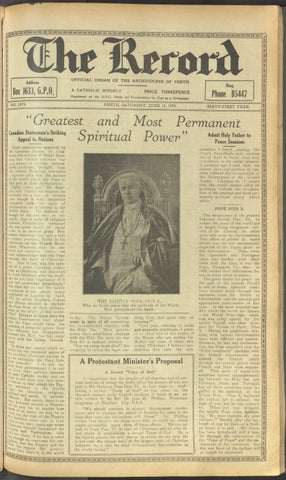
THE SAINTLY POPE. PIUS X., Who so loved peace that the outbreak of the World War precipitated his death. to-day. The British Government, in spits of all opposition. has re-established relations with More governthe Holy See. ments have established relations with the Holy See since the war than for a century previous. "Are we voing to sit aloof? Are we going to refuse the learn any-
thing from that great seat of learning?" "Last year, referring to social and economic conditions, I pointed to these men in- this corner of the House who are neither Catholics, nor some of them, very ardent Christians, I believe; nevertheless they were the only
A Protestant Minister's Proposal A Second "Truce of God." A suggestion that the peoples of all churches and all persons desirous of seeing the world rid of the menace of war, appeal to His Holiness Pope Pius XI., to lead them in establishing a second "Truce of God," as was ,done in the eleventh century under Church auspices, is made in an article written by the Rev. Dr. John M. Phillips. Protestant clergyman of Hartford City, U.S.A. "We should continue to support disarmament conferences, and to educate the people of America for peace in the Dr. Phillips hope that some day the nations will listen." writes, "but there is one thing more that We could try which We can apmight accomplish more than all these efforts peal to Pope Pius NI. to lead all Christians and all who deHe is sire peace in establishing a second Truce of God. the logical person. the only person. to whom we can turn. He is not only the chosen head of the largest body of Christian believers, he is also the most distinguished humanitarian in the world to-day." -4114.-04.-4114110-41.0,-
The endeavours of the present Supreme Pontiff, Pius XI., to ensure the peace of the world ar@ at length being recognised outside of the Church, by other sects and even by Governments. This office of arbiter in world affairs was one not uncommonly expected of the Popes prior to the Reformation. Thus, when the Spaniards and Portugese came into conflict over their trade with the East, it was the Pope, Alexander VI., who, in 1493, settled their differences. So, too, in many other instances. The great desire for peace on the part of the present Pontiff is one of those splendid traditions handed down through the centuries when the Father of Christendom was the natural and appropriate peace-maker of Europe. In the most dreadful con/het which the world has known —the World War—this tradition was nobly upheld by the saintly Pontiff, who then occupied the Throne of Peter, Pius. X. During his pontificate, relations with various Governments were both difficult and painful. However, by tact and condescension, the Pope smoothed over the "Nobis nominavit" question with the French Government, and steered the Church safely through the critical period when Church and State were separated. That spirit of world-wide suspicion caused misunderstanding between the Holy See and Germany, Spain and Portugal, but all these questions were engulfed in the outbreak of the World War. Pius X. implored the nations not to unleash the dogs of war, but he was unheeded. When war was declared, the saintly Pope wept, exclaiming-, "My poor children, my poor children!" Shortly after the 0u:break of war he died—of a broken heart, it is said. His Cause has been introduced, and it may be through the intercession of the "Pope of Peace" and the en. deayours of his successors that the war fever of the nations will at length he restrained.