Registered at the G.P.O., Perth for Transmission by Post as a Newspaper.
Bishop and Lord Chancellor Kaised to Altars MAGNIFICENT CANONISATION SCENES
" England's Day in Rome "
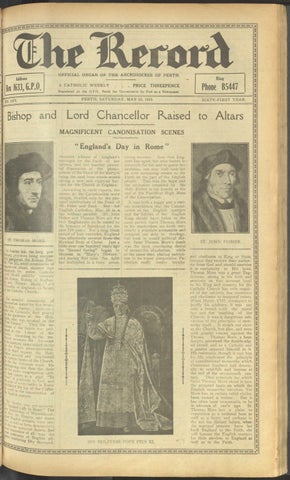
On Sunday last, the long preliminary processes being successfully completed, the Roman Pontiff, Pius XI., amid ceremonies of magnificent ritual, decreed that henceforth the entire Catholic world should publicly venerate John Fisher, Bishop of Rochester, and Thomas More, I ord Utancellor of England, a; Saints of the Catholic Church. The splendid ceremonial of' canonisation lasted for five hcairs. The Holy Father, en th on(•, amid the Cardinals, first prayed for the guidance of the Hol, Spirit, who was invoked in the 'Veni Creator." Then the assistance of the Saints XV:N petitioned in the Litany o f the Saints. According tlitionai ceremon y theto the traAdvocate of the martyrs' cause. asked thrice for the A t the Pope's pronouncement. Sather third request the Holy acceded and Proclaimed the martyrs Saints of the Church. At this the Advocate t made his and theta the choir ahanksgiving nd the e,(1 their entire congregation waitvoices in a glad "Te ,u,eulh" of me peals gratitude to Cod, and of every belfry P in Rome the joy of the Catho1h.roclaimed 0lic world in the canonisation of P-31glish martyrs. iltit , ',Quay Was pre -ern Men tne:ngiand's (1/3, in A Rome-" Rt. rchbishop of The Westminster, OtherRev I-Tinsley, and many sent , of as "glISq well asprelates, were preforty descem tql t the mosll,e, two martyred Saints. But 1 ImPressiye of all was the c sbnis oncourse of numbering 'English fifty thousand,
eloquent witness of England's nostalgia for the Faith of her fathers, and yet another powerful illustration of the phenomenon of the blood of the martyrs being the seed from which would spring a new and vigorous harvest for the Church in England. According to cable reports, the s cenes at the Canonisation were unique, rivalled only by the patronal celebrations of the Feast of SS. Peter and Paul. But for English Catholics, May 19 is a day withot.t parallel. SS. John Fisher and Thomas More are the first Englishmen to be raised to the honours of Sainthood for the past 534 years. For a long bleak period of four centuries, England was effectively severed from the Mystical Body of Christ. Just a little over one hundred years ago the "Second Spring" began to blossom in "Mary's flowery." and during that span the faith has multiplied in a truly aston-
ishing manner. 2,.ow that England has again her own Saints to intercede for .her and to guide her destinies, one May well look for an ever increasing return to the Faith on the part of the English people. This was the hope and the invitation extended by the Holy Father in his homily at the end of the Pontifical High Mass of the Canonisation. It was both a happy and a curious coincidence that the Canonisation of. the English martyrs and the Jubilee of the English King should have fallen in the same period. Saint Thomas More in his martyrdom set forth ver)clearly a principle acceptable and accepted not only in theology, but even in sound political theory. Saint Thomas More's death was the most convincing denial of monarchic absolutism, while at the same time, placing patriotism in its truest perspective. Patriotism really means loyalty
2trid obedience to King or State, because they receive their authority from God and should exercise it in conformity to His laws. Thomas More was a great Englishman. strong in his faith and precisely on that account loyal to his King and country for the Catholic Church has ever required of her subjects due reverence and obedience to temporal rulers. When Henry VIII. attempted to justify his adultery. it was not only a breach with the moral law and the teaching of the Church it was a dangerous subversion nf the principles of monarchy itself. It struck not alone at the Church, but also, and even with greater venom, against the Thomas More, a keen Throne. lawyer, perceived the double-edged sword, and as a Catholic and a patriot opposed himself to it His resistance, though it cost him his life, vindicated the principle of constitutional monarchy which Protestant England ha-d drastically to establish and impose at the end of the seventeenth century. That principle for which Saint Thomas More stood is now the accepted basis on which the English monarchy 'survives. Yet 'More has. in certain rabid circles. been named a traitor. But it has often been treasonable to he in advance of one's age. St. Thomas More has a claim to veneration as a national hero as well as a Saint, and perhaps in .the not too distant future, when the martyrs' prayers have led hack England to the Faith, she will honour the English martyrs for their services to England as well as to the Faith.