Ii
I I
Thr itercor OFFICIAL ORGAN OF THE ARCHDIOCESE OF PERTH.
Address
Box 1633, G.P.O.
A CATHOLIC WEEKLY
.
. PRICE
Phone B5447
THREEPENCE
Registered at the G.P.O., Perth for Transmission by Post as a Newspaper.
PERTH, SATURD AY, MAY 18, 1935.
NO, 2,874.
Ring
SIXTY-FIRST YEAR.
Madrid's Famous Promenade MONUMENTS WHICH ADORN THE PRADO In the records of modernity one page will be found lacking the self-expression of cities. Or mayhap the Champs-Elysees in Paris, with its showy Arc de Triomphe at one end, Hyde Park Gate in London, Macquariestreet, Sydney, are that self-exPressin • • In that case we might say that nowhere do they attain to an expression of spiritual interest. The typical modern yul. garities: show, commercialism, and imitation, are always there. The mediaeval towns had their Cathedral squares; but such affirmation is denied us. An exception must be made in the case of Madrid. in the Prado we have the complete selfrealisation of a city, a city with s omething to say. Leisure is the note of Spanish life. Leisure is at its intensest in Madrid, and ideally manifested in its chief urban thoroughfare. This long walk consists of three parts: the Paseo del Prado, the "Salon" del Prado, and the Paseo de Recoletos. On either side stretch the Jardin Botanic°, the Muse() del Prado, the Ministermo de la Marina, the Ministerio de la Guerra (bosomed high in trees), the great Post Office and the Bank of Spain, the Arab villa. the National Library, and the Palaces of the celi and other Duke of Medina nobles. Practically every sign of commercialism Is absent, and .laving their State departments place here bear no label, and Miniature wear the air of palaces. ray and woods leave a central another Toad on either side, The three sections are separated by the fountains of \ eptune and Cibele. AS might he expected, the message of the Prado--the message °I leisure—is entirely sincere. O therwise beautiful ibt would be neither so nor so clear, It is not the c result of some pedant's exogitation s or some town -planitner's,_. planS.• Looking back on s nistor ' I the s?xtl\• e find that already eenth century it ex,Pressed the same thing: a thing 1\ia' i YPlc 'Y oPan-ish. drileno and typicalIts most Ifis' from the characteristic glimpse mio_d_est Fountain of Neptune. Greek North entry to fronternParable art gallery. treet groNA‘y,nith s green-bordered lip to w the Gothicith trees leading Real—th San Jeronimo el Gothic ine only remnant of pnt rnona madrid. This ands sterY, where the heirs soiern ,panish throne took their oat11, and royal11cere where the last 1"V was the mar-•••
past that it breathes, of the splendid buildings and monuments, old and new, that hedge it in, Dr. M. Clarke, who recently spent twelve months' study-leave in Spain, writes an absorbing article. riage of Alfonso XIII. to his English queen, was here at the beginning of the sixteenth century, and already at that time were sung the praises of the wooded walk lying beneath it. There, we are told (in "Greatnesses and Memorable Things of Spain, 1543") were five curious and sumptuous fountains, rose bushes twined round the trunks
of the poplars growing in three rows, and finely dressed ladies and gentlemen came to enjoy the sun in winter and the shade in summer. "Adieu!" sings Cervantes. "Adieu, Madrid, thy Prado and thy fountains, Where gushes nectar, flows ambrosia." •
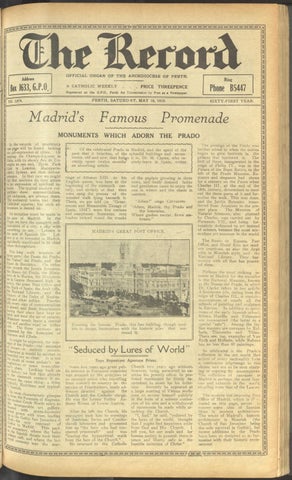
M ADRID'S GREAT POST OFFICE.
The prestige of the Prado was further added to when the nobles began to give festivals in the palaces that bordered it. The first of these, inaugurated in the reign of Philip IV., was in the Palace of the Buen Retiro, to the left of the Prado Museum. Romance and elegance had shone for a century on the Paseo when Charles III., at the end of the 18th. ceutury, determined to level out the three parts of it and formalise the walk. This was done. and the Jardin Botanico transferred from .Aranjuez to the present place. The Museum ot Natural Sciences, also planned by Charles. was carried out by Fernando VIT., and being fortunately dedicated to art instead of science, became the most miraculous art museum in the world. The Banco de Espana, Post Office. and Hotel Ritz are modern creations, as also the Arab villa in Moorish style, and the Natirmal Library. They har monise with all that has preceded them.
Fronting the famous Prado. this fine building, though modcrn in design. harmonises with the historic piles that surround it.
" Seduced by Lures of World" Says Repentant Apostate Priest. Some five years ago great pub- Church two years ago without, lic interest in European countries however, being permitted to exwas aroused by the activities of ercise his priestly office. In proan apostate priest who, travelling found repentance he firmly defrom country to country in the termined to. atone for his defecRecently he appeared at service of Freethinkers, made ad- tion. against . the a large meeting of Vienna _workdresses directed Church and. the Catholic clergy. men to accuse himself publicly He was the former Father An- in the form of a solemn confession of his sins and a withdrawal thony Krenn. of Lower Austria. of statements he made while atA fter he left the Church, his tacking the Church. "I, fool," he said. "seduced by managers took him to meetings of Austrian. Swiss and Czecho- the lures of the world, thought slavak labourers and presented that I might find happiness aside him as "the hero who had con- from God and His Church. I was tell you, for our souls and for and quered priestcraft" "tearing the hypocritical mask human society in general. there is. peace and liberty only in the. from the face of the Church." He returned to the Catholic humble imitation of Christ."
Perhaps the most - striking interest in Madrid for the travel:er is the National Museum, known as the Museo del Prado, to whir!' Dr. Clarke refers in her article. A handsome pile. dating from the reign of Charles III., it contain masterpieces of nearly all the schools of painting and sculpture in Europe. In addition to specimens of the early Spanish schok-- :, Ribera, Murillo and Velasgnez are represented (the latter in a pecial "sala"). Among the Italian masters are canvases by Raffaele. Tintoretto and Titian. There are, too, examples of Van Eyck and Holbein, while Rubens has no less than 60 paintings.
s ts
So celebrated is the Prado's 'collection in the .art world thm artists of every nationality f:)rm .a continuous pilgrimage to this shrine, and are to be seen studying or copying its masterpieces. 'The collection of canvases in Madrid is perhaps the most lamand valuable in the world. ;rivalling even that of the Lau if e. The modern but imposing Po.-4 'Office of Madrid. which is il' .,trated on this page, serves 1-.3 'convey some idea of Spartisn ideas in modern architecture. 'The whole of Madrid's historic (the -architecture is Moorish Church of San Jeronimo being the sole survival in Gothic), but recent additions to the Prado have been so designed a, to liar-monise with their historic environment. -•0
4