Thiglatter --410110-1.N411.-41111.--411411.-410
Address
Box 1633, G.P.O. NO. 2,873.
441.-.11411.-4111P-14110-41.411.-41041.
OFFICIAL ORGAN OF THE ARCHDIOCESE OF PERTH. A CATHOLIC WEEKLY
.
. PRICE
Ring
Phone B5447
THREEPENCE
Registered at the G.P.O., Perth for Transmission by Post as a Newspaper.
PERTH, SATURDAY, MAY 11, 1935.
SIXTY-FIRST YEAR.
THE GLORY THAT WAS SPAIN Historic Associntions of the Escorial Dr. Clarke writes: book, - Joineoue publisned a aensauons 01 ioiedo, but to me me panisn city tails short ot To be seniatoe sensational. tional—to impart sensatitni-4 place must be absolutely authentic, and Toledo is Moorish and built by the Moors. its artist is a Greek. Everything is exotic in the ancient capital. must appeal to one as beiag petpetually decked out in bor ;wed plumes. But the "Escorial" is an original creation—even to its architecture, which is the least part of it, The Escorial is the idea of Philip II., it breathes him, and it breathes the sombre Spanish genius that inspired him.
Monasterio Real del Escorial! It rises high from its deep garden, against the changing panorama on the mountains. Its severe grey stone is chiselled into t id he severest of facades, the order scarcely emerging at all from the pilasters of one side, only defining itself into a severe Doric at the entrance to the Church, and, we presume, on the Royal side facing the garden, which we may not enter. Doric columns are lopped by a sweet Ionic at the entrance to the "Court of the Kings," where Hezekiah, and David, Solomon, Manasseh, preparers of the holy tryst. New Law in the Old,
nlYself wood to burnwould bring the my own son if ht, were as perverse as you." That saYing of Philip as he dragged II. to De Seso, 1;1 s himself to thz: ft take, must echo in the minds of all who think of him. In th(choir of the Church we see tlic simple chantingseat where the King sat, the hours sometimes with the monks. How deep Wah his conviction ! It enabled him to face Europe alone for the Ca ‘tholic idea. M, other and He believed in the ,19r ,thein he Child, in the CrosF, ,X enaissance stood out against a Europe, bent on 0;,ticculent fruits of this world. w as the soul of the Coun t'lof Trent. narrow In his simple bed room, with openinit! onto gazingthe Church, Philip IT. died on the high Crypt h, , altar. The ouilt to receive th,! of'Ilthe es of the S • pantsh kings wai , itof it thePlainest: Philip IV. made . now is.thing of gold and marble A horror the flesh the temptations of hell see and a healthy fear of Cathor tri• to be the basis of his lelsrn- Such a disposition
At the commencement of the current academic year, Dr. Margaret Clarke, M.A., D.U.P., returned to the University to resume her duties as Lecturer-in-Charge of the Departments of French and German. Dr. Clarke had been abroad on study leave, which she spent, for the most part, in Spain. In view of the recent political disturbances in Spain, and of the rise of certain atheOic elements in her Government, the following observations by Dr. Clarke will be of interest, recalling as they do Spain's past grandeur, her intense Catholicity, and the culture which the Church endowed upon Spain, as indeed upon all Europe. of mind seems indicated in Ins liking for the Flemish artist, Boscn's works—The Temptations of Saint Anthony and the Seven Deadly Sins. It was .he who bought these series for the Escorial. The consciousness that Catholicism means renunciation of this world sets the seal of melancholy on Spain from the Renaissance on. Hence the "black legend," the complacency in spectacles of cruelty and death, the steady contemplation of corruption by a 'people essentially gay. What a contrast between the Escorial and ale dainty artistic "Casita del Principe"—dauphin's cottage, built by the Neapolitan Charles I. a few yards away for his son. Its reproduction of Pompeian elegance is almost a spoken comment on the monkishness of Phili5 II.'s erection. Philip II. was also open to the suggestions of mysticism—he is the protector of the great Carmelite reformer of his reign, and at his death brought her manuscripts to the library of the Es-
to a fast materialistic-growing and pleasure-loving Europe, the Escorial stands out, symbol of Spain's tability and deep sense of God.
curial. Greek manuscripts )vhich he could not buy in the original he had copied. So peculiar a genius was a solitary man. He loved nature, and as one travels up from Madrid and conies into the lambent tire and gold of the Guadarrama, one understands why he catne here. An autograph note to his secretary, still to be seen in his apartments, excuses a slight delay in regard to some business on account of a "turn in the country." He would have himself carried four leagues, in spite of illness and suffering, to see a view that had been recommended to him. There is still to be seen in his rooms the chair in which he was carried—illness making driving impossible—for five days from Madrid. to die in his monastery. The "silla del Rey," or stone steps carried out in the rock on which he sat to watch the building of his dream, is miles from the site, and though commanding a clear view requires three-quarters of an hour's hard walking
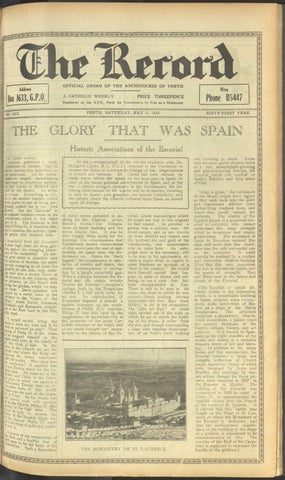
Tlll MONASTERY OF ST. LAURENCE
; From and climbing to reach. t t hat distance, glove thrown down
"Allah is great," the successors of the Moors might have sigbed as they sank back into the quiet and remoteness whither their Father-King confined them, and where they would remain for The vitality of the centuries. Spanish people is a perpetual surprise to outsiders, who cannot understand this deep strength allied to despotism and unproThe resistance of gressiveness. Spain to Napoleon amazed Europe, still more that this resistance was the only successful one It could on the continent. scarcely be realised by a restless and somewhat shallow-thinking \Vest that this very despotism and rest in the eternal values was East the source of strength. and West meet in the domes and clouds of the Escorial. ( The Escorial, of which Dr. Clarke writes in her interesting article, is a remarkable building in Spain, situated some twentyseven milts north-west of Madrid, on a slope of the Sierra structure The Guadarrama. c omprises a monastery, church, royal Mausoleum, a palace (once the summer residence of the Court), college, library, and art galleries. It is known to Spaniards as the eight wonders of the world. and indeed is a veritable treasure trove of art and learning. In addition to its many hooks and fine manuscripts, the Escorial contains a large and valuable collection of Church music. tapestries (many of which were designed by Goya and Maella), and paintings by famous artists, though the finest pictures were removed in 1837 to the Museum in Madrid. The building of the Escorial was -commenced in 1563 by order of Philip II., to commemorate the 'Spanish victory oN- er the French :at the battle of St. Quentin. It - is curiotis that this battle was fought on the Feast of St. LauTence ,to whom the Monastery of the Escorial is dedicated, and that the architectural resemblance of the building to the shape ,of a gridiron is considered to be The commemorative of this. corridor of the Hall of the Caryatides is supposed to represent the handle of the gridiron.)
peo-4100.-.4.-4110.
$
411140. .04P. .411410-111