Thr e'Rtn,r7 OFFICIAL ORGAN OF THE ARCHDIOCESE OF PERTH.
Address
Box 1633, G.P.O.
A CATHOLIC WEEKLY
•
Phone B5447
. PRICE THREEPENCE
R egistered at the G.P.O., Perth for Transmission by Past as a Newspaper.
PERTH, SATURDAY, FEBRUARY. 16, 1935.
NO. 2,861.
Ring
SIXTY-FIRST YEAR.
(5-he Splendour of caw Orient Father Gavan Duffy Lectures at Century Club
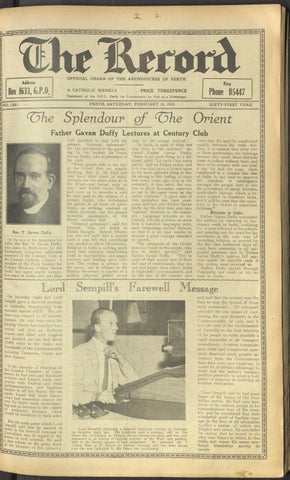
Rev. T. Gavan Duffy. On the eve of his departure for India, the Rev. T. Gavan Duffy, who came to Melbourne for the Eucharistic Congress, addressed m embers of the Century Club at the Central Catholic Library. A member of the Paris Society for Foreign Missions. Father Gavan Duffy has spent nearly twentyfive years in India. and was thus
yell qualified to deal with his subject, "Oriental Splendour." He was introduced to the gathering by his brother, Sir Frank Gavan Duffy, who is president of the club. " When people talk of the lure of the Orient they are usually thinking that in the East one may have three times as many servants for the same price as in the West—and better ones at that," said Father Gavan Duffy, and went on to describe a visit he once paid to the palaces of a certain Rajah, who introduced his guests to all kinds of splendours, in striking contrast to which, however, was the almost monastic appearance of the Hindu audience hall. "Oriental splendour," said the lecturer, "does not reside in Hindu thought. Indeed, Hinduism was not built into a system until it was felt that something was needed to offset Christianity. Religion in India is nothing much more than animism, manifesting itself in superstitions and pagan customs and feeding upon folklore. The Indian is always 'on the move,' and in villages in the Madras Residency a quarter of a million pilgrims gather every
year for the annual festival." "In India, in spite of what one may hear to • the contrary," dedared Father Gavan Duffy, "there is no such thing as a national spirit. 'La caste c'est notre patrie,' said an Indian priest, and it is true that caste is looked upon as the most splendid thing in life. So strong is this feeling of caste that many years ago, even in the seminary, it was never the custom to allow European superiors to eat in the same room as the native students." A good deal of this prejudice has been overcome, and last year Father Gavan Duffy for the first time sent two "outcast" students to the seminary. Language presents an extremely difficult problem, as more than a hundred languages exist, each comprising several dialects, so that it is no easy matter to acquire a good average standard of speech. "The splendour of the Orient does not reside in the people, who live in abject poverty." said Father Gavan Duffy. "Yet, in spite of their misery and of their sad cast of countenance, they are not less happy than others. India is frightfully over-populated, and as the law of the country pro-
vides that the land be subdivided equally between the male children, it is natural that after two or three generations the holdings become very small. Most children come to school without food, and have to be content with one meal a day for half the year. Such conditiong in a climate like that of India do not tend to improve the standard of intelligence amongst the people. Add to this the prevalence of many diseases, particularly leprosy, which is beyond control in Southern India, and it will be seen that the splendour of the Orient is somewhat fictitious."
Missions in India. Father Gavan Duffy concluded his address by referring to missionary work in India, outlining the system followed in the schools and pointing out the need for lay auxiliaries as the only way of spreading religion; as proved by the fact that cathecists have always been numerous in all successful missions, and in Father Gavan Duffy's opinion full success would be - possible only if this system were reverted to. Father DufTy passed through Fremantle last week on his return to India.
Lord On Saturday night last Lord Sempill gave a farewell message to Australia, broadcasting from national station 6WF. His address was relayed to all national s tations. He said that since his landing wheels had touched Australian soil first ., at Bathurst Island—still filled with English and Scottish air—he had flown 15,000 miles in the States and T erritories of the Commonwealth including Tasmania. Papua and New Guinea.
and said that the present was the time to reap the reward of those early endeavours. Air transport provided the one means of overcoming the vast distances in the Commonwealth. he said, and it w as the duty of the Governments o f Australia in the best interests of its people to make possible a rapid expansion of air transport immediately. Aviation companies aero clubs and commercial operators deserved much greater assistance from the Governments than they were now receiving. It would be of definite advantage to trade and the nation's business position generally to adopt a bold policy of progress in fostering all a viation enterprises.
In his capacity of chairman of the London Chamber of Corn' fierce, he had met and discussed aviation and Empire trade reciprocity with Federal and State parliamenta leaders in rians, and business all the States. He sin c erely hoped tha:t these discussions had w ay for somewhat cleared the better trade understanding and an increase in the volume of reciprocal business which w ould be beneficial to both sides. But the Sempill main point which Lord said that he wanted to make in his farewell message to A ustralians was in regard to the future of civil aviation. He paid a fine tribute to the great work of the pioneers of this industrY.
Lord Semphill delivering a farewell broadcast message to Australia His Lordship paid a courtesy call on His on Saturday night last. Grace the Archbishop at Victoria Square during the week, and was very interested in all spheres of Catholic activity in the West, and particularly in the Tardun scheme of land settlement. He attended the 7 o'clock Mass at St. Mary's on Sunday morning and was later shown over the new Cathedral by His Grace the Archbishop.
e.-4po-.00.-IIM.-4WO-11M11.--4N11.--41N11. .
-11N11.
-411411,-.410-....- AMP-
Lord Sempill said he had great hopes of the future of the Australian nation. He had seen hundreds of its outback people in his c omprehensive tour of the country, and he considered that their w onderful spirit of fearless courage in the face of all adversities t ypified a nation of which the Empire was proud. lie concluded by saying that he hoped in the very near future to return to Aus tralia and renew his many newfound friendships among its people.