eReter
OFFICIAL ORGAN OF THE ARCHDIOCESE OF PERTH.
Address
hx 1633, G.P.O. NO.
A CATHOLIC WEEKLY
.
Phone B5447
. PRICE THREE PENCE
Registered at the G.P.O., Perth for Transmission by Post as a Newspaper.
SIXTIETH YEAR.
PERTH, SATURDAY, OCTOBER 20, 1934.
2,844.
Ring
The Catholic Tradition of Wales Wales Can't Break Its Catholic Mould " of Mr. Saunders Lewis, Chairman lecand the Welsh National turer at Swansea University, who was adrecently received_ into the Church, A rchdiocesan dressing the Cardiif 0,Y.M.S., at a rally 1-..a.ently, said: "Wales is a part ,:f Christendom in a itay that is peculia.- in the British Isles. For Wales was Catholic Chtistian even before it -0.- as Welsh. Long before the Welsh had called themsel• ves Cymry, they wer,•! Roman and Of the' tln-ce literatures Christian. I. that exist in the British Isles, Welsh literature alone, though it is as old as English and Irish, p..,ssesses no pagan. , pre•Christian poetry or literary tradi. ,oion. The very shoht pagan element I a Welsh literature. :o the four stories of the 111abinogion, is a borrowing from Irish. . . . "There is no net. miss:onary who 7:lay be said to have brought the aith to \Vales, no St. Patrick, no St. Augustine, no St. Columba, who was he evangelist of Wales. The entire formation of Wales was Christian. Its Christian tradition is its oldest and original tradition: our Christianity, , ,:atholic and Apostolic. was part of our heritage as citi7ens of Rome. "There .never a Welsh paganand we had t- wait till the early 1 1,9th. century tor tllf first appearance f a Welsh .
"Mediaeval Welsh literature is preeminently a Catholic achievement. It is. in fact, almost the only complcte example we have in all Europe of a literature entirely Christian. . . . "A nation's literature and a nation's language contain the national tradition- and the ideals of the nation For most of the modern nations of Europe the classic periods of their lit eraturs are post-Renaissance or pcstReformation. But all Welsh scholars to-day recognise that the Catholic 15th. century is the classic period of It is the syntax Welsh literature. of that century. the prosody of that century, the poetic form§..of that oentur.y, and the literary ideals of that century that are fdr us still the stanWelsh litdards of literary Welsh. erature and Welsh thought are bound to their classical. scholastic. Catholic traditions. . . . For a thousand years Wales was For a thousand years the Catholic. Welsh language was used in daily prayer before the Blessed Sacrament. When our Catholic schools adopt that language and make it their own again, they will be bringing back to its original course one of the oldest Catholic languages of Europe. . . . "That Catholic millennium which ended about 1600 had so tremendous-
ly moulded Welsh habits of thought that even in modern times Welsh literature cannot altogether break its For example, there Catholic. mould. is no tradition of scepticism, of agnosticism, of Deism in Welsh literature Welsh lit. before the 20th. century. erature up to 1914 remains an entirely literaTrinitarian Christian and ture. . . . "On all Welsh history and Welsh culture I see the mark of their Catholic formation. This land of Wales is not a land where Catholics need feel And I make strange and ill-at-ease. only one appeal: it is that the Catholics in Wales. who pray for Wales and its conversion, should help this country to repossess its traditions and should help it to reestablish its language and its family life in the old ways." Mr. Lewis. speaking of the .associa. tions between Wales and Belgium, from which he had just returned. said: "Belgium is one of tilt most devoutly Catholic countries in Europe Now let me supand in the world. pose that you, my fellow -Catholics in this meeting to-night, who are mostly,'I presume, of Irish origin, and very many of whose parents came to South Wales from Ireland during the
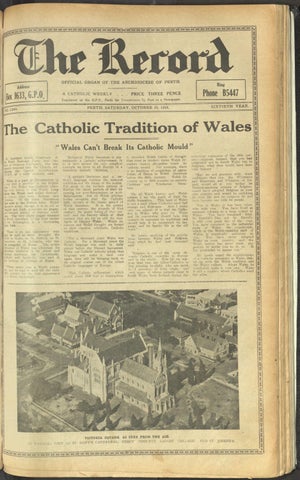
VICTORIA SQUARE, AS SEEN FROM THE AIR. AL, MERCY CONV ENT. LADIES' V IEW OF ST. MAR V'S CATHEDR I
indwArial expansion of the 19th. century- suppose, instead, that you had emigrated not to South Wales but to Belgium, what then would have been your history "May we not presume with some confidence that you, the O'Connors and Donovans and O'Learys, of Ireland, would all of you to-day be F lemish-speaking citizens of Belgium, would have adopted Belgium as your own country and would be enriching its civic life and its religious lfe and have become one with its people. "But in Wales it has been otherYou have lived as wise with you. separate colonies to a large extent in You have remained Irish Wales. St. Patrick's Day. not St. David's, is still your great day of the Year. You have remained in the industrial parts of Wales: the countryside, which is the Welsh-speaking part of Wales, is practically unknown to You have never adopted you. Wales as your country, and the Welsh nation has never made any It gesture to invite you to do St). has pretended to ignore you." Mr. Lewis urged the establishment of a Catholic peasantry in Wales. linked up with the Welsh tradition and Adopt Wales. he the Welsh culture. Wales concluded, make it Your own. is not a country where Catholics need fee! alien.
COLLEGE.
AND ST. JOSEPH'S.