h•-
Address
ox 1633, G.P.O.
ie tt'er
OFFICIAL ORGAN OF THE ARCHDIOCESE OF PERTH. A CATHOLIC WEEKLY
PRICE THREE PENCE
,
R egistered at the G.P.O., Perth for Transmission by Post as a Newspaper.
NO. 2,837.
PERTH, SATURDAY, SEPTEMBER 1, 1934.
et
Ring
Phone B5447 SIXTIETH YEAR.
Buenos AirezimenCatholic as Rome V enue of Coming Eucharistic Congress
There is a celebrate,.i Shrine of the in Spat' : .-All.;4 Santa -,essed Virgin Buenos Aire even to. . :aria de Ro..1: and E;v, sailors who the Mediterranean Iv the waters of And id it in the greatest favotic. 7.1rr centuries ago it inspired the old ,panish explorer, Pedi- f-le Mendoza, confer upon the i: :":tidt foundation :f La Plata the striki:1;.; title, "Puerto Santa Maria de i-:u,:.nos Aires." 1"This, in brief, is ho,,- ti-:e Argentine • -esent name. . pital came by it:, nd it is a tribute to 7'.oanish faith 11 spite of all that ha.. been written .,at can. bet• vilify a great ract , :I illustrate the nobilit :.. of mind that .-.aracterised those daric.g voyages of of the inE!scovery than the tructions issued to S:• -iniento—a con' ,inporary of Mendoza in this area of "For the honour .)uth America? rIci glory of God, and of the Virgin :Iary, His Mother and Our Lady, •.vhom you, Captain Pedro Sarmiento, a to take for Advocat. and Patron E the ships and cre.. v under your :7ders for this discov,-! :: and enterprise" Those lines from M.-fr::harn•s "Voyage of Sarmiento" incite-Ito surely that -Aind the conquest c: the River :late there was simething nobler can quest ior gold. In the wake of the aid Conquistadores there followed '.oselv Spain's ?reatest gift to Latin Am-erica—the A City Catholic as Rome. it was a fortunate and happy coinidence for Buenos A;rss that Argentina's early life and I 7mings touched the chivalric heart Spain. It is doubtful if any other people could have toiled so and so well in the spiritual faithfully vineyard of the River Plate. And so to-day Buenos Aires is a Latin eitv--Cath olic as Rome. It is a city which affords one of tile most amazing exampler of rapid development in modern times. Since the opening of the century it has been virtually re -built. I many parks and plazas, and 11Pon the simple its street , laid out rectangular plan, are lnagnificent. In the early- eighties of the last numbered onlycentury its population a quarter of a million. To-day this maiden citv of the Southlr Cross numbers sonie two and a II' half million souls. After 50 years she would seem I stately metropolis to have emerged a decked in all the sPlendour of now ranks cosmopolitan attire. She the great sixth in mo,:znitude among cities of the world. The P...an and general panorama arc as a The beauty and elegant de In of the public buildings , that is best in the artisticexhibit all temperart)ellt of the Latin peoples. anhat the To state re is confined to specialarchitectu artistic type would be untrue. And beauty runs through all. 111ania of the sky -scraper '.!cilecl has her not as vet. Those hidestructures that -shut off the light , flaY are happily absent, and the ,thern sun can send his beams un..,,!eted upon a glorious Plaza de 0. Here are situated the Bartbuilding l of ten storevs—perhaps, ura lest edifice in the city—the Law • ts• lral Congress Hall, and the Ca,n c, latter building —destined to wolarge in the annals of October— ' tilY of special mention. In rnerica it Cathedral, i a good second to which. in turn, is t O be second only to that of f C' —t'ne most 0 !I he worship in the magnificent . whole WestTrItsPh acity of ere It has a seating :)teriOr cn_ ,uou. h 1° There are twelve s„....,...pet s. In one of these is
the tomb of the great Liberator—Jose San Martin. Because of its twelve Corinthian columns the Cathedral has often been compared with La Madeleine in Paris. A frieze upon the noble Greek facade represents Joseph and his brethren. There are large and elegant marbles, and in the central nave mural paintings of interest. Venerable Churches. San Ignacio de Loyola is an old church, dating from 1722. San Francisco. in charge of the Franciscan Order, has two paintings ascribed to Michelangelo. 'La Merced—Our Lady of Mercy—dates froir 1604. Santo Domingo shows marks made by English bullets—a fact not always mentioned by English writers. Within may be seen four flags taken from Whitelocke's predatory forces in 1806! Santa Cruz. built by the Passionists, whose monastery it adjoins, is a noble specimen of the modern Gothic in granite, and for the Irish colony that looms so large in the religious life of Buenos Aires Holy C ross is the great centre of devotion —a worthy monument to Irish piety A Cultured People. If in an alien land old residents learn little, the hasty visitor is at a much greater disadvantage. And this is especially true, perhaps, of Argentina and her capital. For Buenos Aires is a Spanish city. And that touch of Orientalism, ever common to Spain, is not altogether absent in tile Spain beyond the Atlantic. It makes for seclusion in family life. 1 41. 110.
41 ,10.•
• • •
•
• .. . . . . . . . . . . •
No doubt it will be argued that post-war conditions have broken down barriers in many lands. It has almost reached the mark of "good form" with certain English authors to speak about Latin-American civilisation as fast crumbling to pieces in face cif religious indifferentism. Indifferentism there is, was, and always will be in most countries. Recent statistics show that fifty per cent. of the people of the United States never enter church on Sunday. So-called humanitarianism, whether of English or Anglo-American complexion, is a poor substitute for the, worship of God. And the worship of God is still very prevalent in the life of Buenos Aires, Santiago, and Lima. The eminent Canadian scholar and critic. Dr. Thomas O'Hagan, writing anent this subject, says "The name and title of wife is still a hallowed one in Buenos Aires, entirely free from scandal in either the Press or the courts." N,Votild this striking fact be in any measure due to the conten: tion that the family continues to fill a much larger space in the life of the individual in Latin countries than is the case in many other lands? Let the critics of the "holier-than-thou" t ype supply the answer. A Wcman Pacificator. In the eventful pages of the past fifty years. Buenos Aires has reflected many dreams of statesmen, of warriors. and of scholars. But the most sublime and exalted conception of all that thrilling period can be credited to the women. • • • • I • to • r • • 11 • • ti • it • T1 • t • 1. •
1•1. 4,1•1,1.•
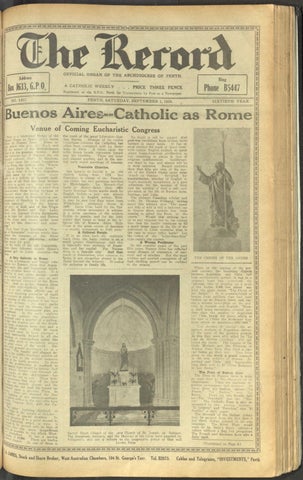
Sacred Heart Chapel of the new Church of St. Joseph, at Subiaco. The brassware, statuary, and the Stations of the Cross were supplied by Pellegrinfs, and are a tribute to the progressive policy of that well known Firm. 411N11.- -41.411,-411411. -411.11.- AHD- -41N110-
ki JAMES, Stock and Share Broker, West Australian Chambers, 104 St, George's Terr. Tel. B2873.
st TIIE CHRIST OF THE ANDES. When, at the opening of the present century, the boundary • dispute between Argentina and Chile had been satisfactorily settled. it was in a woman's heart was conceived the Christian idea of erecting on a peak of the Andes, 8,400 feet above sealevel, the giant statue, "The Christ of the Andes. ' It is manufactured of bronze from artillery that had been broken up at Buenos Aires, and carries a solemn inscription on the ped estal in Spanish and English: "Sooner shall those mountains crumble into dust than the peoples of Argentina o wl chile break the peace which at the feet of Christ the Redeemer they have sworn to maintain-1902-1904." Los circulos de oberos--the organised workers of Argentina—defray. ed the costs of the glorious project. In this they were ably aided by "La Liga de Madres Catolicas," .who col. lected the funds. The League of Ca. tholic Mothers and the Portenas of Buenos Aires have thus shed a special lustre pn their sex. They have given to the world a grand example of the true nobility of woman. Argentina and Chile still honourably keep their vow to El Cristo Redentor de • -Los Andes." The Press of Buenos Aires. The Press in Buenos Aires is truly an open door .to the character of itc inhabitants. There are eighteen Argentine newspapers and reviews. Of these, three are- leading dailies—"La Prensa." "La Nacion," awl "La Razon." There are two British dail-ies—The "Standard" and the `I-Jerald." The Catholic Press is ably represented by two leading reviews— "El Criterio" and "Estudios," also "El Pueblo," a daily paper. The strength of the Italian colony may be gauged from the fact that it has three dailies printed in its own language. The River Plate would seem to be Italy's finest colony—a colony without a flag, but prosperous The French and Germans have also a daily each. (Continued on Page 4.) 4
Cables and Telegrams, "INVESTMENTS," Perth