- 0-0010---01 00 0100-00-10-04,00-00-10.-14.-00-040-00-00-0100-40-04. 00-10-10-00-04.-040-000.00.0-00-01-1110.140-011
0.40-1010-00-10 4110
$4,
A CATHOLIC WEEKLY CIRCTTLATING THROUGHOUT THE STATE OF WESTERN AUSTRALIA PRICE THREEPENCE ESTABLISHED 1874. Registered at the G.P.O., Perth, for Transmission by Post as a Newspaper.
Vol. LX
PERTH, SATURDAY, MARCH 10, 1934
No. 2,812
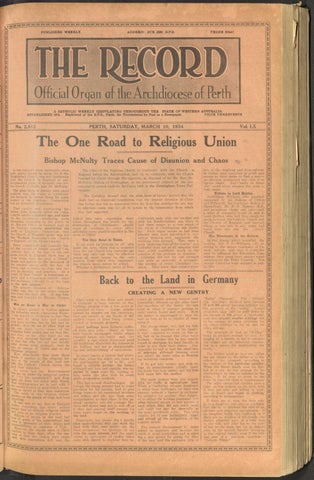
The One Road to Religious Union Bishop McNulty Traces Cause of Disunion and Chaos
It was IIAL: i :"., --even iievitable—that such claims shooid be made, for if the Established Ch',:r. .':1 was not continuous with the Chu: ,. ' , in England in preRefprmation time,. it certainly was not the church , f ..' lo•ist, said Dr. McNulty. The plain fa.i: s of history were proof positive that 1: - claim to continuity put forward in reeent times by some leaders in the Anglican Communion had no historienl Foundation. That card :. - n(-1 truth-loving historian. John Lo - e.,:-(1, called the elaiin a myth nearly 1 seroury ago. and since his day doetioo ots numbering some thousands. aeee -ii,le to the public in thc Record Otece in London and at the Vatican Library, established the truth of Lingaid's contention that the Ohurch of England to-day was not the "Ecclesia Anglicana"---the Church in England---of the Great Charter. Fairly ennsidr.7cri and squarely faced, the record of events proved conclusively that a! the time of the religious revolt in i•:ngland there was a Clean break with the past. a "break" shown not mereiv in the severance of the ancient uni. n with the See of R ome, but a break as clean and certain in doctrine and practice. As a result of that "break" a brand-new religion and a brie/it-new church came into existence. referred to at ths time• as the new religion.' The present disunion of Christiai. S bodies was due to fmie cause---separas tion from the Hob.- See. Tt was fore' t seen and foretold by Blessed Thomas I More. War on Rome is War on Christ. } In Ninrc . , 1,1 e r to Luther appear ,........k ' the following words concerning Rome: Iam movcd e, „bedience to that See. --p not only by what holy and learned men have written. but by this fact es• t Pecially, that we see so often that 1 on t the one hand. every enemy of the Christian faith makes war on that See, I t and that on the other hand ,no one t has ever declared himself an I enemy 1 of that See who has not also shortly after shown most evidently that he I was an enemy of Christ and of the 1 Christian religion." ' How abundantly true were those Words if •applied to the religious history of the people of this land outside the Catholic Church during the PLst four centuries. No sooner had the Establishment he, T) set up under the temporal author, ("hy law land Cut from established"). and Engher union with Rome, that disintegra tion set in, and with i'„ 0 i$ the multiplication of sects which to-da‘ t l'e_re as varied as they were numerous. The result of this religions disintegration on appalling. the People at large had been It was safe to say that in England t"ay something like thirty million People had no definite religious beliefs aril dtiiI1iitotlnes or of no religious practice. people in this land had lost all grasp of the supernatural and Irl.e-ere in ignorance of their duties and sPonsihilitie.s as creatures of Goathe chaotic state of ChristenMoreover, miedsomof ir , these days, when the eneand, W1th . od wer closing their ranks 1.,,... .... marvellous skill and diaa
S 1
1
1
! S
I 1
1
1 '
s
----------
The Cairn of the Anglican Church to continuity with the Church in England before the Reformation, and, so, to continuity with the Church founded by Christ through His Apostles, as disposed of by Rt. Rev. Dr. McNulty. Bishop, of Nottingham, in his presidential address at the seventy-eighth annual Catholic Re-Union held in the Birmingham Town Hall recently. His Lordship showed that the plain,facts of history proved that the claim had no historical foundation, that the present disunion of Christian bodies was due to separation fro'm the Holy See. andthat the only way to effective union was for all to re turn to the communion from which they had separated. conformist sects with one another and with the Establishment was likely to lead them nearer to a true union of the whole of Christendom was doubtful. Such vague unions as had been 'effected were more calculated to stereotype disunion and emphasise the The Only Road to Union. They were a divisions that existed. If, as must be obvious to all who mere "papering over of the cracks." and knew the facts, there was a secession Catholics were not at all sanguine that from the old Church four centuries ago they could contribute much to the there was only one way to effective solution of the problem of disunion. Catholics did not for one moment union—all must return to the sorro mullion from which they separated: cast aside as unworthy of sympathy the anxiety of other Christians tor the truants .must return to school. Whether a preliminary union of Non- union. They knew that earnest mem-
bolical hate were organising their f orces throughout the world for the destruction of Christianity. should move all s liristians to every effort and make every possible sacrifice in the cause of Christ.
the Anglican and Noneonformist bodies were exercised in mind and sincere in their desire to find a way-an effective, permanent way—out of religious chaos. But -"unity in diversity" could never advance the : se true union. Tribute to Lord Halifax, Archbishop Williams, who presided, supported by the Bishops of Clifton and Plymouth, the Coadjutor Bishop of Shrewsbury. Mr. P. P. Hanney, M.P., and prominent clergy and laity—said a letter of sympathy would be sent to Lord Halifax, who had done much for union between the Catholic Church and the Church of England, and through whom, it was safe to say, many had found their way into the atholic Church. The Treatment of the Schcols. A t the dinner which preceded ths meeting. Aid. T. 0. Williams, j.P., referring to the unjust treatment of Catholic schools, said that if Catholics were to influence the Education Committees, they must have greater representation on the Town Councils. Not enough Catholics were engaged in public life.
btr, ,,f
Back to the Land in Germany CREATING A NEW GENTRY comes at certain seasons ruinous and impossible: whereas on the other hand the members of the family an not mind in times of urgency putting in Now daily twelve hours and more. t he father is encouraged to keep his land as long as he is capable of managing it. The voting owner. too, had his diffiThe members of his family. culties. if they consented to work for him at all, had to be treated like other hired workers. Besides this he was usually forced to mortgage his land heavily, in order to pay them their shares. Consequently he had to bear the usual rate of interests, although farming could In many places, a custom had grown not afford the same rates .as flourishup that, when the eldest son came to ing industrial concerns. the marriageable age (24 to 301, and and took refound a suitable partner, the father,- If he got into arrears(chiefly Jews) although still hale and capable, was ex- fuge in moneylenders freepected to hand over the holding to his doom was soon sealed, and the him, under the plea that he could hold came into the market. apply progressive methods. The same usurers were also responThis had several disadvantages. Al- sible for traffic in agricultural land. Gough the young peasant had to make When a freeholder became bankrupt. provision for his parents, had to give or when these traffickers, for their own living rooms to his unmarried brothers interest, induced a farmer to exchange and sisters, and also pay them some his property for another, they delightcompensation as their share in the pa- ed in selling the holding piecemeal. Pld ternal property, yet the younger bro- often induced people to buy parcels of thers and sisters were not so well off as land which they did not really need. if they had assisted their parents for and could not pay for, especially at some years longer in the working of the usual exorbitant price.. This trick usually led to new bankruptcy caser, the land. indignation of the E xperience has shown tha t middle and stirred up the people. class agriculturists. who can work the c ountry land with their own family are the The present Government is determoct prosperous: for hirelings do not mined to maintain and increase the take the same interest, and the appli- stock of small freeholders and is creatcation to agriculture of trsiles union ing a new gentry by giving the tiller rules with regard to working time be- of his own land the exclusive title ot T here exist in the West and South of Germane a large number of free holdings, ranging from a few acres to Large estates a hundred or more. farmed by tenants are the exception, they are usually in the hands of the nobility. many of them being formei Church or monastic property. Small holdings have hitherto sufferMany of them ed from two evils. were heavily mortgaged. whilst others changed hands too easily and frequently, a fast which destroyed good old traditions. diminishd the interest in the holding, and led to commercialising and industrialising of agriculture.
"Baiter" (Peasant The - Ehbhol" ( i.e.. hereditary freehold land between 17 and 300 acres) becomes entai!ed e.. 1,ar.;e:t he property of the family. ;,roperties may still be sold down to t he margin of 300 acres: a freeh,.)1der may also acquire smaller holdings out of his savings to make provision tor his other children or for his and his wifc's old age. The principle is that an "Erbhol." `being at present worked by. and b.-longing to a family, is not a commercial object nor an industrial concern but is a means for maintaining the f amily. The Erbhof must go to a son, either the one chosen by the father or to the eldest or the youngest, according to the custom of the particular country. When the Bauer hands over his Erbhof to a son. he can arrange for his maintenance in case he remains in the place. If he goes to settle in the t own. he loses his right to maintenance The other unmarried children have a claim on free lodging on the farm, and, if they are able and willing to work, also on board and wages. Cr clothing, according to arrangement. If there are no sons, the farm may go to a daughter, but only on condition that she is, or becomes the wife of an efficient and practical agriculturist. If no daughter fulfils this condition, or it there are no children in the family, the landed property goes. as a rule, first to the wife, and after her to the next of kin in the male line (or in default even to the nearest fernalel belonging to the original family, even if the wife had sons of a previous marriage.-"Catholic Times.'•
.... ..--.00- .00 00. -41.-00 00. 10. 00-00- -410. 00 04*.* 4.10 4* 4.0 -00- 04. 00-00-04. 0* -00 4*. 4* 10 -04.0100 00 4.4. 0011410 00 10
0 0*
4* 00 04.
04. 04. 04. -04.-4