•
ADDRESS: BOX J633. G.P.O.
PUBLISHED WEEKLY.
1
PHONE B6447
N Organ of ik Archdiocese of Perth I
AUSTRALIA. A CATHOLIC WEEKLY CIRCULATING THROUGHOUT THE STATE OF WESTERN PRICE THREEPENCE Newspaper. a as Post by for Transmission Perth, G.P.O., the at Registered 1874. ICSTABLISHED
Vol. LX
PERTH, SATURDAY, JANUARY 13, 1934
No. 2,804
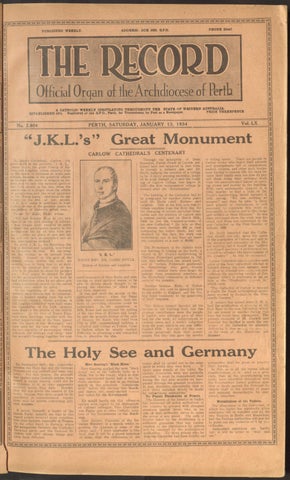
Great Monument CARLOW Cathedral, Carlow, the g wc,rk of the patriotic "J. K. L.,' ')(..yle, the great Bishop of Ku ' tit, u. . ci Leighlin, whose memory live in the hearts of Irishmen at home and 611 abroad, because of his powerful efforts ase the pulse of religion in Iretu raise the national spirit or h people in his day, when the 'as in a stupor from the effects cut-ion and the cruel incidence Penal Laws," celebrated its cenon the 3rd. of last month. . L.'s" name is enshrined in Irish :y as one of the greatest names in :!..allery of Ireland's gifted sons. '.her W. Miller, Ph.D., writes: "We had Solemn Mass in our new church on the first Sunday of Advent. w as (thank God) enabled to assist ereat and participated largely in the Hfaction felt by all who were pre. After six years of care and toil v. our task accomplished and all pations realised." J. K. L., the illustrious 13isre and Leighlin, to a friend on 10, 1833. We can imagine his rigs as he penned these w ords. ....eady in the grip of the disease which, within the next six months, W S to bring him to an early ) 11 grave, he thanked God that he was ii able to be present to share his people's joy. Weil might he himself be glad on the aecomplishment of the task he had uit;lertaken when he set about pros•iding a. cathedral church for the united di re ovss which he ruled. A t the beginning of the sixteenth century. each diocese had its cathedral; that of Kildare dating from the early thirteenth century, whilst portions of Old Leighlin Cathedral were built when the boundaries, of the Irish dioceses were fixed in the middle of the twelfth century. in the time of Queen Elizabeth these buildings. together with the other temporalities of the Sees, passed into the hands of the "Reformers" and were used for the new rites. During the two centuries of persecution, which f ollowed, the Bishops and clergy were too occupi&I keeping together the scat-
CATHEDRAL'S CENTENARY of willing hands. There are people in Carlow to-day who heard their parents and grandparents tell of shoemakers, nailers, coopers, and other such tradesmen having to remain idle for days because their hands were too sore to permit them doing their ordinary work from the unaccustomed labour of carrying stones and mortar to the building. With such enthusiastic support it is little wonder to find a note in Dr. The building of the Cathedral had to Doyle's handwriting, dated January 2, be postponed for another thirty years 1831. saying: "We owe nothing at until Dr. Doyle ruled Kildare and present." and then he adds "a thouLeighlin. One of his first acts was to sand pounds or thereabouts is still obtain sanction from the Holy See for necessary to complete this work so the changing of certain parochial bounhonourable to religion and to the clergy daries and the erection of Carlow into and faithful of these Dioceses." In less a mensal parish, and on March 18th., than two years more the work was fin1828, he laid the foundation-stone of ished, and Mass was celebrated in the his new Cathedral. 's He tells us that new Cathedral on the First Sunday of his means were limited, £60 in cash Advent, 1833. composing his entire funds, but not Dr. Doyle intended that the Cathedaunted by this fact, the work was dral should not only serve the needs undertaken, and in less than six years of the population of Carlow and add to w as completed at a cost of £9,000. the decency' and solemnity of the Divine worship.; but it should also "exhibit The Protestants of the district were s tyle and specimen of architecture calnot wanting in helping on the work; a .•17ated to advance the improvement of record in Dr. Doyle's handwriting of the country." In this he succeeded. "thirteen Protestant gentlemen in Tallow, who subscribed one pound each," Carlow Cathedral cannot compare with and of "certain Protestant gentlemen ;-onie of -the later cathedrals erected in in Goresbridge who gave twenty Ireland during the last century, such out nevpounds:" besides there were larger dotiv.se at Armagh anti nations from prominent members oi ertheless the approving verdict of conthe Protestant community in different tinental critics is expressed in an artie," parts of the country. ticle in the "Bioghaphie which says: Tullow Brother Serenus Kelly, of "The Cathedral of Carlow is beyond Monastery, was sent to appeal for help a doubt the finest ecclesiastical monut o the public in England. and the BisY:e. ment erected in Irelan ' hop bears testimony to the generosity teenth Century." of their response. A century has passed since J. K. L. The Bishop himself devoted all his had the satisfaction of assis.t.ng at. the income to the building fund, but the first Mass in his new Cathedral. which greatest contributors were the people , for one reason or another during that time has never beet, consecrated. The of Carlow. who willingly gave all they had for .the work, by subscriptions at present successor of SS. Conleth and various times and a weekly collection Lazerian has decided to mark the centenary of the Cathedral by solemnly from the poor, which in one year (1831) Itt;.. 1 (!educating it, thus Se reailsed £316. Not only did they conon the work of his illustrious pre. tribute generously from their scanty means, but they also gave the service dece.ssor.
Through the enterprise of Dean Staunton, Parish Priest of Carlow, sufficient land was acquired in that town to furnish a suitable site and Dr. Keefe, judging the erection of a college to be of more pressing necessity, decided to avail himself of it and the building of Carlow College was begun in 1787—the first ecclesiastical college in Ireland after the "Reformation."
Maly 's
K. L.,'' RIGHT REV. DR. JAMES DOYLE, Bishop of Kildare and Leighlin tered remnants of their flocks and ministering to their spiritual wants, to be able to devote much thought to replacing the churches. of which they had been deprived. It was not until the middle of the eighteenth century, when the Penal Code was relaxed somewhat, that the work of providing churches could be In the meantime, in undertaken. 1678, Rome had sanctioned the uniting of the two Sees of Kildare and Leighlin and the seventh Bishop of the united Diocese. Dr. Keefe, who ruled from 1752. to 1787, contemplated building a Cathedral and College at Tullow, County Carlow, where he mostly resided. Difficulty in obtaining a site compelled him to abandon the idea.
The Holy See and Germany On September' 10th., the Concordat between the Holy See and the German Government was ratified and came into lotee. For this reason, the proceedings against some Catholic priests, mentioned in recent reports, could not be a violation of it, as they apparently O ccurred before that date. Besides, t hey did not touch the essence of the t reaty, because they were caused by ill('9fiSidered or misunderstood expresmons used by priests concerning political matters. A priest, formerly a leader of the Centre Party, assured me that in this regard priests received more consideration than laymen, especially in Prussia. On the other hand, in Bavaria, where the antagonism between the (Catholic) B avarian party and the National Socialists was very strong, things may have been different.
treaty shall be carried out in the same spirit in which they were born. . . . If lately some details of the tolder Bavarian) Concordat were not perfectly e xecuted, it must be remembered that during the last nine months we have passed through the greatest revolution. It was, therefore, unavoidable that in such times mistakes should be made by subordinate authorities." To Punish Persecutors of Priests. . The Minister of the Interior in Baden He would hardly use this offensive epithet with regard to his distinguish- has instructed all police authorities of ed Cabinet colleague, Vice Chancellor the country to proceed with sharpest von Papen ,nor to other Catholic mem- measures against those, who, in exbers of the Government or the Reich- cess of their authority, strive to cause the arrest of any priest. The oath of stag. Herr Siebert. President of the Ba- loyalty taken by the Archbishop is a varian Ministry. in a speech, whilst re- sufficient guarantee that any contragretting the mistrust of some of the vention of the stipulations by priests clergy, said: "I must emphasise in this will be censured by the ecclesiastical hour, that it will be a sacred intention authorities. To those priests who beof mine, that the ordinances of the fore the Concordat had been hostile, op-
Herr Goering's "Black Moles." Herr Goering applied the term "black moles" not to the Catholic body as a w hole, but to the Centre, which at that time represented hardly half of the Catholic electors. It was in an election speech in the notorious "Limehouse style" before the election last March, and before the newly-elected Lco,,, had voted for the Government
41.--41040--••-.1140-4/1,--.... 411411.
•••• 401141APO. ipe.-o•-•••-4,4p-Am•-•••--••••-•••-•••-•••-••-.•••-••-•40--0
portunities shall be given to practice their loyalty. In this, as in all the recent official manifestations .it is ated as a principle, that, as the overwhelming majority have identified themselves with the Government. former political speeches or deeds against the National Socialists shall in the interest of peace and national reconciliation be completely forgotten. Watchfulness of the Vatican. The observance of the Concordat, of which the leader has repeatedly given assurance, will he watched over by the two Nuncios in Berlin and Muenchen; and the Vatican authorities will not fail to point out any violation of it by SI.J• ordinates. Antecedent suspicious are hardly fair: it will be better to "wait and see." 4.6.-••••
44- 4•0'-•4-•4•
1