PUBLISHED WEEKLY.
ADDRESS: 3011633. G.P.O.
PHONE B5447
• 1
Official Ottion o.
rchdiocese of Perth
A CATHOLIC WEEKLY CIRCrLATING THROUGHOUT THE STATE OF WESTERN AUSTRALIA. ESTABLISHED 1r4. Registered at the G.P.O., Perth, for Transmission by Post as a Newspaper. PRICE THREEPENCE
No. 2.802
PERTH, SATURDAY, DECEMBER 30, 1933
Vol. LIX.
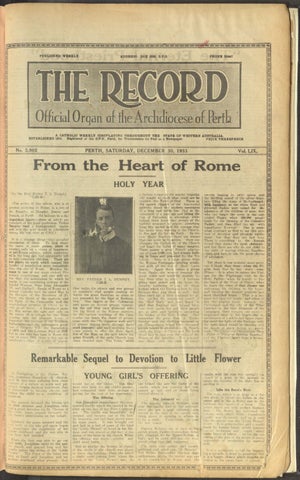
From the Heart of Rome HOLY I lly the Rev. Father T. L. Dunphy. C.SS.R.i (The writer of this article, who is at present studying in Rome, is a son of Mr. Dunphy, of Dunphy, Dwyer and Durack, of Perth. He belongs to a distinguished family—three of which are members of the legal profession. Father Dunphy read a distinguished course and won the gold medal in Literature during his last year at C.B.C.) It is a strange thing—that so-called a ssociation of ideas. To how many the name of some person, place or country calls up a vision of happiness. or perchance sadness, which, experienced in the long ago, had apparently fall. €n into complete oblivion. There are few places on earth which compel this faculty of association more completely than the city of Rome. Mention the name to one of our more violent Protestant countryman, and you will notice that the association to which he r eacts, is one combining notions of the Scarlet Woman, Pope Joan, Alexander VT., and Galileo! Speak of Rome to a devout Catholic and his mind flies to t he thought of the Successor of St. Peter the blood of the martyrs, and the Faith of the Catacombs, and the never -failing promise of Christ to he with us all days! A historian's memory flits across the ages and calls up the vision of a village by the Tiber .. :rowing into the pleasure house A ugustus: the passage of the Northern R arbarians--ancl the subsequent greatness of Gregory VII: the degradation nf 1870 and the Lateran Pact of 1928. Rut to one who has been in Rome this -ear of grace 193.1. there is but one re. !nembrance---that of a city of prayer
REV. FATHER T. L. DUNPHY, One walks the streets and sees groups of sombrely clad people making towards the great Basilicas, as often as not preceded by the Sign of Redemption. One lingers in the Colosseum and gazes on devout groups venerating the soil that once glistened with the life blood of the Roman martyrs. In the narrow winditigs of the Catacombs one hears the chant of processions with the "Te rogamus audi nosof prayer ringing eerily through darkened passages; and each morning there come priests to offer the Holy Sacrifice of the Mass on the spot where the great Pontiffs of the early Church long since chanted their "Pax Vobis." while
YEAR furious tyrant ia the nearby Imperia: city sought to crtsh what could not be crushed—the Faiti of God. There in the square chapels or the low-roofed galleries stand th-! modern successors of a long and noNe line, clad in the vestments of a pas-. age and lifting the Cup of Salvation in adoratioje while behind them kneel tiny groups of the faithful wrapped io prayer, absorbing from this sacred spot the courage that has never been war ting in the Church. to live and die for ,.he Faith. In the four Major Basilica • there are scenes that can never be for gotten. Here one olimpses the Catholi -its: of the Church and hears the babel of many tongues. There passes a grea•. French pilgrim, s ge of some 2.000 men and women walking in fours and preceded by the Tricolour. Here is a irge group from t he Roman Campagni, praying noisi17, and with all the, fire )f their Latin Again there comes a group hearts. from Spain--the worn n wearing the great comb and mant;11a. makino its way from altar to alto o A German group next enters and one hears the weighty rendering of ne of those hymns which the Gerreaos love to sing because they sing them so well. And then one's ear, a little c ofused by all sound of this, catches th- murrm the "Hail Mary- and ooe's heart is glad that England an(' Ireland have --cnt their quota too and their people are so ably and faithfu:ly seconding the wishes of the Holy Fither. One remember the great Mass of Easter tinday and the thrilling moment of t he Consecration when foro thousand people bowed in adoration io St Peter's while the Vicar of Christ arol His Lord stood face to face over the relics of the Prince of the Apostles. Not a sound wae there: onle the clash of naked
swa-'ds leaping to swift salute and the thriaing sound of the silver trumpets filling the dome of Michaelangelo with harmony, as the white Host and glittered chalice were raised for the adoration of the children of men. And who can forget the scene in the sun soaked Piazra. when 300.000 people knelt for the blessing of the Common Father, and then filled the air with tumultuous Evvivas! One is somewhat confused at first to see this mixture of devotion and physical excitement: but that does not last long There is something in the Roman crowd that draws the most obdurate: and few there are who do not yield to the sight of waving ribbons, handkerchiefs and hats to loin the great chorus of adulation. Yet there is one moment more precious. T think, than these: when the Pilgrim feels that he has truly _come Home. It is when he enters the Vatican for the Pilgrimage visit to the Holy Father: when he kneels to kiss the•hand of the Vicar of Christ: when he hears the voice of that chosen one welcoming his children to his hen-. and blessing his dearest projects an most cherished hopes. That is a moment too deep for words: and when at last the pilgrim turns towards his FatI,erland and the city of the Tiber vanishes in the blue distances of the rampagna. there remains one mem. impressed deep in his heart—the remembrance of a white-clad figure stand frig amid Ore halls of the Vatican. with the right hand raised in blessing and th( %olds of grace tailing in gent) tones "Benedicat vos Otnnipotens Den- -Pater et Filius et Spiritus Sancti,? r1 the Pilgrim's heart sings a fers-en,
Remarkable Sequel to Devotion to Little Flower A t Iiordigher.a, in the Italian Riv)era. Josephine Bianchesi di Andrea. 1).:ed 12, had been suffering from rheu11.1atisin of a nature so acute and persistent, despite medical treatment, that it threatened to become chronic and reduce the child to a condition of Paralysis Iler parents invoked the Divine aid ,their distress ,and Josephine, who a great devotion for St. Therese of hild Jesus, prayed fervently for S aint's intercession on her behalf. Suddenly the pains lessened and the body of the title girl- again began e xperience the suppleness of her -lier childhood ,and she was able to f rom bed unaided. W hen she first was able to go out walk, Josephine went to the parchurch and prayed long and fer; •,ntly before the shrine of the "Little ' 1'wer-- The Feast of the Saint was near at hand .and Josephine and her mr, ther wondered what present they
YOUNG GIRL'S OFFERING But they she looked she saw the flame of the would lay at the shrine. were very poor, for the child's parents candle, which was scarcely half eonhad exhausted their little savings in slimed, go out, and an image being formed above it. paying for the cost of her treatment. The Offering. . The Coloured But Josephine remembered the orna1he vion,a1 ignora Molinari, went mented candle which she carried to the near the candle and to her astonish. altar on the day of her First Commun- ment she saw a large coloured rose ion. The candle was beautifully de carved in the wax of the candle and, corated, and became one of the lam; rising above it. seeming to adhere to ily treasures, and had been stored away it by a stalk. Underneath, the car* for some years. It was brought out dl- :vas intact. kind the roses of of and laid in a bed Signora Molinari ran at once to the the ' Little Flower" so loved in her lifetime, and was placed at the feet of the parish priest, Father Sismondine, form. statue of the Saint in the church. When erlv chaplain to the Queen-Mother of the offering was made. mother and Italy, and he came and saw the wonderful thing that had happened. child went home. The news soon spread. and crowds But at midday the woman in charge of the chairs in the church was about gathered and cried out, "A Miracle!" to leave the+, building, when she heard But Father Sismondine checked their o slight noise coming from where the enthusiasm, saying the matter was one to be considered in Rome, and the As .tatue of the 'Little Plower" wa
1 41. 4100.- 4•'-4* 1141.--4114,4* 4* -411411. 404.-
4410..441. 4*
-41410- 4110. 4W
414,-
4*
44111.-
4
candle with the rose was carefully enclosed in a press in the sacristy to await the decision of the Holy See regarding it. Like the Saint's Rose. The rose, which is as large as a dessert plate, is about six inches in diameter and is like a flower put to (11- , between the leaves of a hook. The petals stand out with perfect distinctThe flower has borrowed the ness. lours with which little Josephine's candle was decorated, and so is very like the special rose the "Little Flow, loved. It is quite perfect and a me made by human hands would demo :pet-nil technique and would • entail mails- hours of labour. As for the colouring of the wax of the petals, it see'im possible of production by man skill It it is premature to call the happening a miracle, it must be admitted 'hat it is a happy chance which inspirits de-i. votion to the sweet Saint . f• Lisieux i 'l I 1 -41114110--00.--44N41..-00-41.1- .00-0* 411411.-41141.