





ISSUE 16 — APRIL 2026

Research
Reesa

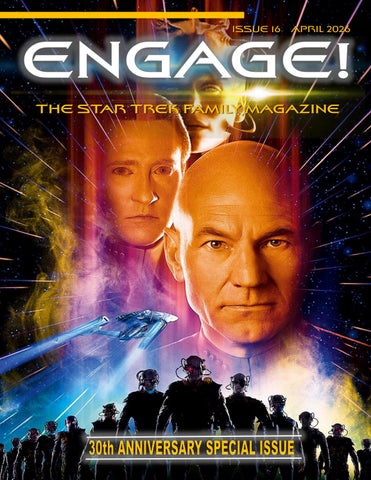
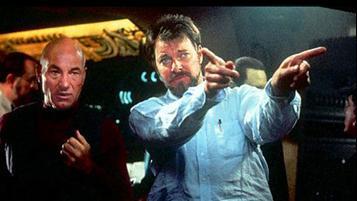
It’s unbelievable to me that Star Trek: First Contact is celebrating its 30th Anniversary this year! For the directorial debut of Jonathan Frakes, this film stands out as arguably one of the greatest Star Trek films of all time!
The prior film, Generations, was a transition film a handing off of the torch if you will from James Kirk to Jean-Luc Picard. First Contact was the first truly TNG film and is often seen as the best of the bunch. Combining two iconic elements from this franchise (the Borg and first contact with the Vulcans) into one amazing, jaw dropping, heart pumping film was pure genius.
And that’s not even mentioning the stellar performances of iconic actors James Cromwell, Alice Krige, Neal McDonough, Dwight Schultz and Alfre Woodard!
First Contact was and continues to be one of the fan favorites of the TNG era movies. The film set itself apart as the quintessential Next Gen movie outing, allowing each of the main cast members to shine in their own moments while expanding beautifully on them. From Counselor Troi’s “counseling moments” to Worf’s “assimilate this”; from Picard’s “the line must be drawn heeya!” to Cochrane’s “you all are astronauts on some sort of, Star Trek?” First Contact is arguably one of the best, if not THE best, Star Trek film of the new era.
Celebrating 30 years of this film was a no-brainer for us at ENGAGE! Magazine to cover. We hope you love all the articles in this issue as we dive deeper into the mega-hit that Star Trek: First Contact is!
Mark Sickle Founder & Host Star Trek Family
We are truly interested in receiving feedback from our readers and fellow fans! Really love an article that appears in our magazine? Truly disagree with someone’s take on a topic? How are we doing? Do you have suggestions for features, articles, etc.? CONTACT US

Have you always wanted to write about your love for Star Trek? We are always looking for volunteer writers to join our team! Send us an email at the ‘Contact Us’ link at left!
** The Star Trek Family is a free, not-for-profit global fan organization.







• Editor’s Log
• Limericks
• Word Search
• Crossword Puzzle










































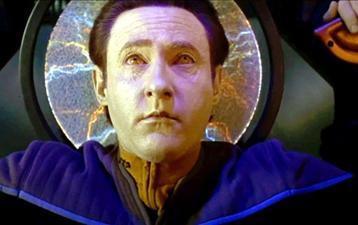

















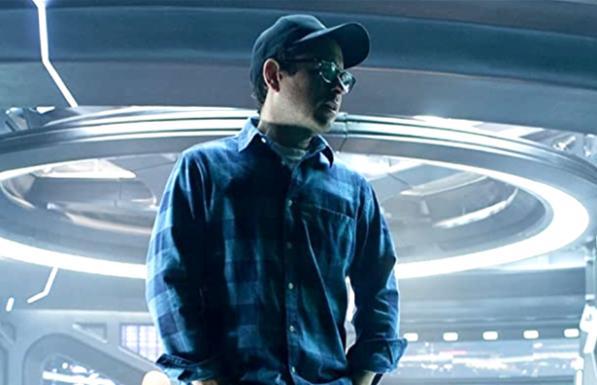








(Touch the Paramount Logo above to Sign up!)




When I was a young lad in elementary school, we were often given an assignment to improve our vocabulary skills. We would be assigned a word, and we were required to look up the definition and use it in a sentence. I hated this assignment.
The word I have chosen for this article is “perfection.” So, to complete the assignment, I looked up the word in the MerriamWebster dictionary. Perfection is a noun and its meaning is: an exemplification of supreme excellence. To use it in a sentence, I have chosen: the film Star Trek: First Contact is an example of absolute perfection.
Ok, that sounds more like a statement than a sentence. The main objective of this article is to state the reasons why I feel First Contact is the best of all the Star Trek films. Yes, many of us have our favorite Star Trek film; some choose Wrath of Khan or The Voyage Home. I cannot disagree with
them. Those films are two of my favorites as well. (Many years ago, there was this fellow who was on stage at the Star Trek Las Vegas convention. He stated that the best Star Trek film was The Final Frontier. That person was William Shatner. Who am I to argue with Capt. Kirk?)
To make my case as to why I feel First Contact is absolute perfection, I must begin with… Writing. The script for First Contact was a collaboration between Brannon Braga and Ronald D. Moore. The story was developed by both writers with the assistance of Rick Berman. All three have contributed to so many episodes of TNG that they knew the voices of the characters better than anyone else. The film brings back one of the most notorious villains, the Borg. It went back to one of the best two part episodes of all time, “The Best of Both Worlds.” It created the story of the first faster than light ship, the
Phoenix, its creator, and pilot Zefram Cochrane (more on him later in the article). There is conflict, humor, terror, treachery, revenge, hero worship and character development in nearly every scene in this movie. And what would a great space adventure be without a massive battle between the Borg cube and what looked like every spacecraft in Starfleet’s inventory?
Direction. The script for this film was given to a first time film director, Mr. Jonathan Frakes. Jonathan had directed a number of episodes of TNG, DS9 and VOY, yet this was his first full-length movie. With his first at bat at directing a film, he hit a grand slam. This movie called upon the characters to express emotions that they would not have done on TNG. This was a complex film, with location shots to be taken in the Redwoods of northern California as a stand in for Bozeman, Montana. All the interior scenes
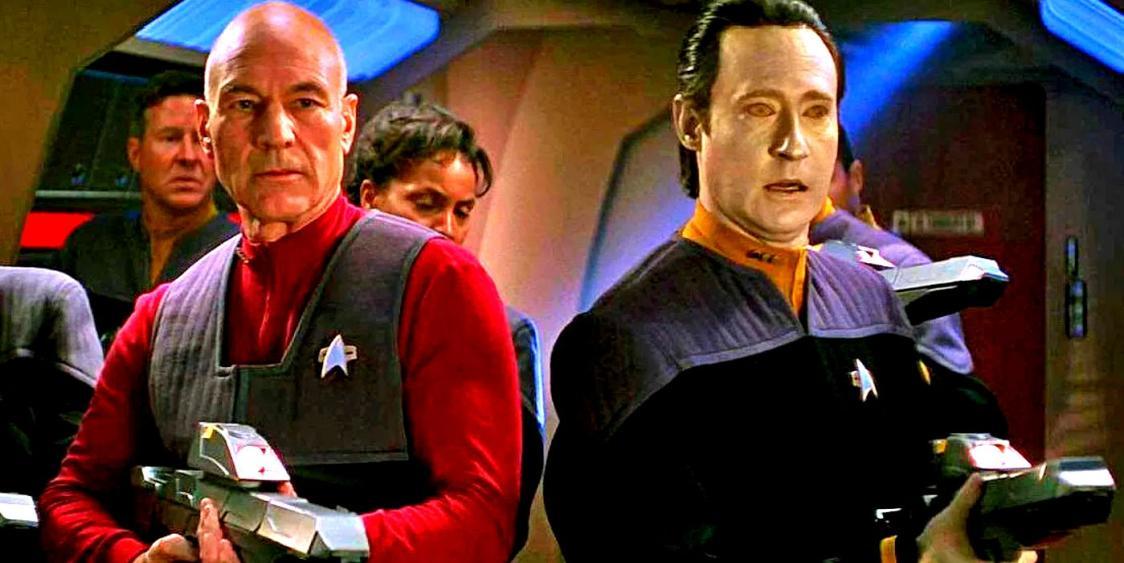
of the Enterprise were done in Hollywood, and the silo scenes were shot at a decommissioned missile site in Arizona. It was all coordinated so seamlessly by Mr. Frakes. As an added treat, we have his commentary on the DVD for the film. It is an absolute joy to listen to his words; it’s as if he was sitting next to you on the couch, with a bowl of popcorn as he makes funny remarks while you watch the film. I have met Mr. Frakes on a couple of occasions and each time I have thanked him for his commentary for the film.
Acting. If it were not for the actors portraying their characters in this film, we would just be looking at some pretty cool sets. Let us begin with Patrick Stewart. He brought back the anguish he felt in being made into a Borg in “The Best of Both Worlds” back into the limelight. It expanded his anger at wanting revenge for what was done to him. Yet, in the moment where he did all he could
to end the Borg’s plans, he could not leave Data behind in the destruction of the Enterprise-E. The hero worship shown by either Lt. Barclay or Geordi when seeing Cochrane is about how we would act when meeting our own heroes. Then there is Alice Krige as the Borg Queen. The sensuality she portrayed with Data to get him to “switch teams” was amazing. And that kiss, wow. The way Troi acted as she encountered meeting Cochrane for the first time was hilarious. Mr. Frakes had to direct himself. He had to show how his character was able to get
Cochrane to come to terms with the magnitude of the flight of the Phoenix. Inspiring. Then there is the actor who had to redefine our thoughts of who Zefram Cochrane was, that being Mr. James Cromwell. He had to convince us that his character was in it only for the money, that he was a drunk who cared very little for his fellow survivors of World War III. Yet it is how his character could make a complete turnaround and become the person to make first contact with the Vulcans successful. I have always appreciated the work of Mr. Cromwell, yet this
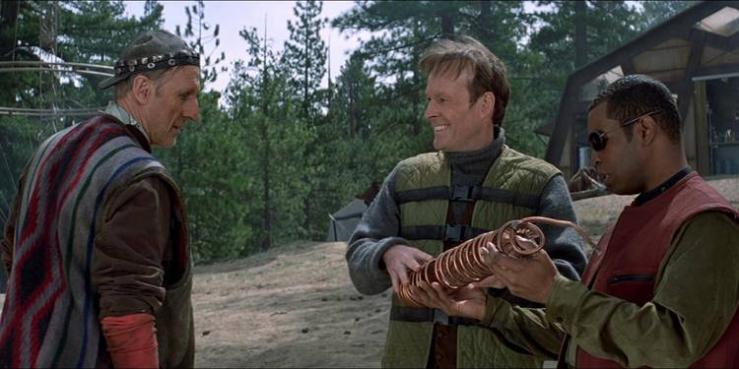
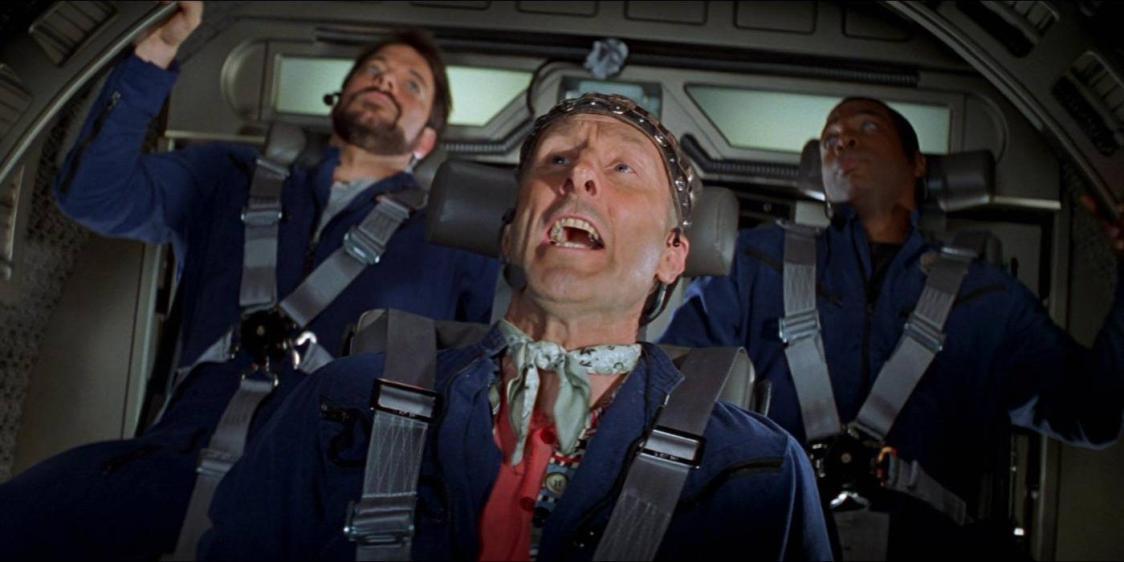
might have been his crowning achievement.
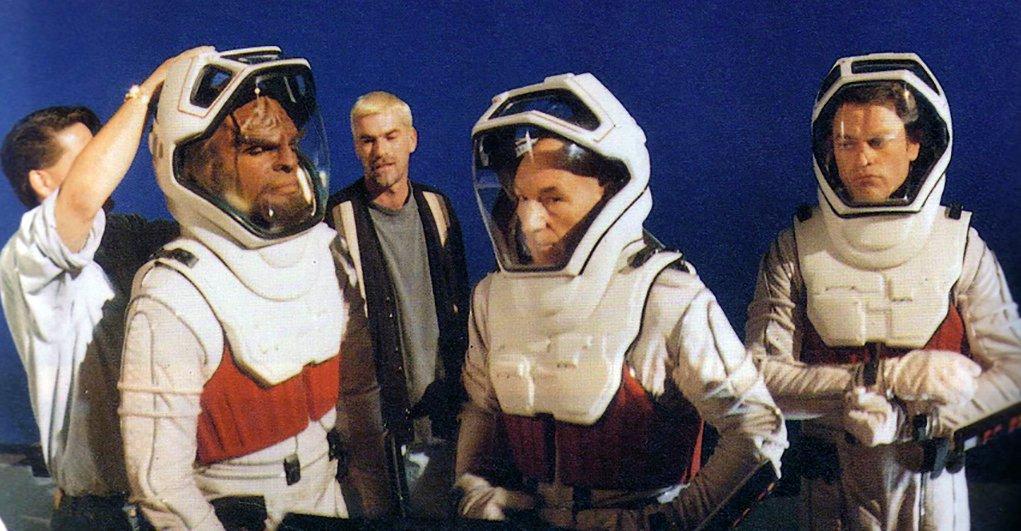
Film design. Without beautifully designed sets and spacecraft, the actors would be reading their parts somewhere in a park. The look of the new Enterprise-E was a major change from the cruise ship like designs of the “D.” It was more muscular and purpose driven, like it was ready for battle. The areas that the Borg controlled abord the “E” were designed for a feeling of dread and lifelessness. The design of the Bozeman, Montana village and all the stand-in actors gave it a really rustic feeling. The EVA suits worn
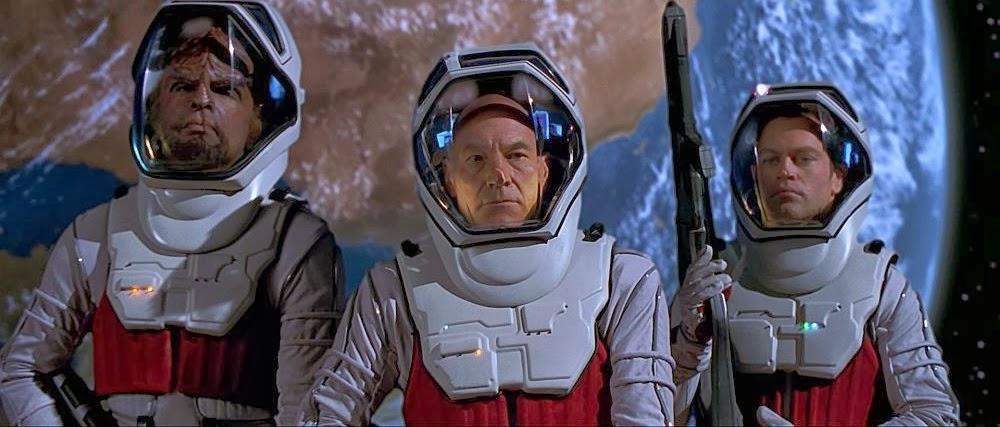
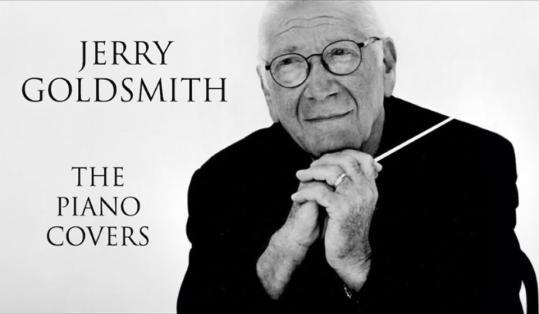
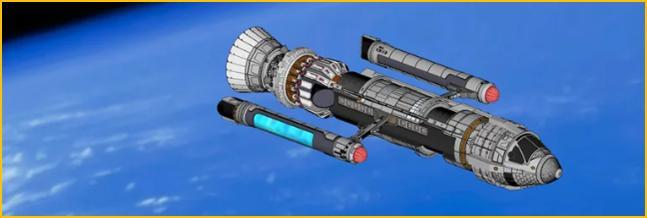
in the deflector battle were beautifully designed and very real looking. They are only topped by those used in Star Trek: Enterprise. Yet the star of the movie is the Phoenix. I have an entire article devoted to this amazing spacecraft elsewhere in this issue and hats off to John Eaves for making it seem so plausible. Finally, the musical score for this movie by Jerry Goldsmith is, as far as I am concerned, one of the best of any film I have ever seen.
Legacy. For a film to be considered perfection, it has to have “legs.” First Contact might be 30 years old in 2026, yet it seems
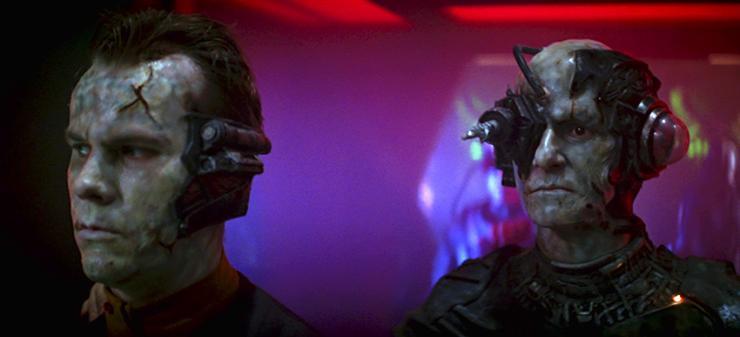
as fresh and modern as any current sci-fi movie. For “Star Wars” fans, the made up day to celebrate that franchise is May The Fourth. Yet for Star Trek fans, we have a real, specific day to celebrate this film and all of Trek: April 5th. Fans will post on social media how they want to celebrate this day and this film (I will watch the movie that day as I also do on July 4th by watching “Independence Day” to celebrate our country’s birthday). This film has been used in a number of Star Trek TV series. In the first episode of Enterprise we see Cromwell playing Cochrane at the commissioning of the Warp Five complex.
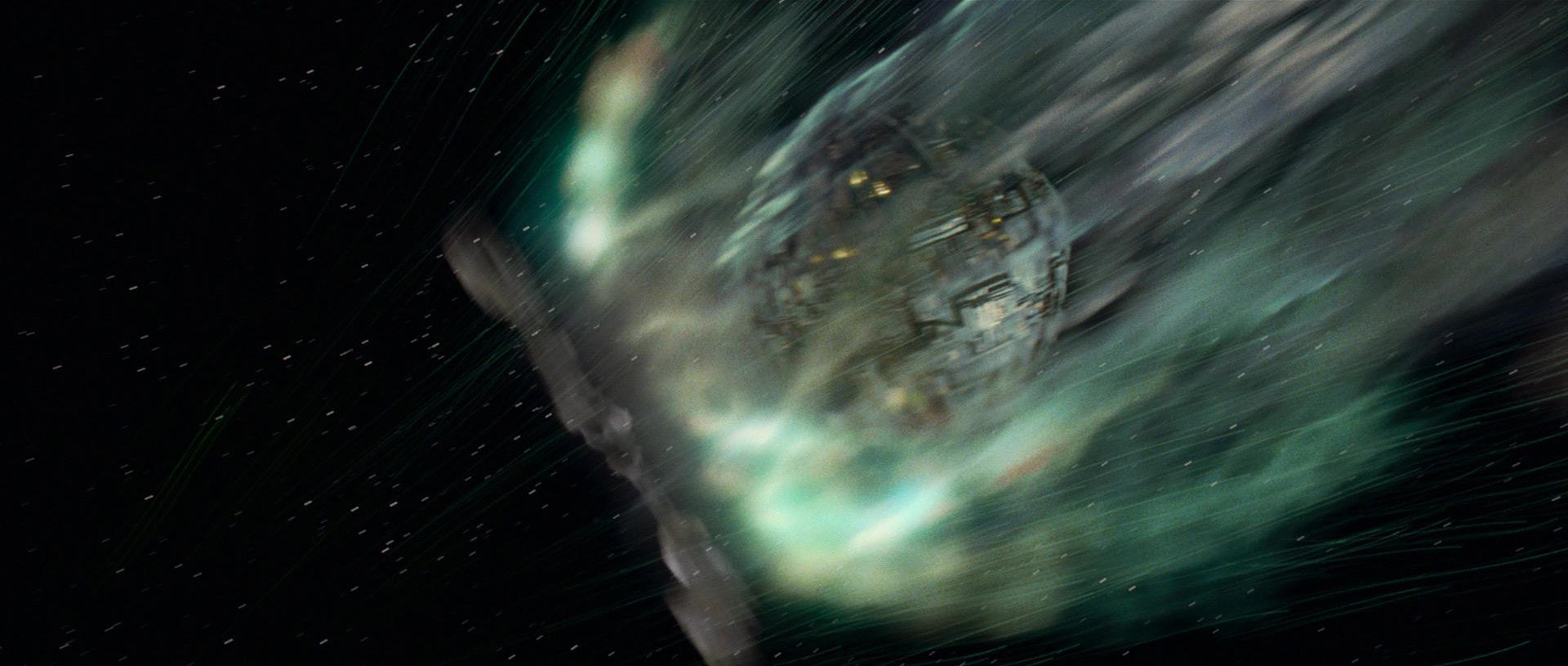
In the second season of Enterprise, the episode entitled “Regenerations,” we get to see what happened to the destroyed Borg sphere from First Contact (and Archer’s haunting words about holding off the invasion for 200 years). Or the opening scenes from the fourth season episode of Enterprise “In A Mirror, Darkly.” In
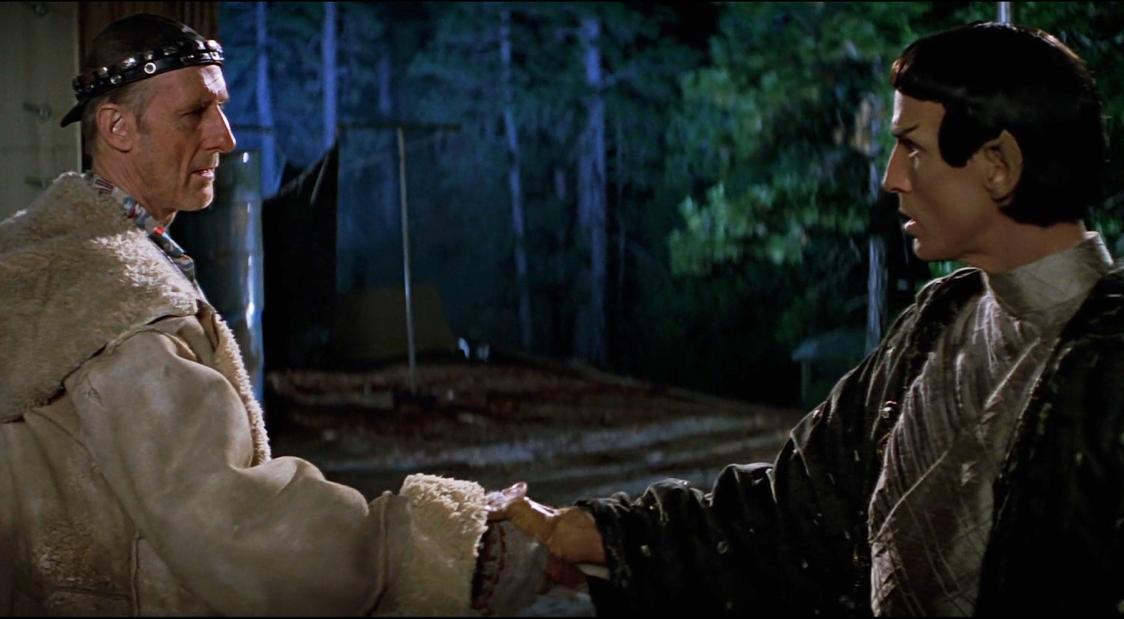
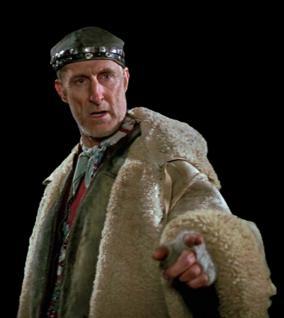
it, Cochrane and the Bozeman villagers attack the Vulcans instead of welcoming them to Earth. However, it is the first episode from season three of Lower Decks entitled “Grounded” that Cromwell voices a hologram image of himself as Cochrane. It is at an amusement park named “Bozeman.” There the beautiful melody of the music from First Contact greets us as if we were at a part of Disneyland, complete with a recreation of the launch of the Phoenix. Even in the ready room of the Enterprise on Strange New Worlds there is an image of the Phoenix to remind the crew of where it all began.
you on the belief that this is the
best Star Trek film? This is something the individual has to make for themselves. I can easily watch the entire sequence of the launch of the Phoenix and the reactions of Cochrane as he sees the Earth from space. I am sure the wonder and amazement he depicted is something we all would do if we could see our home planet from afar. And much like Cochrane, we need to have our traveling music on the stereo when we head off on a trek. I always loved “Magic Carpet Ride” and now it means so much more.
Even though it is past April 5th, that is not the only time to view this movie. Watch it any time you can. And if you have the DVD, be sure to watch it with Mr. Jona-
than Frake’s commentary. Plus, do not forget the popcorn. As the Borg would say, “resistance is futile.”

STEPHEN MIRKIN: I first learned about science fiction the moment I was able to reach the on/off knob on my parents’ black-and-white TV set. Being born in 1956, I was there on Sept. 8, 1966 to watch the first episode of Star Trek. Since then, I have watched every TV series and every movie and I only look forward to the next great Star Trek moment.



Actor James Cromwell became the first to utter what phrase on production?
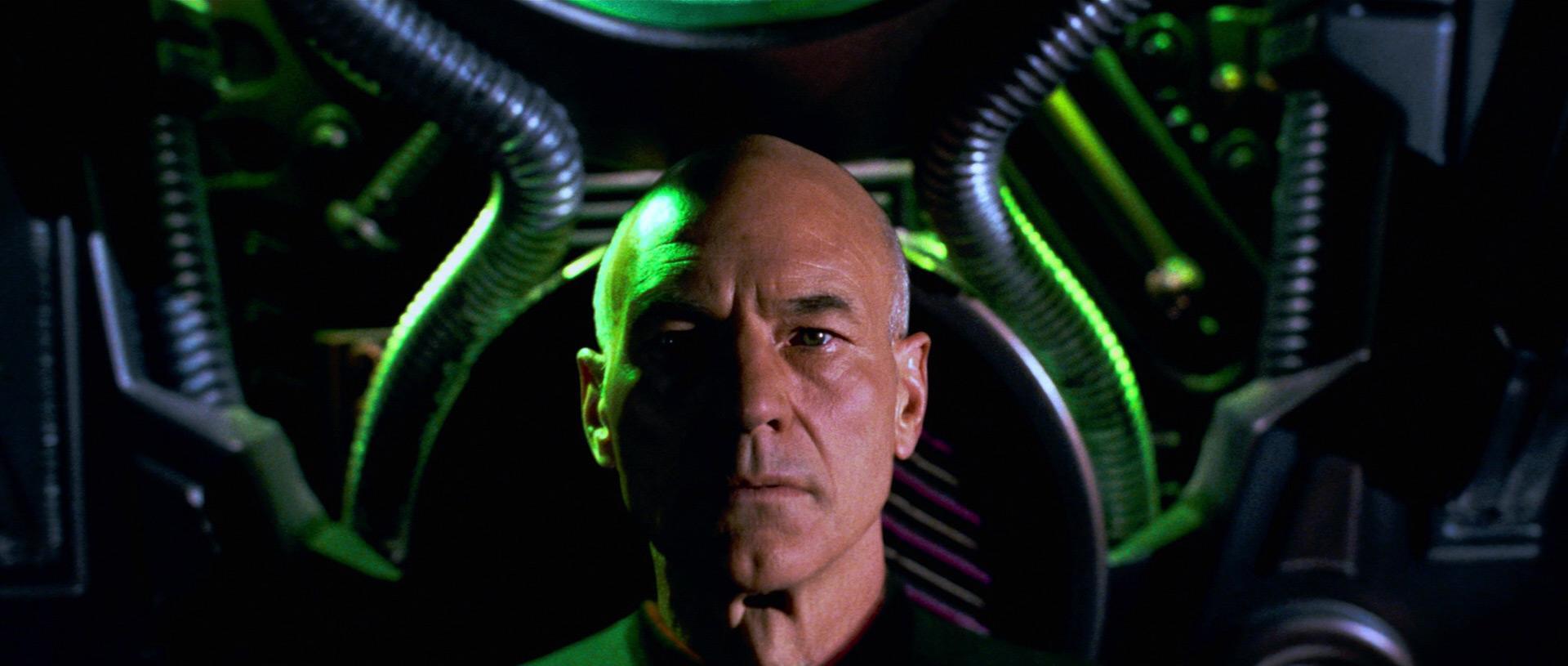


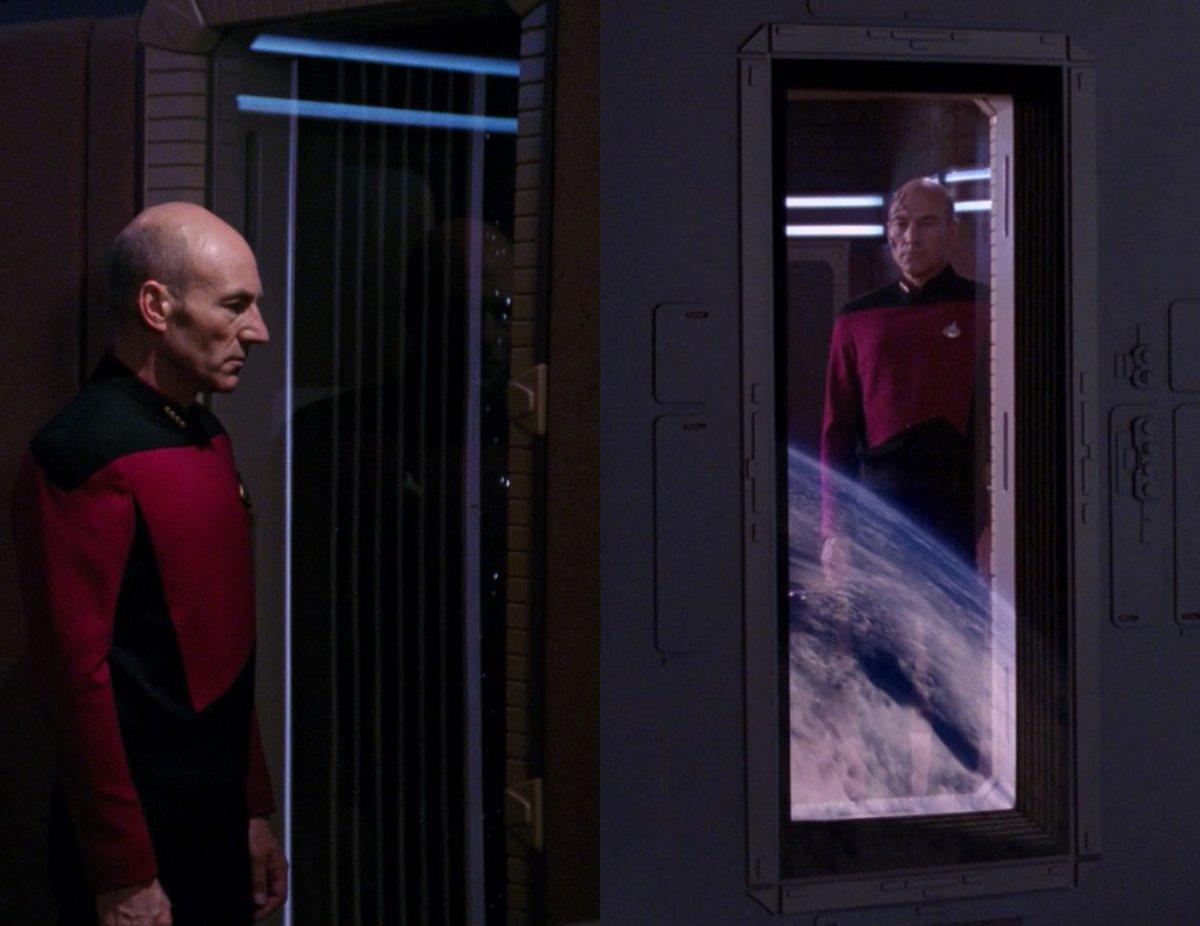
the figure staring back at him. He couldn’t wrap his head around how he had arrived at that moment, in that ready room, on that ship, at that window. He simply couldn’t remember. What he could remember was the pain and the fear. He remembered the explosions of all the Federation
ships that he helped to destroy. He saw captains and crews begging for mercy and peace.
Through the reflection he stared into his own eyes and saw something he hated his own humanity because in his humanity he found weakness and shame.
Picard closed his eyes and inhaled slowly and deeply. He let it out with a shudder and braced himself with hands against the bulkhead. The room started to spin and he wished it would all end.
Even though he had been rescued, for which he was grate-
ful, there was a deep hidden part of himself, the part he rarely let anyone in close enough to know or discern, that wanted an eternal escape from the entire nightmare of the Borg.
This is how I imagined Picard’s mental state following his darkest hours as portrayed in the legendary two-part Star Trek: The Next Generation episode, “The Best of Both Worlds.” This cinematic and epic story put the captain of the Enterprise in a position that seemed dark and set in the universe.
How could he possibly be rescued and brought back to life? He would need a Lazarus miracle and a resurrection that seemed impossible.
This beautifully crafted story also displayed the power, determination and love of family. His crew worked hard to rescue their captain and to retrieve what parts of his humanity they could.
It was now up to Picard to take the journey towards true recovery. And walk he did. He followed that path towards a vineyard to his brother, sister-inlaw, and nephew to a place where he hoped to find perspective and the grounding of his youth.
While the agony of his corruption into Borg service haunted him, the pain of his own failure to stop them hurt far more. He couldn’t stop himself from wondering if he had done enough. It was now the true source of his pain.
Patrick Stewart's portrayal of Picard was masterful in these episodes and the following episode titled “Family.” He painted
upon a canvas with such beauty and subtleness that we all could see ourselves in his shoes. We could feel what he was going through and, possibly, remember our own failings and trauma.
Maybe our trauma wasn’t on the same level, but we’ve certainly felt the pain of wondering if we could have, or perhaps, should have, done more to change, resist, fight back, or maybe even surrender.
This is what I find so captivating about Stewart’s performance. It was one of the first times we saw an unsure Picard. A man who was lost or searching for himself again. It was jarring as a Star Trek fan to see our captain in such a state. It still is when I watch these episodes today, years after they originally aired. It speaks to the quality of the entire production, but mostly to the powerful portrayal of brokenness that Stewart gave.
I love that he had to walk that long path towards his childhood home. What a metaphor for the journey we all must take toward recovery. I didn’t see it as a younger man when watching, but watching it now in my 40s, it’s powerful and deeply meaningful.
In order for Picard to take another step towards his ultimate recovery, he needed to break down and admit his brokenness to his brother. Denial is the enemy of healing. Picard finally realized this as he let it all out in one of the most powerful and deeply moving moments in all of Trek. In that mud and dirt, a symbol of the mess he was in, he was able to release a part of the guilt and shame he felt.
Without confronting his past mistakes, he would never be able to accept the forgiving embrace of his brother. Ultimately, he would never have been able to forgive himself. It was only then that the light began to shine again inside of his heart and his soul. It was then that his humanity regained its strength and dignity. His healing began.
Of course, we see further trauma through many more episodes, but this is, without a doubt, his darkest hour. What did he do to work through it all? He just kept walking. He realized that he was not alone and that he needed the people around him to lift him up when he felt down. His journey led him back to his other family: the crew of the Enterprise. This is where he prospered. Even the strongest among us needs community.
In the recent series, Picard, he surrounds himself with more than just a crew. He surrounds himself with community in order to face the threat facing humanity. With their help, he is able to break through and find the peace he needs. And, in the meantime, they just happen to save Earth and the entire galaxy.

BRIAN DONAHUE: Brian is a pastor, songwriter, aspiring author and avid podcaster hosting three different podcasts including The BIG Sci-Fi Podcast. He lives in Ohio with his wife, two kids, and Data the golden-doodle.

Wherever you get your podcasts!

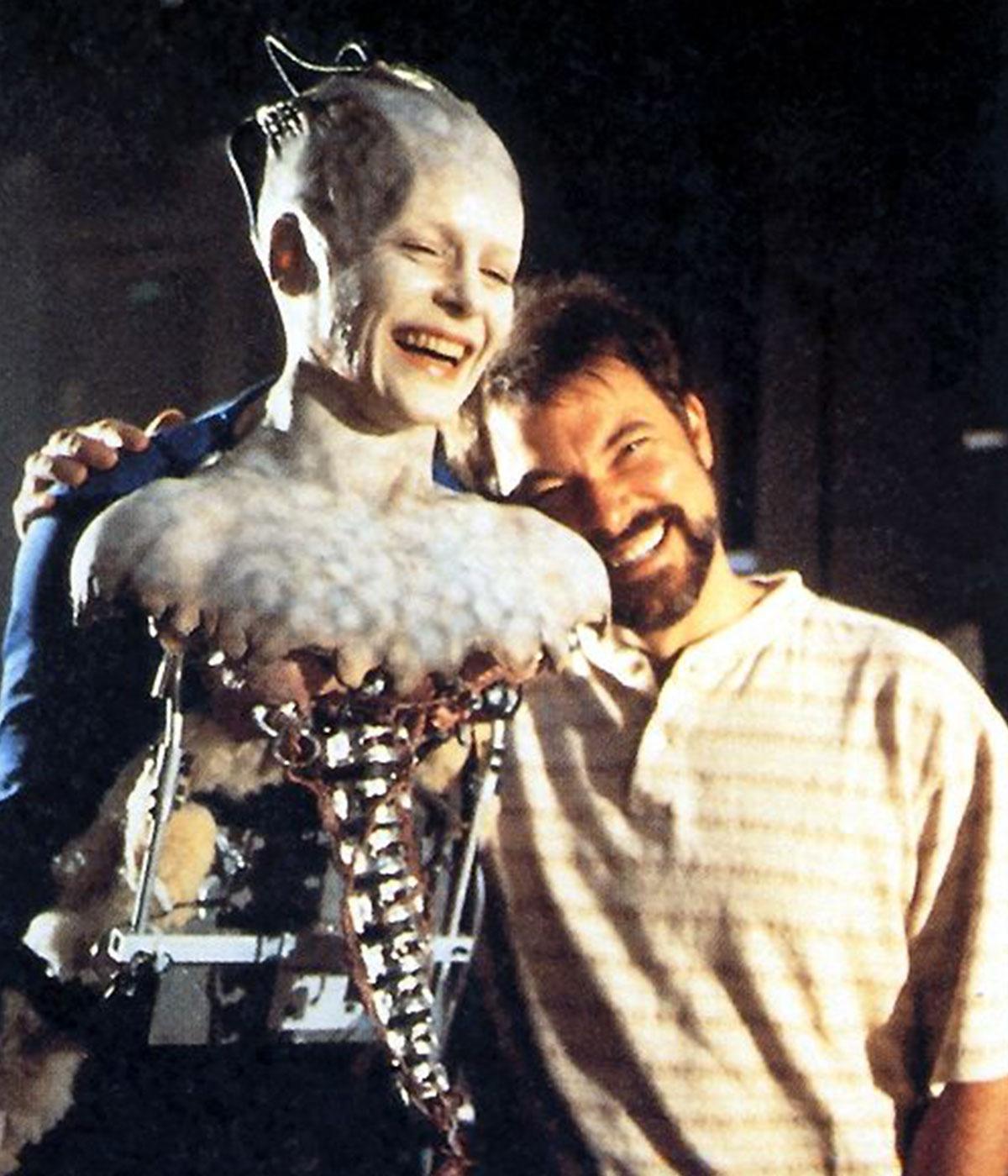




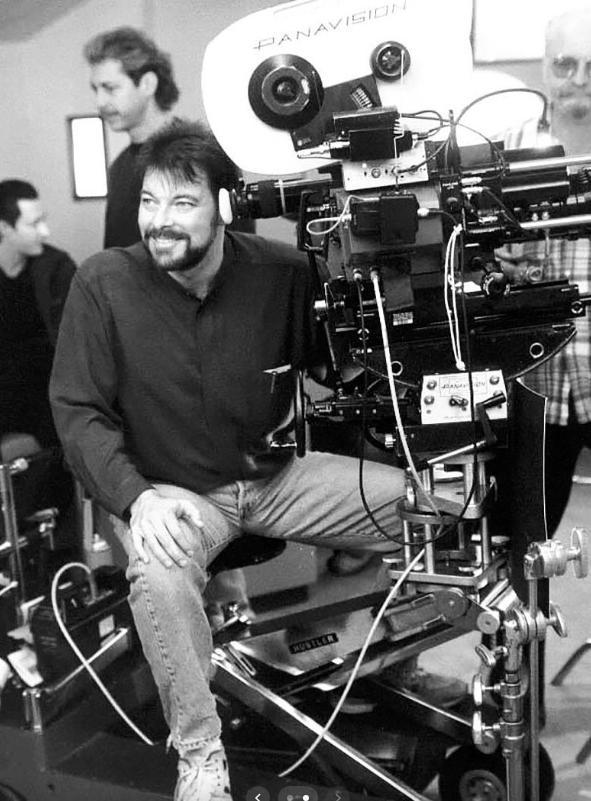
It is a small courtesy, but a telling one. On set, Jonathan Frakes is known for beginning a take with those two words rather than the traditional barked command confirmed by LeVar Burton on the first episode of Frakes’ and Brent Spiner’s new podcast, “Dropping Names… and Other Things.” The phrasing signals something about his approach: collaborative, actor-aware, quietly confident. Frakes understands that filmmaking is a conversation among artists rather than a hierarchy enforced by volume.
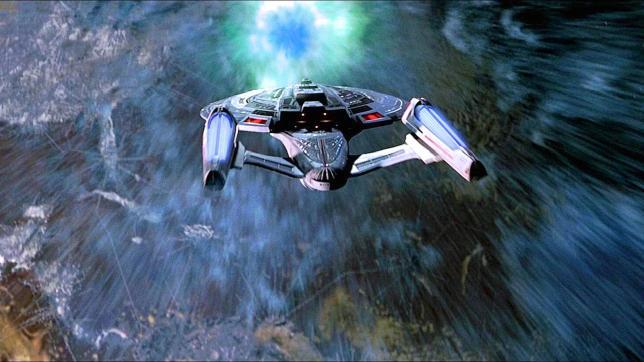
That sensibility and the trust of a franchise he’d spent years inhabiting shaped his work on Star Trek: First Contact (1996). It was his feature film debut, though you’d never guess it from the result.
Frakes came to the director’s chair the way all the best Trek helmers do: from inside. He had directed multiple episodes of The Next Generation, Deep Space Nine and Voyager before Paramount offered him the film reportedly after two higher-profile directors passed. To prepare for
the jump to the big screen and the widescreen 2.35:1 anamorphic ratio, he studied “Jaws”, “Close Encounters of the Third Kind” , “2001: A Space Odyssey” and the work of James Cameron and Ridley Scott. The homework shows.
“Action, please.”
— Jonathan Frakes
What distinguishes First Contact is how Frakes translates his television instincts into a more cinematic language while keeping the emotional core firmly rooted in character.
Character at the Center of the Spectacle
Although the film opens with one of the largest battle se-
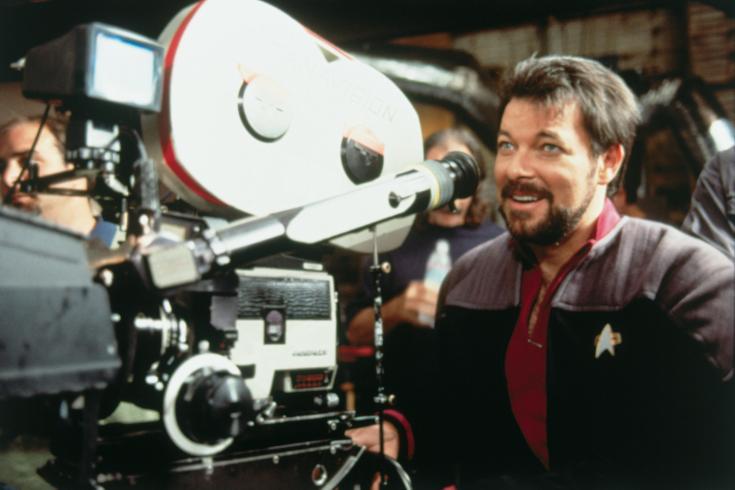
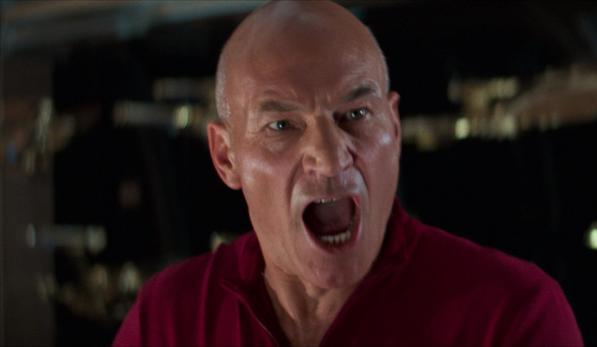
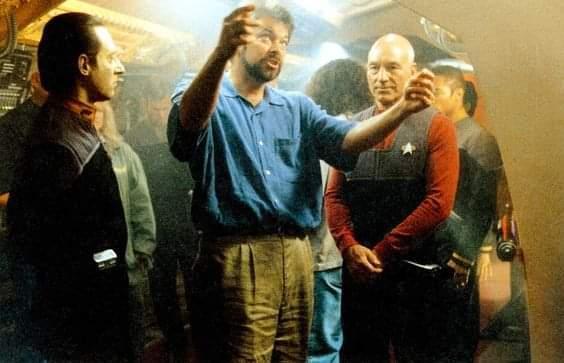
quences Star Trek had produced to that point, Frakes consistently anchors the action in character psychology particularly Picard’s unresolved trauma with the Borg. The emotional core is not the battle but Picard’s increasingly obsessive determination to destroy the Collective at any cost. Frakes emphasizes this through staging and framing. The confrontation between Picard and Lily Sloane in the ready room is the clearest example: rather than treating it as an exposition break, Frakes lets the camera remain close as Picard’s composure fractures. Picard’s speech, “The line must be drawn here!” unfolds in tight, unforgiving shots that put everything on Patrick Stewart and Stewart delivers. The moment feels intensely personal because Frakes trusts his actor enough to get out of the way.
This is the actor-director’s instinct at work. Build tension through performance, not cutting.
Motion and Cinematic Momentum
Frakes also introduces a more fluid visual style than audiences were accustomed to from the television era. The camera in First Contact moves tracking characters through corridors, engineering sections and cargo bays, lending urgency to the Borg’s creeping takeover of the Enterprise-E.
These sequences carry an almost horror-film atmosphere: dim lighting, fog-filled corridors, flickering consoles and the sense that the enemy could materialize at any moment. Frakes leans into the Borg’s horror potential more
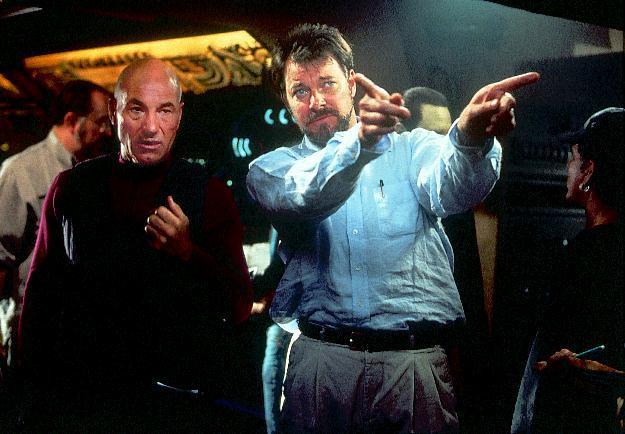
deliberately than earlier Trek had dared. Assimilation scenes are staged with unsettling physicality, and the ship itself gradually transforms from a familiar Starfleet environment into hostile territory. Even in the opening space battle, he prioritizes clarity over chaos. Dozens of Federation ships engage a Borg cube, yet the sequence remains easy to follow because the camera returns re-
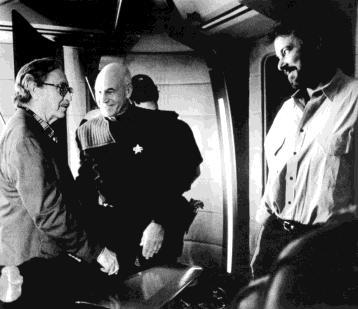
peatedly to Picard’s perspective. The audience understands the battle through Picard’s tactical knowledge spectacle grounded in narrative logic.
Darkness and Humor in Balance
First Contact is among the darker entries in the Trek film series, with the Enterprise slowly being assimilated and Picard forced to confront the psychological wreckage of his time as Locutus. Frakes offsets this with the Montana storyline, which has a looser, more human register.
James Cromwell’s Zefram Cochrane cast fresh off his Oscar nomination for Babe (1995) — is not the mythic hero the crew expects but an irascible, mercenary drunk who built the Phoenix
for all the wrong reasons. The scenes in 2063 Montana provide welcome tonal relief while reinforcing the film’s central argument: the future is built by flawed, ordinary people.
One of the film’s mostloved comedic beats involves Deanna Troi, played by Marina Sirtis, sharing tequila with Cochrane and becoming enthusiastically invested in his historic mission. The scene releases tension without undercutting it.
The Power of Restraint
Frakes demonstrates particular restraint in the film’s most mythic moment — the maiden flight of the Phoenix and humanity’s first contact with the Vulcans. Rather than overwhelming the
with deliberate simplicity: soft light, slow pacing, almost no dialogue. The restraint allows the mythic weight to emerge on its own. It is one of the finest sequences in the franchise’s history, and it works because Frakes doesn’t push it.
Directing from Inside the
Worf each receive moments that feel earned rather than obligatory. And while Frakes appears onscreen as Riker, his direction never tilts toward his own character Picard remains the emotional center throughout.
First Contact
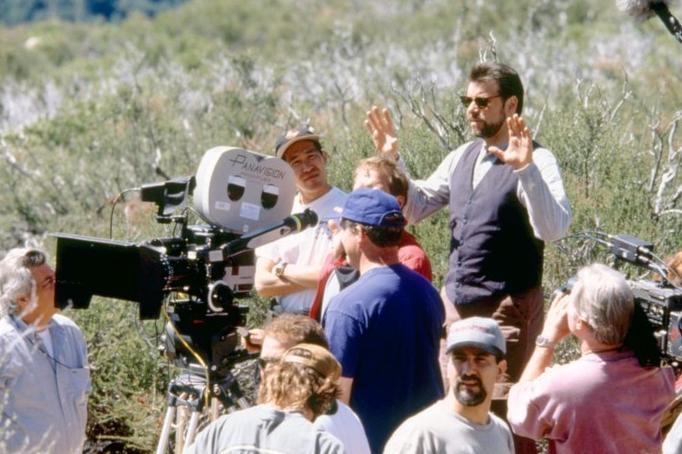
Frakes the Saturn Award for Best Director in 1997, a recognition




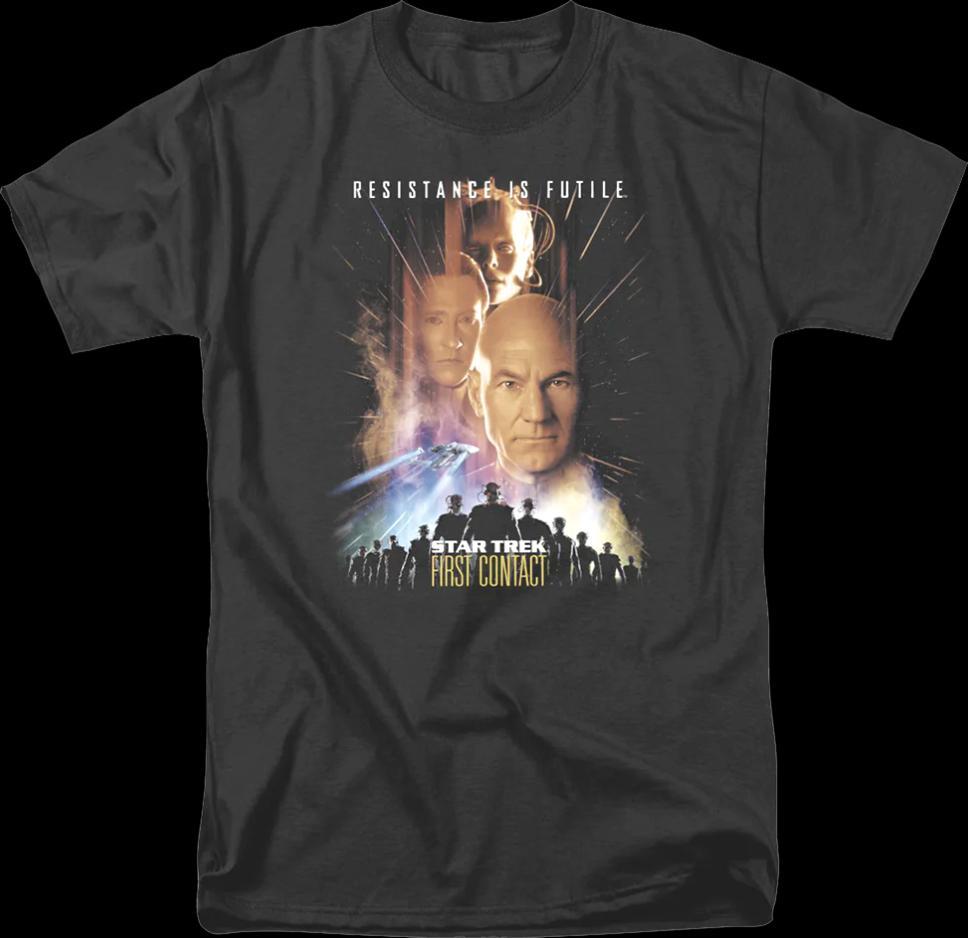
ORDER YOUR SHIRT TODAY!
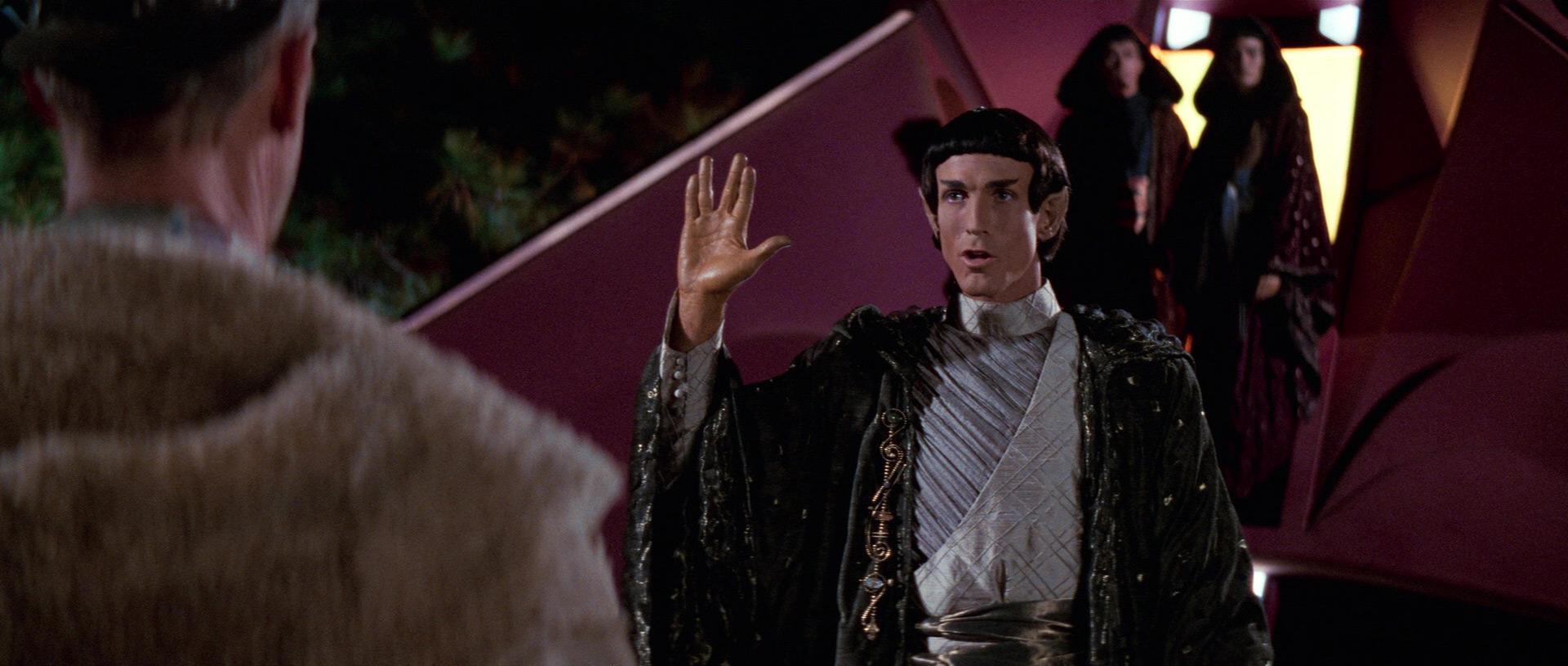

Few films in the long history of Star Trek manage to feel both deeply rooted in the franchise’s philosophical core and thrillingly cinematic at the same time. On its anniversary, Star Trek: First Contact remains not only the strongest of the Next Generation films, but arguably the finest Star Trek movie ever made. Three decades later, it still stands tall, lean, intense, emotionally grounded and defiantly hopeful. While other entries have chased spectacle, nostalgia, or reinvention, First Contact understood something fundamental: the best Star Trek stories are not just about space battles. They are about who we are when tested by fear, trauma and the temptation to abandon our ideals.
Released in 1996 and directed by Jonathan Frakes, Star Trek: First Contact arrived at a crucial moment. Star Trek: The Next Generation had concluded its seven-season run two years earlier. The cast’s first big-screen outing, Star Trek: Generations, had been a transitional piece, pairing the new crew with the aging legends of the original series. It was competent but cautious. First Contact was different. It was confident. It was focused. And it was unapologetically cinematic. Although he had directed some Next Generation episodes, this was his first major directorial debut.
From its opening frames, Picard’s nightmare of assimilation, the film announces that it is not content with comfortable episodic storytelling. It dives headlong into the lingering psychological scars left by “The Best of Both Worlds,” one of television’s most iconic
cliffhangers. The Borg are no longer just a recurring threat. They are personal.
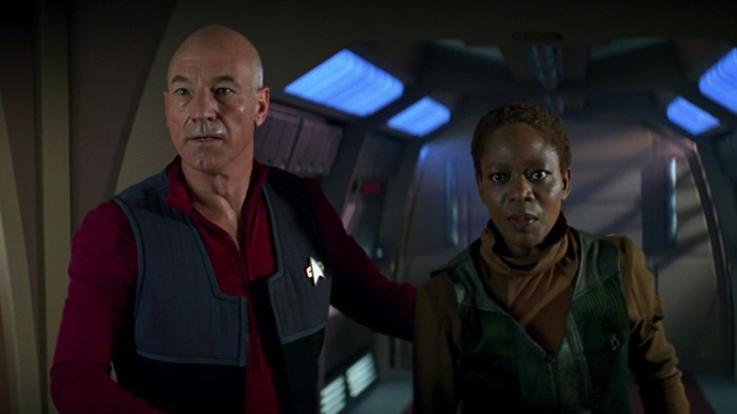
At the center of the film’s enduring power is Captain JeanLuc Picard. In the television series, Picard was often the embodiment of Federation restraint, diplomacy and moral clarity. Here, he is shaken. Haunted. Angry. The trauma of having once been Locutus is no longer background lore, it drives the plot. When the Borg attempts to alter Earth’s past by preventing humanity’s first warp flight, Picard’s pursuit is not purely strategic. It is obsessive.
The film is explicit in the now-legendary confrontation between Picard and Lily Sloane. Picard’s “The line must be drawn here!” speech is not triumphant; it is alarming. In that moment, he is not the enlightened captain of the Enterprise, he is Captain Ahab. The comparison to Herman Melville’s Moby-Dick is deliberate. The crew watches their leader teeter on the edge of vengeance. That vulnerability gives the film dramatic weight few other Trek films achieve.
This is one of the primary reasons First Contact holds up so
well today: it grounds its spectacle in character. The space battle at the beginning is kinetic and visually impressive, but it matters because of Picard’s internal conflict. Even the quieter scenes, Data’s temptation, Cochrane’s doubts, carry emotional stakes.
Picard’s Internal Struggle
After the episode “Best of Both Worlds” and “Family” aired, the show did a reset the events of what happened to Picard during those events, we give a little nibble as to the trauma once or twice more throughout the series but nothing substantial. This movie allows us to really dive into what Picard went through and how he really suffered while he was assimilated. Picard’s internal battle is just as intense as the external war against the Borg. Physically, he endures renewed proximity to the species that once violated his body and autonomy when he was assimilated and transformed into Locutus. Even though he had been freed, First Contact makes it clear that the trauma never truly left him. The invasive mechanical sounds of the collective, the sight of the watching other crew mem-
bers go through the assimilation process, and even Borg’s presence aboard the Enterprise trigger a visceral response. His body remembers what his mind tries to control, manifesting in tension, sleeplessness and flashes of pain.
The film subtly suggests a psychosomatic dimension to his trauma; the echo of implants once embedded in his flesh become symbolic wounds that never fully healed.
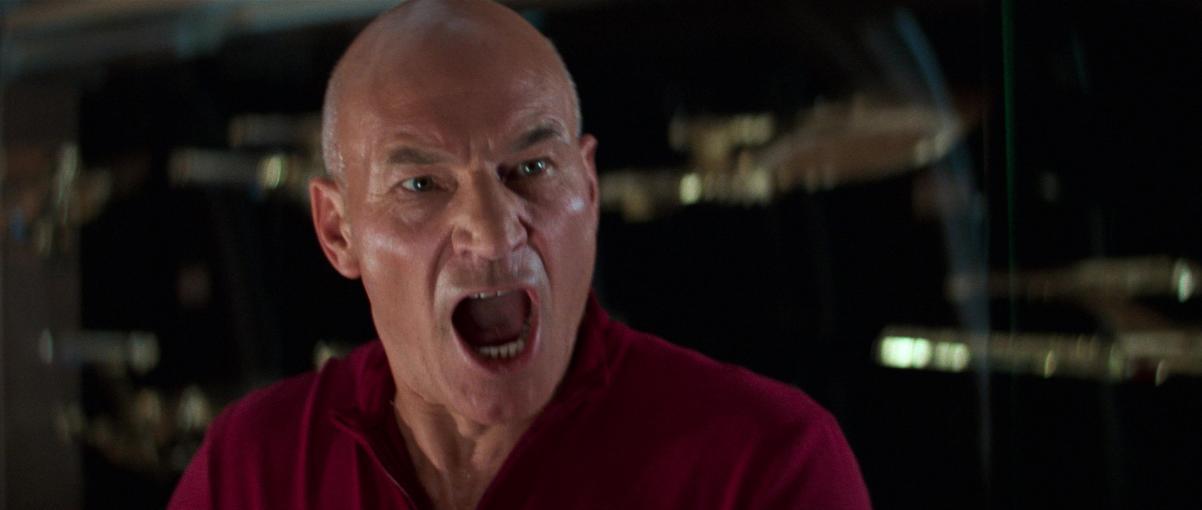
Mentally, Picard faces an even greater challenge, his struggle with rage, obsession and the seductive pull of vengeance. Normally defined by restraint, diplomacy and moral clarity, he begins to unravel as the Borg assimilates his ship. His trauma clouds his judgment, driving him to risk his crew and mission in pursuit of destroying the enemy at any cost. His breakdown in the observation lounge, where he smashes the display case and confesses that the Borg “took everything” from him, reveals a man confronting buried fury and survivor’s guilt. The presence of the
Borg Queen reopens psychological scars, forcing him to confront not only his fear but also the lingering connection he once had to the Collective. Ultimately, Picard’s greatest battle in First Contact is reclaiming his identity from the shadow of Locutus, choosing principle over revenge and proving that his humanity, though scarred, remains intact.
The Borg Queen
The introduction of the Borg Queen in Star Trek: First Contact fundamentally reshaped how the Borg were perceived. In Star Trek: The Next Generation, the
Borg functioned primarily as a faceless, decentralized collective, an unstoppable force of nature defined by pure logic and technological assimilation. They were terrifying precisely because they lacked individuality or ego. By introducing the Queen, the film gave the Collective a singular voice and personality. This added dramatic focus: instead of the Borg being an abstract threat, they became embodied in a calculating, manipulative antagonist who could directly challenge Picard on intellectual and emotional levels. The Queen’s presence allowed for dialogue, seduction and
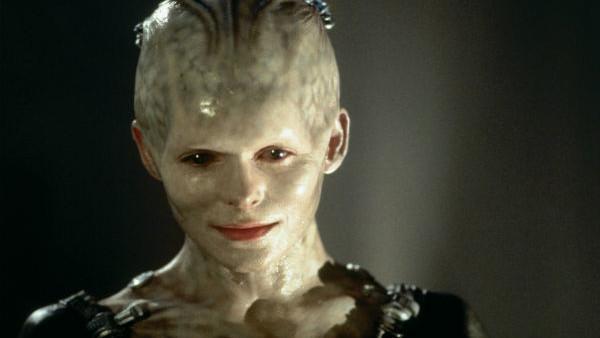
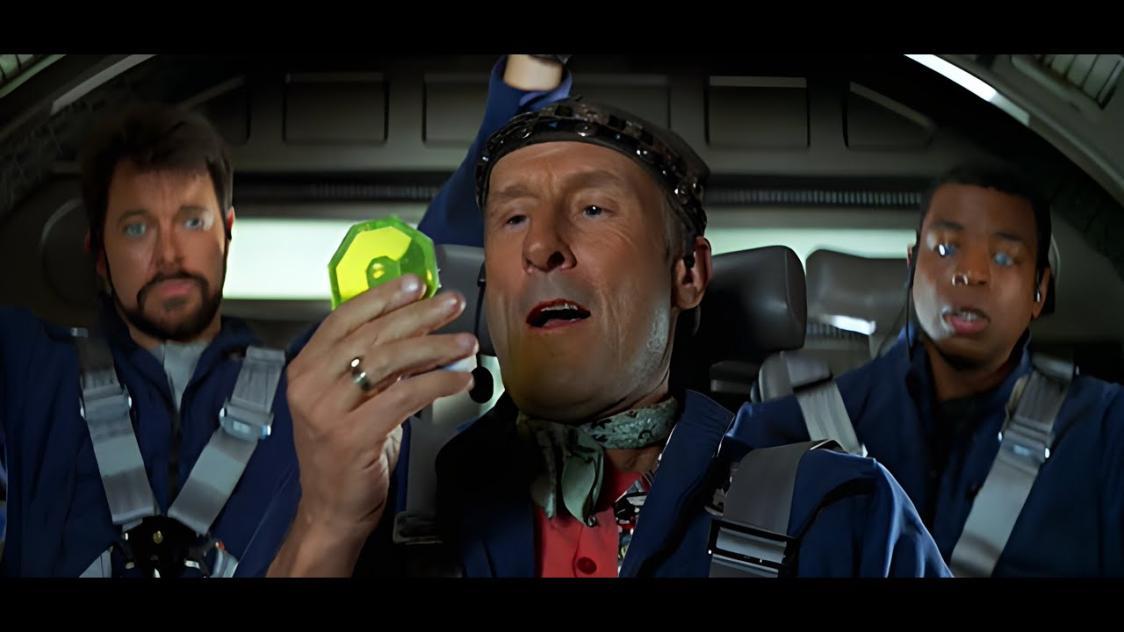
that elevated the conflict from simple survival to something more intimate and ideological.
At the same time, the Borg Queen added narrative substance by revealing internal structure within what once seemed like pure hive-mind uniformity. She reframed the Collective not as a chaotic swarm but as a system with hierarchy and intention. Through her interactions with Picard and Data, she articulated Borg’s philosophy in a more personal way, tempting Data with humanity and attempting to reignite Picard’s connection to Locutus. This personalization deepened the thematic stakes: assimilation was no longer just physical conquest, but a battle over identity and desire. While some fans debated whether giving the Borg a “face” reduced their cosmic horror, the Queen undeniably made them more dramatically complex, turning them from an impersonal force into a character-driven antagonist capable of strategy, ma-
form of ambition.
Zefram Cochrane: Man or Myth?
While the Enterprise is dealing with the threat above, many of the crew are on the planet’s surface in a race against time to get Zefram Cochrane’s warp ship up in time to alert an alien species in initiate First Contact, ushering in a new world for all humanity. As a historical figure, Zefram Cochrane is perceived as this visionary, a man who was selfless, a man who embodies everything that Starfleet represents. In the eyes of the 24th century crew, the man is a God, there are statues of him, schools named after him, he is a legend.
Yet the film deliberately contrasts this polished legacy with the far more flawed, human man the Enterprise crew meets. Cochrane, portrayed as a brilliant but reluctant engineer, is motivated less by destiny and more by profit, survival and a desire for recognition. Living in the after-
cal, self-medicating and overwhelmed by the weight of what others expect him to become. This tension between legend and reality becomes a central narrative thread: history simplifies him into a visionary icon, while the film restores his vulnerability and doubt. In doing so, First Contact suggests that greatness often emerges not from perfect heroes, but from imperfect individuals who rise to a moment despite their fears. Cochrane’s journey reframes the myth, not by diminishing it, but by humanizing it, showing that the foundation of humanity’s future was laid by someone far more relatable than the statue suggests.
James Cromwell brings an unexpected warmth and grounded realism to Zefram Cochrane in Star Trek: First Contact. Rather than portraying him as a polished historical icon, Cromwell leans into Cochrane’s rough edges, his cynicism, opportunism and lingering fear in a post-war world. The
performance feels deliberately unheroic at first, which makes his eventual rise to the occasion more convincing. Cromwell balances humor and vulnerability particularly well; his dry delivery and slightly bewildered reactions to the future’s reverence for him humanize what could have been a one-note “great man of history” role.
How First Contact Stacks up Against other Star Trek Films
Comparisons with other Trek films only strengthen the argument for its supremacy. Star Trek: Insurrection returns to a more episodic tone but feels small in scope. Star Trek: Nemesis attempts darker introspection but lacks narrative cohesion. The Kelvin timeline reboot, beginning with Star Trek, delivers spectacle and energy, yet often sidelines philosophical depth in favor of action.
First Contact achieves something rare: it satisfies mainstream audiences while retaining thematic substance. It is accessible even to viewers unfamiliar
with the series yet richly rewarding for longtime fans. The Borg function as a clear external threat. The time travel premise provides momentum. But beneath that, the film wrestles with trauma, revenge, identity and destiny. Visually, the film also holds up remarkably well. Its practical effects, model work, and makeup lend a tactile realism sometimes missing in modern CGI-heavy productions. The Borg drones are unsettling because they feel physical. The metallic corridors glisten with oil and shadow. The Phoenix launch carries weight because it feels engineered rather than rendered. Frakes’ direction deserves praise. He balances tension and humor with confidence. The pacing rarely drags. Action sequences are clear and kinetic without becoming incoherent. Most importantly, he understands his cast. The ensemble chemistry, Picard’s intensity, Riker’s steadiness, Geordi’s earnestness, Troi’s warmth, feels lived in. The film trusts its characters.
What may be most striking, watching it today, is how ma-
ture the storytelling feels. It does not rush emotional beats. Picard’s breakdown is given space. Lily’s confrontation is not undercut by quips. Even the quieter moments, Data observing his newly grafted skin, Cochrane listening to rock music before liftoff are allowed to breathe.
In a contemporary media landscape saturated with nostalgia-driven revivals, First Contact stands as a reminder that honoring legacy does not require imitation. It expands Trek lore while respecting its roots. The Vulcan handshake scene is not fan service; it is foundational myth made cinematic.
Thirty years on, the film’s themes resonate even more strongly. The fear of losing individuality to a collective machine intelligence feels newly relevant in an era defined by digital interconnection. Picard’s struggle with trauma mirrors ongoing conversations about mental health and resilience. Cochrane’s imperfect heroism speaks to the idea that progress often begins with flawed pioneers.
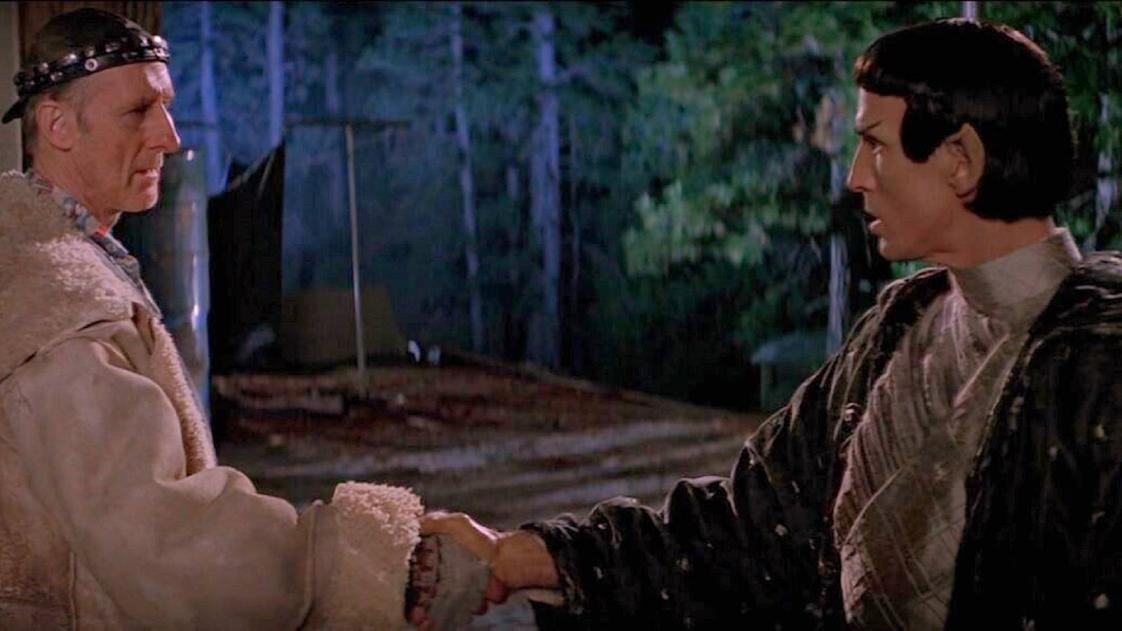
Ultimately, what cements
Star Trek: First Contact as the best Trek film is balance. It balances darkness with hope. Action with philosophy. Intimacy with scale. It dares to let its hero falter but insists that he rise again. It portrays humanity at its lowest, post-war, divided, struggling, while daring to imagine that a handshake between species can change everything.
The final image of Earth’s first contact is not an explosion, but an exchange of curiosity. It is
quiet. It is reverent. It is optimistic. That optimism is not naïve; it has been tested by assimilation, obsession and fear. And that is why it endures.
Star Trek: First Contact does not merely survive its anniversary; it thrives in it. It remains the rare sequel that deepened its characters, expanded its universe, and delivered cinematic spectacle without sacrificing soul. In doing so, it set a standard the franchise has yet to surpass.



MICHAEL MARTIN: I’ve been a Star Trek fan since I was a kid. I grew up on The Next Generation, fell in love with Deep Space Nine and Voyager. It was one of the few shows that my father and I would watch together and still share the love for the franchise today. The show’s ideals, hope, unity and moral courage have always meant something real to me. It gives me great pleasure to see where humanity can go and what can be achieved.

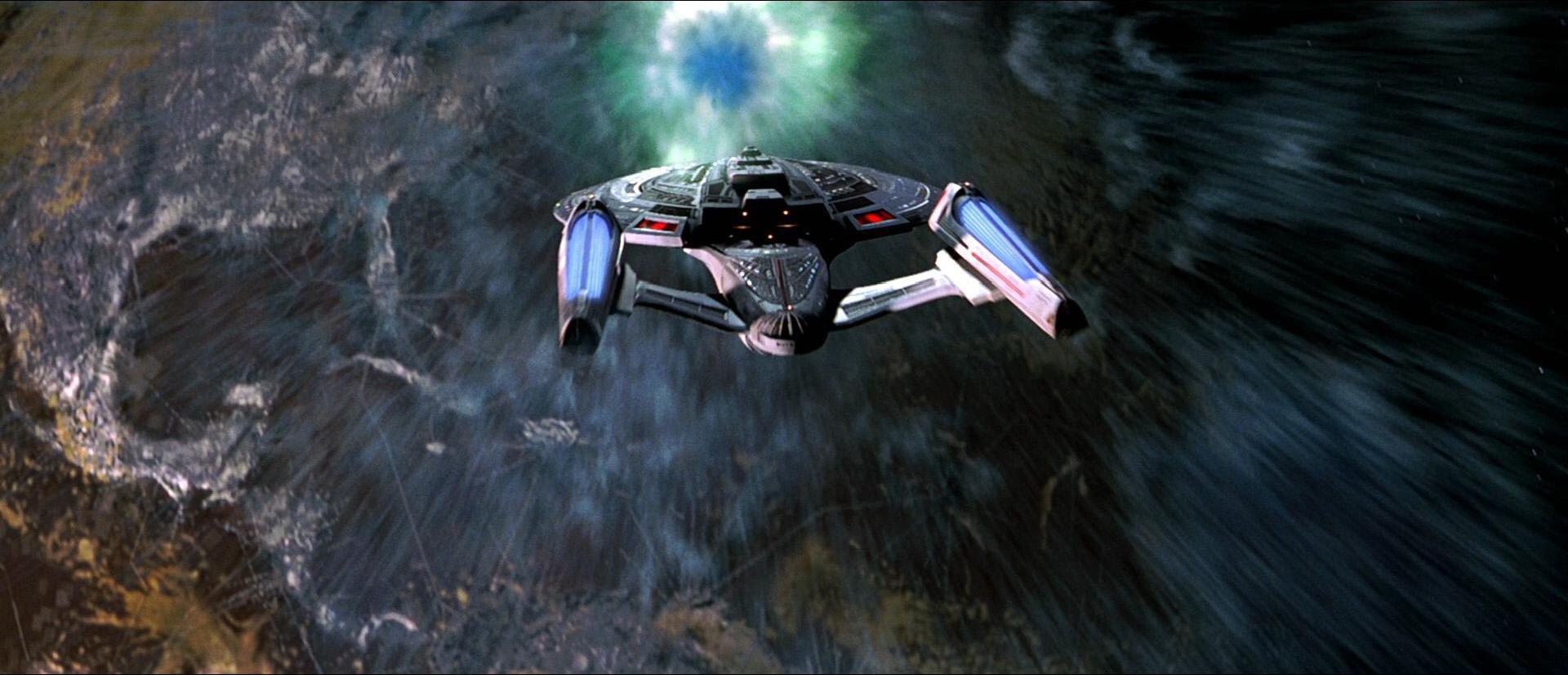





When Star Trek: First Contact debuted in November 1996, a conflict-filled year was coming to a close on the planet that the Star Trek community would eventually come to know as Sol 3. The Taliban was gaining power in Afghanistan, violence in Congo and Chechnya was escalating and guerilla-style attacks derailed peace negotiations in Latin America. It’s not hard to imagine, then, why a sci-fi film imagining new beginnings following a nuclear war was an international box-office success: First Contact grossed $146 million and was the most highly acclaimed film of Star Trek’s three Next Generation movies, according to IMDB.
Looking back, the fictional setting of an even more deeply war-ravaged planet unlocks a very real scientific question. Given the circumstances, would people, even in the faraway 24th century, be able to successfully launch the most advanced spacecraft humankind had ever seen?
Dr. Frederick Walter, a galactic astronomer and professor emeritus at Stony Brook University in New York, is doubtful we could have pulled it off. First Contact depicts a team of scientists and engineers living in tents and huddled around campfires; it might as well have been another Stone Age, Dr. Walter posits.
After a nuclear war, he said in an interview, “You’d have climate change. You put a whole bunch of dust in the atmosphere, and the average temperature will drop 10 to 15 degrees. Crops will fail. Some people will certainly survive, but you’re going to completely devastate macroscopic life
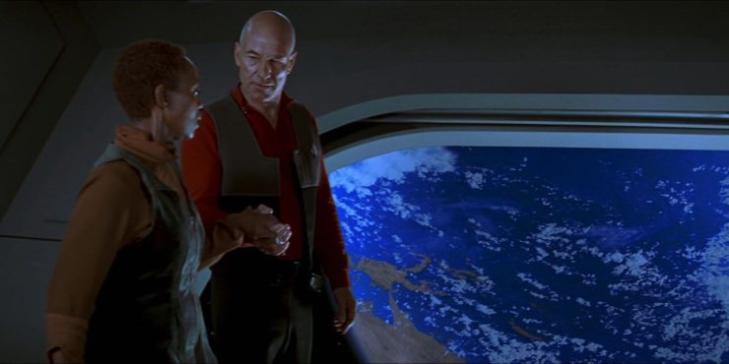
on the planet and human society will die.”
What, then, of the other major scientific elements of First Contact?
Zefram Cochran pilots the first-ever warp-capable ship, the Phoenix, which had been built from the body of a nuclear missile. While faster-than-light speed isn’t a reality in our world today more on that later it is feasible to build a spacecraft inside such a shell, Walter says. Just look at the Skylab experiment of the 1970s; the United States’ first -ever space station was constructed using a repurposed Saturn V
rocket left over from the Apollo mission series, according to NASA.
“It’s just an empty shell, airtight, and you can build whatever you want on the inside, so why not?” Dr. Walter said.
Scientists have not yet solved the problem of achieving faster-than-light propulsion, also known in sci-fi circles as “warp speed” or “hyperspace” travel. According to the publication Universe Today, in 1994 a Mexican scientist named Miguel Alcubierre proposed a method for achieving this speed, based on Einstein’s work on general relativity dec-
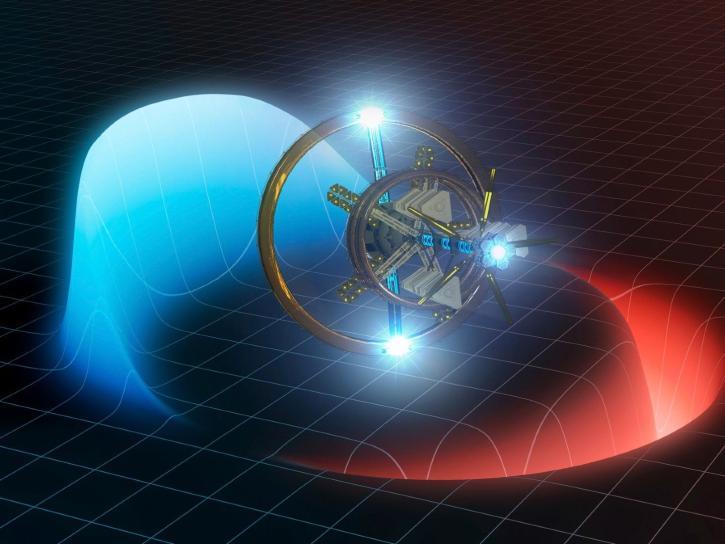
ades prior. Alcubierre theorized that a “wave” could be created to stretch the fabric of space-time around a spacecraft he called this a “warp bubble” and propel that craft forward not by accelerating, but rather by contracting the space ahead of it and expanding the space behind. It’s known today as the Alcubierre metric.
“What Alcubierre posited was ‘Let’s change space. Let’s warp space.’ The term ‘warp drive’ precedes him, but the basic idea is that the speed of light is limited in space, but the expansion or contraction of speed itself is not limited,” Dr. Walter said. “The basic idea is you’re surfing. You can build up a wave in space and surf on it. How do you make a wave in space? It would take more energy than is available in the universe, but it’s a concept that has withstood some serious thought.”
Speaking of energy: there is such a thing as dilithium. The facts stop at the name, though.
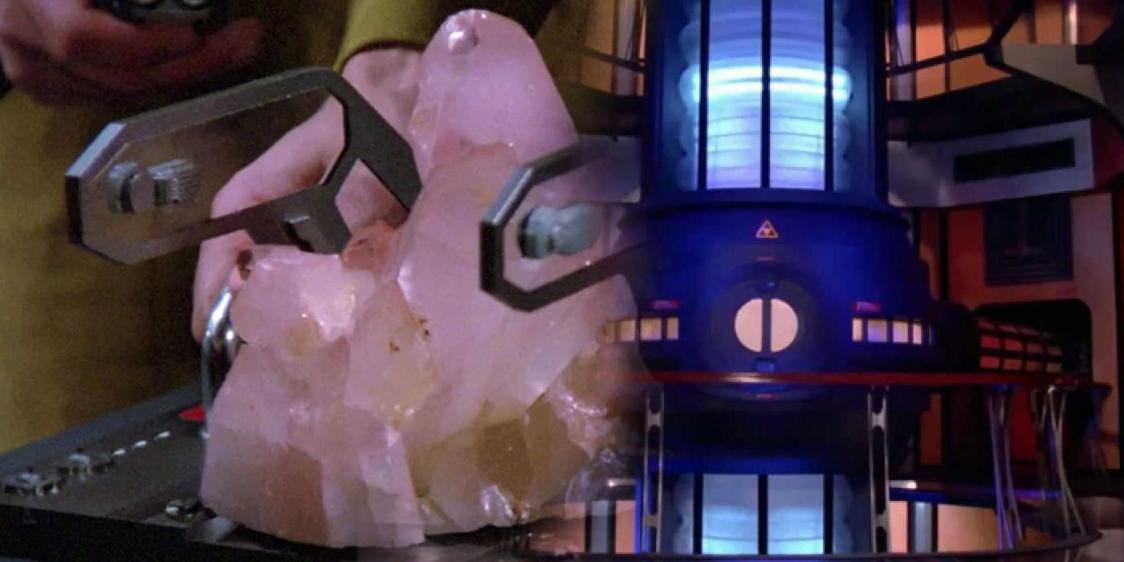
Science today tells us that dilithium is a diatomic molecule consisting of two Lithium atoms covalently bonded. It’s definitely not a glowing crystal capable of fueling massive starships. It barely even wants to bond with itself, Dr. Walter says.

But back to the specific science of First Contact. The Enterprise-E is equipped with quantum torpedoes that are used to attack the Borg, who quickly adapt to the technology, rendering it mostly useless. In the world of current scientific truth, “quantum” tech is one of the fastest-growing fields of study, used in computing to accelerate the speed of research, among other applications.
The Chicago Quantum Exchange, a think tank and research institution affiliated with the University of Chicago in Illinois, doesn’t put a cap on the capabilities of quantum mechanics. This organization explains that “matter has different properties at the atomic or sub-atomic level Now, universities, governments and industries are working together to develop quantum technologies. An entire quantum ecosystem has emerged…”
In First Contact, and in the beloved TNG episodes featuring the Borg, this ultimate enemy flies in cube-shaped vessels. Could this composition fly, literally, in the real world of aerodynamics?
“Once you’re outside of an atmosphere, shape doesn’t matter,” Dr. Walter says. “There’s no drag. You build something like a rocket because you have to plow through the atmosphere.”
But overall, the vast majority of the scientific technology depicted in First Contact is, at present, still science fiction.
“It is a great social commentary,” says Dr. Walter, who recently lectured on the science of sci-fi on Wednesday, April 29 for the Hamptons Observatory in New York. “The thing about science fiction is it considers the known unknowns. It looks at the unintended consequences of our actions. That’s hard to do when you’re constrained by science and history; you’re looking at questions that are hard to answer otherwise. Star Trek has certainly done a lot of that, but it’s not a place to go to learn how scientific technology might advance.”

CHRISTINE SAMPSON: Christine
Sampson is a multimedia journalist who has covered all of Long Island, N.Y., at one point or another over the course of the last 23 years. She made her way east in 2015 and now resides in North Sea. Her official job title is director of community engagement at LTV Studios, a public access TV station in Wainscott. She has loved Star Trek since her first boyfriend took her to see First Contact on their very first date, and the rest is history.


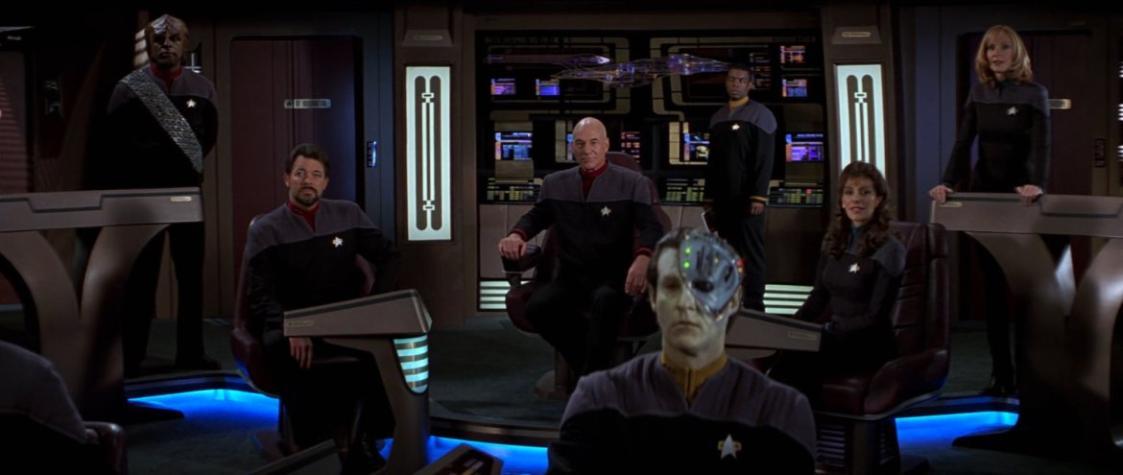
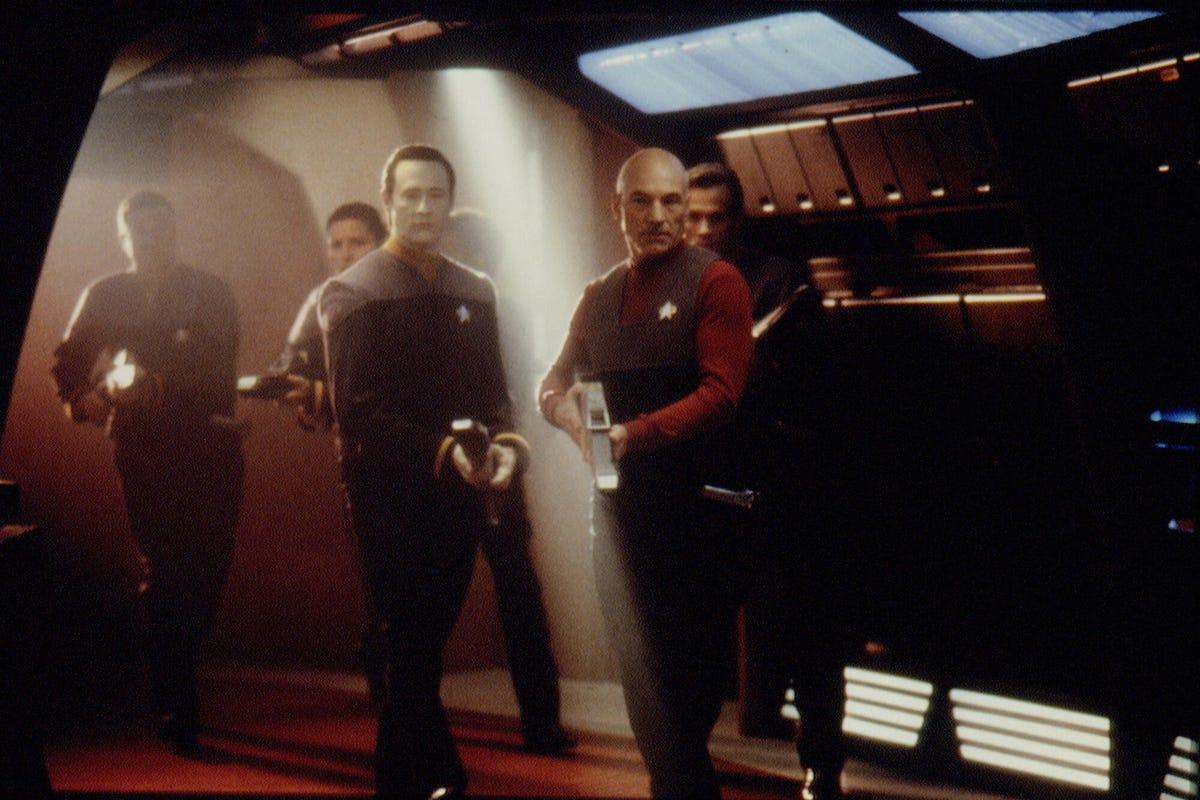
Captain Picard and Data lead a security team into the area of the Enterprise that has been taken over by the Borg.



H
er torso descends from above. Vertebrae snap into place. Mechanical limbs lock in with cold precision. And then — before the scene can settle into horror
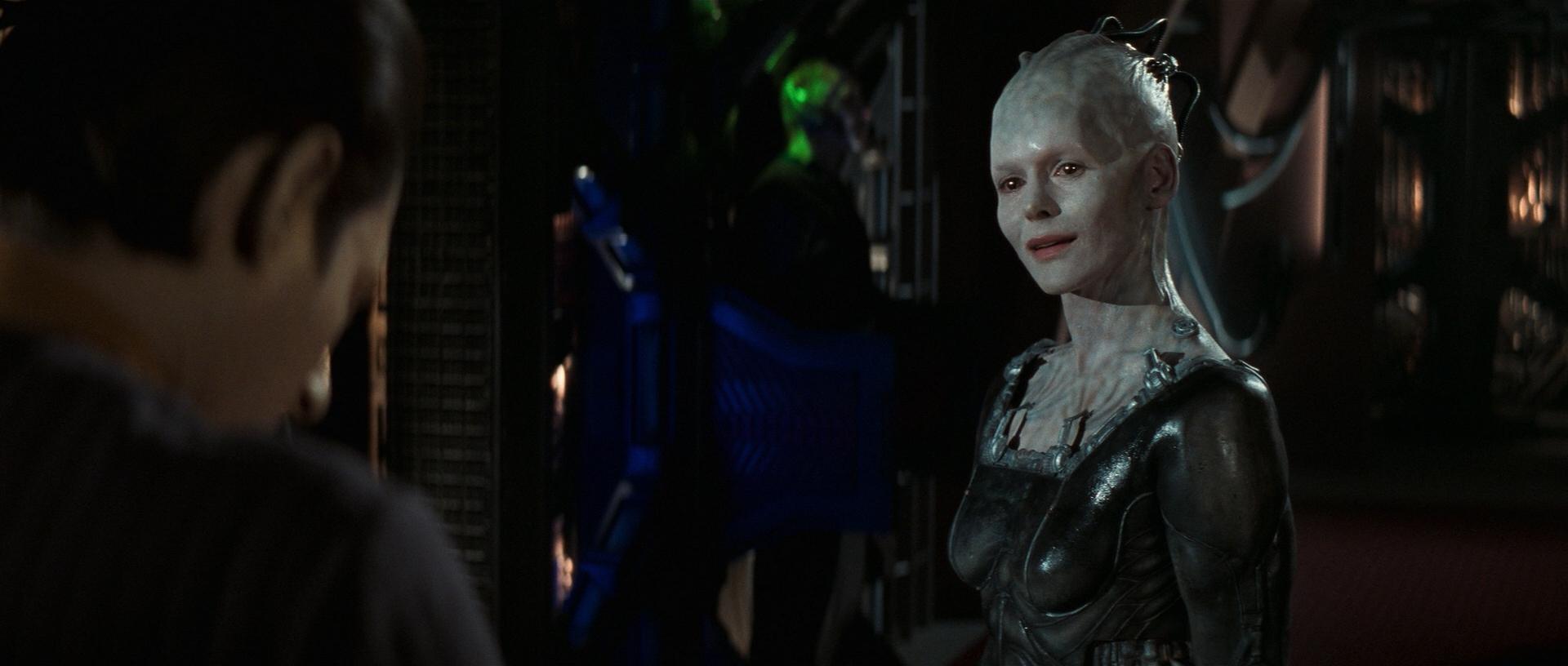
Alice Krige tilts her head with feline curiosity, surveys the room, and takes a slow, deliberate breath of fresh air.
This is the Borg Queen’s entrance in Star Trek: First Contact. It is grotesque. It is also unmistakably sensual. And it broke everything that the Borg had ever stood for. The Borg were never meant to be seductive.
When they first appeared in Star Trek: The Next Generation, they were terrifying precisely because they were impersonal. No leader. No emotion. No temptation. The Borg did not charm you, manipulate you, or whisper promises in your ear. They simply assimilated you and erased your individuality.
First Contact introduced something completely new: a queen. Played by Alice Krige, the Borg Queen shattered the original premise of the Borg Collective in the most unsettling way possible. She didn’t just command the Borg — she seduced, taunted and psy-
chologically dismantled her enemies. Krige’s performance transformed the Borg from a faceless, technological nightmare into something far more intimate and disturbing: a villain rooted in body horror, seduction, manipulation and psychological control.
The Borg Queen doesn’t simply conquer her victims. She courts them.
The scene of her assembly is almost ritualistic. The camera lingers. Krige plays the moment not as the activation of a machine, but as the entrance of a gothic matriarch, fusing biology and machinery into something strangely corporeal, even tactile. Instead of presenting the Borg as purely mechanical, the film makes them dis-
turbingly physical.
That’s where Krige’s performance becomes so effective. The Borg Queen is terrifying not because she behaves like a machine, but because she behaves like a person. A very manipulative one.
If the queen’s entrance establishes her theatrical presence, her interactions with Data reveal how dangerous that presence truly is.
Data has always existed on the edge of humanity. Throughout The Next Generation, his central struggle is not survival or power, but understanding humanity. He studies humor, friendship and emotions with the careful curiosity of someone who desperately wants to experience them rather than simply analyze them, whether that means acting, raising a cat, or attempting stand-up comedy.
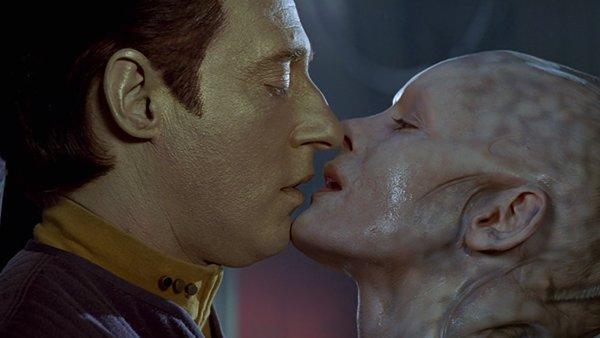
The Borg Queen recognizes that longing immediately. Rather than threatening Data, she tempts him. In one of the film’s most unsettling sequences, the queen grafts living human skin onto Data’s arm, allowing him to experience physical sensation for the first time. The
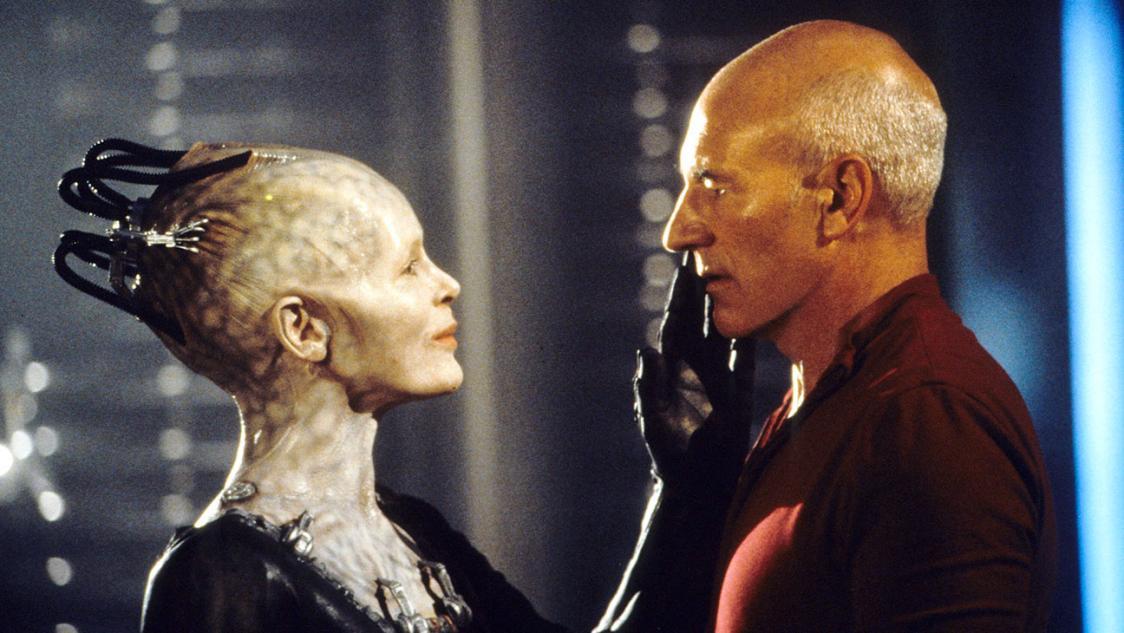
moment is quiet, almost intimate. She softens her voice and movements, offering the sensation as a gift rather than a trap. The experience is intoxicating for Data, and deeply uncomfortable for the audience.
Krige plays the scene with remarkable precision. The queen’s tone is patient and coaxing, like someone gently guiding another person toward an inevitable realization. She does not force Data to accept her offer; instead, she invites him to imagine what it might feel like to finally become the thing he has spent his entire existence studying.
Assimilation, in her hands, becomes temptation. What makes this strategy so disturbing is how precisely the queen weaponizes desire. The Borg once represented a purely external threat: an unstoppable force that stripped away individuality without hesitation or negotiation. The Borg Queen introduces something far
more unsettling assimilation offered as a solution, inviting victims to imagine surrender.
The Borg’s traditional horror lies in their ability to overwhelm entire civilizations. The queen introduces a more intimate threat: the possibility that someone might choose the Collective.
That intimacy cuts deepest when the queen turns her attention to Jean-Luc Picard. Unlike Data, Picard already knows what it means to belong to the Borg. His transformation into Locutus remains one of the defining traumas of his life, a violation of both body and identity that continues to haunt him long after his rescue. For the Borg, he was once more than an enemy captain: he was their voice.
The Borg Queen remembers this too.
When she speaks to Picard, there is an unmistakable sense of familiarity in her voice. She does not address him
simply as an enemy; she addresses him as someone who once belonged to her possessively.
In those moments, the Borg cease to be an abstract enemy fleet and become something far more personal. Picard is not merely fighting the Borg Collective, he’s confronting the memory of his own assimilation and the lingering fear that part of him may still belong to them.
Krige’s performance thrives in that psychological space. The Borg Queen never raises her voice, never rages or threatens. She speaks with calm certainty, as though the outcome of the conflict is already decided. After all, in her mind, assimilation is not destruction: it is perfection. What makes Alice Krige’s performance so unforgettable is the balance she strikes between elegance and monstrosity.
The Borg Queen is grotesque: a partially mechanical body assembled piece by piece,
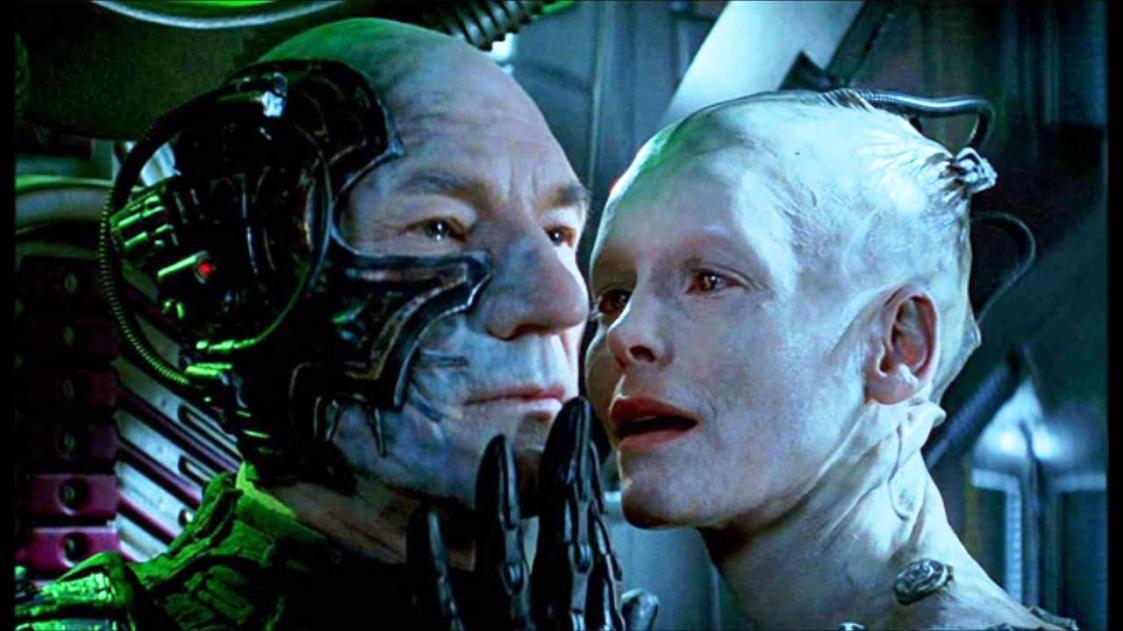
her exposed spine and biomechanical design reminding the audience that she is still very much a creature of the Collective. Yet Krige carries the character with unmistakable grace. Her posture is regal. Her voice is measured and deliberate. Even surrounded by the cold machinery of the Borg, she behaves like royalty presiding over a court.
The effect is unmistakably gothic.
Classic gothic villains blend allure with horror, drawing victims close before revealing the monstrous truth. Krige’s queen follows that tradition perfectly, transforming the Borg from a purely technological threat into something closer to a dark fairy tale. Instead of an unstoppable machine, the Collective now has a voice capable of whispering promises.
The introduction of the Borg Queen permanently altered how audiences understood the
Borg. What began in The Next Generation as a faceless technological nightmare evolved in First Contact into something more intimate and psychologically unsettling. The queen gave the Borg Collective a voice, a personality, and, most dangerously, a sense of curiosity about the individuals she sought to assimilate.
In many ways, that shift would echo throughout later Star Trek storytelling, particularly in Voyager, where characters like Seven of Nine explored the lingering psychological consequences of belonging to the Collective.
The Borg still conquer worlds, but under the queen’s influence, they also tempt them subtly and irresistibly.
Krige transformed the Collective into something deeply personal: a villain who studies her enemies, identifies their deepest desires, and offers them exactly what they want. Perfection. Belonging. Humanity. All at a terrible
cost.
Because the most dangerous monsters are not always the ones who attack first. Sometimes, they simply lean closer and make you an offer.
Long live the queen. Resistance, after all, was never really the point.

TANIA ROSA BINDHOFF:
Tania Rosa Bindhoff is a mezzo-soprano and selfproclaimed “opera-singing Trekkie.” She works as a civilian for Howard County, Maryland Fire & Rescue and runs the Columbia Pawtisserie, her gourmet pet treat business. She lives with her husband and cat, and when she’s not performing or helping her community, she’s baking, cosplaying, cross-stitching, reading and boldly nerding out where no one has nerded before. @TrekkieDiva
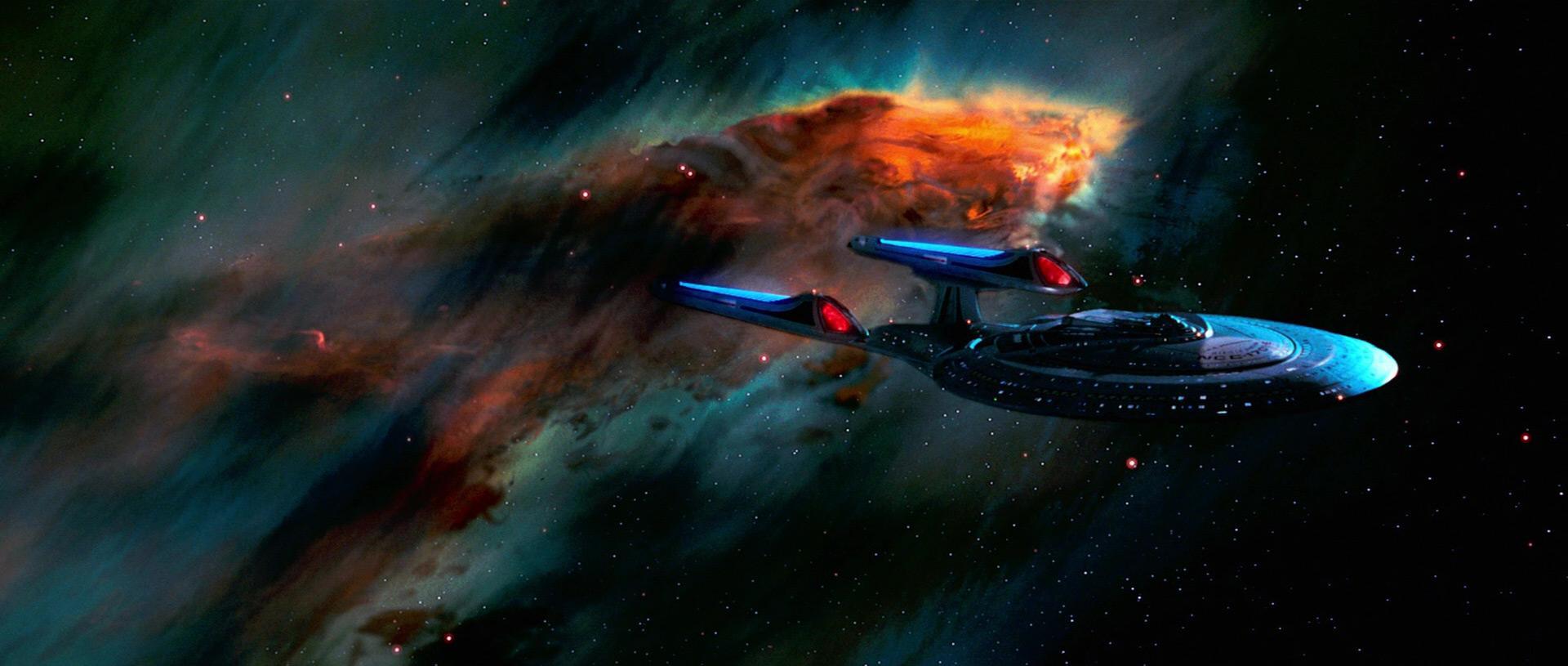
The U.S.S. Enterprise-E glides through a nebula near the Romulan Neutral Zone.

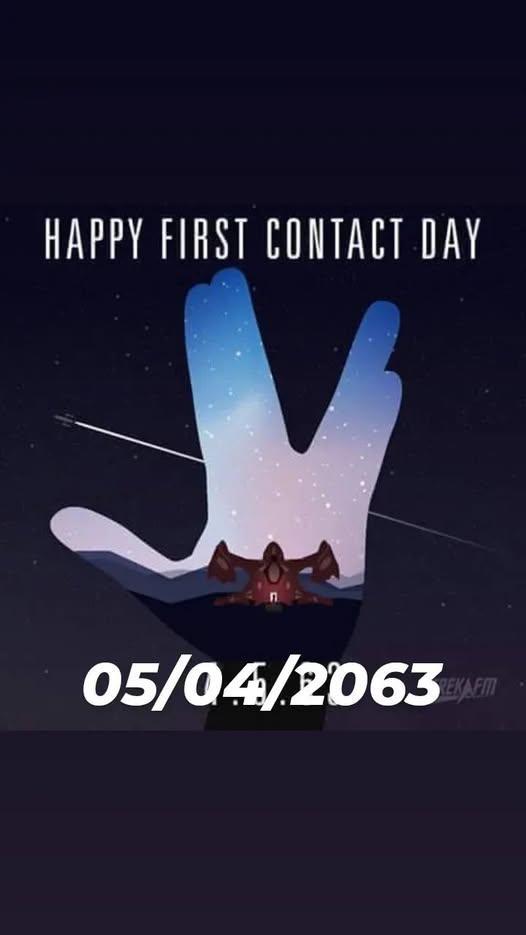


“Captain’s log, April 5th, 2063. The voyage of the Phoenix was a success, again. The alien ship detected the warp signature and is on its way to rendezvous with history.”
As an adolescent watching Star Trek: First Contact in the theater, it was a uniquely transformative experience. It looked different felt different than anything Star Trek had shown me before. A new Enterprise. Sleeker, sovereign. New uniforms that carried a weight of command. And the Borg… not just antagonists anymore, but something far more visceral, more intimate, more terrifying.
Like many lifelong fans, I couldn’t help but notice how dramatically the Borg had evolved from their introduction in Star Trek: The Next Generation to their cinematic debut.
They weren’t just a collective — they were horror. For weeks afterward, I dreamed of being hunted through the dim, smoke-choked corridors of a halfassimilated Enterprise-E. Let’s just say I took Alynna Nechayev’s advice to heart I slept with a phaser under my pillow. Just in case.
But beyond the groundbreaking visuals and darker tone, First Contact gave us something far more enduring than spectacle.
It gave us a date. April 5, 2063.
A point on the calendar that felt close enough to reach — close enough that, for the first time, Star Trek’s future didn’t feel like fantasy. It felt like destiny
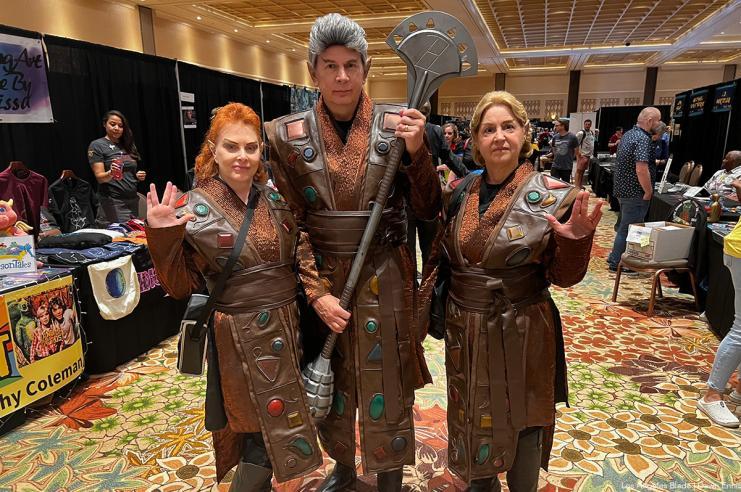
waiting on humanity to grow into it.
And in that way, First Contact Day joins a curious and deeply human tradition: the celebration of fictional milestones that somehow feel more emotionally true than many real ones.
Every year, fans rally around Star Wars Day “May the Fourth be with you” a playful pun that has become a global celebration of myth, heroism and generational storytelling rooted in “Star Wars.” In another corner of science fiction, Star Trek fans mark the somber anniversary of the Bell Riots, a fictional uprising in 2024 that forces a reckoning with inequality, homelessness and social neglect.
These “holidays” are not printed on any official calendar. There are no federal observances, no mandated days off, no institutional weight behind them. And yet they persist. Why?
Because they aren’t really about fiction. They are about values.
May the Fourth celebrates
courage, resistance against tyranny, and the enduring belief that even the smallest individual can change the fate of a galaxy. The Bell Riots force us to confront uncomfortable truths about our own society holding up a mirror and asking whether we are closer to Starfleet’s utopia, or to the Sanctuary Districts we were warned about.
And First Contact Day? First Contact Day is about hope at its most audacious. It dares to suggest that one moment one breakthrough, one act of discovery could “…unite humanity in a way that no one ever thought possible.” That in the aftermath of our greatest failures poverty, war, disease, division we might still find the capacity to rise, to rebuild and to reach for the stars not as competing nations, but as a single species. Not far removed from the vision of the late great Gene Roddenberry.
We know there was no Zefram Cochrane launching the Phoenix from the Montana wasteland. No Vulcan ship descending in silent acknowledg-
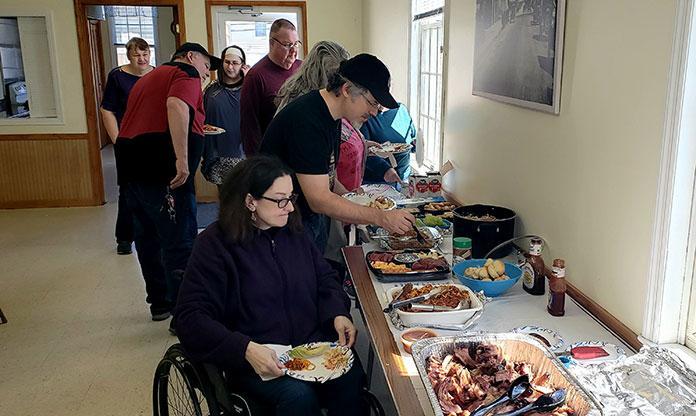
ment of our first steps into a larger universe.
But the act of celebrating April 5th is not about pretending that it happened. It’s about insisting that it still could.
In gathering each year whether through conventions, quiet rewatches, or simply raising a glass to the future fans participate in something larger than fandom. They engage in a shared act of optimism. A collective agreement that the future is not yet written, and that humanity is still capable of becoming something better than it is today.
In that sense, fictional holidays may be the most honest kind we have.
They don’t ask us to remember who we were.
They ask us to imagine who we might become.

And perhaps, in the act of imagining, take one small step closer to a future where poverty, war and disease are not inevitabilities but relics of a past we finally outgrew.
A future where, one day, when April 5th arrives it won’t just be a celebration of fiction. It will be a remembrance of the moment everything changed.

CHRISTOPHER KADY: Rev. Christopher Kady, R.M.A. is a registered medical assistant and ordained interfaith vicar. Living and working in New Hampshire. He has spent the last 22 years in service to faith and humanity, and the last 42 years loving all things
Star Trek


Click this graphic to buy your copy!









Walking around the Paramount lot during the filming of Star Trek: First Contact in the spring of 1996, a peek into Stage 15 reveals the construction of the football-field-sized saucer on which Picard, Worf and Lt. Hawk will spacewalk. It practically fills the entire cavernous, four-story sound stage with the back plates of the dish braced high up near the ceiling and rear wall of the sound stage, which leaves a wide corridor of floor space underneath. There, lined up like Chinese Terracotta Soldiers, are a series of identical mannequins with Lyle Lovett hairstyles, wearing molded Borg suits, drying in the southern California heat.
Executive Producer Rick Berman told Star Trek Communicator Publisher Dan Madsen during filming that the updated Borg for the movie were the most dramatic and the biggest challenge for the production. “The Borg costumes are very complicated.
“There are a lot of electronics and lighting equipment in them, a lot of molding, plating, painting, and foiling. They are very, very time consuming to get on and off and if anything happens to one of them, it takes a great deal of time to fix it. It has been a major task to cast the right people for the Borg — people who are not only good actors but also the right body types. The continual redesign of the costumes, the prosthetics, the makeup have been a huge job.
“They’ve literally gone through an evolution since we started shooting. There are some Borg who are almost prototypes of Borg that get seen later in the
film. We ing and dealing with that throughout the entire process.
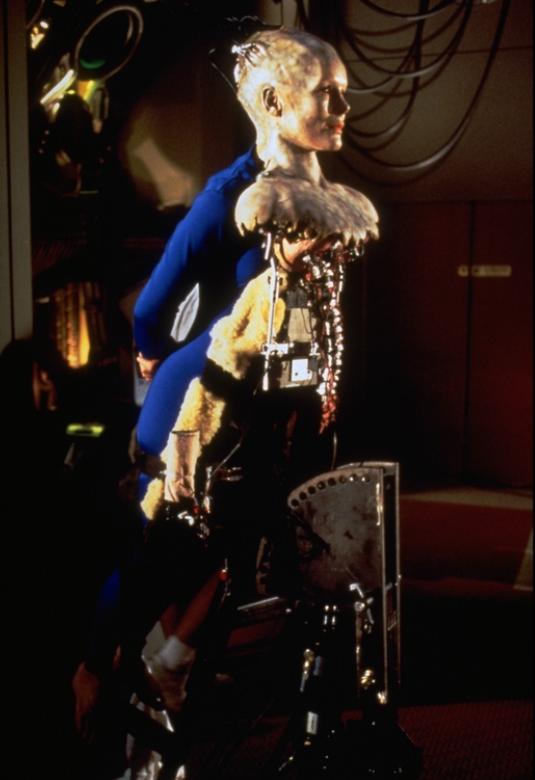
Asked if the Borg had been dramatically changed from TNG on the small screen, Berman said not in principal. “I think anybody who knows the Borg will know that these characters are Borg. They do not act differently; we have not conceptually changed them. But these are the kind of Borg we’ve always wanted to create but didn’t have the time or the money to do it properly on television. They are a great deal cooler!”
enjoys, but more importantly, the new designs were in the hands of large, talented teams led by ST Makeup Director Michael Westmore and, while new to the Trek universe, veteran sci-fi Costume Designer Deborah Everton.
FROM THE NECK UP
“What we wanted to show is that the Borg are suffering,” said Westmore of his First Contact makeup designs. “They’re a
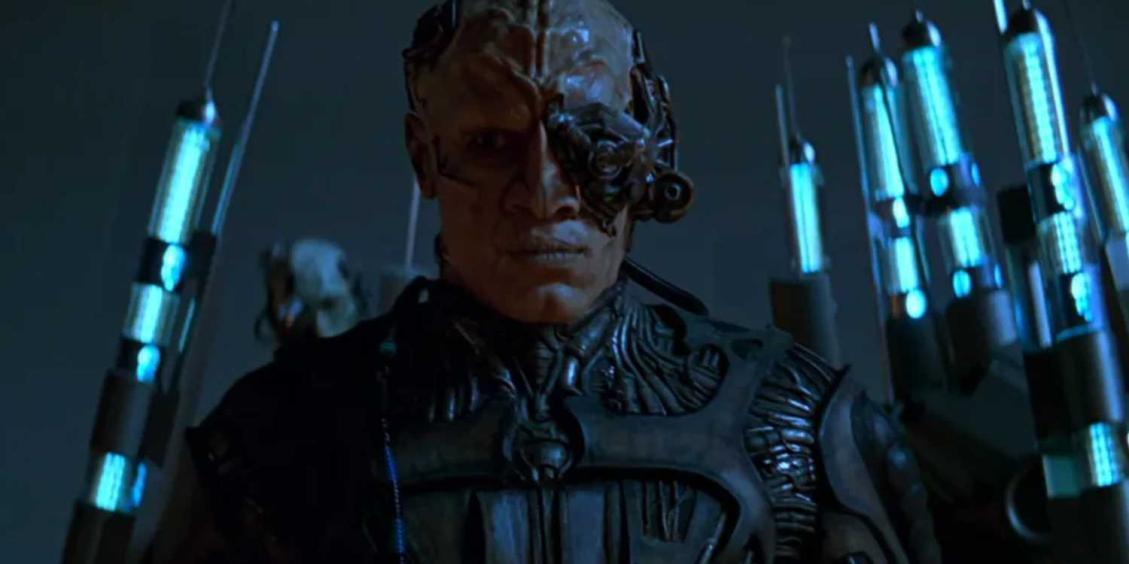
collective and it hurts.”
Westmore is part of a legendary Hollywood family that started in 1917 with his grandfather, George, who created the first studio make-up department. After college, Michael had a solid career in feature films, leading to an Academy Award for Makeup for the 1985 film Mask. He was hired in 1986 to work on TNG and over the course of his career on TNG, DS9 and Voyager, won nine Emmys. Westmore worked with Frakes and Everton to design makeup and costuming that would retain the essence of the Borg, but newly define them for the big screen. “In the television show, the Borg were more or less zombie-like,” said Westmore.
“This time, they’re scarier and much more threatening. This time, you wouldn’t really want to get close to them.”
To achieve this look, Westmore collaborated with, among others, Makeup Artist Scott Wheeler and Special Effects
Makeup Artist Jacob Garber in his lab to go through multiple sculpting and molding phases to get the look he wanted, eventually settling on around eight molds with enough pieces in each to mix and match indefinitely. “Our original Borg had more of a helmet,” said Westmore. “These new Borg are more bald with electronic attachments embedded in their head and different pieces across the top of the head, more like a skull.”
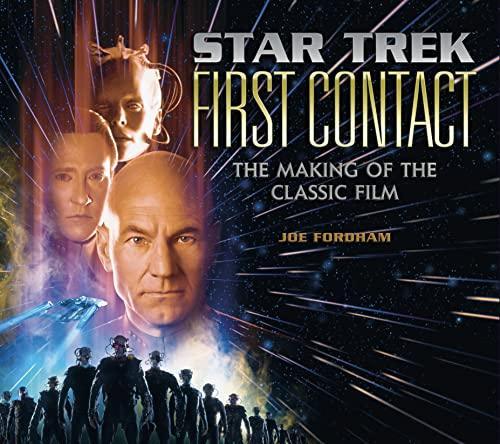
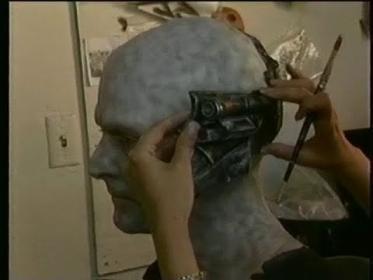
A critical element of the makeup design was the prosthetics. Prosthetic artists Jake Garber and Barry Koper came up with appliances for heads, arms and hands, creating sculpted foam latex pieces that suggested dying organic tissue. Wheeler told author Joe Fordham in his book Star Trek First Contact: The Making of the Classic Film, “My reference was cadavers. We layered colors in reverse to create a sense of depth. We warmed up areas using a brick color airbrushed in washes,
waves, and squiggly details.” Blacks and muddy amber were added, then covered by an overall eggshell color to fade everything. The final touch? “We added K-Y Jelly,” said Wheeler, “which acted as a lens to make it more translucent.”
And blinkies! For which Westmore’s son, Michael Westmore, Jr. was responsible. The

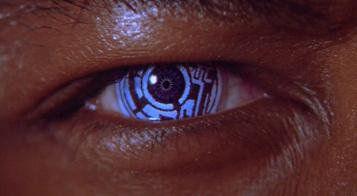
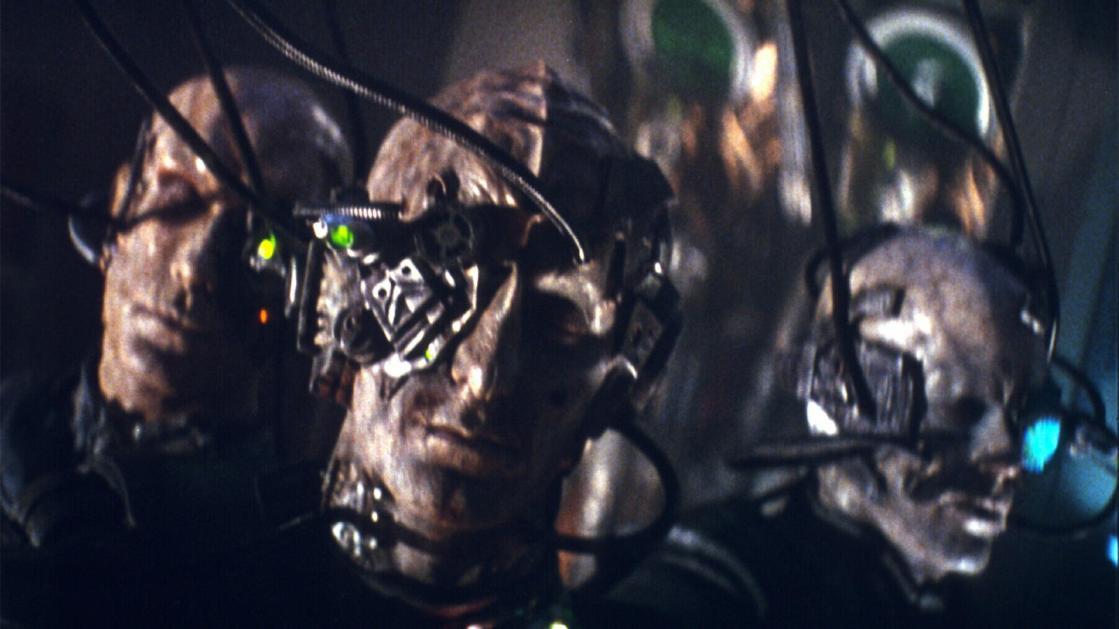
younger Westmore first designed blinkies for Geordie’s eyes, then later for Data whenever he was opened up. For the First Contact Borg, 34 specialized, programmable eyes were created, each wired individually with its own sequences.” Westmore Sr. described them as not just lights, but rather, “They’re actually programmed so they’ll each do something different. Each Borg has its own battery pack and it was my son’s job to run around turning them on and off and making sure nothing broke!”
FROM THE NECK DOWN
Everton worked with Westmore on costume designs that would take the Borg a step closer to a perverse kind of individuality. Everton brought to the assignment a love of sci fi and experience in such films as “Terminator 2”, “Highlander 2”
and “The Abyss” (Trek writer Ronald D. Moore would later hire her to do costumes for his television remake of “Battlestar Galactica”). She watched all of the Borgrelated TNG episodes and talked over the character with Frakes and Berman, developing ways to keep the same silhouette, but making them distinctive for First Contact. Her key idea was that the movie version of the character should look like Borg from the inside out, not someone just wearing a suit as they sometimes looked on television. “When we got ready to do our version of the Borg suits,” she said while sitting in her book-stuffed studio office in Trailer 34 at Paramount, “we plated them, painted them, and did all sorts of fabrications to give them different textures. It looked hard in some places, gooey in others. Then in some places we had pieces of skin that looked like
they came over instead of just coming out.”
And that little bit of creepy individuality? “I believe that there are many types of Borg. They don’t just assimilate humans, there could be Romulans, even animals, any species they come across.” Once there was agreement on Everton’s main concept, she worked with Todd Masters
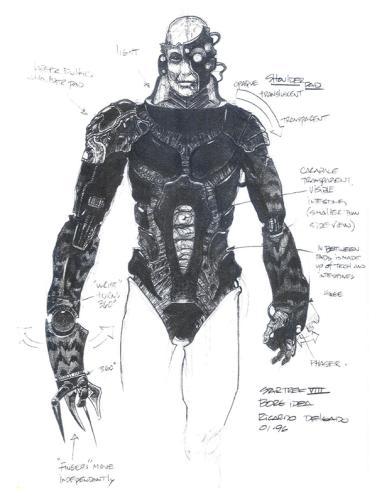
and his MastersFX artist Jeremy Aiello to a produce a clay maquette, a doll-size model to test their ideas. Once approved, the team sculpted the full-size fiberglass mannequin on which the rubber suits were made, then left to dry in the sun on stage 15 as they were mass-produced.
Berman’s remark about how challenging the Borg were was explained by Westmore description of just how arduous it was to suit up and apply makeup to the eight main Borg (actors who could portray multiple variations as needed) and the Queen, a process which started each production day at 3 a.m.(2 a.m. for Alice Krige). Makeup alone took
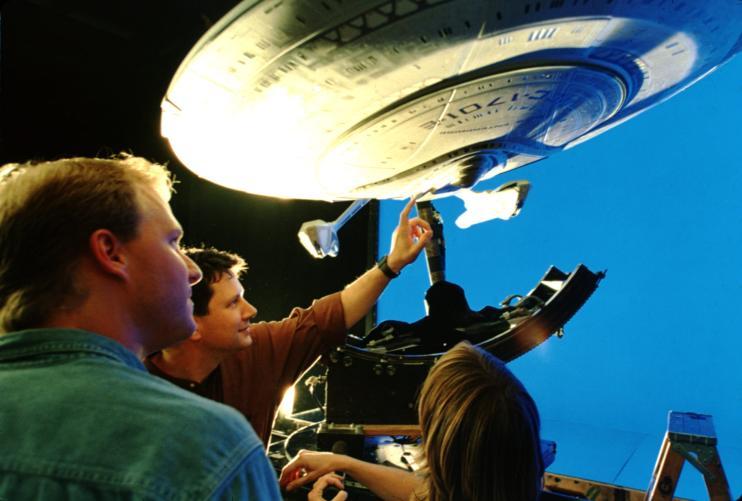
five hours. Westmore employed 18 makeup artists he called his “dream team” to do the work, sometimes starting a second team in the afternoon so others could go home and get some sleep. This dream team of makeup artists included not only his son but his brother Monty. The Borg were finished off by customized technical appliances created by Visual Consultant/Art Director Herman Zimmerman and his assistant John Eaves (who also worked on creating designs for the new Enterprise-E).
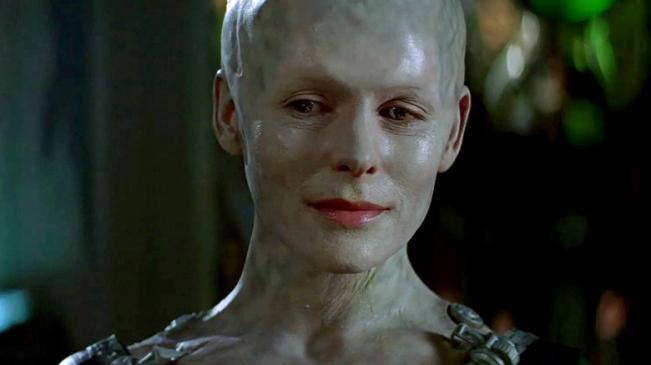
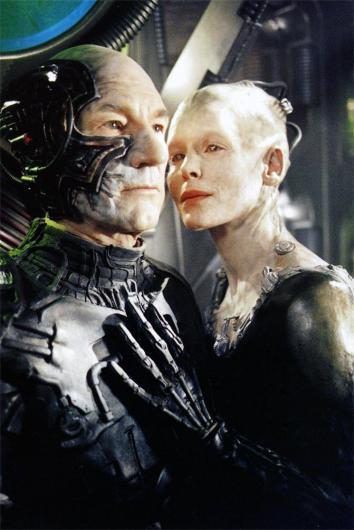
The epitome of the Borg design was, of course, the Borg Queen, played by Alice Krige. Everton said that while the
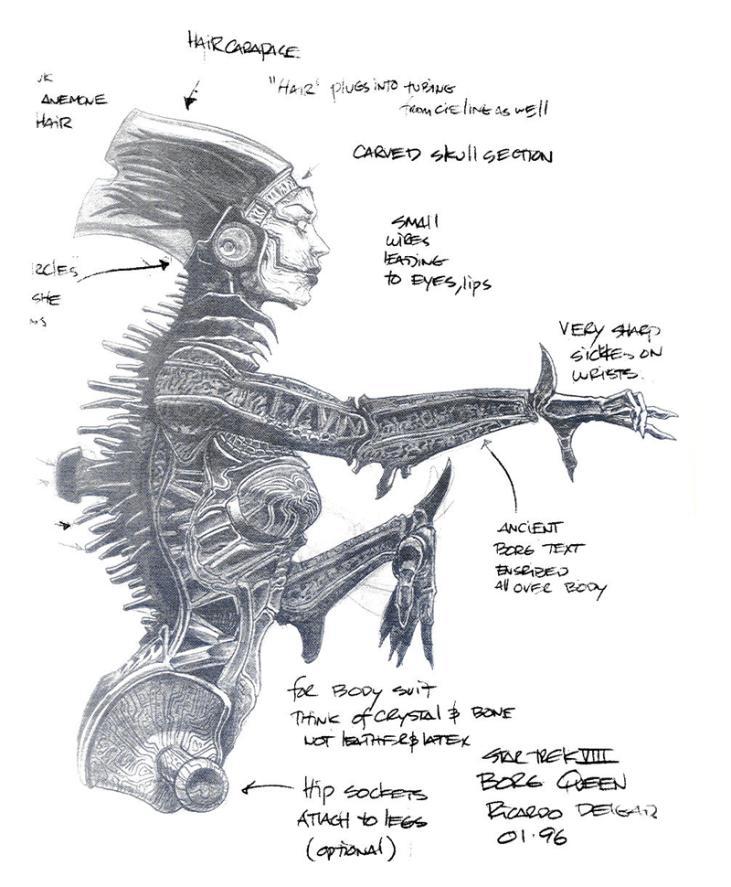
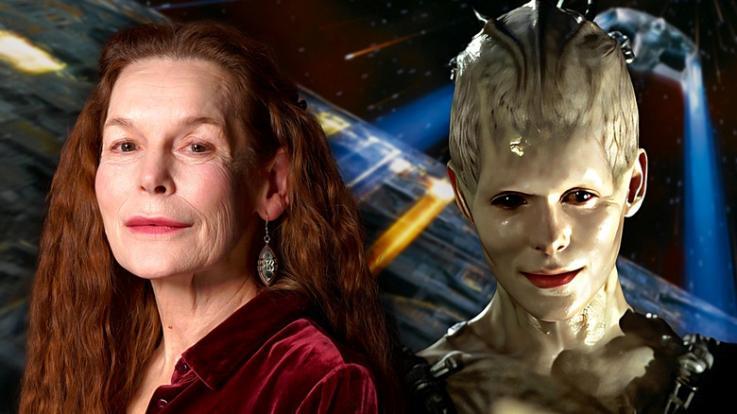
Queen’s costume was a scaled down, simpler version of the Borg, it was still in an elaborate design, but one she kept spare and scary. “She had to have that evil quality,” commented Westmore of the collaborative design, “but we didn’t want to lose the beauty of Alice’s face. We experimented with different contact lenses, hair, no hair. She had pulled and stapled skin, but not on her body, not her face. You do have to know she’s boss.”
To fully realize the Borg Queen’s costume, MastersFX worked from a full-body cast of Krige. Following a similar design trajectory, various iterations were tested and refined until Aiello was given the go-ahead to create another maquette. The life cast was also used to develop all the prosthetics. Westmore entrusted Wheeler with the Borg Queen’s makeup.
Alice Krige told Melissa J. Perenson, writing for the Star Trek Communicator in 1996, that she drew strength for her character from the elaborate costume and makeup. “They were the most interesting tools to explore her with. The script described her as hauntingly beautiful and I really hoped we could somehow accomplish that. She’s part human, so that already there was something for us to identify with.”
The suit almost did Krige in when they started shooting, however. Makeup from the chest up, including the head, took six hours to apply with another hour to put on the suit. Initially the suit was made of hard rubber which uncharacteriscally shrunk just enough the first day to cut off
Krige’s circulation, leading to excruciatingly painful joints and extremities. Prosthetic effects master Todd Masters called in artists Dave Matherly and Bill Fesh to redesign the suit over a long weekend, creating a suit that Krige said felt more like marshmallows for her remaining 13 days of shooting. Despite the daily seven-hour makeup and costume sessions, Krige said the suit especially
was very helpful playing the character. “I felt naked, as if I was on stage with no clothes on,” she recalled. “It was oddly liberating.” Masters also led efforts to update Picard’s Locutus suit, made all the more challenging because they didn’t really have a budget for it. Masters told The “Hollywood Reporter” in a 2016 article that they plowed ahead, even over objections from the studio, because a movie Borg needed to look good when projected on a 300-foot wide screen. “My team somehow cobbled together a suit for Locutus out of Borg parts,” said Masters. “So we didn’t use the TV suit. We actually made it. I think the top is part of the Queen’s suit and part of one of the male Borg suits. It actually didn’t close in the back, so you never see Locutus from the back.”
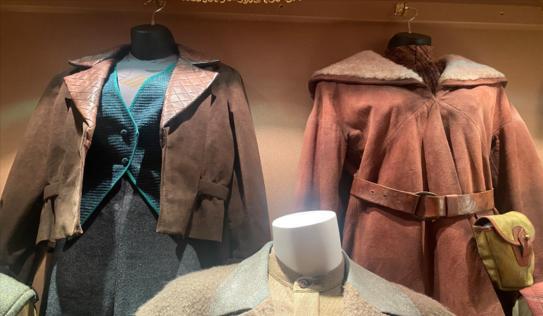
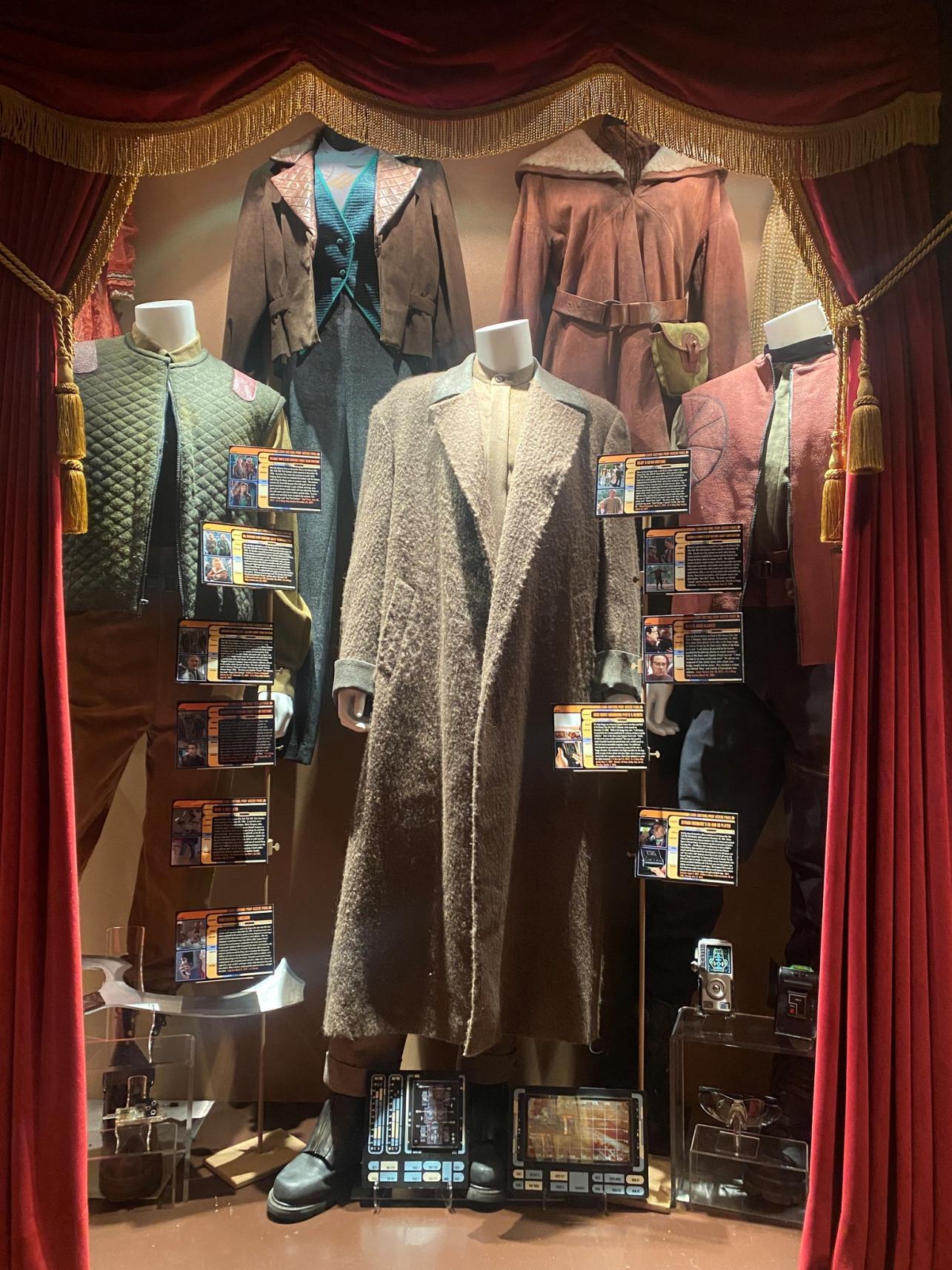
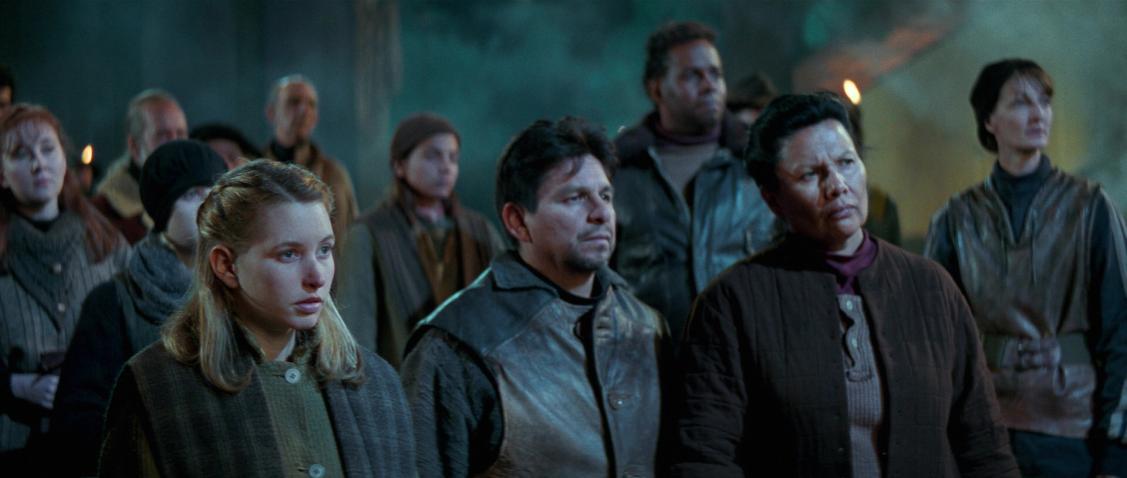
To create the over 800 other costumes needed for the movie, Everton had boned up quickly on TNG to, as she put it, “learn the language” of ST when
she got the job. She had to visualize multiple time periods, from the 1940s to the mid 21st -century to the new earth-tone color palette of the updated Enterprise-E bridge to create her Trek take on encompassing the First Contact world. “I really saw this story as almost a gothic romance. I wanted to bring out the almost legendary or mythical aspect of the story so I chose greys, blacks, mauves. I felt it was a color palette that told it better, not dark or negative, but dramatic, romantic, heroic.”
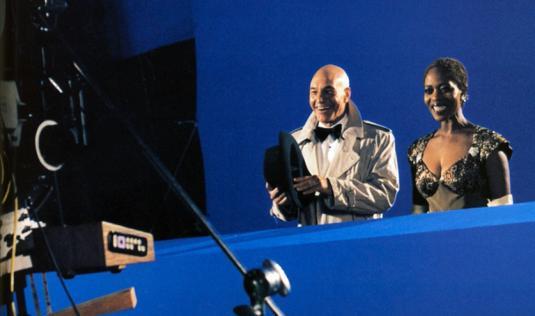
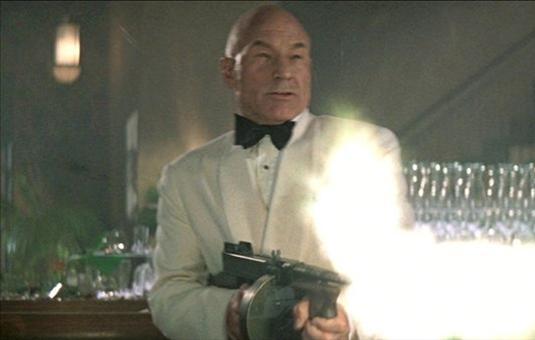
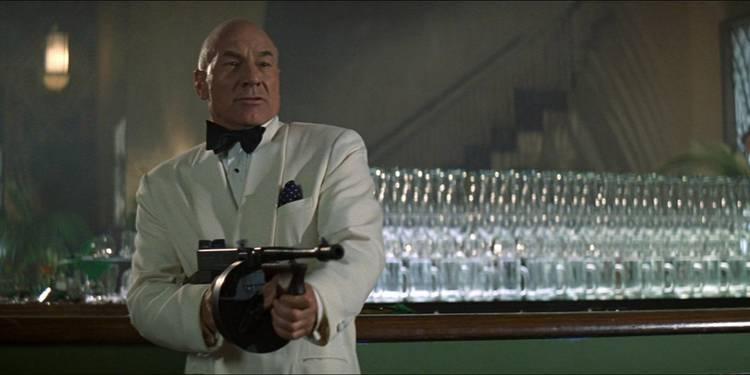
Picard especially gets the hero treatment in the 1940s nightclub sequence, emerging almost Bond-like in an elegant white dinner jacket, to blast Borg with a tommy gun. Said Everton, “The whole thing was to take the Dixon Hill character and refine him, make him more elegant, keeping the romantic figure that Picard is.”
Everton assumed that everyone in the ST universe is dressed by the computer, but that each
person would have their own personal tastes programmed in, so she looked for small ways to reflect individual character choices. She also enjoyed characters that were a blank slate, like Cochrane.
“Even though he’s so established in the lore of ST, he’s not a character with which we’re really famil-
him and take his character pretty far out.”
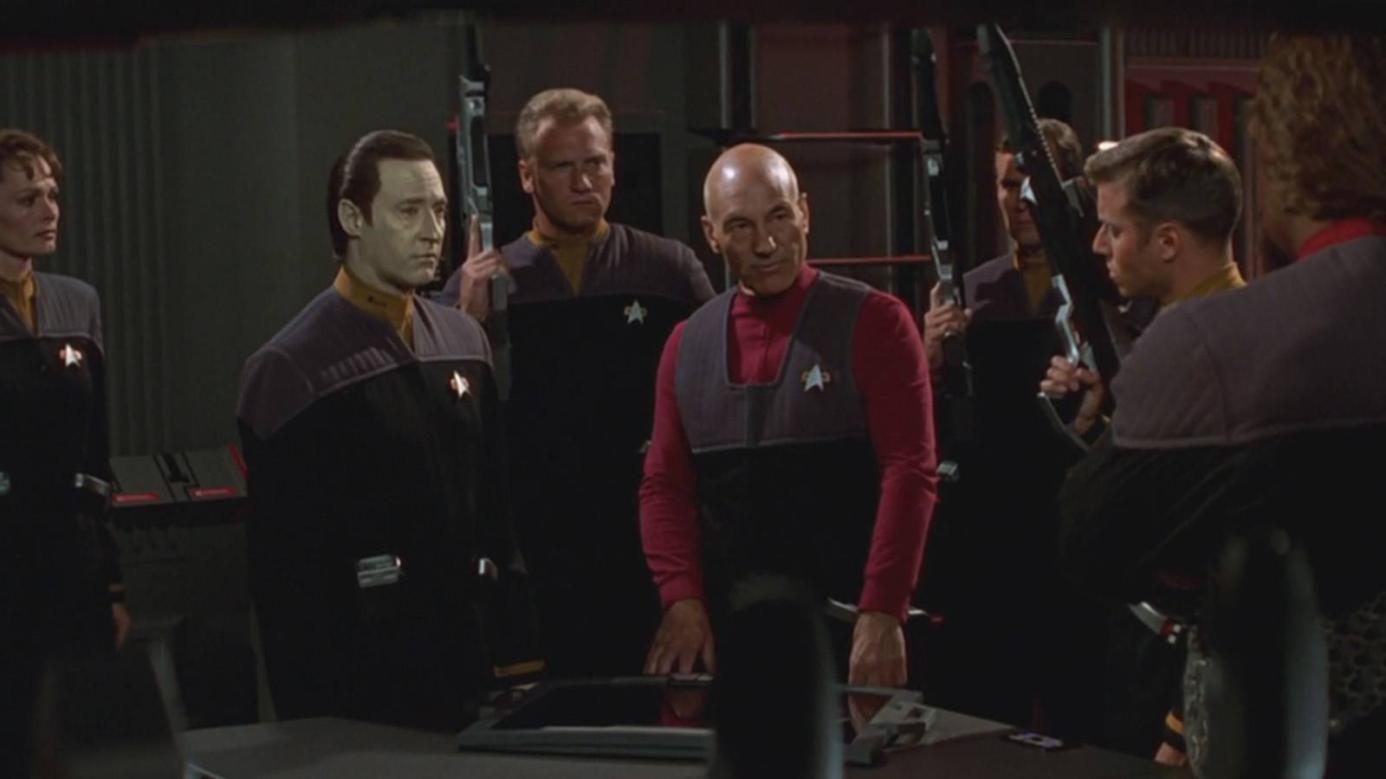
Busy with two other Star Trek shows in concurrent production (DS9 and Voyager), Costume Designer Robert Blackman nevertheless retained creative control over the crew’s updated uniforms, referred to by Everton as Mr. Uni-
they’re really very intricate including all the little details over the years of what each actor likes and dislikes.” Blackman designed the more militaristic-looking uniforms, but Everton did the color changes. The core of the new uniforms were an elegant dark jumpsuit with light grey epaulets
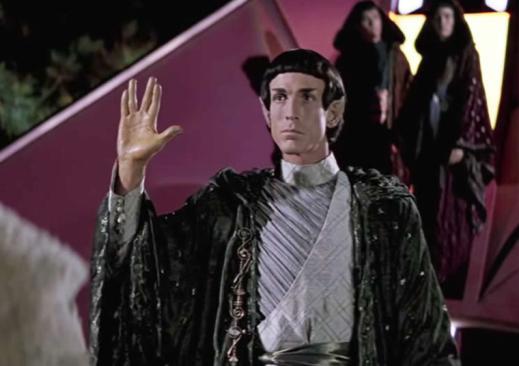
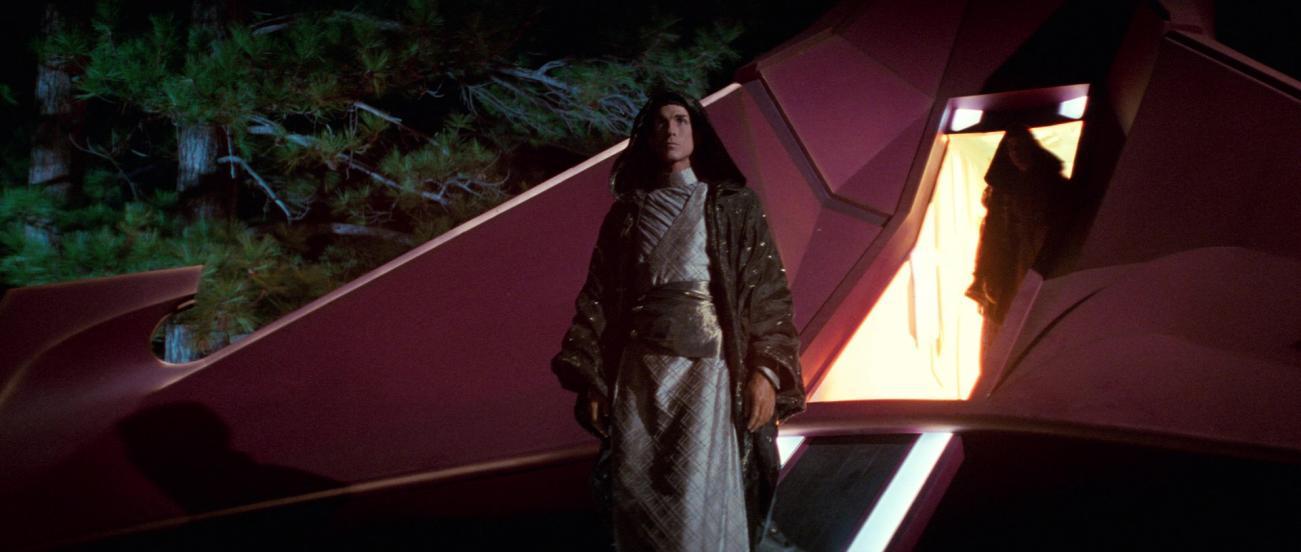
sive, all the same.” Velvet lining gave the robes some shape and heft as the Vulcans floated down their ship’s ramp towards their moment in Star Trek history.
Everton had one disappointment she noted in her conversation with Block and Erdmann — the way the Vulcan costumes looked in the film. She had envisioned the belts in a Japanese obi style, to be worn high on the costume. Unfortunately, she said,
finally appear was shot at three in the morning up in the mountains [where the Angeles National Forest in California stood in for Cochrane’s camp] and I had to be in town the next morning working on a different part of the movie. I couldn’t be there when they shot the Vulcans. When I saw the dailies, and how low the belts were, I wanted to cry. The costumers had illustrations showing how to put this thing together, but at three in
Magazine of the Official Star Trek Fan Club), issues #109 and #110. Material is used with the kind permission of the magazine’s former publisher and editor, Dan Madsen.

DEBORAH FISHER: Deborah Fisher has been a Star Trek fan since The Original Series debuted while she was in high school. She’s been a professional writer her entire life, which helped her get a Writer’s Guild-sanctioned internship with the staff of ST: The Next Generation. One of her current passions is swinging swords with friends as a member and instructor with the Whidbey Swordplay Association. Deborah lives on Whidbey Island, a ferry ride north of Seattle, with her husband, son and mini-American Eskimo puppy Mia, who’s currently running the whole show.
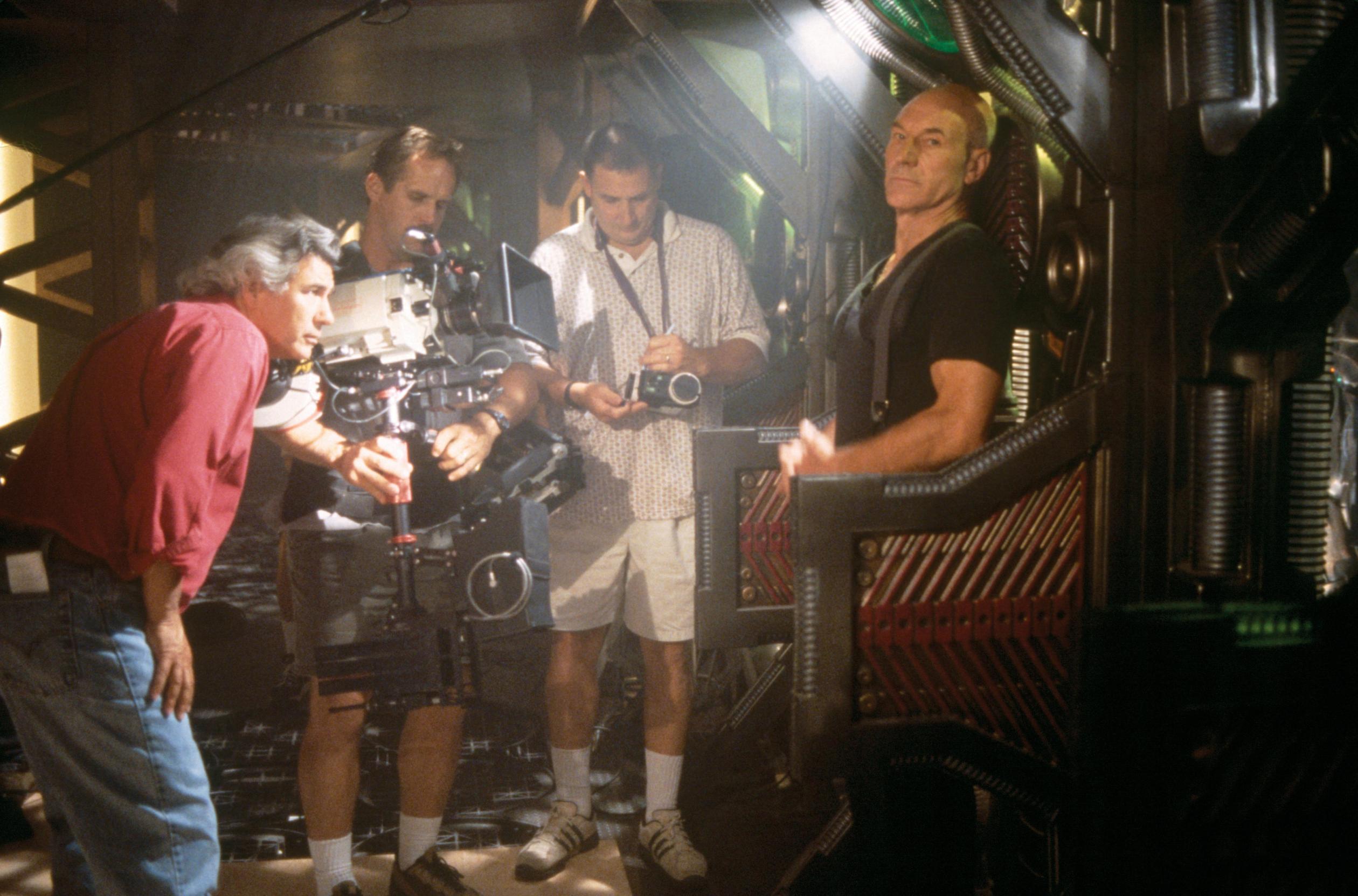
Iam standing just this side of magic, on the film set of Star Trek: First Contact. In front of me, the bridge of the new Enterprise-E dominates sound stage 8 on the Paramount lot, lit by atmospheric, hazy light. It’s a lavish update of the familiar, echoing the longer, leaner lines of the new ship’s overall design. Displays are richer, more complex, reflecting a variety of reds, oranges, and purples that thematically blend with the bridge’s muted earth tones. Crew positions have been adjusted to focus more attention on the Captain and a more open framework for the various stations allows more spaces for action to take place.
Between me and the set, there is a line of massive cameras, while around me there are numerous black canvas chairs, some occupied by cast members, relaxing between takes, noshing on whatever treats and goodies Crafts Services has put out on large tables in the back of the sound stage today. The crew is interstitial to all of the equipment and the set. It’s easy to pick out who’s running the cameras, who’s monitoring the script pages, who’s in charge of lighting, who’s moving cables, but there are also all types of busy people whose functions are not entirely clear,
except for one man who’s only job is to wipe the fingerprints off all the bridge consoles in between takes.
This orderly chaos started with make-up and prep before dawn, with action progressing in tight, focused episodes of shooting 20 seconds of script, the director yelling “Cut!,” then followed by roughly 45-minute interludes during which all lighting and cameras are adjusted for another angle or close-up within the current scene or a major re-set for a master shot of the next scene.
Except for lunch and dinner breaks, this will go on until late into the evening with some days during the fast-paced 12week shoot stretching to 18 hours long. By the time filming finishes on July 2,1996, First Contact will be only two days over schedule, keeping the production on target for a November 22, 1996 release. When the studio green-lit the movie, it wanted to replicate the financial success of Star Trek: Generations from two years prior while spotlighting First Contact as
a jewel in the crown of the upcoming 30-anniversary Trek celebrations. At a total cost of $45 million, the film will come in just under budget and go on to earn $146 million worldwide, making it at that time the second highestgrossing Trek film ever. It will also be wildly popular with audiences. I’ve never been on a film set before and to the uninitiated, while it seems a little chaotic, it is also utterly fascinating. I am on assignment for the Star Trek Communicator magazine to write about the making of First Contact, the eighth feature film in the franchise, which will include interviews with cast members, guest stars, and designers. I’m here now because I got my foot in the Star Trek door when my script submission won me a coveted Writer’s Guild-sanctioned internship with the writing staff of Star Trek: The Next Generation for six weeks in January and February of 1994, the show’s final intern as TNG headed towards the end of its sevenseason run. I’ve been writing for the Communicator and the Para-
mount website, Startrek.com, for the last two years.
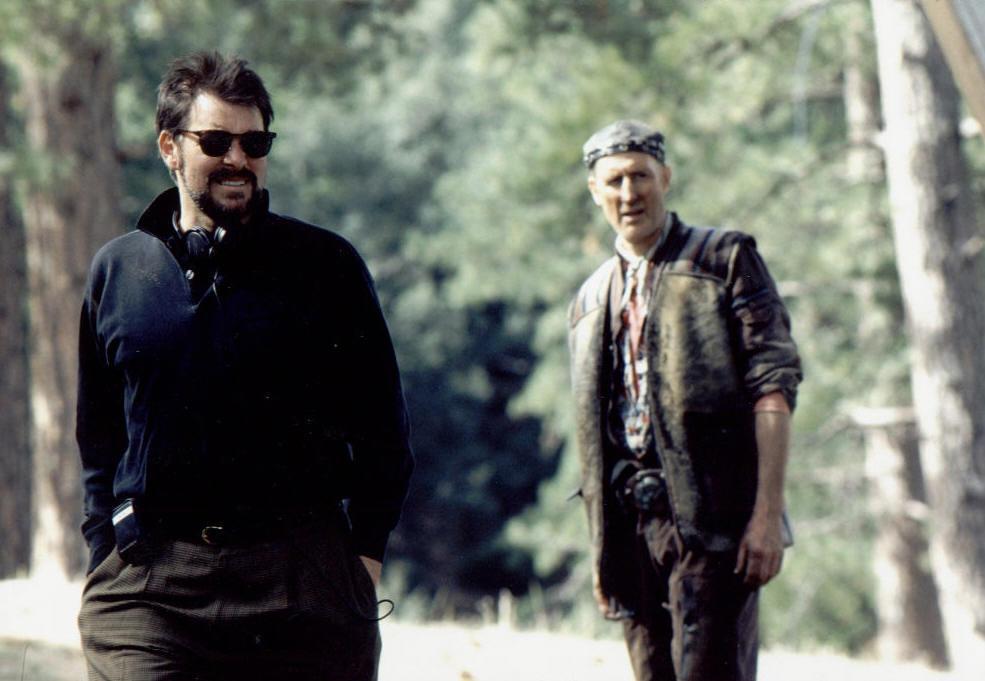
As I drink it all in, the man literally standing in the center of all this activity, the film’s director, Jonathan Frakes, looks at me and asks, “Have we not met?” It’s been two years since I had the freedom to run around on the TNG sets as an intern, including the Enterprise-D bridge set on this very sound stage (and where my son, on a set tour on his fifth birthday, got to sit in the Captain’s chair). After I introduce myself, he smiles warmly and nods. Whether Frakes actually remembers me from two years ago or uses this as a very tactful way of asking a stranger what they’re doing on the set, the interaction is emblematic of his eye
for detail and relaxed approach to managing the shooting atmosphere on the huge set.
Today the cast and crew are working their way through scene #43. Principal photography started on First Contact on April 8, 1996, shooting first on location for one month at the Titan Missile Museum in Arizona and then picking up chilly night scenes in the Angeles National Forest in southern California – all standing in for Montana where the crew first meets Zefram Cochrane. By the time scene #43 comes up for filming, the cast and crew have spent almost two months inside a suite of massive sound stages on the Paramount lot many the same stages in which the entire sevenseason run of TNG had been shot.
It’s a warm spring day outside in Los Angeles but inside, Captain Picard has just learned that it’s April 4th, 2063, the day before the legendary Cochrane will test the first warp drive, which triggers another momentous event – first contact with the Vulcans. The bridge of the Enterprise-E is on red alert as the crew intercedes in an attack on a missile silo in 21st century Montana. The attacking ship is Borg. In this moment, Frakes is clearly enjoying his job, managing no less than three separate story lines in this film, written by TNG vets Brannon Braga and Ronald D. Moore (sharing story development credit with Executive Producer Rick Berman,) grounded in the central arc of the Borg’s
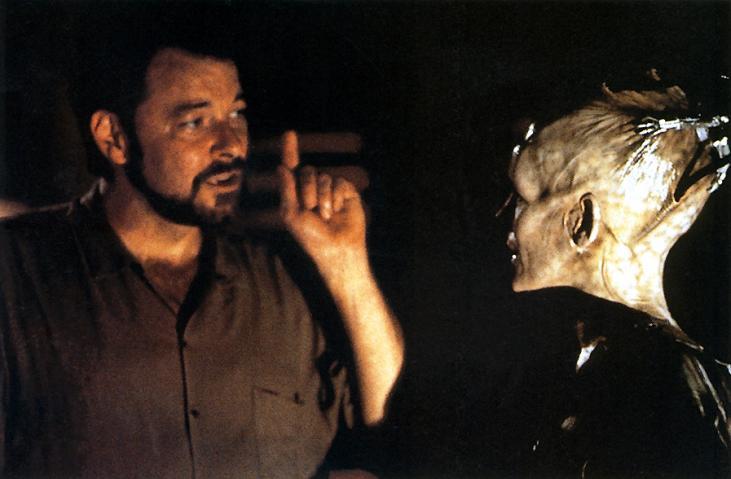
attempt to travel back in time to the very beginnings of the Federation and Star Fleet to obliterate Earth history. Story #1 revolves around Riker, Troi, and LaForge working with Cochrane, played by Academy-Award nominee James Cromwell of Babe fame. Story #2 centers on Picard as he develops a relationship with Cochrane’s assistant, Lily Sloane, played by multiaward winning actress Alfre Woodard, as they try to restore Earth’s future. Story #3 shows Data’s encounter with the Borg Queen, deliciously played by Alice Krige (who will get a Saturn Award for Best Supporting Actress for this role). Threaded through this complex web of story and action are Picard’s own nightmares of being co-opted by the Borg and transmuted into Locutus in the two-part “The Best of Both Worlds” that ended TNG’s third season and opened the show’s fourth season. The fact that the Borg know that April 4th, 2063 is so critical is a fact extracted from Picard’s brain when he was assimilated into the Collective When Frakes got this as-
signment, he had been waiting for this moment for a very long time. He knew as far back as the second season of TNG that he wanted to expand his career beyond acting and get into directing. When he asked Berman back then if he could direct, Berman told Frakes he’d have to attend what author Joe Fordham called “Paramount University” first. Frakes was given access to all aspects of production to allow him to study, watch, and ask a lot of questions. He talked his way into the editing suites of TNG, for example, where he spent some 300 hours shadowing the show’s resident editors, including J.P. Farrell, Bob Letterman, and others. He was finally given his first turn at the director’s helm in TNG’s season 3 with “The Offspring” which he once described as nerve -wracking and exhilarating (and laughingly noted, “I was so over prepared.”) and would go on to direct 15 more Star Trek episodes including TNG, DS9, and Voyager before landing the big chair of First Contact. Of Frakes, Berman told Fordham in his book, Star Trek First Contact:
The Making of the Classic Film, “He was relaxed and so much fun. Everybody loved him as a director. He was fast…(and) he understood all elements of production.” Even so, when it came time to select a director for the movie, Frakes was not the studio’s first choice, (Ridley Scott and John McTiernan were among half a dozen directors approached or considered), which didn’t faze him a bit. He auditioned seven times to get the role of Riker so he was no stranger to patience. ThenParamount studio head Sherry Lansing left the decision up to Berman, who gladly handed the assignment to Frakes, pending Patrick Stewart’s (enthusiastic) approval. Frakes’ cast mates were delighted to be in on his film directorial debut. On the set of First Contact, Patrick Stewart generously said, “I can’t think of why I should ever want to work with a different director.” Stewart credited Frakes’ understanding of his fellow actors as well as his focus, concentration, and command of the film’s technical details for creating the ideal atmosphere in which to work. “Every day he’s observing and responding to things that he sees, making the scenes better and better. I couldn’t be happier.”
This day on the set, everyone’s relaxed and upbeat mood is easy to see. From time-to-time, Frakes consults with Berman or Stewart or most often, his first assistant director, Jerry Fleck, who filled the same position on TNG, Voyager, and Enterprise, and will eventually do the same on Star Trek: Insurrection in 1998. Frakes talks with his cast mates about the
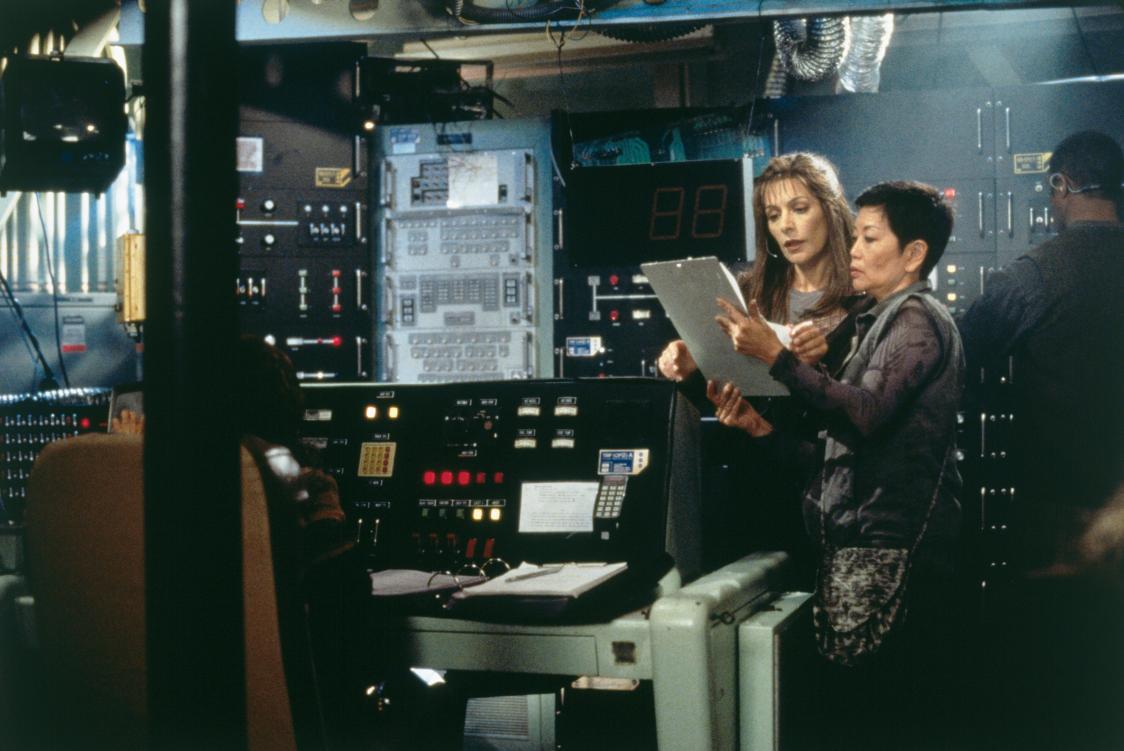
bers, not just the cast, are TNG veterans, including Michael Westmore (makeup), Peter Lauritson (co-producer), Herman Zimmerman (production design), Junie Lowry-Johnson and Ron Surma (casting), Jerry Goldsmith (music), and Denise Okuda (scenic artist/ video supervisor) and Michael Okuda (scenic art supervisor/ technical consultant) to name just a few. There are also guest appearances in the film by Robert
Everyone last worked together on Star Trek: Generations two years ago. That film came out in November of 1994, a scant six months after TNG aired its twoepisode finale, “All Good Things…” Back then, everyone hadn’t yet had a chance to really wind down from TNG’s ending or garner some different professional experiences. Since Generations came out, Marina Sirtis, for example, had
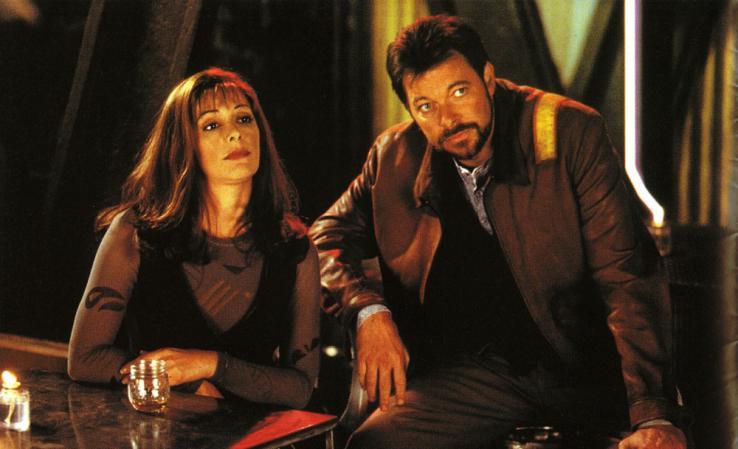
for Counselor Troi, saying set-side, “I used to think Troi couldn’t be funny, but I realized I had just sort of lost my timing.” First Contact gave Sirtis a chance to show a side of Troi not seen before. In the scene where Riker finds her alone and disconsolate after trying to ingratiate herself with Cochrane over multiple shots of tequila, Sirtis was delighted in the fact that Troi was, well, “Drunk,” laughed Sirtis, “and quite belligerent about it.”
For Braga and Moore, who were writing Generations even as they were writing TNG’s finale, having more time to produce a more well-thought out script meant a bit of redemption. Generations came with a number of mandates, not the least of which was Picard sharing top billing with James T. Kirk, leaving the writers to feel somewhat restricted in what stories they could explore. They had always wanted
Berman wanted a time travel story. Braga told The Hollywood Reporter in a 20-years-after recap of First Contact that they had some “aha” moments while writing the script, including conceptualizing the Borg Queen and also making the Star Trek hero Cochrane a bit of an asshole. “(He’s) a hero to all of the people on the Enterprise, but (he’s) creating warp drive for all the wrong reasons,” Braga told The Reporter. The writers gave Cochrane a chance to realize he needs to do it because it’s going to change the world. Braga, who always liked to write Trek stories with a bit of an edge, said, “I thought, if you could go back in time and meet one of your great heroes from history and they’re a jerk, it’s very shocking.”
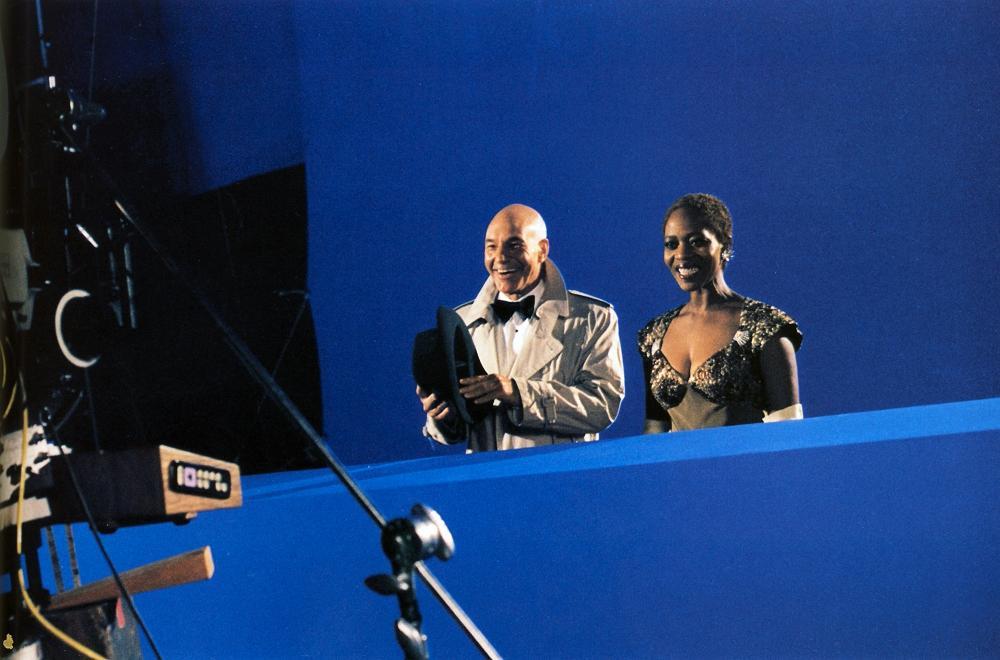
The movie greatly benefitted from well-known and wellregarded big name Hollywood actors featured in each of the three story lines. Patrick Stewart relished the time he spent with Alfre Woodard (also a close friend of Frakes), playing Lily Sloane. After
Cochrane s base, the decision is made to beam her up to the Enterprise for treatment and safety, but Lily tries to go alone as the crew is escaping the Borg’s takeover of the ship. She’s out of her depth and quickly overwhelmed, but Picard convinces her that she can trust him as the two embark upon a series of adventures around the ship, including a delightful Dixon Hill holodeck nightclub scene. Frakes said he saw their chemistry early in the production when they were doing their first night shoots. “Their characters are [in a] sort of a Tracey/Hepburn situation and the two connected as actors, as people, and across the same work ethic. They look great together.” Woodard told The Reporter that because she, Stewart, and Frakes all had worked in theatre, “We worked the same way. We know about finding your intention. The words are the writers’ direction to get you to the plot, but the real activity happens between what is said…(and) as im-
you re not saying.” Stewart said on the set of doing his scenes with Woodard, “A lot of work had gone into our scenes and the chemistry between us was perfect. They were as good as any days I’ve spent on the show.”
In between takes, one actor remained in his seat at the forward console of the ship’s bridge and looked, quite frankly, like a kid in a candy store. Neal McDonough (Lt. Hawk) was no stranger to the industry, having already appeared in film (Angels in the Outfield) and television (NYPD Blue), and his career would continue on a straight-up trajectory after this film, but he couldn’t stop smiling. “Every kid who watches Star Trek wants to be here,” McDonough told me. “I’ve been a fan since I was a kid, but this is the first time I ever auditioned for Star Trek. Everybody in town wanted to get this part.” Lt. Hawk will try, with Picard and Worf, to kill the Borg but be assimilated instead. Sitting on the bridge, McDonough reveled in the
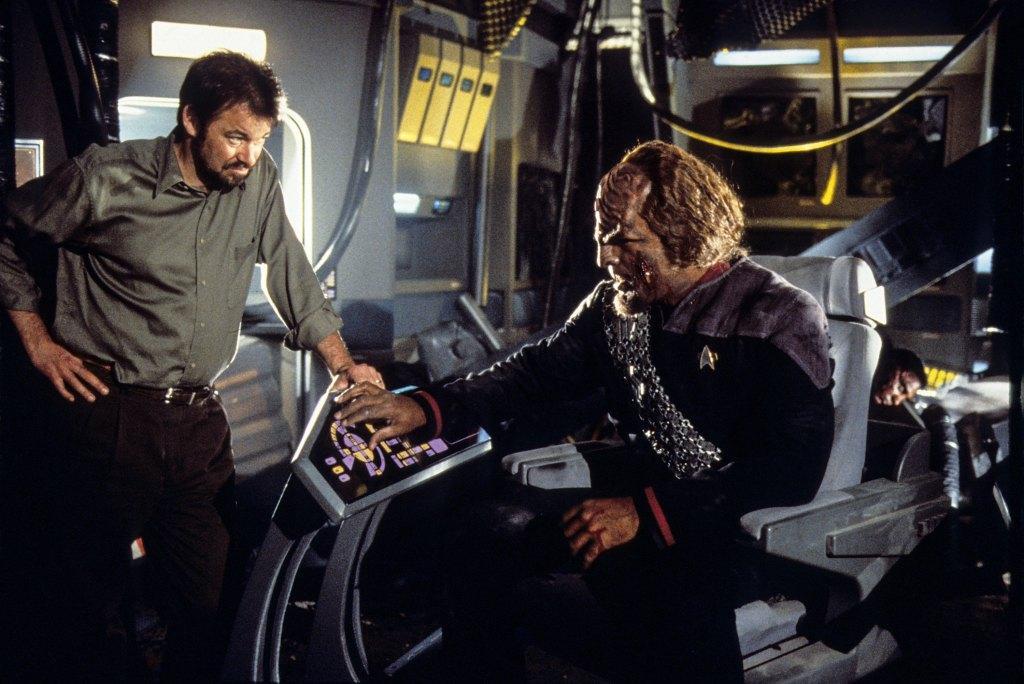
set. They all had to get their jabs in because they knew I wouldn’t be around that long,” he laughed.
The First Contact camaraderie was built upon many of these people working closely together through seven seasons of TNG with one film under their belt. But Gates McFadden had discovered that being so closely identified with Dr. Crusher in the outside world also built some of that connective tissue. During the hiatus, she did a one-person USO tour in Bosnia where she found an abundance of Star Trek fans. “I was incredibly moved by the reception the soldiers gave me,” she recalled. “People who had actually carried with them, with all the 80 pounds plus of gear, things like Star Trek books they were reading. Even the generals on the Blackhawk helicopter I was in were having fun calling out ‘Engage!’ And then I came back
try.”
Michael Dorn, who’s character Worf is brought into the story on the Defiant from DS9 where he had been given a recurring role after TNG wrapped, warmly referred to Star Trek as an old shoe. “You know when you’ve put it on you’re just going to feel good. All my stuff is my favorite sort of Worf stuff, very ‘man of few words,’ man of action. There will be a moment we haven’t seen before, though, when Worf and Picard are up to their navels in Borg and at each other’s throats for control of the Enterprise.”
When First Contact is released the week of Thanksgiving 1996, Star Trek is in as high a gear as the franchise has ever been. Season 5 episode 107 of Deep Space Nine comes out, “The Ascent,” written by Ira Steven Behr and Robert Hewitt Wolfe. Season 3 episode 53 of Voyager also
chael). Sadly in September of that year, Bibi Besch, beloved by many Trek fans as Dr. Carol Marcus in Star Trek II: The Wrath of Khan, dies of breast cancer in Los Angeles at 54 years old. And 72-year old Mark Lenard, who had portrayed Sarek, the father of Spock throughout the franchise, dies of multiple myeloma on November 22nd, the day of First Contact’s release, in New York City. The next film in the franchise, Star Trek: Insurrection, will be directed again by Frakes and released in December of 1998, this time from a screenplay written by Trek Executive Producer Michael Piller after Braga and Moore declined the offer to write another movie.
At the time of this writing, Star Trek: Starfleet Academy is just wrapping up its first successful season, taking the franchise into its 60th year. Frakes deftly directed the penultimate episode,
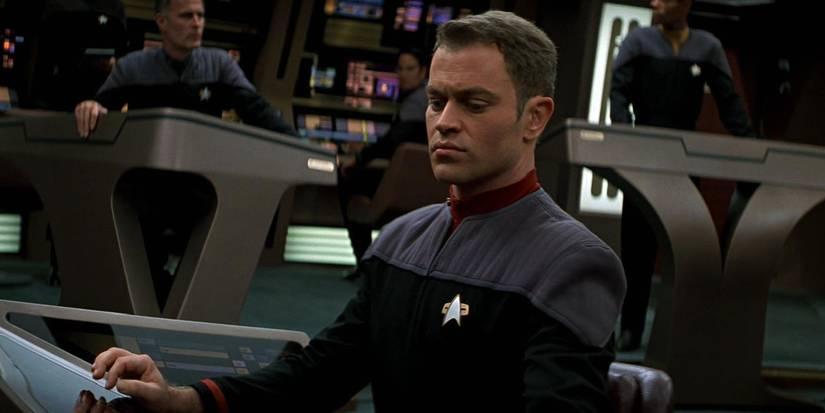
“300th Night,” after enjoying a long career directing not only more TNG, but also DS9, Voyager, Discovery, Picard, and Strange New Worlds, and dozens of episodes of other television shows including Leverage, NCIS: Los Angeles, The Librarians, and The Orville, to name but a few. He has recently revealed in interviews that his Trek directing days may be on hiatus, perhaps by scheduling conflicts, perhaps not. SNW has already finished filming its fourth and fifth seasons, which Frakes did not participate in and he may be unable to direct any more Starfleet Academy. As for movies, late last year Paramount announced it would finally move ahead on a new movie, the first since 2016, but signaling a new direction in casting and storyline by handing the development deal to write and direct to John Francis Daley and Jonathan Goldstein, known for high concept action hits like Game Night and Dungeons & Dragons. Fans hardly know what
to expect.
Back on the First Contact set that spring day in 1996, filming ends early, around 8 p.m. with final pick-up shots on Lt. Hawk’s handling of the con. After Frakes yells “It’s a wrap!” a group will convene for dinner at a local spot picked by Stewart and Sirtis. Even now story and design elements have already leaked out onto the Internet, making Brent Spiner reluctant to say much about Data’s storyline with Alice Krige’s Borg Queen. “I know by the time we open,” he told me, “everyone will have seen something. We bust our butts trying to create magic and everybody’s agenda is to expose the magic even before it happens. From my point of view, I just try to illuminate the material as best I can and hope for the best.”
Writer’s note: Most of the material in this story came from interviews and articles generated for the Star Trek Communicator (The
Magazine of the Official Star Trek Fan Club), issues #109 and #112. Material is used with the kind permission of the magazine’s former publisher and editor, Dan Madsen.

DEBORAH FISHER: Deborah Fisher has been a Star Trek fan since The Original Series debuted while she was in high school. She’s been a professional writer her entire life, which helped her get a Writer’s Guild-sanctioned internship with the staff of ST: The Next Generation. One of her current passions is swinging swords with friends as a member and instructor with the Whidbey Swordplay Association. Deborah lives on Whidbey Island, a ferry ride north of Seattle, with her husband, son, and mini-American Eskimo puppy Mia, who’s currently running the whole show.
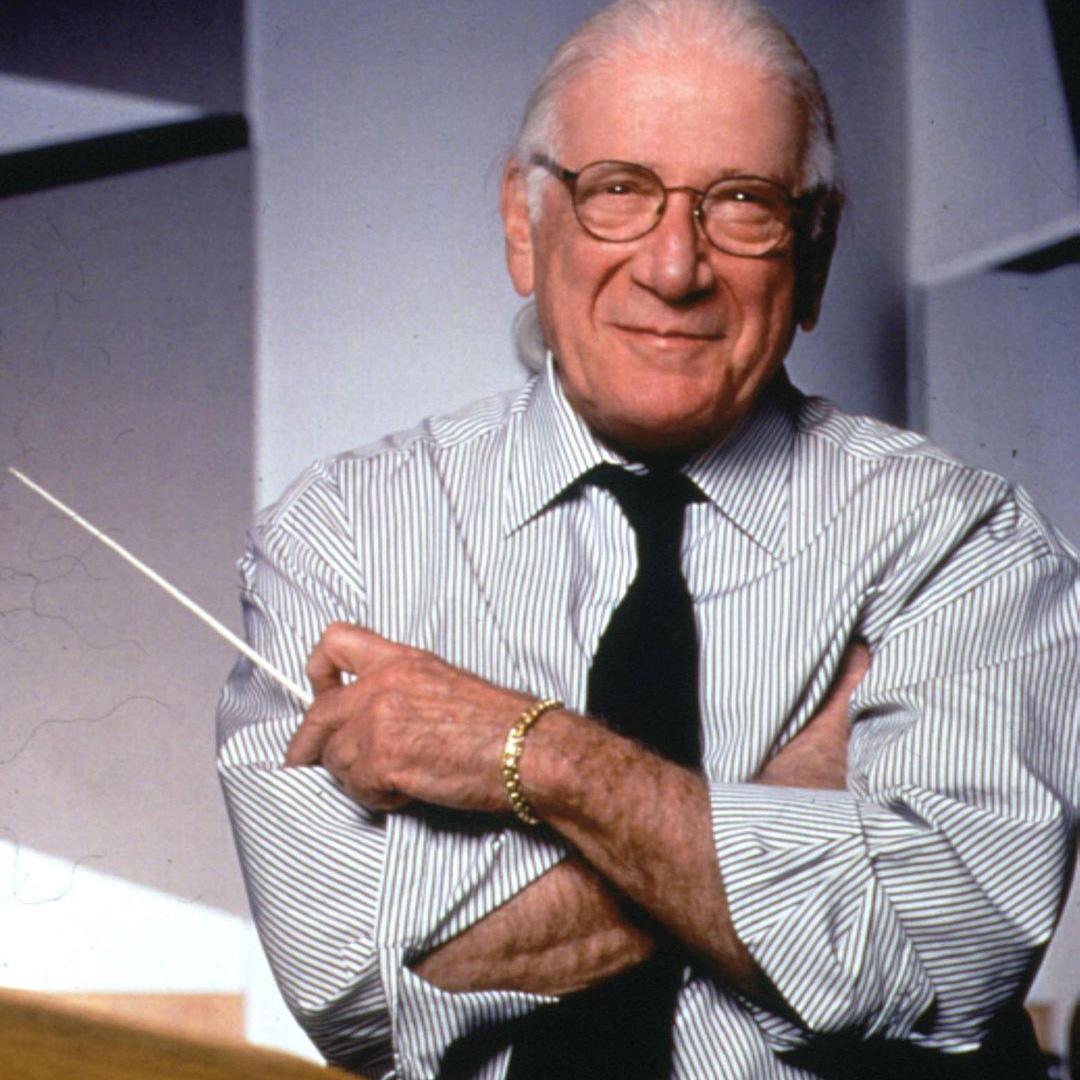



The Borg were never meant to sound like hope.
The first thing you hear is not optimism, wonder, or discovery. It’s dread.
Before a single Borg drone appears on screen in Star Trek: First Contact, the score tells you exactly what kind of story you’re about to experience. Low, ominous tones creep in. The music feels invasive, mechanical, almost alive. This is not the bright, exploratory optimism traditionally associated with Star Trek. This is something darker.
And that shift begins with Jerry Goldsmith.
Goldsmith approached First Contact with a clear understanding of contrast. The film is not just about the Borg it’s about what the Borg threaten. It’s about the fragile, defining moment of humanity’s future: first contact with the Vulcans, sparked by Zefram Cochrane’s historic flight aboard the Phoenix.
To capture that duality, Goldsmith composed a score that does something remarkable.
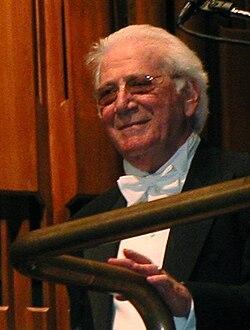
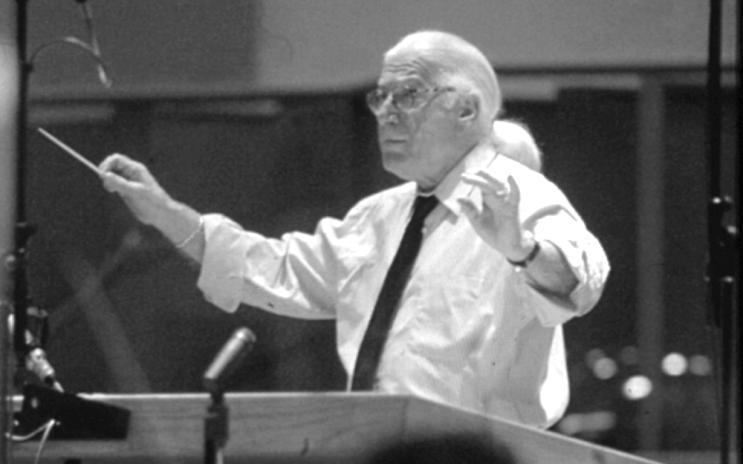
It terrifies and it uplifts.
Goldsmith’s approach to the Borg is rooted in unease rather than spectacle. Where many science fiction scores announce danger with aggression big brass, percussive assault Goldsmith leans into something subtler and far more unsettling.
Low brass and synthetic textures coil around each other, organic and mechanical at once, until you can’t quite tell where the orchestra ends and the machine begins. Rhythms pulse like a heartbeat. But not entirely human.
There is a sense of inevitability in these cues. The music doesn’t attack. It advances. It assimilates the soundscape piece by piece, the way the Borg assimilate everything else.
It’s not just frightening. It’s suffocating.
And that’s exactly the point.
If the Borg represent suffocating inevitability, the Phoenix represents something entirely different.
It represents hope. When Cochrane’s ship prepares to launch, the score shifts in
a way that feels almost startling not a gradual lightening, but a door thrown open. The oppressive tension recedes and something expansive, lyrical, and profoundly human takes its place. Sweeping strings. A rising melodic line that feels as though it is reaching: upward, outward, toward something unknown but full of possibility.
This is where Goldsmith allows the music to breathe. The Phoenix theme shares something with his work on Star Trek: The Motion Picture not in melody, but in scale and reverence. That same quality of awe directed toward humanity’s place among the stars. But where that earlier score felt ceremonial, almost monumental, this one feels earned. Smaller, in the best sense. Closer to a hymn than a march. Closer to a question than an answer.
It is not loud. It is quietly transcendent. Which makes its contrast with the film’s diegetic music all the more striking. Cochrane, the man whose flight will reshape the future of humanity, celebrates by blasting Steppenwolf’s “Magic
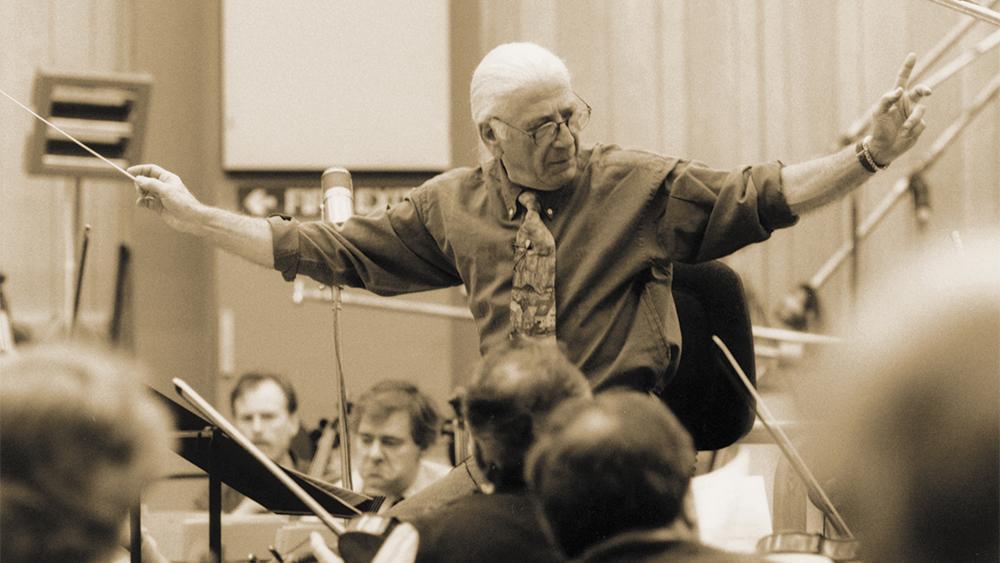
Carpet Ride” from a battered speaker. It’s funny, and deliberately so. Goldsmith’s score reaches toward the stars; Cochrane is firmly, chaotically human. The joke is the point: the future isn’t built by saints. It’s built by people like this messy, imperfect, and still somehow capable of changing everything.
What makes the score remarkable is how Goldsmith refuses to keep these two worlds separate. The Borg and the Phoenix don’t exist in isolated musical universes their influence bleeds into each other. Moments of hope are shadowed by tension. Moments of terror are underscored by the reminder of what is at stake.
Goldsmith’s genius lies in how he places these two musical identities side by side. The Borg’s music constricts; the Phoenix’s music expands. One is mechanical, repetitive, invasive. The other is fluid, emotional, alive. That contrast does more than create tonal
variety it reinforces the central conflict of the film. The Borg don’t just threaten humanity’s survival. They threaten its future.
Hope is not presented as inevitable.
It is something that must be earned.
In the years since its release, the score for Star Trek: First Contact has become one of the most beloved in the franchise, and for good reason. Jerry Goldsmith understood that this was not just another Star Trek adventure. It was a story about identity about what separates humanity from the very forces that seek to erase it.
The Borg reduce individuals to components. The Phoenix reminds us that we are more than the sum of our parts.
When the Phoenix takes flight, carried by that soaring theme, it does more than mark a moment in Star Trek history. It reminds us why that history matters. Because long before the
Federation, before starships and warp drives, there was a single, fragile moment when humanity chose to reach for something better.
And thanks to Goldsmith’s music, we don’t just see that moment.
We feel it.

TANIA ROSA BINDHOFF:
Tania Rosa Bindhoff is a mezzo-soprano and selfproclaimed “opera-singing Trekkie.” She works as a civilian for Howard County, Maryland Fire & Rescue and runs the Columbia Pawtisserie, her gourmet pet treat business. She lives with her husband and cat, and when she’s not performing or helping her community, she’s baking, cosplaying, cross-stitching, reading, and boldly nerding out where no one has nerded before. @TrekkieDiva















(Click the DONATE above or scan the QR code at left)

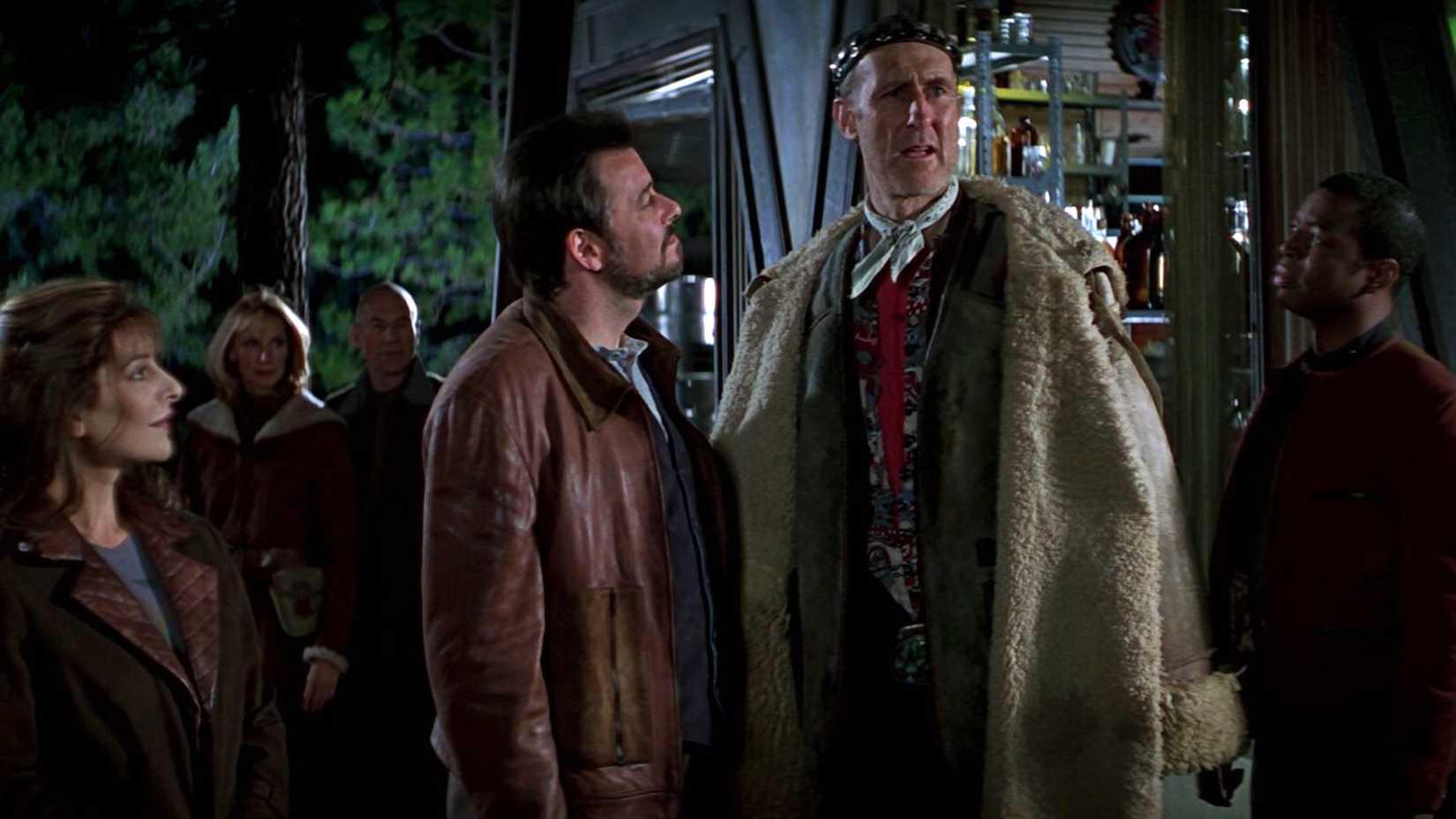



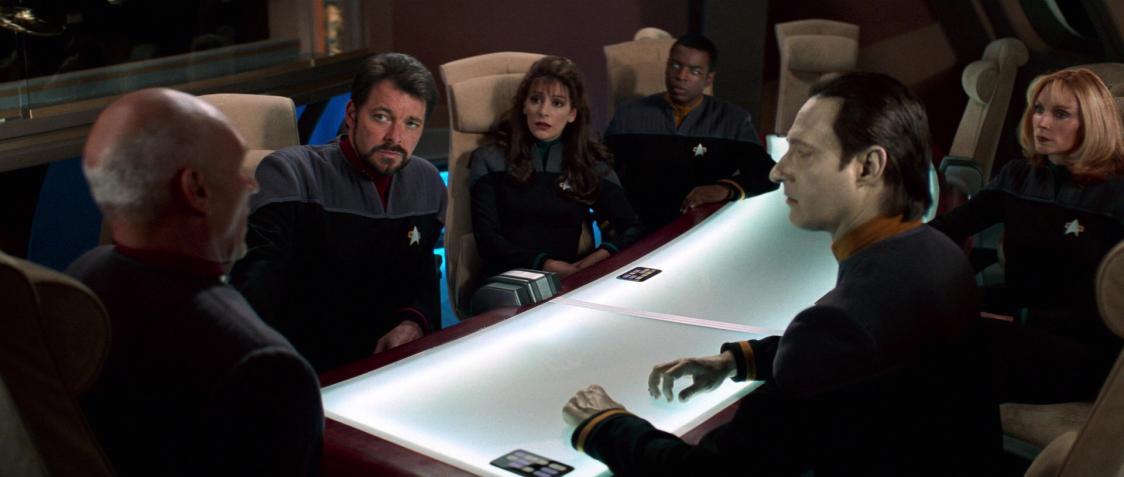
If you had to keep just one of The Next Generation movies and forsake the rest, which one would it be, and why would it be Star Trek: First Contact?
Every film in the series has its fans and detractors. Even the most derided of the movies have those who will defend them, in part or in whole, and die on that hill. While it may be hard to single out a film as the keystone of The Next Generation film franchise, I believe there are legitimate reasons First Contact deserves that focus.
When Star Trek VI: The Undiscovered Country came out in 1991, it was touted as the end of an era, the last time that we would see the original crew of the USS Enterprise on the big screen. The final scene of the movie, a beautiful setup with the crew on the bridge, facing the order to turn in to port for decommissioning, was the perfect way to say goodbye to this band of officers we had come to know and love over the last 25 years. From the Peter Pan quote to the restatement of the iconic prologue to the
cast signatures during the end credits, it had a real sense of finality.
When Generations showed up, with original cast members Koenig, Doohan and Shatner brought out of mothballs not 3 years after we had all said our farewells, it seemed like more of a stunt than a legitimate casting decision. We had seven years to get used to the new crew of the USS Enterprise. We didn’t need yet another appearance of the classic cast to ease our transition into The Next Generation. We were there already. We deserved the spotlight squarely upon the cast we had grown fond of over the past seven seasons on television. If we jump directly to First Contact, we essentially pick up where we left off at the end of the series. We don’t need reintroductions. We already know these characters. We don’t need someone familiar to ease us into the world. We already love this world. Give us a clean break. And, imagine, instead of destroying the Enterprise D, we instead started First Contact with the decommission-
ing ceremony for the beloved starship. We could have been given our first look at the gorgeous Sovereign-class Enterprise E in an Earth-orbiting space dock, with slow, sweeping camera pans. Clichéd? Maybe. In my opinion, however, there’s no better way to be introduced to a new vessel.
Looking at TOS movies, The Motion Picture’s antagonist, a sentient cloud of computers, did not help the film’s chances of success in the theatre. Surely the Klingons, briefly seen and dispatched at the beginning of the movie, would have been a better foil for the Enterprise’s first foray on the big screen. For their second outing, they brought back a classic character as the central antagonist, Khan, and it clicked. Generations tries to lure us in with Malcolm McDowell’s Soran. Again, the Klingons are present, but the Duras sisters are there primarily to support Soran. They do manage to trigger the destruction of the Enterprise D, but they are not the antagonists that they could have been. Soran is fine as a villain, but the way he is
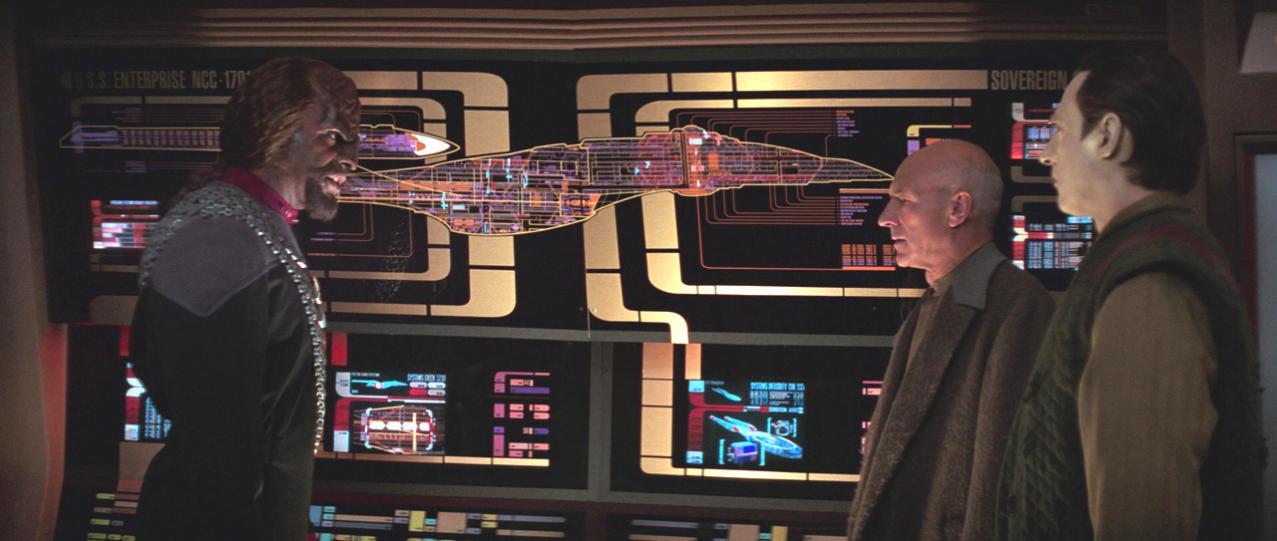
retroactively connected to Guinan to fold his and The Nexus's story into the movie is just not enough to make us truly care about what happens to him or The Nexus.
After First Contact, the chosen enemies don’t get much better. The Son’a are almost comical, nothing but pawns of the shadier parts of Starfleet. And let’s not even get into the fact that the “twist” at the end was obvious from the beginning, for reasons, not the least of which is
the fact that it’s a recycled plot point from “The Vengeance Factor”. And the less said about the Remans from Star Trek: Nemesis, the better. So forgettable that they’ve been mentioned only a handful of times since.
The Borg are possibly the most iconic enemy of the entire run of The Next Generation. Their look and the threat that they pose not only to the crew but to the Federation are instantly recognizable. We don’t need an expla-
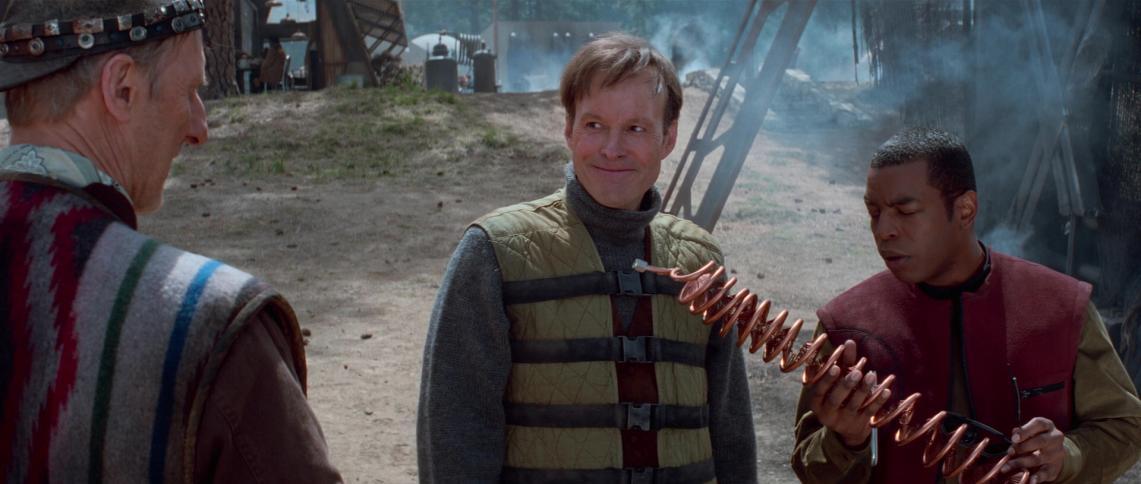
nation. When you don’t have to spend time explaining to the audience what the stakes are, you can instead focus more time on character development and worldbuilding. You can keep the story moving at a brisk pace, which adds to the sense of urgency and anxiety.
One of the criticisms I’ve personally had about Generations is the focus on Picard. This is our first theatrical outing for The Next Generation cast. The entire cast should get a chance to shine during the movie. While we get some nice moments in the beginning and end, with some references to Data’s struggle with human emotions, the bulk of the story focuses on Picard, Shatner, and Guinan. Don’t get me wrong, I could listen to Stewart recite the phone book and be a happy person, and Guinan is certainly a fan-favorite character. But for a movie that is supposed to set up The Next Generation crew's cinematic adventures, it spends precious little time on them.
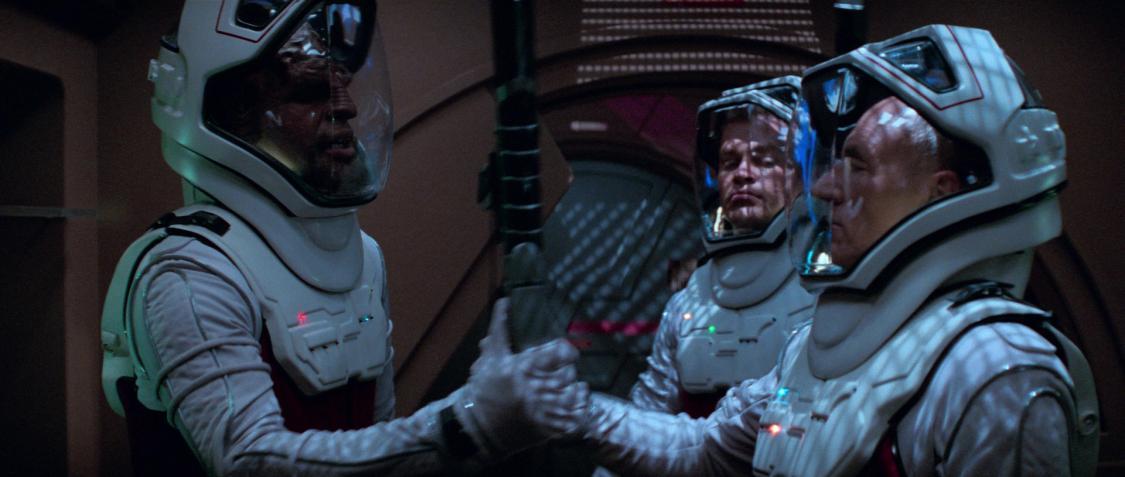
First Contact gives the entire crew a chance to truly shine during the movie. Of course, Picard is there, taking charge, smashing gold Enterprise models, and drawing lines in the sand, with Worf along for hard-hitting support. Riker, Troi, and Geordi are down on late-21st century Earth, working to convince James Cromwell’s reluctant Zefram Cochrane to go through with his pioneering first warp flight, which will initiate First Contact with the Vulcans. We even get a few humorous scenes with Dwight Schultz’s Lt. Barclay. Of course, Data gets to chew nearly as much scenery as Picard here, as he spars with Alice Kreig’s Borg Queen in her attempts to introduce the android to the pleasures of being human. The movie does what some of the series's best episodes do: it focuses on the ensemble to draw us into the story. The perfect way to bring us into the cinematic experience.
There is something that First Contact did that the other Next Generation movies didn’t even really attempt: it brought in
Star Trek's lore and made it a part of the movie. While this isn’t necessarily a requirement for a good movie, it does help. But, more to the point, the movie doesn’t expect the audience to know the lore. It actually shows us the lore happening on-screen. We get to see the results of World War III. While we hear about how Cochrane is seen in the future, we get to see his story firsthand. And as a result, we see how history gets distorted over time, even without the intervention of the time-travelling Borg. And that’s not even mentioning the movie’s namesake event, which is the lynch pin that triggers the creation of Starfleet and the Federation, which the Borg knew all too well. While other movies in the Star Trek franchise have tried to invent and retroactively shoehorn lore to serve the story, First Contact does lore the right way.
While I do think that the great, big universe has room for Star Trek movies of all calibers, if you are only going to keep one of The Next Generation films and use it to represent the crew’s cine-
matic adventures, First Contact is the natural choice because it is, by most measures, the best of them. It has a coherent story. It centers on an interesting, important event from the show's history. It uses an iconic villain from the series, and not only does it not dumb them down for the movie, but it makes them even more menacing by expanding on their backstory. Most importantly, it gives each of the main cast members from the series (at least those around by the series finale) a chance to shine. Why is Star Trek: First Contact the only TNG movie that truly matters? Because it is the only one that gets it all right.

MARCUS ALBERS: Marcus is a systems engineer (though he doesn't get to touch the warp core) by day, and a freelance writer and cat parent in his free time. He's been a Trekker ever since seeing The Wrath of Khan in the theater many years ago. He remains excited to see where Star Trek takes us in the future.
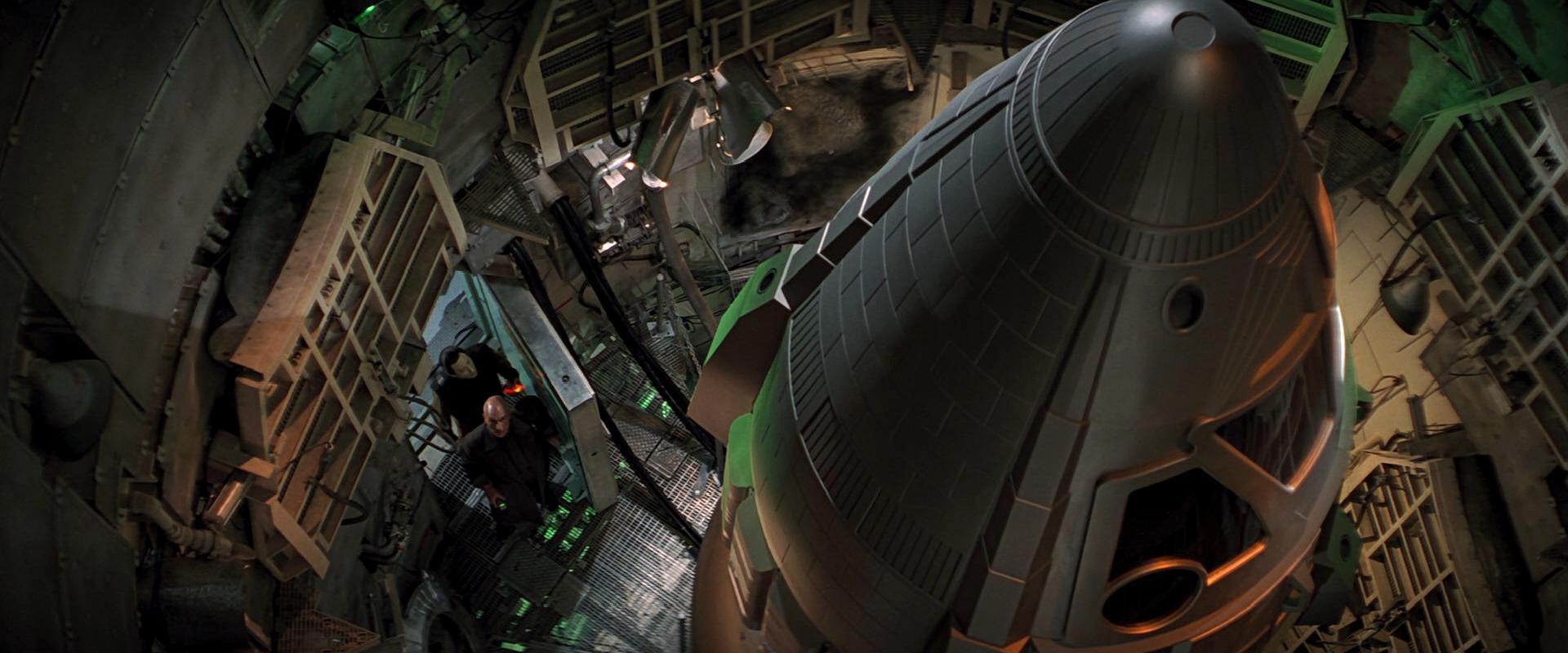



The one unifying statement anyone can make about Star Trek is the importance of the spacecraft. Beginning with Matt Jefferies’ design and creation of the iconic Enterprise, registry number NCC-1701, all future designs of warp drive powered spacecraft have followed that original concept.
I have always liked all the various versions of the Enterprise or other starships that are part of the Trek universe. And as we can see, the starships all have followed the idea of a main saucer section, an engineering section, and the twin nacelles to create the warp bubble that allows faster than light speed.
It is like asking the question: what is your favorite Star Trek series or movie? I am sure you will get hundreds or even thousands of replies as to which one would it be. The same goes for the starships that inhabit the many series or movies that have been created. It could be the original from the 1960s. The reimag-
ined A from The Motion Picture and the following films from the TOS era. Many love the D from The Next Generation or the swift style of the starship used in Voyager. It could be the tough Defiant of DS9 or even the revision of the Enterprise from the JJ Abrams films, with its Arnold Schwarzenegger styled and “pumped up” nacelles.
I have watched all the series and movies and have always liked the original Enterprise when I first saw it on September 8th , 1966. The D always seemed like the ultimate version of the Enterprise, truly designed as a multigenerational ship that could be a home for its crew and families as well.
Yet, when I saw the NX-01 I realized that it was the version of the Enterprise I liked the most. And it all came down to functionality. This Enterprise seemed like it could be a real possibility. A small crew, a submarine like interior and a sleek design that made it look faster than Warp five. Yet
why was this true? Well, it all comes down to the spacecraft that appears in Star Trek: First Contact, the Phoenix.
Yes, the beautiful E that appears in this film is sleek, powerful, with a functionality that I like in a starship. And that is what makes the Phoenix so unique and beautiful. It is simply a warp ship, with one singular purpose, to exceed the speed of light.
Looking back at the Bell X1, Chuck Yeager’s aircraft that broke the sound barrier, you can see the similarities between it and the Phoenix. The X-1 had a cockpit, a rocket engine, and a bullet shape to reduce drag and improve stability at the sound barrier. It could not take off on its own, needing a B-29 bomber to carry it off the ground and to launch it for its flight. Now compare that to the Phoenix. A cockpit in the front of the craft, a rocket engine used to carry it away from its launch vehicle, a retired Titan II missile. This allowed the Phoenix to leave the Earth so that it could be free to
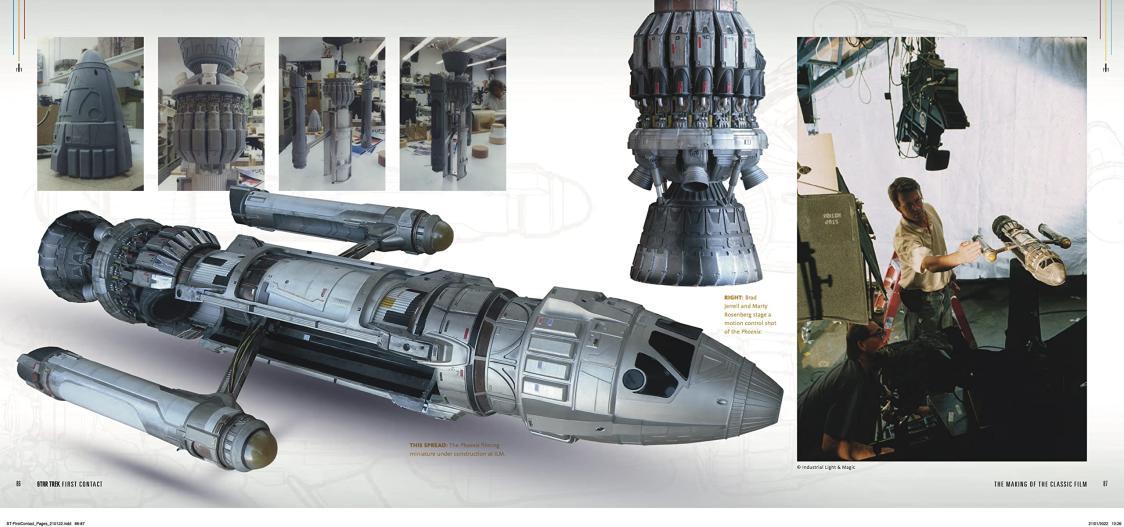
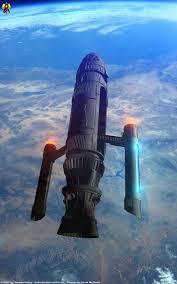
engage its warp engine. Both the X-1 and the Phoenix were designed for one mission: to break a barrier that had not been done before.
What intrigued me the most about the Phoenix was its functionality. Designed by John Eaves, he had to produce a design that could be considered possible in the mid twenty-first century. He chose to use a vehicle that would launch the Phoenix, one that was once a weapon of destruction, a brilliant idea. It was a missile that would have been decommissioned after the end of World War Three. Look at the cockpit of the Phoenix: the seats, switch gear, controls and so on that was used looked like they were “scrounged up” bits and pieces that Cochrane and his crew could have found from discarded aircraft or existing stockpiles of hardware.
Adventurous individuals piloted both crafts. Chuck Yeager, a “cowboy,” an Air Force pilot who chose to fly the X-1 even though he had two broken ribs from a horse riding accident.
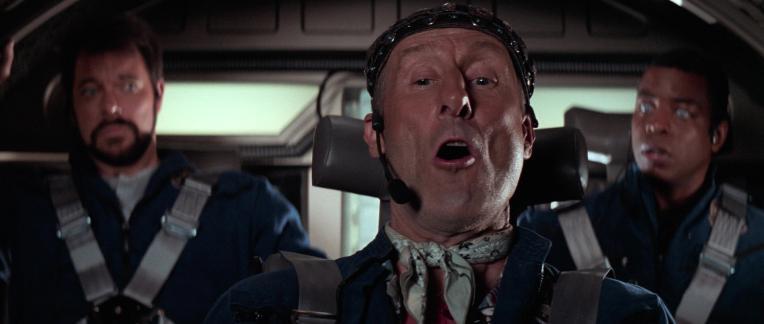
Cochrane flew the Phoenix, not knowing if he would survive the flight. And, as you can recall, he almost canceled the flight, not knowing where he had left his copy of Steppenwolf’s recording of “Magic Carpet Ride.” You always need to have a great tune for a “road trip.”
Okay, Yeager was a real person, while Cochrane was a fictional character. Yet the way Ronald D. Moore created Cochrane’s character, was to me, resembled a similar type to Yeager. He was not a completely noble person, a person who was a drunk, a wild man and a risk taker. This would be the person who would take on the endeavor of doing something no other person had done before. The same goes for the Phoenix as well. It was crude, tough and a bit wild at the limits, like a bucking bronco. The kind of craft that could be the first to go faster than light.
As we have seen from other films and TV series, the Phoenix is remembered in one form or another. I do appreciate how the set designers created the ready room in Star Trek: Strange New Worlds. Past the entryway into the room, all crew members would pass by an image of the Phoenix and the NX-01. This was a way to remind
them of the legacy of the first, faster than light spacecraft and the prior starship to carry the name Enterprise.
Star Trek: First Contact contained many great actors in the film such as Patrick Stewart as Picard, Alfre Woodward as Lily or even the perfectly chosen James Cromwell as Cochrane. Yet it was as in the original Star Trek, the starship could be the most important character. In this movie, the Phoenix takes center stage. I think the scene that solidifies this feeling is when the crew of the Enterprise first sees the Phoenix in its silo. How when they touched it, reveling in the moment of being able to take in the importance of this spacecraft. They knew it would be the first to do something never done before: to break the ultimate barrier, the speed of light.

STEPHEN MIRKIN: I first learned about science fiction the moment I was able to reach the on/off knob on my parents’ black-and-white TV set. Being born in 1956, I was there on Sept. 8, 1966 to watch the first episode of Star Trek. Since then, I have watched every TV series and every movie and I only look forward to the next great Star Trek moment.
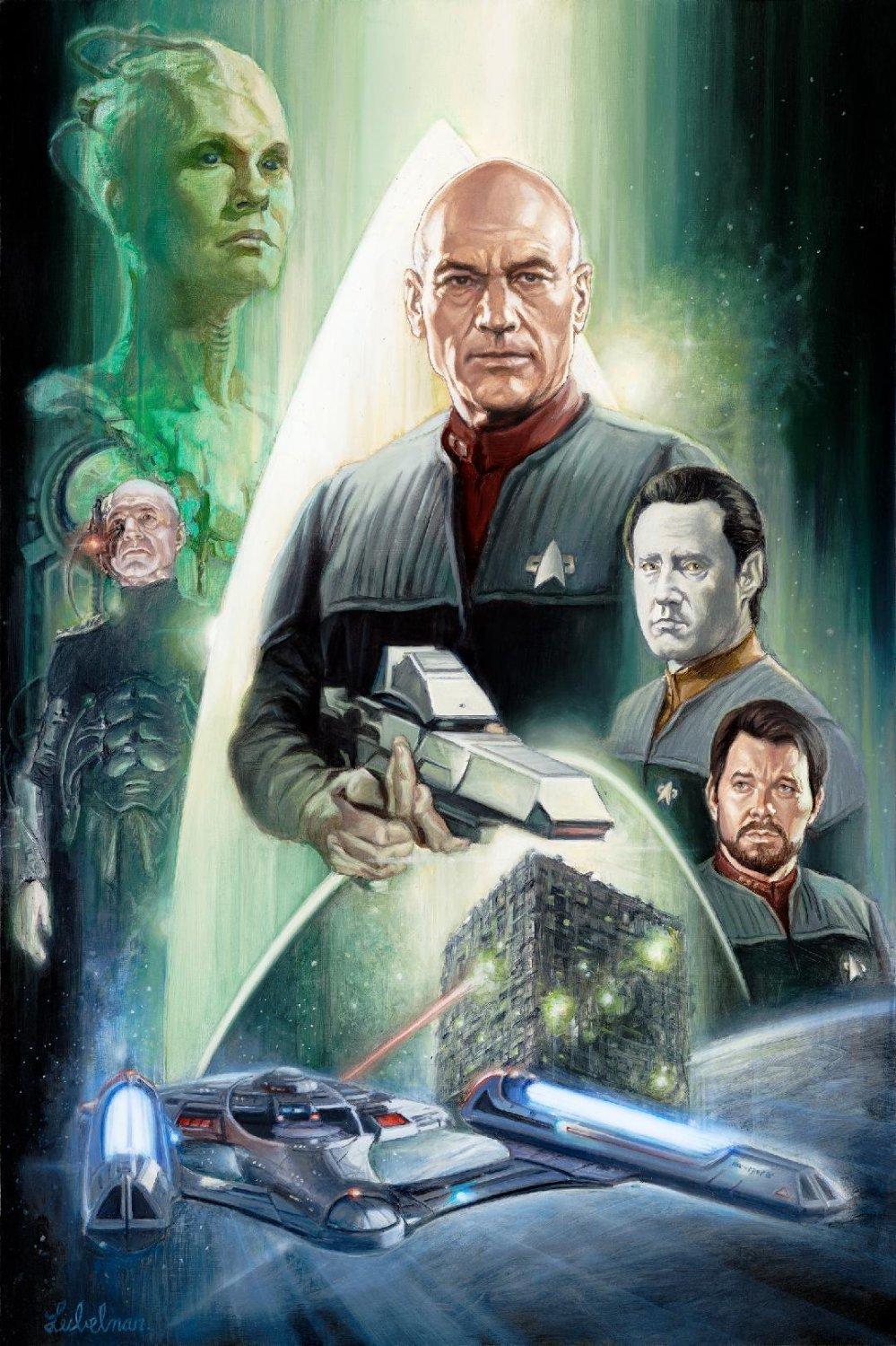




I love certain things because of their emotional resonance and the memories that they evoke. For example, my favorite guitar is not the best sounding or most expensive one that I own, but it is a beat up old Alvarez that my amazing wife bought for me during our very first Christmas together. Guitars come and go, but I will never willingly part with that one because of the emotional value that I place on it. Nostalgia is a powerful emotion for many of us, and it makes us want to recapture the feelings of days gone by. As a life-long lover of comics, I have often associated certain books with different eras of my life. A powerful example of this would be the comic book adaptation of Star Trek: First Contact which instantly brings me back to the mid 90s and harkens back to a fun, transitional, and transformative period in Star Trek comics
COMICS AS A VEHICLE OF ADAPTATION
One of my favorite mediums for television and movie adaptations is comic books. I believe comic books are the best and most natural way to adapt a movie for a different audience. At their heart, movies and comics are not that different. The narrative and plot structure of both are the same and are highly character driven. They are both artistic, atmospheric and visual in nature. These mediums constantly cross pollinate; movies made into comics and comics made into movies. Comic books, when done right, can be extremely cinematic. Just check out Sin City, The Watchmen, or Klaus to see ample evidence of how cinematic
a comic book can be (btw the first two were adapted into movies from the original comics!). This is because, as a visual media, comics use panels in the same way that movies use scenes to tell a story. A good page layout on a comic book can flow as beautifully, effortlessly, and dynamically as any scene in your favorite TV show or movie.
THE EARLY HISTORY OF STAR TREK COMICS
Adapting Star Trek into the medium of comics has had a very turbulent history. The earliest years were especially unsatisfying. By the mid 90s Star Trek had bounced between no less than five publishers, not all of which were dedicated to producing authentic and quality adaptations. Here is a brief breakdown of those years:
Gold Key comics (1967-1979) were, for lack of a better word, bizarre. The writers and artists that Gold Key employed had never seen the show and, because of this, what they produced was not Star Trek but a very strange parody of it. However, the Gold Key years did produce some amazing cover art. You can check that out here: https://www.startrekcomics.info/ goldkey.html
Marvel Comics, (1979-1981) also had trouble adapting the franchise into something authentic. To be fair, Marvel was somewhat restricted by Paramount because they were only allowed to do stories post-The Motion Picture and could not work with material from the TV show. This severely limited the scope of what the writers had to work with in the comic. What
Marvel produced during this period was fun, but seemed more like Spider Man than Star Trek. Despite the restrictions, I feel like the writing and art were subpar and very inconsistent in this series. You can check out the Marvel run here: https://www.startrekcomics.info/ marvel1tos.html.
DC Comics (1984-1995) had a legendary run and produced the first widely accepted and successful Star Trek comics. Highly recommended. They produced comics for both The Original Series and The Next Generation during their tenure. This run also produced some ridiculously good cover art. Jerome Moore’s covers were some of my all time favorite cover art from any series. Check it out here: https://www.startrekcomics.info/ dc1tos.html
Malibu Comics (1993-1995) had the license to only produce Deep Space Nine comics.
These were quality magazines with great writing backed by state of the art digital printing. The 90s were a huge era for comics so Malibu took full advantage of common marketing gimmicks such as ashcans, and foil and variant covers (I actually adore my gold foil DS9 #1).
Marvel Comics (1996-1998) strikes back! When Marvel had acquired Malibu Comics (please take note of this) in ‘94 the rights returned back to Marvel. Paramount, at the time, wanted to create its own comics imprint under the umbrella of Marvel and started publishing many Star Trek titles
through this line. This second Marvel era of Star Trek was much better than the previous incarnation and it produced some truly great titles such as Star Trek: Untold Voyages, Star Trek: Early Voyages, and Star Trek: Unlimited.
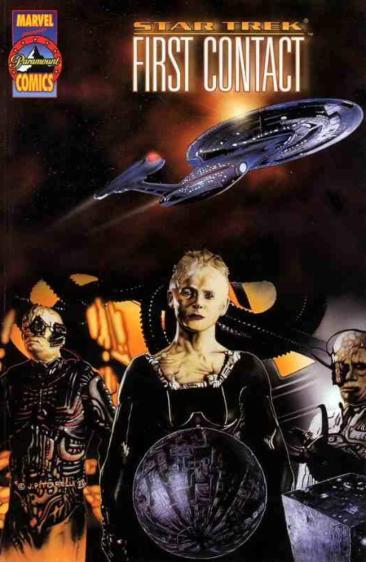
FIRST CONTACT
In my humble opinion, the pinnacle of this era and the single best issue of the entire Marvel line was the adaptation for the movie First Contact. The magazine has a thoroughly modern vibe. It does not feel like anything else produced by Marvel at the time. First Contact was the perfect transition piece between different eras of Star Trek comics publishing. It was also emblematic of the technological revolution going on in the comic book industry. In the 90s it gave us a glimpse of the future of comics publishing.
The movie First Contact was released in November of 1996 and its Marvel Comics adaptation was released at the same
time. It is considered a one-shot graphic novel or prestige format comic because it has 48 pages instead of the usual 24. It has been reprinted a few times since ‘96. It was reprinted along with some other one-shots from the Marvel era in Eaglemoss’ Star Trek Graphic Novel Collection volume 119 in 2020 . IDW Comics (who has had the license since 2006) produced a digital reprint of it (available on Amazon) in 2021 for First Contact Day.
IT ALL STARTED WITH MALIBU COMICS
I believe the main reason for this adaptation being so great is the influence of Malibu Comics. Marvel and Paramount were very wise when they assembled the creatives to adapt First Contact into a comic book. Instead of having the most trendy and popular writers and artists in their superhero line do the work, they actually turned to people who had actual experience making Star Trek comics. This is very important because Star Trek is different from any other media property out there, with decades of lore and demanding fans. As mentioned earlier, when Marvel acquired Malibu in early ‘94 they inherited a stable of writers and artists who had years of experience working on Star Trek. These creatives were familiar with the ethos of the franchise, had worked within Parmount’s guidelines before, and could capture the actors' likenesses. They had a vested interest in making the best possible comic because they were fans. Marvel also inherited a cutting edge art studio from Malibu in the areas of
digital coloring and printing. This adaptation was truly a testament to Marvel’s wisdom in selecting the talent but it was mostly due to the legacy of quality that Malibu had brought to Star Trek comics. Even though First Contact was a Marvel production, Malibu’s fingerprints are all over it.
THE WRITING TALENT
The story was adapted for comics by veteran Trek writer John Vornholt, which was convenient because he also wrote the novelization of the movie. He had prior experience in comics because he had also written 3 issues of Deep Space Nine produced by Malibu. John Vornholt has written well over a dozen novels and created many original stories for the franchise.
You can find a good overview of most of his work on this website: https:// www.fantasticfiction.com/v/johnvornholt/.
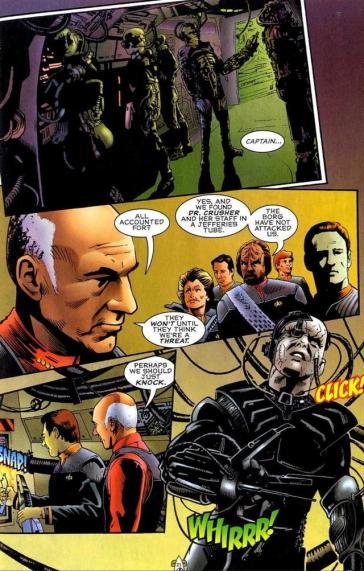
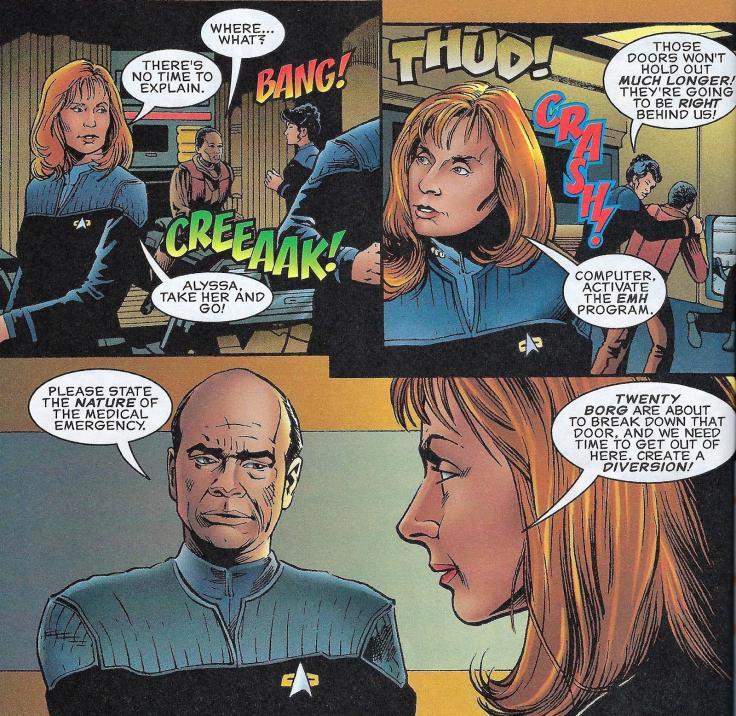
THE ART TALENT
The vast majority of penciling for First Contact was done by Terry Pallot who is a prolific comics professional. Terry is known for both outstanding penciling and inking work in many genres of comics. He has worked on Star Trek comics for DC, Malibu, Marvel, and IDW. His experience working on TNG comics for DC would be especially useful for this adaptation. The vast majority of his Trek work however, was on Malibu’s Deep Space Nine comic where he is credited with 39 issues (either the cover or interior art). Here is an outline of his extensive work: https://memorybeta.fandom.com/wiki/ Terry_Pallot.
The layouts for the adaptation and some of the pencils were
done by Rod Whigham. Layouts are extremely important because they control the pacing, flow, and visual harmony of the story. Rod entered the comics industry in the mid 80s working for Marvel with their G.I. Joe tie-in comics. In the early ‘90s he moved to DC to work on Star Trek and eventually migrated to Malibu before it was taken over by Marvel.
MALIBU’S COLORING TECHNOLOGY
When Marvel acquired Malibu in ‘94 they were not interested in Malibu’s intellectual property or the Malibu Ultraverse. If you look today, Marvel is not really using any of the old Malibu characters. They bought Malibu because Malibu simply had the best coloring studio and the most advanced digital coloring and
printing in the industry. In the early ‘90s Malibu was very disruptive to the industry because they simply had the most stunning colors and paper quality in comics. Most other publishers looked old fashioned in comparison. Today's high gloss paper and vivid colors are the descendents of the advances that Malibu made in the field. When you look at the credits of First Contact it gives this due credit by saying “Colors by Malibu”.
EXPERIENCED TALENT LEADS TO A GREAT ADAPTATION
Marvel and Paramount’s foresight in passing this job to seasoned Star Trek creatives is why this is an outstanding adaptation. By using the talent that they had acquired from Malibu, Marvel had the best possible team to create a top quality and authentic Star Trek adaptation.
Vornholt created a faithful interpretation of the movie within the limits of the medium of comics books. In 48 pages he very successfully translated the story into the format of a comic book. The most common criticisms on Amazon of the adaptation are comments about certain jokes left out or a certain scene that was removed. The simple reality of the space limitations of comics requires nonessential story elements to be left out. Think about it like this; I can read the comic book version in less than 15 minutes but to watch the movie would require one hour and 51 minutes. You can’t cram one hour and 51 minutes of entertainment into a 15 minute experience without sacrificing something. This is a
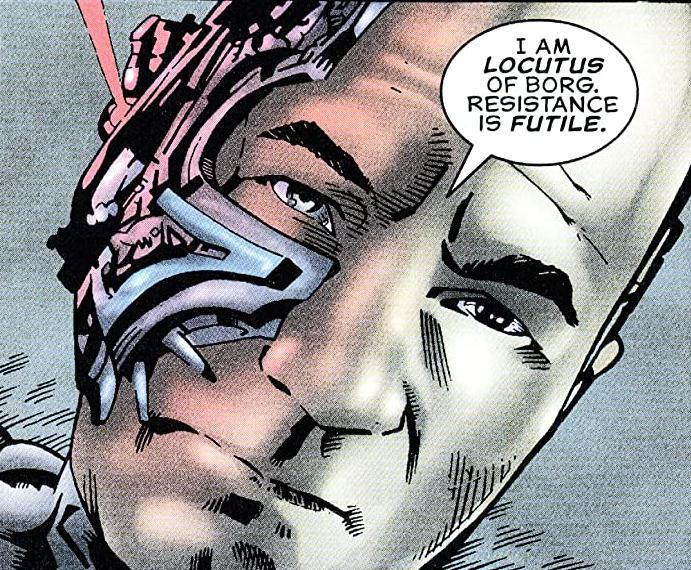
concise and fast paced version of the movie for sure, but Vornholt was judicious in his choices of what he retained from the original script.
Vornholt did his job well, he kept the heart and soul of the story intact.
Between the penciling and layouts of Pallot and Whigham the visual storytelling is compelling. The artists focused on character close-ups and dramatic angles for the action scenes. The characters resemble the live cast, the pacing of the story is engaging, and the visuals are dynamic. Whigham designed the layout of 4-5 panels per page to optimize the space for storytelling. There is a restrained use of splash pages (where there is one panel on a page to make a scene standout). The only splash page in the comic is used to great effect to emphasize the majesty of the new Enterprise-E (p.3). The only complaint that I have in this area is that sometimes the art
does not feel consistent from panel to panel. You might have one panel with amazing art and then the next is less than stellar. Marvel used the coloring techniques gleaned from Malibu to the best possible effect in this issue. The palette of colors are vibrant and matched the darker tone of the movie. The high quality paper and printing allows for fine details to be clearly seen even in the smallest panels (which the old newsprint paper doesn low).
As mentioned earlier, Contact is a beautiful transition piece from the different eras of Star Trek comics. At the time, it gave us a delightful preview of some of the more exciting changes that would be introduced in the late 90s and early 2000s. As a Trekkie and a lover of comics, I think this is why I like this comic so much. It is not only an enjoyable adaptation of a movie that I love, but First Contact


ORDER YOUR SHIRT TODAY!


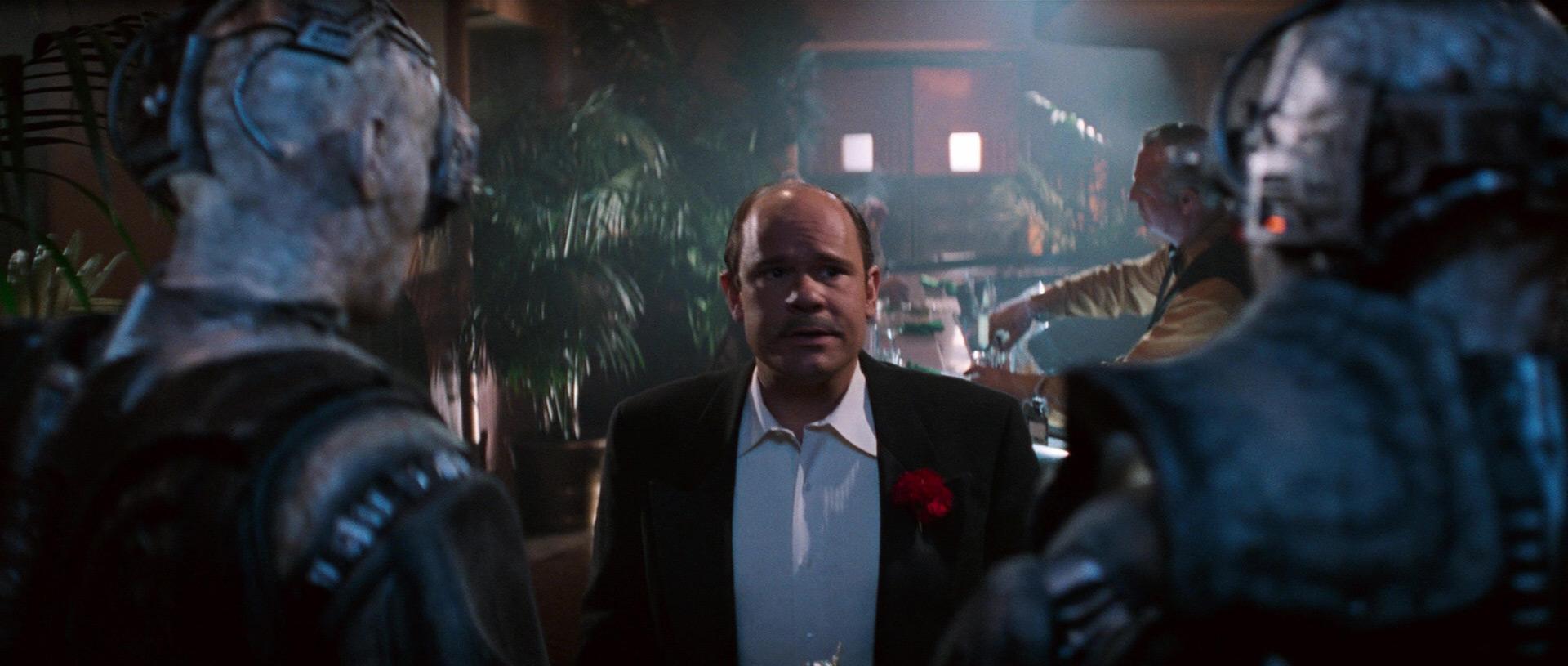

When Star Trek: First Contact premiered in 1996, it redefined what Star Trek was and it could be. It blended action, horror and optimism. about fear becoming vengeance and vengeance becoming hope, mercy, and understanding.




kies. Not only is it day to celebrate the day that humanity met the Vulcans, it’s also considered a holy day in the Terran Empire. On this day in the Mirrorverse, the Terrans killed all of the Vulcans on the survey ship.
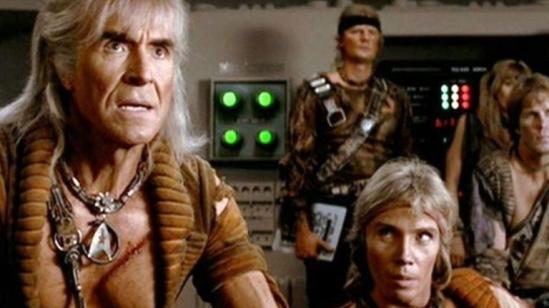

4. First Contact is considered the best TNG film. Fans and critics frequently rank it as the standout among Next Generation films. Some people consider it the second best Star Trek movie behind The Wrath of Khan
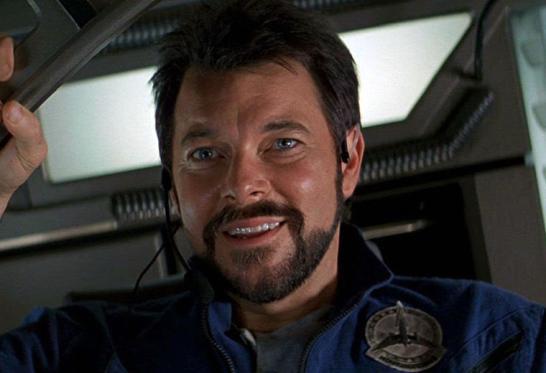

2. Jonathan Frakes made his directorial debut. Best known as Captain William Riker, Frakes stepped behind the camera and helped shape the film’s cinematic tone.
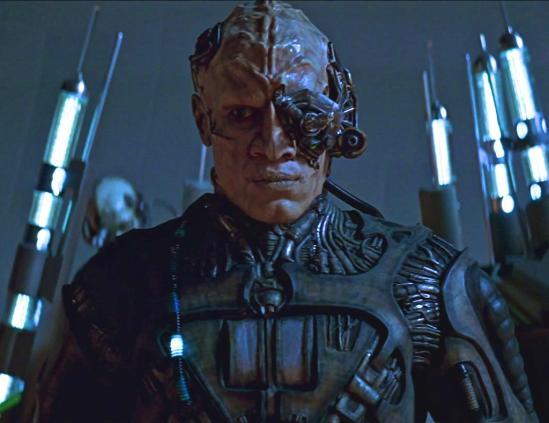

5. The Borg scenes were shot like a horror film. The film leans into zombie-style imagery, making the Borg feel more terrifying than ever.
7. Alice Krige was uncomfortable during filming. Her costume was uncomfortably tight, giving her blisters and the contacts she wore were so painful, she could only wear them for a few minutes at a time. Yet, her performance became one of the most memorable in the franchise.
8. Picard’s trauma drives the story. His past as Locutus gives the film emotional weight. As the audience watches the first scene in the film, we get that message very quickly. If you didn’t know anything about the Borg or Star Trek, the first scene explained it very well.
9. The film echoes Moby Dick. Picard with the Borg mirrors Captain Ahab putting lives at risk all for the sake of vengeance. was made aware of this by Lily Sloane.
10. First appearance of the Enterprise more combat-ready successor to the Enterprise
D. The ship isn't as bright and cheerful as we used to see in the television series. Instead, it is militarized and dark. You don’t see many people with a smile on their face.

The Borg Queen was created for the film. She gave the Borg a singular voice and presence.
11. The atmosphere of the movie gives a military philosophy. Reminding us of the growing threat of the Borg.
12. The opening battle pushed CGI forward. The Borg cube battle was groundbreaking for its time.
13. Builds on The Original Series lore by expanding on Zephram Cochrane’s legacy.
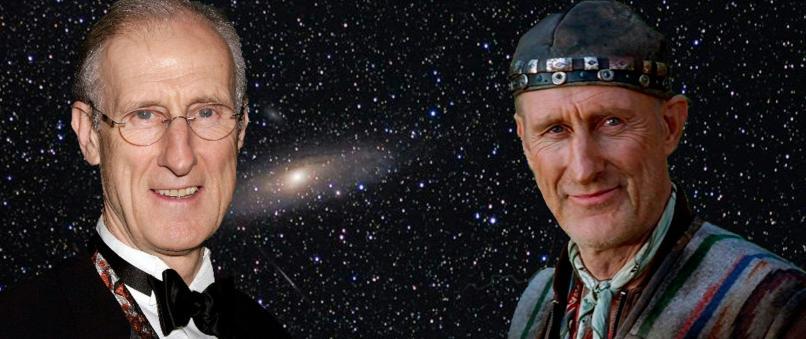
Cochrane is a reluctant hero. He is flawed, cynical and human. He is not this legendary hero that the Federation has made him out to be, nor does he want to be seen that way.


15. James Cromwell wasn’t the only actor to play Cochrane. He was also played by Glenn Corbett in TOS. Cromwell’s Cochrane was different from Corbett’s by bringing humor and realism to the role.
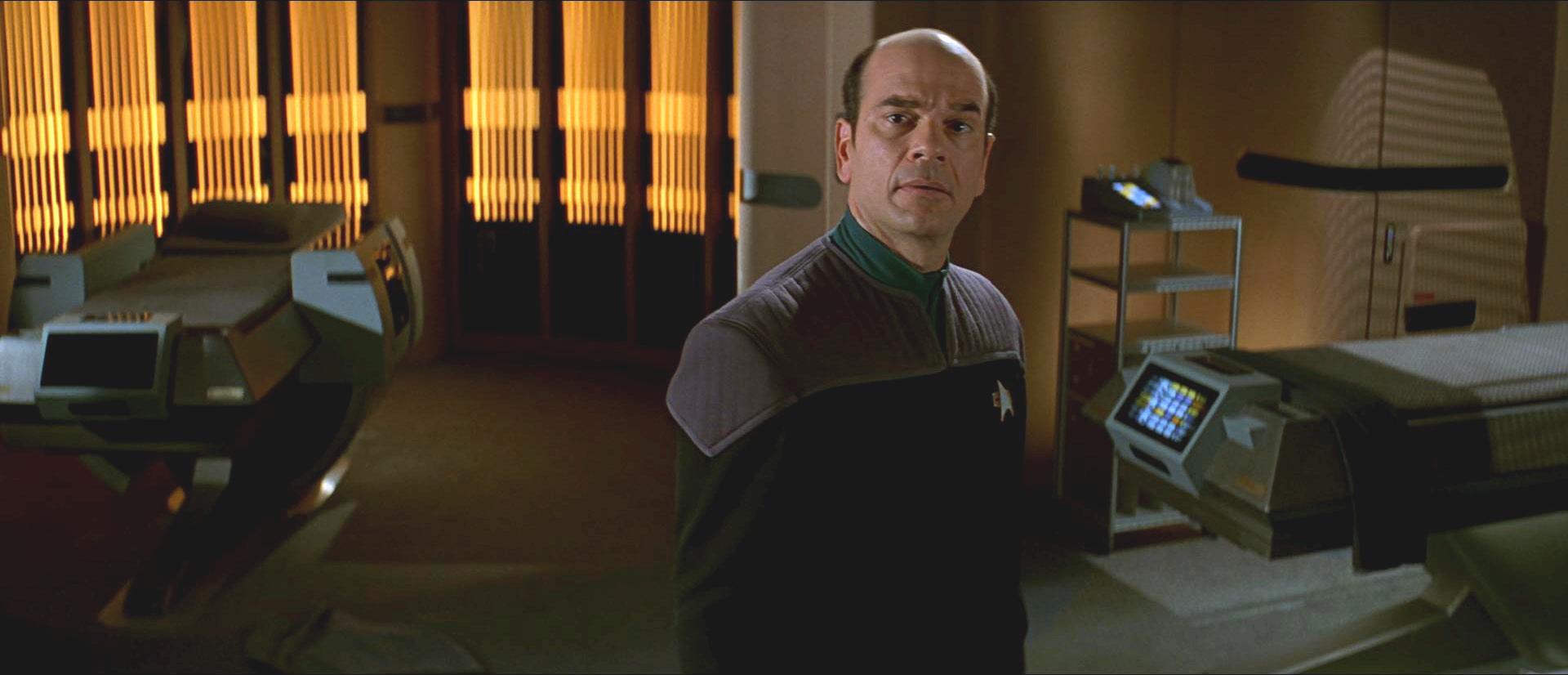


The Phoenix reflects real-world design influences. Its look echoes experimental spacecraft concepts.
17. The Vulcan landing became iconic. It is a standout moment in Star Trek history.
18. Jerry Goldsmith’s new theme emphasizes wonder and discovery. It stands out as one of Trek’s most uplifting compositions.
19. The theme from the movie was used in Star Trek: Picard.
20. “Magic Carpet Ride” adds humanity and humor. As a fan of rock and roll, it grounds Cochrane’s character in a relatable way. The song can later be heard once again in the Lower Decks episode, “Grounded.”
21. The Defiant cameo connects to Deep Space Nine A nod to the broader Star Trek universe.
22. Worf’s “Assimilate this!” became iconic among Trekkies both young and old. It’s one of the film’s most memorable lines.
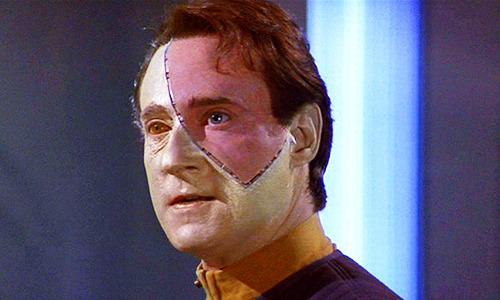
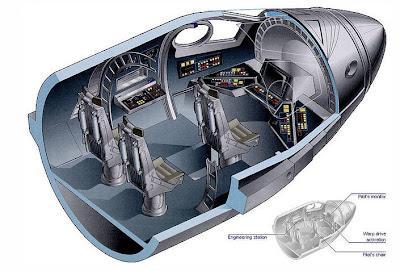
25. The Borg storyline connects multiple series. The Borg’s history and story are expanded in Voyager and continued in Enterprise’s episode, “Regeneration.”
26. Borg makeup required hours daily. Some have reported up to 4-6 hours.
27. Sets were reused across productions, including sets from Voyager and Deep Space Nine
28. Patrick Stewart pushed for more action. This helped the tone and intensity of the movie and made Picard an action hero in Star Trek
29. The film blends different genres such as war, horror, sci-fi, thriller and action.
30. It helped redefine Star Trek for modern audiences. Those who have never watched or heard of Star Trek were introduced to it through this film.
FINAL THOUGHTS

Data’s transformation mirrors classic sci-fi horror. His partial human skin gives callbacks to the story of Frankenstein.
24. The Borg Queen tempts Data with humanity and possibly something else. This continues his character arc of becoming more human.
It’s been thirty years and Trekkies still enjoy this movie. In fact, people who enjoy all types of genres enjoy this film. People don’t enjoy it solely for its action but because it understands what Star Trek has always been about: hope earned through struggle. The future isn’t built by perfect people, it’s built by imperfect ones who choose to be better.

MARISSA ANNE: Marissa Anne is an employee of the State of Indiana. She enjoys Star Trek, especially Star Trek: Voyager. She lives in Indiana with her family.


Robert Picardo appears as the Emergency Medical Hologram, delivering his iconic line. It took several attempts but he was persistent and we were all able to see our favorite holographic doctor on the big screen. Ethan Phillips appears as a holographic nightclub maître d’, nearly unrecognizable without makeup. According to Phillips, the producers wanted the fans to see if they would recognize him as Neelix since he wasn’t credited in the movie. These two cameos showed how Star Trek always makes connections through storytelling.
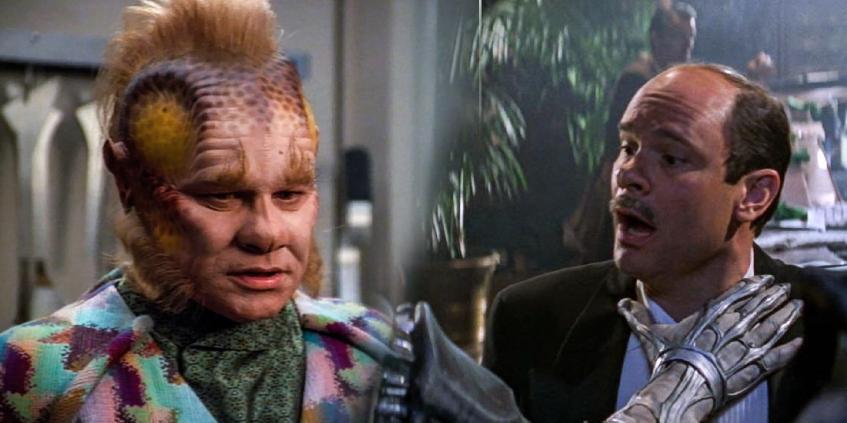
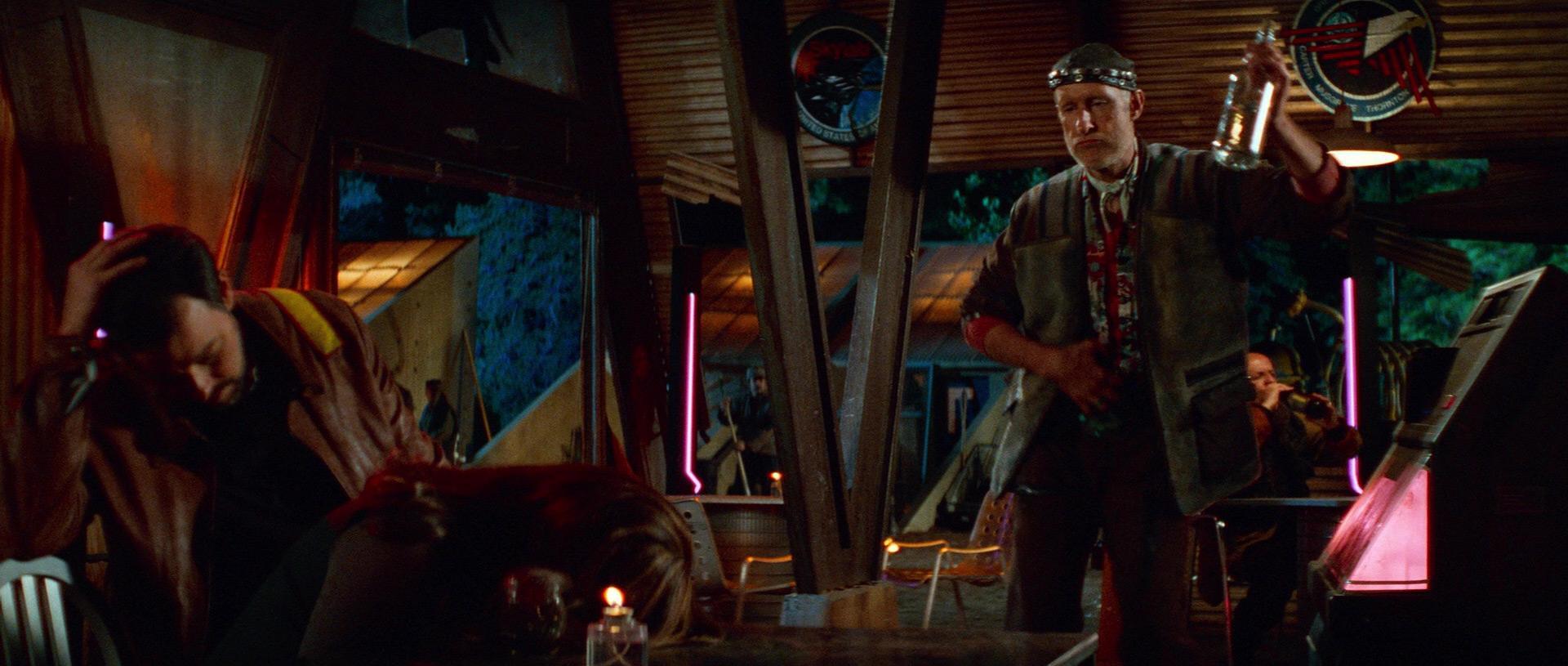




The large circus style tent had been erected only a few days ago. The committee responsible for the event had done all they could to make this the most important and successful event in Earth’s history. The tent was large enough to hold hundreds of attendees. People from all over the world and from off the Earth as well were invited to the ceremony. Government leaders. Captains of industry. Scientists and educators. Military officers from all the nations of the Earth and some from other worlds were invited to attend this momentous event. Even many of the local residents of Bozeman, Montana, were invited to attend the event as well. Some were there fifty years ago, and some were the descendants of those who were there to witness the events that occurred on April 5th, 2063.
Yet the most important person from that day was nowhere to be found on this day, fifty years later. Government officials who had planned this event were worried that they could not present him with the award to recognize his achievements. It was not that he could not be found, he just did not wish to be found.
Off in the woods, not far from where the tent was erected for the event was the person about whom they all were worried. He knew exactly where he was, he remembered it now as if it had happened just the other day. Just the other day, fifty years ago.
“Right here,” Zefram Cochrane said out loud to no one nearby, “this is where Geordi had
to tell me about that stupid statue.” Cochrane walked around in circles, his hands in his pockets looking at the ground as he kicked pinecones away from his feet in anger and sadness. “I miss them all so much.”
Cochrane looked up at the stars in the sky and then shook his right fist saying, “I miss you Geordi, Picard, Riker, even you Barkley, you silly, idol worshiper! And man do I miss you Troi,” he shook his head, “you had a nice pair of nacelles.”
He had to look away as tears began to well up in his eyes. “And I miss you most, Lily. God, I wish you were here. You always knew the right thing to say to me, to everyone who you touched! If it weren’t for you, this day would never have happened fifty years ago!”
He thought back to the events leading up to April 5th , 2063, of those people from the future that he missed so much. How he tried to warn us of the cybernetic beings, whose intentions were to enslave the human race. Of how the crew of the Enterprise were able to stop them. Yet, moreover, how those people from the future allowed the flight of the Phoenix to occur. And how, even at the commencement speech at Princeton, where he issued that warning, he was ridiculed and force to recant the words he spoke that day. He always felt he had betrayed those friends from the future, and this always hurt him the most. For this, he felt receiving the award was a betrayal of those that truly made first contact possible. Cochrane began to walk
further from where the festivities were to occur. Off in the distance he heard the sounds of branches breaking. “Is anyone out there?”
He called out to the unseen stalker, “don’t come near me. I’ve,” he patted down his jacket pockets, looking for something that was not there. “I’ve got a gun, so you better keep your distance.”
The person who had followed Cochrane into the woods appeared from behind a pine tree. He was a much younger man than Cochrane, dressed in a business suit, as did so many of the other dignitaries attending the event that Cochrane tried to hide from.
The younger man introduced himself. “Ah, Dr. Cochrane, you don’t know me, but I know everything about you. Allow me to introduce myself, my name is Henry Archer.” “And?” asked Cochrane. “And I have some design ideas for your Warp engines that I’d like to show you?” “Ah, come on, really?” argued Cochrane. “You stalked me in the forest to try and show me your cockamamie ideas for something you have no knowledge of or even understand the complexity of a Warp Drive engine.”
“If you allow me,” Archer said as he slowly approached Cochrane holding a folder in his hand, “I think you’ll find what I have here rather interesting.”
“Oh, alright, if it will get you out of my hair,” replied Cochrane. He grabbed the folder and began to scan the pages it contained. “Hum…these really your ideas?”
“Ah, yes. I think if you look
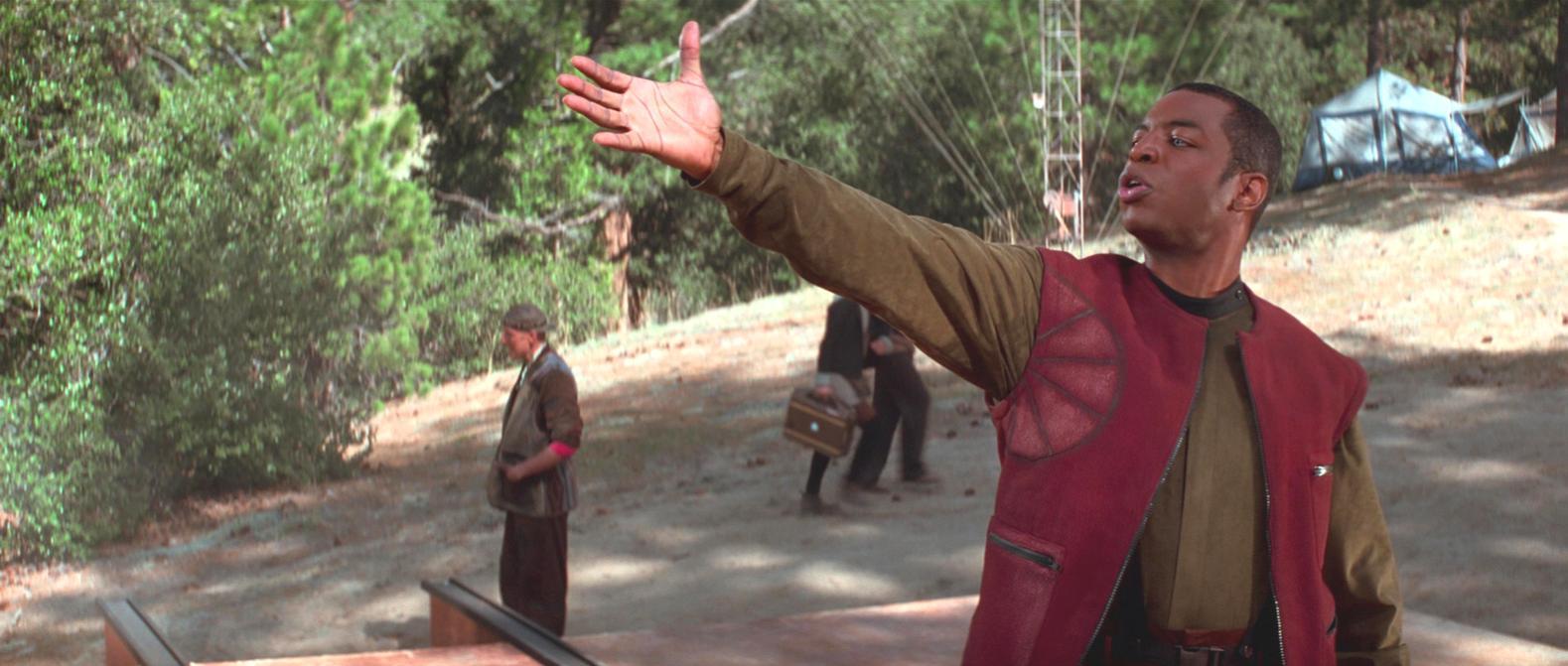
at my schematics near the back, you might find my design, how do I put this gently, an improvement on your Warp One engine. Not that perfection needs improvement, ha, ha,” Archer nervously added.
“Yeah. Nothing is perfect,” Cochrane said, then added in a near whisper, “not even me.” Cochrane handed back the folder to Archer and added, “have you shown these documents to anyone else?”
“Yes, to my associates at MIT,” Archer said. “They laughed and said I was crazy. Crazy when I said I was going to show you the designs. They said you’d reject them on first sight.”
“Yeah, well they were right. And they were wrong as well. You don’t know this, but I am planning on a new, more powerful Warp engine. Yes, perfection can
be improved upon.” Cochrane reached into his pocket and pulled out a business card, handing it to the young man. “I’m going to need brilliant minds for this project. I’m not saying you’re brilliant, some scratching on a paper can lead to great things, but if you are willing to move to Montana, then I’d like you on my team.”
“Really, Montana?” Archer asked. “Why?”
“Well, it’s where it all began and I owe it to the people of Bozeman to establish it here. If I don’t, I’ll bet someone will want to build an amusement park to make money on first contact.” Cochrane scratched his head.
“Like that, oh what was it called again, Disneyland? That Walt Disney, now there was a visionary. And he made money doing it. Now that’s genius.” Archer looked around, as if he
could find the words to reply to the offer. “I don’t know, life on the East Coast has been great. Relocating to Montana, hum? I’d have to discuss this with Sally, my wife…”
“You’re married?”
“And I have a son, named Jonathan. This would be a big step. How powerful an engine are you planning to create, we haven’t even cracked Warp two yet.”
“Warp two, that’s for children. I’m shooting for Warp five!”
“Warp five? Then count me in. Thank you, Dr. Cochrane, thank you.” Archer began to head in the direction of the festivities.
“I’ll see you later, when they give you the award.” “Maybe,” replied Cochrane. And then he was alone again.
“Award. Really. Do I really deserve such a thing? And there’s
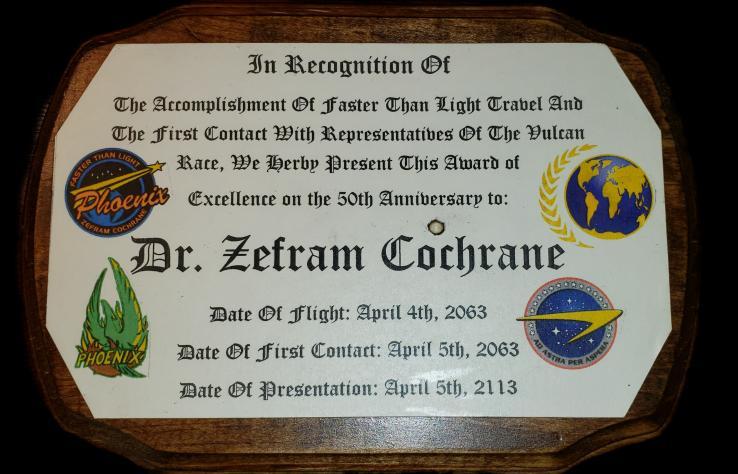
a typo on it. What did I do compared to the real greats of engineering advancement? The Wright brothers, Einstein, Chuck Yeager, Neil Armstrong, they were all the real firsts at what they did.
I just got lucky. And if it weren’t for the help I got from Geordi and the others, I’d be a drunk somewhere, or even dead. And what did I do? I just proved that Einstein was wrong. Einstein, the greatest physics mind in history and I proved his theories were wrong. Sure, I have made mistakes, so a typo is exactly what I deserve.”
Yet from behind Cochrane, another voice called out to him.
“Don’t sell yourself short, my friend.”
“Oh, for Pete’s sake, who is it now?” Cochrane turned and froze. Dressed in his majestic robe was the person he met fifty years ago. “Oh my, is it really you Solkar?”
From out of the shadows stood the Vulcan commander of the survey ship T’Plana-Hath.
“Yes, it is really me.” The Vulcan stretched out his right
hand and took hold of Cochrane’s hand. “Remember how you showed me this form of greeting. I’ve always wanted to return it to you. How have you been my old friend?
’
“Good, I guess?” Cochrane looked at the Vulcan standing before him and added, “you, you look like you haven’t aged a day, compared to me.”
“As you know, we Vulcans aged slower than you humans. So why are you hiding in the forest, you should be back at the festivities.”
“They want to give me an award for what happened when we first met. I don’t think I deserve it.”
“You are acting illogical, Zefram. The old Vulcan proverb of ‘the needs of the many outweigh the needs of the few or the one’ is so applicable now. Today, they need you. We all need you. Come, let us return together.”
Solkar pointed in the direction of the tent. “Let us go, as we did so long ago and let us usher in a new generation. Let them give you the award you so richly de-
serve. Did you know there is a typographical error on the award?” “Yeah, just like me, imperfect.”
As the two walked in the forest, heading to the tent, they spoke about the events that occurred that April night. They talked about how humans and Vulcans had worked together to advance the human race. Knowing humans were not alone in the galaxy and that the Vulcans offered advancements to the human race only made the evening’s event more satisfying.
Once they arrived at the tent, the master of ceremonies grabbed Cochrane by the arm and led him to the stage to stand before all the dignitaries that were seated in the audience.
“And now, ladies and gentlemen, the man of the day, of the year, of the century. The man we have all waited…and waited for has arrived, Dr. Zefram Cochrane.” Cochrane smiled to the audience. “Dr. Cochrane, what do you have to say to the audience on this most momentous occasion?”
“Twas nothing,” Cochrane said. And the audience broke into a sustained applause.
STEPHEN MIRKIN: I first learned about science fiction the moment I was able to reach the on/off knob on my parents’ black-and-white TV set. Being born in 1956, I was there on Sept. 8, 1966 to watch the first episode of Star Trek. Since then, I have watched every TV series and every movie and I only look forward to the next great Star Trek moment.
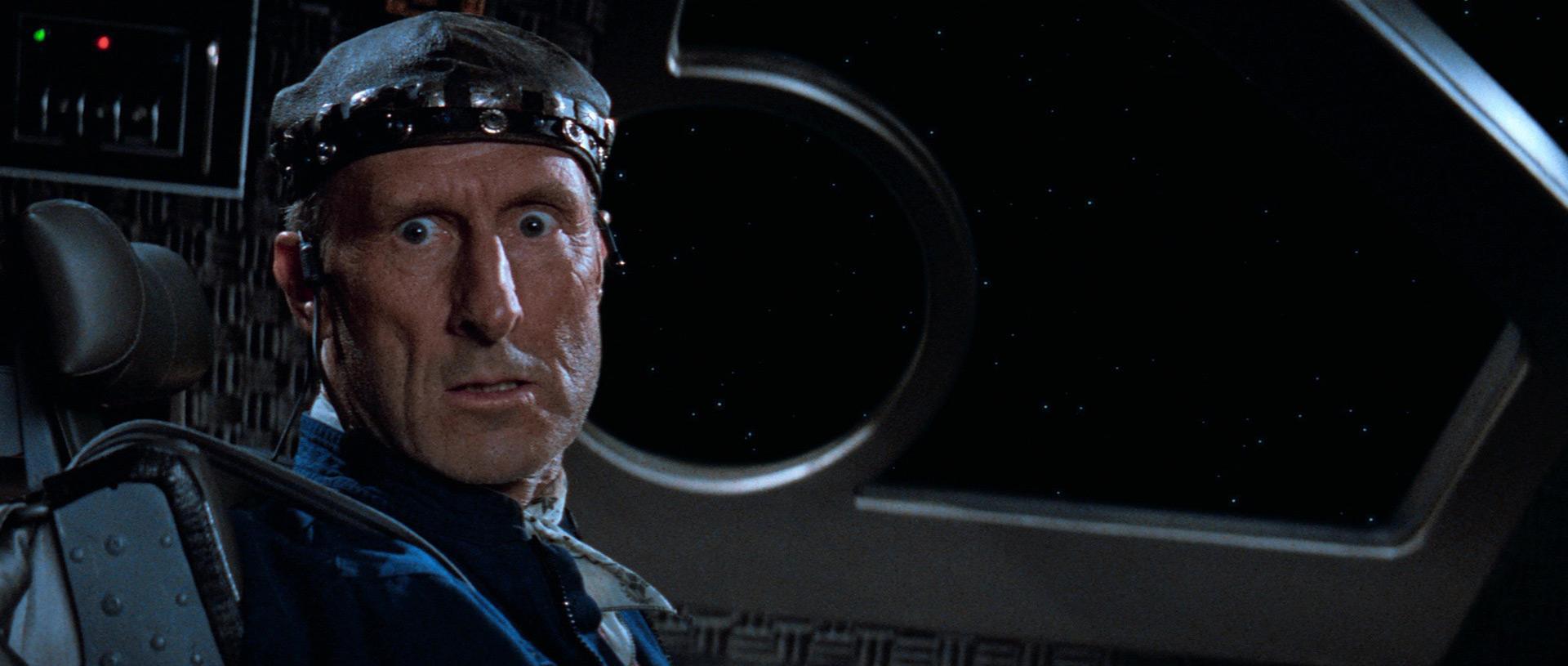

Growing up, I was introduced to Star Trek in a very peculiar way. I was scarred and scared by it. Don’t get me wrong, I love Star Trek. Mostly Voyager and the other shows that are connected to it. But I really was scarred by it. I remember walking into the living room, looking at the tv, and seeing Riker being dragged into a tarpit while screaming for Data to help him. Then, as Riker’s face appeared out of that pit, I saw the monstrosity of Armus. I remember crying and telling my dad that I was scared. He gave me a pillow and blanket and I stayed under it until the episode was over. Then, there was another episode when the crew of the Enterprise were introduced to one of the most terrifying species of its time, The Borg. I remember seeing so much green lighting and black tubing. Watching Riker trying to explain The Borg Nursery was horrifying. I was upset and scared when I saw those babies covered in tubing and wires and then weirdly wrapped in a blanket. It was horrific! The other two episodes, “Conspiracy Theory” and “The Best of Both Worlds” horrified me as well. What I’m saying is that I was introduced to Star Trek by watching all of the “horror” episodes of The Next Generation. Fast forward to 1996. I believe it was a Friday and I was at school. I remember my elementary teacher giving me a pass to the office because I was going home. In reality, I was going to the movies with my dad. My dad had a habit of doing this and I loved him for it. It was my dad, my sister, my little brother, and
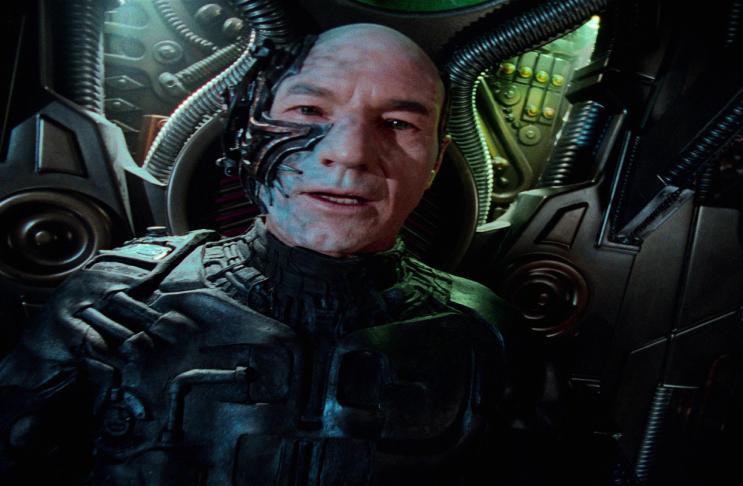
me. I believe we went to the movie theater at River Oaks Mall or the one in Michigan City. Either way, I remember walking through the movie theater and it looked very dark. I remember seeing posters of Star Trek: First Contact all over the place. I didn’t know this movie came out but my dad did and he took us to see it. I remember walking through the movie theater and looking at the different posters of the movie. I felt anxious because I knew who the villain was…those damn Borg! We went into the movie theater and I took my jacket off. The beginning credits rolled and I felt light and fluffy. I was thinking to myself, “This music sounds pretty.” Then, WHAM! Here comes Picard with the nightmares! I felt nauseated. Looking at the details of what he went through was horrifying to watch. Seeing him in pain and misery. Then he turned his head and I saw that familiar head device stuck to his face with that eerie, red light pointing at me. I felt like a target. At some point,
he wakes up and he looks in the mirror. I remember seeing something move in his face. Then, I jumped out of my skin when I saw a mechanical device protrude from his cheek. At this point, I put my jacket over my face. Eventually, I pulled the jacket down and the only thing that you could see were my eyeglasses. I even tilted my head down and pulled my glasses down a little bit so that I could watch the movie through my horrible, blurry vision. Apparently, watching a scary movie using my blurry vision makes it more bearable for me.
Although the beginning wasn’t too scary, it felt very eerie. As the movie continued to play, it felt more tense. It didn’t feel like Star Trek to me. Everyone was on high alert, including me. You could feel the intensity, the fear, the worry from these characters. Jonathan Frakes did a good job of making me feel claustrophobic while watching this movie. Looking at the visual art of the movie and the way Frakes, Brannon Braga and Ronald D. Moore put this
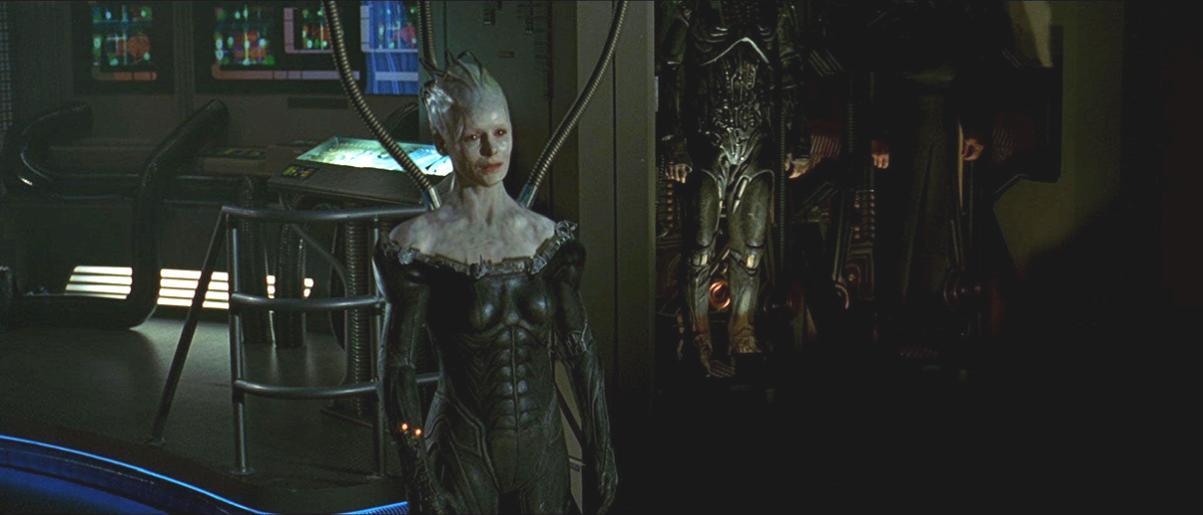
film together, there’s no doubt that HR Giger and Alien were inspirations.
As I continued watching, I remembered getting excited when I saw all of Starfleet come together to fend off a Borg Cube. Seeing everyone working together to save the day was fun to watch. Watching Worf command The Defiant and delivering his signature line, “It is a good day to die,” put a smile on my face. The movie felt like Star Trek again. I could breathe, I could relax. Once they go back in time, chasing The Borg Sphere, some of that anxiousness came back. I knew this was Star Trek but it was going to be different. Although it was scary, the movie was full of hope. I knew there was going to be a happy ending but it was going to be awhile before that happened.
Seeing the set of Bozeman, Montana looked very modern and familiar to me. It felt like Star Trek was in my reality. I saw the bar and a drunk, Zefram Cochrane being escorted out by the lovely Lily Sloan. I thought they were a cou-
ple at first and it was never confirmed. But there were signs. The scenes with Cochrane and the crew were funny and warm. The scenes with Lily were warm, serious, and hopeful.
Now let’s talk about a few more scenes that stood out to me. Frakes did an excellent job of filming this movie. This movie had scenes that reminded me of other movies. As I said before, this Star Trek movie was different. I knew it was going to be more than just
The Borg in this movie. I just couldn’t put my finger on it… until I saw her. Yes, descending from the rafters of Engineering with a head that contained a bun made out of tubing, a neck, shoulders, and a snake-like mechanical spine was the queen herself. Her voice, although motherly, was so horrifying. She didn’t have to tell you she was in charge, you just knew it.
That whole scene reminded me of The Supreme Leader in Captain EO and areas of The Nostromo and the other derelict ship in Alien. I remember feeling chills going up and down my spine
and arms. I put my jacket over my face but I couldn’t escape hearing her voice. I was scared for Data. I was scared that she was going to turn him into a Borg or destroy him.
Then there were some fun scenes, such as the one in Sickbay. I remember keeping my jacket over my face because of the previous scenes. My dad kept trying to get me to pull my jacket down by saying, “Look, look, it’s The Doctor.” Although I knew it was The Doctor I didn’t want to watch it because I was scared. At the last possible second I saw him and I felt somewhat comforted. Seeing a reference to Voyager took away some anxiety and fear. Then there was the scene in the holodeck. Again, I remember my dad saying, “Look, look, it’s Neelix.” But I didn’t see Neelix. I just saw a guy that sounded like him. But as before, it was comforting. I heard a familiar voice from Voyager in that scene. Afterwards, I was able to watch the rest of the movie.
The scene that stood out to me the most was with Lily and
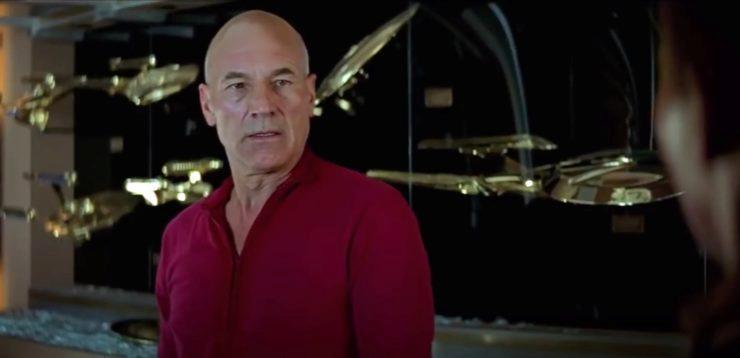
Picard. It starts off with Picard pushing the crew to its limits with The Borg. The crew was tired, frightened, and low on resources. They wanted to leave and destroy the ship so that they could stop The Borg. Picard degraded Worf and didn’t listen to his crew. To me, he was having a tantrum. I remember feeling angry at him and tears rolling down my cheeks.
I understood why he wanted them to continue to fight but it wasn’t right. They didn’t have the manpower to stop them and all I could think about was Data. At this point, Picard was no longer a leader to me. He was just another captain hellbent on revenge because of what The Borg did to
At some
“The line must be drawn here, this far, no further! And I will make them pay for what they've done.”
— Captain Picard
point, he goes into the Ready Room and Lily follows him. If no
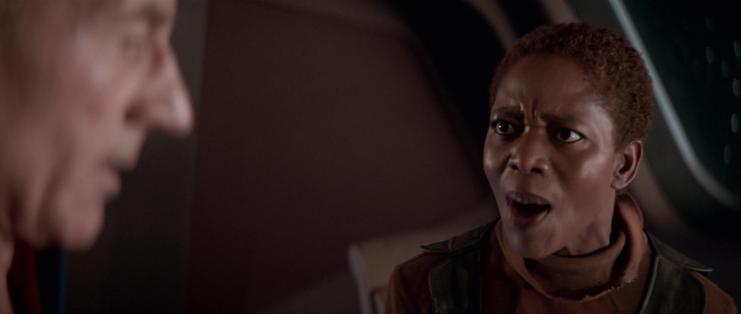
one was going to stand up to him, she was going to do it. Lily told him about the dangers of his decisions and how it was affecting the crew. He yelled at her to get out. “Or what? You'll kill me, like you killed Ensign Lynch,” she yelled back. Picard just kept coming up with different reasons for giving his orders but Lily saw through him. She compared him to Captain Ahab, stating that he “has to go hunt his whale.” Picard then says one of his most iconic lines, “No! ...I will not sacrifice the Enterprise. We've made too many compromises already. Too many retreats. They invade our space and we fall back. They assimilate entire worlds, and we fall back. Not again! The line must be drawn here, this far, no further! And I will make them pay for what they've done.”
So many people quote this line. It sounds cool, powerful, and heroic. But to me, there’s nothing cool, powerful, or heroic about it. Picard sounded like someone full of rage, revenge and fear. Those
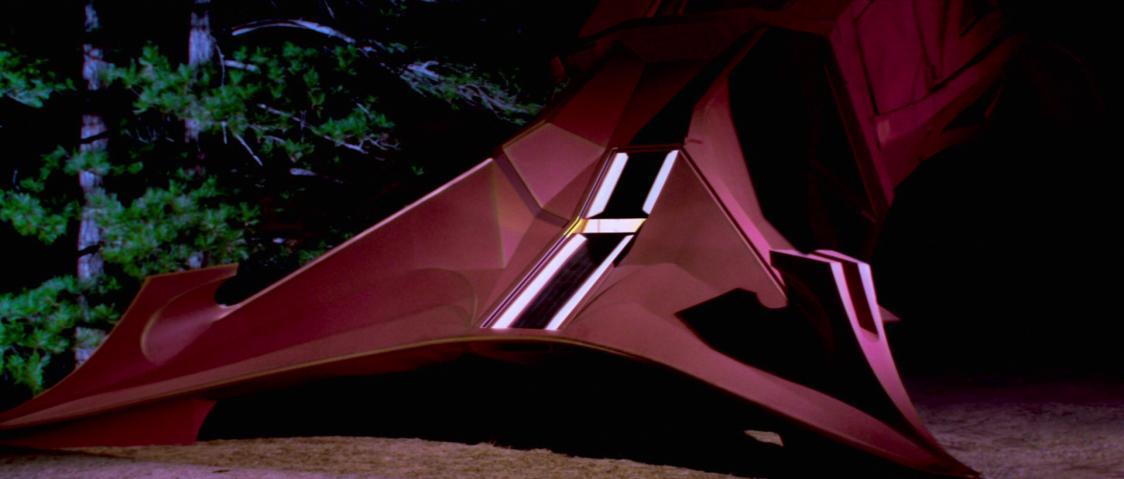
three things, combined, caused him to make irrational decisions. This is where that line stems from. I continued to cry because this wasn’t the Picard that I knew. This was someone different. It took Lily, someone outside of the situation, who didn’t know him, to make him aware of that. I felt so much better when he realized his mistakes, apologized to the crew and Worf, and agreed to destroy the ship. I was able to smile again. I felt warm. I saw the Picard that I
knew again. Lily was his conscience in this film. She respected what he went through as a Borg Drone but reminded him that he still has a family and crew to take care of. This also allowed him to remember that Data was kidnapped by The Borg. He was able to confront his fears, stop The Borg Queen, and save Data and humanity. Lily gave Picard back to me.
Seeing The Vulcans and humanity meet each other for the
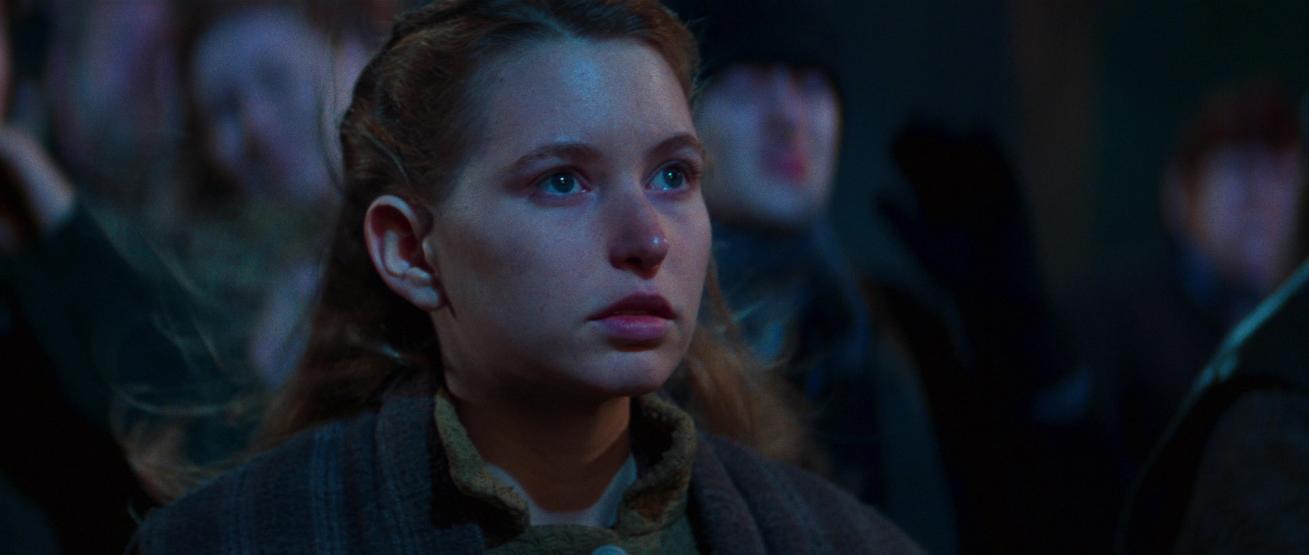
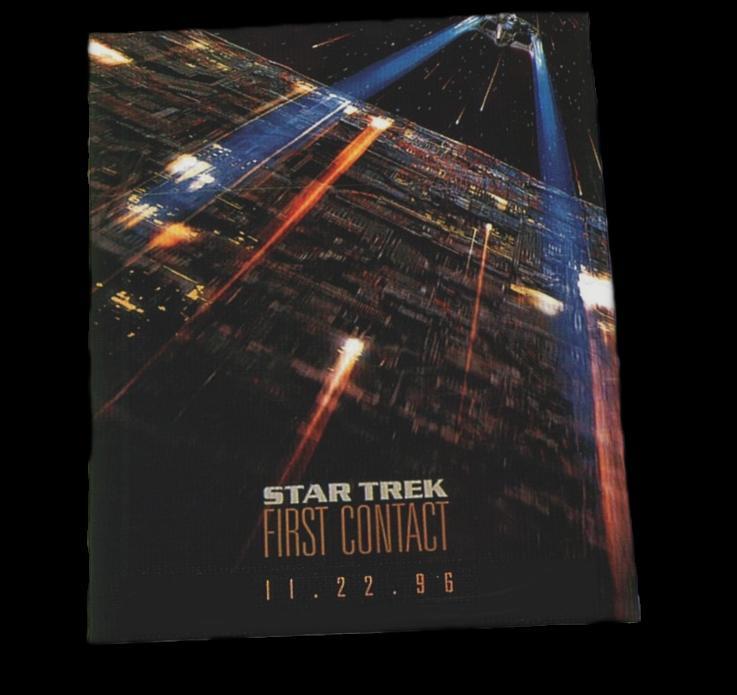




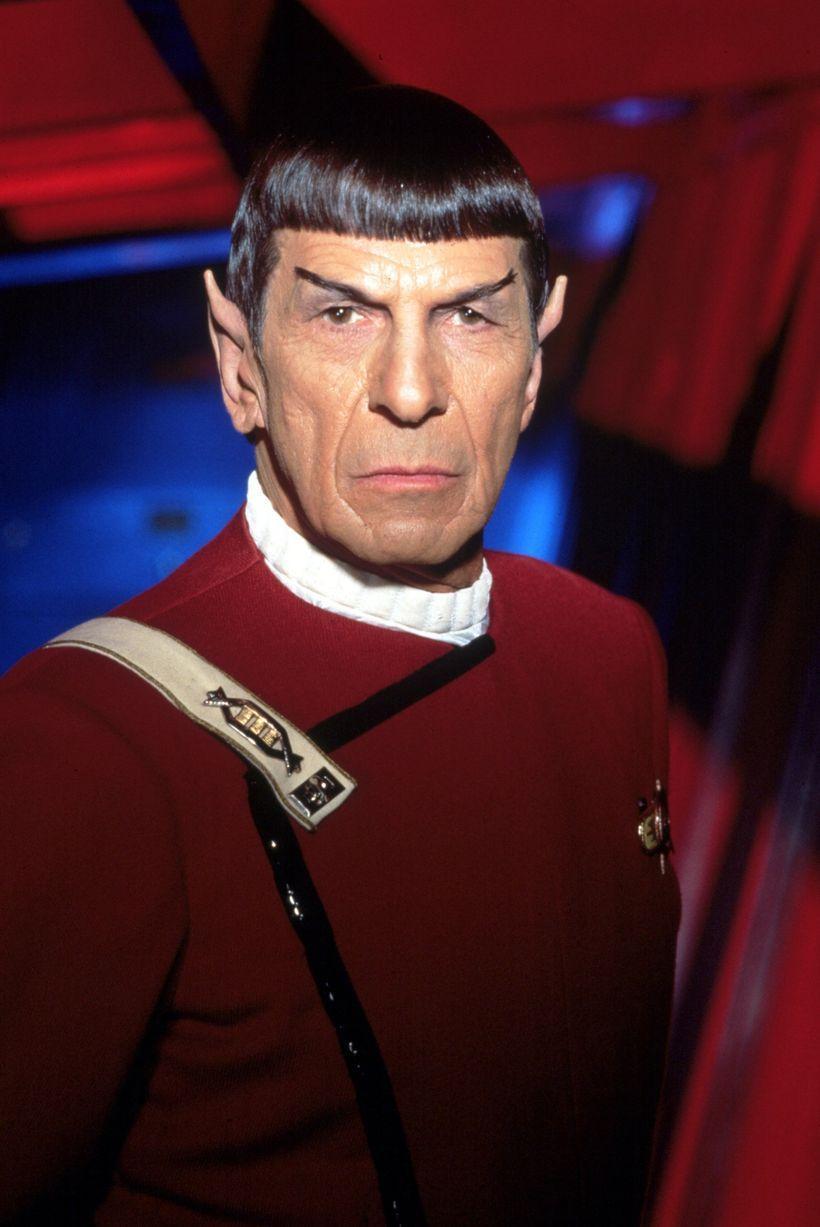




I
n the Star Trek universe, there are few moments in history that are so pivotal that it transcends all of humanity. Perhaps the most pivotal moment in history would be when Vulcans first contacted humans after detecting Zefram Cochrane’s warp ship, the Phoenix ushering in a new era of peace and prosperity for humanity. The Vulcans, a species known for their devotion to logic and peaceful exploration, would lead humanity down a path that would eventually lead to the creation of the Federation of Planets.
But what if that moment never happened?
What if the Vulcan ship never passed near Earth? What if their sensors failed to detect the warp signature of the Phoenix? Or what if the Vulcan High Command chose to ignore the signal and move on?
In this alternate timeline, the absence of that single meeting could dramatically reshape the destiny of humanity, and perhaps the entire Alpha Quadrant.
Earth in 2063: A Fragile Civilization
To understand how different the future might be, it’s important to remember the condition of Earth in 2063.
Humanity had just survived the devastating World War III. Much of the planet was in ruins. Governments had collapsed, economies were shattered, and millions had died in nuclear exchanges. Social order was fragile, and many regions were still struggling simply to rebuild basic infrastructure.
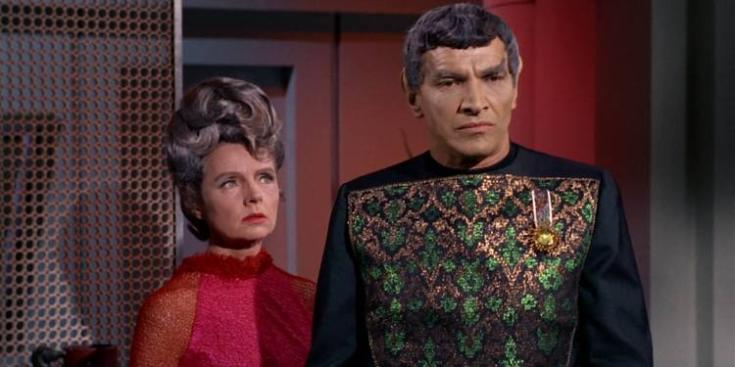
In the original timeline, Vulcan contact provided something humanity desperately needed: proof that it was not alone in the universe.
The knowledge that intelligent life existed beyond Earth fundamentally changed humanity’s outlook. Instead of focusing on internal divisions, people began to look outward. Exploration, cooperation, and scientific advancement became global priorities.
Without Vulcan contact, however, humanity would have lacked that unifying revelation. Earth might have remained inward -looking for decades.
In this alternate history, the first warp flight would still be an incredible technological achievement, but its impact would be far more limited.
Zefram Cochrane’s success might be seen primarily as a military or economic breakthrough rather than a gateway to a new cosmic era.
The Fate of Warp Technology
Without the Vulcans appearing shortly after the Phoenix flight, warp technology would likely develop along a very different path.
In the original timeline, the
Vulcans helped guide humanity’s early warp development. They provided limited technological assistance and encouraged cautious expansion into space. While their mentorship was sometimes controversial, it helped ensure that Earth did not rush recklessly into the galaxy.
In an alternate timeline without Vulcan oversight, humanity might pursue warp technology far more aggressively.
There would be consequences to not having the Vulcans be that guiding light into the cosmos. First, considering how the state of the planet the invention of Warp travel would certainly become a strategic asset. Zefram Cochrane himself said that he had never invented it to usher in a new phase for humanity, he was only interested in money, so, one could conclude that after his trip was successful, his next step would be to sell his designs to the highest bidder, almost certainly having what governments that were left to obtain this technology for themselves. Once acquired, instead of developing exploration vessels, humans would more likely build armed patrol craft, or military fighting craft. New factions would ultimately evolve and fight
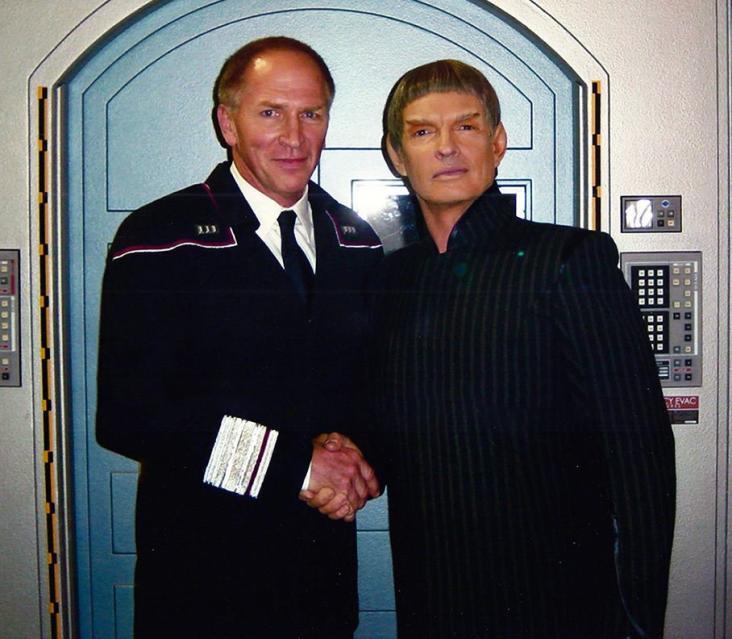
to obtain the technology for themselves to gain a tactical advantage. Although humanity would eventually improve warp technology on its own, the process would likely be slower without alien guidance. The Vulcans possessed centuries of experience in interstellar travel. Without that knowledge, Earth scientists would need decades, or even centuries, to solve the same engineering challenges. In addition, early warp experiments would be far riskier. Without the Vulcan safety principles, human engineers would attempt unstable warp test and would ultimately cause a great deal of injuries and death. In short, humanity might reach the stars eventually, but the journey would be far less controlled.
The Absence of Vulcan Mentorship
The relationship between
humans and Vulcans was often tense. Vulcan leaders frequently believed humanity was too emotional and impulsive for rapid expansion into space. Yet despite these tensions, their influence was critical. Without Vulcans guiding early exploration, humanity would lack one of the galaxy’s most experienced and stable civilizations as a mentor.
Vulcan philosophy emphasized logic, discipline, and rigorous scientific reasoning. Their influence helped shape the intellectual culture of early Starfleet. Without that influence, Earth’s space program might remain fragmented between competing governments and corporations. Humanity’s first diplomatic lessons came from interacting with the Vulcans. Negotiating with an alien species forced humanity to develop new cultural awareness and interspecies diplomacy. Without that experience, Earth’s first encounters with other
civilizations might be far more chaotic.
The presence of a technologically advanced alien ally also helped stabilize Earth politically. Vulcan cooperation encouraged global unity.
Without it, Earth might remain divided far longer.
Humanity’s First Alien Encounter
Perhaps the most dramatic change in this alternate history would be who humanity meets first.
In the original timeline, the Vulcans were an ideal first contact species: patient, peaceful, and curious. They had little interest in conquest and believed strongly in non-aggression.
But the galaxy is full of civilizations that are far less benevolent.
Imagine if humanity’s first contact was not Vulcan, but Klingon.
The Klingons are a proud warrior culture with a long history of expansion and conquest. In the 22nd and 23rd centuries, they frequently clashed with the Federation.
If early warp-era Earth encountered Klingons first, the result could be catastrophic.
The Klingons might see humanity as a weak, newly warpcapable species ripe for conquest. Without allies, Earth might be forced into a defensive war far earlier than expected.
Even if conquest did not occur, the relationship would likely be defined by intimidation and conflict.
Humanity’s first steps into the galaxy might therefore
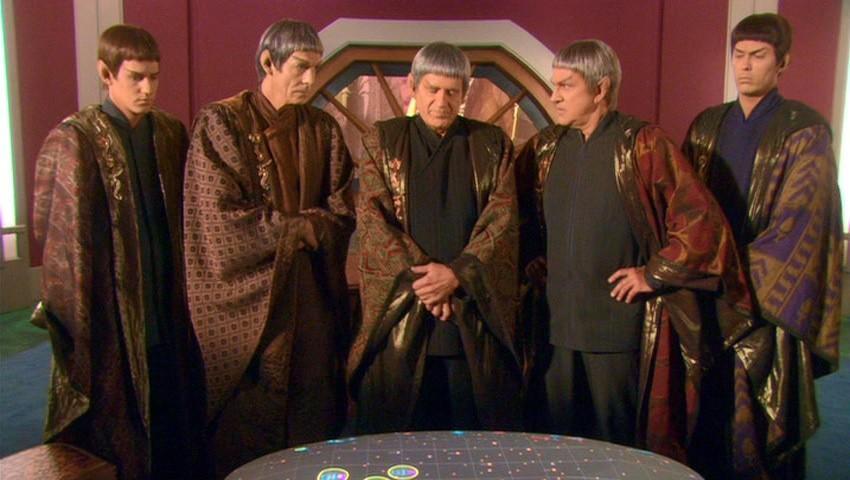
begin not with cooperation, but with war.
Giving the state of what humanity was in this time, if the Klingons were the first aliens that humans encountered, it is very possible that humanity would not survive and be slaughtered.
The Delayed Birth of the Federation
One of the most significant long-term consequences of missing Vulcan first contact would be the likely absence, or delays of the United Federation of Planets.
In the original timeline, the Federation was formed through cooperation between several species: Humans, Vulcans, Andorians, Tellarites were all founding members of the United Federation of Planets. The diplomatic efforts that led to this alliance were heavily influenced by human mediators and explorers working alongside Vulcans.
Without Vulcan contact, humanity might never become involved in those early interstellar diplomatic networks. As a result, the Vulcan-Andorian conflict would have continued longer. The cooperative alliance that became the Federation might never form.
The Alpha Quadrant could remain politically fragmented. Instead of a large cooperative alliance, the quadrant might consist of competing regional powers
The Balance of Power in the Alpha Quadrant
The absence of the Federation would dramatically alter the balance of power among major civilizations.
Without a unified alliance of worlds, the Alpha Quadrant might become dominated by expansionist empires. There would be species that would certainly by fighting for dominance. There would be a few possibilities of
what may happen without a Federation to maintain stability. First, the Romulans built a powerful interstellar empire defined by secrecy and strategic manipulation. The original timeline for their expansion was balanced by both the Federation and the Klingon Empire. However, without the Federation, the Romulans might extend their influence far deeper into nearby star systems
In addition to this, on the other hand, you have the Klingon empire who would also be fighting for conquest. It is possible that the two species would have certainly been at war, each trying to acquire as much of the Alpha and Beta Quadrants as possible. This would inevitably cause all other planets to be conquered by one or both warring species. The absence of a stabilizing alliance like the Federation could lead to frequent border wars, shifting alliances, and po-
litical instability across the quadrant.
In this alternate history, the galaxy might resemble a patchwork of competing empires rather than a cooperative network of worlds.
The Absence of Starfleet
Without Vulcan guidance and Federation cooperation, the organization known as Starfleet might never emerge in its familiar form.
Instead of a unified exploratory service, Earth’s space forces might resemble a combination of military fleets, scientific agencies, and commercial shipping companies.
The famous missions of exploration that defined Star Trek history, might never occur.
There would be no voyages like those undertaken by the legendary USS Enterprise (NCC1701).
The idea of peaceful expansion might remain secondary to strategic defense and economic expansion.
Humanity’s presence in space might therefore feel far less optimistic than in the original timeline.
Cultural Consequences for Humanity
Perhaps the most profound difference would not be technological or political, but philosophical.
First contact changed how humans saw themselves.
Knowing that intelligent life existed beyond Earth encouraged humanity to think on a galactic scale. It inspired a sense of
shared destiny. Without that revelation, humanity might take much longer to develop a unified identity as a species. Nationalism, economic competition, and ideological conflicts might remain dominant for generations.
Instead of becoming explorers, humans might become cautious colonizers, focused more on survival than discovery.
The optimistic vision of the future often associated with Star Trek might never emerge.
A Different Kind of Galaxy
If the Vulcans never made first contact with Earth, the ripple effects would extend across centuries of history.
The Federation might never form. Starfleet might never exist.
Humanity might reach the stars later, and under far more dangerous circumstances. Ironically, this alternate timeline might look far less like the hopeful future imagined in Star Trek and far more like a traditional geopolitical struggle played out across the stars.
The meeting between humans and Vulcans was not merely a friendly greeting between two species.
It was the moment that transformed humanity’s future. Without it, the galaxy might still be full of exploration and discovery, but the spirit behind that exploration would be very different.
Conclusion: The Importance of One Moment
History often turns into small events. A single missed signal, a delayed survey mission, or a minor sensor malfunction could have prevented the Vulcans from detecting humanity’s first warp flight.
If that had happened, the entire course of galactic history might have changed.
Humanity would still dream of the stars. That impulse, to explore, to learn, to reach beyond the horizons deeply human. But without the guiding hand of Vulcan logic and the inspiration of peaceful first contact, humanity’s journey into space might be slower, harsher, and far more uncertain.

The optimistic universe of Star Trek exists because of cooperation between species who chose curiosity over fear. And it all began with a simple meeting between strangers under the Montana sky.
MICHAEL MARTIN: I’ve been a Star Trek fan since I was a kid. I grew up on The Next Generation, fell in love with Deep Space Nine and Voyager. It was one of the few shows that my father and I would watch together and still share the love for the franchise today. The show’s ideals, hope, unity, and moral courage have always meant something real to me. It gives me great pleasure to see where humanity can go and what can be achieved.

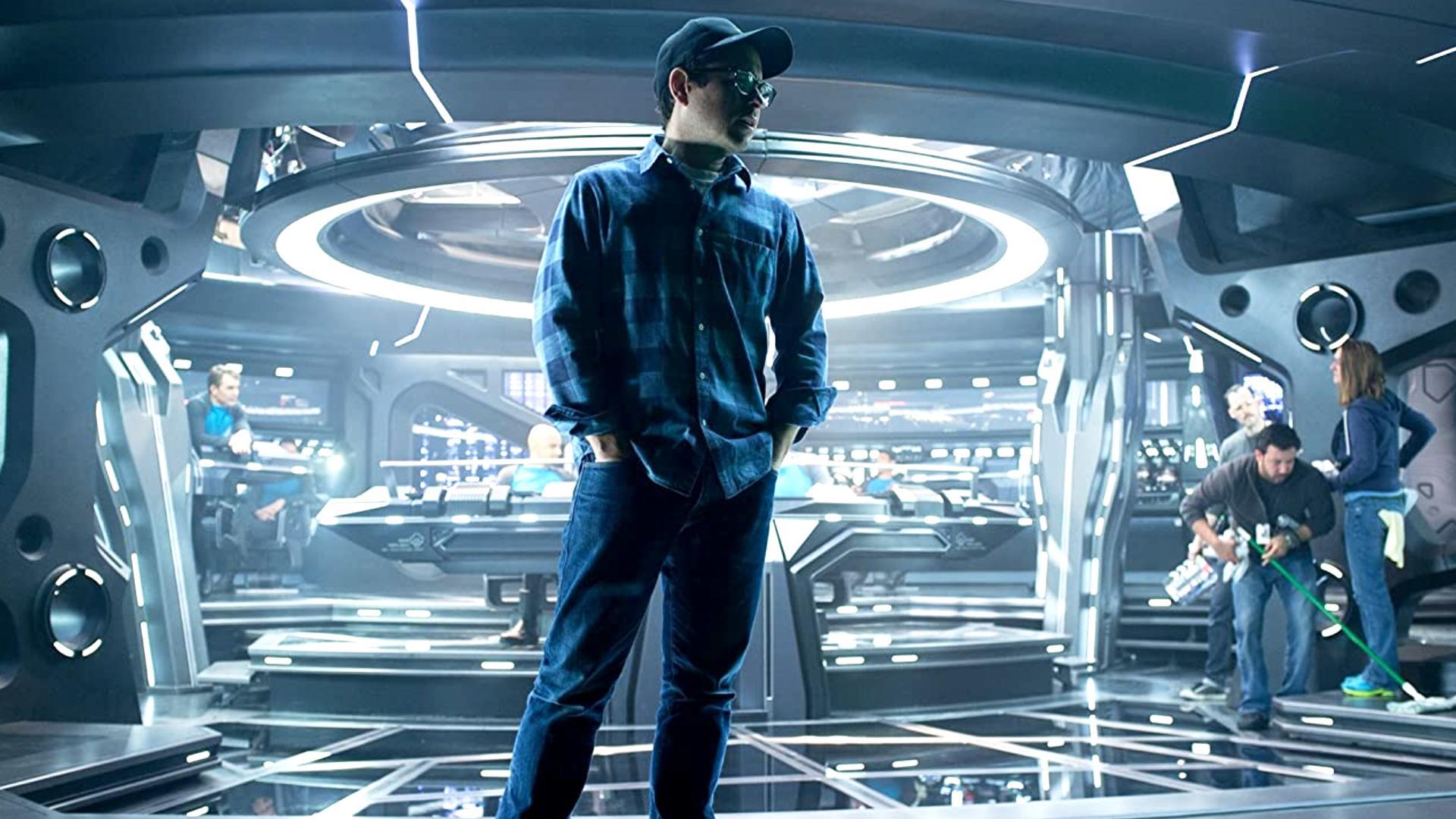
The scene was a stately courtroom. The large windows on both sides of the room allowed a bright sunlit sky to fill the room with light. Overhead, large chandeliers hung from the ceiling adding to the ambiance. At the far end of the courtroom was the bench. It was a massive structure, set ten feet off the hardwood floor. To the left of the bench was the witness box. Behind the center of the bench was the high back chair where the judge was seated for this most unusual case. Located across from the bench were two desks facing forward of it.
This was where the Prosecutor and the Defender made their arguments heard. Behind the Prosecutor and Defenders desks was a low gate separating them from the audience. Behind the gate was the gallery for the spectators. The fans and supporters of the case filled every available seat. The audience was dressed in their favorite Star Trek uniforms.
Grumblings from the audience indicated that they were anxious for the trial to begin. As if they had already made up their minds on what was to be played out in the courtroom that day.
Seated at his desk was the Prosecutor on the left side of the judge’s point of view. He was dressed in the uniform worn by Captain Kirk from the TOS era. The Defender resided at his desk just left of the Prosecutor’s’ location.
He wore the uniform used by Captain Kirk of the Kelvin timeline. The two combatants looked at each other, not saying a word, just a simple nod of acknowledgement. Their attention and that of
those in the audience was drawn to the judge’s bench as they all await the trial to begin.
The bailiff entered the courtroom from a door to the right of the judge’s desk. He scanned the representatives of two different Star Trek realities and the entire audience as well. Raising his hand to cover his mouth, he clears his throat then called out, “All rise. The Court of Canon is now in session.” He paused and then added, “the Honorable Judge Gene R presiding.”
Everyone in the audience rose as the judge made his way to the chair behind his desk and took his seat. He banged his gavel on the desk to signal the beginning of the trial.
“Bailiff, is everyone in attendance for the start of this trial,” the judge asked.
The bailiff turns to look directly at the judge. “Yes, your honor,” he replied.
“Good, then let the proceedings begin.” The judge removed some papers from a file on the desk, looked them over and then said, “this is a very unusual case. Normally cases brought before this court are to challenge
the canon of a particular story line or technology. Yet this case is to determine the validity of the entire Kelvin timeline. I am limiting the arguments of this case to only the Prosecutor and the Defender who are the appointed representatives I do not want this to devolve into a name calling event. And since calling witnesses would cause this to become a long, drawn out trial, I want the representatives to just state their cases. I will allow cross examination of their arguments. And I will allow objections to be raised, yet I will determine if they are to be accepted or denied. Once I have heard enough testimony, I will make my judgement call, and it will be final. Do I make myself clear?”
“Yes, your honor,” the Prosecutor and Defender said in near unison.
“Fine. I’ll allow the Defender to make his opening statement first,” stated the judge.
The defender rose from his seat, pulled at the corners of his Kelvin uniform top and began to speak. “Your honor, I come before you to defend the Star Trek films created by J.J. Abrams. As we all know, Mr. Abrams was more of a
“Star Wars” fan, yet those he chose to help create his vision of Star Trek were all fans of the franchise. Yet they could not make a carbon copy of what we have seen in the past, especially something as unique as TOS. So, the writers and producers of their Star Trek films had to have a familiar, yet slightly different theme to them and…”
The Prosecutor stood up quickly and stated, “I object to what my colleague has to say!”
The Defender shot back, “Your honor, do I not have the floor until I am done with my opening statement?”
“Overruled. Continue with your statement,” said the judge.
The Prosecutor retook his seat and glared at the Defender.
“Thank you, your honor. To continue, by including as unique a character and actor as Leonard Nimoy, reprising the orig-
inal Mr Spock in the first two films, this was done to have some link up to the original TOS. We feel this was done with total respect for the TOS timeline in the Kelvin universe. Thus, by having two versions of Mr. Spock, we showed the relationship and differences between the two uni-
verses. I am sure the fans will agree with this analysis. I hope you will as well, your honor. Thank you.”
The Defender retook his seat with a confident look upon his face. He felt his opening statement was enough to sway the judge’s decision in his favor.
Many in the audience began to emit an almost choreographed sound of “boo,” while shaking their fists in the air.
“Come to order! I will not have the audience acting as a jury. Now, if you will,” the judge said,
“Prosecutor, do you have your opening statement ready to share with the court?”
The Prosecutor stood up and stared over at the Defender. He had a big smile on his face and then began a slow clapping of his hands. “Very good. Very nice,” he began to nod. “Yet so very, very wrong. I would have thought that you might have saved using the Spock card later or even at your summation, but you chose to play it now. That’s amazing. Just having an iconic character such as Mr.
Spock from TOS to appear in your films does not mean it is canon. Yes, it was nice to see him on screen again, but does that help your case? I think not. In the second film of the three, you chose to bring back one of the most recognizable villains…Khan.” The Prosecutor put an emphasis on the name Khan. “And your Khan was not even close to being who was seen in the TOS TV episode or film he appeared in.”
The Defender stood up and looked directly at the judge. “Your honor, TOS might have created Khan, but J.J. Abrams’ team refined him. If you recall, India is the country where Khan was born. As we all know, India was an English colony for many, many years. It would seem that Khan would have an English accent and resemble more of an Englishman as does Benedict Cumberbatch. And that Ricardo Montalban was…”
The Prosecutor called out in anger, “Your honor, I must demand that what the Defender is saying is a crime! TOS created the entire timeline of Khan’s life. Their version removes the existence of the entire “Space Seed” story. The
entire events that occurred on Ceti-Alpha Five. The Genisis device. Everything! I object to this line of evidence.”
“Yes, yes!” called out many in the courtroom’s audience.
The judge waved his hands to settle down all the frayed nerves. “Quiet in the court!” the judge called out. “I will not allow this court case to become a shouting match. Mr. Defender, what do you have to say to explain why such a change was allowed in the Abrams’ films?”
The Defender looked down at his shoes and slowly raised his head having given himself time to formulate a response. “Your honor, I offer no disrespect to the TOS timeline of Khan. We only offered a different set of events. From the moments at the beginning of the film with Kirk’s birth in space…”
The Prosecutor called out, “and that’s another thing! Kirk was born in Iowa!”
“Your honor, might I continue?” the Defender asked politely. The judge nodded in agreement. “We established at the beginning of that film that the timeline was broken when the Romu-
lan ship was drawn into a new dimension. At the point of that occurrence, the old TOS established timeline was altered. In the first film, as you recalled, we did a true service to the Star Trek community by explaining, in detail, the way Kirk went about winning the no win scenario, the Kobayashi Maru test.” The Defender turned to the Prosecutor and added, in Wrath of Khan it is only stated that Kirk reprogrammed the simulation, yet he never explained how he did it. In our film we offer, in deep detail, just how Kirk when about reprogramming the computer.”
“Not in the theatrical release,” offered the Prosecutor.
“Correct,” replied the Defender. “It appears in detail in the deleted scenes in the Blue Ray release.”
“Exactly!” the Prosecutor stated.
Looking at the Prosecutor, the Defender stated “and, as you can recall, a number of deleted scenes from Wrath Of Khan were only restored in the Directors cut version of that film. So, we feel we have done a service to explain these missing details from the TOS universe in the Kelvin timeline film.” The Defender turned to the judge and added, “The point I am trying to make is that even with all the differences in the Kelvin timeline, we only wish to show an alternative universe. Much like the Mirror universe that was first depicted in the TOS episode, “Mirror, Mirror.” This alone established that multiple universes could exist in the Star Trek films and TV shows. And this is my final argument, that Kelvin is canon, just in another universe.”
I can t disagree with that assessment. And I do agree that the first two Abrams’ Star Trek films did cover a number of storylines from the TOS films and TV episodes, yet in a different way. So, if this the case, please explain Star Trek Beyond to me?”
“I’d rather not,” replied the Defender. “Even I can’t explain the Swarm and how a Beastie Boys song could destroy them.”
“And” the Prosecutor added, “I do have to say this about the Abrams films, especially the first one. It did reinvigorate the Star Trek franchise, allowing Paramount to create new TV series that even those have broken the norms of what is canon.” The Prosecutor turned to the audience
response from the fan base. I have decreed that the J.J. Abrams films are canon, yet only in their own universal plane. And that we can all enjoy these films as we do all of the other TV series and movies that carry the words Star Trek within them.” The judge then banged his gavel on the desk and proclaimed, “this concludes this case before the Court of Canon. Dismissed.”
The two adversaries approached each other and shook hands. They then gave each other the Vulcan salute. As they exited the courtroom, the Star Trek fans in the audience patted the two representatives on their backs, showing their approval of the decision.
The bailiff approached the
bench and spoke directly to the Your honor, that was, in sible. Now how are you going to Strange New as to their location in the Lower
The judge took a deep breath and stated, “that is for another day. But if you ask me, Lower Decks is the funniest Star Trek series of all time. I just love it.” “As do I, your honor,” added the bailiff.
STEPHEN MIRKIN: I first learned about science fiction the moment I was able to reach the on/off knob on my parents’ black-and-white TV set. Being born in 1956, I was there on Sept. 8, 1966 to watch the first episode of Star Trek. Since then, I have watched every TV series and every movie and I only look forward to the next great Star Trek moment.














Released for the 25th anniversary of the film by Titan Books, this 160 page behind the scenes book by Joe Fordham is a treasure trove of eye popping photos and illustrations., all presented in a premium 12x11 inch format that looks perfect on your coffee table. It was the first of a nearly annual release of books in this series by Titan, followed by similarly sized looks at the making of Wrath of Khan, Search for Spock, and The Voyage Home. The size of these books simply cannot be overstated, with the large pages offering plenty of real estate for the images to be properly appreciated and ample room for the descriptive text to be as verbose as it needs to be without overcrowding the page.
While I’m obviously a fan of the large scale images and am a particular fan of the starship illustrations, the written text of the book is just as captivating, capturing the history of how the film was originally pitched, how the director was selected, to how some of the practical effects were managed, including the arrival of the Borg Queen and the construction of the Phoenix. You can practically feel the emotional connection when you touch the pages!
This isn’t the first book that’s explored the creation of The Next Generation’s first solo film, but it’s definitely the most premium. Other notable efforts are Lou Anders' "The Making of Star Trek: First Contact" in 1996 and J.M. Dillard and John Eaves' 1998 book "Star Trek: The Next Generation: Sketchbook: The Movies, Generations & First Contact". Both of these are great in their own regard and offer their own content
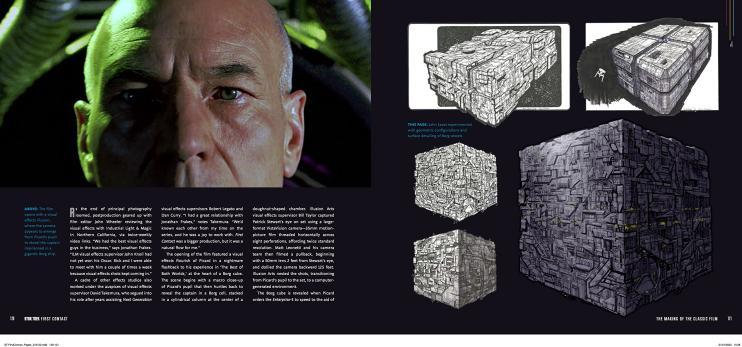
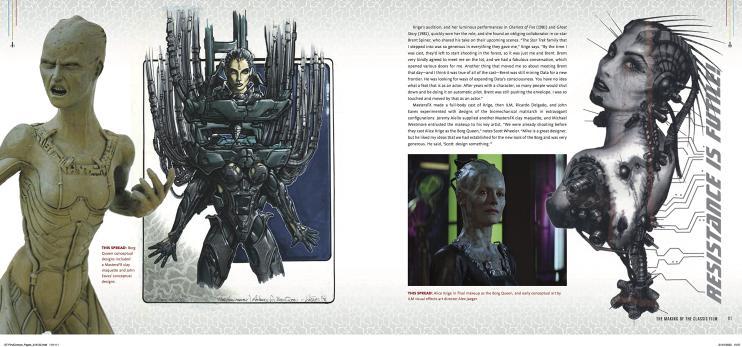
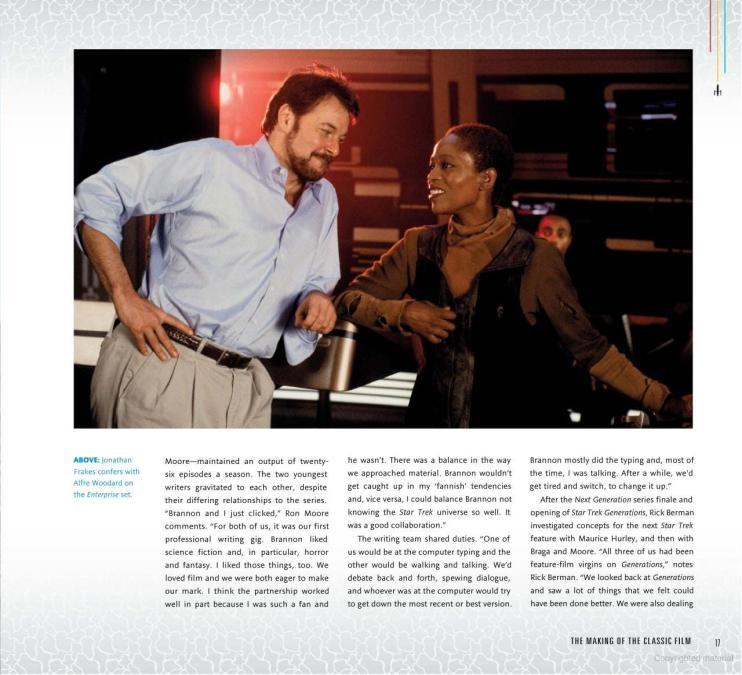
MY BOOK RATING: 4.5 out of 5 STARS



ADAM SELVIDGE: Adam has long loved Star Trek and grew up watching The Next Generation and set a personal mission to own every piece of printed Star Trek material. You can join him on his journey (and track your own collection!) at www.startrekbookclub.com

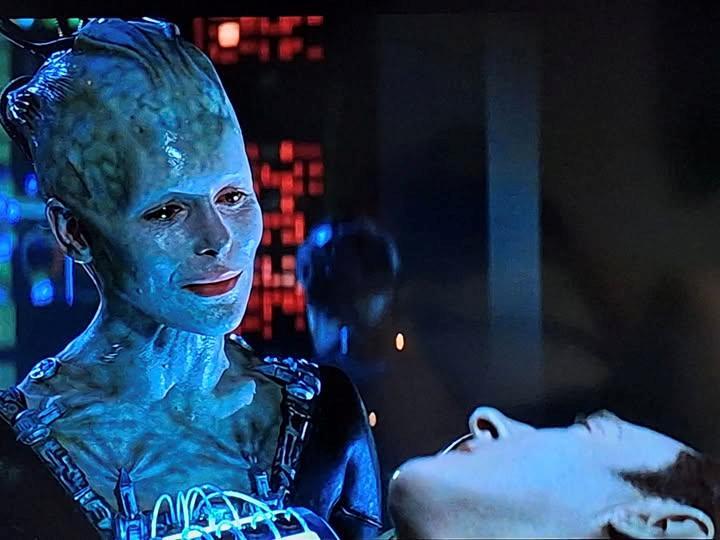




Like honeybees, I am the Queen of this hive
I ensure that the Collective will thrive
Resistance is futile
Yes, I know we seem brutal
Perfection is the goal to which we strive
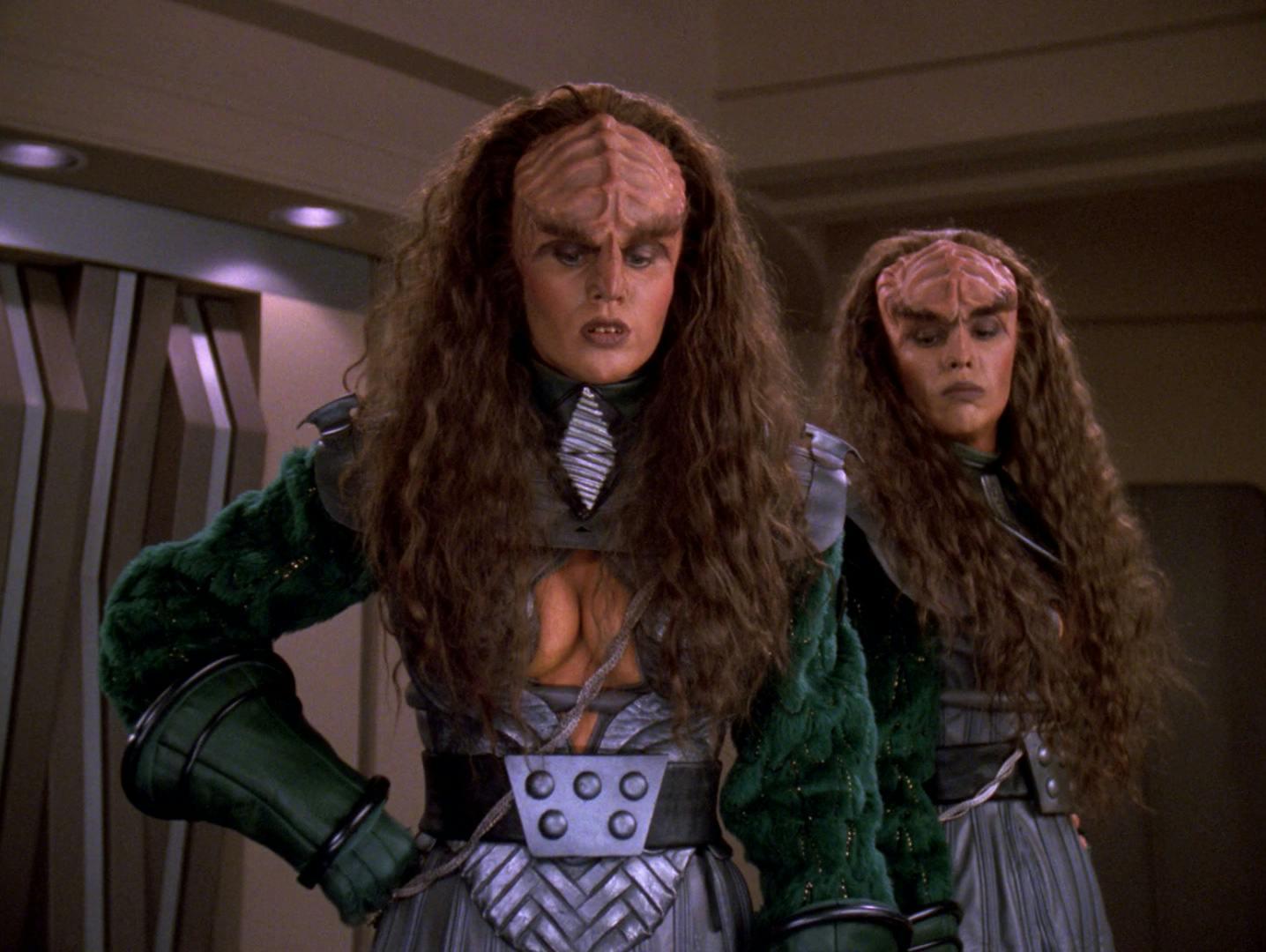


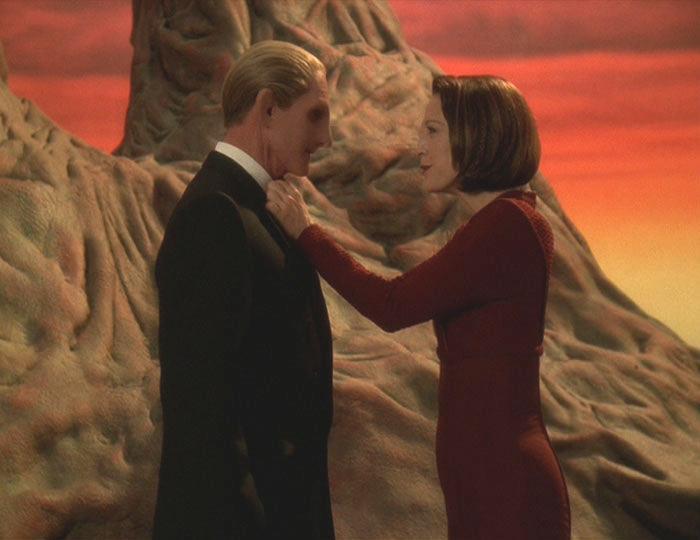


Saying goodbye is not an easy thing
When I'm sad, to your memory I'll cling
I know you had to do this
Your companionship I'll miss
I hope that you know you made my heart sing

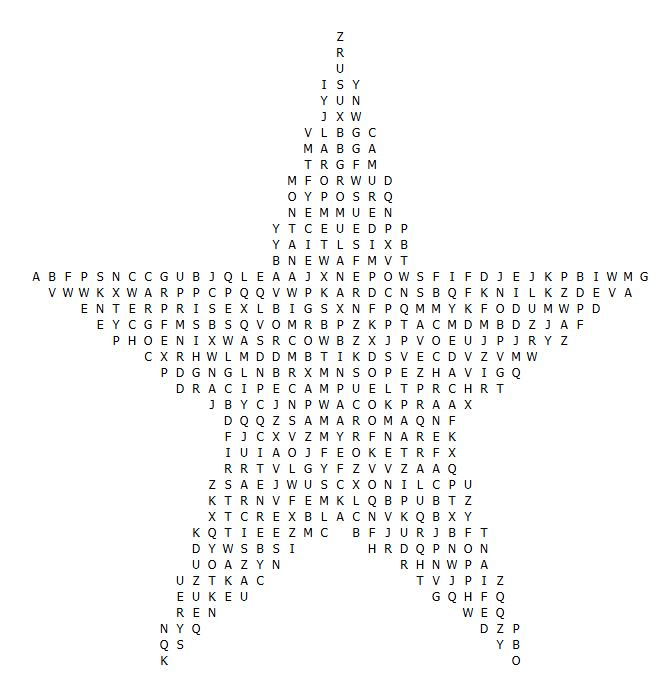
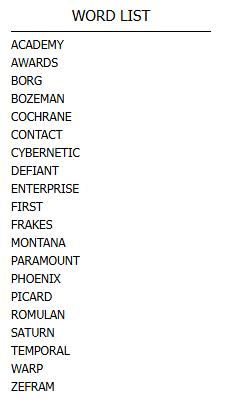

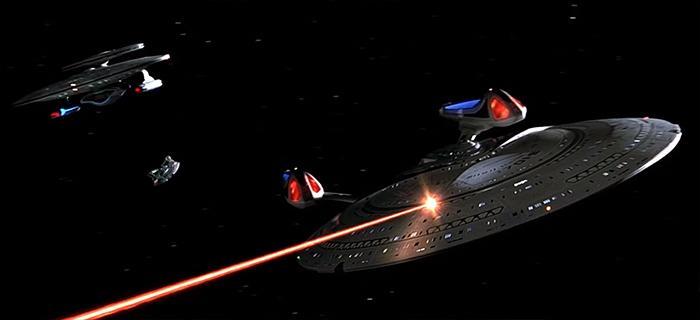


An updated list of events and conventions from all across the world. Marina is recognized in the Star Trek fandom as an expert on conventions, and a much beloved presence at Trek events!.