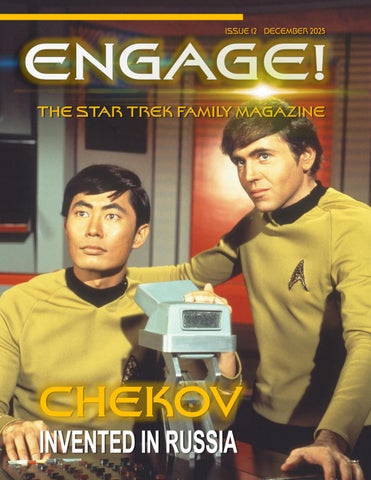
ENGAGE! Magazine
1
2
ENGAGE! Magazine ENGAGE! Magazine
2
ISSUE 12 — DECEMBER 2025
Managing Editor Mark Sickle Senior Editor Jenni Grubbs Editors Jean DeBellis Christopher Edler Mona Mehas Kevin R. Plummer
Pavel Chekov is one of the few characters that I contend was so compelling yet doesn’t receive the recognition he so often deserves. A character added in the second season of TOS, he added much needed depth to the bridge crew. Chekov was, for all intents and purposes, a big swing towards Gene’s optimistic and inclusive future — one that says, yes, even our modern Cold War opponents from Russia can be included in this great journey. Sure, maybe Walter Koenig was cast in the role for his looks (making all those young female Trekkies swoon), but Walter brought gravitas and humor to the character. He was the steady hand at the navigation console, and his character growth throughout TOS and the subsequent films cannot be understated. I had the good fortune of meeting Walter Koenig once at a convention and I will say it’s an encounter I won’t soon forget. He was incredibly funny and personable. Don’t be fooled by his rapier-sharp wit though — his one-line zingers from the show aren’t all that Walter had to offer. I’ve now seen him in several dramatic performances on stage and he really makes you appreciate his depth of acting skill. I believe Walter deserves all the props in the world for playing this character the way he did. That’s why we’re dedicating this month’s issue to Walter and also to Anton Yelchin, who sadly passed away too soon. — Mark Sickle Founder & Host Star Trek Family
Consulting Editor Laurie Ulster Submissions Manager Lisa Sickle Contributors Michael Howard TJ Jeznach Felicia Watkins Kimble Janera Tiell Manno Michael Martin Mona Mehas Stephen Mirkin Mark Sickle Jamey Wylie
CONTACT US
We are truly interested in receiving feedback from our readers and fellow fans! Really love an article that appears in our magazine? Truly disagree with someone’s take on a topic? How are we doing? Do you have suggestions for features, articles, etc.?
Research Reesa Lawton
Have you always wanted to write about your love for Star Trek? We are always looking for volunteer writers to join our team! Send us an email at the ‘Contact Us’ link at left!
“Star Trek and all related marks, logos and characters are solely owned by CBS Studios Inc. This fan production is not endorsed by, sponsored by, nor affiliated with CBS, Paramount Pictures, or any other Star Trek franchise, and is a noncommercial fan-made e-zine intended for entertainment use only. No commercial exhibition or distribution is permitted. No alleged independent rights will be asserted against CBS or Paramount Pictures.” ** The Star Trek Family is a free, not-for-profit global fan organization.
3
ENGAGE! Magazine ENGAGE! Magazine
3
•
Editor’s Log
2
•
Enterprise Xmas Carol
63
•
Fan Art
64
•
Limericks
70
•
Word Search
73
•
Crossword Puzzle
74
•
Marina’s Trek Calendar 76
•
Next Issue
77
All of the Articles in the Contents are linked — click the images or page numbers to view. We added this icon at the end of every article — it will return you to the Table of Contents!
ENGAGE! Magazine ENGAGE! Magazine
4
4
ENGAGE! ENGAGE! Magazine Magazine
55
ENGAGE! Magazine
ENGAGE! Magazine
66
7
ENGAGE! Magazine
When fans recall the bridge of the USS Enterprise, iconic names like Captain James T. Kirk, Mr. Spock and Dr. Leonard “Bones” McCoy often spring to mind. But nestled among the legendary crew stands a figure whose impact on the Star Trek universe — and on broader pop culture — has often been understated: Ensign (later Lieutenant) Pavel Andreievich Chekov. Portrayed by Walter Koenig, Chekov’s significance extends far beyond his youthful exuberance, thick Russian accent, and penchant for inventing Russian origins for everything from Scotch whisky to the Garden of Eden. His presence on the Enterprise was a bold statement in the 1960s, a vital piece of Star Trek’s visionary mosaic, and his influence continues to reverberate through science fiction and popular culture. Breaking Barriers in a Divided World To appreciate Chekov’s importance, one must first revisit the world into which he was introduced. The year was 1967, and the Cold War between the United States and the Soviet Union was at its zenith. Mutual suspicion, espionage, and the ever-present specter of nuclear war dominated global headlines. American media often depicted Russians as villains or caricatures, and the notion of a Russian hero on an American TV show — let alone as a trusted member of an interstellar crew — was almost unthinkable. Enter Gene Roddenberry’s Star Trek. The show’s very premise was one of inclusivity: the bridge crew was intentionally
multinational, with Nichelle Nichols as Uhura, George Takei as Sulu, and Leonard Nimoy as Spock, who himself was an outsider navigating two worlds. But with the addition of Chekov in the show’s second season, the inclusivity took on a new, explicitly political dimension. Roddenberry insisted that in the future, humanity would have transcended its petty divisions. The Cold War, with all its animosity and distrust, would be relegated to history. In Chekov, viewers saw not a Russian adversary, but a colleague, a friend and a symbol of hope for a united Earth. Chekov’s Origins: More Than a Token Some critics initially dismissed Chekov’s introduction as a play for younger audiences — his Beatles-inspired haircut and boyish charm were meant to draw in teenage viewers, particularly after the departure of Grace Lee Whitney (Yeoman Rand) and the rising popularity of The Monkees. But Chekov’s character quickly grew beyond network strategy. His backstory, as a Russian prodigy serving as navigator, positioned him as an integral member of the crew. He was never the butt of a
joke because of his nationality; instead, his intelligence, reliability and moments of heroism established him as an equal among the Enterprise’s best and brightest. Walter Koenig’s performance, infused with humor and heart, ensured Chekov was never a mere stereotype. While his Russian accent and national pride were played for laughs — his repeated assertions that everything was “invented in Russia” became an endearing running gag — he also confronted real dangers with courage and ingenuity. Episodes like “The Trouble with Tribbles” and “The Tholian Web” showcased his quick thinking and loyalty. He was both comic relief and a source of strength, a balance rarely achieved in ensemble casts. The Power of Representation: Star Trek’s Vision Perhaps Chekov’s greatest importance lies in what he represented: the power of representation itself. In an era when television was overwhelmingly white and American, the sight of a Russian officer working alongside Americans, Asians and Africans on equal footing was quietly revolutionary. For Soviet viewers (many of whom watched the
8
ENGAGE! Magazine
show surreptitiously), Chekov was a signal that the future could be different, that the animosity and suspicion of the present might one day be overcome. For American viewers, Chekov’s presence was a subtle rebuke to natioalism. Star Trek did not erase national identities, but it showed them subsumed within a larger, more noble purpose. Chekov was proud of his Russian heritage, just as Sulu was proud of his Japanese ancestry and Uhura of her African roots. The Enter-
prise was a microcosm of Roddenberry’s utopia, where diversity was not just tolerated but celebrated. In this way, Chekov’s very existence on the bridge was a weekly reminder that cooperation across cultures was both possible and desirable. Chekov in Action: Courage Under Fire Chekov’s importance is not limited to symbolism. The character distinguished himself time and again through bravery and skill. In “The Apple,” he saves the ship from destruction by improvising a solution under pressure. In “Spectre of the Gun,” his compassion and resilience are on full display as he faces psychological torment in a surreal Old West town. In “The Wrath of Khan,” Chekov’s role is pivotal — his encounter with Khan Noonien Singh sets the stage for the film’s dramatic events, and his resourcefulness helps the crew escape a deadly trap.
Chekov’s technical expertise also plays a crucial part in countless episodes, whether he’s recalibrating navigation systems or devising last-minute solutions to save the day. Unlike many supporting characters in 1960s television, Chekov was allowed to make mistakes and learn from them, making him relatable and human. His youthful enthusiasm was never mocked; instead, it was depicted as an asset, a reminder that the future belongs to the next generation. The Actor’s Perspective: Walter Koenig’s Legacy Walter Koenig, the actor behind Chekov, has spoken candidly about the challenges and rewards of playing the character. Initially disappointed by the relative lack of screen time and development compared to other main characters, Koenig nonetheless embraced his role as a cultural ambassador. He received letters from Russian fans who were
9
ENGAGE! Magazine
delighted and surprised to see a compatriot on American television, and from American fans who appreciated the show’s message of unity. Koenig’s portrayal gave Chekov depth and warmth, elevating him from potential stereotype to beloved icon. He brought humor, humility, and an everyman quality that resonated with viewers worldwide. Koenig’s
involvement in the Star Trek films and later in Star Trek: The Animated Series as well as his appearances at conventions, cemented his place in Trek lore. His commitment to the character, even in the face of limited opportunities, speaks volumes about the enduring appeal of Chekov. Chekov’s Enduring Influence The impact of Chekov — and by extension, Koenig — can be seen in the generations of fans and creators inspired by Star Trek. The character’s legacy is evident in subsequent iterations of the franchise, where diversity on the bridge became not just an ideal, but a foundation. The rebooted “Kelvin Timeline” films, with Anton Yelchin as Chekov, reintroduced the character to a new audience. Yelchin’s portrayal honored Koenig’s original while adding new layers of vulnerability and charm. The outpouring of grief following Yelchin’s tragic death in 2016 was a testament to
how deeply Chekov had touched viewers’ lives. Beyond Star Trek, Chekov’s presence helped pave the way for more nuanced depictions of Russians and other minorities in Western media. He was neither villain nor comic relief; he was a hero in his own right. This shift, subtle though it was, contributed to a broader reimagining of what was possible in science fiction and television. When viewers saw Chekov on the bridge, they saw themselves — or the possibility of themselves — reflected in the hopeful future Star Trek promised. Chekov and the Larger Message of Star Trek Star Trek has always been more than a show about space exploration; it is a show about humanity’s potential for growth, cooperation, and understanding. Chekov’s importance is inseparable from this message. He is a living (if fictional) repudiation of
10
ENGAGE! Magazine
prejudice and fear. His friendship with Sulu, his respect for Kirk, his camaraderie with the rest of the crew — these relationships modeled the kind of world Roddenberry hoped to inspire. Chekov’s many contributions, both explicit and implicit, challenge us to reexamine our own assumptions about “the other.” At a time when the world
teetered on the brink of nuclear disaster, Star Trek dared to imagine a future where Russians and Americans worked side by side — not just tolerating one another, but trusting, respecting, and relying on each other. This vision, radical in its day and still aspirational now, is embodied in Chekov’s every line, every joke, every act of bravery.
Chekov’s Humor: Breaking Down Barriers One cannot discuss Chekov without mentioning his humor. Whether mangling English idioms, expressing exasperation at being misunderstood, or proudly attributing inventions to Russia, Chekov’s lighthearted moments provided much-needed levity. For him, everything was invented in Russia. But his humor also served a deeper purpose: it humanized him, making him accessible to audiences who might otherwise have been wary of a Russian character. This approach was not accidental. By making Chekov funny, the writers allowed viewers to see past their own biases. Laughter is a universal language, and Chekov’s jokes — always delivered with sincerity — reminded us that underneath geopolitics and stereotypes, we are all fundamentally the same. In this way, Chekov’s humor was a quiet but powerful tool for empathy.
11
ENGAGE! Magazine
The Future of Chekov and Representation in Sci-Fi As Star Trek continues to evolve, so too does the legacy of Pavel Chekov. New series, from Star Trek: Discovery to Star Trek: Strange New Worlds, have embraced and expanded the show’s commitment to diversity. But Chekov’s trailblazing role remains a touchstone — a reminder of what can be achieved when creators dare to imagine a better world. The importance of representation in media cannot be overstated. For young viewers of Russian descent, Chekov was a rare example of a hero who looked and sounded like them. For others, he was a lesson in empathy, a challenge to their pre-
conceptions. Today, as new barriers emerge and old prejudices persist, Chekov’s place on the bridge is as relevant as ever. Conclusion: Lessons from the Boy from Russia Pavel Chekov may not have been the captain or the science officer, but his importance to Star Trek — and to our understanding of what science fiction can achieve — is immense. He was a product of his time, yet also timeless; a symbol of reconciliation, hope and the enduring power of diversity. In celebrating Chekov, we celebrate the best of Star Trek: the belief that the future is not fixed, that humanity can rise above its divisions, and that even
the smallest voices can make a difference. Whether navigating the stars or the complexities of our own world, the lesson endures: we are stronger together, and the future belongs to all of us. MARK SICKLE: Mark Sickle is an Egyptologist (archaeologist) by day, diehard Trekkie all the time. Founder of the Star Trek Family. Lives in West Virginia with his beautiful wife Lisa, puppies Odo, Kira, Wesley and Jadzia; and kitties Nala, Cymba, Cena, Elleadora, and Aeolia.
ENGAGE! ENGAGE!Magazine Magazine
1212
13
ENGAGE! Magazine
Being a child of the ‘60s, there always seemed to be that one person in a group who was labeled “the cute one.” It might have started with the appearance of The Beatles to the American viewing audience. I do not think I need to offer any extensive information as to who The Beatles were. Suffice it to say, they were four mop-top lads from England who wrote some catchy tunes and songs and might have defined the entire culture of the 1960s. Other than that, they were OK, yeah right... The band consisted of John Lennon, George Harrison, Ringo Starr and Paul McCartney. Each had a unique personality and appearance. From this, they each received a specific label. John was the “smart one.” George was the “thoughtful one.” Ringo was the “funny one.” And Paul, he was the “cute one.” If you have seen their performances or the few movies they made like “A Hard Day’s Night” or “Help,” the personalities were prominent. As the ’60s progressed, it was Paul who seemed to garner all the attention due to his good looks and style. To this day, he still retains those qualities that made him a fan favorite. As an alternative to The Beatles, we had our own home grown musical band that fit these requirements as well. Appearing on the ABC TV network, The Monkees premiered on September 12, 1966, four days after the debut of Star Trek (more about that later). Amongst the four members of the band, Davy Jones from England (like The Beatles) was the official
“cute one.” His good looks and British style was much in line with Paul McCartney. The Monkees lasted two seasons on TV, yet their music lives on. Now on to the Star Trek connection. When Star Trek debuted, the stars were Leonard Nimoy, DeForest Kelly and William Shatner. All the other bridge members were considered supporting actors to the shows leads. In doing the comparison to The Beatles, Spock was the “smart one,” DeForest was the “thoughtful one” and Kirk was, at times, either the “thoughtful one” or “the funny one.” Yet who was the “cute one?” For the first season of Star Trek, this person was missing. When the second season was in plans, Gene Roddenberry added a new character to the supporting cast, that being Pavel Chekov. What was significant was this character was of Russian descent and spoke with a Russian accent. This was 1967 and we were in the middle of a “Cold War” with the USSR. Once again, diversity was key to the characters on the bridge of the USS Enterprise and including an enemy of
the USA was very significant. Only two actors auditioned for the role, and it was awarded to Walter Koenig, son to Lithuanian (part of the Russian empire) Jewish immigrants. So, playing this role was not a stretch. His good looks, and that he resembled Davy Jones of The Monkees, made him the perfect “cute one” for the bridge crew. Gene had Walter “ham up” his Russian accent and the bravado of the Russian psyche of the time. When Chekov spoke to Scotty about Scotch, he remarked that it was “invented by a little old lady from Leningrad.” Walter’s character grew in popularity and he appeared in thirty-six episodes in seasons two and three of Star Trek. He could be “the funny one” when needed or the “thoughtful one” as well,
14
ENGAGE! Magazine
yet he brought that missing piece to the bridge crew as the “cute one.” Even as his hair began to recede, the use of a hair piece was used to maintain that “mop-top” look, yet his charm never receded. Originally thought to be a marginal character on the series, his popularity grew and he became more of a fixture on the bridge and on away teams.
When TOS ended, he appeared in all six of the TOS movies and Star Trek: Generations as well. His shining moment was in Star Trek: The Voyage Home when on the streets of San Francisco, he made the now famous statement to a police officer, “it’s where they keep the nuclear wessels.” All in all, he made or appeared in 25 movies and 28 differ-
ent TV series, his last was on Star Trek: Picard, season three as President Chekov (a descendant of Pavel’s.) Walter still continues to appear at Star Trek conventions and makes numerous appearances. I ran into him at the September 8, 2023, protest at Paramount studios in support of actors and writers. There, I had the opportunity to thank him for his contributions to Star Trek. He looked great then and recently celebrated his 89th birthday, still as “cute” as ever. STEPHEN MIRKIN: I first learned about science fiction the moment I was able to reach the on/off knob on my parents’ black-and-white TV set. Being born in 1956, I was there on Sept. 8, 1966 to watch the first episode of Star Trek. Since then, I have watched every TV series and every movie, and I only look forward to the next great Star Trek moment.
15
ENGAGE! Magazine
(Click on the graphic above to buy yours)
ENGAGE! Magazine
16
ENGAGE! ENGAGE!Magazine Magazine
1616
17
ENGAGE! Magazine
One of the most polarizing issues among fans of Star Trek is the Kelvin timeline that ushered in a new era for the franchise. There has been endless debate on whether The Original Series should have been rebooted at all and whether it was done in a manner that was true to the ethos of Star Trek. No matter how one feels about the movies themselves, we can all agree that any reprise of Star Trek would have huge expectations attached to it. The actors, in particular, would have giant shoes to fill. The characters that inhabit the Star Trek universe are cultural icons and have influenced generations since the 1960s. Compounding the issue is the undeniable fact that Star Trek fans are some of the most devoted, demanding, opinionated, and critical consumers of media. The pressure associated with meeting these expectations had to have been enormous for the cast. Despite these lofty demands, the actors in the reboot series did a fantastic job. One actor in particular who understood the responsibility and the gravity of reprising an iconic role was Anton Yelchin as Chekov. Anton Yelchin was born in 1989 in Leningrad (Now St. Petersburg), Russia to figure skaters Irina and Victor Yelchin. His family immigrated to the United States when he was only 6 months old. He had an artistic soul and started acting lessons at an early age and was soon given many roles in television, commercials, and cinema. IMDB has attributed 69 acting credits to Yelchin, which is impressive given his youth. Throughout this brief career he played a diver-
sity of roles. Anton reveled in this broad range of acting parts saying, “I’m trying to figure out what I can do creatively. It’s about trying to find new things and trying to figure out voices and borrowing from things and learning as much as possible so that I have an archive of things to borrow from.” According to a 2016 TrekNews.net article, after meeting Yelchin on the set of Star Trek (2009), Walter Koenig was so impressed with Yelchin’s acting that he commented, “I was in the presence of a gifted performer.” Beyond acting, he was involved in many artistic pursuits such as playing guitar, writing original music, poetry, and photography. Unfortunately, we will never know exactly how much he would have contributed to cinema and the arts due to his untimely death in 2016. Anton took up the challenge of reprising Chekov and along the way became a fan and student of The Original Series. In an interview with SlashFilm.com Yelchin remarked, "...I loved it…I even watched the episodes that Chekov wasn't in.” Though he was given the freedom to interpret the role as he pleased, he sought to honor
the legacy of Walter Koenig and drew inspiration from that. Even when it came to Chekov’s accent, Yelchin made a deliberate effort to sound like Koenig. Despite being able to speak Russian fluently and being familiar with a “real” Russian accent, he wanted to honor the classic Chekov speech patterns. He said in a 2009 interview with TrekMovie.com, “I have no problem doing a real Russian accent, but that wouldn’t be Chekov to me.” In other words, Yelchin was wise enough to understand Chekov's quirky accent and mannerisms were essential to who the character was. This was Yelchin’s humble recognition that Koenig’s Chekov would always be the definitive version. Walter Koenig and the character of Chekov was introduced into the second season of
18 18
ENGAGE! Magazine ENGAGE! Magazine
Star Trek: The Original Series to cover for George Takei’s absence and to make the show more appealing to a younger audience. Chekov’s role was designed to tap into the youth culture of the 60s and to add a “Davy Jones” type to the roster of Star Trek. Yelchin fully embodied this youthful appeal and was definitely relatable to younger audiences. After George Takei’s return to the show in the second season, Chekov’s character morphed into a source of comedic relief and a foil for Sulu’s more serious mien. Yelchin also embraced this aspect of the character and was able to create
an aura of humorous charm and add a bit of catharsis to the tension of the narrative. Although Anton Yelchin sought to pay homage to Koenig’s Chekov, he still worked to make the role his own. Yelchin understood that Chekov was supposed to be a very junior officer, filled with enthusiasm and youthful energy. Anton delivered this supremely, filling the screen with boundless energy, sometimes more so than Koenig. Given an opportunity by J.J. Abrams to improvise, Yelchin brought a great deal of spunk to those scenes. He would move beyond the script by inserting Russian phrases such as "Ох, черт!" (O, man!) or "Я не сумасшедший!" (I am not crazy!). This improvisation delivered a touch of humor and a more authentic “Russian-ness” to the scene. It was in those moments that Yelchin brought something fresh and unique to the role. As a community of fans we can find common cause in celebrating the memory of Anton Yelchin. He was a young and immensely talented actor who ap-
proached the role with the utmost respect and did his very best to honor the legacy of Walter Koenig. While he followed Koenig’s blueprint, he still added his own charm, wit, and energy to every scene. We should be grateful for his part in bringing Star Trek back to the big screen and introducing the franchise to a new generation of viewers. He used his talents to entertain us, make us laugh, and expand upon something that we all love and for that, I am most grateful. His life as a gift. May he live long and prosper in our memory.
JAMEY L. WYLIE: Jamey is a lifelong lover of all things Trek, especially the media of novels and comics. He is currently a professional school counselor and bi-vocational pastor. Jamey is married to Amanda, who enables his nerdiness.
19 19
ENGAGE! ENGAGE!Magazine Magazine
ORDER YOUR COPY TODAY!
ENGAGE! ENGAGE!Magazine Magazine
2020
21
ENGAGE! Magazine
When
discussing the enduring legacy of Star Trek, few characters elicit as much fondness as Pavel Andreievich Chekov. Introduced in the second season of Star Trek: The Original Series (TOS), Chekov, played by Walter Koenig, quickly became a fan favorite, known for his youthful enthusiasm, charming accent and comic relief. As Star Trek transitioned from television to the silver screen, Chekov’s role evolved, prompting debate among fans and critics alike: Was Chekov a stronger character in the original series or in the movies? This article aims to analyze Chekov’s character arc, depth, and narrative function across both mediums, ultimately exploring where he emerged as a more compelling and impactful figure. Chekov in The Original Series: The Young Enthusiast Chekov’s arrival in TOS during its second season was largely motivated by a desire to appeal to younger viewers and to reflect the international nature of the Enterprise crew. Modeled partly after Davy Jones of “The Monkees”, Chekov was written as
a youthful, optimistic and somewhat naïve navigator. His Russian heritage was played up for both humor and political relevance, providing a Cold War-era nod toward a future of international cooperation. In the series, Chekov’s role was often limited. He was usually found at the helm or in the sciences, rarely at the center of the plot. Episodes such as “The Apple” and “Spectre of the Gun” gave him brief moments of focus, often highlighting his loyalty, courage, or penchant for comic misunderstandings. However, Chekov’s development was often constrained by the ensemble nature of TOS and the dominance of Kirk, Spock, and McCoy in the narrative. His stories rarely delved deeply into his background or inner life, and his function was often to provide technical information, comic relief or serve as a plot device. That said, Chekov’s strengths in TOS were clear: he was competent, quick-thinking and fiercely loyal to his shipmates. His exuberance and youthful perspective added a unique energy to the bridge, and his occasional bravado (“I can do that!”) contributed to the show’s sense of
camaraderie and optimism. Yet, his narrative weight rarely matched that of the main trio, and his personal growth remained largely static over the course of the series. Chekov in the Movies: Growth, Agency and Heroism With the transition to the film series, beginning with Star Trek: The Motion Picture (1979), Chekov’s role subtly but notably evolved. The movies offered more opportunities for ensemble characters to shine, as the stories often required teamwork and allowed for more character-driven moments outside the central triumvirate. In Star Trek II: The Wrath of Khan (1982), Chekov is promoted to First Officer of the USS Reliant. This promotion is significant, representing a maturation of
22
ENGAGE! Magazine
his character and a recognition of his competence and leadership. The film places Chekov in highstakes situations — most memorably his capture and later mindcontrol by Khan Noonien Singh. His resilience and resourcefulness are put to the test, and Chekov is no longer simply following orders; he is making critical decisions, facing danger head-on, and contributing meaningfully to the narrative’s tension and resolution. Throughout the film series, Chekov’s responsibilities and moments of agency increase. In
Star Trek IV: The Voyage Home (1986), he is given a central role in the comedic subplot of finding “nuclear wessels” in 20th-century San Francisco. The sequence is both a showcase for Koenig’s comedic timing and a demonstration of Chekov’s determination and adaptability. Facing arrest and injury, Chekov keeps his wits about him, endearing himself to both his crew and the audience. In Star Trek VI: The Undiscovered Country (1991), Chekov is again placed in situations requiring quick thinking and
moral clarity. His dialogue and actions reflect a more seasoned officer, one whose youthful exuberance has matured into steady professionalism. The films thus allow Chekov to grow, to experience setbacks, and to show courage under fire, both literally and figuratively. Character Depth and Narrative Purpose One of the key differences between Chekov’s portrayal in the series and the movies is the degree of narrative importance and depth afforded to his character. In TOS, Chekov is an emblem of youth and diversity, yet often operates on the narrative periphery. In the films, he becomes an integral member of the crew, entrusted with significant responsibilities and allowed to experience personal growth. The movies provide Chekov with an arc, however subtle: from the eager ensign to a seasoned officer with leadership
23
ENGAGE! Magazine
experience. He is allowed to fail, to be vulnerable, and to recover — traits that contribute to a more three-dimensional character. The cinematic format, with its larger stakes and longer runtime, gives ensemble characters like Chekov more space to breathe, to act, and to influence outcomes. Performance and Impact Walter Koenig’s performance is another key factor. In TOS, Koenig infuses Chekov with charm and earnestness, but is often constrained by limited screen time and dialogue. In the movies, Koenig is given the opportunity to explore a wider emotional range — fear, pain, humor and resolve — making Chekov feel more real and relatable. Notably, the film’s willingness to place Chekov in danger or give him pivotal tasks elevates his importance to both the narrative and the audience’s emotional investment.
Conclusion: A Stronger Chekov in the Movies While Chekov’s introduction in TOS was groundbreaking and necessary for the era, his character’s true strength and depth emerge in the Star Trek movies. The films allow Chekov to move beyond the role of comic relief and bridge crew filler, transforming him into a fully realized, competent, and heroic figure. His growth from the enthusiastic ensign to an officer capable of leadership and sacrifice mirrors the franchise’s broader themes of evolution, unity and hope. Ultimately, Chekov is a testament to Star Trek’s ability to nurture even its secondary characters into lasting icons. It is in the movies that Chekov steps out of the shadow of the main trio and becomes, in his own right, a strong and memorable Starfleet officer.
MARK SICKLE: Mark Sickle is an Egyptologist (archaeologist) by day, diehard Trekkie all the time. Founder of the Star Trek Family. Lives in West Virginia with his beautiful wife Lisa, puppies Odo, Kira, Wesley and Jadzia; and kitties Nala, Cymba, Cena, Elleadora, and Aeolia.
ADVERTISEMENT:
ENGAGE! ENGAGE!Magazine Magazine
2424
25
ENGAGE! Magazine
Star Trek: The Next Generation first aired in 1987 and brought with it some big shoes to fill. Audiences and fans of The Original Series had certain expectations following a show that became a cultural phenomenon, known for its optimistic vision of the future, iconic characters, and willingness to tackle controversial issues. TNG inherited that legacy but brought its own approach to storytelling, characters and themes, creating a series that could stand on its own while paying homage to its predecessor. With a detailed comparison of these two series reveals not only their differences but also the ways in which both reflected the hopes, concerns, and creative ambitions of their respective eras. Storytelling Approach The Original Series often embraced an episodic, sometimes experimental storytelling style. With only three seasons, the writers had to tell stories quickly and compellingly, frequently relying on allegory to comment on contemporary social and political issues. Episodes like “The City on the Edge of Forever” explored time travel to confront questions about morality and personal responsibility, while “Let That Be Your Last Battlefield” used aliens to mirror racial prejudice in America. The premise being that these two warring people are in constant conflict and hatred because one race has black on the left and white on the right and the other has it in reverse. TOS tended toward high concept plots, sometimes prioritizing ideas over scientific accuracy or character continuity.
TNG, by contrast, benefited from a more structured, polished production and a stronger focus on continuity. While TNG maintained an episodic storytelling style, it often incorporated multi- episode arcs and explored character development over time. For example, the recurring tension between Capt. Picard and the Borg developed over multiple seasons, allowing for a greater exploration of PTSD and the effects of captivity. The Next Generation also leaned heavily into philosophical questions. Episodes like “Measure of a Man” examined the rights of artificial intelligence, while “The Inner Light” contemplated the meaning of life and legacy. Compared to TOS, TNG’s storytelling was more cerebral, frequently emphasizing diplomacy, moral reasoning and introspection over the sometimes more action driven narratives of its predecessor.
Thematic Exploration Both TOS and TNG were deeply committed to exploring themes that were often ahead of their time, though the nature and treat-
ment of these themes differed. TOS, emerging during the turbulent 1960s, reflected the anxieties and aspirations of its era. It tackled issues like war, racism and authoritarianism, often using alien civilizations as metaphors. Episodes such as “A Private Little War” mirrored the Vietnam conflict, while “The Omega Glory” offered commentary on nationalism and the dangers of rigid ideology. TOS’s themes were often broad and immediate, aimed at provoking thought and reflection in a time of social upheaval. TNG, on the other hand, reflected the optimism and ethical questioning of the late 1980s and 1990s. While TNG inherited TOS’s commitment to social commentary, it often approached issues from a more intellectual and philosophical perspective. Ethical dilemmas were central to episodes like “Darmok,” which explored the difficulties of communication and understanding across cultures, or “The Drumhead,” which warned against the dangers of paranoia and erosion of civil liberties. TNG also frequently examined the consequences of technological advancement, particularly through characters like Data, an android striving to understand humanity, and the Borg, representing the dehumanizing potential of collective con-
26
ENGAGE! Magazine
formity. While TOS was more concerned with immediate social allegory, TNG often pursued timeless moral and philosophical questions, inviting viewers to consider the long-term implications of ethical choices. Characterization and Leadership One of the most notable differences between the series lies in character development and leadership styles. In TOS, Capt. James T. Kirk exemplified a charismatic, decisive and sometimes impulsive leadership style. Kirk’s command was defined by bold actions and instinctual decisionmaking, with Spock serving as his logical counterpart and Dr. McCoy providing an emotional and ethical counterpoint. This trio formed the core of the series, allowing TOS to balance tension, humor and philosophy in a compact ensemble. The supporting characters, while often less deeply explored, contributed to memorable episodic dynamics and iconic storytelling moments. TNG adopted a more ensemble-driven and layered approach to characterization. Capt. Jean-Luc Picard, unlike Kirk, relied on diplomacy, careful deliberation, and moral authority. He was a thinker as much as an actionoriented leader, often engaging in ethical debate and long-term strategic planning. The supporting crew were given more depth and recurring storylines than many TOS characters, creating opportunities for ongoing development. For instance, Lieutenant Commander Data explored artificial intelligence and human emotion; Counselor Deanna Troi addressed
psychological and emotional concerns; and Worf’s journey navigated cultural identity, honor, and personal ethics. TNG emphasized character arcs and personal growth across multiple episodes, which allowed audiences to engage more deeply with the crew’s individual struggles and relationships. Diversity and Social Commentary
TOS broke new ground in its casting and social commentary for its time. Uhura, played by Nichelle Nichols, was one of the first Black women in a significant, non-stereotypical role on American television, representing a hopeful vision of racial equality in the 23rd century. Her role as Uhura would go on to inspire countless future scientists, actors and astronauts such as Mae Jemison who would go on to do a guest spot on The Next Generation. The inclusion of Sulu and Chekov promoted internationalism and cultural diversity. TOS often used alien species to examine prejudice, war and human morality, making social commentary
an intrinsic part of the show’s DNA. TNG continued and expanded on this legacy with more nuanced explorations of diversity and ethics. The ensemble included characters from multiple species and cultures, such as Worf, a Klingon navigating life among humans, and Lwaxana Troi, a Betazoid with a unique perspective on emotion and culture. Gender dynamics were also explored with characters like Dr. Beverly Crusher, who balanced professional authority with maternal concern, and Tasha Yar, whose storyline confronted issues of agency and vulnerability in a male-dominated environment. TNG used its futuristic setting to explore complex ethical dilemmas, how societies should treat artificial life, the morality of intervention and the responsibilities of power, often with less allegorical bluntness than TOS, but with more philosophical depth. Science, Technology and Realism
The Original Series came at a time when the space race was at its peak where rocket ships and computers were just really starting to come into their own. There was an optimistic view of what sort of fascinating technology could be
27
ENGAGE! Magazine
imagined. However, due to budget constraints for a television show, the styles of the futuristic equipment were quite bulky and had a lot of switches and blinking lights. They were designed not so much for technical plausibility but for more of a storytelling purpose. As a matter of fact, the concept of the transporter system came about as a cost-saving measure, so they didn’t have to build a shuttle set to move to the planet’s surface. Even though the communicators at the time resembled the old-style flip phones, they were just cool walkie talkies. Phaser guns were just left over ray guns from the ‘50s sci-fi movies, and the tricorders at the time had no real scientific basis, they were just a scan of anything for whatever reason that was needed at the time. By the time The Next Generation came along in the ‘80s, computers had become more personal, sleek and more importantly a digital interface. The LCARS systems (Library Computer Access and Retrieval Systems) brought forth touchscreens computers. Technology also seemed to have
rules that were rooted in actual science to a point. There were limits to what the computer was able to do. By benefiting from advances in special effects and a growing public interest in scientific literacy, they tended to frame its technology more thoughtfully. Warp travel, replicators, holodecks and the workings of the starship Enterprise were often explored in a way that emphasized problem-solving,
scientific curiosity and consequences. For example, the episode “Cause and Effect” explores time loops with a logical consistency that rewards attentive viewing, while “The Best of Both Worlds” examines technological vulnerability and strategy in dealing with the Borg. TNG’s approach reflected a shift in audience expectations toward more sophisticated, internally consistent science fiction, blending imagination with plausibility. When it came to advanced technologies, TOS dreamed of what the future was and The Next Generation tried to build it. Legacy and Cultural Impact Star Trek is more than a franchise, it is a cultural blueprint, a catalyst for innovation, and a shared mythology spanning generations. TOS invented the future; TNG helped normalize it. Together, they fundamentally reshaped how society imagines technology, diversity, ethics and humanity’s long
-term destiny. The Original Series left such an imprint on the way society dealt with social, racial, and even economic issues of the time. It presented a glimpse into how things should be and something to strive to be. Discussing issues was challenging, so adding a positive angle made conversations easier. As The Next Generation came along it kept the same narrative going but added new pressing issues that the world was facing at the time. Episodes such as “The Outcast” delt with LGBTQ issue. “Symbiosis” dealt with drug addiction in a sci fi way. There are several episodes that have touched on severe trauma and how people get through being abused, specifically in the Picard and the Borg arcs.
Since the 1960s when the original show aired and even today, Star Trek can be linked to some of the real-life heroes and scientific breakthroughs in the last 70 years. Scientists, engineers, astronauts and people from many other professions all say that they owe their careers to watching Star Trek growing up. People would watch Star Trek and want to be a part of exploration and be able to make the fantasy of Trek real in some way. Some of the technological advancements in the last 50 years have started in Star Trek. The flip phones from back in the
28
ENGAGE! Magazine
day resemble the communicators from The Original Series. Tablets, touch screens and even the advancement of holographic technology can all be traced back to Star Trek. Fandom and Sci-Fi Culture TOS as a franchise gave birth to the organized fandom. It gave fans from all walks of life to come together and discuss characters, episodes and the opportunity to meet the stars of their favorite show. It also brought on the concept of fan fiction. For the firsttime, fans of the show began to write their own stories and script ideas. Due to the fan love of Star Trek, when the show was going to be cancelled in 1968, the fans managed to save it for another season by fans sending letters by the thousands to express their love and demanding to save it. The cultural force of Star Trek fandom saved the franchise after TOS was canceled. Without fan conventions and early fan ac-
tivism, Star Trek might have vanished entirely. TNG brought Star Trek into mainstream households. Star Trek: The Next Generation became one of the highest rated syndicated programs in TV history and proved that Science Fiction could be prestige entertainment. TNG helped transform “nerd culture” into something respectable and influential. The idea of tech enthusiasts, scientists and sci-fi fans being culturally important became more normalized during the TNG era. Conclusion Comparing Star Trek: The Original Series and The Next Generation highlights both continuity and evolution within a beloved franchise. TOS laid the groundwork with bold storytelling, social allegory and charismatic characters, establishing the philosophical and moral backbone of Star Trek. TNG refined and expanded upon this foundation, emphasizing character development, philosophical
inquiry and sophisticated, often scientifically grounded storytelling. While the tone, style and narrative strategies differ, both series share a commitment to exploring humanity’s potential and the ethical challenges of the future. Together, they demonstrate how a franchise can honor its origins while adapting to new audiences and cultural contexts, boldly going where no television series had gone before.
MICHAEL MARTIN: I’ve been a Star Trek fan since I was a kid. I grew up on The Next Generation, fell in love with Deep Space Nine and Voyager. It was one of the few shows that my father and I would watch together and still share the love for the franchise today. The show’s ideals, hope, unity and moral courage have always meant something real to me. It gives me great pleasure to see where humanity can go and what can be achieved.
ENGAGE! ENGAGE!Magazine Magazine
2929
ENGAGE! ENGAGE!Magazine Magazine
3030
31
ENGAGE! Magazine
Every Star Trek fan knows the name Enterprise. It’s the most famous flagship of the Starfleet of the United Federation of Planets over multiple decades and many starship designs. Gene Roddenberry’s first draft of Star Trek originally listed the vessel as the U.S.S. Yorktown under Captain Robert April, but that’s another story. He changed it to acknowledge an even more famous ship from World War II. Two landmark books, “History of the Vessel ENTERPRISE: From the 16th to the 24th Century” by Ronald M. Roden, Jr. [ISBN: 0-962-94323-1; Intergalactic Press; May 1992] has an amazing amount of information on the subject; along with “These are the Voyages; A History of the Ships, Aircraft, and Spacecraft named Enterprise” by Arnold E. Van Beverhoudt, Jr. [ISBN 978-0-55717825-4; Self-Published Second Updated Edition, 2013].
The name Enterprise covers more than 150 different vessels throughout 400+ years of history, including British, American and French warships, plus multiple privately owned vessels. For brev-
ity, I’m only covering the history of the American warships named U.S.S. Enterprise. The first American vessel named Enterprise even pre-dates the United States itself. It was a British (62 ft) 12-gunned Supply Sloop named HMS George. On May 18, 1775, it was captured on Lake Champlain by Colonel Benedict Arnold, re-christened as Enterprise, and given command to Captain Israel Daniel Dickinson. It participated in multiple engagements, notably the Battle of Valcour Island (October 11, 1776). It was lost in battle, July 7, 1777, and burned to evade capture. The second ship named U.S.S. Enterprise was a 8-gun Privateer Schooner (135 tons with a crew of 70), launched December 20, 1776, and served in Chesapeake Bay on harbor duty until 1815. The third ship and most famously known as “The Lucky Little Enterprise” was a 84 ½ ft, 18 gun, square tucked stern schoon-
er commissioned in 1799. This ship took part in the Barbary War on May 21, 1801, under the command of First Lieutenant Andrew Sterett, they captured the 14gunned Tripoli in a three-hour battle on August 1, 1801. Enterprise was sent back to Baltimore with dispatches after this engagement. While there, on the recommendation of Congress, Sterett was presented by President Thomas Jefferson with a sword in gratitude of the victory over the Tripoli. In a letter dated 13 July, 1805 it states that the sword would be presented to him along with the letter. Enterprise’s crew was also rewarded with an extra month's pay. The ship returned to the Mediterranean in November
32
ENGAGE! Magazine
1802. Sterett turned over command of the Enterprise to Stephen Decatur in April 1803. [After further battles, Lt. Decatur was later promoted as the youngest Captain in the US Navy at 25 years old, in 1823.] Then the ship was upgraded to a brigantine with 14guns, it served during the War of 1812, and continued to serve the U.S. Navy until 1823, when it ran aground on Little Cureaco in the
West Indies. The fourth U.S.S. Enterprise was an 88 ft Schooner, and served American interests between October 1831 until June 1844. Updated with latest technology, the fifth U.S.S. Enterprise was a steam screw sloop-of-war. Launched in July 1874 as a wooden cruiser 185 ft long, 14 guns, weighing 1375 tons, and with a crew of 184. It was assigned to the North Atlantic fleet where it served until August, 1909. Originally a wooden private yacht, the sixth U.S.S. Enterprise Motorboat 790 was bought by the U.S. Navy in December 1916, equipped with a crew of eight men and a machine gun. It performed harbor duties during World War I. It was eventually sold in August 1919. The seventh and most famous ship of World War II, was the Yorktown class aircraft carrier CV-6 U.S.S. Enterprise (“The ‘Big E’”), 809 ft. long with a displace-
ment of 19,900 tons and a crew of 1890, launched to the Atlantic Fleet October 1936 and commissioned May 12, 1938. In April 1939, she was transferred to the Pacific Fleet. U.S.S. Enterprise participated in more major actions of the war against Japan than any other United States ship. These actions included the attack on Pearl Harbor — 18 Douglas SBD Dauntless dive bombers of her air group arrived over the harbor during the attack; seven were shot down with eight airmen killed and two wounded, making her the only American aircraft carrier with men at Pearl Harbor during the attack and the first to sustain casualties during the Pacific War — the Battle of Midway, the Battle of the Eastern Solomons, the Battle of the Santa Cruz Islands, various other air-sea engagements during the Guadalcanal campaign, the Battle of the Philippine Sea, and the Battle of Leyte Gulf. Enterprise earned 20
33
ENGAGE! Magazine
battle stars, the most for any U.S. warship in World War II, and was the most decorated U.S. ship of World War II. She was also the first American ship to sink a fullsized enemy warship after the Pacific War had been declared when her aircraft sank the Japanese submarine I-70 on December 10, 1941. On three occasions during the war, the Japanese announced that she had been sunk in battle, inspiring her nickname "The Grey Ghost." By the end of the war, her planes and guns had downed 911 enemy planes, sunk 71 ships, and damaged or destroyed 192 more. She was scrapped in 1958. USS Enterprise (CVN-65), formerly CVA(N)-65, is a decommissioned United States Navy aircraft carrier. In 1958, she became the first nuclear-powered aircraft carrier in the United States Navy, and the world, as well as the eighth United States naval vessel to bear the name. Like her predecessor of World War II fame, she is nicknamed "Big E". At 1,123 feet (342 m), she is the longest naval vessel ever built and the only ship of her class, which was originally planned to have five other ships.
Her 93,284-ton (94,781 t) displacement ranks her class as the third-largest carrier class, after the Nimitz class and the Gerald R. Ford class. Enterprise had a crew of some 4,600 service members. After 56 years of service, she was decommissioned in 2017. [The name USS Enterprise lives on at the US Navy Recruit Training Facility at Naval Station Great Lakes, North Chicago, Illinois. The building is named after the eight USS Enterprises that have borne the name, including the two famous aircraft carriers pictured around the building's quarterdeck. The first is CV-6, which was a ship of the Yorktown class launched in 1936 (the most decorated Navy ship in history) and one of only three American carriers commissioned prior to World War II to survive the war. The nautical flags hanging on the quarterdeck of BLDG 7115 are from CV-6. The second is CVN-65, the world's first nuclear-powered aircraft carrier. Many of the displays on the quarterdeck of USS Enterprise (BLDG 7115) were donated by USS Enterprise(CVN65). The USS Enterprise (BLDG
7115) has 120,000 square feet (11,000 m2) of space, enough to accommodate 16 recruit divisions of up to 88 recruits each. This facility integrates berthing, classrooms, learning resource centers, a galley, and a quarterdeck, all under one roof. Each "ship" has a ship's officer who fills the role of commanding officer, a ship's leading chief petty officer who fills the role of command master chief and a chaplain.] USS Enterprise (CVN-80) will be the third Gerald R. Ford-class aircraft carrier to be built for the United States Navy. She will be the ninth United States naval vessel and third aircraft carrier to bear the name, and is scheduled to be in operation by 2029. Her construction began in August 2017 with a steel-cutting ceremony. She is 1106 ft. long and should displace 100,000 tons, and will carry 4660 crew. Other notable Enterprises were: • (1976) Challenger class Space Shuttle Enterprise OV-101, used for NASA Approach & Landing Test flights at Edwards AFB in 1977 & 1978, as well as other NASA duties. It currently resides at the Intrepid Air & Space Museum in New York Harbor. • (1979-1991) Goodyear N1A Blimp GZ-20 Enterprise. One other way to re-live
34
ENGAGE! Magazine
the six-century history of the name Enterprise, is to read the fantastic Pocket Book anthology “Enterprise Logs” (June 2000) conceived by Robert Greenburger and edited by Carol Greenburg. It contains the following stories by some of the best Star Trek authors: • “The Veil at Valcour” by Diane
•
•
•
•
•
•
•
•
(Click the cover above to order a copy)
Carey (featuring Captain Israel Daniel Dickenson (1776); “World of Strangers” by Diane Carey (featuring Captain Osborne B. Hardison (CV-6; 1942); “Though Hell Should Bar The Way” by Greg Cox (featuring Captain Robert April (2246); “Conflicting Natures” by Jerry Oltion (featuring Captain Christopher Pike (NCC-1701); “The Avenger” by Michael Jan Friedman (featuring Captain James T. Kirk (NCC-1701); “Night Whispers” by Diane Duane (featuring Captain Will Decker; NCC-1701 refit); “Just Another Little Training Cruise” by A.C. Crispin (featuring Captain Spock (Starfleet Academy); “Shakedown” by Peter David (featuring Captain John Harriman; NCC-1701B); “Hour of Fire” by Robert Greenburger (featuring Captain
•
Rachel Garrett; NCC -1701C); “The Captain & The King” by John Vornholt (featuring Captain Jean-Luc Picard NCC-1701D).
MICHAEL HOWARD: Michael is a U.S. Army Veteran and retired Deputy Sheriff. He also is an original ’66 TOS fan, who has been a major collector of Star Trek novels and reference books since 1975. His current collections include 852 Star Trek novels (767 unique titles 1967-2025), 661 Star Trek nonfiction reference books (1968-2025) and 663 magazines with Star Trek covers or articles (1966-2024). Nearing 70 years old, he and his wife of 27 years live long and prosper.
3535
ENGAGE! ENGAGE!Magazine Magazine
(Click the button above to view Star Trek art for sale)
ENGAGE!Magazine Magazine ENGAGE!
3636
ENGAGE! ENGAGE!Magazine Magazine
3737
38
ENGAGE! Magazine
and had been accustomed With amazing directors As fans, February 16, tious to hard living. From the first sce- like Jonathan Frakes, who di-
2023 was a Red Letter Day. That was when the long-awaited Season Premiere for the final season of Star Trek: Picard (PIC) dropped on Paramount+. Up to that point, all we had were two trailers that were making us more and more curious about the fate of our heroes. The final season trailer was cryptic. We saw Picard and Riker powering up phasers, staging in front of a door and asking “Are you ready?” We saw Raffi running around a dark, seedy planet conducting some sort of investigation and meeting up with Worf. Finally ending with a terrified LaForge terror-whispering “Lore...” We were ready!
ne to the final one I was hooked and left wanting more. And that was what we got. In true serial form, every episode built on the one prior. We met old friends each week and new ones too. From new Navigator Sydney LaForge, to Captain Liam Shaw played deftly by Todd Stashwick we witnessed the Enterprise crew coming back together on the screen before us. Not only were we introduced to new friends, we were also introduced to new enemies played by Amanda Plummer of Pulp Fiction fame. To say she was a brilliant villain does her no justice as she played as equal a caliber as the Klingon villain played by her father Christopher 30 years earlier in Star Trek VI.
rected multiple episodes, alongside Doug Aarniokoski, Dan Liu and Deborah Kampmeier it all flowed seamlessly. Also present were the Special Effects and Production Designs we've come to know as fans. Jason Zimmer and his team shined with VFX, Makeup and computer animation, while Production Design was Dave Blass' department with assistance from Mike and Denise Okuda and Doug Drexler.
Dave Blass (left) and Showrunner Terry Matalas (right)
Opening sequence S3E1 – The Next Generation Once the episode started, it was Easter Egg after glorious Easter Egg. In the opening sequence we see the phrase “In The 25th Century...” looking like the opening sequence for Star Trek II — giving us a link to the past. Others recognized the beginning bars of the Trek opening by Alexander Courage. Once the episode began, we could tell that this was a vastly different Beverly Crusher, not the same innocent doctor we remembered. She was darker, more cau-
Amanda Plummer as Vadic (left) and Honey Bunny (right) That wasn't all though. Writing was TNG-centric of course and led by showrunner Terry Matalas. Matalas was an avid fan of Star Trek: The Next Generation. As a prior Production Associate on Star Trek: Voyager (VOY) and Star Trek: Enterprise (ENT) he had worked quite extensively with Trek talent like Jeri Ryan and Tim Russ as well as Todd Stashwick from his production of “12 Monkeys”.
Blass recreated the iconic Enterprise D bridge along with help from the Okudas and Doug Drexler. Together, they were able to recreate the D's bridge down to the smallest detail. Many fans posted on their respective social media accounts that the resurrection of the Enterprise D was so moving that they found themselves in tears. That was one of many nods to TNG the producers made to bring the crew full circle, and give them the ending they truly deserved making the season an epic one. The season included the full original cast (and many supporting cast) from TNG, Tim Russ
39
ENGAGE! Magazine
and Jeri Ryan from Voyager, Michelle Forbes from DS9 and even Moriarty, Daniel Davis! They even included Attack Tribbles, the Genesis Device AND the body of Captain James T. Kirk. Even though there were some within our community who were not fans of what we have come to know as “New Trek” — there were still fans who absolutely LOVED Picard Season 3. There is not a thing about Season 3 I didn't like. It was truly a love letter to us — Trekkies, Trekkers,
Star Trek fans, whatever moniker we choose. 2026 marks 60 Years of Star Trek. I'm sure there is going to be list upon list of Best Star Trek Episodes, or Top 10 Star Trek Episodes, etc. If not the ENTIRE run of Picard, then Season 3 should make up the majority of those lists. HANDS DOWN! I want to take a moment to thank Sir Patrick Stewart, Terry Matalas, Jonathan Frakes and the entire cast and crew of Star Trek: Picard for creating a cohesive
team, a solid story and an absolutely epic show that was truly made with fans of the show in mind. They took the world of Star Trek and treated it with care and reverence to bring us an experience that we all want to see continued. Post-Picard a movement has surfaced to pick up where Q and Jack Crusher left off. Star Trek: Legacy has become a fan dream we want to see come to fruition. TJ JEZNACH: TJ Jeznach is the
podcast host of the Jupiter Station podcast and a regular contributor to ENGAGE! Magazine.
ENGAGE!Magazine Magazine ENGAGE!
4040
41
ENGAGE! Magazine
morous and humanizing. He’s the youngest bridge officer, and his fear in tense situations makes him more realistic and relatable, providing a contrast to the stoicism of his older crewmates.
Pavel Chekov, the spirited Russian navigator of the USS Enterprise, is one of Star Trek’s most beloved supporting characters. Introduced in the second season of Star Trek: The Original Series, Chekov — played by Walter Koenig — brought youthful energy, humor and a distinct cultural pride to the bridge. His journey through television episodes and movies is filled with standout moments that showcase his bravery, wit and heart. Here’s a look at Chekov’s top 10 moments and what they reveal about his character and significance in the Star Trek universe.
1. Introduction in "Amok Time" (TOS, Season 2) Chekov’s debut is more than a simple crew addition; it marks Star Trek’s effort to appeal to a younger audience and reflect Cold War-era geopolitics with a Russian character on a unified Earth vessel. His banter and enthusiasm immediately set him apart, and his presence demonstrates the show's message of hope and unity. 2. The Klingon Brawl in "The Trouble with Tribbles" This episode’s bar fight, sparked by Chekov’s spirited defense of Russian pride, is a classic Star Trek
comedic moment. Chekov embodies national pride, but also comic relief, making him relatable and endearing while highlighting the series’ playful side. 5. Emotional Depth in "The Way to Eden" This episode explores Chekov’s romantic past, revealing a softer, more vulnerable side. His dynamic with Irina Galliulin adds depth and complexity, reminding viewers that Starfleet officers have lives and loves beyond their duty.
3. Outwitting Apollo in "Who Mourns for Adonais?" Chekov’s scientific acumen is on display as he helps the Enterprise crew escape Apollo’s grasp. This moment is more than technical problem-solving—it’s a testament to the value of quick thinking and the importance of every crew member’s expertise.
4. Facing Fear in "The Deadly Years" Chekov’s panic in the face of supposed “agony booths” is both hu-
6. Composure Under Fire in Star Trek: The Motion Picture When injured during an alien attack, Chekov’s professionalism and composure underscore his growth. He’s evolved from comic sidekick to a competent and trusted officer, reinforcing the ensemble nature of the crew. 7. Terror and Tenacity in Star Trek II: The Wrath of Khan Chekov’s horrifying encounter with Khan and the Ceti Eels is one of the franchise’s most suspense-
42
ENGAGE! Magazine
venture together, Chekov is a seasoned officer. His role in navigating political intrigue and advocating for peace demonstrates maturity and wisdom, serving as a fitting capstone to his journey. Conclusion Pavel Chekov’s top moments exemplify the qualities that make him a Star Trek icon: humor, intelligence, loyalty, and growth. From his youthful bluster to his seasoned diplomacy, Chekov’s journey mirrors the ideals of Star Trek itself — optimism, unity, and the enduring power of friendship. Each of these moments, big or small, contributes to a rich legacy that continues to inspire fans across generations.
ful moments. His terror is palpable, yet he demonstrates resilience and determination, surviving one of Star Trek’s most memorable villainous plots.
8. Loyalty in Star Trek III: The Search for Spock Chekov’s willingness to help Kirk steal the Enterprise to save Spock highlights his fierce loyalty and the familial bonds that define the crew. It’s a pivotal moment that elevates him from supporting player to integral team member. 9. Comic Gold In Star Trek IV: The Voyage Home Chekov’s attempts to locate “nuclear wessels” in 1980s San Francisco are legendary among
fans. His earnestness and confusion in the face of 20th-century culture provide some of the film’s funniest and most memorable scenes, cementing his legacy as a source of levity.
10. Wisdom and Diplomacy in Star Trek VI: The Undiscovered Country By the time of the crew’s final ad-
MARK SICKLE: Mark Sickle is an Egyptologist (archaeologist) by day, diehard Trekkie all the time. Founder of the Star Trek Family. Lives in West Virginia with his beautiful wife Lisa, puppies Odo, Kira, Wesley and Jadzia; and kitties Nala, Cymba, Cena, Elleadora, and Aeolia.
ENGAGE! ENGAGE! Magazine Magazine
43 43
ENGAGE!Magazine Magazine ENGAGE!
4444
45
ENGAGE! Magazine
He picked up the book, and began to read the book It was one of those beau- book? brushed away the sand covering starting with the table of contents
tiful, full moon nights at the beach of Santa Monica, Calif. The air was cool; a mist was rolling in from the ocean as he walked along the edge of the water in his bare feet. It had been one of those tiring days as an officer with the Los Angeles Police Department. He just wanted to have some alone time as he strolled in the wet sand of the beach. This was something he did many times in the past and tonight was no different. Until… He felt it first with his toe. The big one on his right foot. It hit something buried in the sand. It stung for a moment as he gained his composure. His police training told him to always investigate the unknown so he reached down to see what was buried in the sand. It was a book. “Strange to find a book buried in the sand,” he thought. Not the normal thing you might find. Maybe you could find an old soda can or something else, but a
the cover and read it aloud: “Star Trek Federation – The First 150 Years.” He shook his head. “What is this? A joke?” he thought. He quickly flipped through the pages and saw that it looked like the history books he had read as a youngster in elementary school. He read the authors name, David A. Goodman. He had never heard of him. This was all rather confusing and fascinating. So, to allay his concern, he sat down in the sand
and then the chapters thereafter. The full Moon was the best reading light he could ask for. It was laid out in chronological order, with images and descriptions, documents, even a bibliography at the end of it. The book was broken down into a prologue and five chapters. The prologue told of humanity’s first contact with an alien race, the Vulcans. But more so, it told him of a future with the “Eugenics Wars.” “And how could
46
ENGAGE! Magazine
this person, Zefram Cochrane, build the first spacecraft to go faster than light?” This caused him to pause. “Faster than light, in space?” he thought. “We haven’t even left the Earth for space yet. I’ve got to read further.” It continued on how the Vulcans help humanity to develop our ability to reach out into deep space and develop faster and faster spacecraft, yet at a price. The first chapter dealt with the years 2120 to 2155 as we continued developing technology to reach out and then create “Starfleet Command” to be a greater version than NACA (Authors note: National Advisory Committee for Aeronautics existed before NASA was created). That a new class of spacecraft, the NX series, were built. “NX? Wasn’t that the designation on Charles Lindberg’s airplane?” he thought. It told the story of Captain Archer and the crew of the Enterprise, which he remembered as being an aircraft carrier from World War II. It tells of the heroic battle the Enterprise went on alone, to avenge an attack on Earth by another alien race, the Xindi. As he continued to read on, the second chapter was from years 2155 to 2160 which covered Earth’s next event of survival, the first war with an intergalactic race known as the Romulans, who also wanted to conquer Earth. Battles, strategies and events are all laid out in detail, including the peace treaty ending the war. The third chapter covered 2160 to 2245 and dealt with the creation of a Federation of Planets, much like the post-World War II creation of the UN. It tells of the
difficult times ahead for the Federation, its successes and trials and the creation of the Constitution class of spacecraft and the wanting to explore strange, new worlds. He became more intrigued with the fourth chapter, years 2245 to 2290 and the adventures of the new Enterprise, first captained by April and then on to Pike’s leadership. There were encounters with another alien race, the Klingons. Yet it was the next captain of the Enterprise after the injuries to Pike that really caught his attention. It was the fifth and final chapter of the book covering 2290 to 2311 that was the real gatherer of his attention. As he read more about the exploits of Kirk and his crew, he knew this was the most intriguing part of the book. As he read on, the story of this crew’s adventures, their camaraderie, their difficulties and so on that made the ending of the book so special to him. It sadly ends with the end of Kirk’s life. When he concluded his review of this book, it appeared to him that the stories and future history explained should be shared with everyone. But how? As he rose from the sand, he
(Click the graphic to order your
brushed himself off and knew what he had to do. As he headed back home, he decided that he would take these stories and use the new medium of television to produce them. He tucked the book safely under his arm and Gene knew that he had something that would stand the test of time and become something lasting. The two words on the cover of the book, “Star Trek” would serve him as a way to tell the future facts it contained for the world to enjoy. And he did just that. (Authors note: if you want a copy of this book from the future, it is available on Amazon.)
STEPHEN MIRKIN: I first learned about science fiction the moment I was able to reach the on/off knob on my parents’ black-and-white TV set. Being born in 1956, I was there on Sept. 8, 1966 to watch the first episode of Star Trek. Since then, I have watched every TV series and every movie, and I only look forward to the next great Star Trek moment.
ENGAGE! ENGAGE!Magazine Magazine
4747
ENGAGE!Magazine Magazine ENGAGE!
4848
49
ENGAGE! Magazine
Russian-born Pisces, prolific actor disease hidden in his baby face Anton warmed our hearts with a smile. Despite his long list of credits most knew Anton for one role, Chekov, with an exaggerated accent and curly blonde hair.
A TRIBUTE BY MONA MEHAS Full of vigor, voice of an angel guitar in his hands saw life through a camera lens Anton lived provocative beauty. Walter, son of Russian immigrants, the original Chekov said Anton was gifted extended sympathy to his parents. Walter had lost a son he understood heartbreak. No one was there to witness the roll, the trap at the gate, afterward, recalls for the car. Antosha, your death saved lives.
ENGAGE!Magazine Magazine ENGAGE!
5050
51
ENGAGE! Magazine
Walter
Koenig, who played everyone’s favorite Russian navigator in The Original Series, has contributed more than just his charm, boyish looks and acting talent to the Star Trek universe. He has also employed his writing talents to expand the franchise and contribute to the legacy of the show. His contributions have been diverse and have covered everything from original fiction to memoirs. In 1973 Koenig left his mark on The Animated Series by writing the episode; “The Infinite Vulcan.” It was his way of being a part of the show since he was not cast in it due to budgetary constraints. Koenig chronicled his memories of the production and filming of The Motion Picture in his book, “Chekov’s Enterprise” (1980). He also pitched story ideas to producers of The Next Generation, though none were ever made into an episode. One of Koenig’s least known writing credits is his venture into Star Trek comics. He wrote issue #19 of the first volume of Star Trek published by DC Comics. That issue is titled “Chekov’s Choice.” It is no surprise that with Koenig being the creative force behind the comic book, Chekov is the central character of the plot. Koenig’s foray into Star Trek comics took place in the mid1980s (1985 to be exact). DC Comics, better known for being the home of superhero titles like Superman and Batman, also had the license for Star Trek for much of the 1980s and 1990s. The first volume of the Star Trek series was in publication from 1984-1988 and included 56 regular issues, and three annuals. This series fea-
tured the storytelling talents of several notable Star Trek luminaries, such as Walter Koenig, Diane Duane and Peter David. One stand-out feature of “Chekov’s Choice” is the artwork of Dan Spiegle (1920-2017), who illustrated the interior of the issue. For those who are not familiar with Spiegle’s work, he was one of the most prolific and respected comic book artists of all time. John Trumbull of Back Issue magazine said of Spiegle, “If you weren’t familiar with Dan’s work, I feel sorry for you. He was, simply put, one of the most ferociously talented artists that comics have ever produced.” Spiegle’s work spanned many decades and eras. His professional career started in 1949, and his final work was published in 2008. Spiegle’s portfolio was diverse and showed a broad
mastery of styles; from the "cartoony" to the more realistic. He had worked for every major comic book publisher (Dell, Gold Key, Marvel, DC, Eclipse, and Dark Horse) and his artwork covered a vast array of genres; everything from cartoon characters, westerns, war stories, superheroes, to science fiction. Spiegle is credited with both the penciling and inking in “Chekov’s Choice”. He was well known for penciling and inking his own work, unlike other notable artists like Jack Kirby, who had a litany of inkers. Dan Spiegle’s classic artwork alone makes “Chekov’s Choice” a noteworthy chapter in the history of Star Trek comics. Another feature of note is the chronological setting of the story. The story takes place between the events of The Motion
52
ENGAGE! Magazine
Picture and Star Trek II. This can be evidenced by the crew wearing the uniforms of The Motion Picture era. “Chekov’s Choice” is unusual because the rest of the first volume takes place post-Star Trek II. “Chekov’s Choice” follows the classic 3 act pattern that is the most common narrative structure in comics, TV and movies. Act one sets up the events that lead to the conflict. In Act two the hero faces the conflict with escalating tension/stakes. Act three is the resolution of the conflict and the climax of the action/tension. The first act in Koenig’s story finds the Enterprise answering a distress call from an alien vessel. The Enterprise is unable to save the vessel, and Captain Kirk has to make a difficult decision to abandon the rescue efforts and warp out of the area or the Enter-
prise would be caught in the explosion. This fateful decision will lead to the crew questioning themselves and Kirk’s fitness for command. The second act finds Chekov struggling with tremendous guilt and shame over abandoning the people aboard the alien vessel. This toxic mix of emotions causes Chekov to have nightmares and he’s unable to focus on his duties. In this distracted state, he fails to respond to Kirk’s request for information about a mysterious ship that has appeared on their sensors. Kirk is left with little choice but to relieve him of duty, due to Chekov’s distractibility. This action only exacerbates the situation with Chekov and the crew. The crew start to express their dissatisfaction openly and begin to view Chekov as a martyr. As Chekov is dealing with his inward struggles, he meets a lovely young ensign who offers him a supportive presence. However, she also confirms his fears and challenges him to act on his doubts about Kirk’s leadership. The discontent on the ship grows and there is soon a fight in engineering, and it is reported that Chekov is encouraging mutiny on the ship. Kirk sends Sulu down to the rec room to arrest Chekov,
but this turns quickly into mob violence with the disgruntled crew. The mob leaves the rec room and takes over auxiliary control and cuts off power to the bridge. This puts the Enterprise in serious jeopardy as the ship is now powerless, adrift, and heading toward an asteroid and certain destruction with only minutes to spare! In the final act Spock reveals to Chekov that the crew is being manipulated by illusions created by unknown forces aboard the mysterious vessel. Spock is immune to the illusions because he can see through the illogical nature of the situation. Spock challenges Chekov to see through the illusions as well. Now Chekov is faced with a profound choice (hence the name of the issue). The choice is simple; will he listen to his fears and doubts, or will he overcome them to save the ship? Ultimately Chekov chooses to believe Spock and embraces reason over his fears. By making this choice, he is able to see through the illusions (including that of the lovely ensign) and gets to auxiliary control in time to save the ship. Once the Enterprise is safe from the asteroid, the aliens reveal themselves
53
ENGAGE! Magazine
reason can overcome fear. Koenig’s scripting and Spiegle’s artwork elevate this issue and make it a joy to experience. I highly recommend “Chekov’s Choice” to all fans of Star Trek literature. I would also encourage anyone who has not explored the universe of Star Trek comics to consider checking it out because it is a great source for outstanding Star Trek content. I give it 5 deltas!
as a species that has spent centuries hiding from the dangers of the universe, literally living in fear of the unknown. Their only defense is to create illusions. Kirk lets the aliens go and reminds them that there is much in the universe that is beautiful and worth exploring. By doing this, Kirk is challenging the aliens to make their own choice of reason over emotionalism. This is also a reminder to himself and to the rest of the crew of the nobility of their ongoing mission. “Chekov’s Choice” is essentially an exploration of the power of guilt and fear to shape one’s perception of reality. This theme is consistent with Koenig’s interest and experience in the field of psychology. (He had earned a degree in psychology from UCLA.) This issue is a prime
example of Koenig’s penchant for exploring psychological issues in his writings. The titles of some of his other works (his autobiography “Warped Factors: A Neurotic's Guide to the Universe”, as well as the one-man play “You're Never Alone When You're a Schizophrenic” also reveal this recurring theme in Koenig’s writings. Not only is “Chekov’s Choice” a very satisfying comic book adventure, it is also a very good Star Trek adventure. It has all the earmarks of how a Star Trek story should be told: a focus on a compelling plot, big ideas, and a hopeful tone. It explores deeply relevant themes with a focus on the human condition. Since 1966 Star Trek has revealed a better tomorrow and “Chekov’s Choice” does the same by shining a light on a brighter future where
JAMEY L. WYLIE: Jamey is a lifelong lover of all things Trek, especially the media of novels and comics. He is currently a professional school counselor and bi-vocational pastor. Jamey is married to Amanda, who enables his nerdiness.
ENGAGE!Magazine Magazine ENGAGE!
5454
55
ENGAGE! Magazine
After writing about what comfort Star Trek means to me, I went scrolling to find which episodes I like that I could watch on cozy day. Each series is so different. Can I say that it’s season 3 of Star Trek: The Next Generation? Like, most of the season? It’s 26 episodes and I like 20 of them and could watch on repeat. It’s when the show finally found solid ground and the stories are bangers: “Sins of the Father” or freaking “Yesterday’s Enterprise” and “Best of Both Worlds, Part 1.” Solid, solid, solid. If I’m somewhere and Next Generation is on and has one of those episodes from season 3, I can tell you where they are in the story and probably recite a line or two. What is it about season 3? For me, this is when the show found its footing. It wasn’t Star Trek: The Original Series version 2.0 anymore and for that I’m grateful. A number of scripts in seasons one and two would have easily blended into The Original Series and it wasn’t a good thing. I think the last misstep was the character of Dr. Pulaski. Granted, I like Dr. Pulaski, I didn’t like the genesis of her character to be the female equivalent of Dr. Leonard McCoy. I find Dr. McCoy already problematic and that level of characterization was meant to stay in the 1960s. It had no place in 1980s television and it showed. Season 3, you could tell there was a new energy. Also, it’s when Dr. Beverly Crusher came back and she was needed to make the ensemble work. Also for me, it was when The Next Generation crew were
their own group with their own ways of being one unit. It was a departure from The Original Series that focused on Captain Kirk, Spock and Dr. McCoy. The rest of the bridge crew were peripherals, rarely being the spotlight. The Next Generation, the bridge crew seemed interconnected in season 3 even when there was a central bridge character or two for one episode. “The Offspring” was about Data becoming a parent and very Data centric, but you never lost sight of other bridge crew and how they were affected. In other words, the other bridge characters were not glorified guest stars. They each made a meaningful contribution to the story.
(CLICK THE PICTURE TO WATCH THE SCENE)
Season 3 episodes are when the storylines were consistently interesting. In “The Ensigns of Command,” Data is learning to lead and how to make himself heard when there’s opposition and push back. It gave a little bit of everything and in the end, became one of the first episodes that made me love Data. The humans in the episode aren’t as one dimensional and everyone has valid points, even the stubborn Shelliak. And it gave one of the few moments when Picard is petty and it’s amusing. If I had to pick just one or two, it would be “Who Watches the Watchers” and “Sins of the Father” with an honorable mention for “The Defector.” Looking at these three, it’s kind of a perfect trinity of what Star Trek wrote about: The Prime Directive, the Klingons, and the Romulans. It shows what makes Starfleet and the Federation great and its challenges. “Who Watches the Watchers” has been my favorite since I
56
ENGAGE! Magazine
was a kid for many reasons. One, the Prime Directive is on display and makes a reasonable and valiant argument for its purpose. Picard has such a respect for the Prime Directive that he’s hardcore. If he were in charge of the away mission he would have let Liko die than contaminate the culture. In the end, he was willing to die for it if it meant he wouldn’t be worshipped as a god. I think what’s interesting, the Mintakans were meant to be studied only. I always wondered what the end goal was to observe these people. Whatever it was, the memo was missed by the anthropologists. They were quick to toss away science and the Prime Directive to suggest that Picard become a god in order to retrieve an injured member of their team. I loved Picard’s mini speech to the errant anthropologist who allegedly studied the Mintakan culture: “Horrifying… Dr. Barron, your report describes how rational these people are. Millennia ago, they abandoned their belief in the supernatural. Now you are asking
me to sabotage that achievement, to send them back into the dark ages of superstition and ignorance and fear? No!" Picard refused any kind of interference that would bring a species backward. I admired the dedication and was equally horrified that you can insert a person as a species’ belief and religious figure and not think of the consequences. Or worse, find the consequences insignificant. This brings me to another reason I love the episode. It was a
think piece of beliefs versus logic. How beliefs can turn into religions and the beliefs themselves are wildly subject to someone’s interpretation to an unseen god or being. Using Picard as a guide, it walked me through as a kid how to logically look at something you can’t explain. I loved how patient Picard is with Nuria, leader of the Mintakan group. Nuria’s innocence mirrored my own. It then led me to questions about my own faith and my beliefs as I grew up as a Christian. It didn’t seem
57
ENGAGE! Magazine
those beliefs made it to the 24th century and I wondered why. Did those who lived in the BCE timeframe have their own versions of “The Picard” and that’s why Christians or other faiths believe what they believe now? Even now, I always leave that episode with more questions than answers. I believe asking those questions is necessary in order to avoid complacency and assumption. Picard’s walk through with Nuria taught me to reason things out that I couldn’t understand. Star Trek always talked about logic
but, for me, this was logic 101 and I was a willing student. Acting wise, I felt true empathy for both Liko and Nuria. They both sucked me in and I had to find out what happens next. Liko’s quick descent into religious fervor was fascinating and horrifying to watch. His heartbreak of wanting Picard to bring his wife back, it was one of those moments for me when I wish I could do the impossible to help this man in his grief. After trying to kill Picard, Liko’s admittance and apology of how far he went in the
wrong direction made me like him more. Liko was logical for the most part until logic couldn’t answer what he saw. I always wonder would I be a Liko or a Nuria if something like that happened to me. I want to believe I would be a Nuria. “Sins of the Father” was such a solid episode and I love watching it for one main reason: Tony Todd. His performance as Kurn is unlike any other Klingon we’d seen, including Worf. He commanded such a presence that you can’t help but watch. The confrontation between Worf and his brother Kurn, it gave Worf a chance to be fully Klingon, well, at least to me. He kept within the bounds of Starfleet but so far and Kurn pushed him to the edge. From then on, it’s a wonderful piece of worldbuilding for not only the Klingon homeworld but also of Worf and Picard. The system of honor is nuanced and has a level of logic. It’s
58
ENGAGE! Magazine
the complete opposite of “Code of Honor” and their random systems. The Klingons are intriguing and it makes you want to know more. What makes a cha’Dich and how does that system operate? I want more Klingon lore! Thankfully, we get more as the series and Star Trek progresses overall. I think what also speaks volumes is how Picard is so ready to support Worf. No Prime Directive dance here. His officer is being challenged and he’s not having it. Even accepting Worf’s request to be his cha’Dich shows how much Picard honors other cultures. His one liner to Duras’ taunt about not being a fighter is so badass: “You may test that assumption at your convenience”. Picard took his duties seriously, even if it meant his life.
I wish TNG showed a deeper relationship between Worf and Picard. Not a friendship, it seems wrong but also unprofessional. But one that matches or surpasses what Worf has with Riker. One where Picard valued the relationship and would have never insulted Worf so carelessly as he did in Star Trek: First Contact. As for Worf, this is where it shows that Worf is not a ceremonial Klingon, but his heart is truly of that world. What he was willing to sacrifice is commendable. Kurn’s understanding of it, you can tell what this means but there’s also a glimmer of respect for Picard for standing up for his brother in the High Council. It gives all the things: suspense, intrigue, a whodunit, honor and courage. Everyone plays a part and it works. I even like how Riker, who knew Worf, and I think considered him as a friend, gave way to Captain Picard and never overstepped once. It shows how much respect people had for Worf. Now, for my honorable mention, “The Defector.” First, it’s
one of the first episodes that starts off in the holodeck as a Shakespearean scene. In this case it’s “Henry V.” I always liked those openings because of how they tie into the story later. While the story of the Romulan defector is good on its own merit, it’s especially true with the tête-à-tête between Picard and Commander Tomalak that really cements the episode for me. Not just great performances, but it’s what makes the episode worth rewatching over and over. Happily rewatching these three episodes for writing this piece, I felt a level of calm, knowing the crew of the Enterprise will handle their obstacles with grace, sincerity, and if need be, a little playful pettiness.
FELICIA WATKINS KIMBLE: Felicia Kimble is a wife and mom of three, and works for an environmental nonprofit in her Ready Room at home. An avid Trek fan, she’s a crew member of the USS Monocacy, part of Star Trek: The Fleet.
2 59 59
ENGAGE! Magazine Magazine ENGAGE!
(Touch the Paramount Logo above to Sign up!)
ENGAGE! ENGAGE!Magazine Magazine
6060
61
ENGAGE! Magazine
Why would someone The only people left in morrow! want to steal holiday joy? Right
Quark’s bar were Sisko, Jake and Garak. Odo approached right as they were about to eat to let them know that there had been a crime committed. The ugly holiday sweaters had been stolen right out of the cargo bay. All that was left was a couple of threads. Odo immediately looks at Quark to ask his whereabouts. Quark was left fuming, “Who in their right mind would want those? I have been right here all day! Do you think I would have left my bar during the busiest time of year to steal ugly sweaters?” Odo replied, “You may be right. I cannot imagine there would be any profit in the theft of sweaters. But I AM watching you.” at which point, he left. Sisko, Jake and Garak were stumped as to who could have stolen the sweaters. Sisko left to go help Odo with the investigation, which left Jake and Garak. Jake looked at Garak and lamented, “This is not right, those sweaters are for the holiday party to-
now, I am so angry. We all worked so hard to organize this party. All that was left was distributing the sweaters to everyone.” “You’re right, Jake. This is truly evil, I have been around evil, so I know. I must go put the finishing touches on my alterations. You know I am a poor, simple tailor, right?” And with that, he left. Jake approached Quark to see if he was able to get his hands on the baseball card of the most famous left-handed player of all time, Babe Ruth. Quark said, “I left it right here under the bar.” He reached under the bar with his left hand and put it in Jake’s hand only to quickly remove it. He held out his right hand and said, “Now where is the gold pressed latinum?” Jake handed over the agreed amount and grabbed the card. “My dad is going to love this! I am going to wrap it right away! I can’t wait for him to open this!” and left the bar. Odo and Sisko were still investigating the threads left be-
This is a fun little game to play with friends at get togethers and holidays. It’s based on the leftright game. HOW TO PLAY Have everyone sit in a circle with a wrapped gift that they brought, then have someone read the story aloud; players pass their gift left or right every time those words are spoken, and whoever holds a gift at the end keeps it. The game is a fun, chaotic gift exchange where gifts fly around as the reader speeds up. TIPS FOR MORE FUN • Speed it Up: The faster the reader goes, the more fun and chaotic the gift passing becomes. • Keep it Going: Play multiple rounds with different stories if you have many gifts or players.
hind at the scene of the crime. After running an analysis on the threads, they were left with more questions than answers. They decided to check the logs of the cargo bay and noticed that they had
62
ENGAGE! Magazine
been tampered with. The composition of the threads and the way in which the logs had been tampered with left only one conclusion. The right conclusion. The Cardassian conclusion. All clues led right to the Cardassian. Right to the tailor, right to Garak! Quark had been right all along! Nobody in their right mind would steal the sweaters, which meant the only person left that it could be, is Garak. Sisko and Odo left Odo’s office and went right to Garak’s shop. They were poised to interrogate Garak when right then, they heard him say, “Be right with you!” he came out and said, “Ah, is there something I can help you with?” Odo scowled, “Garak, we have some questions.” Garak replied, “Do you need them answered right now? I am quite busy and have a lot of work left from yesterday.” To which Sisko replied, “Yes, right now!” Garak smiled and said, “Well then, how can I help you?” Odo took a deep breath, “Garak, the threads left at the crime scene were not from the sweaters that were stolen. They were left by the perpetrator. They were left right where the cargo containers were and are specifically threads used in Cardassian clothes. The logs that were tampered with left a trace that led right back to you. You didn’t cover your tracks very well.” Garak just sat smiling through the whole monologue, admiring the smug look on Odo’s face. “My dear Odo, I did not hear you right. Was there a question in there?” Odo looked to his left at Sisko. Sisko, bemused, asked Garak, “All right then Garak, why did you steal the
sweaters? What could you possibly want with them?” Garak beamed at both gentlemen and replied, “You are right. You caught me. I stole the sweaters to make alterations as my gift to everyone. I made a few small improvements to the ugly sweaters.” He left the room and came right back out to show the alterations he had made. Right on the front of every sweater, a mirror had been sewn on. “Quite an improvement, wouldn’t you say?” Garak was quite pleased with himself. Sisko left laughing and Odo rolled his eyes as he left the shop. The next night, the holiday party was in full swing right in the middle of Quark’s bar. Sisko looked around the room at everyone wearing ugly sweaters with mirrors on the front grinning and announced, “I would like to welcome everyone to the first annual Deep Space 9 holiday party. With so many different cultures, it is only right that we include elements from many holidays. I am so pleased to see everyone participating in our ugly sweater contest, a tradition of earth. Although, choosing a winner will be much more difficult thanks to Garak’s contribution!” Everyone laughed. Worf said, “This is NOT the outfit of a warrior.” Jadzia smirked, “I don’t know, Worf, one look and the enemy may run right back home.” Jake left and came back to hand a gift to his dad right away. Sisko opened the gift and saw the left-handed batter Babe Ruth looking back at him. “Jake! Thank you, but how did you afford this? Do you have ANY
latinum left?” Jake said, “Dad, it was worth every penny. It just felt like the right gift.” Dad and son hugged. With his arm around his son’s shoulder, Sisko announced, “There is only one thing left to do! One final Earth tradition, The HOKEY POKEY! You put your right foot in, you put your right foot out….”
JANERA TIELL MANNO : Janera Tiell Manno has been a lifelong Star Trek fan, loves her family, logic and bad puns. Very proud to be a part of the Trek community.
(Click the photos below to check them out)
63 63
ENGAGE! ENGAGE! Magazine Magazine
(sung to the tune of ‘Jingle Bells’)
Dashing through the stars with Khan hot on our tail Tried to blow him up but to no avail Round Antares Maelstom and round perditions flame Khan will never cease as I scream out his name (Chorus) Enterprise Enterprise give her all she’s got We got caught with our pants down and that’s how we got shot Enterprise Enterprise around space we do roam Spock will sacrifice his life so you can bring us home. Genesis is primed Khan will kill us all His need for revenge will be his own downfall Limping away too slow we can’t outrun this past Need warp engines now so we can clear the blast (Repeat Chorus)
ENGAGE! ENGAGE!Magazine Magazine
6464
ENGAGE! ENGAGE! Magazine Magazine
65 65
ENGAGE! ENGAGE! Magazine Magazine
66 66
67
ENGAGE! Magazine
(Click the picture to buy yours!)
Star Trek: The Original Series Rubik's Cube $7.20
Star Trek: Deep Space Nine Niners Logo Embroidered Hat $29.95
Star Trek U.S.S. Enterprise Embroidered Hoodie $44.95
Star Trek: The Original Series Delta Yeti® Rambler 14oz Stackable Mug with Lid $68.95
Star Trek Generations Kirk & Picard Sherpa Blanket $44.95
Star Trek: The Original Series Vinyl Mr. Spock Bluetooth Speaker $62.95
68
ENGAGE! Magazine
(Click the picture to buy yours!)
69
ENGAGE! Magazine
(Click the picture to buy yours!)
Head on over to Star Trek Shop and check out all the great gifts they have to offer any Trekkie!
7070
ENGAGE! ENGAGE!Magazine Magazine
I know the Balance must be protected But my plea to the stars was detected I am meant to be out there I'll keep this place in my prayers I hope my family won't feel rejected
Explore the final frontier and you'll see Beings and planets beyond all your dreams. Some kind, and some not Each will give all they've got To live long and prosper we all agree.
Carrie Schwent
71
ENGAGE! Magazine
(He was at the transporter controls when Tuvix happened)
Helping Harry beam up the away team A malfunction combined both their streams Tried to stop with no success Now I am feeling distressed The incident will likely haunt my dreams
7272
ENGAGE! ENGAGE!Magazine Magazine
Russia invented many things, you see Such as Fool Me Once and Scotch Whisky So many more I could list The options are endless Like the glass slipper gal who had to flee
ENGAGE! Magazine
73
ENGAGE! Magazine
74
ENGAGE! Magazine
75
76 76 76
ENGAGE! Magazine ENGAGE! Magazine ENGAGE! Magazine
An updated list of events and conventions from all across the world. Marina is recognized in the Star Trek fandom as an expert on conventions, and a much-beloved presence at Trek events!.
Marina Kravchuk
Links are clickable
9-10: Hollywood Show - Los Angeles (in-person convention; multiple guests from across various series) January 17th: Star Trek: Academy Premiere Party hosted by Geek Life Rules in NYC (fan-organized event, open to all, RSVP required) January 30th - February 1st: Farpoint (in-person convention; David Gerrold, Jess Bush attending) January 30th - February 3rd: Comic-Con: The Cruise (Jason Isaacs, Doug Jones sailing)
6-8: "Abduction From Seraglio", Star Trek parody, three performances only 14-15: Quebec City Comiccon (in-person convention; Gates McFadden, John de Lancie attending) 16-18: Fan Expo Portland (in-person convention; Jonathan Frakes, Walter Koenig attending) 20-22: Pensacon (in-person convention; Michelle Hurd, Dina Meyer attending)
(Click the graphic to get your cabin)
MARINA’S PAGE
7777
ENGAGE!Magazine Magazine ENGAGE!
Send us feedback! ENGAGESubmissions@yahoo.com WANT TO VOLUNTEER AS A WRITER? toboldlygo78@yahoo.com
ENGAGE! Magazine
78