UNIT 1 ENERGY AND DEVELOPMENT

IStructure
1.I Introduction
Objectives
1.2 The Energy Economy
1.3 Energy Demand due to Population Growth and Industrialisation
Energy Demand vis-h-vis Population Growth Energy Demand in Industrialisation Energy Demand in Asian Developing Economies
1.4 The Earth's Energy Resource Base
1.5 The Carrying Capacity of the Earth's Energy Base
1.6 Summary
1.7 Terminal Questions
1.1 INTRODUCTION
Modem industrial societies are characterised by intensive use of energy. Can you think of a day in your life without electricity or other sources of energy such as fuels for cooking and transport? Think of all the things that you use. Energy is required to produce them and reach them to you. You will agree that energy has been a crucial input in the current model of development. There is a close relationship between energy consumption and economic growth as measured by the growth of GDP and this has been demonstrated by many researchers. It is now argued that the cost and availability of energy is a major factor in promoting economic growth.
However, as the energy intensive industrial economies have expanded, their adverse impact on the environment has grown. This aspect has come under closer scrutiny in the past few decades and an understanding of the role of energy in economic development will help us develop models of environment friendly energy usage. Therefore, we begin our discussion of the energy-environment relationship by understanding the multi-faceted role of energy in economic development. We first highlight the correlation between energy and economic growth as measured by the GDP. We then examine the energy resource base at our disposal and the various energy options available to us. Finally, we analyse the carrying capacity of the Earth in relation to our energy needs.
L 1 In the next unit you will learn about energy consumption in the modern energy economies.
Objectives
After studying this unit, you should be able to: discuss the role of energy in economic growth; analyse the energy demand due to growing population and industrialisation; describe the energy resource base of the Earth; and explain how the Earth's carrying capacity is estimated.
1.2 THE ENERGY ECONOMY
The growth of an economy is measured in many ways. One of the prime indicators of economic growth is the Gross Domestic Product, or the GDP. With energy gaining centre-stage in the industrial economies, the cost and availability of energy was added as one of the major factors in the growth of GDP along with capital, labour and technical assets. Let us understand this point by looking at the trends of GDP growth vis-8-vis the growth in the use of energy and population.
I
Energy and Environment: The Role of Energy in Economic Growth
Current Concerns
In pre-1750 Europe, in countries where land was relatively constant, the growth of GDP has been estimated to be about 0.5% per annum - very similar to the growth in population. From 1760 to 1820, as Britain started to use coal to fuel its early industrial age, the GDP growth rose to 1.5% with a population growth of 1% (population growth in the rest of Europe remained about 0.5%). Then from 1820 to 1913, as the industrialised world adopted the steam engine fuelled by coal, the GDP growth rose to 2.596, the population growth was 0.5 to 1.0%, and capital growth was 1.2 to 2.6%. Study Table 1.1 for average annual percentage rates of change of world energy consumption and population from 1925 to 1972.
Table 1.1: Average annual percentage rates of change of world energy consumption and population from 1925 to 1972
Population
Energy Consumption per capita1.13.6 2.53.4 -3 9 3.2 .3.4
1925-1950 1950-1955 1955-1960 1960-1965 1965-1970 1970-1972 1950-1972
Source: International Energy Outlook, 2000
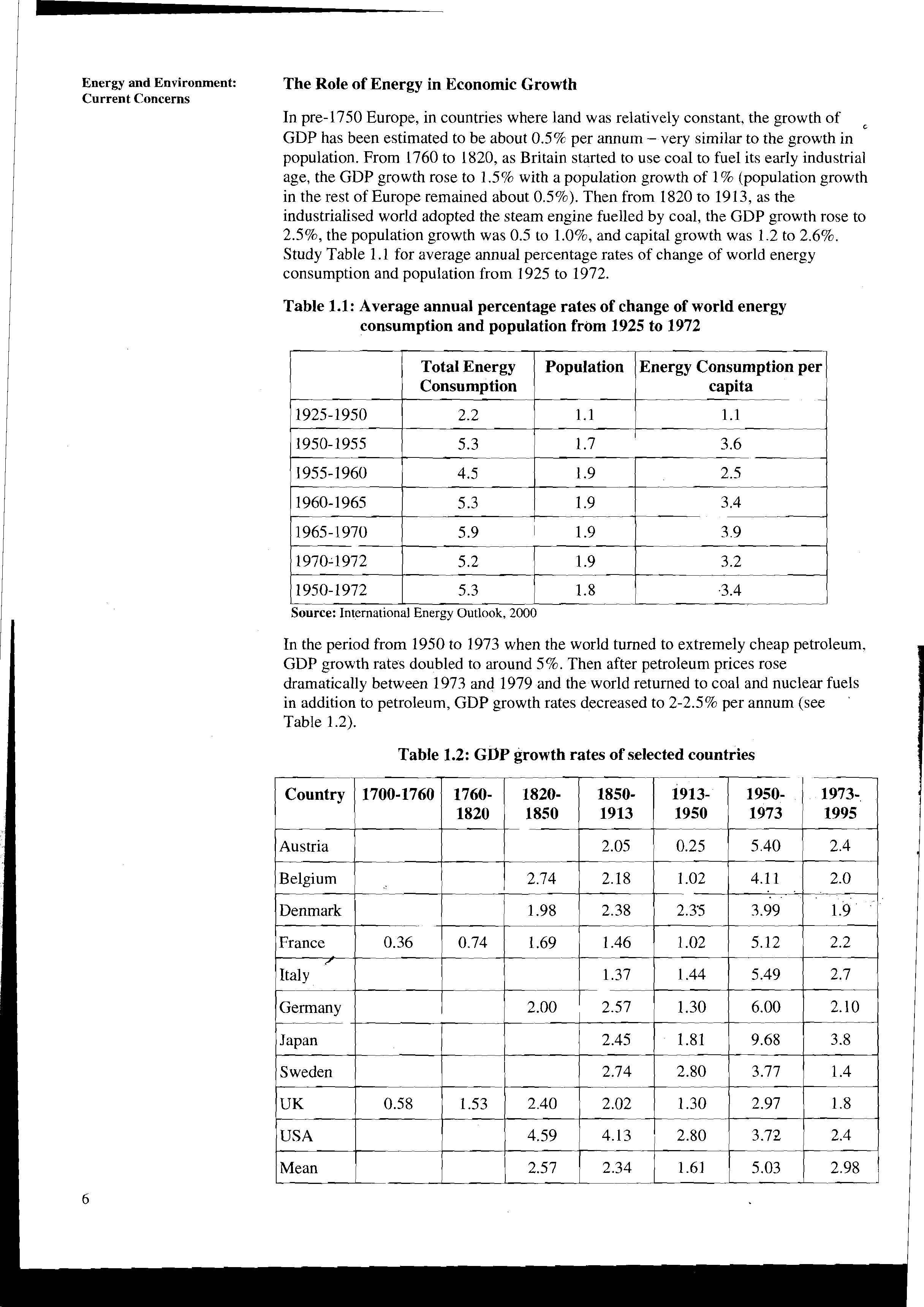
In the period from 1950 to 1973 when the world turned to extremely cheap petroleum, GDP growth rates doubled to around 5%. Then after petroleum prices rose dramatically between 1973 and 1979 and the world returned to coal and nuclear fuels in addition to petroleum, GDP growth rates decreased to 2-2.5% per annum (see Table 1.2).
Total Energy Consumption 2.2 5.3 -4.5 5.3 5.9 5.2 5.3 I Austria 2.05 b.25 - -5.40 12.4 I Denmark 1.98 2.38 2.35 3.991.9 - -France 0.36 0.74 1.69 1.46 1.02 5.12 2.2
1.1 1.7 1.9 1.9 1.9 1.9 1.8 Sweden 2.74 2.80 3.77 1.4UK 0.58 1.53 2.40 2.02 1.30 2.97 1.8 USA 4.59 4.13 2.80 3.72 2.4
Table 1.2: GDP growth rates of selected countries
i
SAQ 1
Study Tables 1.1 and 1.2 and answer the following questions:
a) What is the relationship between the population growth rate and energy consumption?

b) Explain the drop in Japan's growth rate from a high of 9.68 percent in the period 1950-73 to 3.8 percent in the period 1973-95.
C) Compare the future trends in GDP growth of North America, Western Europe, China and India. What implications does this economic growth have for energy demand and sudv in these countries?
Itjs postulated in energy economics that low energy prices stimulate economic growth. However, if economic growth rates higher than population growth rates are desired, nations should adopt a policy of promoting the supply of energy sources at the lowest possible prices.
Energy prices are determined to a large extent by supply and demand rates of new discoveries, inter-fuel competition, environmental considerations, government intervention, and rates of depletion.
Looking at the supplyldemand equation for various energy resources available for consumption, it is clear that supply/reserves/resources are adequate to meet expected. demand well into the next century (see Sec. 1.4). However, governments exercise an important influence on the energy sector, in general, and on energy prices, in particular. Ensuring an adequate supply of energy remains the prime responsibility of the energy industries.
The energy sectof - given its holistic importance for the economy - has traditionally been a sector of strong irivolvement, Governments intervene in the knergy sector for a variety of reasons and in a variety of ways.-~anyinstances and types of intervention are explicitly designed or intended to support energy policy goals and are specific to the energy production and supply industries or to the use of energy. Other actions, designed to support broader economic, political or social objectives, also affect the supply and use of energy amongst a range of goods and services.
In practice, because the role of energy is an essential input to most economic and human activity, almost all government actions impinge on the energy supply and demand in one way'or the other.
Energy and Development
Fig.l.1: The GDP of the industrialised and the developing world by region from 2001 to 2025 (Source: International Energy Outlook, 2004)
Energy and Environment: There is a vast range of measures that governments use in the pursuit of energy policy Current Concerns goals. These measures can be broadly classified into five main groupings:
Economic and fiscal instruments, Trade instruments, Government administration, management and ownership, Energy sector regulation, and Energy Research and Development (R&D).
~overnmentscan use these measures to tax or subsidise the use of energy sources and can, by these actions, encourage or discourage the use of specific fuels.

Based on the above consideration there could be two kinds of energy policies: one for developed countries with high standards of living and reasonably stable populations, and another for the developing and underdeveloped nations.
In the developed nations, major problems associated with energy consumption revolve around air pollution, global warming and traffic congestion. In the less developed and developing world obviously a policy of cheap, freely available energy should be followed. In particular, the expansion of electricity grids and gas pipeline systems should be encouraged. You will learn about these issues in detail in Unit 6 on Energy Policy.
Energy is one of the sectors of the economy where traditionally governments are most heavily involved. Many of the instruments of government intervention affect the final prices of energy to the consumer. The point to emphasise here is that policy measures by governments, which affect the final price of energy, will ultimately have a significant impact on economic growth and development. It is, therefore, imperative to understand and work for environment friendly energy efficient sustainable economies. For this, you need to understand the impact of population growth and industrialisation on energy demand, which is the subject of the next section.
1.3 ENERGY DEMAND DUE TO POPULAT1,ON - " GROWTH AND INDUSTRIALISATION
You have learnt in Block 4 of the course MED-001 about the trends in human population growth. The population of the developing world is predicted to increase from its current value of four billion to over eight billion by 2050, at which time it will comprise almost ninety percent of the world population. Population growth' is one of the factors which drive the world-wide energy demand, especially the demand for electricity.
1.3.1 Energy Demand vis-a-vis Population Growth
'The two main factors which will lead to greatly increased world-wide demand for energy (especially electricity) during the next half-century are:
population growth, and per capita economic growth in the less-developed countries.
Let us explain this further. Currently, the average person in the less-developed countries consumes only one sixth of the energy consumed b:r an average person in Western Europe or Japan (see Fig. 1.2).
Fig.l.2: Energy consumption in selected Asian countries 1980-2001 (Source: eia.doe.gov)
Doubling of per capita energy consumption in the less developed countries over the next 50 years would correspond to only a very modest degree of economic development. Yet, combined with the predicted population increase, it would lead to a two to three-fold increase in world energy consumption.
The actual increase in demand may be expected to be even greater. For example, there will be an increased demand from economic growth in the developed as well as developing countries. Improvements will undoubtedly occur in the efficiency of energy utilisation, but in the face of the expected increases in demand, these could only have relatively minor impact (see Fig. 1.3).
A: High growth presents a future of impressive technological improvements and high economic growth.
B. Middle course describes a future witnessed through perhaps more realistic technological improvements and more intermediate economic growth.
C. Ecologically driven growth presents a 'rich and green' future.
Fig.l.3: World population and global primary energy use projections to 2100. Notice that.at present the world uses roughly 9 gtoe worth of energy per year

1.3.2 Energy Demand in Industrialisation
The changing structure of production and consumption accompanying the process of development are important in determining the growth and composition of end-use energy demand. As an economy develops, it undergoes a series of structural changes. During the initial stages of economic growth, the share of agriculture in total output
Energy and Development
9
Energy and Environment: Current Concerns

falls and the share of industry rises. This is the industrialisation phase of development.
In the later stages of development, the demand for services begins to increase rapidly, increasing its share of GDP. This latter stage is often referred to as the 'postindustrialised' society.
The growth of heavy industry (infrastructure development) during the industrialisation phase leads to enormous increases in energy consumption. Accordingly, the energy intensity of GDP (defined as energy input per dollar of GDP) increases as the share of industry in GDP increases. As development continues, however, the demand for financial services, communications, transportation, and consumer goods (light manufacturing) grows rapidly. As a result, the share of services and consumer goods increases, eventually accounting for over one-half of total output. Light industry (involved in the production of consumer goods) and services require less energy input per unit output than heavy industry. This leads to a reduction in overall energy intensity, i.e., the energy input per unit output (see Fig. 1.4).
Fig.l.4: World energy intensity by region 1970-2020 (Source: 1EO 2004)
Although economic development leads to declining growth rates of per capita energy demand in the industrial sector, there is substantial growth in energy demand in the transportation, residential and commercial sectors.
Fig.l.5: An illustration of eneFgy consumption in the developed world (Picture credit: Ms. Shruti Vidyarthi)
As per capita incomes rise, consumers devote a larger proportion of their income to the purchase of durable goods such as air-conditioners, heaters, refrigerators, and automobiles. Since these items require some energy input to produce a flow of services, energy demand increases. The growth of energy demand in these sectors, however, slows as incomes continue to rise because there is a limit to which energy
*--am-*--.----*%-.---- " -.
-*-hw-~ L o
a 8 75
&
History Projections -1
can be consumed for transport, residential and commercial uses. Thus, there exists a Energy and Development saturation effect in the demand for services that require energy input.
In a recent study of the effect of economic development on end-use energy demand, it was found that energy demand grows at different rates in different, broadlydefined, end-use sectors (industrial, transport, residential and commercial). Specifically, it was found that per capita industrial energy demand rises very rapidly at the onset of development, accounting for the maximum energy use. The growth of energy demand in industry, however, quickly declines, and energy use in the other sectors eventually takes a majority share of total end-use energy consumption. In fact, energy demand in the transportation sector continues to grow well into the postindustrial phase of development, accounting for more than half of all energy use. A simulation of energy demand by sector for an average country based on these results is depicted in Fig. 1.6.

Given these patterns of development, we can expect energy demand in transport to acquire an increasing share of the energy consumption in the developed countries. The trends evident in Fig. 1.6, however, represent average global trends. They do not necessarily hold for any one country. It is, therefore, important to consider this, when malung inferences about the future energy needs for any single country.
Residential and
Fig.l.6: Simulated per capita end-use energy demand
1.3.3 Energy Demand in Asian Developing Economies
Developing countries are playing an increasingly important role in the world energy markets, and their consumption of commercial energy has increased substantially over the past two decades. The increase has been particularly pronounced among the I developing countries of East Asia and Southeast Asia and is expected to continue into the next century. However, the quantum of future energy demand by these loweri I middle-income countries will depend on a host of factors, such as: I the expected income levels, real energy prices, the continuing trend away from traditional non-commercial energy sources to commercial fuels, and
............... ..........................................
* 8 30000 .s 2500.0 3 ; 2000 CI .4 10000 15000 20000 25000 30000 Real GDP per capita 1985 international $
Energy and Environment: the speed of shift toward energy-intensive activities due to urbanisation and Current Concerns industrialisation, increased motorisation, and household use of electrical appliances.

The growing concerns about the environment and the global nature of environmental problems have focused attention on the pattern and trend of energy demand in the developing economies. More than half of the total carbon dioxide emissions originate in the energy sector, and a large and increasing share of the flow of emissions in future will be from lower-middle-income countries. A detailed analysis of energy demand and the possibilities of inter-fuel substitution in the major coal-producing countries, such as China and India, is very important. This is needed for a better understanding of global environmental problems and the energy needs of these economies. For a complete understanding, we also need to have an idea about the available energy resources. This is what you will learn in the next section. But first attempt this exercise.
Discuss the trends in energy consumption from the 1950s onwards. How did the growth in population influence these trends?
1.4 THE EARTH'S ENERGY RESOURCE BASE
The main sources of energy available on the Earth are solar and nuclear energy, with energy from other sources being negligible in comparison. All practical sources of mechanical energy found on the Earth derive their energy originally from sunlight. These sources of energy are: hydro energy, wind energy, tidal energy, seismic energy, and geothermal energy. We now discuss each one of these briefly. In this section, we shall be using terms like ergs, joules, watts, megawatts or MW. If you do not know them, refer to Section 2.2 of Unit 2.
Energy is measured in units of joules or ergs.
1joule = lo5ergs.
Solar Energy
You have learnt in the course MED-001 that the Sun is the main source of energy available on the Earth. Most of the usual sources of energy on the Earth are derived directly or indirectly from sunlight, such as the energy in wood, coal, gas, wind, river currents, fossil and water vapour. The energy from the Sun collected per unit time by a unit area at the outer surface of the Earth's atmosphere (in a plane perpendicular to the light path) is 1.40 x lo6 ergs/cm2/ s. It is called the solar constant. The entire area of the Earth intercepts 1.78 x 10'~ergsls of this energy.
About 35 % of incident solar energy is reflected back into space as visible light. About 12 9% is absorbed in the Earth's atmosphere on the average and is converted into thermal energy. The total energy falling on the ground per second is about 9.44~10~~ergsls. You can appreciate that this is a large quantity of energy by noting that it can provide 23,600 kilowatts of sunlight per person for a world population of 4 i billion. Compare this number with your average consumption of energy per day and calculate the number of days it will last for you. The Sun is not only the source of solar energy. It drives other useful sources, which we take up now.
The Sources of Mechanical Energy
All practical sources of mechanical energy found on the Earth derive their energy originally from sunlight. These sources of energy are: hydro energy, wind energy, tidal energy, seismic energy, geothermal energy, etc. The gravitational energy released by water flowing from higher to lower level is used in dams to generate energy. As you know, the use of electric generators and power lines has enabled the harnessing of a large amount of hydropower.
12
Wind has been used since ancient times for the transportation of both people and goods across water bodies in sail boats. This utiljsation of a mechanical source of energy to transport goods was a major stride forward in the evolution of the economic system. It provided human beings with the capacity to maintain order at a level far above anything known before. Wind mills were probably used as early as 1000 AD. By the thirteenth century;windrnills had become fairly common. Wind mills were used to grind grain and lift water. Holland's famous wind mills made it possible to recover areas of fertile land from the sea. Lately, wind mills have been largely replaced by gasoline engines or electric motors.
Tidal Energy
Generating technologies for deriving electrical power from the ocean include tidal power, wave power, ocean thermal energy conversion, ocean currents, ocean winds and salinity gradients. Of these, the three most well-developed technologies are tidal power, wave power and ocean thermal energy conversion.
Wave energy conversion takes advantage of the ocean waves caused primarily by interaction of winds with the ocean surface. Wave energy is an irregular and oscillating low-frequency energy source that must be converted to a 60-Hertz frequency for linking with the electric utility grid.
Although many wave energy based devices have been invented, only a small proportion of these have been tested and evaluated. Further, only a few have been tested at sea and in ocean waves, rather than in artificial wave tanks.
I Geothermal Energy
When the Earth's surface buckles and folds or shifts longitudinally along a fault, the seismic energy may be converted into the thermal energy. The thermal energy thus developed may produce hot spots, molten rocks and volcanoes along such Earth's faults or folds. Because of the very low thermal conductivity of most rocks, volcanic heat may accumulate over the ages. Thus a considerable amount of geothermal energy may accumulate in a localised region of the Earth's crust.
Practical sources of volcanic heat usually depend upon naturally occurring hot
springs, geysers or holes that eject steam under pressure. The hot water releasing from

Wind Energy Energy and Development
I
Fig.l.7: The energy resource base of the Earth
i
I
Energy and Environment: such wells comes from underground channels that establish a large area of contact Current Concerns with hot volcanic rocks below the surface.
At present, geothermal energy is being converted to electric power at four sites: Larderllo, Italy (since 1904) where 372 MW of electric power is being generated; Wairakei, New Zealand (since 1958) where 192 MW of electric power is being generated; Geysers, California (since 1960) with 82 MW and Japan (since 1968) with 31 MW. Iceland has plans for the utilisation of its abundant supply of geothermal energy for the development of electric power. There are a few other sites that might eventually be utilised for geothermal energy, but the power potentially available from all such sites is quite small when compared to other sources of power.
Chemical Energy in Fossil Fuels
While most of the carbon in an ecosystem is recycled, there can be a small rate of deposition of detritus in a reducing environment that can accumulate over the ages to form large fossil deposits. You have studied about this in MED-001. These deposits contain a large amount of chemical energy in the form of coal, oil, natural gas, etc.
Oil
Petroleum has been used since ancient times for space heating, cooking and lighting. The Chinese were drilling oil wells as early 1000 B.C. It is only recently, however, that energy from oil has been extensively converted to useful work. Oil yields about one third of the total raw energy produced in the world today for a rate of supply equal to 229 x 10" watts.
The total reserves of oil in the ground are limited and the available oil will be consumed eventually. According to usual estimates, the total reserves of oil amount to about 1.2 x ergs of energy. At the rate of present use of oil, the Eartb's oil reserves would last for just about two hundred years.
Coal
Coal was first mined and used in China around 1100 B.C. The early use of coal was in malung ceramics, metallurgy, space heating and cooking. Nowadays coal is used extensively as fuel and in thermal power plants. The total reserves of recoverable coal in the ground are quite large, but still finite. So eventually, the supply of coal will be exhausted.
Natural Gas
The world produces 3.38 x ergs of energy in natural gas at a rate of 107 x 10lOwatts.About 17% of this energy goes into producing electricity at an efficiency of about 30%. The total world reserves are estimated to be about 1.1 x ergs, about the same as the total oil reserves. So at the present rate of consumption, natural gas would last for about three hundred years.
Oil Shale
Although the total energy content in the Earth's reserve oil shale may be'estimated at about 2 x ergs, much less than one-tenth can be extracted, since a large amount of energy is needed to obtain the oil from shale. Due to the cost of mining and extracting oil from the shale, oil shales will not be extensively exploited until the world's oil reserves become largely depleted.

Peat
Peat is currently consumed on a small scale, particularly for space heating. The total reserve energy in peat is about 1% of the reserve energy in coal. At the present rate of accumulation of peat, about 48 x 101° watts of power are continuously available.
Nuclear Energy
Nuclear energy arises from the conversion of mass to energy, according to Einstein's mass energy equivalence principle E= mc2. Here c = 3.00~lo8 m/s is the speed of light. The two sources of nuclear energy are: nuclear fission and nuclear fusion.
Nuclear fission occurs when the nucleus of a large atom - in particular uranium 235, plutonium 239 or uranium 233 - splits into nuclei of approximately equal masses. The total mass of the two fragments is less than the mass of the original nucleus. The deficiency in mass is released as energy. The total energy released in the fission of one uranium 235 nucleus is 190 MeV or 317 x 10-l3joules. 1 gram of Uranium 235 can yield about 8 x 10'~joulesof energy.

The fusion of light atomic nuclei into heavier nuclei also results in a net loss of mass with a resulting release of energy. The Sun and stars obtain their energy from the fusion of light elements, especially hydrogen.
While controlled nuclear fission has been used to obtain energy in nuclear reactors, controlled thermonuclear fusion reaction has not yet been attained. The rare, expensive and radioactive (half-life of 12.5 years) tritium can be fused with deuterium at about 30 million degrees temperature, while the cheap plentiful deuterium can be fused with itself at about 300 million degrees. At such high temperatures, there are several technological problems yet to be overcome. But once this happens, we will have a cheap and everlasting source of energy. However, a word of caution may not be out of context here. There are a host of safety and environmental issues involved in the use of nuclear technologies for energy generation. You have read about some of the risks involved in the course MED-001. We will revisit these issues in Unit 4.
Fig. 1.8 shows the shares of various fuels in the total energy consumption in India in 2000.
SAQ 3
Make a comparative chart of the amount of energy that can be tapped from various energy resources available in the world. Also mention how long each of the nonrenewable energy resources is estimated to last at the current consumption trends. What suggestions can you give about the sustainable use of energy?
i /
"\ 52.7 r--Coal Petroleum 17 Natural gas Hydroelectric Nuclear 1 Non-hydro renewables L___~~~~~~ -----'
32.5
0.1
Fig.l.8: India's fuel share of energy consumption, 2000 You may now like to try an exercise to consolidate these ideas.
Resource potential and its availability is only one dimension of the energy base of the
Earth. The carrying capacity of the Earth's resource base will actually determine how this resource base can support the human population.
We, as human beings are unique in our ability to modify the environment and to improve technology for food and energy production. These unique abilities combined with the inherent social nature of humans complicate the estimation of the human carrying capacity of the planet. We now discuss this aspect of energy and development.
1.5 THE CARRYING CAPACITY OF THE EARTH'S ENERGY BASE
You have learnt in MED-001 that the carrying capacity of an ecosystem is defined as the maximum population size of a species that an area can support without reducing its ability to support the same species in the future. Biological studies of population change typically demonstrate that once the carrying capacity of an ecosystem is exceeded, a severe crash or collapse of the population follows and is associated with rapid environmental degradation.
According to the United Nations Population Fund's (UNFPA) latest population report, the world population has doubled since 1960 to 6.1 billion people and is projected to increase to 9.3 billion by 2050. Along with the increase in the number of people, there is an associated increase in the demand placed on the resources of the Earth. This affects the carrying capacity of the Earth.
The long-term sustainable carrying capacity for the human species on the Earth varies with resource availability as well as culture and level of economic development. Thus, two measures of human carrying capacity arise:
the biophysical carrying capacity, and the social carrying capacity.

The biophysical carrying capacity is the maximum population that can be supported by the resources of the planet at a given level of technology.
The social carrying capacity is the sustainable biophysical carrying capacity within a given social organisation, including patterns of consumption and trade.
The social carrying capacity therefore must be less than the biophysical carrying capacity as it will account for the quality of life. Besides, it can give us an estimate of the number of humans that can be supported in a sustainable manner at a given standard of living.
The amount of energy consumed per person per year is a useful measure of the standard of living. Per capita energy consumption is measured in kwlperson and includes industrial uses, transportation, domestic uses, clothing, electronic entertainment, vacations, food production, etc. Currently there exists an extreme dichotomy in the level of energy consumption between the US, other developed countries and developing countries.
You can see this in Fig. 1.9 that depicts per capita energy consumption in different regions of the world in the year 1995. Notice that the North American per capita energy use was more than twice that of Europeans, more than 10 times that of Asians and more than 25 times that of Africans. Needless to say, these disparities have not been reduced.
Energy and Environment:
Current Concerns
Fig.l.9: Energy consumption per capita in different regions of the world in the year 1995 Eb
In order to estimate the human population that can be sustained by the Earth, a standard of living or level of consumption must be selected or assumed. At this point, the introduction of social issues becomes important. For instance, very high global population could be supported at a very low level of food consumption, perhaps even on the brink of starvation. The result, however, could be a socially unstable situation. A socially sustainable carrying capacity must be based on a level of consumption that meets basic human needs of food, water and space as well as provides opportunity to enjoy socio-political rights, health, education and well-being. Another important aspect of social sustainability is equitable distribution of resources. Inequitable distribution of wealth can lead to social instability and disruption.
Estimating Sustainable Carrying Capacity
The basic resources of the planet, such as land, water, energy and biota are inherently limited. Selection of one or several of these limited resources as a metric for measuring the carrying capacity of the planet is a common method of estimating global human carrying capacity.
The use of a single resource or combination of limited resources to estimate carrying capacity includes measuring how much of that resource is available globally. For instance, global wheat harvest capacity can be estimated based on land area and water availability. It can then be used to compute the number of humans that those quantities
Resource use must also be differentiated between renewable and non-renewable resources (see Table 1.3) for estimation of global carrying capacity. You know that renewable resources are driven primarily by solar energy and are regenerated through natural processes. Non-renewable resources are those with limited quantities and very low or no renewal rates. Long-term use of non-renewable resources is generally not sustainable, though some of these are renewable at reasonable rates of consumption. A socially sustainable global carrying capacity must be based on the use of renewable resources, possibly supplemented by very low consumption of nonrenewable resources.
Recent estimates by the World Energy Council suggest that one-third of the world's oil reserves have been used and that the remainder will be significantly depleted by the end of the 21st century if current rates of consumption continue. Other studies suggest that declines in oil production will occur as early as 2010. Other noni renewable energy sources, such as coal and natural gas, will supplement as oil production potentially declines; however, these sources are also not sustainable over 1 the long-term.

Energy and Development u, 4007 .P
3
5 P
Africa Asia and the Europe and Latin America North America West Asia
Pacific Central Asia and the
Caribbean
I
Renewable Resources
Solar energy (drives wind, hydropower) Freshwater
Some soil used for agriculture Wood for Construction
Some animal species (e.g., animals for transport, insulin and vaccines)

Non-renewable Resources
Energy sources (e.g., oil, coal, natural gas, nuclear)
Stratospheric ozone Tropical forests Biodiversity
I Minerals (e.g., diamonds, gold, iron)
Changes in available technology for energy and food production and distribution, and waste disposal also impact the resulting carrying capacity estimate. Of course, the advancements in fertilising agricultural land lead to increased food production, and 'allow for greater population growth. Some estimates of canying capacity account for future improvement in technology, and other estimates presume that the level of technolugical development remains the same.
Energy Inputs
Energy availability is a useful metric that can be used to estimate c&rying capacity because it can account for many different resources. Energy from the Sun is the driving force of the Earth's ecosystems. You have studied in MED-001, how solar energy generates atmospheric processes that provide wind energy and fresh water. Plants, trees, food crops, and animals all require energy from the Sun. The balance of energy consumption and production can be used to estimate the number of humans that the planet is capable of supporting in a sustainable manner.
The total amount of energy input by the Sun to the Earth is finite and can be estimated. When that energy is divided amongst the entire Earth ecosystem, it is possible to estimate at a given level of consumption, as to how many humans can be supported on the Earth. The resulting estimate is a sustainable number because it does not rely on non-renewable energy sources. Currently, about 50% of all the solar energy captured by photosynthesis is used by humans. On its own, solar energy cannot support the present human population without supplementation by non-renewable energy sources, such as fossil fuels.
Land Area
Land area can be used in different ways to estimate carrying capacity, either as a metric for other resource uses or as a measure itself. The simplest way of using land area to compute carrying capacity is to presume a population density for a given area and compute the total number of people that the region can support. Another method, the ecological footprint concept, uses land area as a metric for a combination of other factors. Ecological footprint takes many different resource uses and measures them by the equivalent amount of land area required for their production. The ecological footprint describes how much land is necessary to support a given population in terms of energy, food, and other resources at a certain level of consumption. The result is that developedJrich countries with high levels of resource consumption have much larger footprints than the land they actually occupy.
Food Production
Estimates of carrying capacity using food as a metric determine the total amount of food that can be produced globally and divide by a standard level of food consumption per person. The result is a global population that can be supported at a given level of subsistence assuming that food is equitably distributed around the globe. More complex methods consider changes in crop yield with increased
Energy and Environment: Current Concerns Table 1.3: Renewable
and non-renewable rksources
I
technology, food distribution, varied world diets, and other resource supply, such as fossil fuels.
SAQ 4
List the parameters, which can be used.as metrics to estimate the carrying capacity of the Earth. Explain how energy availability is used as a metric for this purpose.
Recent Carrying Capacity Estimates
When one considers the array of factors that must be estimated and the conditions that must be assumed, it is unrealistic to expect a unique figure defining the Earth's human carrying capacity. Professor Joel Cohen in his 1995 book, "How Many People can the Earth Support?" summarised estimates of human carrying capacity of the Earth beginning with estimates made as early as the 1600s. His summary is not limited to estimates that are considered socially sustainable as he includes estimates that consider only biophysical parameters.

A sustainable population of humans on the Earth implies reliance on renewable energy sources'combined with socially sustainable standards of living. The standard of living and carrying capacity are inversely related. This means that as the standard of living decreases, the number of people that can be supported on the Earth increases. The current global population of 6.1 billion people exceeds the median range of socially and biophysically sustainable carrying capacity. This is made possible by consumption of non-renewable energy sources, such as fossil fuels as well as inequities in global distribution of food and energy consumption.
Energy is a useful metric for estimating carrying capacity because it can be used to estimate available renewable energy from the Sun as well as the standard of living based on energy consumption. Solar energy is the primary source of renewable energy on the Earth as it generates atmospheric processes as well as food and forest resources. Per capita energy consumption can be used to estimate resource use that defines human standards of living, including food, transportation, manufacturing, heating and cooling, housing, etc.
To sum up, the estimation of the carrying capacity of the Earth is a difficult task involving value-based decisions and assumptions. Whether the future of the Earth will have a dense population of humans with reduced biodiversity and degraded environmental qualities or a smaller human population living in a sustainable manner on diverse resource base, remains to be seen. However, current levels of energy consumption and the impending depletion of non-renewable energy sources point towards the necessity for a change in either population growth or consumption trends if the human race is to survive at anything close to its current level of subsistence. You will learn about the energy consumption patterns in the next unit. Let us now summarise what you have studied in this unit.
1.6 SUMMARY
Cost and availability of energy at the point of usage, is a major factor in the growth of GDP. Low energy prices stimulate economic growth; nations should adopt a policy of promoting the supply of energy sources at the lowest possible prices. In the undeveloped and developing world a policy of cheap, freely available energy should be followed, in particular, for electricity grids and gas pipelines.
Two main factors which will lead to greatly increased world-wide demand for energy (especially electricity) during the next half-century are: population growth and per capita economic growth in the less-developed countries. The predicted population increase would lead to a two to threefold increase in world
Development
Energy and
energy consumption. The actual increase in demand may be expected to be even greater.
The growth of heavy industry (infrastructure development) during the industrialisation phase leads to enormous increases in energy consumption. Accordingly, the energy intensity (defined as energy input per dollar of GDP) increases as the share of industry in GDP increases. As the economies develop, the growth rates of per capita energy demand in the industrial sector decline. But there is substantial growth in energy demand in the transportation, residential and commercial sectors.
The main sources of energy available on the Earth are solar and nuclear energy, energy from other sources being negligible in comparison. All practical sources of mechanical energy found on the Earth derive their energy originally from sunlight. These sources of energy are: hydro energy, wind energy, tidal energy, seismic energy, geothermal energy, etc. While most of the carbon in an ' ecosystem is recycled, there can be a small rate of deposition of detritus in a reducing environment that can accumulate over the ages to form large fossil deposits. These are: oil, coal, natural gas, oil shale and peat. Two sources of nuclear energy are predominant: nuclear fission and nuclear fusion.
The carrying capacity of an ecosystem is defined as the maximum population size of a species that an area can support without reducing its ability to support the same species in the future. The long-term sustainable carrying capacity for the human species on the Earth varies with resource availability as well as culture and level of economic development.
Two measures of carrying capacity are: the biophysical carrying capacity and the social carrying capacity. The social canying capacity is the sustainable biophysical canying capacity within a given social organisation, including patterns of consumption and trade.
The basic resources of the planet, such as land, water, energy and biota are inherently limited. A socially sustainable global carrying capacity must be based on the use of renewable resources, possibly supplemented by very low consumption of non-renewable resources.
Energy is a useful metric for estimating carrying capacity because it can be used to estimate available renewable energy from the sun as well as standard of living based on energy consumption.
1.7 TERMINAL OUESTIONS
1. Discuis the role of energy in the economic growth of developing countries. How do policy measures adopted by governments affect energy use in a country?
2. Explain how the end-use energy demand varies with the changes in production and consumption as an economy develops.
3. Describe the features of energy demand in Asian developing countries.
4. Given the energy resource base of the Earth, what energy options are available to developing economies of the world?
5. Explain how the carrying capacity of the Earth can be estimated using various parameters. Outline the basis of a socially sustainable global carrying capacity.
Energy and Environment: Current Concerns
UNIT 2 ENERGY CONSUMPTION
Structure
2.1
Introduction
Objectives
2.2 Energy Units
2.3
Current Patterns of Energy Consumption
2.4 World Energy Demand and Future Projection
2.5 EnergyEndUse
2.6
Summary
2.1 INTRODUCTION
In the previous unit, you have learnt about the crucial role of energy in the economic growth of industrialising countries. You have also studied about the energy resource base of the Earth and learnt that energy is a useful metric for estimating the canying capacity of the Earth. You would agree that to promote the sustainable use of energy, we need to evaluate the current energy consumption and bring the issue of equity in energy use to the forefront of the energy-environment debate.
While studying Unit 1, you have come across many units like joules, ergs, watt, Btu, Gtoe, etc. We begin this unit by defining these terms. Then we present the data about the patterns of energy consumption in the world and discuss the current energy demand and future projections.
In the next unit, we discuss the technologies currently used for energy production as I these are equally important in any analysis of energy-environment relationship.
Objectives
After studying this unit, you should be able to: define various units of energy and power; analyse the world-wide patterns of energy consumption region wise as well as by fuel type; discuss the energy consumption pattern of Asian countries, in general and India, in particular; and , analyse the future energy demand projections region wise and by fuel type. '

2.2 ENERGY UNITS
You have learnt about the concept of energy in the course MED-001. It is defined as the capacity to do work. Energy is measured in ergs or joules. Although it is common to talk of 'energy generation' and 'energy consumption', strictly speaking, energy is never 'created' or 'consumed'; it is just 'converted' from one form to another.
Therefore, a more useful entity is that of power, defined as the rate at which energy is used or converted from one form to another. The unit of power most commonly used is watt.
IOne watt is equal to one joule per second. In symbols, it is written as 1W = 1 JS-', where W stands for watt, J for joules and s for second.
You would have come across electric heaters of 1 kilowatt rating. What does this mean? One kilowatt (kW) is equal to 1,000 watts. So one kilowatt rating means that
2.7 Terminal Questions
~ner&and Environment: the device consumes 1000 joules of energy in one second. Horse Power (H.P.) is yet Current Concerns another unit of power. One H.P. is equal to work done at a rate of 550 ft lbs-I (footpounds per second). It is equal to 748 watts:
1 H.P. = 748 watts
Water pumping systems are generally rated in terms of H.P., for example. 0.5,0.75, 1, 1.5 and 2 H.P. etc.
A 1 H.P. pump can move 1 pound water to a distance of 550 feet in one second.
Almost all energy generating or consuming devices carry a power rating (or rated capacity) in watts and multiples of watts, e.g., kilowatt, megawatt and so on. You may have read in the newspapers that such and such a city requires 500 megawatts of power. How much energy does the city need in one second? You can calculate this by making use of the conversion factors given in Table 2.1.
Table 2.1: Units of power and conversion factors

I Unit and symbol 1 Conversion factor (in Watts)
kilowatt (kW) megawatt (MW)
1 gigawatt (GW)
I kW = 1000W = lo3 w
1 MW = 1,000 kW = lo6 w
terawatt (TW) I TW = 1OOOGW
To give you an idea of scale, a typical large modem coal or nuclear power station has a rated capacity of around 1.3 gigawatts (GW), while India produced a total of 533 terawatts of electricity in 2001.
Kilowatt-hours or (kwh) is the unit by which electricity and gas are sold in many countries including India. One unit measured by the electricity meters in our homes is equal to 1 kilowatt-hour.
A device of rating 1 kW consumes one kilowatt-hour or one unit of energy in one hour. So, if you run a geyser of 2 kW rating for one hour, it ideally consumes 2 units of energy.
Given this information, can you work out the energy consumption in one day in your home or office? Give it a try.
Write down the power ratings of various devices that you use in your homes. Some examples are given below:
Fluorescent tube 40 W
CFL 5W,7W,9W,llW,13W,15W
Electric bulb 15 W, 40 W, 60 W, 100 W
Fan
Refrigerator Cooler Water Pump
TV Radio
Washing machine
AC
Microwave oven
Calculate the power consumed in your home on one typical day in various seasons. For example, in Delhi, you could do the calculations for a day in summer (e.g., month of May1 June), winter (e.g., month of December1 January) spring (e.g., month of March. April) and autumn (e.g., month of September1October), respectively.
Can you discern an energy consumption pattern from this data? How can you optimise or reduce your consumption?
For larger quantities of energy, multiples of kWhs are used. The most commonly used unit is the terawatt hour (TWh) which is 1,000,000,000 kwh or lo9 kwh.
To give you an idea of scale, the total electricity consumption in India was about 497 TWh in 2001. Remember, however, that this represents consumption of electricity, and not total energy consumption. It does not include all the direct heat supplies (kerosene, wood, gas, etc.) or transport fuels like petrol, dlesel, etc.
You have also come across the unit of Btu in Unit 1 (recall Fig. 1.2). It is the British thermal unit, an old measure for the heat content of various fuels. In terms of kilowatt-hours, it is given as
1 kwh = 3,413 Btu.
The USA still uses the Btu.

The total amount of energy used is often measured in terms of primary energy consumption that is the amount of energy in the basic fuels used by energy conversion devices, whether for electricity production, heating or transport.
However, you must remember that primary energy figures for the total energy in the fuels used by energy conversion devices are much larger than the finally delivered energy, as utilised by consumers. This is because there are losses in the conversion process in power plants and along the transmission and distribution (T&D) grid network.
This is particularly true of electricity: conventional coal or nuclear-fired power plants have conversion efficiencies of around 35 %. Even the best modern gas-fired power stations can only convert around 50 % of the energy in the input fuel to electricity. Moreover, up to 10 % of the electricity may be lost when it is transmitted along power lines to consumers, depending on the distances involved. Finally, consumer devices operate with varying degrees of efficiency. For example, some part of the energy used by coolers or heaters is lost due to poor insulation in buildings.
Primary energy figures, therefore, tell us only a part of the story. As we shall see in the subsequent units, there is also a need, when comparing technologies and energy
SAQ 1 Energy Consumption
systems to consider the overall efficiency of energy conversion and transmission, and Current Concerns the use to which the energy is put.
The Battle of the Units
Measuring energy is not as simple as it might seem to you. Given that there are many ways in which energy is generated and used, it is not surprising that there are many different, often confusing, ways in which it is measured.
We have mentioned kwh, which is the most familiar unit to us since it is used in our electricity bills.
However, energy analysts sometimes use the basic unit of energy, the joule (J) or multiples of joules. Since one watt is one joule per second,
1 kwh = 1000 W x 1 hour = 1000 joules per second x 60 minutes x 60 seconds = 36,00,000 joules
The joule (J) is, however, a very small unit. In the energy sector, larger multiples of joules are used, e.g., peta-joules (PJ) and exa-joules (EJ):
1 PJ = 1,000 tera joules = loi5 joules
1 EJ = 1,000 peta joules = 10" joules
We have also used units like mtoes or the gtoes in Unit 1, which are the European standard units. These render the energy content of all fuels, mainly for statistical comparison purposes, in terms of the equivalent of oil that would have the same amount of energy content. The energy content of all fuels is now presented in terms of tons of oil equivalent, or more commonly, million tons of oil equivalent (mtoes). Gtoe is giga-tons of oil equivalent.
However, in this course, we will use the more familiar units like kwh, Twh, etc. We give the conversion factor for the sake of completeness:
1 mtoe = 11.63 TWh, and 1 TWh =0.086 mtoe.
You need not memorise all the units explained here. But you should know what these terms mean. Having familiarised you with the units of energy and power that we will be using throughout this course, we now focus on various patterns of energy consumption. - - - - - -
2.3 CURRENT PATTERNS OF ENERGY CONSUMPTION
A study group conducted a primary treatment of the data extracted from the Energy Statistics Yearbook of the United Nations, the World Energy Statistics and Balance by OECDIIEA and other energy-related statistics including the Yearbook of Forest Products by FAO. The interim report provides a preliminary summary of the present energy consumption patterns as a result of the above endeavour. The International Energy Outlook 2004 and the Energy Statistics Yearbook of the United Nations provides information on the energy consumption pattern for analysing global environmental problems, by country and by region and by degree of socio-economic development.

World Major Energy Producers and Consumers
In 2001, three countries - the United States, Russia, and China - were the leading producers and consumers of world energy. The United States supplied 71.6 quadrillion Btu of primary energy, significantly more than the
Energy and Environment:
44.9 quadrillion Btu produced by Russia or the 36.3 quadrillion Btu produced by Energy Consumption China (see Fig. 2. la). These three countries produced 38 percent and consumed 41 percent of the world's total energy.
Countries
USA w Russia China
(a) (b)
Fig.2.l: Leading a) producers and b) consumers of world energy in 2001
The United States, Russia, China, Saudi Arabia, and Canada were the world's five largest producers of energy in 2001, supplying 47.9 percent of the world's total energy. The next five leading producers of primary energy were the United Kingdom, Iran, Norway, Australia, and Mexico, and together they supplied an additional 12.8 percent of the world's total energy.
Let us now look at the world energy consumption so far (Fig. 2.2). (exajoules)

Countries
- Developing countries 1- OECD countries - Transition countries (former Soviet Union and Central Europe) - Total
Fig.2.2: Total energy consumption by region up to 1993
The United States, China, Russia, Japan, and Germany were the world's five largest consumers of primary energy in 2001, accounting for 49.8 percent of world energy consumption. They were followed by India, Canada, France, the United Kingdom, and Brazil, which together accounted for an additional 13.5 percent of world energy consumption. The United States consumed 97.1 quadrillion Btu, almost two and onehalf times as much as the 39.7 quadrillion Btu consumed by China, while Russia
8 0 70 3 '60 50 E 0 --
.5
40
30 s 20 10 0
3
25 f I
consumed 28.2 quadrillion Btu (see Fig.2.lb). Compare these numbers with the Current Concerns 12.8 quadrillion Btu consumed in India in 2001. How does the per capita energy consumption in India compare with the other countries? You may like to work it out. Try SAQ 2.
SAQ 2
Use the data given so far and the population data of US, China, Russia and India in 2001 to calculate the per capita energy consumption for the following countries:
USA China Russia India
You may now like to look at the consumption patterns in Asia in some detail.
Asian Energy Consumption Pattern and its Effects on the Global Environment
Asia, to which Japan belongs, is expected to increase its energy consumption at the fastest rate in the world because of its large population, accounting for about 50 percent of the world population, and the anticipated rapid economic growth of the newly industrialising economies (NIEs) and developing countries like China and India. However, the adverse effects of their energy consumption have already become evident, in the form of acid rain, for example. Concern is also expressed over such global atmospheric environmental effects as the greenhouse effect.
The knowledge on Asia's present energy consumption pattern, geo-scientific features and environment is not sufficient for formulating adequate measures to cope up with the environmental problems foreseen in the future. Besides, the great diversity amongst the Asian nations in energy consumption and socio-economic conditions will make such studies even more difficult.
The World Energy Statistics and Balance by OECDIIEA, issued in November 1988 as a bulletin and June 1989 as a formal report, provided for the first time a comprehensive coverage that included the developing countries. The summary of the report is as follows:

Consumption of energy is growing in Asia faster than any other region of the world. Asia also depends heavily on coal, which imposes a heavy load oi the environment. These trends are becoming even more pronounced recently.
If we look at country wise consumption, China, Japan and India are the major consumers of energy in Asi.a. Both China and India have a pattern of energy consumption in which coal is the primary source of energy; further, their demands for energy are increasing fast.
Overall, NIEs and Japan are shifting their dependence from liquid fuel to natural gas and nuclear power, both of which give rise to lesser environmental problems than petroleum. In contrast, India has an ambitious programme to use a liquid fuel i.e., ethanol in the transport sector. It is presently marketed under the name, "gasohol". The idea is to replace the conventional gasoline fuel by ethanol to the extent of about 5% in the first instance. However, the rate of solid fuel consumption is also increasing. The Least Developed Countries (LDCs) are introducing natural gas and developing hydroelectric generation. This trend should be highly valued from the viewpoint of global environmental conservation.
On the subject of energy consumption by sector, Japan in recent times has exhibited a tendency for decreasing share of the industry sector while increasing its energy shares of the transportation and household sectors. By contrast, the
Energy and Environment:
ASEAN countries, LDCs and NIEs are increasing the energy share of the industry
sector. The transportation sector is notably increasing its share in NIEs.
Forests are declining in Southeast Asia at the fastest rate; the rate is faster than even the forest decline of Brazil. Charcoals are cited as a major cause for the forest decline. Firewood and charcoal production accounts for the majority of timber production.
In MED-001, you have studied that global warming due to GHG emissions is one of the major environmental problems being faced today. C02has the maximum share in the GHGs. We now discuss briefly the impact of fossil fuel consumption on the COz emissions.
Carbon Dioxide Emissions from the Consumption and Flaring of Fossil Fuels
The total world carbon dioxide emissions from the consumption of petroleum, natural gas, and coal, and the flaring of natural gas increased from 5.894 billion metric tons carbon equivalent in 1992 to 6.568 billion metric tons in 2001, or by 11.4 percent. The average annual growth rate of carbon dioxide emissions over the period was 1.2 percent (Note: Carbon dioxide emissions are measured here in metric tons carbon equivalent. Tons of carbon equivalent can be converted to tons of carbon dioxide gas by multiplying by 44/12.)
The United States, China, Russia, Japan, and India were the world's five largest sources of carbon dioxide emissions from the consumption and flaring of fossil fuels in 2001, producing 52 percent of the world total. The next five leading producers of carbon dioxide emissions from the consumption and flaring of fossil fuels were Germany, Canada, the United Kingdom, Italy, and South Korea, and together they produced an additional 12 percent of the world total. In 2001, the total United States carbon dioxide emissions from the consumption and flaring of fossil fuels were 1.565 billion metric tons carbon equivalent. This was more than one and three-fourths times as much as the 832 million metric tons produced by China, while Russia produced 440 million metric tons.
The developed countries account for a 79.8% of total world C02 emissions. The absolute emission ranking for selected countries is given in Table 2.2.
Table 2.2: Country wise percentage of world total COz emissions
Country I Percentage of world total C02 emissions 1 1 United States 1 23.3% China Russia 7.28% Japan I 5.30% 1 ~ermany I 4.66% 1
You may also like to know the share of C02emissions from each of the fuel types, viz., petroleum, coal and natural gas.
COz emissions from the consumption of petroleum
In 2001, petroleum consumption was the world's primary source of carbon dioxide emissions accounting for 42 percent of the total C02 emissio.ns from the i consumption and flaring of fossil fuels. Between 1992 and 2001 emissions from the consumption of petroleum increased by 262 million metric tons carbon 1 equivalent, or 10.5 percent, rising from 2.499 to 2.761 billion metric tons. The United States was the largest producer of carbon dioxide from the consumption of
petroleum in 2001 and accounted for 24 percent of the world total. Japan was the

Energy Consumption
I I
I
second largest producer, followed by China, Russia, and Germany, and together these four countries accounted for an additional 20 percent.
COz emissions from the consumption of coal
Coal ranked second as a source of carbon dioxide emissions from the consumption and flaring of fossil fuels in 2001, accounting for 37 percent of the total. World carbon dioxide emissions from the consumption of coal totalled 2.4 billion metric tons carbon equivalent in 2001, up 8.7 percent from the 1992 level of 2.2 billion metric tons. China and the United States were the two largest producers of carbon dioxide from the consumption of coal in 2001. Together they accounted for 49 percent of the world total. India, Russia, and Japan accounted for an additional 16 percent.
COz emissions from the consumption of natural gas
Carbon dioxide emissions from the consumption and flaring of natural gas accounted for the remaining 21 percent of carbon dioxide emissions from the consumption and flaring of fossil fuels in 2001. Emissions from the consumption and flaring of natural gas increased from I .I62 billion metric tons carbon equivalent in 1992 to 1.379 billion metric tons in 2001, or by 18.7 percent. The United States and Russia were the two largest producers of carbon dioxide from the consumption and flaring of natural gas in 2001 and together they accounted for 40 percent of the world total. The United Kingdom, Germany, and Canada accounted for an additional 10 percent.
You may want to know about the contribution of India to carbon emissions. In 2001, India, with 251 million metric tons of carbon equivalent emitted, ranked fjfth in the world in carbon emissions, behind the United States, China, Russia and Japan (see Fig. 2.3).
Fig.2.3: ~ndia'sCOz emissions from 1990 to 2001 (Source: EIA)
However, India's carbon emissions stood at only 80% of Japan's (316 million metric tons of carbon equivalent) total and less than one-sixth of the United States' (1,565 million metric tons) carbon emissions during the same year. Between 1990 and 2001, India's carbon emissions increased by an astonishing 61%, a rate surpassed only by China's 1 11% increase during the samc time period
Still, Indla's per capita carbon emissions are relatively low. At 0.25 metric tons of carbon per person in 2001, India's per capita carbon emissions were less than onequarter of the world average and 22 times less than those for the United States. However, India's contribution to world carbon emissions is expected to increase in the coming years, with an estimated average annual growth rate of 3.1% between 2001 and 2025 (as compared to 3.4% in China and 1.5% in the United States). The absolute

Energy and Environment: Current Concerns
e 250 c li 0 200 8 Y u '58 .3 b too g .3 I 3 50 0
increase in emissions will partially be a function of the degree to which coal is relied upon as a major energy source.
The rise in India's carbon emissions has been mainly due to the low energy efficiency of its coal-fired power plants. It is also on account of the poor quality of the Indian coal, which means high ash content. Many of India's highly-polluting coal-fired thermal power plants will have to remain in operation for the next couple of decades for the following reasons: ,
High capital costs associated with replacing existing coal-fired plants, A scarcity of capital, and The long lead time required to introduce advanced coal technologies.
If, however, coal consumption is substituted by oil and natural gas, India's overall carbon emissions would be surely reduced. India's per capita carbon emissions are also expected to increase in the coming years due to the rapid pace of urbanisation, a conversion away from non-commercial towards commercial fuels, increased vehicular usage and the continued use of older and more inefficient coal-fired plants. The growth of energy-intensive industries that has taken place in the country during the course of its economic expansion, coupled with the very little action on energy efficiency and conservation measures in most industrial sectors will also add to these emissions. In fact, due to fast-paced industrialisation, per capita emissions are expected to triple by 2020, which is a worrying scenario indeed.
In this section, we have presented data about the current trends in energy consumption and C02 emissions in the world, region wise as well as by fuel type. You have also learnt about the Indian scenario. You may now like to do an exercise.based on these data.
SAQ 3
a) Compare the energy consumption trends and C02emissions of India with those of the developed European nations, USA and other Asian countries like Japan and China from 1990 to 2001.
b) Analyse the statement: The richest countries with 20% of the world population consume 80% of all world enerw.
Let us now examine the projections of world energy demand.
2.4 WORLD ENERGY DEMAND AND FUTURE PROJECTION

The total world energy consumption and energy consumption by region from 1970 to 2025 are shown in Figs. 2.4a and b. You can see that the world energy demand will continue its rapid growth. These projections tell us that the overall energy consumption will rise by 54 percent in 24 years, from 404 quadrillion British thermal units (Btu) in 2001 to 623 quadrillion Btu in 2025 (Fig. 2.4a).
In the industrialised world, energy use is expected to grow at the rate of 1.2 percent per year. In the transitional economies of Eastern Europe and the former Soviet Union (EEJFSU) growth in energy demand is projected to average 1.5 percent per year. However, in the developing world, primary energy consumption is projected to grow at an average annual rate of 2.7 percent between 2001 and 2025 (Fig. 2.4b). Thus, the developing nations are largely expected to account for the increase in world energy consumption. In particular, energy demand in the developing economies ofAsia, which include China and India, is projected to more than double over the next quarter century. This is because faster than average growth is expected for the developing nations.
Energy Consumption
Rig.2.4; World primary energy consumption from 1970-2025: a) total; and b) by region. Here EE refers to Eastern Europe and FSU to former Soviet Union (Source: EIA Intemational Energy Outlook 2004)
Let us see how much of energy is derived from various sources of energy.
World Energy Consumption by Source of Energy
Fig. 2.5 shows the history and projections of world energy consumption by energy source. It suggests an increased consumption of all primary energy sources over the forecast period. An underlying assumption is that the fossil fuel prices would remain relatively low. Therefore, the costs of generating energy from other fuels are not expected to become competitive; as a result, much of the increase in future energy demand is projected to be supplied by oil, natural gas, and coal. It is possible, however, that as environmental programmes or government policies - particularly those designed to limit or reduce greenhouse gas emissions, such as the Kyoto Protocol - are implemented, the outlook changes. Then non-fossil fuels (including nuclear power and renewable energy sources such as hydroelectricity, geothermal, biomass, solar, and wind power) could become more attractive. These projections also assume that government laws in place as on October 1,2003, remain unchanged over the fGrecast period.
Fig. 2.5: World primary energy consumption from 1970 to 2025 by source of energy (Source: EIA International Energy Outlook 2004)

Let us now look at these sources individually.
Oil
Oil is expected to remain the dominant energy fuel throughout the forecast period, with its share of total world energy consumption remaining unchanged at 39 percent through 2025. In the industrialised world, increases in oil use are expected to be
Energy and Environment: i Current Concerns 300 ! i 1 i 1 1 4 ,
primarily in the transportation sector, where there are currently no available fuels to compete significantly with oil products. Oil use for electricity generation is expected to decline, and other fuels (especially natural gas) are expected to provide more favourable alternatives.
In the developing world, oil consumption is projected to increase for all end uses unless the oil prices become prohibitive. In some countries where fuels such as wood have been widely used in the past for cooking, the use of alternatives is being encouraged, for example, gas, diesel generators (as well as distributed generators, such as solar photovoltaics) to dissuade rural populations from decimating surrounding forests and vegetation - most notably, in Sub-Saharan Africa, Central and South America, and Southeast Asia.
Natural Gas
Natural gas is projected to be the fastest growing primary energy source worldwide, maintaining average growth of 2.2 percent annually over the 2001-2025 period (Fig.2.6). In comparison, 1.9-percent average annual growth rates are projected for oil and for renewable sources, 1.6-percent annual growth is projected for coal, and 0.6 percent annual growth is projected for nuclear power. Total world natural gas consumption is projected to rise from 90 trillion cubic feet in 2001 to 151 trillion cubic feet in 2025. The infrastructure necessary to expand natural gas use has not been as widely established in the developing world as it has in.the industrialised world. Therefore, natural gas use is not expected to grow enough in the developing world to accommodate all of the increased demand for energy.

Year World total natural gas consumption (in trillion cubic feet) 200 1 90 2010 105 2015 118 2020 134 2025 151
Fig.2.6: World natural gas consumption from 2001-2025 (Source: IEO, 2004)
Natural gas is expected to remain an important supply source for new electric power generation in the future. It is seen as the desired option for electric power, given its efficiency relative to other energy sources. Natural gas is also environmentally attractive because it emits less sulphur dioxide, carbon dioxide, and particulate matter than oil or coal. This fact makes it a more attractive choice for countries interested in reducing greenhouse gas emissions. Combined-cycle gas turbine power plants offer some of the highest commercially available plant efficiencies. Lately India too is basing some of its new power generating capacities on the use of natural gas. The objective is also to reduce its dependence on coal. India is also negotiating for a natural gas pipeline from Iran via Pakistan. Besides, India's capital city New Delhi has its public transport system running on the Compressed Natural as (CNG).
3 1 Energy Consumption
Energy and Environment: Coal
Current Concerns
Coal use worldwide is projected to increase by 2.3 billion tons between 2001 and 2025. Substantial declines in coal use are projected for Western Europe and Eastern Europe, where natural gas is increasingly being used to fuel new growth in electric power generation and for other uses in the industrial and building sectors. In the developing world, however, larger increases in coal use are projected for China and India, where coal supplies rue plentiful. Together, China and India account for 85 percent of the projected rise in coal use in the developing world and 70 percent of the total world increment in coal demand over the forecast period.
The demand projections for coal made by the Planning Commission, Government of India are based on end-use analysis of power, cement, iron and steel sectors assuming a GDP growth of around 4% in the period 1997 - 2012.
The annual average demand growth rate for coal projected for the above period is 6.8%. The domestic supply will be coming from the existing mines as well as new projects.
Table 2.2: Coal demand and supply forecasts for India (Million Tons)
Demand 323 576 872 Domestic supply 298 484 652 Deficit 25 92 220
The deficit is made up through imports.
Nuclear Power
The prospects for nuclear power have been reassessed in the light of the higher capacity utilisation rates reported for many existing nuclear facilities and no substantial change is foreseen (see Fig. 2.7).
Fig.2.7: World installed nuclear capacity, 2001-2025 (Source: IEO, 2004)
It is expected that fewer retirements of existing plants will occur than previously projected. Extensions of operating licenses (or the equivalent) for nuclear power plants are expected to be granted among the countries of the industrialised world and the EEPSU, slowing the decline in nuclear generation. Indla has recently drawn up plans for additional nuclear power sapacity of more than 8000 MW within the next 5 to 7 years. The idea is to raise the cumulative nuclear power capacity within the country to some respectable levels.
So far you have studied how the world energy demand is projected to grow in the next 20 years. You have also learnt about the projections of the use of energy from

different sources. These are estimates made in 2004 and could change with any
drastic changes in the situation. Energy intensity is one more parameter'which should be analysed for the future projections.
Energy Intensity
The rate of energy intensity (defined as energy consumption per dollar of gross domestic product) grcwth is expected to be considerably higher. Of course, continued improvements in energy intensity are also expected. As per the IE02000 forecast, energy intensity in the industrialised world was expected to improve (decrease) by 1.1 percent per year between 1997 and 2020. Energy intensity is also projected to improve in the developing countries by 1.O percent per year as their economies begin to behave more like those of the industrialised countries. This would be due to an improvement in the standards of living that accompany the projected expansion. The energy intensity in Eastern Europe and the FSU is also projected to improve along with the expected recovery from the economic and social declines of the early 1990s (Fig. 2.8). However, they are expected to remain high relative to the industrialised and developing regions through 2020.

China has enjoyed particularly strong improvement in its energy intensity over the past two decades, attributable to the strong economic growth experienced in the country, falling from a high of 117.2 thousand Btu per dollar of GDP in 1976 to 39.6 thousand Btu per dollar in 1997. Between 1978 and 1995, gross domestic product increased by an average 10.0 percent per year in China, whereas energy use grew by 4.2 percent per year over the same period. h History
Fig.2.8: World energy intensity by region, 1970-2020 (Source: EIA, International Energy Outlook 2000)
In 2001, India's energy intensity (energy consumption per dollar of GDP)'stood at 25,307 Btu per $1995. This figure is one of the highest in Asia, surpassed only by Pakistan (26,229 Btu per $1995) and China (35,619 Btu per $1995). India's still elevated energy intensity level is due in large part to the growth of energy-intensive industries that has taken place in the country during the course of its economic expansion. This is compounded due to the virtual absence of energy efficiency and conservation measures in most industrial sectors.
We should also look at the projections of carbon dioxide emissions to form a complete picture.
Carbon dioxide Emissions
World carbon dioxide emissions are expected to increase from about 24 billion metric tons in 2001 to 37 billion metric tons in 2025-growing by 1.9 percent per year (see Fig.2.9). According to this projection, world carbon dioxide emissions in 2025 would exceed 1990 levels by 72 percent. (Carbon dioxide emissions are measured here in
Energy Consumption
2
3 2
fi 70 - I Projections 13- Developing 'A
10 Industrialised
0 C1: 1970 1980 1990 2000 2010 2020
Carbon dioxide emissions from energy use in the industrialised countries are expected to increase by 4 billion metric tons, to 15.6 billion metric tons in 2025, or by about 1.2 percent per year. Of these, emissions from the combustion of petroleum products account for about 42 percent of the total increase expected for the industrialised world, natural gas 33 percent, and coal 24 percent.
History Projections
Fig.2.9: Energy related a) total and b) per capita carbon dioxide emissions by region from 1970 to 2025 (Source: IEO 2604)
Total emissions in developing nations are expected to increase from 9 billion metric tons in 2001 to a total of 17 billion metric tons in 2025, representing about 61 percent of the projected increase worldwide. In 2001, China and India together accounted for 17 percent of total world carbon dioxide emissions, as compared with the 24-percent, share made up by U.S. emissions in the same year.
By 2025, carbon dioxide emissions in the developing world (including China and India) are expected to surpass those in the industrialised countries, even though developing countries are projected to use less total energy than industrialised countries at that time (Fig. 2.9a). Carbon dioxide emissions in developing Asia alone are projected to increase from 6 billion metric tons in 2001 to 11.8 billion metric tons in 2025. However, developing countries will continue to account for less than one-half of global carbon dioxide emissions through the 2025 forecast horizon.
In the EEJFSU region, carbon dioxide emissions are not expected to return to their Soviet-era levels during the projection period. The FSU appears to be in the midst of sustained economic recovery after the political, social, and economic upheavals that followed the break-up of the Soviet Union in the early 1990s. Carbon dioxide emissions are not expected to increase as quickly as energy use because of gains in energy efficiency resulting from the replacement of old, inefficient capital stock, and because in many countries in the region, natural gas is expected to displace coal, particularly for new electricity generation capacity.

Worldwide, carbon dioxide emissions per person are projected to increase from about 4.1 metric tons in 1990 to 4.7 metric tons in 2025. Per capita emissions in the industrialised countries remain much higher than,&ose in the rest of the world throughout the projection period, increasing from 11.8 to 12.9 metric tons per person between 1990 and 2010 and then to 14.7 metric tons per person in 2025 (see Fig. 2.9b).
If we look at the carbon emissions by fuel, the combustion of petroleum products contributes about 5.7 billion metric tons to the projected increase from 2001, coal
Energy and Environment: metric tons carbon equivalent. Tons of carbon equivalents can be converted to tons o$ Current Concerns carbon dioxide gas by multiplying by 44/12.)
20
mndustrialised
e 3 20
101 h, 8
.2 '0 5 15 e 2 2 10 S 0 .e C1 5 B ." a
0- -----
-
4 billion metric tons and natural gas about 3 billion metric tons (Fig. 2.10). Although

coal use is projected to grow at a slower rate than natural gas use over the projection period, coal is also a more carbon-intensive fuel than gas. As a result, the absolute increase in carbon dioxide emissions from coal combustion is larger than the increase in emissions from natural gas combustion.
The sizable rise in emissions projected for the developing nations results in part from their continied heilvy reliance on coal, the most carbon-intensive of the fossil fuels. Coal is used extensively in the countries of developing Asia, which have the highest expected rates of economic growth and energy consumption growth in the forecast. Coal use is also not expected to decline among the FSU countries. In fact, Russia's coal use is expected to increase slowly until 2015 before it begins to decline.
40
History ~rojections*
c --cs ,
Fig.2.10: World energy related COz emissions by fuel type from 1970 to 2025
We end this section by considering the growth of electricity consumption.
Growth of Electricity Consumption
Long-term growth in electricity consumption is expected to be strongest in the developing countries of Asia, followed by those of Central and South America. Rapid growth in population and income, along with heavy industrialisation and more widespread household electrification will be responsible for such an increase. The net electricity consumption is projected to rise by 3.5 percent per year in the developing world, compared with a projected average increase of 2.3 percent per year worldwide. Robust economic growth in many of the developing nations is expected to boost demand for electricity to run newly purchased home appliances for cookiilg, space and water heating and cooling, refrigeration, air conditioning, etc.
Electricity generation is expected to nearly double between 2001 and 2025, from 13,290 billion kwh to 23,702 billion kwh. Strongest growth is projected for the countries of the developing world. For the industrialised world and the transitional economies of the EEIFSU, where electricity markets &e more mature, more modest annual growth rates of 1.5 and 2.0 percent, respectively, are projected.
Natural gas is expected to be the fuel of choice for much of the new electricity generation capacity built over the next two decades. The natural gas share of total energy used to generate electricity is expected to increase from 18% in 2001 to 25% in 2025, at the expense of oil and nuclear power, both of which are expected to lose market share of the world's electricity by 2025. The shares of hydroelectricity and other renewable energy resources, as well as that of coal use for electricity generation, are expected to remain fairly stable over the projection period. Worldwide consumption of electricity generated from nuclear power is expected to increase from 2,52 1 billion kwh in 2001 to 2,906 billion kwh in 2025.
To a large extent, future growth in the world's electricity generation will depend upon the progress made in connecting more of the world's population to national electricity
Energy Consumption
grids. Electricity demand and investment in the electric power sector infrastructure have responded positively to the recent net improvement in the global economic conditions, and to the movement toward privatisation in many parts of the world. So far, many developing countries have been motivated to encourage various forms of private investment so as to raise the capital necessary to meet the rapidly growing demand for electricity. In the developing world alone, $142 billion in private capital flowed into electricity projects between 1990 and 1998. 12 -
Fig.2.11: World Net electricity Consumption by Region, 1990-2020 (Source: IEO, 2000)
One way of looking at the future of world energy demand is to consider trends in enduses of energy. We take this up in the next section. But you may like to reflect on the information presented in this section.
SAQ 4
Consider the projections in energy demand given for developing nations, and trends in the demand for various sources of energy as well as the C02 emissions. What energy options should a developing country like ours promote for sustainable energy use? Support your answer with well reasoned argument and evidence.

2.5 ENERGY END USE
We shall consider four sectors for analysing energy use: residential, agricultural, commercial, and industrial. The mix of energy use in the residential, commercial, and industrial sectors can vary widely from country to country, depending on a combination of factors, such as
the availability of energy resources and infrastructure, the level of economic development including income levels, and political and social factors.
We do not take up the transportation sector, which is almost universally dominated by petroleum products.
Residential Sector
Energy end use in the residential sector is defined as energy consumed by households, excluding transportation uses. The type and amount of energy used by households varies from country to country. In general, households in developed countries use more energy than those in transitional or developing nations. Space and water heating and other appliances such as the refrigerators, washing machines, etc. account for most of the energy used by households in the industrialised nations.
Energy and Environment: Current Concerns
Industrialised
Higher incomes have also led to an increased demand for more and more electric
Energy Consumption appliances, such as home computers, home theatre systems, and the like. Although the fuels used to heat both space and water vary from country to country, the recent trend bas been toward natural gas and away from oil, coal, and biomass (wood and peat, for example) in most industrialised countries. That trend is expected to continue in future.
'Developing World
'Energy use in the residential sector in the developing nations (China, India, Central and South America, Africa, the Middle East, and Other Developing Asia) is projected to increase more rapidly than in other regions over the coming decades. Population growth and urbanisation in populous China and India are expected to produce large increases in demand for residential energy services. Rising incomes and rural electrification efforts are generally expected to increase the demand for electricitybased home appliances in most of the developing countries. As you know, India's electricity supply system is struggling to meet the demand of its customers, both in urban and rural areas.
In most developing countries, energy use for space heating is much less important due to climate as well as scarcity of energy. In the poorest areas of our country, for instance, available wood, wood waste, cattle dung.and other solid wastes are used for cooking, and other purposes. However, as you know, the traditional sources of wood are becoming scarcer and alternatives need to be thought of.
Commercial SectoI'
The commercial sector or the services sector consisting of businesses, institutions, and organisations that provide services encompasses many different types of buildings and a wide range of activities and energy-related services. Examples are schools, markets, stores, parks, restaurants, hotels, hospitals, museums, office buildings, banks, stadiums, cinema halls, etc. Energy is used for lighting, cooking, space heating, water heating, cooling, etc. Energy consumed for public places and services such as traffic lights and city water and sewer services, is also categorised as commercial sector energy use.

Economic and population growth trends drive commercial sector activity and the resulting energy use. Higher levels of economic activity and disposable income lead to increased demand for hotels and restaurants to meet business and leisure requirements; for office and retail space to house and service new and expapding businesses; and for cultural and leisure space such as theatres, galleries, cinema complexes, etc.
The rate of increase in the developed region's commercial energy demand is also expected to slow as its population growth continues slowing. In addition, as energyusing equipment is replaced with newer, more efficient products, energy demand growth is likely to decrease. Of course, strong commercial growth in developed countries is expected to increase energy use in areas such as retail and wholesale trade and business, financial, and leisure services. Electricity demand growth in industrialised countries is becoming more dependent on advances in technology and the introduction of new electronic appliances and equipment.
~e'velo~in~World
The commercial sector typically represents a smaller share of energy consumption in developing countries than in developed countries. However, economic growth and commerce are expected to increase rapidly in the developing nations, making additional energy demand in the services sector. Faster population growth is also expected in the developing world than in the other regions, increasing the need for education, health care, and social services and the energy required to provide them. Thus, commercial electricity demand is expected to grow rapidly in developing countries as more clinics, schools, and businesses gain,access to electricity.. The
37
Industrial Sector
5
Energy is consumed in the industrial sector by a diverse group of industriesincluding manufacturing, mining, and construction-and for a wide range of activities, such as process and assembly uses, space conditioning, and lighting. Overall energy demand in the industrial sector varies across regions and countries of the world, based on the level and mix of economic activity, technological development, and population, among other factprs. Industrialised countries accounted for one-half of all energy consumption in the industrial sector worldwide in 2001, and the United States accounted for one-half of the total in the industrialised countries. On the other hand, the industrialised countries have lower energy intensity, i.e., they use much less energy per dollar of GDP than do countries in the developing regions.
On a per capita basis, delivered energy consumption in the industrial sector is higher in the industrialised countries than in the developing countries.
,
Developing World
Industrial energy consumption in the developing countriei was nearly 40 percent of the worldwide industrial secto~totalin 2001, and their share is projected to increase to almost one-half of all industrial sector energy consumption by 2025 as a result of the more rapid economic growth expected in the region. The ratio of industrial sector energy consumption to GDP is projected to decline at approximately the same rate as in the industrialised countries. China leads the developing countries in terms of both economic growth and industrial energy consumption. Two energy-intensive industries, iron and steel and chemicals, are projected to.increase capacity, both to meet domestic needs and to supply internati~~lalmarkets. As the standard of living in China rises, however, less energy-intensive light industries are projected to increase output even faster, in order to meet growing demand for consumer products.
Agriculture Sector
Agriculture is the backbone of South Asian economy. It is dependent to a very large extent on the water pumping. Pumps are used widely for drawing water from the wells. These pumps are often driven either by electrical motors or by diesel engines. Energy is used not only for water pumping in this key sector, but also for running tractors, and several other agriculture tools and implements. In addition, energy is used in manufacturing and fertilisers pesticides.
You have learnt in this unit that the energy consumption by fuel and by region will increase in all sectors of economy. This will affect the environment adversely unless e the consumption patterns undergo a drastic change in the industrialised as well as developing countries. Some of the damages could be offset by using appropriate and improved energy production technologies. The key concern is to conserve energy as far as possible. "Energy.saved is energy produced" is no longer a fancy slogan, but a meaningful message receiving enough attention now a days in the key. sectors of cement, iron and steel industries. India is poised to popularise all possible means of saving energy under its massive energy conservation programme. We now summarise the contents of this unit.

2.6 SUMMARY
The unit of energy is erg or joule. Power ir defined as the rate of energy consumed and its unit is watt. Specific energy generating or consuming devices are given a power rating (or sated capacity) in watts and multiples of watts.
Energy and Environment: projected increase in commercial electricity demand is compounded in nations with Current Concerns quickly growing economies, such as China and India, as they continue to shift away from heavy manufacturing toward services.
38
i The amount of energy converted is defined by the power of the device multiplied 1 by the time for which it is used (i.e. watts x seconds). It is usually measured in ' kilowatt-hours or (kwh). 1 kwh = 3,600,000joules.
Consumption of energy is growing in Asia faster than any other region of the world. China, Japan and India are the major consumers of energy in Asia. Both China and India have a pattern of energy consumption in which coal is the primary source of energy.
Total world carbon dioxide emissions from the consumption of petroleum, natural gas, and coal, and the flaring of natural gas are increasing. The world's use of energy will continue its rapid growth in the foreseeable future, particularly in the developing nations. The demand for energy in the world has experienced a sudden increase in the developing regions, particularly in Asia.
Long-term growth in electricity consumption is expected to be strongest in the developing countries of Asia, followed by those of Central and South America. Natural gas is projected to be the fastest-growing component of primary world energy consumption. Currently oil provides a larger share of world energy consumption than any other energy source and is expected to remain in that position throughout the forecast period. Electricity consumption worldwide will increase in all sectors of economy, viz. residential, commercial and industrial. Future growth in the world's electricity generation will depend upon the progress made in connecting more of the world's population to national electricity grids.
2.7 TERMINAL QUESTIONS
1. Rank the countries for which data is given in this unit from highest to the lowest in terms of the production and consumption of energy, respectively.
2. Describe the trends of energy consumption in Asia. Describe the end uses of energy in India in residential, commercial and industrial sectors. -
3. Highlight a few measures that can be used to save energy in the residential, commercial and industrial sectors in India.
4. Analyse the current world energy demand by fuel type and by region type. What conclusions can you draw about the current consumption patterns?
5. Give abrief description of the future projection of world energy demand as per IE02004.

UNIT 3 ENERGY PRODUCTION TECHNOLOGIES

Structure
3.1 Introduction
Objectives
3.2 Production Technologies for Non-renewable Energy Sources Coal Petroleum Nuclear Energy
3.3 Production Technologies for Renewable Energy Sources Solar Energy Hydropower Wind Energy Biomass Energy
3.4 Energy Storage Technologies
3.5 Summary 3.6 Terminal Questions
3.1 INTRODUCTION
You have studied in MED-001 that all forms of energy have some source or the other. For example, the Sun is a source of light energy as well as heat energy. You also know that the sources of energy can be classified into two categories renewable and non-renewable. Sometimes, the energy obtained from these sources can be utilised directly. For example, the heat in the Sun can be used to dry clothes; wood can be used to cook food. But most of the time, some processing or production technology is involved in obtaining useful amounts of energy from the sources. For example, electricity is generated in thermal, hydro and nuclear power plants. Oil refineries produce some useful sources of energy from petroleum. Solar panels are used to convert sunlight into electricity. Wind mills convert wind energy into electricity or into mechanical energy for grinding grain.
The energy production technologies also affect the environment as much as the ways in which we use energy. In this unit, we shall consider coal-based thermal power plants, oil refineries, nuclear power plants, and a few solar energy, wind energy and biomass energy technologies. You have to develop an understanding of the energy production processes and technologies to be able to appreciate the issues related to their environmental impact. While studying these technologies, you must make a note of how each step in the process being described, impacts the environment. In this exercise, you will be able to put to use what you have learnt in the course MED-001. In the next unit, we acquaint you with the environmental issues and challenges stemming from the production and use of energy.
Objectives
After studying this unit, you should be able to: explain how electricity is produced in coal-based thermal power plants, hydro and nuclear power plants; describe the production technologies used to process solar energy, wind energy and biomass energy; and discuss how these technologies can affect the environment.
PRODUCTION TECHNOLOGIES FOR NON-

k RENEWABLE ENERGY SOURCES
You have learnt that energy has many different forms, such as electrical, sound, light, chemical, heat (thermal), mechanical, and nuclear energy and is available from many sources, which are classified as renewable and non-renewable (see Fig. 3.1).
Fig.3.1: Renewable and non-renewable sources of energy
You also know that renewable energy sources include the sun, wind, water, heat from within the Earth (called geothermal energy), and plant (biomass) waste products. These renewable sources are all naturally-occurring elements. Human beings have found many ways to use these energy sources. Besides harnessing the Sun's solar energy, we use wind to power windmills, turbines to create hydroelectric energy with water, geothermal energy (heat from within the Earth) for use in power plants to produce electricity. We will discuss these renewable energy technologies in the next section. In this section, we will focus on non-renewable sources of energy.
You know that non-renewable energy sources include mainly fossil fuels and nuclear power. You have learnt in MED-001 that fossil fuels are formed from the remains of plants or animals (like dinosaurs) buried in rock layers all over the Earth. Heat from inside the Earth, along with pressure from rock and soil on the remains (or "fossils"), caused them over time to transform into coal, petroleum, or natural gas. Coal is a solid in the form of a soft, easy-to-burn rock; petroleum is a liquid, and natural gas is more like vapour.
We get most of our energy from non-renewable energy sources, such as oil, natural gas and coal. You have learnt in Unit 2 of this course that some part of the energy is obtained from nuclear power plants.
We use all these energy sources as fuels and to generate the electricity we need for our homes, businesses, schools and factories. Electricity "energizes" our computers, b lights, refrigerators, washing machines, and air conditioners, to name only a few uses. Petroleum products are used as fuels for many purposes. Petrol and diesel are used in almost all forms of transport. We use energy to cook on an outdoor grill or soar in a beautiful hot-air balloon. The propane for these recreational activities is made from oil and natural gas. You have learnt in Unit 2 that fossil fuels are put through combustion in order to produce energy. Combustion releases pollutants such as carbon monoxide and sulphur dioxide, which contribute to acid rain and global warming.
Fuel is any type of material that stores energy and can be processed to supply heat. Fossil fuels contain chemical energy that is released by burning.
Energy Production 3.2
Technologies
Energy and Environment: The process of gathering and processing these fuels is also harmful to the biomes from Current Concerns which they come. We now briefly discuss production technologies based on each of these sources of energy. We will focus on the technologies used for producing electricity using these resources as well as the processing of petroleum and natural gas to make them usable.
3.2.1 Coal
Coal is used directly as a fuel for cooking and heating, and in thermal power plants for producing electricity. The mining of coal leads to environmental problems about which you have studied in MED-001. Here we briefly describe the working of a thermal power plant. A coal-based thermal power plant has several components such as the boiler to produce steam, the turbine to generate electricity, the condenser to cool the steam after it has passed through the turbine and other components like the economiser, super heater, air heater and feed water heaters used to increase the overall efficiency of the plant.
In the thermal power plant, coal is used as a fuel to produce steam. It is usually transported from the mines to the plant via the rail network and stored in huge quantities in the plant. In-plant coal handling is a very important aspect of power plant operation. Coal should not be exposed as it can pollute the air and release poisonous gases like carbon monoxide. Before coal is sent to the plant it has to be ensured that it is of uniform size, and so it is passed through coal crushers and pulverizers. The basic process of electricity generation in a thermal power plant is shown in Fig. 3.2.
Fig.3.2: The process of electricity generation in a thermal plant
Steam is generated in the boiler of the thermal power plant using the heat of the coal burnt in the combustion chamber of the boiler. Air is supplied to the combustion chamber of the boiler to bum the fuel. The dust from the air is removed before it is supplied to the combustion chamber.
The exhaust gases from the boiler released from the burning of coal cany sufficient quantities of heat and ash. These are passed through the air-heater where their heat is given to the air. Then these are passed through the dust collectors where most of the ash and dust is removed before releasing the gases to the atmosphere. It is removed to ash storage through the ash-handling system. This ash is known as fly ash and is currently used extensively to make low cost bricks.
The steam drives a turbine which is used to generate electrical power. Thus a part of the heat energy of the steam is converted into mechanical energy of the turbine, which is further used for generating electric power through a special arrangement. The steam coming out of the turbine is condensed into water in the condenser. Water condensed from the steam is supplied back to the boiler with the help of a pump and the cycle is
repeated. Fig. 3.3 shows the schematic diagram of a typical thermal power plant.

42
Fig.3.3: Schematic diagram of a thermal power plant

Water used to condense steam becomes hot itself. It is cooled in the cooling towers. Some of the steam and water are lost while passing through the different components of the system. Therefore, water is also supplied from external sources to compensate this loss.
The quantity of water required to condense the steam is considerably high. It is taken from a nearby source of water such as a lake, river or sea or artificial water is storage created for this purpose. Hot water cooled in the cooling towers is sent back into the water body. Generally rivers or sea are more economical to discharge hot water than ponds, lakes or other water storage systems. But, can you imagine the environmental cost of this activity on the aquatic organisms inhabiting the natural water bodies? We will come to this question in Unit 4.
In Table 3.1, we summarise the functions of the main parts of a thermal power plant.
Table 3.1: Functions of the main components of a thermal power plant
I Component Function
Boiler
Turbine
Condenser
1
Cooling tower I
3.2.2 Petroleum
To generate steam.
To convert heat energy of the steam into mechanical energy and to produce electricity.
To condense the steam coming out of the low pressure turbine into water and to increase the pressure of the water from the condenser pressure to the boiler pressure.
To cool the water that has been used to condense the steam. 1
Do you know that petrol, kerosene and diesel are obtained from petroleum or crude oil? We now briefly describe the process of extracting crude oil in an oil well and refining it in petroleum refineries.
1.
2.
3.
4.
5. Coal
6. Air
7. Electrostatic
8.
9. Turbine 10. Condenser 11. Transformer 12. Cooling
13. Generator 14.
Thermal power plant
Coal conveyer
Stoker
Pulveriser
Boiler
Ash
preheater
precipitator
Smokestack
Tower
High-voltage power lines
\ Energy Production Technologies
Energy and Environment: oil well Current Concerns
Oil or gas wells may range in depth from a few hundred to more than 20,000 feet.
Fig.3.4: An oil well
In an oil well, what we see above the ground is the support structure that holds the drilling apparatus (Fig. 3.4). It is called the derrick and is tall enough to allow new sections of drill pipe to be added to the drilling apparatus as drilling progresses. Once dnlling is complete, it is replaced by the oil production equipment.
We now briefly explain how oil is extracted from the ground. This will help you develop an understanding of how these processes impact the environment.
An oil well is made by drilling a hole (5 to 30 inches wide), called a well bore, into the Earth (Fig. 3.5). After the hole is drilled, a metal pipe called the casing is placed in the well bore and cement is pumped through it. When the cement reaches the bottom of the casing, it is forced out around the end of the well bore, and pushed to the surface between the outside of the casing and the well bore. This layer of cement bonds the casing to the well bore. It also protects oil, gas and underground water resources and prevents them from moving freely into and out of the well to mix with and contaminate each other.
Fig.3.5: The structure and working of an oil well

Once the final depth is reached, a perforating gun is lowered into the well to the production depth. Explosive charges in the gun are used to create holes in the casing through which oil can flow. After the casing has been perforated, a small-diameter pipe (from 2.5 to 7 inch diameter) is run into the hole. Oil and gas flow up the well through this tubing. A device called a packer is run down the outside of the tubing and expanded to form a seal around the outside of the tubing.
Once the well is completed, oil flow has to be started up the well. If the oil reservoir rock is of limestone, acid is pumped down the well. As it flows o.ut of the perforations, the acid dissolves the limestone creating channels that carry oil into the well. For sandstone reservoir rock, a specially blended fluid containing substances like sand, walnut shells, aluminium pellets, etc. is pumped down the well. As it flows out of the perforations, the pressure from this fluid makes small fractures in the sandstone that allow oil to flow into the well. The substances in the fluid keep these fractures open. High-pressure valves located under the oil rig seal the high-pressure drill lines and relieve pressure when necessary to prevent a blow-out (uncontrolled gush of gas or oil to the surface, often associated with fire). These are called blow-out preventers.

Once oil flow starts, the oil rig is removed from the site and production equipment is set up to extract the oil from the well. There are three main stages of oil production at a given reservoir. These stages include primary recovery, secondary recovery, and a final stage of enhanced recovery. During the first stage, oil is pushed into the well bore via gravity, and pumps are used to bring this oil on to the surface (see Fig. 3.6a).
(a) (b)
Fig.3.6: a) Primary recovery; b) Enhanced recovery
In the pump system, an electric motor drives a gear box that moves a lever. The lever pushes and pulls a polishing rod up and down. The polishing rod is attached to a sucker rod, which is attached to a pump. This system forces the pump up and down, creating a suction that draws oil up through the well.
Energy Production Technologies
4'
Energy and Environment:
Current Concerns
In some cases, the oil may be too heavy to flow. In such cases, secondary recovery is
used. In the secondary recovery phase, water is used to flush out oil and get it into the well bore. If these techniques don't work, enhanced recovery techniques are utilised. A second hole is drilled into the reservoir and steam is injected under pressure. The heat from the steam thins the oil in the reservoir, and the pressure helps push it up the well (see Fig. 3.6b).
The crude oil or petroleum extracted from the oil well has to be processed as it contains hundreds of different types of hydrocarbons all mixed together. The different types of hydrocarbons have to be separated to get useful products such as petrol, i kerosene, diesel, etc. This is done in oil refineries. In India, the major oil refineries , are at Mathura and Panipat. Tndia's largest petrochemical refining capacity is at Haldia.
Oil Refineries
The following products are extracted from cnide oil:
Petroleum gas -used for heating, cooking, making plastics, Gases like methane, ethane, propane, butane that are liquefied under pressure to create LPG (liquefied petroleum gas); you can actually see LPG just as a water drop in a transparent body cylinder, Naphtha or Ligroin that are further processed to make gasoline, Gasoline - motor fuel, Kerosene - fuel for jet engines and tractors; starting material for making other products, and fuel in rural households for cooking, Gas oil or Diesel distillate - used for diesel fuel and heating oil; starting material for making other products, Lubricating oil - used for motor oil, grease, other lubricants, Heavy gas or Fuel oil - used for industrial fuel; starting material for malung other products, and Coke, asphalt, tar, waxes - starting material for making other products.
All these products are made up of molecules of different sizes and have different boiling and freezing temperatures. Chemists take advantage of these properties to i 1 extract them from crude oil by distillation in an oil refinery (Fig. 3.7). Oil refining is i I
- the process of qpr_atingthe mixture of all sorts of hydrocarbons in crude oil intouseful substances. In this Koceis:criideoil is-heatedup,~that it vaporises. The vapour is then condensed. Refineries also treat these products to remove impurities. Refineries combine the various hydrocarbons (processed, unprocessed) into mixtures to make desired products. For example, different mixtures can create gasolines with i different octane ratings.
Fig.3.7: 4n oil refinery

1
1
.A -.~--
-
3.2.3 Nuclear Energy
In Unit I, you have learnt about the process of nuclear fission that can generate energy i in large quantities. If left uncontrolled (as in the nuclear bombs), the nuclear fission I reactions can cause untold destruction. Control the same reactions and you can have a i virtually unending supply of useful energy. How is it done?
1 This is carried out in nuclear power plants (Fig. 3.9).
Fig.3.8: The Kalpakkam nuclear plant

The nuclear power plant resembles the conventional thermal power station in many ways, since in both cases the heat produced in the boiler (or reactor) is used to generate steam. Deuterium or heavy water is a commonly used fuel in the nuclear plants. The steam then goes to the blades of a turbine and the generator connected to the turbine produces electric energy. The used steam goes to the condenser, where it condenses, i.e., becomes liquid again. The cooled down water afterwards gets back to the boiler or reactor (see Fig. 3.9).
Fig.3.9: The nuclear power plant
IThe main difference between a conventional and a nuclear power plant is in the process through which heat is produced. In a thermal plant, oil, gas or coal is burnt in the boiler, and the chemical energy of the fuel is converted into heat. In a nuclear power plant, however, energy is released in nuclear fission reactions.
IWhile nuclear power is a useful source of energy, there are many hazards involved in using it. The radiation produced in the nuclear fission process can be very harmful to people if they are exposed to high levels of it. These are generally known as the occupational hazards and are kept at a safe distance by enforcing the environment, health and safety aspects formulated by the International Energy Agency (IEA).
Nuclear plants must therefore adhere to very strict safety practices in the production of
Energy Production Technologies
I
Energy and Environment: nuclear energy and the disposal of nuclear waste. You will learn about this in detail in Current Concerns the next unit. You may now like to answer a few questions about what you have studied so far.
SAQ 1
a) Explain the basic principle of electricity generation underlying the thermal and the nuclear power plant.
b) Point out the sources of pollution in the energy production technologies based on coal and crude oil.
We now discuss the energy production technologies for renewable energy resources.
3.3 PRODUCTION TECHNOLOGIES FOR RENEWABLE ENERGY SOURCES

Renewable energy resources include solar energy, wind, geothermal energy, biomass and hydropower. We now briefly describe the technologies used to produce useful energy from these resources. The advantage of these technologies is that they generate much less pollution, both in assembling and production, than non-renewable sources. In this section, we provide you a brief overview of these technologies. You will be learning their details in Block 4.
3.3.1 Solar Energy
You have studied in MED-001 how solar energy drives various processes on the Earth. It heats its atmosphere and its lands, generates its winds, drives the water cycle, warms its oceans, grows its plants, feeds its animals, and even (over the long haul) produces its fossil fuels. This energy can be converted into heat and cold, driving force and electricity.
Harnessing the Sun's light and heat is a clean, simple, and natural way to provide all forms of energy we need. It can be absorbed in solar collectors to provide hot water 01space heating in households and commercial buildings. It can be concentrated by parabolic mirrors to provide heat at up to several thousands degrees Celsius. This heat can be used either for heating purposes or to generate electricity. Another way of producing power from the Sun is through photovoltaics. Photovoltaic cells are devices which convert solar radiation directly into electricity. We discuss these technologies in brief.
Solar collectors are the heart of most solar energy systems. The collector absorbs the Sun's light energy and changes it i~toheat energy. This energy is than transferred to a fluid or air which is used to warm and cool buildings, heat water, generate electricity, dry crops, cook food and distil water. Solar collectors can be used for nearly any process that requires heat. Typical solar collectors collect the sun's energy usually with ropftop arrays of piping and net metal sheets, painted black to absorb as much radiation as possible (see Fig. 3.10). They are encased in glass or plastic and angled towards south in the Northern hemisphere to catch maximum sunshine. Generally, these are tilted at an angle equival5nt to the latitude of a place or within _+ 10". The collectors act as miniature greenhouses, trapping heat under their glass plates. Because solar radiation is so diffuse, the collectors must have a large area, but in proportion to the application are under consideration.
Solar box cookers (used for cooking) and solar stills (that produce distilled water from virtually any water source) are also examples of solar collectors. Solar box cookers are inexpensive to buy and easy to build and use. Box cookers can also be used to kill bacteria in water if the temperature can reach the boiling point. Solar stills provide inexpensive distilled water from even salty or badly contaminated water. A
small solar still, whlch is about the size of kitchen stove, can produce up to ten litres
of distilled water on a sunny day. Larger units are installed in the close proximity of sea coasts to desalinate the water. These units work on the principles of evaporate cooling and are ideally suited for desert areas.
Fig.3.10: Different types of solar collectors

Using energy from the Sun to heat water is one of the oldest uses of ~olarenergy. Solar water heating can reduce domestic water heating costs by as much as 70%. Solar domestic hot-water systems are technically mature and available practically all over the world. Today, several million homes and businesses use solar water heating systems. These systems are providing consumers a cost-effective and reliable choice for hot water. These systems are also being used In schools, hospitals, restaurants, agricultural farms and different processing industries for hot water production.
The heat cllergy of the Sun is also being used to produce steam that can drive a turbine and produce electricity. If undertaken on a large scale, solar thermal electricity is very cost-competitive and of course environment-friendly. The first commercial applications of this technology appeared in thp, early 1980s, and the industry has grown very rapidly. Solar thermal electric power plants generate heat by using lenses and reflecting mirrors to concentrate the Sun's energy Because the heat can be stored, these plants can generate power when it is needed, during the day as well as night, and even in the rainy season. Large mirrors can concentrate solar beams to such an extent that water can be converted to steam with enough power to drive a generating turbine. Such systems can convert solar energy to electric power with an efficiency of about 15%. A typical system consists of the concentrator, receiver, heat transfer, storage system and a delivery system. The details of such a system are given in Block 4.
Energy Production Technologies
Fig.3.11: a) Solar thermal power plant; b) solar panels power a home
In the solar photovoltaic technology, solar cells made from semiconductor materials such as silicon, produce electric currents when exposed to sunlight. By manufacturing modules which contain dozens of such solar cells and connecting them, large power stations can be built. Solar PV systems are generally constituted of batteries (sealed to very low maintenance lead acid types), power conditioning unit (PCUs) and some mechanical support structure. Solar PV systems are now generating electricity to pump water, light up the night, activate switches, charge batteries, supply the electric utility grid, and much more.
In addition to the above technologies, passive solar buildings use existing technologies and materials to heat and cool buildings. Besides, these try to bring in the maximum amount of available sunlight and thus cut on artificial lightning significantly. They integrate traditional building elements like insulation, south-facing glass, and massive floors with the climate to achieve sustainable results. These living spaces can be built for no extra cost while increasing affordability through lower energy payments.

3.3.2 Hydropower
In MED-001, you have learnt about the water cycle: Water constantly moves through a vast global cycle, in which it evaporates (due to the activity of the Sun) from oceans, seas and other water reservoirs, forms clouds, precipitates as rain or snow, then flows back to the ocean. The energy of this water cycle is tapped most efficiently with hydropower. Hydropower is currently the largest source of renewable power in the world.
The use of water to generate mechanical power is a very old practice. A flowing stream can make a pddle turn, but a waterfall can spin a blade fast enough to generate electricity. The real key in the magnitude of waterpower is the physical height difference achieved between source and sink - the distance through which the water falls. Conventional hydropower plants use the available water energy from a river, stream, canal system, or reservoir to produce electrical energy. The most common type of hydropower plant uses a dam on a river to store water in a reservoir (Fig.3.12).
Water released from the reservoir flows through a turbine, spinning it, which, in turn, activates a generator to produce electricity. But hydropower does not necessarily require a large dam. Some hydropower plants just use a small canal to channel the river water through a turbine. Although definitions vary, large hydropower plants have a capacity of more than 30 megawatts, small hydropower plants have a capacity of
and Environment: Current Concerns
Energy
0.1 tb 30 megawatts and micro hydropower plants have a capacity of up to 100 kilowatts (0.1 megawatts). There are small and micro*hydropower plants that individuals operate for their own energy needs or to sell power to utilities. Micro
I hydropower plants, for example, meet the power needs of village communities in the states of Uttaranchal, HP, Karnataka, etc.
Fig.3.12: Hydropower station
Most conventional hydropower plants have the following major components:
Dam: It controls the flow of water and increases the elevation to create the head. The reservoir that is formed is, in effect, stored energy.
Turbine: The turbine is turned by the force of water pushing against its blades.
Generator: It is connected to the turbine and rotates to produce the electrical energy.
Transformer: It converts electricity from the generator to usable voltage levels.
Transmission lines: These conduct electricity from the hydropower plant to the electric distribution system.
In some hydropower plants another component is present - the penstock, which carries water from the water source or reservoir to the turbine in a power plant (see Fig. 3.13).
Fig.3.13: Components of a hydropower plant

Energy Production Technologies
Energy and Environment: Current Concerns

Thus, in hydropower plants the kinetic energy of falling water is captured to generate electricity. The turbine and the generator convert the energy from the water to mechanical and then electrical energy. The turbines and generators are installed either in or adjacent to dams, or use pipelines (penstocks) to carry the pressured water below the dam or diversion structure to the powerhouse.
3.3.3 Wind Energy
Human beings have known how to extract energy from the wind by means of ships, sails or wind wheels for several thousand years. The first simple sailboats were. set afloat in Egypt about 5,000 years ago. Around the year 700 AD, the first wind machines rotating around a vertical axis were employed to grind grain in what is Afghanistan today. Wind-mills were one of the greatest technical achievements of the Middle Ages. In the 14th century, the Dutch improved on the design that had spread throughout the Middle East.
The classic Dutch windmill design predominated for 300 years, pumping water, grinding grain and sawing wood until the multi-bladed American farm windmill was developed in the middle of the 19th century. A wind powered water pump was introduced in the United States in 1854. By 1940, over 6 million of these windmills were being used in the United States mainly for pumping water and generating electricity. However, the 20th century soon brought an end to the widespread use of wind energy, which gave way to the "modern" energy resources, oil and electricity. It was not until after the oil crisis that wind energy options met with renewed interest.
Wind energy is environmentally attractive for many reasons. It produces no healthdamaging air pollution, forest-destroying acid rain, climate-destabilising carbon emissions, or dangerous radioactive waste. Wind, as the primary energy source, costs nothing and can be used in a decentralised manner. There is no need for an extensive infrastructure such as that required for a power supply network or for the supply of oil or natural gas. Wind is in fact one of the cheapest source of renewable energy today.
Wind energy is used in many countries for generating electricity, pumping water, irrigation, and telecommunication. This has been possible due to advances in the fields of aerodynamics and composite materials. Today's Wind Electric Generators (WEGs) are available in a wide range of power capacities - a revolutionary change from the days of a 50 kW machine. Now, it is quite common to have a 750 kW - 1 MW machine churning the useful power in or lonely ambience.
Fig.3.14: Producing energy from wind
3.3.4 Biomass Energy

Biomass as the solar energy stored in chemical form in plant and animal materials is among the most precious and versatile resources on the Earth. It provides not only food but also energy, building materials, paper, fabrics, medicines and chemicals. Biomass has been used for energy purposes ever since human beings discovered fire. Today, biomass fuels can be utilised for tasks ranging from heating the house to fuelling a car and running a computer (Fig. 3.15). Biomass is considered to be one of the key renewable resources of the future at both small- and large-scale levels. It already supplies 14 % of the world's primary energy consumption. But for three quarters of the world's population living in developing countries, biomass is the most
important source of energy.
Wood may be the best-known example of biomass. When burnt, wood releases the energy the tree captured from the Sun's rays. But wood is just one example of biomass. Various biomass resources such as agricultural residues (e.g., bagasse from sugarcane, corn fibre, rice straw and hulls, and nutshells), wood waste (e.g., sawdust, timber slash, and mill scrap), the paper trash and urban yard clippings in municipal waste, energy crops (fast growing trees like poplars, willows, and grasses like switch grass or elephant grass), and methane captured from landfills, municipal waste water treatment, and manure from cattle or poultry, are also examples of biomass that are being used nowadays for energy generation. Coal briquettes are also used in the biomass gasifier systems for power generation.
Nearly all types of raw biomass decompose rather quickly, so few are very good longterm energy stores; and because of their relatively low energy densities, they are likely to be rather expensive to transport over appreciable distances. Recent years have therefore seen considerable effort devoted to the search for the best ways to use these potentially valuable sources of energy.
Energy Production Technologies
I
Fig.3.15: Biomass to bio energy
In considering the methods for extracting energy from biomass, it is possible to order them by the complexity of the processes involved:
Direct combustion of biomass.
Thermochemical processing to upgrade the bio fuel. Processes in this category include pyrolysis, gasification and liquefaction.
Biological processing. Natural processes such as anaerobic digestion and fermentation' which lead to a useful gaseous or liquid fuel.
The immediate product of some of these processes is heal - normally used at the place of production or at not too great a distance, for chemical processing or direct heating, or to generate steam for power pro'duction. For other processes the product is a solid, liquid or gaseous fuel: charcoal, liquid fuel as a petrol substitute or additive, gas for sale or for power generation using either steam or gas turbines.
The most common process of biomass combustion is burning of wood. In developed countries wood boilers are used. Replacing oil or coal-fired central heating boiler with a wood boiler can save between 20 to 60% on heating bills, because wood costs less than oil or coal. At the same time wood burning units are eco-friendly. They only emit the same amount of the greenhouse gas C02 as the tree absorbed when it was growing. So burning wood does not contribute to global warming. Since wood contains less sulphur than oil does, less sulphate is discharged into the atmosphere. This means less acid rain and less acid in the environment.
Small wood burning boilers are frequently used for heating houses in developed countries. Such a boiler gives off its heat to radiators in exactly the same way as, e.g., an oil-fired one. In this it differs from a wood burning stove, which only gives off its heat to the room it is in. In other words a wood burning boiler can heat the whole house and provide hot water. For a single family home, a hand-fired wood burning boiler is usually the best and most economical investment.
There are manually fired boilers for fuel wood and automatically fired boilers for wood chips and wood pellets. Manually fired boilers are installed with storage tank so as to accumulate the heat energy from fuel. Automatic boilers are equipped with a silo containing wood pellets or wood chips. A screw feeder feeds the fuel simultaneously with the output demand of the dwelling.
Wood pellets are a comparatively new and attractive form of fuel (Fig. 3.16). Pellets are usually made out of waste (sawdust and wood shavings), and are used in large quantities by district heating systems. Wherr you burn wood pellets, you are utilising an energy resource that would otherwise have gone waste or been dumped in a landfill.
The pellets are made in presses, and come out 1-3 cm long and about 1 cm wide. They are clean, pleasant smelling and smooth to touch. Wood pellets have a low moisture content (under 10% by weight), giving them a higher combustion value than other wood fuels. The fact that they are pressed means they take up less space, so they have higher volume energy (more energy per cubic meter). The burning process is highly combustible and produces little residue. Some countries have exempted pellet appliances from the smoke emission testing requirements.
The most immediate way to decrease the use of wood as cooking fuel is to introduce improved wood- and charcoal-burning cook stoves. Simple stove models already in use can halve the use of firewood. A concerted effort t~ develop more efficient models might reduce this figure to 113 or 114, saving more forests than all of the replanting efforts planned for the rest of the century. Using simple hearths such as those used in India, Indonesia, Guatemala and elsewhere, one-third as much wood would provide the same service. These clay "cookers" are usually built on the spot with a closed hearth, holes in which to place the vessels to be heated, and a short chimney for the

Energy and Environment: Current Concerns
Fig.3.16: Wood pellets
draught. Their energy yield varies, depending on the model, between approximately 15 and 25%.
IThere are clear benefits of improved cook stoves to the individual family, the local community, the nation and the global community. In brief, they include:
less time spent gathering wood or less money spent on fuel, less smoke in the kitchen; lessening of respiratory problems associated with smoke inhalation, less manure used as fuel, releasing more fertiliser for agriculture, little initial cost compared to most other kinds of cookers, r improved hygiene with models that raise cooking off the floor, safety: fewer bums from open flames; cooking convenience: stoves can be made to any height and can have work space L on the surface, stove building may create new jobs, potential for using local materials and potential for local innovations, money and time saved can be invested elsewhere in the community, lowered rate of deforestation improves climate, wood supply and hydrology; decreases soil erosion, potential for reducing dependence on imported fuel. I
Conventional pyrolysis involves heating the original material (which is often pulv&ised or shredded and then fed into a reactor vessel) in the near-absence of air, ! typically at 300-500°C, until the volatile matter has been driven off. The residue is I then the char - more commonly known as charcoal - a fuel which has about twice the ' energy density of the original and burns at a much higher temperature. For many centuries, and in much of the world still today, charcoal is produced by pyrolysis of I wood. Depending on the moisture content and the efficiency of the process, 4-10 tons I of wood are required to produce one ton of charcoal, and if no attempt is made to collect the volatile matter, the charcoal is obtained at the cost of perhaps two-thirds of the original energy content.

Gasification is done by 'partially burning and partially heating the biomass (using the heat from the limited burning) in the presence of charcoal (a natural by-product of burning biomass). Gasification based on wood as a fuel produces a flammable gas mixture of hydrogen, carbon monoxide, methane and other non-flammable by products. This is usually known as the produce gas. It can be used instead of petrol and reduces the power output of the car by 40%.
Fig.3.17: A gasifier
Production Technologies
Energy
Energy and Environment: Fermentation is an anaerobic biological process in which sugars are converted to Current Concerns alcohol by the action of micro-organisms, usually yeast. Ethanol (ethyl alcohol) is produced by fermentation of sugar solution. It is a very high liquid energy fuel which can be used in internal combustion engines, either directly in suitably modified engines or as a gasoline extender in gasohol: gasoline (petrol) containing up to 20% ethanol. Suitable feed stocks include crushed sugar beet or fmit. Sugars can also be manufactured from vegetable starches and cellulose by pulping and cooking or from cellulose by milling and treatment with hot acid. After about 30 hours of fermentation, the brew contains 6-10 percent alcohol, which can be removed by distillation as a fuel.

Fig.3.18: Bio fuel
Anaerobic digestion, like pyrolysis, occurs in the absence of air; but in this case the decomposition is caused by bacterial action rather than high temperatures. It is a process which takes place in almost any biological material, but is favoured by warm. wet and of course airless conditions. It occurs naturally in decaying vegetation on the bottom of ponds, producing the marsh gas which bubbles to the surface and can even catch fire. Anaerobic digestion also occurs in situations created by human activities. One is the biogas which is generated in concentrations of sewage or animal manure, and the other is the landfill gas produced by domestic refuse buried in landfill sites.
Fig.3.19: Biogas production technology
1 t Manure
Manure Storage
Storage Tank
Tank
In both cases the resulting gas is a mixture consisting mainly of methane and carbon dioxide; but major differences in the nature of the input, the scale of the plant and the time-scale for gas production lead to very different technologies for dealing with the two. sources. Biogas is a valuable fuel which is produced in digesters filled with feedstock like dung or sewage. The digesters range in size from one cubic metre for a small 'household' unit to more than thousand cubic metres used in large community, commercial installation or farm plants. The input may be continuous or in batches, and digestion is allowed to continue for a period ranging from ten days to a few weeks. The bacterial action itself generates heat. A well-run digester will produce I 200-400 m'of biogas with a methane content of 50% to 75% for each dry ton of input.
So far, we have provided you with an overview of the energy production technologies for renewable energy resources. It may seem as if these are entirely free of any fi harmful environmental consequences. This is not entirely true as you will find out in the next unit.
Energy storage is an accompanying component of energy production and is used in several forms. We now discuss some energy storage technologies, in brief.
3.4 ENERGY STORAGE TECHNOLOGIES
Batteries, fuel cells and hydrogen comprise the three key elements of modem energy storage technologies. In fact, batteries are the lifeline of quite a large number of products and systems for various end-use applications. We will deal with each of these storage medium briefly in this particular section starting with batteries.
Batteries
Basically, all battery technologies have three main components known as the anode, cathode and an electrolyte (a liquid solution that aids in the flow of energy). Leadacid, cadmium, sodium, sulphur are the commonly used batteries. A slightly different category is the metal hydride battery, which stores twice as much energy as a lead acid battery. It also uses less toxic materials than other batteries. Lithium polymer batteries use polymer as an electrolyte and as such need no container to hold the electrolyte. These are quite well suited for smart card applications in particular.
Small batteries are used in hearing aids, heart pace makers, mobile phones, watches, digital still cameras, portable audio and video products and laptop computers etc. Large batteries are used in industrial applications, power stations, standby systems, telephone exchanges and submarines etc. Modem production technologies for battery focus on minimal or zero maintenance, besides a high weight to power ratio. For example, the valve regulated lead acid battery better known as the VPLA battery has an absorbent glass water gel technology. This ensures no spillage of electrolyte or release of gas and also no need to add water.
Hydrogen Storage
Hydrogen ii,ppens to be one of the most abundant elements in nature. Water is made up of hydrogen and oxygen. It is found in many organic compounds, the most familiar being the hydrocarbons.
It is possible to make hydrogen from the hydrocarbons by applying heat. This process is known as reforming. At present, large quantities of hydrog& are made from natural gas. Electrolysis also enables the production of hydrogen by breaking up water. Hydrogen has very high energy content and is therefore effective energy storage medium. The only by-product is water. Hydrogen is a key energy carrier and can be stored until the time of use.
.
The premier American Space ~~ency(NASA) has uS&dliquid h9d;ogen since the 1970s to propel the space shuttle and the rockets into outer space. Also, the hydrogen fuel cells provided useful power to the electrical systems of the space shuttle.
Energy Production Technologies
Energy and Environment: Fuel Cells
A fuel cell combines hydrogen and oxygen to produce electricity, heat and water. Occasionally, fuel cells are also compared with batteries. Both transform the energy produced by chemical energy into usable electric power. Hydrogen acts as a fuel for the fuel cell and so fuel cells are also known as the hydrogen fuel cells. Fuel cells represent a new generation technology and are used as both a source of heat and electricity for the buildings. These also act as an electrical power source for electric battery propelled vehicles.
We now summarise the contents of this uniti
3.5 SUMMARY
- -
Energy is defined as the capacity to do work. All forms of energy have some source. Renewable energy resources can be used over and over, like energy from the sun, wind, water, biomass, etc. Non-renewable resources like coal, gas, petroleum, nuclear energy resources cannot be renewed once they are used. Energy is linked to the environment in that the energy production technologies and energy use can cause environmtntal damage.
In a coal-based thermal power plant, heat is produced in a boiler by burning coal and used to generate steam. The steam then goes to the blades of a turbine and the generator connected to the turbine produces electric energy. The steam goes to the condenser, where it condenses, i.e., becomes liquid again. The cooled water gets back to the boiler or reactor. The same process is used in a nuclear power plant where, however, the primary energy is produced through nuclear fission.
Crude oil or petroleum is extracted from oil wells and processed in oil refineries to produce petroleum gas, gases like methane, ethane, propane, butane that are liquefied under pressure to create LPG (liquefied petroleum gas), naphtha or ligroin that are further processed to make gasoline, gasoline, kerosene, gas oil or Diesel distillate, lubricating oil, heavy gas or fuel oil, coke, asphalt, tar, waxes.
Energy production technologies for solar energy, hydropower, wind energy and biomass are being developed as viable alternatives to coal, oil and nuclear energy. Solar collectors, solar thermal power plants, solar photovoltaic technology, hydropower plants, wind turbines, and several biomass based technologies have shown the way to more environment friendly options for producing energy.
Batteries, hydrogen and fuel cells are some important energy storage technologies.
3.6 TERMINAL QUESTIONS
1. Sum up the salient features of the non-renewable energy production technologies.
2. List the important merits of the renewable energy production technologies.

3. Assess the suitability of installing the renewable energy technologies based on the raw feedstock availability and other site characteristics within your geographical region.
4. Which of the production processes you have read about are environmentally benign and commercially attractive?
Current Concerns
UNIT 4 ENVIRONMENTAL IMPACT OF ENERGY PRODUCTION AND USE
Structure
Introduction Objectives
Climate Change and Global Warming Deforestation
Environmental Pollution Nuclear Hazards

Environmental Issues in Renewable Energy Sector Solar Energy Environmental Issues of Hydropower Biomass Wind Energy Summary Terminal Questions - - - - -
4.1 INTRODUCTION
You have studied about the energy consumption patterns in Unit 2. In Unit 3, we have acquainted you with the energy production technologies in use today. We now look at the questions: How do these energy production technologies and energy consumption patterns affect the environment? We have already given you some idea of the issues involved, e.g., the problems of climate change due to GHG emissions, deforestation, mining, etc. in other courses as well. Let us revisit these problems from the energy perspective. -
We begin by looking at the issues of climate change on account of the energy sector, which is also responsible for GHG emissions and global warming. Deforestation is one of the major consequences of developmental activities and the quest for cheaper sources of energy in the developing world. Although you have learnt about the impact of deforestation in MED-001, we take up this issue once again for the sake of completeness. The use of renewable energy resources is not entirely free of environmental problems. In particular, mega dams for generating hydropower have met with a great deal of opposition due to serious environmental and social issues. Likewise, wind energy and biomass energy have attendant environmental problems. You need to understand these issues in order to form an informed.opinion when it comes to evaluating and deciding about energy options suitable for our situation. This discussion also leads to another very crucial aspect of energy-environment interface, namely, the disparities among the developing and developed nations in terms of energy use and production, and the consequent divide in the North-South perceptions of these issues. We end our discussion on the major concerns related to energy and environment by analysing this aspect in Unit 5.
Objectives
After studying this unit, you should be able to: discuss the impact of energy use and energy production technologies on the environment; analyse the issues of climate change, global warming and deforestation from the energy perspective; explain the problems with mega dams; and describe the impact of renewable energy use and technologies on the environment.
4.2 CLIMATE CHANGE AND GLOBAL WARMING

Climate change is a major global environmental issue today, with profound implications for the way the world produces and consumes energy. Although uncertainties remain about the scale of the phenomenon and the costs of abatement of emissions or of adaptation to the consequences, it is recognised as a major problem. The concern about global climatic change results from the negative effect of excessive concentrations of greenhouse gases in the atmosphere. Climatic scientists point out that increasing concentration of these gases could lead to global warming.
Interestingly, the prediction of climate change due to human activities was first made by the Swedish chemist, Svante Arrhenius, in 1896. Arrhenius took note of the industrial revolution then getting underway and realised that the amount of carbon dioxide being released into the atmosphere was increasing. Moreover, he believed carbon dioxide concentrations would continue to increase as the world's consumption of fossil fuels, particularly coal. increased ever more rapidly. His understanding of the role of carbon dioxide in heating the Earth, even at that early date, led him to predict that if atmospheric carbon dioxide doubled, the Earth would become several degrees warmer. However. little attention was paid to what must have been seen to be a rather far-out prediction that had no apparent consequence for people living at that time.
Arrhenius was referring to a potential modification of what we now call the greenhouse effect. You have learnt about it in MED-001. We need to distinguish between th/e "natural" and a possible "enhanced" greenhouse effect. The natural greenhouse effect causes the mean temperature of the Earth's surface to be about 33°C warmer than it would be if natural greenhouse gases were not present. This is fortunate, for the natural greenhouse effect creates a climate in which life can thrive and we can all live under relativelv benign conditions. Otherwise. the Earth would be L a very inhospitable place.
On the other hand, an enhanced greenhouse effect refers to the possible raising of the mean temperature of the Earth's surface above that occurring due to the natural greenhouse effect. This happens because of an increase in the'concentrations of greenhouse gases due to human activities. Such a global warming would bring other, sometimes deleterious, changes in climate; for example, changes in precipitation, storm patterns, and the level of oceans about which you have studied in Block 4 of MED-001 in quite some detail.
Nearly 100 years after Arrhenius's prediction, we are now aware that carbon dioxide in the atmosphere is increasing, with the likelihood that it will double by the middle of the next century from the levels at his time. Post-World War I1 industrialisation has caused a dramatic jump in the amount of carbon dioxide in the atmosphere. As the prospect of considerable change in the atmosphere becomes more real and threatening, new computer models are being applied to the problem. These models take into account the natural processes that must be a part of the whole picture to understand what could happen to the Earth's climate as carbon dioxidejncreases. An important aspect of the newer models is their treatment of the "amplifier" or feedback effect. in which further changes in the atmosphere occur in response to the warming initiated by the change in carbon dioxide.
Greenhouse Gases
Greenhouse gases include carbon dioxide, methane, water vapour, nitrous oxide, ozone, Chlorofluorocarbons (CFC), halons and Peroxyacetylnitrate (PAN). The major gases in the atmosphere, i.e. nitrogen and oxygen, are transparent to both the radiation
incoming from the sun and the radiation outgoing from the Earth, so they have little or no effect on the greenhouse warming. The greenhouse gases are transparent to
incoming short wave radiation but relatively opaque to outgoing long wave radiation.
Energy and Environment: Current Concerns
I
1 4
1 60 3
Global concentrations of greenhouse gases today are mainly the result of human
activities in industrialised countries. Energy activities play an important role in the
release of anthropogenic greenhouse gases. More than two thirds of the world GHG emissions originate from the energy sector in processes like energy production, transmission, distribution and end use:
fossil fuels account for about 75% of total anthropogenic C02 released, the remainder coming mainly from deforestation and oxidation of exposed soil; combustion of fossil fuels and biomass together accounts for about 65 to 75% of anthropogenic emissions of N20;
ozone is the product of reactions involving pollutants from fossil fuel use (essentially NO, and Volatile Organic Compounds (VOC)). The same is true for emissions of aldehyde (itself a greenhouse gas) that leads to the formation of PAN. Some alternative fuels, such as methanol, reduce carbon monoxide pollution but produce increased aldehyde emissions;
methane releases are primarily due to the fermentation of organic matter. The distribution and use of fuels, principally natural gas, may account for 10 to 30% of total methane emissions.
There has been about 25% increase in carbon dioxide in the atmosphere from 270 or 280 parts per million 250 years ago, to approximately 350 parts per million today. Recall the data on C02 emissions due to the energy sector given in Unit 2 (Sec. 2.4 and Figs. 2.9 and 2.10). In order to understand how the greenhouse gases can influence climate change, you should know about the climate system, its components and their interactions.

The Climate System: Components and their Interactions
The climate system, as defined in this study, is an interactive system consisting of five major components: the atmosphere, the hydrosphere, the cryosphere, the land surface and the biosphere, forced or influenced by various external forcing mechanisms, the most important of which is the Sun. Also the direct effect of human activities on the climate system is considered an external forcing. We now briefly describe how these components affect the energy budget of the Earth and hence its climate.
The atmosphere is the most unstable and rapidly changing part of the system. Its composition, which has changed with the evolution of the Earth, is of central importance. The Earth's dry atmosphere is composed mainly of nitrogen (N2, 78.1 % volume mixing ratio), oxygen (02, 20.9% volume mixing ratio, and argon (Ar, 0.93% volime mixing ratio). These gases have only limited interaction with the incoming solar radiation and they do not interact with the infrared radiation emitted by the Earth. However, the greenhouse gases play an essential role in the Earth's energy budgzt. Moreover, the atmosphere contains water vapour (H20),which is also a natural greenhouse gas. Because these greenhouse gases absorb the infrared radiation emitted by the Earth and emit infrared radiation, they tend to raise the temperature near the Earth's surface. Water vapour. C02and O3also absorb solar short-wave radiation.
The atmospheric distribution of ozone and its role in the Earth's energy budget is unique. Ozone in the lower part of the atmosphere, the troposphere and lower stratosphere, acts as a greenhouse gas. Higher up in the stratosphere there is a natural layer of high ozone concentration, which absorbs solar ultra-violet radiation. In this way this so-called ozone layer plays an essential role in the stratosphere's radiative balance, at the same time filtering out this potentially damaging form of radiation.
Besides these gases, the atmosphere also contains solid and liquid particles (aerosols) and clouds, which interact with the incoming and outgoing radiation in a complex and spatially very variable manner. The most variable component of the atmosphere is
Environmental Impact of Energy Production and
Use
water in its various phases such as vapour, cloud droplets, and ice crystals. Water vapour is the strongest greenhouse gas. For these reasons and because the transition between the various phases absorb and release much energy, water vapour is central to the climate and its variability and change.
The hydrosphere, as you know, is the component of the environment comprising all surface and subterranean watel;, both fresh witer, including rivers, lakes and aquifers, and saline water of the oceans and seas. The oceans cover approximately 70% of the Earth's surface. Fresh water runoff from the land returning to the oceans in rivers influences the ocean's composition and circulation. Oceans store and transport a large amount of energy and dissolve and storegreat quantities of carbon dioxide. Their ? circulation is driven by the wind and by density contrasts caused by salinity and thermal gradients (the so-called thennohaline circulation). It is much slower than the atmospheric circulation. Mainly due to the large thermal inertia of the oceans, they i damp vast and strong temperature changes and function as regulators of the Earth's climate and as a source of natural climate variability, in particular on the longer timescales.
The cryosphere includes the ice sheets of Greenland and Antarctica, continental glaciers and snow fields, sea ice and permafrost. It derives its importance for the climate system from the following factors:
high reflectivity (albedo) for solar radiation, low thermal conductivity, large thermal inertia, and a critical role in driving deep ocean water circulation.
Since the ice sheets store a large amount of water, variations in their volume are a potential source of sea level variations.
Vegetation and soils at the land surface control how energy received from the Sun is returned to the atmosphere. Some is returned as long-wave (infrared) radiation, heating the atmosphere as the land surface warms. Some serves to evaporate water, either in the soil or in the leaves of plants, bringing water back into the atmosphere. Because the evaporation of soil moisture requires energy, soil moisture has a strong influence on the surface temperature. The texture of the land surface (its roughness) influences the atmosphere dynamically as winds blow over the land's surface. Roughness is determined by both topography and vegetation. Wind also blows dust from the surface into the atmosphere, which interacts with the atmospheric radiation.
The marine and terrestrial biospheres have a major impact on the atmosphere's composition. The biota influences the uptake and release of greenhouse gases. Through the photosynthetic process, both marine and terrestrial plai~l;(especially forests) store significant amounts of carbon from carbon dioxide. Thus, the biosphere plays a central role in the carbon cycle, as well as in the budgets of many other gases, such as methane and nitrous oxide. Other emissions in the biosphere are of the socalled volatile organic compounds (VOC) which may have important effects on atmospheric chemistry, on aerosol formation and therefore on climate. Because the storage of carbon and the exchange of trace gases are influenced by climate, feedbacks between climate change and atmospheric concentrations of trace gases can . occur. The influence of climate on the biosphere is preserved as fossils, tree rings, pollen and other records, so that much of what is known of past climates comes from such biotic indicators.
Interactions amongst the Components
Many physical, chemical and biological interaction processes occur among the various components of the climate system on a wide range of space and time scales, making the system extremely complex. Although the components of the climate system are very different in their composition, physical and chemical properties, structure and
 ',Energy and Environment:
i d
,
behaviour, they are all linked by fluxes of mass, heat and momentum: all subsystems I are open and interrelated.
For example, the atmosphere and the oceans are strongly coupled and exchange, among others, water vapour and heat through evaporation. This is part of the hydrological cycle and leads to condensation, cloud formation, precipitation and ! i runoff, and supplies energy to weather systems. On the other hand, precipitation has an influence on salinity, its distribution and the thermohaline circulation. Atmosphere and oceans also exchange, among other gases, carbon dioxide. maintaining a balance by dissolving it in cold polar water which sinks into the deep ocean and by outgassing c in relatively warm upwelling water near the equator.
Some other examples are: Sea ice hinders the exchanges between atmosphere and oceans; the biosphere influences the carbon dioxide concentration by photosynthesis b and respiration, which in turn is influenced by climate change. The biosphere also affects the input of water in the atmosphere through evapotranspiration, and the atmosphere's radiative balance through the amount of sunlight reflected back to the sky (albedo).
These are just a few examples from a virtually inexhaustible list of complex interactions some of which are poorly known or perhaps even unknown. Any change, whether natural or anthropogenic, in the components of the climate system and their interactions, or in the external forcing, may result in climate variations.

Global warming has the potential to influence the climate system and bring about global climate change. The causal connection of the dramatic increase of the greenhouse gas concentration with global warming and global climate change is now acknowledged the world over. Let us look at global warming from the energy perspective.
Global Warming
Energy production technologies like thermal power plants and the combustion of fuels in various activities like cooking, heating, transport, etc. add greenhouse gases to the environment. These, as you have learnt, can enhance the greenhouse effect and lead to global warming. Global warming has become an issue of grave concern today because of the perception that increasing green house gases will cause the Earth to warm so fast that nature may not be able to adapt to the rapid change. The main concerns about global warming are as follows:
human activities are increasing the amount of carbon dioxide, atmospheric carbon dioxide (C02) causes warming of the planet, the average temperature of the Earth has increased approximately by 0.5"C in the last 100 years, global temperature will increase by another 1.5 - 4.5"C sometime in the next century if we do not take drastic measures, the predicted results of this warming include melting of polar ice caps, flooding of coastal areas around the world, massive extinction of species, and finally the severe deterioration of the civilization.
You may like to build in your own experiences into the above discussion. Attempt the following exercise.
SAQ 1
a) Make a list of the activities in your daily routine that involve the direct and indirect use of energy. Mention the production technologies being used in providing this energy. Which ones among these activities and technologies add greenhouse gases to the environment?
b) How can you reduce your contribution to global warming?
1
Impact of Energy Production and Use
Environmental
You have studied about deforestation as one of the consequences of modern industrial
development in MED-001. Deforestation is a major global problem with serious consequences to the planet. These consequences have many devastating effects on the climate, biodiversity, the atmosphere, and even threaten the cultural and physical survival of indigenous peoples. We revisit the problem with a special focus on energy.
4.3 DEFORESTATION
The use of wood as fuel is still quite common in develsping countries. Along with agricultural activities and urbanisation, wood extraction for energy use as fuel is one of the major causes of deforestation in developing countries. Wood has always been a primary forest product for human populations and industrial interests. Since wood is an important structural component of any forest, its removal has immediate implications on forest health.
Intensive harvests can lead to severe degradation, even beyond a forest's capacity to recover. Forests are also cleared for the establishment of developmental projects such as power plants (both thermal and mega hydro projects), oil wells, oil refineries, mines for raw stock such as coal, uranium, etc., and industries for producing energy appliances and ancillaries.
You have learnt about the grave consequences of deforestation in Block 4 of MED-001. These are too harmful to continue destroying the forests. We recapitulate some of the major consequences.

Deforestation and the Global Carbon Cycle
Forests are the reservoirs of carbon. The plants and soil of tropical forests hold 460-575 billion metric tons of carbon worldwide with each acre of tropical forest storing about 180 metric tons of carbon. When trees grow, they take in COzbecause they need it to make the carbohydrates, fat and proteins that are used to make up the tree. But when trees decompose after they have been cut down, they release that COz back into the atmosphere (increasing the greenhouse effect, therefore accelerating global warming).
When a forest is cut and burnt to establish cropland, pastures, industries or towns, the carbon that was stored in the tree trunks (wood is about 50% carbon) combines with oxygen to form COz.
The loss of forests bas a profound effect on the global carbon cycle. From 1850 to 1990, deforestation worldwide (including the United States) released 122 billion metric tons of carbon dioxide into the atmosphere, with the curicnt rate being approximately 1.6 billion metric tons per year. In comparison, fossil fuel burning (coal, oil, and gas) releases about 6 billion metric tons per year. So it is clear that deforestation makes a significant contribution to the increasing COz in the atmosphere.
The burning and felling of the forests is also exacerbating the greenhouse effect: Approximately 10% of the heat-trapping carbon dioxide released into the atmosphere in 1987 was a result of the fires in the Amazon.
Deforestation and the Hydrological Cycle
Deforestation affects the climate significantly, in part because the forest plays a major role in the water cycle, recycling rain back into the clouds as it receives rainfall. As a result, when the land is cleared, flooding and drought become serious problems, as rainwater travels quickly through the ground without the forest to regulate it.
Tropical deforestation also affects the local climate of an area by reducing the evaporative cooling that takes place from both soil and plant life. As trees and plants are cleared away, the moist canopy of the tropical rain forest quickly diminishes.. Recent research suggests that about half of the precipitation that falls in a tropical rain
Energy and Environment:
Current Concerns
forest is a result of its moist, green canopy. Evaporation and evapotranspiration processes from the trees and plants return large quantities of water to the local
atmosphere, promoting the formation of clouds and precipitation. Less evaporation means that more of the Sun's energy is able to warm the surface and, consequently, the air above, leading to a rise in temperatures.
Deforestation and Biodiversity
Worldwide, 5 to 8 million species of plants and animals comprise the "biodiversity" of planet Earth. Tropical rain forests - covering only 7% of the total dry surface of the Earth - hold over half of all these species. Of the tens of millions of species believed to be on Earth, scientists have only given names to about 1.5 million of them, and even fewer of the species have been studied in depth.
Deforestation has killed hundreds of thousands of species by taking away the habitat that those species are living in and are adapted to. It has not only robbed the world of countless species, but also destroyed crucial biodiversity and loss of species with potential uses in medicine, agriculture and industry. The loss of species will have a great impact on the planet. We are losing species that might show us how to prevent cancer or help us find a cure for AIDS. Other organisms are losing species they depend upon, and thus face extinction themselves.
Fig.4.1: Global deforestation
The biodiversity reduction, combined with climate change, has the potential to spin out of control and to threaten the prosperity of global civilisation. Already the scale of biodiversity loss caused by the present generation of human activities ranks with the great prehistoric extinctions. Recovery from this level of disturbance will require tens of millions of years. Deforestation causes soil erosion, because when trees are cut, there are neither roots to hold the soil in place nor vegetation to lessen the impact of hard rain on the soil. The silting of lakes and rivers is caused by soil erosion.
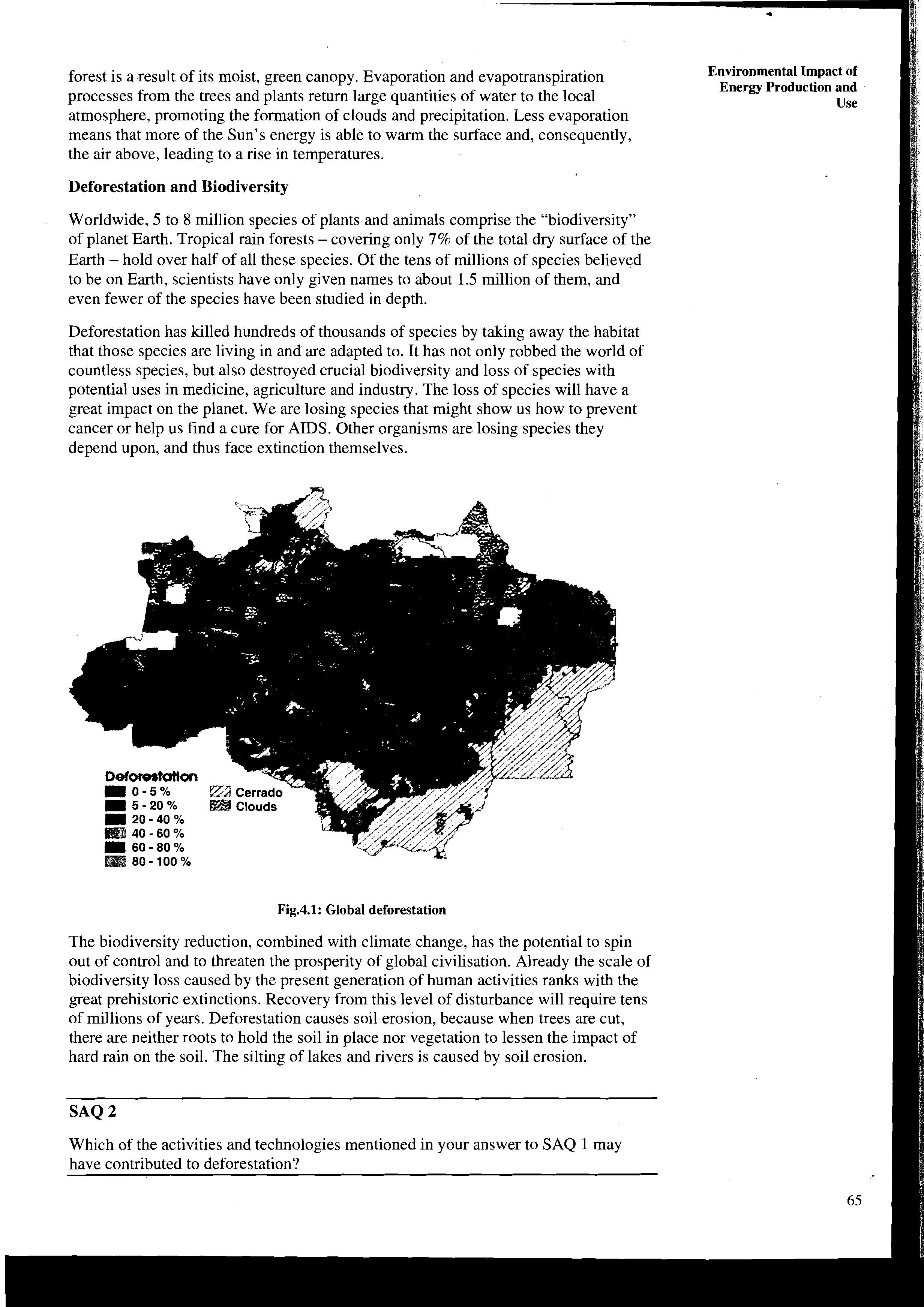
SAQ 2
Environmental Impact of Energy Production and TTco .,"-
Which of the activities and technologies mentioned in your answer to SAQ 1 may have contributed to deforestation?
ENVIRONMENTAL POLLUTION
Effluents from energy p~oducingindustries add to the pollution of air, land and water resources. You have learnt about environmental pollution in Block 4 of the course MED-001. We now discuss environmental pollution due to the energy sector.
Air Pollution
Several energy-related activities emit hazardous air pollutants apart from GHGs: hydrocarbons (including PAH) and dioxin are emitted in the combustion of petrol and diesel oil for transport. These are a major source of energy-related toxic air pollutants like lead;
the combustion of coal and heavy fuel oil in power plants and industrial boilers results in the emission of small quantities of arsenic, mercury, beryllium and radionuclides. These substances are trace constituents of coal and heavy fuel oil that become airborne during combustion;
oil and gas extractjon and processing industries emit hydrocarbons, such as benzene;
emissions from municipal waste incinerators such as mercury, chlorinated dioxin 1 and furan (to mention a few) are causing increasing concern. I i
We have already discussed various activities related to the use and production of energy that emit air pollutants such as GHGs and suspended particulate matter. GHG i emissions, as you know, influence climate change. You have also learnt about some l 1 damaging effects of air pollutants (acid rain and smog, for example) in Unit 14 of the i I course MED-001. You know that fossil fuel combustion produces noxious gases and a 1 wide range of toxic pollutants including soot and smoke that are the largest sources of atmospheric pollution. The emissions from vehicles too add to the SPM load of the air causing tremendous health problems amongst the elderly, children and those with respiratory diseases.

Power plant pollutants include nitrogen oxides, sulphur dioxide, mercury, carbon dioxide and fly ash. They outstrip all other pollutants as the largest source of sulphates. These pollutants may even lead to death as reported in several studies. Researches carried out in the USA, for example, indicate that over 30,000 deaths each year are attributable to fine particle pollution from U.S. power plants. The World Health Organization estimates that annual deaths due to indoor and outdoor air pollution from energy use account for 6% of the total 50 million annual global deaths. Ingestion of heavy metal pollutants, including lead, arsenic, and mercury from the burning of coal and oil can cause a wide variety of health disorders including cancer.
These effects can be mitigated by limiting people's exposure to the pollutants, appropriate siting of the power producing plants as well as large energy consuming facilities like industrial plants, the installation of pollution control devices on polluting industries and vehicles, the enforcement of stringent emission regulations and air quality norms.
It is reported that approximately two-thirds of the deaths due to fine particle pollution
Fig. 4.2: Air pollution from power plants could be avoided by implementing policies that cut power plant sulphur dioxide and nitrogen oxide pollution by 75 percent below 1997 emission levels. Some of the polluting by products can also be put to good use. For example, fly ash is being used to make construction materials like bricks, tiles, etc.
Energy and Environment: riirrpnt rnnrernc
66 -
Water and Land Pollution
The main sources of water pollution from the energy sector include hot water discharge from thermal power plants, runoffs from mining sites, acid rain.
Thermal power stations need plenty of water to convert to steam in the process of generating electricity. They also discharge heat or hot water into the water body, which can cause thermal pollution. This can affect the natural balance of ecosystems in the water body. For example, oxygen dissolves better in cold water than in hot water. So water at a higher temperature does not contain as much oxygen for aquatic life to use. If the water temperature is greater than 95"F, the dissolved oxygen content may be too low to support some species. If the differential temperature is too large, the difference can also stress some species.
The problem of thermal pollution can be solved by the use of cooling towers. Cooling towers use evaporation to cool water. All or part of the hot water can be pumped through cooling towers to lower the ultimate temperature before it is released into the water body. Cooling towers solve the problem of thermal pollution by shifting the rejection of heat from water bodies to the atmosphere, which has a much greater ability to absorb and dissipate the heat input without adverse effects. Due to energy and environmental concerns, new power plants are often being built with permanent cooling towers.
Acid rain, as you know, is caused when the burning of fossil fuels emits sulphur dioxide into the atmosphere. The sulphur dioxide reacts with the water in the atmosphere, creating rainfall which contains sulphuric acid. As acid rain falls into lakes, streams and ponds, it can lower the overall pH of these water bodies, killing vital plant life in them. This affects the entire food chain. It can also leach heavy metals from the soil into the water, killing fish and other aquatic organisms. Again, we need to enforce strictly the emission norms to prevent acid rain formation.
Land and soil pollution problems due to the energy sector arise mainly from siting and waste disposal. All energy-related activities have some sort of siting impact. In this context, mining sites and hydroelectric reservoirs have attracted the most attention. Fuel refining and other electric power plants too involve large facilities or complex industrial processes. In many cases, opposition to siting specific projects (the so-called "Not in My Backyard" or "NIMBY" syndrome) stems from a combination of concerns about land use, pollution and accidents, which are not easily separated and evaluated.
Fig.4.3:
Siting
of energy plants and systems is a major environmental problem
In addition to energy activities which traditionally have run into siting difficulties such as power stations or refineries, growing siting problems are occurring for installing transmission lines and the disposal of solid wastes. The effects of the

Environmental Impact of Energy Production and Use
Energy and Environment: electromagnetic fields associated with transmission voltages up to 800 kV on humans Current Concerns and animals are under investigation. Though decisive evidence of such negative effects is yet to come in. the future of major new transmission projects does not seem to be too bright.
Water and soil can become contaminated with toxic materials from energy-related industries, mine sites and abandoned hazardous waste sites. This can of course be taken care of by following stringent norms for waste disposal at suitably chosen sites, especially hazardous waste disposal of radioactive waste containing long-lived radionuclides, in particular.
You may like to consolidate these ideas about the impact of energy sector on environmental pollution by attempting the following SAQ.
SAQ 3
Write down the causes (stemming from the energy sector) of air pollution, thermal pollution and soil pollution. Make a list of the pollutants in each case.
Let us now discuss the environmental hazards associated with nuclear energy.
4.5 NUCLEAR HAZARDS
It is often said that nuclear power is now a mature technology as it has been operating for over 40 years. Despite this, there exist many hazards of nuclear energy, viz. radioactive waste disposal, threat to health and the fearsome possibility of nuclear accidents, and the stockpiling and proliferation of nuclear weapons.
Radioactive Waste: The. Problem with No Solution
Fig.4.4: Nuclear hazards

In the former Soviet Union at least 9 million people have been affected by the Chernobyl disaster; 2.5 million in Belarus: 3.5 million in Ukraine; and 3 million in Russia. In total over 160,000 km2of land is contaminated in the three republics. Although the nuclear industry continues to refute evidence on the widespread health effects and prevalence of diseases resulting from Chernobyl. it is now widely accepted that the accident has resulted in a massive increase in thyroid cancers in these three countries. The President of the European Thyroid Cancer Association has stated that thousands of children exposed to radiation will contract thyroid cancer in the next 30 years.
There is still no environmentally appropriate programme of dealing with any form of radioactive waste. This problem is made worse on a daily basis by the continual uroduction of radioactive waste. Nuclear waste is vroduced at everv stage of thenuclear fuel cycle, from uranium mining to the reprocessing of spent nuclear fuel. Much of this waste will remain hazardous for thousands of years, leaving a deadly radioactive legacy to future generations.
At nuclear power stations, highly radioactive waste has to be regularly removed from the reactor and at most sites this 'spent' fuel is being stored temporarily in water-filled cooling ponds. According to independent experts, the global quantity of spent fuel produced is expected to increase from 145,000 tonnes in 1994, to 322,000 tonnes by the year 2010. This is an estimate that does not foresee a radical expansion of nuclear power. Whilst a variety of disposal methods have been under discussion for decades, there is still no demonstrated method for isolating nuclear waste from the environment for adequate time periods.
As part of the routine operation of every nuclear power station, some waste materials are also discharged directly into the environment. Liquid waste is discharged into the sea and gaseous waste is released into the atmosphere.
The Horror of Nuclear Accidents and the Threat to Health
Around the world, nuclear power plants are getting older, both in the East and in the West. Although much public and political concern has centred on the hazards of the older Soviet-designed reactors, experience has shown that problems and signs of ageing are also occurring in western reactors. By the turn of the century some 200 reactors will have been in operation for 20 years. Half of these will be over 25 years old. The safety problems posed by ageing reactors are being largely ignored by the industry. Given the enormous consequences of nuclear accidents such as Chernobyl, great attention must be devoted to the ageing process of nuclear reactors.
The problems of reactor safety are three fold:
Reactors approaching the end of their design lives are a recognised harard, which is not being addressed.
The poor safety management appears to be endemic in some national industries and an ongoing problem.
The safety of current and future reactor designs cannot be demonstrated to the necessary degree given the serious consequences of a nuclear accident.
I Unfortunately, instead of placing more stringent requirements on an older plant. safety is often cut back to permit continued operation. The effect of the global increase in the number f iieing reactors is a serious increase in global health risk from nuclear power plants. The current round of reactor closures in Canada

1 demonstrates that the managerial and procedural inadequacies that led to Chernobyl are very much alive in western, OECD nuclear industries.
Nuclear Weapons: Uncontrollable World-wide Proliferation
The links between the civilian use of nuclear technology and military applications is one of the most disturbing aspects of the nuclear age. The very first, crude nuclear reactors were specifically built in the 1940s and 1950s to produce plutonium for the US, fomler Soviet Union and British bombs. Only later were they adapted to generate nuclear electricity.
Plutonium is an inevitable consequence of nuclear power pr6duction. It is contained in the spent nuclear fuel. It is one of the most radiotoxic and dangerous substances in existence. A single microgram, smaller than a speck of dust, can cause fatal cancer if inhaled or ingested and a sphere of plutonium smaller than a tennis ball can be used to make a'nuclear bomb capable of killing many thousands of people. As nuclear technology spreads around the globe, so does the risk of nuclear proliferation. Nuclear weapons can be constructed using plutonium from either military or civilian sources.
The installed nuclear capacity is estimated to grow from the present 330 GW to about 3,300 GW in 2100. This assumes a tenfold increase in the number of nuclear reactors over the next century. With this increase in the number of reactors operating, there would also be a massive increase in the amount of spent nuclear fuel 'and radioactive waste generated. If this scenario is followed, it would lead to some 6.3 million tons of I accumulated spent fuel by 2100, using the technology currently available. A r plutonium inventory of between 50-100 million kg is anticipated. The security threat posed by such massive amounts of plutonium would be colossal. A nuclear bomb powerful enough to destroy a city requires a mere 10 kg of plutonium. If the majority , of spent fuel was to be reprocessed, and if for example 3 million kgfyr of plutonium were to be generated, global plutonium production would follow the pattern shown in Fig. 4.5.
I I '
of
and Use
Environmental Impact
Energy Production
Fig.4.5: Plutonium production per year by region based on IPCC estimates
4.6 ENVIRONMENTAL ISSUES IN RENEWABLE ENERGY SECTOR
In this section, we discuss the environmental problems related to the production, distribution technologies and end uses of solar energy, hydropower, wind energy and biomass. Certain problems such as siting and land use src common to many of these technologies.
Concern has been voiced about the large land surfaces that might be needed for the large-scale exploitation of renewable energy forms such as wind power, solar power stations or biomass production (wood, peat, straw or sugar cane) which would compete .with other land uses. For example, the large amount of land required for utility-scale solar power plants (approximately one square kilometre for every 20-60 megawatts (MW) generated) and mega dams is a cause ofconcern. Issues such as wildlife and biodiversity protection, deforestation and large scale displacement of people need to be addressed. But this problem is not unique to these power plants. Generating electricity from coal actually requires as much or more land per unit of energy delivered if the land used in coal mining is taken into account.
Let us now take up some problems specific to each form of reilewable energy.
4.6.1 Solar Energy
Materials used in some solar energy systems can create health and safety hazards for workers and anyone else coming into contact with them. The relatively inert silicon, a major material used in solar cells, can be hazardous to workers if it is breathed in as -dust. The manufacturing of some photovoltaic cells requires hazardous materials such as arsenic and cadmium. Workers involved in manufacturing photovoltaic modules and components must consequently be protected from exposure to these materials. There is an additional, probably very small, danger that hazardous fumes released from photovoltaic modules attached to burning homes or buildings could injure fire fighters.
None of these potential hazards is much different in quality or magnitude from the innumerable hazards people face routinely in an industrial society. Through effective regulation, the dangers can very likely be kept at a very low level. However, the Environment, Health and Safety (EHS) aspects of the full range of solar PV manufacturing processes are receiving great deal of attention from many research

-
Energy and Environment: We now discuss the environmental problems related to renewable energy resource use Current Concerns and technologies.
- - --
I
Fig.4.6: Solar and wind energy power plants require large land areas creating siting problems
I
70
groups around the world. The environmental impacts arising due to the handling and
use of cadmium and copper indium diselenide cell materials are also being
investigated.
Solar-thermal plants (like most conventional power plants) also require cooling water, which may be costly or scarce in desert areas. Large central power plants are not the only option for generating energy from sunlight, however, and are probably amongst the least promising. Because sunlight is dispersed, small-scale, dispersed applications are a better match to the resource. They can take advantage of unused space on the roofs of homes and buildings and in urban and industrial lots. And, in solar building designs, the structure itself acts as the collector, so there is no need for any additional space at all.
Today, architectural integration of solar PV within the building envelope itself is gaining ground especially in the European countries. However, safe electrical installation practices as advocated through several studies need to be put in place. Moreover, such types of buildings need to have proper lightning conductors to guard against any eventualities of lightning strikes.
Batteries
The safe and effective disposal of used batteries is still a matter of great concern especially in the developing world. Incidentally, the bulk of solar PV systems are located in areas with little or no resource base for such handling. Lead, for example, used in lead-acid battery is quite hazardous. It can pose a whole range of environmental problems, e.g., it can gradually seep into the ground water table in minute quantities over a period of time and contaminate it.
4.6.2 Environmental Issues of Hydropower

The general belief is that thermal power projects are more polluting and damaging the environment than the hydroelectric projects. The primary reason for this impression is that there are visible symptoms like smoke emanating from cliimneys, discharge of water from power plants into river courses, disposal of fly ash, etc. The reality, however, is that current hydropower technology, while essentially emission-free, has many undesirable environmental effects. The reservoirs created by mega dams frequently inundate large areas of forest, farmland, wildlife habitats, scenic areas, and even towns. In addition, the dams can cause radical changes in river ecosystems both upstream and downstream.
Over 800,000 dams have been constructed worldwide for drinking water, flood control, hydropower, irrigation, navigation, and water storage. Once symbols of development, dams today symbolise, for some critics, not progress but environmental and social devastation. The benefits and detriments of dams have locked opponents and proponents in hot debate. The major environmental issues associated with the development of hydropower projects include
Submergence of sizable area due to creation of reservoir/impoundment of water. Impact on flora and fauna due to destruction of the habitat.
Rehabilitation and Resettlement.
Health aspects.
De-stabilisation of slopes in higher reaches due to associated road construction activities.
Dam breaches
The Problems of Impoundment
Dams change the chemical, physical, and biological processes of river ecosystems inevitably, adversely effecting the coastal and marine environment. They alter freeflowing systems by reducing river levels, blocking the flow of nutrients, changing
Environmental Impact of Icnergy Production and
Use
In drought-ridden countries, reservoirs are vital for community and urban water storage, and new ones will likely need to be created to respond to population expansion and the push for agricultural development. But reservoirs can be difficult to maintain - reservoirs from large dams in drought-ridden areas evaporate huge quantities of water - and often result in increased environmental problems and human health risks.
Worldwide, a common problem with reservoirs is that they trap nutrient-laden sediments behind the dam. This reduces reservoir volumes and accelerates a cycle of eutrophication (or oxygen depletion). This results in increased plant and algal growth, bacterial decomposition that consumes oxygen, and release of phosphorus that nourishes further algal growth.
Water Quality and Flow

Hydropower plants can cause low dissolved oxygen levels in the water, a problem that is harmful to riparian habitats and is addressed using various aeration techniques. Maintaining minimum flows of water downstream of a hydropower installation is also critical for the survival of riparian habitats.
Dams and weirs profoundly change the pattern of water flow. Dams have major impacts on water temperature and water oxygen levels. These tend to drop dramatically below the surface water of the dam, leading to an environment unable to sustain riverine life.
By storing water that once flooded riverbank vegetation and surrounding wetlands, dams deny water to the environment, often leading to the loss of wetlands and riparian (streambank) vegetation.
Flora and Fauna
Submerging, reduced water flow or changed flow pattern downstream lead to changes in the fauna and vegetation beyond the watercourse as such. The effects may be direct ones in that the flora and fauna react to the water flow, or the effects may be indirect owing to changes in the ground-water level and the transport of nutrients.
Large reservoirs exert a considerable direct impact on the flora and fauna of the hydro power plant area by submerging the area permanently or periodically. Animals may to some extent move to new habitats beyond the reservoir area, provided that suitable conditions are to be found. But normally the types and species of csture existing in areas being submerged must be considered as lost.
Local climatic changes and changes to the ground-water level can affect the flora and fauna. Valuable types and species of nature may be lost. A general activity increase in the area, such as traffic, noise etc., may also affect the fauna in a negative way. This especially pertains to the construction period. ,
Problems such as fish injury and mortality from passage through turbines are well known. Fish populations can be impacted if fish cannot migrate upstream past impoundment dams to spawning grounds or if they cannot migrate downstream to the ocean.
To ease this trip, hydropower plants may be required to divert water around their turbines at those times of the year when the fish attempt the trip. Upstream fish passage can also be aided using fish ladders or elevators, or by trapping and hauling the fish upstream by truck. Downstream fish passage is aided by diverting fish from turbine intakes using screens or racks or even underwater light and sounds, and by maintaining a minimum spill flow past the turbine.
Energy and Environment: water temperature and oxygen levels, and impeding or preventing fish and wildlife Current Concerns migration.
Fig.4.7: In the interest of fish, many dams, such as the Bonneville Dam, incorporate fish hatcheries (above, lower right) into their design; fish ladders, such as the one on lower left at the John Day Dam, allow migratory species to continue to visit traditional spawning grounds

Hydropower: Clean Energy or Destroyer?
In addition to the water they provide, large dams also provide energy in the form of electrical hydropower. One of the most serious charges against hydropower, though it applies to all dams, is its high social cost in terms of involuntary resettlement. It is estimated that 30 million people have been ousted by dams till date. Most often, "oustees" are poor or indigenous people who often leave behind productive farms and ancestral homes. Though these groups pay the social and environmental costs of dam construction, they don't receive the benefits; instead, those go to urban areas and industries. The Aswan High Dam ousted 100,000 people, according to the World Bank, and the planned Three Gorges Dam in China, a 600-foot-thick, mile-wide project so large it will be visible from outer space, will expel 1.3 million people from the area.
Fig.4.8: The Three Gorges Dam, planned for China, wiU be large enough to be seen from outer space
When countries can agree, cross-boundary water sales or water sharing could furnish an incentive to find "good" dam sites that provide power without demanding resettlement. Numerous arrangements for interstate water exchange exist in the United States, and a number of developing countries, including South Africa, Uganda, and Paraguay, sell or resell excess hydropower. This is one area which calls for an active cooperation amongst South Asian countries.
Environmental Impact of Energy Production and
Energy and Environment: Current Concerns Health

Large hydropower plants can increase the extent of water-related diseases. Reservoirs with large, stagnant waters and slow water-level variations offer favourable living conditions to pathogens. Vegetation in the reservoir also affords improved living conditions for several types of infection-carriers. The vegetation may provide infection-carriers with an increased supply of nutrients, improved conditions for breeding and protection in periods of a low water level.
Among water-related diseases one could mention typhus, cholera, dysentery and several tapeworm and roundworm diseases. Several serious diseases have intermediate hosts linked to water. This applies to bilharzia, malaria, filariasis, sleeping sickness and yellow fever. Moreover, the aquatic vegetation shields snailswhich are carriers of bilharzia infection - from strong sunlight. In addition, research reveals that mosquito species carrying malaria and filariasis thrive due to vegetation in dams. If the reservoir is employed both for irrigation and as the industrial and drinking water supply, there will be a risk of infection spread by pathogens living in the water. Such infection may spread over large areas.
4.6.3 Biomass
Biomass energy derived from the burning of plant matter raises more serious environmental issues than any other renewable resource except hydropower. Combustion of biomass and biomass-derived fuels produces air pollutants including carbon monoxide, nitrogen oxides, and particulates such as soot and ash. Besides, there are concerns about the impacts of using land to grow energy crops. The picture is further complicated because there is no single biomass technology,'but rather a wide variety of production and conversion methods, each with different environmental impacts.
The amount of pollution emitted per unit of energy generated varies widely by technology, with wood-burning stoves and fireplaces generally the worst offenders. Modern, enclosed fireplaces and wood stoves pollute much less than traditional, open fireplaces for the simple reason that they are more efficient. Specialised pollution control devices such as electrostatic precipitators (to remove particulates) are available, but without specific regulation to enforce their use it is doubtful they will catch on. However, ESPs (electrostatic precipitators) are proving quite effective in case of thermal power plants.
Emissions from conventional biomass-fuelled power plants are generally similar to emissions from coal-fired power plants. A notable difference is that biomass facilities produce very little sulphur dioxide or toxic metals (cadmium, mercury, and others). The most serious problem is their particulate emissions. which must be controlled with special devices. More advanced technologies, such as the whole-tree burner (which has three successive combustion stages) and the gasifier/combustion turbine combination, should generate much lower emissions, perhaps comparable to those of power plants fuelled by natural gas.
On the other hand, the use of biomass energy has many unique qualities that provide environmental benefits. It can help mitigate climate change, reduce acid rain, soil erosion, water pollution and pressure on landfills, provide wildlife habitat, and help tnaintain forest health through better management. .
Capturing methane from landfills, wastewater treatment, and manure lagoons prevents the methane from being vented to the atmosphere and allows the energy to be used to generate electricity or power motor vehicles. All crops, including biomass energy crops, sequester carbon in the plant and roots while they grow. providing a carbon sink. In other words, the carbon dioxide released while burning biomass is absorbed by the next crop growing. This is called a closed carbon cycle. In fact, the amount of carbon sequestered may be greater than that released by combustion because most
energy crops are perennials; they are harvested by cutting rather than uprooting. Thus Environmental
the roots remain to stabilise the soil, sequester carbon and to regenerate the following
year.
Since biomass has no sulphur content, and easily mixes with coal, "co-firing" is a very .simple way of reducing sulphur emissions and thus, reduce acid rain. "Co-firing" refers to burning biomass jointly with coal in a traditionally coal-fired power plant or heating plant. These type of plants are known as - Combined Heat and Power Plants or CHPs.
Biomass crops can reduce water pollution in a number of ways. Energy crops can be grown on more marginal lands, in floodplains, and in between annual crops areas. In all these cases, the crops stabilise the soil, thus reducing soil erosion. They also reduce nutrient run-off, which protects aquatic ecosystems. Another way biomass energy can reduce water pollution is by capturing the methane, through anaerobic digestion, from manure lagoons on cattle, hog and poultry farms. These i?normous lagoons have been responsible for polluting rivers and streams across the country. By utilising anaerobic digesters, the farmers can reduce odour, capture the methane for energy, and create either liquid or semi-solid soil fertilisers which can be used on-site or sold.
Using biomass-derived methanol and ethanol as vehicle fuels, instead of conventional gasoline, could substantially reduce some types of pollution from automobiles. Both methanol and ethanol evaporate more slowly than gasoline, thus helping to reduce evaporative emissions of volatile organic compounds (VOCs), which react with heat and sunlight to generate ground-level ozone (a component of smog). According to US Environmental Protection Agency estimates, in cars specifically designed to burn pure methanol or ethanol, VOC emissions from the tailpipe could be reduced 85 to 95 percent, while carbon monoxide emissions could be reduced 30 to 90 percent. However, emissions of nitrogen oxides, a source of acid precipitation, would not change significantly compared to gasoline-powered vehicles.
Some studies have indicated that the use of fuel alcohol increases emissions of formaldehyde and other aldehydes, compounds identified as potential carcinogens. Others counter that these results consider only tailpipe emissions, whereas VOCs, another significant pathway of aldehyde formation, are much lower in alcohol-burning vehicles. On balance, methanol vehicles would therefore decrease ozone levels. Overall, however, alcohol-fueled cars will not solve air pollution problems in dense urban areas, where electric cars or fuel cells represent better solutions. However, a notable exception is Brazil, where the sugarcane derived ethanol is ikiving a large number of transport vehicles. Ethanol purified to a desired extent can safely avoid the perils of poor air quality, so prevalent in the major cities around the world.

4.6.4 Wind Energy
There are many harmful impacts of wind energy technologies in use today, which we now describe briefly.
Acoustics
Noise pollution is a major harmful impact. It is mostly generated from turbine blade tips (high frequencies), from blades passing towers and perturbing the wind (low frequencies) and from machinery, especially gearboxes. The critical noise intensity is usually considered to be 40 dBA, or less, as judged necessary for sleeping. This level of acceptance is usually attained at distances of about 250 m or less.
Land Area and Use
Turbines should be separated by at least five to ten tower heights; this allows the wind strength to reform and the air turbulence created by one rotor not to harm another turbine downwind. Consequently, only about 1% of land area is taken out of use by the towers and the access tr'acks. The taller and larger the turbines are, the greater is
Impact of Energy Production and
Use
Energy and Environment: the separation. Megawatt machines should be spaced between half and one kilometre Current Concerns apart. Neither buildings nor commercial forestry can be established between, so the land is thereaftkr safeguarded against such development and can be used for agriculture, leisure or natural ecology. Agro based wind farms are now becoming a slow reality.
Bird Strike
Birds are beldom bothered by wind turbines. Radar studies from Tjaereborg in the western part of Denmark, where a 2 megawatt wind turbine with 60 metre rotor diameter is installed, show that birds -by day or night - tend to change their flight route some 100 - 200 metres before the turbine and pass above the turbine at a safe distance. There have been many independent studies of birds killed by rotating blades. This undoubtedly happens, but perhaps to a similar or lower frequency than strikes by a car, against the windows of a building or against grid transmission cables. The counter argument, again attested by experts, is that land around wind turbines may provide excellent breeding conditions. The exception to this argument is the possibility of strikes by large migratory birds flying in the dark and by raptors intent on their prey.
Some birds get accustomed to wind turbines very quickly; others take a somewhat longer time. Migratory routes of birds should usually be taken into account when siting wind farms. Offshore wind turbines have no significant effect on water birds. That is the overall conclusion of a three year offshore bird life study made at the Danish offshore wind farm Tun@Knob.
In Denmark there are several examplcs of birds (falcons) nesting in cages mounted on wind turbine towers. The only known site with major bird collision problems is located in the Altamont Pass in California. A "wind wall" of turbines on lattice towers is literally closing off the pass. There, a few bird kills from collisions have been reported. A study from Denmark says that power lines, including power lines leading to wind farms, are a much greater danger to birds than the wind turbines themselves.
In this unit, we have acquainted you with the environmental impact of technologies related to energy production and use. We now present the summary of the unit.

4.7 SUMMARY
Energy use, production and distribution impact the environment in many ways. Climate change is recognised as a major global environmental issue today, with profound implications for the way the world produces and consumes energy.
The concern about global climatic change results from the negative effect of excessive concentrations of greenhouse gases in the atmosphere. Climatic scientists point out that increasing concentration of these gases could lead to global warming. Thus, consumption of energy is related to global warming, which is causing grave concern because of its possible effects like melting of polar ice caps, flooding of coastal areas around the world, massive extinction of species, and the severe deterioration of the civilisation.
Deforestation is another consequence of the activities in the energy sector. The first and most important cause is wood extraction for energy use as fuel. Clearing of forests for setting up mega energy producing projects is another major cause.
Deforestation has many devastating effects on the environment. It affects climate significantly, in part because the forest plays a major role in water cycle, recycling rain back in to the clouds as it receives rainfall. The burning and felling of the forests is also exacerbating the greenhouse effect. Deforestation has killed hundreds of thousands of species by taking away the habitat. that those species are
living in and are adapted to. Deforestation increases the amount of C02 and other
trace gases in the atmosphere. Tropical deforestation also affects the local climate
of an area by reducing the evaporative cooling that takes place from both soil and plant life.
Energy related activities and effluents from energy producing industries add to the pollution of air, land and water resources.
Combustion of fuels, emissions from transport sector, energy resource extraction and processing industries, incinerators for waste disposal, etc. add several pollutants to the air. These include GHGs, smoke, soot, hydrocarbons (including PAH) and dioxins that are sources of toxic air pollutants like lead; small quantities of arsenic, mercury, beryllium and radionuclides, hydrocarbons, such as benzene, mercury, chlorinated dioxin and furan, etc.
The main sources of water pollution from the energy sector include hot water discharge from thermal power plants, runoffs from mining sites and acid rain.
Land and soil pollution problems due to the energy sector arise mainly from siting and waste disposal.
The hazards of nuclear energy include radioactive waste disposal, threat to health and safety, possibility of nuclear accidents, and the stockpiling and proliferation of nuclear weapons.

Environmental problems related to the production, distribution technologies and end uses of renewable sources such as solar energy, hydropower, wind energy and biomass include common problems like siting and land use.
Materials used in some solar energy systems can create health and safety hazards for people coming into contact with them as hazardous materials such as arsenic, cadmium, silicon are used in making solar devices. In addition, hazardous fumes released from photovoltaic modules attached to burning homes or buildings could injure fire fighters. Large solar thermal plants can also cause thermal pollution.
The major environmental issues associated with the development of hydropower projects include submergence of sizable area due to creation of reservoir1 impoundment of water, impact on flora and fauna due to destruction of the habitat, rehabilitation and resettlement, health aspects, de-stabilisation of slopes in higher reaches due to associated road construction activities, dam breaches, etc.
The adverse effects of river impoundments - disruption of ecosystems, decline of fish stocks, forced resettlements, and disease - have of late made dams symbols of corporate and governmental hubris. Dams and weirs profoundly change the pattern of flow and the ecology of the river system, inevitably adversely effecting the coastal and marine environment.
Combustion of biomass and biomass-derivedfuels produces air pollutants including carbon monoxide, nitrogen oxides, and particulates such as soot and ash. Besides, there are concerns about the impacts of using land to grow energy crops.
There are many harmful impacts of wind energy technologies such as noise pollution generated from turbine blade tips (high frequencies), from blades passing towers and perturbing the wind (low frequencies) and from machinery, bird strike, and electromagnetic interference from the metallic parts of rotating blades in signals.
Environmental Impact of Energy Production and
Use
4.7 TERMINAL QUESTIONS
1. Explain how energy production and use impact climate change.
2. Evaluate the impact of energy use, storage and production in your surroundings on forests and land use. Suggest ways of mitigating it.
3. Describe the environmental hazards of nuclearenergy

4. Analyse the environmental issues and problems dfie to any one mega dam project in the light of the general information provided here. Support your argument with facts and figures.
5. Describe the positive and negative impacts of the following renewable energy technologies on the environment:
Solar energy Wind energy Biomass
Energy and Environment: Current Concerns
UNIT 5 THE NORTH-SOUTH DEBATE
Structure
5.1 Introduction
Objectives
5.2 Issues and Concerns
Disparities in Energy Production and Consumption Energy and the Environment
Other Issues
5.3 Addressing the Issues Energy Availability and Access Equity

5.1 INTRODUCTION
So far you have studied about some common concerns related to energy and environment, such as the energy consumption patterns, the impact of energy use and energy production technologies on the environment. You need to understand that these concerns are not purely technical in nature. We have to consider the social, political and economic aspects as well. For example, you have studied in Unit 2 that the consumption of energy is not uniform throughout the world. But energy use can have a global impact and its mitigation requires the same measures from the developed and developing countries. This is an unequal situation that could place the developing countries at a great disadvantage if they are not vigilant enough.
You have studied about some dimensions of the North-South divide in the course MED-002. It impacts the energy-environment relationship as well. The disparity in the energy consumption between the North and the South, and the impact of environmental agreements on developing economies are of concern to us as they can influence the course of our development. What is the perspective of developing countries on contentious issues related to energy and the environment? How best can we meet these challenges? What is the Indian response? These are the concerns that we address in the last unit of this block.
Objectives
After studying this unit, you should be able to:. discuss the major issues and concerns in the North-South debate on energy and environment; analyse the perspective of developing countries, in general, and India, in particular, in the energy-environment debates; and outline the ways in which the concerns of developing countries can be addressed.
5.2 ISSUES AND CONCERNS
Energy has a long history. Before people could read and write, fire was discovered and used for cooking, heating and scaring wild animals away. Fire was possibly civilisation's first great energy invention, and wood was the main fuel for a long time. The Industrial Revolution changed the energy situation considerably. It not only increased dramatically the energy options available to humanity for development but also paved the way for disparity and inequity in future energy production and use.
5.4 Summary 5.5 Terminal Questions
Energy is now a critical input and a major constraint in development. Commercial energy shortages in the wake of the first oil price adjustment in the early 1970s have hindered the pace of development of poor countries. The continued dependence on the rapidly dwindling non-commercial biomass resources of firewood, crop waste and manure has hit the rural poor in the developing countries the hardest. Can you visualise what the lack of modem energy services means for the poor in their daily lives? It makes their poverty worse and it makes escaping poverty more difficult.
The challenge today is to improve energy availability and access to modern energy services for poor countries and for poor people. This has to be done in ways that are financially sustainable and affordable, that address energy security concerns, and minimise local and global environmental damage. These issues have resulted in serious debates between the developed and developing countries about the policies and mechanisms required to meet the growing energy needs of the people in a sustainable and equitable manner.
Developing countries are, in fact, expressing strong and growing concern at what they see as a highly unfair and biased focus on their environmental problems, while little is done to address major environmental challenges in the industrialised countries. In this section, we outline the contours of the North-South debate in the energy sector. Such a debate has to take into account the socio-cultural and economic variables of the developed and developing countries, their relationship to the existing and desired patterns of energy consumption, environmental constraints in the developing countries, and, above all, the needs and priorities of the people as they see them.
5.2.1 Disparities in Energy Production and Consumption

Energy scenarios in the developed and developing countries reveal sharp disparities between the energy production and consumption patterns of these countries, as well as between the rural and urban areas within the developing countries.
If the per capita energy consumption in the developing world were to reach only 50% of that consumed by the citizens of industrialised nations, and if everyone in the prosperous industrialised nations were to scale their resource use down to the same level, energy production worldwide would still have to double. To try to prevent this process is to impinge on the sovereignty of nations, slowing their progress towards prosperity.
Can we increase the global energy production to more than double in the next twenty years in a way that is clean and sustainable? Even with highly efficient energy usage and conservation worldwide, this is what it is going to take for all the countries of the world to stay on the course of increasing prosperity. Can "non-h;dro renewable sources" provide this much energy? Maybe, but it would take a transi~rmationin the world energy infrastructure of unimaginable speed and scope. We can hope that such a thing will happen with technological innovation, solid business plans, and arguments between the North and South that rely on reason along with passion.
As far as energy consumption is concerned, you have learnt in Unit 2 that the total energy (in all forms) produced and used, GHG emissions, COz emissions as well as per capita energy consumption is much lower in the developing countries than in the industrialised countries. However, in future, the relative portion of energy consumption and thus the carbon dioxide emissions of the developing countries are bound to increase further as they develop.
The Western way of life, style of economy and way of using natural resources has a direct impact on the complex ecosystem of the Earth. Responsibility and danger, however, are not shared equally among the nations and regions of the Earth. The global pattern of distribution of energy consumption and thus the responsibility for the anthropogenic carbon dioxide emissions shows huge inequalities. For example, in the year 2000, the share of developed countries in total GHG emissions was 56% and in
Energy and Environment: Current Concerns
I
C02 emissions it was 7 1%. COz emissions rose by 8% from 1990 to 2000 and from energy supply industries, they rose by 14%. Consequently, the environmental impact of energy use and production technologies due to developed countries is far more significant compared to the developing world. You may like to revisit the information and record it here. Do this exercise before studying further.
SAQ 1
Complete the table below for any one year in the recent past. Refer to data given in earlier units.
Countries Total Share in Energy Share in CO2 Energy GHG Consumption emissions Production emissions per capita
FoY;:rEd Developing countries India

What conclusions do you draw?
Fig.S.l: There are glaring disparities in energy consumption between the developed and developing countries and between the rich and the poor sections within the developing countries.
, Women in many rural areas of India have to walk tens of kilometres in a single day to fetch water for household uses
A point to note is that a dichotomy exists within the developing countries as well: Between tl.c urban and rural areas, and between the rural rich and rural poor. A major proportion of the total "commercial energy'"is consumed in the urban and industrial sectors, and for transportation. The agricultural and the rural sector in the developing countries, which support more than 70% of the world's population, get a relatively small share of the available commercial energy.
In South Asian countries, for example, agriculture contributes a significant share to
I the national income and provides employment for more than half the workforce. But, it usually gets 5 to 10% of the total commercial energy in these countries. The scarcity of commercial energy for rural development hinders the growth of other incomegenerating activities in rural areas (such as agro and other rural industries). This, in turn, affects the opportunities for providing employment to the growing labour force, and stemming large scale rurallurban migration.
The North-South Debate
Moreover, a major proportion of the total energy consumed in many developing Current Concerns countries continues to be provided by "non-commercial" energy sources - firewood, manure draught and pack animals and agricultural wastes which are mostly utilised in the rural areas. Energy in rural areas is used mainly for household consumption and produced from these "non-commercial" energy sources secured by private efforts at almost zero private cost.
Energy and Environment:
Industrial pollutants are responsible for global warming
Interestingly, even the International agreements can work at cross purposes. The Ozone convention's solution was to switch from CFCs to HFCs ( hydrofluorocarbons). But this became a problem for the Climate Change Convention as HFCs are very powerful greenhouse gases that lead to global warming!
A predominant argument in this debate is that energy is used inefficiently both in urban and rural areas in developing countries, with the result that the per unit consumption of energy is much higher than the per unit increase in national gross domestic product. And, the inefficient use of energy has a negative environmental impact, though it has yet to be assessed.
5.2.2 Energy and the Environment
In Unit 4, you have studied how the energy sector is affecting the environment and the global climate. There is rising anxiety around the world about climate change and global warming. Climate change is a serious, emerging threat to the stability of the Earth's ecosystems, and a particular hazard to the world's poorest people. The threat of climate change also brings more urgency to the need to reorient energy- related investments, using them to provide abundant, clean, safe energy for human needs and sustainable livelihoods.
It is now well known that unsustainable consumption patterns of the rich industrialised nations are responsible for the threat of climate change. Only 25% of the global population lives in these countries, but they emit more than 70 percent of the total global C02 emissions and consume 75 to 80 percent of many of the other resources of the world. In per capita terms, the disparities are also large. For example, an Indian citizen emits less than 0.25 tons of carbon per year whereas a citizen of the USA emits more than 5.5 tons. India's carbon dioxide emissions are projected to increase fourfold compared to 1986, but even then would be only 0.36 tons per capita below the world average of 1.2 tons per capita in 1986. To accommodate even a modest rise of emissions by only India and China, the developed countries would have to reduce their GHG emissions by 30% by 2025, to keep global emissions in 2025 at the same level as in 1986.
For most developing countries, a central element of the climate debate revolves around the need for a fair resolution of contentious questions such as how are the emissions estimated and who should reduce GHG emissions and by how much, how these reductions will be achieved, and how the burden of impacts, adaptation, and mitigation will be shared. For example, there is a lack of reliability of GHG emission estimates, particularly of methane. According to initial estimates, large emissions of methane from paddy fields were ascribed to developing countries.
However, the empirical basis of these estimates was questioned; subsequently experimental measurements by Indian researchers showed these doubts to be wellfounded. Moreover, there are questions like: Should emissions by poor who live on the margin of subsistence be counted on par with the industrial emissions when ascribing responsibilities for emission reduction?

Fig.5.3:
Source for cartoon: archive.greenpeace.org/ozone/ hfcs
Two major international agreements, the United Nations Framework Convention on Climate Change (UNFCCC) in 1992 and the Kyoto Protocol in 1997 attempt to address these questions. The Kyoto Protocol requires countries to cut emissions of carbon dioxide and other greenhouse gases.
Some 141 countries, accounting for 55% of greenhouse gas emissions, have ratified the Kyoto Protocol, which came into force on February 16, 2005. It pledges to cut these emissions by 5.2% during the first implementation period between 2008 and 2012. Each country has been set its own individual targets according to its pollution
HFCs are environmentally destructive chemicals and are therefore obsolete
levels. Large developing countries including India, China and Brazil are not required to meet specific targets for now.
Different positions within the political debate on climate change can be demonstrated by the different responses to the Kyoto Protocol.
The European Union countries, together with a number of OECD countries, are implementing measures to transform their economies to substantially reduce their dependence on fossil fuels as an energy source.
The United States of America, the world's largest emitter of greenhouse gases in fossil fuel consumption, has not ratified Kyoto Protocol. It cites the potentially adverse impact on its economy and competitiveness as the reason. In addition, the lack of hard targets for the developing world in the Protocol is unacceptable to it. Australia has also not ratified it for largely the same reasons. However, the U.S. is the biggest polluter and its involvement is clearly very important. It cannot be ignored by the negotiating parties since it emits around 23 percent of greenhouse gases. While it is an important part of the problem, it is also an important part of the solution. It has the advanced economy with the technology able to avert the threat posed by climate change.

But even for countries that have signed it, meeting the goals of the Kyoto Protocol could be difficult. For example, Canada, one of the treaty's first signatories, has no clear plan for reaching its target emission cuts. Far from cutting back, its emissions have increased by 20% since 1990. And Japan is also unsure if it will be able to meet its legal requirement to slash emissions by 6% from 1990 levels by 2012.
The decrease of the C02 emissions in Europe has been caused by short term factors: The dropping of industrial production all over Europe, the reduced energy consumption in East Germany and the closing down of British coal mines. In the coming years, a new rise in the COz emissions is expected. A report of the European commission confirms that hardly any EU-member state has taken serious measures to protect the climate.
It turns out that the industrialised countries, whose contribution to greenhouse gas emissions is far more due to their unsustainable modes of production and consumption, are attempting to further delay the process and preserve their lifestyles to the detriment of the global environment. Ironically, the mechanisms for meeting the challenge of global warming have emerged from the developed countries. Let us see what these are.
The Kyoto Protocol specifies three flexible mechanisms to help meet the challenge of combating climate change:
Clean Development Mechanism (CDM), Joint Implementation activities (JI), and Emissions Trading.
The CDM is a system that would give industrialised countries credit for financing technologies in developing countries aimed at reducing emissions. It presents an opportunity to make real greenhouse gas emission reductions, and provides a mechanism for technology transfer to promote sustainable development in developing countries. CDMs have both advantages and. limitations as outlined in the box on the next page.
To date JI projects undertaken in the Kyoto Protocol have focused on the forestry sector. Forests as you know act as carbon sinks: As trees grow, they absorb carbon dioxide from the air and transform it into carbohydrates, the storehouse of carbon. About 50% of the dry weight of a tree is carbon.
Afforestation of previously cleared land can markedly increase the total carbon stored In the land and provide carbon credits for trading to offset the emissions of
Fig.5.4: Is the role of developing countries limited to that of carbon sequestration sinks?
The North-South Debate
Energy and Environment: greenhouse gases. The intention is that credits will be certified and recognised by a Current Concerns certificate owned by individuals or companies who have created the storing of the greenhouse gas. These certificates could then be sold to industry wanting to reduce their greenhouse gas emissions. Thus, developed countries could fund such projects to meet the Kyoto emission reduction targets.
Advantages of Clean Development Mechanism
The proposal to grant emission credits gives developed countries (committed to emission reductions) an incentive for partnership with developing countries, by way of technological changes or technology transfer, to promote sustainable development in developing countries. It also enables these countries to work together in JI activities to reduce emissions through projects consistent with local development needs.

It could generate practical experience with the exchange of emission credits on an international basis and create confidence in the role of flexibility mechanisms in the reduction of emissions in a cost-effective manner.
It could assist in arranging funding of certified project activities, while helping address the issues of global climate change through a market-based concept.
It may result in certified emission reductions achieved through individual projects, which reduce greenhouse gas emissions beyond what would have been achieved in the absence of the project.
I
Limitations of Clean Development Mechanism
A developed country buying another country's emissions could hinder the developing country from developing economically and socially. Emissions trading is more geared to benefit the technological and environmental markets, which are largely dominated by developed countries. The developed countries not only benefit from the emission credits, but also from the financial returns of their investments. Developing countries stand to be net losers in such a situation, because they will be immersed in a vast marketing mechanism, the long-term implications of which are difficult to grasp at present; they will also be excluded from the distribution of emission credits.
The trading of emissions still does not solve the problem of reducing the developed country's emissions. It allows them to comply with the Protocol without making any real reductions in GHGs. It does not influence companies to invest in clean technologies, such as solar and wind. This may be detrimental to the environment as a whole.
It could give the industrialised countries emission credits for projects that they were already planning, or worse, for projects that might be environmentally destructive. The cheapest project to fund is one that would have happened anyway and at no additional costs. Developing countries might take advantage of this as long as they get additional resources. If the market were to be flooded with bogus and cheap credits, then legitimate projects would be crowded out. The price of credits would fall and the total resource transfers that the CDM might have otherwise generated would diminish.
However, the choice of this sector suggests that the role of developing countries is limited to that of carbon sequestration sinks. The question is: Does this role correlate with their developmental priorities? Whether it is a question of Joint Implementation or emission credits, the choice of sector is of the utmost importance. One must take into account not only the developmental priorities of the potential for emission reduction or COz limitation which
terms, as well as the potential impact on the country's economic and social

development. Any investment made within this framework must situate itself within the perspective of sustainable development and the fight against poverty.
Further, forestry projects have many limitations in addressing the problems of sequestration of energy, since they demand a long period of growth and are dependent on rainfall conditions and the modes of energy consumption of a country. Recurring costs related to the preservation of forests, which can impact their sustainability, are not usually accounted for in these projects, nor are the political uncertainties and reforms which the sector may undergo. Moreover, large-scale planting of fast growing exotic species may result in the destruction of old forest ecosystems and severe biodiversity loss.
The ongoing debates on Kyoto Protocol revolve around many controversies and conflicting evaluations, particularly with regard to:
The risk of diverting North-South Joint Implementation towards increasingly profitable private investment, on the basis of irrelevant projects, created to some extent to gain emission credits.
The definition of analytical limits or temporal horizons (deadlines) which can lead to the over- or under-evaluation of the impact of certain projects in terms of emission reductions.
Accounting for the existing efforts of developing countries in order to arrive at an equal partition of emission credits amongst the partners?
A tradeable emission quotas system is recognised as economically efficient in allocating resources to the reduction of C02emissions. 'Debtor' (read developed) countries who find it costly to reduce C02 emissions will transfer resources to 'creditor' (read developing) countries by purchasing emission rights. Creditors can then use these resources according to their own priorities. This is currently seen as the best option in international negotiations.
However, until such an international system is in place, there are possibilities for developed countries to invest in developing countries in projects to reduce C02 emissions and claim credit for the reductions. This may be a second-best solution from the viewpoint of the creditor countries. It lacks the flexibility of the tradeable quota system because the transfer of resources from debtors to creditors is restricted to emission-reducing investment. Funds may not be directed towards the environmental , priority of the choice of creditors (e.g., drinking water and sanitation).
The lesson to be learnt is: The development of any mechanism requires that rigorous, reliable and equitable procedures of evaluation be defined, and transparent procedures of control and verification be initiated.
The efforts of developing countries could turn to their disadvantage if the potentials for low-cost emission reduction which are available to these countries are used by developed countries for their own benefit. Developing countries will then have to support higher-costing measures to reduce emissions. This is why it makes sense for these countries to defend their own commitments, the concept of equity, and the fight against poverty.
Ultimately, the only way to make the Kyoto Protocol an effective vehicle for clean development and global climate protection is to restrict all projects undertaken in the Protocol to renewable energy technologies. These technologies should be specified in a list that is made part of the rules. Technologies and practices that are not on this list - such as sinks, 'clean coal' and nuclear power - would not be eligible for CDM or emission trading credits.
It is important to note that the reduction or limitation of emissions should in no way constitute a brake on the development of developing countries:it should
The North-South Debate
Energy and Environment: instead be regarded as an opportunity for them to rethink their development. The Current Concerns developed countries, considering their historic and actual responsibilities in producing emissions must remain at the forefront of the fight against climate change, and must show that they are capable of curbing the cultural and technological model they present to the rest of the world.

Kyoto is only a first step and much hard work needs to be done to fight global warming.
India's position
From India's perspective, its fossil-based carbon emissions were only 115 million tons in 1985 compared to 5.4 billion tons for the world and 1.3 billion tons for the USA. Even in 2025, its total emissions are likely to be only 0.6 billion tons - a per capita emission of 0.36 tons compared to a world average of 1.2 tons per capita. These emissions would not be a problem if the developed countries' present and past use of fossil fuels had not resulted in an excessive build-up of C02 in the atmosphere. India has to tackle basic problems of health and nutrition and needs to work on basic environmental problems such as increasing access to safe drinking water and sanitation and reducing the use of bio-fuels which harm the health of women and children. Under the Polluter Pays principle, those above the world average should pay money to those below the world average.
India's main energy resource is coal. With the threat of climate change, India is being called upon to change its energy strategy based on coal, its most abundant resource, and to use other energy sources (e.g. oil, gas, renewables and nuclear energy) instead. These are expensive options. We should have more freedom to decide which type of energy we use, how we generate power, how we reduce methane emissions by agricultural practices or forestry and so on. An immediate concern for India is to come up with a better negotiation strategy to garner a better deal for its citizens. These negotiations should also serve as a means to reduce or postpone future vulnerability by getting the developed countries to reduce their emissions.
Needless to say, India has been pursuing GHG friendly policies in its own interest to minimise energy consumption - particularly oil consumption - and to deal with its environmental problems. Efforts are being made by the Government as well as by the people to reduce energy consumption. 1 hese include
Energy conservation and pollution control programmes; Wasteland development, afforestation; Promotion of renewable energy sources; Economic measures such as pricing reforms, removal of subsidy, etc.; and Fuel substitution policies.
5.2.3 Other Issues
Energy subsidies, energy and global security and the impact of liberalisation are some other important issues in the North-South debate.
Energy Subsidies
Another point of debate centres on energy subsidies. In the liberalisation regime, it is expected that the developing countries will reduce the subsidies in the energy sector. This sector has traditionally seen high and varied level of subsidies in developing countries, particularly in India. These countries have acted under a constant pressure from the current GATT, WTO regime: The Indian government has taken steps towards removing price controls on oil and coal and lowering subsidies to energy generally. Coal prices were deregulated in the year 2000 and hence direct subsidies
either to the consumers or producers are non-existent now. However, due to subsidies
on rail transportation, delivered coal prices remain below the market prices.
In April 2002, subsidies on all oil products were removed barring Liquid Petroleum Gas (LPG) and kerosene, which are mainly used by households. Electricity in India is highly subsidised and forms the lion's share of the total subsidies allocated to the energy sector. These subsidies have created price distortions and have led to overutilisation of certain resources due to under-pricing. Dismantling energy subsidies is now on the national energy policy agenda and attempts are being made to rationalise power subsidies.
However, paradoxically, substantial subsidies to the energy and transport sector exist in the industrialised countries. Although exact estimates are quite difficultsingle assumptions can add up to tens of billions of dollars to the total - research suggests that the energy sector receives annual subsidies of about $70 billion per year while road transport receives subsidies of about $550 billion per year. These subsidies have a direct and significant influence on the consumption patterns of individual and industrial actors in these sectors, and eventually on the global environment through their GHG emissions.
The transport sector, for example, is the fastest growing contributor to greenhouse gas emissions from industrialised countries. Industrialised countries are responsible for over two thirds of the global GHG emissions on an annual basis (and even more on a historical cumulative basis). The trajectories of industrialised country GHG emissions, and the role of subsidies in influencing this, are important issues for developing countries because these countries are likely to suffer substantial environmental impacts from a changed climate.
Energy and Global Security
Energy, climate change and economic issues, particularly in relation to the North and South are inextricably linked to global security. Throughout the twentieth century, wars have been fought over fossil fuels and the fear of war still lurks. The reliance of rich countries on fossil fuels fosters a climate of insecurity, and a rationale for large military budgets in the North. In the South, it often fosters or nurtures autocratic or dictatorial regimes and corruption. At the same time, it increases poverty and destroys subsistence cultures and sustainable livelihoods. A continued rapid consumption of fossil fuels also ensures catastrophic environmental consequences at the global level. These impact human safety and security as you have learnt in the course MED-001.
The Impact of Liberalisation
Liberalisation or deregulation and privatisation of the energy sector are common components of structural adjustment packages imposed by the World Bank and regional development banks on Southern countries. They also constitute a condition established by regional trade agreements such as NAFTA and those between the EU and governments of the South. Governments and international organisations are promoting privatisation, deregulation, and indiscriminate openness to other countries, not only in developing countries, but in some industrialised countries as well. Privatisation of power plants and power distribution are advocated by many in the developing countries as a panacea to meet the growing energy needs. However, there is another side to this argument.
In the case of energy, ownership of the means of production, transportation, and distribution is not sufficient to ensure adequate performance (which entails much more than just microeconomic efficiency); it can, in fact, be self-defeating in terms of such important criteria as equity, solidarity, and adequate satisfaction of basic needs. In the case of the energy sector, despite recent technological advances, markets are still basically monopolistic. Therefore, the concepts of privatisation and deregulation are contradictory in the case of the energy sector. Privatisation will generally require
Fig.5.5: Energy and global security (Source: www.mindfully.orgl)
 The North-South Debate
Energy and Environment: even more and mort-,complex regulations, as well as the technical and economic Current Concerns capacity, and the ed6nomic and political power, to implement it. All these capabilities are yet to be developed in the developing countries.
As far as the issue of opening the energy sector to the external market is concerned, it would do us well to remember that every industrialised country, at the moment of its economic take-off, had tariff barriers to protect its nascent industries. As you have learnt, these countries also subsidise their energy sector and hinder international commerce through custom duties and other measures in spite of GATT and WTO.
Finally, one basic issue that the proponents of deregulated privatisation ignore is: The development of new environmentally sound and sustainable solutions such as renewable sources of energy (hydro, solar, wind, biomass, and geothermal). the sustainable use of renewable and non-renewable resources, and the protection of the environment require high initial investment that is recovered over the system's lifespan with a reduced operating cost. This implies that the profit rates must be reduced and the rates of return must be low. This contradicts the demands of deregulated privatisation of a high internal rate of return in order to pursue a search for alternatives.
This was amply demonstrated by the experience of two recent cases of privatisation of electric systems, in Argentina and the United Kingdom. In both cases, the utilities shifted all new investment to gas turbines fuelled by natural gas, open cycle in the case of Argeptina and combined cycle in the case of UK. This was in contradiction to the objective of reducing emissions of contaminating gases into the atmospheredecisions to which their governments had agreed at the U.N. Conference on Environment and Development in Rio de Janeiro in 1992. This is how the policies pursued by national governments and international agencies and their actions regularly contradict their proclamations in speeches, declarations, development proposals, and international agreements.

There are many other such cases. During 2001, the world experienced several examples of the failure of market-led energy reforms such as the Californian power crisis, the collapse of the Brazilian energy grid, and towards the end of the year the financial collapse of the ENRON Corporation. These events brought to the fore the inadequacy of markets as regulating mechanisms. These reaffirm the need for a critical review of market-led energy reforms at a global level, with a view to developing sustainable policy strategies.
It seems that sustainable, integrated, equitable human development will remain a far cry as long as short-term, market criteria prevail, and as long as societies and their governments lack adequate mechanisms to prevent common rescurces (air, water, lands, renewable and non-renewable natural resources, and general health) from being used for private benefit and not for public good.
So far we have highlighted some contentious issues between the developed and developing countries in the energy sector. You may like to concretise these ideas before studying about how to address these issues.
SAQ 2
Write down the specific arguments of the North-South debate related to
'.
9
a) Energy and environment, b) Energy subsidies, c) Energy production and consumption, d) Energy security.
5.3 ADDRESSING THE ISSUES
All problems related to energy production, use and their impact on the environment have to be addressed in the broad framework of energy availability, access to energy, and equity in energy use. Greater availability and access to energy is an essential mndition for the economic and social evolution of developing countries. Security of supply and equity is an issue for all countries. Solutions have to be found within this framework for mitigating the environmental impact of the energy sector and fostering social and economic development of the less developed countries.
These solutions involve both the implementation of current and emerging technologies and the modification of individual human behaviour and ways of life. Price signals will help spur these changes. At the same time, solutions are needed to facilitate both access to energy and the security of energy systems. One has to identify and highlight solutions that take into account these objectives and propose ways to facilitate their implementation.

5.3.1 Energy Availability and Access
Energy is scarce in the developing countries, and as far as these countries are concerned, their first priority is to augment energy production from all sources in order to meet their development needs. The economic situation of the people can be bettered only through promotion of economic activities and increasing the .'productivity of existing agricultural and non-agricultural activities. These require commercial energy as a critical input and its use is bound to increase in the coming years, as you have learnt in Unit 2. The developing countries not only have to increase the production of commercial energy but also reduce the disparities within their own rich and poor to provide access to energy to all in a sustainable manner.
Poverty is the biggest obstacle to sustainable development and the rural poor, preoccupied with survival, do not have an opportunity to think through the consequences of over-utilisation of resources. Eradicating poverty and improving the access of the poor to energy resources is a major challenge ahead.
A close relationship thus exists between the prevention of the destruction of the environment due to indiscriminate use of non-commercial energy sources, and utilisation of commercial energy for improving productivity, creating employment and increasing income in rural areas. Legal and administrative measures alone will make little or no impact in controlling the damage that is being caused to the environment by the continuing, widespread and often unsustainable use of these resources. Specific developmental programmes will have to be put in place for the socio-economic and sustainable development of these regions.
The developing countries' energy consumption is set to increase to meet their development and poverty reduction needs. This may result in increased emissions of greenhouse gases by them. Thus, these countries cannot have any specific targets for meeting th;: requirements of the Kyoto Protocol on climate change. Despite the absence of specific targets or timetables, they should take measures to mitigate climate change.
While the broad features of the energy consumption pattern in most developing countries may be similar, there would be a marked'variation in the specific end-uses and energy forms used from one region to another, and from one micro-region to another, representing different agro-climatic and eco-systems within a country. This brings out the need for carrying out energy assessment and planning for energy production and management at all levels.
Area-based micro-level integrated planning for meeting the energy needs for development, would, therefore, have to include, renewable energy resources which may be tapped locally. Various commercial energy sources would also have to be
The North-South Debate
Energy and Environment:
tapped for productive agricultural, non-agricultural and industrial activities for the Current Concerns economic development of these countries. These include electricity, petroleum products, and coal. These commercial sources of energy may have to come from outside the country; but their production, procurement and distribution could be planned and regulated at the national and state levels.
Attaining lower energy intensity could be one of the initial objectives. It applies to both the use of energy for the production of goods and services for humankind and to the supply of energy from all sources. However, to reach significantly beyond traditional energy efficiency gains that are economically sound, society must accept and adopt major changes in many areas, including transportation, housing and town planning. The evolution of human behaviour must also play a very significant role in addition to technological innovation.
The "decarbonising"of national and regional economies must be sought wherever it is possible. This will rcquirc the development of renewable energies as well as the development and deployment of new technologies, such as sequestration of carbon in cleaner fossil fuel systems, the commercialisation of bio fuels and the development of forests. This approach can also contribute to the security of supply.
All these aspects require urgent interventions for energy production and distribution in developing countries. These have to be undertaken through integrated energy planning mechanisms which specifically take into account energy requirements of all sections of their population for sustainable development.
Recognising the critical role of energy for sustaining their economic growth, most developing countries have set up institutional mechanisms for energy sector policies and planning. Issues that are of direct interest to the developing countries include funding, technology transfer and capacity building.
Funding is important because it can aid all development projects, particularly because financial resources are often the biggest constraint in developing countries. Technology transfer from the developed countries and funding of energy programmes of the developing countries have to go hand in hand.
A word of caution is in order: Increased levels of foreign direct investment may be a mixed blessing. Multinationals with better technologies, energy management systems and training programs may spur better energy and environment management in other national firms. At the same time, however, increased foreign direct investment may also lead to increased production and consumption of energy intensive and polluting goods.
Enhanced capacity building will be required in developing countries to improve the information availability and disscmination, government ability to promote an enabling environment and engage in negotiations with the developed world to protect their interests, and to manage technological change.
Negotiating on energy related issues requires first of all the ability to understand and articulate national needs and concerns and to place them on the international aienda. '. The global climate discussions have been characterised by sophisticated strategising to best serve national interests, rather than mutual coopcration. Thus. developing nations need to support and propagate national positions through targeted analysis.
' This requires a focus on he capacity for detailed strategic policy analysis and use of the knowledge gained for developini n'atioilal positions. Also, education, extension and training programmes for decentralised energy production, efficient energy use and managing technology transfer and change are essential for capacity building.
Capacity retention is a serious problem in the South. The migration of highly skilled workers to the North (the "brain drain") leads to a loss of embodied kr;6&l&lg&and -- .: expertise in the South. Immigration policies in OECD countries tend to favour better-

educated people, and therefore are partly responsible for the migration of highlyeducated workers from developing countries.
But the advances in technologies, institutions, and financing arrangements are not enough. To attract and sustain private investment, developing country governments must provide appropriate governance and investment conditions.
Governments' role
This means supporting economic growth, adopting legal and regulatory frameworks to keep energy markets fair, efficient, and incorrupt and establishing clear, sensible, and reliable rules for transacting business. The greater emphasis on distribution and customer-side service is opening up new prospects for energy efficiency, distributed supply, and off-grid service delivery means.
Further, recent developments in conventional and renewable energy technologies have made distributed and off-grid energy services technically and economically more attractive. Alternative approaches to energy service delivery need to be promoted, including giving service providers incentives to diversify and innovate to enable clean technologies, fuels, and incentives to compete on equal terms.
The developing countries could exploit their hydroelectric potential and the potential for new and renewable sources of energy. They could focus on efficient energy-use to address issues such as C02emission reductions and energy availability.
PATHWAYS TO ADDRESSING THE ISSUES

5.3.2 Equity
We have to also ensure equity in distribution and access of energy by bringing about reduction in the existing sharp imbalances in energy consumption, among the developed and developing countries, within rural and urban areas in developing countries. and between the rural rich and the rural poor. The disparate consumption patterns also underscore the need for more efficient and environment friendly energy utilisation in the developed industrialised countries.
The North-South Debate
Fig.5.6: Pathways to addressing the issues in North-South debate
Energy and Environment: Ensuring equity requires thoughtful and informed decision making. It could consist, Current Concerns for example, of linking the emissions of a country to factors like population, economic activity, income, energy 'consumption, energy resources and level of technological development. Adoption and implementation of such criteria, even in the long run, will require extraordinary leadership from governments and industry working together with other interested parties.
All projects related to the energy sector, and especially carbon sinks if aliowed, should be subject to transparent assessments of environmental and social impacts. A rigorous environmental impact review process needs to be established, so that these projects provide net benefits, not only for greenhouse gas emissions, but for the local environment, without displacing indigenous people and without any unanticipated negative consequences. The assessments should be carried out independent auditors using international standards and with full public participation including the opportunity for review and comment.
For this, procedures that guarantee public participation in all phases of the project cycle would have to be put in place. All relevant information such as project design documents, assessments, public comments, monitoring and verification reports, etc. should be made available in the public domain so that people get meaningful opportunities to participate in the process.

The multi-dimensional and complex energy scenario of the developing countries needs a comprehensive approach for tackling it. Integrated energy plans should determine the most cost-effective mixture of different energy sources - commercial, non-commercial, renewable and non-renewable - for meeting the diverse energy needs of different income groups in an equitable manner. For this, various technical, socio-economic and cultural factors would need to be taken into account, such as:
people's needs and priorities;
the integration of environmental concerns at local, regional and global levels, with existing and proposed development programmes in the developing countries, for example an improvement in energy efficiency (decrease of energy intensity) for reconciling the challenges of climate change, access to energy and security of supply;
the establishment of national and global agenda for R&D to foster technologies that enable national, regional and global energy systems to address all the requirements in industrialised and in developing countries; a serious examination of the modalities of technology transfer, an increase in the effectiveness of existing mechanisms (of the CDM type) by opening them to all countries and to all technologies that reduce emissions and by adopting an approach that is both simpler and more transparent;
the re-orientation of public investments in public-private initiatives and partnerships, which would make it possible to more effectively engage companies in the issue. I
Thus, we would be able to ensure the integration of energy with employment and environment as part of the total development process.
The integration of planning for energy with environmental concerns and the economj development programmes at the state and national level is a complex process no doubt. It involves overcoming a large number of barriers and constraints between th developed and developing countries, which have been discussed in the previous section.
To sum up, energy is a vital resource that should be embedded in the development strategy of developing countries. The strategy should address at the same time, other fundamental issues such as education, and health care, public participation in decision-making and econolnic opportunities for the poorest. The need is to steer the financial investments of the developed countries away from support for fossil fuels and towards more socially responsible and environmentally friendly alternatives. Support for energy efficiency and renewable energy is a key element, together with creating the conditions to meet the needs of the poorest, North and South, in an equitable and democratic manner.
' SAQ 3
Outline the ways in which the developed and developing countries can cooperate to increase the access and availability of clean energy around the world.
In this unit, we have sensitised you to the major issues in the energy-environment debate between the developed and the developing countries. We now summarise its contents.
5.4 SUMMARY
The challenge before the developing countries today is to improve energy availability and access to modern energy services for their people in ways that are sustainable, that address energy security concerns, and minimise local and global environmental damage.
The debates between the developed and developing countries about the policies and mechanisms required to meet the growing energy needs of the people in a sustainable manner centre on many issues: sharp disparities between the energy production and consumption patterns of these countries. as well as between the rural and urban areas within the developing countries, inefficient energy use, impact on the environment, etc.
The disproportionate responsibility of the impact of energy use in these countries on qlimate change gives rise to contentious questions such as how are the GHG 'emissionsestimated, who should reduce GHG emissions and by how much, how these reductions will be achieved, and how the burden of impacts, adaptation, and mitigation will be shared.
The Kyoto Protocol specifies three flexible mechanisms to help meet the challenge of combating climate change: Clean Development Mechanism (CDM), Joint Implementation activities (JI), and Emissions Trading. The CDM is a system that would give industrialised countries credit for financing technologies in developing countries aimed at reducing emissions.

Substantial subsidies to the energy and transport sector exist in both the developing and the industrialised countries. These subsidies have a direct and significant influence on the consumption patterns of individual and industrial actors in these sectors, and eventually on the global environment through their GHG emissions. However, the removal of subsidies cannot be advocated only for the developing countries as it impacts the lives of their poorer sections the most.
I'There is a need for more efficient and environment friendly energy utilisation in the developed industrialised countries.
Liberalisation or deregulation and privatisation of the energy sector and concerns for global security give rise to many debatable issues.
The concerns of both these categories have to be addressed in the broad framework of energy availabiliw, access to energy, and equity in energy use. This
The North-South Debate
Energy and Environment: involves many measures. Energy production from all sources has to be Current Concerns augmented. Energy assessment and planning for energy production and management at all levels has to be carried out. Funding, technology transfer and capacity building are major issues. These days distributed and off-grid energy services are becoming quite popular. Public participation in all stages is a must.
5.5 TERMINAL QUESTIONS

1. Explain the Indian position on climate change and giobal warming.
2. Analyse the impact of liberalisation and privatisation of the energy sector on the people of the developing countries.
3. Discuss the framework in which the concerns of the developing countries in energy sector need to be addressed.
UNIT 6 ENERGY POLICY
Structure
6.1 Introduction
Objectives
6.2 Energy Policy: An Introduction Energy Policy Guidance
Considerations underlying Energy Policy Formulation Energy Policy vis-a-vis Environment and Development
6.3 International Environmental and Energy Policies

6.4 Energy Policies in the SAARC Region
6.5 Summary
6.6 Terminal Questions
6.1 INTRODUCTION
In recent years, both developed and developing countries have become increasingly concerned about managing economic growth without depriving future generations of a sound base of natural resources and a healthy environment. It is clear that sustainable I development depends upon the implementation of energy policies which incorporate I environmental needs while at the same time providing for social and economic I growth.
The key to meeting this challenge is to optimise world energy use and supply options, including renewable energy. This requires careful planning and formulation of coherent and suitable energy policy that fulfils national goals without compromising the environment and the international commitments to safeguard it in a sustainable development paradigm. In fact, national energy policy affects us every day in ordinary activities like turning on the lights at home, filling up the tank at the petrol pump, adjusting a thermostat in the office, and starting a motor on the assembly line. You may wonder: How is energy policy involved in these activities? When we turn on the lights, we need not know whether the electricity is produced from coal, nuclear power, natural gas, or wind power. However, the electricity tariffs we pay and the quality of the air we breathe is a result of certain policies that influence the electric utility's choice of fuels, generating technologies, and investments in pollution controls. That is why it is important that we know about the energy policy and exercise our right in shaping it.
We begin this unit with a discussion about what the general objectives of a sustainable energy policy should be for developing countries like ours, and the issues that need to be addressed by them. We then examine the role of energy policy in relation to environment and development. Next, we describe how the concerns for sustainable energy gemration and use figure in the international environmental policies. Finally, we discuss the concerns about energy policy in the SAARC Region. In the next unit, we continue this discussion by focussing on planning for sustainable energy use.
Objectives
After studying this unit, you should be able to: discuss the goals of sustainable energy policy; analyse the concerns that figure in energy policy formulation; and describe the policies on energy and environment at the international and SAARC level.
6.2
ENERGY POLICY:
AN INTRODUCTION
You have studied in the earlier courses that sustainable development is about improving the quality of life, for people today and for future generations. It covers a whole spectrum of issues, which may affect people's quality of life, and it relates to almost every sector of economy including energy. You have also learnt in Unit 1 that energy is a crucial input in developing economies for three main reasons: energy fuels a competitive economy, energy utilisation affects the environment, and energy use may affect national security.
We rely on energy in almost all sectors of our economy. Therefore, sustainable energy production and use should form an integral part of the sustainable development paradigm. As our experience with several energy crises and our ongoing concerns for the environment attest, the future does not always take care of itself. We need appropriate energy policy and planning that is in tune with both economic and environmental considerations. In the context of developing countries, this implies the need for formulating long-term assessments of the energy sector, evaluating the relationship between energy consumption and the environment, creating a safe, stable and favourable environment for investment, and developing a workable energy policy in which the policy objectives, structures and systems of implementation, particularly, the systems of incentives and taxes, are transparent.
Of course, each country must adopt policies suited to its own particular circumstances. Smart policy decisions can make a difference in how well we realise our national goals. However, certain general principles should guide the formulation of the energy policy of a nation. This is what we now discuss.
6.2.1 Energy Policy Guidance
We begin with the questions: What should the key objectives of a sustainable energy policy be? How could these be met? Let us first set down the goals of energy policy. Fig.6.1: Key goals of energy policy

Energy Policy and Planning
6
Let us elaborate these ideas further.
Providing an environmentally acceptable and assured energy supply is one of the key requirements for economic growth and improving living standards. Problems of poverty and environmental degradation in developing countries compound the difficulties of making progress on this front* The issue is further complicated by international concerns over the increasing use of non-commercial fossil fuels in developing countries, the consequent environmental impacts and emerging pressures for developing countries to share the burden of containing trans-boundary and global environmental problems.
For example, during the past decade, the rate of deforestation in Asia and the Pacific has increased by 70% from 1.8 million hdy to 3 million hdy. While, in theory, trees can be grown to provide a sustainable yield, in practice the regeneration rate is much less thanJhe harvest rate. The energy balance for fuel wood is highly negative for India and to a lesser extent for Pakistan, Nepal and Bangladesh. Some studies predict that at current rates of harvesting, timber reserves in Asia will last for less than 40 years.
As you know, there are many other adverse environmental impacts associated with the use of traditional fuels such as localised air pollution (including particulate matter and carcinogens), exposure to carbon monoxide poisoning in households and net additions to greenhouse gas emissions resulting from biomass depletion. You have studied about these issues in detail in Unit 4.

All these factors need to be mitigated and certainly add to the difficulties of policymakers in the South Asian region in addressing the issues of energy availability and security.
The objective of enhancing energy supply also requires significant investments in energy facilities so that a range of energy commodities and services better suited to a growing economy are made available. It implies supplying appropriate fuels for industrial and commercial use. Cleaner energy sources are also to be provided for househol2 use.
Another important requirement is greatly expanded production of electricity. Electricity is a clean form of energy at the point of end-use and will increasingly be required by industry and households. It is an essential input to information technology and telecommunications, which are now the mainstay of global economic growth. The dilemma facing developing countries is that currently they generate most of their electric power using fossil fuels, which will exacerbate the greenhouse problem. Till such time as other alternatives are available, policies and incentives will be needed to limit fossil fuel consumption and greenhouse gas emissions.
Energy Policy
These policies can be expected to impact, for example, rates of extraction of fossil fuels such as coal and petroleum, design, construction and operation of fossil-fuel power plants, evaluation of energy sources other than fossil fuels, consideration of biomass as a source of fuel and as a carbon sink, trade in energy products, etc.

These measures could also affect the structure of the energy system and the economy as a whole. Policymakers face a major challenge in reversing the adverse environmental impact of energy production and use. In this respect, one of the most important issues currently faced by South Asian countries is whether it is wise to rely on fossil fuels for power generation or whether other forms of power generation may, especially in the longer term, be a wiser policy option for supplying sustainable energy.
This would involve the introduction of appropriate technology and significant investments in infrastructure. Solutions at a local and decentralised scale will have to be facilitated. A viable option for achieving sustainable energy supplies lies in promoting renewable energy resources such as solar energy, biomass (e.g., forests managed in a sustainable manner and other forms which may be used in direct combustion, the production of liquid fuels, biogas and electric power generation, etc.). It will involve implementing policies to encourage restoration of the natural resource base, e.g., improved management of natural forests and encouragement of "social forestry". Geothermal, wind and hydro power may also be feasible, depending on specific local conditions.
Privatisation of energy generation and distribution is being advocated as a preferred solution in developing countries. However, if the environmental impact of commercialisation of energy (reliance on market forces) is not addressed simultaneously, the energy policy may be self-defeating.
Where large-scale conventional thermal, hydro or nuclear power stations are usedfor example, to supply large amounts of electricity to industry and urban areas - they should be subjected to rigorous environmental controls. For example, coal-based power plants must be made to comply with strict emission standards. New and emerging thermal power technologies (e.g., combined cycle gasification, fluidised bed combustion, co-generation, etc.) could be promoted to improve generation efficiency.
You have studied that energy use creates many other environmental problems such as problems of solid waste disposal, especially from coal and biomass. Where waste ash is not properly handled, the quality of land use and surface water runoff may be adversely affected. Controlling energy-related environmental problems in urban areas can be expected to emerge as one of the most difficult tasks facing policymakers in the South Asian region.
In sum, we must understand that the developing countries of South Asia are in a state of transition from traditional to commercial energy supply. The challenges lie in bringing the non-commercial energy sector into a more commercial mode of . operation, generating monetary incomes, providing appropriate pricing signals, and achieving a more efficient balance between the use of traditional fuels with other energy products supplied from commercial sources, and renewable energy sources.
Pricing is an important part of energy policy - prices are frequently distorted through government policies in developing as well as developed countries. Low energy prices discourage indigenous energy development and encourage unnecessary
Energy PG!~CYand Planning
consumption. Ways will have to be found for reducing fuel poverty, ensuring equity in energy supply and at the same time preventing wasteful use of energy.
You may like to reflect on the implications of these ideas in your own setting.
SAQ 1
Make a list of your daily activities or events around you involving energy use or its environmental impact. Link them with the goals of energy policy. For example, if there are huge power cuts, then the goal of energy security is relevant. If you use polluting transport, safeguarding the environment becomes important, and so on.
In order to meet the challenges outlined so far, an appropriate energy strategy needs to be put in place involving mechanisms for restructuring energy demand, and promoting clean energy. Energy planning has to be done keeping in view specific
I national priorities. Therefore, we discuss this aspect for India in Unit 8.
Energy strategy
The overall energy strategy should be based on
a realistic long-term assessment of energy needs in all sectors of economy, targets for producing sufficient energy, re~tructuringand reducing energy demand, and increasing the role of cleaner, more efficient and renewable methods for I generatinglsupplying it.
The first step obviously is to investigate the patterns of energy use and generation. Systems need to be set up to monitor all aspects of energy use by households, communities, other organisations and economic sectors. This information can be used to provide feedback to people about their consumption of energy and about progress towards realisation of local targets for reduction. The strategy also needs to examine the possibility of creating Energy Services Companies (ESCOS).
Fig.6.2:
Some elements of energy strategy
We now discuss some of these aspects.

Energy Policy
.-
.Restructuring and Reducing Energy Demand
There are many ways of managing and reducing energy demand at the individual, community and national levels. A comprehensive energy advice service may be created to help households, businesses and other organisations to minimise the energy they consume for various purposes such as heating, lighting and in other activities or appliances. We need to actively manage and reduce the use of energy in all public places.
This can be done through awareness, training and promotional programmes aimed at raising the awareness of people about their role in helping to do this. For example, the use of dimmers and sensors for lighting appliances could be promoted.
Use could be made of visits, information and marketing techniques to inform people, local businesses, offices, etc. about the bcncfits of energy efficiency. Other forms of support (e.g., economic incentives) could be provided to encourage them to invest in energy efficiency.
Information, marketing methods and practical support such as energy surveys, improvement grants and fiscal incentives could be used to help people increase energy efficiency in their homes. This may well be preceded by putting forth a suggestive list of more energy efficient applianccs. We will discuss more about how this can be done in the next block.
Some measures that may be considered are to:

Develop rate incentives, which are ban of the electricity market. Different rate incentives should be developed for different groups of customers, including industrial, large commercial, small commercial and residential customers.
Encourage Green Power Agreements where customers agree to pay for green power.
Include some of the cost of environmental impacts into the costs of using nonrenewable fuels.
The goal of reducing energy use should be fully incorporated into the other sectors of economy, e.g., transport, agricultural or industrial sectors.
The principles of energy efficiency should be incorporated early in the planning stage when siting and designing new buildings, industries and other infrastructure. For example, houses could be located near public transport services and other facilities (like markets, schools, medical facilities, work places, etc.); and buildings could be oriented to maximise solar gain and incorporate efficient heating systems and appliances, as well as high standards of insulation.
Households experiencing fuel poverty can be helped to meet their energy needs affordably by improving the availability of energy as well as the standards of energy efficiency at home. For example, replacing incandescent bulbs by Compact Fluorescent Lamps (CFLs) can lead to significant energy savings. You will learn morc about these aspects in the next unit.
Clean, Efficient and Renewable Energy Generation
If new energy generating capacity is needed, or existing capacity has to be replaced, the implementing agencies could:
Consider developing Combined Heat and Power (CHP) schemes and deliver energy efficiently. These may range from the small scale, such as for a single house, to larger schemes supplying electricity and hot water for an entire housing complex, villages or small towns.
Energy Policy and Planning
L
Use planning and other strategies to favour the cleanest, most efficient and, if possible, renewable options.
Challenge any proposals, which do not meet these criteria.
1 Use any influence, which they may have with the Government, or with energy providers, to lobby for investment in cleaner, more efficient energy generation.
t Adopt a favourahle attitude to small-scale off-grid energy generating schemes,
I which meet local needs cleanly and efficiently, without the transmission losses I often associated with supply to the national grid.
Investigate the potential for renewable energy schemes in the area by
I commissioning a full survey (It may well be a socio-economic survey) and use this information to develop a Renewable Energy Strategy for the area.
Hold a dialogue with the local community to find out people's views about
I renewable energy, and to help guide the development of the most appropriateand well-supported - local schemes.
I Set up meaningful partnerships to help realise the potential for renewable energy use in the area, through pilot projects or full scale schemes.
Raise awareness of the benefits and the local potential for renewable energy.
Help those wanting to develop appropriate renewable energy sources, by directing them towards sources of advice and financial assistance.
You may like to build in your own ideas and experiences into the discussion. Do the following exercise.
SAQ 2
a) What measures can you suggest in your local context to meet the goals of the energy policy?
b) Does your area have any presence of a Renewable Energy System? If so, list its key features.
c) What is your level of interaction within the comniuility with regard to energy use? How can vou help in raising awareness about the issues discussed so far?
So far, you have learnt about the objectives of energy policy and the challenges developing countries face in meeting these objectives. We now discuss certain factors that need to be kept in view while formulating the energy policy.
6.2.2 Considerations underlying Energy Policy Formulation

National self-interestis paramount in Energy Policy formulation. The interests of a nation-state should be kept at the forefront in formulating its energy p_olicy. For example, the responses of different countries to international energy crisis in the latter part of the 20th century were determined by their own interests.
Factors that shape national interests include:
public concerns and public pressure on decision makers, dramatic instances of environmental problems, awareness and scientific understanding of the key issues, and interests of dominant groups.
That is why national preferences and policies differ from each other. For example,
Fig.6..6.3:The though western industrialised countries have been the main pushers in the international negotiations to curb the emissions of greenhouse gases, they have not
Energy Policy
I
I
acted as a unified group. The United States has referred to scientific uncertainties as well as high abatement costs and has tended to drag its feet on curbing unsustainable use of energy (e.g., in the transport sector). Most developing countries have been sceptical about the need to act on climate change, but the judgment has not been shared by the small island nations that are particularly vulnerable to the potential rise in sea level and to greater incidences of tropical storms. Many nations have established regional mechanisms to facilitate cooperation among them.

In sum, the main actor responsible for energy and environmental policy is the nationstate, whose preferences may be influenced by many factors.
However, even though the nation-state is regarded as the main actor in energy policy, international cooperation to meet its goals is desirable. The succcss of efforts in this direction would depend to a great extent on whether nations perceive shared interests or not apart from their readiness to get involved. Whereas in the case of stratospheric ozone depletion, there has been a sufficient degree of shared interebtb to enable nations to agree on the protection of the ozone layer, we witness a greater diversity of state interests in the case of climate change. The reason perhaps is the wavering attitude of the key GHG contributor - the USA.
Economic Development and Scientific and Technological Prospects
The promotion of sustainable development will not be possible unless economic objectives relating to technological development, competitiveness and growth are reconciled with societal goals. This challenge must be met in the context of significant structural and demographic changes, and globalisation of the economy. Enormous potential exists for global collaboration, strengthening economic cooperation and creating new jobs.
South Asian developing countries depend critically on the adoption of appropriate technology as a basis for expanding and improving their energy systems. Many of the technologies that could be usefully applied by developing. countries are cost-prohibitive, despite the fact that they might also bringsignificant environmental gains. The wider adoption of some of the bio-fuels and solar technologies is currently hampered by bottlenecks in R&D. Adoption rates for energy technologies will thus depend on further advances in innovation, economies of scale in production and economies of "learning by doing".
Developing countries can undertake joint ventures with companies from advanced countries to establish and operate energy facilities. This could help to overcome the problems of capital shortage, limited technical skills and patent protection mentioned earlier. Such ventures may also be undertaken for environmental reasons. It is well known, for example, that it may be more cost effective for advanced countries to I invest in environmental controls in less developed countries rather than attempt to do so in their own situation at higher costs. Japan, for example, has expressed strong interest in assisting China with its coal mining operations and installation of modern electricity and industrial plants to combat potential problems of trans-frontier acid precipitation.
In this context, energy technology cooperation and transfer for sustainable economic development becomes very important.
You have learnt that one of the prerequisites for economic development and one of the key goals of energy policy is assured energy availability and energy security. In the coatext of developing countries this implies that the energy policy facilitate technology transfer from the developed to the developing nations and promote greater cooperation between them.
It should spell outmeasures for improving the effectiveness of cooperation. technology transfer efforts, and facilitate all such programmes:
Energy Policy and Planning
Of course, the transfer of technologies to improve the effectiveness and efficiency of energy systems can be best attained by using available technologies, sound management, and customised training on employing and maintaining these technologies. Market prices are a critical component as these reflect the costs and benefits within a given economic system and provide incentives for developing newer technologies and energy supplies.
Impediments to technology transfer include a lack of engineering skills, shortages of investment funds, inadequate evolution of commercial energy markets .and retention of intellectual property rights or patents by energy companies in the,industrialised world.
Therefore, a number of key elernents must be put in place in order to assure the overall success of the technology transfer process.
Specifically,
overall government policies (e.g., those regarding movement of personnel and availability of foreign exchange for purchase of equipment) must support the process, both parties in the process must be competent, adequate time must be allowed for training, technical updating must be continuous, financial assistance.must be provided in key areas such as infrastructure equipment and training, and skilled "people" infrastructure must be created as it is equally important for successful technology transfer.

Some general recommendations can be made to guide policies aimed at fostering technology cooperation and transfer. These are as follows:
Sound overall economic, energy pricing, trade and investment policies should be put in place to support technology transfer. For this,
+ International institutions and bilateral aid agencies should focus primarily on creating the proper overall economic policy environment,
+ The interest of the people and the markets (not political or economic ideology) should dictate technology choice.
+ New policies on investment approaches to increase the foreign investment in the energy sector may be formulated.
+ Cooperative R&D programmes involving developing and developed countries and the private sector should be increased.
+ Efforts should be made to better coordinate international technology transfer programmes, well supported by awareness about the Operation and maintenance (O&M) mechanisms.
The technology transfer process should be comprehensive and focus on all aspects of the technology transfer process including
+ improvements within all phases of the system from energy extraction to conversion and end-use.
+ the energy supply and consumption sectors with the highe'st potential economic and environmental benefits for a nation.
Cooperation between multilateral development banks, donor agencies, developing country agencies and utilities should be facilitated to expand the use of integrated resource planning methods and ensure optimum investment throughout energy systems. For example, a special program could be created by the Global Environment Facility (GEF) in cooperation with national donor agencies to
Energy Policy
13
facilitate the introduction of cleaner energy technologies in China, India and other developing countries.
An intensive and coordinated attention should be given to improving the managerial and technical capabilities in recipient countries. Training should be provided on a long-term basis together with the technology being transferred. Technical management programs should be expanded, placing particular emphasis on public/private partnerships. Entrepreneurship development skills should be cultivated as well. The message thus is to invest in people.
Some other considerations to be taken into account while energy policy formulating are described below.

Alternative Energy Futures
The trends that are shaping the developing nations' energy future suggest that we face substantial challenges in meeting economic, environmental, and national security goals. These trends also indicate that these nations have to find ways to improve energy productivity, prevent pollution, and enhance national security.
The energy policy should not be predicated on a single projection of energy future. Instead, it should take into account multiple scenarios based on an appraisal of risks and opportunities evident in current patterns of energy development, and focus on areas where the opportunities to reduce risks are greatest.
The major risks that threaten the attainment of national goals include rapid growth in global energy demand, unstable world oil supplies vulnerable to fluctuating oil prices, growing recognition of international environmental threats, and a slowdown in investments to develop and deploy new energy technologies. These trends could lead to the following scenarios:
Growth in the U.S. and world energy demand could strain the capacity of energy suppliers to expand production, resulting in sustained energy price increases. Midrange projections of growth in world energy demand generally assume that economic growth continues at about 2 percent annually in industrialised countries, with non-industrialised countries growing about 3 to 4 percent annually. But growth during 1993 and 1994 exceeded these rates in most parts of the world. If such growth persists, world energy supplies could become choked within the next decade.
International conflict or social turmoil in unstable oil-producing regions could disrupt global oil markets and rapidly increase oil prices. Continuing political and social upheaval in the Middle East, Central Asia, and Africa could lead to significant and prolonged disruptions in the ability or willingness of the countries in these regions to supply oil to the international market. Resulting high oil prices, combined with inadequate monetary and fiscal policy responses in industrialised nations, could impair global economic growth.
Clear evidence of significant global climate changes or other energy-related environmental problems could precipitate widespread public demand for more stringent measures to reduce greenhouse gas emissions or other environmental risks from energy production and use. Many scientists believe that stronger evidence could emerge in the next decade or two indicating that human-induced climate changes would result in large adverse impacts. Although it is difficult to forecast how the international community would respond, nations that are less dependent on carbon-intensive fuels or that have developed and begun to deploy the technologies needed to reduce such dependence are likely to have an advantage.
Reduced investments in developing and deploying advanced energy technologies could place a country at a competitive disadvantage in global energy technology
Energy Policy and Planning
markets. Such a trend could result from the relatively low overall rate of private savings and investment or from less research and development (R&D) investment in the energy sector.
These risks are evident in current trends, but are not forecasts of future events. Plausible scenarios of energy futures bracket a range of possibilities. Scenarios can be envisioned in which energy risks threaten economy, environment, and national security, while equally plausible scenarios emphasise the positive trends that could reduce risks over time. By focusing on the most prevalent risks, the energy policy can enhance the prospects for a clean, competitive, affordable, and secure energy future.
Social Objectives
Society is making increasing demands for better living conditions, better safety, and better use of vital and scarce resources including secure and economic energy supplies ' and services. These key societal issues will only be solved if in addition to developing technologies, the socio-economic context is appropriately analysed and taken into account in the energy policy. The social indicators are as important as the technical indicators. We will take these issues in detail in Units 7 and 8.
You may now like to attempt an exercise to apply these ideas to the Indian context.
SAQ 3
Which of the factors outlined so far should be considered while formulating the Indian energy policy? Justify your answer.
6.2.3 Energy Policy vis-a-vis Environment and Development

You have studied in the previous section that the energy policy is motivated by the goals of economic productivity, environmental quality, and national development. In this section, we discuss the economic, environmental, and national security implications of the current path of energy development, and explain how risks and opportunities define the scope and intent of the energy policy.
Energy and Economic Development
Reliable and competitively priced energy supply is a critical need for economic development. Energy supply markets and demand markets have changed considerably over the past 25 years. On the supply side, greater competition has led to ! expanded production of coal, natural gas, and renewable energy under conditionb of stable or even falling energy prices.
On the demand side, as technology has become more efficient and the economy has shifted away from energy-intensive industry, the amount of energy to produce one dollar's worth of GDP - the energy intensity of the economy - has declined, as it has in most other industrialised economies. This trend of GDP growth outpacing energy use is expected to continue for at least the next 15 years in the developed nations. h
The increased demand for energy services has been partially offset by more efficient use of energy in all major end-use sectors. The net result of this mix of the technology trends has been relatively stable or slowly growing energy demand in most sectors of developed economies.
However, you have studied in Unit 2 that the rapidly expanding economies of Asia and the developing world will increase their energy consumption. Thus, energy is going to be a critical input in their economic progress.
Energy and the Environment
1 You have studied in Unit 4 that energy transformation and consumption are the I primary sources of most harmful air pollutants and greenhouse gases. Although , considerable progress has been made over the past two decades in limiting or reducing !
Energy Policy
air pollutants, Significant air-quality problems persist in some areas. Because the environmental regulatory system in most developing countries tends to focus on individual technologies, more is made reducing the pollution produced per unit of energy use (or per unit of energy service delivered) as compared with the slower pace of reducing overall levels of pollution.
The global climate changes likely to result from increasing concentrations of greenhouse gases pose another potentially serious environmental problem related to the production and use af energy. Unlike the case with several other energy-related air pollutants, emissions of carbon dioxide (the principal greenhouse gas) from energy use have been generally rising over the past 10 years and are expected to continue to rise. Although many unchainties remain regarding the magnitude, timing, and regional effects of such global climate changes, there is mounting evidence that climate changes could begin to occur early in the next century and that, if current trends continue, these changes could ultimately have significant harmful effects on economic growth, human health; and the stability of vital ecosystems besides health related problems.
You have also studied that energy production and use have other important impacts on the environment, such as energy-related water pollution, including oil spills; nuclear, toxic, and other waste disposal problems; and disruption of sensitive land and natural ecosystems besides health related problems.
Fig.6.4: Some features of energy policy related to the environment

Existing environmental laws and regulations help reduce the adverse effects of many of these energy-reked environmental impacts. However, some pollutants are not controlled, and progress toward a cleaner environment has been accompanied by increasing costs. Because these high costs could limit further progress, the energy policy should also focus on the development of new technologies and new approaches to environmental regulation that will help minimise the costs of pollution reductions. In particular, it has to catalyse a shift toward more performance-based regulation that can achieve environmental goals at a lower cost by giving industries more flexibility in selecting compliance strategies. This also indicates a strong need for perfomance monitoring, fiscal incentives and a holistic evaluation.
Including the cost of pollution mitigation and cleanup in the cost of energy could be an option. Financial incentives could be given to both utilities and consumers for
direct reduction or sequestering of emissions and for improving efficiency of energy i generation and use. These financial incentives could be through lowering of costs resulting from efficient methods and equipment or regulation by penalties. Tax
benefits could be given for using more efficient fuels and conserving energy minimising transmission and distribution losses developing and using energy efficient appliances.
Energy Policy and Planning
1
I 1
i i
So far we have discussed the general.framework of energy policy. We now examine policies at the international and SAARC and level. We first discuss how energy figures in the international environmental policies.
6.4 INTERNATIONAL ENVIRONMENTAL AND ENERGY POLICIES -
Energy has been a major international policy issue for a very long time. It gained great attention in the 1970s as a result of the 1973 and 1979 oil price shocks. The vulnerability of all economies to energy price and supply fluctuations became evident to government policy makers and consumers alike. Oil importing countries confronted serious balance of payments problems, and in some cases, debt trap's. The UN Conference on the Development and Utilisation of New and Renewable Sources of Energy held in Nairobi in 1981 stressed the importance of alternative, renewable sources of energy to offset oil dependence. The hopes raised and plans formulated floundered, however, with the reduction of international oil prices. In parallel, acidification and global greenhouse gas emissions were taking on new international significance as were the health concerns related to emission:;. However, an integrated approach linking energy, environment and development soon emerged and was reflected in several global agreements arrived at under the UN auspices.
Energy and the Major United Nations Conferences

You have learnt in other courses that, during the 1990s, the United Nations convened a series of major Conferences on global issues including the 1992 Conference on Environment and Development (UNCED) in Rio de Janeiro, the 1993 Conference on Human Rights in Vienna, the 1994 Conference on Population and Development in Cairo, the Global Conference on the Sustainable Development of Small Island Developing States, the 1995 World Summit for Social Development in Copenhagen, the 1995 Fourth World Conference on Women in Beijillg, the 1996 Conference on Human Settlements (Habitat 11) in Istanbul, and the World Summit on Food Security in Rome.
At each of these Conferences, Member States agreed on objectives, principles and action programmes pertaining to environment and sustainable development. Energy issues have been present at all of the Conferences. In the Platforms and Programmes for Action emanating from the Conferences there are texts, whch clearly discuss the role of energy. The negative impact on human health and the environment are explicitly recognised in these documents. Statements supporting the objectives of providing more energy-efficient technologies and utiliBing renewable sources of energy are adopted. In addition, there are also three Conventions closely linked to energy: the UN Framework Convention on Climate Change (UNFCCC), the 1979 Convention on Long Range Trans-boundary Air Pollution and the Convention to Combat Desertification.
However, there has not been a focused examination of the role of energy for an overall sustainable socio-economic development and actions called for concerning sustainable energy have not been integrated into development strategies.
The message from the Conferences with respect to energy is that a new approach to energy is required to meet the societal objectives agreed upon by the community of nations. The impact of poverty on the natural resource base was recognised at the 1992 Earth Summit in Rio. Designing and implementing environmental protection and resource management measures to take into account the needs of people living in poverty and vulnerable groups has been repeatedly highlighted at all major United Nations Conferences since 1992. In spite of this, however, the necessary changes are not reflected in the overall trends in energy as observed in the 1990s. Present trends in
Energy Policy
J3nergy Policy and Planning
energy pose serious barriers to the goals of sustainable development and poverG eradication.
In its resolution 471190 the United Nations General Assembly decided to convene not later than 1997 a special session for the purpose of an overall review and appraisal of Agenda 21.The same resolution urged organisations and programmes of the United Nations to take the necessary actions to give effective follow-up to the Rio -Declaration on Environment and Development and Agenda 2 1.
Agenda 21 programme areas, activities and objectives from the Rio Conference describe numerous links between sustainable development and energy issues. These are reflected in the Agenda 21 on Promoting Sustainable Human Settlement Development, Health, Integrating Environment and Development in Decision-making, Protection of the Atmosphere, Combating Deforestation, Combating Desertification and Drought, Sustainable Mountain Development, and Promotillg Sustainable Agriculture and Rural Development. Energy efficiency, new and renewable energy, dissemination of modern, clean technologies for conventional fuels, supporting policy frameworks and capacity building are pivotal to this issue.
The Programme of Action adopted at the United Nations Conference on Population and Development emphasises the need to integrate population concerns into all aspects of economic and social activity. It addresses the interrelationships between population, sustained economic growth and comprehensive sustainable development, particularly for the implementation of effective population policies and meeting basic human needs.

The United Nations Conference on Human Settlements HABITAT I1 statement "Sustainable Human Settlements Development in an Urbanising World explicitly deals with sustainable energy use. The use of energy is essential in urban centres for transportation, industrial production, and household and office activities. Current dependence in most urban centres on non-renewable energy sources can lead to climate change, air pollution and consequent environmental and human health problems, and may represent a serious threat to sustainable development. Sustainable energy production and use can be enhanced by encouraging energy efficiency, by such means as pricing policies, fuel switching, alternative energy, mass transit and public awareness and importantly, the safe energy practices. Human settlements and energy policies should be actively co-ordinated. The promotion of efficient and sustainable energy use and actions for Governments, the private sector, non-governmental organisations, community-based organisations and consumer groups to solve many of the crucial social and economic requirements of sustainable development are recommended.
The implementation and follow-up of recommendations related to health, education, safe food, potable water and sanitation, transportation, employment and poverty eradication, afforestation as well as the needs of special groups such as the ageing, handicapped, victims of natural disasters. children, refugees and the displaced, will all require a substantial increase in energy services.
The Beijing Conference Platform for Action, Objective K "Women and the Environment" refers to women's numerous roles in the management and use of natural resources, as providers of sustenance for their families and communities, as well as women's needs and requirements as users, consumers, managers and decisionmakers. It stresses the need to integrate gender concerns and perspectives in all progranlrnes for sustainable.
The World Food Summit in its Rome Declaration on World Food Security noted that "unless governments and the international community address the multifaceted causes underlying food security, the number of hungry and malnourished people will remain very high in developing countries, particularly Africa south of the Sahara and sustainable food security will not be achieved". The importance of energy in
agricultural production, food preparation and consumption is clear. Therefore, various elements of food chain supply need to be examined at length.
SAQ 4
Describe how energy concerns figure in international environmental agreements and ~olicies.

6.5 ENERGY POLICIES IN THE SAARC REGION
I SAARC has come a long way in elevating the importance of energy sector under its ambit of multi-dimensional programmes. Energy, which was one of the sectoral F elements, has now been moved to a full working group at SAARC. It is functional under the purview of SAARC integrated program of action. Modalities for doing so were set rolling at the 12th SAARC summit held in January, 2004. k
Fig.6.5: Strengths of the SAARC region: Hydropower in Nepal, renewable energy technologies in India (Source: www.vigyanprasar.con1/),rural energy cooperatives in Bangladesh
SAARC countries offer tremendous scope for mutual cooperation and growth in the energy sector owing to the rich diversity of their natural energy sources. For example, Nepal and Bhutan in particular have significant hydropower sources, which if optimised fully could serve the energy interest of the whole SAARC region. Likewise, India has much to offer on the renewable energy (RE) front owing to its enriched experience of RE use and Operation and Maintenance structure. The twenty fifth session of the SAARC Council of Ministers approved the report of the first meeting of the working group on energy (WORGEN) and recommended that the following energy policy initiatives be taken in the region:
Possibility of establishing SAARC energy centre.
Detailed study concerning the available options, benefits and constraints of forging an energy trade in the region.
Regular exchange of energy information.
Joint strategies for the wholesome development of Renewable Energy (RE) within the member states.
Examining the institutional and energy pricing reforms.
Enkrgy
Policy
19
l'nergFPn'ic). and
Investigating the \cope for setting up of trans-national energy lines (electricity, oil and gas) with an aim to make SAARC energy sufficient.
Focus on the energy development linkage in rural areas besides setting up of a regional fund for energy development. I
India is currently negotiating with Iran to bring a gas pipeline via Pakistan by the year 2010. This may well be il test case of cooperation between two key member countries of SAARC region. Many such initiatives may well crop up within SAARC later on. For example, the Indian experience with the use of CNG in transport sector may be replicated elsewhere. Similarly, member countries could learn from smoothly functioning rural energy cooperatives in Bangladesh. In brief, each member country can benefit from the other rather than squabbling about various issues. Ultimately the SAARC energy group may become a force to reckon with at the global level too.
Fig.6.6: A lot more needs to he done! (~ou~ce:www.gohartirncs.org/, a supplement of Down to Earth)

In this unit, we have discussed the energy policy, in general, including its objectives, key elements of the energy strategy and the concerns that help in shaping the energy policy. We hope that while you were studying the general principles, you would have been evaluating their applicability to the Indian situation. Let us now summarise the contents of the unit. *
6.7 SUMMARY
The goals of energy policy should be to provide energy security. to ensure reliable and affordable energy services, to encourage cleaner, more efficient forms of energy \upply, and the use of renewable energy sources. to llmit the adverse envlronmentql impacts associated with the energy sector and to maxim~seenergy productib ity and improve the quality of life.
The overall energy strategy should be based on a realistic long-term assessment of energy needs in all (;ectors of economy, targets for producing ~ufficientenergy, restructuring and reducing energy demand, and increasing the role of cleaner, more efficient and renewable methods for generatinglsupplying it.
The main concerns underlying energy policy formulation include national self interest, economic development, social equity, technology transfer and capacity building, environmental impact.
Energy figures as a key concern in many international agreements. In the SAARC region, a working group on energy has recommended many energy policy initiatives such as establishment of SAARC energy centre, regular exchange of energy information, and joint strategies for the wholesome development of Renewable Energy (RE) within the member states.
3
TERMINAL QUESTIONS

1. Discuss the measures that can help in achieving the goals of energy policy.
2. Outline the avenues for greater collaboration in the energy sector in the SAARC region.
3. Discuss the concerns that shape the energy policy of a nation.
4. Analyse the role of energy policy in dealing with the environmental impact of energy generation, production and use.
6.8
Energy Policy
UNIT 7 ENERGY PLANNING
Structure
7.1 Introduction Objectives
7.2 What is Energy Planning? Aims and Benefits of Energy Planning Energy Planning in Developing Countries
7.3 The Process of Energy Planning
7.4 Urban Energy Planning
Land Use and Transportation Planning Site Planning and Building Design Infrastructure Efficiency Strategies Alternative Energy Supply Community Energy Planning: What You Can Do
7.5 Summary
7.6 Terminal Questions
7.1 INTRODUCTION
In the previous unit, you have studied about various features of the energy policy. You have learnt that the energy policy of a country should aim at ensuring energy security, providing the required energy services at the least cost, using indigenous and renewable sources of energy, and implementing measures for mitigating environmental problems at local, national, regional and global level. Promoting the efficient use of energy is a principal feature of a meaningful energy policy. Energy planning, which forms the subject of-this unit, is the key to effective implementation of the energy policy. A well-thought-out energy plan can improve the economic, environmental and social impact of nearly all decisions about how energy is used, generated, distributed or imported by a nation or a community, both now and in the future.
In Block 1, you have learnt about the linkages between energy and various sectors of the economy: agricultural, industrial, commercial and domestic. We need to make the current energy use and production environmentally benign. At the same time, these should be able to meet everybody's energy needs in a sustainable manner. You know that we have better technologies than ever before to use energy efficiently, and to use the world's renewable energy resources without harming the environment. Sustainable energy planning can help us optimise the use of the existing capacities as well as the development and use of energy efficient systems and appliances, and importantly, an efficient energy management system.
What are the objectives of energy planning? What does the process of energy planning involve at the national and local level? What are the strategies that can be used by nations, local municipalities and energy supply utilities for bringing about these changes? What roles can we play in this process at the individual and community levels? These are some of the questions we address in this unit with a focus on urban energy planning. In the next unit, we look at the Indian energy scenario and rural energy planning in the Indian context. +
Objectives
After studying this unit, you should be able to: explain the concept of energy planning and outline its objectives; discuss the process of energy planning at macro-level and at local level in urban areas; and analyse the role of national and local governments, communities and individuals in energy planning.

7.2 WHAT IS ENERGY PLANNING?
Energy planning is the process of envisioning a desired future state of sustainable energy supply and consumption based on existing concerns and realities, and designing the appropriate measures to implement that energy future. It offers a number of opportunities and tools for nations and communities to deal with energy issues related to development. Energy planning is not a one-time exercise, but a continuous, iterative process in which the results are continuously reviewed and new information leads to new analyses.
Energy planning is extremely relevant for developing countries as it can be used to overcome the limitations that inhibit sustainable energy strategies. These limitations may arise from a number of factors such as:
The limited trained human and financial, and in some cases, natural resources available to developing countries for addressing energy problems;
The complex relationship between the need to provide better energy services and the need to limit total energy consumption; and
The lack of technological know-how for mitigating environmental problems associated wlth energy production and use.
Energy planning helps in creating a picture of the current energy situation and estimated future changes based on expected or likely plans and patterns of population growth, resource availability, industrialisation, agricultural energy requirement, etc. It has to be designed to make sure that it furthers the interest of society as a whole and is used to meet social goals such as improving the quality of life, environmental goals such as climate protection and sustainability goals.
Whereas traditional energy planning focused on sectoral energy demand and supply, increasing emphasis is now being laid on environmental issues, sound social development and healthy economic growth. A steady growth in demand for energy is no longer deemed synonymous with development, as many energy intensive developmental efforts may prove to be unsustainable in the long run.

New approaches to energy planning have evolved as a response to the increasing recognition of the significant economic, environmental and social costs associated with current patterns of development in bpth urban and rural areas (see Fig.7.1). These include issues such as unsustainable resource use, urban sprawl, traffic congestion, water and air pollution, loss of affordable housing, energy conservation, loss of open space and areas of high environmental sensitivity (e.g., forests, wildlife preserves, etc.), lack of development in rural areas, rural energy poverty.
Fig.7.1: The need for energy planning stems from the environmental, social and economic costs of unsustainable energy use in the current development paradigm
Tpe current approaches to energy planning aim at providing energy services (as distinct from energy per se) to the society at lowest cost and with the least negative social and environmental impacts. For example, instead of demanding more electricity or more petrol, we should look at the issue of providing services like lighting, heating, cooling, running machines and appliances, mobility, comfort, etc.
Energy Planning
\;Ye should ask: How can these services be provided in the cheapest and most efficient way, meeting all social, environmental and financial costs?
Energy planning enables the policy makers / decision makers to examine in an integrated manner, the critical relationships between supply and demand, land use, bio resource issues, environmental sustainability, economic development and resource sharing. Integrated energy planning takes into account techno-economic aspects such as spatial variation and seasonal variation in resource availability, energy demand, energy technologies, relating energy consumption to macro-economic factors like GDP and population. It also includes social aspects such as decision structures, levels of decision making, and implementation strategies that ensure the participation of all stakeholders.
In the current energy planning paradigm, a systematic analysis of all possible strategies to meet the energy needs is undertaken, taking into account all future scenarios. It also helps in developing alternative scenarios with assumptions such as:
Transformation (e.g.,thr_ough introduction of energy efficient devices such as fuel efficient stoves, improved furnaces, boilers, pumps, motors, dryers, compact florescent lamps, light emitting diodes, etc.);
Use of advanced control systems and features; H,

Increase in energy intensity (such as rapid industrialisation yithFen energy demand increase of, say, 20%);
Increase in energy demand in domestic, industrial, agricultural and commercial sectors;
Expansion of renewable en&gy technologies (solar, hydro, bio efcrgy etc.) and agro foiestry (conversion of' wastelands with locally accepted species).
Thus, it helps provide a range of optimal policy alternatives in a common socioeconomic framework. Transparency, reiriew by experts, SWOT (Strengths, weaknesses. Opportunities and Threats) analysj s and participation of stakeholders at all stages & essential ingredients of energy planning.
Energy is linked with almost all economic sectclrs such as agriculture, industry, commerce, trade, transport, telecommunications:, etc. Therefore, energy planning also requires the development of capabilities of related institutions. It requires the cooperation between various agencies from these sectors for the planning to be effective. At present these-capabilities are still limited in Asian countries and cooperation is not yet adequate. At high level, decision-makers often lack understanding of the energy scenario. Energy planning is thus one of the most challenging tasks facing governments, and societies today.
Energy planning can be carried out at the macro.-level(or national) as well as at the regional or local levels (e.g., state / district / towl taluk / blockl village levels). Macro-level planning covers longer time spans and considers more sectors and processes. However, centralisecl macro-level energy planning exercises cannot pay attention to the variations in socio-economic and ecological factors of a region which influence the success of any intervention.
Decentralised energy planning based on the assessment of local or regional needs and available resources can lead to more efficient utillisation of resources. This implies that the assessment of the demand and supply and the intervention in the energy system : which may appear desirable due to such exercise:; must be at a similar geographic scale. You will appreciate this point better when we discuss urban energy planning. Area based decentralised energy plans should be incorporated into the centralised . energy plan. This seems to be realistic in view of large scale variations in the energy consumption patterns.
Energy Policy and Planning
Energy planning may also be carried out as a project, which focuses on one or more specific aspects, e.g., reducing the energy costs of a business, increasing the efficiency of energy use in a municipality or introducing renewable energy options for meeting the heating / cooling needs of a building. Implementation of specific projects requires preparing concrete proposals, and having an effective and efficient system of performance monitoring, evaluation and control.
With this brief introduction to the concept of energy planning, we now outline the major aims and benefits of energy planning.
7.2.1 Aims and Benefits of Energy Planning
The broad aims of macro-level energy planning are:
To provide the basis for the policy framework and to assist state agencies and other energy-related organisations in setting the energy goals and making energy decisions that will contribute to a growing economy in a sustainable and environmentally sound manner.
To help in finding and allocating the resources (funds, technologies, skilled workforce, etc.) for meeting the specific energy requirementsfdemand of all sectors in an optimal manner. This includes minimisation of the total costs of energy, minimisation of non local resources, and maximisation of overall system efficiency.
To increase the use of design philosophies and features that improve energy performance, and enhance the quality of life.
To develop compact and "complete" resource use patterns so as to increase the availability of alternatives.
To promote the development and use of new, high efficiency, and "cleaner" supply options.
To promote the use of energy-efficient technologies or service options in infrastructure and to increase the production of energy from local or regional distributed facilities.
More specific goals of local level (area based) or project based energy planning may include:
encouraging reductions in energy consumption and costs through energy audits and investments in efficiency opportunities; i encouraging the planning, design and construction of energy efficient t neighbourhoods and buildings in urban areas; I , assessing the scope and extent of energy use efficiency so that both energy and t t money are saved; exploring local renewable energy development potential; improving community liveability by reducing local sources of pollution, reducing the need for transportation through proper urban design; increasing the use of cleaner etergy alternatives; providing information and help to users to implement local energy plans; and so on.
Benefits of Energy Planning
Energy planning has many benefits, some of which are outlined below:
GIs supported energy plan serves as a demographic database, natural resource b database (e.g., land use, land cover, forest types, wastelands, agriculture-crop types, i production, yield, irrigation details, horticulture-crop types, residues, plantation area ' and plantation types, social forestry programmes) and energy database.

Energy Planning
It is possible to update data, edit it, address queries, retrieve data, generate reports, and generate graphs and link to spatial maps at the national / state/ district / town / taluk 1 village levels.
Energy plans can be used as forecasting tools to make projections of energy supply and demand at intervals of 5 years and as policy analysis tools that simulate and assess the technical economic, environmental effects of alternative energy programmes. A number of simulation models and tools are now available. which can be used to decipher the energy planning practices in a much better way.
Energy plans provide comprehensive information at one place about renewable energy potential, supply status of commercial sources of energy (electricity, oil, kerosene, etc.), estimation of energy demand of various sectors, techno economic and environmental assessment of alternatives. They can be used to promote efficient use of resources including land, energy and capital. Thus, they can help protect an area's natural features and environmentally sensitive areas.

Energy planning helps reduce energy expenditures of governments and taxpayers, saves non-energy capital and operating expenditures. A transition to efficiency and renewable energy options can result in huge amounts of money freed for other investments, millions of new jobs, a healthier environment, and greater comfort and productivity. When households, businesses, and governments cut energy expenses, they have more disposable money to spend on other priorities. For example, local schools can spend more money on education instead of on lighting classrooms: They can use day lighting techniques in the school buildings to save on electricity. Businesses can increase productivity instead of spending money on inefficied energy use. And families can increase their quality of life instead of worrying about high energy bills. In addition to these direct benefits, the money saved from reduced energy bills circulates in the economy, creating additional benefits. Depending on the type of products made and sold, a "multiplier effect" creates a ripple of benefits throughout the economy.
Energy planning helps increase land values in urban areas through better land use planning. For example, the low-value use of land for parking lots. roads, telephone exchanges, service stations, etc. can be converted to high value use for buildings and commercial services. It also helps preserve the value of non-financial land. or example, agricultural land, wetlands, forest and wildlife areas, and community watersheds have important non-financial functions, and are being threatened in many regions by the encroaching urban development or by transmission corridors for electricity and natural gas. An energy plan involving more compact urban form, lower energy needs, and local energy supply systems can help alleviate these pressures.
Good energy planning can reduce the costs of infrastructure. For example, infrastructure in expanding urban areas is in constant need of periodic costly upgrades and expansions. Moderate density, mixed use and contiguous development patterns decrease the cost of linear infrastructure (roads, sewer lines, water lines, telephone cables, electric supply lines and gas supply lines) simply because fewer kilometres of line are needed to serve the same customer base. This can reduce the development costs 9s' well as long term maintenance costs. The cost of "response-time" services (fire, ambulance, police, etc.) can also drop.
Energy planning helps in cleaning up the environment through preservation of green spaces. It reduces climate change due to greenhouse gas emissions by reducing exclusive dependence on fossil fuel combustion. Further reductions can be made through the capture and use of landfill methane for supplying energy. It helps reduce local pollution such as air emjssidns from vehicles, buildings and factories, urban runoff to lakes and rivers (for example, motor oil and transmission fluids), increased solid waste (for example, non-recyclable automobile scrap), land and groundwater contamination (for example, transformer oil and PCB spills, leaking underground fuel
Energy Policy and Planning
storage tanks). Community energy planning can reduce local pollution by optimising transportation (e.g., providing better public transport and reducing single occupant vehicles), reducing energy consumption, and increasing the use of cleaner energy alternatives. Neighbourhood car pooling schemes can be pursued more vigorously.
Energy planning achieves many socio-economic objectives, such as increased local employment and the creation of jobs through investments in energy, lower annual energy bills, better indoor working conditions through the use of advanced building, heating, cooling and lighting technologies. Many of these social benefits also have financial benefits. For example, cleaner air leads to fewer health problems, which saves on medical expenses, better working environment leads to greater produciivity and cost savings. Savings due to lower energy bills result in a re-spending effect as people spend them in the local economy.
Money spent on commercial fuels and electricity does not remain with the local r community. Keeping this money in the community - either by reducing bill payments, 1 investing in efficiency instead of supply, or investing in local supply optionsstimulates the local economy. Whereas.relatively few permanent jobs arise from large-scale centralised facilities, local energy facilities provide more jobs to more people. For example, a programme to produce ethanol from sugar cane helped create 700,000 jobs in rural areas in Brazil.
Fig. 7.2: Some benefits of energy planning
Sustainable energy practices can also directly generate new jobs and businesses. For example, they require an investment in new technologies, insulation, efficient light bulbs, solar water heaters, super-efficient windows, etc., as well as new skills and services. Local businesses can offer these products and services and benefit from the increased demand for them. If such products and services are unavailable locally, community entrepreneurs can create new jobs and businesses to meet the demand. Jobs related to energy supply tend to require skiils in occupations where there is little underemployment. Local communities can be trained in the kinds of skills needed for such energy enterprises. Component manufacturing at the local level may well take the shape of a local cottage industry, if managed well.

Energy Planning
The discussion so far applies more to the industrialised countries and the higher income sectors in developing countries. There is a need for strict energy conservation in high-energy-consumption areas for these categories because in both situations, an increase in energy consumption does not improve the quality of life; rather it can even deteriorate it. It surely does not make sense to project increases in commercial energy consumption for countries or sections of populations that consume the largest amounts of energy (estimated to reach 10,000 to 15,000 kgoe per capita by the year 2025).
Today, there are 8 1 countries, with a total population of 4,750 million people (87 percent of the world's population) that have not yet reached 3,000 kgoe per capita, and 62 countries, with a combined population of 3,800 million people (70 percent of the world's population) that do not use even 1,000 kgoe per capita.
The lower income sectors in developing countries face different problems stemming from an acute shortage of energy supply. lack of equitable distribution of available energy and ways of increasing their (useful) energy availability have to be found. We now discuss this dimension of energy planning. But before studying this aspect, you may like to reflect on the ideas presented so far.
SAQ 1
Outline the goals of a suitable sustainable energy plan for your area (home, workvlace, village or communitv). What benefits would vou exvect from such a plan?
7.2.2 Energy Planning in Developing Countries

Developing countries are highly diverse in their social and economic systems and conditions. Energy planning in developing countries has to take into account the distinctions between urban'and rural areas and between literacy and income levels. Marginal sectors of society face acute energy shortages and have totally different energy needs.
A large fraction of the total energy consumption in developing countries does not come from commercial sources. Many energy requirements are not satisfied because of supply restrictions. A large number of potential consumers in developing countries cannot access energy sources due to physical, systemic or economic constraints. An enormous gap exists between current consumption levels of the rich and the minimum reasonable requirements of the poor sections of the developing country populations. Let us elaborate on these points.
The modes of producdon differ considerably in rural and urban areas. For example, in rural areas, they range from subsistence farming, to artisanal production to intermediate commercial systems that supply local requirements. These coexist in urban areas with sophisticated modern export-oriented systems. So we have roadside potters, blacksmiths, hawkers, vendors and mechanics with low energy requirements as well as mechanised workshops, factories. shopping malls, etc. in urban areas.
In the manufacturing sector, the range extends from crafts, to small- and mediumsized industries, to largc high-technology industries. A variety of production modes are used for the same activity, obtaining the same product, or the same service. These can have different levels of energy consumption that can be met from a variety of sources. For example, weavers producing cloth on handlooms or power looms would have different energy requirements from those of textile factories.
Thus, we need to make a detailed study of the technology associated with each production mode, taking into account specific energy inputs, as well as the energy associated with other inputs or production factors.
Transportation ranges from traditional animal driven carts, to organised public transport and private vehicles using modem technology. Similarly, the services sectors include informal, individual activities in the unorganised sectors in rural and urban
Energy Policy and Planning
areas (e.g., vendors of goods, wandering repairmen and roadside mechanics) to modern commercial centres and services (e.g., hospitals and telecommunications) making use of the latest technology.

The agricultural sector relies heavily on the use of human and animal energy, which 1 has to be taken into account while assessing the possibility of substitution or of t improving the energy use efficiency. In the industrial sector, the technologies most suitable for a given need and the available natural and energy resources of a country have to be identified. The energy requirements of the agro-industrial sector must be carefully assessed just as the energy requirements of other industries (e.g., cement or 1 steel are assessed). You could think of many more similar situations around you.
Fig.7.3: The diverse range of energy use in developing comtries
For the developing countries, the best way of preventing the negative impacts of energy consumption on the natural and human environment is not consuming or producing more energy but increasing their level of energy services. To achieve sustainable human development, they must increase their useful energy consumption. Thus, the solution must not necessarily be to increase supply, but to focus on a Rational Use of Energy (RUE), energy conservation, and adequate Demand Side Management (DSM). This is particularly true in urban areas and in activities related to transportation, industrial production, and services.
Rational use of energy and energy conservation are not contradictory with the need to increase energy services. Moreover, it is both possible and necessary to apply these principles not only in developing countries, but in industrialised countries as well.
The point being made here is that energy planning in developing countries must correspond to their own real time situations. We cannot blindly apply the analytic frameworks, technologies, or solutions relevant for industrialised countries to developing countries. The conditions, resources, and social and cultural patterns of the developed and developing countries are very different.
I i
Energy Planning
A CIS is a computer system capable of capturing. storing, analysing. and displaying geographically referenced information; that is. data identified according to geographical location. Practitioners also define a GIs as including the procedures, operating pcrsonnel, and spatial data that go into the system. Different kinds of data in map form can be entered into a CIS. A GIs can also convert existing digital information, which may not yet be in map form, into forms it can recognise and use. For example, digital satellite images can be analysed to produce a map of digital information about land use and land cover. Likewise, census or hydrologic tabular data can be converted to a map like form and serve as layers of thematic 1..1. I-.. :.- nr"
To sum up, energy planning is very useful from all perspectives: social, economic and environmental. However, energy planning in developing countries must correspond to their own needs and social conditions.
If developing countries are to adequately pursue Energy Planning based on their own resources, interests, and problems, they must form their own understanding of these issues, acquire technical expertise in all aspects and train appropriate workforce that has access to the centres of government, where decision-making power rests. Above all, planning in these countries must be a participatory process in which all those affected take part, including users, producers, workers, professionals, enterprises, and local, regional, and national interest groups.
7.3 THE PROCESS OF ENERGY PLANNING
Energy planning, as you have learnt, is a continuous, iterative process which should first assess energy requirements consistent with sustainable human development objectives and the lifestyle preferences of the whole population. These objectives and preferences should then be pursued through a supply system that is autonomous, safe, and fair and that limits (to the extent possible) the socio-economic costs of doing so. The supply and consumption systems must try to maximise the positive effects on the environment and the social and economic systems, and to minimise the negatives ones.
A full-scale energy planning effort thus involves compiling an energy data base, examining the critical relationships between supply and demand, taking into account issues of sustainable resource use, environmental sustainability and economic development, stimulating local energy awareness, examining existing energy goals and objectives for their effects on energy production and use, and suggesting institutional mechanisms for all stages of the plan.

The following activities may be identified as a part of the energy planning process:
data base development, supply and demand analysis, assessment of economic, social and environmental impacts, creation of research and development facilities, creation of institutional mechanisms for the participation of all stakeholders in the planning and implementation process, schemes for implementation including awareness, capacity building and educational programmes, setting up monitoring, follow up and evaluation mechanisms.
We now discuss the energy planning process, in brief.
Database development and management is one of the most important steps in the process and requires careful thought, money and time. Effective energy database management provides the planner with information to properly allocate budgets and resources, make forecasts (for multiple scenarios), and manage costs and risks. Risk benefit analysis can be done using this data.
Energy database contains physical data on energy supply, i.e., energy resources, their productivity and accessibility, patterns of resource distribution and resource use options. The existing supply options (power plants. import options etc.) must also be enumerated. This includes data on renewable and non-renewable energy resources (e.g., solar insolation, water resources, land use, forest cover, wastelands, agriculturecrop types, production, yield, horticulture-crop types, plant residues, coal, oil. natural gas, etc.), their potential and availability along with seasonal and spatial variations. For example, a water source such as a water fall may be present in the vicinity of an
Energy Policy and Planning
I
water, low flow speeds or low height of the fall. Or, it may not be possible to extract a resource (oil or coal) at economical costs. So it may be viable to go in for the import of such commodities.
r Fig.7.4: Some aspects of the energy planning process

The database has information about sector wise energy demand / energy consumption in all sectors: domestic, industrial, commercial, public services, agriculture and forestry, and transport. A breakdown of energy demand by fuel source within these sectors is also included. It informs about, e.g., patterns of average household energy use, energy needs in agriculture (activity wise), transport (e.g., total vehicle ktlometres travelled), and commercial and industrial energy use.
The database should highlight exceptions where attention must be focused. The database also has information about the present and expected future energylelectricity demand incfuding the total energy needed, peak power, load curve(s) and load forecasts for future energy needs, systemic data such as network losses and limitations of the grid, expected future development including expected increase of end-use efficiency. It should also provide estimates of capital, operation and maintenance costs of energy infrastructure.
Energy database also includes environmental database, which provides comprehensive information about the environmental consequences of energy use, distribution and production, e.g., siting, waste generation, pollution as well as the environmental impacts of energy alternatives. Socio-economic parameters such as income levels that determine paying capacity and affordability, acceptability, existing skills, training needs are particularly relevant for rural energy planning.
Many useful tools are available for compiling the database and GIs (Geographical Information Systems) is one of them. It can be used to map resources and evaluate potential resource use options against specific indicators of resource efficiency and quality of life.
Similarly, global positioning systems can be put to use for keeping a tab on those collecting energy data. You may know that the Global Positioning System (GPS) is a worldwide radio-navigation system formed from 24 satellites and their ground stations and can be used to track aircrafts, cars, cell phones, boats, and even individuals anywhere in the world.
Energy Planning
Managing energy demand and supply are the key elements of the energy planning process. Improved planning andlor management of these elements involve identifying:
the optimal pattern of end-use demands, ensuring that it matches the requirements of a growing economy, including sectoral needs, incorporates demand conservation measures and achieves improved efficiency in utilising devices; and
the optimal energy supply system, including technically efficient extraction, conversion and distribution of energy, and application of the most appropriate and cost-effective production technologies.
In view of the adverse environmental impacts of energy production and use (recall Unit 4), environmental management has now become an integral part of the energy planning process. The failure to address environmental concerns is likely to lead to constraints on future expansion of energy utilities.

A recent innovation of relevance to energy planning is the concept of industrial ecology. Industrial ecology draws an analogy between natural ecosystems (where nothing is wasted), and the industrial system, including the energy sectors. In this model, energy and material residuals are no longer wastes discharged to the environment. Instead, they become valuable resources for the economy.
The traditional approach to energy planning involved preventing energy shortages by increasing the supply (e.g., supply of electricity was sought to be increased by building a new dam or fossil fuel power plant). This approach is called supply side management. It generally involves identifying
how much energy is required to eliminate an impending shortage, determining the kind of energy that could best meet that demand, and a selecting an appropriate site.
You have studied about the variety of energy supply options available today. Many energy supply technologies can be applied at several scales of planning, from regional planning to localised sites. The era of mega hydropower projects is, by and large, over in developed countries and is meeting stiff resistance in developing countries due to appalling social misery and environmental costs that such projects bring in their wake.
The world is moving towards distributed, decentralised utilities managed by local communities. Both new and established energy technologies, frequently located inside buildings themselves, generate electricity and useful heat. This type of electricity generation mode is known as the captive system of localised energy fixation.
For example, mature technologies are now available for simultaneously producing heat and power in stand-alone units suitable for on-site installation. Systems can be owned and operated by developers, building owners, or energy service companies as a revenue generating venture or by ownerltenant cooperatives as a community based cost-saving initiative. Various options like the BO (build, own), BOO (build, own, operate), and BOOT (build, own, operate, transfer) are available.
Many commercial activities are net generators of heat, while residences are net heat users. Mixed uses within a building, especially with commercial uses on the ground floor and residential units above, are being used for saving energy. This helps in energy optimisation.
A variety of renewable energy supply forms are now being used for remote communities or communities not connected to electricity or natural gas grids. Technological innovations support these trends. For example, the least expensive size of electric generators has been dropping rapidly.
Energy Policy and Planning
Energy Supply in Developing Countries
The following characteristics of developing countries may be considered in assessing energy supply:

insufficiently developed local energy sources; large gap between the resource potential and that actually realised;
diversity of available systems and technologies (including, for example, such old technologies as firewood stoves and such new technologies as micro computers); highly dispersed demand, which, in turn, complicates supply systems; dependence on foreign appliances, research and development; and lack of adequately trained and experienced human resources essentially for even routine operation and maintenance.
1 Energy resources (such as biomass, hydroelectricity, solar energy, geothermal energy, etc.) in many developing countries are not developed because they are not large I enough. Besides, they may not have the economies of scale of interest to the 1 international market due to their location or lack of easy access. Yet if developed, they could contribute to increasing energy self-sufficiency at the local level and improving the quality of life. An added benefit is that they help in controlling greenhouse gases, both locally and globally. For example, in Latin America and the Caribbean, the massive development of hydroelectricity between the 1960s and 1980s made that region the lowest in the world in terms of carbon dioxide emissions per unit of energy consumed. Between 1975 and 1985, Latin America and the Caribbean attained the i greatest reduction in carbon dioxide emissions.
in the 1970s when the world was hit by the first major energy crisis, it became clear that some of the most convenient fossil energy reserves, such as crude oil, would not last forever. The search for equally cost-effective alternatives was not making much headway. It was then that the focus shifted from supply side management to managing energy demand which sought a reduction in the demand for energy instead of a simple increase in the supply. This approach was termed demand side management. Let us learn about it in some detail.
Demand-Side Management and Energy Efficiency
Demand Side Management or "DSM" is the process of managing the consumption of energy, generally to optimise available and planned generation resources. It involves using existing energy supplies more efficiently and improving efficiency of energy use. Demand-side management (DSM) comprises all planning, implementing, and monitoring activities and measures designed to improve efficient use of energy and encourage consumers to modify their level and, pattern of energy usage. It includes:
reduction in the total quantity of energy consumed by users through better load management;
energy conservation measures for using lesser energy to produce similar or greater output and minimising losses in existing processes of energy production and use;
resource andlor technology substitution, i.e., altering the mix of a given energy system by replacing less efficient fuels with more efficient fuels or by introducing new technologies that are more efficient;
structural changes by shifting away from high energy-intensive industries to high capital- or labour-intensive industries or by changing lifestyles that encourage excessive energy consumption;. and
Energy Planning
reduction in the demand for energy (e.g., electricity or gas) at peak times when energy supply system is strained and to shift demand from peak to offpeak times.
Fig.7.5: Important features of Demand Side Management

Specific measures include incentives for not using power during peak hours, full cost pricing, encouraging the use of more efficient equipment and technologies that save both energy and money. For example, consumers could change the amount or timing of electricity consumption in order to utilise scarce electric supply resources most efficiently, far more energy can be saved by optimising the size and design of a pump than by improving only the efficiency of the motor that drives it.
Traditionally, DSM was driven by electricity businesses as a load and investment rnunagernent tool, often within a least-cost planningfi-amework. While this aspect continues even today in some countries, DSM is increasingly finding new applications in liberalised energy markets as an important tool to: help balance the supply and demand of energy, reduce price volatility, increase system reliability and security, rationalise investment in energy supply infrastructure, reduce greenhouse gas emissions, and incorporate the RETs in the energy planning regime.
Demand side management is primarily achieved through technology changes and/or consumer behaviour changes.
An energy conservation measure such as replacing incandescent lights with more efficient compact fluorescent bulbs is an example of a technology change. Similarly, using a thermostat operated electric geyser is a better technology option than the immersion rod for heating water.
Turning lights off when they are not needed is an example of a behavioural change. Several load reduction technologies, e.g., energy-efficient lighting, appliances, and building equipment, etc. are used to reduce total energy use. Commercial building energy consumption can be reduced by an average of 55 percent primarily through
Energy Policy and Planning
controlling lighting and air conditioning loads. About 25 percent of power consumed by motors could be saved through use of power factor controllers. These are essentially energy conservation technologies. Fig. 7.6 presents useful information on power consumption by a variety of household appliances when these are not being used but are kept on in the standby mode.
Fig.7.6: Power consumed by various devices and appliances in the standby mode
Many opportunities to implement demand side management can be uncovered simply by attitudinal changes. For example, by recognising that we don't just want energy, we want the services that energy provides. For instance, we should be happy to use an energy efficient fridge versus a standard fridge provided that both provide the same services (i.e., they both keep our food cold).
There are many other ways of influencing the consumer's behaviour to reduce energy demand (e.g., the amount or timing). These include reducing the peak demand by spreading out the consumer load more evenly over the entire daily or weekly period. Load levelling technologies are used to smooth out the peaks and dips in energy demand y reducing consumption at peak times, shifting the load from peak to off-peak periods, or increasing it during off-peak times.

One strategy commonly used in developed countries to change the timing is to charge more per kwh during high demand periods, such as during business hours in daytime or dinnertime. Such a pricing policy encourages consumers to defer non-critical electrical loads such as operating a clothes drier to off-peak times. Energy storage devices located at the consumer's end are also used to shift the timing of energy consumption.
Energy management control systems (EMCSs) can be used to switch electrical equipment on or off for load levelling purposes. Some EMCSs enable direct off-site control (by the electric supply company) of user equipment. Typically applied to heating, cooling, ventilation, and lighting loads, EMCSs can also be used to invoke on-site generators, thereby reducing peak demand for grid electricity.
Energy Planning
Many DSM programmes include measures such as:
Direct load control switches that allow the electric company to control appliances such as air conditioners during periods of maximum demand;
Energy efficiency retrofits (weatherisation) of homes, particularly for low-income customers;
Energy audits for commercial businesses and industrial units;
Small rebates to install certain types of efficient new equipment such as geothermal heat pumps;
Assistance in financing efficiency improvements;
Information about energy for school children and the general public; Information about efficient construction methods for new homes, etc.
The idea is to encourage people to use more efficient energy technologies to get more power for the same amount of energy inputs and reduced costs as well as to change the ways in which they use energy.
Thus, the essential components of the demand-side management and energy efficiency domain are:
Efficient appliances;
Efficient components for buildings;
Methods to manage an assembly of appliances and systems in order to iinprove the use of energy system capacities;
Economic criteria for the energy and environmental planning process.

Community energy planning also falls under the general category of demand side management. It involves municipal governments, planners, developers, businesses and residents malung sure that homes and communities are built in a way that conserves energy, e.g., encouraging clustered housing, modifying building codes to increase insulation. For example, this may include the mandatory use of double glazed windows particularly in buildings having energy consumption above 500 kW. This is also being enforced in India according to the very recently approved National building energy code for Indian buildings. You will learn more about this aspect in the next section.
Benefits of DSM
Properly planned and managed Demand Side Management (DSM) initiatives such as energy efficiency and load management programmes can:
Reduce energy usage;
Enhance customer service;
Reduce operational costs; and
Create new revenue streams.
Other benefits of DSM include reduced pollution, reduced bills for customers, reduced price volatility, improved reliability of the electric grid, and improved resilience against accidents.
In the developed countries, there are exaniples of DSM services that have reduced load by over 1,700 MW and saved customers more than USD 7 billion in energy costs; protected the environment by eliminating over 126 million tons of carbon dioxide emissions - equivalent to taking 1.7 million cars off the road each year.
,Energy Policy and Planning
One such service in the USA analysed over five million households through on-line, mail-in and on-site energy audits throughout North America, provided energy analysis and implementation services for more than six billion square feet of commercial and industrial floor space, and designed a wide variety of incentives and energy saving programmes for residential, commercial andindustrial customers.
Renewable Energy Use for DSM
Problems such as shortage of power during peak hours and poor quality of power can also be handled by incorporating renewable energy systems in the DSM programmes. For example, a small PV capacity can be added to boost the voltage at the tail end of a distribution network. This helps to arrest the poor quality of grid supply. In case of the multi-storied office complexes, the same PV capacity can be added to augment the grid supply during the peak load hours instead of shutting down part of the load.
To sum up, the solution is not just to increase supply, but to focus on a Rational Use of Energy (RUE), energy conservation, and adequate Demand Side Management (DSM). Rational use of energy and energy conservation, and the need to increase energy services are not contradictory goals. This is particularly true for industrialised countries and urban areas of developing countries in activities related to transportation, industrial production, and services.
Developing countries must increase their level of energy services, i.e., their useful energy consumption, if they are to achieve sustainable human development. This calls for a massive shift in the way energy is metered especially in the developing countries like India.
SAQ 2
Distinguish between supply side and demand side management. Explain the strategies and methods that can be used to manage urban energy demand.
The assessment of economic, social and environmental impacts of energy production and use is an essential part of the energy planning process and requires technical expertise as well as the participation of stakeholders. It is a complex issue as you have studied in Unit 5. It has implications for the development process and therefore is context specific. Yet, as we have mentioned right in the beginning, the ultimate aim of energy planning should be to provide sustainable energy to all citizens in an equitable nlanner.

I Research and development activities are essential for improving existing technologies i and inventing new technologies, finding better practices, investigating public response to energy policies and options, etc. Scientists and engineers, architects and city/utility planners. as well as elPcted officials, and developers can research better practices to I use energy more efficiently and in a sustainable manner.
To ensure equity of access, we also need to create institutional mechanisms for the , participation of all stakeholders in the energy planning and implementation process as I well as monitoring ad evaluation mechanisms. In India, the Panchayats could be i one category of grassroots organisations to participate in micro-level energy planning; I energy cooperatives have been established in some parts as you will learn in Unit 8. ? Similarly, the Residents Welfare Associations (RWAs) can be roped in to help establish a sustainable energy supply system.
Awareness about new energy saving technologies, renewable energy options, .&d capacity building are important areas that require methodical planning. You must have come across the campaigns of the PCRA (Petroleum Conservation Research Association) to save energy. Comprehensive energy educati~n,~ro~ramhes can be included at all levels of formal education as well as be offered through informal modes. We will weave in these issues in our discussion on urban energy planning in
Energy Planning
Fig.7.7: Various stakeholders in the energy planning process

The roles of various stakeholders in the energy planning process is summarised in Table 7.1.
Table 7.1: The role of various stakeholders in the energy planning process
Stakeholder
National Government
Role
Formulating the energy policy and setting energy goals for national development;
Faming regulations to facilitate fulfilment of energy goals;
Providing funds and resources for the energy sector. Encouraging state and local governments to adopt regulations that reflect good energy planning principles;
Developing national energy database, promoting national standards for energy performance and establishing guidelines for energy efficiency;
Setting up national R & D facilities for research, development, standardisation and demonstration of energy efficient systems and technologies;
Setting up monitoring mechanisms, developing and disseminating tools and methods for monitoring energy performance and implementing energy policy;
Linlung infrastructure financing to energy-related performance targets;
Providing information, financing and technical
r-
State/Local Government
development strategies and plans and ascertaining energy opportunities;
Distributing information on energy options and financing to developers, builders and the people;
Commissioning energy surveys in accordance with the ongoing energy planning scenario as well as the near term projections. This will help to ascertain the willingness of the target group to share energy driven responsibilities;
Energy Policy and Planning 2%
Monitoring energy use and enforcing energy performance standards;
Developing regional energy sharing agreements.
Utilities (Related Identifying energy resources;

Providing advice and technical support on energyrelated issues;
Participating in planning exercises to influence community development and energy consumption patterns;
Identifying energy options and incorporating them into internal strategic and operational plans (such as Integrated Resource Plans);
Identifying potential design changes and design standards to improve service quality and costeffectiveness.
Developers
Identifying commercially viable local and/or renewable energy resources;
Becoming familiar with current energy opportunities and using them;
Becoming familiar with public preferences and potential market trends;
Worlung with local planners to identify preferred development standards or design features that can be practically implemented;
Constructing buildings and roads, etc. on the basis of their long term costs and performance and conforming to standards;
Using cost-saving or cost-neutral energy options. and adopting designs and features that recognise and mitigate infrastructural and environmental constraints or costs;
Facilitate easy financing mechanisms devoid of bulky and cumbersome documentation practices of the past.
Public
Making local governments include energy sustainability goals in official development plans;
Providing input about energy issues and options;
Making preferences for alternative neighbourhood designs known to planners and developers;
Participating in energy planning exercises;
Making purchasing decisions on the basis of "life cycle costs";
Indicating support for reducing the cost of infrastructure and improving energy efficiency to local politicians, planners and developers.
7.4 URBAN ENERGY PLANNING
Urban areas are facing rapid expansion, with a growing demand for public infrastructure and services, pressure to accommodate new growth and preserve existing areas and a limited ability to pay. There is growing public dissatisfaction with the quality of life. There are many challenges today for urban development: creating
Energy Planning
Energy Policy and Planning

new infrastructure and services, managing residential growth, preserving watershed quality and valued green space, controlling air pollution, mitigating traffic congestion and revitalising local economy.
As climate change pressures begin to mount, urban communities will have to look for ways of "doing their bit" to reduce the emissions of greenhouse gases. For example, one way of reducing GHG emissions would be to use mass public transport and avoid single vehicle use so that there is lesser number of vehicles on the roads emitting GHGs. The metro rail in the capital city of Delhi is a new agent of such change. This is one example. The larger question is: As we work towards long-term liveability and sustainability goals in urban areas within ever-shrinking budgets, where does energy fit in the overall urban development planning? Good energy planning, integrated into urban planning processes, can help us address many of today's challenges.
You have studied that the way we use and deliver energy affects the development and sustainability goals. Traditionally, the urban areas were designed without consideration of the energy effects and were unnecessarily wasteful of energy. Since energy has typically been delivered quite independent of the urban planning process, opportunities for innovative energy and cost-~vingmeasures have been missed. In fact, large multi-storeyed complexes having enough glass area for heat admittance are mushrooming. These guzzle precious electrical energy showing an utter disregard for energy conservation. Since energy doesn't run through municipal or builders' considerations, energy benefits are the easiest to sacrifice!
It is now well known that decisions made about urban land use, transportation, site plans and neighbourhood design have a profound effect on energy and energy-related air emissions. The hidden costs of energy include not just the price we pay for electricity or transportation, but also land development costs, infrastructure costs, health costs and many other non-financial costs.
Politicians, planners, engineers, land developers, and most importantly the public, must recognise how much our current approach to energy is costing us - financially, environmentally and socially. We need to make use of the new approaches to urban energy planning that are compatible with the goals of energy planning outlined in the previous section.
Times are changing and the available energy options are changing. New opportunities are emerging in the energy sector. New small-scale energy supply technologies now offer cost-competitive choices for delivering energy at the site, neighbourhood, community and city scale. The major advantage of this arrangement is an easily accessible operation and maintenance setup.
A changing policy environment is opening up business opportunities for independent power production and distribution. This should lead to more energy choices for communities in both urban and rural areas.
Urban areas need to be developed in a manner that is compact, more sustainable and energy efficient. An example will help you understand the importance of good energy planning. Through effective land use planning, the following benefits were derived by the community of Northeast Coquitlam in Canada:
30% lower infrastructure capital and operating costs, 24% lower CO emissions, 20% less land covered in streets, 5% reduction in energy consumed for all purposes, 93% improvement in solar orientation of streets, 70% less travel distance to shopping, 20% increase in household proximity to parks and open space, 250% increase in the number of key community facilities and amenities, and 400% increase in local job opportunities.
Thus, energy planning is an essential requirement for comprehensive urban development. Energy-related concerns need to be integrated into overall urban planning to improve energy availability at least social and environmental costs. For this, we need to understand the complex linkages between energy, land-use planning, air quality, transportation, energy supply options and economics in urban areas.
Let us begin by listing the energy needs of urban areas.
Energy ih urban areas is used mainly in the services sector, infrastructure, buildings and also in industries, if any. Some energy uses are indicated in Table 7.2. You can add to the list.

Table 7.2: Energy needs of urban areas
Services Infrastructure
Buildings
wastewater treatment, power, telecommunications, etc.
Transport to move people and For delivering municipal goods goods within the city, and services such as water, Hospitals and other healthcare facilities,
Schools, offices and other institutions, Markets, I
For domestic tasks like cooking, ' washing, etc. , heating, cooling, equipment and appliances, etc.
Banks, etc. I I i
In all these areas, energy use can be influenced by planners, engineers or land developers through regional growth strategies, area-based plans and regulations, site planning, building design and laws, transportation and infrastructure plans. Energy goals must be identified explicitly, formal monitoring mechanisms and a strong communications programme developed to maintain commitment over time.
Urban energy planning involves strategies that can be applied at the local level by planners, engineers and developers in cooperation with energy suppliers (both public and private). It involves
Land use and transportation planning to develop appropriate urban land use patterns, land use density and mix, to increase the availability and convenience of transportation alternatives, to make urban areas more liveable and accessible to all.
Site planning and building design to increase the use of design philosophies and features that improve energy performance and enhance the quality of life.
Infrastructure design and efficiency to increase the use of energy-efficient technologies or service options in infrastructure, and to increase the production of energy from regional or municipal facilities.
Planning for new energy supply options to increase the use of local supply options, high efficiency supply options, and "cleaner" supply options.
Urban energy planning can be applied either comprehensively or incrementally, and it can be adapted to suit any area, small or large. Urban Energy Planning can result in many benefits such as:
Reduced traffic congestion and lesser air pollution: Transportation (surface, air and water), the single largest source of air pollution in most urban areas, is a major consumer of energy. Transportation and traffic congestion also rank high among public concerns. Effective land use and transportation planning can help urban areas reduce congestion and air pollution. Certain "indirect" sources of urban pollution such as large shopping centres, hotels or office buildings can also
Energy Planning
urban areas as generally more "liveable" than sprawling suburban areas. Well designed compact areas lead to energy savings; they are interesting and saferplaces to walk around, (and so people do actually walk around). Denser areashave an increased viability of public transport, and so people again are coaxed out of their cars and into public areas.
Reduced energy demand: Despite higher energy efficiency standards and improved technologies, energy use is bound to increase in the industrial, residential and commercial sectors of urban areas as a result of population growth. Current energy saving measures can help reduce energy demand by 10 percent to 40 percent. This not only saves money, but also helps meet air quality standards by reducing power plant emissions.
Conservation of water and reduced solid waste: Reducing water consumption and solid waste generation saves the costs of energy used in water pumping and purification, waste-water treatment, water heating and waste collection, treatment and transportation.
Reduced cost of developing new areas: By using fewer materials and less energy and by retrofits in older areas, urban energy planning helps reduce the cost of developing new areas too. For example, landscaping the area with vegetative cover cuts down on the net heat entering the building.
What other benefits Can you think of'? Write them down.
SAQ 3
Make a list of the'benefits that vou exDect to derive from urban enerev ~lannine.
Let us now consider the aspects of urban energy planning outlined above in some detail.
7.4.1 Land Use and Transportation Planning
Land use planning and transportation strategies focus on aspects such as: contiguous urban development patterns; siting of various buildings, utilities, parking plans, etc.; travel reduction measures that include multi-modal road designs; and use of alternative fuel vehicles in public transport to reduce fuel costs and emissions.
From the energy perspective, some features of good land use planning being followed in planned urban development may be identified as follows:
A mi: of closely integrated land use types and densities, and more variety in housing types around strategically located centres that are within walking or accessible distances of residential, commercial areas and other services like schools, hospitals, etc. Density targets for future urban development; Promotion of a contiguous development pattern through staged development plans; Promotion of local employment sources;
An inter-connected transportation network and a multi-modal street design that accommodates cars, transit vehicles, bicycles, pedestrians and high occupancy vehicles; Higher density uses directed to arterial roads and future transit routes; The role of feeder services becomes quite important in this scheme of things;
Protection of areas of high environmental sensitivity; and
Energy Policy and Planning
Let us elaborate on these points.
In energy friendly planned land use, strategic locations are developed as centres of residential, commercial, and civic activity. These centres may be designed to be the "heart" of complete communities within which amenities are clustered. A variety of residential types and densities within an area ensures that housing opportunities exist for a broad cross section of people in the community. Complementary land uses coexist in a single neighbourhood. Institutional, commercial, and retail uses, along with their associated range of employment opportunities, are then easily accessible to residents.

Green spaces protect and link key environmental resources, and also support a compact urban form. Avoiding unnecessary fragmentation of the urban core allows b new development to be located next to existing urban areas and infrastructure.
Effective green space planning can preserve environmental resources, reduce the cost 1 of serflcing new development, and discourage dependence on single user transport. Strict urban boundaries are defined to protect productive land - agricultural land, wetlands, forests and wildlife areas - and prevent urban sprawl. However, this is more often than not disturbed by the private land developers in the name of unavoidable urbanisation.
Moderate-to-highdensity, mixed use centres offer energy and cost savings through reduced travel needs, better utilisation of infrastructure and increased opportunities for utilising waste heat and other alternative energy supply resources.
When new areas are built on the outskirts of the city boundaries, quite often large tracts of empty land are left between these new neighbourhoods and existing ones. This increases travel requirements, and consequently emissions and travel costs, as well as infrastructure costs for servicing such neighbourhoods. Planned new growth follows the principle of contiguous development.
It can be concentrated in appropriate areas adjacent to developed areas, or existing neighbourhoods can be redeveloped. Structures may be designed to accommodate present or future vertical development.
Fig.7.8: An illustration of land use planning compatible with energy planning (Source: www.zedfactory.com)
The planning of gas and power distribution lines has to be coordinated with bicycle and other green corridor networks. Substantial cost savings can be realiskd by coordinating the timing and routes of municipal water mains, sewers,
Energy
" /I
Planning,
telecommunication lines and any other linear underground infrastructure with energ$ utility distribution systems. This, of course, requires coordination between various civic agencies.
The situation can improve if energy performance is included as a parameter for which urban planners, engineers, and ultimately developers are held accountable. If energy is to be regulated, performance-based regulation and incentives must be used rather than prescriptions. This approach also calls for faster methods of land acquisition. This is many times cited as a major reason for delay in the timely completion of large civic projects.
The creation of an efficient and reliable public transport system is an essential component of urban energy planning as single vehicle transport is extremely energy intensive and wasteful. This can be supplemented by other strategies that encourage the use of alternative energy saving options like cycling, walking to work, or using carpools, etc. Certain design measures like multi-modal road design help in meeting these aims. It includes the following features for transit, bicycles, pedestrians and high-occupancy vehicles, in addition to the single-occupant vehicles such as:
Narrower Streets and Traffic Calming: Narrower streets, speed bumps, pedestrian corner-bulges and other such features slow or deter traffic, making streets more attractive for walking and cycling.
Interconnected Roads Design: It provides more direct access throughout the area, which promotes alternatives to automobile travel. Subways, for example, in Delhi are registering the least number of foot falls owing to a variety of reasons. Energy planners entrusted with the civic works must look at the possibility of elevated pathways much closer to the bus shelters.
Bicycle Lanes and Signals: The development of effective bicycle and pedestrian lanes and supportive facilities and amenities is a must. There are many different designs for bicycles lanes, from signage for designated routes to the provision of dedicated lanes.
Bus/ Transit Lanes: Bus lanes and amenities such as shelters, road signs, signals, special lanes for high-occupancy vehicles and transit, which can be permanent, or designated for peak hours only, improve the usage of public transport by reducing travel time.
Preferential Traffic Rules that, for example, allow transit or high-occupancy vehicles to bypass long line-ups or left turns help in decongesting traffic.
Roadside trees and landscaping: These provide shade and reduce heat absorption on roads.
A comprehensive parking plan complements the overall transportation strategy. The plan should address the following features which promote energy efficiency: parking pricing to encourage public transport use; shared parking; preferential parlung for car pools; parking location and design which encourages transit use and pedestrian activity; parking supply ratios which consider the availability of other travel options; differential parking rates for surface parking, underground parking and above ground parking could be administered. Time operated parking lots need to be put in place in busy areas as soon as possible.
In addition, inefficient road patterns that use unnecessary amounts of construction material due to excessive width or poor geometry should be identified. Road designs that require less road materials reduce the energy needed to produce them. The road

Energy Policy and Planning
geometry can be rationalised and the surplus road areas can be converted into developable land. A "finer" street grid with shorter blocks established in neighbourhoods encourages pedestrian travel. Also, roads oriented within 30 degrees of an east-west axis maximise the benefits of passive solar gain and optimise conditions for the use of photovoltaics.
Other measures to reduce single vehicle use include providing an optional public transport subsidy for employees, cash or passes instead of free parking as an employee benefit, pay parking for employees, a shuttle service to public transit stops, support for formation of car pools, a guaranteed ride home policy for employees who work late, telecommuting options and variable working hours.

These are some measures in land use and transportation planning that can generate significant savings in energy, bring in financial returns for the community, put the land to productive use, decongest traffic in urban areas and improve traffic patterns.
SAQ 4
How many of these features of land use and transportation planning do you see around you? Write them down.
7.4.2 Site Planning and Building Design
Site planning and building design decisions can affect energy used in buildings, transportation and infrastructure. Design features such as the number of residences within walking distance of transit, grid-like road design, the orientation of a neighbourhood to transit routes, the provision of bus shelters and amenities can all be prescribed in site development standards. Standard building designs that guarantee a minimum energy efficiency must be used.
Building design and site planning strategies focus on
building and appliance efficiency, solar orientation, landscaping, wind shielding and shading, pedestrian.facilities and orientation, and transit facilities and orientation.
Some of the measures are: promoting environmentally sound buildings by labelling them on the basis of their long-term cost and performance; encouraging building design and features (windows, colours) which reduce energy needs; encouraging the use of local or recycled construction materials; encouraging the installation of energy and water-efficient appliances; encouraging multi use buildings which can share energy needs; encouraging landscaping which can buffer buildings from wind and sun and help reduce heating and cooling needs; locating roads and buildings so that solar access is preserved. In addition, rainwater harvesting system should be encouraged along with the terrace garden concept for cooling of the building interiors.
More than 30% energy operating costs can be saved by conducting energy audits and investing in efficiency opportunities.
The following features can also help improve the energy efficiency in urban areas.
Siting of public facilities: Public facilities such as hospitals, offices, etc. could be sited in transit-accessible mixed-use zones to ensure long term accessibility to them.
Parking location and design: Parking spaces could be located behind or adjacent to buildings, or underground. This preserves transit and pedestrian access. Also, at workplaces special spaces may be established for high-occupancy vehicles in the most convenient locations. Parking lots and driveways with concrete, earth-filled blocks on
Energy Planning
perforated rubber sheets reduce cooling load on the neighbouring buildings in the summer, let grass grow through, let water sink into the ground to reduce runoff, and keep the underlying soils healthy.
On-site Bicycle /Pedestrian Facilities: Secure storage must be provided for bicycles in medium-to-large commercial buildings to encourage bicycle commuting. Buildings and entrances could be oriented towards the primary pedestrian system, including links to neighbouring properties.
On-site Carpool Facilities: On-site facilities for carpooling, meeting areas and transit shuttles can enhance participation in these programmes. Battery operated vehicles may be used for the common areas.
On-Site Transit Features: Transit plans and building plans could be developed together to maximise convenient access and amenities at transit stops. Buildings could be oriented towards transit facilities. Transit facilities such as shelters and benches are a must. Telephones, cyber cafes, transit maps and schedules, bicycle racks and postal services located at transit stops help to make transit a more attractive travel alternative.
Building Facades: Buildings located close to and oriented towards sidewalks add interest to pedestrian travel. The building line could be varied with offsetting walls, awnings, textures, and especially, entrances and windows.
Building, Equipment and Appliances Strategies: There are many building design features and equipment and appliance choices that improve energy efficiency, e.g., in building envelope design standards for air tightness, insulation and windows; in heating, ventilating and air conditioning equipment and operation; lighting appliances and controls; water heating options; energy efficient appliances; mechanical heat recovery systems, etc. These also include elements such as orientation, glazing, insulation, vegetation shading, efficient lamps, and so on. There are now experimental building designs that simply use the evaporative power of the wind to cool offices, saving most of the fans, blowers and air conditioners, as well as their power use.
Incentives and bonuses could be provided to developers to include energy efficient design, or renewable or on-site energy supply options by allowing increased density of housing in exchange for meeting energy supply or efficiency targets. Bonuses can also be offered in exchange for the provision of amenities such as well designed bus shelters, cycling paths, etc. This calls for category wise rating of the energy efficient buildings as well as the public utility areas.
Some additional site and building energy options include:

Landscaping: Attractive landscaping creates interest and can be used to buffer pedestrian pathways from moving traffic. It can also create shading or windbreaks in areas where summer heat or winter winds are a deterrent to pedestrian travel. Strategic landscaping buffers buildings from wind and sun, and can significantly reduce heating and cooling needs at low cost. Effective use of micro-climate (landscaping. wind shielding and shading) can save 5 to 10% of building heating and cooling costs.
Solar orientation: Buildings on a site could be located so that solar access is preserved. For example, the longest facade of the building could be presented to the south (in the Northern Hemisphere). Simply re-orienting a new building to take advantage of solar energy would save 10 to 15% of the building energy costs every year. Passive solar heating can provide 30 to 60% or more of space heating needs depending on the building design.
Day lighting: Most of the light that comes through office windows is converted to heat that then, together with the electric lights, loads down the cooling system. Intelligent design and advanced windows can simultaneously reduce electric lighting requirements, provide non-glare, full spectrum task lighting and save energy in
Energy Policy and Planning
building cooling. To tap even greater savings, we can design buildings that require little or no electrical lighting in the daytime. It is cheaper to construct and operate an energy efficient building that maximises sunlight than it is to use conventional design approaches and pay the resulting electricity bills. There is an undeniable need to work out the illumination requirements of each working area(s) instead of simply fixing the light fixtures at random.
Lighting is just the beginning. Creating comfortable indoor climates leads to many money-saving opportunities. Well-insulated buildings that are heated by the sun or cooled by natural means are more efficient and cost-effective than heating with electricity or using air conditioners. Such buildings are also more pleasant and healthy places in which to live or work. Since electricity is a highly refined energy source, using it to provide heat is like using a heavy truck as a personal car.
Reflectivity: The colour of a building and its surroundings influences its energy use significantly. Dark surfaces create excess heat in summer, loading down air conditioners, which then add to the uncomfortable heat outside. In a cold, sunny climate, dark buildings absorb heat in the winter.
Local and resource-efficient construction materials: The use of local or recycled construction materials reduces energy used in transporting and manufacturing materials. It may also stimulate local business in materials collection, distribution and retail.
Water-efficient appliances and appliance controls: Water conserving appliances lead to energy savings in water pumping (in infrastructure).
SAQ 5
How many of the features mentioned in the discussion so far have you come across in the buildings and sites around you? You may like to mention them here.
7.4.3 Infrastructure Effkiency Strategies

Infrastructure efficiency strategies are related to, for example:
power and water supply and use, wastewater collection and storm drainage, solid waste management, recycling facilities, and joint infrastructure planning and delivery.
Power and water conservation are the principal energy saving strategies in energy supply and use. Electricity is used for many activities in urban areas. Energy is used to pump (and heat) water and to convey and treat wastewater. Reducing the demand for electricity and water will reduce energy costs arid associated emissions for power, water and wastewater infrastructure. For exaniple, low-flow showerheads and low volume flushing systems reduce energy bills, and also save on expenditures for new water supply and treatment infrastructure. If all departments calculate their collective energy bills, and collaborate to figure out what energy conservation measures will mean to water and wastewater costs, then joint planning and financing opportunities may emerge.
The costs to deliver power and water include both the costs of operation and the costs of expansion. Therefore, these reductions may defer the need to expand existing facilities, resulting in further energy and cost savings. A comprehensive power and water conservation programme should be implemented in the mission mode. For example, use of efficient electrical appliances must be promoted; rainwater harvesting and waste water recycling is now mandatory in building design in cities like Delhi. The need is to enforce these measures.
Energy Planning
Energy Policy and Planning

Roads should be designed to facilitate the collection of storm water instead of allowing it to drain away. Energy efficiency experts can help identify other energy and cost-saving opportunities. The general perception is that major losses take place in transmission and distribution of electricity and little concern is shown for water leakage through pipelines. For example, Delhi loses around 40% of its piped water resources, which represents colossal loss in terms of energy usage and is a matter of grave concern.
Recycling and re-use can be encouraged by setting up required infrastructure and by creating awareness and training for composting, industrial and white goods collection and recycling. For example, waste polystyrene - coffee cups, boxes and packing material - can be used to make high-quality thermal and noise insulation for homes. It has been in wide use in Europe, Asia and the Middle East for years. Polystyrene is
completely non-biodegradable and would otherwise just sit in landfills. Proven technologies exist for urban solid waste management for energy recovery and energy supply.
All measures must be taken to reduce the volume of goods going to the landfill. Thus the energy costs of transporting them there would also be reduced. Re-use programmes reduce the consumption of goods in the first place. Since energy is used to produce those goods, re-use programmes also save energy. Energy savings should be included in cost-benefit analyses for recycling and re-use strategies.
The introduction of direct user fees by civic agencies for services such as solid waste collection, water supply and wastewater treatment will not only provide a means of recovering costs without raising taxes, but will encourage consumers to balance their needs with the real costs of the service. Reductions in demand can be expected, which will lead to energy and cost savings, both for operational expenses and future capital expenditures.
7.4.4 Alternative Energy Supply
Urban energy planning encourages the development of other energy supply options such as the following:
Multi-use buildings and waste heat utilisation:Many commercial activities are net generators of heat, while residences are net heat users. Mixed uses within a building, especially with commercial uses on the ground floor and residential units above, are favourable for saving energy. Multiple uses even out heat and power needs over time, increasing the viability of on-site energy supply. Mature technologies are now available for simultaneously producing heat and power in stand-alone units, which can be installed on the site. Systems can be owned and operated by developers, building owners, or energy service companies as a revenue generating venture or by ownerltenant cooperatives as a community based cost-saving initiative.
At the community or neighbourhood level, there are a number of energy supply strategies such as micro-cogeneration of heat and power, waste heat utilisation, heat pumps, heat and power from sewage facilities or local industry and District Energy systems that should be considered by planners, engineers and developers. Some of them could provide unique revenue generating opportunities. Municipalities, regions, or land and building developers can produce and sell heat and power to i discrete group of tenants or owners - and make a profit in the process!
Cogeneration is the simultaneous production of power and usable heat (see Fig.7.9). In conventional power plants, a large amount of heat is produced but not used. By designing systems that can use the heat, the efficiency of energy production can be increased from current levels that range from 35-55%, to over 80%. New technologies are making cogeneration cost-effective at smaller and smaller scales, meaning that electricity and heat can be produced for ~eighbourhoodsor even individual sites.
1
4
Micro-cogeneration refers to systems that produce heat and power at site scale - for I individual buildings or building complexes.
I Heat pumps move heat around without creating new heat, just like a refrigerator.
I They can heat or cool a building, reversibly. Although they do require electricity, they typically move about three times as much energy as they use. A heat pump can use the ground, air or river or ground water as a source of heat. It is a highly adaptable, proven and energy-efficient technology. It can be built to the scale of an individual house, to suit a large building or to provide heat to larger urban communities.
Methane from anaerobic decay can be tapped, gathered and used for power generation at landfill sites. Landfill gas projects use standard technology to generate useful heat and power. Not only is energy produced, but greenhouse gas emissions are t reduced, as methane releases from landfills are a significant contributor to the climate change problem. Sewage gas can be used for generating combined heat and power at
Fig.7.9: A typical co-generationsystem (Source: www.energiestro.com)
sewage treatment facilities. Costs for small, natural gas-fired turbines and reciprocating engines 1 generators have been dropping in recent years. Most communities over 40,000 in population have sewage treatment facilities suitable for power production. Heat pumps can take the waste heat from sewage trunk lines to create useful heat sources for district heating systems.
Industrial facilities (such as pulp mills and other large industrial plants) close toarban areas generate large quantities of residual heat that may be recovered and used productively. Recent plastic piping technology enables relatively long-range transport of low-pressure steam and hot water, with minimal heat loss.
District Energy Systems are multi-building heating and cooling systems. Some district energy systems are cogeneration systeins, i.e., they produce both usable heat and electricity. Heat is distributed by circulating hot water (or low pressure steam) through underground piping. Some systems also include district cooling. The source of energy for district heating systems is usually a steam boiler, typically fired by natural gas, although other sources are possible. Hybrid systems, using a combination

Energy Planning
A fuel cell is an electricity generator that produces an electric current by combining fuel and oxygen in an electrochemical reaction. Fuel cells are efficient, clean and can run on a variety of fuels, including natural gas and hydrogen. Because they produce electricity directly (while conventional generators must bum the fuel and use the heat to turn a shaft), even, those that run on natural gas (a fossil fuel) are a "clean" energy alternative. They have very high efficiency over a wide range of operating conditions. They are quiet, very easy to site, have low maintenance costs, and can be built to almost any size by linking cells in a stack. Most types also produce useful heat that can be used for space or water heating, or in some cases, for > further power generation. Commercial fuel cells have ; been running for many years. : Their noise levels are 3 approximately the same as 3 m average street noise. m -I
of natural gas, wood waste, municipal solid waste and waste heat from industrial sources are possible, and often more economical. District energy system technologies are standard and in common use in developed countries. Because they use waste heat, either from an existing boiler that is currently venting excess heat, or from electricity generation facilities, they are more efficient, cleaner and often more cost-effective than conventional supply systems.
Technology options for co-generation and District Energy to generate heat and power for use at the community, neighbourhood or site level include fuel cells, smallscale generators including gas turbines and small internal combustion engines; their costs have been dropping steadily and they are now available at increasingly small scale. From the perspective of air emissions and environmental protection, gas-fired combined-cycle plants are efficient, modern and reliable. Dispersion of the air pollutant emissions is such that impacts at residential points (open spaces, streets, buiIdings) are minimal. These generators can be housed in self-contained units located in building basements or utility sheds. Renewable energy technologies like photovoltaics, solar thermal devices, solar passive design, wind turbines. small-scale hydro, wood "waste", etc. are also becoming viable. You will study about them in detail in Block 4. and

return return
Fig.7.10: District
energy
system (Source: www.riistrictmergy.org/)
So far, we have given you a bird's eye view of the immense possibilities that exist for saving energy through urban energy planning. Sustainability principles are as relevant to local systems as tcj global ones. For example we might talk about "sustainable cities" or even "sustainable buildings". The question is: What can we do in our individual capacity and at the community level to help in this effort?
7.4.5 Community Energy Planning: What You Can Do
Today, we are faced with rising fuel and electricity costs, accompanied by shortages and unreliability of supply. Besides, there are local pollution problems. Can we do something about the situation? Local energy planning can help us meet local needs. For example, in India, individuals and local communities in Karnataka and Uttaranchal have installed micro-hydro plants to meet their energy needs. Any single energy-related issue can be a catalyst for local illvolvement in energy planning. Often
Energy Policy and Planning
Heating supply and
this can be a good way of getting started, especially for smaller communities and individuals.
! One wry of going about this is to match various tasks with the appropriate kind of I energy and then use that energy as efficiently and cost-effectively as possible. This can lead to significant savings m all end-uses. We can save more than half of all energy used to cool and heat our buildings, heat water, cook, heat and refrigerate food, and run motors for various processes by improving energy efficiency.
For example. ask yourself: How do you meet your lighting needs? The use of available options like CFLs, sensors to dim lights or bring them on as needed, add up to big results as the lighting bills can bi reduced by up to 90 percent, while improving lighting quality. It also improves the working conditions noticeably that result in reduced absenteeism and increased productivity. P SAQ 6
b In what ways can you save energy in your home and your work place? Make a list of the things you would like to do to save energy.
The end-uselleast cost approach for delivering energy services has many economic benefits. For example, the use of more efficient buildings, computers, appliances, automobiles and factories reduced energy expenditures by more than $150 billion a year since 1973 levels in the USA. While part of this energy bill reduction is because the American economy shifted from manufacturing to services, at least 75 percent of these savings are due to increased energy efficiency. Far greater savings can be tapped. It is estimated that lighting improvements could save as much as 50 percent of all electricity used for lighting across USA. These energy savings would allow consumers nationwide to save $18.6 billion on their utility bills, free up $60 billion for other economic purposes, avoid the cost of building new power plants, and prevent 200 million tons of carbon dioxide from entering the atmosphere.
You can draw the energy profile of your home, work place or community. Find out how much energy is being used, where it comes from, how much it costs and how it affects the local and the global environment. There are sophisticated modelling tools that can help you do this. But you can also do a "back-of-the-envelope" calculation. Precise measurements are not essential; a broad understanding of the collective impact of energy use patterns on the individual or the community is. Then explore where you can save energy or improve energy use efficiency.
Set goals and make an action plan. Design and implement simple, high-visibility projects. This helps to build momentum. Monitor the results. Define indicators to measure progress toward goals. Set targets and assign accountability for achieving them. Use monitoring results to identify which strategies are working and which ones are not. Use this information to revise the action plan if necessary. Find ways to provide feedback to the community and to celebrate success.
Many community energy planning strategies cost liltle or nothing, such as alternative land use planning approaches, certain building design features or educational initiatives. Others, like retrofits in municipal buildings or local energy systems, save money in the long term, but have initial costs. These require financing. Financing means finding money. You could try various options such as joint ventures, publicpublic and public-private partnerships, third-party financing, e.g., by Energy Service Companies Energy Service Companies, or ESCOs, (private firms that offer technical and financing services for energy supply and efficiency investments). Financial institutions, banks, trust companies and credit unions are starting to develop energy efficiency-related financial services.
All the best technical tools and strategies will be ineffective if the public is not aware of, involved with, and committed to the community energy planning process.

Energy Planning
Energy Policy and Planning

You can take the message to the community. Once you know the current costs of energy services, spread the message about the benefits of an alternative approach. Make sure elected representatives and civic officials understand how energy relates to other priorities. Make energy a high-profile issue in your community, build energy into public involvement and help in developing energy education programmes that have been developed for other planning issues. Public meetings and open houses are good ways of providing information to the public and getting feedback on development proposals. You could organise workshops, form focus groups to provide feedback on a specific issue and use the meeting to gauge the likely response of a broader group. Get strong, committed individuals to champion successful community energy strategies.
Take the message to energy and water utilities. large energy users, small business representatives, residents' associations, land and building developers, financing institutions, independent power producers, energy service companies, equipment and appliance dealers and senior government agencies. Review success stones in other I communities and develop local ideas. Most enterprises, small and large, are looking for opportunities to save money. Sometimes just by providing information on cost-
saving opportunities, businesses become leaders and catalysts of change. Organise programmes for local businesses and developers; your community could institute "green business" awards for innovative businesses that achieve significant energy and 3 other resource savings. Look for ways to disseminate "best practices" and to support 1 green business and industry networks. i
We have put forth a few ideas to set you thinking. You could generate a host- of other i innovative strategies and plans of action. With this we end the discussion on energy 1 planning and present a summary of the unit contents.
7.5 SUMMARY
Energy planning is the process of envisioning a desired future state of sustainable energy supply and consumption based on existing concerns and realities, and designing the appropriate measures to implement that energy future. It helps in creating a picture of the current energy situation and estimated future energy needs based on expected patterns of development.
The broad aims of macro-level energy planning include providing the basis for framing the energy policy, helping find and allocate resources for meeting specific energy requirementddemand of all sectors in an optimal manner, helping improve energy performance. and enhancing the quality of life, promoting the development and use of new, high efficiency, "cleaner" supply options and energy-efficient technologies.
The energy planning process consists of data base development, supply and demand analysis, assessment of economic, social and environmental impacts, creation of research and development facilities, creation of institutional mechanisms for the participation of all stakeholders in the planning and implementation process, implementing schemes for awareness generation, capacity building and educational programmes, setting up monitoring, follow up and evaluation mechanisms.
Urban energy planning involves land use and transportation planning, site planning and building design, infrastructure design and efficiency, and planning for new energy supply options.
Communities and individuals can play a very important role in the energy planning process by adopting energy conservation practices and popularising them.
i
1
7.6 TERMINAL QUESTIONS
1. What do you understand by energy planning? Discuss its relevance for developing countries.
2. Explain the process of energy planning in the context of your locality/region. Which steps in this process need to be worked upon to meet the goals of energy planning in your context?
3. Analyse the role of individuals, governments and local institutions in community energy planning.
4. Identify a set of activities that you can cany out to improve the energy situation
around you. Make a plan of action and try to implement it.
5. Outline the main drawbacks of a faulty energy planning.
6. Can energy planning be done in at the household level?

t
r
1
Energy Planning
UNIT 8 ENERGY: THE INDIAN SCENARIO
Structure
8.1 Introduction Objectives
8.2 The Energy Fact File of India Domestic Energy Demand and Supply Non-hydro Renewable Energy Resources
8.3 Energy Policy of India
Key Concerns for a Sustainable Energy Policy in India
8.4 Rural Energy Planning in India Issues and Challenges Meeting the Challenges
8.5 Summary
8.6 Terminal Questions
8.1 INTRODUCTION
In Units 6 and 7 you have studied about various features of the energy policy and the process of energy planning. You have learnt that good energy planning is the key to effective implementation of the energy policy. Nations have to frame their own energy policy and create energy plans to achieve all round growth in various sectors of economy. In this unit, we look at the general principles enunciated so far in the Indian context and discuss the energy scenario in India including its energy policy and planning measures.
India has a share of about 3% in the world energy consumption but harbours 17% of the planet's population. Currently, India is one of the fastest growing economies with a population growth rate of about 2%. A guaranteed availability of economical energy is a prerequisite for meeting the energy needs and for the development of India. With a large part of its one billion plus population without access to modern fuels and energy, India faces a formidable energy challenge. What options does Indiu have in the energy sector? How can it meet its energy challenge? These are some of the questions we look at in this unit. We begin by assessing the current energy demand and supply situation in India and then discuss the national energy policy. We also talk about rural energy planning in the Indian context. We hope that this unit will help you acquire a holistic view of the Indian energy situation, the energy potential of India and the challenges we face in realising it.
Objectives
After studying this unit, you should be able to: describe the current energy situation in India, including its energy needs, and the status of various resources; discuss the Indian 'energy policy; outline the challenges of rural energy planning in India; and analyse the issues facing India in the energy sector and the measures required to deal with them.
8.2 THE ENERGY FACT FILE OF INDIA
You have learnt in Unit 2 that the per capita energy consumption and carbon emissions are relatively low in India. For example, in 1997, the per capita energy consumption in India was about 12.4 million BTU as compared to 35 1.9 million BTU per person in the United States and a global average of 64.8 million BTU per person. Likewise, in 1997, India emitted 0.25 metric tons of

carbon dioxide per person, which is nearly one-quarter of the global average and 22 times less than the USA. However, with the growth of Indian economy accompanied by rapid urbanisation and increasing consumerism, the energy dekand in India is bound to increase. The per capita C02 emissions are also expected to rise 3-fold between 1990 and 2020. Of course, the actual increase in emissions will also depend on the degree to which coal is used in India. How is our increasing demand going to be met in a manner that does not compromise the environment? What energy options are available to us? To answer these questions, we first look into various aspects of energy demand and supply in India.
8.2.1 Domestic Energy Demand and Supply
The total energy available (in million tons) and the primary energy demand (in million tons) are shown in Table 8.1.
Table 8.1: Energy availability and demand in India Energvaky (in million tons)
You can see from Table 8.1 thatbarring coal, there is a net shortfall of commercial energy which has to be made up through imports. The imports are projected to rise in the coming decade. You know that coal, oil, natural gas, hydro and nuclear power are

I
11
Commercial sources I 1 Non-Coking Coal Traditional sources LAnimal wastes 97.3 89.0 80.7 68.1 Crop residue 52 52 52 52 Firewood 187 152.8 124.8 102 Primary energy demand (in million tons) Production 1 Imports 23.7 1 67.7 1 154.3 1 251.5 1 Production ~mports 1 0.0 40 1 92 220 1
Production ~mports 1 0.0 0.0 68.3 1 170.8 1 * In billion cubic metres
Energy: The Indian Scenario
Energy Policy and Planning
Data in Tables 8.2 to 8.8 are taken from the annual reports of the Planning Commission of the Govt. of India.
amongst the primary sources of commercial energy in India. Their consumption is shown in Fig. 8.1 for the year 2000.
32.5 6.2 0.1 1.5 1.4 52.7
l~oal 8 Petroleum Natural gas Hydroelectric INuclear a Non-hydro renewables -
Fig.8.l: The energy consumption of India by fuel for the year 2000

Data for energy consumption by various sectors of economy reveals that industry accounts for nearly half of total commercial energy consumption, followed by transport and domestic sectors. However, the share of industry in consumption has fallen by over 2% from a high of 50.4% in 1990-91 to 47.8% in 1997-98. While the share of domestic consumption has remained more or less the same, the share of transport sector has gone up by one percent. Agriculture in India accounts for only about 5% of commercial energy consumption. While industry accounts for a large (60%) share of coal consumption in the country, the transport sector consumes nearly 40% of petroleum products.
Data on India's share in the world energy resources indicates that India is poorly endowed in terms of commercial energy resources. *
Table 8.2: Proven fossil fuel reserves and estimates of R/P ratio*
Fuel Unit Reserves (End 1997) R/P Ratio India World India World
Coal billion tons 69.90 1032.0 212.0 219.0
Oil billion tons 0.6 140.90 15.60 40.90
Natural gas trillion cubic 0.49 144.80 22.90 64.01 metres
* The R/P ratio indicates the length of time (in years) the reserves would last if production were to continue at the current levels.
The question is: How should we manage our energy resources to meet our developmental goals? For this we need to know the status of individual sources of energy in India.
Coal
India is comparatively rich in terms of coal. It has huge coal reserves, about 7% of the total world reserves. At the current level of production and consumption, these would last for well over 200 years. Coal constitutes the main source of commercial energy and accounts for over 60% primary consumption in the country. The annual average demand growth rate for coal projected for the period 1997-2012 is about 6.8% (see
Table 8.3). The demand projections for coal made by the Planning Commission, Government of India are based on the end-use analysis of power, cement, iron and steel sectors assuming a GDP growth rate of about 7.4% in the period from 1997 to 2012. The domestic su'pply is expected to come from the existing mines as well as a few new projects needing huge investments. However, the exploitation of coal reserves is constrained by various factors like poor quality of coal, its high ash content, low calorific content as well as environmental concerns.

./i
/'
Table 8.3: Coal demand and supply forecasts for India (in million tons)
1997-98 2001-2002 2006-2007 2011-12
Demand 323 400 576 872 Domestic Supply 298 360 484 652 Deficit 25 40 92 220 I. -
Coal imports have risen as they have become more economical in comparison with coal mining in India at some locations, especially along the coastline. By the end of the 1lth plan period (200617-2011/12), the demand for coal is expected to touch 872 million tons. However, in the long term, the shortfall in the supply of the domestic coal may lead to the use of cleaner alternative fuels like natural gas, which is a relatively new entrant in India's energy sector.
Oil
From Table 8.2, it is clear that proven reserves of hydrocarbons in India are small accounting for less than 0.6% of the global reserves. Nonetheless, for India, oil is a very vital energy resource. Table 8.4 shows the status of oil demand and supply in India.
Table 8.4: Oil demand and supply in India (million barrels per day)
Year Crude Crude Petroleum Self reliance production imports products demand (%)
1997-1998 0.69 0.62 1.68. - 39 200 1-2002 0.74 1.57 2.10 33 2006-2007 0.80 2.20 2.89 26 2011-2012 0.90 3.3 1 4.06 2 1
Oil provides about 35% of the total commercial energy used and is the prime mover for the transport sector providing nearly 99% of its energy needs. Almost 45% of the total oil consumed by the economy goes to the transport sector. Oil is very important for other sectors too. Oil derivatives are critical ingredients of nearly 5000 consumer products ranging from medicines, fabrics, fertilisers, cosmetics and plastics to petroleum jelly.
The demand for petroleum products is estimated to grow at a Compound Annual Rate of Growth (CARG) of 6% in the period 1997-2012. It is expected to touch 4.06 mb/d (million barrels per day) in the year 201 1/12. The product demand estimates for oil have been made by the Planning Commission for various periods on the basis of enduse analysis and by correlating the consumption of petroleum products to the growth in GDP. The per capita consumption of oil in India is about 106 kgoe as against a global average of 576 kgoe. However, the demand for oil in India is likely to go up as its economy develops further. At present, about 70% of the oil is imported into the country and may well go up to 85% by the year 2020. Table 8.5 shows the current status and future scenario of oil and gas reserves in India.
The
Scenario
Energy:
Indian
Natural gas
Natural gas has experienced the fastest rate of increase in India's primary energy supply growing at about 6.5% per year. It now supplies about 7% of India's energy, and its share is expected to double by 2020.
Table 8.5: India's current and future oil and gas scenario
Projected oil reserves
Total oil required (during 2003-2004)
Oil produced indigenously Oil imported
Present oil and gas consumption
Expected consumption in 2025
Projected gas reserves
21 billion tons 106 MMT (million metric tons) 32 MMT 74 MMT 120 MMT 400 MMT 0.7 1 billion tons
Oil and natural gas together account for over 40% of primary commercial energy consumption in the country. At present, about 80% of the gas is spent in the power and fertiliser sectors, 10% by the sponge iron units and 10% by the industry, where it replaces fuel oil and LPG. Natural gas is expected to acquire a larger role in the energy picture for India, primarily as a means to reduce dependence on foreign oil. Its environmental benefits include the absence of sulphur dioxide and reduced levels of carbon dioxide and nitrogen oxide (compared to coal). Thk gas demand and supply projections for India are given in Table 8.6.
Table 8.6: Natural gas demand and supply in India (million cubic metres per day)

Demand Production Gap
1996-1997 52.1 49.3 2.8
2001-2002 , 117.8 71.2 46.6
2006-2007 167.1 57.5 109.6
2011-2012 2 16.4 43.8 172.6
India's natural gas consumption is currently met entirely with domestic production. However, demand for natural gas is soon likely to outstrip supply. India will have to begin importing natural gas within a few years to supply new gas-fired power plants proposed by the government. In order to raise supplies in the longer run, liquefied natural gas (LNG) imports as well as the use of unconventional gas resources like coal-bed methane, gas hydrates, in-situ coal gasification etc. are under consideration.
The Indian Power Sector
Electricity has become an absolute necessity in the modem times. It is critical for all sectors of economic activity. However, only 55% households in India have access to electricity and these too do not get uninterrupted reliable supply.
India's power sector is plagued by capacity shortages, resulting in frequent blackouts, poor reliability, and deteriorating physical and financial conditions. At the same time, 1 India's need for power is growing at a prodigious rate. Its annual electricity generation 1 and consumption have both nearly doubled since 1990. The annual rate of increase of electricity consumption (through 2020) is projected at 2.6% (low end) to 4.5% (high I end).
The power industry in India has among the highest tariffs in the world and does not assure good quality electric supply. In this era of globalisation, it is essential to assure
Energy Policy and Planning
I
3
electric supply at reasonable rates for economic activity so that competitiveness increases. Being internationally competitive is now essential for achieving the vision of 8% GDP growth per annum, employment generation and poverty alleviation. We deal with this sector at length keeping in view its enlarged interface with the public.
Table 8.7 shows the planned capacity addition in the Indian power generation sector. Table 8.7: Planned capacity addition in the Indian power generation sector (MW)
nz
Hydro
Thermal (coal and gas)
Thermal (liquid fuels) Nuclear Total
1997-2002 9819.7 23545.5 6000.0 880.0 40245.2
2002-2007 8550.7 467 11.O Nla 1706.0 56987.0
2007-2012 27809 21074 5942 4174 58999
The political leadership has set the goal of electrifying all our villages by 2007 and all our households by 2012. In spite of plans to substantially increase power generation capacity, the performance of the power sector has fallen woefully short of the targets. Power failures are familiar and frequent occurrences. Access is yet to be provided to about 80,000 villages.
Uninterrupted and reliable supply of electricity for 24 hours a day needs to become a reality for the whole country including rural areas and massive efforts are needed to achieve this goal. Independent power producers were supposed to be key players in enhancing power generation capacity in India. But they are only producing 2.7% of the capacity they were supposed to produce in 2000.
There are many reasons for the shortfall in power supply other than inadequate generation. The Ministry of Power estimates total energy transmission and distribution losses at 21% (though unofficial figures place it much higher). In recent years the financial health of SEBs in India has been deteriorating. The power generation and distribution is managed by State Electricity Boards and Power Corporations though the situation has changed after the Electricity Act, 2003 came into force.
The performance of SEBs leaves much to be desired. There is a huge gap between the unit cost of supply and revenue and the annual losses of SEBs have been increasing and have reached unsustainable levels (over Rs. 33,000 crores). In the last two Plan periods, barely half of the capacity addition planned was achieved. The optimistic expectations from the Independent Power Producers (IPPs) have not been fulfilled. The energy as well as peaking shortages across the country are a matter of concern and the situation would have been worse but for the slowdown in manufacturing sector.
 Fig.8.2: The power scenario in India: Rural and urban areas are short on electricity even as the amuent sections of cities indulge in unmindful waste
Energy: The Indian Scenario
Table 8.8 gives a bird's eye view of the Indian power sector.
Table 8.8: An overview of the power sector in India

Total Installed Capacity Ownership
Energy Generation (Bus)
Per Capita Consumption per annum (kwh)
Energy Shortage (%)
Peaking Shortage (%)
Minimum Capacity Addition (over next 10 years)
Investment level required
Hydroelectric power
112706 MW (as on August 2004)
SEBs- 58%; Corporations-32%
558 580 8.8 12.2 100,000 MW
US $ 200 billion (including that for Transmission and distribution)
India has vast hydroelectric resources and it has focused on them for generating power. It has an estimated unutilised hydropower potential of more than 150,000 MW. Around 399 potential hydro projects with an aggregate capacity of 107,000 MW have been identified to be developed. Of these, 162 projects, spread across 16 States, with an aggregate capacity of 50,560 MW have been identified as most promising.
The National Hydroelectric Power Corporation (NHPC) created in 1975 has been given the mandate to develop India's hydropower potential. Its total generating capacity is presently 2,180 MW. NHPC, with more than 3,600 MW of new hydroelectric capacity under construction and at least another 25,000 MW in planning stages, is positioned to become the dominant hydropower player in India.
India is also actively pursuing smaller hydroelectric power generation opportunities. More than 1,400 MW of generating capacity is now online. It consists of hydroelectric facilities of 25 MW and less, with about another 500 MW in construction stages. The Ministry of Non-Conventional Energy Sources of India now considers small hydro a success story of sufficient commercial interest and has allowed the SEBs to allot another 2,000 MW for development by the private sector.
A rather small fraction of India's energy needs is met by the nuclear energy sources and non-hydro renewables.
Nuclear Energy
India has 14 nuclear reactor units in operation at six facilities with a combined generating capacity of 2,720 MW, all operated by the government-owned Nuclear Power Corporation of India Ltd. (NPCIL), which is run as an independent company under the Atomic Energy Commission. NPCIL wants to boost capacity to 7,300 MW by 2007, and by 2020 the goal is to have 20,000 MW worth of capacity online, representing 7-10% of total electricity generating capacity.
You may like to stop and attempt an SAQ to put this information in the right perspective.
SAQ 1
Tabulate the potential of commercial energy sources in India. In the light of what you have studied in Unit 7, suggest ways of managing energy use to optimise these resources.
Energy
Policy and Planning
8.2.2
Non-hydro Renewable Energy Resources
Solar, wind, geothermal and biomass sources are also being explored and show some promise in meeting the energy needs of remote and rural areas in India. We briefly describe the status of each of these resources.
Solar Energy
India has a great promise for solar energy utilisation as most of its regions get 300 days of sunshine a year. So far, electricity generation from solar photovoltaics (SPV) in India has been limited to very small installations, but throughout the country there are more than 750,000 of them, generating a total of about 58 MW. Most of these are stand-alone installations for applications such as pumping water for irrigation, but there are 17 grid-interactive PV installations that supply a total of about 1.4 MW to the electricity grid during daylight hours. Hybrid solar-thermal combined-cycle gas turbines are also being; encouraged. - -
Energy: The Indian Scenario
I The Indian government promotes the direct use of solar energy in the form of solar cookers and solar water heaters, which are in use at hotels, hospitals, textile mills, other industries, dairies and individual homes. Nearly 500,000 square metres of , b conventional solar flat plate collectors are now in use throughout India.
r %ir
Wind Energy
Fig.8.3: Solar energy is a very India has abundant wind resources to harness for power generation. A map of India's promising option in wind resources is shown in Fig. 8.4. the Indian conditions
Fig.8.4: Wind resources of India (Source: Ministry of Non-Conventional ~nerg-y?Sources, India) Strong seasonal winds blQw across the Indian subcontinent from April to September. The ~iniskyof Non-Conventional Energy Sources has estimated that the gross wind power potential of India is about 45,000 MW and has identified more than 200 sites

suitable for wind power facilities. Southern India in particular has excellent wind resources, with the states of Gujarat, Andhra Pradesh, Tamil Nadu, Karnataka, Kerala, Madhya Pradesh, Maharashtra, and Rajasthan having the highest potential. India ranks fifth in the world in the number of wind power installations; wind power installed capacity is now more than 1,700 MW, with almost all of the capacity located in the southern half of the country.
Geothermal Energy

There are seven main geothermal regions in India, which contain a total of about 400 thermal springs. The major geothermal area is the Son-Narmada-Tapi (SONATA) rift zone. An additional place of interest is Barren Island in the Andaman Islands, which has the only active volcano on the Indian subcontinent.
Geothermal energy in India is presently mostly being used for direct heating applications such as heating of bathing pools and drying of agricultural produce. For power generating purposes, the overall geothermal potential of India is about 10,000 MW. The Geological Survey of India (GSI) has developed an atlas identifying more than 300 potential sites for generating power. A map of India's geothermal regions is shown in Fig. 8.5.
Biomass
The Ministry of Non-Conventional Energy Sources estimates India's energy potential from biomass at nearly 20,000 MW, with 16,000 MW from biomass and 3,500 MW
Energy Policy and Planning
Fig.8.5: Geothermal Regions of India: Key: I - Himalaya; I1 - Sohana; 111 - Carnbay; IV - SONATA; V - West Coast; VI - Godavari; VII - Mahanadi; M - Mehmadabad; B - Billimora (Sourcq: Indian Institute of Technology) '\
from cogeneration (i.e., combined heat and power) plants using bagasse from sugar mills. Besides its use for power generation, biomass is also a large component of the energy mix in poor households. These include firewood, agricultural residues and cow dung, and are used mainly for heating and cooking.
India has created a sound manufacturing base for various renewable energy technologies. A separate financial arm, the Indian Renewable Energy Development Agency (IREDA) has been created to promote these technologies. It advances soft loans both to the product manufactures as well as the energy services companies. It also organises the inspection of the field installed systems to assess the overall gain accruing from such systems being used for various end-use applications.
The Ministry of Non-conventional Energy Sources (MNES) is the nodal ministry for framing policy guidelines and programmes as well as for overseeing the progress of RE programmes in the country. It administers the entire RE programme through the State Nodal Agencies for renewable energy. There is one nodal agency in each state with its offices extending up to the district and block levels in some cases. 8
MNES is also responsible for the creation of necessary organisation and support structure both at the central and regional levels. For example, the MNES run Solar Energy Centre (SEC) at Gurgaon, Haryana is responsible for the development/framing of product quality standards in association with the Bureau of Indian Standards (BIS). SEC also undertakes product testing and certification procedures in association with a few regional testing centres set up in the country.
In this section, we have given you some idea of the overall energy potential of India, its energy consumption and projected energy demand. You would have noted that energy consumption in India is constrained by shortages in supply. In spite of its huge energy potential, India is a net importer of energy; it imports nearly 70% of its requirements for petroleum and petroleum products. You would have realised the need for sound energy policy and planning to exploit this vast potential for meeting the energy needs of our people and for national development.

SAQ 2
Form a table listing the potential of each renewable source of energy in India. How can we overcome the scarcity of energy faced by our people using these resources?
8.3
ENERGY POLICY OF INDIA
You have learnt in Unit 6 that the goals of energy policy should be to ensure reliable and affordable energy services for the people while simultaneously limiting the risks and impacts of the available energy-supply options on the environment. This requires increased use of the best available technologies for energy supply and energy end-use efficiency as well as increased investments in energy research and development to increase ollr future energy options.
Energy is a crucial input for India's development process and the first priority is to meet the energy needs of all segments of India's population in the most efficient and cost-effective manner while ensuring long-term sustainability. Therefore, the energy policy cannot be confined to the energy industry as energy use depends on what happens in every sector of economy. Thus, the vision for a clear cut energy policy has to encompass all sectors of economy. A couple of examples from the transport and agriculture sectors may help you understand this point better.
In the transport sector, over the last 50 years, there has been a continuous decrease in rail transport and increase in road and air transport. This has major implications for energy consumption, because road and air transport are several times more intensive in energy use than efficient rail transport. If the demand for energy in the transport sector is to be reduced, then we need new technologies, new policies and investment
Energy: The Indian Scenario
danerg~Policy and Planning
patterns that favocr railways and mass transport rather tbn motorised personal transport or travel by ai;. For example, substantial imp&ements in and strengthening of rail capacity, improved telecommunications and signalling and other infrastructure that matches improvements in rolling stock technology would be needed.
In the agricultural sector, the price of power is very low or even zero in some states. This has resulted in a highly inefficient use of energy. The State Electricity Boards (SEBs) incur high losses on this account and also use this as an excuse for their poor performance. The need is to move agriculture towards greater use of organic fertilisers or the use of seed material derived from research on modem biotechnology requiring lower quantities of chemical fertilisers. Then the consumption of energy for fertiliser production and transportation could be eliminated.
Similarly, seeds that are developed with qualities of pest resistance can do away with the use of chemical pesticides with direct implications for energy production and use. Similar examples can be found from other sectors such as domestic, manufacturing . . sectors. In fact, why don't you do this exercise?
SAQ 3
Give examples that bring out the need for taking a holistic view of the energy policy, which includes other sectors of economy. Use the information given in Units 6 and 7.
Let us now outline the major concerns of a sustainable energy policy in India.
8.3.1 Key Concerns for a Sustainable Energy Policy in India

\ Energy policy in India must focus on "energy for all" and build an environment friendly sustainable energy supply industry. The key concerns that need to be addressed by the energy policy of India in conformity with the objectives of sustainable development are to:
ensure security of the energy supply in both rural and urban areas as well as in all sectors of economy by tapping our own energy resources, increasing the availability and clean use of fossil fuel, and managing the growing external dependence; encourage optimum and efficient use of energy resources particularly in the urban areas, and the transport and industrial sectors; manage the energy industry and the energy markets (including the pricing of fuels) for affordable and efficient use of clean energy; develop new and renewable sources compatible with energy-related and environmental objectives; facilitate closer integration of the energy markets, so as to improve the competitiveness of Indian industry, without in any way neglecting the safety, quality a~ddurability of energy equipment, or public service objectives; and
promote res&rch and technological development in the energy and related sectors.
Let us elaborate some of these objectives.
The challenge of energy security requires consideration on various fronts. For example, a more purposeful policy for production of hydrocarbons is required. We need to reconsider carefully the expansion of those activities which are highly energy intensive, particularly the ones which increase oil consumption. A major concern arises from the changes that are taking place in the global oil market, e.g., the sudden fluctuations in prices. A sudden price increase in the world market would have serious economic impact for a major oil importer like India and affect its energy security. One
measure currently taken to meet such a contingency is to maintain an oil stock as a backup.
However, energy security is not merely a question of being able to access substantial hydrocarbon resources in other parts of the world. If we really want a secure energy future, basic questions of development need to be answered and the vision of a totally different structure of Indian society and economic growth would need to guide actions and decisions today.

In the long run, fuel substitution initiatives which reduce dependence on oil imports and favour greater use of indigenous energy resources are preferable and the energy policy should encourage this. For example, natural gas is a clean alternative. Some of these change~swould occur naturally if there is an import premium attached to prices of crude oil and oil products. However, this presupposes efficiency and market responsive supply of other forms of energy, which unfortunately is not the case. In fact, failures of electric supply lead to the installation of local power generation units using large quantities of petroleum products. This is also true in the case of diesel pump-sets which are used in preference to electric pump-sets in rural areas, which generzil@ receive very poor quality power.
To increase the energy availability, we need to focus on issues such as the development of national grid, non-grid and off grid systems, gas pipeline policy and pipeline tariff, ~ayaltyand freight structure with respect to coal. You have learnt that India has made large investments in capacity building for utilising renewable energy resources like wind, solar thermal and solar photovoltaics. At the same time, we need to manage urban energy demand by promoting infrastructure that is low in consumption of energy, e.g., public transport instead of private vehicles, strengthening rail transport, reducing the demand of energy, encouraging energy efficient buildings and appliances, etc. This would also be compatible with the environmental goals.
Until 1980s, the energy prices were kept artificially low so that the input prices for other sectors would remain low. Concerns like subsidies to the poorer sections and security of energy supply prompted the government to nationalise the energy supply industry to create monopolies in each sector - oil, coal, gas, hydropower, electricity, etc. However, in the eighties reforms in the energy sector were initiated by the Government and the thrust of the reforms has been to I deregulate the price of commercial energy resources (which, until recently, were entirely administered), increase competition through institutional, legislative and regulatory reforms, and reduce subsidies.
In the post-reforms years, private investment is being allowed in generation as well as distribution activities. An investor is guaranteed 16% post-tax return on equity in the currency of investment. These generation projects also enjoy a tax-holiday (zerotax for five years and 30% reduction in taxable income for next five years in block of 12 years). India now allows 100% privately owned transmission firms to exist. While private sector firms can own the transmission lines, the operational responsibility is that of the State Electricity Boards and Power Grid Corporation.
In the hydrocarbon sector, the Government allows private sector investment in exploration as well as the refining activities. The Government has also set a time frame for dismantling the Administered Price Mechanism (APM) to allow for removal of pricing as well as distribution controls. In the coal sector, the government has amended the Coal Mines Nationalisation Act to provide for private investment, inclu&ng 100% foreign investment, in the mining industry. The public sector coal companies have now been given higher amount of freedom to price different grades of coal. While the prices of superior grades are completely deregulated, the prices for low-grade coal can now be changed every six months based on a predetermined foimula.
Energy: The Indian Scenario
The Government has been endeavouring to provide a policy environment that encourages free and fair competition in each element of the energy value chain and attracts capital from all sources: public and private, domestic and foreign.
Energy efficiency may be improved through rational pricing of energy, which also requires independent regulation of the energy sector. Independent regulatory bodies at the national (Central Electricity Regulatory Commission, CERC) as well as the state level (State Electricity Regulatory Commissions) have been set up during the last few years in the power sector to facilitate the rationalisation of electricity tariff as well as to encourage competition while protecting the interest of all stakeholders. These commissions are assigned with the task of regulating tanffs and promoting competition and efficiency in the electricity supply industry in the country. Suitably empowered and totally independent regulatory commissions can take pricing decisions unhampered by political pressure and domination of specific interest groups.
For example, CERC has implemented Availability Based Tariff (ABT) in all the five electrical regions of the country at the inter-State level. The price for 'unscheduled interchanges' (UI) of energy has been related to the grid frequency. Since the grid frequency drops below 50 hertz'when demand exceeds supply and vice versa, this generates incentives for grid discipline and for reduced demand and additional supply when there are shortages. As a consequence, grid discipline has improved remarkably; the grid frequency now stays much closer to 50 hertz as compared with the situation prior to the ABT. Among other things, this has helped reduce the damage to capital equipment caused by fluctuations in the frequency. These developments have taken the market for electricity closer to other normal markets in the economy. However, the coal and oil sectors continue to be regulated through various government departments, which are part of the Ministry of Coal and the Ministry of Petroleum.
There is, in fact, an urgent need to examine the issue of a single regulatory authority for the energy sector.

Along with these efforts, there is also a need for institutional initiatives and innovation such as empoweringpanchayats and municipal bodies for effective decisions and 1 actions in the energy sector. Efforts to improve the efficiency of energy use, conversion of waste material into useful energy, and the installation of renewable energy devices would only take place if local institutions are strong enough to bring about a change in these directions.
The production, transformation, and transmission of energy, as well as consumption efficiencies are determined by the state of technology defining these transactions. Technology is an important driver of efficiencies, costs and prices, as well as the pattern of production and consumption of energy in an economic system. India needs to develop a comprehensive technology policy for energy production, conversion, and use aiming at over the next 50 years and beyond. The technology strategy for the energy sector has to be embedded in an overall technology strategy for the economy as a whole. The globalisation of economic activities and the resulting competition would require India to use its energy far more efficiently over the entire cycle of production, conversion, and consumption.
However, we need to take care of our own priorities that are unique to our situation. For instance, the commercialisation of coal gasification technology could open up a new era in the use of indigenous coal in every sector of the Indian economy. Similarly, the use of fly-ash for commercial purposes could provide hundreds of tons of useful construction material and alter the construction sector in the country substantially; the development of sophisticated renewable energy technologies would serve the interests of India in a sustainable manner.
Decentralised and distributed energy systems can provide vast opportunities to large populations who currently do not have access to grid-based or centralised stlpply of energy. Innovation and new methods of producing and using energy can provide
Energy Policy
Planning
and
substantial welfare benefits. Government subsidies for R&D and new product
development can be used in efficient ways, so that market mechanisms are fully
utilised and efficiency criteria fully met. Technological development has led to a substantial reduction in material and energy used. However, the market has grown so
fast and so much that the reduction in material and energy use per unit is more than i off-set by the enhanced numbers demanded. I i
To sum up, in order to meet the goals of India's energy policy, measures such as the following need to be taken:
Reducing technical losses and increasing efficiency in production, transportation and end-use of all forms of energy.
Maximising returns from the assets already created in the energy sector.
Promoting efforts for energy conservation and demand management through appropriate organisational and fiscal measures and reduce the energy intensity of c the energy consuming sectors of the economy.
Promoting institutional arrangements at the grassroots level to manage local energy needs.
Meeting fully the basic energy needs of the rural and urban households, so as to reduce the existing inequities in energy use.
Promoting progressive substitution of petroleum products by coal, lignite, natural gas and electricity to restrict oil imports to the 1991 level.
Promoting accelerated development of all renewable energy resources, especially the available hydro-electric potential.
Promoting an energy supply system based largely on renewable sources of energy.
Promoting technologies of production, transmission and end-use of energy that conserve energy, are environmentally benign and cost effective.
IYou may like to think about why the efforts made so far have not yielded the desired results. One of the reasons is that India still lacks an integrated energy policy, which includes in its ambit all energy resources and links up with all sectors of economy that impact energy use. We have a coal policy, an oil policy, a policy for the power sector, another one for renewable sources of energy and yet another one for rural energy. Multiple Ministries and agencies oversee the framing and implementation of these policies and related programmes in a fragmented approach. This situation needs to be C changed.
We would like to end this discussion by outlining the imperatives for an integrated energy policy of India and various measures that could fall in its ambit.
Energy Policy Imperatives
Apart from the issues raised so far, an integrated energy policy should be able to look holistically at specificities like: Capacity expansion or end-use efficiency gains? Decentralised or grid electricity? Gas pipelines or gas by any other means? Coal burning or coal gasification? It would imply different measures for different sectors and we give some examples to explain this point.
Lighting and Space Conditioning: Lighting energy demand enhances the peak electricity demand. This can be managed by offering incentives for efficient lighting technologies, encouraging passive building architecture, incorporation of renewable energy technologies in building envelopes (for example PV in buildings is turning out to be a very high growth application overseas). The use of CFLs (one-sixth energy

used) alone has a saving potential of about 10,000 MW.
Fig.8.6: Lighting and space conditioning enhance electricitv demand
I I
1
Energy: The Indian
Scenario
I-
I
i 67
,EnergyPolicy
and Planning
Power Sector: Use of different mechanisms to privatise power distribution, e.g., putting in place the existing decentralised institutional mechanisms such as resident' s welfare associations, cooperatives or an energy service company. It would also require stimulating competitive marketing. Could offering total freedom for source and form of fuel be an option? The regulatory commissions will need to be given more teeth, independence (selection process, expertise), autonomy and stability (policies). Energy efficiency inprovements like minimising the transmission and distribution losses, improving the quality of supply and service are essential. So are regulatory reforms along with proper estimation and delivery of subsidies to the needy. Compulsory metering of agricultural supply could be an option (indicating thereby that subsidies may be provided on the metered power as well to faiiers and those consuming less than 100 units per month).
Coal: Measures like providing financially attractive reserves to private investors, encouraging competitive bidding for coal mining blocks with no special privileges to CIL subsidiaries could be considered.
Oil and Natural Gas Sector: Elimination of the administered pricing mechanism, offering open access to pipelines subject to some genuine safeguards, granting infrastructure status to pipelines and port ancillaries could be additional measures.
Renewable Energy: Options could include encouraging the mechanism of competitive bidding for procurement of renewable energy based electricity by utilities, creating local institutional capacitylnetwork for local energy needs through renewable energy technologies, offering soft loans as capital credit for decentralised RETs, introducing - personal income tax exemption for the use of RETs.
Energy Efficiency: Supporting, developing and disseminating energy efficient technologies in small scale industries, compulsory labelling of consumer appliances, promoting innovative market incentives to increase end-use efficiency, lending proper accreditation to energy audit organisations and facilitating energy audits for hotels, large commercial complexes and industries, upgrading. the small and medium enterprises to face stiff market challenges.
In the next section, we focus on the energy needs of rural areas and rural energy planning. However, you may like to do an exercise before studying further.
 Fig.8.7: Imperatives of the integrated energy policy for India
Outline the goals of the Indian energy policy and the steps needed or being taken to meet them.
The vast majority of the world's poor live in rural areas, mostly in villages and have very low levels of energy services that become an obstacle to improving their living standards. Today, in spite of great strides in energy technology and increased energy options, rural energy poverty in developing countries stands at quite unacceptable levels. How often have we seen pictures of women labouring under the burden of a bundle of firewood? How often have we come across reports about millions of Indian villagers, without access to adequate, affordable and convenient sources of energy?
Hopes that improvement would trickle down from the more advanced sectors of the economy to rural areas have not been realised in India. Nor is it realistic to believe that any emerging technology will provide, on its own, a technical fix to the problem of rural energy poverty in India. Meeting the energy requirements of rural India in a sustainable manner continues to be a major challenge for the country. In this context, rural energy planning in India assumes tremendous significance.
8.4 RURAL ENERGY PLANNING IN INDIA
Let us first examine the nature of typical energy consumption patterns at the village level. Energy is used in rural areas mainly for the following activities:
agricultural operations, domestic activities (grazing livestock, cooking, gathering fuel wood, and fetching wat'er for domestic use, particularly drinking), ' lighting, industry and commerce (cottage industries, viz. pottery, weaving, iron smithy, flour mills, shops, etc.).

For a fraction of villages, we may add telecommunications, transport of produce and entertainment also to this list!
Almost 75% of the total rural energy consumption is in the domestic sector. A majority of the rural population continues to rely on human and animal energy and traditional fuels - firewood, animal dung, and crop residues - to meet most of their energy needs. For meeting their cooking energy requirements, villagers depend predominantly on biomass fuels like wood, animal dung and agricultural residues, often burnt in inefficient traditional cook stoves.
The main fuels used for lighting in rural households are kerosene and electricity, if and when available. Otherwise, they live in darkness. Irrigation is mainly throughelectrical and diesel pump sets, while the rural industries and the transport sectors rely primarily on animal power and to some extent on commercial sources of energy like diesel and electricity.
Women continue to suffer ill-effects on their health because they have no choice but to burn poor quality biomass fuels in their ill-designed cook stoves. Children still study in the poor light of a kerosene lamp. The village economy continues to suffer as power supply is neither adequate nor reliable. More alarmingly, the lot of the rural people in India does not seem to have prospects for getting any better in the future, with projections indicating an increase in reliance on traditional fuels. Indeed, the challenges are many.
Let us discuss them, in brief.
SAQ 4
Energy: The Indian Scenario
8.4.1 Issues and Challenges
Energy supply strategies for plral areas are closely linked to the economic, social and environmental concerns of maihstream rural development. There are several barriers currently contributing to rural energy poveriy and constitute the main challenges to effective energy planning in rural areas. These include lack of data that identifies and quantifies rural energy end-user needs, lack of political will and institutional responsibility and effectiveness, fiscal considerations and lack of rural people's participation. It also involves the social and health costs of village people.

Lack of Data
The bulk of rural energy supplies in the form of wood fuels, cow dung and crop residues, etc. are usually gathered by the villagers themselves. They never enter the commercially traded system and therefore do not figure in national energy statistics. In fact, large amounts of energy used in village and local industries contribute to the production of goods that are exported, but this value of energy is not reflected in GDP. Data obtained through special surveys and studies is typically patchy. Moreover, household consumption patterns in rural areas differ not only from region to region, but even between locations only a few kilometres apart. Thus there is great danger in extrapolating the available data to other localities. Very few resources are allocated for data collection and analysis, which is the important first step in developing energy policies and strategies.
Institutional Failures
Structural adjustment programmes, privatisation of publicly-owned utilities and the elimination of costly subsidies are resulting in increase in prices across the board. Commercially-traded energy sources as well as the lower cost rural energy sources such as wood fuel and charcoal are becoming expensive by the day. This exacerbates existing rural energy shortages.
Reliance on the private sector to provide energy services to the rural poor may not work and result in their continued neglect, since potential returns on investment in rural areas may be lower than in other areas, or non-existent. Appropriate policies will have to be framed to encourage alternative institutional structures such as local cooperatives to become involved in improving the provision of energy in rural areas. You will learn about some such initiatives in Blocks 3 and 4 of this course.
Subsidies and Substitution
The immediate priority in dealing with rural energy poverty is to provide a minimum amount of energy to meet people's basic needs, irrespective of their ability to bear the costs of supply and delivery. In the longer term, it would be necessary to accelerate the "modernisation" of the rural energy sector, to facilitate and sustain productive economic activities in rural areas, which will hopefully ensure economic and financial sustainability and increase rural people's self-reliance.
Another very critical issue in rural energy development pertains to the fact that the bulk of energy supplies in the form of wood fuels and other biomass fuels is of a nonmonetised nature. The limited cash that rural people do have needs to be spent on a variety of goods. Since energy has traditionally been considered a free resource, it may not enjoy the highest priority in spending. At the same time, moving beyond basic needs satisfaction towards higher levels of economic productivity does mean the introduction of modern energy sources into rural societies. All of these carry a cash price. Can the rural people afford this transition? Are they not likely to be pushed further into energy poverty? Energy subsidies do matter in villages of India,
However, it is a matter of debate whether the subsidies reach the intended audience. These subsidies usually end up benefiting higher income strata and commercial establishments far more than disadvantaged households. The ability and the
'Energy Policy and Planning
willingness of rural people to make the transition from traditional to modem energy sources depend upon their financial resources. However, their prospects of achieving higher income levels are often constrained by the extent to which such a transition is achieved. Energy and rural development are mutually dependent, and represent an important aspect of rural poverty. Breaking this deadlock is one of the major challenges faced by developing countries in rural development and elimination of rural poverty.
In recent years, pressure has increased to identify and implement rural energy strategies that could hasten the transition from traditional to modern energy in rural areas. However, the possibility of eliminating the dependence of the majority of rural people on traditional energy sources, especially wood fuel seems remote in the near future.
The Technology Challenge
The use of traditional energy sources is not undesirable in itself. It is the manner in which they are currently being used that requires attention. This is more a matter of technology than of resource. In this context, the promotion of existing and emergent technologies capable of delivering efficient, economical fuels (e.g. biogas, methanol, ethanol and producer gas) from traditional biomass energy sources becomes important.
However, the products offered to rural people are far too often technically inferior, and when compared with mass marketed items (such as vehicles, television sets, household electrical appliances), offer low value for money. Even renewable energy technologies, the subject of much attention at present, are a far cry from comparable electrical appliances used in urban households, e.g., geysers, heaters, vacuum cleaners, coolers in terms of reliability, cost effectiveness, user-friendly design and standardisation.
If technologies really are to help transform rural livelihoods, then it is essential that the difficult challenges of financing, training, dissemination and establishment of true local participation are supported by, and clustered around, technologies that work well and offer real value to the customer. Herein lies a technical and commercial challenge which has, in most cases, not yet been met.
Fig.8.8: Challenges in rural energy planning
 Energy: The Indian Scenario
Lack of People's Participation
Several efforts on this front have been made both by governmental organisations and non-governmental organisations in the form of vast investments, national programmes for rural electrification, and promoting renewable energy technologies like biogas, improved cook stoves and solar cookers. However, in spite of these programmes being in existence for nearly two decades, their impact on the rural energy scene has been limited.
Much analysis has been done on why the rural energy problem stays unabated in India in spite of these efforts. In most cases, the answer is that the people, unfortunately, have not been made part of programme planning and implementation. Though decentralised planning was encouraged through programmes such as Urjagram and the Integrated Rural Energy Programme, they could not become workable models largely because they did not envisage any role for the local communities.
The traditional approach to energy development is characterised by external agencies determining the suitability of selected technologies for rural populations. A typical rural energy planning exercise begins with the assessment of available energy technologies and then proceeds to implement these technologies. There is very little or zero flexibility to adjust the programme according to the local situation, the users' needs and preferences. Most such programmes exhibit a lack of appreciation of the socio-cultural diversity that exists in the rural areas of India.
Further, the participation of rural communities is not envisaged in the planning and implementation phases of these programmes. Therefore, they are neither able to build up their capability to operate and manage the systems nor do they develop a sense of ownership towards them. Consequently, technological successes are limited, with most technologies being rejected by the users. Moreover, due to insufficient followups the programmes are abandoned once the targets are met.
The failure of many rural and renewable energy programmes to meet the expectations of the people has had several adverse effects. Rural people are often apprehensive about whether these programmes can actually work in the field. Even the mature technologies fail to perform satisfactorily in the field due to lack of repair and maintenance services, poor quality control, lack of user education and training, etc. But these aspects are still not given their due in programme planning. An even bigger challenge is'to find ways in which the programmes can be made more sensitive to the socio-cultural reality in which they have to function. Poor information dissemination and communication, and poor access to credit add to-the difficulties.

Costs of Rural Energy Poverty
The energy poverty of rural India has serious implications both for the environment and for the users. Fuel wood requirements have contributed to the degradation of forests. This has led to villagers, especially women and children travelling longer distances and spending more time in collecting fuel wood, switching to inferior fuels, and even altering food habits to reduce fuel consumption. This affects their nutrition levels adversely. Rural energy systems are further strained by the inability of people to shift to commercial fuels like electricity, LPG and kerosene because of low purchasing powers and limited availability. The situation is likely to worsen in the years to come.
Thus, the rural poor pay a much higher price for their energy services than any other group in society. The price can be measured in terms of time and labour, economics, health, and social inequity, particularly for women. Let us briefly enumerate these costs.
Human labour and time costs: Meeting basic needs for fuel, food, fodder, and water consumes enormous time and labour of the rural poor, particularly women. It can otherwise be used for more productive or life-enhancing activities. The return per unit
Energy Policy and Planning
of human time and labour invested in these activities is very low in the absence of other energy sources and/or labour-saving technologies. For example, a round trek of seven to ten kilometres, requiring about four to six hours of a woman's time, may yield only enough firewood for one day's cooking and heating needs in a household of four to five persons or water for one day's needs. An urban middle-class household, in contrast, may spend a fraction of this time and labour for the same results. There is a high correlation between land ownership and access to biomass for fuel and fodder. This traps the landless poor, especially poor women, in a subsistence level of living with low productivity.
Economic costs: The direct and indirect unit cost of energy needed to fulfil basic needs is much higher for the poor than the relatively affluent. Not only is the cost of economic opportunities lost much hlgher, but the actual cost of energy used for a specific activity (e.g., cooking) is also much greater. In addition, there is the ecological price of the poor people's forced dependence on inefficient biomass-based technologies (e.g., open cook stoves) in the absence of alternative energy sources.
Health costs: Among the most serious costs of energy scarcity for the poor are the range of health problems it causes; women and children are particularly affected, both directly and indirectly. Firewood, dung cakes, and other fuels are used primarily in traditional open cook stoves with a fuel efficiency of just 3 to 10 percent, in poorly ventilated one-' or two-room homes. They release highly toxic emissions such as carbon monoxide, total suspended particulates (TSPs), and hydrocarbons and have alarming health effects even where ventilation is relatively good (such as in thatchroof homes). '
For example, an early study in Gujarat state in western India found that fuels such as firewood, dung cakes, and crop wastes emit more TSP, benzo-a-pyrene, carbon monoxide, and polycyclic organic pollutants than fossil fuels. It showed that women were exposed to 700 micrograms of particulate matter per cubic metre (the level considered permissible is less than 75 micrograms); they inhale benzo-a-pyrene equivalent to 400 cigarettes per day. Moreover, women begin regular cooking around the age of 13, and, thus, are exposed to pollutants for a long time.

The health hazards of dependence on biomass for cooking are not limited to those arising from air pollution. Each part of the fuel cycle from producing and processing fuel, collecting it, and actually cooking with it has health implications that can be serious.
Health and nutrition effects of energy scarcity: In addition to the direct health effects of cooking with biomass, its growing scarcity and difficulty in obtaining it also affects the health of the poor in indirect ways. Activities like cooking, fuel gathering, water "fetching, and grazing lead to higher calorie expenditure per day for rural women. Coupled with inadequate food, this affects their health.
Grassroots workers in many developing countries have observed that the scarcity and high time and labour cost involved in obtaining biomass results in widespread proteincalorie malnutrition, chronic anaemia, poor immunity and high risk of morbidity and mortality from infectious and communicable diseases. This is because fuel consumption is economised by preparing fewer meals, undercooking, eating stale food or less nutritious cereals that do not require cooking.
There is higher 1naternaVfemale morbidity and mortality and increased infant and child mortality. The reproductive health status of women and girls is poor due to the hardships emanating from energy scarcity. A 1982 study of some 30,000 people in western India showed a sharp increase in stillbirths, premature births, and neonatal mortality during the rice-planting months.
The reduction in water consumption, particularly for personal hygiene, because of the time and labour costs involved in collecting water also has negative effects on women's health. Lack of adequate water for bathing and washing is a major
Energy: The Indian Scenario
7 3
contributing factor to the high rate of genito-urinary and reproductive tract infections (RTIs) in poor women. RTIs can be a significant contributing factor to female sterility, cervical cancer, and uterine prolapse; uterine prolapse is also related to excess load carrying (water, firewood, etc.).
Table 8.9 summarises some of these health effects of energy scarcity.
Table 8.9: Health effects of energy scarcity
Process
Preparation of dung cakes and charcoal.
Combustion:Effects of smoke, heat, toxic gases
Ergonomic effects
Bending for agricultural work or cooking, load bearing, etc.
Collection
Effort and time given in gather&g fuel wood, dung, fetching water, etc.
SAQ 5
Health effects I

Faecal I oral Ienteric and skin infections, allergies, fungal infections, animal bites, fatigue, back ache, arthritis, etc.
Respiratory tract infections, conjunctivitis, bums, cataract, acute poisoning, pulmonary infections, cancer, etc.
Arthritis, uterine prolapse
Malnutrition, reproductive tract infection,
Interact with the urban and rural poor around you. Record the extent of energy scarcity they face and its impact on their lives. You may also like to record some more information in Table 8.9 after this exercise.
Energy Policy and Planning
The burden of health problems is carried mainly by millions of poor women and girls, and has serious implications for the health and development status of entire nations. The quality of life for the majority of poor people cannot be improved without urgently addressing these problems, which arise from unmet energy needs.
Social costs: Energy plays a key role in achieving the goals of social justice including gender justice, in eradicating discrimination on the basis of gender, caste, class, race, ethnicity, and nationality: It has a role in helping meet the basic human needs (for food, water, fuel, shelter, health, and education) of all citizens and improving their economic and social status. Low levels of energy services are a serious obstacle in the economic development of poor people. Nations must invest in improved energy C systems to achieve social justice as well as economic growth.
To sum up, energy consumption in rural areas though not quantified is dominated by the needs of the domestic sector. Energy demand is determined by,basic human needs rather than by people's choice, preferences or income. Traditional non- commercial energy sources are generally overexploited but rural incomes are so low that alternative energy forms are not affordable unless given at subsidised prices. Social and institutional policies (which often work to the disadvantage of the poor) determine the distribution of and access to energy resources.
Therefore, rural energy planning should focus on the need for more equitable access to energy resources and more efficient end-use technologies. Rural energy development strategies should not only be concerned with the essentially technical questions of balancing demand with the range of conventional and new energy supply options. To be effective, they should be more sensitive and responsive to, and thereby, fundamentally integrated with other parallel rural development interventions. The challenges are many and formidable. How do we meet them?

8.4.2 Meeting the Challenges
There has never been a single comprehensive rural energy policy for the country. However, the government, through its various committees such as Fuel Policy Committee (1974), Working Group on Energy Policy (1979), Advisory Board on Energy (1985), Energy Demand Screening Group (1986), etc. has formulated programmes aimed at rural energy and implemented them through various ministries. These, as you have learnt have not been enough. What more needs to be done?
The vision of energy development for rural areas with the elimination of rural energy poverty as its goal should focus on the following:
Rural development in general and rural energy specifically should be given much higher priority by policy makers;
Rural energy development must be decentralised to put rural people themselves at the centre stage of energy planning, implementation, operation and management of rural energy systems;
Rural development policy must encompass rural energy issues and rural energy must be linked with economic growth.
Rural energy planning must not look at energy in isolation and as an end in itself. It should look at energy as an instrument of development in an integrated sustainable rural development framework. Instead of focusing on subsistence and marketbased needs, energy planning and implementation have to address the development needs of the rural poor, e.g., meeting the basic needs, provision of rural infrastructure and services, increase in agricultural productivity, local industry opportunities, income levels and marketing options, access and equity in resource use, etc. Energy strategies must be integrated with water use, food production and land use strategies as these are closely linked.
Energy: The Indian Scenario
Further, rural energy planning should provide for choices among energy technologies. Other than centralised energy supply technologies such as power plants based on hydroelectricity, coal, oil, or natural gas, technological alternatives for decentralised sources of supply should be made available to rural areas. This is an imperative, particularly in view of the difficulties faced in using centralised energy sources, namely, shortages of capital to expand, and public opposition focused on local and global environmental degradation.
Rural energy programmes should
Provide for minimum domestic energy needs for cccking, heating, and lighting purposes to rural people. Rural electrification and expansion of grid should be accelerated to assure electric supply.
Provide the most cost effective mix of various energy sources and options for meeting the requirements of sustainable agriculture and rural development. Small scale and renewable energy generation and storage technologies are particularly useful in remote areas.
Ir
Ensure people's participation in the planning and implementation as well as in the repair and maintenance of energy systems and devices. This can be done by involving panchayats, voluntary organisations and institutions at the micro level, such as Joint Forestry Management committees, Water user groups, women's selfhelp groups.
Develop and strengthen mechanisms and coordination arrangements for linking micro-level planning and implementation for rural energy with National and State level planning and programmes for energy and economic development.
Decentralised energy plans that address the needs of rural communities should be based on real-time data about existing patterns of energy consumption, assessment of various rural energy supply options, and an analysis of the driving forces of rural energy demand. These should then be integrated with other rural development plans. Of course, the general considerations of managing the environmental impact, improving energy use efficiency and encouraging the use of renewable energy resources apply here.

In rural areas of developing countries a variety of biomass materials, including fuel wood, agricultural wastes, and animal wastes are readily available. In particular, many countries have large cattle and buffalo herds, whose considerable wastes have considerable energy potential.
he scarcity of fuel wood forces village people to burn dung-cakes as cooking fuel although traditionally, these wastes were collected and used as fertiliser. These materials can be used in biogas plants. Since biogas plants yield sludge fertiliser, the biogas fuel and/or electricity generated is a valuable additional bonus. It is this bonus output that has motivated the large biogas programmes in a number of developing countries, particularly India and China.
To sum up, traditional energy supplies available in the villages should be supplemented by new rural energy technologies to meet the total energy requirements of the rural areas. Integrated energy systems that incorporate both modern and indigenous knowledge must be put in place for better synergy at the grassroots level. Education and training programmes can be run for facilitating the use of energy systems and the use of energy in rural enterprise development. Some feasible nonconventional energy devices include:
Biogas plants,
Solar energy based devices such as lanterns, domestic lighting systems, water pumps, solar cookers, hot water systems, hot air driers, power plants, etc.
Energy Policy and Planning
Biomass Gasifiers,
Wind - powered water pumps, battery chargers, electricity generators
Mini-micro hydro plants, etc.
We hope that this discussion has given you some insight into the issues in rural energy planning. We now end this unit and summarise its contents.
8.5 SUMMARY
The per capita energy consumption and carbon emissions are relatively low in India. Industry accounts for nearly half of total commercial energy consumption, followed by transport and domestic sectors. Agriculture in India accounts for only about 5% of commercial energy consumption.
Coal, oil, natural gas, hydro and nuclear power are amongst the primary sources of commercial energy in India. It has huge coal reserves, about 7% of the total world reserves. At the current level of production and consumption, these would last for well.over 200 years.
The proven reserves of hydrocarbons in India are small accounting for less than 0.6% of the global reserves. The demand for oil in India is likely to go up as its economy develops further. At present, about 70% of the oil is imported into the country and may well go up to 85% by the year 2020. Oil and natural gas together account for over 40% of primary commercial energy consumption in the country. Natural gas is expected to acquire a larger share in the energy supply for India, primarily as a means to reduce dependence on foreign oil.
A rather small fraction of India's energy needs is met by the nuclear energy sources and non-hydro renewables. India has 14 nuclear reactor units in operation at six facilities with a combined generating capacity of 2,720 MW. By 2020 the goal is to have 20,000 MW worth of capacity online, representing 7-10% of total electricity generating capacity.
India's need for electricity is growing at a rapid rate. Its annual electricity generation and consumption have both nearly doubled since 1990. The annual rate of increase of electricity consumption (through 2020) is projected at 2.6% (low end) to'4.5% ihigh end). However, India's power sector is plagueci by capacity shortages, resulting in frequent blackouts, poor reliability, and deteriorating physical and financial conditions.
India has vast hydroelectric resources and it has focused on them for generating power. It has an estimated unutilised hydropower potential of more than 150,000 MW. India is also actively pursuing smaller hydroelectric power generation opportunities. More than 1,400 MW of generating capacity is now online.
Renewable energy resources such as solar, wind, geothermal and biomass resources are also being explored to meet the energy needs of India, particularly in the remote and rural areas.
The key goals of the energy policy of India are to ensure security of the energy supply in rural and urban areas and in all sectors of economy, encourage optimum and efficient use of energy resources, manage the energy industry and the energy markets (including the pricing of fuels) for affordable and efficient use of clean energy, develop new and renewable sources compatible with energy-related and environmental objectives, facilitate closer integration of the energy markets, and promote research and technological development in the energy and related sectors.
Energy: The Indian Scenario

Energy Policy and
India needs an integrated energy policy that takes into account all resources and sectors of economy in a holistic manner, ensures energy security and efficiency, manages energy demand in an environment friendly manner and promotes renewable energy technologies. !
Meeting the energy requirements of rural India in a sustainable manner f * continues to be a major challenge. The main challenges in eliminating rural energy poverty stem from lack of data about rural energy needs, lack of political will and institutional responsibility and effectiveness, lack of appropriate technology options, fiscal considerations and lack of rural people's participation.
Rural energy planning should focus on the need for more equitable access to energy resources and more efficient end-use technologies. Rural energy development strategies should be fundamentally integrated with other parallel rural development interventions.
Integrated energy systems that incorporate both modem and indigenous knowledge could be one option for meeting rural energy needs. Traditional energy supplies available in the villages should be supplemented by new rural energy technologies. Education and training programmes can be used to build slulls and capacity for rural energy enterprise development.
8.6 TERMINAL QUESTIONS - -

1. Describe the problems and issues related to the energy sector that you face every day. What are their implications for energy policy in India?
2. Discuss the unresolved issues in the energy sector of India. What is the role of the government, NGOs and local institutions in addressing these issues?
3. Outline the sustainable energy requirements of each sector of Indian economy and suggest measures to meet them.
4. What are the challenges before rural energy planning in ~ndia?How should these be faced?
1
Appendix: Hydrocarbon Vision, 2025 and the Electricity Act, 2003

The Hydrocarbon Vision 2025 is an attempt to provide a full fledged energy policy in India. It is the result of persistent attempts to work out a strategy for exploration and infrastructure requirements based on demand and supply projection, development and utilisation of natural gas, including LNG, restructuring of oil industry, including disinvestments, role of the Government and regulatory structure, pricing and tariff reforms and long-term external policy of the Hydrocarbon sector including oil security. We give its salient features here for reference.
c Hydrocarbon Vision 2025
The key goals set forth in the Hydrocarbon Vision 2025 are:
To assure energy security by achieving self-reliance through increased indigenous production and investment in equity oil abroad.
To enhance the quality of life by progressively improving product standards to ensure a cleaner and greener India.
0 To develop hydrocarbon sector as a globally competitive industry; this could be benchmarked against the best in the world through technology upgradation and capacity building in all facets of the industry.
Tp have a free market and promote healthy competition among players and customer service.
To ensure oil security for the country keeping in view strategic and defence considerations.
The hydrocarbon vision has been converted into prioritised action agenda for implementation in the medium and long term. In brief, the main thrust of the activities would be to:.
Focus on oil security through intensification of exploration efforts and achievement of 100% coverage of unexplored basins in a time bound manner to enhance domestic availability of oil and gas.
Secure acreages in identified countries having high attractiveness for ensuring sustainable long-term supplies.
Pursue projects to meet the deficit in demand and supply of natural gas, and fwlitate availability of LNG.
~3ntainadequate levels of self-sufficiency in refining.
*
Establish adequate strategic storage of crude and petroleum products in different locations. Create additional infrastructure for distribution and marketing of oil and gas.
Open up hydrocarbon market so that there is free and fair competition between public sector enterprises, private companies and other international players.
In the coal sector
Foreign investment in capital coal mining projects linked to power plants and other specific end uses would be allowed and regulations reduced to woo foreign investment.
Pricing of coal fully has been deregulated since April 1,200 1.
Energy: The Indian Scenario
Foreign firms may buy up to 50% of Indian firms though with the consent of Foreign Investment Promotion Board (FIPB).
The production from large coal reserves would be increased.
The Electricity Act, 2003

The Electricity Act 2003 came into force with effect from June 10,2003. It has been hailed as a revolutionary piece of legislation, which promises to usher in a new era in India's power sector. As per this Act, enough generating capacity needs to be created to outgrow the situation of energy and peaking shortages and make the country free of power cuts with some spare generating capacity so that the system is also reliable. The sector is to be made financially healthy so that the state government finances are not , burdened by the losses of this sector. The sector should be able to attract funds from the capital markets without government support. The consumer is paramount and he should be served well with good quality electricity at reasonable rates.
The objectives of the Act are "to consolidate the laws relating to generation, transmission, distribution, trading and use of electricity and generally for taking measures conducive to development of electricity industry, promoting competition therein, protecting interest of consumers and supply of electricity to all areas, rationalization of electricity tariff, ensuring transparent policies regarding subsidies, promotion of efficient and environmentally benign policies, constitution of Central Electricity Authority, Regulatory Commissions and establishment of Appellate Tribunal and for matters connected therewith or incidental thereto."
The Act strikes a balance and takes into account the conlplex ground realities of the power sector in India with its intractable problems. The salient features of the Act are as follows:
The Central Government will prepare a National Electricity Policy in consultation with State Governments.
Rural electrification will be a thrust area; management of rural electricity distribution will be done by Panchayats, Cooperative Societies, non-Government organisations, franchisees, etc.
There will be provision for license free generation and distribution in the rural areas.
Generation would be de-licensed and captiv'e generation freely permitted. Hydro projects would, however, need clearance from the Central Electricity Authority.
Transmission Utility at the Central as well as State level, will be a Government company-with responsibility for planned and coordinated development of transmission network.
Provision will be made for private licensees in transmission and entry in distribution through an independent network.
Open access will be given in transmission.
Open access in distribution will be introduced in phases. The surcharge for current level of cross subsidy will be gradually phased out along with cross subsidies and obligation to supply.
Distribution licensees would be free to undertake generation and generating companies would be free to take up distribution businesses.
The State Electricity Regulatory Commission is a mandatory requirement.
There will be provision for payment of subsidy through budget.
Energy Policy and Planning
Power trading is an emerging concept. It is being recognised with the safeguard of the Regulatory Commissions being authorised to fix ceilings on trading margins, if necessary.
There will be a provision for reorganisation or continuance of SEBs.
Metering of all electricity supplied is made mandatory. An Appellate Tribunal to hear appeals against the decision of the CERC and SERCs.
( Provisions relating to theft of electricity will be made more stringent.
The Electricity Act 2003 allows companies to trade in power on an inter-state basis subject to the fulfilment of the stipulated eligibility criteria. This is being regarded as a revolutionary step towards transmitting power in an energy efficient manner. Till date, only the State Electricity Boards (SEBs) had the absolute monopoly in this area. The striking feature of this deal is that companies need not be power producers by themselves. This rids them of the necessity of having significant capital outlays to generate power. The idea is that the private companies may be allowed to access the government's main power grid and look for power surplus states, even though the number of such states may be quite low.

A central policy goal is that of shifting to a competitive market framework, where electricity is bought and sold across an ecosystem of producers, consumers and intermediaries. This framework emphasises choice by consumers, and competition amongst producers. Under this framework, patterns of energy conservation, investments in generation, and time-of-day characteristics of consumption would be shaped by price-based incentives.
The Electricity Act, 2003 made considerable progress in terms of giving buyers and sellers of electricity flexibility to transact with each other. It emphasised the role of traders in serving the power needs of the country. Distribution, trading and transmission have now become licensed activities, while thermal generation has been de-licensed. The distribution licensee does not require a separate trading license. Apart from increased competition over the long term, the near-term impact of these measures will be that of making the owner-trader and distributor trader business models a reality. Market development has been enabled by many other policy initiatives.
Energy: The Indian Scenario

UNIT 9 ECONOMIC APPROACH TO THE ENERGY PROBLEM
Structure
9.1 Introduction
Objectives
9.2 Introduction to Energy and Environmental Economics Energy Economics Environmental Economics
9.3 Economic Approaches to the Energy Problem
General Economic Approach to the Energy Problem Energy and Sustainable Development 9.4 Summary 9.5 Terminal Questions

9.1 INTRODUCTION
In addressing and considering issues related to energy and environment from the perspective of development economics, it is very difficult for anyone to remain objective. The questions are complex, the decisions are difficult, and the answers are crucial. It is upon these answers that the future welfare of our entire species and planet hangs; if we do not act swiftly and decisively now, we jeopardise both the present generation's fundamental rights and, more importantly, those of our future generations.
Energy and environmental issues have, perhaps more than any other recent economic topic, stretched the computational and analytical capacities of economists. Perhaps it is the high-stakes involved in these particular issues that make this so; whatever the cause, these issues have thus far been at the forefront in the minds of the economists and will probably continue to be so for some time to come.
In this unit we introduce the economic dimension of the energy-environment relationship. We follow it up with a discussion on the different economic approaches to the energy problem. In the next unit, we consider these issues in greater detail from the macro as well as micro-economic perspective.
Objectives
After studying this unit, you should be able to: explain the concerns addressed by energy economics and environmental economics; discuss the general economic approaches to energy problem; and analyse the economic aspects of energy in relation to sustainable development.
9.2
INTRODUCTION TO ENERGY AND ENVIRONMENTAL ECONOMICS
Energy is a key factor in the economic development of a nation. The primary consideration for developing countries is increasing their rate of economic growth. ! Economic growth depends on a number of factors:
In a macroeconomic context, it involves increasing consumption, investment, government spending, and trade.
In a microeconomic context, it involves physical resources, labour resources, and technology as applied to production.
I
Microeconomic concerns oblige us to think in terms of efficiency and
productivity. ~acroeconomicissues require us to think in terms of savings flowing to investments in productive activities.
Thus, the economics of energy and environment is closely linked with development. Most important within the field of development, especially when environmental and energy issues are under consideration, is the still stricter criteria of sustainable development. This, as you know, is defined as "adopting business strategies and activities that meet the needs of the enterprise and its stakeholders today while protecting, sustaining and enhancing the human and natural resources that will be needed in the future".
In recent years, many experts on the Earth's environment have been very alarmed, and perhaps not without cause. On November 20, 1992, a declaration was signed by 1,575 scientists, including no less than 99 Nobel Prize winners, cautioning that: The Earth is finite. Its ability to absorb wastes and destructive effluent is finite. Its ability to provide for growing numbers of people is finite. And we are fast approaching many of the Earth's limits. Current economic practices cannot be continued without the risk that global systems will be damaged beyond repair. Pressures from unrestrained population growth and resource uses put demands on the natural world that can overwhelm any efforts to achieve a sustainable future.
You have studied in Block 1 that energy production and use pollutes the environment more than any other human activity. You know that human society relies upon a continuous supply of raw energy to function, and development cannot occur without a su-rplus of raw energy. This makes the sustainable production of raw energy instrumental in sustaining environmental quality. At present, agricultural production of raw energy in the form of food stuffs is the sector of raw energy production that allows the greatest return on investment, both in terms of total social good produced and monetary returns.
These considerations bring us to the question: Which conditions related to energy and environment are most conducive to economic development? In answering this question, we will take up the energy and environmental issues separately. Although there are undeniable links between the two, you will certainly find your attention less likely to waver if we discuss each one of them separately. We first talk about the slightly, simpler topic of energy economics.
9.2.1 Energy Economics
You have learnt in MED-001 that energy is the capacity for doing work, e.g., lifting, running, producing electricity or heating material. In economic terminology, energy includes all energy resources and energy commodities, commodities or resources that embody significant amounts of physical energy and thus offer the ability to perform work.

Energy resources are obtained from nature and can be harvested to produce energy commodities. Examples are crude oil, natural gas, coal, biomass, hydro, uranium, wind, sunlight, or geothermal deposits.
Energy commodities are used to provide energy services for human activities, such as lighting, space heating, water heating, cooking, motive power, electronic activity. Examples are petrol, kerosene, diesel, CNG, hydrogen, or electricity.
a
Economics of Energy and
Environment
Fig.9.1: Energy resources and energy commodities

IEnergy economics studies factors and forces that lead economic agents (such as firms, individuals, governments), to supply energy resources, convert those resources into other useful energy forms, transport them to the users, use them, and ' dispose of the residuals.
The roles of alternative market and regulatory structures on these activities, economic distributional impacts,-and environmental consequences fall in the purview of energy economics. Energy economics studies economically efficient provision and use of energy commodities and resources and factors that lead away from economic efficiency.
By definition, energy economics concerns itself with any sort of energy that is used in the world economy. However, at this juncture in our history, oil continues to be the predominant source of energy globally. Oil is used and traded in world markets to sudh an extent that any discussionof energy economics still focuses nearly exclusively on oil. In this discussion, our main focus will be on oil, as this energy resource has the maximum impact on the world economy.
The following factors need to be considered in any discussion on energy economics:
Energy demand and its response to price. The connection between energy and other factors of production. The response of the aggregate economy to input price changes or shocks.
All these factors are highly empirical in nature.
Let us now discuss these considerations of energy economics in greater detail.
Economic Approach to the Energy Problem
A price floor exists when the price is artificially held above the equilibrium price and is not allowed to fall. A price ceiling occurs when the price is artificially held below the equilibrium price and is not allowed to rise.
Fig.9.2: The major considerationsin energy economics
Energy Demand and its Response to Price

Price is a means of rationing goods, which is necessary to deal with scarcity. The main interest on the energy demand side is that of price elasticity of demand. Let us explain what this means.
The price elasticity of demand measures how much consumers respond in their buying decisions to a change in price. If price increases by 10% and consumers respond by decreasing purchases by 20%, it means that the consumers respond a great deal to a change in price: the ratio of percentage change in sales to percentage increase in price is 2 in this case. If, on the other hand, a 10% change in price'causes only a 5% change in sales, economists would say that the demand is inelastic as the above said ratio is 112.
Price demand is inelastic whenever the ratio of change in sales to price increase is less than one. When it is greater than one, the price demand is elastic.
Products that have few good substitutes generally have a lower elasticity of demand or are said to be price inelastic than products with many substitutes.
Energy tends to be price inelastic, even in the long run.
For example, when the price of petrol rose rapidly in the late 1970s, the only adjustment consumers could initially make was to drive less. With time, they could also move closer to work or find jobs closer to home, and switch to more fuel-efficient cars. But the use of oil did not decrease, in spite of increasing energy prices.
Thus, time plays an important role in determining both consumer and producer responsiveness for many items. The longer people have to make adjustments, the more adjustments they will make. This has one important policy implication. If we are to convince society to use alternative energy sources to any appreciable extent, price floors will not be a sufficient impetus; no matter how high they may reasonably be set.
Economics of Energy and Environment
The key factor in considering links between energy and other production inputs is capital. There has been much disagreement over the issue of whether energy and capital substitute each other or are complementary inputs in the process of manufacturing goods. The policy implications of each possibility are of large import in meeting the goal of decreased energy demand.
Suppose we assume that energy and capital are complementary, i.e., an increase in the price of either one of them will lead to less of the second being demanded at any given available price of the second. Then we should raise the societal capital costs if we desire energy demand to decrease.
On the other hand, suppose we assume that energy and capital are substitutes, i.e., an increase in the price of either one (other things being equal) will result in more of the second being demanded at any given available price of the second. Then to meet the goal of decreased energy demand, we should lower the capital costs.
Energy and Price Shocks
In considering the economic impacts of energy price shocks, we have to pay attention to the short term considerations and look at macroeconomic issues. A permanent increase in the real cost of energy can result from two different events:
b
> Greater depletion of domestic energy resources, and
> An increase in the price of energy imports.
Both these paths lead to the same end result: A decrease in real income for the . country, whether it be an oil importer or an oil exporter.
Such price shocks, as they are called, are aptly named, for they can take place very quickly indeed, with little to no time for a nation to react suitably to minimise the, damage to their economy.
In sum, higher prices or price shocks for oil, whatever their source, lead very definitely to decreases in income and capital for a nation so affected. The issue then becomes whether this is a worthwhile price to pay. Indeed, higher prices for oil will also lead to somewhat decreased quantities of the same being consumed; however, due to oil's relatively price inelastic demand as outlined above, the consumption will not decrease by that much relative to the income thus lost by the country.
This makes it even harder to convince countries to willingly raise their oil prices, even though decreasing consumption is one of the primary goals of environmentalists, and is necessary at some point if we are to achieve sustainable development. Thus more attention must be given to alternative fuel sources; this seems the only feasible method at this point of limiting andlor reducing the demand for oil.
SAQ 1
What do you understand by energy economics? Explain the factors that need to b'e considered in energy economics.
9.2.2 Environmental Economics

Environmental economics is a rather new field, essentially the creation of the present generation of economists. It is a subfield of economics concerned with environmental issues.
Environmental issues in general had never really been considered important until the latter half of the twentieth century. This was because the industrial production had not been at high enough levels of production for long enough to justify such concerns.
Energy and Capital
Approach to the Energy Problem
Economic
Economics of Energy and Further, we lacked the technology to really make fair and detailed diagnoses on just Environment how worse the environmental problems had become. Thus we chose to assume they did not exist in the absence of contravening evidence. However, as environmental concerns became prominent, economists also took note of them and initiated studies in environmental economics.
The main conflict with which the economists are concerned in thinking about the environment is, as with energy, the short term versus the long term. Although 'long term' in the context of energy economics implies effects which could conceivably be seen within a person's lifetime, it is not so with environmental economics.
One key problem in environmental economics is that the Earth has a very finite capacity to assimilate residual pioducts of industrial production. In determining the level to whiqh this capacity should be pushed, it must be realised that businesses and/or consumers themselves will have little to no motivation to either keep the environment clean through their own actions or paying others unless national governments (or, better yet, some sort of consortium of nations such as the U.N.) decide that keeping a clean environment is their foremost priority.
The main problem with laissez faire policy making in the case of environmental economics is'that to fail to provide an answer (i.e., to not mandate acceptable levels of pollution and other environmentally unfriendly practices) is to leave matters by default to the market. This is a non-decision that has been shown to lead to the provision of a lower quality than would be optimal if individuals' willingness to pay could be summed and balanced againsr the cost of provision.

Once the necessity of some form and amount of government intervention is accepted, there are basically two possible analytical paths that may be followed in order to arrive at an acceptable answer to the questions of What? and How much? The first method is the well-known one of cost-benefit analysis.
Cost-benefit analysis
Under this scheme, One problem with this method is that since the willingness to pay is constrained by income, the result is heavily conditioned by the status quo. The other issue is that of the difficulties inherent in measuring such abstract notions such as the importance of clean air to breathe, safe water to drink, etc.
Voter Behaviour
The second method is to look to voting for solutions. In this method
The two possible ways of analysing voter behaviour in this scenario are by examining ethical issues and through an area of economics known as public or social choice theory. This way of looking at voter behaviour focuses exclusively on the behaviour of the decision-making processes themselves rather than the normative nature of the decisions they might lead to.
The main problem with this method is that it is singularly unable either to prescribe the correct constitution or to judge among the outcomes thrown up by alternative decision making arrangements.
In the light of this, welfare economics seems more enticing. Thus we are led back to the cost benefit analysis and must consider how to implement such an analysis.
SAQ 2
Compare the two methods of environmental economics used to ensure environmental quality;
The main issue in attempting to measure benefits and costs is that of empirical methodology. This is because due to the nature of environmental quality, the benefits to be expected from proposed changes in prescribed quality are difficult to measure. In estimating these benefits, we are drawn to two groups of methodologies for data collection:

indirect, in which economists obtain benefit estimates from the records of other transactions, and direct, in which individualsare asked to state how much they are willing to pay for a specific environmental improvement.
There are three main indirect methods:
the travel cost method, the method which focuses on participation in activities dependent on the natural environment, and the biological response approach.
The travel cost method is perhaps the best known method, whereby the value of a clean environment (at a particular place) is measured by peoples' willingness to pay to travel to the place. Thus, we assume that the demand to travel to a particular place will increase by some amount as its environment is made cleaner. The main inadequacy inherent in this method is that it posits environmental changes at a finite number of separable places around the world.
This is obviously not so; the environment is changing all the time all over the world, and, further, it changes at different rates and in different ways in different regions. These concerns led economists to develop a second method, focusing on participation in an activity dependent on the natural environment (e.g., recreational fishing.) This method argues that improvements in the environment will lead to increases in the supply of a natural resource, and thus lower the price of activities that depend on such resources. However, this model too has its problems. There are no expenses on the part of the participant that are directly linked to the decision to participate, and thus the model falls quite nearly flat on its face. We can attempt to place a value on a unit of participation itself, but this proves problematic in that there is nothing close to consensus on how to compute such a valuation.
The third method, the biological response approach, attempts to put a value, indirectly, on the health of all living things. It is assumed that environmental cleanliness, or moreover lack thereof, leads most surely to health problems in all organisms. When commercial products are involved, the valuatioli process is fairly
Approach to the Energy Problem
Economic
straightforward. However, when any other living thing is involved, especially. Environment aesthetic species and most of all humans, the analysis becomes complex and elusive, to say the least. Over time, economists have tried valuing human life through multiple \' avenues; property values and occupational risks and wages are among the most prominent. When it is not human life but instead merely sickness that is involved, even greater ing6nui$ is required. '
The main thing that has come clear through e'xarninatian of these three diverse techniques of gathering data for cost benefit analysis is that the data necessary to complete such an analysis is almost never available; even when it is, there is a manifest lack of conajjqus among experts in the field on how to go about the analysis and which data is rele~aMt.
Because of these great problems, some amount of attention has been devoted of late to a direct method of estimating the benefits of particular proposed environmental legislation: that of contingent valuation or, willingness to pay surveys. In using such a technique, individuals are asked, in more or less sophisticated ways, what they would be willing to pay for some carefully specified environmental good.
Once data has been collected and the methods for analysing it have been agreed upon, we can examine particular data and information from developing countries around the world and learn from it in our quest to finally make effective policy recommendations for the developing world, on local, regional, national, and finally international levels. The task is one well worth our attention if we are to preserve our terrestrial home for generations to come.
SAQ 3
Explain the indirect empirical methodologies of data collection in environmental economics.
9.3 ECONOMIC APPROACHES TO THE ENERGY PROBLEM

Modern economies are energy dependent. The provision of sufficient energy has been perceived as a central problem. Energy availability and consumption has been such an important consideration to economies worldwide that the magnitude of energy consumed per capita has become one of the key indicators of modernisation and progress in a given country. Recently, attention has begun to shift towards a more balanced perspective including concerns related both to demand-side and energy consumption patterns about which you have studied in Blocks 1 and 2. In any case, there is no escaping the fact that the use of energy is a necessary and vital component of development.
9.3.1 General Economic Approach to the Energy Problem
Energy is indispensable for modern life, and the oil price shock of the seventies has prompted serious studies on the economics of energy. Energy consumption is closely related to environmental degradation. Increasing awareness about cleaner environment and sustainable development has provided incentives for understanding the economics / of environmental pollution.
Energy is, and will remain, a crucial traded commodity in the international economy. Many countries, however, have unrealised energy potentials when renewable energy options are taken into account. Thus, quite apart from the critical issues related to the supply of fossil fuels, the political, social, and economic institutions dealing with energy are facing a series of new challenges in energy production, distribution and use. New issues associated with energy are also emerging.
Economics of Energy and
These include problems of economics such as
access to capital, empowerment (self-reliance), equity, and environment.
Many of the human-based threats to the species and the biosphere are energy-related. Awareness of these issues has risen more recently, but they are still imperfectly understood.
Global energy strategies are linked to major global problems, including poverty, gender disparity (biases and discrimination against women), population growth, food, water and health, urban air pollution, climate change, acidification, land degradation, investment and foreign exchange requirements, energy imports and security, and nuclear proliferation. The implication of these linkages is that the issue of energy has to be tackled in such a way that other problems are not aggravated. Conventional energy strategies which are sectoral in nature tend not to address these other global problems in the responses, plans and solutions proposed. It will be argued that these linkages with energy can be utilised to help solve many wider problems. Within this perspective energy can be used as an instrument to promote sustainable development.
Demand-side, End-use,'Energy-services Approach
You have learnt in Block 2 that people want the services that energy provides rather than energy resources. They do not demand oil or coal, or eyen petrol or electricity. They desire, e.g., provision of hot water in cold weather, cooling in warm weather, transport to go from one place to another, machines that run and produce goods, and so on. Therefore, it is essential to focus on the demand side of the energy system, theend uses of energy and energy services. Examples of energy services include: providing cooking, heating, cooling, lighting, and safe storage of food, clean water and sanitation, and other services required by society such as means of transportation, motive power for industry and agriculture, energy for commerce, communication and other economic activities. The demand side, end use-oriented, energy-services . approach stresses the end users' preference for service, quality, affordability, reliability, safety, impact on the environment, and accessibility.

Economic Approach to the Energy Problem
Fig.9.3: The demand-side, end-use, energy-services approach focuses on availability of energy services
'
Theltraditional approach to the energy problem is the supply-side approach. The supply-side approach tends to focus on forecasts of energy demand, based on projections of past and present economic trends, considering factors such as
demography and economic growth. It takes limited account of the large opportunities
for improvements in energy efficiency, shifts to modem energy carriers, and dissemination of renewable energy technologies.
You have learnt in Block 1 about the potential of renewable sources of energy. These are now reaching commercial viability due to technology improvements and decreasing prices. Solar, wind, geothermal, and commercial biomass options offer feasible and attractive alternatives to conventional energy sources. The development of these resources has the potential to generate large scale economic activities in regions which currently face energy constraints. For the large numbers of people living in rural or remote areas, where grid extension of any sort will remain prohibitive based on infrastructure costs, decentralised renewable energy applications offer alternatives for the provision of affordable energy services while supporting local development and improved quality of life.
SAQ 4
Explain the supply-side approach to the energy problem.
9.3.2 Energy and Sustainable Development
The issues of supply and demand of energy are significant for sustainable development, particularly, with regard to:
the role of energy in sustainable development; technological options to supply energy services; and experiences in energy policies to achieve objectives in areas linked to energy.

We need to understand the linkagh between the current social, environmental, aconomic and security issues and energy in the framework of sustainable development. These linkages are not only the determinants of these problems, but actions related to energy can contribute to their alleviation, if not solution. Implementing sustainable energy strategies is one of the most important levers humankind has for creating a sustainable world.
Energy therefore must be an instrument for the achievement of sustainable development. It is vital to reveal the linkages between energy and the major global issues to identify the technical opportunities for sustainable energy, to bring the technical options together at a global scale, and to assess the manifold implications of sustainable futures associated with the implementation of these opportunities.
A promising and cost-effective means to finance and promote sustainable development is to phase out or remove environmentally damaging subsidies. These interventions distort the economy and subsidise waste and environmental degradation.
Although not precise, recent calculations indicate that large amounts are involved. For instance, a World Bank study estimates that developing countries spend over $230 billion a year subsidising energy - roughly four times the total 'amount of oficial development assistance. A common argument for environmentally damaging subsidies is that they serve social purposes: essential goods are made available at low prices to poor people. Removing those interventions would, therefore, be socially unacceptable.
However, there could be alternative policies for the intended assistance of poor population groups. Considering vested interests and social motives, it should be
Economics of Energy and Supply-side
Environment
Approach
4
1
I 4
1
1
recognised that it requires political courage to phase out or remove environmentally damaging subsidies, particularly in the water, energy and transport sector.
Policy measures and strategies should be developed for the phasing out or removal of environmentally damaging subsidies.
It is claimed that if market economies functioned perfectly, there would be no environmental problems. Unfortunately, this is far from reality. We should study the wide variety of market failures that lead to environmental problems, looking at them as theoretical issues and finding real-world examples of the theoretical failures. We should also examine the traditional approach toward regulation of such problems and contrast it with market-based approaches designed to address the specific market failure, rather than the particular environmental problem. In most cases, it does not make economic sense to have no restrictions on environmental harm, nor does it usually make sense to allow no environmental harm whatsoever.
Let us now summarise the contents of the unit.
9.4 SUMMARY
The economics of energy and environment is closely linked with development. By definition, energy economics concerns itself with the study of human utilisation of energy resources and energy commodities and the consequences of that utilisation. Energy economics studies factors and forces that lead economic agents (such as firms, individuals, governments), to supply energy resources, convert those resources into other useful energy forms, transport them to the users, use them, and dispose of the residuals.
In economic terminology, energy 'includes all energy resources and energy commodities. Energy resou,rces are obtained from nature and can be harvested to produce energy commodities. Energy commodities are used to provide energy services.
Energy economics is concerned with energy demand and its response to price, tbe connection between energy and other factors of production and the response of the aggregate economy to inppt price changes or shocks. The key factor in considering links between energy and other production inputs is capital.
Environmental economics undertakes theoretical or empirical studies of the economic effects of national or local environmental policies around the world.
Cost-benefit analysis and voter behaviour are two empirical methods of environmental economics for ensuring environmental quality. In the former, the collectivity should decide on environmental quality by adding up the benefits to whomsoever they may accrue and comparing the total to the costs. In the latter each person counts exactly the same, and the extent of an individual's prospective gain or loss is not important to the ultimate decision. All that matters is whether the individual is for or against the proposition.
There are two empirical methods of data collection for cost-benefit analysis: indirect, in which economists obtain benefit estimates from the records of other transactions, and direct, in which individuals are asked to state how much they are willing to pay for a specific environmental improvement. There are three main indirect methods: the travel cost method, the method which focuses on participation in activities dependent on the natural environment, and the biological response approach.

Approach to the Energy Problem
Economic
There are two principal economic approaches to the energy problem: The Environment demand side end use-oriented, energy-services approach and the supply-side approach. The former stresses the end users' preference for service, quality, affordability, reliability, safety, impact on the environment, and accessibility. The latter focuses on forecasts of energy demand, based on projections of past and present economic trends, considering factors such as demography and economic growth.
The issues of supply and demand of energy are significant for sustainable development, particularly, with regard to the role of energy in sustainable development, technologica1 options to supply energy services, and experiences in energy policies to achieve objectives in areas linked to energy. A cost-effective means to finance and promote sustainable development is to phase out or remove environmentally damaging subsidies. Alternative policies for the intended assistance of poor population groups need to be implemented.
9.5 TERMINAL QUESTIONS - -

1. Outline the concerns that fall in the purview of energy economics.
2. What are the main areas of study in environmental economics?
3. Explain the demand side, end use-oriented, energy-services approach in energy economics.
4. Analyse the imperatives of energy economics for sustainable development.
Economics of Energy and
I
UNIT 10 MICRO-ECONOMIC PERSPECTIVE AND MACRO LINKAGE
Structure
10.1 Introduction
Objectives
10.2 Economics of Demand and Supply of Energy Economics of Energy Demand Economics of Supply of Energy
10.3 Energy, Economic Growth and Sustainability Energy in Relation to Sustainability Governance and Finance for Sustainable Energy
10.4 Economics of Climate Change Costs of Reducing CO, Emissions Reducing the Costs of Controlling Emissions
10.5 Summary
10.6 Terminal Questions
10.1 INTRODUCTION
You have learnt in Unit 9 that energy economics involves the study of energy resources and energy commodities. It includes: forces motivating firms and consumers to supply, convert, transport, use energy resources, and to dispose of residuals; market structures and regulatory structures; distributional and environmental consequences; economically efficient use.

It recognises that energy is neither created nor destroyed but can be converted among different forms; Human beings harness energy conversion processes to provide energy services. Energy demand is derived from preferences for energy services and depends on properties of conversion technologies and costs. Energy commodities are eoonomic substitutes of each other. Energy resources are non-renewable or renewable and storable or non-storable. Human energy consumption leads to depletion of nonrenewable resources, particularly fossil fuels.
In this unit, we discuss the economics of demand and supply of energy, and the macro linkages of energy and economy. You will also learn about the economics of climate change and mitigation of the negative environmental impact of energy use. We also acquaint you with some estimates of the costs of reducing carbon dioxide emissions on a worldwide scale.
In the next unit, we discuss an important dimension of energy and environmental economics, namely, energy infrastructure services and efficiency improvement.
L Objectives
IAfter studying this unit, you should be able to: discuss the economics of demand and supply of energy; analyse energy in relation to sustainability and explain the requirements - governance and finance for sustainable energy; and discuss economics of climate change and reduction in C02 emissions.
10.2 ECONOMICS OF DEMAND AND SUPPLY OF ENERGY
Let us first understand the economics of demand of energy.
10.2.1 Economics of Energy Demand
Energy demand depends primarily on demand for desired services, availability and properties of energy conversion technologies, and costs of energy and technologies used for conversion.
Fig.lO.1: Factors influencing the energy demand
Let us explain these factors further.
Demand for Desired Services
The demand for energy is a derived demand as it stems from wishes to use energy to obtain desired services. It is not derived from preferences for the energy commodity itself. For example, consumers use petrol to fuel automobiles or other motorised vehicles. The chemical energy obtained by burning the fuel (Petrol/CNG/gasohol) in the engine is converted into mechanical energy for running the vehicle. The amount of fuel used is proportional to the kilometres the vehicle is driven and inversely proportionate to the efficiency by which the fuel is converted to useful mechanical energy. This is measured as kilometres per litre (kpl) of the fuel used in the automobile. Demand for fuel is thus derived from choices abouf distances a vehicle is driven and its energy conversion efficiencies.
simi&ly, electricity is purchased by consumers only to perform functions using electricity. Typical electricity uses include lighting, refrigeration, space heating, air conditioning, clothes washing, drying, dish washing, water heating, operating electronic equipment such as computers or televisions. Electrical energy is converted to mechanical energy (motors in refrigerators, air-conditioning units, vacuum cleaners), heat (space heating, clothes dryers, water heating), or radiation (lighting, television, computer monitors). Electricity demand is derived from demand for the underlying services - comfortable space, refrigeration, cleaning, entertainment, information processing. .
Properties of Energy Conversion Technologies
Energy demand is also determined by the efficiency of energy conversion equipment. Typically, energy conversion equipment is long-lived - automobiles, air-conditioning

Economics of Energy and Environment
units, refrigerators, televisions, computer systems, furnaces. Consumers or firms can usually choose among alternatives with various conversion efficiencies; such choices significantly influence energy demand. To the extent that consumers and firms purchase these units with an understanding of their conversion efficiencies, expectations of future energy prices can influence choices of particular equipment. For example, high natural gas prices can motivate consumers to invest in home insulation.
Demand Substitution among Energy Commodities
Some energy services can be provided by several different energy commodities. Homes could be heated using electricity, natural gas, oil, or wood, since each can be converted to thermal energy. Cooking could use electricity, natural gas, propane, wood, or charcoal. Thus, energy commodities are typically economic substitutes for one another. There can be demand substitution among energy commodities. Thus, the demand for a particular energy commodity is an increasing function of prices of other energy commodities.
Fig.10.2:
Energy commodities are economic substitutes for one another
This substitutability of energy is made possible by and is limited by the available, set of energy conversion technologies. Typically one conversion technology can be used only for one particular energy commodity. For home heating, a natural gas furnace cannot use oil, electricity, or wood. Because conversion equipment typically is very long lived, substitution among energy commodities occurs only slowly, and only when new equipment is purchased.

Short-term substitution can usually occur only if several eilergy conversion technologies are simultaneously available for use by particular consumers, e.g., homes that have a central natural gas heating system plus portable electric space heating units. Thus, usually various energy commodities can be viewed as imperfect substitutes for one another, with much greater substitutability in the long term than in the short term.
The degree of substitutability can be sharply altered by development of new conversion alternatives. For example, automobiles historically were fuelled only by gasoline or diesel fuel, but technologies currently being developed would allow
Micro-Economic Perspective and Macro Linkage
Economics of Energy and vehicles to b$ powered by electricity, natural gas, propane, hydrogen, or other energy Environment commodities. Once such conversion technologies are successfully commercialised, petrol, diesel and other energy commodities could become substitutes for one another in transportation.
Costs of Energy and Energy Conversion Technologies
In general, increased energy prices reduce demand by reducing use of energy services and motivating selection of higher conversion efficiency equipment. For example, fuel prices influence demand through vehicle kilometres and fuel efficiency of vehicles. Vehicle kilometres is influenced by cost per kilometre of driving, including per kilometre fuel costs, equal to the ratio Pglkpl (where Pg is the fuel price), and other costs. Increased fuel prices lead consumers to purchase more fuelefficient vehicles. Both factors imply that increased fuel prices reduce fuel demand, with the vehicle kilometres adjusting relatively quickly and vehicular fuel efficiency adjusting slowly as more vehicles enter the fleet.
Except for firms selling energy resources or energy commodities, the same issues are important for industrial and commercial use of energy.
There is another dimension of the economics of demand: Is energy an ess'ential good?
In economics, an essential good is one for which the demand remains positive no matter how high its price becomes. In the theoretical limit, for prices unboundedly high, consumers would allocate all of their income to purchases of essential good.
Energy is often described as an essential good because human activity would be impossible without energy: the act of living requires food embodying chemical energy. However, neither particular energy commodities nor any purchased energy commodities are essential goods. Particular energy commodities are not essential because consumers can convert one form of energy into another. Even the aggregate of all purchased energy cannot be viewed as an essential good. Experience from low-energy research facilities shows that an extremely energy efficient home needs relatively little energy. Solar energy could generate electricity or heat water. Travel could be limited to walking or riding bicycles. Solar-generated electricity or wood fires could be used for cooking. For high enough prices of purchased energy, demand for purchased energy by consumers could be reduced to zero. Thus, purchased energy is not an essential good.
SAQ 1
a) Why is marketed energy not an essential good? Explain.
b) The demand of energy is a derived demand. Justifi.
10.2.2 Economics of Supply of Energy
The economics of supply of energy encompasses all stages from exploring the sources of energy to resource extraction and from energy commodity generation to reaching energy services to the consumer.
What sources does the energy supply depend on? You have learnt in Block 1 that depending on the speed of natural processes, we can classify primary energy resources as non-renewable and renewable. Non-renewable resources are those whose renewal speeds are so slow that it is appropriate to view them as made available once and only once by nature. Crude oil, natural gas, coal, and uranium fall in this category. Renewable resources are self renewing within a time scale important for economic decision making. To analyse the economic aspects, we further classify renewable resources into storable or non-storable resources.
Storable renewable resources typically exist as a stock, which can be used or can be
stored. Biomass, hydro power, and some kinds of geothermal resources fall in this
category. The amount used at one time influences the amount available in subsequent times.
Non-storable renewable resources such as wind, solar radiation, run-ofLthe-river hydro resources may be used or not at a given time, but the quantity used has no direct influence on the quantity available subsequently.
Most energy commodities are storable (refined petroleum products, processed natural gas, coal, batteries), but electricity is not storable as electricity.
Initially all human energy use depended on renewable resources, in particular biomass resources used for food, heat, or light. Even in the developed countries like the USA, renewable energy (human, animal, water, wood, and wind power) dominated energy supply through the middle of the 19th century. Only during the second half of the 19th '+centurydid coal, a non-renewable resource, surpass renewable resource use. Crude oil and natural gas started supplying large quantities of energy only in the 1920s. Now the dominant use of energy in developed nations is based on non-renewable resources, particularly fossil fuels.
But non-renewable resource use cannot dominate forever. Once particular resource deposits have been used, they cannot be reused. Therefore, a future transition from non-renewable resources, particularly from fossil fuels, is inevitable. However, which renewable energy sources will dominate future consumption is not yet clear. And there is great uncertainty about the timing of a shift to renewable energy resources. A related unresolved question is that of future energ? adequacy. Will the renewable sources of energy be adequate to satisfy demands for energy, once the fossil fuel supplies move close to ultimate depletion?

In addition are activities associated with commercial conversion of energy from one form to another, particularly to electricity, from hydro power, coal, natural gas, oil, nuclear fission, wood and waste products, geothermal, wind, or solar radiation.
Energy conversion industries, for economic success, must be able to sell their product at a price higher than the cost of energy commodities used as inputs plus per unit capital and operating costs of the facilities. Energy conversion is never 100% efficient and some input energy is lost to the environment. Therefore, the price per unit of electricity must be substantially greater than the price of energy commodities used to generate electricity.
Fig.10.3: Supply chain of energy
In such a situation, technological advance can be very important. New technologies -./ +- are becoming available that increase the conversion efficiency from natbral gas or
Micro-Economic Perspective and Macro
Linkage
Economics of Energy and coal to electricity and which can be expected to have lower operating and capital
costs. Such technological advances can be expected to bring prices of these energy commodities closer together over time. In addition to these technological changes, there'are important ongoing changes in economic structure of the electricity production and distribution industry, throughout the world.
In many countries, state-owned industries generate, transmit, and distribute electricity. In others, private electricity suppliers are subject to special economic regulation. The reason for governmental ownership or control seems to stem from two factors:
Firstly, electricity is fundamental to economic activity and many people have not trusted private industry.
Secondly, production, transmission, and distribution of electricity have shown significant increasing returns to scale and the industry has been viewed as a natural monopoly. Fearful that an unregulated monopoly would exercise market power and overprice electricity, most nations have chosen to tightly control or own the industry.
Recently, however, smaller geographically distributed electric generating plants that could reasonably compete with one another have become economically attractive. Thus, the possibility for competition in electricity generation has been recognised. In addition, it is now realised that an electric utility sells two classes of products:
electricity delivery services (transmission and distribution equipment transformers, wires, etc. and services operation and maintenance); and electricity.
Although traditionally these two classes of products were bundled together into a price per kilowatt hour of electricity, in principle, these two classes could be unbundled and sold by separate companies. Electricity delivery service is characterised by increasing returns to scale, but electricity itself is not. Therefore, the possibility is open for a competitive market structure to sell electricity to consumers, separately from the electricity delivery services.
Many important environmental damages stem from the production, conversion, and consumption of energy. The costs of these environmental damages generally. are not incorporated into prices for energy commodities and resources; this omission leads to overuse of energy. Concern about this issue is common to energy economics, environmental economics, and ecological economics.

You have learnt in Unit 4 that energy production and use leads to environmental damages. Coal combustion, particularly high sulphur coal combustion, emits oxides of sulphur, which, through atmospheric chemical reactions, result in acid rain. Petrol combustion in automobiles releases oxides of nitrogen and volatile organic compounds, which, in the presence of sunlight, result in smog. Electric generating facilities often use much water for cooling and release the heated water into lakes or oceans, leading to local impacts on the ecosystem. Extraction of oil or mining of coal can lead to subsidence of the land overlying of the extracted deposits.
~nviionmentalimpacts currently receiving most attention are associated with the \ release of greenhouse gases into the atmosphere, primarily carbon dioxide, from combustion of fossil fuels. The three primary fossil fuels - coal, petroleum, and natural gas - each include carbon. You know that during combustion, carbon combines with oxygen to produce carbon dioxide, the primary greenhouse gas. Carbon dioxide accumulates in the atmosphere and is expected to result in significant detrimental impacts on the world's climate, including global warning, rises in the ocean levels, increased intensity of tropical storms, and losses in biodiversity. -, Pervasive environmental impacts of energy use, accompanied by a virtually.non-
Environment
included in the price energy users face. These so-called externalities lead to overuse of energy and provide strong motivation for intellrentions designed to reduce energy use.
Energy economics and environmental economics attempt to assign monetary valuation of environmental impacts. However, ecological economics reject the idea that a monetary value could be placed on them.

SAQ 2
~bcussthe factors that influence the cost and prices of energy use.
10.3 ENERGY, ECONOMIC GROWTH AND SUSTAINABILITY
Economic growth and social development in developing countries are hindered by a lack of adequate, eff~cientsupplies of quality modern energy. The energy sector in many developing countries is dominated by state-owned monopolies that are often not operated along commercial lines; they are commonly characterised by relatively low levels of efficiency and frequently undermined by corruption. The result is underperformance, which translates into high costs. The high costs often lead to the adoption of untargeted, damaging, and distorting subsidies. This problem results in considerable economic waste and fiscal burdens at the macroeconomic level in many developing countries. It also inhibits the provision of energy to other sectors that require supplies of quality modern energy at the micro-economic level. How can these problems be addressed in a sustainable development framework?
10.3.1 Energy in Relation to Sustainability
Let us first understand how energy impacts economic growth.
Economic Growth: Constrained by Inadequate Energy Inputs?
Energy is generally believed to be a limiting factor for economic growth in the developing world while it remains a fundamental resource for continuing economic prosperity in the developed countries. While some Asian economies do not face a constraint with respect to energy availability, most are still grappling with energy shortages. Even in economies where access has been enhanced, low per capita energy consumption, particularly in rural areas, has constrained development. Given their low energy consumption levels and the structure of their economies, the linkage between energy consumption and economic growth is likely to remain strong in developing countries for some time.
You have learnt in Block 2 that equitable and affordable access to clean energy is one of the major elements of energy policy in most developing countries. This has been sought to be achieved mainly through ambitious electrification programmes and through large subsidies on electricity and other hels for some Consumers (poor, rural, and resident) or uses (irrigation, goods transportation, fertiliser production, etc.). In the power sub-sector, governments have subsidised the sector through the provision of grants and low-interest loans to utilities; the provision of excessive equity without dividend expectations; the exemption of the utilities from taxes and duties; and the frequent rescheduling, and often cancellation, of debts owed to the governments by utilities.
In addition, governments have seldom allowed utilities to adopt tariffs that recover the full cost of supply and in most cases have required cross-subsidies from the industrial to the residential consumers and from the urban to the rural and agricultural
Micro-Economic Perspective and Macro Linkage
consumers. Instances of utilities being compelled to supply electricity free of charge Environment to certain classes of consumers such as farmers are a regular feature in our country.
Cbuntries also have special programmes depending upon their local situations, such as the farm forestry programme in India in view of the dominance of biomass fuels and the promotion of localised renewable energy systems as in Bangladesh and India.
While the rationale behind the government-subsidy programmes is justified, the programmes themselves have typically been fiscally profligate with no hard targeting. This is evident in the perpetuation of energy shortages and consumption inequalities and in the growing number of people without access to energy. Despite subsidies, poor households in Asia pay a larger fraction of their incomes for energy than middleand high-income households and continue to depend predominantly on traditional fuels.
In the agricultural sector, it is the rich farmers who typically benefit disproportionately from subsidies. Subsidies have led to a decline in the sector and have hampered the development of local energy projects built in consultation with local communities. Further, in many cases, rural electrification has bypassed the needs of women, lowincome households and even, high-priority social services such as schools and health clinics.
With the process of sector reforms under way, economies need to examine alternative approaches to meet their social obligations. This includes review of criteria and administering mechanisms for lifeline rates, income transfers, micro-finance, and promotion of indigenous community-managed decentralised energy systems.
Energy Policies: integration of environmental and efficiency concerns

Whether on not environmental concerns have been integrated with energy policies of various countries, there is the issue of sub-optimal efficiency levels in energy supply and end-use due to energy policies. Price subsidisation has supporte'd inefficient energy uses in certain countries and sectors, often with negative economic and environmental consequences.
Moreover, energy prices alone are not sufficient in internalising environmental costs. bThere is a need to look at a-broader regulatory framework. Enforcement of legislation is another important factor as seen in the case of India.
Renewables: their present and future role in the energy scenario of Asia
You will agree that there is a need for a greater share of renewables given the problems of pollution associated with fossil fuels and the risks associated with nuclear energy. Moreover, a stronger role for renewables can help meet critical energy needs, particularly in rural areas, and enhance energy independence. Significant opportunities exist to increase the use of renewable sources of energy in the Asia-Pacific region. Photovoltaic systems are, for instance, already established as economically and environmentally efficient ways of providing electric power to areas not connected to electricity grids, especially in rural areas.
In future, the share of renewables is expected to increase given the common thrust towards energy self-sufficiency and environment-friendly fuels. However, in spite of their increased significance in the future, renewables will not fulfil the majority of the energy requirement.
Strong policy commitments are necessary to encourage more investments in this sector. Moreover, renewable energy technologies will play an increasing role as costs fall due to economies of scale. Among the various energy sources, wind, small hydro, and solar have been identified as better options compared to biomass (not necessarily a pollution-free source).
I
Economics of Energy and
New institutional models are required that will channel market forces and specific policy instruments to foster the development of an appropriate mix of existing and renewable energy technologies.
.
The energy-growth linkage covering the scale and composition of output and the efficiency of energy use is well understood. You have learnt in Unit 1 that, in general, the energy intensity of economies rises with economic growth and increases in energy consumption (often related to a shift from non-commercial to commercial forms of energy and industrialisation), while the efficiency of energy use may be low. Beyond I a certain level of per capita income, it begins to decline, indicative of the overall i increase in the efficiency of energy use, the switch to more efficient fuels, and the 1 structural changes towards less energy-intensive production.
Notwithstanding marked disparities within Asia, most economies have shown a downward trend in commercial energy intensities in the last 25 years. Notably, having benefited from the experience of the 'early' developers, energy intensity peaks in the 'later' developing countries at levels lower than those of the foriner (see Fig.10.4).
Fig.lO.4: World energy intensity by region 1970 to 2020
The East, South, and South-East Asian countries have achieved declines in commercial energy intensities, mostly over 50% during 1975-97. The case of China is exemplary, which, starting at more than twice the world energy intensity level [at 2.28 kgoe/$ PPP ( kilogram of oil equivalent per dollar using purchasing power parity) against the world level of 0.81 kgoe/$PPP in 19751 attained the fastest decline to reach 0.30 kgoe/$PPP, close to the world level of 0.26 kgoe/$PPP level in 1997.

Here again the West Asian region provides an exception; select countries, particularly Saudi Arabia and the United Arab Emirates depicted an overall increase intensity through 1975-97, with fluctuating trends over time. In keeping with the general trend, the US Department of Energy predicts a 1.38% per annum decline in energy intensity of the GDP for the developing countries of Asia during 1999-2020.
The issues discussed so far lead us to the questions of governance and finance for sustainable energy.
SAQ 3
Explain how lack of energy inputs constrains economic growth of a nation. What economic policies are required to .overcome this constraint?
10.3.2 Governance and Finance for Sustainable Energy
The first question we congcler is: How do we foster governance in the energy sector?
Micro-Economic Perspective and Macro Linkage
The ability to create a business environment that will attract the investments necessary to provide adequate, efficient supplies of quality modern energy is constrained by the following problems:
Inefficient energy-sector institutions, Inappropriate energy-sector policies, Intermittent application of the rule of law, Immature markets for energy and environmental services, Weak local capital markets, Poor performance by business management in energy institutions, Lack of adoption of best practices and standards by energy institutions and the public sector, Lack of consumer knowledge about legal and commercial requirements for Sustainable Energy Services, and Lack of roles for civil society in formulating public policies.for energy services.
Good governance, by addressing inadequacies in the administration of the energy sector by public and private sector institutions, can resolve these constraints. Generally, governance involves how decisions are made, implemented, and enforced within a sector as well as how disputes are resolved. Good governance embodies transparency, accountability, efficiency, and the rule of law. It leads to relatively low levels of corruption; consistent, cost-effective levels of service provision, and responsiveness to changing conditions and public needs.
Energy-sector governance is the institutional scaffolding (i.e., transparent, predictable, and enforceable political, social, and economic rules) of public administration that enables transactions for energy products and services to be economically sustainable. Governance (both public policy and corporate governance) is a means to achieve the economic and financially viable provision of sewices by the energy sector. There is a growing international acceptance of several basic principles that can promote sustainable development by all countries, anywhere in the world. These include
Effective and democratic institutions.
An independent and fair-judiciary.
Sound monetary, fiscal, and trade policies that promote economic growth and encourage social development and environmental protection.
Participatory roles for all members of civil society, and
Sound policies informed by science and the scientific method.
The second question to look at is: What is the energy governance-finance connection?
The growth of the energy sector that is required to meet human needs hinges on financing,'which in the present climate involves attracting investment.
Experience so far shows that both debt and equity are drawn to sale havens where funds are iikely to grow and provide a return on investment. Legal, regulatdj, and policy regimes that ensure a stable environment (i.e., transparent and predictable political, social, and economic market rules) characterise locations in which investments can flourish. Governance actions designed to mobilise financial investment in the energy sector include:
Promoting transparency in the formulation, promulgation, and implementation 01 rules, regulations, and technical standards;

of Energy
Environment
Economies
and
Establishing non-discriminatory third-party access to and interconnection with energy networks and grids;
Establishing independent regulatory authorities separate from and not accountable to any supplier of energy services;
Establishing non-discriminatory, objective, and timely procedures for the transportation and transmission of energy;
Requiring parties to undertake measures designed to prevent certain anticompetitive practices from occurring in energy sectors (e.g., engaging in anticompetitive cross subsidization or using information obtained from competitors that could lead to anticompetitive results); and
Increasing the public's understanding of the market approach to providing energy services and its knowledge of ways in which it could effectively particrpate in this approach.
The issue of climate change - specifically the effects of global warming due to increasing atmospheric concentrations of human-made emissions of so-called greenhouse gases - is the subject of renewed interest. Policies to slow the rise in concentrations by controlling greenhouse gas emissions raise a number of economic issues. In the following section we review some of these issues.'

SAQ 4
What are the imperatives of good governance for the energy sector?
10.4
ECONOMICS OF CLIMATE CHANGE
You have studied in Unit 5 that there has been a growing concern about climate I change in the recent past.
IIn 1995, more than 150 countries adopted the L.TN Framework Convention on climate change at the Earth Summit in Rio de Janeiro. The OECD countries, except Mexico, Korea and Turkey, and Russia, Belarus and the countries of central and Eastern Europe have committed to stabilising their C02 emissions. This Convention was a response to mounting scientific evidence collected by the Intergovernmental Panel on Climate Change (IPCC). As you may know, it was established in 1988 by the UN I Environment Programme and the World Meteorological Organization in order to I I produce assessment reports written and reviewed by about 2000 scientists and experts world-wide. The general conclusion of the second IPCC report, published in 1995, i i was that "the balance of evidence suggests a discernible human influence on climate". I I Subsequently, it became clear that industrialised nations would fall short of their commitments adopted in Rio, and the main objective of the Third Conference of the Parties to the Convention, held in Kyoto in December 1997, was to agree to legally binding quantitative targets. The result was the Kyoto Protocol, which, for the first time, commits industrialised nations to stabilise their emissions of greenhouse gases.
You know that the Kyoto Protocol covers six greenhouse gases: carbon dioxide, methane, nitrous oxide and three synthetic fluorinated compounds. It allows for emission trading among the signatories. Emissions reductions can be "banked", in the sense that countries that more than meet their commitments in the first commitment period can use the surplus reductions for future commitment periods. It also makes provision for joint implementation through a "Clean Development Mechanism", about which you have studied in Block 1.
Net emissions changes from land-use change and forestry are included in the Kyoto
Micro-Economic Perspective and Macro Linkage
10.4.1 Costs of Reducing COz Emissions
The considerable uncertainty surrounding both costs and benefits of greenhouse gas emission abatement greatly complicates their assessment. An important source of uncertainty is the very long time periods over which climate change is expected to occur. Climate change and its effects may appear in the second half of the next century, and virtually nothing is known for sure about economic conditions and technological opportunities that far ahead. In addition, our knowledge of the links between emissions and atmospheric concentrations of greenhouse gases, and of the effects of climate change is still very incomplete, although improving.
This analysis is restricted to anthropogenic emissions of carbon dioxide (C02), mainly emissions from fossil-fuel combustion. Carbon dioxide accounts for more than onehalf the total effect of greenhouse gases on climate change, but other gases are also important and have been explicitly included in the Kyoto Protocol.
Reducing Emissions Growth by 1 Percentage Point
I't is estimated that a reduction in annual emissions growth of 1 percentage point by all countries (or regions) would stabilise the emissions of OECD 'countries at 1990 levels: However, C02emissions of developing countries would continue to grow. Thus, world emissions would grow by 0.5 to 1 percent per year, depending on assumptions about economic growth and energy efficiency. Concretely, lower emissions growth could be brought about by tighter regulation, taxation of carbon or energy, or a system of tradable emissions permits.
Let us examine the latter two.
Taxation of Carbon or Energy
Carbon taxes, i.e., a tax on whatever activity raises GHG emissions, would increase the cost of emitting, thereby providing an incentive to abate. If carbon taxes were uniform (per ton of carbon emitted), then this incentive would act to equalise the marginal cost of abatement across countries, industries, firms and plants.
The abatement efforts needed to reach a specific target path for emissions.would have to intensify over time, at least until the carbon-free "backstop" became available.
 Economics of Energy and change is concerned, the whole range of issues boils down to one question: What is Environment the cost of reducing COzemissions? Let us find out.
BENEFITS OF CARBON TAX REDUCTION IN DEMAND INCREASED SAVINGS Fig.lO.5: Some benefits of carbon taxation REDUCED GHG EMlSSlONS
Thus, carbon tax rates or the price of emissions permits would have to rise to
iinduce further abatement. This is because initial cuts-in carbon emissions come relatively cheaply through substitution of high-carbon fuels (such as coal), for lowcarbon fuels (such as natural gas). As such substitution possibilities become fully exploited, further cuts become more costly and higher taxes are needed to induce them.
Likewise, assuming that each region makes the same percentage cuts implies that abatement efforts and costs will vary across regions. Those that rely relatively extensively on high-carbon energy - such as China, India and Russia - can reduce emissions relatively cheaply in comparison to those, which have already substituted extensively away from coal - notably the OECD countries. Such equi-proportionate
I emissions cuts are economically costly relative to a programme in which more of the abatement takes place in countries that can abate cheaply. i
Abating emissions would reduce real income, or GDP, by distorting resource use and economic activity. This should not, however, be seen as a net loss to society as a whole, because abatement would also bring benefits in terms of less global warming.
IEmissions abatement and global warming would generate both transition costs and longer-term costs once a new equilibrium had been reached. Ideally, abatement would be carried to the point where its benefits are maximised and its costs are minimised.
Depending on the underlying assumptions enumerated above, by 2050 the assumed emissions cuts would entail costs ranging from 0.6 to 1.7 percent of GDP in OECD countries and from 1.2 to 2.3 percent in non-OECD countries (see Fig. 10.6). Overall, the level of world GDP would be lower by 0.9 to 1.8 percent in 2050.
Tradable Emissions Permits
The same incentive as for carbon taxes would operate in the case of tradable i emissions permits, but would be less direct. Permits would be issued allowing emissions of a fixed amount of carbon, with the total amount equal to the emissionreduction target. Decisions on abatement would depend on the market price of the permits: at any price, those with relatively high abatement costs would prefer to buy permits and increase emissions, whereas those with low abatement costs would find it profitable to sell permits and abate more. In a well functioning market, this process would continue until marginal abatement costs in each country (and industry, and so forth) equalled the world price of permits.
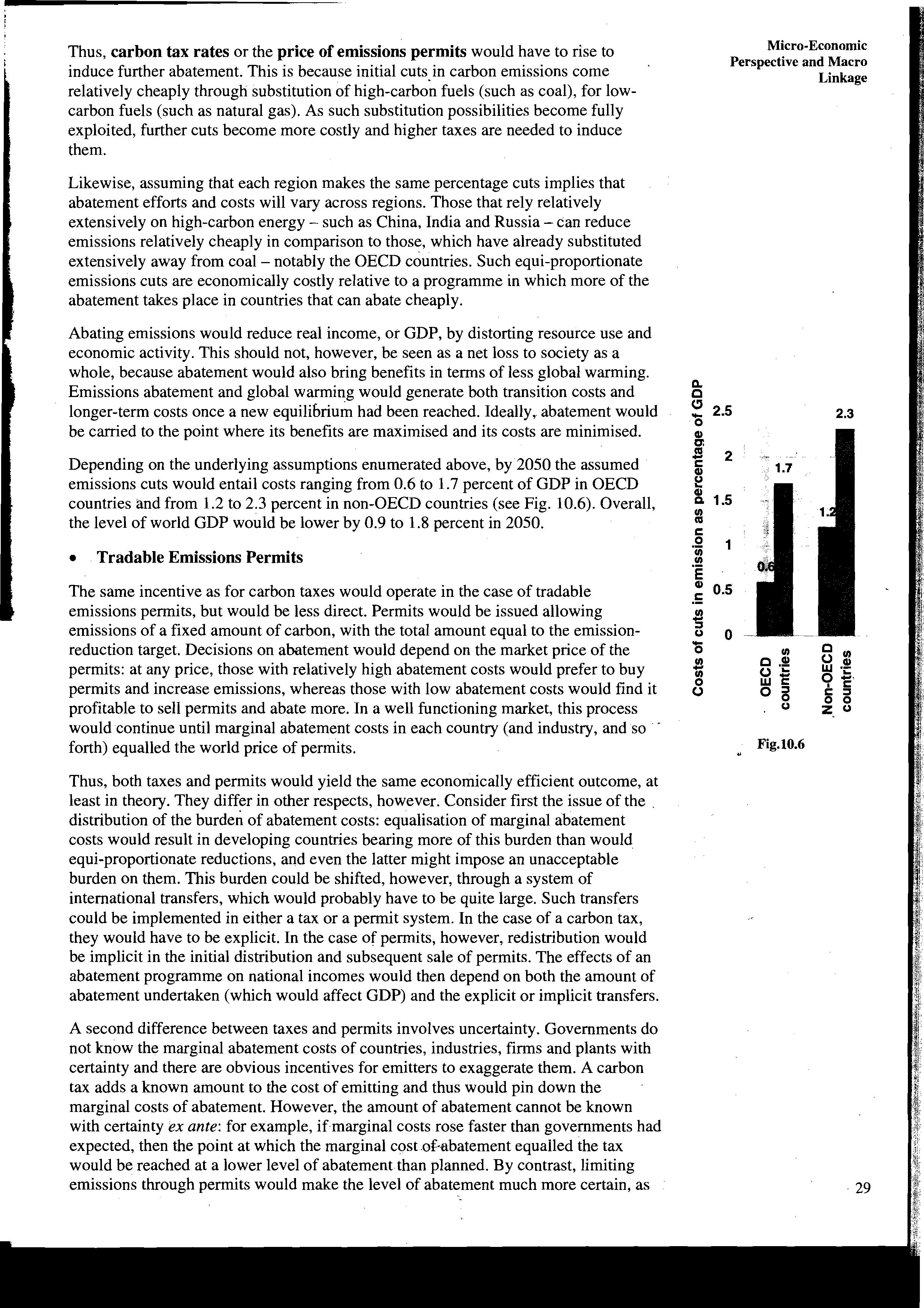
Thus, both taxes and permits would yield the same economically efficient outcome, at least in theory. They differ in other respects, however. Consider first the issue of the distribution of the burden of abatement costs: equalisation of marginal abatement costs would result in developing countries bearing more of this burden than would equi-proportionate reductions, and even the latter might impose an unacceptable burden on them. This burden could be shifted, however, through a system of international transfers, which would probably have to be quite large. Such transfers could be implemented in either a tax or a permit system. In the case of a carbon tax, they would have to be explicit. In the case of permits, however, redistribution would be implicit in the initial distribution and subsequent sale of permits. The effects of an abatement programme on national incomes would then depend on both the amount of abatement undertaken (which would affect GDP) and the explicit or implicit transfers.
A second difference between taxes and permits involves uncertainty. Governments do not know the marginal abatement costs of countries, industries, firms and plants with certainty and there are obvious incentives for emitters to exaggerate them. A carbon tax adds a known amount to the cost of emitting and thus would pin down the marginal costs of abatement. However, the amount of abatement cannot be known with certainty ex ante: for example, if marginal costs rose faster than governments had expected, then the point at which the marginal cost of-abatement equalled the tax would be reached at a lower level of abatement than planned. By contrast, limiting emissions through permits would make the level of abatement much more certain, as
Micro-Economic Perspective and Macro Linkage
Economics of Energy and it would simply be the number of permits issued, enforcement issues aside. However, Environment the cost of achieving that abatement would not be certain.
A third difference involves the role of the public sector. In both cases, there are important issues of monitoring and enforcement (tax collection in one case and emissions in excess of permits held in the other). However, for a tradable emissions permit system to deliver the desired result, there must be an active and efficient secondary market for permits. The limited practical experience with permits suggests that a relatively large number of traders and minimal governmental regulation of trades both help to ensure a "deep" market and low transactions costs.
It is increasingly accepted that economic instruments are more effective than regulations for controlling pollution externalities, including those associated with green-house gas emissions. In a nutshell, economic instruments allow firms and households to meet environmental goals in a least-cost way, whereas regulations often lock in technologies or market practices that turn out to be inefficient. In this section, ' we have discussed two economic instruments most actively considered in the context of global warming due to C02 emissions, namely, carbon taxes and tradable permits to emit carbon. Let us see what other measures can be taken for reducing the costs of controlling emissions.

10.4.2 Reducing the Costs of Controlling Emissions
The policy of equiQroportionate emissions reductions by region or country, which was described in the previous section, is a relatively costly way of achieving a global emissions target. Some policy reforms could both reduce emissions and improve economic efficiency. These are referred to as "no-regrets"policies because they would be worth implementing even if global warming were to turn out to be no threat. Substantial costs could also be saved if emissions reductions were timed to minimise transition costs, notably the obsolescence of capital, and to take advantage of the possibility that cheaper abatement technologies may be developid in the future.
Finally, equalising the marginal cost of abatement across countries or regions would ensure that total costs were minimised for a given amount of global abatement. The logic of this. last point is straightforward: if marginal costs are not equal, then reducing abatement a little in a high-cost country and raising it by an equal amount in a lowcost one would reduce overall costs. This logic applies equally to firms and plants within a country.
"No-regrets" Policies
The clearest case for a "no-regrets" policy is a shift to better technologies (see Fig. 10.7) and reform of energy subsidies. This priority is recognised in Article 2 of the Kyoto Protocol, which specifies a progressive removal of subsidies and reform of taxes as a means of achieving reduction commitments. Removing subsidies would reduce fossil-fuel use and C02 emissions, while at the same time eliminating distortions. Results from the OECD GREEN model indicate that removing subsidies would reduce emissions by 18 percent in 2050 and would increase world real income by 0.7 percent. (Transition costs, however, were not taken into account in this model.) To some extent, countries have already begun to reap such gains: in particular, reforms in China, the central European countries and Russia have helped to close the gap in those countries between domestic and world energy prices.
Emission reductions could also be achieved if the structure of existing energy taxes better reflected the carbon content of fuels. Currently, oil and gas typically face high implicit carbon taxes while coal receives subsidies. Rebalancing existing taxes according to the carbon content of each fossil fuel could reduce OECD emissions by 12 percent and lower the economic cost associated with existing energy taxes from 0.4 to 0.1 percent of GDP.
Fig.lO.7: The effect of using CNG as compared to diesel buses
Another element of "no-regrets" policy would be to encourage technologies that raise energy efficiency. A number of these are already commercially available: improvements in insulation, refrigeration and lighting control; the use of electric vehicles; increased use of public transportation and telecommuting; and reduced vehicle weight. (The next two units focus exclusively on this dimension of energy economics.) The extent to which this is truly a "no-regrets" policy depends in part on why such technologies are not already in wider use. According to one view, firms and households would have already adopted them if they were, in fact, less costly. In this case, inducing their adoption would not truly be "no regrets".

On the other hand, there may be numerous market failures inhibiting the adoption of these technologies, including inadequate information regarding alternative costs, principal-agent problems (those paying are not those making the decisions about what technology to adopt) and capital-market imperfections (some cannot borrow to pay for the up-front cost of installing the new technology). Overcoming such market failures would both raise welfare and reduce greenhouse gas emissions.
SAQ 5
Outline the main features of "no-regrets" policy for reducing the costs of C02 emissions.
The Timing of Abatement
Costs of meeting emissions goals also depend on the distribution of reductions through time. Abatement costs will probably fall over time because abatement technology will improve and alternative low-carbon sources of energy will become available or less costly. Phasing in abatement could also reduce costs by allowing natural depreciation of existing capital equipment. On the other hand, delaying action involves risks, since it would result in higher atmospheric carbon concentrations, all else equal. Early reductions may therefore be justified as risk management. The possibility of unexpected and catastrophic consequences from global warming adds
weight to this argument.
Although models have been used to assess the costs of alternative time paths of emission reductions, the results are subject to a great deal of uncertainty. In addition, the relative costs of such paths also depend on the likelihood of cost-reducing abatement technologies being discovered, the social discount rate used and, in view of
the risk-management issue, the degree of risk aversion assumed.
Equalising Marginal Emiisioos Costs
Since the marginal cost of greenhouse gas abatement differs widely across countries and regions, the equi-proportionate cuts of the scenario discussed above is a costly way to meet a global emissions-reduction goal. Equalising marginal abatement costs would mean those countries or regions with lower costs would abate more. Such an outcome could be implemented either through a uniform world-wide tax on carbon emissions, or through a global market for tradable emissions permits with a single price for all countries.
10.5 SUMMARY
Energy demand is derived from preferences for energy services and depends on availability and properties of conversion technologies and costs of energy and technologies used for conversion. In general, increased energy prices reduce demand by reducing use of energy services and motivating selection of higher conversion efficiency equipment.
Energy commodities are typically economic substitutes for one another. Substitutability of energy is made possible by and is limited by the. available set of
Micro-Economic Perspective and Macro Linkage
1
!
I
[
1
energy conversion technologies. Technological advances can be expected to bring prices of these energy commodities closer together over time.
~ne&g is often described as an essential good because human activity would be impossible absent use of energy: living requires food embodying chemical energy.
Energy is generally believed to be a limiting factor for economic growth in the developing world while it remains a fundamental resource for continuing economic prosperity in the developed countries. Economic growth and social development in developing countries are hindered by a lack of adequate, efficient supplies of quality modern energy.
Despite subsidies, poor households in Asia pay a larger fraction of their incomes for energy than middle- and high-income households and continue to depend predominantly on traditional fuels.
The ability to create a business environment that will attract the investments necessary to provide adequate, efficient supplies of quality modern energy is constrained by many problems such as.
Policies to slow the rise in concentrations by controlling greenhouse gas emissions that are expected to grow by 0.5 to 1 per cer:: per year, depending on assumptions about economic growth and energy efficiency, raise a number of economic issues.
Costs of environmental damages are generally not incorporated into prices for energy commodities and resources Emissions abatement and global warming would generate both transition costs and longer-term costs once a new equilibrium had been reached. Emission reductions could also be achieved if the structure of existing energy taxes better reflected the carbon content of fuels. Costs of meeting emissions goals also depend on the distribution of reductions through time.
"No-regrets" policy specifies a progressive removal of subsidies and reform of taxes as a means of achieving reduction commitments.
Abatement costs will probably fall over time because abatement technology will improve and alternative low-qarbon sources of energy will become available or less costly.
Economic instruments allow firms and households to meet environmental goals in a least-cost way, whereas regulations often lock in technologies or market practices that turn out to be inefficient.
10.6 TERMINAL QUESTIONS
1. Explain how technological advances cin bring prices of energy commodities closer together.
2. Explain why we need to consider environmental damage in energy costing. 3. Analyse the linkages between energy, economic growth and sustainability. 4. Discuss the economic instruments used globally to control COz emission.

of Energy and Environment
Ecodomics
UNIT 11 ENERGY INFRASTRUCTURE, SERVICES AND EFFICIENCY IMPROVEMENT

Structure
1 1.1 Introduction
Objectives
11.2 Energy Infrastructure Development
11.3 Energy Services: Linking Supply and Demand
11.4 Supply and Demand Side Energy Efficiency Improvement
11.5 Use of Energy Efficient Appliances and Buildings
11.6 Summary
11.7 Terminal Questions
11.1 INTRODUCTION
In Unit 10, you have studied the relationship between energy economics, the demand for energy services and their supply. Trends in today's marketplace, such as tight energy supplies, increasing energy prices, and the environmental impact of energy such as air pollution, are shining a spotlight on energy economics. As social responsibility, climate change and green buildings become drivi~gissues, leading businesses and institutions are looking to gain a competitive advantage by taking proactive steps to address these issues through effective energy management. Energy efficiency improvement is one of the prominent steps in this direction. Energy savings translate into financial value, which could be used to further develop energy resources and infrastructure.
Energy is necessary to run the buildings we work in and to make the products we use in our everyday lives. The energy used in commercial buildings and manufacturing generates greenhouse gases, but, it is possible to make significant reductions in these emissions cost-effectively. Businesses can reduce, on average, 30 percent of their energy use just by targeting energy that is used unnecessarily or inefficiently. Effective building strategies and technologies can help reduce energy consumption and save money. For example, we can build and operate green buildings as they not only lead to environmental benefits but also financial benefits. It is estimated in energy studies in the developed countiies that a commercial-building owner can generate $2 to $3 of incremental asset value for every $1 invested in energ efficiency improvements. A retail shopkeeper can reap the equivalent of increasing sales by $85 by reducing annual energy costs by $1 ..Thus, there is a strong economic case to be made for investing in energy efficiency improvements.
In this unit, you will learn about various measures that can be taken to improve energy services and infrastructure by improving energy efficiency on the supply as well as demand side. The emphasis in this unit will be on the technological aspects of saving energy. In the next unit, we shall discuss the role of individuals and society in energy &vings.
Objectives
After studying this unit, you should be able to: outline the guidelines for energy infrastructure development; explain how energy supply and demand should be managed to improve energy efficiency; and describe the technological measures for energy conservation in commercial, industrial and transport sectors.
11.2 ENERGY INFRASTRUCTURE DEVELOPMENT
Energy generation, transmission and distribution calls for the development of infrastructure. This not only involves capital outlays but also several other considerations such as appropriate technology, public welfare, and safety of the environment.
In developing energy infrastructure and facilities, critical decisions have to be taken to ensure stringent environmental standards and public good. Public participation in decision making should be ensured at all stages of development for such measures to succeed. Each nation should have an energy infrastructure development mechanism with open and transparent processes. The following guidelines are helpful in evaluating specific proposals, plans and legislation related to energy infrastructure development.
Energy Infrastructure Development Guidelines
First and foremost, the development of energy related facilities requires land and involves sound overall land-use planning. The following categories of land should be excluded from consideration as sites for such facilities:
Land included in local conservation parks or natural area systems, or in wildlife refuges, or in such proximity as threatening the environmental quality of protected areas;
Areas reserved for ecological, scenic, natural, wildlife, geological, educational, or scientific value;
Wild, natural, scenic or pastoral portions of coasts or shores, including bays, estuaries, wetlands, lakes and rivers;
Coastal or riverine areas serving as spawning grounds for aquatic life;
Habitats of rare, endangered, or threatened plant or animal species;
Areas containing outstanding examples of plant communities, such as virgin timber stands;
Valuable archaeological or historic sites;
Prime agricultural lands;
Lands that play a vital role in the hydrological cycle such as aquifer recharge areas and wetlands;
Land characterised by adverse geological or geophysical characteristics such as earthquake zones or floodplains.
The development of large, energy-related facilities should not proceed unless a definitive need for them has been demonstrated, through open public disclosure and certification of need, which cannot be met through conservation and smaller-scale alternatives. In the case of electric generating facilities, the impact of large size on raising required reserve margins should be considered as well.
Generating plants should be located as close as possible to load centres to:
avoid unnecessary, long, wide transmission corridors; encourage conservation and pollution abatement by linking the environmental burdens of power generation with its benefits; and
a maximise efficient use of energy through utilisation of waste heat for beneficial purposes. -
Economics of Energy and Environment
I
I
I
I
Where the siting of a power plant conflicts with clean air goals, the emphasis should be placed on reducing the emission of pollutants rather than relying on remote siting. Since airborne pollutants have been found to cause damage to the natural environments far from their source (e.g., via acid rain), remote siting will not prevent environmental degradation. Any tmde-off between impacting urban and ruraVwild environments should be discussed explicitly and publicly. In general, new energy facilities should be located on land that has little other productive value, be sited in such a way as to be compatible with and encourage the use of waste heat and waste water and the development of renewable energy resources.
Fig.ll.1: Energy infrastructure for generation, transmission and distribution .B

The development of new electric transmission line corridors, as a general principle, should be kept to an absolute minimum. To that end, new transmission lines should, whenever possible, utilise comdors already established for highways, railroads, and pipelines, andlor share previously established electric transmission corridors.
The need to protect other important resources, such as water resources and quality, air quality, and minerals, shbuld be carefully considered in the planning for and placing of energy facilities by all levels of government.
In the development of such facilities, each level df government affected should be involved in the decisions to allow a balancing of national/ regional and statenocal energy and land-use policies.
Energy Infrastructure, Services and Efficiency Improvement
Economics of Energy and Full public participation should be part of all phases of the decision making process at Environment
all levels of government, with appropriate funding made available. Information in a form easily understood by the people should be popularised in all areas impacted environmentally or economically by the proposed facility. The public should be - informed about its opportunity to participate. Interactions should be held during hours accessiblk to the working public whenever public comment is solicited.

When considering a specifi facility, a full record should be developed in order that the least environmentally damaging alternative is selected. The decision should be made by an independent board or commission set up in advance.
Purchase of land or equipment should not be allowed in advance of site approval. This invariably skews considerations in favour of the preferred site and mode, thereby biasing the final decision against alternatives that might minimise the environmental impact. The value of the land should be fixed at the time of the declaration of the site, with the final price subject to increases based only on increases experienced by comparable land types elsewhere.
Any proposal to bank power.plant sites by selecting potential sites in advance of need should:
Ensure the selection of sites that represent the minimum adverse environmental impact.
Include sites presenting a range of options, rather than relating exclusively to one mode and/or scale of generation.
a Provide funding for public participation in the site-selection process.
a Preserve all licensing procedures for final approval of a specific plant on a specific site.
a Be subject to periodio review to allow consideration of changing circumstances.
SAQ 1
Consider a major energy project from your area. Have the guidelines stated in this section been followed in this project? If not, mention the violations.
Economics of Public Demand for Renewables
You have studied in Block 1 that a variety of technologies are associated with renewable energy resources. These technologies are at various stages of advancement and range from very low cost options to those involving high levels of investment that yield cheaper and cleaner energy in the long run.
The main reason for the lack of mass exploitation of renewable energy technologies is economic, particularly in the widespread generation of electricity. For these technologies to be feasible and an economically viable choice for the production of electricity, they must be economically advantageous. The production costs must go down and efficiency of the final product must go up. It is difficult to find funding to fuel the projects that are necessary to increase the amount of electricity that can be produced for a certain price, when the current technology is not already adequately efficient.
The absence of mass consumer demand for these technologies is a hidden factor behind the lack of wide-spread solar power production. If there is a demand for a product, there will be people who will supply that product at a cost that fulfils the demand. If there is enough consumer demand, economic and efficient renewable energy technologies will be developed and exploited more quickly.
Despite a lack of truly substantial financial investment from both consumers,~the government (compared to the investments made in conventional energy soutces); th'a
efficiency of these technologies continues to improve. The increasing efficiency coupled with decreasing prices may lead to more and more electricity generation from renewable energy resources.
The use of these technologies is bound to increase
as prices go down, efficiencies go up, tax incentives and rebates increase in impact, reliability of standard electrical generation fluctuates, and increased awareness of the dangers of fossil fuel combustion becomes widespread.
This increase can already be seen in the solar market. Solar energy is a good energy option in developing countries. These cou~ltriesare increasingly turning to solar energy as a low cost way to supply electricity because of the cost of transmission links and the difficulty of transporting fuel to remote areas. You know that one-third of the world's population still lives without electricity; and most such people live in developing countries. As the demand for electricity spreads throughout the world, the use of solar panels is expected to increase greatly.
Large-scale solar power application is not limited to developing countries. For example, in Murcia, Spain, AstroSolar is planning to supply a Spanish power plant with 13 MW of solar cells. This Spanish power plant will be four times larger than any other PV plant and will cover an area the size of 57 football fields. The Japanese are currently spending 10 to 20 times more than the USA to commercialise PV and hope to install 4,600 MW of solar power by 2010. While growth i11 the USA has not matched international growth, there is still a sizable growth in both PV and solar thermal use in its residential sector.
Overall, the use of renewable energy technologies is increasing globally. However, the percentage of energy produced using these resources is still miniscule.
SAQ 2
List the economic reasons behind the lack of widespread use of renewable energy technologies.

d You have studied in Unit 4 about how different renewable energy technologies affect the environment. For example, during operation, PV and solar thermal technologies produce no air pollution, little or no noise, and require no transportable fuels. However, one environmental worry with solar technologies is the lead-acid batteries that are used with some systems. This is a concern especially in developing countries where proper disposal and recycling is not always available. The impact of these lead batteries is lessening however as batteries become more recyclable, batteries of improved quality are produced and better quality solar systems that enhance battery lifetimes are created.
A second environmental concern with solar technologies is the difficulty of recycling heavy metals such as cadmium, which are used in PV cells. There is a worry that the cadmium used in discarded PV panels may also be an environmental threat. Since the use of cadmium sulphide in the production of PV panels is on the rise (replacing the more expensive silicon) this is an issue that should be considered.
However, the environmental impact of renewable energy technologies is relatively small and it is perhaps more beneficial to take into account the enormous amount of pollution that is prevented due to the use of these technologies.
A pertinent question to ask in this context is: How much do these technologies cost?
Improvement
Energy Infrastructure, Services and Efficiency
Economies of Energy and Currently electricity generation from most of the renewable resources is more Environment expensive than other methods. However, utilities using fossil fuels and nuclear power are able to provide a lower price, in part, because of government subsidies and incentives as well as the avoided cost of pollution control, and NO credits in some places. It is also important to remember that as supplies of fossil fuels continue to be depleted, their price will increase. Renewable energy technologies on the other hand will become less expensive as they evolve into more efficient forms. Let us understand the cost of these technologies taking the example of solar energy.
L
With solar power, along with some batteries for backup, one is also paying for the extra reliability with their increased resistance to the simple line failures of standard utility electricity. There are different parts of the whole system to consider when looking at the price. There is the price per watt of the solar cell, price per watt of themodule (whole panel), and the price per watt of the entire system. It is important to remember that all systems are unique in their quality and size, making it difficult to make broad generalisations about price.
The average PV cell price was $2.01 per peak watt in 1999 and the average per peak watt cost of a module was $3.62 in the same ye&. The,module price however does not'include the design costs, land, support structure, batteries, inverter, wiring, and lights/appliances. With all of these included, to buy a full system it can' cost anywhere from $7 per watt to $20 per watt. So, for example, if you wanted to put in a 10 kilowatt-hour per day system in an area with an average 5 hours of sunlight every day, you would need a 2 kilowatt system. At $7 a watt it would cost about $14,000. With most average homes drawing from 1 kilowatt to 2 kilowatts, a system of this size would offset a significant portion of load during the hours of maximum sunlight, maintenance free for 15-20 years.
Do you think these costs can be afforded by all sections of people at this juncture? Certainly, there is aneed for further research for bringing down costs.
So far, we have discussed briefly various economic aspects of energy infrastructure development, we move on to energy services and their economics.
11.3 ENERGY SERVICES: LINKING SUPPLY AND DEMAND
You have read time and again in this course that except in the form of food, no one needs or wants energy as such. That is to say, no one wants to eat coal or uranium, drink oil, breathe natural gas or be directly connected to an electricity supply! What people want are energy services -those services which energy can provide uniquely in an efficient and desirable manner. Why don't you make a list of the energy services that you need?
SAQ 3
Make
a list of all the energy

services
required by you.
When Thomas Edison (the inventor of electric bulb) set up the world's first electric power station in New York in 1882, it was not electricity he sold, but light. He provided the electricity and light bulbs, and charged his customers for the service of illumination. This meant he had a strong incentive to generate and distribute electricity as efficiently as possible, and to install light bulbs that were as efficient and long-lasting as possible.
Unfortunately, the early Edison approach did not survive. The regulatory regime under which most utilities operate today simply rewards them for selling as much energy as possible, irrespective of the efficiency with which it is used or the longevity of the appliances using it.
3 8
In a few countries, however, governments have changed the way energy utilities are regulated by setting up mechanisms to reward them for providing energy services rather than mere energy. In this case, cus'tomers benefit by having lower overall costs, the utility makes as much pmfit as before, and the environment benefits through reduced energy wastage and the emission of fewer pollutants. This approach has enough scope for replication, provided a healthy competition develops amongst the utility companies.
Linking Supply and Demand
But apart from these relatively few enlightened examples, the efficiency with which humanity currently uses its energy sources is generally extremely low. We have - established long supply chains to connect our coal and uranium mines, our oil and gas wells, with our energy-related needs for warmth, light, motion, communication, etc. At present, only about one-third of the energy content of the fuel the world uses emerges as 'useful' energy, at the end of these supply chains. The remaining twothirds usually disappears into the environment in the form of 'waste' heat.

Fig.ll.3: An example of one of the energy 'chains' linking primary energy with delivered energy and useful energy, via various energy transformations
One of the reasons for our continuing inefficiency in energy use is that energy has been steadily reducing in price, in real terms, over the past 100 years. Energy's decreasing cost means that our society has only a relatively weak financial incentive to use it more wisely. For example, in India, electricity prices have been kept deliberately low under a typical please all policy of the government (see Table 11.1).
The chains that link energy supplies with users' demands are lengthy and com~lex. Each link in the chain involves converting energy from one form or another, for
Energy Infrastructure, Services and Efficiency Improvement
Fig.ll.2: Edison's Jumbo Dynamo (Source: www.ieee-virtual-rnuseurn.org)
Economics of Energy and example, in the burning of coal to generate electricity; or distributing energy via some Environment kind of transmission link or network, such as a national electricity grid or gas pipeline infrastructure. The common feature underlying these scenarios is the prediction that economic growth will continue to fuel strong energy demand on the part of developing countries. This emphasises the importance of ensuring that such growth is met in as sustainable a fashion as possible. That is why there is now an increasing shift towards captive mode of power generation, wherein energy parameters are not kept under wraps but revealed in everybody's interest.
Table 11.1: Electricity tariffs in various countries (In US cents1 kwh)

Industry
Domestic 1
1 India I 7 I 3 1
Country Belgium I 4 13
1 Canada 1 3 1 5 I
1 Chinese Taipei I 6 I 8
Sweden Japan
12 8 23 3 16
I S. Korea I 6 1 7
I Mexico 1 5 I 7 1
I
1 New Zealand 2 I 6 1
I Portugal I 6 1 11 1
Spain United Kingdom USA
iource: IEA
5 5 4
12 10 8
For the policy-maker, planning for a sustainable energy and transport future is a major priority. Choosing a path towards sustainable development will require broad societal consensus around the strategic choices of economic, environmental and social development. Transparency, stakeholder involvement and institutional flexibility will be key ingredients of any set of decisions. Different countries have the freedom to pursue different paths towards a variety of sustainable development options arid they will require different policy mixes, likely incorporating fiscal, regulatory and research and development efforts to overcome barriers to the adoption of new approaches.
The recent World Energy Assessment - a joint project by UNDP, the World Energy Council and UNDESA - indicates that targeted strategies are needed to address the needs of the 2 billion people with inadequate access to energy services, most of whom live in rural areas of developing countries. The lives $d productivity of this large group could be enormously improved over the short term with relatively small inputs of energy. For instance, the cooking needs of those nqt served by modern fuels correspond to just 1 percent of global commercial energy consumption, or 3 percent of global oil consumption.
Where extension of electricity grids is not economically feasible, decentralised % solutions, including diesel and biomass systems, wind and solar power, are viable options that also offer opportunity for local control. Innovative approaches and financing mechanisms, tailored to local conditions, will be needed to bring modern forms of energy to rural areas. This was how the rural electrification programme in many newly industrialised countries was accomplished with government support in
order to achieve social and economic objectives. A holistic approach of deploying Renewable Energy systems in large numbers may help to realise the economies of scale and thereby lower costs. In this context, the World Energy Council, in its recent study has defined three broad goals for energy sustainability:

accessibility to modern, affordable energy for all; availability in terms of continuity of supply and quality of service; and acceptability in terms of social and environmental goals.
Accessibility to modern energy means that energy must be available at prices, whi~h are both affordable (low enough for the poorest people) and sustainable (prices which reflect the real costs of energy production, trsnsmission and distribution to support the financial ability of companies to maintain and develop energy services). The best way to ensure that a growing number of people are able to afford commercial energy in line with their needs is to accelerate economic growth and pursue more equitable income distribution. This requires special measures such as increased funding for decentralised sources of energy, increased reliance on private efforts for power generation and distribution, etc.
An energy tariff reflecting all costs, including external costs such as emissions or waste management, could be necessary to secure adequate investment and encourage energy efficiency and environmentally preferred technologies but such a tariff would be unaffordable for many people.
At the same time, a tariff subsidised down to a socially affordable price would not attract sufficient investment, consequently in the long-run working against the interests of those who are in need of commercial energy infrastructure. There may be a need, in some cases, to subsidise energy technology and delivery for a period of time without creating price distortions or at least by keeping them to a minimum. Variable, maintenance and infrastructure extension costs need to be reflected in the price paid for energy. The way out is to create conditions for the development of components and Operatibn and Maintenance (0 &M) services at the local level to keep the energy cost to the consumer groups (mostly for poor) within a reasonable limit.
Availability involves both quality and reliability of delivered energy. The continuity of energy supply, particularly electricity, will be essential in this century. While shortterm interruptible supply may be feasible in certain circumstances, unexpected power cuts bear a high cost for society that cannot be ignored. Our growing reliance on information technologies makes reliability even more critical. Energy availability requires a diversified energy portfolio consistent with particular national circumstances together with the means to harness potential new eneru sources.
It is generally agreed that various mixes of all currently available energy resources will be needed over the next fifty years and there is no case for the arbitrary exclusion of any source of energy. In this Information Technology enabled age, the initial push should always be for taking electricity to every nook and comer and not only for powering computers in electricity deprived areas.
Acceptability addresses environmental goals and public attitudes. Local pollution is a cause of harm to billions of people, especially in developing countries. Global climate change has become an important concern. Mindful of these two facts, developing countries are concerned about both the potential impact of climate-change-related response measures on their economies, and the rising levels of consumer-based household emissions, which create local (urban) and regional pollution (such as the impact of acid rain on crops and forests).
The energy sector is one area in which new and readily available technologies have already reduced emissions and hold out prospects for future improvement. Of course, environmentally friendly technologies have to be developed, diffused, maintained and expanded in all parts of the world. Hence, there is a need to foster adequate local capacity to ensure that the technologies can be used and maintained by local people.
Infrastructure, Services and Efficiency Improvement
Energy
Economics of Energy and Energy resources must be produced and used in a manner that protects and preserves Environment the local and global environment now and in the future.
Addressing these three goals of energy accessibility, availability and acceptability is fundamental to political stability worldwide, to energy business strategy in the 21st century, and to achieving a sustainable energy future. Investment is the direct path toward tackling the global resource challenges for energy as accessibility and affordability will depend upon investment in new infrastructure, introduction of new technologies, and maintenance of deteriorated systems.
The energy industry is the key provider of wider accessibility to commercial energy services, of the availability of uninterrupted supply, and of more socially and environmentally acceptable energy products. The speed, scale and nature of these developments depend in part on enabling frameworks, the wishes and support of social actors, and the deployment of the required technologies and financing.
SAQ 4
Outline the key issues in energy supply and demand for attaining energy sustainability.
Let us now learn how energy efficiency can be improved on supply and demand side in order to meet the energy goals discussed so far. - -11.4
SUPPLY AND DEMAND
IMPROVEMENT
SIDE ENERGY EFFICIENCY
The purpose of any energy system is to convert primary energy to useful or final energy. The immediate efficiency measure is that of the energy losses: an energy supply system with small energy losses is more efficient than the one with great losses.
The value of a demand-side efficiency measure is determined by the effect on the broader energy system: the local, national, regional, or global technical energy system: This means that demand-side energy efficiency is subordinated to the whole technical energy system.
The energy efficiency level is balanced with the idea of cost efficiency, which implies that an energy-efficiency measure should be implemented only if it costs less than the least cost energy supply alternative.
Design of the Energy System
Energy systems engineering offers recommendations on what should be done. It recommends a cost-efficient design of the technical energy system. Energy systems engineering also provides informat@ on the physical flow of energy in the system,. the total and marginal costs, and emissions originated from energy conversion. The system cost includes the cost for the production of useful energy, and the associated costs for environmental control.
The estimate of the cost for changing the energy system is improved by including the transaction costs of the consumers. The energy system design should also include a foolproof metering system. This is because properly metered arrangement catalyses the consumer approach towards healthy energy use practices. The transition from the analogue to the digital electronic metres is a case in point.
We now discuss the measures being taken for energy efficiency improvement on the supply and demand side.
On the supply side of our energy systems, there is a very large potential for improving

the efficiency of electricity generation by introducing new technologies that are more efficient than older power plants.
Since the early days of electricity production, power plant efficiency has been improving steadily. In the older steam turbine power plant that is still in widespread use, the efficiency is only about 30%. Thus two-thirds of the energy content of the input fuel is wasted in the form of heat, which is usually dumped into the atmosphere via cooling towers.
The most advanced form of fossil-fuelled pbwer plant now available is the Combined Cycle Gas Turbine (CCGT). CCGTs are more than 50% efficient, compared with the older plants (see Fig. 11.4).
Fig.ll.4: Diagram comparing the operation of a simple gas turbine power plant (a) with that of a combined cycle gas turbine plant (b). In the CCGT, fhe hot exhaust gases from the gas turbine are used to produce steam to power a steam turbine. The steam turbine and gas turbine are coupled to a generator to produce electricity
CCGTs are more 'climate friendly' than older, coal-fired steam turbine plants, not only because they are more efficient but also because they bum natural gas, which on * combustion emits about 40% less C02 than coal per unit of energy generated (see Fig. 11.5). Increasing efforts are now under way by many nations including India LO set up gas based power plants. India-Iran collaboration for the supply of natural gas is in full swing. Taking into account both the higher efficiency and natural gas's lower COz emissions, CCGT-based power plants release about half as much C02 per unit of electricity produced as compared to the traditional coal-fired plants. For example,
i Supply-side Energy Efficiency Improvement Energy Infrastructure, Services and Efficiency
Improvement
C
1
Economics of Energy and most of the reductions that occurred in UK's C02 emissions during the 1990s were Environment due to the so-called 'dash for gas' as a substitute for coal in power generation.
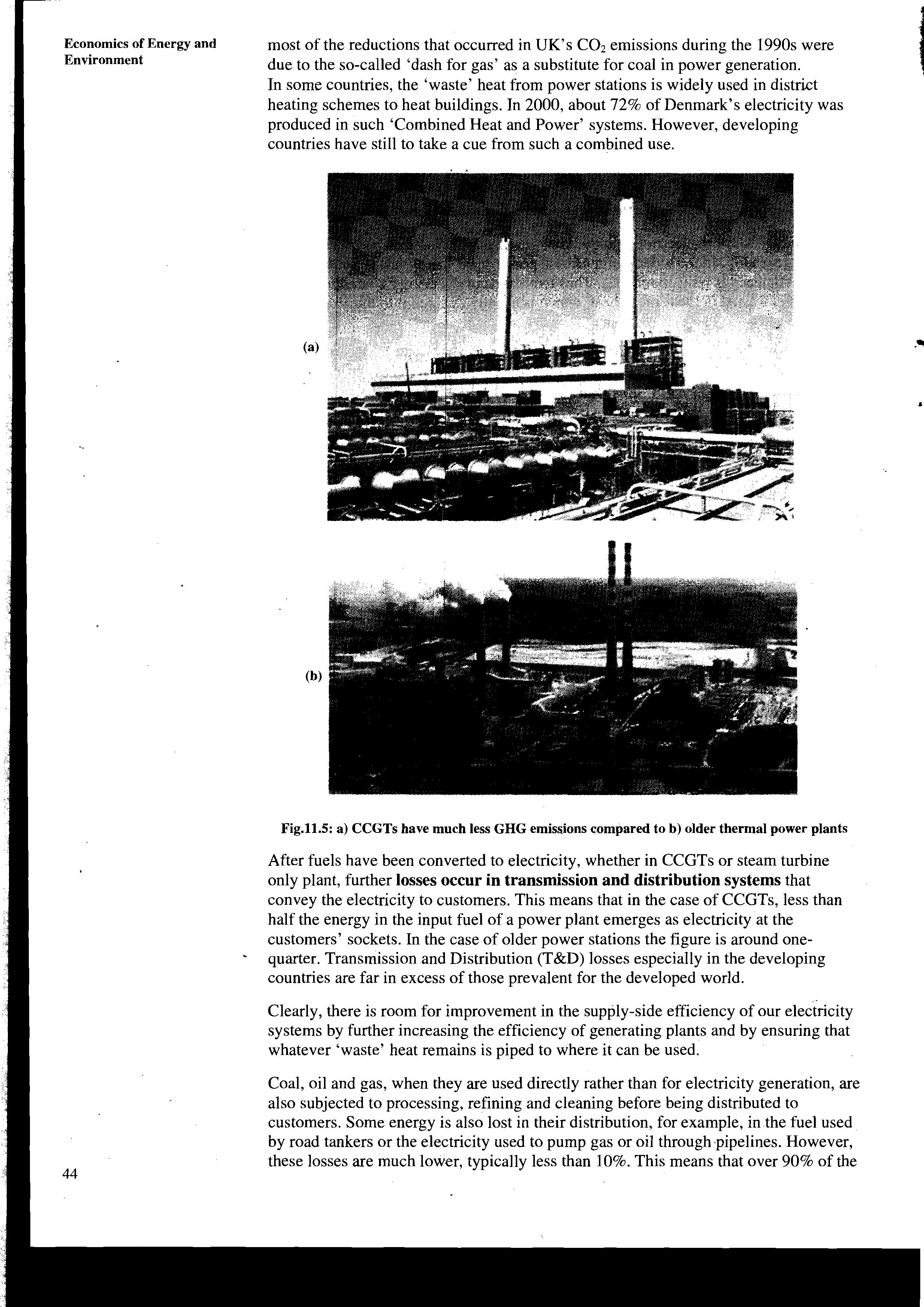
In some countries, the 'waste' heat from power stations is widely used in district heating schemes to heat buildings. In 2000, about 72% of Denmark's electricity was produced in such 'Combined Heat and Power' systems. However, developing countries have still to take a cue from such a combined use.
Fig.ll.5: a) CCGTs have much less GHG emissions compared to b) older thermal power plants
IAfter fuels have been converted to electricity, whether in CCGTs or steam turbine only plant, further losses occur in transmission and distribution systems that convey the electricity to customers. This means that in the case of CCGTs, less than half the energy in the input fuel of a power plant emerges as electricity at the customers' sockets. In the case of older power stations the figure is around one- quarter. Transmission and Distribution (T&D) losses especially in the developing countries are far in excess of those prevalent for the developed world.
Clearly, there is room for improvement in the supply-side efficiency of our electricity systems by further increasing the efficiency of generating plants and by ensuring that whatever 'waste' heat remains is piped to where it can be used.
Coal, oil and gas, when they are used directly rather than for electricity generation, are also subjected to processing, refining and cleaning before being distributed to customers. Some energy is also lost in their distribution, for example, in the fuel used by road tankers or the electricity used to pump gas or oil through pipelines. However, these losses are much lower, typically less than 10%. This means that over 90% of the
I
energy content of coal, oil and gas, if used directly, is available to customers at the
end of the processing and distribution chain. The scope for further supply-side
efficiency improvements is obviously much more limited here than in the case of electricity.
SAQ 5
What steps can be taken to improve the efficiency of energy supply?
Let us now look at the issues involved in improving the energy efficiency on demand side.
Demand-Side Energy Efficiency Improvement
You have studied about demand side management in Block 2. In the past two decades, increased demand-side energy efficiency has been a strategy for decreasing the oil P demand and for decreasing the emissions resulting from energy conversion. The current debate between energy engineers and energy economists focuses strongly on the cost of reducing COzand other greenhouse gases. Let us now look briefly at what a can be done to improve the efficiency of energy use at the demand side -that is, in our buildings, industries, vehicles and homes.
Improving the sustainability of energy use by applying demand-side measures involves two distinct approaches, one technological, and the other social. The social approach will be,discussed inthe next unit. The technological approach involves installing improved energy conversion (or distribution) technologies that require less input energy to achieve a given level of useful energy output or energy service.

In Government energy statistics, energy demand is usually broken down into three main sectors: Domestic, Commercial and Institutional.
The domestic sector consists of individual households, within which the main I categories of energy use are for space heating and cooling, water heating, cooking, lighting and for other electrical appliances. We consider the domestic sector in the next unit.
The commercial and institutional sector consists of offices, shops, schools, hospitals, banks, etc. The energy requirements of this sector are very similar to those of the domestic sector: space heating, water heating, cooking, lights and running various appliances. Air conditioning, however, is more prevalent in this sector than in t the domestic sector - at least in poor countries and countries with temperate climates. In this sector, as in the domestic sector, the bulk of energy consumption is within buildings and appliances. Buildings consume a large chunk of the available energy and rely more on artificial lighting than on natural lighting and ventilation.
11.5 USE OF ENERGY EFFICIENT APPLIANCES AND BUILDINGS
Much of energy use occms within buildings, and consists of requirements for space heatingkooling, water heating, cooking, lighting and appliances.
Use of Energy Efficient Appliances
Energy-efficiency of appliances such as refrigerators, cooking ranges, washing machines, dishwashers, TV sets and hi-fi equipment in the domestic sector is improving day by day; more efficient computers, copiers and other business equipment are being used in the commercial and instidtional sector. These consume less energy whilst delivering the same level of service as their inefficient predecessors; improved control systems are in use to ensure that energy-consuming equipment is switched off when not needed, and power output levels match the requirements of users.
i
Energy Infrastructure,
Services and Efficiency Improvement
t
I
Economics of Energy and
However, user awareness about the proper use of functional features is quite important Environment (see Fig.11.6). More often than not, users find themselves at crossroads when they have to activate certain features oriented towards energy conservation. The irony is that users pay for such value additions, but find themselves helpless at times! How often have you had to struggle with the energy conserving features of, say, a washing machine or a microwave oven? We will describe some ways of conserving energy while using such appliances in the next unit.
Fig.ll.6: For each appliance type, the figure indicates how many energy dollars can be saved during the life of the appliance, simply by choosing the most efficient model rather than the least efficient
Energy Efficiency in Buildings
See Fig.ll.7. It shows some ways of ensuring energy efficiency in buildings.

Fig.11.7: Six steps to an energy efficient building
You may like to learn about some specific technological measures that can be taken to conserve energy and use it more efficiently within buildings.
Fridge Deep Range Dish Washer Dryer Freeze Washer
These include:
improved levels of insulation in walls, roofs and floors, to reduce heat losses through these elements;
energy-efficient windows, (e.g., double glazing windows) designed to allow less heat to escape whilst still admitting large amounts of sunlight; draught-proofing and heat recovery systems to reduce heat loss through ventilation whilst retaining sufficient fresh air within the building;
more efficient boilers that require a smaller fuel input to achieve a given level of space or water heating, together with improved insulation of pipes to reduce heat losses;
energy-efficient lights that require much smaller amounts of power to provide a given level of illumination e.g., CFLs along with the choice of the lamp typelnumber according to the needs of various areas within a building envelope.
Lighting, of course, is a very 'visible' consumer of energy and it often seems that in the past nothing was done to reduce this energy consumption. However, appearances are deceptive since the lighting industry has already put a lot of effort into systems that produce substantial energy savings.

The lighting equipment used today consumes only one fourth of the energy that a typical lighting system of the seventies did, thanks to a clear progress in lamp, ballast and reflector design. One of the simplest ways to conserve energy is to turn lighting systems off in unoccupied areas. However, accomplishing this task can sometimes be a challenge. Building lighting can be controlled by many methods, from simple (local switches, occupancy sensors, photocells and time clocks) to more elaborate computerised lighting control systems which can be tied in to automatic building mechanical and security system controls.
To save even more energy, without endangering lighting quality, we could use additional control techniques, such as daylight-dependent regulation. Although these techniques have been known for over 15 years, they have been applied only very reluctantly. This is caused mainly by dissatisfaction of the users, and the usual control systems for daylight-dependent regulation are often referred to as 'big brother is watching youY.
The reason for this lies in the centralised character of the control system, with one light-sensor controlling several lights. The light-sensor usually measures the illuminance or luminance somewhere in the room, or the luminance of one window or even the Sun's radiation. Despite often complex control algorithms, there is no direct relationship between the measured light value and the resulting lamp output. These socalled open-loop control systems are therefore very difficult to design, to install and to adjust properly. And in practise, they just do not seem to function as could be expected, causing the 'big brother' effect.
Numerous case studies show that centralised control systems often cause annoyance and complaints. Dissatisfied users tend to sabotage such disturbing control systems. Only control systems that function unnoticeably for the user have a chance to save energy. Such systems control the lighting individually for each lamp, dependent on the luminance level under that lamp.
Exterior Lighting
Exterior lighting is typically controlled with photovoltaic sensors (photocells) to ensure lighting operates only at night. Electronic sensors, available at a premium cost, provide additional energy savings by controlling the on and off periods more accurately, and reducing daytime running with consistent operations. Exterior lighting
Energy Infrastructure, Services and Efficiency
Interior Lighting
IIndoor lighting options can be grouped into two categories: manual and automatic. Manual controls can be the most cost-effective systems, but they rely on human intervention. For example, lighting in industrial buildings with regular hours of operation can be most efficiently controlled with a routine of manually shutting off lights at the end of the day. On the other hand, in office buildings with groups of switches located near the elevators, staff leaving the building typically leave the lights on, as they are not sure which lights they are turning off. The task is then left to the cleaning or security staff. The use of automatic controls takes away the responsibility of the occupant to control the lighting. Of course, each control type has an optimal application.
Such a closed-loop proportional control system assures a perfect adaptation to the specific situation in each work-place and can function without any disturbance for the user. Besides providing individual control per lamp, this system has some specific features. Each sensor is easily adjustable, giving the possibility to set the light level individually, according to each user's wishes or the room geometry. It is a 'gentle' regulation system that does not produce any abrupt, irritating changes in the light level. Further, it continually adjusts the light level to meet users' expectations, which makes the regulation almost unnoticeable. It forms, together with the lamps, a selfcontained and pre-set system that does not require any extra wiring. So, there are no additional installation costs. This also makes the system very flexible and universally applicable.
The savings from the control system alone are at least the same or higher than the savings that a non-dimmable electronic ballast would bring. The supplemental cost of the sensor plus the dimming part of the ballast is about the same as the supplement for electronic ballast compared to a conventional one. This means that the payback period for this control system is the same or even shorter than the payback period for an electronic ballast.
In addition to the considerable energy savings, user satisfaction is very high and this clearly shows that energy savings can be combined perfectly with user comfort.
SAQ 6
Outline the measures that can be taken to improve the energy efficiency of buildings. Have you come across any of these measures in buildings you normally visit? If so, describe them.
Energy Conservation in Industries
Many industries, e.g., the steel industry, use substantial quantities of high temperature heat and large amounts of electricity to power various specialised processes. These demands in many cases exceed those of the buildings where the activities are housed and of the people within them.
So apart from improving the energy efficiency of buildings and appliances in the industrial sector, where the approaches are similar to those in the domestigand services sectors, there are other measures that apply specifically to industry. In particular, these include 'cascading' of energy uses, where 'waste' heat from a hightemperature process is used to provide energy for lower temperature processes. Highefficiency electric motors, pumps, fans and drive systems are used with accurate matching of motors to the tasks they are required to perform, and accurate sizing of pipes and their associated pumps. This calls for energy use optimisation at all possible levels by choosing the best suited energy practices vetted through effective energy simulation models.

I
1
Economics of Energy and can also be controlled by time clocks, computerised lighting control systems or the Environment building's mechanical control systems.
Dematerialisation
The measures that can be adopted by industry also include
reductions in the material content of products, for example, in car bodies or drinks cans, where thinner metals can be used without any reduction in the required strength;
substitution of less energy-intensive materials, as in the use of plastics instead of steel for car bumpers.
These measures are one form of what has been termed 'dernaterialisation' - a reduction in the material-intensity (and hence the energy-intensity) of production.

Another form of dematerialisation involves changes other than technological. It'occurs whtn the structure of a country's entire economy shifts towards less energy- and materials-intensive activities. For example, in developed countries the manufacturing sector today accounts for a much smaller share of the gross domestic product (GDP) than it did 20 years ago. By contrast, their services sector now constitutes a much bigger fraction of GDP than two decades ago. Since the service sector usually requires less energy than the manufacturing sector for every dollar's worth of production, the overall energy demands of developed countries have been less than what they would otherwise have been.
However, if the products that were formerly manufactured in the developed countries are now manufactured elsewhere but still imported to these countries in similar quantities, all that has happened is that the energy input, with its associated COz emissions and their implications for global warming, has been transferred to another country.
Another important issue in developing countries is that of bridging the divide between the organised and unorganised sector. The unorganised sector usually does not have easy access to the energy efficient equipment and practices. So the gains reaped by the organised sector are offset to some extent due to energy inefficiency in the unorganised sector.
SAQ 7
Explain how the energy use efficiency can be improved through dematerialisation.
The Transport Sector
Fig. 11.8 shows that various forms of transport vary enormously in their energy requirements per passenger-kilometre travelled. Cycling and walking, of course, require no fuel input apart from food.
Walk Bicycle Moped Motorcycle Boeing 737 Express coach Minibus Bus
Double-decker bus
Rail (suburban diesel) Rail (suburban electric) Rail (intercity diesel)
Rail (intercity electric)
Diesel car (large)
Diesel car (small)
Petrol car (large) Petrol car (small)
Fig.ll.8: Energy requirements of different modes of transport
0 0.5 1.0 1.5 2.0 2.5 3,O -3.5
MJ/ passenger kilometre
Energy Infrastructure, Services and Efficiency Improvement
Economics of Energy and Motor vehicles (cars, vans, buses, trucks and motor cycles) dominate the transport Environment sector in developed countries. But this sector also e~compassesmany other modes of transport, including rail, air and shipping, and non-motorised transport forms such as animal power, cycling and walking more common in developing countries. In most developed as well as developing countries there has been an enormous increase in transportation, measured in passenger-kilometres travelled annually, over the past few decades. In the developed countries, most of this increase has involved motorised transport, mainly fuelled by oil, and so energy use has also increased greatly, as have the associated C02 emissions.
Transport Energy Demand Reduction: Technological Measures

There are numerous technological options for improving the energy-efficiency of transport energy use. Improving vehicle fuel economy is one obvious measure, and the average fuel economy (in litres per 100 km) of vehicles has indeed improved very substantially over the past few decades. However, this improvement has been largely offset by an increase in the total number of vehicle-kilometres travelled, and by increases in the average speeds of vehicles, both of which result in increased fuel consumption. Nevertheless, manufacturers continue to introduce new models with steadily improving fuel economy, partially spurred by legislation requiring them to do so. New approaches include 'hybrid' petrol-electric cars. Battery operated cars have essentially remained confined to limited distance regimes and thus do not act as an agent of change in most situations.
The use of strong but ultra-lightweight composite materials such as carbon fibre or Kevlar, combined with a highly streamlined body shell in the hybrid cars has also improved fuel economy. The drive system is either of the 'hybrid' type, consisting of a small petrol-fuelled engine augmented by electric motors and a small battery store; or a more advanced system employing a fuel cell powered by hydrogen. Fuel cells are continuously re-charged by supplying fuel - usually hydrogen gas - that reacts with oxygen from the atmosphere to produce an electric current.
In the hyper car of the future, the fuel cell would generate electricity for electric motors that provide power to the wheels. The hydrogen fuel would either be stored in tanks in its pure form, or generated on-board by 're-forming' fossil fuels. The oxygen would come from the surrounding atmosphere. Hyper cars, their proponents claim, could achieve between three and five times the fuel economy of current models, with emissions levels approaching zero in the case of the hydrogen-fuel cell version.
Hyper cars may still be some way off, but major car manufacturers have recognised the need to make dramatic reductions in vehicle C02 emissions in the long term, and are investing many hundreds of millions of dollars in the production of fuel-celled vehicles. Switching to hydrogenlfuel cell transport economy is still a distant dream for developing countries like India. What we need to do is to infuse more efficiency into the petroleum-driven transport sector.
We now summarise the contents of the unit.
11.6 SUMMARY
Energy services are the services uniquely provided by energy such as lighting, cooking, transport, etc. Targeted strategies are needed to address the needs of the 2 billion people with inadequate access to energy services, most of whom live in rural areas of developing countries.
The chains that link energy supplies with users' demands are lengthy hnd complex. Each link in the chain involves converting energy from one form or another. At present, only about one-third of the energy content of the fuel the
world uses emerges as useful energy, at the end of the long supply chains. The remaining two-thirds is lost in the form of 'waste' heat.
1 There are three broad goals for energy sustaioability: accessibility to modem, , affordable energy for all; availability in terms of continuity of supply and quality I of service; and acceptability in terms of social and environmental goals.
I The purpose of an energy system is to convert primary energy to useful or final I energy. The energy efficiency level is balanced with the idea of cost efficiency, I which implies that an energy-efficiency measure should be implemented only if it costs less than the least cost energy supply alternative.

On the supply side of our energy systems, there is a very large potential for improving the efficiency of electricity generation by introducing new technologies that are more efficient than older power plants. The most advanced form of fossilfuelled power plant now available is the Combined Cycle Gas Turbine (CCGT).
P CCGTs are more than 50% efficient, compared with the older steam turbine power plant that is still in widespread use. They are more 'climate friendly' than older, coal-fired steam turbine plant, because they bum natural gas, which on
T combustion emits about 40% less COzthan coal per unit of energy generated.
Improvement in the supply-side efficiency of our electricity systems is possible by increasing the efficiency of generating plant and by ensuring that the 'waste' heat is piped to where it can be used.
Improving the sustainability of energy use by applying demand-side measures
I involves two distinct approaches, one technological, and the other social. Energy demand is usually broken down into three main sectors: the domestic sector the
I commercial and institutional sector (often termed the services sector). Demandside management handles change as well as design of the technical energy system.
Energy-efficient appliances consume less energy whilst delivering the same level of service as their inefficient predecessors. They have improved control systems, to ensure that energy-consuming equipment is switched off when not needed, and that power output levels match the requirements of users.
I The main technological measures that can be taken to conserve energy and use it r more efficiently within buildings include: improved levels of insulation, energyefficient windows, draught-proofing and heat recovery systems, more efficient boilers, energy-efficient lights. P
The energy efficiency in the industrial sector includes 'cascading' of energy uses.
11.7
TERMINAL QUESTIONS
1. What do you understand by energy services? Describe the energy services required in the commercial, agricultural, industrial and the services sectors.
2. Explain how new technologies help in improving the energy efficiency on the supply side.
3. Discuss how the supply and demand side energy efficiency can be improved in your work place.
4. List the main features of an energy efficient building.
5. Discuss how energy efficiency can be improved in the transport sector.
6. Taking a typical case from the commercial or industrial sector, describe the measures that can be taken to improve energy efficiency.
I
I
Infrastructure, Services and Efficiency Improvement
Energy
UNIT 12 SOCIAL CONTROL OF ENERGY

Structure
12.1 Introduction , Objectives
12.2 Energy Efficiency Improvement: Social Measures
12.3 Energy Conservation: Home Energy Savings Do-It-Yourself Home Energy Audit Professional Energy Audits Formulating the Energy Plan and Acting on It
12.4 Energy and the Poor Energy, Poverty and Environment Power to the People: A Ten Point Agenda for Change
12.5 Summary
12.6 Terminal Questions
12.1 INTRODUCTION :
In the previous unit, you have studied about various technological measures for improving the energy efficiency and effecting energy savings in buildings and appliances. However, energy efficiency management has to move beyond technologies, appliances, or high-profile buildings to strategic energy management in the society aid in homes in order to increase substantially the energy savings. The money thus saved through collective effort could be utilised for further development of the energy sector. You have learnt about some of these measures in Block 2. In this unit, we elaborate on these measures.
We begin with the question: What kinds of efforts, initiatives and involvement are needed at the individual and societal level to improve energy efficiency and effect energy savings? We also discuss the need for special efforts to mitigate the energy poverty of the disadvantaged sections of our society.
Objectives
After studying this unit, you should be able to: discuss the role of individuals and society in effecting energy savings and developing energy infrastructure; outline measures for home energy saving; and analyse the problem of energy poverty in your own context.
12.2 ENERGY EFFICIENCY IMPROVEMENT: SOCIAL
MEASURES
Low-cost energy is essential not only for economic growth but also for societal wellbeing and individual comfort. The demand for energy is growing rapidly in the developing countries and theckafienge lies-in fulfilling the demand at the least cost to the environment, society and tkeindividual.'
The social approach in control of energy primarily involves re-arranging our lifestyles, individually and collectively, in minor or perhaps major ways. Thus, we can ensure that the energy required to perform a given service is reduced in comparison with other ways of supplying that service. Let us take the example of transport to understand this point.
We may live in a densely populated town with shops, offices, schools and other ame~iiiesscattered evenly around. We may be able to do our shopping, go to work,
\\,
and take the children to school without using a car, simply by walking relatively short distances. Or we may find it convenient to use public transport such as trains or buses, as usually these services are frequent and efficient in higher density settlements.
On the other hand, we may live in a town with a similar population, but one that has been designed (as have many new towns) to have a low population density (i.e., fewer residents per hectare of land), with shops and ofices concentrated in the town centre. In this case, we may well use a car for many of our local journeys, consuming fossil fuels and generating emissions of greenhouse gases and other pollutants.
In both towns, the residents receive exactly the same levels of service: shopping, working, schooling, etc. But in the high-density town the residents can use energy services in a more sustainable manner than in the low-density towns - all other things being equal. The question is not merely of cutting the distances but more importantly of having a mass rapid transport system.
One social approach to reducing the energy required by the transport sector is to shift a proportion of people's journeys away from the energy-intensive modes towards the more energy-frugal modes. This process is sometimes termed 'modal shift'.
This could be achieved without reducing the total number ofjourneys, or the overall distance travelled, so that the amenity or service enjoyed by the traveller would remain the same. If, for example, a greater proportion of long-distance journeys within a country were made by train rather than by air, the overall energy demand involved could be reduced substantially. Or if urban commuters made more journeys to work by rail or bus instead of using their cars, the effects would be similar. And if householders walked to their local shops instead of taking their cars, no fossil fuels at all would be used foithose journeys.
Of course, if people are to undertake transport modal shifts of these kinds, they will need to be encouraged by fast, comfortable, efficient services - or penalised into switching by such measures as congestion charging. Such a step needs social awakening of the highest order in terms of feeling responsible towards the need to cut the C02 emissions, which hardly leave anyone in the safe zone.
You c'ould think of similar social approaches to energy efficiency improyement in other areas requiring energy services, e.g., for space heating or cooling, for washing and for processing materials or construction, etc. Try the following exercise.

SAQ 1
List the services that require the most intensive energy use at your work place. What -. social measures can you suggest for energy conservation in these services?
At the individual level, you are concerned about your rising electricity bills and energy costs. You also want'to be responsible to the environment. What kind of efforts do you need to make? Will your efforts pay off? How much energy and money will you actually save? Will your savings cover the cost of purchasing and installing new energy efficient appliances such as a programmable thermostat, a frontloading washing machine, or a hot water blanket?
A great deal of energy can be saved by us in our homes. Here are a few suggestions that will help you answer these questions and make sensible choices for saving energy in your home or buying new appliances.
12.3 ENERGY CONSERVATION: HOME ENERGY SAVINGS
The first step is to assess how much energy we use in our homes and to evaluate what measures we can take to make our home more energy-efficient. This can be done with the help of energy audits.
li
P
Social Control of Energy
Economics of Energy and A home energy audit will show us problems that may, when corrected, save Environment significant amounts of energy money over time. During the audit, we can pinpoint where our house is losing energy. Audits also determine the efficiency of our home's heating and cooling systems. An audit may also show us ways to conserve hot water. The key to achieving these savings is a whole-house energy efficiency plan. To take a whole-house approach, view your home as an energy system with interdependent parts. The first step to taking a whole-house energy efficiency approach is to find out which parts of your house use the most energy (see Fig. 12.1).
WALLS 33% FLOORS 15%
20% DRAUGHTS 15%
A home energy audit will show you where energy losses take place and suggest the most effective measures for reducing your energy costs. Energy-efficient improvements not only make your home more comfortable, they can yield long-term financial rewards. Reduced operating costs more than make up for the higher price of energy-efficient appliances and improvements over their lifetimes.
You can perform a simple energy audit yourself, or have a professional energy auditor carry out a more thorough audit. We first describe a home energy audit that you can conduct yourself.
12.3.1 Do-It-Yourself Home Energy Audit
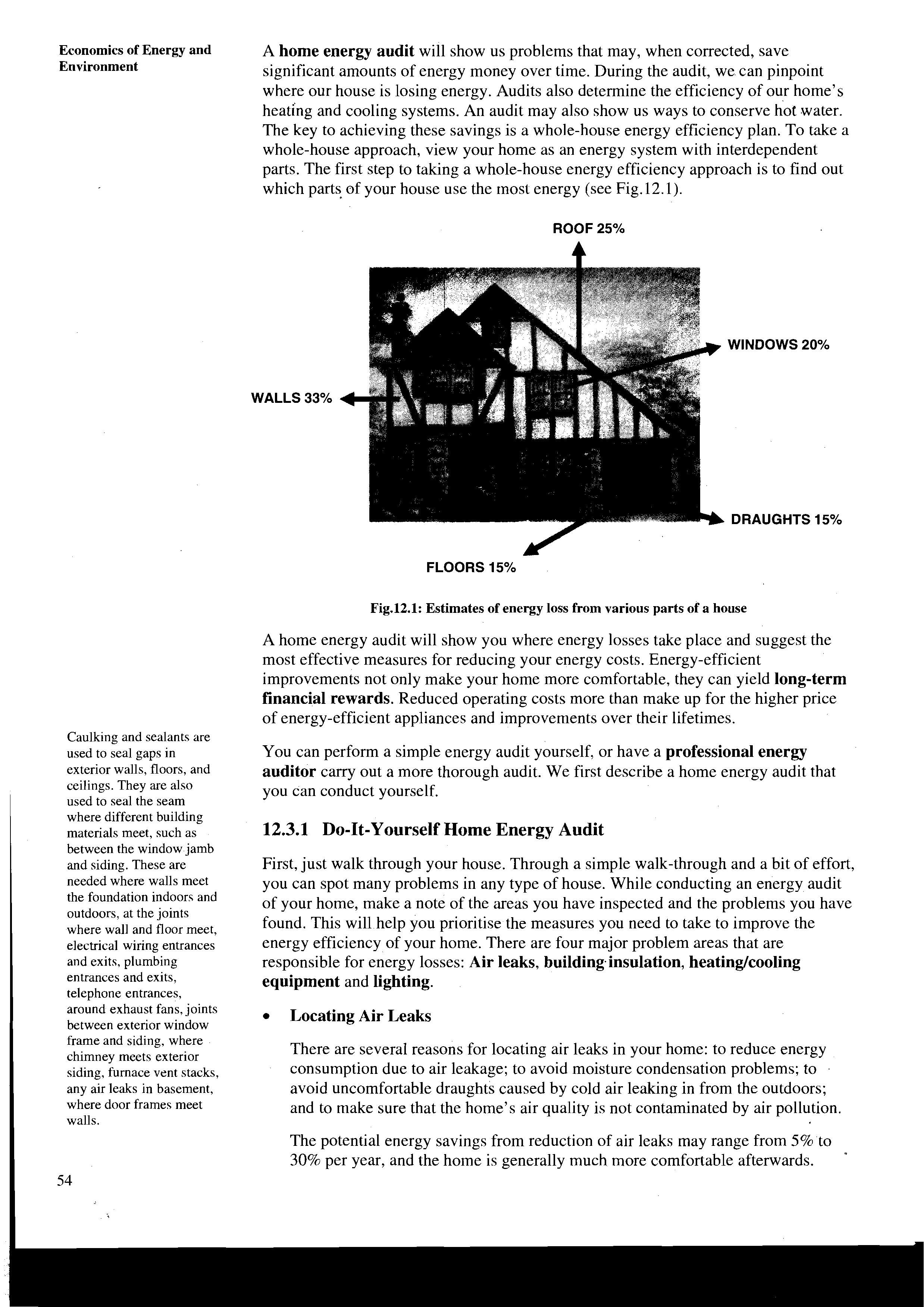
First, just walk through your house. Through a simple walk-through and a bit of effort, you can spot many problems in any type of house. While conducting an energy audit of your home, make a note of the areas you have inspected and the problems you have found. This will help you prioritise the measures you need to take to improve the energy efficiency of your home. There are four major problem areas that are responsible for energy losses: Air leaks, building insulation, heatinglcooling equipment and lighting.
Locating Air Leaks
There are several reasons for locating air leaks in your home: to reduce energy consumption due to air leakage; to avoid moisture condensation problems; to u any air leaks in basement, avoid uncomfortable draughts caused by cold air leaking in from the outdoors; where door frames meet and to make sure that the home's air quality is not contaminated by air pollution. walls.
The potential energy savings from reduction of air leaks may range from 5% to 30% per year, and the home is generally much more comfortable afterwards.
ROOF 25% 4
Caulklng and sealants are used to seal gaps in exterior walls, floors, and ceilings. They are also used to seal the seam where different building materials meet, such as between the window jamb and siding. These are needed where walls meet the foundation indoors and outdoors, at the joints where wall and floor meet, electrical wiring entrances and exits, plumbing entrances and exits, telephone entrances, around exhaust fans, joints between exterior window frame and siding, where chimney meets exterior siding. furnace vent stacks. WINDOWS
Fig.lZ.1: Estimates of energy loss from various parts of a house
Make a list of obvious air leaks in your home, e.g., from doors and windows. See if you can rattle windows and doors, since movement means possible air leaks. If you can see daylight around door and window frames, then the door or window leaks. You can usually seal these leaks by caulking or weather stripping them. Check the storm windows to see if they fit and are not broken. You may also wish to consider replacing your old windows and doors with newer, high-performance ones. If new factory-made doors or windows are too costly, you can install lowcost plastic sheets over the windows.

Check for indoor air leaks such as gaps along the edge of the flooring, and at junctures of the walls and ceiling. Check to see if air can flow through electrical outlets, switch plates, window frames and wall- or window-mounted air conditioners. Look for gaps around pipes and wires, electrical outlets, foundation seals, and mail slots. Check to see if the caulking and weather-stripping are applied properly (with no gaps or cracks), and are in good condition.
If you are having difficulty locating leaks, you may want to conduct a basic building pressurisation test. First, close all exterior doors, windows, and exhaust pipes. Turn off all combustion appliances such as gas burning stoves, and water heaters. (Remember to turn them back on when you are done with the test!) Then turn on all exhaust fans (generally located in the kitchen and bathrooms) or use a large window fan to suck the air out of the rooms. This increases infiltration through cracks and leaks, making them easier to detect. You can use incense sticks or your damp hand to locate these leaks. Moving air causes the smoke to waver, and you will feel a draught when it cools your hand.
On the outside of your house, inspect all areas where two different building materials meet. For example: inspect all exterior corners where siding and chimneys meet; and areas where the foundation and the bottom of exterior brick or siding meet. You should plug and caulk holes or penetrations for faucets, pipes, electric outlets, and wiring. Look for cracks and holes in the mortar, foundation, and siding, and seal them with appropriate material. Check the exterior caulking around doors and windows, and see whether doors seal tightly.
Insulation
Heat loss through the ceiling and walls in your home could be very large if the insulation levels are low. Checking your home's insulation is one of the fastest and most cost-efficient ways to use a whole-house approach to reduce energy waste. A good insulating system includes a combination of products and construction techniques that provide a home with thermal performance, protect it against air infiltration and control moisture.
Warm air leaking into our home during the summer and out of our homes during the winter can waste a substantial portion of energy. One of the quickest energysaving tasks you can do is caulk, seal, and weather-strip all seams, cracks, and openings to the outside. You can increase the comfort of your home while reducing'your heating and cooling needs by up to 30% by using proper insulation and weatherisation products. You can also save 10% or more on your energy bill.
First, check the insulation in your ceilings, exterior and basement walls, floors, and crawl spaces to see if it meets the levels recommended for your area.
, Insulation is measured in R-values-the higher the R-value, the better the walls and roofs will resist the transfer of heat. Ensure that the openings for pipes, ductwork, and chimneys, etc. are sealed. Any gaps should be sealed with a permanent sealant. Check to see if there is a vapour barrier such as a plastic or fibreglass sheet on the ceiling. If there does not appear to be a vapour barrier, you might consider painting the interior ceilings with vapour barrier paint. This reduces the amount of water vapour that can pass through the ceiling.
Social Control of Energy
Large amounts of moisture can reduce the effectiveness of insulation and promote
structural damage. Make sure that the vents in your house are not blocked by insulation. You also should seal any electrical boxes in the ceiling and cover the entire roof with at least the recommended amount of insulation.
Checking a wall's insulation level is more difficult. Only a thermo-graphic inspection done professionally will help in this. Your water heater, hot water pipes, and furnace ducts should all be insulated.
Heating/Cooling Equipment
Heating and cooling of home uses more energy. In cold weather, when we cosy up next to a crackling fire on a cold winter day, we probably do not realise that our fireplace is one of the most inefficient heat sources we can possibly use. A roaring fire can exhaust as much as 24,000 cubic feet of air per hour to the outside, which must be replaced by cold air coming into the house from the outside. Our heating system must warm up this air, which is then exhausted through our chimney. Thus, a fire place literally sends our energy cost right up the chimney along with volumes of warm air!
It might surprise you to know that buying a bigger room air-conditionink unit will not necessarily make you feel more comfortable during the hot summer months. In fact, a room air conditioner that is too big for the area it is supposed to cool will perform less efficiently and less effectively than a smaller, properly sized unit. This is because room units work better if they run for relatively long periods of time than if they are continually switching off and on. Longer run times allow air conditioners to maintain a more constant room'temperature.
What is more, heating and cooling systems together emit GHGs and CFCs into the atmosphere each year, adding to global warming and ozone layer depletion. They also generate sulphur dioxide and nitrogen oxides, the chief ingredients in acid rain.
No matter what kind of heating, ventilation, and air-conditioning system we have in our house, we can save energy and increase comfort by properly maintaining ' and upgrading our equipment. By combining proper equipment maintenance and upgrades with appropriate insulation, weatherisation, and thermostat settings, you can cut your energy bills and your pollution output in half. Here are a few suggestions in this regard.

Inspect heating and cooling equipment annually, or as recommended by the manufacturer.
If you have central heating or cooling in your home, then have a professional check done once a year. The duct system, a branching network of tubes in the walls, floors, and ceilings, carries the air from your home'; furnace and central air conditioner to each room. Ducts are made of sheet metal, fibreglass, or other materials. Unfortunately, many duct systems are poorly insulated or not insulated properly. Ducts that leak heated air into unheated spaces can add to energy loss. Insulating the ducts placed in unconditioned spaces is usually very cost effective.
Sealing ducts to prevent leaks is even more important if the ducts are located in an unconditioned area such as the rooftop. If the supply ducts are leaking, heated or cooled air is forced out of unsealed joints and lost. In addition, unconditioned air can also be drawn into return ducts through unsealed joints. In the summer, hot air can be drawn in, increasing the load on the air conditioner. In the winter, the furnace will have to work longer to keep your house comfortable. Either way, the energy losses would cost money.
~conomicsof
Energy and
Environment
'
Although minor duct repairs are easy to accomplish, ducts in unconditionedspaces should be sealed and insulated by qualified professionals using the , appropriate sealing materials.
Sizing is equally important for central air-conditioning systems, which needs to be done by professionals. If you have a central air system in your home, set the fan to shut off at the same time as the cooling unit (compressor). In other words, do not use the system's central fan to provide circulation, but instead use circulating fans in individual rooms.
If the unit is more than 15 years old, you should consider replacing it with one of the newer, energy-efficient units. This would go far in reducing your energy consumption, especially if the existing equipment is in poor condition. Check your ductwork for dirt streaks, especially near seams. These indicate air leaks, and they should be sealed.
Lighting and Other Appliances
Energy for lighting accounts for about 10% of your electric bill. Examine the wattage size of the light bulbs in your house. You may have 100 watt (or larger) bulbs where 60 or 40 watts would do. You should also consider compact fluorescent lamps for areas where lights are on for hours at a time.
Appliances account for about 20% of your household's energy consumption, with refrigerators and washing machines at the top of the consumption list.
When shopping for appliances, think of two price tags. The first one covers the purchase price -think of it as a down payment. The second price tag is the cost of operating the appliance during its lifetime. You will be paying on that second price tag every month with your electricity bill for the next 10 to 20 years, depending on the appliance. Refrigerators last an average of 20 years; room air conditioners and dishwashers, about 10 years each; washing machines about 14 years. Go for modern energy efficient appliances.
SAQ 2
In view of what you have learnt in this section, prepare an energy audit plan for your own home.
Another option is to get the advice of a professional. For a fee, a professional contractor will analyse how your home's energy systems work together (as a system) and compare the analysis against your utility bills. He or she will use a variety of equipment such as blower doors, infrared cameras, and surface thermometers to find ineficiencies that cannot be detected by a visual inspection. Finally, they will give you a lisi of recommendations for cost-effective energy improvements and enhanced comfort and safety.
12.3.2 Professional Energy Audits
All professional energy audits should, at a minimum, include a "walk-through" similar to the one described in the previous section and a blower door test. Most will also include a thermo-graphic scan. Professional audits generally go into great detail. The auditor should do a room-by-room examination of the residence, as well as a thorough examination of past utility bills.
Before the auditor visits your house, make a list of any existing problems such as condensafion and uncomfortable or draughty rooms. Have copies or a summary of the home's yearly energy bills. The auditors use this infirmation to establish what to look for during the audit. The auditor first examines the outside of the home to determine the size of the house and its features (i.e., wall area, number and size of windows). The auditor then analyses the occupants' behaviour: Does anyone stay at home during

Social Control of Energy
Economics of Energy and many people live here? Is every room in use? The answers to these questions help
uncover some simple ways to reduce the household's energy consumption.
If you decide on a professional energy audit, walk through your home with the auditors as they work, and ask questions. By using a few inexpensive energy-efficient measures, we can reduce our energy bills by 10% to 50% and, at the same time, help reduce air pollution. We briefly describe the tests an energy auditor will conduct to detect energy leaks. ',
Blower Door Tests
A blower door is a powerful fan that can be mounted into the frame of an exterior door. The fan pulls air out of the house, lowering the air pressure inside. The higher outside air pressure then flows in through all unsealed cracks and openings. The auditors may use a smoke pencil to detect air leaks. These tests determine the air infiltration rate of a building.
There are two types of blower doors: "calibrated" and "uncalibrated". It is important that auditors use a calibrated door. This type of blower door has several gauges that measure the amount of air pulled out of the house by the fan. Uncalibrated blower doors can only locate leaks in homes. They provide no method for determining the overall tightness of a building. The calibrated blower door's data allows the auditor to quantify the amount of air leakage and the effectiveness of any air-sealing job.
Thermo-graphic Inspection or Infrared Scans

Energy auditors may also use thermography or infrared scanning to detect thermal defects and air leakage in building envelopes. Thermography measures surface temperatures by using infrared video and still cameras. Images on the video or film record the temperature variations of the building's skin, ranging from white for warm regions to black for cooler areas. The resulting images help the auditor determine where the insulation is needed. They also serve as a quality control tool, to ensure that insulation has been installed correctly.
Fig.12.2: An IR scan of a house shows missing insulation above one window (dark blue)
A tbermo-graphic inspection is either an interior or exterior survey. The auditor decJes which method would give the best results under certain weather conditions. Interior scans are more common, because warm air escaping from a building does not always move through the walls in a straight line. Heat loss detected in one area of the outside wall might originate at some other location on the inside of the wall. Also, it is harder to detect temperature differences on the outside surface of the building during windy weather. Because of this, interior surveys are generally more accurate: as they benefit from reduced air movement.
Environment
58
Thermo-graphic scans are also commonly used while the blower door is running. The blower door helps exaggerate air leakages through defects in the building shell. Such air leaks appear as black streaks in the infrared camera's view finder.
Once an energy audit is done, you will need to act on the information you have obtained.
12.3.3 Formulating the Energy Plan and Acting on It V

Having identified the places where your home is consuming (see Fig.12.3) and. losing energy, you will need to assign priorities to your energy needs by asking yourself a few important questions such as:
What is the energy consumption for various services in your home?
How much money do you spend on energy?
Where are your greatest energy losses?
How long will it take for an investment in energy efficiency to pay for itself in energy savings?
Can you do the job yourself, or will you need to hire a contractor?
What is your budget and how much time do you have to spend on maintenance and repair?
other appliances
Fig.12.3: Energy consumption in a typical urban household
Once you have assigned priorities to your energy needs, you can formulate a wholehouse efficiency plan. Your plan will provide you with a strategy for making smart purchases and home improvements that maximise energy efficiency and save the most money. We give below some suggestions for saving energy.
Heating and Cooling
You have learnt in the previous section that a lot of heat gets lost through windows. Look for windows with these energy saving features: double panes, low-e coatings, low conductivity gas-fill between panes; and wood, vinyl or fibreglass frames.
Normal double-glazing prevents 50% of the heat being lost. Another option is a plastic window kit, which prevents 30% of heat being lost. Using them in conjunction with thermally-lined curtains and pelmets is the best way to keep heat from escaping through your wiqdows and doors. Sheets of plastic film, which looks like cling-film,
Fig.12.4: A lot of heat is lost through windows
Social Control of Energy
but is slightly thicker can be cut to fit the size of the windows and taped on the window frame. Blowing a hair dryer on the plastic shrinks it so that it is very tight.
The fitted plastic creates the air-tight gap that double-glazed windows have. This' ensures that hot and cold air does not come into direct contact on your window pane. However, these films cannot be used on most aluminium-framed windows and doors, as there is not enough of a gap b~tweenthe window frame and the glass to work effectively. Plastic window insulation helps prevent indoor heat from escaping and largely prevents condensation from forming on the window.
An open fire is the most expensive way to heat your home, if you are buying wood (twice as expensive as a standard electric heater).
Other clean forms of home heating are electricity, gas or diesel. They db not pollute air and provide more comfort. You should look at home heating and insulation in combination, as improved insulation and draught stopping can reduce your heating needs considerably, making clean heating possible. Clean heating in combination with good insulation is the best option.
Heat Pumps
If you use electricity to heat your home, consider installing an energy-efficient heat pump system. Heat pumps are the most efficient form of electric heating in moderate climates, providing three times more heating than the equivalent amount of energy they consume in electricity.
There are three types of heat pumps: air-to-air,water source, and ground source. They collect heat from the air, water, or ground outside our home and concentrate it for use inside. Heat pumps do double duty as central air conditioners. They can also cool our homes by collecting the heat inside our houses and effectively pumping it outside. A heat pump can trim the amount of electricity we use fof heating by as much as 30% to 40%.
Solar Heating and Cooling
The cheapest way to heat your home is to let the Sun do the work for free. If your home has north-facing windows, make sure trees or bushes do not block the Sun. Using passive solar design techniques to heat and cool our homes can be both environmentally friendly and cost effective. Passive solar heating techniques include placinglarger, insulated windows on south-facing walls and locating thermal mass, such as a concrete slab floor or a heat-absorbing wall, close to the windows. In many cases, we can cut our heating costs by more than 50% compared to the cost of heating the same house that does not include passive solar design.
Passive solar design can also help reduce our cooling costs. Passive solar cooling techniques include carefully designed overhangs, windows with reflective coatings, and the use of reflective coatings on exterior walls and the roof.
However, a passive solar house also requires careful design and site orientation, which depend on the local climate. So, if we are considering passive %olardesign for new construction or a major ;emodelling, we should consult an architect familiar with passive solar techniques.
Gas and Oil Heating and Cooling Systems
Portable gas heaters seem a good, clean option, but they release up to a litre of moisture an hour into your home, and make your home very damp and harder to heat. After a few years of use they start to release dangerous gases like carbon monoxide and they have been banned in other countries for that reason. Dehumidifiers are not the best solution for places where winters are usually damp; dehumidifiers use a lot of power and may not get rid of the moisture problem. The best way to get a dry home is

Economics of Energy and Environment
1 Fig.lZ.5: Avoid open fires!
by preventing moisture building up and by getting rid of excess moisture by ventilation and extraction fans.
If you plan to buy a new heating system, ask for information about the latest technologies available to consumers. For example, many newer models incorporate designs for burners and heat exchangers that result in higher efficiencies during operation and reduce heat loss when the equipment is off.
Gas air conditioners and electric evaporative coolers are environmentally friendly and their lower operating costs will put money in your pocket.
Programmable Thermostats
Using a programmable thermostat, you can adjust the times you turn on the heating or air-conditioning according to a pre-set schedule. As a result, you do not need to operate the equipment as much when you are asleep or when the house or part of the house is not occupied. Programmable thermostats can store and repeat multiple daily settings (six or more temperature settings a day) that you can manually ovemde I without affecting the rest of the daily or weekly programme You can save up to 10 to i 20% on heating costs by lowering your furnace thermostat by 3 to 5 degrees.

Water Heating
Fig.12.6: Use programmable thermostats
Water heating is the third largest energy expense in cold areas. There are four ways to cut water heating bills: use less hot water, - turn down the thermostat on the water heater, insulate the water heater, and buy a new, more efficient water heater.
Leaking hot water pipes and taps can account for higher power bills. Fixing the problem is much cheaper than paying a higher power bill. Hot water pipes lose heat rapidly before they reach the kitchen, bathroo-m or laundry taps. To prevent the heat loss you can simply wrap them with pipe lagging material along the whole length of the pipe. The lagging will also shorten the time you have to wait for hot water to get to your taps. If the pipe is not accessible, wrap at least the first metre of hot water pipe coming out of the hot water cylinder.
Landscaping
Landscaping is a natural and beautiful way to keep your home more comfortable and reduce your energy bills. In addition to adding aesthetic value and environmental quality to your home, a well-placed tree, shrub, or vine can deliver effective shade, act as a windbreak, and reduce overall energy bills. ~.
Control of Energy
Social
Economics of Energy and Carefully positioned trees can save up to 25% of a typical household's energy for Environment
heating and cooling. During the summer months, the most effective way to keep your home cool is to prevent the heat from building up in the first place. A primary source of heat build-up is sunlight absorbed by your home's roof, walls, and windows. Darkcoloured home exteriors absorb 70% to 90% of the radiant energy from the Sun that strikes the home's surfaces. Some of this absorbed energy is then transferred into the house by way of conduction, resulting in heat gain inside it. In contrast, lightcoloured surfaces effectively reflect most of the heat away from your home. Landscaping can also help block and absorb the Sun's energy to help decrease heat build-up in your home by providing shade and evaporative cooling.
Buildings and Trees-Natural Partners
Deciduous trees planted on the south and on the west will help keep your house cool in the summer and allow the Sun to shine in the windows in the winter.
Orientation of the house and surrounding landscaping has a large effect on energy consumption. A well-oriented, well-designed home
admits low-angle winter Sun to reduce heating bills; rejects overhead summer Sun to reduce cooling bills; and minimises the chill effect of winter winds.
ROOF OVERHANG
THERMAL MASS
INSULATION
SUMMER SUN
Fig.12.7: Orientation of the house and its surrounding landscape can lead to substantial energy savings
Fences, walls, other nearby buildings, and rows of trees or shrubs block or channel the wind. Bodies of water moderate temperature but increase humidity and produce glare. Trees provide shade, windbreaks, and wind channels. Pav~mentsreflect or absorb heat, depending on whether they are light or dark in colbur.
Lighting and Appliances

Increasing lighting efficiency is one of the fastest ways to decrease our energy bills. If we replace 2590 of our lights in high-use areas with fluorescents, we can save about 50% of our lighting energy bill.
Indoor Lighting
Use linear fluorescent and energy-efficient compact fluorescent lamps (CFLs) in " fixtures throughout your home to provide high-quality and high-efficiency lighting. Fluorescent lamps are much more efficient than incandescent bulbs and last 6 to 10
Fig.12.8: Use CFLs! times longer. Although fluorescent and compact fluorescent lamps are more expensive than incandescent bulbs, they pay for themselves by saving energy over their lifetime.
62
"
Outdoor Lighting
Many homeowners use outdoor lighting for decoration and security. When shopping for outdoor lights, you will find a variety of products, from low-voltage pathway lighting to high-pressure sodium floodlights. Consider natural gas outdoor lights. Many lights can be controlled with motion detectors, so they only turn on when they are needed. Install timers, time clocks or photocells to ensure that exterior lights are turned-,off at the appropriate time.
Fluorescent and high-intensity discharge bulbs are recognised for their long life, high light output, are relatively small size, and can be used in various types of exterior lighting. You may like to install PV-powered lights for areas that are not close to an existing power supply line.
Turn off lights, computers and monitors, agd other office equipment when they are not being used, when you leave a room, and at night.
Home Appliances
IWe describe below energy saving measures for some home appliances.
Refrigerators can use more electricity than any other appliance in your home. New, efficient models use as little as half the electricity of older units. You can take the following measures to save electricity:
Check and vacuum dirty coils on the back or bottom front of your refrigerator at least twice a year as they can make it work harder than necessary.
Do not leave the refrigerator door open any longer than absolutely necessary. Cover liquids and wrap foods stored in the refrigerator. Uncovered foods release moisture and make the compressor work harder. And avoid putting hot foods directly into the refrigerator or freezer.
Make sure your refrigerator door seals are airtight. Test them by closing the door over a piece of paper placed half in and half out of the refrigerator. If you can pull the paper out easily, the latch may need adjustment or the seal may need replacing.
Choosing an energy-efficient washing maehine and following a few simple tips can save you money on your natural gas, electricity and water bills:
Wash full loads or adjust the water level to fit the size of your load. Save up to 5% on water heating costs by washing and rinsing your clothes in cold water.
Use a front loading washing machine. It uses less water and requires less energy.
Choose a washer that offers plenty of choices for an energy-saving wash. The ability to change load size and water temperature can save you money.
Save on your natural gas, electricity and water bills by following a few practical steps when you use dish washers:
Wash full loads of dishes in the dishwasher; this actually uses less water and energy than washing them in the sink.
Choose the "energy saver" feature for the drying cycle, or let the dishes air dry.
Cooking stoves and ovens
LPG is the number one choice for cooking as it can be put on and off instantly, distributes heats evenly and is economical. Gas burners are often preferred because gas offers a greater level of control in the speed of cooking.
Fig.12.9: Use energy efficient refrigerator, washing machine, dish washer, cooking stove, etc. in your home

Social Control of Energy
below:
Do not preheat the oven unless the recipe specifically requires it.
Do not open the oven door while food is cooking.
You can lose up to 50 degrees in temperature and waste energy.
Cook by time-and-temperature guides.
Be sure all burners are off when not in use.
Cook several meals at the same time.
If you have two avens, use the smaller one whenever you can. Never use the gas range for room heating! It is very unsafe.
In addition, measures such as turning lights off when you leave a room, switching off your television, video, DVD, etc. at the end of the day instead of leaving them on in standby mode would save energy and money. And next time you make a cup of tea, do not fill up the pan or the electric kettle -just boil the water you need! You could think of many more ways of saving energy!
These suggestions are mainly for the city dwellers. They have access to all these sources of energy and appliances. The problem of people living in rural areas is of a different nature as a majority of them suffers from acute energy poverty and in the next section we revisit this issue. However, you should attempt an SAQ to consolidate the ideas presented in this section.

SAQ 3
a) List the appliances that you use in your home. Outline the measures you can take to save on energy while using them.
b) Collect the information about energy efficient appliances from newspapers or other popular magazines. Is this sufficient or something more needs to be done?
The Rebound Effect
When individuals or organisations implement energy efficiency improvements, they usually save money as well as energy. However, if the money saved is then spent on higher standards of service, or additional energy-consuming activities that would not have otherwise been undertaken, then some or all of the energy savings may be eliminated. This tendency is sometimes known as the 'rebound effect'.
For example, if householders install improved insulation or a more efficient heating boiler, they should in principle reduce their heating bills. However, if they instead maintain their homes at a higher temperature than before, or heat them for longer periods, the savings-may be wholly or partly negated. Alternatively, they may decide to spend the money saved through lower heating bills by taking a holiday involving air travel. Their energy savings will be offset by increased consumption, although of a different kind pince air travel is quite energy-intensive.
These examples underscore the importance of user awareness and education. This aspect is usually neglected while propagating the strengths of various utilities and energy appliances. Sustained campaigns are needed to popularise the best use energy savings practices.
In devising national policies to encourage energy efficiency improvement, Governments need to take the rebound effect into consideration. In some cases, it may meanqhat the energy savings actually achieved when energy efficiency measures are implemented are less than expected. Another policy implication is that citizens should be given incentives to spend any savings they make through implementing energy efficiency measures in ways that are energy-frugal rather than energy-intensive.
Economics of Energy and Some tips on energy saving for gas-basedlelectric cooking ranges or ovens are given
Environment
ENERGY AND THE POOR
The issue of energy choice is fundamental to the great challenge facing the world at the beginning of the 21 st century - how to eliminate the obscene levels of poverty without further polluting the planet. With the help of clean sustainable energy millions can be lifted out of poverty without ruining the planet. Small amounts of energy can have a big impact on the lives of poor people.

Appropriate, affordable energy services need to be made available to the poor if the Millennium Development Goals are to be achieved. Both international political commitments and partnerships between government, private sector, non-governmental and community groups will be needed in order to make this happen. Energy, environment and development stakeholders must work together to produce 'win-win' solutions to halve world poverty without it costing the earth.
12.4.1 Energy, Poverty and Environment
Energy is the lifeblood of human society and economies. It cooks the food we eat. It heats our work places. It lights our hospitals and schools. It powers our industries. It keeps us warm - or cool - in our homes. And for a majmity of the world's people, turning on a light switch is something that rarely, if ever, requires conscious thought.
Yet over two billion people in the developing world today have no modem energy services. A majority of people living in rural areas in the SAARC nations have no electricity. In the thousands of small towns dotting the landscape of these nations, and even larger cities, electricity comes and goes every now and then, giving the term 'alternating current' a new meaning!
Access to basic, clean energy services is essential for sustainable development and poverty eradication, and provides major benefits in the areas of health, literacy and equity. The Millennium Development Goal of halving poverty will not be achieved without energy to increase production and income, create jobs and reduce drudgery. You have learnt about various costs of energy poverty in Block 2. You know that improving health and reducing death rates will not happen without energy for the refrigeration needed for vaccination campaigns. The world's greatest child killer, acute respiratory infection, will not be tackled without dealing with smoke from cooking fires in the home. Children will not study at night without light in their homes. Water will not be pumped or treated without energy.
At the same time, the world faces another great challenge: the prospect of a climatic catastrophe if present trends of fossil fuel consumption continue. Heat-trapping gases such as carbon dioxide and methane that keep more of the Sun's warming energy in the Earth's atmosphere cause climate change. This is primarily caused by the industrialised world's fossil fuel consumption, although developing country emissions are rising quickly. You know that the per capita emissions of developed country citizens are far higher than those of people living in developing countries: the average American produced 20 tons of COz in 1998, compared to an Indian average of less than one ton. The Intergovernmental Panel on Climate Change projects a substantial global temperature rise and sea level increase, and more extreme weather events such as floods, hurricanes, drought and heat-waves. Those most vulnerable to these changes live in the developing world.
Developing countries will feel these impacts most acutely, even though they also have the least responsibility for climate change. A range of effects consistent with climate change has primarily triggered the current famine in Southern Africa. Extreme weather events are growing stronger and more frequent, as recent years have shown abundantly in events ranging from the Orissa Cyclone in India and floods in Mozambique to Hurricane Mitch in Central America. Most tellingly of all, the people of Tuvalu - a tiny small island state in the South Pacific - have started negotiations with New Zealand for the evacuation of their entire population. Rising sea levels are
12.4
Social Control of Energy
Economics of
and salinising the country's low-lying cropland and making it unusable. Tuvalu is a sign Environment of things to come.
Energy is, then, fundamental to the great challenge facing the world at the beginning of the 21st centurv: how to eliminate the huge levels of Dovertv without furtherpolluting the planet or worsening climate change. These two goals need not be in conflict - indeed, they can be achieved in tandem. There is a huge potential for renewable energy to provide clean, appropriate and efficient energy to the world's poorest. Millions cah be lifted out of poverty without costing the earth, with the help of clean sustainable energy.
The Challenges
To best respond to the basic needs of the two billion poor people who lack access to modem energy services in a way that does not further damage the environment, the
Fig.12.10: Potential of key challenges for energy econbmist planners and policy makers are to provide renewable energy energy for cooking, electricity for rural poor and sustainable energy for urban poor.
Energy for Cooking
The first energy priority of people living in poverty is how to meet their household energy needs. Poor people spend up to one-third of their income on energy, mostly to cook food. Around three billion people in the developing world use biomass such as wood, dung, charcoal and agricultural residues for cooking and for heating in cold regions.
Due to poverty and lack of appropriate altzmatives, many people will continue to rely on biomass as their primary energy source for cooking in the foreseeable future. There is urgent need to establish and maintain a sustainable supply of wood and charcoal to people on a very low Income. This will require widespread and sustainable reforestation programmes, which directly involve communities.
Women, in particular, devote a considerable amount of time to collecting, processing and using traditional fuel for cooking, often spending up to three hours per day and walking many kilometres to gather firewood - time which could be spent on child care, education or income generation. Reducing the amount of firewood or dung used through simple affordable technology, such as more efficient stoves, is vital.
(Source: www.devalt.org/)
Fig.12.11: The challenge of energy for cooking can be met with smokeless cooking stoves
 Energy
66
1
Every year 1.8 million people die of illness related to smoke for cooking fires. Smoke is a major factor contributing to acute respiratory infection, the greatest single cause of under-five-year-old deaths. Simple, low-cost solutions to deadly indoor air pollution are available, including chimney stoves, smoke hoods, switching to cleaner fuels and improved ventilation.
Long term uptake and use of improved cooking technology will require:

+ working with target communities to develop technologies which are appropriate and affordable to them,
+ effecthe marketing and promotion strategies, including micro-credit schemes, to encourage households to purchase the stoves, and
+ ultimately, there should be viable businesses established which can continue to supply appropriate, good quality and affor%le stoves to the community. Subsidies, fiscal incentives and other dedicated ecgnomic - measures would be needed to promote such programmes.
As cooking is usually a woman's task this is generally not a priority for funds in a household. Women-to-women promotion of improved cooking technologies is best. They need to be convinced of the overall gains the new technology will give to the family. Micro-credit schemes can play a valuable role in facilitating roll-out of these technologies.
Getting Electricity to the Rural Poor
A major challenge will be to provide electricity to the rural poor. Electricity is needed to power small industry and enterprise, run health clinics and light schools. Without it rural poverty will not be eradicated.
The conventional approach to electrification tends to marginalise rural communities who are located far away from the grid. Rural population densities are generally low and the cost of energy supply is high compared with densely populated areas. Electricity companies - public or private - have little incentive to provide services to these areas.
The options for decentralised rural electrification are either through diesel or renewable energy sources. Renewable energy has distinct advantages over diesel as it has much lower running costs, uses local energy sources, does not run out, is much cleaner and does not contribute to global warming. Where centralised approaches have failed to reach the poorest communities, there is a need for a new approach based on small-scale sustainable energy options. Decentralised energy options can:
+ make efficient use of local energy resources, e.g., hydro, solar, biomass, wind. They can avoid the negative environmental and social impacts of large-scale pro-iects, and remove dependency on costly supplies of fossil fuels or grid
I power;
1
I
+ make use of and develop indigenous manufacturing and technical capability;
+ harness the energies and resources of the community; and
+ be controlled by local communities and their organisations, enabling them to identify their own needs.
Relatively small investments are needed to produce or improve technologies that are within the reach of low-income communities. There are many examples of good practice in this field, such as the micro-hydro programme in Peru, where
Social Control of Energy
Mongolia over 180,000 stand alone small wind generators are being used by households following a government initiative providing financial support to dissemination programmes. You will learn about the use of renewable energy technologies in SAARC nations in the next block. You will agree that wherever possible success stories should be replicated, especially through South-South transfer of technologies and experience.
Sustainable Energy for the Urban Poor
Urbanisation is one of the defining trends in the developing world today. By 1999, 47 percent of the world's population lived in cities, which is nearly four times as many as in 1950. Most of this growth has taken place in developing countries. Cities now generate three quarters of global C02 emissions.
Many poor people living in cities in the developing world are still dependent on traditional fuels (wood and charcoal) for their principal energy needs. Large concentrated populations draw significantly on scarce natural resources, most acutely in the areas surrounding the population centre. In many countries the cost of fuel wood and charcoal in urban areas is kept low, often due to government attempts to fix the price of wood fuel. This artificial selling price does not allow sufficient funds to return to the rural areas to cover the cost of re-planting the depleted biomass (trees). Priority areas for action include:
+ Improving efficiency and sustainability of the supply chain for charcoal and fuel wood by creating strong incentives for replanting and reforestation, whilst ensuring that the interests of the poor are safeguarded. Replanting should use high standards of environment management in order to maximise biodiversity benefits and should where possible avoid single crop monocultures.

+ Disseminating improved biomass cooking stoves widely in urban markets.
Many poor urban homes share the same indoor air pollution problems as homes in rural areas. In the short to medium term, fossil fuels will continue to be the main alternative fuel for poor urban households. The increased use of LPG (liquid petroleum gas) and kerosene is the most feasible way to improve air quality in the home and reduce the environmental damage of deforestation around cities in the short term. There are three barriers to providing fossil fuels to poor urbanhouseholds for cooking, which must be overcome to ensure greater availability of LPG and kerosene:
+ The lack of infrastructure for supplying these fuels in cities and towns of many developing countries.
+ Poor households often cannot afford the up front cost of the cooking equipment, both the stove and the LPG cylinder. Access to micro finance can be a powerful tool in this context.
+ Many households currently purchase fuels on a day to day basis. Fossil fuels, particularly LPG, are supplied in bulk quantities, which many households cannot afford to pay.
There remains a need for a longer-term strategy to ensure a more sustainable supply of energy to poor urban areas as the rural poor continue to migrate to the cities. To date there has been very limited development in this field, and there are few mature, viable sustainable energy technologies readily available, in particular for cooking. Some innovative technologies have been piloted in urban areas, for example, solar water heaters, biogas from agro-residue and night soil, and recycled waste to energy. To achieve a sustainable energy supply in urban areas, these innovations and many more need to be investigated, and the most effective ones then scaled up. LPG and cleaner biomass fuels will in the long run be just a transition towards full sustainability with minimal emissions of greenhouse gases.
Economics of Energy and Environment
,-
Consider an energy poor area in your vicinity. Describe the key challenges in removing the energy poverty of this area.
12.4.2 Power to the People: A Ten-Point Agenda for Change
Addressing the three challenges set out in the previous section will play an invaluable role in delivering the Millen~iumDevelopment Goals. To achieve this there must be a plan of action on the economic front and clear targets to get sustainable energy to the world's poor people. This section sets out what needs to be done.
Put energy at the heart of poverty reduction strategies
There is general agreement on the need for a 'joined-up' approach to energy and poverty reduction. It is essential that energy strategies for poor people are incorporated into national and international development frameworks. In particular, national Poverty Reduction Strategy Papers (PRSPs) in developing countries should explicitly state the energy services required to achieve their poverty reduction goals.

Provide aid support to sustainable energy options for the poor
Development assistance must recognise that cooking remains the principal energy need of the poor. Bi-lateral and multi-lateral agencies should therefore provide increased support for clean cooking strategies in order to achieve the target of halving deaths from indoor air pollution.
Spff trade and subsidy policies towards renewable energy
Bi-lateral trade, subsidy and export credit policies in the energy sector are currently focused overwhelmingly on large scale fossil fuel technologies. Trade policy must be redirected towards sustainable energy and the creation of a level playing field for renewable energy technologies, particularl; by reducing import duties on renewable energy technologies. This calls for:
+ Commitment by OECD governments to immediately target 20 percent of their energy sector lending and support to renewable'energies and energy efficiency in the form of guarantees via Export Credit Agencies.
+ Commitment by all governments to phase out subsidies to conventional energy, estimated at between $250 billion and $300 billion annually.
Develop financing mechanisms to reach the grass roots
A critical factor in making sustainable, decentralised energy options accessible to poor people is affordability. The up-front cost of new technologies, whether an improved cook stove or a micro-hydro power plant, is extremely high for poor people. Appropriate financing and subsidies can give low-income communities, households or entrepreneurs the ability to afford to invest in new energy technologies. Achieving this aim will require a sustained effort by the international community, as well as new local partnerships involving NGOs and private sector. There are good practice models that can be replicated. These success stories must be emulated to produce 'smarter' financing models.
The G8 Renewable Energy Task Force and the UN Development Programme
I have called for changes in existing financing mechanisms to specifically target poor people, including the Global Environmental Facility (GEF) and the Clean Development Mechanism (CDM). The World Bank's role through its people focused initiatives such as Community Drive Development and the Social Investment Fund should be espanded.
Fig.12.12: Funding of sustainable energy is the key to poverty reduction
SAQ 4 Social Control of Energy
Increase national capacity for sustainable energy
Developing countries need support in creating an environment in which renewable and sustainable energy technology can be effectively developed. The most urgent areas for capacity building in countries are:
+ Basic national assessments of local resources for renewable energy. Without this, it is very difficult to plan for renewable energy development. Donor agencies should see this as a priority for external assistance.
+ Technical standards for quality assurance in the renewable energy sector, to ensure reliability and consumer confidence in the technologies. Standards of service of electrical utilities may not be appropriate in areas of very low demand, and a lower quality (for example based on battery charging) may provide a great improvement in energy service at a lower cost than conventional grid extension.

+ Business and technical training and strengthening of Business Development Service providers to support small and medium sized enterprise (SME) activity in renewable energy service and equipment supply.
+ Encouragement to local finance institutions to target renewable energy as a sound investment.
Leverage private sector partnerships to target the poor
While developed countries are l;ading the way in increasing the viability of renewable energy technologies, there is a clear need also to support the development of local technical skills and knowledge needed in developing countries.
The private sector -particularly in the technology and banking sectors - needs to be encouraged to form local partnerships to supply services which are accessible and appropriate to the poor. Again, mechanisms such as the CDM and the GEF should lead international policy by creating opportunities and reducing risks for the private sector to work along side entrepreneurs in developing countries.
Engage the poor as active partners in delivering change
People living in poverty must have their say in the prioritisation of energy options if energy policy and services are to meet their needs and provide long term solutions. In energy sector planning, as elsewhere, the poor themselves are too frequently the invisible stakeholders.
Evidence shows that if the primary stakeholders are involved in the design and implementation of development initiatives they are much more likely to bring prolonged benefits. Local communities possess invaluable local expertise that should be taken into account in defining and implementing any energy project.
Projects characterised by high levels of community engagement will typically generate a greater sense of community empowerment, ensure that improvements are tailored to a community's specific needs, and create a much higher chance that the improvements will be well maintained by the community after installation.
Set up a decentralised international renewable energy agency
A new international renewable energy agency would be another invaluable tool in assisting implementation of renewables, especially in the developing world. An agency along these lines should be decentralised in format ta maximise local
of Energy
Economics
and
Environment
knowledge, and would provide advice on areas such as: financing options,
training, best practice in implementation, technology decisions and processes for abatement accreditation under the CDM and other schemes. The intention of such an agency would be to support and join up existing energy knowledge networks rather than to supplant them: the agency's role would be primarily as a knowledge base. It should make a point of working in partnership with local communities rather than applying 'off-the-shelf solutions not tailored to specific circumstances. Above all, such an ageacy will require clear and assured levels of financial commitment from developed countries.

Agree that a target of 15 percent of global energy needs to come from renewable energy resources by 2010
Renewable energy implementation is currently held back by the high capital costs of technologies. This leads to a vicious circle in which high capital costs restrict demand - the one factor that will bring down the costs of renewable technologies. Current policies such as the Clean Development Mechanism are unlikely to catalyse demand on the scale needed. An international framework is needed to break out of this cycle: a global target of 15 per cent of energy to come from renewable sources would help to jump-start the market.
Move towards tougher long-term global action on climate change
, Climate change represents perhaps the most serious long-term challenge of all for people in developing countries. For this reason, deeper and more sustained action on reducing emissions at the international level is a key priority.
12.5 SUMMARY
Low-cost energy is essential to economic growth throughout the developed and developing world, particularly in nations with large and rapidly growing populations.
A home energy audit or a professional energy audit is the first step to assess how much energy our home consumes, and to evaluate what measures we can take to make our home more energy-efficient. An audit will show us problems that may, when corrected, save significant amounts of energy money over time.
There are four major problem areas that are responsible for energy losses: air leaks, building insulation, heating/cooling equipment and lighting.
Access to basic, clean energy services is essential for sustainable development and poverty eradication, and provides major benefits in the areas of health, literacy and equity.
f 7
There is a huge potential for renewable energy to provide clean, appropriate and efficient energy to the world's poorest. Where centralised approaches have failed to reach the poorest communities, there is a need for a new approach based on small-scale sustainable energy options.
IThe increased use of LPG (liquid petroleum gas) and kerosene is the most feasible way to improve air quality in the home and reduce the environmental damage of deforestation around cities in the short term.
There is a need for a longer-term strategy to ensure a more sustainable supply of energy to poor urban areas as the rural poor continue to migrate to the cities. To date there has been very limited development in this field, and there are few mature, viable sustainable energy technologies readily available, in particular for
Social Control of Energy
12.6 TERMINAL QUESTIONS
1. Explain the social approacl to energy efficiency improvement.
2. What do you understand by home energy audit? Explain the different aspects of conservation of energy in homes.
3. Describe the outcomes of a professional energy audit. How is it carried out?

4. What are the key economic challenges in providing energy to the poor?
5. Analyse the agenda for change presented here for its efficacy in meeting the energy needs of the rural and urban poor in India.
Economics of Energy and Environment
TECHNOLOGIES
Structure
13.1 Introduction
13.2
Objectives
Solar Thermal Technologies
The Principle underlying Solar Thermal Technologies Devices for Solar Thermal Applications
13.3 Solar Photovoltaic Technology
The Principle underlying Solar Photovoltaic Technologies
SPV Applications
13.4 Summary
13.5 Terminal Questions
13.1 INTRODUCTION
The Sun is a bountifbl source of energy providing us both'heat and light. The Earth receives nearly 4000 trillion units (kwh) of energy,from the Sun on a daily basis. In actual terms, this energy is approximately 100 times the total energy consumption of the world per year. As you know, solar energy not only sustains life on the ~amut is also the source of almost all forms of energy used by human beings. It is available in the form of fossil fuels as well as renewable energy sources like biomass and wind energy. It is a pollution-free abundant energy resource that is freely available to everyone. Most parts of India get a good amount of sunshine throughout the year. Therefore, solar energy is a good candidate for fulfilling our energy needs. We can use the energy in sunlight to warm and light our homes, heat our water, and provide electricity to power our lights, stoves, refrigerators, and other appliances.
Solar energy is made available to us through a variety of processes such as solar heating, solar water heating, photovoltaic energy (converting sunlight directly into electricity), and solar thermal electric power (when the Sun's energy is concentrated, to heat water and produce steam, which is used to produce electricity). It can be used in stand alone systems or to supplement other systems. You may like to know how to use these technologies in your own homes and surroundings. Therefore, in this unit we acquaint you with the solar energy technologies, which are relevant in the SAARC and the Indian context. In the next unit, we describe the biomass resources and technologies.
0 bjectives
After studying this unit, you should be able to: describe different solar energy technologies in use today; discuss various applications of solar energy; and prepare an action plan for using solar energy in your own context.
13.2 SOLAR THERMAL TECHNOLOGIES
The energy in the Sun is experienced by us in the form of light and heat. Sunlight is t generally used to produce electricity, while the heat in the Sun's energy finds use in I water heating, space heating, crop drying, desalination and power generation. These I applications are possible due to the advances in Solar Photovoltaic (SPV) and solar i thermal technologies. Although these technologies have high initial costs in I comparison with other sources of energy, their main advantages are that the fossil fuel I and electricity consumption is decreased leading to lower energy bills and reduced C02 emissions. We now describe these technologies, beginning with solar thermal technology and its various applications.

UNIT 13
SOLAR ENERGY
and
13.2.1 The Principle underlying Solar Thermal Technologies

Have you ever been inside a closed vehicle on a sunny day? Did you experience the warmth inside it? It was due to the energy in the Sun's rays. Can you think of some commercial uses of this energy? We can dry tea leaves, spices, cardamom, fish and several other commodities using solar energy. We can heat water both for bathing purposes as well as for several applications in small and medium scale industries, e.g., in laundries, canteens, hospitals, hotels.
The solar thermal technologies utilise solar energy for heating water, space heating, cooling, drying, water purification and power generation. Solar collectors are the heart of most solar thermal energy systems. The collector absorbs the Sun's energy and transfers it to a fluid or air, which gets heated up. Hot fluid or air is then used to warm buildings, heat water, generate electricity, dry crops or cook food. Solar collectors can be used for nearly any process that requires heat. The possible applications of these technologies in different temperature ranges are given in Table 13.1.
Table 13.1: Solar thermal energy and its uses
Low grade thermal Water heating, air heating, drying, refrigeration, space energy (below 100°C) heating, desalination, etc.
Medium grade thermal Cooking, steam generation for industrial applications, energy (100-300°C) power generation, water pumping, etc.
High grade thermal energy Power generation (above 300°C)
We now discuss briefly some of the technologies and devices that make these applications possible.
Solar Thermal Collectors
Solar collectors are used to collect solar radiation and transfer the energy to a fluid passing in contact with it. These are mainly of two types:
non-concentrating or flat plate type, and concentrating or focusing type collectors.
Flat-plate collectors, used for temperature ranges below 90°C, are the most common collectors for residential water heating and space-heating installations. A typical flatplate collector is an insulated metal box with a glass or plastic cover called the glazing and a dark-coloured absorber plate (Fig. 13 .la). The glazing can be transparent or translucent. It allows the light to strike the absorber plate but reduces the amount of heat that can escape the box. The sides and bottom of the collector are usually insulated, further minimising heat loss.
The absorberplate is usually black because dark colours absorb more solar energy than light colours. Sunlight passes through the glazing and strikes the absorber plate, which heats up. The heat is transferred to the air or liquid passing through the flow tubes. Absorber plates are often made of metal (usually copper or aluminium) because they are both good heat conductors. Copper is more expensive, but is a better conductor and is less prone to corrosion than aluminium. An absorber plate must have high thermal conductivity to transfer the collected energy to the fluid or air with minimum temperature loss. To obtain higher temperatures, the absorber is coated with materials which absorb the radiation selectively. Thermal insulation, usually of glass wool of 5-1 0 cm thickness is provided behind the absorber plate to reduce the heat losses from the back side of the collector.
Energy, Sustainability
Environment
Flat-plate collectors fall into two basic categories: liquid heating collectors and air heating collectors.
In a liquid heating collector, solar energy heats a liquid as it flows through the tubes in the absorber plate (Fig. 13. lb). For this type of collector, the flow tubes are attached to the absorber plate so the heat absorbed by. the absorber plate is readily conducted to the liquid. Glazed liquid collectors are used for heating household water and ymetimes for space heating. Unglazed liquid collectors are commonly used to heat water for swimming pools. Because these collectors need not withstand high temperatures, they can use less expensive materials such as plastic or rubber.
Fig.13.1: Liquid heating collectors
In air heating collectors, an air stream is heated by the absorber plate. The back side of the collector is heavily insulated with mineral wool. The use of air as the heat transport medium removes both the freezing and corrosion problems normally observed with liquids. The heated air can be put to direct use for space heating and drying crops. However, large duct sizes and higher flow rates with increased pumping power are needed for air in comparison to water as heat medium. In some solar airheating systems, fans on the absorber are used to increase air turbulence and improve heat transfer. The disadvantage of this strategy is that it can also increase the amount of power needed for fans and, thus, increase the costs of operating the system.
Concentrating Collectors
These types of collectors make use of parabolic mirrored surfaces to concentrate solar energy on an absorber called a receiver (Fig: 13.2).
Fig.13.2: Schematic diagrams of different kinds of concentrating collectors: a) trough; b) dish and c) tower

Solar ~nerg~ Technologies / Y FLOWS
THE
\ ABSORBER PLATE
COOL FLUID IN WARM FLLllD THROUGH
OUT TUBES
13.2.2 Devices for Thei-ma1Applications
Solar thermal technology finds many uses in cooking, heating water, drying, space heating and cooling, desalination, greenhouses and also power generation. We describe some of these in this section.
Water Heating Systems
These are mainly of two types: collector coupled to a storage tank and collector cum storage unit. In the former, heat is taken from the collector either by natural convection or via a forced flow of fluid using an electrically operated pump. The collector cum storage unit has three key components: front glazing, absorber sheet and insulating storage tank. Sunlight passes through the front glazing and is absorbed by the absorber which is thermally integrated with the storage tank containing the water. The typical capacity of different kinds of solar water heaters is given in Table 13.2.
Table
13.2: Typical capacity of solar water heaters
Domestic systems : 10Ees of hotwater per day
Commercial and industrial.systems : 500-2,00,000 litres of hot water per day (Hotels, hospitals, canteens, milk diaries, textile mills and food processinp; industries)
Fig.13.3: Solar water heater used in a) homes; and b) commercial establishments

Sustainability
Energy,
and
Environment
8
Solar Cookers
A solar cooker is made of a well insulated box. It is painted black on the inside and covered by one or two transparent covers of glass. These covers allow solar radiation to enter the box but do not allow the heat from the black absorbing plate to escape. In this way, the temperature of the blackened plate inside the box rises and can go up to 140°C. The sides and bottom of the box are painted black to capture more heat. The space between the inner and outer box is packed with glass wool. A mirror is used to increase the solar radiation input on the absorber surface. The cooking containers are made of aluminium or stainless steel. Another type of solar cooker uses a reflector suitably designed to concentrate the solar radiation over a small area. This is capable of attaining higher temperature and reducing cooking time.
Fig.13.4 Solar cookers: box type and one that uses a reflector ,

Solar Dryers
These are used to dry agricultural produce for better preservation as micro-organisms thrive in moist conditions. Solar dryers are of two types: passive (or radiative) and forced convection dryers. In the former, a black surface covered by glass or polythene sheets absorbs the solar radiation and raises the temperature inside the I chamber or a cabinet. The moisture from the drying matter is carried out by the , exhaust air. In forced convection type dryers, a fan is used to create the air flow, I reducing the drying time by about 30%.
Fig.13.5: Solar dryers
Solar Energy Technologies
Passive cabinet dryers are used to dry fruits, cash crops, fish, etc. Larger systems are
. needed for drying of tea, timber, tobacco. and food grains.
Solar Desalination
This process can be used to convert brackish or sea water into potable water. In the distalation process, water is evaporated and condensed as pure water. This process needs an energy input as heat, which can be supplied directly by solar energy. The device is called solar still. In a glass roof type solar still, sunlight enters through the glass cover. The heat causes water to evaporate. It then condenses on the inner side of the cover. The water droplets flow downwards into the discharge troughs, while the remaining brine is replaced with a new supply of salty water.
,= Fresh Water Trough Support
ISpace Heating and Cooling

Fig.13.6: Solar stills
Think about a sunny spot on the floor of your house on a cold day. That spot is warm and nice, right? Now think of a building, which we want to keep warm during the cold winter months. We can put to use solar passive building techniques for capturing and absorbing solar energy. A passive solar home or building collects solaiheat through large sized south-facing windows and traps it.
We can also cool buildings, which get sufficiently warm in the hot climatic regions. The important task is to reduce the cooling load before using desert coolers and air conditioners. For this purpose, we can use sun control films as well as single and double glazed windows, overhangs and Venetian blinds. However, quite a few buildings use too much of glass, which results in their overheating.
Solar film is also used to control the amount of heat entering the building. However, it has a limited ability to prevent the incoming solar radiation. Electro-Chromic (EC) window coatings are being used, though selectively, on the large glass facades of multi-storeyed buildings. Applying a small voltage changes the colour of these coatings. This prevents most of the heat from entering the building. Simultaneously though, sunlight is allowed to enter.
In this way the dependence of a building on qificial lighting is reduced and the inside temperature of a building remains lower than what it would earlier be.
You may wonder how the EC coating could be used during winters. This is done by simply reversing the polarity of the voltage applied to the EC film. This decolorises the coating, which allows both heat and light to enter the building. The small amount of voltage may be applied through a normal battery. Lately, the SPV technology, which is a part of the building envelope itself, is used to provide the voltage. This is
Energy, Sustainability and
Environment
I
10
one of the very few examples of solar PV and solar thermal technologies going hand in hand.
Two most common refrigeration techniques are vapour compression and absorption. Both techniques can be adapted for use with solar energy. Some designs use flat plate collectors while others use concentrating collectors.
Solar Greenhouses
Solar greenhouses make it possible to grow fruits, vegetables and flowers throughout the year. A greenhouse is basically a structure covering the area under cultivation, enveloped by glass or plastic sheets. Tt traps and retains solar energy and is more useful in cold climates.
Solar Thermal Power Generation
Recall the basic principle of thermal power generation explained in Unit 3. This is based on the absorption of heat to convert a heat conducting liquid into steam, which moves a turbine to generate electricity. All three types of solar collectors (dish type, trough type and tower type) are used to concentrate solar energy and generate steam. They can operate in hybrid modes, in which fuel is burnt to supplement solar heat. In addition, both trough and power tower systems can incorporate thermal storage which allows system operation after sundown.

Energy
&~arvvall-, 'K~anserva~fan unit pane 1. b4 Frasl air
Solar
Technologies Fresh air in
Fig.13.7: ~oAemore uses of solar thermal technologies: a) solar greenhouse; b) solar wall; and its c) schematic diagram
1
i
Fig.13.8: Solar thermal power plants with tower type and trough type collectors
Solar thermal power systems have relatively high solar-to-electric conversion efficiencies. However, a variety of techno-economic reasons such as the following affect its use:
Solar thermal power systems require direct-beam solar radiation, so their siting is limited to relatively sunny, dry regions. Nonetheless, these resources are adequate for solar thermal power systems to eventually contribute substantially to our national electricity needs.
Since competitive solar thermal power plant costs require relatively large-scale manufacturing, the major challenge is to realise adequate commercial sales to permit development of that industrial capacity.
Development programmes are targeted at improving the economics through demonstration of better technologies, cost-shared pilot plants, and development of better manufacturing technologies.
Many businesses use solar water heating to preheat water before using another method to heat it to boiling or for steam. We now present an example of such a use of solar thermal energy in India.
Solar Water Heating System Utilisation in India
Solar water heating systems are becoming increasingly popular in India. There is a big market demand for such systems in the industrial units, which find it a cheaper ' alternative in comparison with the conventional techniques for water heating.
One such large industrial unit is the Godavari Fertilisers and Chemicals located in the southern Indian state of Andhra Pradesh. It is a leading manufacturer of DAP and is amongst the first few companies in India to have adopted a large capacity solar water heating system.
The aim was two fold: To save valuable fossil fuels, and to contribute towards energy consgrvation and environmental protection. The important technical features of this system are given below.
Capacity of the system
1,20,000 litres per day at 80°C
Collector area 2610 m2
Total number of solar collectors 1305
Installation area 5520 m2
Service
Key Benefits of the SWH System

Pre-heating of the boiler feed water.
Saving of conventional energy.
Modular design.
Simple controls.
Pre-heating of boiler feed water from ambient temperature
Energy savings: 6.0 million kcallday.
Fuel oil savings: 2.72 lakh litres.
The hot water is supplied from the solar water heater at a fairly constant temperature throughout the 24 hour cycle by a four-tank system designed by the manufacturer. The system layout is modular in design and is integrated with simple effective conbols both at the inlet and outlet of the syste.n.
Energy, Sustainability and Environment
Explain the principle underlying solar thermal devices. What are the key components of a solar thermal system?
Let us now discuss the solar photovoltaic technology.
13.3 SOLAR PHOTOVOLTAIC TECHNOLOGY
In India, it is not possible to electrify each and every remote comer of any country by
SOLAR CELL the grid due to the prohibitively high cost of extending the grid to such areas. This brings into sharp focus the role of sunlight derived electricity. One of the most interesting and aesthetically appealing applications of solar energy is the Solar Photovoltaic (SPV) technology. Photo means light and voltaic stands for electricity. So, SPV refers to sunlight derived electricity. Let us try to understand how this transformation takes place.
13.3.1 The Principle underlying Solar Photovoltaic Technologies ELECTRONS

When sunlight falls on special cells called solar cells, electric voltage and current are Fig.13.9: Solar cell: Light generated (see Fig. 13.9). These cells are made up of semi-conducting materials such entering a solar cell is as silicon. Silicon is found in ordinary sand. However, it is first purified to the constituted of high energy photons. Electronic Grade (EG) before being processed as a solar cell device. The chips found These impart energy in modem day computers and mobile phones are also made of electronic grade silicon. to the negatively and However, EG silicon does not come cheap as the whole process of material refining is positively charged quite energy intensive. Yet another grade of cheaper silicon is the solar grade, whose energy carriers in the purity lies in between that of the metallurgical grade and electronic grade silicon. solar cell and they move, generating electric current On the other hand, amorphous silicon (of glass like structure) is relatively less capable of powering expensive to produce. It is possible to coat large areas of glass with a semi conducting some load. material. There are a few more solar cell materials like Cadmium Telluride (CdTe), Copper Indium Diselenide (CIS) and Gallium Arsenide (GaAs). Of these, GaAs is ideally suited to space applications due to its higher tern~er'aturetolerance and radiation resistance.
Normally, a single solar cell generates 1 watt of useful power and even more depending on its conversion efficiency. Power thus generated is fed to the battery and can be drawn when actually needed. You may be wondering if we can get more power from a solar cell on a hot day. Actually solar cells work best at ambient temperature of around 25°C. Higher temperatures reduce its power producing capacity.
PV System Technology
Modem SPV technology enables us to meet our power requirements in the rnilli- watt to megawatt range. PV cells measuring between 100 mm to 125 mrn produce between 1-1.2 watts of power. Around 36 such cells are normally interconnected to form a solar module (see Fig. 13.10). Today solar modules have power generating capacities ranging between a few watts to about 400 watts or even more. The conversion . efficiency of a solar cell ranges between 4- 16% depending on the cell technology used. Just to give you an idea, the Earth receives about 1000 W of incident solar radiation per square metre per day. This means that a solar cell of about 10% efficiency will approximately produce about 100 W of power per square metre. However, a slightly more efficient cell of about 12% efficiency will produce nearly Fig.13.10: A solar module and an array
An assembly of solar modules known as solar array is capable of meeting higher power requirements, for example, the lighting needs of a small village. Another key element of a PV system is the mechanical support structure to mount the modules and incline these at an angle. This angle, known as the tilt angle, is either set equal to the latitude of a place (or site) or within 10+5" of the given latitude.
Solar Energy Technologies
Power produced by a solar module during the day is useful only if we have to run, say,
a wat& pumping unit. However, if we want to operate a light at night, a battery is also needed. This means that PV power can be stored in the battery for night time use. For this purpose, a highly efficient charge controller is needed. The main function of this device is to prevent the undercharging as well as the deep discharging of the battery.
Again, PV power is a Direct Current (DC) source of power, which can just run the DC appliances. You may wonder what happens in the case of AC appliances. A well designed PV system also includes an efficient inverter. The basic function of an inverter is to convert the DC power into AC power to enable us to run AC appliances. In this way, both the DC and AC appliances can be operated.
SPV systems suffer from a few limitations, e.g., the intermittent nature of sunlight, availability of solar energy only during day time, (thus, storage facilities are required for many applications) and high initial capital cost. Besides, economies of scale are still not realised in large number of situations due to continued dependence on donor aid programmes. Battery is still a weak link in a PV system. Moreover, recycling facilities to prevent any contamination by toxic elements present in solar panels are yet to become common.
13.3.2 SPV Applications
Solar PV technology can be used in the following modes depending on the site characteristics as well as the load to be powered:
stand-alone (without connection to grid) such as in home lighting systems, PV-Grid (connected to the grid) as in PV utility power plant, and PV-hybrid (connected with another non-grid energy source), for example PVWind system.
C
An important purpose of interfacing PV with the grid suppl~is to provide back up at the tail-end of a distribution network. In contrast, a hybrid system meets the objective of using two naturally occumng renewable resources to the best possible extent. Also, a village power supply depending on diesel, for example, can demonstrate a better techno-economic viability when run in tandem with a Py system. We now describe some widely used PV applications.
Use of PV for lighting is regarded as the best possible application. It removes the age old darkness of rural and remote households providing them with good quality white light. It relieves them of the smoky oil lamps and provides respite from the drudgery of arranging kerosene oil on a recurring basis.
Solar Lanterns and Solar Street Lighting System
The solar lantern is a portable device akin to a commonly used emergency lamp. It has a small maintenance free lead-acid battery which is charged by a small solar module.
Fig.13.11: Solar lanterns It also has a high frequency inverter to convert the DC power supply into AC. The illumination is provided by a Compact Fluorescent Lamp (CFL) for 2 to 3 hours every day. This device provides cool white light and is an ideal replacement for the oil lamps. Generally, this lamp runs fo; about 3-4 hours per day, which increases the productive hours of the day, e.g., it enables school going students to study for a few hours more.
The presence of a street lighting system can tun the deserted streets of a developing geographical region into lively places. These systems run between dusk to dawn and are automatically switched on at night. A light sensing device in these systems switches on the light as soon it senses darkness. Similarly, it cuts off the battery supply from the lamp, when it senses light at dawn. Thus it economises power use in the best possible manner.
 Energy, Sustainability and
Environment
Energy, Sustainability and
Environment
Fig.13.12: SPV in lighting applications
Solar Water Pumping System

Initial use of PV was in pumping drinking water. It was followed by agricultural and related uses. The majority of PV pumping systems are essentially daytime applications as they do not have battery support. Both the DC as well as the AC type of pumping systems are being used at present. More recently, drip and sprinkler type of irrigation systems have been added to the applications.
SPV for Buildings
SPV for buildings is a fast emerging application. SPV modules are now architecturally integrated within the building envelope itself. Thus, the power requirement of a ,building is partly met by SPV technology. Besides, the conventional building material is replaced by the SPV area to offset the cost to some extent. SPV cell manufacturers are now producing cells of various aesthetically appealing colours in tune with the upcoming demand of the architects. However, in technical terms, this translates into some loss of power conversion efficiency. Amongst various solar cell technologies, amorphous silicon is best suited for building use. This is due to its high degree of material laying flexibility, but it has low conversion efficiency. Crystalline silicon modules are preferred for this very reason.
Fig.13.13: SPV for buildings
Solar Energy Technologies
Energy, Sustainability and SPV for Very L0.w Power Consumer Products Environment
.-___. Amorphous silicon cells and telluride solar cells are used for very low power applications in calculators, watches, toys, etc.
Miscellaneous SPV Applications

Commercial use of SPV technology is seen in the key sectors of telecommunication, oil and gas, railways, defence, civil aviation and also in TV transmission. Battery charging remains the significant use of SPV for a wide range of end-use applications in many sectors. A common requirement in all these areas is system autonomy, which is higher than usual. Autonomy refers to the excess charge in a battery, which can safely provide back up for power needs of a given system for about 2-3 days during cloudy weather. With-most of the above-mentioned sectors being quite critical, the system is designed to take care of about 5-6 cloudy days at a stretch. Also, the associated electronics is quite rugged in nature because it is deployed under hostilk weather and terrain conditions. @
Hybrid Systems
By definition, hybrid refers to the use of two mutually exclusive energy sources in tandem. A significant objective of such systems is to restrict the full use of one energy source primarily with an eye on cost reduction. However, in few selected cases, the purpose is to keep the load running, should any breakdown occur in the conventional energy supply. For example, an SPV system may take care of a bare minimum load if a diesel generator intended for a village community power supply develops some problem.
Hybrid systems are also designed for locations having a fair mlx of two energy resources. For example, a partially windy site may receive good sunshine too. So, it is quite prudent to install a PV-Wind hybrid system in accordance with the site characteristics and importantly, the load profile.
Fig.13.14: A hybrid system for water pumping
Solar systems have a fairly wide outreach in almost all SAARC countries. Bangladesh, for example, has a large solar rural electrification project, which is managed by rural cooperatives and societies. Similarly, Nepal has a successful programme of solar home systems ably managed at the local level. India has a rich experience in renewable energy technologies. We now take a close look at the solar
energy development in India and also Bangladesh. But before studying further, you may like to stop and consolidate what you have learnt so far.
SAQ 2
Explain the principle underlying solar photovoltaic systems. List the most commonly used solar cell materials.
Solar Photovoltaic System Utilisation in India
Until recently, Kurnaldhi, a small hamlet deep inside the forest area of the Pauri Garhwal region in the state of Uttaranchal, was so remote that it defied identification. It is an extremely backward village with no electrification and a large number of economically and socially deprived people. The village has clusters of mud and thatched hutrnents. Today, this village boasts of a solar light connection in each household much to the delight and comfort of the villagers. Nearly the whole village sits glued to a solar powered television set every evening for about 2-3 hours. Solar street lights have vastly facilitated movement in the pitch-dark conditions at night during emergencies. These lights operate from dusk to dawn. The routine care of the solar plant is being handled by a village youth trained specially for the purpose. The key technical specifications of the plant are given in Table 13.3.
Table 13.3: Key specifications
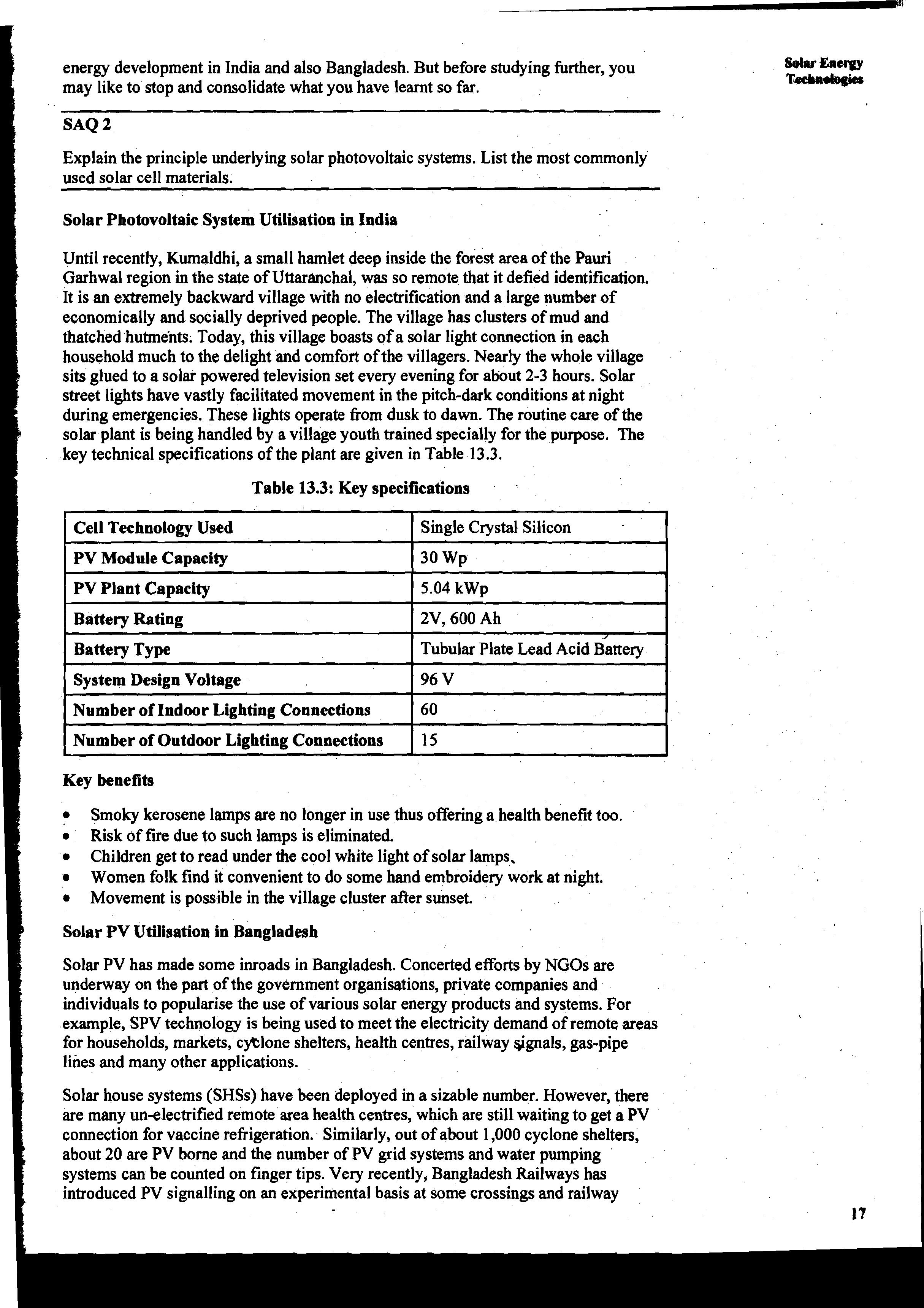
Cell Technology Used
Single Crystal Silicon
PV Module Capacity 30 Wp
PV Plant Capacity 5.04 kWp
Battery Rating 2V, 600 Ah
Battery Type Tubular Plate Lead Acid Battery
System Design Voltage 96 V
Number of Indoor Lighting Connections 60
Number of Outdoor Lighting Connections 15
Key benefits
Smoky kerosene lamps are no longer in use thus offering a health benefit too. Risk of fire due to such lamps is eliminated. Children get to read under the cool white light of solar lamps, Women folk find it convenient to do some hand embroidery work at night. Movement is possible in the village cluster after sunset.
Solar PV Utilisation in Bangladesh
Solar PV has made some inroads in Bangladesh. Concerted efforts by NGOs are underway on the part of the government organisations, private companies and individuals to popularise the use of various solar energy products and systems. For , example, SPV technology is being used to meet the electricity demand of remote areas ' for households, markets, cytlone shelters, health centres, railway Signals, gas-pipe I lihes and many other applications. I
Solar house systems (SHSs) have been deployed in a sizable number. However, there are many un-electrified remote area health centres, which are still waiting to get a PV connection for vaccine refrigeration. Similarly, out of about 1,000 cyclone shelters, about 20 are PV borne and the number of PV grid systems and water pumping systems can be counted on finger tips. Very recently, Bangladesh Railways has introduced PV signalling on an experimental basis at some crossings and railway
Energy, Sumtninrbility and

stations. Gas Transmission Company Limited (GTCL) has also introduced PV for Environment surveillance of gas-pipeline at selected places.
The solar electrification programme is marching ahead successfully. Under a focused initiative of Rural Electrification Board (REB) in 1997-1999, nearly 806 consumers of two river islands were connected to solar electricity through PV installed capacity of 62 KW power. Two non-governmental organisations, Grameen Shakti and Bangladesh Rural Advancement Committee (BRAC), took the initiative of countrywide dissemination of SHSs.
Solar electrification has by now become a major part of the rural electrification programme of the country. A programme entitled "Rural Electrification and Renewable Energy Development (RERED) Programme" is being implemented since 2002. Under this programme, two government organisations IDCOL and REB are entrusted with the responsibility of installing about 64,000 SHSs with the cooperation of NGOs and rural electrification cooperatives, respectively. Until July 2004, more than 23,000 SHSs had been installed by IDCOL. BPDB has recently completed a programme of implementing 900 SHSs. Thus a cumulative total of about 37,000 SHSs with a total capacity of about 2.5 MW have been installed so far in the country. The current rate of installation is about 2500 systems per month.
With this overview of the power of solar energy in this unit, we summarise its contents.
13.4 SUMMARY
Solar energy is an unending source of energy. It can be converted into heat as well as electricity. It has many uses ranging from cooking, lighting, crop drying, space heating and cooling to production of electricity. There are two main categories of solar energy technology: Solar thermal and solar photovoltaic.
Solar collector is the basic device used in the solar thermal technology. It traps solar energy and transfers it to the fluid or air in its immediate contact, which gets heated up. This heat is used for many applications.
Solar cells are the basic devices in the SPV technology used for converting sunlight into electricity. They are made of materials like crystalline silicon, amorphous silicon, cadmium telluride, etc.
SPV systems are mostly used for indoor and outdoor lighting, water pumping, telecommunication, refrigeration and signalling etc. PV for buildings is a fast emerging area, wherein the solar modules are architecturally integrated into the building envelope.
Solar desalination systems are well suited for meeting the potable drinking water requirements of remote communities.
13.5
TERMINAL QUESTIONS
1. Describe the main applications of solar thermal technology. What are the advantages and limitations of using this technology?
2. What are the key components of a solar photovoltaic system?
3. Describe the applications of solar photovoltaics.
4. Which of your own needs can be met by using solar energy? Make a list of the useful solar technologies in your conditions. Prepare an action plan for using solar energy in your home or in your community.
..
UNIT 14 BIOMASS RESOURCES AND TECHNOLOGIES
Structure
14.1 Introduction
Objectives
14.2 Biomass Resources
Some Issues in the Use of Biomass 14.3 Biomass Technologies
Technologies based on Direct Combustion Thermo-chemical Processing Biological Processing 14.4 Summary . 14.5 Terminal Questions

14.1 ' INTRODUCTION
In the previous unit, you have studied about solar energy and its applications. Along with solar energy, biomass is an abundant renewable resource in developing countries. As you know, biomass is nothing but solar energy stored in a chemical form in plant and animal materials. It is a truly rich energy resource ended with a significant potential to meet the energy end-use requirements of millions of people worldwide. It provides not only food and energy, but also raw material for cloth, paper, medicines, chemicals, buildings, etc. Since the discovery of fire, biomass has beeh used as a source of energy. Today, biomass derived fuels are used to heat homes, run cars and buses and even computers. Hardly any part of biomass is worth wasting; energy of some magnitude can be derived out of practically every bit of biomass.
Nature has blessed us with these resources in ample measure. However, existing biomass-based technologies are relatively inefficient and provide Iess energy service than the proportion of total energy it represents. Biomass energy use also contributes to indoor air pollution and associated negative health impacts. However, if the production and conversion of biomass is modernised, it has the potential to provide a much higher level of energy services in developing countries, in environmentally friendly ways. Handling technologies, collection logistics and infrastructure are important aspects of the biomass resource supply chain. Biomass technologies use renewable biomass resources to produce an array of energy related products including electricity, liquid, solid, and gaseous fuels, heat, chemicals, and other materials.
In this unit, we begin by analysing various issues involved in using biomass as an energy resource. We then acquaint you with important biomass technologies and their applications.
Objectives
After studying this unit, you should be able to: /'.
analyse various issues related to biomass resource use; describe biomass processes and technologies; and discuss the important applications of biomass technologies. -- - - ----
14.2 BIOMASS RESOURCES
The term biomass means any plant derived organic matter available on a renewable basii, including dedicated energy crops and trees, agricultural food and fodder crops, agricultural crop wastes and residues, wood wastes and residues, aquatic plants,
I
1
animal wastes, municipal wastes, and other waste materials. There are three ways to use biomass. It can be

burnt to produce heat and electricity, changed to a gas-like fuel such as methane, or changed to a liquid fuel.
While heat is required for cooking purposes, electricity can meet the power needs of small to medium sized communities. Biomass gasification is a promising route to produce useful power via the combustion of several types of agricultural residues like rice husk, baggase and coal briquettes. Producer gas thus released can be used for several end-use applications.
Biomass is considered to be one of the key renewable resources of the future at both small- and large-scale levels. It already supplies 14% of the world's primary energy consumptiori. For three quarters of the world's population living in developing countrkes, biomass is the most important source of energy. It produces more than onethird of the primary energy in developing countries (90% in some countries). It has been called "the poor man's oil" because of its direct use by combustion for domestic cooking and heating. With increasing population and per capita demand, and depletion of fossil-fuel resources, the demand for biomass is expected to increase rapidly in developing countries.
A number of developed countries also use this resource quite substantially. For example, biomass accounts for 15% of the primary energy consumption in Sweden and Austria. Sweden has plans to increase further use of biomass as it phases out nuclear and fossil-fuel plants.
( Energy, Sustainability and Environment
Fig.14.1: Biomass resources
Biomass Potential and its Advantages

The three main categories of raw feedstock materials for biomass technologies are:
IAgricultural waste such as crop residues of cereals, pulses, oil seeds and fibres (cotton stalk), animal wastes such as cow dung, etc.
IAgro-industrial waste such as saw dust, wood chips, groundnut shell, rice husk, bagasse, press mud, coconut shell, coir pith, jute mill waste, etc. [
Plantation crops like coffee husk, tea waste, sugarcane leaves, etc.
There exists an enormous biomass potential that can be tapped by improving the utilisation of existing resources and by increasing plant productivity. Plants are the most common source of biomass. They have been used in the form of wood, peat and straw for thousands of years. More than half of the total wood harvested in the world is used as fuel wood. PlWts ( e.g., trees like willows or Eucalyptus or other high growth rate plants such as sugar cane, maize or soybean) can either be specially grown for energy production, or they can be harvested from the natural environmen'c.!
Wood can be, and usually is, removed from existing forests world-wide in a sustainable manner. Thinning of plantations and trimming of felled trees generate large volumes of forest residues. At present these are often left to rot on site, even in countries with fuel wood shortages. They can be collected, dried and used as fuel by nearby rural industry and domestic consumers. The use of forest residues to produce steam for heating and/or power generation is now a growing business in many countries. Timber processing is a further source of wood residues. Dry sawdust and waste produc6d during the processing of cut timber make very good fuel.
Agricultural waste is a potentially huge source of biomass. Crop and animal wastes provide significant amounts of energy, which is only second to wood as the dominant biomass fuel world-wide. Waste from agriculture includes: the portions of crop plants discarded like straw, whether damaged or surplus supplies, and animal dung. Every year, millions of tons of stFaw are produced world-wide and about half of it is surplus. In many countries it is burnt in the field or ploughed back into the soil. In some developed countries environmental legislation restricts burning straw in the field and I has drawn attention to its potential as an energy resource.
Industrial waste that contains biomass may also be used to produce energy. For example, the sludge left after alcohol production can produce flammable gas. Other useful waste products include waste from food processing and fluff from the cotton and textiles industry.
Biomass can also be produced by so-called short-rotation plantation of trees and other plants like grasses (sorghum, sugarcane, switch grass). All these.plants can be used as fuels. Their main advantage is the short span between plantation and harvesting - typically between three and eight years.
Bio-energy can be modernised through the application of advanced technology to convert raw biomass into electricity, liquid or gaseous fuels, or processed solid fuels. Therefore, much more useful energy could be extracted from biomass than at present. This could bring very significant social and economic benefits to both rural and urban areas, accelerate rural economic activity and help in employment generation.
Growing biomass is a labour-intensive activity and it can create jobs in rural areas. Imagine a new type of farm where energy crops, such as fast-growing trees or grasses, might be grown and harvested for their energy content. Rural industrial-scale biomass energy systems could lead to a variety of income-generating actiiities, e.g., managing bioqass plantations, operating and maintaining bio-energy systems, etc. In regions where climate is especially suitable for biomass growth and labour costs are relatively low, as in the SAARC nations, biomass production costs from plantations-areless than
Biomass Resources and Technologies
US$YGJ. If biomass is sold at $2/GJ, and yields are 10 to 15 dry tonnes per hectare
per year, a plantation could generate gross revenues of $400 to $600 per hectare.
Moreover, the costs of inputs (such as fertilisers and herbicides) for biomass energy production are likely to be substantially lower than those for an annual crop. Besides, biomass could be used locally to generate electricity, which, in turn, could be consumed by additional income-generating industries within the region.
The use of biomass energy has many unique qualities that provide environmental benefits. It can help mitigate climate change, reduce acid rain, soil erosion, water pollution and pressure on landfills, provide wildlife habitat, and help maintain forest health through better management.
However, some issues need to be taken care of while promoting the use of biomass resources. We discuss them in brief.
14.2.1 Some Issues in the Use of Biomass

The major issues pertaining to the use of biomass are: Food or fuel, land availability, and impact on the environment. Let us examine each of these briefly.
Food vs. Fuel
A major criticism often levelled against large-scale biomass plantations for fuel is that it could divert agricultural production away from food crops, especially in developing countries. It is argued that energy-crop programmes compete with food crops in a number of ways (agricultural and nual investment, infrastructure, water, fertilisers, skilled labour etc.) and thus cause food shortages and price increases. However, the subject is far more complex.
The argument should be analysed against the background of the world's (or an individual country's or region's) concrete situation of food supply and demand (everincreasing food surpluses in most industrialised and a number of developing cpuntries), the use of food as animal feed, the under-utilised agricultural production potential, the increased potential for agricultural productivity, and the advantages and disadvantages of producing bio fuels. Food shortages and price increases in the developing countries result from a combination of factors such as growing cash crops on large areas, inflation, currency devaluation, price controls of domestic foodstuffs, etc.
It is important to mention that developing countries are facing both food and fuel I problems. Adoption of agricultural practices should, therefore, take into account this reality and evolve efficient methods of utilising available land and other resources to meet both food and fuel needs (besides other products), e.g., from agro forestry systems. Using improved agricultural technology, it is definitely possible to produce enough food from the present cropland to feed more number of people than the present population.
Land Availability
Biomass differs fundamentally from other forms of fuels since it requires land to grow it on. Since populations are growing, an important question is whether there are sufficient land resources to both feed future populations and sustain the magnitude of biomass energy development envisioned in energy planning. The issues are:
How can land be used in the best possible way?
What mixture of land use and cropping patterns will make optimum use of land to meet the objectives of food, fuel, fodder, and other societal needs?
This requires a full understanding of the complexity of land use. Increased productivity is the key to providing competitive costs and better utilisation of
Energy, Sustainability and
Environment
available land. The main technical challenge is to find a sequence of plantings that can
restore ground temperatures, organic and nutrient content, moisture levels, and other
soil conditions to a point where crop yields are high and sustainable. 5
-- .
US; of fast-growing multiple species, new physiological knowledge of plant growth processes, and manipulation of plants through biotechnology applications, are helping raise productivity 5 to 10 times over natural growth rates in plants or trees. With good management, research, and planting of selected species and clones on appropriate soils, yields of 10 to 15 tlhdyr in temperate areas and 15 to 25 tlhalyr in tropical countries have been obtained. Record yields of 40 tlhdyr (dry weight) have been obtained with eucalyptus in Brazil and Ethiopia.
Developing countries can also use degraded lands for biomass production. It is estimated that developing countries have over 2,000 million hectares of degraded lands, and of these about 621 million hectares are suitable for reforestation. Worldwide interest in restoring tropical degraded lands is growing.
Energy industries might provide the capital needed to finance land restoration activities since advanced biomass conversion technologies like gasifier/gas turbine systems are expected to be highly economically attractive. In principle, energy industries would have an incentive to restore lands in sustainable ways because tliey would require secure supplies of biomass feed stocks throughout the lifetimes (twenty years or more) of their capital-intensive investments in energy conversion facilities. Such supply security could be assured only if the plantations were managed in a sustainable manner.
Other difficulties that must be surmounted reflect general conditions in many developing regions, for example, complex or disputed land ownership, lack of roads or other means to transport biomass to processing facilities and bio fuels to markets. Besides, poor people cannot be expected to wait from three to eight years for cash returns on short-rotation tree crops.
However, in spite of these technical, socio-economic, political, and other difficulties, the potential for growing energy crops is being explored in many successful energy plantations in developing countries. India also has substantial potential for establishing biomass-plantation energy industries. The total area under crops in India was roughly the same in 1990s (around 125 million hectares) as it was in 1970s, despite population growth averaging about 2.4 percent per year during these two ! decades. The prospects for doubling or tripling average annual yields in India are I I good. Thus, food production might be doubled or tripled without increasing cropped area, leaving substantial amounts of land for other uses like biomass plantations.
I Impact on the Environment
Large-scale plantations of biomass for energy are considered to be a massive assault on nature by many people. Environmentalists are concerned about chemical contamination of groundwater, loss of soil quality, aesthetic degradation of landscapes, and loss of biological diversity. They are critical of the intensive agricultural management practices that biomass energy plantations require. Biomass can, of course, be grown for energy in ways that are environmentally undesirable. However, the environmental outcome depends on how the biomass is produced; the production of biomass for energy can also improve the land environmentally relative to present use.
.a
Let us consider the challenge of sustaining the productivity of the land. Since harvesting biomass removes nutrients fiom the area planted, care must be taken to ensure that these.nutrients are restored. The current processes of biomass conversion e.g., in power production, allow the recovery of all mineral nutrients as ash at the biomass conversion facility and to return the ash to the plantation as a fertiliser. However, nitrogen lost to the atmosphere at the conversion facility must be
Biomass
and Te
Sustainability
replenished. This, as you know from the course MED-001 can be done in a number of Environment environmentally acceptable ways.
Energy crops also offer flexibility in dealing with erosion and chemical pollution from .\-A pesticide use. If the energy crop is an annual crop (e.g., sorghum), the erosion and
herbicide pollution problems would be similar to those for annual row-crop agriculture; cultivating such crops should be avoided on lands susceptible to soil erosion. However, potential biomass energy crops also include: fast-growing trees that are harvested only every three to eight years and replanted perhaps every fifteen to twenty-four years, and perennial grasses that are harvested annually, but replanted only once in a decade or so. Both these alternatives reduce erosion. Careful selection of species and good plantation design and management can be helpful in controlling / pests and diseases, thereby minimising or even eliminating the use of chemical pesticides.
It is also argued that the range of biological species supported by biomass plantations is much narrower than for natural forests. This criticism is valid only if a biomass plantation replaces virgin forest. However, if a plantation is established on degraded lands, it can support a more diverse ecology than was possible' before restoration. TE same argument holds if biomass energy crops replace monoculture food crops. A more ecologically varied landscape can always be designed and implemented.
With this brief discussion of some issues involved in the use of biomass resources, we move on to the biomass technologies in use today. But first you must attempt an SAQ!SAQ 1
Outline the arguments given for and against biomass plantations. In their light, analyse the feasibility of biomass as an energy resource. - -
14.3 BIOMASS TECHNOLOGIES

A number of biomass energy technologies exist worldwide. You have learnt in unit 3 that the technologies are based on direct combustion, thermo-chemical processing and biological processing. We have described briefly these processes in Unit 3. We now describe some important technologies based on these processes, their advantages and limitations.
14.3.1 Technologies based on Direct Combustion
Direct combustion is the commonest and the simplest way of extracting energy from * biomass resources. A significant population of the developing countries still bums wood, cow dung cakes, coal or plant residues in open stoves to meet their cooking and heating needs. Unfortunately, this simple method of energy extraction is also quite inefficient. For more than a third of the world's people, the real energy crisis is a daily scramble to find the wood they need to cook dinner. Their search for wood, once a simple task, has become increasingly difficult due b deforestation. Reforestation, use of alternative fuels and fuel conservation through improved stoves are some ways to meet the firewood crisis. Alternative fuels like biogas and solar energy can be one part of solution. Another solution lies in using efficient wood burning techniques like improved cook stoves and boilers.
Improved Stoves
An example of the improved stove is the Kenya Ceramic Jiko (KCJ). It is made of ceramic and metal components and can be produced and marketed through the local informal sector. This stove is an improved version of the traditional all-metal stove. It increases stove efficiency by the addition of a ceramic insulating liner (the brown element), which enables 25 to 40 percent of the heat to be delivered to the pot. From
20 to 40 percent of the heat is absorbed by the stove walls or else escapes to the
Energy,
and
j
24
environment. In addition, 10 to 30 percent gets lost as gases, such as carbon dioxide.
The traditional metal stove delivers only 10 to 20 percent of the heat generated to a pot; from 50 to 70 percent of the heat is lost thfough the stove's metal sides, and another 10 to 30 percent escapes as carbon monoxide, methane and other flue gases.
Fig.14.2: a) Open stove transfers heat to a pot poorly. As little as 10 percent of the heat goes to the cooking utensil; the rest is released to the environment; b) The metal stove also transfers about 80-90% of the heat to the surroundings; and c) the improved stove enables up to 40% of the heat to be used
You have studied about the use of boilers for direct combustion in Unit 3. Apart from wood pellets, wood chips (made of waste wood from the forests), wood briquettes (made of compressed sawdust'and wood shavings) and straw are used in boilers (see Fig. 14.3). Good boilers have efficiency of the order of 80-90%. While using biomass, the thing to take care of is that the fuel being used must be dry. Water content in biomass makes it uneconomical to burn. This is because a proportion of the energy in the wood is used for evaporating the water, leaving less energy for heat. Therefore, biomass has to be dried before it can be burnt. Wood that has been painted or glued should never be burnt, since toxic gases are formed on combustion. Nor should waste such as waxed paper cartons be burnt.

Flue gas exhaust
I I
Fig.14.3: Schematic diagram of a wood boiler along with the fuel
i
Biomass Resources and Technologies
14.3.2 Thermo-chemical Processing
You have learnt in Unit 3 that pyrolysis, gasification and liquefaction are some of the processes in this category.
You have also learnt about charcoal production through pyrolysis in Unit 3. ' Charcoal has many advantages: It can be produced from nearly any kind of plantderived biomass material. Biomass can be converted to charcoal with conversion yields of 40% to 60% compared to current yields of 25% to 35%. This means that less feedstock would be needed to produce the same amount of charcoal. Moreover, with improved technology, charcoal can be produced in 1 to 2 hours.
The production of charcoal spans a wide range of technologies. The various production techniques produce charcoal of varying quality. The characteristics of good quality charcoal are given in Table 14.1.
Table 14.1: ~haracteristifsof good quality charcoal
Ash content
Fixed carbon content 75 percent Volatiles content 20 percent Bulk density 250-300 kg/m3
Physical characteristics : Moderately friable
The production of charcoal comprises six major stages: Preparation of wood, drying, pre-carbonisation, carbonisation, end of carbonisation and cooling and stabilisation of charcoal.
Preparation of wood for charcoal production consists of stacking wood, debarking it to reduce the ash content of the charcoal produced. Debarking reduces the ash content to between 1 and 5 percent which improves the combustion characteristics of the charcoal. Drying of wood is carried out at temperahires ranging from 110 to 220 degrees Celsius. In this stage the water content is reduced. Pre-carbonisation takes place at temperatures of about 170 to 300 degrees. In this stage, liquids in the form of methanol and acetic acids are expelled fiom wood and a small amount of carbon monoxide and carbon dioxide is emitted.
At 200 to 300 degrees, in.the carbonisation stage, a substantial proportion of the light tars and acids are produced. The end of carbonisation produces charcoal which is in essence the carbonised residue of wood. It takes place at temperatures between 300 degrees and a maximum of about 500 degrees. In this stage, the remaining volatiles are driven off and the carbon content of the charcoal increases. Finally, cooling of charcoal takes place for at least 24 hours to enhance its stability and reduce the possibility of spontaneous combustion. Then charcoal is removed fiom the kiln, packed and transported for sale to customers.
Gasification

Gasification refers to the production of flammable gas by burning wood or charcoal at high temperatures under controlled conditions. Carbon monoxide, methyl gas, methane, hydrogen, hydrocarbon gases, and other assorted components, in different proportions, can be obtained by heating or burning these fuels in an isolated or oxygen poor environment. This is done by burning them in a burner which restricts combustion air intake so that the complete burning of the fuel cannot occur. A related process is heating them in a closed vessel using an outside heat source. Each process produces different products.
Gasification is the newest method to generate dectricity from biomass. It captures about 6570% of the energy in solid fuel by converting it first into combustible gases.
Energy, Sustainability and Environment
This gas is then used like natural gas, to create electricity, fuel a vehicle, in industrial applications, or converted to synfuels, i.e., synthetic fuels. It can be used to run a turbine. Gas turbines have lower unit-capital costs, can be considerably more efficient and have good prospects for improvements of both parameters.
Biomass gasification systems generally have four principal components: Fuel preparation, handling and feed system; gasification reactor vessel; gas cleaning, cooling and mixing system; energy conversion system (e.g., internal-combustion engine with generator or pump set, or gas burner coupled to a boiler and kiln).
When gas is used in an internal-combustion engine for electricity production (power gasifiers), it usually requires elaborate gas cleaning, cooling and mixing systems with strict quality and reactor design criteria making the technology quite complicated. Gasifiers used simply for heat generation do not have such complex requirements and are, therefore, easier to design and operate, less costly and more energy-efficient. All types of gasifiers require feedstocks with low moisture and volatile contents. Therefore, good quality charcoal is generally best, although it requires a separate production facility and gives a lower overall efficiency.
Biomass is easier to gasify than coal and has very low sulphur content. Gasifiers using wood and charcoal (the only fuel adequately proved so far) are commercially available these days.
In India, the frontier areas of research in biomass gasification are: making cheaper gasifier systems; design and development of application packages for drying agricultural produce, for plywood industry, and other industries; formulation of qualifying tests and upgradation of standards; optimisation of dual-fuel engines for rural grid; design and development of 100% producer gas based engines along with electronic control systems for gasifiers, gas engine conversion kits for various power levels and pyrolised biomass based gasifier systems.

SAQ 2
Describe the applications of biomass technologies based on direct combustion and thermo-chemical processing.
14.3.3 Biological Processing
Fermentation and anaerobic digestion are biological processes that can be used to derive useful energy from biomass.
Fermentation
A unique feature of biomass energy is that it can be converted directly into liquid bio fuels such as ethanol and bio diesel. Ethanol is generally produced by fermenting any biomass high in sugar or carbohydrates, e.g., corn. It finds use as a fuel additive to cut down on a vehicle's carbon monoxide and other smog-causing emissions. Ethanol is the most commonly used bio fuel. A blend of gasoline and ethanol under the name of Gasohol is already used in cities with high air pollution. However, ethanol made from corn is currently more expensive than gasoline on a gallon-for-gallon basis. Today, we have found new ways to produce ethanol from grasses, trees, bark, sawdust, paper, and farming wastes. These processes could greatly increase the use of biomass energy.
Bio diesel is being used as a diesel additive to reduce vehicle emissions or in its pure form to run a vehicle. It is made from vegetable oils, animal fats, algae, or even
Biomass Resources and Technologies
Energy, Sustainability and recycled cooking'greases. Any vegetable oil, corn, cottonseed, peanut, sunflower, or Environment canola could be used to produce bio diesel. Diesel fuel can also be replaced by bio diesel made from vegetable oils. Researchers are also developing algae that produce oils, which can be converted to bio diesel. Jatropha is a new oil seed, which is being touted as the'fuel of the future. Extensive field testing of this high growth fuel plant has been carried out worldwide and its energy content is up to the desirable standards and requirements. At present, a few major oil companies are also looking into the possibility of using Jatropha as a transport fuel. As biomass can be changed directly into liquid fuel, it could someday supply much of our transportation fuel needs for cars, trucks, buses, aeroplanes, and trains.
IFig.14.4: An etl~anolproduction plant and the use of ethanol in transportation
Biogas

Biogas is a colourless. tasteless, odourless, non-toxic, inflammable gas. produced by the decomposition of organic waste and biomass such as animal, human and plant (crop) wastes, weeds, grasses, vines, leaves, aquatic plants and crop residues etc. It is produced in the absence of air (oxygen), in a process in which the organic material is converted into methane and carbon dioxide. Excellent organic fertiliser and humus are , obtained as by-products.
Since the composition of this gas is different, the burners designed for coal gas, butane or LPG when used, as 'biogas burner' will give much lower efficiency. Therefore specially designed biogas burners are used which give a thermal efficiency of 55-65%. Because of the mixture of carbon dioxide in large quantity, biogas becomes a safe fuel in rural homes as it will prevent explosion.
Biogas Plant
The one essential requirement in producing biogas is an airtight (air leak-proof) container. The airtight container used for the biogas production under artificial condition is known as digester or reactor. It is either an under ground cylindrical or ellipsoidal structure where the digestion (fermentation) of the raw materials takes ' place. The decomposition (fermentation) takes place inside the digester due to bacterial (microbial) action, which produces biogas and organic fertiliser (manure) rich in humus and other nutrients.
In a simple Rural Household BGP working under ambient temperature, the digester is designed to hold slurry equivalent to of 55,40 or 30 days of daily feeding. The drgzster can be constructed of brick masonry, cement concrete (CC), reinforced cement concrete (RCC), stone masonry, pre-fabricated cement concrete blocks (PFCCB), ferro-cement (ferro-concrete), steel or rubber or bamboo reinforced cement mortar (BRCM).
The fresh organic material (generally in a homogenous slurry form) is fed into the digester of the plant from one end, known as inlet pipe or inlet tank. The inlet pipe reaches the bottom of the digester well on one side of the partition wall. The top end of this pipe is connected to the mixing tank. It is a cylindrical tank used for making homogenous slurry by mixing the manure from domestic farm animals with appropriate quantity of water. Thorough mixing of the slurry before releasing it inside the digester helps in increasing the efficiency of digestion. Normally a feeder fan is
, I fixed inside the mixing tank for facilitating easy and faster mixing of manure with water for malung homogenous slurry.
There is a provision for storing biogas on the upper portion of the BGP. There are some BGP designs that have Floating Gas Holder and others have Fixed Gas Storage Chamber (see Fig. 14.5).

Mixing tank fi Steel gas drum
Mixing tank Gas pipe
Plan view
Slurry outlet
In the case of floating gas holder BGPs, the gas holder is a drum like structure, fabricated either of mild steel sheets, ferro-cement (ferroconcrete), high density plastic (HDP) or fibre glass reinforced plastic (FRP). It fits like a cap on the mouth of digester where it is submerged in the slurry and rests on the ledge, constructed inside
Biomass Resources and Technologies
I
Fig.14.5: a) Cross-section of a floating gas holder BGP; b) fixed dome BGP
the digester for this purpose. The drum collects gas, which is produced from the slurry &+&mtnment inside the digester as it gets decomposed, and rises pwards, being lighter than air. t'

In the case of fixed dome designs, the biogas holder is commonly known as gas storage chamber (GSC). The GSC is the integral and fixed part of the Main Unit of the Plant (MUP) in the case of fixed dome BGPs. The gas storage capacity of a family size fixed dome BGP is kept as 33% of the rate capacity (daily gas production in 24 hours). This storage capacity comes to approximately 8 hours of biogas produced during night when it is not in use.
On the other end of the digester, an outlet pipe or outlet tank is provided for the automatic discharge of the liquid digested manure. In the case of floating gas holder, the outlet is made of cement concrete pipe standing at an angle, which reaches the bottom of the digester on the opposite side of the partition wall. In the fixed dome plants, the outlet may be made in the form of rectangular tank.
However, in some cases, the upper portion of the outlet (known as outlet displacement chamber) is made hemi-spherical in shape, designed to save in the material and labour cost. In almost all models, the bottom end of the outlet tank is connected to the outlet gate. There is a small opening provided on the outer wall of the outlet chamber for the automatic discharge of the digested slurry outside the BGP, equal to approximately 80-90% of the daily feed. The top mouth: of the outlet chamber .I is kept covered with a heavy slab.
The gas outlet pipe is fixed on the drum at the centre in the case of the floating biogas holder BGP and on the crown of the fixed dome BGP. From this pipe thegconnection to gas pipeline is made for conveying the gas to the point of utilisation. A gate valve is fixed on the gas outlet pipe to close and check the flow of biogas from plant to the pipeline.
Functioning of a Simple Indian Rural Household Biogas Plant
A fixed quantity of fresh organic material (generally in a homogenous slurry form) is fed each day into the digester of the plant from the inlet. Normally it is fed in one lot at a pre-determined time. It goes down at the bottom of the digester and forms the 'bottom-most active layer', being heavier than the older material.
As the organic material ferments, biogas is formed which rises to the top and gets accumulated (collected) in the gas holder (in case of floating gas holder BGPs) or gas storage chamber (in case of fixed dome BGPs). The biogas is obtained from the gas outlet pipe. Alternatively, the biogas produced can be taken to another place through a pipe connected on top of the gas outlet pipe and stored separately.
The slurry (semi-digested and digested) occupies the major portion of the digester and the sludge (almost fully digested) occupies the bottom most portion of the digester. The digested slurry (also known as effluent) is an excellent bio-fertiliser, rich in humus. The anaerobic fermentation increases the ammonia content by 120% and . quick acting phosphorous by 150%. Similarly, the percentage of potash and several micro-nutrients useful to the healthy growth of the crops also increase. Nitrogen is transformed into ammonia that is easier for the plant to absorb.
The digested slurry can either be taken directly to the farmer's field along with irrigation water, stored in slurry pits (attached to the BGP) for drying or directed to the compost pit for making compost along with other waste biomass. The sluny and the sludge contain a higher percentage of nitrogen and phosphorous than the same quantity of raw organic material fed inside the digester of the BGP. The digested slurry effluent, either in liquid-form or after sun drying makes excellent bio-fertiliser for agricultural and horticultural crops or aquaculture.
Energy,
Sustainability and
I
The freshly digested sludge, especially if night soil is used, has high ammonia content. In this state, it may act like a chemical fertiliser by forcing a large dose of nitrogen than required by the plant and thus increasing the accumulation of toxic nitrogen compounds. For this reason, it is best to let the sludge age for about two weeks in an open place. The fresher the sludge is, the more it needs to be diluted with water before application to the crops; otherwise very high concentration of nitrogen may kill the plants.
The mixture of coarse fibrous and lighter material that separates fiom the manure slurry and floats on the top most layer of the slurry is called scum. The accumulation and removal of scum is sometimes a serious problem. In moderate amounts, the scum cannot do any harm and can be easily broken by gentle stirring, but in large quantities, it can slow down biogas production and can even shut down the BGPs.
The spent liquid of the slurry (mixture of manure and water) layering just above the sludge is known as supernatant. Since supernatant has dissolved solids, the nutrient value of this liquid (supernatant) for plants is as great as that of the eMuent (digested slurry). Supernatant is a biologically active by-product; therefore, it must be sun dried before being used in agticultural fields.
The feed stock for the BGP always has some inorganic solids such as mud, ash, sand, gravel, etc. which go inside the digester dong with the organic materials. The bacteria cannot digest the inorganic solids. Therefore, it settles down as a part of the bottom most layers inside the digester. The presence of too many inorganic solids in the digester can adversely affect the efficiency of the BGP. Therefore, to improve the efficiency and enhance the life of a BGP, it is advisable to empty it in a period of 5- 10 years. It should be washed and cleaned thoroughly fiom inside and then reloaded with fresh slurry.
Cogeneration: Biomss-Fired Gas Turbine
A current trend in industrialised countries is the use of increasing number of smaller and more flexible biomass based plants for cogeneration of heat and electricity. The plant combines a wood furnace with a gas turbine. A hot, pressurized flue-gas filter cleans the exhaust gas from the furnace before it drives the power turbine. The plants can give an electric efficiency of about 19% and overall efficiency of up to about ' 75%. The exhaust gas can be used in a steam turbine, increasing electric output and electricity.
Future Developments

Efforts are under way to assess the suitability of using bio-based chemicals and materials, fiom which it may be possible to derive products such as anti-freeze, plastics, and personal care items. In some cases these products may be completely biodegradable. Currently, all these elements have a petroleum base. Bio-based chemicals are under various stages of development at present, but their availability at some point in the near future may be a boon to us.
Of course, like many resources, we need to manage our use of biomass or we might consume it faster than we produce it. So what do we need to do to replenish the I biomass on a regular basis? This can be accomplished through energy crop i plantations.
Also, like any fuel, biomass creates some pollutants when it is burnt or converted into energy. However, the associated emissions are by and large well within the stipulated norms barring some situations. Biomethanation of the vegetable waste for power generation is also catching up fast. However, Municipal Corporations in the developing regions have yet to take concrete steps in this direction.
With this brief description of biomass technologies, we now present some Indian ' initiatives for acceleration of the Biomass Power generation programme.
Biomass Resources and Technologies
Energy, Sustainability and Key Initiatives of Indian Biomass Production Programme
An established potential of 3,500 MW of power generation through bagasse based co-generation in sugar mills.
Biomass power generation
from surplus agricultural residues.
A new programme on advanced biomass gasification for development and application of advanced technologies, such as, Biomass Integrated Gasificationcum-Gas Turbine Combined Cycle technology.
Indigenous development of biomass gasifiers capable of producing power fiom a few KW up to 1 MW capacity. Export of biomass gasifiers to developing countries of Asia and Latin America, as well as to Europe and USA.
Large number of installations for providing power to small scale industries and for electrification of a village or group of villages.
Biomass Gasification System Utilisation in India: An Example
Gosaba is one of the several important islands of Sunderbans, a place located around 135 km from the main city of Kolkata in West Bengal. It had no grid connection until 1997. Based on the site-specific survey, a 500 kW capacity biomass gasifier system was put up for the electrification of 5 villages. These villages have a collective population of around 10,000 people. To meet the raw feedstock requirement, nearly 100 hectares of wasteland on the island was converted into an energy plantation area. As per the available estimates, the consumption of biomass in a dried form is about 900 g per unit of power produced. The expected yield of the biomass in a plantation area of 100 ha is about 10 MTthalyr.
Gosaba is now known as the energy island due to path breaking initiatives taken by the West Bengal Renewable Energy Development Agency (WBREDA). At present, domestic, commercial and industrial users are using the electric power supply fiom these gasifiers for a variety of end use applications.
We hope that in this unit, you have acquired some insights into the usefulness of biomass as a sustainable energy resource. We now summarise the unit contents.

14.4 SUMMARY
Biomass is a form of stored solar energy, which can be burnt to produce both heat and electricity, changed into gas like fuel or even transformed into a liquid fuel.
Biomass energy systems make use of nearly all types of agricultural residues, agro-industrial residues, and plantation crops.
The major issues pertaining to the use of biomass are: Food or fuel, land availability and the impact on the environment.
Biomass technologies are based on direct combustion, thermo-chemical processing and biological processing. Improved cooking stoves, boilers, charcoal production through pyrolysis, gasification, production of bio fuels like ethanol and bio diesel, bio gas, etc. are some of the biomass technologies and products in use today. Biomass gasification is a cheap and efficient way of producing electricity.
Biomass energy is cost competitive with that available from the utility grid. It is a relatively clean source of energy, if combustion is ensured under the controlled conditions. Biomass energy can either be used in a stand-alone mode or coupled to the grid for meeting various end-use applications.
Environment

UNIT 15 HYDROPOWER AND WIND ENERGY
Structure
15.1 Introduction
Objectives
15.2 Hydropower , Small Hydropower
Working of Small Hydropower Plant
Small Hydropower Development in India
15.3 Wind Energy
Working of Wind Energy Systems
Wind Energy Applications in India
15.4 Summary 15.5
Terminal Questions
15.1 INTRODUCTION
Along with solar energy and biomass resources, water and wind are abundantly available energy resources. Many regions across the world have enormous supplies of water mainly in the form of rivers, streams, waterfalls, etc. You know that the water in rivers and streams can be used to produce electricity, also termed hydropower. The most common form of hydropower uses dams on rivers to create large reservoirs of water. In Unit 3, you have learnt how electricity is produced in hydropower plants. The focus in this unit is on small hydropower that produces electricity without disturbing the ecological and social conditions of a place. SmallStomedium sized local water resources can be tapped to fulfil the electricity demands of remotely located areas. Small hydropower has proved to be a cost competitive source of electricity.
In this unit, we also acquaint you with the working of wind energy systems. You have learnt about wind energy in Unit 3. In view of its economic success, wind power is playing a leading role in the development of renewable energy technologies. The technological progress made in wind turbines over the last few years has been tremendous. The next generation of turbines are expected to generate 3 to 5 MW power. The idea is that if you'know the potential of these technologies, you can influence decisions about their use and take advantage of their applications in your own context.
Objectives
After studying this unit, you should be able to: ;.<explain the working of a small hydropower plant and a wind turbine; discuss the advantages and limitations of these technologies; and evaluate the potential of small hydropower and wind energy in India.
15.2 HYDROPOWER
You have studied about the ecological impact of hydropower in Unit 4. Although hydropower is inexpensive and does not produce air pollution, damming water bodies can change the ecology of the region. For example, the water below the dam is often colder than what would normally flow down the river, so fish sometimes die. The water level of the river below the dam can be higher or lower than its natural state, which affects the plants that grow along the riverbanks. Mega hydropower projects also have major social costs. In developed and many developing countries, such huge

r
projects are being phased out slowly. The share of hydropower generation in India has shown a downward slide in spite of its large scale potential.
With the growing environmental consciousness, the stage is well set for large scale exploitation of small hydropower (SHP), which if used with care, can leave the ecology of a place undisturbed. Moreover, it is the highest density energy resource amongst all renewable sources of energy. The small hydropower route of power generation is well-established technologically across the globe under a diverse range of geo-physical conditions. Small and medium hydropower stations are now major sources of power supply in many countries of Europe and South East Asia, Canada, the USA and Brazil. Governments worldwide have formed a wide range of attractive policy initiatives coupled with financial and fiscal incentives to boost the growth of SHP.
Increasing numbers of small hydro systems are being installed in remote sites across the globe. There is a growing market for small hydropower systems especially in the developing countries as it also decreases the power demand and supply reliance on the conventional power grid. Therefore, you should know about it.
15.2.1
Small Hydropower
A hydropower plant producing less than 10 MW of useful electric energy is said
k to be a small hydropower plant. It can meet the captive power needs of closely located communities. With SHP, the transmission and distribution (T&D) losses are much lower as the power generated is close to the point of use. The small scale hydro is the cheapest way to power a house located away from the main grid. The price per kilowatt-hour is far cheaper than photovoltaics (PV) and even less than wind. We now explain the working of a small hydropower plant.
15.2.2
Working of Small Hydropower Plant
You know that in hydropower plants, the energy of falling water is captured to generate electricity (see Fig. 15.1). The falling water moves a turbine, which runs the generator to produce electricity.
Small hydro systems have the following components:
a water turbine that converts the energy of flowing or falling water into mechanical energy that drives a generator, which generates electrical power; a control mechanism to provide stable electrical power; and

Hydropower and Wind Energy
Energy, Sustainability and The amount of power that can be produced in a hydropower plant depends on two Environment factors:
I. Flow rate, i.e., the amount of water flowing per unit time, and 2. Head, i.e., the height from which the water falls.
Fig.15.2: Flow rate and head determine the power capacity of a hydropower plant
See Fig. 15.3. Depending on the site, the following may need to be put in place to produce power from a small hydropower system:
an intake to divert stream flow from the water course. The intake is usually placed off to the side of the main water flow to protect it from the direct force of the water and debris during high flow,

a canallpipeline to cany the water flow to the fore bay from the intake,
a fore bay tank and trash rack to filter debris and prevent it from being drawn into the turbine at the penstock pipe intake, a penstock pipe to convey the water to the powerhouse, a powerhouse, in which the turbine and generator convert the power of the water into electricity, and
a tailrace through which the water is released back to the river or stream.
Power house Tail 'race Feeder f / Reserve flow
Fig.15.3: Schematic diagram of a small hydropower plant
If a pipeline is used, it should be of sufficiently large diameter to minimise friction . losses from moving water. If possibl~the pipeline should be buried in the ground. This stabilises the pipe and prevents animafs from chewing it. Pipelines are usually made from PVC although metal or concrete pipes can also be used.
IMost SHP systems are of the "run-of-river" type. This means that neither a large dam nor water storage reservoir is built nor is land flooded. Only a fraction of the available
Most SHP systems are of the "run-of-river" type. This means that neither a large dam nor water storage reservoir is built nor is land flooded. Only a fraction of the available stream flow at a given time is used to generate power, and this has little environmental impact. Additionally, fish ladders can be created to prevent fish from being harmed. Power is generated at a constanbrate in an SHP system. However, if it is not used, it can be stored in batteries or sent to a shunt load.
However, these systems produce electricity only when water is available; generation ceases when it dries-up and the flow falls below a predetermined amount. Therefore, there is much less regulatory complication.
Power can be supplied by a small hydropower plant in two ways:
In a battery-based system, power is generated at a level equal to the average demand and stored in batteries. Batteries can supply power as needed at levels much higher than that generated and during times of low demand, the excess can be stored. The input voltage to the batteries in a battery-based system commonly ranges from 12 to 48 volts DC. If the transmission distance is not large, then 12 volts is often high enough.
Lead-acid deep-cycle batteries are usually used in-hydro systems. Deep-cycle batteries are designed to withstand repeated charge and discharge cycles typical in renewable energy systems. Usually, a small hydro system needs just one to two days storage. In contrast, PV or wind systems may require many days' storage capacity because the Sun or wind may be unavailable for extended periods. This is typically known as system autonomy.
If enough energy is available, an alternating current (AC) system can generate power. This system typically requires much higher power level than the batterybased system. In an AC system, there is no battery storage. This means that the generator must be capable of supplying the instantaneous demand, including the peak load.
The most difficult load is the short-duration power surge drawn by an induction motor found in refrigerators, freezers, washing machines, some power tools and other appliances. Since other appliances may also be operating at the same time, a minimum power level of 2 to 3 kilowatts may be required for an AC system, depending on the nature of the loads. In a typical AC system, an electronic 1 controller keeps voltage ar.d frequency within certain limits. The system's output is monitored and any unused power is transferred to a "shunt" load, such as a hot i water heater.
Battery-based systems usually need far less water than AC systems and are cheaply available. One of the advantages of a battery system is that the generator can be shut down for servicing without interrupting the power delivered to the loads. Since only the average load needs to be generated in this type of system, the pipeline, turbine, generator other components can be much smaller as compared to an AC system. Very reliable inverters are available to convert battery power into AC output. These are used to power almost all home appliances.
Small hydropower in developing countries implies decentralisation. Energy produced is usually supplied to relatively few consumers nearby, mostly with a low-tension distribution network. With energy efficient appliances and lights and careful end-use management, it is possible to reduce the average demand to about 200 watts of continuous supply.
Small hydropower system is not a complicated system. However, it needs to be designed with an utmost care keeping in view its operation at remotely located sites. -
! \ i Before ending this discussion, let us look at the advantages and limitations of thiA i, technology.

and Wind Energy
Hydropower
Energy, Sustainability and Key Advantages of Small Hydropower Environment
SHP is a reliable, mature and proven technology. It can be exploited wherever sufficient water flows in streams, small and medium rivers, waterfalls, irrigation dams and canal drop sites.
SHP does not involve setting up of large scale dams or problems of deforestation, submergence or rehabilitation of displaced population.
It is a decentralised and environmentally benign source of power, which can be harnessed cheaply.
It is non-polluting, entails no wastes or production of toxic gases and is thus quite safe to use.
It is ideally suited for power fulfilment needs of small areas and village clusters and is an ideal substitute for diesel generators run at high cost of power generation.
It has minimal operation and maintenance costs and can be maintained even by semi-skilled local people.
Limitations
Hydropower systems can be difficult to install.
Site topography is usually complex and logistics during the period of system installation become somewhat difficult.
SHP systems require a diversion from the water body, pipelines from the diversion to the turbine,and a place to put the turbine above the high-water level of the stream. Building a diversion and intake that effectively screens out debris and can stand up to high seasonal e flows is particularly challenging.
Many a times, the turbine site is far enough away from the home and requires long runs of electrical cable.
Most hydro systems are limited in output capacity by stream conditions. That is, they cannot be expanded indefinitely like a wind or PV system. The sizing procedure needs to be based on site conditions rather than power needs. Thus, the size and/or type of system components may vary appreciably from site to site.
System capacity may be governed by specific circumstances (e.g., water drying up in the summer). A hydropower system is much more site-specific than a wind or photovoltaic system since a sufficient quantity of falling water should always be available.
In case insufficient potential is available to generate the power necessary to operate the average load, more energy efficient appliances need to be used. Or other forms of generation equipment have to be added to the system. Hybrid wind/PV/hydro systems are very successful and the energy sources complement each other.
But if these limitations are overcome, we are rewarded with a constant, inexpensive, and low-maintenance source of energy.
15.2.3 Small Hydropower Development in India
India is bestowed with large resources of water bodies in the form of large rivers, waterfalls and streams. There exists an estimated potential of about 15,000 MW of small hydropower projects in India. In India, successful execution of smaller hydro capacities has been demonstrated under the UNDP-GEF hilly hydro programme and

also by successful Independent Power Producers (IPPs). There are a sizable number of small hydropower development projects with the potential to generate 25 MW each.
Thirteen States in India (Himachal Pradesh, Uttar Pradesh, Punjab, Haryana, Madhya Pradesh, Karnataka, Kerala, Andhra Pradesh, Tamil Nadu, Orissa, West Bengal, Maharashtra and Rajasthan) have announced their policies for private sector participation in SHP sector. Core activities identified under the renewed focus on SHP include the following:

nation-wise resource assessment, setting up of commercial SHP projects, renovation and modernisation of old SHP projects, development and up-gradation of water mills, and industry based research and development.
The facilities available include wheeling of power produced and banking, attractive buy-back rate, and facility for third party sale.
More than 760 sites of about 2000 MW capacity have already been offered/allotted in these States. Indian Renewable Energy Development Agency (IREDA) provides soft loans for setting up SHP projects up to 25 MW capacity in the commercial sector. UNDPIGEF Hilly Hydro project is also being implemented actively.
There are more than eight manufacturers in the country in the field of small hydropower manufacturing various types of turbines, generators and control equipment etc.
However, to date, only about 15% of the projects sanctioned have been implemented or are under various stages of implementation. The reasons for such a massive shortfall may be enumerated as follows:
The existing mode of project allotment via open bids does not differentiate between bidders who are keen to actually implement the project and those who bid and hold on to the allotment indefinitely.
The entry cost of Rs. 5-10 lakhs per MW is rather low. This allows bidders with minimal financial means to enter the fray, particularly in the 1-3 MW range. More often than not, such bidders are always on the lookout to sell the allotted project in lieu of some quick cash gains.
Occasionally, the bidding company does have not the proper capability to execute the project. This may be in the form of inadequate knowledge and experience of executing such a project.
In some cases, the project may have been taken up under the business diversification plan of the company. The remoteness of the project site and the distance from the usual place of business turn out to be the major handicaps.
At some sites where the actual generation potential was found to be lower than estimated, the project has been abandoned.
The high project cost and water royalty levied as free power deliverable to the SEB at 12-18 percent of generation also hinder the projects.
The state governments have not instituted any scheme to encourage timely' completion of the projects.
Due to these reasons, the actual power generated from the small hydro projects remains insignificant and much of the realisable potential remains untapped.
Hydropower and Wind Energy
The Ministry of Non-Conventional Energy Sources (MNES) offers substantial cash subsidy for hydropower projects up to 25 MW capacity. The Project income is exempt from tax for ten years. No less important is the fact that hydro projects automatically qualify for carbon credits under the Clean Development Mechanism (CDM) supported by the Kyoto Protocol and similar Emission Reduction Funds. In addition, such projects provide a perennial stream of revenue to the investors. Besides, with the allowable provision to trade power, the entry of the private sector may push up the demand for hydropower generation because of its cost advantage. Let us look at some examples of SHP use in India.
Small Hydropower Utilisation in Uttaranchal
The water mills of Uttaranchal are in the process of receiving a technology refit at the hands of non-governmental organisations and the concerned government agencies. These water mills are known as gharats in the local parlance. The gharats are typically used for grinding wheat, rice and maize and also to extract oil. Such gharats are now getting technology attached to their slow moving wheels.
As per rough estimates, about half-a-million water mills exist in the entire Himalayan region from the North Eastern states to Jammu and Kashmir. It is possible to produce about 2500 MW of power from these mills at an average generation of 5 kW per unit. Uttaranchal alone has over 70,000 water mills. Around 150 such water mills have been turned around with bare minimum changes since 1989 to produce power in the Garhwal region of Uttaranchal through the painstaking efforts of local NGOs.

Today, in Lachiwala near Dehradun (in Uttaranchal) one such water mill produces enough electricity to light homes and run appliances along with grinding grains. The proud owner of the house has upgraded his gharat to power light bulbs, fans, TV, refrigerator and cooler too.
In Rudraprayag, another house owner designed his own turbine, which is no mean accomplishment. Today, each one of the 5 1 houses in the village cluster has a light connection at the nominal charge of Rs. 10 per month.
Small Hydropower Projects in Uttaranchal
Sustainability
Environment
Energy;
and Incentives available for SHP Development
In the village of Dogwala up in the mountains, just 12 km from Dehradun, the capital of Uttaranchal, there are no roads, water supply, and telephone lines. The village houses about 12 families living below the poverty line. Homes are located roughly around a small canal that runs right through the middle. A few families, own traditional water mills or gharats. Until some time ago, there was no electricity in the village.
When the story of a faster gharut model that increased the output of flour grinding reached this village, three water millers in the village installed this new system. This turbine was so fast that their grain grinding output nearly tripled to 40 kg per hour and they could also produce their own electricity. Each water mill started generating 1 KW (kilowatt) of power. The children of Dogwala no longer had to study by the light of kerosene lamps. The run down water mills of the mountains were beginning to light up homes here.

Village youth were trained in operating and maintaining the system. They not only understood the working of the system they could also trouble shoot. These gharats have turned into a small industry. The miller usually employs two others to thus
t ensuring employment opportunities for the village youth. Sometimes a third person is employed as an electrician to check the lines and ensure that the power supply is uninterrupted.
Wedged deep in the Himalayan Mountains are springs andglaciers that ensure steady b flow of water perennially. The rivulet that runs through Rarngopal's field is a forceful one, and it hosts three turbines. Once his mill used to grind grains, today it is being used almost exclusively to operate a lathe machine. His turbines not only produce 5 KW of electricity but also run a lathe machine. The workshop is lined with metal wheels at all stages of development. Turbines are being fabricated here. His unit also doubles up as a training centre for aspiring gharatis - from government officials to army men who want to use this technique in remote outposts on the mountains. His unit can be seen busy working on new turbines that need to be installed in more inaccessible parts of the mountains. They are happy, as all the villages they have visited are now producing 2 kW power.
Most homes have two to three lights - no one wants to use oil lamps any more. Ramgopal cannot believe the respect and admiration he has started getting! And that too for a home made product. He has found a novel way to share this prosperity with the rest of his village. With one more turbine he should be able to generate 10 KW power, he says, "...at night when my workshop is shut, the street lamps can be lit. Our village is near the highway, after nightfall the place is very dangerous for our children,
Fig.15.4: a) A traditional gharat; b) Ramgopal with his lathe machine (Source: www.indiatogether.org/)
Hydropower and Wind Energy
Energy, Sustainability and so the street lamps would be really useful. I think the best service I can provide others Environment is sharing my knowledge with them."
Ramgopal avers "I have seen that the government spends lakhs of Rupees and yet it cannot provide electricity to all the remotest of places. If it decides to spend small amounts like Rs. 1 to 1.5 lakh on newer and more efficient models like the glzarat, our villages can produce their own electricity. Through simple technology and minimum investment, maximum benefit can be obtained."
These are some glimpses of how small hydropower is transforming the lives of people in remote areas.
So far, we have provided you a brief introduction to the working and the usefulness of small hydropower. You may like to evaluate your understanding before studying . about wind energy in the next section.
SAQ 1
Explain the working of a small hydropower plant. Under what conditions would such an option be feasible for power generation?
15.3 WIND ENERGY
You know that wind is considered an indirect form of solar energy. This is because wind is driven by temperature differences on the surface of the Earth caused by sunshine. For centuries, wind has been used to sail ships, grind grain, and pump water. Now, people use it to generate electricity. The windmills built long ago had many blades, but modern wind turbines have two or three blades (Fig. 15.5). However, the blades on wind turbines are much longer than those you might see on a windmill. In fact, wind turbine blades can be up to 82 feet (25 metres) long.
Fig.15.5: Wind turbines
The blades drive a generator that produces electricity, much like steam turbines. The longer the blades and the faster the wind speed are, the more is the electricity generated by the turbine. Wind turbines are placed on towers because the wind blows harder and more steadily at these heights. A typical 600 kW turbine has a blade diameter of 35 metres and is mounted on a 50-metre concrete or steel tower.
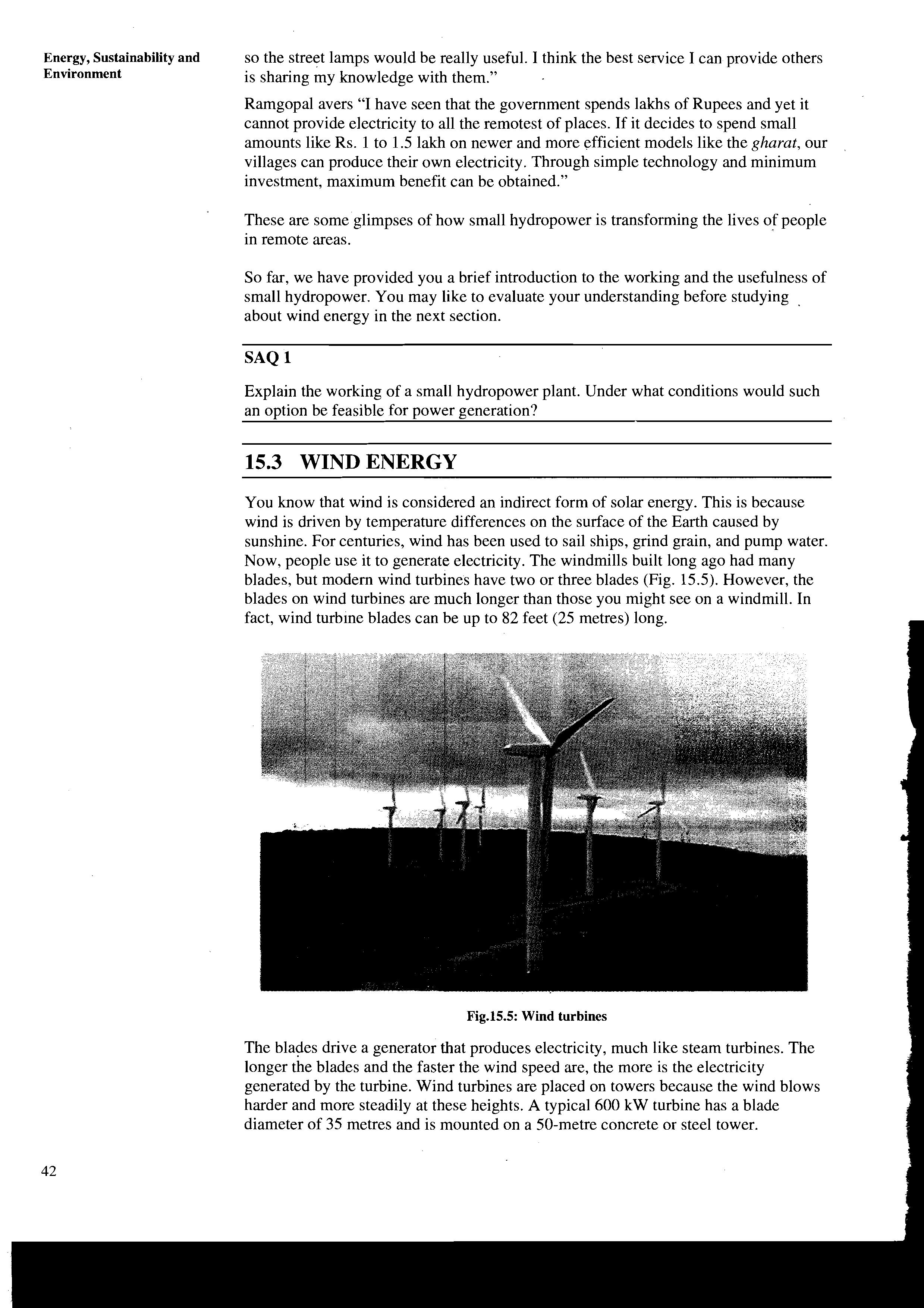
1
To produce the maximum amount of electricity, wind turbines need to be located in areas where the wind blows at a constant speed. Wind speed is described by seven "classes." Class 7 winds are extremely strong, while Class 2 winds are mild breezes. Generally, Class 4 winds and above are considered adequate for a wind turbine to produce electricity. New turbine designs now take advantage of less windy areas by using better blades, more electronic controls, and other improvements. Some new turbines can also operate efficiently over a wide range of wind speeds.
Large groups of wind turbines, called wind farms or wind plants, are connected to electric utility power lines and provide electricity to many people. New wind farms can generate electricity at $0.04/kWh, a price competitive with many conventional technologies. Wind energy can be used for stand-alone systems or fed into the grid.
The immediate demand for rural energy supply in developing countries is for smaller machines in the 5-100 kW range. These can be connected to small, localised microgrid systems and used in conjunction with diesel generating sets and/or solar photovoltaic systems. These types of hybrid systems are ideally suited both for energy resource optimisation as well as cost reduction measures. Battery power backup system may be needed in view of the intermittent nature of both solar and wind, energy.
An advantage of wind turbines over some forms of renewable energy is that they can produce electricity whenever wind blows (at night and also during the day). In theory, wind systems can produce electricity 24 hours every day, unlike SPV systems that cannot produce power at night. Land around the turbines may still be used for agricultural production. There is no aidwater pollution anc! wind farms are relatively cheap to build.
However, even in the windiest places, the wind does not blow all the time. So, even though wind farms do not need batteries for backup storage of electricity, small wind systems need backup batteries. Moreover, wind energy systems have relatively high initial costs. Complex rotating machinery requires regular servicing from trained personnel. Care must be taken to avoid noise from the turbines. There can be a danger to birds from the rotating blades. There may be a strong resistance from local groups objecting to the visual impact of turbines on the landscape.
You may be wondering if it is feasible to tap wind energy wherever it blows and in whatever measure. Practically, every such site is not wind potential worthy. Generation may be intermittent and is best suited to sites with regular and reliable wind patterns.
Criteria for Site Selection

The following considerations may be kept in mind for the purpose of evaluating windy sites:
The ideal and best possible site for locating a wind energy system is at the top of a smooth well rounded hill having a gentle slope and open areas like the shorelines of sea or lake. Ideally, the average wind speed should vary from 6.5 to 8 m/s for useful power production. Prime wind sites have average wind speeds greater than 7.5 m/s (27 kmhour). Offshore sites provide excellent opportunities for wind turbines. Sites with wind speed varying between 3-4 m/s may also be feasible. The mountain coastal terrain offers some of the best wind power generation sites.
The power that can be generated from a modern wind turbine is usually related to the square of the wind speed. This means that a site with twice the wind speed of another will generate four times as much energy.
Good wind speed data is critical to determining the economic feasibility of a wind project.
Energy, Sustainability and Applications of Wind Energy Environment
There are many applications of wind energy in domestic use: to provide power for homes in remote areas for lighting, and other appliances.such as radios and televisions; water pumping: to provide clean water for drinking and washing, water for fish farming, animal fanning and irrigation systems; large-scale power generation: by connecting wind farms to the national grid.
We now explain the working of wind energy systems.
15.3.1 Working of Wind Energy Systems
The wind turbine is the main component of a wind energy system. As it rotates, it drives a genera'tor to produce electricity. A modem wind turbine (see Fig. 15.6) usually consists of the following components: Blades, Rotor, Transmission, Generator, and Controls.
Shaped like the wings of a plane, blades capture the wind. They are made of Fibre Reinforced Plastic (FRP). Most turbines have two or three blades. As the blades are moved by the wind, they turn a central hub.
All the blades of a turbine and the central hub to which the blades are attached make up the rotor. The rotor is connected through a series of gears (transmission) to an electrical generator, Gears connect the low-speed shaft to the high-speed shaft and increase the rotational speeds from about 30 to 60 rotations per minute (rpm) to about 1200 to 1500 rpm, which is the rotational speed required by most generators to produce electricity.
Fig.15.6: The schematic diagram of a wind turbine

he generator in wind energy systems is similar in construction to the generators used in thermal power plants. The controls start up the systems at wind speeds of about 8 to 16 miles per hour (mph) and shut them off at about 65 mph.
Turbines cannot operate at wind speeds above about 65 mph because their generators could overheat.
Wind turbines are rated by their maximum power output in kilowatts (kW) or in megawatts. For commercial utility-sized projects, the most common turbines sold are in the range of 600 kW- 1000 kW (one megawatt) - large enough to supply electricity to 600-1 000 homes. The newest commercial turbines are rated at 2 niegawatts.
SAQ 2
Discuss the advantages and limitations of wind energy systems citing a few applications.
15.3.2 Wind Energy Applications in India

India's total wind power potential stands at around 45,000 MW. These figures were upgraded on the basis of a massive national wind resource assessment project. The wind machines deployed initially had a power generating capacity ofjust around . 50 kW which has now leen upgraded to about 750 kW and more.
Today several large scale wind farms operate in the southern region of the country. A National wind energy tes'ing centre has been established in Chennai to maintain the standards as well as test the field performance reliability of the wide range of wind manufacturing equipment. 'bite-wise data pertaining to wind speed is'now available for a large number of windysites. Using this data, the techno-economic feasibility of a site can be evaluated.
Wind farms are now adding nillions of units to the Indian power grid and several arrangements are now avaihble for grid interfacing, third party sales and wheeling and banking facilities. We pesent here an example of wind energy use in India.
Wind Energy: An ExampL from Tamil Nadu
Wind energy has changed on of the most backward regions of Tamil Nadu, the Muppandal region, into an inbmational model for social development. The giant fans atop the cluster of hills here see a standing testimony to the wind power development in this region. The region has dose to 1500 giant windmill structures accounting for a whopping 460 MW of electric4 generation.
Large sums of money invested 1 wind power have offered many direct and indirect job opportunities to the villagers In fact, Muppandal may be the only inhabited terrain in the world with a large concernation of wind mills. It may also go down as one of the first examples of renewable eergy having brought riches to an otherwise barren and drought prone area.
The land owners were the first to enefit from the wind farm development. Earlier, they had neither the means to cultlate their land nor were they in a position to sell it due to the lack of buyers. Their lothanged with the setting up of the National Centre for Wind Equipment Testing at Ch~nai.Availability of wind power helped them to irrigate their fields as they took advntage of 24 hour supply of quality power flowing through the newly set up electrical &id. Financial and technical support services related employment has found largepkers here. Young boys barely out of teens have been trained to check for defects on routine basis.
Having provided you a glimpse of thpower of small hydro and wind energy in transforming the lives of people with :adily accessible technology, we end this unit
Hydropower and Wind Energy
15.4 SUMMARY

Small hydro and wind energy are economical, non-polluting and environmentally benign renewable sources of energy. These are clean sources of energy and therefore effective,technologies for reducing carbon emissions.
Water in the rivers, canals and streams can be captured and turned into hydro electric power. Small hydropower depends on two parameters: the flow rate, i.e., the amount of water flowing per second and the head, i.e., the vertical distance from which the water falls.
A small hydro system consists mainly of turbine, generator and pipeline to ca&y water from the source to the turbine. In addition, it has an intake to divert stream flow from the water course, a fore bay tank and trash rack to filter debris and prevent it from being drawn into the turbine at the penstock pipe intake, and a tailrace through which the water is released back to the river or stream. It is easy to maintain and has long term operability.
Power produced in a small hydro system can either be stord in the batteries or fed directly to the grid. Small hydro system can also be put in a hybrid combination either with Solar PV or wind energy dependingon the site specific conditions and parameters.
/
Small hydro use is particularly well suited for developing auntries like India, which has a large hydro resource and a large number of upelectrified villages. Small hydropower is a cheap source of power, which can aeet the power needs of isolated village communities.
Wind is an intermittent energy source and not availabe everywhere unlike solar energy. Wind energy output depends on a number of ite specific parameters like the terrain, hour of the day and other topographic&\features.
The machines which convert wind energy into electricalenergy are called wind electric generators. The turbine is the main componed of a wind energy system.
Wind energy farms use a large number of wind elechc generators and are usually located away from the humdrum of noisy citis and towns. Wind energy can be fed to the utility power grid directly or used fo~captivepower generation.
Large scale wind energy programmes are in operatio throughout the world. India, a SAARC member nation, is the fifth major pvducer of wind energy.
Energy, Sustainability and Environment
15.5 TERMINAL QUESTIONS 1. Discuss the advantages and limitations of small hyropower technology. 2.4 What are the criteria to tap small hydropower? 3. Discuss the advantages and limitations of wind etrgy technology. 4. Explain the criteria to set up wind energy system # 5. How can the small hydropower and wind enery systems be used in the Indian context? Use the information given in Unit 8 wlle formulating your answer.
UNIT 16 SUSTAINABLE ENERGY FOR CLEAN ENVIRONMENT
Structure
16.1 Introduction
Objectives
16.2 Moving towards a Sustainable Energy Future
16.3 'Cleaning-up' of Fossil and Nuclear Technologies
Carbon Sequestration
Fuel Switching
16.4 Switching to Renewable Energy Sources
16.5 Future Energy Scenarios
16.6 Summary
16.7 Terminal Questions
16.1 INTRODUCTION
You have now reached the end of this course. By now you have acquired a fairly comprehensive understanding of the available energy resources, their advantages and limitations, the energy production technologies and consumption patterns, and their impact on the environment, the economics of energy use and the potential of renewable energy technologies. Where do we go from here? Given the current understanding of energy and environment related issues, what are our future options? How should we fashion our energy future so that it is compatible with the goals of sustainable development?
In the last unit of this course, we look at these questions and explore the pathways that lead us to environment-friendly sustainable use of energy. We examine what steps need to be taken to improve energy sustainability. We conclude by presenting certain long-term energy scenarios that have been developed by governmental and nongovernmental bodies. These bring in a wide variety of assumptions about population and economic growth and the potential for energy conservation or efficiency improvement, and different combinations of carbon-based and carbon-free energy sources. 1 I Objectives
I
t After studying this unit, you should be able to: 1 discuss the measures that need to be taken for sustainable energy use in future; describe the steps required to clean up existing energy technologies; a explain the desirability of using renewable energy sources; and a analyse the future energy scenarios presented in current studies for their sustainability.

16.2 MOVING TOWARDS A SUSTAINABLE ENERGY FUTURE
You would agree that in order to progress?owards energy sustainability, we need to carry out radical changes in our patterns of energy production and consumption. However, before we discuss the feasibility and the plausibility of these changes, it would be useful to recall the profound changes that have already occurred in our energy use and energy systems during the latter half of the twentieth century.
Energy, Sustainability and Recall the situation just after the Second World War. In the developed world (the Environment USA and Europe), most homes and other buildings were heated by coal. Most electricity generation was coal-fired, and most rail transport was propelled by coalburning steam engines. Coal combustion caused major pollution problems, including the notorious 'smogs', which in most winters caused the premature deaths of hundreds (and occasionally thousands) of people.

Coal miners'perished in their dozens, and sometimes hundreds, in mining accidents year after year, and many others died slowly of lung diseases caused by inhaling coal dust. Open coal fires in most houses were so inefficient that, despite consuming large quantities of energy, they only heated a few rooms effectively whilst the rest remained cold. At times, coal burnt for domestic heating in closed rooms resulted in the death of the occupants due to poor awareness about the deadly release of carbon monoxide in the process.
Motor cars were still owned only by a minority and air travel was confined to a small elite. Most people travelled by bus, train, cycle or on foot. Journeys were relatively few, compared with today, and usually over quite short distances.
In India, only a small percentage of the population had access to electricity. Most people relied on vegetable oil fired lamps to combat darkness and on biomass resources for cooking and heating needs.
Post Second World War, the energy systems were transformed. Oil became the main fuel for industries and the transportation sector. Natural gas, which burns much more cleanly and efficiently, was introduced very rapidly into, homes and buildings in the developed world. Most homes in the developed countries now have gas-fired central heating systems which ensure that the whole house is maintained at a comfortable temperature.
Coal is still used for electricity generation, but flue gas desulphurisation and electrostatic precipitators now greatly reduce emissions of sulphur dioxide and particulates. In new power stations, coal is increasingly being replaced by gas, which can be burnt very cleanly and efficiently using combined cycle gas turbines.
Cars are now owned by the majority of the people in developed countries and by the affluent sections of the developing countries. Air travel overseas has increased, railways are powered mainly by electricity, and travel overall, measured in passengerkilometres, has tripled since the 1950s. New gas emission standards have been promulgated, for example, EURO I and EURO I1 standards. Vehicle testing in respect of the polluting gas has been made more stringent now. The dramatic changes that have occurred in energy systems during the past 50 years have, broadly, been paralleled in most 'developed' countries over the same period.
Given the scale and profundity of the changes over the past half-century, it does not seem unrealistic to suggest that equally-profound changes could well occur over the next 50 to 100 years in developed as well as developing countries, as we attempt to improve the sustainability of our energy systems, nationally and globally.
b
What can we do today to help in the move towards a sustainable energy future? Let us find out. However, even as we discuss various dimensions of this issue, you need to keep in mind that a large proportion of people in developing countries still suffer from, acute energy poverty. Energy sustainability from their perspective implies energy security, access and equity in energy use, of course, in an environmentally benign manner. Many arguments coming up in the discussion particularly in relation to consumption, pricing, etc. apply more to the affluent sections of these countries.
The measures for energy sustainability would need to be taken on many fronts: Energy technologies, energy demand and consumption patterns, and economic policies.
You know that the current ways of producing, distributing, and consuming energy are quite inefficient. The majority of energy technologies and systems in use today are polluting, non-renewable, and damaging to ecosystems. You have learnt in Block I that burning coal, natural gas and other fossil fuels causes global warming and degrades air quality. Nuclear energy generates intractable radioactive wastes and relies on destructive mining practices. While hydropower dams do produce renewable energy, almost all dams of any size have devastating effects on fish and wildlife as well as human habitations, which need natural, free-flowing rivers to sustain them.
Large, highly centralised power utilities are inefficient and suffer significant power
I losses during power generation, transformation and distribution. Transportation systems currently rely almost entirely on fossil fbels, which will need to be phased out to stabilise the climate.
These problems suggest the need for making capital investments, and designing energy systems in new ways to increase the efficiency of energy use and decrease their environmental impact.
5 Oil and coal have been the principal drivers of our economic prosperity so far. Renewables and electricity hold the keys for the future. Electricity is the most efficient power source for running trains, fixed route transport and homes, and for lighting, especially with the emerging LED technology. Communication depends almost entirely on electricity. Electricity could be used with high efficiency for space heating (if electric heat pumps were used together with solar energy heat sources) and cooling.
In future, as oil and coal are left behind as the dominant energy technologies, the energy systems would have to be converted increasingly from a chemical to an electrical base. Electric power would become the reference energy against which all other forms of energy would be compared. For example, the cost of synthetic hydrogen would be compared against the cost of electricity needed to obtain this hydrogen. Applying the principles of this simple comparison may well lead to new technologies focused on energy use more than on energy production and distribution.
Future engineers will need to make choices that are quite different from those made a generation or two ago. Electrical systems with their proven high efficiencies would gradually replace chemical energy conversion systems saddled with inferior efficiencies. For example, efficient electric systems would replace inefficient chemical energy converters like thermal power plants, IC engines or fuel cells. This vision is
directly related to the physics of the future energy supply and the necessity for rational use of the energy we would be able to harvest from renewable sources.
Energy production will need to become more regional and local. When utilities are locally owned, they can be given a mandate to promote energy efficiency amongst their customers through technical assistance and financial incentives. Thoroughly exploiting efficiency strategies can lead to a reduction of energy use by a factor of two to four or more. Moreover, the enormous infrastructure for transporting oil and gas could be phased out as it competes with super-efficient systems for bringing electrical energy to industrial and personal consumers. By 2050, we might not be transporting energy as chemical commodity at all. Instead we might be able to transport energy as pure energy itself.
Renewables like wind energy and biomass conversion will play a dominant role at the regional and local level as these offer a certain measure of choice on where and when to produce electricity. Wind farms are located on the basis of decisions that take account of where suitable wind conditions and land are available and of where custome~sare. By contrast, there is no choice possible on where to locate oil or coal field - it must be where the oil deposits are, and that may be half a world away from

Sustainable Energy for i Clean Environment
Energy Technologies for the Future
E
Energy Demand and Energy Efficiency
You have studied that the existing energy production and distribution system is rife with inefficiencies: in fossil-fuel burning utilities themselves, in transmission and distribution losses, and in appliances and devices of all kinds (motors, lights, buildings, pumps, computers, etc.). This situation will need to be remedied.

We should not forget the cheapest resource we have: energy efficiency. You know that energy efficiency, which effectively manages energy demand, is the cheapest way to provide for an increased demand for services. We will have to do more with lessby substituting frugal technologies, improved management, changing behaviours, and decentralising and fine-tuning the production and distribution of electricity. Stringent standards would need to be enacted for all energy-consuming products; these should be analogous to electrical safety standards but aimed at preventing wasteful use of energy.
You have learnt in Block 3 that it is cheaper to generate megawatts by reducing energy demand through energy efficiency than to provide new power sources. Even without energy taxes which reflect the environmental costs of energy production, investments in energy efficient motors, lights, buildings, vehicles, etc. offer rapid paybacks to individuals and companies. Compact-fluorescent and other efficient lights, efficient motors and pumps, efficient appliances and office equipment, and solar building retrofits are all cost-effective.
The energy demand would have to be met with a portfolio of energy sources, which are renewable, non-polluting, and compatible with the health of ecosystems. Such sources include wind, solar, small-scale hydro, biomass, and geothermal. With suitable safeguards, these sources can be certified and marketed at a substantial premium under such names as "green power". We will take this point up in greater detail in Sec. 16.4.
One major step towards a sustainable energy future involves an improvement in energy efficiency. Societies must promote and invest in energy efficiency; people must bring about changes in their lifestyles, behaviours and energy consumption patterns.
i
For example, we must use energy-efficient lighting including compact fluorescents, efficient neon tubes, day lighting, Light Emitting Diodes (LEDs) for traffic lighting and billboard advertising purposes, and heating and cooling (including natural ventilation, passive solar design, insulation, and efficient furnaces) systems. We must exercise all options available for energy conservation including recovery of energy from waste.
Waste as an Energy Resource
Industrial processes were initially designed to take resources, make products, and turn them to waste. Two centuries of take-make-waste have begun to degrade the.health of ecosystems. Waste, by definition, is a foregone opportunity, which is now placing a severe drag on the bioregional, national, and global economies. Industrial waste includes components from crude materials extraction (e.g., mining or forestry), materials processing and manufacturing, pesticides and fuels dissipated into the environment during product use, and post-consumer and municipal wastes. This volume of waste is hcreasing annually, as is the total resource consumption. With future population growth, the increased social, environmental and economic stress from resource use and waste will only become worse.
This growth in the volume of waste. has important total cost implications for its disposal. The economic costs associated with disposal include the escalating prices charged for using the limited capacity of our landfills and the expense of cleaning up unproductive areas created by waste. There are also nfajor human and ecosystem
Energy, Sustainability
Environment
and
q
health impacts. Eco-friendly ways of waste treatment are an active area of research today (see Fig. 16.1).
Waste generation is increasing also because the industry, retail firms, governments and individual consumers do not have an incentive to use natural resources frugally. The resources are artificially cheap, and the gross national product and other measurements of economic health do not capture the environmental and social consequences of the initial and subsequent waste production and disposal costs. Strategies need to be evolved and implemented to reduce and, if possible, eliminate waste. One way to go about this is to shift the current tax burden from labour and investment (which provides no incentive for conservation) towards consumption, particularly consumption of natural resources, virgin materials, and goods and services that pose significant environmental threats.

Not generating any external waste in the first place remains the primary strategy. A significant move towards sustainable energy future involves using waste as a resource. An internal cascade of waste streams, as water, energy, and materials go through a series of cross-fertilising transformations is an excellent application of Waste as a resource. An example is that of zero-waste breweries which generate a whole range of value by-products, including worms, compost, animal feed, and mushrooms from process "wastes".
Fig.16.1: Living machines are complex ecosystems which can be used for wastewater treatment
Any external waste streams that remain after careful applications of this strategy should be designed to be a useful resource as far as possible. For instance, the industrial eco-parks now being developed throughout the United States contain clusters of companies, which are designed to synergistically use each other's waste heat, water, chemicals; and materials, collectively producing zero waste. Waste Exchanges are most beneficial and easiest to arrange when companies are in close proximity, but even then contractual arrangements for the supply of waste streams can be a delicate issue given the intrinsic variability of production processes.
When waste streams have not been designed as a resource, it is often still possible to find willing customers. It may be necessary to make capital investments to alter the quality, composition, packaging, or timing of the waste stream. Waste Exchanges allow industrial producers and consumers to find each other through listings of materials available and in demand. Such exchanges have kept thousands of tons of materials in use.
Inside a facility, waste as a resource can be used to cascade different uses of water, energy, and materials. When external waste streams are generated, these can be co-
Sustainable Energy for Clean Environment
Energy, Sustainability and located within a zero-waste eco-industrial park. If this is not possible, or waste Environment streams already exist, customers can be sought for them through Waste Exchanges, and capital improvements can be made as needed to provide a compatible form of waste.
Waste as a Resource can be applied in any rural or urban community as an important contribution to sustainable energy use and for employment generation. In many instances, it creates new skilled jobs, contributing to social equity.
SAQ 1
How can energy efficiency and managing energy demand contribute to energy sustainability? Explain how waste can be used as an energy resource.
Creating a sustainable energy future involves introducing radical changes in energy consumption, improving efficiency of energy use and energy technologies, and using waste as a resource. In addition to these measures, certain economic measures are needed to manage energy demand and promote energy sustainability.
Economic Measures
Pricing and regulatory changes will have to be introduced to reduce per capita energy consumption and carbon emissivity, and increase efficiency of energy usage. Energy prices would need to be made sufficiently high to punish wasteful behaviour while honouring efficient energy use across the board, especially in the road transport sector. Managing energy flows economically would require price signals by real-time tariffs so the system can optimally use generating capacity.

Modern information technology could help in managing demand side and in improving the match between production and consumption of electricity in time. This will reduce the requirements for stand-by capacity to follow peaks in demand and reduce overall costs. With proper incentives most electricity could be consumed at the same time as it is produced, so that there is no big need for storage. Facilities like electric cars, many heating or cooling appliances or private washing machines can be programmed to draw power fiom the grid during off-peak hours. Even laptop computers and other electronic devices with storage batteries can be programmed to go off-grid at certain times during the day.
To attain a diversity of electricity from primary renewable energy sources, operators of all renewable energy systems could be given guaranteed feed-in tariffs which cover their specific generation costs, with regressive twiffs over time. This would help them recover their sometimes high up-front investment costs, and serve as an incentive for switching over to renewable energy systems.
Wind energy seems to be at the threshold of becoming the least-cost-technology for electricity generation. But other technologies for renewable energy are still more expensive than electricity from paid-off thermal power plants. Guaranteed feed-in tariff system should be applied for all renewable technologies with no or very low . externalities and with good potential for cost:regression by mass production and further technical improvements.
The energy consumer, in particular the industry, will eventually benefit from investments made in the renewable area, considering that once paid-off renewable energy installations produce energy extremely cheap. With mass production, renewable electricity will be much cheaper than power from ever more expensive coal, natural gas or nuclear as in this system, energy will be produced where it is cheapest and most available in terms of capacity and time.
Models would need to be developed which apply guaranteed feed-in-tariffs for electricity imports, too. This can give access to cheap primaryresources for mutual
benefit of exporting and importing countries. Regional arrangements between countiies already exist on a limited scale, which will have to be expanded.
A balance would need to be maintained between locally produced energy and cheap imports. A standard for mandatory use of renewables in situ by every household or business might be an incentive for more energy security, for controlling efficiency of electricity use (minimising stand-by-losses, for example) and for reducing costs.
1 Economic incentives would need to be given for promoting research fo; future energy technologies for harvesting and distributing energy from renewable sources, in systems for efficient energy storage with superconducting magnets, super capacitors,
I I advanced batteries, compressed air, and to practicable methods for converting biomass into synthetic liquid hydrocarbon energy carriers.
In addition to the measures suggested so far, the existing energy technologies would need to be made environmentally benign so that their impact is mitigated in the
I transition period to futuristic energy technologies.
16.3 'CLEANING-UP' OF FOSSIL AND NUCLEAR
* TECHNOLOGIES
Cleaning-up of fossil and nuclear technologies means mitigation of some of the adverse 'environmental' consequences of fossil and nuclear fuel use. It is done through the introduction of new, 'clean' technologies that should substantially reduce pollution emissions and health hazards. These include 'supply-side' measures to improve the efficiency with which fossil fuels are converted into electricity in power stations; cleaner and more efficient combustion methods; the increasing use of 'waste' heat in combined heat-and-power schemes; and 'end of pipe' technologies to intercept and store pollutants before they enter the environment.
This approach also includes carbon sequestration and fuel switching -shifting our energy use towards less-polluting fuels, for example, from coal to natural gas. It may also be possible to 'clean up' nuclear power by adopting more advanced technologies that are safer and entail the emission of fewer radioactive substances over the entire nuclear fuel cycle.
t 16.3.1 Carbon Sequestration
You have learnt in Block 2 that one way of mitigating climate change is through 'carbon sequestration'. To sequester means to 'put away', and sequestratfon of carbon essentially involves finding ways of removing the carbon generated by fossil fuel burning and storing it so that it cannot find its way back into the atmosphere.

One way of sequestering carbon is to plant additional trees which 'soak up' C02 from the atmosphere while they are growing. However, whilst this could provide a partial response to the problem of rising C02 levels, the sheer magnitude of world emissions is now so great that sequestration in forests alone is probably impractical. It has been estimated that to sequester (in trees) the carbon produced by world fossil fuel combustion over the next 50 years would require the afforestation of an area the size of Europe from the Atlantic to the Urals. Also, when these trees eventually decay and die, they would emit a similar quantity of COz, which they had absorbed during growth. Therefore, it would be necessary to replace the old trees with new ones on an indefinite basis.
However, wood fuel from fast-growing plantations, managed in a sustainable manner, could be harvested and used as a substitute for fossil fuels, instead of simply being allowed to grow to maturity and then decay. This would offset the carbon emissions that would otherwise have been generated by burning fossil fuels.
Energy for Clean Environment
Sustainable
Energy, Sustainability and Another approach to sequestering C02 is to extract it after combustion in, for Environment example, a power station and store it in some suitable location. It appears to be technically possible to transport by pipeline, large quantities of post-combustion C02 and store it indefinitely in disused oil or gas wells or in saline aquifers beneath the sea bed (see Fig. 16.2).
Sleipner A platform
Sleipner T -* platform
A$&& ,' ,id,; ,a ,
COz injection scheme
Production And Injection
Fig.16.2: Norwegian Statoil's Sleipner field project. Gas from this field has a very high COz content. Excess C02 is pumped into a saline aquifer, the Utsira formation, about 800 m below the sea bed. A million tons per year of COz are 'sequestered' in this way
Further research is required to confirm the feasibility, security, safety and economic viability of such techniques. These would only be a realistic option in the case of power stations or similar large installations: it would hardly be practicable to apply this approach to emissions from vehicles or homes.

16.3.2 Fuel Switching
Switching to a fuel with lower carbon content will reduce emissions of C02 but may involve a structural change in the energy supply system. The greenhouse gas emissions from combustion of a number of fuels are compared in Table 16.1. Emissions from all stages of the cycle of production, transport and use are considered; apart from the combustion stage. These include: COz released from transport of fuels and from flares; CH4 leakage from oil and gas fields and pipelines, and N20 from forestry.
Table 16.1 shows that, for example, switching from coal to gas to meet a particular energy demand would reduce emissions of greenhouse gases. Examples of thls can already be seen in the UK, with commercial decisions to replace coal-fired power generation by natural gas-fired combined-cycle plant, Another example, at smaller scale, is in Poland where CHP equipment and condensing gas boilers are being installed with GEF funding.
A possible form of fuel switching for the future could be the use of an alternative. energy carrier, such as hydrogen. Fossil fuels could be de-carbonised by removing C02 for separate storage. Hydrogen would then be supplied to consumers, who would use advanced combustion systems or fuel cells. This route offers a technically feasible
C.
Gas I
I
wells I I
way of delivering fuel to distributed users without incurring the penalty of large C02 emissions.
Table 16.1: Greenhouse gas emission facton for a number of fuels

The potential to reduce emissions of C02 by fuel switching is limited by the resources available to a country or region and issues such as the national policy on energy security.
Researchers report the desirability, cost effectiveness, feasibility, and practicability of switching fuels from coal to natural gas at major electric generating plants. Fuel switching to natural gas, researchers theorise, could contribute significantly to a reduction in the major air pollutants emitted by the electric generation industry.
Key pollutants of concern include sulphur dioxide (SO2) and nitrogen oxides (NOx), responsible for acid rain and also precursors to the formation of secondary particulates that are strongly associated with human health morbidity, mortality effects, and visibility impairment. NOx is also a precursor to tropospheric ozone, which causes human health problems and damage to agriculture and forest ecosystems. Several hazardous air pollutants including mercury emitted from coal-fired power generation are also a concern for human and ecosystem health.
Natural gas, on the other hand, emits virtually no sulphur dioxide and has lower NOx emissions than coal, leading to far lower particulate formation. Natural gas emits much less mercury and other hazardous air pollutants, and less than one-half the carbon dioxide per kilowatt-hour of electricity generated with coal.
Although major regulatory initiatives are underway to reduce many of these pollutants, including NOx, particulates and mercury, these efforts are largely focused on feasible emission abatement technologies and not on fuel switching. Since coalfired power plants contribute a major share in all the above pollutants, fuel switching would have cumulative positive effects in preventing pollution.
Researchers are considering fuel switching initiatives given the environmental issues facing the electric utility industry. They seek to identify the environmental benefits and economic costs of fuel switching to natural gas as a compliance strategy when the switch is viewed as a solution to an integrated environmental problem involving multiple pollutants. Transition to new fuel modes needs to be realised by creating a proper infrastructure both for storage and fuel delivery.
SAQ 2
a) Discuss the economic measures needed to promote energy sustainability.
b) What do you understand by carbon sequestration?
c) Explain how fuel switching to natural gas from coal based power production technologies helps in cleaning up the environment.
Clean Environment
Sustainable Energy for
16.4 SWITCHING TO RENEWABLE ENERGY
SOURCES
Energy is integral to virtually every aspect of life; it is hard to imagine life without it. Yet many of our most serious threats to clean air, clean water, and healthy ecosystems stem from human energy use. Currently, most of our useful energy is produced from coal, oil, natural gas, and uranium. These energy sources destroy fragile ecosystems and endanger human health. The use of outdated, polluting energy sources is dirtying our air and water and destabilising our climate. We can meet our energy needs and protect human health, our climate, and other natural systems by using energy more efficiently and by switching to clean, renewable energy sources such as the sun, wind, biomass, hydropower, etc.
You have studied in Unit 4 about the reasons why we need renewable energy sources. We briefly recapitulate the information here.

Acid rain and mercury pollution from coal power plants damage forests, wildlife, and human health. Oil spills and energy-related toxic wastes destroy marine ecosystems and contaminate soil and water. Nuclear power produces radioactive wastes that will poison the environment for thousands of years, unless managed through advanced control mechanisms.
The consequences of global warming are already being felt, and in future we can expect to see much greater impacts. The severity of climate disruption that we will ' face in the future may depend significantly on how much and how soon we reduce our fossil fuel use and switch to clean, renewable energy.
We can meet our energy needs and protect human health, our climate, and other natural systems. The key is to use energy more efficiently, and to switch to clean energy systems powered by renewable energy sources such as the sun and-wind. We have to mobilise our financial gnd human resources now to achieve this essential energy transition sooner rather than later. This will minimise economic disruption and help us preserve a liveable planet for future generations.
You know that almost one third of the world's population does not have access to e1ectricity:The cost of extending the electricity grid into remote areas is extremely high, making renewable energy more cost-effective. It will allow developing nations to meet their energy needs without concern for the price fluctuations of global fuel markets.
Switching to clean energy and installing energy efficiency retrofits will create millions of new jobs and prevent damage to our health and the environment. Cleaner air and water will result in huge monetary savings in health care. Renewable energy jobs will be more geographically balanced and will offer greater stability than jobs in the fossil fuel economy. Preventing runaway escalations in heat-trapping carbon dioxide emissions is the best insurance policy we can buy against the potentially devastating worldwide impacts of global warming.
Renewable energy sources are virtually inexhaustible. They generate energy with minimal pollution, causing no oil spills, nuclear meltdowns, nuclear wastes, smog, or acid rain. Renewable energy sources have no fuel costs and are freely available. Switching to clean, renewable energy will bring us cleaner air and water, while improving human health and increasing energy security. Zero emissions building technology is readily available and has to be vigorously promoted.
The amount of wind-generated electricity worldwide grew almost 40% in 1998 alone and the total amount of wind power in use has doubled in the last three years. Advances in wind turbine technology and falling costs have combined to make windgenerated electricity an increasingly viable alternative to conventional energy resources. Wind turbines can co-exist gracefully with sustainable agriculture and wildlife, although special sounds must be generated to warn birds away.
Energy, Sustainability and Environment
The efficiencies of photovoltaic cells and solar thermal systems continue to increase
slowly, with rapid cost decreases. Photovoltaic cells can be integrated with roof tiles or advanced window glazing, allowing buildings to produce more energy than they consume. Currently photovoltaic cells rely on materials which are difficult to recycle, and take large amounts of energy to produce. These defects are being addressed with the current generation of cells.
Fig.16.3: A sustainable energy future based on renewable energy sources

Small hydropower is compatible with the needs of fish and other animal species. It cleanly and efficiently converts the power of flowing water into electricity without blocking a river. Advanced, high-efficiency turbines and reliable control systems mean that even a small stream with heads as low as two metres can now be used to generate electricity.
Biomass, including agricultural and forestry residues and the organic component of municipal and industrial wastes, can be burned to produce both heat and electricity through a cogeneration process. As long as the biomass crop is grown in a sustainable manner, any carbon dioxide releases from combustion will be matched by the carbon sequestration of growing crops. Dedicated biomass crops are relatively low-value, but biomass residues can provide an important opportunity for using Wqste as a Resource.
Geothermal power plants capture steam from hot underground brine fields to spin turbines, which in turn generate electricity. Advances in design are making geothermal wells more efficient and less expensive to build. However, geothermal systems may have a finite life span, and there are indications of broader impacts on groundwater and wildlife. They will most likely play only a marginal role in the future renewable energy scenario.
Sustainable Energy for Clean Environment
Energy, Sustainability and Hydrogen provides a viable transportation fuel alternative to fossil fuels, and a viable Environment energy storage device alternative to the electrical grid. Renewable energy sources can be used to generate liquid or gaseous hydrogen. When recombined with oxygen in a fuel cell, electricity and heat ye generated in precisely controlled amounts. The only reaction by-product is water vapour. Billions of dollars are now being invested in fuel cells. Fuel cells remain expensive, but their price is dropping exponentially, and several major auto-makers have pledged to have fuel cell powered automobiles on the market within five years.
Decentralised renewable energy technologies like photovoltaics can be combined with decentralised energy storage devices like fuel cells to allow communities, neighbourhoods and buildings to be largely energy self-sufficient. Storage and time management of electrical energy is critical for the stability and robustness of a grid depending on solar and wind as dominant primary power sources. Storage is best provided locally near the point of use. Imagine that by 2050 every house, every business, every building and every car has its own local electrical energy storage device, an unintenuptible power supply capable of handling the entire needs of the owner for 24 hours!
No energy source is perfect, and there are environmental issues to be addressed with renewable energy sources (see Unit 4). Yet these challenges should not stop us from using these resources.
In a world of rising energy prices and increasing instability in the international oil market, renewable energy has two huge advantages: it has no fuel costs, and it is freely available. Clean, renewable energy is already being used successfully around the world. The missing ingredient preventing more widespread use is a significant commitment of human and financial resources.
Thus, another major step in moving towards a sustainable energy future is to generate energy using renewable sources, including wind, solar, small-scale hydro, biomass, and geothermal, to use fuel cells as energy storage devices to complement the electrical grid, and hydrogen to run the fuel cells.
SAQ 3
Discuss the role of renewable energy technologies for sustainable energy use in future.
Having presented a bird's eye view of the options for sustainable energy future, we come to the big question. Will these options be exercised? What are the long-term future energy possibilities? What are the possibilities for radical changes in our energy systems when viewed from a world perspective? There have been numerous studies of the various future options for the world's energy use and energy systems. Let us look briefly at the major studies of future sustainable energy scenarios.
16.5 FUTURE ENERGY SCENARIOS

In this section, you will learn about the energy scenarios presented in various reports that examined the changes needed in energy systems to reduce the emissions of greenhouse gases by about 60% by 2050.
The reports suggest four~'scenarios'for 2050. These scenarios were constructed to illustrate the options available for balancing demand and supply for energy in the middle of the twenty-first century to reduce carbon dioxide emissions from the burning of fossil fuels by 60%.
You must understand that scenarios are not predictions of what will happen, butplausible outlines of what could happen, under given conditions. In all four scenarios, the overall contribution from fossil fuels is reduced to approximately 40% of current
consumption, consistent with the 60% reduction in fossil fuel use required to achieve a 60% cut in C02 emissions. We briefly state these energy scenarios.
Scenario 1: Combination of renewables and either nuclear power stations or large fossil fuel power stations at which carbon dioxide is recovered and disposed of.
Scenario 2: Demand reductions, renewables (no nuclear power 'stations or routine use of large fossil fuel power stations).
Scenario 3: Demand reductions, combination of renewables and either nuclear power stations or large fossil fuel power stations at which carbon dioxide is recovered and disposed of.
Scenario 4: Very large demand reductions, renewables (no nuclear power stations or routine use of large fossil fuel power stations).
Fig.16.4: Various scenarios of future energy use

;You may like to ponder on the questions: Which of these scenarios is the most desirable? Which is the most likely to occur in India?
One of the most comprehensive studies was produced in 1998 by the International Institute for Applied Systems Analysis (IIASA) and the World Energy Council (WEC), a version of which was published in 2000 as part of the United Nations' World Energy Assessnient (United Nations Development Programme, 2000). IIASA is a leading 'think tank' based in Austria, whilst the WEC is a body that represents the world's main energy producers and utilities. For simplicity, we shall refer to their scenarios here as the World Energy Council (WEC) Scenarios.
The World Energy Council Scenarios
There are six WEC scenarios in all, and these have been grouped into three 'cases': A, B and C. Case A consists of three 'High Growth' scenarios, Case B includes only one scenario, termed 'Middle Course' and Case C includes two 'Ecologically-Driven'
Sustainable Energy for Clean Environnient
Energy, Sustainability and Each scenario incorporates different assumptions about rates of economic growth and Environment the distribution of that growth between rich and poor countries; about the choices that are made between different energy technologies and the rapidity with which they are developed; and regarding the extent to which ecological imperatives are given priority in coming decades. They all assume that world population will increase from its 2000 level of around 6.1 billion to 10.1 billion by 2050 and 11.7 billion by 2100. (More recent UN projections, however, suggest that these figures may be over-estimates, with 9 billion as the new median population estimate for 2050. Other recent research also suggests that world population is likely to peak before the end of the twenty-first century and then begin to decline.
SAQ 4
List the assumptions underlying the six WEC scenarios.
The results of these assumptions are shown in Fig.16.5, which also shows world population growth from 1850 to 2000 alongside the various scenario projections to 2 100.
Case A
In all three High Growth scenarios, the world's economy expands very rapidly, at an annual average rate of 2.5% per annum - significantly faster than the historic growth rate of about 2% per year. In all of them, primary energy intensity (the amount of primary energy required to produce a dollar's worth of output in the economy) reduces quite rapidly, reflecting a fairly strong commitment to energy efficiency measures and /or dematerialisation. The three scenarios differ mainly in their choices of energy supply technologies.
One is based on ample supplies of oil and gas; another envisages a return to coal; and the third has an emphasis on non-fossil sources, mainly renewables with some nuclear component. By 21 00, the High Growth scenarios all envisage world primary energy consumption rising to 1859 exajoules, more than four times the 2000 level.
Case B
In the single Middle Course scenario, economic growth is lower than in the High Growth scenarios, averaging around 2.1% per annum, close to the historic average rate. Primary energy intensity improves rather more slowly, reflecting a slightly lower world-wide emphasis on energy efficiency improvement. Energy supplies come from a wide variety of fossil, nuclear and renewable sources, and by 2100 total primary energy consumption has reached 1464 EJ, over three times the 2000 level.
Case C

In the two Ecologically-Driven scenarios, world economic growth is 2.2% per annum, slightly higher than in Middle Course, but there is a very high emphasis on improving energy eficiency, reflected in substantially lower primary energy intensity figures. Both scenarios feature a strong development of renewables, alongside a continued use of oil, coal and natural gas. In one scenario, nuclear energy is phased out by 2100 whereas in the other, some nuclear power is retained. Overall primary energy consumption increases to 880 EJ by 21 00, just over twice the 2000 level.
The WEC study concludes that, judged in terms of their sustainability, one of the High Growth scenarios (the third) includes many elements favouring sustainable development, though the other two High Growth scenarios do not. The Middle Course scenario, however, falls short of fulfilling most of the conditions for sustainable development.
The Ecologically driven scenarios, unsurprisingly, are much more compatible with sustainable development criteria, although one of them requires a more radical departure from current policies since it envisages a phasing-out of nuclear energy.
Year
Fig.16.5: a) Global primary energy requirements, 1850-1990, and projected requirements 1990-2100 in the three World Energy Council scenario 'cases', A, B and C. World energy use here includes commercially-traded energy only; b) World population, 1850-1990 and projected population, 1990-2100

To sum up, the actual outcome over the coming decades will depend on the extent to which we change our lifestyles and our technologies in order to conserve energy; how effective we are in generating and using it more efficiently; how rapidly we choose to develop and deploy renewable energy sources; how large a role we choose to give to nuclear power; and whether or not we decide to implement carbon sequestration and other technologies for 'cleaning-up' fossil fuels. It will also depend on how effectively a conscious citizenry influences the sustainable energy future.
We are heading into a new energy world. Energy is the core of virtually every b problem facing humanity. We cannot afford to make mistakes. We should not assume that the existing energy industry will be able to provide solutions on its own. Somehow we must find a basis for energy prosperity for ourselves and for worldwide L peace. Energy needs to be available, affordable and secure for all. To do this we need to improve or adapt the existing energy technology. We also need new policies for a sustainable solution.
On this note, we would like to summarise the contents of this unit.
16.6 SUMMARY
Profound changes have already occurred in our energy systems during the latter half of the twentieth century. Equally-profound changes could well occur over the next 50 to 100 years, as we attempt to improve the sustainability of our energy systems, nationally and globally.
The current production, distribution, and consumption of energy are largely inefficient. There are enormous opportunities to make capital investments, change behaviours, and design in new ways to reduce energy use with rapidpayback times.
Energy for Clean Environment
Sustainable
Energy, Sustainability and

Implementing energy efficiency strategies can lead to a reduction of energy use Environment by a factor of two to four or more. The remaining demand can be met with a portfolio of energy sources, which are renewable, non-polluting, and compatible with the health of ecosystems.
Waste as a Resource can be'applied in any rural or urban community as important contribution to energy needs.
Cleaning up fossil fuels is an important step. Sequestration of carbon is one way of doing this. Sequestering carbon involves planting additional trees which 'soak up' C02 from the atmosphere while they are growing and extracting it after combustion.
We can meet our energy needs and protect human health, our climate, and other natural systems. The key is to use energy more efficiently, and to switch to clean energy systems powered by renewable energy sources such as the sun and wind. Clean energy will allow developing nations to meet their energy needs without concern for the price fluctuations of global fuel markets. Switching to clean energy and maximising energy efficiency will create millions of new jobs. The sun, wind, and other clean, renewable energy sources make up a small yet fast-growing share of total power generation.
If we mobilise our financial and human resources to make this essential energy transition now, we can minimise economic disruption and ensure a liveable planet for future generations.
Future energy scenarios include: 1) combination of renewables and either nuclear power stations or large fossil fuel power stations at which carbon dioxide is recovered and disposed of, 2) demand reductions, renewables (no nuclear power stations or routine use of large fossil fuel power stations), 3) demand reductions, combination of renewables and either nuclear power stations or large fossil fuel power stations at which carbon dioxide is recovered and disposed of, 4) very large demand reductions, renewables (no nuclear power stations or routine use of large fossil fuel power stations).
The World Energy Council has presented six scenarios grouped into three 'cases', A, B and C: Case A consists of three 'High Growth' scenarios, Case B includes only one scenario, termed 'Middle Course' and Case C includes two 'Ecologically-Driven' scenarios.
16.7 TERMINAL QUESTIONS
1. Explain how renewable energy use is more beneficial for the environment. 2. Discuss the measures that need to be taken for sustainable energy use in future.
Describe the measures required to clean up existing energy technologies. 4. Compare the future energy scenarios against the parameters given in the studies presented in the unit. Analyse each one of them for its sustainability.
62
3.
