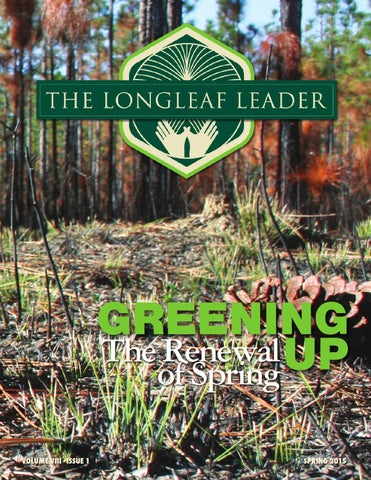
GREENING The Renewal UP of Spring VOLUME VIII - ISSUE 1
SPRING 2015
TABLE OF CONTENTS
6 15
10
24 28
34
R E G I O N A L U P D A T E S .........................................18 H I S T O R Y ...............................................................24 A R T S & L I T E R A T U R E ........................................26
President’s Message....................................................2 Calendar ....................................................................4 Letters from the Inbox ...............................................5 Is your site prep helping or hurting your longleaf resoration..............................................6 Understory Plant Spotlight........................................9 Growing Season .......................................................10 Longleaf nurseries ....................................................13 Landowner Profile....................................................15
While You’re in the Grass Stage ..............................32 Longleaf Destinations ..............................................28
P E O P L E .................................................................33 Heartpine ................................................................34
S U P P O R T T H E A L L I A N C E ................................37
P U B L I S H E R The Longleaf Alliance, E D I T O R Carol Denhof, A S S I S T A N T E D I T O R Margaret Platt, D E S I G N Bellhouse Publishing A D V E R T I S I N G Carol Denhof 678.595.6405 – editor@longleafalliance.org C O V E R Conecuh National Forest longleaf woodland resprouting after fire. Photo by Carol Denhof. The Longleaf Leader (USPS#) is an official publication of The Longleaf Alliance, 12130 Dixon Center Road, Andalusia, Alabama 36420 and is published 4 times a year. The Longleaf Alliance reserves the exclusive right to accept or reject advertising or editorial material submitted for publication. Advertising rates quoted upon request.Postmaster: Send address changes to Longleaf Alliance, Address12130 Dixon Center Road, Andalusia, Alabama 36420. Periodicals Postage Paid at Montgomery, Alabama. In accordance with Federal law and U.S. Department of Agriculture policy, this institution is prohibited from discriminating on the basis of race, color, national origin, age, or disability. (Not all prohibited bases will apply to all programs.) To file a complaint of discrimination, write USDA, Director, Office of Civil Rights, Room 326-W, Whitten Building, 1400 Independence Avenue, SW, Washington, DC 20250-9410 or call (202) 720-5964 (voice and TDD). USDA is an equal opportunity provider and employer. [1]
BY ROBERT ABERNETHY, THE LONGLEAF ALLIANCE
P R E S I D E N T ’S M E S S A G E
{A Season of Change} It is 23 degrees with a clear beautiful winter sky as I sit writing this message. Deer seasons are finishing up and quail season (or as my grandmother would say “bird season”) is in full swing. The spring peepers are waking up, slowly. I heard their first tentative calls on February 1. The weather had changed and there was a slow drizzle and it had warmed to 57 degrees that night. Longleaf is being planted across the range, and we are all burning on every available day that is suitable. When you read this, it will be spring. The trees will be leafed out and the wild azaleas in full bloom along the creeks. The burns will be greening up and the gobblers will be following the hens to the burns in search of exposed insects and acorns and green shoots. This is a wonderful season of change in the longleaf woods. Much of the change is the result of the weather, the tree species, or the topography of the land. The red maples in the swamps bloom first while the hickories on the hillsides can be the last to leaf out. Then along comes a late freeze and sets everything back. This change is natural and varies from year to year and forest to forest. Other change is man-made and designed to mimic the natural processes. We cut stands of timber to introduce sunlight to the ground and start a new stand of longleaf, or we set prescribed fires to mimic the natural process of lightning caused fires.
These processes that mimic land altering natural events such as wind storms, hurricanes, and fire are temporary disturbances across the landscape. Other changes are less temporary. Trees will return to a site following a timber harvest, but the clearing and stumping of an old growth tract of longleaf to make way for homes, businesses, and agricultural fields is a more permanent change. We need houses and I certainly like to eat the food that is grown in these fields, but we must realize that these changes are permanent. We must work with landowners that value the forest for all the products it can produce: timber, wildlife, recreation, water, and clean air. The Longleaf Alliance is committed to the restoration and management of our Southern Forest while also realizing that we live, work, and play in this landscape. The longleaf forest will only exist as a natural working ecosystem if we commit ourselves to doing what we can to ensure that our grandchildren will always have the opportunity to enjoy a walk in the spring piney woods. Now, enjoy April. These 30 days of breathtaking change come but once a year. Don’t miss it, and thank you for caring about the longleaf forest.
[2]
Longleaf Alliance Board of Directors Barclay McFadden – Chairman Salem Saloom – Vice-Chairman Judd Brooke – Secretary/Treasurer Angus Lafaye – Past Chairman Lynda Guerry Beam Katherine Eddins Julie Moore Dick Porterfield Charley Tarver George Tyson Marc Walley Phillip Woods
Staff Robert Abernethy President robert@longleafalliance.org 803-480-1849 Ad Platt Vice President of Operations ad@longleafalliance.org 850-982-8480 Anne Rilling Vice President of Business anne@longleafalliance.org 334-427-1029
Carol Denhof Understory & Media Coordinator carol@longleafalliance.org 678-595-6405
Mike Thompson Ecosystem Support Team Supervisor mike@longleafalliance.org
Donna Vassallo Bobby Franklin Ecosystem Support Team Member SoLoACE Partnership Coordinator donna@longleafalliance.org bobby@longleafalliance.org Casey White 843.893.7775 Administrative Assistant Ryan Mitchell office@longleafalliance.org Outreach & Technical Assistance Bob Wilken Coordinator Fire Specialist ryan@longleafalliance.org bob@longleafalliance.org 850-758-8559
Brian Schumann Ryan Bollinger Local Implementation Team Consul Ecosystem Support Team Member brian@longleafalliance.org ryan_b@longleafalliance.org 803.487.1653 Randy Tate Ft. Stewart/Altamaha Longleaf Vernon Compton Restoration Partnership Coordinator GCPEP Director randy@longleafalliance.org vernon@longleafalliance.org 404-664-0586 850-623-0987
[3]
Karen Zilliox Ecosystem Support Team Field Leader karen@longleafalliance.org
UPCOMING EVENTS
2015
One of our delicate, native orchids (Pogonia ophioglossoides) represents the stunning botanical diversity in our frequently-burned piney woods. Photo by Robert Smith.
*Longleaf Academy: Longleaf 101 Aiken, South Carolina
July 14-16, 2015 *Longleaf Academy: Fire 201 Webb Wildlife Center, Garnett, South Carolina
Longleaf Academy: Longleaf 101
August 18-20, 2015
Withlacoochee Fire Center, Brooksville, Florida
*Longleaf Academy: Understory 201
April 14-16, 2015
Moody Forest Natural Area, Baxley, GA
Longleaf Academy: Herbicides & Longleaf 201
September 29-October 1, 2015
Columbus, GA
*Longleaf Academy: Understory 201
May 5-7, 2015
Solon Dixon Forestry Education Center, Andalusia, AL
*Longleaf Academy: Longleaf 101
October 20-22, 2015
Hattiesburg, MS * Registration is not open at this time. Email The Longleaf Alliance office (office@longleafalliance.org) if interested and we'll notify you when it is open.
May 19-21, 2015 *Longleaf Academy: Longleaf 101 Heflin, AL
Check The Longleaf Alliance website (www.longleafalliance.org) for updates on scheduled events.
June 2-4, 2015
SPRING MANAGEMENT CHECKLIST • Burn young longleaf stands that have been invaded by short needle pines that are too large to control with winter burns. • Evaluate your winter burns to determine if you obtained desired fire effects. • Use growing season fire in wiregrass stands to promote viable wiregrass seed production and more wildflowers. • Plant Native Warm Season Grasses before mid-May to try to avoid summer droughts.
• Assess winter tree plantings for early mortality from freeze damage or other factors. • Uncover and/or lift viable containerized longleaf seedlings that were planted too deep. Order seedlings for future plantings. • Spray or mow to control herbaceous competition on former agricultural sites. If spraying, know your pH before applying Oust® or Oustar®. • Fall herbicide site preparation treatments may be effective, IF early timber harvests allow sufficient time for resprouting of hardwoods and shrubs. If in doubt, wait a year.
[4]
FROM THE INBOX A demonstration site on the Escambia Experimental Forest in Alabama where fire has been applied every 3 years in the dormant season only for more than thirty years. Photo by Ryan Mitchell.
Q.
Ryan, My family and I own a tract of older longleaf in Southwestern Georgia. We have conducted February burns every 3 years for the last 32 years. The problem we are having is the hardwood trees are starting to take over the stand. Is there anything we can do other than using herbicide to get rid of the hardwoods?
Q.
Thanks, Charlie in Georgia
A.
Thank you for your help. A.B.
A.
Ad, I established a longleaf planting on an old pasture site in the winter of 2013, following herbicide treatment and scalping. Last summer it looked great, with very high survival. I mowed in between the rows before the sicklepod and dogfennel on site could go to seed. But on my last visit to the site, I’m finding that many of the seedlings are beginning to be overtopped or smothered within the scalped rows, especially by mats of dewberry vines. It looks like a serious problem. Would you agree? What are my best options?
A.B., You have been faithfully conducting prescribed burns but not obtaining the desired fire effects. An important component of any prescribed burn is the objective. Why are you burning? For example, are you wanting the fire to reduce the fuel load, promote wiregrass seed, control brownspot needle blight, or to control hardwood encroachment? Your objective will determine many factors; some include season, frequency, weather conditions, and ignition patterns. Dormant season fires generally top-kill hardwood stems that readily resprout during the growing season. To better control hardwoods, conduct a growing season burn. When the ambient air temperature is warmer, growing season burns easily raise the actively growing plant cells above the temperature needed to kill it. Often, the most overlooked part of a prescribed burn is the post-fire evaluation. This can be done in two stages: immediately after the fire and towards the end of the next growing season. Immediately after the fire, some factors to evaluate include if the plan was followed, spot-overs, tree scorch, amount of litter/duff consumption, vegetation consumption, and others. Later, some conditions to look for may be insect or disease damage, erosion problems, resprouting, or invasive species. If you have questions about conducting growing season burns, conduct your local state forestry office. Sincerely, Ryan
Thank you Charlie, for your inquiry regarding dewberry competition in your longleaf planting. While the southern dewberry (Rubus trivialis) is an important wildlife plant for a long list of game and non-game animals, it can also be a ferocious competitor to grass stage longleaf when out of balance. Miller and Miller suggest in their excellent text Forest Plants of the Southeast and Their Wildlife Uses that the blackberry family is arguably the most important group of plants to wildlife in the southeast, not only for soft mast, but also browse and cover. In your question, abundant dewberry is overtopping and smothering the 2nd year longleaf, as it can be prone to do. If there are not enough other fuels to help carry a fire, the ability to reintroduce fire is going to be delayed. Herbicide release of the planted longleaf will likely be necessary at this stage to prevent significant mortality. If the size of this planting or problem is more than what can be treated by backpack spray application, your best option is likely to be a banded application (46’ wide) of Milestone® (Aminopyralid), at a rate from 4 to 7 fl. oz. per acre, to the scalped/planted rows. Milestone® is effective at controlling blackberries, as well as sicklepod, but use caution with exposed or elongating longleaf buds and try to minimize application to longleaf, as some transient needle curling, twisting, or droop to the longleaf seedlings will result, though it tends to be temporary. The application should ideally be made when the target leaves are actively growing and abundant and when the pines are not actively elongating candles. Do not add a surfactant, and follow all label requirements. The label is the law. Although Escort® (Metsulfuron) is often used in site preparation for control of Rubus or in release of loblolly or slash pine, it cannot be safely used at any rate in longleaf release. Good Luck! Ad
[5]
Is your site prep
HELPING OR HURTING
YOUR LONGLEAF RESTORATION? By Nathan Klaus and Alan Isler, Georgia Department of Natural Resources and Joyce Klaus, Gordon State College
Herbicide treatment in a forested area using a boom sprayer. Photo by Anne Rilling.
When we plant longleaf pine, we tend to focus on seedling survival; however, successful planting of longleaf should not be mistaken for successful restoration of the longleaf pine ecosystem. Longleaf pine groundcover, the low-growing wildflowers and grasses, includes hundreds of species and is a driver of game and nongame wildlife populations. Groundcover is also a critical fuel input for the successful use of prescribed fire and is key to the long-term stability of the forest. With regular fire, good groundcover makes it almost easy to keep hardwoods at bay. Unfortunately, most of us cannot readily identify all of the hundreds of species of plants found in longleaf pine groundcover. Because of this, it is tempting to gloss over groundcover conservation, referring to any of the dozen or so species of bluestem grasses as “broomsedge” and assuring ourselves that chemical site prep might temporarily knock it out but that it will come back. After almost 20 years of tinkering with longleaf pine restoration for the Georgia Department of Natural Resources, we have finally come to
understand that this easy dismissal of groundcover conservation comes with a lot of costs, and that the idea that groundcover will bounce back a few years after chemical site prep just isn’t true. We encourage you to look back at your planting jobs and look for some of the same evidence that brought us to this conclusion. Compare stands planted in the last decade to older stands that predate chemical site prep. Careful inspection of sites that received broadcast broad spectrum herbicides will likely reveal that a lot of plants are missing, including key grasses such as wiregrass and little bluestem, two species that are integral to a healthy longleaf pine system. That inspection might also reveal distinctly different groundcover anyplace there was an herbicide “skip,” even decades after site prep. Compare these areas when you burn. Are you struggling to push fire through patches of blackberry and dogfennel where there was broad spectrum site prep? We experienced this too, and came to the conclusion that our choice of site prep was the cause of these problems. [6]
On some of these sites we have tried to replant the groundcover, collecting seed from nearby stands and growing plugs or seeding directly. While we have had some limited success, it is a far cry from what was there before we sprayed. Putting a site’s unique groundcover back, species by species, is hard, expensive, and far from certain to succeed. While better than nothing, replacing the unique assemblage of hundreds of plant species that are part of our landscape with a store-bought selection of a dozen or so species is far from ideal.
imazapyr at various rates and tank mixes. We also tested several hexazinone products, along with metsulfuron and triclopyr. Plots were 66-by-66 feet. Herbicides were applied according to the label, using suggested surfactants and put out at appropriate timing, most in September, except the hexazinone products which were put out in May just ahead of a rain. Prior to application, all vascular plants were documented and a measure of their cover recorded. Three years later, we again catalogued plant diversity and cover.
Post treatment condition when using a combination of Imazapyr and Glyphosate. Photo by Nathan Klaus.
Post treatment condition when using Metsulfuron. Photo by Nathan Klaus.
How long before the groundcover recovers? It’s clear that a few species do bounce back. We manage many tracts across Georgia that are far from pristine. Most have a distant agricultural past and yet have recovered bluestem grasses and a modest diversity of forbs, but only after seven to eight decades or longer, and the wiregrass and many forbs don’t ever seem to return. Besides robbing a site of key species for fire and wildlife, broad spectrum site prep also dumbed down our sites, removing many of the plants (and many animals) that make a patch of land unique. We wanted to preserve the unique diversity of each site, not have another stand full of blackberry, pokeweed, dogfennel and broomsedge; there’s enough of that in this world already. Facing this dilemma, several of us set out to implement herbicide trials on longleaf pine groundcover. Could we identify lesser herbicide rates or combinations of herbicides that gave reasonably good longleaf pine survival but didn’t wipe out the rest of the ecosystem? Our study sites covered a range of longleaf pine ecosystems, from the montane longleaf pine of Sprewell Bluff Wildlife Management Area (WMA) and the sandhills of Fall Line Sandhills WMA in middle Georgia to the wiregrass country of Silver Lake WMA in southwestern Georgia. Because imazapyr is so widely used and effective as a site prep tool, we were especially interested in it. Of our twelve treatments, half used
In our analysis, we divided plant species into various groups of interest, some of which were admittedly subjective categories. How did herbicide application affect those species typical of good longleaf pine groundcover? How did it affect grasses associated with longleaf pine groundcover? How about weeds and woody competition? We also looked at the site prep effects on longleaf pine survival. Here are some of our key findings: • Plots treated with imazapyr and glyphosate clearly gave the best longleaf pine establishment, but also did the greatest damage to groundcover. Lowering the rates of this combination did not seem to help. • At the rates tested with hexazinone (ULW® and VelparL® on a grid), triclopyr and metsulfuron, plots had improved groundcover and higher grass cover than other plots or the untreated control. • Metsulfuron and triclopyr plots had respectable longleaf pine survival, greater than 50 percent, despite two years of severe summer droughts. Some hexazinone plots also had reasonably high longleaf survival. • Lower rates of imazapyr still caused substantial damage to groundcover and had high values of woody and weedy cover, primarily blackberry. This blackberry cover made later burns patchy and ineffective and made restoration difficult for years to come. {continued on page 8} [7]
{continued from page 7} • Metsulfuron and triclopyr gave only moderate control of most oaks but good control of blackberry, sweetgum and many other hardwoods. Only hexazinone provided excellent control of oaks while conserving groundcover. • Not every site is likely to respond the same to these treatments. The methods that conserved groundcover for us would likely provide insufficient control in very rough cutover sites such as flatwoods or Bermudagrass pastures. Our study does not intend to recommend any particular chemical or rate but only to share our results and encourage consideration of alternatives. It also doesn’t intend to encourage heavy mechanical site prep, which is likely equally destructive
to groundcover, less selective, more expensive and may cause erosion in some soils. Instead we encourage you to consider that some of the challenges we all face in restoration may result from site prep choices years earlier. Maybe you’ve been having the same issues we’ve experienced. If so, we hope you find these ideas helpful. As with everything in life, there is a tradeoff. The methods we found that conserved groundcover cost us somewhat in longleaf pine survival; however, in our experience, planting a few more longleaf is easy and inexpensive compared to restoring groundcover. For the many benefits that groundcover provides, we believe the tradeoff is worth it.
Effects of different herbicide treatments on percent cover of native grasses.
Change in woody and herbaceous cover across herbicide treatments
Effect of herbicide treatments on weedy plant cover. Change in longleaf groundcover combined with percent longleaf survival across herbicide treatments.A
[8]
y r o t s r e d n U
PLANT SPOTLIGHT By Carol Denhof, The Longleaf Alliance
{ PALE PITCHER PLANT SARRACENIA ALATA ALPH.WOOD }
Description The pale pitcher plant is one of several different species of Sarracenia that occur within the southeastern United States. Pitcher plants are especially unique because they have adopted carnivorous eating habits in order to adapt to the nutrient-poor habitats in which they live. These plants capture their prey in Closeup of the pale pitcher plant leaf or pitcher. the “pitchers” that are Photo by Carol Denhof. in fact hollow, upright leaves. The leaves of the pale pitcher plant can reach heights up to 29 inches tall and vary greatly in coloration. Depending on geographic location, pitchers can run from yellow-green, to yellow-green with red or purple colored veins. Like the other pitcher plants, this species blooms in the spring. The flowers are pale yellow and generally emerge prior to the leaves on single stems. The flower structure is quite unusual. The pale petals hang down from the style that is shaped like an upside-down umbrella. Each flower produces 100’s of seeds that ripen in the fall.
Wildlife Uses This plant does not generally provide much wildlife benefit. However, the flowers provide a good nectar source for bees that serve as the primary pollinators for pitcher plants. Other common species Other pitcher plant species that also occur within the longleaf range include trumpet pitcher plant (Sarracenia flava), whitetopped pitcher plant (S. leucophylla), hooded pitcher plant (S. minor), purple pitcher plant (S. purpurea), parrot pitcher plant (S. psittacina), and sweet pitcher plant (S. rubra). This group of plants also hybridizes readily. Commercial Availability These plants can be acquired from several nurseries throughout the region. However, it is important to only buy from reputable nurseries that guarantee their plants have not been harvested from the wild. Pitcher plants can be easily propagated from seed.
Wet pine savanna habitat of the pale pitcher plant on the Distribution & Habitat DeSoto National Forest in eastern Mississippi. Sarracenia alata is a species that occurs only in the western Photo by Carol Denhof. portion of the longleaf range. It is found from extreme southwestern Alabama across to southeast Texas. Its distribution is disjunct though across this range, as it does References not occur in the alluvial soils in a large portion of Louisiana. eFloras (2008). Published on the Internet Pale pitcher plant can be found growing in wet pine savannas http://www.efloras.org [accessed 22 January 2015]*' Missouri and flatwoods, bogs, and pineland seepage slopes. Botanical Garden, St. Louis, MO & Harvard University Herbaria, Cambridge, MA. [9]
Bobwhite quail chicks in a nest. Photo courtesy of Tall Timbers Research Station and Land Conservancy.
Growing Season
By Robert Abernethy, The Longleaf Alliance
Prescribed Fire and Nesting Birds “Why do you guys burn in the spring and summer when the birds are nesting? Why not just burn during the winter?” We get that question a lot! And it is a reasonable question from a concerned public. sparrow require for nesting and brood-rearing. Simply put, there are not enough good burn days in the winter to burn all the acres that need to be burned to provide the habitat needs for these species. Fire has been a part of the southern landscape for thousands, if not millions of years. Fire scars on ancient pine stumps and recent wild fire activity in the South indicate that the season when most fires occurred has historically been May through August. Most naturally occurring fires are started by lightning,
The Longleaf Alliance, as well as prescribed fire managers and wildlife biologists across the South encourage burning during the growing season (after the trees and shrubs have leafed out) because these burns provide additional days that augment the more common winter burning. Additional days burning translate into more wildlife habitat improved. Growing season burns also provide better control of hardwoods and shrubs and encourage the grass-forb communities that species such as northern bobwhite, wild turkey, and Bachman’s [ 10 ]
and the summer thunderstorm season is when these fires are started. Species in the southern piney woods have adapted to this cycle of lightning-caused fires and have evolved to require the grassy habitat created by regular burns on a 2 to 3 year interval. In short, without fire these species decline. While growing season fire does destroy some nests, the benefit of the high quality wildlife habitat created by the burns far outweighs the destruction of the few nests that are lost. Let’s look at three bird species individually and examine how these species require fire in general, and growing season burning specifically, in order to thrive. Northern Bobwhite Studies at Tall Timbers Research Station in south Georgia have shown that less than 10% of bobwhite hens nest before mid-May with the majority of the nests peaking in June. Burning in April and May can achieve many of the desired habitat objectives without destroying nests. Burning into the growing season also leaves additional cover for the adult birds during late winter. Research on Arcadia Plantation in Georgia indicated higher adult survival when the burning was stretched out into June. This was primarily due to the additional cover remaining for the birds to escape from migrating hawks during March. Once the hawks clear out and head north, the habitat can be burned without exposing the birds to this additional predation. Spreading the burns over a 5 or 6 month season also provides a wide range of habitats for the birds. One burn unit
is bare and black, while other units burned earlier are greening up. Research has also shown that grasshoppers and other insects increase significantly following growing season burns. This is especially important because young bobwhite chicks depend on this high protein food to grow throughout the summer. Wild Turkey Wild turkeys need a habitat that they can easily walk through, see through, and see over. If our southern pine lands are not burned, they quickly grow up into habitat too thick for wild turkeys. Wild turkeys also prefer to nest in areas that have been burned in the last two years. Frequently burned pine lands provide this important habitat. Sisson et al (1990) found that 62% of all the nests he was monitoring occurred in areas that had been burned in the last 2 years. Moore et al (2005) found only 2 of 22 nests monitored were destroyed by fire, and Allen et al (1996) found that areas not burned in the last 2 years were almost entirely avoided by hens. Also, as we discussed with bobwhite, the abundance of insects is higher following growing season fire and equally important for the health and growth of young turkey poults. If you are burning in thick areas that have not been burned during the past 2 or 3 years, research has shown you will not burn up very many turkey nests because they are nesting where you burned last year and the year before and you are not burning where most of the hens are nesting. And even if you do burn up the occasional nest, research has shown that the hen will more than likely re-nest.
Eastern Wild Turkey. Photo by Larry Price and courtesy of the National Wild Turkey Federation.
{continued on page 12}
{continued from page 11}
Bachman’s sparrow. Photo by Greg Holder.
bobwhite, wild turkey, Bachman’s sparrow, and the whole suite of species that call the southern piney woods home. We also know that if we space the burns across the landscape and avoid burning areas that were burned during the previous year, we will minimize impacts on the nests. And, finally, we also know that even if a nest is destroyed by fire, the female will likely renest and bring off a brood in habitat that is much improved as a result of the fire that destroyed her nest. So, burn when the weather is right and burn often. Rest assured in the knowledge that you are using a natural process that has shaped the southern piney woods and with which all the species found within this landscape have learned to survive.
Bachman’s Sparrow Bachman’s sparrow, like quail and wild turkey, prefer to nest in areas burned the previous growing season, not the areas where fire has been excluded for 3 years. Also like bobwhite and wild turkey, if a nest is destroyed by fire, the female will often re-nest. Bachman’s sparrow requires frequent fire Summary So, in summary, we know that the more habitat we can burn in the winter and during the growing season, the more high quality nesting and brood rearing habitat we can create for
References This article was condensed from Lightning-Season Burning: Friend or Foe of Breeding Birds? by Jim Cox and Brent Widner of Tall Timbers Research Station and Land Conservancy, Miscellaneous publication 17. The complete brochure can be viewed at http://www.talltimbers.org/images/pubs/FireBreedingBirdsBooklet-small.pdf Allen, A.W., Y.K. Bernal, and R.J. Moulton. 1996. Pine plantations and wildlife in the southeastern United States: an assessment of impacts and opportunities. Information and Technology Report 3, U.S. Department of the Interior, Washington, D.C. Moore, W.F., J.C. Kilgo, W.D. Carlisle, and M.B.Caudell. 2005. Chapter 6. Wild Turkey. Pages 359-366 in Kilgo, J.C. and J.I. Blake (Eds.). Ecology and management of a forested landscape. Island Press, Washington, D.C. Sisson, D.C., D.W. Speake, J.L. Landers, and J.L. Buckner. 1990. Effects of prescribed burning on Wild Turkey habitat preference and nest site selection in south Georgia. National Wild Turkey Symposium 6:44-50.
[ 12 ]
The Longleaf Nursery List By Carol Denhof, The Longleaf Alliance
The Longleaf Alliance works closely with nurseries to ensure that high-quality seedlings are produced and that landowners know where they may find them. All of the nurseries on our list grow high quality longleaf seedlings. The location of the nursery may be a matter of convenience, but a more important question might be choosing the correct seed source for your area. Several of these nurseries grow longleaf collected from multiple seed sources. The following nurseries help support The Longleaf Alliance through the Longleaf Seedling Surcharge Program. Nurseries that participate in the Longleaf Seedling Surcharge Program demonstrate a commitment to The Longleaf Alliance and the reestablishment of longleaf pine and the longleaf ecosystem across the southeastern U.S. While The Longleaf Alliance does not endorse any given nursery, we encourage those purchasing longleaf pine seedlings to support these nurseries and thus The Longleaf Alliance.
ALABAMA Rayonier - Elberta Nursery Elberta, AL 36430 Tel: 251.986.5210
Superior Trees Lee, FL 32059 Tel: 850.971.5159 Fax: 850.971.5416
FLORIDA Andrews Nursery, Florida Division of Forestry Chiefland, FL 32644 Tel: 352.493.6096 Fax: 352.493.6084 Web site: www.fl-dof.com
GEORGIA International Forest Company Moultrie, GA 31768 Tel: 229.985.0321 Toll Free: 800-633-4506 Fax: 229-985-0567 Web site: www.interforestry.com
Blanton's Longleaf Container Nursery Madison, FL Tel: 850.973.2967 Fax: 850.973.2967 E-mail: BIGJMB1@vol.com
Flint & Walker Nurseries, Georgia Forestry Commission Byromville, GA 31007 Tel: 229.268.7308 Fax: 229.268.1819 E-mail: jfields@gfc.state.ga.us Web site: www.gfc.state.ga.us
Whitfield Farms & Nursery Twin City, GA 30471 Tel: 478.763.2951 Cell: 912.682.4948 Fax: 478.763.3308 E-mail: bwhitfield@pineland.net Web site: fbwhitfieldtreemasters.com
Deep South Growers Douglas, GA 31534 Tel: 912.384.5450 Fax: 912.384.5450
Rutland Forest Nursery Lenox, GA 31637 Tel: 229.382.5504
Brewton, AL Tel: 251.867.7629 Cell: 251.363.2952 E-mail: dismukesr@bellsouth.net
Meek's Farms & Nursery, Inc. Kite, GA 31049 Cell: 912.536.3844 Toll Free: 877.809.1737 Fax: 478.469.3150 Web site: www.meeksfarms-nurserys.com Mickey Parker, Seedling Sales Pensacola, FL 32504 Cell: 850.572.3932 Tel: 850.476.4815 or 850.438.2619 E-mail: longleafmickeyp@bellsouth.net
{continued on page 14} [ 13 ]
{continued from page 13} K & L Forest Nursery, Inc. Buena Vista, GA 31803 NOTE: We sell bareroot longleaf only! Tel: 229.389.1841 Fax: 229.649.7766 E-mail: kandlforestnursery@gmail.com
LOUISIANA Beauregard Nursery DeRidder, LA 70634 Tel: 337.463.5509 Fax: 337.825.6814 E-mail: khanchey@ldaf.state.la.us
ArborGen - Georgia Supertree Nursery Shellman, GA 39886 Tel: 800-554-6550 Fax: 229-679-5640 E-mail: recross@arborgen.com Web site: www.supertreeseedlings.com
NORTH CAROLINA Claridge Nursery/Goldsboro Forestry Center, N.C. Division of Forest Resources Goldsboro, NC 27530 Tel: 919.731.7988 Fax: 919.731.7993 E-mail: seedlings@ncmail.net Web site: www.dfr.state.nc.us
Bellville SuperTree Nursery Bellville, GA 30414 Tel: 877-833-4760 Website: www.arborgen.com Zellner Farms Culloden, GA 31016 Tel: 770-283-7187 E-mail: bzellner@zellnerfarms.com Web Site: www.zellnerfarms.com
SOUTH CAROLINA Taylor Forest Tree Nursery, S.C. Forestry Commission Trenton, SC 29847 Tel: 803.275.3578 Fax: 803.275.5227 E-mail: taylortree@pbtcomm.net Web site: www.state.sc.us/forest/nur.htm
Bodenhamer Farms & Nursery Rowland, NC 28383 Tel: 910.422.8118 Cell: 910.608.9823 Fax: 910.422.9793 E -mail: Louie@BodenhamerFarms.com
RULES OF THUMB WHEN DETERMINING THE SEED SOURCE FOR YOUR TREES: l l l
l
Rule #1 Seed may be collected within a zone for planting within that zone Rule #2 Seed should not be moved from more than one zone distant Rule #3 Seed from one zone warmer (moved north) will generally result in trees with increased growth compared with local sources Rule #4 Seed collected from one zone cooler (moved south) will generally result in trees with decreased growth compared with local sources
Reference: Schmidtling, R.C., Longleaf pine genetics. In: Proceedings of the 2nd Longleaf Alliance Conference, November 17 - 19, 1998, Charleston, SC. Longleaf Alliance Report No.4, June 1999 pps. 24 - 26.
[ 14 ]
LANDOWNER SPOTLIGHT
JUDD BROOKE AND BROOKEWOOD
By Judd Brooke, with Ad Platt
A 63 YEAR PERSPECTIVE ON LAND OWNERSHIP AND THE LONGLEAF ECOSYSTEM IN SOUTH MISSISSIPPI Natural regeneration a few years after Katrina. Photo by Judd Brooke.
As absentee land owners living in New Orleans, Clyde Brooke, a geologist, and Ruth Brooke, an elementary school teacher, sacrificed much in those early years to make payments on land. The purchase of the first parcel eradicated the small amount of money that had been set aside for a down payment on a house, and Ruth almost gave up on getting dining room furniture for the place they rented. Everything went to land payments, and every weekend and vacation was spent working on the land. Clyde’s philosophy was basic: “Every time you leave the farm (as they called it), leave it in a better condition than when you came.” From the mid-1950s to 1960, in an effort to plan for future income, slash pines were planted on much of the land. This unimproved variety of slash was neither disease nor fire resistant, which proved to be a major problem in an area that had no stock law and was burned on an annual basis for the benefit of the “woods cows” belonging to others.
Judd and Ruth Brooke at entrance to Brookewood. Photo by Russell Cuevas. Judd Brooke was not quite five years old when his father bought one hundred and forty acres of cutover land in Hancock County, Mississippi as a weekend retreat and a place to keep bird dogs and quail hunt. This purchase was the beginning of a two generational effort to assimilate a 4300 acre block of land that has become one of the best examples of privately owned and managed longleaf timberland in the South Mississippi area.
{continued on page 16} [ 15 ]
{continued from page 15} Conservation and restoration efforts on Brookewood soon were recognized by others, leading Judd to serve on the Boards of Wildlife Mississippi, his local chapter of the Mississippi Forestry Association, and the American Forest Foundation, where he cochaired the Woodland Committee (the American Tree Farm System). He has also been active in the Mississippi Prescribed Fire Council and currently serves on the Board of Directors of The Longleaf Alliance. In 2010 Judd was honored with the US Fish and Wildlife Service’s “Regional Director’s Conservation Award” and in 2014 the Mississippi Wildlife Federation’s “Forestry Conservationist of the Year” award. Judd regularly hosts forestry related functions at Brookewood, and with the Photo by Kevin Ladner. help of the American Forest Foundation and others, constructed a one mile interpretive trail with eleven stations depicting various aspects of the longleaf ecosystem, from prescribed fire to threatened species. The trail is open to the public, by appointment. Brookewood also began a tradition of hosting youth groups to introduce them to the longleaf ecosystem and to ethical hunting, through hunter safety/education courses. Judd and his mother have undergone a transition regarding agency involvement. “Until the late 1990s we did virtually everything on Brookewood with only occasional Federal or State agency involvement. Now, we see the merits of working in partnership with these agencies, such as USFWS and NRCS.
A transfer to Houston in 1959 made absentee Judd tending a control burn. ownership an even greater challenge, but 1965 saw a move back to New Orleans and the 1 ½ hour drive to the farm once again became a ritual. By this time Judd was in college at Millsaps College in Jackson. After graduation, his work as a land negotiator for Amoco in New Orleans enabled Judd to continue weekend farm work and to purchase adjoining property as opportunity and finances permitted. By the early 1990s, Judd realized that what was once cutover now had significant volumes of timber, and that this resource needed to be managed more effectively. Furthermore, Judd realized that while most of the slash pine planted in those early years had either been destroyed by fire or hurricane (especially Camille in 1969), the longleaf pine was flourishing. In 1997 Judd turned his full time and attention to managing the land which is now called “Brookewood” and transitioned from an absentee landowner to living on the land. The decision was made to convert entirely to longleaf and the process was begun. Slash and loblolly pines were harvested from good longleaf sites, thus lowering the basal area and allowing for natural regeneration of the longleaf. Starting in 2001, working with Wildlife Mississippi and the US Fish and Wildlife Service’s “Partners For Wildlife Program”, approximately 500 acres of pastureland and former CRP loblolly plantations were planted with containerized longleaf seedlings.
[ 16 ]
Katrina has been the primary issue. Basic infrastructure of fire lines and roads needed much work, and they are still playing catch-up on their prescribed burning regime. “Katrina took a big toll on our finances and our lives,” says Judd. “Seeing sixty percent of your merchantable timber destroyed in eight hours is something I would not wish on any landowner. All you can do when you love the land as we do is to go forward. I’m getting accustomed to looking at the younger growth stages,
They not only provide valuable technical help, but also the cost share programs enable us to restore and reestablish production on more acreage in a shorter period of time. We would encourage landowners to familiarize themselves with these various sources of financial help and advice.” Additionally, Judd recommends utilizing the services of a professional forester. “I consult with my forester on a regular basis, at least a couple of times a week, and would not think about making a major
“I consult with my forester on a regular basis, at least a couple of times a week, and would not think about making a major decision without his input.” and I still have some relatively mature timber. A good friend, Randy Browning with Wildlife Mississippi and the USFWS, commented, ‘You still have an intact longleaf ecosystem.’” Katrina was not the first hurricane, and will not be the last that this ecosystem has weathered. Now that Brookewood has somewhat recovered from Katrina, Judd has four primary land management objectives: 1) prescribed burning; 2) control of invasive species (especially cogon grass); 3) road and bridge maintenance to reduce soil erosion and; 4) wildlife habitat enhancement. There is constant juggling of these priorities, depending on time of year and available cash flow, but each day there is an attempt to make a little progress in one area or another, so Boy Scouts on Brookewood’s interpretive trail. Photo by Judd Brooke. as Clyde, now deceased, said years ago, “to leave the land a little better than you found it.” What does the future hold? After devoting their lives to the decision without his input.” One other piece of advice is to acquisition, restoration, and maintenance of Brookewood, Judd document various aspects of the ecosystem with pictures. “You and Ruth (now ninety three) have no desire to see it subdivided can’t imagine how much I wish I had taken more pictures of and developed. Their preference would be to see Brookewood the plants and animals that make land management both remain a prime example of what private property owners can surprising and ultimately captivating. But it’s never too late to begin this process,” says Judd. achieve through saving and hard work. Perhaps Brookewood What are the major challenges Judd and his mother face as will be an educational demonstration area for the longleaf landowners? For the last nine years, recovering from Hurricane ecosystem. Time will tell.
[ 17 ]
REGIONAL UPDATES
Longleaf Partnership Council News By Kevin McIntyre, LPC Chair, JW Jones Ecological Research Center at Ichauway
“
A
T I M E
T O
C E L E B R A T E
Greetings! I hope that everyone’s New Year is off to a good start. As I sit desk-bound on a dreary January day, I remind myself that it’s an exciting time in the annual cycle of the longleaf world with seedlings being planted and acres being burned while the weather is on our side for those activities. Let me begin by saying that I am honored to have the opportunity to serve the longleaf community as Chair of the Longleaf Partnership Council (Council) for 2015. We have much to be proud of with our accomplishments to date, and the future is indeed bright for longleaf pine. I would be remiss if I did not take a minute to acknowledge the contributions of Glen Gaines to the longleaf world over the last few years. As most of you know, Glen served as the Regional Longleaf Coordinator for the U.S. Forest Service until his recent retirement. Glen helped birth the Longleaf Partnership Council and was instrumental in beginning the implementation of the Range-Wide Conservation Plan. We will miss him greatly and I do not know where we would be without his tireless dedication to longleaf and the partnership that supports our collective efforts. Thank you Glen, for everything you have done for longleaf conservation. We have many exciting developments on the horizon for the Council and for longleaf restoration in general. We are putting the finishing touches on the Accomplishment Report for fiscal
”
year 2014. I’m proud to inform you that the numbers reported for 2014 are very close to those contained in our initial report from 2013, with slight increases in some of the metrics. Preliminary numbers indicate that we have accounted for almost 1.6 million acres of on-the-ground longleaf management and restoration over the last year. These activities include tree planting, prescribed fire, mid-story treatments, invasive species control, native understory plant establishment, over-story treatments, and land acquisition/easements. These numbers suggest that we have a relatively consistent, solid base on which to build even greater accomplishments in the years ahead as we move towards the overall goal of doubling the acreage of longleaf pine. We appreciate very much all of the hard work from our State teams and Local Implementation Teams that contributed data to the report; rigorous accounting of our accomplishments is key to maintaining the resource base for our restoration efforts. While it’s nice to have a second data point that suggests our numbers are consistent, we must keep an eye to the future and reinforce our efforts where we can. To that end, we have a team beginning work on the next iteration of the 2013-2015 Priority Strategies and Actions document. The new document will cover the years 2016 – 2018 and take us through the tenth anniversary of the release of the Range-wide Conservation Plan. In closing, I would like to thank Vernon Compton for his service on the leadership team over the last three years. We also appreciate the contributions of Mike Black as Council Chair over the last year and look forward to having him on board for another year as Past Chair. Finally, welcome and thanks to Troy Ettel for joining the leadership team as Incoming Chair. The next Council meeting will be held in conjunction with the National Fish and Wildlife Foundation’s Stewardship Partners meeting in Pensacola, FL April 6 – 7. Stay tuned for more details, and we look forward to seeing you there.
[ 18 ]
REGIONAL UPDATES
Apalachicola Regional Stewardship Alliance (ARSA) Update: Trees in the Ground and Grants in the Pipeline By Brian Pelc, The Nature Conservancy
Federally listed Eastern indigo snakes will be released on The Nature Conservancy’s Apalachicola Bluffs and Ravines Preserve in Florida’s Liberty County. This threatened species relies on longleaf pine habitat and has been the focus of a campaign by The Nature Conservancy, The Orianne Society, and numerous state and federal partners. Photo by D.Printiss.
Longleaf pine- wiregrass restoration is in full swing in the eastern Florida Panhandle as ARSA continues to deliver on our first NFWF proposal: Apalachicola Longleaf Initiative (ALI). The recently executed sequel, ALI Phase 2, will hit the ground running with additional trees and groundcover restoration projects. During this current planting season, 372,000 seedlings will be planted and 200 acres of native understory restored with the help of NFWF and Southern Company, The Longleaf Alliance and American Forests, The Nature Conservancy (TNC), Northwest Florida Water Management District (NFWMD), Florida Fish and Wildlife Conservation Commission (FWC), Tyndall Air Force Base, and Florida State Parks. Fall also saw some terrific native seed collection; thanks to the US Forest Service, The Nature Conservancy, FWC, NFWMD and Florida State Parks for their on-going commitment to longleaf beyond just planting trees. Kudos to TNC’s Apalachicola Bluffs and Ravines Preserve which will be a release site for The Orianne Society’s captive bred Eastern indigo snakes. ALI 3 is in development with a proposed 755,000 seedlings and 200 acres of native understory restoration. ARSA fingers are crossed.
Sharing the Longleaf Story on the Chattahoochee Fall Line LuAnn Craighton, The Nature Conservancy A high priority for the Chattahoochee Fall Line Conservation Partnership is to consistently reach out to local landowners and key stakeholders in order to broaden the base of support for longleaf conservation activities in our region. Recently, we had the opportunity to share the “longleaf story” with a variety of audiences in a range of venues including: Oxbow Meadows Environmental Learning Center, Talbot County Patsiliga Museum, Talbot County Chamber of Commerce Landowner Field Day, Georgia Soil and Water Conservation District Annual Conference in Columbus, GA, and Columbus’ Coalition for Sound Growth. Longleaf 101 Academy participants working on a We were also pleased to host the Longleaf Alliance’s Longleaf 101 management scenario exercise in a longleaf stand on Academy in Columbus, GA in November 2014. The Academy field Fort Benning. Photo by LuAnn Craighton. trip sites were on Fort Benning, and we had strong support from the Fort Benning Land Management Branch to facilitate visits to some very special longleaf stands on post. The Academy attendees represented diverse groups including: Georgia Forestry Commission, Natural Resources Conservation Service, Georgia Department of Natural Resources, Fort Valley State University, Auburn Extension Service, private landowners, consulting foresters, Tuskegee National Forest, Tuskegee University, Fort Benning Conservation Branch, Alabama Wildlife Federation, Georgia State Parks, and The Nature Conservancy. The fantastic Academy curriculum accomplished both formal learning and informal relationship building for our participants.
[ 19 ]
REGIONAL UPDATES
Well Known Sansavilla Tract Purchased by the Conservation Fund By Randy Tate, The Longleaf Alliance One of the more popular and ecologically important leased Wildlife Management Areas (WMA) in Georgia was purchased by The Conservation Fund in late 2014, an important step towards ultimately protecting the property. The entire property is 19,577 acres, with Sansavilla WMA comprising 16,867 acres of uplands, wetland swamp and river bluff. It runs along more than 11 miles of the Altamaha River in Glynn and Wayne Counties and has been leased by the state of Georgia from various timber interests for over 15 years. Recently, the tract was offered for sale through a sealed bid process and likely would have been divided into many tracts with several new owners if The Conservation Fund, with urging by the DNR, had not been the successful purchaser. View of the Altamaha River from the river bank on In addition to being a popular spot to launch a boat or a canoe from Williamsburg Landing and to hunt and fish, it is extremely important the Sansavilla WMA. Photo by Randy Tate. to the gopher tortoise. The results from a tortoise survey in 2014, estimate a population of 444 gopher tortoises at Sansavilla +/- 19.8%, at a density of 1.2 per hectare. Over 30% of the sample were juveniles or subadults. This is easily a long-term viable population, especially once fire is reintroduced and more longleaf replaces dense loblolly stands. A lot of the tortoises there are on somewhat unusual (for tortoises) flatwoods soil types like Olustee or Albany. This is actually the third-largest tortoise population on a WMA in GA, behind Townsend WMA (just across the river in Long County) and Silver Lake (in southwest GA). (Matt Elliott, GA DNR, pers.comm.) The Fort Stewart/Altamaha Longleaf Restoration Partnership is working with The Conservation Fund (a signatory to the Partnership Memorandum of Understanding) on replanting some areas to longleaf pine. Already 87 acres have been replanted to longleaf pine and more is planned for next season.
Partners Work Together to Burn Escribano Point Wildlife Management Area By Vernon Compton, The Longleaf Alliance and Mark Winland, Florida Fish & Wildlife Conservation Commission The Escribano Point Wildlife Management Area encompasses over 4,000 acres and borders not only Eglin Air Force Base, but also Blackwater Bay, East Bay, and the Yellow River Estuary. It is located fourteen miles northeast of Pensacola, Florida and protects some of the last undeveloped waterfront tracts in Santa Rosa County. It also preserves wetlands and forested areas that provide habitat for a number of rare plants and animals such as the Florida black bear, gulf The helicopter used to aerially ignite sturgeon, and white-topped pitcher plant. It the Escribano Point burn area. Photo also provides stopover and foraging habitat for by Thomas Harrison. migrating shorebird species. Prescribed fire is an important part of the management planned for Escribano Point, and with multiple partners managing land in the vicinity, both an opportunity and need existed for a partnership burn. Thus the Escribano Point Interagency Burn of 4490 acres was Aerial view of Escribano Point Insuccessfully conducted in January 2015 with Eglin Air Force Base in the lead. Other teragency burn. Photo by Thomas Harrison. partners assisting included the Florida Fish and Wildlife Conservation Commission (FWC), the Florida Department of Environmental Protection, the Northwest Florida Water Management District, the U.S. Forest Service, the National Park Service, and the LLA/GCPEP Ecosystem Support Team. Mark Winland, Wildlife Biologist with the FWC, indicated the burn successfully reintroduced fire into an area that hadn’t seen it in a long time, and that FWC was appreciative of the help provided by the GCPEP partners in conducting such a large burn. Collaboration on burns such as this has made a big difference in the GCPEP landscape, helping the partners reach a more sustainable burn rotation. [ 20 ]
REGIONAL UPDATES
Boots on the Ground…finally By Alan Dozier, Okefenokee/Osceola Local Implementation Team (02LIT) Our 2013 National Fish & Wildlife Foundation (NFWF) Longleaf Stewardship Fund grant provides for a prescribed burning team to be created under direction of The Nature Conservancy. This has been a challenging effort but after almost a year in development, The Conservancy launched a collaboration with the Jacksonville JobCorps Center in October 2014. JobCorps is a program of the US Department of Labor that targets young people who are classified as living below poverty level for job training and career placement. Fifteen students that were selected by representatives from the Conservancy and the US Forest Service (USFS) completed all JobCorps students and graduates Nicole Reynolds, components that lead to certification as a Firefighter Type II, thus gaining Marcus Johnson, Delmar Stewart, Luis Carrasco, and John King prepare for a day of prescribed fire eligibility to serve on federal prescribed fire crews. The four top students were then selected for an additional 10-day at the Moody Forest Preserve in Baxley, GA. mentoring experience at the Conservancy’s Moody Forest Preserve in South Photo courtesy of The Nature Conservancy. Georgia to immerse and embed them within a prescribed fire crew for their initial exposure to fire. Three of these students were hired by a forestry contractor, WCC Services, from Winter Park, Florida to serve on a fire crew that assists the US Forest Service, US Fish and Wildlife Service, and the states of Georgia and Florida in the Okefenokee/Osceola landscape. The crew officially began its tour February 2, 2015 and is being supervised by retired US Forest Service Fire Management Officer, James Hart. An additional 12 certified prescribed fire trainees from JobCorps eagerly await opportunities to utilize their new training. At least two more will eventually roll onto the O2LIT fire crew and the partners are looking for areas to engage others as well. This team represents an unusual mix of private contractor, Job Corps, and experienced burn boss which we hope will be the perfect combination for sustaining a burn team well into the future. The feedback from all partners has been universally positive regarding the performance of the students and there is a strong feeling that the groundwork has been set for an important collaboration moving forward. This project could not have been possible without funding support and matching funds from the National Fish and Wildlife Foundation and the Southern Company, the U.S. Endowment for Forestry and Communities and the Collaborative Forest Landscape Restoration Program of the U.S. Forest Service.
Private Lands Work, Sharing Information, and Plans for the Future: Ocala Longleaf Pine Local Implementation Team (OLIT) By Cheryl Millett, The Nature Conservancy The Florida Forest Service (FFS) private landowner incentive program that is offering restoration, maintenance, and technical assistance through contracts with 25 private landowners is showing fruit. FFS began receiving requests for payments for completed work, including one from a landowner that originally signed up to plant 66 acres of longleaf pine and ended up planting 150 acres, leveraging the $10K incentive program investment with $28K of his own funds. The Gainesville private-public partnership, bridging public and private boundaries to coordinate longleaf work, continues as an engine, with partners planning a visit to a nearby public land in response to a request for information about hardwood removal techniques and public outreach. The Gainesville partnership has been conducting public outreach in advance of their restoration, including a positive story in the Gainesville Sun. The Coordinator published an Op Ed in the Ocala Star Banner about the importance of restoring longleaf pine and made Marked red-cockaded woodpecker presentations called, “Investing in a Forest that Fire Built.” trees at Ocala National Forest. A focus this quarter has been planning for the future in three ways: 1) working on a Photo by Carrie Sekerak. proposal for future work through the NFWF Longleaf Stewardship Fund, 2) working with Wildland Restoration International, the new home of what was The Nature Conservancy’s Ecosystem Restoration Team, a vital restoration and maintenance tool on our landscape, and 3) planning a Longleaf Academy for the spring. [ 21 ]
REGIONAL UPDATES
Sewee Longleaf Conservation Cooperative Hosts Inaugural “Sewee Fire Fest” By Colette DeGarady, The Nature Conservancy On March 21, 2015 members of the Sewee Longleaf Conservation Cooperative put the focus back on fire and nature at the Sewee Fire Fest, a longleaf pine and prescribed fire festival. This festival was held at the Sewee Visitor and Environmental Education Center in Awendaw, SC. Attendees to the free event were treated to a live burn demonstration, sweetgrass basket making, native plant sale, fun family activities, and a visit by Smokey Bear. This festival provided the opportunity to introduce the public Using prescribed fire to manage a longleaf forest in South to the local organizations working to restore forests and protect communities. The Partnership was able to expose the public to Carolina. Photo by Chandler Melton. the positive benefits of controlled burning in South Carolina’s forests. “Fire” and “forests” may seem like an unlikely team, but in fact South Carolina’s forests depend on fire to survive. Regular, natural burning clears the forest floor of underbrush that blocks sunlight and prevents new trees from germinating. Many animals also depend on new-growth grassy areas for food and habitat. Additionally, consistent controlled burns help prevent excess flammable materials from building up on the forest floor, which can ignite dangerously during prolonged droughts or lightning storms, threatening lives and property. “People are our forests’ most important allies today,” said Colette DeGarady, senior conservation ecologist with The Nature Conservancy in South Carolina and one of the event organizers. “We’re thrilled for this chance to teach the community about the importance of prescribed fire and show how they can help support South Carolina’s forests.”
South Lowcountry –Ashepoo-Combahee-Edisto (SoLoACE) Update By Bobby Franklin, The Longleaf Alliance The SoLoACE Longleaf Partnership had a busy fall and winter. A longleaf workshop was held in Aiken, SC and Hitchcock Woods on November 20, 2014 and was attended by 60 landowners and natural resource professionals. Participants learned the basics of longleaf pine planting and management. The highlight of the day was a field tour of Hitchcock Woods, a 2,000 acre forest located inside the Aiken city limits, where they learned about efforts to restore the longleaf ecosystem. Program sponsors included The Longleaf Alliance, National Wild Turkey Federation, Hitchcock Woods Foundation, International Workshop attendees learn about longleaf restoration at Hitchcock Woods in Aiken, SC. Photo by Bobby Forest Company, Clemson University Cooperative Extension Service, Natural Resources Conservation Service, U.S. Fish & Wildlife Service, Franklin. U.S. Forest Service/Savannah River Site, South Carolina Department of Natural Resources, and the South Carolina Forestry Commission. This summer, we will be sponsoring a Longleaf 101 Academy in Aiken, SC at the Savannah River Ecology Lab’s UGA Conference Center in mid-July and a Fire and Longleaf Academy at the Webb Wildlife Center in Hampton County in mid-August. Check the Longleaf Alliance website (www.longleafalliance.org) for details. Signup for the SoLoACE Longleaf Partnership cost share programs is ongoing. To date, we have 7 landowners who have agreed to plant 500 acres of longleaf within the project area. Technical assistance is going on almost daily with more than 70 requests through February 1, 2015. The SoLoACE Longleaf Partnership is a project area covering 3.95 million acres between the Edisto and Savannah Rivers in the South Carolina counties of Aiken, Allendale, Bamberg, Barnwell, Beaufort, Colleton, Edgefield, Hampton, and Jasper. The Partnership is funded by a generous grant from the National Fish and Wildlife Foundation. For additional information on programs and services, contact Bobby Franklin, SoLoACE Coordinator, by phone 843-893-7775 or email bobby@longleafalliance.org. [ 22 ]
REGIONAL UPDATES
Texas Longleaf Implementation Team Update By Wendy Ledbetter, The Nature Conservancy and George Weick, US Forest Service As members of the Texas Longleaf Implementation Team, the Texas Chapter of The Nature Conservancy (TNC) and partners completed a 223 acre-prescribed fire and reforestation of 185 acres on the Roy E. Larsen Sandyland Sanctuary in Hardin County, Silsbee, Texas. The burn crew consisted of TNC staff and fire management personnel from the Big Thicket National Preserve and Texas Parks & Wildlife Department. With the support of a NFWF grant, longleaf seedlings were planted by a local contract crew and college student volunteers on their winter break TNC Staff Shawn Benedict and Markus Hodges with from Austin Peay State College of Clarksville, Tennessee. Planting and volunteer students from Austin Peay State College, burning were completed on the longleaf habitat ridges that were Clarksville, Tennessee planted longleaf pine at the Roy formerly commercial timberlands. Lands owned in fee by TNC are E. Larsen Sandyland Sanctuary, Hardin County, Sils- adjacent to land under a working forest conservation easement with bee, Texas. Photo by Lisa Tucker. Campbell Global. The 5,654 acre project area is committed to longleaf forest restoration, bottomland hardwood forest and other associated communities protection, and includes recreational archery-only hunting leases. For several decades the National Forests and Grasslands in Texas (NFGT) has utilized longleaf pine seed provided by the Stuart Seed Orchard near Pollock, Louisiana to produce seedlings for reforestation. With the excellent cone crop this year they initiated a cone count survey of seven sites on the Angelina and Sabine National Forests. Cone counts ranged from 45 to 78 cones per tree. Following specific gravity tests, collections began October 22nd on the Sabine National Forest. With assistance from NFGT law enforcement personnel, the contractor used a tree shaker and a hand crew to collect cones and then deliver to Sabine National Forest’s Yellowpine Work Center. With 1,036 bushels collected, the cones were shipped to the Ashe Seed Extractory near Brooklyn, Mississippi for processing and seed storage. NFGT staff anticipates that cones will yield at least 0.6 pounds of seed per bushel, for a total yield of 620 pounds of seed. Given seed averages of 4,900 per pound, the 620 pounds of collected seed should yield approximately three million seeds. This amount should meet the longleaf seedling needs for the national forests for the next several years.
[ 23 ]
HISTORY
By Kent Wrench
Historical Perspectives TAR MAKERS
a circular pattern to a height often North Carolina tar makers to fourteen feet and completed the pulled life out of fat lightard knots, kiln by covering the heap with and the pine lightard knots meant green pine boughs and a coating of life to our kin. They piled fat pine clay or loam. He left a hole at the fragments into special patterns and top through which fire was when all preparations were introduced and smoke could finished, the tar markers set slow escape. He also opened or closed fire to their work. They worked smaller holes in the sides of the day and night until the smoldering earthen kiln to regulate the amount flames swallowed up the lightard. of oxygen that got to the fire. As All that remained was the tar that the knots slowly burned, their sap, was sweated out and crumbs of transformed into tar, dripped down charcoal. These earlier folks earned to the floor and out to the waiting North Carolina a place in this barrels. ancient history of tar making. Once the fire was set to the Accounts about extracting tar lightard, the process was a night from resinous wood are threaded throughout history. Noah used “Sweating Out” tar from Pine Wood in the turf covered Tar Kiln, and day job until the kiln burned pitch to waterproof the Ark. The North Carolina. Photo courtesy of University of North Carolina out. During the third and fourth nights, the tar flow peaked and ancient Greeks used a method that Library at Chapel Hill. sometimes had to be dipped all is similar to what the early night and day. As word spread of a fired “tarkel,” neighborhood colonists used in North Carolina, in fact the art changed very men gathered at night and spun tales, chewed, and drank. When little even in the years following the War Between the States. tar prices were cheap, the tar makers might wait for a better Compared with the production of turpentine, tar making was a market before firing their prepared kiln. more primitive and less expensive process. Tar was rafted from the headwaters of the many creeks and Scattered over the huckleberry woods of my youth were small streams to Wilmington throughout the nineteenth century. clearings strewn with charcoal and when we stumbled onto one, Receipts from family records show a price of $2.00 per barrel Granny would identify it as an "old tarkel." The forest of her prior to the Civil War and $1.65 in 1877 as demand was generation was thick with longleaf pine knots begging to be dropping due to more metal hull ships being built. harvested for the tar kiln. Early sources stated that while the Tar was processed into pitch in different ways; tar could be ground was not entirely covered, these fragments were so thick boiled down into pitch or a pot of tar could be set afire and as to fill the body of an ox cart; in many places, in a square of ten allowed to burn until it was the consistency of pitch. Both yards, and very often in a square of ten feet. methods removed excess turpentine from the tar. Colonial ship After bringing several cartloads of lightard knots to a carpenters used the burning method most often. convenient spot, the tar maker would construct a sloped floor The English navy and merchant marine, as well as colonial paved with clay or loam. A gutter ran from the low center of the shipbuilders, used tar and pitch to waterproof and preserve ships' kiln floor and out to one side. This was to channel the hot tar hulls and lines. The cracks where planks joined were filled with into a vessel. Then the tar maker piled the knots on the floor in [ 24 ]
Tending the Tar Kiln Fires The people throughout the period were generally referred to, somewhat derisively, as "tar, pitch and turpentine folk." In time, the "Old North State" would come to acquire the nickname "Tar Heel." The earliest known recorded use of the term “Tar Heel” is in a diary entry dated February 6, 1863 by Second Lieutenant William B. A. Lowrance, who wrote: "I know now what is meant by the piney woods region of North Carolina and the idea occurs to me that it is no wonder we are called Tar Heels." As the North Carolina soldiers left the piney woods of home and began to fill the ranks of the army of Northern Virginia, soldiers of other states sized up their crude and humble appearance and referred to them as Tar Heels. In the earliest days of the war being called a Tar Heel was to suffer insult. This stigma was still alive in 1890 based on a comment made by one born in that year. During a WPA interview, the interviewee made this statement: "You better go find somebody who's worth something. You see we were tarheels." As the kiln's smoke drifted through the pine boughs and faded away in the heavens; so, has the living memory of "tar makers" passed from the consciousness of modern day "Tar Heels." Reprinted from Huckleberry Historian, The newsletter of the Sampson County (NC) Historical Society.
oakum, and pitch was smeared over the outside of the hull to make it watertight. Ships required literally miles of rope of one sort or another. Part of it consisted of what was called the stiff "standing rigging" which braced the masts to keep them in place. The ropes for this rigging were heavily coated with tar to preserve them from decay. The more flexible "running rigging" was treated with lighter coats of tar and was used for hauling and adjusting the sails. Tar making remained a profitable industry as long as wooden hull ships sailed the oceans of the world. From the late Colonial days until the Civil War, North Carolina was the center of the industry, producing far more tar than all the other states combined. In the period just prior to the Revolution, North Carolina produced 70 percent of all the tar exported from the British Continental Colonies. By 1860, naval stores constituted the third most important export crop of the South; the total value of the products amounted to nearly $7,500,000, over $5,300,000 of which was produced in North Carolina. The tar maker’s industry started in the early 1700’s in the northeast section of the North Carolina colony and slowly ebbed its way through the Tar River counties and down to Duplin, Sampson, Bladen, and several smaller counties. The extent to which the tar making industry had become identified with North Carolina is to be seen in the fact that one of her rivers situated in the heart of the naval stores region acquired the name "Tar," and the town located at the head of its navigation became "Tarboro."
[ 25 ]
ARTS & LITERATURE
LITERARY REVIEW By Carol Denhof, The Longleaf Alliance
Ecology of a Cracker Childhood - Janisse Ray Another “must have� for your longleaf library is Ecology of a Cracker Childhood by Janisse Ray. This book, published by Milkweed Editions in 1999, is like no other that I have ever read. Ray is an incredible storyteller and the language that she uses throughout the look will leave you laughing one moment and crying the next. Fans of moving fictional works or descriptive environmental texts alike will enjoy this read. In Ecology of a Cracker Childhood, Ray weaves together an intricate story of her life growing up in a junkyard in Baxley, GA with the story of the longleaf forest. Both aspects have left a lasting impact on her as a person. Throughout the book, she explores the full spectrum of growing up in the rural south as well as the history, beauty, and threats to the once dominant longleaf pine ecosystem. Writer, naturalist and activist Janisse Ray is author of five books of literary nonfiction and a collection of nature poetry. She attempts to live a simple, sustainable life on a farm in southern Georgia with her husband, Raven Waters. Ray is an organic gardener, seedsaver, tender of farm animals, and slow-food cook.
[ 26 ]
LONGLEAF ART SPOTLIGHT ARTS & LITERATURE
By Carol Denhof, The Longleaf Alliance
A rare southeastern kestrel perches on a coastal longleaf pine branch draped with a tendril of Spanish moss.
An endangered red-cockaded woodpecker returns to a nesting cavity surrounded by a face plate of sticky sap with a mouthful of winged termites to feed the nestlings.
An endangered Mississippi gopher frog hops through the longleaf understory in early winter to reach breeding ponds.
ABOUT THE ARTIST
|
ROBERT SMITH
Robert Smith has been carrying a camera in the frequentlyburned southern piney woods since 1988. Over that time he has captured an un-totaled number of images, and his approach has changed from simply taking a snapshot of the plant, animal or habitat that he found to be interesting to trying to create an image that tells part of a story. While he is happy any time that he can photograph an animal, he is even happier when he can get a good image of a critter that is rare or seldom seen in a photogenic habitat. For several years, he has been amassing images of longleaf-associated animals in a set of environmental portraiture that makes it obvious to the trained observer that this animal is found in longleaf habitat. The cue in the image
might be a fragment of clay turpentine pot in the background, a longleaf cone, or a spray of longleaf foliage. Some environmental portraits are fairly complex, and others are more “bird on a stick” or “herp on a stick” with a strong influence of the art style of John James Audubon or Athos Menaboni. Robert received formal training in forestry and wildlife management at Mississippi State University and the University of Georgia and has been lucky enough to work on many interesting properties and projects throughout the range of longleaf pine. Robert is currently the Coastal Program Coordinator for Wildlife Mississippi. You can find more of Robert’s images at www.photobiologist.com .
[ 27 ]
Longleaf Destinations By Carol Denhof, The Longleaf Alliance
Longleaf seed that has been processed at the Ashe Seed Extractory on the DeSoto National Forest. Photo by Carol Denhof.
Longleaf landscape on Camp Shelby. Photo by Becky Stowe.
Southern Mississippi & The DeSoto National Forest Southern Mississippi is home to some of the best remaining stands of longleaf pine. These stands are found on both private and public lands scattered throughout this portion of the longleaf range. The longleaf forests found in this part of the range are typically found on pine ridges within gentle, rolling topography. This is not wiregrass country. These piney woods have groundcover dominated by bluestems and a multitude of other grasses and wildflowers. Between the ridges and pine dominated areas you will find hardwood bottoms and beautiful, tea-colored streams. The heart of this country is the DeSoto National Forest that is owned and managed by the US Forest Service. The DeSoto is located in southeastern Mississippi and the district office is located in Wiggins, MS. In combination with Camp Shelby Joint Forces Training Center that adjoins the forest to the north,
this area encompasses approximately 650,000 acres of biologically significant lands in this diverse region of the state. The possibilities are endless for experiencing the natural environments of southern Mississippi here on the district. The DeSoto offers a wide variety of ecosystems ranging from the dry ridges that grow longleaf pine and scrub oaks to bottomland swamps with bald cypress to expansive pine savannas containing rare pitcher plant species. Mississippi’s two wilderness areas, the Black Creek and Leaf, as well as its only national Scenic River, Black Creek, are found on the DeSoto. Additionally, the recreational options abound for visitors to the forest. Whether you are a hiker, bicyclist, camper, canoeist,
[ 29 ]
ATV rider, horse enthusiast, hunter, or fisherman, there is something for you here on this national forest. The Ashe Nursery and Seed Extractory is also located on the DeSoto. The staff manage the longleaf seed orchards on the nursery property and process longleaf seeds that are harvested on the national forests in the southeastern US. Privately owned properties are not generally open to the public, but it’s important to note that the majority of “piney woods” habitats are in private ownership in Mississippi and other parts of the longleaf range. The importance of preserving and restoring these lands is essential to achieving long-term
restoration goals of bringing back the longleaf ecosystem. The American Forest Foundation, with the help of local and regional partners, is reaching out to private landowners in order to promote proper long-term management of their properties. These efforts will have lasting impacts on restoration of the longleaf ecosystem in this area. For more information about the project visit www.forestfoundation.org/piney-woodsconservation-in-southern-mississippi. Just up the road from the DeSoto Ranger District is Hattiesburg where visitors can enjoy great restaurants, comfortable lodging, and other area attractions. The Longleaf Trace, Mississippi's only certified Rails to Trails Conservancy project, originates in Hattiesburg and runs 41 miles where it ends in Prentiss, MS. This multi-use recreational trail allows for running, biking, hiking, and horseback riding. For more information about Hattiesburg visit www.hattiesburg.org. Heading south from the DeSoto, you will find any number of hotels, restaurants, and entertainment options that will appeal to everyone. On your way down to Biloxi, stop in at the Whistle Stop Café in Wiggins for catfish and fried green tomatoes or O’Neal’s in McHenry for a delicious shrimp or oyster po boy. The Tux Creek Inn Bed and Breakfast (http://www.tuxcreekinn.com/), located just outside of Biloxi, is a great option if you are looking for a more quiet, relaxing lodging experience. For a bit more excitement, visit one of the many casino hotels in Biloxi. Make sure to sample some of the local seafood that is served up in restaurants such as the Half Shell Oyster House (http://halfshelloysterhouse.com/) and McElroy’s Harbor House Restaurant.
Longleaf Trace multi-purpose trail in Hattiesburg, MS. Photo courtesy of VISITHATTIESBURG.
[ 30 ]
Slenderstalk beeblossom (Gaura filipes) blooming on the DeSoto National Forest. Photo by Carol Denhof.
[ 31 ]
While you’re in the
grass stage… By Anne Rilling, The Longleaf Alliance
“Grass Stage” is a section just for kids and/or kids-at-heart. Longleaf forest management is a long-term endeavor and in order to keep the longleaf pine ecosystem in longleaf, the next generation must get engaged or else all of the hard work, restoration, and protection currently going on will be for naught. We hope you share “Grass Stage” with your “next generation” longleaf enthusiast. Lesson Fifteen: Try to imagine what your life would be like without electricity, telephone, internet, paved roads, or even grocery stores. For the settler families living amongst the longleaf pine forest, not having the luxuries that you and I take for granted was a way of life. The longleaf pine forest provided much of the food and supplies needed for their survival. Use Lesson Fifteen found on our website (www.longleafalliance.org/next-generation) to fill in the blanks and find the answers in the crossword puzzle. Answers can be found below the puzzle.
Across: 4. A slang word used to refer to those of European ancestry. 5. Longleaf pine forests were described as this because they could not sustain cotton or rice. 6. A tool used to produce firewood. 8. Gopher tortoises taste like this animal. 10. The resinous part of pine, it is good as a fire starter. 15. Part of the cabbage palm used for weaving. 16. An animal native to the southeastern United States and known as a keystone species. 19. Pioneer families foraged in the pinelands, another name for a forager. 20. The heart of this plant is eaten raw; often referred to as swamp cabbage.
Down: 1. A bag made of course material such as burlap. 2. The fruit of Rubus species. 3. General term for the family dog (not purebred). 7. The number of a species in a geographic area. 9. Naturally occurring plants. 11. Made from galvanized steel, this piece of domestic equipment was common in the early 1900 and still used today. 12. A versatile hand tool used for digging and chopping, similar to a pickaxe. 13. A farmer, in the past who owned a small amount of land. 14. A small cane basket. 17. Country women wore these to protect the faces from the sun. 18. A protection instrument. Answer Across: 4. cracker, 5. barrens, 6. axe, 8. chicken, 10. fatwood, 15. fibers, 16. gopher tortoise, 19. hunter-gatherers, 20. palmetto. Down: 1. croaker sacks, 2. berries, 3. hounds, 7. population, 9. native, 11. washtubs, 12. mattock, 13. yeomen, 14. berry basket, 17. bonnet, 18. firearm. [ 32 ]
Early settlers of the southeastern US harvesting food and supplies from the longleaf forest. Drawing by Patrick Elliott.
PEOPLE
LLA WELCOMES RYAN BOLLINGER AS LIT CONSUL
By Ad Platt, The Longleaf Alliance
The Longleaf Alliance is pleased to welcome Ryan Bollinger as our Longleaf Implementation Team Consul. In this newly created position, Ryan will work to strengthen the longleaf restoration network by improving communication and collaboration among all seventeen of the Implementation Teams that are located in Significant Geographic Areas (SGAs) from Virginia to Texas. The Consul will not only serve as a resource to the teams and their coordinators, but will also play an important role in facilitating the exchange of new learnings and best practices. Improving connections to the funding organizations will also help to advance longleaf restoration and management across the South. Ryan was born in longleaf country, but grew up just outside in Rock Hill, South Carolina. He received his BS from Clemson University in Environmental and Natural Resource Management, and his Master of Environmental Studies from College of Charleston. While living in Charleston, Ryan spent considerable time traveling the low country, where he gained an appreciation for the longleaf pine ecosystem. He currently lives in Southern Pines, NC and will work from this location. The Alliance now has staff living in five of the nine states of the historic range. Prior to joining the Alliance, Ryan served in the NC Sandhills Partnership since 2011 as the Conservation Planner. There he helped coordinate the Sandhills Partnership by facilitating meetings, participating in working groups,
Newly hired Local Implementation Team Consul, Ryan Bollinger. Photo courtesy of Ryan Bollinger. developing Conservation and Monitoring Plans, and communicating with the public about Partnership accomplishments. His technical expertise has been employed conducting complex GIS analyses to support conservation reserve design, land protection priorities, and other special projects. He also served the Partnership on numerous prescribed burns, longleaf restoration planning, grant writing, and restoration activities. Ryan enjoys traveling and spending time with his sweetheart Gretchen and their cat Hunter. [ 33 ]
HEARTPINE
[ 34 ]
By Rhett Johnson, Co-founder, The Longleaf Alliance
W
hen I reflect on my career, and particularly the portion of my career that revolves around longleaf ecosystems, I sometimes wonder how my colleague, Dean Gjerstad, and I got to where we did. Dean is an Iowa farm boy, blessed with a good mind and a good scientific education as a tree physiologist, and an interest in forest management. I used to tease him about his career choices prior to The Longleaf Alliance, particularly his role as Director of the Silvicultural Herbicide Research Cooperative at Auburn. When I first took him to the beautiful natural spring on the Dixon Center, surrounded by blooming mountain laurel and wild azaleas, he said (in jest, I think), “I think I can kill all of this with Spike!” Like born again drinkers and smokers, when Dean “got it,” he really got it, and he became a champion for
clean down to the bare ground to protect the houses and outbuildings from fire. Two of my uncles, also living on Johnson Road, were part time Fire Wardens for the state forestry agency. They had to supply their own trucks and there were no tractors, but they were provided with hand equipment like fire rakes, flaps, and Indian pumps. As kids, we viewed these as handy toys for our games. I had three cousins about my age who were boon companions, and we played in the woods around the house all the time. One of our favorite games was to pretend to be fire wardens. We were probably 10-12 years old and had an assortment of two wheeled goat carts, bicycles, and other forms of transportation at hand. We built little structures (that would most resemble today’s ladder deer stands) around in the nearby woods and pretended they were
“Unlike Dean, I grew up in longleaf. Growing up on family land in Lowcountry South Carolina guaranteed that longleaf forests were a part of my life.” holistic ecosystem management, with emphasis on retaining all of the parts, particularly the understory and non-game wildlife species. His friendship and quiet guidance made it impossible for me to not appreciate the task before us and be willing to take it on when many of our colleagues and peers thought it was foolish. Unlike Dean, I grew up in longleaf. Growing up on family land in Lowcountry South Carolina guaranteed that longleaf forests were a part of my life. Our extended family owned forest land that either was or had been longleaf, and our roots ran pretty deep there. As a small child living in my greatgrandmother’s house in rural Georgetown County (on the eponymous Johnson Road, near Johnson’s Chapel), one of my first “jobs” was standing by while my father split “lightard” kindling, dashing in after the axe stroke to pick up the splinters used to light fires like long matches. We heated and cooked with wood burning stoves and fireplaces and didn’t have running water until I was nearly 5 years old. We kept the woods around the houses burned annually and the yards raked
fire towers. We would divide up the tools among us and retreat to our respective towers. One of us would set a small ground fire and immediately “report” it, using radio call signs and jargon we had overheard. Then we would scramble down our ladders, hook up whatever buggy we had and haul our equipment to the site of the fire and put it out. The fuel loads were so low and we were so diligent that we could do that several times a day if we wanted. We spent hours picking up “lightard” knots to use in the fireplace, placing particular value in the ones we called rose combs, with a “fin” on either side of the knot. The family had and still has cows ranging in the woods. Consequently, the woods were burned regularly to keep the woody brush down and to freshen up grazing. The cows were relatively tame, but would occasionally put a young squirrel hunter up a tree. When you heard the cowbells coming, it was usually prudent to at least make sure there was a climbable tree nearby. Roundups were achieved by tolling the cows up with corn and then slowly easing them along from horseback until {continued on page 36}
[ 35 ]
{continued from page 35} they were safely inside ever-narrowing wing fences, funneling them eventually into a corral where they could be drenched, wormed, castrated, or penned to be sold. We also had hogs in the woods, with ear notches to identify them. Periodic captures with pen traps or catch dogs led to feeding out and butchering, but that’s an entirely different set of memories and stories. I remember the first and only fox squirrel I killed as a boy. It was in the very top of a tall old growth longleaf and I blasted away with my little .410 single shot over and over until I finally overcame him and he plummeted to the ground. His skin was grainy with No. 7-1/2 shot that never made it into his vitals from that distance. He was so pretty and I was both excited and sad and, to this day, I have never killed another fox squirrel. Gray squirrels were an entirely different matter, and I hunted them with my father, uncles, and cousins avidly. Hunting with my father helped me to be comfortable in the woods because he would routinely ask me at the end of a long day of stalking to lead us out. If I started in the wrong direction, he followed faithfully until I realized my mistake. I quickly learned to pay attention to the “run” of the branch, the sun, and landmarks as I hunted. We would frequently separate to hunt, even when I was fairly young. A favorite “meeting up” place was at one of the many old tar kilns dotting the landscape, left over from earlier times. My childish ears heard not “tar kiln” but “tark hill” and I always made sure to get there before dark. I wasn’t sure what a “tark” was, but anything that had a den that big was surely not to be encountered without good light. Of course, I was a kid that was also wary of the “Undertoad” that lurked just beyond the waves at nearby Pawleys Island. Good thing I learned to read early…saved me a lot of embarrassment. I came across a letter not long ago that my grandfather had written from the trenches of either France or Belgium in 1917. In it, he instructed his sister to let his younger brother sell the two barrels of pitch he had collected before he left to help the family in his absence. That younger brother, from whom I learned so much about the woods and life, died two years ago at 98, still riding the horse in the woods to check on cows, burning the woods to keep them open, and listening to hounds until almost the very end. With those formative experiences in my background, it was probably inevitable that my career would lead me eventually to the Baruch Forest Science Institute at Hobcaw Barony, where I participated in studies of feral hog ecology, immobilizing drugs (for wildlife, not me!), neo-tropical migrants (at that time known mostly as birds that took more than five to make a meal) and red-cockaded woodpeckers. We were among the first to study this newly listed species under the brand new Endangered Species Act. I learned firsthand the interactions between wildlife and habitat, including the depredations of hogs on longleaf regeneration and the dependence of red-cockadeds on mature longleaf forests and fire. These experiences helped me
[ 36 ]
“graduate” to the Solon Dixon Forestry Education Center and Auburn University. The rest, as they say, is history. I do love longleaf forests, but I can’t say with any conviction that they are my absolute favorite. I also love piedmont and mountain hardwood forests, especially in winter. I have a special fondness for the wet hardwood flats and true swamps of my Lowcountry home. In fact, I just like woods. Maybe it’s the open nature of the above forest types that I like, the open vistas, and long lines of sight. Still not much makes my heart beat faster than the sight of a rangy pointer coursing through grassy groundcover under mature longleaf, unless it’s that moment when he isn’t, but instead is quivering motionless, his rigid intensity fairly shouting out, they’re over here, Boss!
SUPPORT THE ALLIANCE
Welcome to our Newest Supporters! Rufus Duncan Brian Baldwin Arthur Hitt Charles Simon William Perry Stowe Amy Bell Jack McClung Clarissa Pipes Wm Laseter Dixon Olive Mike Harrison Caroline Causey Thomas Coleman Helen Thompson Katrina White Larry Brede Stan Polinsky Lydia Rose Bud Coward Carl Strojan Joe Cockrell James Wendland Kathleen Roth Lisa Kruse Jay Addison Phillip Woods Michael Hall A.J. & Mary Beth Isacks Ed Longino Michael Prevost Charles McMillan W.J. Hough
Benjamin Gifford Charles Graziadei Jim Hancock Alexis Harvey Ron Hasken Malcolm Hodges Jacob Hodnett Eddie Jolley George Kappler Brannon Knight Daniel Leckie Chelsea MacKenzie Steven Maharrey Christina Mahmood Kyle Marable Russ Marchion Jeff Marcus Chuck Martin Jay McClain Tom McMillan Mark Melvin Tim Mersmann Ed Moody James Mordica Kyle Palmquist Rusty Plair William Puckett Cynthia Ragland Duke Rankin Chuck Rayborn Angie Reid William Rivers
John Woodward John Izard John Hoomes George Lodge Barclay McFadden IV Thomas McFadden George McFadden John Bauknight IV John Saad Robert Fisher Vivian Beech Eddie Sparks Phil Delestrez Joey Francis Amy Trice Timothy Griggs Gerhard Skaar Tommy Moore David Chastain Andrew Woodham James Harrison Elizabeth Foose C. Martin Wood III Ryan Bollinger Amanda Briant Brian Camposano Trevor Caughlin Matthew Corby Keith Coursey Larry Ford Paul Gagnon Jason Gardner
[ 37 ]
Brian Rudd Henry Sansing Stacey Shankle Kathy Shelton Eric Spadgenske Shi-Jean Sung Amy Thames Andrew Thompson Tate Thriffiley Jeff Thurmond James Tillman Skip Van Bloem Sandra Vardaman Morgan Varner Shannon Weaver Rickie White Rick Oates Wayne Harris Allyne Askins Catherine Rideout James Agerton Ashley Ramsay Nail Amber Ramsay Sergio Pierlusissi Aubrey Lee DeRouen Corey Flowers William Thomas Gil & Anne Mackey Cornelia Corbett Tall Timbers Librarian