
Sandy Springs pitches 10-year vision for transportation
By DYANA BAGBY dyana@appenmedia.com
SANDY SPRINGS, Ga. — Sandy Springs is weighing an update to the city's Transportation Master Plan that includes prioritizing more than $250 million in transportation investments over the next decade.
The 276-page draft plan, presented to the Sandy Springs City Council on June 16, is the culmination of a nine-month planning process. It was prepared by Modern Mobility Partners and updates the city’s 2021 Transportation Master Plan, originally adopted in 2008. It lays out transportation priorities through 2036.
The City Council is expected to vote on the draft plan in July.
The document proposes investing tens of millions in the city’s major corridors, such as widening Hammond Drive and making intersection improvements on Roswell Road, to ease traffic congestion. But at least one City Council member said the plan does not focus enough on other modes of travel for residents.
“I was struck by how much our planning seems to be toward car-oriented travel versus others,” Councilman Andrew Chinsky said at the June 16 meeting.
While the corridor projects could include sidewalks and bike paths, Chinsky said it doesn’t make sense to keep investing in traffic mitigation projects that help commuters more than residents.
“I'm hesitant to keep spending so much on caroriented travel thinking it's going to solve the traffic
DRIVEWAYS & CONCRETE

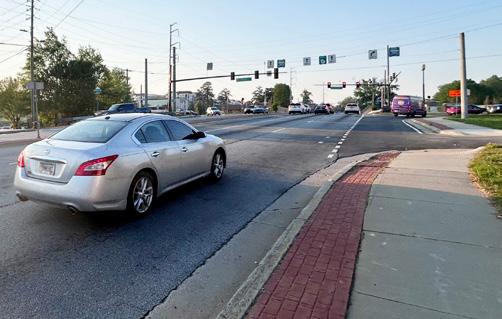
Sandy Springs is investing in sidewalks along busy Roswell Road to improve safety because the major corridor accounted for more than 40 percent of pedestrian crashes and nearly 30 percent of bicycle crashes between 2020 and 2024.
problem when it's not going to,” he said. “We have to provide people other ways to get around and also help people stop driving through Sandy Springs.”
Housing investments
Chinsky also noted that the city’s population of roughly 105,000 has declined over the past five years because it is too expensive for people to live here. The transportation plan needs to address housing issues, he said.
“I would love to see one of our goals for a transportation plan to enable new housing to be built so that new families can move here and buy into Sandy Springs,” he said.
For example, as the city updates its comprehensive plans over the next year, it would be wise to look at denser housing in downtown Sandy Springs, he said.
“Traffic planning and transportation planning has to go hand-in-hand with that, or else traffic is going to be very bad,” Chinsky said. “But when done right, it can reduce traffic and create a nice walkable downtown area where people are living here. I think those two things have to be married a little bit more than I'm seeing so far.”
Although Sandy Springs’ rapid population growth has slowed in recent years, regional forecasts project the city will grow to approximately 118,000 residents by 2050. Officials say that growth, coupled with the city's role as a major employment center, will require transportation investments that improve mobility within the city and throughout Metro Atlanta.
Nearly 8 percent of Sandy Springs households do not have access to a personal vehicle, making transit, sidewalks and bicycle infrastructure critical for reaching jobs, schools and medical services, the Modern Mobility Partners study says.
The report also says the city is also home to roughly 132,000 jobs, but only about 6 percent are held by Sandy Springs residents. That means that 94 percent of the jobs are held by commuters.
See VISION, Page 15
DRIVEWAYS