

Your Local Broker for Medicare Insurance Needs

Jay Looft Owner/Agent
•
•
•
•


The unexpected hospital stay
Brought to you by – Senior Source Medicare Solutions
If you are on Medicare, are you prepared financially for the cost of an unexpected hospital stay?


According to a study published on KFF.org, 1 in every 5 Medicare beneficiaries experience at least one inpatient hospital stay in a given year.
If I had to guess, I bet many of those visits were unplanned.
Do you have traditional Medicare paired with a Medicare Supplement?
Or do you have the all-in-one Medicare Advantage plan? Typically with a Medicare Supplement (depending on the plan type), your cost is relatively low for a hospital stay.
But with Medicare Advantage, a hospital stay could be hundreds of dollars per day for a set of days (ex. $350 per day, days 1-7). If this was your hospital stay benefit, and you stayed 7 days in the hospital, are you prepared to pay out $2,450 ($350 x 7 days)?
If you have that amount in savings, that’s great! I tell my clients on Medicare Advantage to try their best to earmark part of their savings as a “copay fund” for any unexpected healthcare
costs that may pop up.
The second option would be to purchase a low monthly cost insurance plan to cover hospital stay copays. This coverage is called Hospital Indemnity coverage. There are varying levels of coverage, but for as low as $25 per month you can insure against the potential exposure of a high cost hospital stay. This coverage will pay you (or the hospital) a per day amount.
Factors that can affect cost and acceptability are the “per day” benefit amount, age and health status. We work with Hospital Indemnity plans because it fills in the holes of the high cost of hospital copays on Medicare Advantage.
I receive so much positive feedback from my clients that purchased a Hospital Indemnity; no one really regrets this purchase!
Call us today to get your quote on a Hospital Indemnity plan. Even if you have traditional Medicare paired with a Medicare Supplement, you can still benefit from the Hospital Indemnity coverage.
Call us today to find out more at (770) 913-6464 or contact us on our website at SeniorSourceMedicare. com/contact-seniorsource.
Is Lidocaine a secret weapon against cancer?

We always worry about the negative side-effects that a medicine might have. At the end of a pharmaceutical company’s commercials, an auctioneer very quickly states the twenty terrible things that might happen if you take the advertised medicine. Side effects range from your ear falling off when you sneeze to the belief that you are Elvis. Side-effects make almost any medicine sound scary. But occasionally, a positive side effect emerges. Sometimes, we discover something wonderful about a medicine that is wholly unexpected.
Examples of positive side-effects are not hard to find. The medicine finasteride was first being used to help decrease the size of the prostate in men who were having difficulty urinating. An unexpected positive side-effect was discovered when it was noticed that many of the men were re-growing their scalp hair. With finasteride, male pattern baldness was often partially reversed or stopped in its tracks.
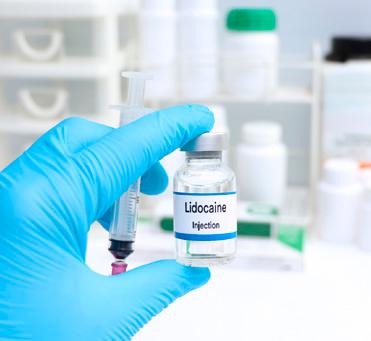
One of the most recent medications discovered to have a possible positive side effect is lidocaine, which has been around since 1943. Lidocaine is an injectable anesthetic. We use lidocaine for skin biopsies, excisions, Mohs surgeries and countless other procedures every day in the dermatology office. Amazingly, lidocaine may be more than an anesthetic. It may also have anti-cancer effects.
A team of surgeons in India operating on breast cancer divided patients into two groups. One group had standard breast cancer surgery. The other group received a lidocaine injection around the tumor 7-10 minutes prior to surgery. During the 5 years after surgery, the group that received the lidocaine injection had an 8.5% rate of the cancer recurring (popping up again) at a distant site versus an 11.6% rate of distant recurrence in the surgeryonly (no lidocaine) group. The study has some limitations including not being a double-blind trial and being a single-center study, but it is intriguing enough to warrant further investigation. The authors reported that injecting lidocaine around breast cancer before removing it increased survival in their study.
What made the surgeons perform this study in the first place? Why lidocaine? Over the last few years,
researchers have discovered that electrical gradients maintained across the membranes of cancer cells are important to their ability to metastasize or spread. Our cells have pumps in them called “ion channels.” They allow certain ions to pass across the cell membrane. The resulting ion concentration gradient creates an electrical charge across a cell. This gradient affects the way other proteins in the cell function. Importantly, some of the proteins affected by the charge across a cell membrane are important for healthy cells’ growth and development as well as for cancers’ ability to grow and spread.
Lidocaine works by blocking sodium channels in cell membranes. Disrupting the electric charge across a cancer cell membrane was suspected to have the potential to weaken the cancer itself. Pre-clinical studies supported this hypothesis, and the breast cancer surgeons took the next step of performing a trial with breast cancer patients and peritumoral lidocaine injections.
I don’t know if breast cancer surgeons in the United States consider these results valid, are awaiting confirmatory studies or are already injecting lidocaine. However, in dermatology, these results are exciting because, for now, we do not need to change anything that we are already doing. Every day that I perform Mohs surgery, we inject the area around a tumor with lidocaine prior to surgically removing the cancer. If lidocaine is more than an anesthetic, then our patients are likely already benefiting from any anti-cancer properties that lidocaine has.
Mohs surgery is the gold standard for treating most skin cancers and has a cure rate that is usually at or above 99%. Perhaps lidocaine is one of the secrets to this success.
Insist on the BEST
Dr. Brent Taylor is a Board-Certified Dermatologist, a Fellowship-Trained Mohs Surgeon, and is certified by the Board of Venous and Lymphatic Medicine in the field of Vein Care.
He is an expert in skin cancer and melanoma treatment, endovenous laser ablation, minimally invasive vein procedures and cosmetics procedures such as Botox and injectables.
Kathryn is a certified physician assistant with over 23 years experience as a Dermatology PA and cosmetic dermatology.
Her specialties include general dermatology such as acne, eczema, rashes, hair loss, full body skin exams, abnormal growths etc. Kathryn also specializes in cosmetic dermatology including lasers, injectables, micro-needling, PRP, facial peels, sclerotherapy for spider veins and at home skin care.


Kathryn Filipek, PA-C
Brought to you by – Dr. Brent Taylor, Premier Dermatology and Mohs Surgery of Atlanta
Protecting your skin in February
Brought to you by - Dr. Lola Sode, Epiphany Dermatology
February is the season of love, but it also brings some of the toughest challenges for your skin. It may feel as though winter is over once the holidays pass, but the season continues well into March! The cooler and drier weather causes skin dryness and is one of the most common complaints I see in my patients. Without the right care, this can progress beyond tightness and flaking to painful cracking, itching, and irritation.
For individuals with chronic skin conditions like eczema or psoriasis, winter often means more frequent flare-ups. Cold, dry air and indoor heating can strip the skin barrier, making it harder to control symptoms and leaving skin inflamed or uncomfortable. In addition, texture concerns such as keratosis pilaris—those small, rough bumps on the arms
or thighs—tend to be more noticeable this time of year.
The good news is that with the right approach, you can manage and even prevent many of these issues. Partnering with a board-certified dermatologist is the best way to develop a customized plan that addresses your skin’s unique needs in winter. This may include targeted prescription treatments, barrier-repairing moisturizers, or specialized therapies to calm flare-ups and smooth texture.
February is also an excellent time to prioritize professional treatments that support overall skin health. Options like gentle exfoliating procedures, light therapy, or customized skincare routines can make a noticeable difference in how your skin looks and feels.
Don’t let winter take a toll on your skin. With expert guidance, you can keep it comfortable, healthy, and radiant all season long.




Mobility scooters vs. power wheelchairs: How to choose?


You have determined that it’s time for a powered mobility device so you can continue going where you want to go...SAFELY! Read more to learn how to determine whether a scooter or power wheelchair is the best option for you.
When is a scooter the perfect choice? If you simply need help managing longer distances such as the airport, the mall, and outings with the grandkids, then a scooter could be the perfect solution. There are standard 4-wheel and 3-wheel scooters that disassemble for transport in a car, support up to 300 lbs. and travel 6-15 miles on a charge depending on the model of the scooter.
When is a power wheelchair the perfect choice? Power wheelchairs, also known as “powerchairs” are ideal for someone who needs safe mobility support inside their home as well as outside. They have a zero-turn radius so they can maneuver in tight spaces like bathrooms and narrow hallways and are operated by a joystick. The latest models weigh 27-40 lbs., fold flat like a stroller for portability, and have lightweight, and long-lasting lithium batteries.
Buy Local! Working with a local dealer will ensure that you are guided to the solution that is right for your needs, and that you will be able to get service and repair if required. They will advocate on your behalf when discussing your repair issue with the manufacturer and can provide a loaner device while yours is being repaired. Local support for the life of the product is priceless! Additionally, your neighborhood mobility partner will stock high-quality products that will last for years. Beware of online retailers advertising mobility equipment at low, low prices! If it sounds too good to be true, it probably is. Expect to pay between $1000 and $3500 for well-made powered mobility items. Accessories – Both scooters and powerchairs have a wide range of accessory options. Oxygen tank holders, cane holders, storage bags, weather protection covers, attendant controls (to allow a caregiver to control the device), and cup holders are all popular items that can make sure everything you need is at your fingertips!
Come visit us Monday-Friday 10am-5pm or Saturdays 9am-1pm or call us at (470) 545-1827. We look forward to helping you “go where you want to go!”







The unexpected hospital stay
costs that may pop up.
If you are on Medicare, are you prepared financially for the cost of an unexpected hospital stay?
According to a study published on KFF.org, 1 in every 5 Medicare beneficiaries experience at least one inpatient hospital stay in a given year. If I had to guess, I bet many of those visits were unplanned.
Do you have traditional Medicare paired with a Medicare Supplement? Or do you have the all-in-one Medicare Advantage plan? Typically with a Medicare Supplement (depending on the plan type), your cost is relatively low for a hospital stay.
But with Medicare Advantage, a hospital stay could be hundreds of dollars per day for a set of days (ex. $350 per day, days 1-7). If this was your hospital stay benefit, and you stayed 7 days in the hospital, are you prepared to pay out $2,450 ($350 x 7 days)?
If you have that amount in savings, that’s great! I tell my clients on Medicare Advantage to try their best to earmark part of their savings as a “copay fund” for any unexpected healthcare
The second option would be to purchase a low monthly cost insurance plan to cover hospital stay copays. This coverage is called Hospital Indemnity coverage. There are varying levels of coverage, but for as low as $25 per month you can insure against the potential exposure of a high cost hospital stay. This coverage will pay you (or the hospital) a per day amount.
Factors that can affect cost and acceptability are the “per day” benefit amount, age and health status. We work with Hospital Indemnity plans because it fills in the holes of the high cost of hospital copays on Medicare Advantage.
I receive so much positive feedback from my clients that purchased a Hospital Indemnity; no one really regrets this purchase!
Call us today to get your quote on a Hospital Indemnity plan. Even if you have traditional Medicare paired with a Medicare Supplement, you can still benefit from the Hospital Indemnity coverage.
Call us today to find out more at (770) 315-8145 or contact us on our website at SeniorSourceMedicare. com/contact-seniorsource.
Your Local Broker for Medicare Insurance Needs

Paige Gorman Agent

Appen Media Group publishes 7 award winning publications, home-delivered, with a combined circulation of 114,000 every week* and is the #1 source for hyper-local news in the areas we serve.
Are you a business owner/manager looking to increase sales & gain new customers/clients?
Learn how to reach this attentive and affluent audience with a customized marketing plan just for you!
Call 770-442-3278 or email: advertising@appenmedia.com to get started!

*Decaturish Ink currently publishes on the 2nd & 4th Thursdays of every month. All other publications publish every Thursday.