DeKalb County rolls out blight tax against neglected properties ► PAGE 15
DeKalb County rolls out blight tax against neglected properties ► PAGE 15
By HANNAH YAHNE hannah@appenmedia.com
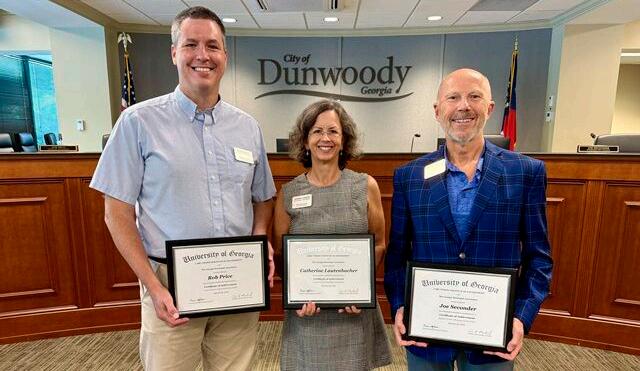
DUNWOODY, Ga. — Dunwoody City Council members Catherine Lautenbacher, Rob Price and Joe Seconder received certificates of achievement from the Georgia Municipal Association for participating in a series of training programs in June.
The council members were presented with

the Harold F. Holtz Municipal Training Institute certificate during the municipal association’s annual convention in Savannah on June 29. The institute is a cooperative effort between the association and the University of Georgia’s Carl Vinson Institute of Government. Participants complete 72 hours of training to obtain the certificate.
See CERTIFICATE, Page 16

By HANNAH YAHNE hannah@appenmedia.com
DUNWOODY, Ga. — Residents showed up to the July 27 Dunwoody City Council meeting confused about an incorrect version of the draft vision concept for the Georgetown Small Area Plan that was published in the project outline and showed a small-lot development at the corner of Chamblee Dunwoody and Peeler roads.
The site at 4680 Chamblee Dunwoody Road once housed Chamblee Middle School, which closed in 2006. The mayor addressed the error and citizenmade mailers that were sent out to residents featuring the wrong map.
A previous version of the plan did recommend a dense residential development on the property with a new road through it. However,
Richard McLeod, director of community development, confirmed the Georgetown Small Area Plan does not include rezoning the school property.
The former middle school property is still owned by the DeKalb County School District. City officials said the school district has no plans to sell the site.
The vision concept map has been updated to correctly reflect the vision outline in the Georgetown Small Area Plan.
Kroger development
At the meeting, council members approved a special land-use permit, modified zoning conditions and four variances requested for the Kroger Marketplace coming to the shopping plaza on Ashford Dunwoody Road.
See COUNCIL, Page 16
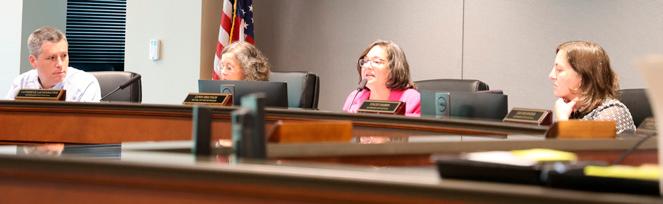
vision concept for the Georgetown Small Area Plan
city council meeting.


NEWS TIPS
770-442-3278
AppenMedia.com
319 N. Main Street Alpharetta, GA 30009
HANS APPEN Publisher DICK WILLIAMS Publisher Emeritus CONTACT
Contact reporters directly or send story ideas to newsroom@appenmedia.com.
LETTERS, EVENTS AND ANNOUNCEMENTS
Send your letters, events and community news to newsroom@appenmedia.com. See appenmedia.com/submit for more guidance.
ADVERTISING
For information about advertising in the Dunwoody Crier or other Appen Media properties, email advertising@appenmedia.com or call 770-442-3278.
CIRCULATION
To start, pause or stop delivery of this newspaper, email circulation@appenmedia.com or call 770-442-3278.
By DYANA BAGBY dyana@appenmedia.com
DEKALB COUNTY, Ga. —
DeKalb County police have arrested a 15-year-old boy in the shooting deaths of two men at a park on July 24.
The teen is charged with two counts of malice murder. He also is charged with possession of a pistol by a minor and possession of a firearm during the commission of a crime.
Police are not revealing the suspect’s name because of his age.
Tomas Cano’, 23, and Andres Valtazar, 27, were shot to death the morning of Friday, July 24. DeKalb County police officers found their bodies at Constitution Lakes Park, home of the Doll’s Head Trail, in the 1300 block of South River Industrial Boulevard.

By HANNAH YAHNE hannah@appenmedia.com



Correction: A map that ran with the July 30 story “Dunwoody council hears Georgetown small area draft plan” was incorrect. After last week’s newspaper went to print, city staff members replaced the map originally used in the Georgetown Small Area Draft Plan presentation. The corrected map is displayed in this week’s Dunwoody City Council update.
SANDY SPRINGS, Ga. — A man is facing federal charges after authorities say his firearm accidentally discharged on a Metropolitan Atlanta Rapid Transit Authority bus, hitting a woman and also wounding himself while traveling in Sandy Springs on July 22.
Guillermo Cruz Velazquez appeared in federal court July 28 on charges of unlawful possession of a firearm by an alien illegally or unlawfully present in the U.S., the U.S. Attorney’s office for the Northern District of Georgia said in a press release. He will remain in the
custody of the U.S. Marshals Service pending further proceedings.
The incident happened near the intersection of Roswell Road and Glenridge Drive. A firearm in Velazquez’s bag discharged one round that struck a female passenger in the leg and Velazquez in the forearm.
Velazquez fled on foot, and Sandy Springs police found him wounded in a parking lot and possessing a bag with a hole in it, the release said. Officers found a .45 caliber pistol with a used cartridge case stuck in the ejection port in nearby bushes.
Chief of the MARTA Police Department M. Scott Kreher said the
safety of passengers and employees remains a top priority.
“We are working closely with our federal, state and local law enforcement partners as the investigation continues,” Kreher said. “Reckless actions that place the public at risk have no place on our transit system, and we remain committed to maintaining a safe environment for everyone who relies on MARTA.”
The case is being investigated by the MARTA and Sandy Springs police departments, the federal Bureau of Alcohol, Tobacco, Firearms and Explosives, and Immigration and Customs Enforcement.

Representative government rests on a simple covenant between citizens and those they elect. Citizens entrust their elected officials with the authority to make decisions on their behalf. In return, those officials accept the responsibility to exercise sound judgment, explain their decisions openly, and remain accountable to the people they serve. That covenant is the foundation upon which public trust is built.
Attorneys play an indispensable role in government. They provide legal advice, prepare legal documents, and protect the city’s interests when legal issues arise. Their responsibility, however, is to advise. The responsibility to govern belongs exclusively to the mayor and city council. Those roles are complementary, but they are not interchangeable.
When those responsibilities become blurred, citizens naturally begin asking a fundamental question. Who is making the decisions, and who is accountable for them? In a representative democracy, there should never be uncertainty about the answer.
In recent months, many Dunwoody citizens have sought answers to important questions affecting their community. Emails have been sent to the mayor and city manager. Community leaders have requested meetings. Too often those requests have gone unanswered or have been redirected through legal counsel rather than the elected officials responsible for the decisions. That should concern every citizen regardless of the issue involved.
When Dunwoody was founded, it was founded on the belief that government should be closer to the people, more responsive to citizens, and more accountable for its decisions. Those principles remain just as important today as they were on the day our City was incorporated.
Legal advice should inform public policy, but it should never replace leadership. Governing requires judgment, communication, transparency, and accountability. Those responsibilities cannot be delegated. Citizens deserve elected officials who are willing to explain their decisions and stand behind them.
Consistency is equally important. Citizens understand that every circumstance is different, but they
TALK BACK TO THE CRIER: You talk, we listen. The Crier is parking the Talk Back section at the front of the paper for the foreseeable future. Send your letters to newsroom@appenmedia.com by Sunday night and they’ll end up here that week.
Rules of engagement:
• Typically we restrict letters to 300 words. To limit fury from the copy desk, try and stay below that line.
• We normally do not publish letters written in response to other letters. We are going to waive that policy for the time being.
• We won’t publish your letter or name without explicitly getting your approval.
also expect similar situations to be evaluated according to the same principles. When outcomes differ, government owes the public a clear explanation. Consistency builds confidence because it demonstrates fairness. Inconsistency weakens confidence because it creates the appearance that the rules change from one case to another.
Transparency is not measured by the number of meetings held or documents posted online. Transparency exists when elected officials willingly engage with the people they represent, answer reasonable questions, and explain the reasoning behind their decisions. That is the essence of representative government.
The issue is not whether the city has capable legal counsel. It does. The issue is preserving the proper roles within government. Attorneys advise. Elected officials govern. Those responsibilities are distinct because accountability ultimately rests with those chosen by the voters.
Government should not make decisions under the assumption that they may someday be litigated. The government should make decisions with the knowledge that they are right. When decisions are grounded in fairness, consistency, transparency and accountability, they earn the confidence of the public they are intended to serve.










Danny Ross Founding member, Dunwoody


City Council
DUNWOODY, Ga. — The Dunwoody Woman’s Club will hold its 53rd annual Home Tour on Friday, Oct. 2, 2026, from 10 a.m. to 2 p.m., marking a change from its traditional Wednesday schedule.
This year’s tour will feature two homes in Sandy Springs and one in Dunwoody. Among the featured properties is a renovated home in East Roswell converted into a modern farmhouse.
According to the club, the property includes several gardens, a fine art collection and a model railroad display that is open to the public annually.
The tour serves as the club’s primary fundraising event. Proceeds support the organization’s community programs, including scholarships and grants for local nonprofit and civic organizations. Since 2005, the club, according to members, has contributed more than 184,000 volunteer hours, raised more than $600,000 for charitable projects and awarded more than $135,000 in student scholarships.
Organizations that have received support from Home Tour proceeds include the Dunwoody Nature Center, animal shelters, local schools and libraries, the Spruill Center for the Arts, Stage Door Theatre and programs serving veterans, children and families.
Tickets and sponsorship opportunities are available at dunwoodywomansclub.com/hometour.
— Elle Girard















Each line in the puzzle below has three clues and three answers. The last letter in the first answer on each line is the first letter of the second answer, and so on. The connecting letter is outlined, giving you the correct number of letters for each answer (the answers in line 1 are 4, 5 and 5 letters). The clues are numbered 1 through 7, with each number containing 3 clues for the 3 answers on the line. But here’s the catch! The clues are not in order - so the first clue in Line 1 may (or may not) actually be for the second or third answer in that line. Got it? Good luck!






1. Radar image. Gung-ho. Small olive-colored flycatcher.
2. Big party. Long-legged webfooted shore bird. Urban haze.
3. Clan emblem. Elevator, in England. European blackbird.
4. Three-toed bird. Downhill racer. Newbie golfer.
5. Winter wear. Diving duck. Figure skater’s jump.
6. Big brass. Room at the top. Short-billed Old World rail.
7. Tyrant flycatcher. Pricing word. Trade.
1 Radar image. Gung-ho. Small olive-colored flycatcher.
2. Big party. Long-legged web-footed shore bird. Urban haze
How to Solve: Each line in the puzzle above has three clues and three answers. The last letter in the first answer on each line is the first letter of the second answer, and so on. The connecting letter is outlined, giving you the correct number of letters for each answer (the answers in line 1 are 4, 5 and 5 letters). The clues are numbered 1 through 7, which each number containing 3 clues for the 3 answers on the line. But here’s the catch! The clues are not in order - so the first clue in Line 1 may (or may not) actually be for the second or third answer in that line. Got it? Good luck!
3. Clan emblem. Elevator, in England. European blackbird.
4. Three-toed bird. Downhill racer. Newbie golfer
5. Winter wear. Diving duck. Figure skater’s jump
6. Big brass. Room at the top. Short billed Old World rail. 7. Tyrant flycatcher. Pricing word.

white squares to the right of it. A number below the diagonal line is the sum of the white squares in the sequence below it. You may only use the digits 1 to 9, and a digit can only be used once in any sequence. How to Solve: To solve the Sudoku puzzle, each row, column and box must contain the numbers 1 to 9.

By ERLANDRYA RUTLEDGE erlandrya@appenmedia.com
ALPHARETTA, Ga. — Less than three years after its launch, nearly 10,000 parents a month are using ConfettiJar. com, an Atlanta-based platform that, according to its founders, connects families with trusted local vendors for birthday parties and other events.
Jessica Vicars, who moved to the Atlanta area 18 years ago, and Roy Duvall, a lifelong Georgian, founded the website. They worked together in healthcare information technology before founding Confetti Jar to solve an ongoing issue — birthday parties that required parents to find service providers and vendors through blind social media or internet searches.
Confetti Jar makes that process more simple, bringing those businesses together on one website. Its staff members spend time with vendors, helping them get exposure and build trust with customers.
It’s free for parents to use, with a small commission fee charged to businesses when their services are booked through it, the founders said. The latest update, they said, allows customers to book services from local vendors directly through Confetti Jar.

A screenshot shows the homepage of ConfettiJar.com. The Atlanta-based platform connects parents with local vendors for birthday parties and other events.
The new booking feature cuts out the back-and-forth quote requests that used to define party planning, they said.

“It’s bringing everything together for both sides to make a seamless experience,” Duvall said. The website now has 150 participating businesses. Social media platforms like Facebook and Instagram have been the biggest driver of Confetti Jar’s visibility.
YOUR VOICE. YOUR BUSINESS. YOUR SUCCESS. YOU ARE WHAT MAKES US GREATER.

Memberships is now opendon’t miss out on this exciting new chapter! today and become part of a dynamic network that’s shaping the business landscape
Together, we’ll create opportunities, drive innovation, and build a brighter tomorrow
“[I’m] a real mom [who] genuinely cares about other families having a great birthday party experience, and we really aim for that to come through in [our] social media pages, where people get a chance to get to know
us,” Vicars said.
Vicars and Duvall have plans to branch out to other cities but are more invested in Atlanta right now, they said, wanting to ensure local businesses are seeing growth.
“[Our local businesses are] so collaborative, fun and friendly,” Vicars said. “It’s been an amazing community to get to connect with, and we certainly couldn’t do something like this without the local businesses being so excited about what we’re building.”
DUNWOODY, Ga. — City staff members are seeking input from Dunwoody residents on the concept design for a proposed shared-use path along the north side of Mt. Vernon Road from Vermack Road to Dunwoody Village Parkway now through Aug. 17.
This portion is the third phase of the Mt. Vernon Road Path project. It will extend the shared-use path that starts at Jett Ferry Road to Dunwoody Village Parkway.
The first phase from Jett Ferry Road to Mt. Vernon Place includes improvements at the Tilly Mill intersection, and construction will begin later this year. Staff members said in a press release the right of way
is currently being acquired for phase two of the path, which will extend from Mt. Vernon Place to Vermack Road.
The project also includes a fourth phase that will connect the path to Chamblee Dunwoody Road.
Dunwoody Public Works Director Michael Smith said this project continues efforts to provide safe, connected and accessible walking and biking access along a key corridor in the community. He encourages residents and property owners to review the concept design and share their feedback on the public comment portal at dunwoodyga.gov.
— Hannah Yahne
By DYANA BAGBY dyana@appenmedia.com
DEKALB COUNTY, Ga. — The city of Brookhaven will receive more than half a million dollars in grant money to help design a pedestrian bridge over Interstate 85.
The bridge, known as the Peachtree Creek Greenway Connector Bridge, would improve safety and connect a growing trail network with the Emory University Executive Park campus, one of DeKalb County’s largest employment centers, officials said. The bridge will also be in compliance with requirements set by the Americans with Disabilities Act.
Decide DeKalb, the county’s economic development agency, approved July 23 a $588,168 Urban Renewal Fund grant to Brookhaven to advance the design on the bridge, described as a “critical link” between the Peachtree Creek Greenway, the county’s trail network, PATH 400 and the Atlanta Beltline.
The bridge will span I-85 from Executive Park South to West Druid Hills Road. It is planned to be a 14-foot multiuse path that will connect to a stair and elevator plaza along the second phase of the Peachtree Creek Greenway and with a trail and ADA ramp structure connection to Executive Park South. The bridge will cross the interstate just before the North Druid Hills Road exit on I-85 north, an area notorious for traffic gridlock.
Currently, the only pedestrian crossing over I-85 in the area is a 42inch sidewalk on the North Druid Hills Road interchange bridge.
“If you’ve ever driven this corridor in the morning or in the afternoon commute, it can be tough … so we’re looking forward to having some pedestrian access,” Brookhaven Economic Director Aaron Szarowicz said at the July 23 meeting.
The grant is funded through the Briarcliff North Druid Hills Tax Allocation District. It covers about 31% of eligible soft costs, including design and acquisition of property. The total project is expected to cost between $18 million and $24 million.
“This is exactly the type of thing that tax allocation funds should be spent on,” Ann Hanlon, chair of Decide DeKalb, said.
Brookhaven is contributing funding through its Special Service District, and additional tax allocation district support is expected to be considered as the project moves toward construction, officials said.
Emory University is also providing $15.8 million.

This rendering shows a pedestrian bridge that will
University Executive Park campus.
The project supports goals outlined in the Briarcliff North Druid Hills TAD Redevelopment Plan, which calls for infrastructure that connects neighborhoods, supports pedestrian and bicycle travel, and expands access to parks, according to funding documents.
Brookhaven has been developing the project since it was recommended in the city’s 2020 Comprehensive Transportation Plan update, working with design firm Michael Baker International and coordinating with the Georgia Department of Transportation, which oversees I-85 and bridges statewide.
“This investment represents the kind of strategic infrastructure work that makes growth more connected, more accessible and more sustainable," Dorian DeBarr, president and CEO of Decide DeKalb, said in a statement. "We are not simply helping fund the design of a bridge. We are helping connect people to jobs, institutions, trails and future opportunities."
DeKalb County CEO Lorraine Cochran-Johnson said the bridge reflects the kind of investment the county needs as it grows.
“By creating safer connections across
a major transportation barrier, we are expanding access and supporting a more connected DeKalb,” she said in a statement.
City officials plan to return to the Decide DeKalb board in late 2027 to request a supplemental grant for construction costs. Rightof-way acquisitions, easements and environmental permitting are expected to wrap up in 2027, followed by final design and GDOT authorization.
Construction is expected to begin in 2028, with completion targeted for 2029.


By HANNAH YAHNE hannah@appenmedia.com
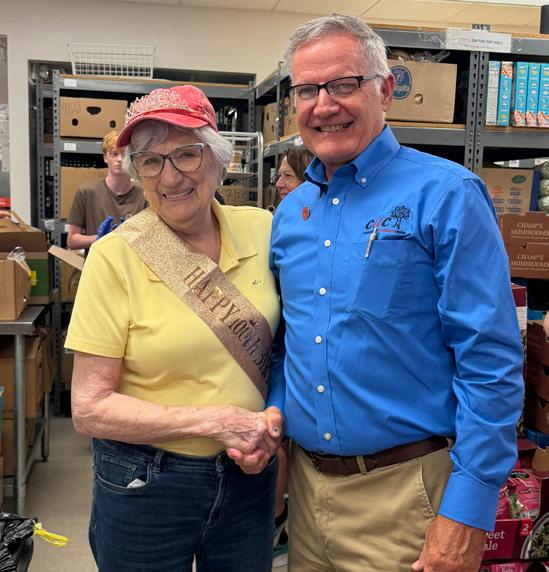
SANDY SPRINGS, Ga. — For the past four years, Margaret Lines’ Tuesday afternoons have been spent volunteering at the food pantry at the Community Assistance Center off Roswell Road.
She planned the afternoon of July 28 to be no different, buta crowd of 30 fellow volunteers had other ideas. They gathered around a birthday cake to surprise Lines as she strolled in for her 1 p.m. shift with her daughter, Nancy Overheim.
Surprise washed over Lines as she stepped into the food pantry and was greeted by familiar faces and even those who didn’t know her but wanted to help celebrate her 100th birthday.
She walked around the room thanking everyone, hugging those she knew and people she had just met.
“It’s not everyday somebody turns 100,” CEO Francis Horton said. “And it’s certainly not every day that somebody turns 100 and is volunteering at a food pantry.”
Lines serves as an inspiration to those doing nonprofit work, Horton said.
She started her work with the Community Assistance Center at age 96, but serving others has always been important to Lines.
She grew up on a farm in Indiana, walking through muddy fields to attend a one-room school until she entered sixth grade, when she could take a bus to the school in town. She earned a scholarship to Purdue University and worked as a
dietitian for several hospitals before retiring.
“Not a lot of women were [graduating college] back than,” Lines said. “And I was able to do that and go on and offer my services to … the state of Indiana.”
Nutrition isn’t the only thing Lines remembers from her college days. She began bowling 82 years ago as a freshman at Purdue and keeps her skills sharp by playing at least one game a week at a nearby bowling alley with Overheim and friends on their way home from the Community Assistance Center.
Volunteering became a part of Lines’ Tuesday routine after she moved from Arizona to be closer to her daughter. Every week, the pair weigh and sort food items donated by community partners that feed hundreds of families throughout the month.
“I worked as a dietitian for many years,” Lines said. “I want to see the nutritious things that are offered here … I don’t want it to just be thrown away.”
Lines said time spent volunteering with her daughter is wonderful, allowing them to talk about things that otherwise might not come up while filling a passion she has had all her life.
The Community Assistance Center is built around its roughly 520 monthly volunteers, Horton said, and it has been for 40 years. They staff the Canopy Thrift Shop six days a week, unload and sort food delivered from local food banks and pack donations from the nonprofit’s 28 church partners.
“It really is a picture of community helping community,” Horton said.


By HANNAH YAHNE hannah@appenmedia.com
SANDY SPRINGS, Ga. — When David Raphael wrote his first essay, “Jacob’s Story: A Miracle of the Heart,” nearly 30 years ago, he never predicted it would turn into a published book that explores the “amazingly emotional” experience he said results from raising a child with autism.
“Every autistic kid’s story is unique,” David said. “Among the things that makes Jacob’s path unique is … he started in a really serious place.”
His son Jacob was diagnosed with autism at 2 years and 7 months old, and doctors could not guarantee how far he would progress due to significant cognitive delays. In the essay published in 1997, David wrote that the weeks following his son’s diagnosis were among the most painful he had ever experienced.
“I would lie awake at night, unable to sleep,” David wrote. “I had no appetite. I could think of nothing but the son that would be lost to me forever.”
This severe anxiety continued until the Raphaels were introduced to the DIR model, a scientific framework used to promote healthy development in children with autism. DIR — an initialism for the developmental, individual differences, relationshipbased model — was developed in the 1980s and 1990s by Dr. Stanley Greenspan and expanded upon by Dr. Serena Weider.
“The first time we saw Dr. Greenspan … Jacob and I were in his office and it was as if somebody had opened a door to the future,” David said. “When we started doing the Floortime method, we saw changes right away.”
Floortime, according to the DIR website, is the DIR model put into practice. Activities focus on building a child’s underlying developmental capacities — emotional regulation, engagement, two-way communication and problem-solving — through play that follows the child’s interests.
With Floortime treatment, David said progress came “immediately,” making the three-hour commute to Greenspan’s office — and the thousands of dollars spent on provider costs — worth it. He said it was gratifying and exhilarating to see his son’s growth.
“As Jacob was healing, I was healing, too,” David said.
David read his “Jacob’s Story” essay at the 1996 Zero to Three child development conference, sharing


BOYD GRAPHICS/PROVIDED David Raphael,
embraces his 13-year-old son Jacob in the cover photo for “A Miracle of the Heart: A Father and Son’s Autism Journey,” which was published earlier this year.
A Father and Son’s Autism Journey,” which was released this summer through the publisher they founded, The Narrow Bridge Press.
how important early intervention and DIR was to their lives. He said it was hard work, frustrating at times, and he noted Jacob’s progress was rapid and remarkable. Jacob, by age 5, had said his first word — “meow” — and wanted to learn everything.
“Jacob’s Story” was published in the April/May 1997 edition of the Zero to Three Journal, which publishes the latest research on early childhood development and related insights from experts. Three years later, he was again invited to speak at the group’s conference. His second essay, “Jacob’s Story Part II: Each Day is Another Adventure,” was published in 2000.
David said parents of children diagnosed with autism are desperate for hope. The diagnosis is becoming more prevalent, with the Centers for Disease Control reporting that, in 2022, 1 in 31 8-year-old children in the U.S. were identified with autism spectrum disorder. In 2002, 1 in 150 were noted.
“We’ve been telling Jacob for years that he has an important message to
share, that he has an important story to share with others,” David said.
Last year, David collected his essays and spoke with Jacob about each chapter. The dad transcribed his conversations with his son. Jacob contributed his own chapter, “A Boy and His Autism,” which details the confusion and difficulties he experienced while growing up with autism. The prose also recounts the first time he read “Jacob’s Story.”
Jacob, usually hesitant to discuss the development disorder, wrote that reading the essay caused a wave of emotions to burst through a dam he had long been building.
“The emotion that broke the camel’s back, in this case, wasn’t anger but empathy … empathy and a radical shifting of a memory that happens years after the fact,” Jacob recorded.
Chapters pairing dad-and-son reflections weave readers through the shared experience and what those times meant to both individuals. The essays and reflections were published in the book “A Miracle of the Heart:
Jacob, now 35 with a bachelor’s degree in creative writing from Georgia College and State University, is working on his own novel and applying for a graduate-level social work program. With his father, he served as a keynote speaker at the Creating Connections to Shining Stars child development conference in Virginia July 14-16.
“It’s taken me three decades to become more comfortable in my own skin and with my own unique qualities,” Jacob said. “I still have a ways to go. That said, I’d like to think that I’ve learned a thing or two along the way.”
Jacob told the conference crowd, a group of special educators and parents, that it is essential to help neurodivergent people connect with others around them. He said finding people who accept others as they are — autism and all — is even more important.
“When thinking about his long journey, the latest chapter of his is embracing his autism identity,” David said. “He really embraced who he is and it’s incredibly … empowering for him and affirming.”
To learn more, read the dad-andson pair’s blog or purchase a book, visit narrowbridge.us.
By DAN WHISENHUNT dan@appenmedia.com
DEKALB COUNTY, Ga. — A DeKalb County Superior Court judge is accused of jailing an attorney for being late, threatening to jail prosecutors and refusing to take the bench to return indictments in open court.
On July 20, Judge Yolanda C. Parker-Smith was named in formal charges filed with the Judicial Qualifications Commission Hearing Panel. The JQC investigates allegations of misconduct against judges. A JQC investigative panel investigated three separate complaints and found reasonable cause to believe that ParkerSmith had committed misconduct.
“[JQC Director Courtney Veal] hereby files these formal charges with the JQC Hearing Panel in accordance with JQC Rule 19 and requests that proceedings be instituted for the purpose of determining whether Judge ParkerSmith committed the acts outlined below,” the charging document said.
The proceedings would also determine whether the acts violate the state Code of Judicial Conduct and what the appropriate sanctions should be.
A message sent to Parker-Smith’s attorney was not immediately returned. Her attorney told local TV station WSBTV, “Judge Parker-Smith is aware of the formal charges and is working with her counsel to respond fully and fairly to the same.
“Judge Parker-Smith does her best to approach every case and every matter before her with good intentions and a sincere commitment to the fair administration of justice.”
Parker-Smith was elected to the court in 2020. The allegations date back to 2023. She faces eight counts of misconduct tied to the three complaints.
‘Illegal jailing’
The charging document alleges that in August 2024, an assistant for an attorney identified as G.G. emailed the judge’s staff to notify her he would be late to court on Aug. 15, 2024. The attorney had a conflicting hearing in Henry County.
When the attorney arrived late, deputies took him into custody on the judge’s orders given before he arrived, the charging document said. The attorney was placed in a detention area in the basement. His electronic devices were confiscated. He was released about an hour later, given his electronic devices back and returned to the courtroom. He was seated in the jury box. Parker-Smith summoned the attorney and another attorney to her chambers.

“This summons occurred without Judge Parker-Smith addressing G.G. or his illegal jailing in open court,” the charging document said.
Parker-Smith “lectured” the attorney about punctuality. She appeared confused when G.G. explained he had notified her office about the conflict the day before.
“G.G. inquired of Judge Parker-Smith the reason for his jailing, but she did not respond,” the charging document said.
‘Across the pond into bars’
A different allegation involves claims that Parker-Smith threatened to jail prosecutors in 2023. In May 2023, she presided virtually over a criminal calendar call. The assistant district attorney prosecuting the case was on leave and out of the country, so another assistant district attorney filled in during the call.
That prosecutor announced that the
prosequi still had not been submitted.
Parker-Smith said, “if she doesn’t, then [the prosecutor] will come across the pond into bars.”
The judge then threatened to jail the assistant district attorney who was filling in.
That evening, Parker-Smith sent an email to her staff, the prosecutors and defense counsel saying she had not received the nolle prosequi.
“The Court expects all parties to adhere to its orders or face consequences for failure to do so,” she wrote.
She was notified the following morning that the nolle prosequi had been resubmitted. The judge signed it.
A few days later, Parker-Smith ordered the district attorney and the assistant district attorneys to appear in her court “to show cause why they should not be held in contempt for lying to this Court and failing to submit the nolle pros as stated.”
The prosecutors filed a motion to recuse Parker-Smith from that hearing, a motion that fellow DeKalb Superior Court Judge Gregory Adams denied. A few days later, Parker-Smith rescinded the show-cause order and canceled the hearing.
The third complaint alleges that Parker-Smith was the presiding judge over the DeKalb County grand jury for the January/February 2026 term.
office had submitted a nolle prosequi, or a decision not to prosecute, in the case. However, that statement was in error and the nolle prosequi had not been submitted. Parker-Smith asked if it could be submitted that day, but the prosecutor asked that it be placed on the calendar for June 2023.
Parker-Smith denied that request and said she’d return to the case later in the day. When the case was called again, the assistant district attorney said the vacationing prosecutor handling the case would submit the nolle prosequi from “across the pond” that day. ParkerSmith asked about the time difference and was told the prosecutor would “hopefully” file before the close of the business day.
Parker-Smith warned “somebody’s going to be in trouble” if it wasn’t submitted before 5 p.m. that day. At the conclusion of the calendar call, the defendant’s attorney said the nolle
When the grand jury concluded its business on Feb. 3, 2026, the assigned assistant district attorney, a clerk and a DeKalb County Sheriff’s Office corporal — called a “grand jury team” — went to Judge Parker-Smith’s courtroom so the indictments could be returned in open court.
Parker-Smith did not take the bench and instead summoned a DeKalb County Sheriff’s Office captain to her chambers. She said she did not want the assigned corporal in her courtroom. The charging document does not explain why.
“Judge Parker-Smith then refused to enter her courtroom to return the indictments,” the charging document said. “Instead, the grand jury team had to find another judge to complete the duty.”
The charging document said ParkerSmith should face consequences for her actions.
“Judge Parker-Smith’s conduct as outlined above amounts to willful misconduct in office and conduct prejudicial to the administration of justice which brings the judicial office into disrepute, and warrants discipline,” the charging document said.





















Brought to you by – Bath and Kitchen Galleria
The bathroom, a place we take for granted, transforms into one of the most hazardous areas in the home for aging seniors. With slippery surfaces, high tub walls, and the need for frequent maneuvering, the risk of falls—the leading cause of injury among older adults—spikes dramatically. John Hogan, President of Bath and Kitchen Galleria and Aging in Place Expert says, “Proactive bathroom modifications are not merely an upgrade; they are an essential investment in the long-term safety, independence, and dignity of our seniors.”
To mitigate the dangers, several specific aspects of the bathroom should be modified to create a supportive and accessible environment:
Shower and Bathtub: The single greatest fall risk is often stepping over a high tub wall. The ideal solution is a curbless or low-threshold walk-in shower to eliminate this barrier entirely. For added security, install a permanent shower seat or bench and a handheld showerhead to allow for comfortable, seated bathing. Shower floor should have non-slip tile surfaces.
Grab Bars: Strategically placed sturdy, professional-grade grab bars are critical. They must be securely anchored into wall studs, not just
the drywall. Placement is key: near the toilet to assist with sitting and standing, and both inside and just outside the shower/tub for secure entry and exit. Modern grab bars come in a variety of stylish finishes to seamlessly blend with your décor.
Toilet Area: A standard toilet can be difficult to use for those with limited mobility. Installing a comfort-height or raised toilet seat reduces the strain on joints and makes the transition from sitting to standing much easier. Pairing this with well-placed grab bars provides a significant boost in stability.
Flooring and Lighting: Replace slippery tile or remove loose bathmats and throw rugs, which are tripping
hazards. Install slip-resistant flooring throughout the bathroom. Finally, good lighting is paramount. Bright, even lighting—including motion-sensor nightlights—helps seniors navigate safely, especially during middle-of-thenight trips.
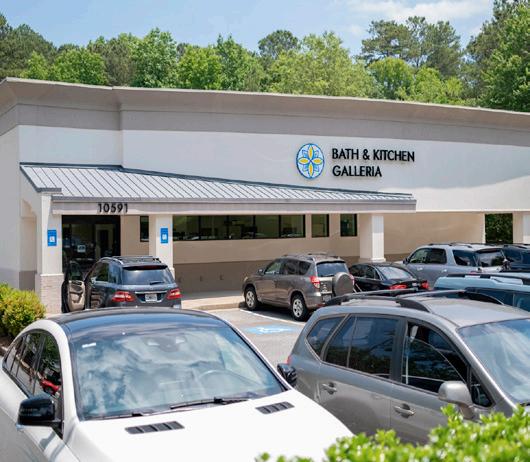
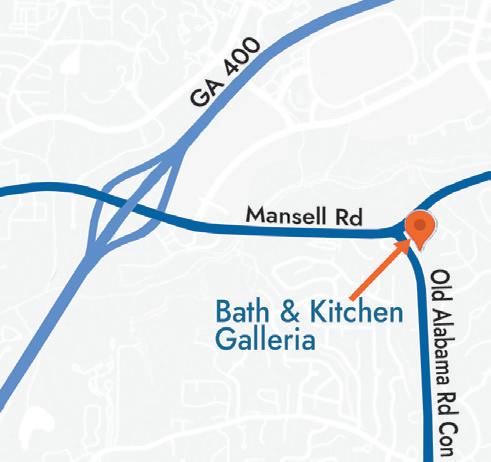
By implementing these thoughtful changes, the bathroom can evolve from a high-risk area into a secure, comfortable, and accessible space that supports an aging senior’s desire to age in place safely at home. For more information visit Bath and Kitchen Galleria’s showroom at 10591 Old Alabama Rd Connector in Alpharetta (no appointment needed) or call them at 678-459-2292.

Kitchen Tune-Up
Paint Cabinets
New Countertops, Sink & Faucet
New Backsplash
Cut Down 2-level
Island
Bathroom Tune-Up
New Countertops, Sink & Faucet
Enlarge Shower
Shower Glass
Shower Safety
Kitchen Remodel
Total Cabinet Replacement
Large Island
Optimize Cabinet / Appliance Locations
Open Concept –Move Walls
9-5 Mon-Fri • 10-4 Sat
Showroom – Design Center 10591 Old Alabama Rd. Connector Alpharetta, GA 30022 (near Northpoint Mall)
Bathroom Remodel
New Larger Shower
Vanity Replacement –Cabs, Counter, Sink
Free Standing Tub
Floor Tile, Wall Tile
Plumbing Fixtures

Brought to you by – Holly Geerdes Estates Law Center USA
For decades, a will was the default estate planning tool — simple, familiar, and seemingly sufficient. That's changing, and the numbers back it up.
This is not a small shift. It is a sign that more families are starting to understand the real difference between the two documents — and that difference matters more than most people realize until they're the ones dealing with a loved one's estate.
A will tells the court what you want. A trust lets your family avoid the court altogether.
A will is, at its core, a set of instructions for a judge. It doesn't transfer anything on its own — it has to be validated, interpreted, and executed through the probate process before your wishes carry any legal weight. A properly funded trust sidesteps that step entirely. Assets titled in the name of the trust pass directly to beneficiaries according to the trust's terms, with no court involvement required.
A will becomes public record. A trust stays private.
Once a will is filed for probate, it becomes part of the public court record. Anyone — a nosy neighbor, a dis-

gruntled relative, a scam artist targeting new heirs — can request a copy and see exactly what you owned and who inherited it. A trust is a private contract. Its terms, its assets, and its beneficiaries are not filed with any court and are not part of the public record.
A will still has to go through probate. A properly funded trust does not.
Probate is not free, and it is not fast. Depending on the state and the size of the estate, it can take anywhere from several months to well over a year, and it typically comes with court fees, executor fees, and attorney fees that reduce what's left for the family. A properly funded revocable living trust — meaning one where the person's assets have actually been retitled into the trust's name — bypasses probate for those assets altogether. The family gets access to what they need, often within weeks, not months.


Why "properly funded" is the phrase that matters most
Here is where most DIY trust plans fail: a trust document is only as good as the funding behind it. If a house, brokerage account, or business interest is never retitled into the trust's name, that asset still goes through probate — regardless of what the trust document says. This is the single most common mistake in self-prepared estate plans, and it's exactly the kind of detail an experienced estate planning attorney is trained to catch. Proper funding requires coordinating deeds, account retitling, beneficiary designations, and sometimes business entity documents — work that goes well beyond filling out a template. The biggest growth in probate is the DIY Trust that didn't get property expert advice in setting up properly beyond just signing the trust.
Why this shift is happening now
More families are choosing structure over paperwork, and that's a good thing. It reflects a growing awareness that estate planning isn't just about stating your wishes — it's about building a system that actually carries those wishes out without unnecessary cost, delay, or public exposure for the people left behind. But building that system correctly, with all the pieces properly funded and coordinated, is not a do-it-yourself project. It takes an attorney who understands both the legal requirements and the practical funding steps that make a trust work the way it's supposed to.
Come visit our workshop to learn more!


By DYANA BAGBY dyana@appenmedia.com
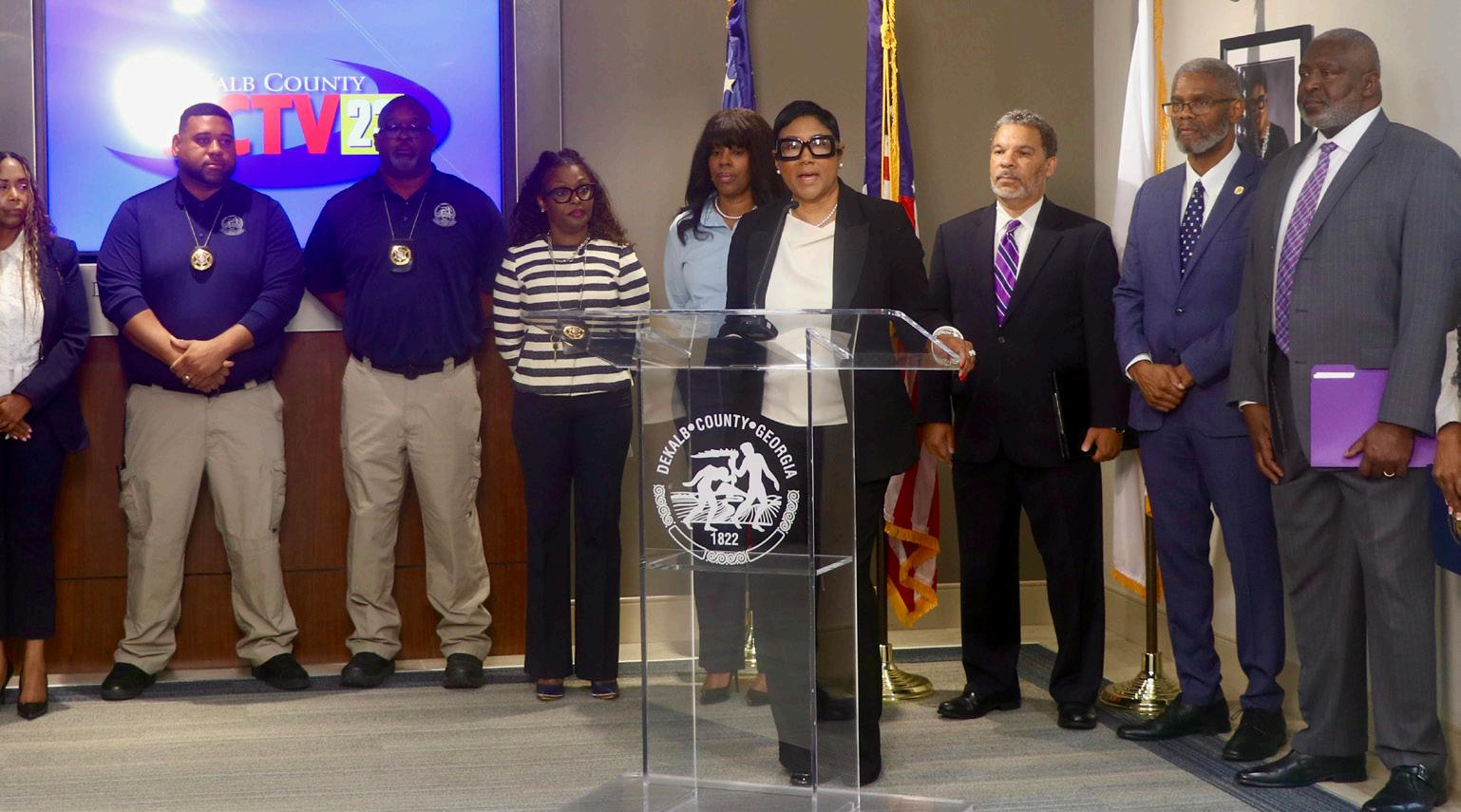
DEKALB COUNTY, Ga. — DeKalb County is rolling out a new “blight tax” that will slap much higher taxes on commercial properties deemed severely neglected.
Abandoned and neglected properties threaten the public safety of residents, diminish their property values and stifle the county’s economic development. Making property owners pay property taxes 10 times higher than the regular rate is a way to hold them accountable while also cleaning up the county, officials said.
The new blight tax puts absentee property owners on notice that they either need to clean up their property or sell it to someone else who will, CEO Lorraine Cochran-Johnson said. A property assessed at $350,000 would normally pay about $7,500 in county
property taxes; if deemed blighted, the total would jump to $75,000.
“No longer will business owners who strategically invest in DeKalb County to simply await until there is an uptick in profit be allowed to sit in comfort,” she said at a July 21 press conference at the Manuel J. Maloof Center in Decatur. “Either invest in your properties, or let's move them along to someone who will.”
The DeKalb County Board of Commissioners approved legislation in November to give the county authority to increase property taxes for blighted properties until violations are corrected. Enforcement went into effect May 10 and officials said they have identified about 10 properties that could be headed to court. Another 50 property cases are pending.
County officials declined to say where the approximately 60 properties being investigated are, but empty and
neglected buildings are a common sight in south DeKalb around Glenwood and Candler roads.
Properties can only be declared as blighted by a judge and taxes can only be raised with judicial review, officials stressed, ensuring property owners have due process to appeal their case.
“Our blight tax is what I call a tool — it is a tool that allows us to hold chronically neglected property owners accountable, while protecting the residents who live in these communities, who invest in them and have been forced to live next door to blight for years,” Cochran-Johnson said.
Blight taxes are not new. Stone Mountain approved a blight tax in 2021. Tucker did so in 2024. The city of Atlanta passed a blight tax in 2024 that calls for a tax increase 25 times as high as the regular rate, but has not been able to collect any revenue.
“I can’t speak for other jurisdictions, but we were given the full authority on May 10. We’re not 60 days in, and we have a blight task force. We have 10 cases under review with an additional 50 pending,” CochranJohnson said.
She said county officials know where the most neglected properties are and who owns them. The new blight tax is the tool they need to go after those who don’t care for their property and hold them accountable.
“This is about sending a message in the county,” Cochran-Johnson said. “We have, in many ways, not held property owners accountable.”
Code compliance officers within the blight task force will conduct thorough investigations and “have those cases all tied up really nice with a bow and all the evidence” to present to judges, she said. “I’d love for us to be the poster child of how this should be done.”
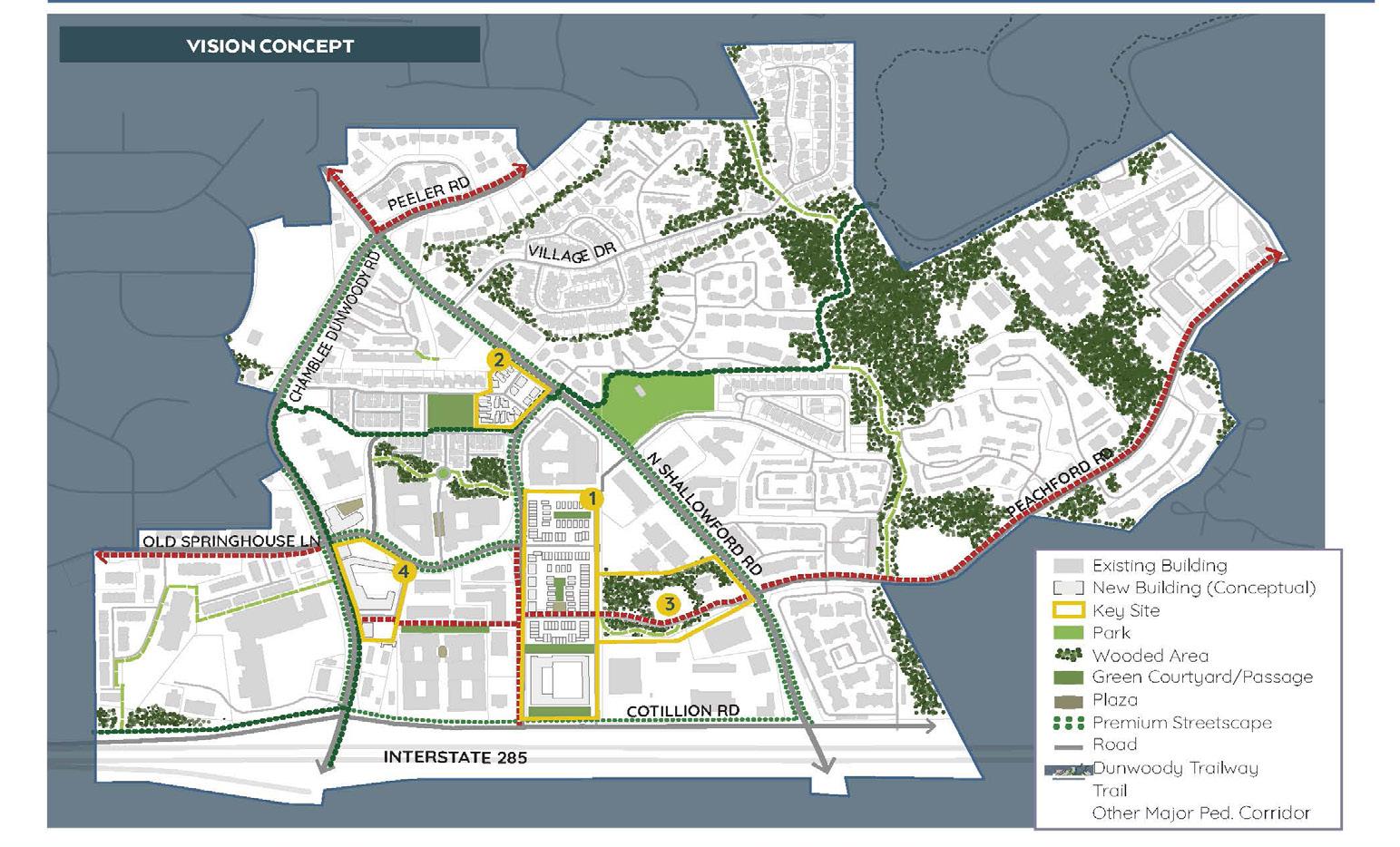
This graphic shows a corrected version of the vision concept for the Georgetown Small Area Plan.
Continued from Page 1
After hearing residents’ concerns about proposed truck delivery hours, officials modified the hours to allow deliveries only between 9 a.m. and 9 p.m. — more restrictive than the hours previously in place under Walmart, the site’s former tenant.
Other updates to the conditions include finalizing a trail easement agreement to convert a temporary construction easement into a 20-foot path. The property owner will also repair a fence on the rear property line.
The signage plan for the grocery store and its drive-thru pharmacy and gas station was also approved with a modification.
Council members negotiated with
twice a year informs how she and the city can operate better.
the applicant to remove an LED sign displaying gas prices and a Kroger shopping cart logo on the side of the gas station canopy that faces Meadow Lane. Dunwoody’s signage code allows only one sign per street-facing side of the canopy.
Other business
In other matters, council members:
• Approved an amendment to the city attorney’s contract that increased
the annual payment by $50,000 for the first time in 4.5 years.
• Discussed expanding Dunwoody’s entertainment districts to help incentivize economic development, specifically in Georgetown. Currently, two places — Dunwoody Village and Perimeter Center — allow customers to purchase a 16-ounce alcoholic beverage from a restaurant and walk the area.
Continued from Page 1
Price said the training allows him to network with representatives from other cities to learn about innovative ideas and best practices that could benefit Dunwoody. Lautenbacher echoed his reason and said attending conferences
“Serving the residents and businesses of Dunwoody means investing the time to continually learn, grow and better understand the complex issues that affect our community,” Seconder said. “This training provides practical knowledge, fresh perspectives and valuable connections with municipal leaders across our region and Georgia.”
The association is a nonprofit organization that provides legislative advocacy, education, employee benefits and consulting services to Georgia’s 537 municipalities. The association also provides leadership, tools and services to help local governments become more innovative, effective and responsive.
“This accomplishment reflects a strong commitment to excellence in public service,” association CEO
and Executive Director Larry Hanson said. “Through continued investment in professional development, City Council members Lautenbacher, Price and Seconder demonstrate leadership that benefits not only the residents of Dunwoody but also advances the strength and effectiveness of local governments throughout Georgia. This achievement sets a meaningful example for city officials across our state.”
ANNE WISKIND Guest Columnist
Do you look forward to delicious fresh peaches, golden zucchini and luscious tomatoes every summer?
Then thank the bees and other insect pollinators! They pollinate over 85% of wild flowering plants, more than 75% of agricultural crops and are essential to maintaining a balanced ecosystem.
Why is pollination so important?
Pollination allows plants to develop seeds, which then produce flowers, fruits or vegetables. It requires the transfer of pollen from the male flower part (the stamen) to the female flower part (the ovule), which then forms the seed. The problem is that some flowers may have only male or female parts, so they require pollinators to move pollen. Research shows that a single flower requires eight separate pollinator visits to develop properly shaped fruit. Talk about busy bees!
Flowers produce both nectar and pollen. Nectar is a sugar-rich fluid packed with energy to attract pollinators. Pollen is a protein-rich powder that contains the plant’s male genetic material. Bees are considered the most efficient pollinators because they collect and transport both pollen and nectar. They are also “fuzzy,” and pollen collects on their hair or on special collection structures on their legs. Wasps, flies, butterflies, beetles and ladybugs are more accidental pollinators. They are primarily after the nectar and may transport pollen collected on their legs, but their true benefit is as predators that eat harmful insects such as aphids, mites, thrips, leafhoppers and insect larvae. Most insects are not aggressive and are just interested in the nectar or pollen, but it is best not to touch them. Using the magnifying feature on your phone may help with insect identification.
Insect populations have been declining since the 1930s. This trend is widespread, not only in developing areas of the world but also in remote locations. Scientists believe this insect decline is due to habitat loss, light pollution, microplastics, pesticide use, disease and climate change. The U.S. Fish and Wildlife Service currently lists more than 50 species of pollinators as threatened or endangered. The loss of insect communities may have a disastrous effect on food webs.
The University of Georgia Extension developed and launched the Great Georgia Pollinator Census in 2017 to track insect pollinator populations in Georgia to measure the effects of pollinator habitat restoration. The initiative has since expanded throughout the Southeast to include South Carolina, North Carolina, Florida, Alabama, and, for the first time this year, Mississippi. Now known as the Great Southeast Pollinator Census (gsepc.org), it is the nation’s largest pollinator counting effort. The project also features an educational component designed to augment STEM curriculum in elementary schools.
Anyone can participate in the GSEPC on either Friday, Aug. 21, or Saturday, Aug. 22, and all ages are welcome! Participants simply pick a pollinator plant and count the number of insect visits to that single plant in a 15-minute window. Participants can complete multiple counts using a separate tally sheet.
The census tracks insects across eight different categories: bumble bees, carpenter bees, honeybees, small

bees, wasps, flies, butterflies, moths and others, such as beetles, ladybugs, dragonflies and lacewings.
The tallies are then loaded onto the GSEPC website for analysis. A pollinator plant is any blooming native or nonnative plant that shows insect activity. The GSEPC tally sheets feature pictures of the different insects to assist with identification, and an identification guide on the website helps participants understand differences between the pollinator groups.
This year, the Fulton County Extension Office is hosting census events at four locations on Saturday, Aug. 22, 2026:
• Autrey Mill Nature Preserve, Summerour House Garden, 9770 Autrey Mill Road, Johns Creek, 10 a.m. to 2 p.m.
• Chastain Park Native Plant Garden, 4001 Powers Ferry Road NW, Atlanta, 9 a.m. to noon.
• GROWL Garden at Camp Truitt, 4300 Herschel Road, College Park, 10 a.m. to 1 p.m.
• Little Diggers Booth at Sandy Springs Farmers Market, 1 Galambos Way, Sandy Springs, 8:30 a.m. to noon.
Fulton County Master Gardeners will be at these locations and will host free, family-friendly educational activities to help everyone learn about the importance
of pollinators in nature. You will find everything you need to participate in the census, including tally sheets and insect ID guides.
You can also participate in your own yard or local park, any place with flowers! You will find all the necessary information and forms at gsepc.org. Consider joining their Facebook page: Southeast Pollinator Census or follow on Instagram @SoutheastPollinators.
So Bee on the lookout for pollinators!
Happy Gardening!
North Fulton Master Gardeners, Inc. is a Georgia nonprofit 501(c)(3) organization whose purpose is to educate its members and the public in the areas of horticulture and ecology in order to promote and foster community enrichment. Master Gardener Volunteers are trained and certified by The University of Georgia Cooperative Extension.
Learn more at nfmg.net. Previous Garden Buzz columns are featured at https://appenmedia.com/opinion/ columnists/garden_buzz/.
Come visit us at the Alpharetta Farmer’s Market on the 2nd and 4th Saturdays through October or the Sandy Springs Farmer’s Market the 3rd Saturday of the month through October.

BOB MEYERS
Georgia is home to roughly 35–40 incorporated ultra small cities, each with about 500 or fewer residents.
Many of these towns were founded in the late 19th to mid-20th centuries to secure a post office, school district or railroad stop. Incorporation also offered local autonomy — their own government and taxing authority. Over time, some communities have faded from the map, while a handful continue to thrive.
Mountain Park, incorporated in 1927, has about 550 residents in an area of 0.5 square miles, making it the smallest city in Fulton County. Located on the North Fulton-Cherokee line between Roswell and Woodstock, it is wooded, has two lakes and mostly narrow roads. To those fortunate enough to live there, it is paradise.
Trish Hill is the city’s unofficial historian. She has lived in the community for 43 years and worked for one of the first computer distributorships during the pioneering days of the industry. Later, she and her husband, now deceased, developed a marketing agency with a specialty in international business.
She says that living in a very small town has many advantages.
“I live on a lake and enjoy the herons, turtles and ducks,” she says. “It is a city of trees and is very different from the hustle and bustle of a large city. There is a strong sense of community. We know each other. We are a diverse city with young people, old people and rich and not so rich. The Atlanta Journal used to say that going to Mountain Park was like going back 100 years and 100 miles north.”
Among the city’s founders were six businessmen operating together as the Mountain Park Improvement Club. Three of them were with Southern Railway, a major employer in the 1920s. Trish says that all the men and their wives were frequently featured in the social pages of various newspapers. The group’s attorney was Stephens Mitchell, president of the Atlanta Bar Association whose sister was Margaret Mitchell, author of “Gone with the Wind.”
In its early years before incorporation, the future lakeside city was known as a summer resort for Atlantans, many of whom drove to Mountain Park on roads of varying quality. A series of ads in the Atlanta Journal in 1925 promoted the sale of 1,000 50x150 “camp sites” at $10 each.
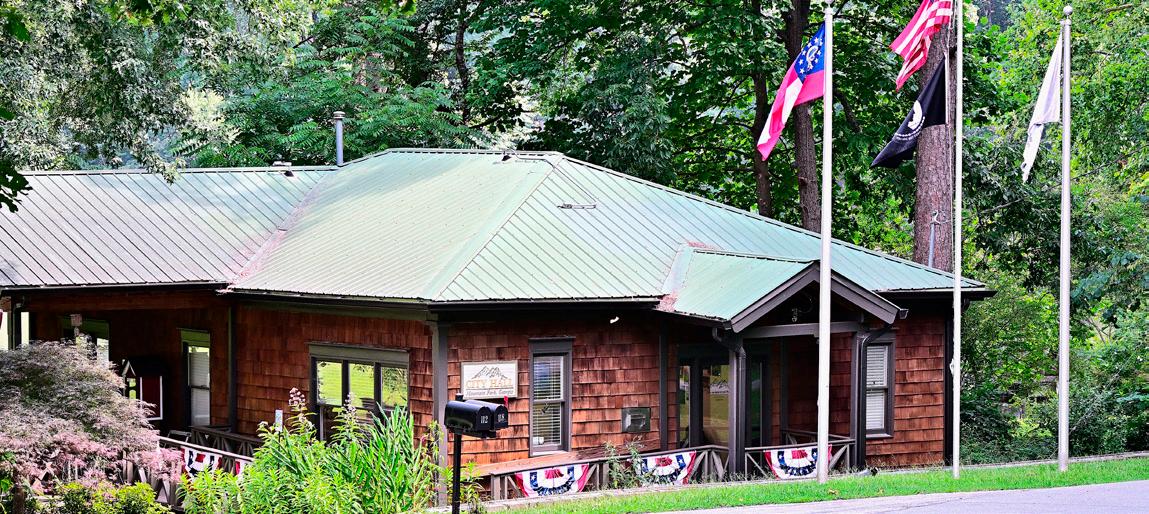
The first lot was sold on April 1, 1925, according to Trish’s research.
In 1929, the Atlanta Constitution reported that Mountain Park had “about a hundred cottages already built and occupied and more under construction. Many of Atlanta’s businesses and social clubs here have commodious clubhouses where their members and friends may spend weekends during the summer.”
In 1934, the Mountain Park Skeet Club opened as the newest skeet club in the area with traps installed in the community’s valley. One member was famous baseball star Nap Rucker. It is no longer in operation.
The only store ever operated in the city was The Stand, a country store and restaurant with a dance floor adjacent to the neighborhood pool and a small jail. It was established in the late 1930s and closed in the late 1970s.
The Mountain Park Elementary School is part of the Fulton County School District and is in Roswell just outside the Mountain Park city limits.
A non-denominational Sunday school opened in 1956 which, according to Trish Hill, is the “longest standing continuous organization in Mountain Park other than the City Council.”
In 1989, Mountain Park became the first city in Georgia to require a recycling program.
The city has a volunteer Fire and Rescue Department and relies on Fulton County for police services. It also has contracts with Roswell for

police and fire department services as needed.
The city is currently gearing up for next year’s centennial celebration.
Bill Kolbrener became mayor of Mountain Park 2 ½ years ago, following in the footsteps of longtime mayor Jim Still. The new mayor says, “I want to honor the past while taking the city to a new level.”
Bill has been a developer for the past 30 years, and he is using his experience to focus on some needed infrastructure and erosion control issues. He also wants to help Mountain Park become more involved with other Fulton County cities.
Bill says, “We are a great and proud city. We are also an anomaly. We have no income from businesses, so we must
be wise and efficient with money. We are fortunate that we have a great local government team building on the strong foundation put in place by Jim Still.”
The history of Mountain Park invites all of us to appreciate a special place that enjoys a unique way of life.
Thanks to Jacqueline Venchi, owner of Wild Birds Unlimited Crabapple/ Roswell for suggesting this topic.
Bob is a member of the City of Alpharetta Historic Preservation Commission, director emeritus of the Milton Historical Society and trustee on the Board of Directors of the Alpharetta and Old Milton County Historical Society. You can email him at bobmey@bellsouth. net. Bob welcomes suggestions for future columns about local history.

If you ask almost any real estate agent why homes are taking longer to sell, you'll likely hear the same answer: mortgage rates. It's an understandable response. Thirtyyear fixed mortgage rates began 2022 near 3.25%, climbed rapidly, and averaged 5.34% that year. Since 2023, they've averaged roughly 6.67%, and today they're hovering around 6.75%.
That sounds expensive—until you zoom out. Since Freddie Mac began tracking mortgage rates in 1971, the long-term average has been approximately 7.70%. By historical standards, today's rates are not unusually high. They simply feel high because we've become anchored to the once-in-a-generation rates of 2020 and 2021.
So, if mortgage rates aren't the primary villain, what is?
The answer may be hiding in plain sight: home prices.
In Metro Atlanta, the average homeowner has seen approximately $200,000 in appreciation since 2020. That's wonderful news for current homeowners. For buyers, however, it's an entirely different story.
A $200,000 increase in purchase price translates into roughly $1,500 more per month on a typical mortgage payment. Compare that with today's higher interest rates, which add another $300 to $400 per month relative to the ultra-low-rate era.
The math is revealing. Interest rates certainly matter, but they account for only a fraction of today's affordability challenge. The overwhelming driver is the dramatic increase in home values. When a family's monthly payment rises by nearly $1,900, about four-fifths of that increase stems from the higher
purchase pricnot the higher interest rate.
Here's the irony. Many homeowners who purchased in 2020 invested perhaps $20,000 to $30,000 as a down payment. Five or six years later, many have accumulated more than $200,000 in equity, largely by making their mortgage payments and maintaining their property. Warren Buffett often reminds investors that time is the friend of a good asset. Metro Atlanta homeowners have received a remarkably vivid demonstration of that principle.
The next question is obvious: Are home prices due for a correction?
Perhaps, but context matters. We're already seeing subtle adjustments. Sellers are offering larger concessions. Price reductions have become more common. Homes are staying on the market longer than they did during the 2021 frenzy.
That doesn't necessarily signal another 2008. Today's homeowners generally have significant equity, lending standards remain far stronger
than they were before the financial crisis, and inventory is still well below historical norms.
The market is adjusting, not collapsing.
Mortgage rates make convenient headlines because they're easy to measure and easy to blame. But if we're looking for the principal force behind today's slower housing market, we should spend less time staring at interest rates and more time looking at price tags.
Sometimes the biggest obstacle isn't the cost of borrowing money.
It's the cost of the house itself.
DC Aiken is Senior Vice President of Lending for CrossCountry Mortgage, NMLS#658790. For more insights, you can subscribe to his newsletter at dcaiken.com.
The opinions expressed within this article may not reflect the opinions or views of CrossCountry Mortgage, LLC or its affiliates.

Oh, how I do love the sound of flowing water –but not when it’s coming from the potty.
Yeah, that’s right. The other day, something happened and the outflow from the washing machine had nowhere else to go. You really can’t blame the water; it was just doing what water does.
The first clue that something was amiss was a burbling commode. Toilets are not supposed to burble. But this one was.
Hearing it, I walked into the bathroom to check things out. The potty was full of soap-sudsy bubbles, and the first thing I thought was, “Well, at least it looks clean.”
The burbling stopped. I went back to the other room. But then the burbling resumed, even more burbly than before. It sounded…cheerful, like a burbling creek…happy even… I went to look again. This time the carpet squished.
Uh-oh.
Long story short: That musical hydrology was just a devious little teaser of what was really going on, which was that water was flowing across the basement floor on the other side of the wall. Said water flowed around baseboards and into the carpet, soaking the padding, sheetrock, and whatever boxes or other items were within its reach. It didn’t take long for it all to happen, and by the time we got the water cut off we had (as my grandma used to say when talking about politics) “a mell of a hess.”
Fast forward a few days, during which the disaster folks came and did their thing. That basically involved tearing up the kitchen, bedroom, closet, vanity area and bathroom, too. That latter, which was especially disruptive to (forgive me) the normal flow of things, involved removing the toilet (the very same one which had alerted me in the first place) and setting it unceremoniously in the tub (no, not so it could be used but just to get it out of the way). I actually felt kind of sorry for the toilet, ensconced as it was in that noble but now totally non-functional state. The bathroom sink, for its part, ended up in the
living room, while the kitchen sink ended up outside. Oh boy.
One has not fully experienced this modern world until one has lived in it accompanied by a non-functioning toilet sitting in one’s bathtub – and without a kitchen, too. If we’d had at least a functioning kitchen, we might have used it to prepare some sort of comfort food, ideally one involving chocolate or perhaps some sort of fortified spirits.
We stayed for a little while, albeit without kitchen or sinks and or toilet or tub (remember, it now held the toilet), while the restoration folks worked. It was, my wife observed, kind of like camping but without the woods.
That is not nearly as much fun as you might imagine.
Soon, they told us we needed to go somewhere else while things dried out (mold) and then, a few days later, they told us we needed to go somewhere else again while repairs were made.
That’s where we are now, camping out (but this time with conveniences) at an Airbnb up in the foothills north of home.

Continued from Page 19
This evening, barely two days into telling ourselves that lemonade-out-of-lemons is really a thing, we decided that we needed respite.
This water catastrophe had messed with our home, with our nest – and by her own admission, my wife is a nest builder. She was stressed, for you do not lightly mess with a nest-builder’s nest.
Water therapy. That’s what we needed. It would be oddly appropriate, wouldn’t it? So we got in the car and drove to the local lake. As its watery expanse came into view, thoughts of that other H2O and all it had wrought began to fade from view. Life on Earth began to look a little better.
I knew we were on the right track when she asked me, “Do you think there will be fish?”
“I don’t know,” I said. “But I will go find out.”
“Some fish would be good right about now,” she mused, her voice a little softer maybe. “Maybe they’re there. I’ll sit here and crochet while you check it out.”
So that’s what she did, and that’s what I did, too. I tied a bright yellow foam fly to the end of the line, made my way down to the water, and immediately caught a decent bluegill. Three casts later, I caught another.
Then I stopped fishing and turned to walk back up the hill, ready to deliver the happy news.
“It’s good,” I told her.
Together, we walked back down the hill to the water’s edge. She cast, using the rod I had built for her not long after we married, and she promptly caught a bluegill of her own. It was a good one.
I caught one, too, and she took my picture.
I walked on down the shoreline, fishing as I went. Then I heard her call my name and turned and saw her rod bent more than I’d ever seen it bent before. She had a big one – an enormous one, a brag-worthy one, a bluegill of epic proportions. I watched as she brought it in, and I went to her to take a picture.
It was the biggest bluegill she’d ever caught.
“With fishing like this, we could have had some for supper,” she said. “We would have eaten well.”
But she slipped it back into the water, and for the first time that day I saw a smile flicker across her face.
Water therapy? Uh huh. Sometimes that’s all you need.

Join today for $16/month
DC Aiken
Big Sky Franchise Team
David & Michelle Bertany
Amour & Duane Carthy
Scott Childress
Adam Corder
Barbara Anderson
Kerry Arias
Scott Baynton
Joseph Bell
Rita Brown
SM Buscher
Mark Casas
Carl Abernathy
Bruce Ackley
Salpi Adrouny
Alpharetta Lions Club
Omar Altalib
Dave Altman
Ron Altman
Joel Alvis
American Legion Post 201
Ken Amos
Alice & Dr. Richard Appen
Stewart Applbaum
Gaye Armstrong
Mary Asbury
Amy Auffant
Bonnie Avera
Carolyn Axt
Bangkok Boxing LLC
Sandra Balmer
Shannon Banna
Beth Barnes
Michael Baron
Janet Bass
Caitlin Bates
Jannet Bauer
Barbara Bauschka
Miriam Beattie
Kathy Beck
Laura Bentley
William Bentley
Steve Berman
Leslie Berry
Patrick Cressaty
Lindsay DeFranco
Robert Flint
Robin Fricton
Zachary Hahn
Allison January
David Conti
Theodore Davis III
Maureen Drumm
Charlcie Forehand
Aileen Horton
Deborah Jackson
David Johnson
Tom Billings
Caroline Blackmon
Tochie Blan
Ron Boddicker
Jodi Bogen
Sherri Bolles-Rogers
Katherine Bolt
Helen Borland
Debra Bowen
Joe Bowen
Kenneth Bowman
David Boy
Ryan Brainard
Mark Brandus
Mel Brannen
Amy Bratten
Carol Bright
Linda Brill
Dorothy Brouhard
Mary Anne Brown
Erendira Brumley
Zack Buchanan
Bernhard Burgener
Alvin Burrell
Mike & Theresa Buscher
Mary Busman
Clea Calloway
Kirk Canaday
James Carr
Bridgette Carter
William Carter
William Cartwright
Michael Kenig
Roderick Liptrot
Bob Meyers
Claude Nardy
Cliff Oxford
Bruce Paulk
Ali Mahbod
Richard Matherly
Evan McElroy
Vickie McElroy
Anne Peer
Helen Perry
Jennifer Phillippi
Linda & Frank Catroppa Pat Check
Virginia Christman
Adam Cleveland
Ann Coaloa
Kim Coggins
Michael Cohen
Evelyn Collazo
Michael Mackenzie
Communications
Joan Compton
Kathleen Cook
Carol Cookerly
Terri Coons
Sarah Cox
Cynthia Crawford
Rhonda Cude
Connie Cunningham
Christopher Cupit
Bart Dean
David Dean
Duane DeBruler
Marilyn DeCusati
Kathleen DeMartino
Nancy Diamond
Sarah Donehoo
Rebecca Donlan
James Dorsey
Tom Driscoll
Michael Dudgeon
Jeanette Dummer
DutchCrafters Amish Furniture
Ross & Lori Ramsey
Sarah Reiter
Mark Rundle
Matthew Sayle
Lynn Thomas
Kim Truett
Robert Popp
Dave Rhinehart
Sergey Savin
Heather Sawyer
Kate Seng
Karen Shih
Bob Stevens
Thomas Edmonds
William Edmundson
Denise Eicher
Mim Eisenberg
Danny Elkins
Su Ellis
Grady Evans
Leslie Ann Everett
Steve Fabian
Carol Fain
Martha Fasse
Nell & Doug Fernandez
Renai Fitzpatrick
Daniel Fleck
Lee Fleck
Laura Floyd
Andrew Flynn
Cathy Flynn
Paul Folger
Adrienne Fontaine
Mary Ford
Nanci Foster
Amy Frederick
Kelly Frommer
Carol Fry
Tim Fulton
Andrew Garner
Tracey Ganesh
Steve Garrett
Daniel Gay
Matthew Geller
John Gibbs
To join go to appenmedia.com/join and follow the prompts to select your membership level and select your t-shirt size! Questions? Email Hans Appen at hans@appenmedia.com or call 770-442-3278.

Roger Wise Jr.
Colt Whittall
John Gilberto
Leslie Gilliam
Bailey & Ryan Gladysz
Michelle Glotzbach
Harvey Goldberg
Christopher Goodrich
Jim Gray
Ralph Griffin
Rihard Griffiths
Elaine Gwynn
Carolyn Hall
Marilee Hamilton
Susan Hanna
Marion Hannah
Chris Harrell
Roxanne Hazen
Joe Hirsch
Penn Hodge
Dianne & Steffan Holmquist
Joan Hostetter
Julie Hostetter
Krista Howland
Austin Hughes
Jason Hunyar
Jacqueline Hursh
Susan Huss
Paul Huth
Jeffrey Hyde
J. Craig Inman
Sandra Jacobs
Sue Jacques
Lynn Johnson
Scan QR code to join the Appen Press Club
Tyler Jones
Zach Jones
Patricia Kachur
Amy Kanderis
Arthur Kebanli
Laura Keck
Mark Kelly
Nancy Kennell
Randall Kent
Carol Kerr
Sally Klaskala
Allison Kloster
Dyna Kohler
Brett Koutnik
Larry Krueger
Jess & Chris Kysar
Malinda Lackey
Sarah Lamm
Daniel Lashinsky
Richard Lapin
Christine Law
Brandon Leach
Dennis Lee
Ken Leffingwell
Carol Lehan
Melissa Libby
Bonnie Lind
Francia Lindon
Karen Lippert
Harlan Little
Jarrett Long
Ross Long
Kyser Lough
Rita Loventhal
Jerry Lucas
Brenda Lundy
Harry Lutz
Rita Loventhal
Karen Magill
Freda Manning-Rumph
Kyile Marshall
Julie Martin
Linda & Todd Martinez
Carla Masecar
Valerie Matthews
Theresea Mattioli
William Maxwell
Nicole Mayer
Rachel McCord
Austin McCully
Diane McDonald
Evan McElroy
Karen McEnerny
Jack McGinnis
Lynn McIntyre
Mike McLoughlin
Margaret McManus
Jennifer Mendoza
Al Merrill
Chris Miller
Christine Miller
Patricia Miller
Milton Animal Hospital
George Mobley
Joe Modica
Fred Moeller
Sarah Moen
Catherine Moore
Ralph Moore
Carol Morgan
Kathy Morgan
Stu Moring
Leslie Mullis
Donna Murphy
Jack Murphy
Aileen Nakamura
George Nathan
Caroline Naughton
Richard Nichols
Cindy Nolan North Fulton Master Gardeners, Inc.
Tricia Novarro
Bob O’Brien
Diana O’Sullivan
Anne Pappas
Lynn Pennington
Jonathan Peters
Kurt & Leslie Phillips
Mary & Jan Phillips
James Potts
Debra Powell
Seth Price
Joyce Provissiero
Chuck Pugh
Patricia Rackliffe
Robert Radloff
Raj Rajagopalan
Pankaj Rajankar
Ashwin Ramaswami
Cheryl Rand
Manu Rao
James Rasmussen
Paula Rattray
Lori Rausch
Jean Rearick
Joseph Reed
Scarlett Reynolds
Righteous PR
Angie Rigney
Sean Riley
Neil Robertson
Kimberly Robinson
Matt Rohs
Kim Romaner
Courtney Rozear
Fran Russell
Continued innovation in digital media has changed the ways in which people buy, sell and interact with products and services. It has caused businesses to reassess the ways in which it communicates with potential customers and advertises its products. It has been well documented that these changes have had a destructive impact on local newspapers, which continues to be a primary source for local news, but is no longer a primary source for local advertising dollars – historically the lifeblood for reporters and their coverage. At Appen Media Group we want to address this conflict head on, and build new and innovative approaches to monetizing local news and creating a sustainable future for local journalism in metro Atlanta.
Janet Sandberg
Kelly Sarmiento
Fran Schefer
Derek Scheidt
Dorothy Scherr
Stephanie Schniederjan
The Schoenblum Family
Robert Scholz
Robert Schreiner
Stephanie Schuette
Susan Searles
Frances Segars
Tracy Shealy
Tina Shelton
Lisa Shippel
Steve Short
Tom Simon
Cindy Simpson
Robert Singleton
Faye Sklar
Mitchel Skyer
Judith Slaughter
Andy Smith
Lee Smith
Tia Solh
Morris Soriano
Heidi Sowder
Gena Spears
Donald Spencer
Melissa Spencer
Jan Stephens
Wesley Stewart
Cathryn Stovall
Celeste Strohl
Diana Sullivan
Andy Sumlin
Kathy Swahn
Carol Tall
Mike Tasos
Candice Teichert
The Small Business Advisor
Suzanne & Bob Thomas
William Tietjen
Lisa Tilt
Michael Townes Trunnion LLC
Matthew Tyser
Edward Votta
Linda Wabler
Ollie Wagner
Lewis Walker
Elizabeth Waller
Valerie Walters-Gold
Ann Marie Warning
Terry Warnke
Jonathan Washburn
Michael Watson
Deborah Weiss
Michael Weiss
Herbert Wells
Benjamin Wemberly
Beverly Whisenant
Sally White
Thom White
Umpika White
Mae Whiteside
Ashley Whitt
Jennifer Wieland
Christine Williams
Jamie Wimberly
Jonathan Winkie
Nancy & Dave Wistrand
Kalle Wood
Theresa Woolridge
Laura Wysong
Jonathan Young
One solution is the creation of a membership driven organization called the Appen Press Club that is dedicated to recruiting people and companies to join as members. Members pay recurring monthly or annual dues that are 100% dedicated to sustainable journalism. By providing predictable revenue, Appen Press Club members and partners help fund the salaries and expenses of local reporters who will no longer be subject to the whims of marketing budgets and an ever changing advertising world. In turn, those reporters will provide the readers they serve with highly researched and qualified journalism focused on subjects that directly affect their quality of life.
To join go to appenmedia.com/join and follow the prompts to select your membership level and select your t-shirt size! Questions? Email Hans Appen at hans@appenmedia.com or call 770-442-3278.








NFCC is seeking a qualified candidate to fill the full-time Food Pantry Manager position. Under the direction of the Food Pantry Director, the Food Pantry Manager leads back of house food pantry operations including inventory control, receiving products, client orders, managing volunteers, entering data and creating reports.
This role is perfect for someone who enjoys managing people and process! Volunteer and inventory management, operations and data entry are primary responsibilities of this role.
The applicant should have a desire to join the team of a mission-driven non-profit where we work to ease hardship and build financial stability throughout our community. We offer one of the most competitive total rewards packages among Atlanta’s nonprofit organizations, making this role both meaningful and rewarding.
Please send resumes to jobs@nfcchelp.org
Executive Secretary and Administrative Assistant. Ortiz Decorating, Inc, Stone Mountain, GA. Prep sales reports, track renewals, & monitor biz performance indicators. Answer calls & sched appts in office. Participate in internal promo activities, sales campaigns, & agency events. Mng & maint executive scheds. Organize executive travel. Prep invoices, reports, memos, letters, financial stmts, & other docs using word processing, spreadsheet, dtbase, or presentation software. Coord & direct office srvcs, such as records, dept finances, budget prepn, & personnel matters, to asst executives. Req High School Diploma & 2 yrs exp as executive secretaries & executive admin assistants. $74,485/yr. Send resume to: mirtaortizdecorating@gmail.com
To place a classified ad, email classifieds@appenmedia.com.
Deadline is Thursdays by 3pm