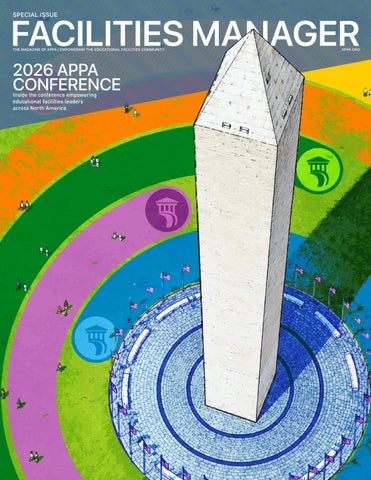
FACILITIES MANAGER SPECIAL ISSUE
THE MAGAZINE OF APPA | EMPOWERING THE EDUCATIONAL FACILITIES COMMUNITY
2026 APPA CONFERENCE Inside the conference empowering educational facilities leaders across North America
APPA.ORG
COVER ART BY AUDREY SORENSEN
4
APPA CONFERENCE LOBBY
5
FACILITIES MANAGER MAGAZINE
THE MAGAZINE OF APPA EMPOWERING THE EDUCATIONAL FACILITIES COMMUNITY
2026 CONFERENCE SPECIAL ISSUE
12 APPA Conference
How the profession rewrote its job description at APPA Conference 2026.
FEATURES
14 One Day, One Room, Decades Of Experience
Inside APPA's first Senior Facilities Officers Summit since 2019.
22 One APPA, Not Thirty
Thirty-seven leaders spent two days in DC on the question most associations avoid. In 2027, we want every chapter there.
30 The Keynote: What Would They Do Without Us? Leadership for those who can't hit pause.
36 The End Of The Backlog Era
From measuring to managing to executing.
48 The New Energy Normal
Volatility as a permanent condition, and an opportunity.
54 The Campus Gets A nervous System
Analytics, digital twins, and the end of the spreadsheet.
62 When The Water Rises
Resilience is a first-hour, first-year dicipline.
64 From The Mainstage To Your Campus Custodial Guidelines training is here.
6
66 Buildings That Bring People Back
Designing for connection in a post-commute world.
70 The People Who Make It Work
Culture, pipelines, and who gets to be in the room.
74 The View From Abroad
Same profession, different hemispheres.
80 Your Membership, Upgraded
What's new at APPA, and what every bit of it means for you.
92 Celebrating Excellence
APPA's 2026 award winners embody service, innovation, and stewardship.
106 Designing The Conference
How to Map a Career in Facilities Management
118 The Through-Line
Shape it, or let it shape us.
Editors
Audrey Sorensen / marketing@appa.org Lindsay Wagner / publications@appa.org 7
THE MAGAZINE FOR FACILITIES LEADERS
Facilities Manager is the flagship publication of APPA and the go-to resource for facilities professionals who want to go deeper. Unlike a newsletter, a magazine is lingered over, with readers spending meaningful time with each issue. With in-depth features, industry research, expert perspectives, and practical guidance, it is the trusted print and digital magazine for educational facility managers nationwide.
Submission Guidelines All article or ad submissions must be received no later than one month prior to publication. Facilities Manager is published four times a year on the second Monday of January, April, July, and October. For specific deadline dates, please see our editorial guidelines page at appa.org/editorial-guidelines. Accepted Formats: High-resolution (minimum 300 dpi) PDF, JPG, or TIF files only. Color Requirements: Files must be prepared in CMYK. Images must be provided in a separate folder and should not be embedded in Word documents. How to Submit: Materials can be submitted via email or through a file-sharing service such as Dropbox to marketing@appa.org.
APPA publications reach 13,000+ facilities professionals and 1,000+ institutions across two high performing channels. A monthly newsletter and a quarterly magazine, both consistently outperforming national benchmarks.
SUBMIT TO FACILITIES MANAGER MAGAZINE
3x
The National Average Digital Magazine Read Time vs 3 Minute Industry Average
8.5+ 82%
4,600+ 62%
Trust Magazine Articles Most
Avg Magazine Article Recall
Submit Articles
Advertise Inside
appa.org/editorial-guidelines
appa.org/purchase/ advertising-opportunities
Avg Minutes Per Issue
Impressions Per Issue
National average benchmarks sourced from MailerLite 2025 Email Marketing Benchmarks 2026. Magazine trust and recall statistics sourced from industry research. APPA performance metrics reflect recent issue data.
10
SFO NETWORKING CARICATURES
11
APPA Conference HOW THE PROFESSION REWROTE ITS JOB DESCRIPTION AT APPA CONFERENCE 2026 EVENT PHOTOGRAPHY BY ANSALDO MEDIA
12
SENIOR FACILITIES OFFICERS (SFO) SUMMIT
S
omething shifted in Washington this July. You could feel it in the session rooms, hear it in the hallway conversations, and read it on nearly every opening slide: the era of facilities as a back-of-house function, the people you call when the air conditioning dies, is ending. In its place, a new identity is taking shape, one that presenters from community colleges, R1 research universities, K-12 districts, liberal arts colleges, and academic medical centers described in strikingly similar terms. Facilities professionals are no longer just the keepers of buildings. They are stewards of the largest asset most institutions own, managers of the second-largest budget line, and, increasingly, the people whose decisions determine whether an institution can compete for students, faculty, research dollars, and its own future.
past one trillion dollars, and reinvestment need is rising in every sector that tracks it. The enrollment cliff is no longer a forecast; it is a line item. Energy markets have entered what one session bluntly called "the new energy normal," where a handful of peak hours can drive 30 to 70 percent of an electricity bill, and the workforce that has kept campuses running for four decades is retiring faster than it can be replaced.
Yet the mood in Washington was anything but grim. Across two dozen sessions, presenters offered not laments but playbooks: tested, quantified, and remarkably candid about what failed along the way. Taken together, they tell a single story in seven movements, the story of a profession that has stopped merely measuring its problems and started executing on them. This special issue traces The numbers behind the shift are sobering. Deferred that story through the presentations that defined the maintenance across U.S. public infrastructure has climbed conference. 13
ONE DAY, ONE ROOM, DECADES OF EXPE INSIDE APPA'S FIRST SENIOR FACILITIES OFFICERS SUMMIT SINCE 2019
B
efore a single concurrent session began, the conference's most consequential conversations had already happened. On July 16, APPA convened its Senior Facilities Officers Summit, the first since 2019. The opening exercise set the tone. Tables were asked to name the three issues keeping them up at night, and the wall filled quickly: AI, both disruptive and assistive; budgets, inflation, and enrollment swings; a shrinking skilled-trades labor pool; leadership turnover and the loss of institutional knowledge; space utilization; aging infrastructure and rising energy costs; and the political and funding crosswinds buffeting state institutions. The first panel moderated by Andy Feick, Associate Vice President Sustainable Facilities Operations &
14
Capital Planning at Swarthmore College, asked whether facilities still holds the strategic seat it earned during the pandemic, when FM teams reconfigured campuses in days and demonstrated a decisiveness that surprised their academic colleagues. The panelists' answer was a conditional yes: the seat is real, but it is kept through innovation and the quality of engagement, not the memory of 2020. Penn State supplied the day's most vivid illustration of what that seat now involves. The university is closing seven of its 23 Commonwealth campuses, with the remaining sixteen under financial evaluation, while centralizing facilities, finance, IT, and procurement services; its facilities organization is expected to grow from roughly 1,700 to 2,500 people as operations consolidate. At the same time, Penn State is weighing
ERIENCE the addition of some 10,000 students at University Park, and its facilities leaders believe most of that growth can be absorbed without proportional new construction by pushing classroom utilization from as low as 14 percent toward 80 percent, with trustees backing extended teaching hours to make the math work. A "seat at the table," one panelist observed, means being the first voice in a strategic facilities decision rather than the last. A second panel, moderated by APPA's Dr. Lindsay Wagner, took on what one participant called the profession's other "F word": finance. The institutional snapshots were sobering. The University of Minnesota is exploring student fees and has built a revolving infrastructure fund that redirects operational savings
ABOVE Senior Facilities Officers (SFO) Summit Workshop
into debt service. The University of Iowa, preparing for enrollment decline, monetized its utility system through a public-private partnership and stood up an asset optimization team from existing staff; Iowa’s panelist was frank that P3s consume enormous staff time and live or die on governance and contract fine print. Hamilton College, despite a healthy endowment, is holding a zerogrowth budget that has faculty carrying their own trash to the hallway bins. Against that backdrop, the panel cataloged the alternatives: energy performance contracts that convert guaranteed savings into modernization capital, state rebates, corporate sponsorships, grant funding, and one deliberately provocative idea, a "tax" on major building donations to endow the total cost of ownership the gift creates. 15
16
ABOVE Andy Feick of Swarthmore College, Mark Miller from Penn State and Pete Zuraw of Gordian open the Summit with a candid look at whether facilities has kept the strategic seat it earned during the pandemic. 17
The afternoon risk panel pushed the profession's definition of risk well beyond mechanical failure, into reputation, community, cybersecurity, and enterprise risk management. The memorable phrase was "stay left of boom": mitigate before the incident, because the boom always costs more. Panelists described "Risk Hero" recognition for frontline staff who surface hazards, a University of Chicago model that tiers preventive maintenance into life-safety (always funded at 100 percent), critical, and non-critical categories, and governance experiments ranging from Indiana University merging its trustee facilities and finance committees to the Hackley School seating a fundraiser on its enterprise risk committee. Williams College shared how a building failure converted "deferred maintenance" into "planned renewal" in the institutional vocabulary, and a Florida 18
case study showed the stakes of such renaming: after regulators rejected a request framed as deferred maintenance, the state's institutions redefined the categories in statute and secured $887 million. The day's communication masterclass came from an unexpected direction: one campus, whose technical white paper on a complex energy project was losing its board, fed the paper through AI and produced a ten-minute conversational podcast; approval followed smoothly. One university reported it had renamed the whole function "Campus Experience." Framing, the panelists agreed, is not spin; it is the difference between a cost center and an asset. A closing sustainability panel surveyed decarbonization in an era of funding crunches and political headwinds:
LEFT Panelists at the Summit's afternoon risk session, moderated by Dr. Lindsay Wagner, broaden the definition of institutional risk beyond mechanical failure to reputation, cybersecurity, and finance.
Swarthmore College's geo-exchange conversion, aimed at a 2035 carbon-neutrality target and expected to eliminate more than 90 percent of Scope 1 and 2 emissions; the shift from LEED to the Living Building Challenge where values align; the harder cultural work of Scope 3; and international snapshots from the UK's mandates to South Africa's grid constraints. The strategic consensus was practical: align decarbonization with planned renewal cycles, so no one reinstalls a fossil-fuel system in an emergency.
named just as plainly: the skilled-trades pipeline, the cost of converting buildings from gas to electric, and the perennially rough handoff from construction to operations. As it happened, the conference sessions that began the next morning would take up nearly every one of those threads.
By day's end the summit had its synthesis. The two words underneath every discussion, participants agreed, were framing and finance, and the mantra proposed for the profession, printable on a t-shirt, was "creative, decisive, and innovative." The unfinished business was 19
“THE TWO WORDS UNDERNEATH EVERY DISCUSSION, PARTICIPAN THE MANTRA PROPOSED FOR THE PROFESSION WAS "CREATIVE, D
20
NTS AGREED, WERE FRAMING AND FINANCE, AND DECISIVE, AND INNOVATIVE."
BELOW Senior Facilities Officers (SFO) Reception.
21
ONE APPA, NOT THIRTY
THIRTY-SEVEN LEADERS SPENT TWO DAYS IN DC ON THE QUESTION MOST ASSOCIATIONS AVOID. IN 2027, WE WANT EVERY CHAPTER IN THE ROOM.
T
wo days before the APPA Annual Conference opened three levels of this organization actually working toward at the Gaylord National Resort, thirty-seven leaders the same thing? were already at work in a room in Washington, DC. The answer, from the people who volunteered it, was not really. Not yet. And then they spent two days doing Chaper presidents, regional officers, national board something about it. members, and staff came from research universities and community colleges, from k-12 districts and independent They started with the truth. Forty-seven leaders completed schools, and from both sides of the Canadian border. On a pre-workshop survey before the meeting, rating July 14 and 15, they sat down together for the first APPA alignment across five dimensions on a five-point scale. Leadership Exchange and put a question on the table that most associations spend years not asking out loud: are the
22
ABOVE APPA Leadership Exchange (ALE) Workshop
How aligned are APPA's three levels? (Average rating, 1 to 5, n = 40) Communication and information flow: 3.35 Ease of collaboration: 3.20 Use of resources: 3.17 Strategic direction: 3.10 Consistency of member experience: 2.95
scheduling conflicts, sponsor fatigue, and what one leader called a dog-eat-dog fight for the same members and business partners. One respondent summed it up in a line that got repeated in the room all week: it can feel like there are 30-plus APPAs instead of one connected network.
Nobody mistook this for a failure of commitment. People care deeply. The friction is alignment, communication, Nothing cleared 3.4. The lowest score went to consistency and clarity of ownership. Those are fixable, which is of member experience, which is another way of saying exactly why the conversation was worth having face to that what a member gets from APPA depends substantially face. on where they happen to work. They also named what is working, this was not two days The open responses were blunter than the numbers. of complaining. Professional development came through Messaging does not cascade reliably from one level to the as the flagship. APPAU, the Supervisor’s Toolkit, and the next, and it can be difficult to know who to contact on a Leadership Academy were named again and again as the chapter board. Chapters maintain their own websites, greatest benefit flowing across the organization, building email systems, and membership rosters, paying separate capacity no volunteer board could build alone. hosting and processing fees while contact data goes stale. Conferences are planned independently, producing Several leaders described the last two years as a genuine 23
“THE MOST BENEFICIAL THING WAS THE OPPORTUNITY TO MOVE AROUND THE COUNTRY."
24
AROUND THE ROOM AND INTERACT WITH MY PEERS FROM
APPA LEADERSHIP EXCHANGE (ALE) WORKSHOP
25
turn: the rebrand, new technology and event services cost? that lighten the volunteer load, and APPA staff who have made themselves visible and accessible. One described a That last question is where good workshop ideas usually die. Not here. Groups drew their own boundaries, named relationship with national that had turned 180 degrees. their own risks, and put real numbers against their own The catch is that this strength is uneven. Where proposals instead of leaving the arithmetic to someone relationships exist, collaboration is strong. Where they else. do not, chapters describe operating independently for years with almost no contact. Which is the quiet argument A slate of recommendations came out of those two days. for being in the room: the chapters that were there got It now goes to the APPA Board for review and sequencing, and will be shared once the Board has worked through it. connected. Not all of it will move at the same speed, and several items The design mattered as much as the agenda. Leaders carry investment figures that will require real decisions were mixed across levels rather than seated by region, rather than enthusiasm. But it exists, it has owners so a chapter president from one state worked a problem attached, and it was built by the people who will have to alongside a regional officer and a national board member. live with it. Ideas went up on the wall, got argued over, and were Ask the people who were there what mattered most and prioritized by the room rather than from the podium. almost none of them lead with the recommendations. The discipline came in the second half. Every idea that survived the vote had to run the same unglamorous Knowing we are not alone. Meeting the people whose gauntlet. What problem does this actually solve? How names had only ever been in an email. Hearing that would it work? What is explicitly out of scope? What could a chapter three states away is fighting the same fight. go wrong? How would we know it worked? What does it Networking with chapters and regions I have never met in 26
the past. Collectively solving problems. ALE returns in 2027. Every chapter should be there. “The most beneficial thing was the opportunity to move around the room and interact with my peers from around The APPA Leadership Exchange will be back, in person, the country.” on Monday, July 12, 2027, at the Grand America in Salt Lake City, Utah, ahead of the APPA Annual Conference. You cannot get that from a recap. ■ The goal for 2027 is simple, and it is not a stretch target: every chapter represented in the room. Not most. Every one. Thirty-seven leaders got this started. The decisions about how this organization connects, communicates, and serves its members will keep being made by the people who show up, and there is a seat with your chapter’s name on it. More information is coming soon on the APPA website. Represent your chapter. This conversation gets better the more of us are in it.
ABOVE APPA Leadership Exchange (ALE) Workshop 27
28
LEFT Who Was In The Room Lalit Agarwal APPA Robert J. Aldrich Hackley School Quajalyn Amos University of Maryland College Park John Argento Princeton University Erika Balm APPA Jeffrey Benjamin Tulane University Greg Clayton University of Prince Edward Island Bryan Coady St. Paul’s School Douglas Cosentino Dartmouth College JeCory Crenshaw University of Alabama at Birmingham Colby D. Dye Kirkwood Community College Solomon T. Franklin University of North Carolina at Charlotte Mary Grube St. Mary’s College of Maryland David Hall Missouri State University Gabriel Hampton University of Nebraska–Lincoln Louis R. Hengesbach Michigan State University John Herrera Arizona State University Ally Keeney Illinois State University Mia Love Stanford University LaDella Mackey-Williams Alcorn State University Glen Mathieu SMG Corporate Services Christopher McConnell University of Alaska Anchorage Mark Owens Southern Illinois University Carbondale Jason Penney Dalhousie University Tricia Pugh University of Northern Iowa Ross Rick University of North Carolina at Greensboro Matthew Rom University of Oklahoma Nicole Sanderson University of Washington Bothell Jerry P. Santos Bridgewater State University Crystal D. Smith The University of Chicago Scott Stevens Elon University Travis Thomas California State University, Northridge David Ulmer APPA David VanDeventer Clemson University David VanHook Bartow County School System Dan Whatley Auburn University Kelly A. Wilson Columbus State University 29
THE KEYNOTE WHAT WOULD THEY DO WITHOUT US? LEADERSHIP FOR THOSE WHO CAN'T HIT PAUSE K E Y N O T E B Y PAT R I C K M A L O N E , P H D
30
ABOVE Patrick Malone, PhD
I
f the summit gave the conference its agenda, the opening keynote gave it its heartbeat. Speaking to a ballroom of roughly 500 professionals under the title "What Would They Do Without Us? Leadership for Those Who Can't Hit Pause," keynote speaker Patrick S. Malone, PhD, opened with a definition of the audience that drew immediate laughter of recognition: people responsible for everything, and for everything no one notices; stewards of systems built by people no longer alive, using documentation that may or may not exist, to support technology that has not been invented yet. His organizing observation doubled as
a diagnosis of the profession's visibility problem: success is quiet, failure is loud. The president gets applause, the faculty get recognition, the students get diplomas, and facilities gets a phone call at 2:13 a.m. that is never "a problem" but always "an adventure." The first half of the talk was a comic demolition of the ten biggest myths facilities managers face, and the room supplied the punch lines before he did. Facilities managers just fix broken stuff (what people say is "can you fix a light bulb?"; what FMs hear is "please apply your master's degree 31
and twenty years of experience to this lamp"). Facilities has unlimited money (most FM budgets resemble a college student's checking account three days before payday). If nobody complains, facilities isn't working (the opposite is true: the best facilities operation is invisible, like oxygen, unnoticed until it is gone). Smart buildings require less work (smart buildings simply create smarter problems). And facilities managers are always calm (no: they are professionally suppressing panic, preventing floods, fires, power failures, and the occasional squirrel, all before lunch; that is not calm, that is elite emotional regulation). Then the talk turned serious, and its real subject emerged: resilience, though pointedly not the motivational-poster version. Resilience, he argued, is not toughness, not going it alone, and not powering through; enduring pain without adaptation builds scars, not strength. Research treats resilience as a dynamic process, shaped by the small adjustments leaders make as they integrate difficult experiences into a life that continues forward. He organized the practice into three truths. First, know yourself: emotional intelligence, the capacity to recognize and manage emotions in ourselves and others, predicts leadership success better than IQ, and in an age of algorithms he offered the sharper formulation that EI beats AI, because a system may flag emotional cues but it cannot repair fractured trust or restore morale after a mismanaged change. Second, lean on others: humans were never designed to go solo, and against a backdrop of workplace stress, loneliness, and career churn, resilience is a team sport built on psychologically safe environments where people can ask for help. Third, have a little fun: humor reduces stress, restores perspective, and builds connection, and he came armed with evidence, from a study finding that twenty minutes of laughter reduces stress comparably to twenty minutes of exercise to Stanford research showing a roughly ten percent productivity bump after a comedy clip. He closed by proposing a new title for everyone in the room, Vice President of Reality: the person who knows the difference between "strategic vision" and "this will never physically work." Facilities management, he reminded the audience, is not about buildings; it is about people. Buildings do not complain that the room is too cold or request an extension cord ten minutes before an event, people do. Somehow this profession makes it all work anyway. His parting benediction set the tone for everything that followed: you don't have to be perfect, just slightly more stable than the systems you manage.
32
PATRICK MALONE, PHD 33
INSIDEAPPA
THE MONTHLY NEWSLETTER OF APPA, AND THE GO-TO RESOURCE FOR FACILITIES PROFESSIONALS WHO WANT TO STAY CONNECTED. InsideAPPA delivers results. In recent issues, the leaderboard banner placement alone has achieved a 14% click rate, making it one of the top-performing links in the entire newsletter. With over 11,500 successful deliveries per issue and a 12.6% clicks-per-unique-open rate, InsideAPPA readers are highly engaged and actively clicking. Submit all materials as high-resolution (minimum 300 dpi) JPG or PNG files in CMYK color. Include any text if applicable, and the destination URL you would like attached to your ad. To learn more visit https://www.appa.org/purchase/advertising-opportunities or email marketing@appa.org Leaderboard Banner The first thing members see, your brand is front and center before any content competes for attention. This prime above-the-header real estate delivers maximum impressions and is consistently one of the highest-clicked spots in the newsletter. Image size 600×90px Non-member rate $3,500 Member rate from $2,625 Top Banner Readers who’ve made it into the content are engaged and ready, and your brand meets them right in the flow. This mid-matter placement catches attention, driving strong click-through from members. Image size 600×90px Member rate from $2,437.50 Non-member rate $3,250 Top Featured Content More than a banner, this image and text combo lets you tell a story. Sitting mid-newsletter with a headline, visual, and up to 200 characters of copy, it’s the ideal spot to promote a product, service, or event in a format that feels native to the editorial content around it. Image size 150x125px, title up to 75 characters, and body up to 200 characters. Member rate from $2,062.50 Non-member rate $2,750 34
Box Banner (x2) A classic format that delivers. These side-by-side placements in the back-matter are a proven performer for brand recall, giving you bold visual presence as readers finish the newsletter and are primed to take action. 300×250px Member rate from $1,875 Non-member rate $2,500 Bottom Featured Content The last impression is a lasting one. Members who read all the way to the end are your most engaged audience, and this image-and-text placement gives them one final, compelling reason to click through to your brand. Image size 150x125px, title up to 75 characters, and body up to 200 characters. Member rate from $1,687.50 Non-member rate $2,250
35
THE END OF THE BACKLOG ERA FROM MEASURING TO MANAGING TO EXECUTING
36
BELOW General Session Presentations
F
or decades, the facilities condition assessment has been the profession's central artifact: a thick report, a ten-figure backlog number, and a plea for funding that rarely arrived. Several of the conference's most compelling sessions argued that this model is not just tired; it is actively counterproductive. No one made the case more forcefully than Erica Barbuto and John Less, PE, of Halcyon Facilities Group, joined by Dr. Stephen Wooldridge, in "Beyond Assessment: The Facilities Identity Shift Toward Execution." Their diagnosis of the legacy facilities condition assessment was withering: age-based risk models with no operational context, replacement-only capital strategies with no procurement planning, and ten-year deferred maintenance lookaheads that "never reach zero." The backlog, in their phrase, is "measured, not managed." Their alternative, a Renewal Asset Management Program built on engineering-based assessments performed by operators who know how systems work (in their words, "the 2 a.m. call team"), produced numbers that made the audience sit up. At the University of Maryland Baltimore Washington Medical Center, a legacy FCA had priced the MEP portfolio's need at $134.5 million. Performance-based assessment cut the true operational risk to $45.2 million in replacementonly projects, and to just $17.8 million once targeted refurbishment was integrated, roughly 13 percent of the original estimate. With an average capital budget of $3.5 million a year, the medical center is now on track to stabilize its infrastructure eight years faster than the replace-because-it's-old model would have allowed. The University of Miami Health System case was larger still: a 2020 traditional FCA had produced a $691 million deferred-need figure across 5.4 million square feet and 33 buildings. The modern approach identified 690 genuinely unstable assets among 1,712 total and scoped their stabilization at $109 million: three years of work instead of ten. In fiscal 2026 alone, Miami executed $47 million across 28 active projects, stabilizing 230 building systems while coordinating 71 outages. A single case study crystallized the logic: replacing five air handlers at Bascom Palmer Eye Institute would have cost $10.5 million over 36 months of long outages; refurbishing ten units to original design performance cost $5.1 million over 18 months with only spot-cooler disruptions, and the savings were recycled into stabilizing 34 more 37
unstable assets. "We don't just identify," the presenters said. "We execute." The same reframing animated "From Backlog to Portfolio Strategy," in which Jean Robinson, Associate Vice Chancellor for Facilities Management and Planning at the University of Massachusetts Lowell, and Gordian's Jacob Blythe walked through what capital risk looks like at system scale. The University of Massachusetts system carries a $4.8 billion deferred maintenance backlog across 537 buildings and 27.6 million gross square feet, with a $17.5 billion replacement value. Sixty-two percent of the system's space is now high-risk (over 25 years since construction or renovation), and the cost consequences compound brutally: capital need runs about $49 per gross square foot in buildings under ten years old, but $439 in buildings over fifty, a five-fold escalation. Since fiscal 2021, the system has hit only 71 percent of its annual investment target on average, and maintaining the status quo alone would demand roughly $273 million a year. UMass Lowell's answer was to stop letting projects pick the institution. "Which short-term investments align with long-term strategy?" is a project-by-project question, Robinson argued; the destination is scenariobased planning by portfolio. Lowell sorted its $1.055 billion in identified need across 55 buildings into a divestment portfolio (four buildings, $52.8 million in need walking out the door), a major-renovation portfolio (ten buildings, $498.4 million, sequenced near- and long-term), and a remainder to be managed, all aligned with the campus's newly acquired R1 research status. The modeled payoff: where doing nothing lets highrisk space climb to 59 percent by 2035, the divest-andrenovate strategy brings Lowell's facilities condition index from 42 percent to 17 percent, in line with peers. Bergen Community College told the same story at community-college scale in "Evolving from Master Planning to Stewardship," presented by Nathaniel Saviet, the college's Vice President of Facilities, with Lawrence Eighmy of The Stone House Group and Walter Kneis of NK Architects. Bergen's wake-up call was visceral: a major cooling tower and chiller failure in July 2021, months after a new president arrived with a mandate to improve the physical environment. The college knew its needs but had never consistently quantified them. A facilities condition assessment across its one million square feet found $66.8 million in identified need against a $596.7 million replacement value, a manageable figure but with $33.4 million of it due within two years. The session's most quotable idea was a challenge to institutional priorities: your facilities
RIGHT General Session Presentations 38
39
APPA CONFERENCE GENERAL SESSION
RIGHT APPA Conference General Sessions
portfolio is worth more than your endowment, yet the endowment gets managed daily while the buildings get a plan every decade. Stewardship, the presenters argued, means closing that gap, and Bergen has already replaced roofs, phased rooftop-unit replacements, strategically abandoned a culinary arts program, and built a six-year capital forecast that now anchors its annual bond requests. If Halcyon, Lowell, and Bergen supplied the strategy, David H. Van Hook, CEFP, supplied the vocabulary. The Director of Maintenance and Construction for Georgia's Bartow County School System, a veteran of Kennesaw State, Georgia Highlands College, and the U.S. Marine Corps, used "Capital Planning in Tight Fiscal Environments" to deliver a plainspoken master class in total cost of ownership. Design and construction, he reminded the room, account for roughly five percent of the cost of owning a building; a dollar saved in operating costs through better early decisions is worth ten to twelve dollars off construction. His six-component TCO worksheet (first cost, maintenance, energy, replacement cycles, ancillary costs like mandated inspections, and non-financial factors like reliability and service interruptions) turns HVAC selection from a first-cost reflex into an informed decision. He even invoked Colin Powell's 40-70 rule: decide when you have between 40 and 70 percent of the information, because waiting for certainty costs you the opportunity. Van Hook's sharpest point was linguistic. "Deferred maintenance," he argued, is an accounting term for postponed recognition, and it frames facilities as a problem. There is no HVAC replacement that "became deferred maintenance"; there is an HVAC replacement that is a capital investment need, justified by documented downtime, or a capital investment opportunity, quantified by rising operating costs and a four-year break-even. "Accountants have a different vernacular than facilities professionals," he said. "It's not their job to interpret your message. It's your job to speak their language." The strategic stakes of all this were laid out most starkly by John Kambic, PE, of Northern Virginia Community College and John Edwards, PE, of Facility Engineering Associates in "The Facilities Identity Shift: Turning Assets Into Institutional Advantage." NOVA's numbers describe the environment every institution now inhabits: full-time-equivalent enrollment down 12 percent since 2012-13, campus-based instruction down from 86 percent of modality to 59 percent, dual enrollment up from one percent to 18, netting out to roughly 27 percent fewer students paying tuition and 40 percent fewer students physically on campus, with classrooms running near 50 percent utilization. Their 42
43
44
response is a master plan organized around three verbs: invest (new skilled-trades and medical-education buildings, 80 laboratory classrooms new or renovating), divest (closing three leased sites to recapture $5 million a year), and fix (a project machine running more than 500 active non-capital projects, guided by condition, lifesafety, elevator, and accessibility assessments). Their "shuffle" initiative, systematically re-stacking programs to raise utilization, may be the most exportable idea in the deck. But their closing thought was the one that echoed through the rest of the conference: "Our allocation of resources reveals our true values. The question is no longer whether change is coming, but whether we will shape it or let it shape us."
LEFT APPA President & CEO Lalit Agarwal Presents at the APPA Conference General Sessions ABOVE APPA COO Dave Ulmer Announces Next Years Conference Venue: The Grand America Hotel In Salt Lake City, Utah.
45
OVERVIEW
Attend the Conference
The APPA Annual Conference brings tog and K-12 institutions of every size. If you built for you.
Attendees come to Salt Lake City to hea who understand the work, and return to
We encourage you to bring your team. T continue back home, and the more voic
APPA membership is not required to att if you are not yet a member, now is a gre
Registration is currently open. Intereste announced early 2027.
What to Expect
General Sessions Thought-provoking keynotes and conve ties profession is headed from the leade
Educational Sessions and Breakouts Practical, peer-driven sessions across th you are managing a team of five or five
Senior Facilities Officer Summit A focused gathering for educational fac strategy, leadership, and the future of th
Define Your Journey With Us. Register for the Annual Conference 2027
Networking Events and Receptions Structured and informal opportunities to ucational facilities community. Some of happen outside the session rooms.
Business Partner Exhibit Hall Connect with leading solution providers shaping educational facilities today.
The full program will be announced in 20
Salt Lake City The APPA Annual Conference is where the educational facilities community comes together to learn, connect, and lead. In 2027, we are gathering at The Grand America Hotel in Salt Lake City, Utah.
Take the next step in your facilities leadership journey and join us in Salt Lake City! Visit https://www.appa.org/events/appa-2027-annual-conference 46
The Grand America Hotel sits in the hea class dining, cultural landmarks, and ea scapes in the country. National parks in day’s drive, and the Wasatch Mountains to forget.
Salt Lake City International Airport is a m North America, making travel straightfo
gether facilities professionals from higher education u work in educational facilities, this conference was
ar from experts in the field, learn alongside peers o their institutions with ideas they can actually use.
The conversations that start in a session room often ces your institution sends, the greater the return.
tend. Members enjoy preferred registration rates, so eat time to join.
ed in getting involved? Speaking opportunities will be
ersations that speak to where the educational faciliers helping shape it.
he topics that matter most to your work. Whether hundred, there is content built for where you are.
cilities directors to engage in high-level dialogue on he profession.
o build relationships with peers from across the edf the most valuable conversations at the conference
s and explore the tools, technologies, and services
2027.
art of downtown Salt Lake City, steps from worldasy access to some of the most spectacular landncluding Zion, Bryce Canyon, and Arches are within a s frame the city with an iconic backdrop that is hard
major hub with direct service from cities across orward no matter where you are coming from.
SPONSORSHIP OPPORTUNITIES
Partner With Us As a Business Partner, you are not just sponsoring an event—you are putting your organization in front of the decision-makers who specify, purchase, and advocate for the solutions you provide. Our sponsorship program is built around genuine connection. Every tier is designed to give your team meaningful access to the APPA community, from brand visibility throughout the conference to direct engagement in the exhibit hall and beyond.
2027 Sponsorship Tiers Leader Tier The highest level of partnership available. Leader sponsors receive prominent recognition throughout the conference and an introductory keynote opportunity that puts your brand at center stage in front of the full attendee audience.
Champion Tier Premier visibility and access, including sponsorship of the SFO Reception and the offic� cial conference bag carried by every attendee throughout the event.
Advocate Tier Prominent brand presence at signature conference moments, including the Opening Reception, attendee lanyards, and additional high-visibility touchpoints across the program.
Contributor Sponsorship of a functional conference experience, from meals and coffee stations to Wi-Fi and signage. Contributor sponsors are woven into the day-to-day fabric of the event.
Starter Tier Targeted brand exposure through a co-branded gift, mobile app advertising, or notebook sponsorship, reaching attendees directly in the spaces where they spend their time.
Entry Tier Get your brand into attendees’ hands from day one with a swag bag insert delivered to every conference participant.
Exhibitor A dedicated exhibit presence on the show floor with tabletop space and direct access to attendees, plus the option to add lead capture for follow-up after the conference. Sponsorships are available for purchase today. The full sponsorship prospectus, including tier benefits, is available on the event page (see QR code). To express interest or learn more, contact us at events@appa.org. 47
THE NEW ENERGY NORMAL
VOLATILITY AS A PERMANENT CONDITION, AND AN OPPORTUNITY
I
f capital planning dominated one wing of the conference, energy dominated the other, and the message was equally blunt: the stable, predictable utility bill is gone, and it is not coming back. Debra Nauta-Rodriguez, FAIA, Associate Vice President for Facilities Planning and Management and University Architect at The Catholic University of America, and Fatmir Gjinaj of F&D Partners titled their session "The New Energy Normal: Reframing Market Volatility, Financial Risk, and Operational Resilience in Higher Education," and the market data justified the drama. Electricity costs are up roughly 35 percent over five years. Data centers, which consumed about 4.5 percent of U.S. electricity in 2023, are headed toward eight or nine percent of national demand by 2030. PJM capacity auctions have cleared at
48
their price cap three years running ($270, then $329, then $333 per megawatt-day, up from $29 in 2024/25), while the 2027/28 reserve margin fell to an all-time low of 14.8 percent. Gas sets the marginal price of power for roughly 70 percent of U.S. ratepayers, and surging LNG exports are keeping it elevated. For universities, the implications are budget uncertainty, higher operating costs, and a procurement function that can no longer be an everythree-years transaction. Catholic University's answer was to replace the "procure, contract, wait three years" model with a continuous cycle: market intelligence, budget forecasting, bill auditing, risk management, demand response, and renewables, monitored constantly. The results since 2024 make the case: a natural gas strategy projected to avoid more than
ABOVE General Session Breakout Room Presentation Series
Existing Assets," one of the conference's most eye-opening hours for anyone who has never read their tariff closely. In PJM territory, an institution's share of capacity and transmission charges is set by its consumption during a handful of coincident peak hours: five for capacity, five for transmission. In 2026, every megawatt drawn during those ten hours costs roughly $21,000, or about $21 per kilowatt. Set against Ohio's average commercial rate of 14.3 cents per kilowatt-hour, electricity in those hours is effectively 146 times more expensive than average. The corollary is powerful: an institution that can predict those hours and shed load, whether by nudging HVAC, dimming laboratories, firing a backup generator, or ramping up combined heat and power, is not just saving money but Victor Hoerst of OnSite Partners made the market earning it, through demand response and ancillarymechanics concrete in "Unlocking Hidden Revenue from service markets where regulation prices briefly spiked $500,000 over five years; an electricity strategy avoiding more than $1 million a year against PEPCO default rates; PJM demand-response enrollment that turns curtailable load into capacity revenue; and a historical bill audit that reviewed 3,240 utility bills, identified over $400,000 in overcharges (much of it improperly applied sales tax on a nonprofit), and confirmed more than $200,000 in recoveries. Total projected value: $5.5 million and growing. All of this sits atop a genuine energy legacy, from a 677-kilowatt solar program begun in 2009 to the West Campus array: 13,858 modules totaling 5.75 megawatts AC, the largest solar installation in the Washington, D.C. metropolitan area.
49
above $45,000 per megawatt last January.
array with battery storage at the Kent campus power plant, plus photovoltaic arrays across seven regional campuses, Kent State University, Hoerst's featured example, showed and the university's 8 million square feet have become, in what that looks like when a campus fully commits. Doug effect, a trading desk with classrooms attached. Pearson, Ph.D., CEM, laid out the machinery in his companion session on energy management at Kent State: Hamilton College offered the liberal arts counterpoint: a campus power plant with two gas turbines producing how does a 2,000-student residential college finance 12 megawatts of electricity and 60,000 pounds of steam, decarbonization when budgets tighten and facilities is generating 43 percent of campus electricity at a fuel cost "often the bill-payer"? In "From Advocacy to Action," of 2.13 cents per kilowatt-hour against an all-in purchase Mike Klapmeyer, Ph.D., PE, Hamilton's AVP for Facilities price of 6.23 cents. Kent State runs reverse auctions for and Planning, and Siemens' Sara Culotta described how electricity purchases, hedges gas six years out, participates student and faculty advocacy pushed trustees in 2022 in emergency load response, real-time demand response, to move the college's carbon-neutrality target up by two frequency regulation, and synchronized reserve decades, and how the facilities team turned that mandate programs, and manages capacity and transmission peak into funded projects through energy savings performance tags, all orchestrated through enterprise optimization contracting. The Taylor Science Center EPC, completed in software developed with Johnson Controls that uses fall 2025, cut the building's energy consumption 23 percent, predictive modeling to run the plant and recommend trimmed the total campus utility budget seven percent, commodity purchase points. Add a 7.2-megawatt solar and reduced campus carbon emissions nine percent, 50
ABOVE General Session Breakout Room Presentation Series
with $4.14 million in guaranteed energy savings over a 20year bond term and a net-positive cash flow of $636,000. Success bred success: a geothermal borefield engineered for the new Nye Center for Innovation and Technology (net-zero-ready, NYSERDA-funded) had capacity to spare, so Hamilton's next EPC is renovating the 1970s-era systems of the heavily used Burke Library, while occupied, with an estimated 50 percent reduction in the building's energy demand and a 30 percent federal investment tax credit on the geothermal scope. The governance lesson drew knowing nods: geothermal cost roughly $2.5 million more than like-kind replacement, about $125,000 a year over the financing term, and the board accepted the premium because the team never hid the delta. "The honest case, made patiently, was persuasive," Klapmeyer said. "We didn't hide the delta, we defended it against mission." As of fiscal 2025, Hamilton's net emissions are down roughly 54 percent from its 2007 baseline.
And if data centers are the demand story straining every grid in the country, the University of Minnesota showed what it looks like when a campus builds its own and wires it into the energy strategy rather than against it. Jonathan Mesik, PE, National Mission Critical Leader at DLR Group, and Matt Harmann of McGough Construction walked through Minnesota's Advanced Operations Data Center (AOC), a two-story, 34,000-square-foot facility in the university's East Gateway innovation district, designed for 1.5 megawatts of IT load in Phase 1 with a potential 3-megawatt-plus second phase. The design reads like a tour of where the industry is heading: rack densities now exceeding 100 kilowatts, which leave adapted legacy data centers looking half empty; piping run into the data hall for direct liquid cooling at the racks; and, most notably for this audience, a district-energy move borrowed from Europe, rejecting the center's waste heat into the campus chilled-water loop, where it will help heat buildings in winter. The engineering choices carried their own 51
52
"THE HONEST CASE, MADE PATIENTLY, WAS PERSUASIVE." sustainability arguments: concurrently maintainable Tier 3 redundancy with N+1 power; nickel-zinc UPS batteries selected over lithium-ion for a greenhousegas footprint roughly 63 percent lower, a 96 percent smaller water footprint, and non-flammable chemistry that satisfied the insurer; 415-volt power distribution to cut copper; and two 1.75-megawatt generators in place of a single 3-megawatt unit, a decision driven as much by lead times and craning logistics as by resilience. The construction story was equally instructive for anyone building on a dense campus: a constructionmanager-at-risk delivery running from August 2024 to June 2026, and a parallel "OIT Pathway" project that directionally bored 1.5 miles of dual-redundant fiber conduit and 27 underground vaults across an operating campus, threading generators past skyways, tenting cable installation through a Minnesota winter, and coordinating exhaust permitting with state regulators. The lesson paired neatly with the procurement sessions: the AI boom is not just a line on a utility bill; it is a facilities project, and facilities teams are learning to build for it on their own terms.
LEFT Panel Question & Answer 53
THE CAMPUS GETS A NERVOUS SYSTEM ANALYTICS, DIGITAL TWINS, AND THE END OF THE SPREADSHEET
A
third stream of sessions described what might be the quietest revolution in the profession: campuses are wiring their buildings, their data, and their decisions together, and discovering that the hardest problems are organizational, not technical. Colby Tuttle of Clockworks Analytics opened "Beyond the Dashboard: How Leading Universities Are Turning Building Analytics Into Operational Strategy" with a distinction every operator recognizes. An alarm says a discharge air temperature is high. Fault detection says it has been high for three days on a big unit. Fault detection with diagnostics says the preheat valve is stuck open, it is affecting every perimeter zone on the third floor, and it has wasted $315 so far; here is the fix. That last sentence is what changes behavior, and the campus case studies showed the compounding returns. Western Michigan University has grown its program over eight
54
years from seven buildings to 26, monitoring 3,000 pieces of equipment, driving more than 760 corrective actions and $767,000 in annual avoided energy costs at a 1.4year average payback, with commissioning agents and vendors logging directly into the diagnostic workflow, and a Clockworks-curated triage service returning eighttimes ROI in its first six months. The University of Arizona reviews faults daily across 35 buildings and 4,000 pieces of equipment, routing warranty-period issues to contractors; its Grand Challenges Research Building alone resolved eight tasks worth nearly $50,000 in annual avoidable cost during commissioning, and its new architecture college caught broken outside-air dampers, tripping ERV fans, and bad sensors while the contractor was still on the hook. One longtime customer has focused the platform entirely on carbon, documenting 8,000 tonnes of realized savings worth $1.3 million, the lowest cost per tonne of any carbon program on its campus, by a factor of ten. Another, nine
M
ABOVE General Sessions "Who traveled farthest"
years in across 49 buildings, has integrated diagnostics bi-directionally with its CMMS so that condition-based work flows to the right trade without flooding the system: $4.3 million in avoided energy, $780,000 of it in the first year, with 24 percent of work orders now generated from analytics. One campus shifted air-handler preventive maintenance to condition-based scheduling and clawed back 17 hours per unit per year, a 70 percent efficiency gain. Tuttle's closing vision, "condition-based everything, everywhere, all at once," imagines asset-health data feeding maintenance, capital planning, risk, compliance, and even institutional AI tools through APIs and, soon, an MCP server connecting building data directly to campus AI initiatives.
Vice President for IT, described how a Sustainable Smart Campus Master Plan developed with DLR Group led NAU, via a Microsoft introduction and a confidence-building site visit to Dallas-Fort Worth International Airport's enterprise deployment, to the Willow digital-twin platform across three campuses, 175 buildings, and seven million square feet. The pilot deliberately "started big," then refined toward high-value operational use cases and a repeatable deployment playbook. The demonstrations felt like a preview of the profession's next decade: continuous commissioning that detected a stuck outside-air damper, diagnosed it, and ticketed the field team in real time; AI agents determining root cause; a Copilot interface putting the building's own data in front-line technicians' hands; and automation that senses an empty room and adjusts Northern Arizona University is already living a version of setpoints and airflow with no human in the loop while that future. In "Innovation in Action: NAU's Smart Campus staying code-compliant. Perhaps most significant for this Digital Transformation," Steven Burrell, the university's audience: NAU is feeding real-time performance data 55
and work-order history into capital planning, replacing the traditional age-plus-one-day-inspection model with a plan based on how assets actually behave. Burrell's lessons learned were disarmingly practical: don't let perfect data stop you from starting, start small and scale, assign a dedicated internal project manager, partner early with IT, and remember that "energy savings pay the bill; operational efficiency and risk avoidance create the longterm value." Georgia Tech's contribution was the unglamorous, essential middle of the story: migration. In "Building the Intelligent Campus: Lessons from Georgia Tech's Cloud Migration Journey," Svetlana Soroka, CFM, and Priti Bhatia, CFM, CEFP, of Georgia Tech, with CJ Singer of IMS Consulting, recounted moving 28 years of space data (17.7 million square feet, 258 buildings, 1,038 floor plans, 43,362 rooms) from the homegrown INSITE system, in service from 1996 to 2024, into Archibus Cloud in an 18-month effort. The war stories were specific and valuable: atriums 56
and "open to below" spaces that broke space calculations, ignored shafts and structural chases, shifted centroids, double-counted rooms, and department hierarchies that rolled up wrong, each solved by patient standardization and verification reporting. The payoff went beyond a prettier interface. A custom indirect-cost-recovery module replaced a biennial manual space survey with continuous, real-time space allocation synced to Workday grants and cost centers; a lease-management module replaced the spreadsheet that had been Georgia Tech's entire real estate system; and automated HR and Workday integrations now feed an Azure data pipeline into the institute's enterprise data warehouse, where Tableau dashboards and state reporting draw from a single source. At the Ivan Allen College of Liberal Arts, Bhatia's team verified some 680 data points and now runs semester-by-semester occupancy verification in sync with HR data. The lessonslearned slide could hang in any project office: clean your data first, test everything, and never let a sign-off linger.
ABOVE AI Panel
The University of Mississippi is a few years earlier on the same road, and Dean Hansen, Assistant Vice Chancellor and Chief Facilities Officer, was refreshingly honest about the starting point in "From Spreadsheets to a Single Source of Truth," presented with Planon's Jay Shah. In 2018, Ole Miss facilities (roughly 380 buildings and 9.4 million gross square feet, plus an airport, a golf course, a stadium, its own wells, water treatment, and a 20-megawatt standby power plant) ran on paper work orders, Excel-based utility billing, and building automation systems generating 10,000 alarms a day. There was no reliable building, space, or equipment inventory. Hansen's rebuild followed a crawl-walk-run discipline: mission first, quick wins with tools already owned (Access databases, Tableau, ProntoForms), then the long procurement of an IWMS: an RFP that took over two years to draft and a full year from issue to contract. His change-management insight was the session's gem: enforce compliance even with the inefficient legacy systems, "to organically build demand for a better solution," and hire your departmental CIO far
sooner than feels necessary. With Planon implementation now underway across space, asset, custodial, capital, and fleet management, and with foundational inventory contracts largely complete, Mississippi's journey validates the session's core claim: breaking data silos is not about consolidating software; it is about establishing a shared foundation and extending value in phases. The final piece of the intelligent-campus puzzle sits below all the platforms: the building automation system itself. In "Reframe Building Automation as Campus Infrastructure," Kelly Johnson, PE, of the University of Nebraska Medical Center and consultant Rick Kmiecik, PE, argued that the traditional BAS delivery model, with controls buried in a mechanical sub-bid, fragmented vendors, and an accountability gap where "finger-pointing replaces ownership," is why so many systems meet spec yet fail the building. Their alternative, an integrated delivery model uniting the owner, BAS manufacturer, design team, and a trained low-voltage contractor, treats controls the way 57
ABOVE AI Panel
campuses long ago learned to treat IT: as designed infrastructure with its own standards, drawings, and Division 25 specifications. UNMC's proof point was a 141,000-square-foot Medical Sciences Building delivered with a 50 percent reduction in automation cost per square foot compared with the previous three or four projects, zero automation change orders, and a 50 percent reduction in energy use intensity, alongside a five-phase, three-year plan to migrate every legacy system on campus to a single BACnet-native platform. Kmiecik's design philosophy was quotable throughout: "Design the logic, not just the diagram." "Integration is not connecting systems; it is designing shared behaviors across the entire campus." And a warning label the vendors in the exhibit hall might not love: this model "is not for owners who don't have dedicated staff to manage the BAS." If the technology sessions supplied the case studies, the conference's AI panel supplied the profession's collective state of mind. Moderator Sid Thatham, who led APPA's first AI and Facilities 101 course earlier this year, opened the 8 a.m. session with the observation that in 2026, "if you do not have a panel on AI at your conference, it's a fire code violation," then got down to business: APPA's two-day AI and facilities summit in February drew more than 60 institutional and businesspartner participants, its two most common refrains ("too many options, we don't know where to start" and "we have no dedicated time") became the design brief for a four-part hands-on workshop series that has now graduated two cohorts, with a third beginning in late August and a white paper of lessons learned already published. The panelists, Bill Roth of Roth IAMS and SLAM Technologies, Joe Eglston of Southern California University of Health Sciences, and John Vornell, Vice President for Administrative Operations at the University of Central Florida, testified to how quickly individual practice is changing. Vornell has transformed how he reviews contracts, policy mashups of state statute and university procedure, and thick A/E proposal books, though he pointedly refuses to let AI write his email. Eglston, whose university recently went Claude Enterprise, spent a weekend building a certificate-of-insurance "robot" that intakes requests through a campus-branded website with the human still in the loop. Roth, a geologist who owns an engineering company, discovered AI coding and now has some twenty applications in various stages of development ("my wife says I'm cheating on her with Claude"). The panel's discipline matched its enthusiasm. On data quality, Roth delivered the session's most quotable warning: "AI, with bad data, will just make you really good at making really bad decisions really quickly." Eglston pushed back constructively, citing NAU's session from the day before: imperfect data is a reason to start, 58
59
60
not to stop, because AI can surface the trends and skews that tell you where the data itself needs work; the panel settled on Vornell's distinction that fragmented data can be unscrambled but incorrect data stays incorrect. On institutional integration, Vornell described UCF's yearlong evaluation before going deep on operational AI with Willow, where building insights now flow directly into AiM work orders and technicians query a built-in copilot ("those tokens are on their side of it," he noted, in the panel's most practical budgeting advice). A Georgia Tech audience member added a memorable proof point from the migration story told elsewhere at the conference: a ChatGPT-generated Python script validated more than a thousand AutoCAD floor plans against Archibus standards in hours, work that would have consumed a team of CAD operators for weeks. And on the human side, every panelist had fought the same battle: staff who fear being replaced. Roth spent six to eight weeks repeating that the goal was to deliver twice the value with the same people, not the same work with half the people; Eglston framed adoption around student success and led by example; Vornell let a volunteer working group grow organically for two years rather than mandating tools top-down. The closing advice was compact: start with writing, review, and data analysis before attempting code; demand citations with functioning hyperlinks, because hallucinations are real; treat IT's "no" as the start of a collaboration rather than the end of one; and when Thantham asked whether any panelist would create a digital AI twin of themselves, the answer was a unanimous, emphatic no.
LEFT AND BELOW Conference Reception
61
WHEN THE WATER RISES RESILIENCE IS A FIRST-HOUR, FIRST-YEAR DISCIPLINE
T
wo sessions brought the conference's strategic ambitions down to two in the morning, when the chiller dies or the water is four inches deep, and both argued that resilience is built long before the emergency. "Rethinking Water Response: First Hour Ownership," presented by Rachel Paff of the Ready 2 Respond program and Romie Prince of the University of the District of Columbia, was anchored by Morgan State University's hardwon transformation. Morgan State's inherited response model was accidental rather than designed: limited internal capability, equipment scattered across campus,
62
no formal mitigation strategy, and heavy dependence on contractors it lacked the expertise to oversee. The wakeup call came at 11:30 p.m. during Christmas 2022, when an overnight flood put four inches of standing water through the engineering building: $600,000 in losses that a first-hour response could have dramatically reduced. The rebuild was systematic: a readiness assessment, supervisor training grounded in drying science, response planning, zoning and accessibility reviews for staged equipment, and continuous improvement tracking. The proof arrived with a roof-drainage leak over the library and the president's boardroom: rapid extraction and
early containment kept water from spreading through additional floors, with contractors used strategically rather than desperately. The presenters' five lessons were crisp: accessibility matters as much as equipment; training creates confidence; planning enables faster decisions; internal expertise improves contractor oversight; and ownership during the first hour changes outcomes. Their four-level self-assessment scale, from Reactive through Aware and Structured to Resilient, gave every attendee a mirror; their homework list (identify response ownership, map building shutoffs, run a tabletop exercise) fits on an index card and could
save six figures. Hunter Gellman, CEFP, Associate Director at Florida Atlantic University, generalized the same discipline across an entire infrastructure portfolio in "From Crisis to Capital Strategy: Using Infrastructure Failure to Frame a Resilient Campus Future." Gellman arrived in his housing-facilities role in April 2025 to a 1,000-workorder lock-and-key backlog, no remaining institutional knowledge, and long lead times on parts, and then the real trouble started. At noon on move-in day, one of two chillers serving three buildings and 510,000 square feet failed with a long-lead part; the plant, built in 2016 with no redundancy, needed both machines to make temperature. The response was a case study in improvisation with a paper trail: a temporary unit located three hours away, pipefitters and electricians mobilized, the student union opened as a cooling station, economizers disabled and water recirculated while the manufacturer's senior leadership was pressed for the replacement drive. Two weeks later, both pumps in a residential lift station failed overnight; three weeks after that, a second lift station backed up into a multipurpose room, and in June a failed fitting sent sewage into the street. What elevated the session beyond war stories was what came next: each crisis was traced to a systemic root (a value-engineered lift-station location, a plant designed without redundancy) and converted, within days, into approved capital strategy. Senior leadership approved a redundancy design immediately after the chiller failure, ultimately selecting a 1,500-ton dual-compressor unit that gives the plant effectively N+2 redundancy while expanding capacity to serve another 200,000 square feet. The lift stations got new pumps and floats across all four locations, schedule-80 re-piping, BAS-integrated monitoring, and a hard review of every service contract. Gellman's takeaways were pure field wisdom: know your infrastructure, stakeholders, and contracts; keep regional, not national, contingency plans; automate alerts; and "get to know your techs, they're a goldmine of information."
LEFT SFO Reception 63
FROM THE MAINSTAGE TO YOUR CAMPUS CUSTODIAL GUIDELINES TRAINING IS HERE
T
he highlight of the “What’s New at APPA” mainstage presentation was the launch of two new online, on-demand courses developed to support custodial teams across the educational facilities management community. The new APPA Custodial Fundamentals and APPA Custodial Management & Leadership courses are the first training programs built from the ground up based on APPA’s Custodial Guidelines. And if you weren’t in the room at the conference, I want to make sure you don’t miss this announcement. We set out to solve a common problem across educational facilities: everyone wants a clean facility (custodians, supervisors, and leadership), but without a shared custodial standard, everyone is left guessing what “clean” really means. APPA’s Custodial Guidelines define five levels of facility cleanliness, including what each level looks like and the staffing required to achieve consistent results. These new online courses bring APPA’s Guidelines to life, so expectations are clear, measurable, and defensible. With both a frontline custodial course as well as a supervisory course included, APPA’s Custodial Guidelines Training can provide standardized custodial training across your team on day one. For institutions with mature training programs, these courses add the professional framework that makes local SOPs and onboarding more effective. Course 1, APPA Custodial Fundamentals, speaks directly to frontline custodians and cleaning professionals. Across eleven video modules, it covers the custodial role in student success, the five APPA service levels, cleaning validation, PPE and chemical safety, highperformance team cleaning, specialist procedures, and safety fundamentals. The course closes with the idea that anchors the whole program: ownership. Our custodians aren’t just cleaning buildings. They’re guardians of every space and everyone in it. Course 2, APPA Custodial Management & Leadership, equips supervisors, managers, and lead custodians with the operational toolkit behind the standard: the APPA evaluation framework, space inventory, workloading and FTE calculations, standard operating procedures, inspection data, staffing for leave and noncleaning duties, benchmarking with APPA’s Facilities Performance Indicators, contracting options, and green cleaning. In short, this course teaches your leaders how to turn quality into numbers that can be used to justify staffing, make budget decisions, and inform others in your institution.
64
Both courses were built on APPA’s Operational Guidelines for Educational Facilities: Custodial, Fourth Edition—the industry benchmark developed over decades by experts across our community. Every module is a narrated video with captions, followed by a knowledge check; learners must score 80% or higher to advance, and each completed course earns an APPA certificate. This means that each certificate your team earns represents verified learning, not just seat time. You’ll have a documented training record for every member of your staff. Prefer to have your leaders deliver the content? Each module also includes presenter notes and a discussion prompt, so supervisors can walk through modules live in team meetings and connect every lesson back to your own campus. To be clear, this program is not a replacement for your institution’s SOPs, onboarding, or site-specific protocols. Instead, it helps supplement and standardize your custodial training while providing the “what” and “why” behind professional custodial operations. At APPA, we believe that developed people stay and trained teams perform. Investing in your custodial team is a retention strategy, a quality strategy, and a culture strategy all in one. Both courses are available now, and the pricing model is simple: one subscription includes both courses. Institutional subscriptions cover your entire custodial staff with unlimited seats, so everyone on your team trains on the same standard. If you’d rather start small, single seats are available for APPA members and non-members alike—this is a great way to preview the program yourself or pilot it with a member of your team. Launch pricing is in effect now through December 31, 2026, with savings of up to 50% on your first year. Spanish-language editions of both courses are coming soon. And this is just the beginning. The same program model is coming to APPA’s Grounds and Maintenance Operational Guidelines, with new course tracks already in development. Visit appa.org/custodial-guidelines-training to explore the full curriculum, watch a two-minute overview, and subscribe. Questions? Email professionaldevelopment@appa.org.
FAST FACTS SIDEBAR CUSTODIAL GUIDELINES TRAINING
2 courses · 24 modules · 5+ hours · 2 APPA certificates Available now, on demand — one subscription includes both courses. Institutional subscriptions: unlimited seats for your entire team. Single seats available for members and non-members Launch pricing: save up to 50% on your first year. Subscribe by December 31, 2026. Spanish editions of both courses coming soon. Learn more: appa.org/custodial-guidelines-training
65
BUILDINGS THAT BRING PEOPLE BACK DESIGNING FOR CONNECTION IN A POST-COMMUTE WORLD
I
f enrollment is down and modality has shifted, why invest in buildings at all? Three sessions offered the same answer from different angles: because the campus's remaining advantage is connection, and connection can be designed. "Building Connections: Designing Halls of Opportunity," presented by Curt Brown, Associate Vice President for Construction and Facilities at Palm Beach Atlantic University, and Anya Grant, AIA, of LEO A DALY, paired two case studies: the University of Maryland's Thurgood Marshall Hall, a four-story, 70,000-square-foot public policy building that consolidated more than 90 faculty and a thousand students from four scattered facilities around an oval "deliberation chamber" inspired by the ancient agora; and PBAU's six-story, 125,000-square-foot Rinker Business Hall, opened in March 2026 with a liveterminal trading room, a two-story atrium with a twostory LED screen, a 300-seat lecture hall, and a ground floor deliberately opened to West Palm Beach's "Wall Street South." Their thesis: the best academic buildings are connectors, not containers, and post-pandemic, "place has to earn the commute." What distinguished the session was evidence: post-occupancy surveys at Marshall Hall showing that comfortable seating, natural light, and an attractive environment move student satisfaction most; a 72 percent gain in event seating capacity from reconfigurable rooms that double as revenue-generating venues; oversized stairs designed as social space; and per-floor lounges that engineer run-into-each-other moments. Their treatment of safety was equally practical: crime prevention through environmental design (natural surveillance, access control, territorial reinforcement, and maintenance) reconciles openness with security, backed at PBAU by more than 135 cameras layered over spaces designed to be seen. Over-securing kills the hub, they warned; under-designing leaves real risk. The balance is "layered, not locked down." The University of Cincinnati brought the researchfacility version of the same argument in "Driving and Supporting Growth Through STEM Facilities," presented by Jessica Donovan, Assistant Vice Provost for Integrated Planning, and Leila Kamal, AIA, of HDR.
66
APPA CONFERENCE ARCH
67
Cincinnati is defying national enrollment trends, with 53,682 students and growing, but its West Campus classrooms were failing the growth: large lecture rooms scarce, instructional labs at 65.6 percent seatfill against a 100 percent goal, research anchored in the aging Crosley Tower, and maker spaces scattered into unsupervised, hazardous silos. The replacement, a 210,694-gross-square-foot STEM academic and research facility, is organized around five guiding principles (welcome and engage; attract and interact; research and reach out; resilient and sustainable; creativity and collaboration) and a striking architectural concept: a mass-timber-and-concrete section that reads as strata, from "tree tops" to "subterrain," reconnecting the campus edge to historic Burnett Woods and bringing nature back to the heart of discovery. The program mix tells the pedagogical story: wet research labs (24.5 percent of space) organized into three flexible typologies, an imaging core, a 13,000-square-foot capstone design-build suite with an AR/VR studio, a 300seat tiered classroom, and collaboration space equal to 15.4 percent of the building, with shelled lab space held for the research growth the university expects the building itself to attract. And who will fill these buildings? Nico Hohman of Georgetown University supplied a demographic answer most campus planners have not yet metabolized. In "The Emerging Youth Workforce: How Younger Graduate Students Are Reshaping Campus Facilities and Capital Planning," Hohman marshaled IPEDS, NCES, and National Student Clearinghouse data to document a national shift: graduate students are getting younger, increasingly jumping straight from undergraduate programs, a trend accelerated by the Great Recession's echo, COVID-era disruption, and a softening entry-level job market. The facilities implications are profound. The traditional graduate student, a mid-career professional attending one evening seminar a week, barely touched campus. Today's younger cohort treats graduate school as a full-time job: heavy users of study space, dining, recreation, housing, and student services. Hohman's examples showed institutions already responding: the University of Nebraska's $10 million, 30,000-square-foot Learning Commons, the campus's first 24/7 building; Georgetown's 2023 purchase of a 303-unit marketrate apartment building beside its Capital Campus, converting units to graduate and law housing; even a storage room turned grab-and-go market in the law school. His planning mandate, to treat age composition as a strategic variable alongside enrollment totals and program mix, doubles as a warning about the entrylevel workforce these same students will soon join: more credentialed, less experienced, and needing employers who train.
68
APPA CONFERENCE SPEAKER SERIES
69
RIGHT Conference Speaker Sessions
THE PEOPLE WHO MAKE IT WORK CULTURE, PIPELINES, AND WHO GETS TO BE IN THE ROOM For all the capital plans and digital twins, the conference kept returning to a simpler truth: every strategy presented in Washington ultimately runs on people, and the profession's hardest problems are human ones. George Washington University offered the most complete culture-change case study in "From Reactive to Accountable," presented by Baxter Goodly, GW's Vice President for Safety and Operations and a former Navy officer, with Anthony Maione, President and CEO of Core America. GW's 2021 starting point was familiar: a reactive mindset, unclear ownership, thin data, and eroding customer trust. The rebuild rested on three staggered pillars. First, a zone maintenance model replaced trade-based silos, in which custodial, grounds, and electrical crews each roamed the whole campus and no one owned a building's outcomes, with zone teams spanning all trades, each led by an assistant director, zone maintenance manager, and a dotted-line custodial manager. Second, a 22-month "reboot" of the AiM work-management system stripped out a decade of GW-only customizations that had left the platform a "Frankenstein" unable to accept upgrades, replacing shadow spreadsheets with a modern customer portal and dashboards, work that earned the team an innovation award at AssetWorld 2025. Third, a custodial performance partnership set an APPA-aligned quality target, measured by quarterly third-party audits and daily self-inspections on a shared platform: custodial quality rose from 81 percent (APPA Level 3.25 cleanliness) in 2022 to 90.8 percent (Level 2.25) by September 2025, with the contractor correcting thousands of documented deficiencies under a formal monthly improvement plan. The model is now extending to grounds and HVAC rounding audits. The slide that landed hardest, though, was a collage of customer comments thanking technicians by name (Alphonso, Nelson, Michael, Andre, Julio, Don), evidence that accountability, done right, reads to the campus as care. Towson University attacked the other end of the people problem: where the next generation of tradespeople will come from. In "From Workforce Challenge to Workforce Pipeline," Michelle Joyce and Mike Snider described an 70
O&M operation of 160 covering seven million square feet with 55 maintenance staff (one plumber, three electricians, 23 HVAC technicians) staring down the "silver tsunami," private-sector wage competition, and a culture that pushes every high schooler toward a four-year degree. Their answer, the STEP program, converted the campus itself into a training environment using only what they already had: existing trade shops, experienced staff willing to mentor, and relationships with Baltimore City and County public schools. Students rotate through multiple trades in paid positions, with genuine expectations and accountability; the paid part is essential, removing financial barriers and signaling that this is real work. Eighteen months in, nine schools are on a waiting list for the high school program, 32 post-high-school graduates are waitlisted, and one student, Luis, has already gone from a junior-year interview to completing 450 hours in Maryland's youth apprenticeship program as a maintenance aide. The lessons were humble and transferable: start smaller than you think, staff buy-in is everything, you have to spend the money, and workforce development is not extra work; it is future staffing strategy. Beth Clark, CEFP, ProFM, of the Penn State Facilities Engineering Institute reminded the conference that every one of these transformations lives or dies on leadership behavior. Her session, "When the Recipe Changes: Leading Change with Intention and Influence," was the conference's most interactive hour, with polls, reflection, and a framework built on five practices: articulate vision as a journey; practice empathic listening, because people need to feel understood before they will follow; manage energy through the circles of control, influence, and concern; distinguish motivation (internal) from inspiration (external) and build environments where the former can flourish; and treat self-care as a leadership discipline, not an indulgence. "You can't pour from an empty cup," she told the room, and "change is a marathon, not a sprint," sentiments that could have served as the epigraph for half the sessions in this issue. The conference's most courageous hour asked the question underneath all the others: who gets to be
71
in the room where facilities decisions are made? "Understanding the Hidden Drivers of Long Queues to Women's Restrooms: Excerpts from In-Depth Doctoral Studies" brought together three researcherpractitioners: Dr. Winnie Kwofie, Assistant Vice President for Facilities and Construction at Texas Tech University; Dr. Lindsay Wagner, Vice President for Strategic Programs at APPA; and Dr. Maria Isabel Martinez, Director of Space and Asset Data Management at the University of Tennessee. Their three studies, in three methods, surfaced one pattern. Wagner's autoethnographic Aletheia Project, drawn from fifteen years rising from plumber to director of operations at a single institution, reframed workplace harassment not as misconduct at the margins but as a defense of territory, a message that she was trespassing in work "claimed" by others, and noted that while 90 percent of workplaces train against harassment, rates hold steady, because training built on simplistic assumptions misses the mechanism. Kwofie's research identified two structural barriers compounding the problem: facilities management is a poorly defined profession (most people enter it by accident, campuses misunderstand it, and it absorbs blame for everything that goes wrong), and its leadership culture carries narrow assumptions about who looks like an FM leader. Martinez's study of women's leadership aspirations in higher education administration found leaders motivated by purpose, service, and impact, shaped by mentors and non-linear paths, and institutions that fail to intentionally develop them. The session's synthesis gave the conference one of its defining lines: the same culture that excludes women and marginalized people from facilities leadership produces campus spaces that exclude them from campus life. The long queue outside the women's restroom, the missing lactation room, the thermostat calibrated to a 1960s office population: read them, the presenters urged, "not as amenities, but as a record of who was in the room." Their recommendations were concrete: rebuild harassment training around intersectional realities rather than compliance modules; define the profession visibly on campus so "don't know, don't care, blame" loses its grip; audit hiring and promotion pipelines; and build mentorship, sponsorship, and stretch assignments at every career stage. Each attendee left with a commitment question: what is one thing you will do differently, and who will you be accountable to?
RIGHT Conference Speaker Sessions 72
73
THE VIEW FROM ABROAD SAME PROFESSION, DIFFERENT HEMISPHERES
T
74
he conference's international panel, convened with APPA's sister associations (TEFMA in Australia, AUDE in the United Kingdom, and HEFMA in Southern Africa), was the week's best reminder that the profession's challenges are global and its humor is universal. Moderator Gabe Hampton of the University of Nebraska-Lincoln, fresh from touring the monuments with his panelists, led the room in a consoling chant of "Ian, I'm sorry" for Ian Grimes of the University of Hertfordshire, whose England side had just lost to Argentina, and closed the session by having Sam Wishart of Australia's La Trobe University teach five hundred facilities professionals the "Aussie, Aussie, Aussie... oi, oi, oi" chant. In between, invoking the keynote's charge to have a little fun, the panel covered as much strategic ground as any session of the week.
one PC in the office and we weren't really sure if we were allowed to use it," and noted that Hertfordshire's new facilities contract, starting August 1, bakes AI tools directly into the CAFM and help-desk systems. Lindo Zolo of the University of Johannesburg, which has positioned itself as an AI champion and recently hosted an AI conference at Kruger National Park, acknowledged the same gap between ambition and adoption, and the same staff anxieties. Wishart offered the panel's sharpest test for AI-first rhetoric: ask people what they actually do with it, and push past "we use it to search stuff like Google." La Trobe's own answer is energy AI platforms for budget and solar-yield forecasting, and his own answer to the replacement fear was a 2 a.m. text about a sick student who needed to be gotten to a hospital: "AI is never going to do that."
On AI, the international picture rhymed with the domestic one: enthusiasm outrunning implementation, with fear close behind. Grimes compared the current moment to the arrival of the internet, "when we had
The data discussion produced some of the conference's best one-liners and its most concrete wins. Zolo insisted on a single source of truth and observed that "data is always in the past tense," useful only if analyzed in time
ABOVE International Partners meet with APPA members
to shape decisions, and valuable above all because it makes conversations fact-based instead of emotional. Grimes described using utilization data to retire "myth and anecdote": when an academic insists a building is full to the rafters, Hertfordshire can now reply that it held two people on a Wednesday afternoon, and two of its five schools now operate with no personal faculty offices at all, including a new medical school converted from a building that was once entirely offices. His institution measures every teaching room (the current sensor experiment, Wi-Fi logins, is imperfect "but as good as a guy going around with a clipboard") and submits the numbers to national benchmarking. He also flagged a paradox with lessons for American campuses chasing utilization: Hertfordshire has grown from 25,000 students in 2020 to 36,000 in 2026, yet room occupancy has fallen even as frequency rises, driven partly by international-student attendance patterns. Wishart's favorite data story was operational: La Trobe's after-hours Uni-Safe transport service handled about 46,000 student trips a year entirely by phone
until the data prompted a simple app, which eliminated 10,000 calls a month and freed the security team to watch cameras instead of taking bookings. The panel's most striking divergences were about money and mission. International students have become existential at Hertfordshire: 50 percent of its 36,000 students are international, most from India, drawn by a two-year master's designed around a three-year UK working visa; visa delays cost the university roughly a thousand students this February, and Grimes was frank that losing that population "would be devastating." Nebraska, by contrast, has slid from 10 percent international students in 2016 to 6.4 percent, and Johannesburg sits near 10 percent while receiving 700,000 applications for 11,000 first-year spaces. Johannesburg's story was mission-led: ranked number one in Africa (and 39th globally) in the 2026 Times Higher Education Sustainability Impact ratings, UJ is leveraging its Soweto campus's liberation-struggle heritage to incubate township entrepreneurs, and it 75
opened Africa's first rescue simulation centre. La Trobe deliberately runs some regional campuses at a financial loss to serve first-in-family students. On sustainability, the three reported the same destination on different timetables: Hertfordshire is pursuing "degasification," down from more than 20,000 tons of carbon to 8,000, with its 125-bus fleet (4,000 tons) next; La Trobe expects to hit carbon neutrality by 2029, with a solar power purchase agreement in place and only three sevenmegawatt gas boilers left to electrify; and Johannesburg, hardened by South Africa's load-shedding crises, pairs a revised net-zero-by-2050 target with heavy investment in energy and water resilience, from generator plants and PV to water backup systems. The session's lasting image, though, belonged to the student experience. Grimes has rebranded his estate's purpose in terms every attendee could steal: "We're an education theme park... In estates, in property and facilities, we make people's day." Beyond compliance and legality, he argued, every penny should improve the campus experience, because a student frustrated by the parking lot arrives at class with the day already ruined. Wishart agreed, noting that La Trobe's international marketing repeats the word "safe" 87 times and that its top-performing social media stars are the campus ducks, which once delayed the rollout of an automated campus bus by four weeks until the vehicle could be taught to stop for them. And Zolo supplied the panel's benediction, a Southern African proverb that could have closed the conference itself: "You are because we are."
RIGHT International tour of D.C. with representatives of APPA partner associations.
76
77
APPA ADVISORS
HOW TO BENEFIT FROM CONCISE, HIGH IMPACT EVALUATIONS
Deliverables, Development & Recognition
What APPA Advisors Provide
Your APPA Advisors engagement is designed to produce clear, usable outputs that support decision-making and accelerate improvement. Depending on the scope, deliverables can include:
Targeted Performance Reviews
• Custom-written reports and findings
Executive Coaching
• Oral briefings and executive presentations • Actionable recommendations
One-on-one mentoring for facilities leade challenges, or building leadership capacit
• Post-review follow-up and implementation support
Talent Management
• Training programs aligned to institutional needs
Assessments and strategies for workforc planning that ensure long-term readiness
Concise, high-impact evaluations of selec and support for redesigning services, proc
APPA’s Facilities Management Evalu
In addition to APPA’s Advisors progr evaluate, strengthen, and support yo
The FMEP Program is Conducted in Four Self-evaluation by the institution’s facilities team using APPAestablished criteria
Oral report delivered onsite to summarize findings and gain clarification
78
APPA’s Facilities Management Evaluation Program (FMEP) The FMEP Helps Institutions:
ct functions, including recommendations cesses, and personnel.
• Benchmark performance against industry best practices • Gain an unbiased assessment rooted in factual data • Strengthen long-range strategic planning and operational effectiveness
rs navigating change, addressing ty.
ce development, training, and succession s.
• Improve customer satisfaction across faculty, staff, and students • Build staff engagement and support for change Key Areas of Evaluation FMEP assessments are built around seven core criteria that together reflect the health and effectiveness of facilities organizations:
uation Program (FMEP)
Leadership
ram, the FMEP assessment can our facilities’ operations.
Direction, vision, values, and ability to drive cultural change Assessment & Information Analysis
r Stages: Onsite evaluation team organized by APPA meets with the facilities organization
Use of data and metrics to improve performance Human Resources Development & Management Building talent, creativity, and capacity
Final written report delivered to the institution after the onsite evaluation
Strategic & Operational Planning Alignment with institutional goals and future needs Customer Focus Engagement with faculty, staff, students, and stakeholders
Process Management Efficiency and effectiveness of operations and services
Performance Results Outcomes in campus appearance, satisfaction, financial stewardship, and more 79
YOUR MEMBERSHIP, UPGRADED WHAT'S NEW AT APPA, AND WHAT EVERY BIT OF IT MEANS FOR YOU
T
he conference closed with "What's New from APPA", a tour of new member benefits: new tools for telling your story, filling your vacancies, training your team, benchmarking your operation, and running your chapter, nearly all of it included in your membership. Here is what is waiting for you, and how to use it.
and the mix says everything about whose magazine this is: 30 came from educational institutions and another 28 were co-authored by institutions and business partners together. Your peers are also actually reading it: each issue draws about 4,600 impressions and more than 3,100 reads, with an average read time of 8.5 minutes, roughly three times the national average. If your team just delivered a project worth bragging about, the editorial guidelines and submission instructions are at appa.org. That renovation, that turnaround, that program you built? This is where the profession will see it.
Start with your story. Facilities Manager magazine, the publication you are reading right now, has been rebuilt as a true magazine, and it is built to showcase your work: an editorial board reviews every article, campus photography gets real showcase treatment, and an open call for articles and case studies means the next byline can be yours. If your biggest problem is empty positions rather than Seventy-four articles and case studies have run so far, untold stories, the refreshed APPA Careers Center is the
80
benefit to bookmark. It runs on a modern job-board platform that makes postings easier to create and easier for candidates to find, and posting prices have been cut in half for members. In a week when nearly every session touched the skilled-trades shortage, halfprice access to a facilities-specific talent pool is not a small perk. The APPA Bookstore has been upgraded too: a new home makes purchasing simpler, your digital titles are easier to access after you buy them, and print editions now ship through Amazon, which means the reference shelf in your shop is a two-day delivery away. When you need more than a book, you can now
bring APPA to campus. APPA Advisors and the Facilities Management Evaluation Program served a record number of institutions in the past twelve months: 25 Advisors projects and five FMEP engagements, producing more than 1,800 recommendations, every one delivered in an achievable implementation-plan format rather than a report that sits on a shelf. Whether you need a targeted look at custodial, grounds, or maintenance, a desktop staffing and work-loading study, or a full organizational assessment, the peer-review model means your operation gets evaluated by people who have run operations like yours. And if you are the seasoned professional other campuses should be learning from, there is a benefit on the other side of the table too: you
81
82
LEFT First Timers Reception 83
"OUR ALLOCATION OF RESOURCES REVEALS OUR TRUE VALUES. WHETHER CHANGE IS COMING, BUT WHETHER WE WILL SHAPE IT
84
THE QUESTION IS NO LONGER T OR LET IT SHAPE US." can apply to become an APPA Advisor yourself. Your benchmarking tool just got dramatically stronger. Participation in the Facilities Performance Indicators survey is up 60 percent, which means the peer data you compare yourself against is deeper than it has ever been. The FPI 2025 report is out now: as a member, you can access the summary findings today, participants get the full detailed report plus the interactive benchmarking dashboard, and if you did not participate, you can purchase access to both. This year's findings include a record efficiency gain in energy alongside custodial, maintenance, and grounds indicators, exactly the kind of evidence the week's presenters used to build a case. A new, easier data collection system arrives with the FPI 2026 survey this fall, so if your institution has been sitting out, this is the year to get your numbers in and your name on the peer list. Your team's development got the biggest investment of all. Members logged 29,695 learning hours this year across the Supervisor's Toolkit (490 on-campus participants), the Institute for Facilities Management (443 learners through APPA University), the Leadership Academy (199 online and 172 on campus), Invest in Success, and the CEFP credential, where 166 members prepped, 100 earned certification, and 126 renewed. What that investment bought you is convenience: a new learning management system puts on-demand videos and resources in one place, CEFP exams are now proctored online through testing partner Strasz, meaning no travel to a testing center, and renewal has been simplified to a three-year window you can complete any time within it. The credential your career rests on just got easier to earn and easier to keep. Two brand-new courses deserve a spot on your team's training calendar. "AI for Facilities: 101, From Curious to Confident" is the hands-on course your peers kept referencing during the conference's AI panel: facilities examples, taught by facilities professionals, open to every skill level, and designed so the person on your staff who is "not a tech person" walks out with working skills; registration for the next cohort is open. And for the largest workforce on most campuses, APPA Custodial Guidelines Training is available today: two on-demand
LEFT Collaborating during general sessions 85
tracks, Custodial Fundamentals for front-line staff and Custodial Management & Leadership for supervisors, built directly on APPA's operational guidelines, with certificates of completion, and an institution-wide license so you can train the whole department, not just the few who can travel. A new website, membership database, registration system, and eCommerce platform (replaced start to finish in five months) mean you can now manage your institution's roster yourself, let multiple team members share the administration, and pull your own invoices, due and paid, without emailing anyone. Event registration now prices tickets automatically to your membership status and organization type, the new events app gives you streamlined check-in and integrated surveys at every APPA event, and a new submission and review system handles your speaker proposals, award nominations, and scholarship applications. If you volunteer with a chapter or region, your affiliate just gained a support department. Free technology services now include website hosting, file storage, email addresses, email marketing tools, the APPA brand toolkit, and membership database management. Free event technologies add registration, on-demand registration and sponsorship reports, the review system, and the events app; and if your all-volunteer board would rather not run event logistics at all, a for-fee tier will set up and manage your event with onsite coordination and check-in. Still ahead: an APPA Community Platform, a connected online community for members. And a friendly nudge that your peers are already moving: the first two registrations for the APPA 2027 Annual Conference were logged before this year's even ended, by Bob Nash of UWC-USA and Gordon Jensen of the Horace Mann School. The through-line is hard to miss. Your dues now buy a louder platform for your work, a cheaper way to hire, stronger peer data, easier credentials, ready-made training for your whole team, self-service account tools, and real infrastructure behind your chapter. The association spent the year building for its members the way this conference urged members to build for their campuses. The next move is yours: submit the article, post the job, join the survey, register the team. It is all sitting in your membership already.
RIGHT Resources and support desks became a place for conversation and discussion. 86
87
88
LEFT Starting August 31, 2026, oversight of the Certified Educational Facilities Professional (CEFP) credential will move from the independent CEFP Certification Board to a new CEFP Commission housed within APPA, simplifying administration and aligning with best practices among leading credentialing bodies. If you hold or are pursuing the CEFP, nothing changes: eligibility, exams, the testing partner, and recertification all stay the same, and the standards you trust remain firmly in place. 89
APPA ADVISORS Strategic Guidance for Facilities Excellence in Higher Education
Trusted Peer Insight. Practical Solutions. Measurable Results. 90
The Magazine for Facilities Leaders Facilities Manager is the flagship publication of APPA and the go-to resource for facilities professionals who want to go deeper. Unlike a newsletter, a magazine is lingered over, with readers spending meaningful time with each issue. With in-depth features, industry research, expert perspectives, and practical guidance, it is the trusted print and digital magazine for educational facility managers nationwide.
Full Page A strong presence without the full-page investment. This horizontal placement sits prominently on the page and captures reader attention right where editorial content draws them in, making it an ideal format for a focused message or product highlight. Ad Specifications | Size: 8.5” x 11” Bleed: 8.75” x 11.25” Non-member rate $5,000 | Member rate from $3,750
Half Page A strong presence without the full-page investment. This horizontal placement sits prominently on the page and captures reader attention right where editorial content draws them in, making it an ideal format for a focused message or product highlight. Ad Specifications | Size: 8” x 4” Bleed: 8.25” x 4.25” Non-member rate $3,500 | Member rate from $2,625
Quarter Page A strong presence without the full-page investment. This horizontal placement sits prominently on the page and captures reader attention right where editorial content draws them in, making it an ideal format for a focused message or product highlight. Ad Specifications | Size: 4” x 4” Bleed: 4.25” x 4.25” Non-member rate $2,000 | Member rate from $1,500
Eighth Page A strong presence without the full-page investment. This horizontal placement sits prominently on the page and captures reader attention right where editorial content draws them in, making it an ideal format for a focused message or product highlight. Ad Specifications | Size: 2” x 4” Bleed: 2.25” x 4.25” Non-member rate $1,500 | Member rate from $1,125
Full Page Spread The ultimate brand statement. A full two-page spread commands the entire reader’s view, delivering unmatched visual impact and making your message impossible to miss in the hands of facilities professionals nationwide. And the numbers back it up: studies show magazine ad recall averages 62% among readers, more than double that of television, and 82% of consumers say they trust magazine ads more than any other form of advertising. With readers spending an average of 20 or more minutes per issue, a full page spread in Facilities Manager is not just an ad, it is an investment in lasting brand recognition with the exact decision-makers you want to reach. Ad Specifications | Size: 17” x 11” Bleed: 17.25” x 11.25” Non-member rate $10,000 | Member rate from $7,500
Ready to Advertise? To purchase visit https://www. appa.org/purchase/advertisingopportunities Questions? Email marketing@ appa.org 91
CELEBRATING EXCELLENCE
APPA'S 2026 AWARD WINNERS EMBODY SERVICE, INNOVATION, AND STEWARDSHIP
E
very campus tells a story about the people who care for it. Behind well-lit classrooms, comfortable residence halls, and grounds that welcome students back each fall stand facilities professionals whose work rarely makes headlines but always makes a difference. Once a year, APPA pauses to put those stories front and center. The 2026 award winners represent the full breadth of what leadership in educational facilities looks like: decades of quiet, faithful service, rising leaders who rebuild and reimagine their chapters, and institutions whose programs
92
prove that operational excellence and environmental stewardship go hand in hand. From a K-12 district in Oklahoma to an urban research campus in Atlanta, this year's honorees remind us that the profession's impact reaches every corner of the educational community. All will be recognized at the APPA Annual Conference this July.
BELOW Presentation of awards
93
SPACESETTER AWARD The Pacesetter Award encourages continued involvement in APPA among members who have already made significant contributions to their regions or chapters. It celebrates emerging leaders whose energy strengthens the association from the ground up. The 2026 recipients have done exactly that, one by elevating a thriving region and one by rebuilding a chapter from scratch. Dr. Ayodele Akinola, Truckee Meadows Community College In eight years as an APPA member, Dr. Ayodele Akinola has held virtually every leadership post PCAPPA offers, serving as chair of information and communications, presidentelect, president, and past president, and currently chairing the region's Small and Community Colleges group. As Associate Vice President of Facilities and Campus Operations at Truckee Meadows Community College, he has overseen transformative capital projects and championed sustainability initiatives that earned the college an EPA Green Power Leadership Award. Dr. Akinola's fingerprints are all over APPA's educational and editorial life. He hosted the first APPA Supervisor's Toolkit at TMCC, expanding access to supervisory training for facilities professionals across Northern Nevada, particularly those at smaller institutions. He has served on the APPA President's Committee and the Communications Strategy Committee, reviewed submissions for the Rex Dillow Award, and peer-reviewed multiple Facilities Manager articles. He is also a two-time Facilities Manager author, contributing "TMCC Facilities: A Commitment to Environmental Sustainability" in 2021 and "What Is Best for a Facilities Culture of Care: Mentor, Facilitator, Manager, or Leader?" in 2023. Beyond APPA, he serves as president of the Northern Nevada Facilities Management Association and sits on the board of Keep Truckee Meadows Beautiful, modeling the servant leadership his nominators describe as the hallmark of his career. Larin Davis, Ponca City Public Schools When the Oklahoma chapter of APPA (OACUPPA) experienced a complete board turnover, it could easily have faded away. Larin Davis made sure it did not. Stepping in 94
as membership chair during the chapter's most fragile moment, she rebuilt its operational structure from scratch, launched a strategic recruitment drive to re-engage members, and helped restore the chapter's financial health and professional reputation. Her peers responded by electing her president-elect. Now Executive Director of Operations at Ponca City Public Schools, Larin has served on the host committee for four OACUPPA statewide conferences, managing advertising, venue logistics, and budgets to keep professional development accessible and financially sustainable for facilities professionals across
the state. Her commitment to education runs deeper still: while managing operations at Oklahoma State University, she identified a gap in technical training around interpersonal skills and partnered with Meridian Technology Center to build a custom curriculum in deescalation and conflict resolution for frontline staff. A CEFP credential holder, Larin coauthored "Redefining Collaboration for More Successful Project Management" in the March/ April 2024 issue of Facilities Manager, and she has carried her leadership into the wider community as campaign chair and building committee chair for the United Way of Payne County.
95
SUSTAINABILITY INNOVATION AWARD The Sustainability Innovation Award recognizes institutions that have implemented significant or transformative programs creating a greener, more sustainable campus environment while supporting student success and environmental stewardship. This year, two institutions at opposite ends of the country show what circular thinking looks like in practice: one gave a building's worth of furniture a second life, and the other turned yesterday's lunch into tomorrow's landscape. University of California San Francisco When UCSF began decommissioning its 400,000-square-foot Laurel Heights campus, convention said the furniture inside would head to construction and demolition waste streams, where even San Francisco's best sort lines recover only 64 percent of material. UCSF's Recycling Program saw something else: a resource. Working without dedicated funding and relying entirely on existing university tools, the team cataloged more than 1,000 pieces of furniture in SmartSheets, then distributed them to the campus community through a Qualtrics request system with a point-based priority model. The results speak for themselves. The initiative diverted 64.9 tons of furniture, 1,765 individual pieces, from disposal, with 25.7 tons donated to eight local nonprofits and the rest reused across UCSF. Recipients offset an estimated $809,540 in furniture purchases, and the project saved roughly $50,000 in disposal costs while shortening the decant timeline. Three nonprofits described the donations as organizationchanging, with one educational nonprofit redirecting $15,000 originally budgeted for office furniture back into programming for children. The team has since built a furniture valuation calculator covering more than 460 furniture types, drafted a standard operating procedure, and replicated the model on two additional buildings, proof that a program born of resourcefulness can become standard practice. Georgia Institute of Technology Georgia Tech's In-Vessel Composting and Campus Composting Initiative is the first large-scale in-vessel composting system on an urban campus in the Southeast, processing 96
up to 1,000 pounds of organic waste each day, roughly 175 tons per year, nearly half of the approximately 400 tons the Institute composts annually. Acquired through a grant from the Georgia Environmental Protection Division, the system delivers a return on investment of less than two years while cutting landfill tipping fees, hauling costs, and the methane emissions that come with sending organics to landfill. What sets the program apart is how thoroughly it is woven into campus life. Students run the operation, collecting compost by electric bike and cart, leading tours, and, through the
VIP Energy Solutions class, installing solar panels on the composter itself in support of the Institute's net zero energy goals. Finished compost feeds the landscapes of a campus recognized as an ArbNet Level II accredited arboretum, closing the loop from dining hall to garden bed. The initiative advances Georgia Tech's Climate Action Plan and Living Campus framework while serving as a living classroom, and its contained, scalable design offers a replicable model for spaceconstrained campuses everywhere.
97
MERITORIOUS SERVICE AWARD First presented in 1958, the Meritorious Service Award is APPA's highest honor for individual service, bestowed on members who have made significant, lifelong contributions to the profession of educational facilities management. Given to no more than three individuals each year, the award recognizes sustained leadership at the international, regional, and chapter levels. This year, APPA honors two recipients whose careers span the profession's full spectrum, from K-12 districts to research universities. Jessica Pepoy, Wolcott Public Schools Jessica Pepoy has served APPA from the ground up. Her nominator traces a 12-year arc that begins with cultivating student interns and emerging professionals and culminates in helping select the association's own chief executive, a journey that captures what life-long service to the profession truly means. Jessica's early APPA years centered on the talent pipeline. As ERAPPA's representative on the Emerging Professionals Committee from 2014 to 2018 and a member of the Student Internship Task Force, she invested in the next generation of facilities leaders long before she held a title of her own. Service on the Mentoring, Professional Affairs, and Awards and Recognition committees followed, along with roles as SNEAPPA representative, ERAPPA vice president for professional development, and presidentelect. Then came the true test: elected ERAPPA president in 2019, Jessica ended up leading the region for three years rather than the standard one-year term, steering member institutions through the uncertainty of the global pandemic and keeping the region connected and supported when it mattered most. Today, as Facilities Director for Wolcott Public Schools and a CEFP credential holder, Jessica serves on APPA's international board as ERAPPA Regional Director through 2026, and in 2024 she was entrusted to co-chair the APPA President and CEO Search Committee, a direct role in shaping the association's longterm trajectory and a reflection of the deep respect she has earned from peers across the international community. A frequent 98
presenter at ERAPPA annual conferences, she is now co-chairing the 2026 ERAPPA Annual Conference in Providence, Rhode Island, and remains active in the Connecticut School Building and Grounds Association, advancing professional standards for K-12 facilities leaders across her state. Thomas W. Jones, Clemson University For 34 years, Tom Jones has been the kind of member every association hopes to have: present, prepared, and generous with his time. A University Director at Clemson University, Tom has served on the SCAPPA board in nearly every capacity, including vice president, president, treasurer, and conference chair, while climbing the full SRAPPA leadership ladder from second vice president through president and past president, and continuing today as SRAPPA's vice president for conferences. Tom's deepest legacy may be in the classroom. A certified facilitator for APPA's Supervisor's Toolkit since 2008, he helped shape the program's 2018 revision and has facilitated more than 50 classes for SRAPPA and APPA, equipping generations of frontline supervisors with the skills to lead. His nominator recalls a February 2010 Toolkit session at Appalachian State University where the lead facilitator was losing his voice; Tom drove up from Clemson to step in, a small story that captures a career of showing up when the profession needed him. A contributing author to the fourth edition of APPA's Operational Guidelines for Educational Facilities: Custodial, Tom earned his CEFP in 2018 and received the APPA President's Award in 2023. At Clemson, he has chaired the university's Solid Green and Environmental committees, extending his stewardship beyond the shop floor to the campus community.
99
EFFECTIVE AND INNOVATIVE PRACTICES AWARD APPA's Effective and Innovative Practices Award recognizes programs and processes that enhance service delivery, lower costs, increase productivity, improve customer service, generate revenue, or otherwise benefit the educational institution. Projects displaying a high level of innovation and adaptability for implementation at other schools rise to the top. Auburn University As a silver tsunami of retirements sweeps the skilled trades, taking decades of institutional knowledge with it, Auburn University Facilities Management decided to stop competing for scarce talent and start producing it. The result is "The Loveliest Pipeline on the Plains," a three-tiered apprenticeship ecosystem that meets future technicians wherever they are, from high school shop class to full-time employment. The tiers work in concert. Auburn's Registered Apprenticeship, run through the department's NCCER-accredited training site, hires apprentices as full-time employees from day one under a hire once, develop for a career model, pairing them with journey-level master mentors. FAME on the Plains, delivered with Southern Union Community College, puts students in class two days a week and on campus three, earning an associate degree while working alongside Auburn technicians. And a preapprenticeship with Auburn City Schools' Career and Technical Education program brings high school students into the shops for hands-on experience, with stipends fully funded by the City of Auburn in a creative town-gown arrangement that costs the university nothing in payroll. The retention numbers tell the story: 75 percent for registered apprentices, 80 percent for FAME students, and 100 percent for the inaugural pre-apprenticeship cohort of seven. In 2023, Alabama recognized the Registered Apprenticeship as a statewide best practice. Because the model rests on standardized NCCER curriculum and modular partnerships, it can be adapted by institutions of any size. As the submission puts it, "We don't just maintain buildings; we build the people who do." 100
REX DILLOW AWARD FOR OUTSTANDING ARTICLE Presented since 1987, the Rex Dillow Award honors the best article published in Facilities Manager magazine during the previous publication year, judged on content, interest, readability, applicability, and ease of editing. The 2026 award goes to a piece that gives facilities officers both a financial framework and the courage to use it. Dean Hansen, P.E., and Mike Dunnavant, University of Mississippi
In "A Strategic Shift," co-authors Dean Hansen, Assistant Vice Chancellor and Chief Facilities Officer, and Mike Dunnavant, Director of Facility Services, chronicle how the University of Mississippi broke from lowest-bid procurement and made life cycle cost analysis the north star of its infrastructure decisions. Empowered by Mississippi's Energy Efficiency Services legislation, Ole Miss launched a multi-phase energy savings performance contract that has touched nearly every corner of campus, from building controls and central plant equipment to an LED retrofit across 93 buildings projected to deliver $13.8 million in combined utility and material savings over 20 years.
The article's reach extends beyond the balance sheet. Ole Miss paired its infrastructure program with engineering capstone projects that put students to work on real campus energy challenges; 22 students have completed capstones tied to the program, and ten have been hired by the university's energy services partner upon graduation. As Hansen and Dunnavant write, life cycle costing is not just a financial technique but a mindset, one that builds resilience, fosters sustainability, and makes institutions future-ready. It is exactly the kind of practical, generously shared knowledge the Rex Dillow Award exists to celebrate. 101
102
103
104
BELOW Exhibitor hall was full of conversation, networking and connection.
105
DESIGNING THE CONFERENCE
HOW TO MAP A CAREER IN FACILITIES MANAGEMENT BY AUDREY SORENSEN, MARKETING AND C O M M U N I C AT I O N S M A N A G E R , A P PA
What does a career in facilities management actually look like, if you had to draw it. That was the real design brief behind APPA's new conference brand. The answer the team landed on borrowed from graphic design trends and from architecture, starting with a step architects take before anyone touches a rendering: defining the problem. In architecture, this first step has a name: programming. Before a design decision gets made, the architect and client sit down and define exactly what the building needs to do, who it serves, what it has to accommodate, and why. At its core, programming is the search for enough information to state the problem clearly, rather than guess at it. Skip that step and you end up designing a solution to the wrong question. APPA's rebrand started the same way. Before any sketch or concept, the team had to sit down and define what the brand actually needed to communicate. What does a member's career journey look like, through training, leadership, and technical growth. How do we represent the many unique experiences that make up a facilities manager's career. And how do we build that concept into the design itself, so it communicates clearly on its own. Once a concept is defined, architects and designers research comparable work, learning from patterns and successful examples of similar projects before drawing anything new. APPA's marketing team did the same, looking across a wide range of conference and graphic design work for a visual language that could actually carry the new brand. That search moved through a lot of comparable material before the team discovered transit maps and began exploring what that language could do for the brand identity. 108
The research led to Massimo Vignelli, who in 1972 redesigned the New York City subway map for Unimark International using straight lines set at 45 and 90 degree angles, color coded routes, and a stripped down modernist aesthetic. Vignelli was after clarity, not geographic detail, and he treated those as two separate problems, a distinction that became the central design argument for APPA's own design character. The redesign shrank Central Park into something closer to a square and abandoned real geography almost entirely, which caused enough backlash that the city replaced it by 1979. Vignelli, who
BELOW New York City Subway Map RIGHT Concept designs in varying stages of development for APPA Conference 2026
110
also championed Helvetica for its neutrality, never really backed down from the choice. In Gary Hustwit's 2007 documentary Helvetica, he pushed back on the critics directly, arguing that the people demanding literal geography were missing the actual point of a diagram. The conference brand design does not need to represent the profession literally. It needs to represent the relationships and energy that represents each member journey; where someone is, where they are headed, and how the different tracks connect.
The final design carries that logic forward. Bold, rounded lines run diagonally in distinct, fresh colors, curving like routes on a transit map, never running perfectly parallel for long before bending into another line's path. Small circular icons, each carrying APPA's simplified logo, sit along those routes like stations, marking points of arrival on a map. Nothing about the composition is trying to depict an actual campus or an actual building. It is a diagram of movement, several paths in motion at once, all headed somewhere, which is exactly the idea the research was chasing from the start.
Each design also has to answer to its site, the existing conditions it has to work within: climate, zoning, sightlines, how light moves through a space over the course of a day. A brand has a site too, just a different kind: the range of screens, formats, and printed materials a design has to hold up across. APPA's brand had its own version of this design challenge. Once the concept was resolved, it had to work as a logo, a printed program, a website, and a forty foot banner in a convention hall, without looking like four unrelated decisions. A pattern that reads cleanly on a phone screen might not when expanded on a banner. A
111
CONCEPT SPECIFICATIONS Before any artwork gets produced, the space itself gets measured and mapped, down to the inch. This spec sheet for the Woodrow Wilson A and B at the APPA Conference venue breaks the hall into individual sections so the design can be scaled correctly before design and production.
Woodrow Wilson A WW-A / Door 1
WW-A / Door 2 RHS
Wall 1
Wall 2
screen
156.25" × 76"
174" × 76"
D3 L 57.25"×76"
10.5" depth
CONCEPT DESIGN Each wall gets its own version of the same design system and a rotating set of messages and quotes. The layout shifts from surface to surface, but the visual language stays consistent, so the space reads as one continuous design.
DESIGN INSTALLATION The finished panels installed on site, spanning walls, doorways, and freestanding signage throughout the conference hall. Seen in place, the diagonal lines carry the eye from one section to the next, turning a hallway of separate installations into a single connected path through the space.
112
Woodrow Wilson B
D3 R 57.25"×76"
WW-B / Door 4 LHS
WW-B / Door 4 RHS
Door 4 L
Door 4 R
174.25" × 76"
screen
152" × 76"
10.5" depth
113
palette calibrated for print goes flat on a backlit display. None of this meant redesigning from scratch at each scale. It meant redetailing one concept for a new set of constraints each time, without losing what made it work in the first place. The same system carried into merchandise, tote bags, water bottles, tumblers, pens, notebooks, brochures, each object bringing its own limits of print area, material, and durability, and each limit forcing another small refinement. Good design process also includes structured interviews, built to pressure test a design against real stakeholder needs rather than assumptions. Pena and Parshall, who literally wrote the book on architectural programming, describe those sessions as built around a short list of questions: what does the client actually want to achieve, what do we know for certain, how does the client want to get there, and what are the real constraints on money, space, and quality. APPA's version of that interview process happened in public. Once early directions were built out, the team put them into the field and tracked how they performed against real engagement data on social platforms. A design that underperformed was an answer to a question the team had asked, and it sent the work back for another round of revision. That loop, precedent, sketch, review, test, revise, repeated until the system held up consistently. Functional affinities matter too, the relationships between spaces and their users that determine whether a building or landscape actually works day to day. A brand needs to follow a similar logic. The logo has to agree with the signage, the signage has to agree with the merchandise, the merchandise has to agree with the website, or the whole system reads as improvised rather than designed. Getting that agreement right was the real work of the final stretch: returning to the earliest applications once the full system existed, and correcting the small inconsistencies that had been invisible in isolation but became obvious once everything sat next to everything else.
TOP LEFT Branded conference bags TOP RIGHT Section of branded wall installation BOTTOM LEFT Branded pen BOTTOM CENTER Branded bottle BOTTOM RIGHT Lanyard design 114
115
116
LEFT Branded conference elevators BOTTOM LEFT Branded conference bag BOTTOM RIGHT Wayfinding signage
There's one more thing good design accounts for: future growth, asking not just what a space or client needs today but what it will need five or ten years out. A brand needs the same flexibility, maybe more, since it has to keep making sense as the people using it keep changing. That is the actual test of APPA's latest conference branding. It was chosen because it is, quite literally, a visual representation of what our mission statement already says: empowering the educational facilities community to drive student success through innovative learning environments. That mission is a professional trajectory built from training, leadership growth, and the ongoing pursuit of new knowledge and technology in the stewardship of educational facilities. The lines converge and diverge because members' paths do the same, and the whole system reads as a fairly direct expression of the values that produced it: collaboration, connection, camaraderie, education, and teamwork, extended equally to members and to the business partner members who share the same route. Like any well designed building, this brand is not expected to stay static. It will keep being used, tested, and shaped by the people who move through it, the same way a journey is never really finished either.
ABOUT THE AUTHOR Audrey Sorensen is the Marketing and Communications Manager at APPA, based in Denver, with a background spanning product design, research, architecture, and graphic design. That mix shapes how she and the APPA marketing team approach brand systems: as something researched and diagrammed, iterated and tested, and always moving forward. 117
THE THROUGH-LINE SHAPE IT, OR LET IT SHAPE US
R
ead together, the presentations of APPA 2026 describe a profession crossing a threshold. The capital planners have stopped reporting backlogs and started stabilizing assets. The energy managers have stopped renewing contracts and started working markets. The data teams have stopped drawing dashboards and started rewiring how institutions decide. The operators have stopped waiting for contractors and started owning the first hour. The designers have stopped building containers and started building connectors. And the profession has started, only started, reckoning honestly with who it welcomes, develops, and promotes. The view from abroad confirmed that none of this is uniquely American: the same seat-at-the-table ambitions, the same dataversus-anecdote battles, and the same workforce fears are playing out from Hertfordshire to Johannesburg to Melbourne. The vocabulary of the conference told the story in miniature. Stewardship, not maintenance. Portfolio, not project. Capital investment opportunity, not deferred maintenance. Execution, not assessment. Ownership, not response. If there was a single sentence that captured the week, it came from the NOVA team's closing slide, and it applies to every theme in this issue: the question is no longer whether change is coming, but whether we will shape it or let it shape us. On the evidence of Washington, the profession has made its choice.
ABOUT THE AUTHOR Lindsay Wagner, Ph.D serves as the VP of Strategic Programs for APPA, leading APPA Advisors, FPI, and managing content for key publications. Lindsay is a educator, consultant, and facilities management leader with over two decades of experience in higher-ed, strategic planning, sustainability, and organizational transformation. Prior to this role with APPA, Lindsay founded The Knowledge Collaborative. 118
Sessions Referenced in This Issue Opening Keynote: What Would They Do Without Us? Leadership for Those Who Can't Hit Pause · Patrick S. Malone, PhD Evolving from Master Planning to Stewardship · Nathaniel Saviet (Bergen Community College), Lawrence Eighmy (The Stone House Group), Walter Kneis (NK Architects) Beyond Assessment: The Facilities Identity Shift Toward Execution · Erica Barbuto and John Less, PE (Halcyon Facilities Group), with Dr. Stephen Wooldridge From Backlog to Portfolio Strategy: Managing Capital Risk Across a System · Jean Robinson (University of Massachusetts Lowell), Jacob Blythe (Gordian) Capital Planning in Tight Fiscal Environments · David H. Van Hook, MS, CEFP (Bartow County School System) The Facilities Identity Shift: Turning Assets Into Institutional Advantage · John Kambic, PE (Northern Virginia Community College), John Edwards, PE, CFM, FMP (Facility Engineering Associates) The New Energy Normal · Debra Nauta-Rodriguez, FAIA, LEED-AP (The Catholic University of America), Fatmir Gjinaj (F&D Partners) Unlocking Hidden Revenue from Existing Assets · Victor Hoerst (OnSite Partners) Energy Management at Kent State · Doug Pearson, Ph.D., CEM, CEA, CFM (Kent State University) From Advocacy to Action: How Hamilton College Is Framing a Sustainable Future for Facilities · Mike Klapmeyer, Ph.D., PE (Hamilton College), Sara Culotta (Siemens) University of Minnesota Advanced Operations Data Center (AOC) · Jonathan Mesik, PE (DLR Group), Matt Harmann (McGough Construction) Beyond the Dashboard: How Leading Universities Are Turning Building Analytics Into Operational Strategy · Colby Tuttle (Clockworks Analytics) Innovation in Action: NAU's Smart Campus Digital Transformation · Steven Burrell (Northern Arizona University) Building the Intelligent Campus: Lessons from Georgia Tech's Cloud Migration Journey · CJ Singer (IMS Consulting), Svetlana Soroka, CFM, and Priti Bhatia, CFM, CEFP (Georgia Institute of Technology) From Spreadsheets to a Single Source of Truth · Jay Shah (Planon), Dean L. Hansen (University of Mississippi) Reframe Building Automation as Campus Infrastructure · Kelly Johnson, PE (University of Nebraska Medical Center), Rick Kmiecik, PE Rethinking Water Response: First Hour Ownership · Rachel Paff (Ready 2 Respond Program), Romie Prince (University of the District of Columbia) From Crisis to Capital Strategy · Hunter Gellman, CEFP (Florida Atlantic University) Building Connections: Designing Halls of Opportunity · Curt Brown (Palm Beach Atlantic University), Anya Grant, AIA (LEO A DALY) Driving and Supporting Growth Through STEM Facilities · Jessica Donovan (University of Cincinnati), Leila Kamal, AIA (HDR) The Emerging Youth Workforce · Nico Hohman (Georgetown University) From Reactive to Accountable: How GW Built a Culture of Ownership in Facilities Operations · Baxter Goodly (George Washington
University), Anthony Maione (Core America) From Workforce Challenge to Workforce Pipeline · Michelle Joyce and Mike Snider (Towson University) When the Recipe Changes: Leading Change with Intention and Influence · Beth Clark, CEFP, ProFM, CIG (Penn State University Facilities Engineering Institute) Understanding the Hidden Drivers of Long Queues to Women's Restrooms · Dr. Winnie Kwofie (Texas Tech University), Dr. Lindsay Wagner (APPA), Dr. Maria Isabel Martinez (University of Tennessee) AI in Facilities Panel · Sid Thantham, moderator; Bill Roth (Roth IMS / SLAM Technologies), Joe Eglston (Southern California University of Health Sciences), John Vornell (University of Central Florida) International Panel (APPA / TEFMA / AUDE / HEFMA) · Gabe Hampton, moderator (University of Nebraska-Lincoln); Sam Wishart (La Trobe University, Australia), Ian Grimes (University of Hertfordshire, UK), Lindo Zolo (University of Johannesburg, South Africa)
119
3-DAY COURSE OPTIONS: INSTITUTE, LEADERSHIP ACADEMY & CEFP EXAM PREP Spend 3-days attending one of APPA's signature training programs: Institute for Facilities Management or Leadership Academy — both are long-standing and highly successful programs that expand students' facilities management acumen and leadership skills. Both programs include full days of classes Tuesday through Thursday. An in-person CEFP Exam Prep Course will be offered Tuesday through Thursday. Instructors will lead participants through the Certified Educational Facilities Professional (CEFP) exam content areas in preparation for taking the exam. Registration includes access to the CEFP learning platform and registration fees for the credentialing exam. 2-DAY OPTION: INVESTING IN THE FUTURE FACILITIES WORKFORCE Join us for a Targeted Titles and Topics (T3) workshop on Investing in the Future Facilities Workforce. Facilities leaders across education are facing persistent workforce challenges, from unfilled skilled trades positions to rising turnover, retirements, and growing competition for talent. This T3 session spotlights realworld strategies institutions are using to strengthen their workforce pipeline and build teams that can sustain operations today and into the future. Learn more about this compelling session.
120
WHAT'S INCLUDED APPAU kicks off with a Monday evening reception. Student meals are provided for breakfast, lunch, and breaks throughout the training days (Tues-Thur). APPA also provides a closing reception on Thursday where we celebrate graduates who have completed all four cores of our Institute for Facilities Management or all four levels of our Leadership Academy programs. LOCATION Hilton St. Louis at the Ballpark 1 South Broadway St. Louis, MO 63102 APPA has a room block available with negotiated rates. Book your room now before rooms fill up!
Scan the QR code or visit www.appa.org to learn more.