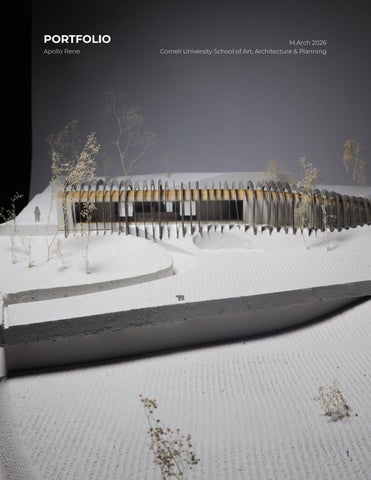
PORTFOLIO
Apollo Rene

M.Arch 2026
Cornell
University School of Art, Architecture & Planning
June - August 2025
Apollo Rene
M.Arch 2026
Cornell
University School of Art, Architecture & Planning
June - August 2025
https://apollorene.com/
https://www.linkedin.com/in/apollo-rene/ +1 (757) 634-7460
Cornell College of Art Architecture and Planning Ithaca, NY
Master of Architecture, Professional
December 2024January 2025
May - August 2024
Apollo René is a Master of Architecture student at Cornell University whose work is driven by a commitment to community, sustainability, and material reuse. His design approach combines low-carbon construction, innovative material systems, and social engagement to create architecture that responds to context while supporting environmental and cultural resilience.
Steinhardt School of Culture, Education and Human Development New York, NY
Bachelor’s of Fine Arts
Plan A Architects New York, NY
Summer Architectural Intern
Advanced the design development of an ongoing university construction project in Punjab India.
Drafted initial construction documents for additions to an existing university campus development.
Partnered with developers and consultants at designing schematics for a billion-dollar luxury villa.
GuernseyTingle Williamsburg, VA
Winter Architectural Intern
Advanced the design development of a theme park and new food bank project with engineers.
Partnered with contractors and builders on-site for an ongoing community center project.
Revised construction documents for a residential phasing component for an existing community center project.
GuernseyTingle Williamsburg, VA
Summer Architectural Intern
Drafted construction documents and renders for 5 existing projects such as churches, military housing, fire stations, and an extension to a community center.
Produced updated construction documents in the closing phase of a military housing project based on collaboration with builders and contractors.
DIGITAL MODELING + FABRICATION
Revit | Rhino | Adobe Creative Suite | SketchUp | CAD CNC Milling | Laser Cutting | 3D Printing | Lumion Enscape | D5 Render
ANALOG CRAFTSMANSHIP
Sketching | Drafting | Woodworking | Metalworking Model Making | Printmaking | Ceramics
LEADERSHIP
Innovation + Development | Community Strategist Project Management | Cross-Functional Team Leadership | Future-Focused
INTERPERSONAL SKILLS
Public Speaking | Resiliency | Adaptability | Skill Development Training | Team Development Collaboration | Decision Making and Problem Solving
Olive Tjaden Merit Scholarship Award
Academic Merit Scholarship Award at Cornell University
Silverstein Merit Scholarship Award
Academic Merit Scholarship Award at New York University
Steinhardt Merit Scholarship Award
Academic Merit Scholarship Award at New York University
Jefferson Cup Award of Arts
Artistic Award in Fine Arts
01 03 02 04 05 06


ITHACA RE-USE CENTER
Academic: Graduate Semester 4
Programs: Rhino, Illustrator, Photoshop, D5 Render, Climate Studio
Collaborators: Danaya Gaines
ANIMAL REHAB CENTER
Academic: Graduate Semester 1
Programs: Revit, Rhino, Illustrator, D5 Render
Collaborators: Bhodie Chisum | Jaden Godfrey
WILDFLOWER OBSERVATION CENTER
Academic: Graduate Semester 1
Programs: Rhino, D5 Render, Illustrator
Collaborators: Bhodie Chisum | Jaden Godfrey
FOREST CITY: INDIGENOUS LEARNING CENTER
Academic: Graduate Semester 3
Programs: Rhino, D5 Render Illustrator
Collaborators: Daniella Zhang
PROFESSIONAL DEVELOPMENT
Professional Internship Experience
Programs: Revit | Bluebeam
ARTWORK | EXHIBITIONS
Professional Art Exhibitions
Mediums: Painting | Sketching

Cornell University
Spring 2025 Studio
Location: Ithaca, NY
Finger Lakes Re-Use Center is a mixed-use campus design project set in Ithaca, New York. The project focuses on a community retail Re-Use facility with affordable housing units, and outdoor gardening. This multidisciplinary design aims to promote social, economic and environmental growth for the area.
The design aims for a connected environment. Linking residential spaces to workshops, career center support, the Re-Use marketplace and community gardens. The project is constructed in Cross-Laminated Timber (CLT) and light wood framing. Passive systems are a key factor in the campus layout. All buildings were programmed to maximize on daylighting and natural ventilation with private balconies and a public pavilion to provide outdoor shading to residents and the public.
Collaborators: Danaya Gaines
Instructors: Felix Heisel | Margaret Kirk
Programs: Rhino, D5 Render, Illustrator, Climate Studio


EXISTING SITE SHIFTING RE-USE


The privacy offered by the terraces creates intimate moments for residents shared equally in each unit. The terrace itself also becomes a larger public feature as each individual resident is responsible for nurturing their shared green space. As this unified responsibility blossoms, passive shading becomes shared amongst all units in Ithaca’s warmer months.
The residential and retail spaces are constructed out of Glue-Laminated Wood and CLT. The material choices were motivated by our client and their connections with local reconstruction projects in the area that focus on timber deconstruction.

Cornell University
Fall 2023 Studio
Location: Ithaca, NY
Wildlife centers play a significant role in protecting endangered species. This project focuses on a center designed for black bear cubs in upstate New York. The center is intended on housing the cubs for nine months, from fall through spring and then release the cubs back into nature. The key objective is to accurately simulate their existing wild conditions to foster the cub’s ability to thrive in nature. The center is sited on a steep topography and will require some landscape architecture in order to create an adequate sanctuary space.
Human and bear cub interaction must be limited at all times. This is crucial for bear cubs to be released back into the wild and be fully self-sufficient. To address this, the design circulates around a public access system that removes the public from the cubs. This ensures that they remain undisturbed during the rehabilitation process.
Balancing environmental preservation, species centered design and minimal human engagement provides an optimal environment for black bear cubs to be rehabilitated and released into the wild to thrive.
Collaborators: Bodie Chisum | Jaden Godfrey
Instructors: Leslie Lok | David Costanza
Programs: Revit, Rhino, Illustrator, D5 Render


A cut and fill system to create a natural boundary for the bear cubs was employed as well as a tunneling system to prevent disturbances to the rehabilitation process. Caretakers in emergency situations have access to the enclosure through hatches and sliding doors invisible to the bear cubs. These systems provide a smooth rehabilitation process to bear cubs while also allowing caretakers access to bears who need intensive and emergency treatment.

Public and private circulations for the rehab center were designed around pre-existing trails on the site. The public would enter in on either side of the upper level and travel down underneath the rehabilitation center as to not disturb the animals in their sanctuary. They then will reappear on either side with another viewing platform for the bear cubs.

2023, Masters Semester 1, Animal Rehab Center

Simultaneously, the private circulation derived from another trail on-site, offers spaces for veterinarians and animal keepers to care for any injured bear cubs as well as observe their rehabilitation progress. They are also able to provide emergency support to the cubs on site as needed.


Cornell University Fall 2023 Studio
Location: Ithaca, NY
The objective of this project is to conceptualize the tetromino as an operable form. Interior spaces must be defined and integrated into the final design. The goal is to establish a system for arranging tetrominoes into a group and resolving how this system evolves into either an ‘L’ or ‘T’ shape. A key design question is: How can this system facilitate a unique and abstract form while still providing functional interior spaces for human interaction?
As a group, we were tasked with creating viewing planes for the tetrimino system. We were also navigating spatial and programing layout based on the patterns of the, ‘L’ or ‘T.’ This was a conceptual exercise with the intent of analyzing circulation, form and function based on the tetrimino’ s inherent shape. Highlight the ways in which the system’s organization informs its final shape and usability.
Collaborators: Bodie Chisum | Jaden Godfrey
Instructors: Leslie Lok | David Costanza Programs: Rhino, Illustrator, D5 Render


A singular conceptual element of a ribbed system was discovered through rigorous physical models and sketches. This ribbed system is what defined our programming and structural system for our observation center.

Cornell University Fall 2024 Studio
Location: Ithaca, NY
The Gayogohó:no’ Tribe is one of the remaining Indigenous tribes originating from Upstate New York. In response to political conflicts and social upheaval, we developed a project to establish a learning center rooted in the tribe’s cultural heritage and values. This project also aims to help reunite the tribe which has been dispersed accross New York State.
The proposed learning center is designed to embody these principles by seamlessly integrating indoor and outdoor spaces, incorporating culturally significant materials, and harmonizing with the surrounding landscape. Sourcing locally with timber native to their region, we wanted to blend their cultural values of education, nature and spirit into the surrounding landscape. These themes dictate the programming and layout of the center. The project was also proposed in a phasing plan to help with budgetary constraints and facilitate the initial construction process.
Collaborators: Daniella Zhang
Instructors: Anna J.M. Dietzsch | Sean Anderson Programs: Revit, Rhino, D5 Render, Illustrator


The site for our learning center is located on the Southern portion of our site, with access to direct sunlight and access to roads for construction. The ambition for this project was to create a learning and community center for the Gayogohó:no’ nation in a two-phased development.


The client wanted us to construct our learning center in two phases. The first phase is designed to be a beacon for the tribe to unite under. From there, the second phase additions would be constructed as a more united front for the tribe.

We selected locally sourced timber specifically from white pine trees to help with lumber and the transportation of materials. We took inspiration from the white pine in its anatomy to produce a structure that was sustainable and also helped blend nature and tradition into the design project.

2024, Masters Semester 3, Forest City: Indigenous Learning Center

The anatomy of the white pine was also beneficial in creating a natural heating and ventilation system for the project. We developed a post and beam roof structure supported by bracing to paint the illusion of the white pine tree. As a result, nature enters into the building not only through education but through its exposed structural system.


Project Details:
GuernseyTingle Summer & Winter 2024 Internships
Location: Williamsburg, VA
Project Managers: Brad Sipes, Kristin Baum Programs: Revit | Bluebeam

New York University Group Exhibitions
Artwork from my time at NYU that has been featured in group exhibitions in New York City. The work is from two separate series of paintings made discussing land rights and how bodies migrate and transform. The resulting impacts of those acquisitions and transformations often leading to destruction and a reconstruction suiting a new and differentiated architecture and cultural vernacular.
Exhibition Collaborators: Amanda Lindsay
Mediums: Painting | Drawing | Weaving


Contact: ajr329@cornell.edu +1 (757) 634-7460
Website: https://apollorene.com/ https://www.linkedin.com/in/apollo-rene/ ISSUU - apollorene

