2
3
JASON WINSTANLEY – CHIEF AUDIO OFFICER, NZME
A PART OF YOUR LIFE W
A hundred years. It’s an extraordinary milestone and it feels slightly surreal.
hen I started working at Newstalk ZB, Mike Hosking told me it was a privilege for all of us to be there, not because it has the biggest audience or the flashest studios, but because we got to be part of a station with real legacy in New Zealand. Getting to a hundred years on-air with the station still at the top of its game shows just how right he was. I’ve spent a big part of my working life around ZB. I’ve sat in studios, stood in the control room and watched major moments unfold live on air. I’ve seen first-hand the pride and responsibility that comes with being part of this place. And the truth is, ZB gets under your skin. Radio does that anyway, but ZB is different. You don’t just work there. You become part of something that
has mattered to New Zealanders for generations. You feel the weight of that legacy when the country is going through something big – election nights, emergencies, breaking news, and in those moments when people turn to a familiar voice to make sense of what’s
cooking dinner, and the last thing you hear before bedtime. For a hundred years, people have made ZB part of their everyday life, which is an extraordinary privilege. There have always been awards, ratings success and big on-air moments we are
FOR A HUNDRED YEARS, PEOPLE HAVE MADE ZB PART OF THEIR EVERYDAY LIFE, WHICH IS AN EXTRAORDINARY PRIVILEGE. happening around them. But the day-today connection is probably what I love most about ZB. It’s not only there for the big moments. It is there in the car before dawn, beside you at work, in the kitchen
incredibly proud of. They matter, and they are worth celebrating. But they are not the thing that has kept ZB strong for a century. The audience has. A hundred years of ZB is not really a hundred years
of us talking. It is a hundred years of New Zealanders listening. This milestone is a chance to acknowledge the many people who have built and protected this station over the years – the hosts, producers, journalists, newsreaders, technicians, sales teams, leaders and everyone behind the scenes. Great radio is never made by just one person. And to our advertising partners, thank you. Your support has helped sustain a station that continues to matter deeply to New Zealand. It is appreciated and never taken for granted. The way people listen will keep changing. But the reason they listen has not changed at all. As long as people want a real voice they can trust, ZB has a place, for the next hundred years and beyond.
Striving for Excellence in Outdoor Living Aluminium Pergolas, Outdoor Blinds & Other Accessories NZ Owned & Operated
WE ARE PROUD TO SUPPORT ZB AND CONGRATULATE THEM ON 100 YEARS
Custom-made
Servicing North Auckland to Taupo & everywhere in between
FREE, NO OBLIGATION MEASURE & QUOTE To book, contact us via our website sunvue.co.nz or call us free 0508-SUNVUE (0508-786-883)
4
CONTENTS 6 VOICES OF THE PAST The famous, the infamous, the mild and the wild. 8 MIKE HOSKING I’m proud of Newstalk ZB.
BUILT FOR BROADCAST A journey through ZB’s Auckland studios.
10 KERRE WOODHAM Carrying the listeners and their stories in her heart. 13 ZB IN PICTURES Colourful moments over the years at ZB. 14 MARCUS LUSH Calls from the weird and wonderful. 15 HEATHER DU PLESSISALLAN For all the Trevors and the Pauls. 16 LEIGHTON SMITH Unleashing talkback.
DURHAM STREET 1941-90
17 JENNIE GOODWIN A life of adventure. 19 JAMIE MACKAY The rural voice of ZB. 20 THOSE WERE THE DAYS Blasts from the past. 21 SIR PAUL HOLMES The man who revolutionised broadcasting.
MAGAZINES NEWS EDITOR Brenda Ward CHIEF AUDIO OFFICER Jason Winstanley HEAD OF TALK Will Maisey ASSISTANT HEAD OF TALK Edward Swift CHIEF PRODUCER AND HEAD OF DIGITAL CONTENT Michael Allan CHIEF MARKETING OFFICER Katie Mills SENIOR GROUP MARKETING MANAGER Jennifer Pryor
QUEEN’S ARCADE C.1933-41 Before Broadcasting House, 1ZB operated from several makeshift premises, principally Queen’s Arcade in the Dilworth Building at the corner of Queen and Customs Streets. It was here during the 1930s that Uncle Scrim and Uncle Tom transformed the station into an Auckland institution. The facilities were modest, with staff and broadcasting equipment squeezed into rooms never designed for radio. Yet from these studios came programmes that entertained, informed and supported listeners through difficult times.
Officially opened on October 6, 1941, Broadcasting House was a striking five-storey modernist building designed by Alva Bartley and Imi Porsolt. Its five studios were joined by control rooms, offices, workshops and a 110-seat Radio Theatre, where orchestras, plays, quizzes and variety shows were performed before live audiences. For nearly five decades, the Durham Street landmark was the beating heart of Auckland radio and home to generations of celebrated ZB broadcasters. By the late 1980s, however, its facilities had become outdated. The final live Radio Theatre broadcast aired in 1989, and Broadcasting House was demolished the following year.
SENIOR BRAND MANAGER Michelle Howard HEAD OF COMMERCIAL, BUSINESS, RURAL & SPORT Neil Jackson CREATIVE DIRECTOR Xanthe Williams
WITH THANKS This magazine would not have been possible without the research and colourful writing of Bill Francis, from his book ‘ZB: The Voice of an Iconic Station’. Bill joined the station in 1983 as sports editor and worked his way up to general manager in 1993. He is a former CEO of the Radio Broadcasters Association. Thanks also to Harper Collins for allowing us to reprint some of the content. Bill’s book is still available online. Images: Thanks to the Auckland Libraries Heritage Collections, the New Zealand Herald archive and the Newstalk ZB team. Thanks to Rod Emmerson for his caricatures of ZB’s radio stars.
54 COOK STREET 1990-2015 On April 14, 1990, ZB moved into the former Kodak building at the corner of Cook and Nelson streets. Its top-floor, glass-walled studios offered a lighter, more modern broadcasting environment. The building later became home to The Radio Network, bringing ZB together with its other radio stations under one roof.
GRAHAM STREET 2015-TODAY In late 2015, ZB moved into the newly built NZME Central alongside the New Zealand Herald and NZME’s other radio and digital brands. Located on Level 1, its purpose-built studios connect with an integrated, multi-platform newsroom, bringing radio, print, video and digital journalism together under one roof.
5
6
VOICES FROM THE PAST
1
The famous, the infamous, the mild and the wild all made their mark at 1ZB.
1
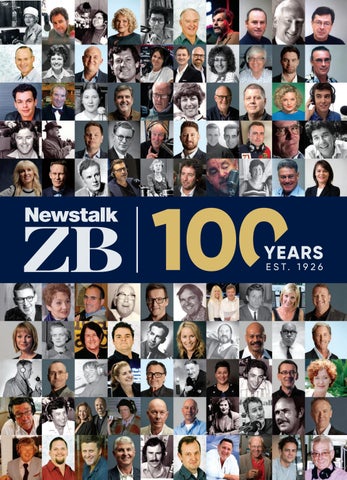
ZB was the first ‘commercial’ radio station in New Zealand, but former Newstalk ZB general manager Bill Francis says in his book ZB: The voice of an iconic radio station that its history goes back even further than that. From 1926, the station existed under various owners for a decade, back in the era of the Radio Broadcasting Company, set up in 1925. In 1933, its history began in earnest when Tom Garland and Colin Scrimgeour (known as Scrim) bought the station with the proceeds of selling Scrimgeour’s wife’s piano (without her permission). Just two years later, with the country about to go to the polls, 1ZB hit the news itself when the government jammed a broadcast by Scrim, worried he might influence the election result. That was the power of radio waves in the early days. The era of Uncle Scrim and Uncle Tom (Garland) was pioneering and ground-breaking, but it was merely the start of the success we see today. 1ZB has been the home of many of the great broadcasters. The much-loved broadcaster Aunt Daisy was a contemporary of both Scrim and Tom. She knew Phil Shone, who knew Merv Smith. And then there was the controversial change to the talk format – Newstalk 1ZB – that ushered in a broadcasting genius in the form of Paul Holmes, high-profile hosts like Leighton Smith and others. These names are just a few of the famous, the infamous, the mild and the wild who have made their mark at 1ZB. In audience size, 1ZB is the most successful New Zealand radio station ever. It has been No.1 in Auckland for most of its history, but it hasn’t always been the most profitable. Let’s take a journey through the past.
1926
1YB becomes 1ZB
THE 1930S: THE DEPRESSION
The 1930s brought tough times for New Zealanders when 1ZB was in its infancy. Early radio stations were prevented from running advertising, so most formed ‘radio clubs’. Scrimgeour and Garland formed the ‘Fellowship of the Friendly Road’ before buying Charles Pearson’s 1ZB in 1933. They could only broadcast for a couple of hours in the morning and a few hours in the evenings, Tuesday to Friday.
THE MONEY TO RUN THE STATION CAME FROM ‘SUBSCRIPTIONS’ PUT INTO THE ‘LITTLE BROWN BOX’. WAGES WERE HANDED OUT ONLY AFTER RUNNING EXPENSES HAD BEEN DEDUCTED The money to run the station came from ‘subscriptions’ put into the ‘little brown box’. Wages were handed out only after running expenses had been deducted, so the staff had to live frugally. Unable to earn decent revenue, 1ZB was in a poor financial state, and in 1936 it was on the brink of insolvency when Scrimgeour approached Prime Minister Michael Joseph Savage. The Government agreed – amid a veil of secrecy – to buy 1ZB, granting a £750 deposit to keep the station on-air. Scrim-
1933
The Friendly Road takes over
1935
Uncle Scrim’s broadcast is jammed
geour was appointed to lead a national broadcasting commercial service for New Zealand. Religion was a key early part of 1ZB and choirs of both adults and children were formed. Many famous names started their public lives as members of one of the children’s choirs. Among them were former Prime Minister David Lange, star announcer Merv Smith and former cabinet minister Jim Anderton. As the popularity of 1ZB continued to grow, its announcers became stars. Scores of women would arrive at the Queen’s Arcade after Aunt Daisy came off-air, swapping recipes, getting autographs or bringing in cakes and flowers. But Scrim said he often had to use a staff member as a bodyguard to help him handle the Depression ‘down and outers’ waiting for him outside the studios in the hope of a handout.
THE 1940S: THE SECOND WORLD WAR
At 9am on September 1, 1939, station manager John Griffiths called his staff together, paced up and down several times, deep in thought, and then told them: “We are at war.” Local content was hampered by strict censorship restrictions and manpower shortages, so broadcasts of the BBC news became the main source of wartime updates. Margaret Pratt of Warkworth, 105, was in her late teens when the war started. She recalls gathering with her family around the radio during the blackouts to hear the latest from the war zones. “Oh, yes, we listened every day,” she says. “It was how we got our news.” Patriotic programmes were launched to keep up Kiwis’ spirits. Rod Talbot’s Diggers sessions became a station icon. Talbot had suffered a serious head
1936
1ZB becomes New Zealand’s first commercial station
5 wound at Gallipoli, leaving him with a scar on his face that he regarded as a badge of honour. For his day, Scrim was a ‘modern’ manager. Newspapers had been running letters complaining about the poor pronunciation of Māori place names. So, Scrim set up a session on correct Māori pronunciation. Soon after, a Māori vocalist, Uramo Paora (Lou Paul) joined 1ZB as its first Māori announcer.
THE 50S AND 60S – RADIO SITCOMS ARRIVE
In the days before TV, radio plays were popular entertainment, so 1ZB bought programmes from Australian drama libraries that won massive followings. ‘Dad and Dave’ was one that ran from 1937 to 1952. The ‘Snake Gully’ farming family were stereotypically Australian – the slow-talking and cunning Dad, his son Dave, practical Mum, and Dave’s ‘sheila’, Mabel. American soap opera Dr Paul, “a story of human conflict”, started in the late 1940s and ran until the early 50s. Through the 1950s and until the New Zealand Broadcasting Corporation (NZBC) started in 1962, news on 1ZB
1941
The art deco Durham Street studios open
1963
Merv Smith begins his Breakfast era
7
1ZB was also getting a reputation as the place to listen to sport. Sports announcer Pete Montgomery was in the right place at the right time when the America’s Cup came downunder. On May 14, 1995, he was able to broadcast the words that have become part of New Zealand’s sporting history: “The America’s Cup is now New Zealand’s Cup.” Nothing stands still for long. At one time, the Cook Street building housed eight radio stations. On the third floor, Newstalk ZB was joined in 1998 by another talk brand, Radio Sport.
THE 2000s – NEW MILLENNIUM
2
3
4
Defending the America’s Cup in New Zealand in 2000 created new challenges for Newstalk ZB. Bill Francis says: “I was station manager at the time, and on-the-water rights needed to be negotiated with Team New Zealand, although I managed to obtain rights to the Louis Vuitton Cup for the princely sum of $1, plus a booth for Pete Montgomery.” At the end of the 5-0 whitewash of the Italian Luna Rossa, Peter Montgomery was able to tell Newstalk ZB listeners that it was ‘Black to the future – the America’s Cup is still New Zealand’s Cup.’ In 2005, the New Zealand Press Association started pursuing radio outlets for their news and supplied a tailor-made service to radio networks.
THE MODERN ERA
6
7
8
1: Uncle Scrim, who brought to the airwaves ‘joy where it was wanted and grief where it was needed’. 2: The ‘Diggers’ friend, Rod Talbot. 3: Daisy Basham (Aunt Daisy), 150cm of human dynamo, the advertisers’ friend capable of speaking 200 words per minute. 4: Phil Shone preparing for more radio action. 5: An 1ZB favourite, McHairy with his alter ego, Merv Smith. 6: Leighton Smith, the commanding voice of Newstalk ZB Mornings. 7: Paul Holmes, the broadcasting genius who transformed Breakfast. 8: The Voice of Yachting, Peter Montgomery.
was almost non-existent. Items could be put together by the station manager, an announcer or programmer, none with any news training. But radio did jump on major events that stopped the nation. Among them were Prime Minister Savage’s funeral, the Melbourne Centennial Air Race, the arrival of the Pan American Clipper plane, Jean Batten’s solo flights, and then later the Tangiwai disaster and Hillary’s conquering of Mt Everest. Royal tours were always high on the list for special arrangements. One of the first decisions of the NZBC was to set up an independent news service, with four journalists in a 1ZB newsroom, preparing news stories for the network, compiling regular bulletins for 1ZB and stories for the new television service. For years, 1ZB was dominated by horse racing. Listeners in the 1950s and 1960s had become so used to this cacophony of race noise on radio that Syd Tonks, Dave
1970
1ZB introduces live open-line talkback
Clarkson and Peter Kelly were almost part of the family.
THE 70S AND 80S – COMPETITION AND TALKBACK
The commercial radio market might have been small, but the rivalry was becoming intense. Radio Hauraki had become a legitimate station, Radio i secured a licence and then in 1978, Radio Pacific started up. One of the most important developments of the decade was the start of ‘open-line current affairs’, where listeners were able to telephone in live to discuss topical issues. In 1970, competitor Radio i ran a newspaper advertisement for a talkshow host, which was spotted by 1ZB’s Brian Stephenson. Brian showed the rival ad to 1ZB’s manager, who without a second’s thought said: “We’ll have it on air in three weeks.” And it was, with a seven-second delay that could be used to remove offensive material.
1987
Newstalk 1ZB launches – Holmes on Breakfast, Leighton Smith on Mornings
1990
ZB leaves Durham Street and moves to new studios at 54 Cook Street
THE 80S AND 90S – THE NEW NEWSTALK FORMAT
Changing 1ZB to the Newstalk format that was launched in 1987 was a big risk for the management. At first, ratings plunged, then started to pick up. The team had been based in Durham Street but had to contend with the news and sports teams operating out of a separate building. In new Cook Street premises, hosts and producers were able to wander from studios directly into the news-gathering area and confer about stories. In the Cook Street studios, a sort of pecking order was set up among the hosts, with Paul Holmes and Leighton Smith, together with their producers, being allocated individual offices. The clanking ‘search and stab’ typewriters became a thing of the past, to be replaced by a computer system named ‘Newsboss’. In the studios, a ground-breaking system known as ‘Touchstone’ was introduced to schedule and play commercials.
1994
The “1” is dropped from 1ZB – Newstalk ZB goes national
In 2014, The Radio Network was merged with APN News & Media’s New Zealand print assets, and the station became part of New Zealand Media and Entertainment. The New Zealand Herald was based at the historic Albert/Wyndham Street block while The Radio Network (TRN) studios were on Cook Street. It wasn’t until late 2015 that the company combined its various print, radio, and digital brands into one converged newsroom at the newly developed NZME Central building on Graham Street, off Victoria Street West, where it is still based, with high-tech studios for its high-profile hosts. Covid felt like a turning point for the Newstalk ZB team. As lockdowns loomed, the station was preparing for split teams and separate locations, and the team had one last drink at the pub. That Friday, word came of a state-of-thenation address the next day, so several of the team came back in to help produce it. Everyone gathered in the control room to watch events unfold. By Monday’s lockdown on March 25, 2020, the newsroom was near-empty. Teams were split across NZME Central and Ellerslie, with journalists working from home where needed. A new nightly show, ‘The Lockdown’ launched with an hour summarising the day’s Covid news and interviews. Radio thrived as a companion for listeners stuck at home. Newstalk ZB grew to its biggest-ever audience of more than 700,000, the largest commercial radio audience in New Zealand history. Bill Francis’ book ZB: The voice of an iconic radio station, is available as an e-book.
1995
Peter Montgomery calls Team New Zealand’s historic America’s Cup victory
1996
RNZ sells commercial arm. Newstalk ZB becomes part of The Radio Network
8
MIKE HOSKING
I’M PROUD OF NEWSTALK ZB It’s about personality, longevity and connection, says Mike Hosking.
I
remember sitting at the Newstalk ZB 80th party, thinking it wouldn’t be long before it was 100. Eighty years was good; but 100, now that is something. That then led me to wonder how many businesses there are that are 100 years old and still at the top of their game. The answer is – not many. Chat GPT provided me with Kirkcaldie’s and Smith & Caughey’s ... both of which are gone (which immediately shows the frailty of AI). But it did toss up TSB, Sanford and Hallensteins ... so we are not alone, but in very rarified air. There is some debate, I guess, around the structure and nature of the company ZB as it originally was was – 1ZB, 2ZB and so on. It was part of the state-run broadcasting system. It was a world away from the Newstalk ZB we have had for the past (almost) 40 years.
PERHAPS THE GREATEST JOY OF THE ZB SUCCESS IS THAT ESSENTIALLY IT HASN’T CHANGED. The Newstalk rebranding decision might well be one of the great business, far less media, masterstrokes of the past half-century. It is essentially why I got into talk radio. Having started at the now-defunct Radio Windy in Wellington in 1982, I could see when deregulation came and FM licences were sold at about 50 cents a pop, the number of music stations would explode and every man and his turntable would be scrapping for an everdiminishing slice of the music pie. Talk, on the other hand, was expensive but there was always a large audience ready to consume it. So, if you got it right, the field would be dabbled in by comparatively few players. Newstalk ZB is a winning example of getting it
right. Consistency is the other part of the equation. It is with real pride we can say that in the Newstalk era ZB has had just two breakfast hosts. One was called Paul, one is called Mike. Giving the audience the respect of longevity and an ongoing relationship is not to be underestimated, it is one of the many things ZB has done and continues to do better than anyone else. Perhaps the greatest joy of the ZB success is that essentially it hasn’t changed, in a world that is in many areas unrecognisable. The essence of ZB is a constant. It is about personality, and connection with an audience. About a need to communicate, to be heard, about ideas and debate. My career started in 1982 and although a lot of the bits and pieces of radio have changed and apps and podcasts are part of the newish landscape, the quintessential bit that hasn’t changed is: all you need a microphone, some ideas and some people to listen. The simple pleasure of communication in radio terms is pretty much the way it has always been. In a media landscape that has not only changed (and dramatically), the ZB story is one of consistency, careful planning, longevity and respect for the audience. We are profitable in an age of troubled bottom lines. We are critically acclaimed (Station of the Year six years in a row) and we have the largest audience in the industry. Most at ZB would be too modest to point out these aspects of the business, which is probably why they quietly achieve what they do. But, you know me! I like the facts, and no one beats us at the game of radio. It is not said with arrogance, it is said with pride, and it is achieved as the result of hard work. ZB is one of the great, if not the greatest – radio story this country has seen. Not only is it 100, but I would also argue that, at 100, it’s never looked better, and it’s more than likely its best days are ahead of it.
POMP AND CEREMONY FOR A ROYAL FAN Mike Hosking was the only New Zealand media invited to King Charles’ coronation. This is what he wrote for the NZ Herald: I was lucky. I was seated directly next to where some of history’s greatest names are buried – Newton, Darwin, Dickens, Chaucer. My eyeline met the royal family on the other side. At its closest point the King and Queen were no more than 30m from me. Those like UK Prime Minister Rishi
Sunak, who had major parts, walked directly in front of me. Vewing was restricted, but it was the “being there” that counted. You were a witness to history, and unlike so many events these days, this one was rare. Virtually no one would have seen or been at the last one, so it had a character of uniqueness to it. We all felt privileged. There were so many famous people, spotting them ran the risk of being boring. There was a buzz when
Prince Harry arrived. I thought he looked sort of lost. His seat was not as bad as some media had suggested, but even he spent a decent chunk of the ceremony looking at the screen, not to mention Princess Anne’s hat in front of him. The bells that were tolling could barely be heard inside, and when the crown was placed on the royal head (I thought the Archbishop of Canterbury gave it a bit too much pressure, and did it twice, plus it’s not light) cannon fire was let off. We couldn’t hear that either. People were impeccably dressed. Everyone knew how lucky they were. No matter who you were or where you came from, you were all equal for a couple of hours.
9
ÔÀ¼ÍÎ ÊÇ¿ ÎÏÄÇÇ ¿ÊÄÉ ÏÃÄÉÂÎ ÔÊÐÍ Ò¼Ô ÏÝÖéąè ãä èâÖáá ÖØÝÞÚëÚâÚãé
Áäç îÚÖçè ÉÚìèéÖáà Õ½ ÝÖè ÞãÛäçâÚÙ êè ØÝÖááÚãÜÚÙ êè ÚãéÚçéÖÞãÚÙ êè ÖãÙ äØØÖèÞäãÖááî ÜÞëÚã êè èäâÚéÝÞãÜ éä ÖçÜêÚ Ö×äêé äëÚç ×çÚÖàÛÖèé ¼é ¼çëÞÙÖ ìÚąçÚ ×ÞÜ ×ÚáÞÚëÚçè éÝÖé ÖÜÚ èÝäêáÙãąé ØÝÖãÜÚ ìÝä îäê ÖçÚ Äé èÝäêáÙ ÜÞëÚ îäê ÚëÚã âäçÚ ÛçÚÚÙäâ éä ×Ú îäêçèÚáÛ Îä ÝÚçÚąè éä îÚÖçè äÛ ÙäÞãÜ Þé îäêç ìÖî
ÃÖååî ½ÞçéÝÙÖî ÉÚìèéÖáà Õ½
Áçäâ îäêç ÛçÞÚãÙè Öé ¼çëÞÙÖ åçäêÙ èåäãèäçè äÛ éÝÚ ÈÞàÚ ÃäèàÞãÜ ½çÚÖàÛÖèé
ÖçëÞÙÖ Øä ãï
10
KERRE WOODHAM
I FEEL THAT I KNOW THEM Kerre Woodham says she will always carry the listeners and their stories in her heart.
W
hat I love about ZB is that when you turn up for work, you know you’re part of a continuum of broadcasters who were there before you, who have helped shape the station into what it is today. I love that she is for the listeners and by the listeners. I am a real-life version of the Human League song: “I was working as a waitress in a cocktail bar, when he found me. He picked me out, he shook me up, he turned me around, he turned me into someone new.” Yes, I was working at a restaurant in Hamilton when Bill Francis rang me and asked me if I’d like to do nights on 1ZB. I said no twice – I was hip! I was cool! Talkback was for old people! But after the troubled chef had a meltdown and a water rat came up from the river and into the kitchen, a nice quiet studio seemed like a dream, so when he rang a third time, I said yes. Some moments will always stick in my mind. One was the dreadful night in the middle of April when word started coming through that a group of school kids and their teachers were in trouble on the Tongariro River.
AFTER NEARLY 30 YEARS ON 1ZB, THERE ARE SO MANY MOMENTS AND CALLERS AND LETTERS FROM LISTENERS THAT STICK IN MY MIND. It was nigh impossible to get any information quickly – we were being drip-fed the news as it came through. And it was the worst possible news. By the end of the evening, we knew that six young people and a teacher from Elim Christian School had drowned in the raging Mangatepopo Canyon. I’ll never forget that night. And I remember the night of the Canterbury February quake – it was just awful. For many people in Canterbury, their only access to the outside world was through their radio. So, they rang in, desperate for information about family members and friends. There was a mum who desperately needed goat milk powder for her baby – a listener was able to fix her up. That baby will be 15 now.
After nearly 30 years on 1ZB, there are so many moments and callers and letters from listeners that stick in my mind. Nights are special. It’s the time when people are at their most vulnerable and if they’re going through difficult times, there’s nothing to distract you in the dark of night. I remember receiving a beautiful
bone china cup in the mail from a woman whose dad had just died. She would call in to see him every night as he got more frail and ask him if he wanted her to stay. “You go, love”, he’d say to her. “I’ll make a cup of tea and Kerre will see me through.” When he died, she sent me a bone china cup just like his.
About six months after I’d started on 1ZB, I received a letter from a young widow who told me her husband had drowned at sea. He was a fisherman, she said, and she always knew the sea would get him, but she thought she’d have longer with him. She had young children but she missed him so much, she didn’t know whether she had the strength to carry on. She wrote to me to tell me she was fine now and to thank me for helping her get through. She never rang, she said, but she always knew she could, and that helped her through the nights. I cried; my producer, Jimmy, cried, and she and her family have stayed with me forever. I hope they’re doing well. Sometimes it’s the people who don’t call who stay with you. Then there was Lewis, the 12-year-old who schooled me for thinking there were tigers in Africa. And Brucey from Little Wanganui, Vivienne and her Christmas cake, Mikey who now works here – and the man who rang me during the global financial crisis to tell me in hushed tones that he was ruined. He was using credit cards to pay the mortgages on rental properties he had bought and was in dreadful financial trouble. He hadn’t told his wife, because he handled the money and he couldn’t bear to let her down. I was talking to him, and I heard her in the background. He said he had to go and he hung up. That call has haunted me. I never heard back from him. The truckie whose marriage had broken up because he was working every hour God sent and he was now living in a crappy rental with another bloke. He didn’t want his kids to see him in the place and every spare cent he had went to his ex-wife and kids, so he couldn’t ever imagine starting over again. His wife had hooked up with his best friend. The listeners have been with me from the time I was a 32-year-old single mother, newly arrived in Auckland, to becoming a 61-year-old grandmother and through all the highs and lows that come with living a full life. I feel like I know some of them, and I know some of them feel like they know me. They have taught me so much and they have shown me different ways of viewing the world. I will always carry them and their stories in my heart.
11
Helping Kiwi businesses grow and succeed since 1859
Trust takes time. Congratulations Newstalk ZB. Earning the trust of generations of New Zealanders is an achievement worth celebrating. Staying relevant for a century? That takes vision, resilience, the courage to back yourself, and a willingness to keep evolving. Qualities we’ve always admired here at NZI because they’re the same values that have helped guide us through 167 years of serving New Zealand businesses. From one long-standing Kiwi brand to another, congratulations on your centenary. NZI Insurance. Peace of mind for NZ business.
Talk to your insurance broker
| nzi.co.nz
12
ZB IN PICTURES These are a few of our favourites from the thousands of photos that were shared with us.
2008
Paul Holmes signs off Breakfast. Mike Hosking takes over
2012
Paul Holmes’ final broadcast on his Saturday Morning Show
2013
Early Edition launches with Rachel Smalley
2014
Newstalk ZB’s owner, The Radio Network is merged with APN, forming NZME
2015
ZB moves into purposebuilt studios at the new NZME building in Graham Street
2018
Leighton Smith retires from mornings – and launches his podcast
13
2019
Kerre Woodham takes charge of 9am – Noon on Newstalk ZB
2019
Larry Williams retires from ZB Drive. Heather du Plessis-Allan takes over
2021
Record ratings achieved with an audience of more than 700,000
2023
Mike Hosking attends King Charles III’s coronation
2026
Station of the Year at the NZ Radio & Podcast Awards for a record sixth consecutive year
2026
ZB celebrates 100 years with an event and a podcast
14
MARCUS LUSH
LOCKED OUT, BUT THE SHOW MUST GO ON (FROM OUTSIDE THE DOOR) Marcus Lush had to break into the Newstalk ZB studio with a knife one night in 2019. The NZ Herald reported that the radio host was pushed to this desperate measure after he locked himself out of the studio mid-broadcast, when he went to get a cup of coffee. Returning to the airwaves on a nearby landline, an embarrassed Lush told his dedicated listeners: “I don’t quite know how to say this, but I am now on the phone. “I went to make a cup of coffee and ... I’ve locked myself out! “My phone’s in there and my car keys are in there, and I’ve got no idea where the spare key is, so it looks like I’ll be finishing the show on the phone, which is slightly upsetting.” He said he tried to break into the studio with a knife but “it’s not moving”. He then apologised, saying: “It’s something that I never thought would happen. “Why would you have a locked door on the studio and not tell me where the key is?” Still, he maintained a professional attitude: “Onwards and upwards. I’ll just have to wing it from now,” he said, adding that his problems were nothing compared to others’. While he was locked out for about an hour, his misfortune did provoke some laughter for those listening in and posting on Twitter, including a colleague who called the broadcast “strangely riveting”.
VOICES IN THE NIGHT Calls from the weird and the wonderful have kept Marcus Lush entertained.
I
t was 1990 and I was about to move to Melbourne, when I saw an advertisement for a part-time radio announcer for Radio 1ZB. Intrigued, I went for an interview and got the job. I started out doing three nights a week at the old Broadcasting House in Durham Street, then I was promoted to doing five nights a week. All these years later, I’m still the ZB Night Announcer. We all soon moved to a studio at the corner of Nelson and Cook streets. Of course, at that stage it was only an Auckland station and it had only been in the talkback format for a couple of years, so it was still a new concept for us all. Working the night shift, I got to talk to some really interesting callers. One I recall with amazement was a man who told me the Soviet Union was disintegrating. I asked him how he knew this quite surprising information. It turns out he was a ham radio operator and had been talking to the Russian cosmonauts in the Soviet Space Station. They told him that their reentry plans had changed because of the impending collapse of the union. Of course, he was totally right. The mid-dawn callers were always the most interesting. Often, they would ring from gas stations, because they were the only places where someone would lend them a phone. It seems weird these days but there was a time when a lot of people didn’t have access to phones. I talked to some of the listeners so many times they became friends – and I even met some of them. I ended up doing the Round the Bays run with a listener who lived rough under a ramp in Mayoral Drive. He must have been in his 70s, but I have to say he was remarkably fit. Another listener who intrigued me was a guy called Mike the Pirate. I got to know him quite well because he has called me many times over the years. Years later, I got a call from a psychiatrist asking me if I knew what was wrong with Mike the Pirate. I said: “I thought that was your department!” He seemed quite well to me, but he did remind me a bit of the character who dressed like a pirate from the movie Dodgeball: A True Underdog Story. It’s amazing what you hear in this job.
Our readers are leaders Subscribe now
15
HEATHER DU PLESSIS-ALLAN
FOR ALL THE TREVORS AND THE PAULS The best part of radio is the people listening, says Heather du Plessis-Allan.
I
need to tell you about Trevor from Wellington. Trevor is (it feels like) a fulltime Newstalk ZB listener. He’s always texting and calling. When I hosted Wellington Mornings nearly 10 years ago, Trevor was a regular. He’s still texting me on the Drive show. He often knows as much, if not more, than the host does about any particular subject. He has a keen sense of the ridiculous. I discovered this when he called me one day years ago about whatever it was that I was talking about. But then he changed the subject on me because he thought it was far more interesting that some researcher had suggested parents ask their newborns if it’s okay to change a nappy before we change a nappy (which he declared to be ridiculous) and thus he sent our talkback off on a much more fun and wilder adventure for the morning. Trevor is a tradie – I can’t remember which trade exactly. He has a giant moustache (at least he did when I saw him last). He wears the collar on his polo shirt popped up against his neck. He stands with both feet planted firmly on the ground, hip-width apart like he has no doubt he belongs. I know all of this about Trevor because I’ve also had the pleasure of meeting him in person. One day when I pulled my car up outside our house in Oriental Bay, Trevor came bounding across the street. He said something like “Heather, I’m Trevor!” and then gave me an enormous hug without asking permission first (that would be ridiculous). Turns out, he owned the rental across the road. Why I’m telling you about Trevor is that he – more than anyone else – epitomises a Newstalk ZB listener to me: someone engaged in news, deeply interested in what is happening in their city, their country, their world, and who has a strong opinion about what they’re seeing. Often, they’re really intelligent. There’s also Paul. I haven’t yet had the chance to meet him. Paul is also from Wellington and has been
emailing me since my stint on Wellington Mornings. He emailed me last month to congratulate me on winning the Sir Paul Holmes Broadcaster of the Year award. He had actually emailed me earlier in the day to predict I would get the award, then emailed me afterwards to congratulate me on the win and himself on his correct prediction. It’s funny that Paul sent me that email because in my first six months of the Wellington job he emailed me at least twice (possibly three times) to tell me he was so furious at my stupid opinion that he was turning the radio off and never listening to me again.
MORE OF US COULD DO WITH DISAGREEING MORE OFTEN AND THEN GETTING THE HELL OVER IT AND GETTING ON WITH LIFE I cherish Paul’s continued correspondence. It reminds me it’s okay to strongly disagree with each other. It doesn’t have to be the end of the relationship. More of us could do with disagreeing more often and then getting the hell over it and getting on with life. I sort of hate calling Paul or Trevor or anyone else a “Newstalk ZB listener”. Everyone is obviously much more than that. They’re dads, mums, workers, mates, ratepayers; people with fascinating lives. It just happens that they choose to listen to Newstalk ZB and get stuck into the conversation. But it’s because of ZB that we’ve had the chance to meet. That’s the beauty of ZB. It gives us a place to have a chat. Sometimes an argument. Often a laugh. Thanks for being part of it.
16
LEIGHTON SMITH
UNLEASHING TALKBACK
From a ratings crash to loyalty – and love.
F
or me, 1985 was a benchmark year. After five years on 2ZB in Wellington, I had accepted an offer to move to Adelaide radio station 5AA. Essentially, it was a good move, but when I was invited to return to New Zealand and 1ZB Auckland, I said yes. So began the most amazing time in my broadcasting career. Who would have guessed it would be 33 years, going well beyond my expectations; good times and bad. 1ZB was the biggest station in the country, but its management had decided it was time for change. I was contracted to unleash talkback onto an unsuspecting music audience. People aren’t fond of change, so it’s no wonder that soon after I arrived in October, midway through a survey, the Nine-to-Midday ratings dropped from 19% to 15.5%.
I ONCE HAD A GOOD CHAT WITH QUEEN ELIZABETH AS WE LEANED ON A FENCE IN THE GROUNDS OF GOVERNMENT HOUSE, WHERE WE TALKED ABOUT RACEHORSES, DOGS AND HOW MUCH SHE DIDN’T LIKE THE GRANDCHILDREN COMING TO VISIT Something similar had happened in Adelaide but, there, by the second survey the figures had bounced up by 30%. I told the team this to give them some reassurance and, sure enough, by the end of 1986, Nine-to-Midday hit 22% ... but not for long. The decision to bring forward the full format change triggered a rating crisis. For a time, mine was the only programme hitting ratings above 10% (at 10.5%). I could see chaos ahead and, downhearted, had made up my mind to return to Australia. But station man-
ager Brent Harman had other ideas and presented me with an offer. The result – I stayed, we hit the accelerator, and the ratings started to grow. There are big egos involved in radio, so it was no surprise that diplomacy wasn’t always in evidence. Those working in the early mornings at that time have never forgotten a very agitated Paul Holmes, who was stressed about plunging ratings, leaving the studio to confront me over a comment I’d made the previous day (details in my book!). He was raging. I suggested it was his problem, not mine. We had had a competitive relationship for a long time, and it was only in 2002 when I contracted prostate cancer that we buried the hatchet – for Paul too confronted the same challenge. I recall another screaming match when my producer couldn’t get her own way and let fly as I walked up the long hall to the exit. After that, we parted ways. Enter Carolyn Leaney, who was with the BBC as a Radio 4 producer. She accepted a three-month contract – 38 years ago. Prostate cancer changed the nature of our relationship, although it took some time, and we were married in 2012. My book, Beyond the Microphone, was published in 2013. I was persuaded to write it because I was determined not to renew my ZB contract in 2014. However, I did renew it, and then again two years later. My last radio programme was December 14, 2018. I intended to spend the rest of my life travelling and reading. But Covid put paid to that. One of the best parts of the job for me was my audience. The volume of mail that arrived stunned me. When Carolyn and I got married, the mailbox was overflowing. And it was overflowing again in 2018 when we left. I have saved most of that mail, and I have to thank those of you who wrote. It meant a lot to us. Over the years, I can recall a swathe of memorable calls but the one I remember most was from ‘Claire’. Carolyn told me Claire was crying and begged me: “Take the call now!” Claire was parked in her car and had taken an overdose. She wouldn’t say where she was, but she was fading fast. I have never been so focused in all my life. She said she was in a little red car and could see planes. Miraculously, a woman was parked near Whenuapai airport
THE BUG MAN AND HIS CREEPY CRAWLIES Leighton Smith was responsible for another famous face appearing on Newstalk ZB, says Bill Francis, in his book ‘ZB: The voice of an iconic radio station’. He says that, on February 23, 1987, bug expert Ruud Kleinpaste appeared as a one-off guest on Leighton’s morning show, where Leighton began by saying, ‘Ruud, tell me about crabs.’
listening to the programme. She told us she could see a red car parked there. Carolyn had already called 111, and emergency services sprang into action. Claire was rescued and spent the next four days in hospital. A few years later she came into the studio and we chatted. It was a very emotional moment. Interviews were an important part of my programme. I have interviewed many famous people and a handful of royals, including King Charles. I once had a good chat with Queen Elizabeth as we leaned on a fence in the grounds of Government House, where we talked about racehorses, dogs and how much she didn’t like the grandchildren coming to visit!
As they say, it was basically all downhill from there, with Ruud becoming established as a ‘creepy crawlies’ advocate. Three months after that he had his own show, and his producer of the time, John Pagani, started calling him the ‘Bug Man’. Ruud’s sense of fun on radio quickly established an enthusiastic following, with children in particular attracted like bees to a honey pot. While Ruud’s great passion and interest has been in entomology, his university degrees are in silviculture, animal ecology and conservation. When he emigrated to New Zealand from Holland (after an early childhood in Indonesia) in 1978, he became a scientific adviser for the Nature Conservation Council, later moving to the Department of Sci-
A legion of prominent people passed through the studio; actors Roger Moore, Charlton Heston, Sean Connery and economist Thomas Sowell. I know he has influenced many people in New Zealand. I have worked with some wonderful people over those 33 years – and Mrs Producer (aka Carolyn) was the very best. The radio station’s management has been consistently second to none. It was a pleasure to come to work every single day, and I thank them all for placing their trust in me. Leighton’s book, Beyond the Microphone, is available as an e-book.
ence and Industrial Research (DSIR) before becoming an entomologist with the Ministry of Agriculture and Fisheries (MAF) in 1982. Ruud, of course, is far from being a dusty, dry academic scientist. Laughter, fun and irreverence are always bubbling to the surface, and a listener might be surprised to be told (jokingly) to use napalm to rid themselves of some noxious plant or weed. Over the years his show has evolved into green gardening, but always bubbling along with his advice is the part his ‘creepy crawlies’ play in the bigger picture of nature, and not just something to be stamped under a foot in the garden. He continues his Sunday morning run on Newstalk ZB with his Gardening Show with Pete Wolfkamp.
17
JENNIE GOODWIN
A LIFE OF ADVENTURE
Quizzes, the royals and my balloon escape.
plugged. This meant there was no gas to power the balloon, so we started slowly drifting away. While this happened, I was in the middle of a live crossover to 1ZB. I had to suddenly abort it while we screamed at the technicians below, alerting them to our predicament. We were eventually rescued and brought safely to the ground. As part of a promotion, I once drove a sand buggy through the streets of Auckland all the way to Muriwai to broadcast live crossovers on Merv Smith’s 1ZB breakfast show. I’m pretty sure the buggy didn’t have a warrant of fitness – neither did I! I can remember what a big deal the live broadcasts of Royal Tours were. Queen Elizabeth and the Duke of Edinburgh did one of their first walkabouts in Queen Street, where I had secured a great spot on the kerb and spoke to the duke as he walked by. His comment, broadcast on air, was: “You have a very good radio station there.” I was delighted. What better advertising could we have had for 1ZB! I was often sent out to do live broadcasts at shopping areas. Once, in Takapuna, we ran a competition to select a shopper who could spend $100 in an hour, rushing to buy items in the stores along Hurstmere Road in Takapuna. A hundred dollars was a lot of money in the late 1960s, but it was very wisely spent by the winner. As well as going out to meet the public, I did many shifts in the studio on 1ZB, where ‘Dr Paul’ and ‘Portia Faces Life’ were popular radio soap operas. Soon we were also playing Songs of the Day from The Beatles, Cilla Black, The Seekers, The Hollies and The Rolling Stones. It was always exciting to be chosen to interview these stars. I have many fond memories of my many years at 1ZB, working with the radio stars of the day – Barry Holland, Margaret Moore, Nerida Nicholls, Lindsay Broberg, Patricia Coleman, Peter Empen and Les Andrews. In 1974, I was fortunate to be allowed to read the local news on 1ZB, the start of a new initiative for radio. That set me up for a move to TV2 News in 1975. It was the end of my radio days, but looking back, I’m proud to have played a small part in the growth and ever-changing direction 1ZB took during the 1960s and 1970s.
I
t was 1966 when, as a 21-year-old member of staff working with the New Zealand Broadcasting Corporation, I first sat behind the microphone at 1ZB. I had just finished a six-week course at an announcers’ training school in Wellington and was shoulder-tapped by the district announcer in charge, Bob Irvine, to audition for radio and television. In the days of the NZBC, announcers at 1ZB were rostered on shifts, because the station broadcast daily from 6am until midnight. Some women were also rostered on as continuity announcers on local television station AKTV2, but men had always presented the news and weather. Unlike today’s Newstalk ZB, where listeners play an active part with the hosts in talkback programmes, 1ZB went out to the public with ‘outside broadcasts’. ‘Lunch Dates with Barry Holland and Jennie Goodwin’ were two-hour live broadcasts from the Farmers department store in Hobson Street, which attracted huge crowds of listeners, hoping to win prizes for the quizzes and competitions. We did these events at least twice a year – usually at the time of the ‘Hector’s Birthday Sale’, named for Hector the cockatoo, a mascot for Farmers from 1936 until he died in 1977. Then Barry and I moved onto ‘Sound Safaris’, held each summer at beaches around Auckland during the holiday season. We broadcast these two-hour live shows from the back of a truck, until sponsor Four Square set us up on a temporary stage at each beach site. These events became immensely popular, attracting big summer crowds from all round the city. At the official opening of the Glenfield Shopping Mall in 1972, the Smarties Hot Air Balloon (quite a novelty at that time), was brought along as an added attraction. It was filled from a gas cylinder in a van on the ground. From there, lines and extension cords were connected to ignite the flame and inflate the balloon. Four extra-long ropes were tied to ground stays in the large parking lot to secure and stabilise the basket. Towards the end of the show, the pro-
ducer decided I should do a live broadcast with a radio mic from the balloon, more than 20 metres in the air. We rose into the air. With me in the basket were the pilot and two guests. Unfortunately, by this stage, the wind
had become significantly stronger, tugging at the ropes. The hundreds of people milling around below somehow caused some of the ropes to loosen from their stays. Then the extension lines became un-
BACKED BY A STUDY
Lester’s Oil
®
Premium healthy ageing support:
FREE GIFT
WITH PURCHASE*
For NZ Herald Readers Use promo code
JOINT HEALTH
EYE HEALTH
HEART HEALTH
ORDER YOUR BOTTLE TODAY!
0800 999 309
BRAIN HEALTH
NZH At checkout
abouthealth.co.nz
Always read the label and use as directed. Supplementary to a balanced diet. About Health, Auckland. *Terms & Conditions apply. See website for details.
18
Steelfort would like to congratulate Newstalk ZB for 100 years in operation, wishing you well for the future.
7Z 7 .LZ 0DM
- John McOviney
I
$
V D
F
H
W
W
H
Z
V
R
J
Q
R H K
H
D
F
J
Q L H
JF P H O V
Q
L V
Q
W
Q P
U
H
W W
X
DQ
P
W
V U
QJ Q
V
0
G
U
G
S R P S
Z W
D
F
L
Q
H
Q
V Q R H
L
Q
H
D
V R
J
L \
K
I
Q D
P
LQ
J P X W
F
W H
V
V
H
R
DD
JH
G
R
H
V
Q
R
J
X D
J 6WDQGL J Q 0D Q 0 O WRQ V
P
D G P
® t h e
p o w e r
t o
d e l i v e r
6
19
JAMIE MACKAY
THE COUNTRY Jamie Mackay says he was an accidental farmer but now he loves being the rural voice of ZB.
I
love the cut and thrust of a daily radio show. I’m a news junkie so I would be doing all the reading and prep regardless. It’s nice to be able to do my bit to influence opinion, go into bat for the rural sector and try to be a champion for farmers and growers. More than ever, this country is dependent on the export income from our primary industries to save our flagging economy. Previous governments, starting with Lange and Douglas in the 1980s when I was a farmer, have treated farming as a sunset industry. Thankfully sanity has prevailed, and the lunatics are no longer running the asylum. I entered the radio industry by accident. By rights, I should have been an accountant but left university and went home to run the family farm when my father died early. I was 19. My brother was 18. It was a baptism by fire on how to run
a business, but it stood me in good stead. When I tried to expand my operation in the late 80s, the Rural Bank wouldn’t lend me the money to do it and I thought there had to be a better way. After a failed career as a house husband, I joined Lee Piper and Grant Nisbett to buy 4ZG off the Governmentowned Radio New Zealand in 1994. So, it goes without saying, my first boss was a great bloke! As a young farmer in the 1980s, I was a big listener to National Radio. It had a very good midday rural show. When I started on the radio, I based my fledgling rural show on that. I really only became a ZB listener and fan-boy more latterly with Holmes, Hosking and Heather. As NZ’s most popular radio station, ZB wields a huge influence on forming opinions and informing everyday Kiwis every day. ZB listeners have kept the wolves from the door by keeping me off the streets and have given me a wonderful opportunity to be the rural voice on ZB. Newstalk ZB is a behemoth and a beast. I love that I get the Hosk’s default audience for my Saturday 6-7am show. As I’m fond of saying to Jason [Winstanley], a dead cat could rate its socks off on ZB on a Saturday morning. And I was right!
PGG Wrightson has supported rural New Zealand for 175 years, and is proud to partner with Jamie Mackay to provide livestock, rural real estate, and wool market updates on The Country.
pggwrightson.co.nz
Scan to learn more
20
ONE SANDWICH SHORT OF A PICNIC
FLOWERPOT FUN Announcer Uncle Tom was at times criticised for spluttering and hissing on-air, and for hogging the mic. In his small studio talks, the technicians revealed later they would hide the real mic in a flower-pot and put a dead one in front of him to minimise the defects. In the early days, most talks were pre-recorded on an acetate disc and would run while the technician headed out to make a cup of tea. One day, listeners were shocked to hear Uncle Tom croaking, “By Christ . . . by Christ.” Someone rushed to find the technician, who promptly reset the stuck recording so that Uncle Tom was heard to finish saying “. . . so the promise is that by Christ we shall be saved”.
Host Phil Shone was known as a prankster. One morning he described a flying boat’s take-off, then sudden return to base, ‘because the pilot’s wife forgot to give him his sandwiches’. TEAL pilots were particularly prone to quips at their expense, the radio audience being told one day that the pilot couldn’t seem to make up his mind about the direction in which to take off, as he kept wetting his finger and sticking it out the cockpit to see which way the wind was blowing.
Cartoonist Sir Gordon Minhinnick captures Phil Shone’s April Fool’s stunt. 1949.
A PLAGUE OF WASPS
Breakfast announcer Phil Shone rewrote the broadcasting manual with his April Fool’s Day stunt of 1949. In his most serious voice, Shone told the 1ZB
audience that a plague of wasps a mile wide was approaching Auckland. The police were inundated by panic calls from concerned citizens, demanding to know what they should do. The police dispatched a car to 1ZB to order Phil Shone to tell the listeners
it was only an April Fool’s Day joke. Phil then informed the listeners that: “Fortunately, the plague of wasps has now settled on a house in Herne Bay – to be precise, number 41 Argyle Street – and the danger is over.” It was the address of John Griffiths, the station manager.
21
THE GREAT SIR PAUL HOLMES The man who revolutionised broadcasting lived a life of controversy – and survival, says Bill Francis.
W
hen Paul Holmes arrived at Newstalk 1ZB he was an upstart from Wellington, broadcasting under a new format which was completely divorced from the traditionally safe, comfortable, warm style beloved by Aucklanders for generations. Paul’s early months on Newstalk 1ZB were racked by controversy, anger, frustration and catastrophic ratings, but the broadcaster’s previous life was strewn with enough evidence to show a fortitude capable of withstanding not only personal drama, but of riding out controversy and being a survivor. After a car crash in 1973, where he was thrown out of a vehicle down the side of a South Island mountain, he lost the sight in his right eye. This was merely the first in a list of escapades. In 1986, while flying in deteriorating weather conditions in a helicopter on assignment for the Holmes television programme, the chopper dropped into the sea at Anaura Bay on the East Coast. The pilot, Paul and two others survived, but cameraman Joe von Dinklage died. Still later, with many years’ flying as a pilot under his belt, he crashed his vintage Boeing Stearman biplane alongside Hastings Airport, walking away with a bent finger and some bruised ribs. And then there was the prostate cancer. Add alcoholism and an astoundingly public marriage break-up, and you had sufficient personal dramas to last not one, but several lifetimes. These events, like the controversies in his broadcasting life, eventually shaped his persona as the people’s advocate, both on Newstalk ZB and on his television show. The controversies grew out of pushing boundaries. In his first stint in radio, on Radio New Zealand’s ‘Go Cola Show’, he was broadcasting through the night over New Year’s Eve, 1975–76. He rang the Archbishop of Canterbury and made a hoax call to the British MP John Stonehouse (who had mysteriously disappeared). A complaint was sent to the Broadcasting Council. Director-General James Hartstonge was outraged by the broadcasts and the “unauthorised expenditure of corporation money” [toll calls]. Hartstonge said Holmes “would not be employed for onair work for Radio New Zealand” and his behaviour had “put an end to his usefulness to Radio New Zealand”. But Sir Paul was the same man who some years later, after an interview on his Newstalk ZB breakfast show, talked for over an hour to a distraught man on the run from the police, and persuaded him that neither flight nor suicide were the answers. The hoax call drama stopped his New Zealand broadcasting career temporarily, but the years in the radio wilderness led him to work in radio in Britain and Europe – experiences that created a confidence to perform later, back home, at a staggering level of success.
audience wanted to know. And he demanded his subjects speak to the audience in words people could understand. He was frequently impatient with politicians and bureaucrats who talked in double-speak or gobbledygook, interrupting them to tell them to say what they meant. Words and their use were vital to his broadcasting armoury. On Newstalk ZB he started addressing all his interviewees, from the prime minister down, by their Christian names, not through familiarity or trying to establish some sort of closeness by association but attempting again to make the subject accessible to the audience. As he took hold on the breakfast ratings at Newstalk ZB, the most intriguing aspect of his ratings success was that the audience was shown to either love him or hate him – there were few inbetweens. While naturally empathetic, Paul also pointedly refused to jump on public bandwagons against people or issues. His most likely course of action was to take the opposite view – stances that could upset some of the audience.
HE FIRMLY BELIEVED THAT THE COMMUNITY HAD THE RIGHT TO KNOW WHAT WAS HAPPENING WITHIN AND AROUND IT, AND THAT PEOPLE HAD A RIGHT TO INFORMATION
Paul Holmes during his last breakfast show on Newstalk ZB, Friday, December 19, 2008. Photo / NZPA Wayne Drought
This confidence came from his personal development as a combination of actor, performer, student of history, and lover of news and current affairs. This was seen more clearly when he started working, on his return in 1985, at 2ZB in Wellington, and through until early 1987 on the ‘Nine to Noon’ show. Here he started to hone the interviewing skills used to such telling effect in later years on Newstalk ZB and the Holmes television show. Sir Paul’s interviewing style revolutionised radio news and current affairs in this country, both public and private. He became a people’s advocate on radio, although he would never describe himself in those terms. He firmly believed that the community had the right to know what was happening within and around it, and that people had a right to information. First, he introduced editori-
al comment to radio. He would tell people what he thought of an issue. He would call a spade a spade, and issue challenges. Somehow, he had the ability to express his views one moment and still do an impartial interview on the same subject minutes later. As he grew in the job, he was able to display a multidimensional approach to the interview, firing questions at a prime minister one minute, talking easily and comfortably with a sufferer the next, or being uproarious with an entertainer soon after. One of his finest accolades was that people undergoing a hard interview could talk to him in a casual and friendly fashion seconds later. The characteristic that allowed so much of this quick-change temperament is best recognised as empathy. He was determined to find out what the
Over the course of his 21 years on ‘The Paul Holmes Breakfast’, he copped flak of all sorts, and people swore they would never listen again – but next morning, there they were, back listening to him. This was the secret of Paul’s ratings success, 57 successive number ones in the overcrowded and competitive Auckland market. Often he worked both ends of the day and there were times of exhaustion. But somehow, Paul’s work ethic gave him the desire to return day after day, despite the punishing schedule. This body of work made him at the time the highest-paid New Zealand radio performer ever and has shaped lives, informed people, teased thought, and created laughter and happiness. He was a broadcaster who was honest about his success, his personal failures, and his joys and sorrows. Importantly, he used his intelligence, his general knowledge and his skills to ensure others didn’t feel left out. Newstalk ZB could hardly have asked for more.
22
1
3
2
4
5
THE CHARACTERS
Because she was an early riser, Daisy found herself assigned to the job of putting the radio station on-air each morning. She would arrive at the deserted Queen’s Arcade building, turn on the mic and announce, ‘Good morning, everybody.’ With her incessant chatter and tiny stature (she was just 150cm tall), it would have been easy to regard Daisy as a figure of fun. People used to laugh at her and pretend they thought her silly. But announcing colleague John Gordon said the thing about Daisy was that you laughed with her, rather than at her. Scrim was also known to make her the butt of studio humour. He would tell inquirers, ‘You’ll see her come in, a tall, rather massive woman, with a big bust.’ People who knew her loved her for her effervescence, her dedication and devotion to radio, her natural talent. Her voice was only silenced on 1ZB in 1963 when she departed the airwaves, struck by illness. ‘Aunt Daisy’ Basham then shocked the country by dying just a few days later, aged 83.
Someone recommended young Shone, and before long he had advanced from broom to microphone. The listeners loved him, but so too did the advertisers, none more so than Roly Magness, the home appliance dealer. Magness claims to have set Shone on his mad-cap path, telling him, ‘We don’t want radio advertising with an English voice. Why don’t you do something different? No one has the guts to do it.’ Shone used to say, ‘Don’t go to Roly Magness, he’s too busy helping everyone.’ It worked. A woman even rang the shop, asking why she couldn’t come to the shop anyway. Magness believed that, years after Shone had left radio, he was still benefiting from the profile Shone had created for him. Phil Shone’s live breakfast show from the Trans-Tasman Hotel was his chance to “see Aucklanders waking up”. One August day in 1959, Phil went to the office of his boss and bluntly announced that his radio career was over. He felt slighted and, suffering from depression, left the business at age 41. Eventually, he spent many happy years in retirement.
2 PHIL SHONE
3 MERV SMITH
Like many who made their way in radio, Phil Shone’s entrance was a bit of an accident. Cliff Hands, who owned 2ZJ in Gisborne, also owned the local radio shop and was looking for ‘a smart boy on a broom’.
Merv had arrived on breakfast radio in 1961, at the age of 28, when Phil Shone’s replacement, Buzz Perkins, resigned after a barney of major proportions with management. It wasn’t long before his natural talent for talk, clarity of delivery, facility
1 AUNT DAISY ON AIR 1933-63
ON AIR 1939-59
ON AIR 1961-86
for mimicry, jokes, great laugh and allround cheerfulness made him the No.1 choice of most Aucklanders for their first contact with the world every morning. By late 1986, Merv had had enough. After 30 years with Radio New Zealand, he let it be known in the market that his services could be available. Radio i, then running a programme very similar to 1ZB, promised Merv more input into his show, and so he signed to move. His dominance in the ratings for so long was astounding: 26 years as number one on 1ZB – with the exception of one survey, won by Kevin Black on Radio Hauraki. He went on to achieve a further two years as number one on Radio i.
4 BARRY HOLLAND ON AIR 1962-2011
Barry Holland’s time with the station ran close to 50 years, from his start as a schoolboy cadet in 1962 to his last show behind the microphone in 2011. Barry was a Mt Albert Grammar student when he put down on a careers day form that he’d like to be a cadet at 1ZB. He got the job. “I had to go and clean the boiler room,” he later recalled. “It was actually quite clean. But that’s what you had to do. First day.” From there Barry spent time working in Australian radio before returning to Auckland and rejoining 1ZB in 1968, fronting the night programme. For much of the next two decades he was a fixture
on the lunchtime and Drive shows, often broadcasting from wherever the action was, including the White Heron Hotel. Sport ran through his career as well, with more than a decade as host of Scoreboard and years spent as 1ZB’s sports editor. When Merv Smith left over the Christmas break of 1986, Barry found himself behind the breakfast microphone with barely a warning, only for the station to switch format a few months later and hand the job to newcomer Paul Holmes. He kept working across the station for years afterwards, before finally delivering his last Newstalk ZB show in 2011. In 2016, he was made a Member of the New Zealand Order of Merit.
5 ANGELA D’AUDNEY ON AIR 1970-2001
Angela could turn her hand to a range of on-air or on-camera activities that had her constantly in front of the public. Alongside the talk quality grew a remarkably authoritative newsreading style that was marked by impeccable enunciation and pronunciation. In the latter years of her career, a weekend slot on Newstalk ZB became her mainstay. It was on television in May 2001 that the word-perfect Angela stumbled twice over her words in one week, and realised there was something awry. A visit to a neurologist revealed a brain tumour the size of a ping-pong ball. By November Angela had passed away – she was just 57 years old.
23
Thank you for listening.
NEW ZEALAND’S #1 COMMERCIAL RADIO STATION
GfK Commercial RAM, S1/26, Total NZ, Cume, AP10+, M-S 12MN-12MN (unless otherwise stated)
More than a century o putting Members first Since 1921, MAS has been helping pro essionals build financial confidence through expert advice, insurance and investment solutions. mas.co.nz
MAS ʻˢ˨˦˘ ʶˢˡ˧˘ˡ˧˦ ʶ˔˥