PROJECT CANTERBURY
Thursday, September 10, 2026
nzherald.co.nz / business
Analysis, trends and interviews
Chris Keall reports on Christchurch’s tech boom Bill Bennett examines Canterbury’s growth pangs
Cameron Bagrie’s ‘five things front of mind’ Andrea Fox looks at investment in Christchurch’s health precinct Grant Bradley on Pratt & Whitney’s expansion
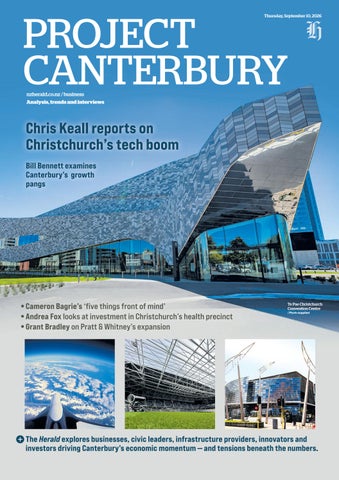
Te Pae Christchurch Convention Centre / Photo supplied
The Herald explores businesses, civic leaders, infrastructure providers, innovators and investors driving Canterbury’s economic momentum — and tensions beneath the numbers.
B2
nzherald.co.nz | The New Zealand Herald | Thursday, September 10, 2026
PROJECT CANTERBURY A Herald Business report
NZME’s growing commitment to Canterbury
I
t’s an exciting time for NZME in the region, with the release of Project Canterbury — a premium report showcasing the region’s growth, innovation, investment opportunities and future economic potential. Initiatives like Project Canterbury reflect exactly the kind of investment NZME is making in Canterbury, helping local businesses connect their stories with audiences, investing in community events and providing local audiences with more news and entertainment from across the region. We have some of the country’s strongest media brands deeply embedded here, including NZ Herald, Newstalk ZB, The Hits and OneRoof, backed by a talented Christchurchbased team who work hard every day
Michael Boggs
Maria O’Halloran
to serve our communities, advertising customers and audiences. We see great opportunity to invest in telling more local stories, deepen our relationships with businesses, agencies and communities throughout Canterbury. Later this month we will welcome Maria O’Halloran as our new GM Canterbury. Maria will lead NZME’s community presence, including our commercial partnerships. She is a well-known and highly respected business leader in Canterbury, having spent more than a decade as Chief Executive of Ballantynes — Christchurch’s iconic department store, and more recently as CEO of Nutrient Rescue. She also holds board and advisory roles across the region,
including as Chair of BrainTree Wellness Centre and Associate Director of Venues Ōtautahi. Bringing someone of Maria’s calibre into this role sends a clear signal about how seriously we take our commitment to Canterbury, and I’m confident her experience and connections will complement the strengths of our existing Christchurch team. Canterbury is at the centre of New Zealand’s growth and future prospects, and NZME is committed to continuing its investment and support in the region.
Michael Boggs
NZME Chief Executive
Interview with the PM
Christopher Luxon addresses the inaugural South Island election conference hosted by Business Canterbury.
Photo / Anna Heath
Christopher Luxon is guest speaker at an NZME-hosted breakfast in Christchurch this morning to launch the Herald’s inaugural Project Canterbury report. The prime minister will be interviewed in a Q&A session with Herald Editor-in-Chief Murray Kirkness (above). The interview will play at https://www.nzherald.co. nz/video/herald-now/ at 9.30am this morning.
Christchurch shows what a more productive NZ looks like Investment in infrastructure is giving Canterbury the confidence to grow, says Christopher Luxon
C
hristchurch is where I was born, raised, educated, and where I met my wife. I have spent much of my life in the region and continue to visit regularly. And each time I return, it offers something new and exciting. Canterbury demonstrates the progress that New Zealand can achieve by focusing on five key drivers of greater productivity, wealth, and standard of living. And that progress matters. Higher productivity is not an abstraction. It is what pays for more doctors, more nurses and more teachers, for better schools, shorter hospital queues and higher wages. It is how we make sure our kids and grandkids inherit better futures than we did. The approach is clear: build a world-class education system, embrace technology and innovation,
cut the red tape that holds businesses back, deliver reliable infrastructure, and drive international trade and investment. Start with education. Students in this region have higher school attendance than many others, and the world-class university attracts young people from across the country. Enrolments at the University of Canterbury have increased by about 40% over the past decade. Those enrolment numbers reflect not only the quality of the university, but also the appeal of the city. Increasingly, young people are choosing Christchurch as the place to begin their adult lives and, more than ever, as the place to achieve their ambitions. That ambition is also being realised through technology and innovation. Today, engineering and science graduates in Christchurch can pursue careers locally, not overseas, thanks to advanced aerospace firms such as Dawn Aerospace and Kea Aerospace, and critical minerals recycling company Zethos. These companies provide a clear pathway from study to a rewarding career and highpaying jobs, encouraging young people to see Christchurch as a place to build their futures. It is a choice more and more people are making. Across the country the tide of Kiwis heading to
Australia is turning, with those returning home up 14% in the past year, meaning more Kiwis are backing a future here at home rather than abroad. World-class infrastructure matters too, and Christchurch has it in spades — airport, convention centre, stadium and roading. Post-earthquake planning rules significantly reduced red tape. This has lifted the supply of more affordable housing, supporting the goal of home ownership, while the rebuild has given Canterbury infrastructure expertise that should be replicated nationwide. As Mayor of Christchurch Phil Mauger often highlights, the new stadium was delivered on time and under budget — a rarity for major projects. This is why, to me, Christchurch exemplifies National’s plan to “Fix the Basics and Build the Future”. When people ask me what that looks like, I tell them not to imagine it. Just go to Christchurch. Walk through the city centre. Talk to business owners. Feel the confidence and ambition that has returned to this place. Do that, and it’s hard not to feel optimistic about New Zealand and its future. None of this momentum happened by accident. It is the result of deliberate action and proof that the
right choices pay off. Investment Boost is helping local businesses invest in plant and equipment to grow. The new trade agreement with India alongside deals opening up Europe, the UK and the Gulf, are giving Canterbury’s exporters more places than ever to sell into. And it is working, with New Zealand’s exports up $12 billion in just two years. A 42% lift in South Island transport funding is getting people and freight moving, with work underway on Pages Rd, Ashburton, and Brougham St. But a region with this much potential is never finished. The next wave of investment is already on the way: $50 million for the road and rail links that will unlock the Rolleston freight hub, a replacement for the Resource Management Act to give farmers and growers the certainty to invest, and a new Tower Three at Christchurch Hospital, adding 96 beds. This is the city that shaped me, and I have never been more optimistic about its future. A place where businesses invest with confidence, farmers and exporters compete with the world, and young people can build a career and raise a family without leaving home. That is the future Canterbury is building, and it is the future we are building for all of New Zealand.
Project Canterbury Executive Editor: Fran O’Sullivan Writers: Miriyana Alexander, Cameron Bagrie, Bill Bennett, Grant Bradley, Liam Dann, Andrea Fox, Anne Gibson, Chris Keall, Tim McCready and Graham Skellern. Subeditor: Isobel Marriner Layouts: Isobel Marriner Online Subeditor: Sue Baxalle Cover: Richard Dale Graphics: Richard Dale Photographer: Anna Heath Proofs: Tim McCready, Graham Skellern Advertising: Neil Jackson nzherald.co.nz/business The Herald’s Project Canterbury report is supported by sponsorship from: Armstrong’s, Dentons, Downer, Plato, Pratt & Whitney and WSP.
B3
nzherald.co.nz | The New Zealand Herald | Thursday, September 10, 2026
F
A new chapter for Christchurch
ifteen years after the earthquakes tore the heart out of New Zealand’s second-largest city, Christchurch has completed one of the most remarkable urban rebuilds in the developed world. The next chapter is considerably more difficult. It is about managing success. You can see it in the cranes over Christchurch, the industrial expansion across Rolleston, the pressure on housing in Selwyn and Waimakariri districts, the freight moving towards Lyttelton, and the extraordinary ambition now being displayed by Christchurch Airport as it positions itself as much more than an aviation gateway. And you can see it in a city confident that its post-quake ambitions are becoming reality. Canterbury’s economic momentum is generating precisely the pressures that successful economies inevitably face: infrastructure struggling to stay ahead of demand, rapidly growing communities requiring new schools and roads, competition for skilled labour, escalating land values and increasingly complex debates over who pays for the enabling infrastructure that growth demands. And yet there is another important shift underway. Christchurch is developing a technology and innovation economy that sits alongside its traditional strengths in agriculture, manufacturing and logistics. The city’s technology companies are increasingly operating in global markets, while the University of Canterbury and its engineering and science capabilities provide an important talent pipeline. Canterbury has also developed a distinctive position in the emerging space economy, with companies and research organisations working across satellites, earth observation, advanced materials, aerospace and other technologies. That matters because the next stage of regional prosperity will not simply come from producing more agricultural commodities. It will come from adding more value to what Canterbury already does
The future of Canterbury Business leaders will unpack the opportunities, challenges and investments shaping the future of Canterbury at an NZME-hosted breakfast in Christchurch this morning. The three panellists (pictured below) will discuss the region’s momentum and what it means for business.
Steven Joyce CNZM Chair, NZME
Stefan Powell CEO, Dawn Aerospace
One New Zealand Stadium looms over Cashel St, Christchurch.
exceptionally well — and commercialising the intellectual capital being generated in its universities, laboratories and businesses. The aerospace and space story is particularly revealing. Christchurch has already developed a genuine innovation cluster: engineering expertise, specialist manufacturers, research capability and entrepreneurs prepared to tackle global markets from a relatively small city. The new Te Kaha One New Zealand stadium adds another piece to that city-building equation. A stadium is easy to dismiss as an amenity project. But the bigger question is what it draws into Christchurch. Major sporting events, concerts, conferences, exhibitions and entertainment bring visitors who spend across hotels, restaurants, retail, transport and
hospitality. More importantly, a modern central city venue gives Christchurch another reason for people to come to the city — and another reason for businesses, investors and event organisers to see it as a destination rather than simply a place to pass through. That matters for a city competing for talent and investment. The stadium, the airport, the university, the innovation precincts and the emerging technology and space sectors that we report on today are pieces of the same larger story. Christchurch Airport is expanding international services while investing heavily in freight, property and energy opportunities that will broaden its role as a major economic precinct. Lyttelton Port is pursuing significant investment to increase resilience and capacity as export
Photo / Anna Heath
volumes and freight expectations continue to rise. I was in Christchurch when the devasting Magnitude 6.3 earthquake struck at 12.51pm on February 22, 2011. The Herald’s Business Reports team went regularly to Christchurch to report on the recovery. The city’s early post-quake vision for a “21st century city with a beating heart; a green connected hub in a thriving economic region” has now become reality. The Herald’s inaugural Project Canterbury report explores the businesses, civic leaders, infrastructure providers, innovators and investors helping drive the southern province’s economic momentum — but also the tensions beneath the headline numbers. Enjoy the report,
Fran O’Sullivan
Lauren Quaintance Chair, ChristchurchNZ
Moderator: Miriyana Alexander
The panel discussion will be moderated by Herald Associate Editor Miriyana Alexander (pictured above). Video of the panel will be replayed at https://www.nzherald. co.nz/video/herald-now/ later this morning.
Christchurch needs a Government ready to invest in it
C
Chris Hipkins
hristchurch has rebuilt. Now it needs a government willing to back its future. Some may think Christchurch has already had its big infrastructure moment. The earthquakes happened. The rebuild happened. The cranes came down. The new buildings went up. But it’s not job done. Christchurch has rebuilt. Now the challenge is making sure this city, and the wider South Island, has the infrastructure and investment it needs to seize the opportunities ahead. It is a city where people can build a good life, with great schools, parks and public spaces, a strong sense of community, and an increasingly exciting mix of technology, science, advanced manufacturing, aerospace and innovation. We shouldn’t take that for granted. Christchurch has something special because so much of its future has been deliberately designed around being liveable. We need to protect that as the city grows.
Labour leader Chris Hipkins
Growth should strengthen the things that make Christchurch a great place to live, not undermine them. And when it comes to economic growth, it doesn’t happen simply because a city has talented people and good businesses. It needs the infrastructure to support them. If we get that investment right, Christchurch can create opportunities well beyond the city
itself, strengthening the wider South Island economy and contributing to a more productive, higher-wage New Zealand. Good infrastructure determines whether a business can expand, whether workers can get where they need to go, whether houses can be built and whether people can get around their city easily and affordably. Christchurch doesn’t need another government that promises the Earth and delivers very little of it. It needs a government that makes realistic commitments, backs them with investment, and then gets on with delivering them. A future Labour Government will invest in the South Island, but not through election-year pork-barrelling or projects chosen for a headline. We will make good, ambitious, disciplined investment that unlocks growth and makes people’s lives better. We will ask where infrastructure investment can make the greatest difference to productivity, growth and people’s lives. And we will make those decisions
with the people who know this region best: councils, iwi, businesses, researchers and communities. Wellington shouldn’t be sitting in an office deciding what Christchurch needs. And Christchurch City Council shouldn’t have to fight central government to get the support it needs. Local government understands the city. Central government has the resources and national levers. We get better outcomes when we put those things together. We know this because we have seen it when Government investment is used to unlock something. When we last came into Government, Christchurch’s school rebuild was still a massive unfinished job. We kept it moving, backed it with hundreds of millions of dollars of investment, and helped deliver new and redeveloped schools across the city. The Christchurch Acceleration Fund helped get the Tāwhaki National Aerospace Centre off the ground. That is an extraordinary facility for
this region and a great example of Government investment acting as a catalyst for private-sector activity, innovation and new opportunity. The challenge now is to do more of that. The South Island has enormous strengths in agriculture, tourism, renewable energy, manufacturing, science and technology. Christchurch is an important economic hub for all of it. Better connections between our cities and regions can open markets, support tourism, improve productivity and create opportunities. There are real challenges. Infrastructure costs money. Construction is expensive. Councils are under pressure. Government must make choices. But those are arguments for better investment decisions, not for walking away from investment. We shouldn’t lose sight of what we are trying to achieve. A successful city isn’t simply one with more buildings, roads or economic activity. It is a city where people actually want to live.
B4
nzherald.co.nz | The New Zealand Herald | Thursday, September 10, 2026
PROJECT CANTERBURY A Herald Business report
Aerospace, medtech and
Project Canterbury Chris Keall
‘Momentum attracts momentum’: the Christchurch tech sector flourishes
I
n the 2000s, we had “Silicon Welly” as firms like Xero, Trade Me and Wētā Digital powered up, drawing thousands of tech workers and a wave of venture capital to the city. Now there’s a new tech buzz capital: Christchurch. This time, a lot of action is based around “deep-tech” or research-and-developmentintensive hardware. But many of the themes are the same, including a “cluster effect” that’s seen firms in related areas cooperating and all benefiting from tech talent being drawn to the city both from around New Zealand and offshore. “It’s an over-used analogy in economic development, but it’s a flywheel. Momentum attracts momentum,” says Ali Adams, chief executive of the council’s economic development agency, ChristchurchNZ, and the chairperson of the Canterbury Aerospace Leadership Group. Billion-dollar aerospace goal Last year, the Leadership Group set a goal to quadruple Canterbury’s aerospace industry to a $1 billion sector supporting more than 1500 jobs by 2035. The strategy also calls for Canterbury to become a global research and investment hub for the space sector, to achieve net-zero
emissions for aerospace companies, and for the traditionally white maledominated sector to reach 20% Māori and Pacific peoples workforce representation. Research carried out in 2023 found the Canterbury aerospace sector contributed around $250 million to the region’s economy and employed around 500, ChristchurchNZ aerospace cluster lead Emma Renowden says.
Adams says the sector had been growing at 8% to 9% a year and that the aerospace strategy would accelerate that clip. She saw its targets being hit “slightly before” its target date. “There are really good signals. We’ve seen Kea Aerospace raise $17.5m and move into a new facility as part of their expansion and Dawn Aerospace’s US$25m raise,” says Adams.
Nearly $6m worth of jobs were added to the Canterbury economy by the aerospace sector last year, she says. Why choose aerospace as one of ChristchurchNZ’s key points of focus? “We need a challenge that’s globally scalable,” Adams says. “It’s big enough to go, but not so big it’s unrealistic. You also need something that makes a sector uniquely sticky to Christchurch. For aerospace, it’s
things like the dark skies and the test bed facilities.” Tāwhaki National Aerospace Centre, jointly run by the Government and two local Māori rūnanga, Te Taumutu Rūnanga and Wairewa Rūnanga in a 50:50 commercial partnership, features a 1km sealed runway that opened in 2024, plus a hangar, that is used by Dawn Aerospace and Kea Aerospace for test flights of their un-crewed aerial vehicles (UAVs). Around $30m had been spent on Tāwhaki (MBIE breaks it down as $16m in 2021 for purchase of the land at Kaitorete, $8m in 2022 to support operating costs for Tāwhaki and $5.4m in 2024 for runway upgrade and support buildings). There’s also a network effect. Kea and Dawn’s presence has attracted smaller aerospace start-ups, and provided business for firms in related sectors, such as cryogenics company Fabrum. The $1b plan calls for better promotion and better co-ordination between various local aerospace companies, the council, the University of Canterbury, New Zealand Trade and Enterprise’s The NZ Story and central government. Can Canterbury attract more aerospace players of, say, Dawn’s scale? “We’re more than hopeful. We’re optimistic,” Adams says. “We’re big enough to be globally continued on B5
B5
nzherald.co.nz | The New Zealand Herald | Thursday, September 10, 2026
cleantech drive new boom
I like to think our students will come out leading the way to the future, but also informed by industry who are also pushing the future.
Catherine Moran, deputy vicechancellor, University of Canterbury
BioOra's new CAR-T immunotherapy manufacturing facility will open on October 7
significant, but small enough everybody to know everybody and work well together. That’s Christchurch’s secret sauce and it’s not easy to replicate in bigger places.” Medical tourism opportunity Adams says Christchurch is the only New Zealand city with an aerospace strategy. But it’s not her agency’s only area of focus. Health tech is another. Here, a signature development is BioOra’s new CAR-T cell immunotherapy manufacturing facility at Christchurch’s Te Papa Hauora Health Precinct (a joint venture between Health New Zealand, the University of Canterbury, the University of Otago and the Ara Institute of Canturbury), which will open on October 7. Born out of research at Wellington’s Malaghan Institute (which remains a key partner), BioOra’s Christchurch facility will support the delivery of nextgeneration CAR-T cell immunotherapy, a highly personalised cancer treatment that uses a patient’s own immune cells. It
targets blood cancers such as lymphoma and leukaemia. “One of the most exciting things is that their treatment is cheaper and has fewer side effects than other treatments, which makes it easier to administer,” Adams says. “You can do it as an outpatient, which opens it up to a really interesting medical tourism opportunity.” NZ Trade and Enterprise alum and ex-Icehouse chairman David Downs — who would later work closely with Malaghan in advocacy and fundraising — had to go offshore for life-saving CAR-T cell treatment. By year’s end, BioOra is aiming to have 60 local patients in clinical trials. The facility has the potential to generate around $98 million in annual GDP for New Zealand, based on treating approximately 500 patients per year. Adams said BioOra’s decision to locate in Christchurch reflected confidence in the city’s innovation ecosystem. “There are lots of things that brought them here. The fact that we’ve got the health precinct; the fact that we’ve got an international airport
just 20 minutes from the city, the fact that we’ve got the University of Canterbury, Lincoln University, University of Otago, and ARA here that can all help to provide the skills for what they need. “But we still needed to work really closely with them to make sure they got the right local partners, the delivery partners, and investment partners to be able to set up.” Then there’s cleantech, where Adams namechecks Zethos (formerly Zincovery), a Canterbury University research spin-off, founded by Jonathan Ring and Prof Aaron Marshall, which opened a $6m demonstrator plant in April. The facility takes a waste product, steel mill dust (from partner NZ Steel) and produces zinc and copper — both materials in short supply amid the data centre boom. The start-up’s funding has come from a mix of Crown funding (via Callaghan Innovation, now absorbed into MBIE) plus venture capital firms including Icehouse Ventures, Motion Capital and Sir Stephen Tindall’s K1W1. The 2500sq m facility, opened by Prime Minister Christopher Luxon, is
a proving-ground at this point. Once Zethos transitions to commercial production, the plant will recover around 1000 tonnes of zinc and copper per year, and employ around 60. UC’s ‘strong partnership’ with local businesses ChristchurchNZ’s memorandum of understanding with the University of Canterbury has been a key part of its strategy. “We work to both inform industry and be informed by industry,” says the university’s deputy vicechancellor Prof Catherine Moran (who will take the reins as vicechancellor in February). “There’s a really strong partnership.” “Our vice-chancellor Cheryl de la Rey, and Clare Murray, the director of our Centre for Employability and Career Development, just held a workshop with Business Canterbury to find out what’s industry looking for, what are we offering, and how can we be an even stronger part of that.” An online short course on regulatory economics was codesigned with lines company Orion. “It’s aimed primarily at people who
are already working and don’t have time to come and sit on campus. It’s been highly popular. It was a demand industry had. It was a gap in the education system.” A student studying for a mechanical engineering degree can minor in aerospace engineering. The university also offers a master’s degree in aerospace engineering. “Aerospace students do a lot of their final-year projects with Kea Aerospace, Dawn Aerospace or even Air New Zealand.” Engineering students have summer placements at firms like HamiltonJet, Trimble, Tait and Fabrum, while the big engineering firms also bankroll scholarships. Tait is also partnering with the university for the Response Ready Disrupt challenge on the last weekend of this month, which will give students from multiple disciplines the chance to win $3000 as they’re asked to respond to critical event scenarios. The rise of AI has fuelled more industry co-operation. The university’s data science students are suddenly in hot demand for placements. As ChatGPT first broke into the mainstream, “One of our law professors, Ursula Cheer, did a review with a number of law practices across the country to ask, ‘Will you be using AI? How? Should our students be coming out knowing how to use AI for law?’ and 95% said ‘Absolutely.’” It was a similar story for the business school, says Moran. “So we mapped a whole program of AI development that ranges from understanding the ethics of AI to applying AI to critiquing AI. “I like to think our students will come out leading the way to the future, but also informed by industry who is also pushing the future.” Tesla battery boss trades Texas for Christchurch What draws a start-up to the Garden City? “As a thriving hub for innovation and industrial growth, Christchurch provides the ideal foundation to scale our operations and expand our network across New Zealand,” says Antoine Riboulon, chief operating officer for smart home battery maker Aotea Energy — which has just launched its battery for homes in Auckland and Christchurch. Before an 18-month career break, which brought him to New Zealand, Riboulon spent five years working on energy products for Tesla in California and Texas, rising to global continued on B6
HamiltonJet: The grand-daddy that’s growing faster than ever Christchurch’s oldest high-tech firm has been going through a growth spurt recently. The Sir Bill Hamilton-founded HamiltonJet has manufactured in Christchurch since the 1950s. It’s financials are kept close, but chief executive Ben Reed says, “For the past eight years, our growth has averaged around 11% per year.” The company is in the process of kitting out a 7500sq m expansion of its Christchurch factory, taking the facility’s total footprint to 22,500sq m. (You might have seen the Prime Minister Christopher touring it recently without realising it. Reports carried close-ups of the PM’s face as he fielded questions about a possible leadership challenge.) A new office area on the same site will be opened in the new year. Reed says the firm has taken on 30 staff over the past few months, taking its Christchurch complement to 410 (including satellite offices
overseas, the firm employs 480). It’s best known in the popular mind for its jet boats, which can spin thrillseeking tourists around in a river just inches deep. The still family-owned firm now makes vessels up to 80m long. Here, it’s been in the news for the propulsion systems it made for Auckland’s Transport’s two 300-passenger hybrid-electric ferries (made by Wanganui’s Q-West) and two 200-passenger fully electric ferries. “Electric vessels are a fascinating niche,” says Reed. “We’re really thrilled to be involved with them. They’re great showcases, but they’re still sub-1% of our business. “New Zealand is a small market for us as 97% of our business is exports. “Defence is probably our biggest single segment but it’s closely followed by offshore energy; boats that service and inspect oil and gas rigs and offshore wind turbines.
The Hamilton Jet factory in Christchurch.
“Ferries are another reasonable segment for us, and then you get into things like pilot boats and fishing boats and fire boats; anything that needs to be very manoeuvrable or go very fast or in shallow water; those are the general things that bring people to water jets.” Family ownership has allowed for
stable long-term planning, Reed says. Why keep manufacturing in the city? “The family philosophy is that the business was built to employ people in Christchurch and make use of the Kiwi ingenuity.” The family maintains majority control.
“I work for the grandson of the founder,” Reed says, referring to director Mike Hamilton, while his son, hydrodynamic engineer Sam Hamilton is in the business, and “will be one day be chairman of the board”. There are also other reasons to stay local. “We’re a pretty low-volume, high variety product,” Reed says. The company’s waterjets range from 270kW to large 5500kW models. That means there are no economies of scale to be gained from manufacturing in China. “We run a very good lean production system here. It’s very smart and makes a very good job of building a high variety of different product sizes and configurations. New Zealand is not a low-cost country, but it’s also not a high-cost country either.” It seems to be working. Reed says HamiltonJet has around half the market in a sector where there are 10 waterjet makers worldwide.
B6
nzherald.co.nz | The New Zealand Herald | Thursday, September 10, 2026
PROJECT CANTERBURY A Herald Business report
Launchpad for aerospace sector Established tech firms are giving back by taking start-ups under their wing
M
Chris Keall
ark Rocket cut his aerospace teeth as the seed investor and codirector of Rocket Lab in the 2000s. In November 2009, he and founder Sir Peter Beck launched a miniature rocket, the Ātea-1, from the Sir Michael Fay-owned Great Mercury Island (it reached the Karman Line or the edge of space 100km up before going missing, despite local fishing boats being roped into the search. “Coromandel, we have a problem,” this reporter headlined a story at the time). Rocket Lab went on to thrive in Auckland and expand into the US, “But I was also keen to see a thriving aerospace industry emerge here in my home city, Ōtautahi Christchurch. So during 2017, I started to research potential pathways to achieve this,” Rocket says. “Christchurch is New Zealand’s second-largest manufacturing hub, has relatively low air traffic, and has many other factors favouring aerospace development. “There’s a potential future where Christchurch is the home to hundreds of aerospace companies and thousands of aerospace jobs. The city is a gateway to the Antarctic; Christchurch could also be a gateway to space.” With co-founder Philipp Sueltrop, Rocket created Kea Aerospace, which is developing the Atmos, an unmanned aerial vehicle the size of a hang glider, designed to fly on solar power for weeks of aerial photography, marine surveillance and other applications. One of Kea’s prototypes — the Atmos Mark I — achieved its first stratospheric test flight in February last year after launching from the Tāwhaki National Aerospace Centre south of Christchurch, taking photos from 17,000m (a distance that Rocket pitches as allowing much higher resolution pictures than a satellite,
Dawn Aerospace's Mk-II Aurora suborbital spaceplane; the Kea Atmos achieved its first stratospheric test flight in February last year .
and much cheaper than a plane). In June, on the back of a $17.5 million capital raise, Kea moved into a new, 3000sq m manufacturing centre and mission control building. It was an upsizing required to accommodate the in-the-works Atmos Mark II, which will have a 35m wingspan to the Mark I’s 12.5m. The larger wingspan will allow for more solar panels, allowing the Mark II to stay aloft for weeks — or even months — at a time. The site includes land for future expansion, with capacity to develop a large-scale manufacturing plant capable of producing “dozens of aircraft and ultimately hundreds for customers around the world,” said Rocket. The Burnside building also includes an aerospace hub, or space to house aerospace start-ups. One of the first to take up the offer is the Auckland-founded Astrix Astronautics, which is developing a system of inflatable solar cells for satellites and numbers Beck among its backers. The hub forms part of the
Christchurch City Council’s development agency ChristchurchNZ’s new Business Landing Pad initiative, designed to help innovative companies explore opportunities, establish a presence and accelerate growth in Ōtautahi. It’s no coincidence that Rocket (born Mark Stevens) would host the aerospace hub. Rocket has fostered the local industry since his return to the city, becoming the founding president of Aerospace Christchurch — now Aerospace New Zealand — which hosts the annual Aerospace Summit that has become a fixture at Te Pae since 2022, the year the new convention centre opened for business. Air Vice-Marshal Darryn Webb and other RNZAF brass were on hand for the opening of Kea’s Burnside building. Rocket says the Air Force is a prospective Kea Aerospace customer for border protection, including maritime surveillance for illegal fishing and drug smuggling. The
Government recently said it would be buying local drones under its new $300m defence capability plan to boost new defence tech. “The relationship between the air force and Kea is long and strong,” Webb said, with the Wigram Aerodrome made available for early Atmos testing. He hoped Kea could participate in an upcoming tender for persistent maritime surveillance. Defence forces worldwide had to work with the private sector, Webb said. “The Defence Force has a need to enhance our own maritime surveillance,” Webb said. “The Persistence Surveillance Air Project has entered the early request for information phase, seeking market feedback on uncrewed systems able to operate 1400 nautical miles from base for up to six hours, delivering high-definition imaging in near real time by day or by night.” Forestry, precision agriculture and search and rescue are other areas that can utilise the Atmos Mark 2, Rocket said. His pitch is that it flies much lower than satellites, allowing for high-resolution photos and video, is cheaper than an aeroplane or helicopter, and can fly for weeks, rather than a drone’s minutes. Dawn Aerospace fuels up, makes second spaceplane deal Dawn Aerospace, which raised $42m at a $348m valuation, is Canterbury’s largest aerospace player, and the biggest in New Zealand outside of Rocket Lab. The firm was co-founded in 2017 by Waikato-raised brothers James Powell (who studied mechanical engineering at Canterbury University) and Stefan Powell, a onetime Rocket Lab intern who moved to the Netherlands to study aerospace engineering at the Delft University of Technology, where he worked on a project with three fellow students who would also become Dawn co-founders: Jeroen Wink, Tobias Knop and Robert Werner. The firm set up its operational headquarters in Christchurch, but also maintains a facility in Delft. Dawn is best-known for its Aurora “spaceplane” — an uncrewed, remotely controlled aerial vehicle. In June last year, it announced its first Aurora sale. The Oklahoma Space Industry Development Authority picked up one of the
spaceplanes for US$17m ($27.6m). Last week, it revealed its second Aurora deal. Californian firm Astral Materials will use one of Dawn’s spaceplanes for microgravity experiments as it develops cuttingedge new materials for making computer chips. Dawn’s second major line of business has been propulsion systems, which now power more than 50 satellites. A signature feature is that the KiwiDutch company’s systems are fuelled by a combination of nitrous oxide and propene, billed as a cleaner, safer alternative to the widely used hydrazine. “When we first backed Dawn, the company consisted of founders working out of a garage with a radiocontrolled model aircraft,” Icehouse Ventures partner Barnaby Marshall said. “Today Dawn has more than 140 staff, tens of millions in annual revenue, hundreds of operating units in orbit — and a supersonic aircraft.” Now the firm is developing a third major line of business. And once again, it’s not bandwagon jumping but developing a whole new field: A system for refuelling satellites in orbit. Today, when a satellite runs out of fuel for its thrusters, it falls out of the sky — typically after three to five years for a low-Earth orbit design (thrusters are used to adjust a satellite’s orbit, while solar-powered reaction wheels are often used for finer tweaks to altitude, or the direction a satellite is facing). Dawn is working on a reusable Space Utility Vehicle (SUV) that will dock with a satellite and deliver propellant, plus a network of Orbital Propellant Depots (OPDs or “disposable dumb tanks”) that are launched “opportunistically” whenever a rocket has spare capacity. One SUV will carry enough propellant to refuel 50 to 60 satellites. In practical terms, that means one $1m Dawn launch could save $100m by extending satellites’ lifespans. More fuel also means satellites could make more adjustments, enabling them to fly at just 300km overhead or roughly twice as close as today’s low-Earth orbit satellites, Powell says. That will mean the ability to swoop below space junk, deliver faster satellite internet and take higher resolution photos.
Momentum builds: deep tech continued from B5
head of operations for Tesla Autobidder — the firm’s energy trading and control system for its utility-scale batteries. Those skills should come in handy at his gig, given Aotea’s locally designed and assembled $10,500-$12,500 home battery (which doesn’t require solar), comes with an app that, among other smarts, lets you buy power at the cheapest times of the day, then sell it back to the grid at peaks. The start-up, backed by Sir Stephen Tindall and Vaughan Fergusson, was founded in 2022 by Tama Toki, who learned about energy resilience growing up on gridless Great Barrier. Toki is based in Auckland. Riboulon will oversee manufacturing expansion from the firm’s Christchurch plant. “Having spent nearly a decade building global energy storage systems, I joined Aotea Energy because it offers the single biggest opportunity to transform New Zealand’s power grid,” he says.
Jade goes MADCAP Global operator Jade, which grew out of the firm founded by Kiwi tech legend Sir Gil Simpson, is Christchurch’s most established software firm. Its core business has been its Jade platform or “software for making software”, which was joined by its ThirdEye platform — which automates financial crime detection and helps companies grapple with complicated anti-money laundering and counter-terrorism financing regulations. The latter has been an engine of growth recently, as AI has both fuelled new threats and been deployed by Jade to counter them, chief executive Justin Mercer says. In November last year, it entered dairy supply chain management by buying another Christchurch-based software firm, Contec Group, maker of the MADCAP (Milk Analysis, Data Capture & Processing) platform used by six of the world’s largest global dairy processors. The deal took privately-held Jade’s headcount to 300 as it took on all of
Contec’s 50 staff and will add 20-25% per year to its revenue (which grew 9% to $49m last year). MADCAP — which built its dairy software on Jade’s platform — numbers Fonterra, Nestle, Synlait, Cadbury, Mondelez and Bega among its clients. Mercer says the acquisition is enabling Jade to expand its work in agriculture and grow new export opportunities. The chief executive sees three big advantages to being headquartered in Christchurch. One is his firm’s close relationship with the University of Canterbury, which goes two ways — UC supplies interns and graduates and is also a Jade customer. Jade also supports the ShadowTech programme that matches secondary school-aged girls with local tech firms for workplace tours and activities to help bolster and diversify the next generation of tech talent. The second is that, “We find the Canterbury business network very open to sharing.
“Perhaps because it’s smaller, it actually has more cross representation across industries, and therefore there’s quite a lot of cross pollination of ideas and just generally greater willingness to open up and help each other.” The third is that in a world of increasing volatility, “New Zealand has a really unique position we’ve carved out in the world as a bit of a safe harbour; a neutral trusted brand. “From a technology perspective, we see that as a huge advantage.” A rubbish idea University of Canterbury research has been spun-out into a number of start-ups, including Mars Bioimaging and Zethos, plus Syft, a maker of airquality sensors. Now an early-stage firm called Enagain, founded by Dr Matthew Cowan and Dr Gavin Hedley (both with the university’s engineering school), is seeking to commercialise the pair’s work on biogas, with $2.5m via a seed round led by Motion Capital.
Landfills produce biogas when organic waste breaks down without oxygen. A proprietary process developed by Cowan and Hedley turns that biogas into renewable natural gas (RNG), which the pair say is chemically identical to fossil natural gas. It’ll be suitable for use in heavy industry, particularly high-heat processes. The company is initially targeting small landfills, where the volumes are too low to justify the capital cost of existing systems. Operators of those sites typically flare the gas off at their own expense rather than create an income stream from it. Enagain’s modular low cost system offers these landfills an income stream. By lowering the cost of upgrading biogas, the company is aiming to turn a stranded waste stream into a usable local energy source. “Gavin and I are acutely aware of the challenging energy landscape continued on B7
B7
nzherald.co.nz | The New Zealand Herald | Thursday, September 10, 2026
‘One of the best hidden gems of the southern hemisphere’ Clean energy pioneers chose Christchurch because it was in their DNA
A
Chris Keall
s well as drawing new tech companies, Christchurch has seen established players expand. As the world experiments with liquid hydrogen as a new clean energy, Christchurch-based Fabrum, founded by Christopher Boyle (managing director) and Hugh Reynolds (technical director) has been involved in projects around the world, from Australia’s largest liquid hydrogen storage and refuelling site for a Fortescue mine site in Western Australia to a hydrogen fuelling station for trucking firm HW Richardson in Invercargill (due to come online before year’s end) to various airline and airport pilots in the UK to an Airbus and Fortescuebacked facility at Christchurch Airport’s Kōwhai Park energy precinct for creating gaseous or liquid hydrogen on demand for test projects. In 2023, surging interest in hydrogen saw Fabrum raise $23 million in venture capital in a raise led by London’s AP Ventures and supported by Fortescue and Japan’s Obayashi. The funds were used to expand manufacturing and to double staff numbers to around 70. Boyle, who grew up in various towns around the North Island, cofounded the company now known as Fabrum in 2004. The firm initially focused on cryogenic cooling and superconducting storage systems, which require extremely cold temperatures (down to -273C, aka 0 Kelvin) to operate, then expanded into the related area of hydrogen liquefaction infrastructure, where constant, extremely low
Fabrum founder Christopher Boyle at the company’s premises in Christchurch. Photo / Anna Heath.
There’s this rich history of technology development and development, so you’ve got clusters of capability, an ecosystem of highly capable entities that can support you on your path. Christopher Boyle
temperatures must also be maintained. Why set up shop in Christchurch? Boyle and Reynolds both did engineering degrees at the University of Canterbury. “I was cognisant of the fact that when I finished my degree, a number of my cohort headed offshore for jobs. Hugh and I were really clear that we wanted to try and leverage Canterbury’s high-tech manufacturing history, and create a pathway for students to stay local but contribute innovation technology globally.” Referring to HamiltonJet and Tait Communications, Boyle says, “There’s this rich history of technology development, so you’ve got clusters of capability, an ecosystem of highly capable entities that can support you on your path. “You’ve got this really deep
technical and innovative business cluster, which is heavily leveraged off engineering capability, which is aligned to the university’s really strong engineering school. “You’ve got the ability to work at a global level and contribute to real change around the world, live in an environment where you can be in the hills and the mountains and the rivers, the sea, etc, within less than an hour and a half in any direction. “Christchurch is a really great choice when you talk about living and building your life. It’s a great place to work. It’s an exceptional place to live. It’s probably one of the best hidden gems of the Southern Hemisphere.” Why stay in Christchurch? “We’ve had the US and the UK try to entice us. And there is definitely going to be a day when we’ll do some of our manufacturing offshore, simply
because it makes sense as you scale. We might set up a secondary base. “But our R&D activity and core manufacturing will stay here. “Some of our core strengths are off the back of our connections with the university and other Canterburybased technology groups and suppliers. “We choose to be here. Christchurch is a core part of our DNA,” Boyle says. Boyle says his firm takes on Canterbury University engineering students as cadets over summer. “We try to give them really clear industrial engagement to support the practical and professional hours that they require for their degrees,” he says. Less obviously, Fabrum also works with marketing students, and uses others to help research offshore markets.
fuelling Christchurch boom continued from B6
facing industrial gas users in New Zealand and overseas,” Cowan said. “By redirecting methane emissions that would otherwise be wasted, Enagain provides a stable, affordable supply of renewable gas to businesses that cannot feasibly electrify. That’s a win for businesses, a win for energy security, and a win for the environment.” Tait: staying in Christchurch means staying agile Tait Communications is a Christchurch veteran, but growing faster than ever before. The maker of radio communications gear, founded by Sir Angus Tait in 1969, was named Company of the Year at the 2026 Hi-Tech Awards. “While Tait was founded 57 years ago, the company continues to innovate on the global stage and move at speed — not an easy achievement for such a wellestablished company,” the panel of international judges said. “Tait is coming off a phenomenal
year, passing the half-billion-dollar revenue mark,” the judges added. “It grew organically and by acquisition, expanding into new countries and introduced technically advanced new products, and it competes strongly on the world stage.” The company has had a focus on keeping manufacturing local at its sprawling Christchurch campus. Its biggest growth spurt in recent times came over 2023 and 2024 as revenue jumped from $421.6m to $426.6m on Tait’s acquisition of distressed Australian player RFI. In 2025, Tait made a net profit of $44.1m on $516m revenue. It remains the city’s largest hightech employer, with around 700 local staff. “Our founder Sir Angus Tait’s vision was to create an industry rather than a business. Today, Tait Communications continues to do this and is committed to growing future engineering and technical talent in Christchurch and New Zealand,” chief executive Yoram Benit says. Tait mentors students through a
summer internship programme and partners with Canterbury education providers to build capability in the industry. “The upcoming UC Response Ready Disrupt Challenge is one of these initiatives that lets students understand the real-world challenges Tait’s customers face, while empowering them to come up with innovative solutions that keep people, communities and organisations safe — just as our staff do every day,” Benit says. Tait is a strong exporter-led business with over 85% of revenues being global, the chief executive said. “Fifteen per cent of our revenue is reinvested in Research and Development, so we can continue to innovate for our global public safety, law enforcement, transportation and utilities customers. Our customers rely on our interoperable technology to keep them connected when failure is not an option.” “Tait is committed to Christchurch. The majority of Tait’s products are made in our manufacturing facility here, which sets the company apart.
Having engineering, research and development, design, and manufacturing located on one campus allows us to be agile and better serve our customers. “Tait has the largest dedicated electronics assembly plant in New Zealand, the biggest surface mount technology (SMT) environment in the Southern Hemisphere, and our campus environment allows for rapid prototyping and manufacturability iteration.” Two challenges remain “Christchurch has built real momentum over recent years. We are seeing growing confidence, increased investment, a stronger international profile and an economy that continues to diversify and evolve,” Adams says. “But cities go in cycles. We can’t rest on our laurels.” A couple of challenges remain. One is inherent, the other tied to a change in central Government policy, she says. “One is scale. We can’t compete on scale. We just can’t. We’re never going to be the richest. We’re never going
to be the largest,” Adams says. “But there are other levers we can pull.” For example, last year then-Space Minister Judith Collins announced that the Tāwhaki National Aerospace Centre, west of Banks Peninsula, would be given Permanent Special Use Airspace approval from the Civil Aviation Authority — allowing Tāwhaki to manage the entry, exit and operations of aircraft in the area and, at times, designate it a Restricted Airspace, rather than having to constantly re-apply for permission. The other challenge centres on the tension between the Beehive and local Government. “With rates capping coming in and some of the local government reform, I think it’s going to be hard for economic development to remain well-funded,” Adams says. “That will be a challenge across the country.” ● Chris Keall is an Auckland-based member of the Herald’s business team. He joined the Herald in 2018 and is the technology editor and a senior business writer.
B8
nzherald.co.nz | The New Zealand Herald | Thursday, September 10, 2026
PROJECT CANTERBURY A Herald Business report
‘The best little city in the world’ Attracting talent and events, Christchurch is fast becoming a destination again, writes Grant Bradley
P
lato co-founder John Plato is confident Christchurch is on track to become “the best little city in the world”. The multi-service marketing and advertising agency is based in the city and, among the hundreds of clients it has worked with over the last 19 years, many are local. This has given him a unique insight into how Christchurch and Canterbury are performing. The agency builds websites, creates content, does advertising and marketing, so knows what’s under the hood of client businesses that sell anything from rugby to ryegrass. “If you look across different sectors, Christchurch is doing some incredible things. You can certainly feel it on the streets now,” says Plato. “There’s quite an energy, a lot more people visiting and a lot of events on. It’s got a really good vibe.” Plato is one of the country’s biggest independent agencies and one important client, ChristchurchNZ, has a new campaign that embodies the spirit of the city. Plato says its tagline covers its new bold personality as a city that’s well out of recovery from the earthquakes to a place that is in motion. Launched earlier this year, “Made for it” re-introduces Christchurch as a destination, not just a gateway. He’s seen that all around him. At Clearwater Golf Course — where he also sits on the board — guests come to stay at what is now a premium “must-play” golf destination instead of transiting at the airport and heading straight to Queenstown. It’s happening within his business too, now up to about 65 staff. “When we advertise for roles now, we’re attracting a lot of people from Auckland and people returning, which was impossible seven or eight years ago.” Before its post-quake reinvention, what was known as the Garden City played on wide open spaces and being a great place for families. Nothing has changed there, he says. But now it has something more; energy. “No matter what sector or walk of life you’re in, whether you’re in business or just living here, there’s a real sense of energy and momentum.” Plato says it’s more than just worklife balance in a small city. “It’s about opportunity and ambition, attracting talent and attracting world-class events to the city which it never had before this reinvention.” Plato and his wife Lisa started the business in late 2007, just as the Global Financial Crisis was looming. While Canterbury’s agriculture and export economy softened the blow, on the face of it, the timing wasn’t great for launching a business. But he says it worked for the newcomers, who were then in their mid-20s. “I think timing is everything. It doesn’t really matter whether you’re starting in a financial crisis or when things are booming, at the end of the day there are still customers that need servicing. Sometimes in bad situations or tough times is when you can actually add the most value.” He had worked for a big agriservices business and Lisa was a marketing graduate at Ravensdown. The agency was initially set up to service the agricultural sector offering design and outsourced agency services. Over time it morphed into a full-service agency, offering digital and marketing strategy services in-house. It enjoyed steady growth until 2011 and there were about 10 staff at its Victoria St office when the February earthquake struck. “Once we exited the building, we never returned to it,” he says. Plato and his team lived through the harrowing experience of staying
being able to surf and ski all in the same day. John Plato, 44, grew up in Leeston, south-west of Christchurch, and he knows well the social make-up of the city and wider region. “I think Christchurch is attracting diversity, which is a good thing.” But the one foundation of the community remains important. “I still think rugby is a big part of the culture down here. It’s getting more diverse, but rugby is a key part of the city.” The new stadium has been a catalyst for regeneration and is increasingly seen as a bucket-list destination for sports fans from around the country and for those who want to see big gigs. But the fervour of hometown rugby fans has been a big driver of its success. Likewise, the cliche about being asked about what school you went to as soon as you arrive at a party hasn’t entirely disappeared. “I’d be lying if I said it wasn’t still there, but I think it’s definitely softened.” But there’s plenty of change in the business sector. The new generation of businesses is innovating and funded by new capital. “It’s not the old money that was here through the 1980s and into the early 2000s. I feel there’s the next generation leaving its mark on the city now.” John and Lisa Plato and Aaron Morrison, directors of MP Property, at the New City Hotel at the beginning of renovations. Below: Clearwater Golf Course.
If you look across different sectors, Christchurch is doing some incredible things. You can certainly feel it on the streets now.
John Plato
in business in what he describes as a crazy time. The agency moved about seven times in two-and-a-half years and that experience meant Plato staff were able to empathise with clients. “It was a tough time for everyone down here. There was a lot of personal loss, business was very unpredictable and suffered a lot. The city itself lost its vibe for a long time.” But Plato’s own business recovered quickly and within months staff numbers had more than doubled as many businesses needed expertise to first update the local market about where they had moved to and how they had repositioned themselves and the rebuild started. “As the recovery started to take hold, it became about communicating more broadly across New Zealand about recruitment and trying to get good people to come to the city because we had a mass exodus of talent during that time.” The agency also landed a marquee client — the Canterbury Earthquake Recovery Authority (Cera) — established as a government department a month after the February quake to lead and coordinate the Government’s response and recovery efforts until its disestablishment in 2016. While Plato says it accounted for 10% of the agency’s turnover, it had an outsized influence on the business as its first exposure to public domain government department work. “It gave us a lot of credibility and a lot of exposure that we might not
otherwise have had.” Cera had its critics, especially over the speed of the rebuild, and while not at the front line of dealing with the public relations scuffles, Plato says exposure to them made his firm more battle-hardened. “Everyone had the best intentions to deal with a situation that was changing daily. It’s easy to look back with hindsight. It was the same with Covid — on the day, you deal with what you can.” For his own business, one of the big challenges was getting stability; finding office space and staff and working with clients who were in tough financial positions. “Businesses were struggling to be viable so it was about managing cash and being supportive of clients who couldn’t always pay while doing some short term work to keep the connections.” Plato has no regrets about playing the long game, as the agency was able to build long-lasting, strong relationships as a result. For his own business, the light at the end of the tunnel was quickly apparent — but that wasn’t something he wanted to broadcast back then. “It’s hard to skite about that at the time, because it wasn’t like that for a lot of people.” Plato grows — so do clients For Plato, the next seven or eight years were transformational as some out-of-town agencies were unsuccessfully pitching for work and others were shedding staff. “We were quite nimble and lean, so we could take a risk at that time and grow.”
In parallel, many of its clients were growing too. He cites as a success story Southbase, a construction firm involved in major projects in Christchurch including One New Zealand stadium (Te Kaha), Hagley Park’s redevelopment and the central city shopping precinct, The Crossing. Southbase has now expanded to Auckland and Southland. Mainland Capital is “doing some great stuff” financing major projects including hotels and ChristchurchNZ has established a distinct identity for the city. Major events are coming into the area, with big shows attracted to the stadium and Lyttelton hosted the highly successful SailGP event. He’s also excited about the growth of the aerospace and technology sectors which has seen the growth of Dawn Aerospace and the Pratt & Whitney-Air New Zealand engine maintenance base partnership. Christchurch Airport has just announced a record annual profit and is looking forward to record international capacity this summer as Air New Zealand launches new longhaul flights from the city. “We’re proud that over the last five or six years as the city has been rebuilt we’ve been involved in a lot of the promotion of the city.” There are plenty of new events and attractions to sell, but he says the city’s location is always going to work in its favour. Proximity to the ocean and the mountains means it is able to retain the long-standing appeal of
Diversifying business John and Lisa Plato, with builder partner Aaron Morrison, have diversified their operation beyond their agency, forming the MP Property company, that has built residential and commercial places for sale or lease. A project important to Plato is now under way — rebuilding what was the derelict New City Hotel on Colombo St for the agency staff to move in the first quarter of next year. Constructed in 1930, the New City Hotel has Historic Places Trust grading and the large Moderne-styled building had social significance as the last traditional hotel operating within the central city. “It’s cool, I’m not only proud to live here and build Plato as an agency but also to build our footprint as the city has been rebuilt and to have actual ownership.” The firm has growth ambitions beyond its home base. It already has offices in Auckland and the Philippines and Plato says it is looking to scale up. It considers itself a national brand, aiming to grow in Auckland and looking at acquisitions. He says they are looking to buy marketing or tech businesses as its own growth aligns with its core aims of working with ambitious businesses to grow revenue and scale. “We want to make sure Plato is perceived as national but really grounded in what we’ve done in Christchurch, where it has built one of the largest, if not the largest independent agencies in New Zealand.” Christchurch and Canterbury are on a roll right now but Plato doesn’t worry about it being a victim of success. “Because there is such a big landmass and footprint, there’s lots of room to grow.” The Platos have two young daughters and, looking a decade or more out, he wants them and other young people to see opportunities for advancing their careers without leaving the area. “You’ve got interesting, exciting industries being built within the city, particularly in the tech space. I really believe Christchurch can position itself as the best little city in the world.” ● Plato is a sponsor of the Herald’s Project Canterbury report
B9
nzherald.co.nz | The New Zealand Herald | Thursday, September 10, 2026
On the edge of something special I
began campaigning my northern friends almost immediately after our arrival in Ōtautahi Christchurch in late 2024. I emailed them job advertisements. I shared links to houses for sale. I may have mentioned the easy traffic, affordable houses, a first-class hospo scene, the soon-to-open stadium, the big skies and dream sunsets. I shared stunning photographs and generally made a nuisance of myself. They told me to stop being so smug. Fair call*. Sometimes good fortune is simply about timing. We left big, busy, expensive Auckland where roadworks had been a constant suburban backdrop and the central city was hostage to the CRL works. We arrived in Christchurch as some of the key post-quake foundation projects were coming to life in a city that seemed full of selfbelief, stunning new architecture, creativity and innovation. The economic indicators have been well picked-over, so there’s little need to revisit them. But this is absolutely a city on the up. Speak to any recent arrival and two common themes emerge: affordable housing (which means more discretionary income) and a perfect mix of lifestyle and city living. It’s easy to cycle to work and just as easy to pile the kids in the car and soon be at nearby mountains, lakes or beaches. Fishing, climbing, skiing, surfing and boating are on the doorstep. But it’s more than that. Christchurch is a genuine growth story and feels on the edge of something special. I’ve been deeply impressed to
Herald Associate Editor Miriyana Alexander on why she moved south.
discover the vision and energy coming from city leaders in two key quarters — economic development agency ChristchurchNZ and Business Canterbury, the local chamber of commerce. At a recent background briefing, ChristchurchNZ boss Ali Adams was full of vim, covering a whiteboard as she outlined the agency’s economic development strategy, and the work underway to support the key growth sectors of aerospace and future transport, healthtech, cleantech and the bioeconomy. It is having success, too, in positioning Christchurch as a worldclass major events destination. Seven key events this autumn, including Supercars and the Super Rugby Super Round opening of One NZ Stadium,
smashed expectations to deliver a $31 million visitor spend. Of the 157,000 attendees, 66,000 were from outside Christchurch and 8000 were international visitors. That spectacular new stadium has already hosted sold-out All Blacks, Warriors and Crusaders matches, and its first international concert — Robbie Williams in November — has also had the sold-out sign go up. That’s not all. Conventions at the stunning Te Pae Christchurch Convention Centre have generated almost $74m for the local economy in the year to June. This is serious money. Business Canterbury’s Leeann Watson is no fan of sitting back and waiting for local and central government to keep up the momentum. She has led the way in driving growth
plans for the south, helping co-ordinate efforts by all eight South Island chambers of commerce to launch their first shared election manifesto. It calls on all political parties to back the South Island as a driver of New Zealand’s next phase of economic growth. The manifesto, Growing New Zealand from the South: A Policy Platform for Election 2026, sets out a vision for unlocking investment, productivity and sustainable growth across the south, while providing political parties with an actionable blueprint to support regional business success. Among its core goals are lifting South Island GDP per capita to at least $130,000 by 2035, up from the current $79,400, and positioning the south above the national average in living standards and economic performance. It told political leaders of all stripes at its excellent pre-election conference in Christchurch last month that its priority areas were securing skilled labour and practical immigration settings; investment in transport, connectivity, and regional resilience; ensuring reliable, sustainable and affordable power supply; streamlining regulations and cutting red tape; and supporting businesses that compete and win globally. This is not the stuff of pipe dreams. This is an intelligent, cohesive, achievable plan for growth. The incoming Government should get on board. As Watson told the Herald in an interview announcing the manifesto,
the South Island is already a major contributor to New Zealand’s economy, producing a third of the country’s exports, attracting billions in visitor spending, and being home to innovative businesses competing on the world stage. Growth is already happening here. But it must continue. “Our message to political parties is simple: if New Zealand wants stronger productivity, higher incomes and greater resilience, backing South Island growth is one of the smartest investments we can make.” Of course, it is not perfect (how does the Cathedral saga limp on? Why are the museum and Arts Centre far from finished?), and there are growing pains that will need to be managed. But Canterbury has its mojo on. Now it’s time to ensure the growth is accelerated for the benefit of everyone. After a long stint at the Herald in Auckland, I’m ecstatic to have joined our brilliant team in the south. Publisher NZME is committed to growth here — and I’m thrilled about that too. Because everywhere I turn, there are tremendous stories to tell. And those stories deserve a national stage. * Seriously! Then there’s the fabulous international airport, and the bursting at the seams Canterbury University. The catch in the throat when you turn a corner and glimpse the snow-dipped alps, the blossom blanketing Hagley Park, or the light on the Port Hills as the sun sets. How is there not a permanent traffic jam down SH1 from the Bombays to Belfast?
Growing Canterbury. Providing exceptional legal expertise for businesses in Christchurch and beyond. Redefining what is possible. Together. Everywhere. dentons.co.nz
B10
nzherald.co.nz | The New Zealand Herald | Thursday, September 10, 2026
PROJECT CANTERBURY A Herald Business report
Rebuild shows what longterm investment can achieve Project Canterbury Liam Dann
How post-quake recovery helped drive the city’s economic boom
C
hristchurch is booming. I see it in the statistics, and I see it in the central city when I return to my home town to visit friends and family. I’m aware that what constitutes a boom is relative. I have friends in Christchurch dealing with redundancy; I know times are still tight for many small businesses — especially those without a connection to the vibrant export sector. There’s no escaping the cost squeeze and margin pressure wherever you are in the country. So, I suspect there are some in the south who are a bit tired of hearing how wonderful the economy is. But as a Cantabrian looking on from Auckland, it is hard not to be envious of the momentum Christchurch currently has. The city has a confidence and vibrancy that I haven’t seen there since my childhood. Let’s run through the numbers before stepping back to look at the bigger picture — the economic theories like the notion of creative destruction and the limitations of the broken window effect. The statistics paint a strong picture of growth. While Auckland’s unemployment rate sits above the national average at 6.5%, Canterbury’s is at just 3.6% — tied with Otago for the lowest in the country. That’s about where the rest of the country was during the labour shortages of 2021 and 2022. It is close to what economists describe as full employment. Business confidence tells the same story: ANZ’s July survey put Canterbury firms at +67, comfortably ahead of the national reading of +56.1. On growth, the gap is just as stark (although Stats NZ regional data is a bit dated, the year to March 2025). The GDP figures show Canterbury’s economy expanding 5.3%, more than double Auckland’s 2.1%. But housing is where the divergence is perhaps most visible. Real Estate Institute of NZ (REINZ) figures to the end of May show Canterbury’s median sale price hit $725,000 in May, up 6.6% on a year earlier — one of the strongest results in the country. Meanwhile, Auckland’s median of $1,005,000 crept up just 2.6% — still sliding backwards in real terms (with annual inflation at 4.1%). Christchurch is building to match: the city consented 12.1 new dwellings per 1000 residents in the year to May, the highest rate of any region, against Auckland’s 9.3 and a national average of 7.4. Let’s face it, if the rest of the country could match this performance, New Zealand would be in a golden era of economic growth. But, for better or worse, Auckland still dwarfs Canterbury in scale, output and income per head. There’s no escaping the impact its downturn is having on national GDP. So we are watching and waiting for the recovery to spread north, as
Pre-quake Christchurch, Cathedral Square with the Chalice sculpture and the cathedral.
The earthquakes did generate a GDP boost, as insurance money flowed into the region, and the rebuild may still be underpinning confidence and growth. They were a circuit breaker for town planning malaise that plagues other New Zealand cities. But we’ll never know what might have been. Christchurch leads the way. I’ve been watching the development of Christchurch city for about 50 years now. So I’m not under any romantic illusions about the city’s journey to this point. If anywhere in New Zealand has earned its economic boom, it’s Christchurch. I have vivid memories of a vibrant pre-quake city, dating back to the mid-1970s. Once upon a time, everything was centred around Cathedral Square, which was dotted with multiple cinemas and pubs, full of quirky characters like the Wizard, Bird Man and Radio Ron. It was a bustling place which retained the gothic vestiges of its English heritage. There was the Victorian charm of Chancery Lane, dark and crowded, with curious dispensaries like Delano’s Magic Shop. Warners Tavern, The
Doghouse, Wizards, the old Dux de Lux . . . I could go on. It’s easy to be nostalgic about prequake Christchurch. But the reality is that the CBD was struggling well before September 2010. By the time I was working at the Countdown South City in the early 1990s, the cracks were already beginning to show. There were obvious dead spots in a central city that was under pressure from the growth of suburban malls. The Square, with movie theatres long gone, had become something of a dead zone. Attempts to rejuvenate the CBD were undermined by a lack of central planning. Cinemas headed south to Moorhouse Ave. Bars and restaurants went north, drawn towards the Casino. Everything seemed spread too far and wide. In the years before the quakes, Christchurch was struggling to find its focus. And, of course, things only got worse after September 4 and February 22. The challenge for anyone writing about the economic rejuvenation of Christchurch is to balance the enthusiasm for the current success against the cold reality of the earthquakes and the trauma they put the city and its people through. Was it worth it? That’s a moot question. There was no choice involved, of course. The disaster was preordained by ancient geological forces that no one anticipated in advance. I know all too well the trauma and ongoing disruption Cantabrians lived through, even though I watched much of it from afar. It is sobering to think about fate and the cruel twists that divide the lucky from those who were not. If the strongest quake had happened on Christmas morning 2010 (and there was a big shake on that Boxing Day), my family may well have been among the dead or injured. My parents’ chimney collapsed and fell into their living room, dumping a mountain of bricks on to the rug where two generations of Dann family children had always
gathered to open their Christmas stockings. Despite serious damage to a treasured family home, I remember feeling fortunate that my family and friends were all safe and accounted for. But I’m not sure they all felt so lucky. The challenges of day-to-day living and the shock of watching their homes and their beautiful city fall left many Cantabrians in despair. I’ve seen lives consumed by insurance battles and rebuilding issues. For a time, it seemed the trauma would never end. In the first days after the February quake, I flew down to see my family and jumped on a media tour of the city. The combination of a strong nor’wester blowing and military helicopters created an eerie dust storm. With the rubble and heaviness of the death toll, it all felt quite apocalyptic. So returning all these years later and seeing the city looking so complete is something special. There’s been no shortage of debate about the rebuild, but far more has gone right than wrong. The shift in focus to the Avon River in the CBD has provided people with something to celebrate while they waited for each new development — the library, the convention centre and the stadium. Almost 16 years on from the first quake, the announcements are still coming — the renovation of the old Noah’s hotel, the Catholic Cathedral. Each new project feels like one more piece of a vast and complex puzzle falling into place. It has created a sense of progress that has accelerated in recent years. It has combined with good postCovid economic conditions in the south. Christchurch remains more closely linked to the booming agricultural economy than either Auckland or Wellington. We should never forget the rebuild has not been cheap. The early estimates for the rebuild
costs after the Christchurch earthquake were around $10 billion. By 2013 that had risen to $40b. After that, we kind of stopped counting. The closest anyone’s come to an update recently is a report by Swiss Re — the giant global reinsurer — which in 2025 put the total economic cost at a staggering US$47 billion when converted into today’s dollars. That’s a blunt reminder of something economists call “the broken window fallacy”. Using the example of a broken window, which appears to create new work for the glazier, 19th-century French economist Frédéric Bastiat pushed back on the popular idea that wars and disasters could generate economic growth. He pointed out that this thinking fails to account for what might have been, where money might otherwise have been spent. The earthquakes did generate a GDP boost, as insurance money flowed into the region, and the rebuild may still be underpinning confidence and growth. They were a circuit breaker for town planning malaise that plagues other New Zealand cities. But we’ll never know what might have been. If we are to take inspiration from it all in an economic sense, it is surely to do with the scale of what is possible, with time, money, determination and — to be fair — good planning. The big question now is: how does Christchurch maintain its current momentum? From the outside, the city seems to be on a roll. With strong population growth, investment in new industries (like its thriving tech sector), growth in tourism and continued strong links to the agricultural export sector, the outlook is good. But, as evidenced by the recent economic history of Auckland, it is all too easy for cities to slip into boom-and-bust cycles. If there was ever a time for the city to double down on investing for longterm growth, it is now, while confidence is strong.
B11
nzherald.co.nz | The New Zealand Herald | Thursday, September 10, 2026
Rural wealth driving wider growth Five things are front of my mind
Canterbury is leading New Zealand’s economic recovery, says Cameron Bagrie
B
oom. Here comes the recovery led by the south and regions such as Canterbury. Canterbury and Otago share the lowest unemployment rates in the country, at 3.6%. The national figure is 5.4% with a massive divergence between the North Island (6%) and the South Island (3.7%). Go south to get a job, set up a business, get a tertiary education or buy a house. And — dare I say it — a more relaxed lifestyle, with less tension across society. That’s a powerful combination. Business creation If you want an indicator that tells a simple economic story, look no further than growth in the number of businesses. Businesses create jobs and invest. They are the engine room of real growth. Employment impacts housing needs. If you shift into a region, you enrol kids in a local school. Canterbury is on a roll. The region has seen an 8.6% rise in the number of businesses in the past three years. The only region to outshine Canterbury is Otago, which has seen 9.95%. Otago and Canterbury are the two regions most correlated with New Zealand’s economic performance. Auckland, which represents a massive 35-40% of the economy, comes in at number three. Those correlations tell a simple story about the importance of the heartland in the economic equation. A broad church Canterbury’s economic path is being driven by many facets. A big earthquake rebuild helped for years. More affordable housing has been important too, unlocked by the 2011 earthquake that forced the freeing-up of land for development outside the city. Cheap new housing has driven bums on seats. The median house price in New Zealand is $760,000. Auckland is $940,000. Canterbury $685,000. The area seeing the fastest population growth, Selwyn now has median house prices above the national average at $812,000, removing a competitive advantage. Waimakariri is another fast-growing region and is closing in on the national average ($740,000 vs $760,000) too. The affordability edge is being whittled away. Meanwhile affordability remains better elsewhere. Ashburton’s median house price is $645,000. Timaru’s is $482,000. In Christchurch city it’s higher, at $669,000. Statistics New Zealand projects the Selwyn District will be the fastestgrowing territorial authority (TA) in the coming decade. It was up 2.4% to 87,600 people in the year to June 2025. By 2053, Selwyn is projected to exceed the population of Dunedin, with more than 150,000 people. There has been a strong theme of moving from the north to the south — and not just to Queenstown. More than 135,000 people who lived in Auckland in 2018 moved to another part of New Zealand by 2023 according to Statistics NZ. Canterbury took 17,000 of them. Tekapo has ridden a wave. As Auckland infrastructure woes deepen, the allure of the South and the periphery to Auckland, such as Cambridge, increases. Then we have a rejuvenated
Christchurch business growth compared to the rest of the country Annual growth in the number of businesses. 8
%7
New Zealand
6
Christchurch
5 4 3 2 1 0 –1 –2
2016
2017
2018
2019
2020
2021
2022
2023
2024
2025
2026
Source: Statistics NZ. Herald Network graphic
An earthquake rebuild and cheaper housing have been keen elixirs of growth over the past decade. One has completed and the second’s advantage is being eroded as prices climb. GDP per capita dropped sharply. It is now ascending again underpinned by a broader regional upswing as the heartland flourishes. The challenge is to keep it going. Cameron Bagrie
central business district (CBD), strength in the rural economy and surging student numbers at Canterbury University (+50% in a decade). The Mackenzie Country has features to rival the Queenstown Lakes district and the more Queenstown chokes with infrastructure woes, the more enticing the Mackenzie Country looks. Twizel and Tekapo have seen strong growth. If you wanted to take a punt, Christchurch Airport should be looking at Mackenzie and not the
proposed Wānaka airport. Passenger arrivals into Christchurch Airport from an international port are up 15% on a year ago, compared to around 5% nationally, as a key gateway into the south. Conversely, Lyttelton’s port has underperformed the total for all seaports in value and volumes. Meanwhile, a couple of hours down the road, Timaru’s port is having a blinder, with export values up 22% testament to the rural importance of the Canterbury story. Rural strength NZ dollar dairy prices are down 10% on a year ago but still up 57% on three years ago. Meat, skins and wool prices are up 9% in the past year and 28% in three years. Throw in Fonterra’s $400,000 average payment per dairy farmer following the Lactalis deal. There is money to invest. The median price per hectare for dairy farms increased 24.8% across Canterbury according to REINZ in the past year. That has created a lot of wealth, which impacts the wider economy, beyond tractor sales. The rural land price situation is not one way traffic though. The median price for arable farms fell 18.9%. Little wonder it’s game on with lots of conversions and associated demand for infrastructure such as expanded port facilities and essentials such as quality roads. Building consents for farm buildings across the Canterbury region have gone from $51 million in
2025 to $89m in 2026. It was $34m in 2020. Confidence is flowing into investment across the region. Canterbury’s economic structure is more skewed towards the rural economy than the national average, somewhat surprising for a region that has the third largest city in the country. This means Canterbury benefits more from rural led growth upswings. Surging growth in core public service employees in Canterbury (+2100 or 47.5% since 2017) has also gone under the radar. Then you throw a stadium into the mix and — voila — a tipping point, reached well before the stadium was completed. The story is less flattering when you look at GDP per capita (population adjusted growth). GDP per capita across Canterbury was 90% of New Zealand’s average in 2000. It reached 104% in 2016 before falling back to 95.5% in 2023. The latest figures put it at just over 98%. Population growth and housingcentric growth from the likes of booming Selwyn takes you only so far. Going forward With New Zealand now experiencing a traditional export and rural-led recovery with many add-ons such as tourism, led by the southern pair of Canterbury and Otago (hat-tip to Southland too), the challenge is to focus on keeping the story going. Canterbury is planning for growth. Christchurch is that service hub that feeds off the wider region. We can see
● The first is maintaining quality infrastructure, a critical component of productivity. An example is the situation on SH1 south of Christchurch, which is not good. The South Island is not getting its share of the national roading wallet, and the population growth is now matching growth in the North Island, driven by internal migration shifts south off-setting a lower natural population increase. ● The second is the importance of getting council amalgamation right. Leave the rugby jerseys at the door. The Auckland supercity example needs to be followed by others. Auckland is the only region that has seen rates income stable as a share of GDP (the rating base), testament to the benefits of scale. Wellington and Christchurch need to follow this lead. Getting scale into smaller sub-regions such as Timaru is equally important with effective governance and management of assets. Council consolidation is required to drive efficiency and higher capability. ● The third is transport. Act now on the projected growth to avert Auckland’s transport pickle. Selwyn’s population growth to the size of Dunedin is going to demand some sort of mass transit system. ● The fourth is the management of assets and extraction of value. New Zealand has a structural problem in the form of mismanagement of assets, which is reflected in capital productivity being a negative number. The ruler needs to be run over Lyttelton’s proposed expansion. The performance of Christchurch City Holdings’ portfolio too, along with all council-owned assets across the region. ● The fifth is hooking in with the new world order, which has the potential to align with some of Canterbury’s strengths such as food and niche manufacturing/ engineering via the university. Economic prosperity is now being aligned with national security. That means defence spending is going to need to explode and manufacturing and engineering expertise will be required. Canterbury and Taranaki are the contenders. It also means security in food, energy and technology is paramount. The first one plays into one of Canterbury’s strengths. The bottom line “Back to basics” is the tagline being used by the Government and a southern-led recovery is an example of it. Earn dollars before you spend dollars. An earthquake rebuild and cheaper housing have been keen elixirs of growth over the past decade. One has completed and the second’s advantage is being eroded as prices climb. GDP per capita dropped sharply. It is now ascending again, underpinned by a broader regional upswing as the heartland flourishes. The challenge is to keep it going. it in the Lyttelton Port’s proposed expansion. The airport’s expansion. They are critical connections. Rural land values across Canterbury have lifted sharply following a decade of stagnation. There is confidence out there. ● Cameron Bagrie is principal economist at Bagrie Economics, a premier boutique research firm.
B12
nzherald.co.nz | The New Zealand Herald | Thursday, September 10, 2026
PROJECT CANTERBURY A Herald Business report
Te Kaha marks a turning point Project Canterbury Graham Skellern
Christchurch is bucking the national trend with economic and population growth and increased investment, says a local lawyer
W
illie Hamilton, a Christchurch resident for more than two decades, describes the economic and social transformation of the city since the earthquakes in three distinct phases. “The first five years were a really tough period for the city. Then it’s one of those things — it starts slowly and picks up. We are now seeing the fruits of hard work from really clever people over the past 10 years. “The central business district has filled in and Christchurch has accelerated in the past 12 months.” Hamilton, a partner in litigation and dispute resolution at Dentons, says the turning point came with the completion of the $683m Te Kaha Stadium (now sponsored by One New Zealand). “Suddenly, the conversation shifted to: ‘What a great place this is.’ After years of hard slog, there were really positive vibes in the city. I hadn’t experienced Christchurch in this way before. “The day the stadium opened and we had the Super Rugby round, it felt like the Wellington Sevens all over. When was the last time Christchurch had something like that? It was back to the old Lancaster Park days. “The excitement and crowds, the busy bars and restaurants — it just felt like a big turning point.” Hamilton says locals are positive about the city and its growth. “The biggest thing we are seeing is people moving here who may otherwise not have come back. It is the fastestgrowing region at the moment. “We have been the beneficiary of that. In the past 12 months, the office has hired three talented lawyers from overseas who would have normally taken the next step in the North Island. Now, the city has become a more desirable place to live and attract talent,” he says. According to Stats NZ, in the year to June last year Canterbury’s population grew by 7600 people to 698,200, an increase of 1.1% — the fastest population growth of all New Zealand’s 16 regions. Christchurch city accounted for 52% of the region’s growth, with the neighbouring Selwyn district making up 27%, representing 2.4% population growth. Christchurch’s population reached 419,200 last year with an annual growth rate of 0.9% — it was 1.9% in 2024. Rolleston, the country’s fastestgrowing town, now easily accessible by motorway, has sprung from a population of 2800 in 2001 to a present-day 34,100 and is expected to reach 50,000 residents by 2050. Canterbury has also led the way in economic performance, driven by strong dairy prices and the return of tourism. Over the final six months of last year, Canterbury topped the ASB
Cashel St, with its offices, shops and cafes, has become the vibrant heart of central Christchurch. Below: Manchester St, Christchurch after the 2011 quake.
After years of hard slog, there were really positive vibes in the city. I hadn’t experienced Christchurch in this way before.
Willie Hamilton, partner with Dentons law firm
Regional Economic Scoreboard, and slipped to second in the first quarter of this year because of the booming kiwifruit industry in the Bay of Plenty. Only once (second quarter last year) has Canterbury been out of the top three since the second quarter of 2024. The region has a 12.9% share of the national economy, generating $56 billion in gross domestic product. Its GDP growth for the year to March was 1.8% compared with the national average of 0.8% and the number of business units grew 1.5% (Christchurch 1.4% and Selwyn 3.4%), ahead of the national average of 0.5%. In the first quarter of this year, Canterbury’s employment grew 1% to 397,000; core retail sales were up 8.1% to $3.416 billion; construction increased 30.8% to $1.365b; and new car registrations were up 15.5% to 6744. Since 2024, job ads in Canterbury recovered more quickly than the national total, and the unemployment rate dropped to 4.4% in the first quarter, down from 4.9% in the same period last year. ASB said people are moving to Canterbury, getting jobs, buying houses and cars. The only mystery is why consumer confidence remains below the national average despite the Canterbury economy outshining the rest of the country. Canterbury’s economic outlook is brighter than any other region. “We are not immune to the challenges of the national economy
and the cost of living the same as everyone else in New Zealand,” Hamilton says. “Our unemployment may be lower than the national rate but there are still challenges in filling roles in manufacturing, engineering, skilled trades, healthcare and construction.” Hamilton says the new landmark facilities such as the One New Zealand Stadium, the Parakiore Recreation and Sport Centre, the Te Pae Convention Centre, the Tūranga Library and the rebuilt Arts Centre Te Matatiki Toi Ora have helped attract people to Christchurch, made it more liveable and created the positive vibe. He says businesses, particularly professional services, have moved back within the four avenues. “After the quakes, they pushed out to Lincoln Rd and thought they would not go back. “We now have a good formula. A more vibrant central city that is attractive to the younger demographic, who will consider living here rather than Auckland and Wellington. “The housing is still pretty affordable, and it’s an easy place to get around and into the nature nearby.” Hamilton says plenty of investment is going into emerging sectors of aerospace, clean tech, health tech and biotechnology. “There’s other stuff. The Christchurch Airport, which just announced a record profit, is gearing up for its biggest international summer season in a long time with more long-haul flights. And Lyttelton Port is planning a big development.” The port company is spending $821m to expand its container terminal and build a new 388m deepwater wharf at Te Awaparahi Bay to meet growing demand from South Island exporters and accommodate bigger ships, up to 15,000 TEUs. The Government has fast-tracked an application by Ngāi Tahu Property Development Holdings to develop the 60ha Pound Road industrial park
on the western fringe of the city. The park will eventually contain 84 lots ranging in size from 2000sq m to 1.5ha, helping local businesses (there are 48,000 of them) to grow and expand. Dentons, the world’s largest law firm by number of lawyers, is playing its part in Canterbury’s economic future. The Christchurch office is a strong supporter of the thriving startup community. Dentons sponsors Entre, a studentled organisation from Canterbury and Lincoln Universities that runs programmes and events to foster young entrepreneurs. Entre was the launching pad for legal tech and communications firm VXT; Ethique zero-waste personal care brand; and material science company KiwiFibre, turning flax into high-performance ecological composites. The Christchurch office makes presentations to the University of Canterbury Centre for Entrepreneurship on patents, designs, and trademarks. Dentons also provides mentoring on intellectual property strategy to start-ups that have come through the nationwide Ministry of Awesome, headquartered in Christchurch. Hamilton says New Zealand’s aerospace sector is rapidly developing into a globally connected, high-value industry, spanning launch services, satellites, advanced aviation, space technology, manufacturing, and research. “Not only is Dentons helping local aerospace businesses realise their potential in the global market, we are now advising overseas-based businesses on entering the New Zealand market to take advantage of our engineering and manufacturing talent and culture of innovation.” Dentons New Zealand has a dedicated aerospace team helping clients with domestic and international structuring and investment, acquisitions, joint ventures, production and manufacturing, patents, intellectual property, human firewalls, and
export control. “Like our clients, we are end-to-end from idea to orbit,” says Hamilton. He moved to Christchurch from Blenheim in 2003 and over the next five years completed law and Bachelor of Arts (mass communications) degrees at Canterbury University. By March 2008 Hamilton was a solicitor at Anderson Lloyd Lawyers in Christchurch, where he stayed for three years. He was working out in the gym on the third floor of the Clarendon Tower, on the corner of Oxford Terrace and Worcester St, when the second deadly earthquake struck on Tuesday, February 22, 2011 at 12.51pm. He was able to walk out of the building but soon realised he couldn’t reach the 10th floor to fetch his car keys and phone from his desk. “Staff members were stuck in the office all afternoon and were escorted out in the evening,” he recalls. Hamilton walked the 9km from the central city to his home in Halswell. “I walked up Lincoln Rd and there was liquefaction everywhere. There were bits of footpaths you couldn’t walk on, and people were trying to get back into town. “I didn’t appreciate how bad it was until I got home and saw the news. It was an unseasonably cold day and it was an awful time. You’d hear stories afterwards of people who were killed just metres from where you were.” Hamilton’s car remained in the car park for a month and by then he was planning a move to Wellington to get further work. Six months after the earthquake, he was told a team would abseil down the building and retrieve personal effects. He was allowed three items from his desk and he asked if they would retrieve his father’s white police helmet. It now sits proudly in his home. Hamilton returned to Christchurch in November 2012, and was a senior associate with Chapman Tripp before joining Dentons in March 2025. He has seen the office grow from eight to 22 staff, and at the start of next year he will lead a team of nine. “We are riding the momentum in Christchurch — that’s how it feels,” says Hamilton. “The scars from the earthquakes will be here for a generation and people won’t forget about them. But the conversations now are more collaborative and open than they were. “Christchurch is going in a great direction, particularly in the last 12 months, and let’s continue to be innovative and bold with projects, and build on the positive momentum,” Hamilton says. ● Dentons is a sponsor of the Herald’s Project Canterbury report.
B13
nzherald.co.nz | The New Zealand Herald | Thursday, September 10, 2026
‘Not a future problem’ Project Canterbury Bill Bennett
Canterbury growth puts infrastructure under pressure as leaders seek more funding, writes Bill Bennett
Clockwise from top left: Deon Swiggs; Leann Watson; Lydia Gliddon; Dan Gordon; Phil Mauger.
C
anterbury is growing because people want to work there. Businesses want to invest there. And the region offers something increasingly difficult to find elsewhere: economic opportunity. “People are looking at the opportunities here for employment,” says Canterbury Regional Council chairman Deon Swiggs. With Canterbury’s unemployment rate among the lowest in the country, people are moving there for jobs. Yet, he also says that the region’s success puts pressure on the infrastructure that supports Canterbury’s economy: “This is not a future problem. This is a now problem.” Canterbury has something Aucklanders would recognise: traffic congestion and the other challenges growth brings. Swiggs notes that Christchurch peak-hour commute times are already the worst in the country. Data from the TomTom Traffic Index shows that Christchurch is the slowest city in New Zealand to drive a standard 10km journey during rush hour. But Canterbury also has something Auckland didn’t leverage when it could — a chance to get ahead of these challenges. Can it invest and plan early enough to avoid turning today’s congestion and infrastructure pressures into tomorrow’s structural constraints? Business Canterbury chief executive Leeann Watson says Canterbury is not yet facing the infrastructure constraints seen elsewhere: “That’s why we’re focused on planning ahead of demand so we can show up to Wellington as a region with a clear, consistent and prioritised set of asks across investment, policy and regulation that can be actioned.” She says Canterbury Ambition, a private sector-led programme developed by her organisation alongside local government, is the mechanism for doing this. The constraints are broader than congestion and transport. Energy security, resilient freight networks and housing all play an important role in supporting business confidence and investment. “While we are not seeing those future constraints having an impact yet, we need to get in front of them now while we have the space to plan well,” Watson says. “It’s encouraging to see commitments to projects like the Lyttelton Port expansion and continued efforts to secure more international air connections through Christchurch, because those investments strengthen Canterbury’s competitiveness and support growth across the wider South Island economy.” Transport funding an issue While business leaders see room to plan ahead, regional leaders warn that the figures behind Canterbury’s central government funding fail to stack up.
spread the cost of infrastructure that delivers benefits beyond a single council. Funding becomes particularly important for transport. Canterbury’s growth is already putting pressure on roads, while decisions about the next generation of transport infrastructure need to be made years before the infrastructure is required.
Swiggs says the gap between what the South Island generates and receives in transport funding is unsustainable. He says the South Island carries 27% of the country’s vehicle kilometres travelled, produces 33% of goods exports and holds 45% of the state highway network. Yet it receives just 11% of the National Land Transport Fund, a structural funding gap that Swiggs estimates amounts to $1.5 billion a year. “We’re not asking North Islanders to subsidise us. We’re asking for a share that reflects what we carry and what we produce,” he says. Canterbury’s internal numbers tell a similar story. The region generates $55.6 billion in GDP, accounts for 15.3% of national goods exports and logs 13.9% of total vehicle kilometres. Despite these contributions, Canterbury received only 5.5% of National Land Transport Fund expenditure in the year to June 2025. Demographic trends compound the pressure. Since 2018, the South Island’s population has grown faster than the North’s for the first time since World War II. Yet of 17 planned Roads of National Significance, only two are in the South Island. Construction funding for both has been deferred. (Another Government-nominated RON was an upgrade.) Swiggs warns that sweating existing assets without active funding will make future retrofitting far more expensive, while leaving critical freight corridors and bridges vulnerable to weather disruptions. Greater Canterbury growth Canterbury’s growth is not only about Christchurch City. Greater Christchurch is emerging as a single economic entity spread across three councils. People might live in one district and work in another. Many travel between the council areas every day. Christchurch Mayor Phil Mauger says the challenge is to plan for that growth as a whole rather than as three separate jurisdictions. “We need to plan across Greater Christchurch, not individual boundaries. There is no single project that will solve the problem. What matters is getting the planning, partnerships and timing right,” he says. “People don’t think about council boundaries when they’re travelling to work, taking kids to sport or running a business. Our job is to make sure
Growing concern The South Island carries
27%
of the country’s vehicle kilometres travelled, produces
33% 45%
of goods exports and holds of the state highway network. Yet it receives just
11%
of the National Land Transport Fund, a structural funding gap that Deon Swiggs estimates amounts to
$1.5 billion a year.
we’re looking at the bigger picture and working together to deliver the infrastructure the region needs.” Selwyn is the fastest-growing area. Rolleston has passed 34,000 people and the district expects continued rapid expansion. Selwyn Mayor Lydia Gliddon says the three councils need to recognise that they are dealing with “one interconnected regional economy”. “We absolutely need to plan together,” she says. “That does not necessarily mean creating one council. But decisions about housing, transport, water, schools and other infrastructure need to reflect the way the region actually works.” The ambition in Selwyn is not simply to build more houses. Gliddon wants a “more complete Rolleston”, with jobs, services, recreation and transport connections so that the town does not simply become a dormitory for Christchurch. North of Christchurch, Waimakariri faces similar issues. Mayor Dan Gordon says the district is on track to reach 100,000 people by 2050. “The question isn’t whether we grow, it’s how and where we grow.” Growth in the wrong places can create infrastructure demands that
are expensive to retrofit. Growth in places with existing road, school and community capacity can make better use of what is already there. Greater Christchurch already has the mechanisms to plan across the boundaries. The question is whether it can make decisions quickly enough to match the speed of growth. Building infrastructure before population growth is expensive. Mauger says the cost cannot fall on councils alone. Developers, central government and those who benefit from new infrastructure all have a part to play. Gliddon agrees. She says: “We’ve invested heavily in roads, water infrastructure, community facilities and reserves. We’ve made sure development contributes towards the infrastructure that growth requires. “Where we continue to see a gap is in the infrastructure Council doesn’t control. We can plan for housing and build local infrastructure, but we can’t build the schools, healthcare, public transport or state highways. “That’s why we’ve been working with central government for much more forward-looking planning. Growth needs to be planned alongside infrastructure, not catch up after the fact.” Gliddon says development contributions are useful: they protect existing ratepayers from carrying all the costs of growth. Yet, she says: “Councils still face substantial upfront investment requirements and often have to borrow to deliver infrastructure ahead of development. “Local government is expected to fund infrastructure that supports national population growth and housing objectives, yet our funding tools remain relatively limited. We need funding models that better recognise the national benefits that growth districts deliver.” Waimakariri’s Gordon argues that rates cannot carry the load indefinitely. He points out that local government has received about 2% of the tax revenue generated by the economy for the past 50 years, while being expected to fund an increasing share of the infrastructure that supports growth. Gordon wants central government to contribute more directly, including paying rates on the services it uses and sharing GST revenue with councils. He also supports city and regional deals and the Regional Infrastructure Fund as ways to
Mass rapid transit Swiggs says Christchurch cannot wait until congestion becomes severe before deciding where future transport corridors should go. “We need to be looking at those future corridors now, so we don’t end up in the situation Auckland’s in, where it becomes gridlocked before you make decisions.” That puts Mass Rapid Transit back on the agenda. Transport and Infrastructure Minister Chris Bishop says he is “conceptually interested” in rapid transit for Christchurch, but wants a long-term spatial plan for the city and surrounding area before the Government commits to a major project. For Swiggs, the issue is not simply choosing between roads and public transport. It is making sure transport investment follows where people will live and work and that decisions are made early enough to avoid expensive retrofits later. Canterbury has come a long way since it emerged from the rebuild following the 2010–2011 earthquakes. Today it is New Zealand’s growth engine. The region is home to business sectors capable of creating strong export returns. It has high-tech clusters, especially in aerospace, healthtech and cleantech that are expanding rapidly across Greater Christchurch. This is underpinned by two universities and the Ara Institute of Canterbury, a vocational tertiary institution. Canterbury has shown it can translate demographic expansion into productivity gains, creating highearning jobs that retain local talent and attract workers from across New Zealand and beyond. Yet even high-value innovation still relies on basic infrastructure: reliable energy, digital connectivity and transport links that function smoothly. The region has space to grow, there are jobs to attract people and an economy capable of supporting them. Swiggs says whether it can preserve that momentum while building a functional metropolitan region depends on securing the infrastructure to match. He says the region cannot afford to stall while waiting for central funding to catch up to demographic realities. “Growth needs to pay for growth. “If we don’t start getting the investment now and planning with the knowledge that investment will come, we will rapidly grind to a halt. Lost time equals lost productivity,” he says.
B14
nzherald.co.nz | The New Zealand Herald | Thursday, September 10, 2026
PROJECT CANTERBURY A Herald Business report
Christchurch’s aircraft engine I think we’re very fortunate to be in Christchurch. A lot of people want to come here as it’s an attractive place to live and work. There’s a real buzz about around the place, which is clearly good for what we’re trying to achieve.
Project Canterbury Grant Bradley
Nearly 80 years after Pratt & Whitney aircraft engines were first overhauled in Christchurch, the city’s aerospace engineering sector is about to take another big leap into its future, writes aviation journalist Grant Bradley
L
ater this year, a joint venture between Pratt & Whitney and Air New Zealand will start overhauling the latest in aircraft engine technology, ensuring a pipeline of work for decades to come. Following a $250 million expansion of the JV’s Christchurch Engine Centre, highly skilled technicians will begin the maintenance, repair and overhaul (MRO) of groundbreaking engines that Pratt & Whitney introduced 10 years ago. The geared turbofan aircraft engine (GTF) is now regarded as the benchmark for powering single-aisle planes such as the Airbus A320/21 family of aircraft operated by Air NZ on its domestic, transtasman and Pacific flights. More than 120 other carriers around the world also operate the Airbus single-aisle aircraft. At Christchurch, a 14,000sq m expansion of the already vast engine centre will allow hundreds more staff to work on them using some of the most advanced aircraft engineering equipment used anywhere in the world. A 4000sq m sound-proofed test cell facility is at the heart of the expansion and within it engines can be run at maximum thrust to test performance parameters in a safe environment. The engines are monitored for any problems and, if necessary, they can then be repaired. The Christchurch Engine Centre general manager and a proud
Graham Jack
Cantabrian, Graham Jack, says the expansion is a significant milestone for the plant, situated at Christchurch Airport. He says it’s a vote of confidence in what can be achieved in the city and Canterbury region. The centre has also overhauled more than 1500 of another highly popular aircraft engine, the V2500, during the last 25 years. “We’ve been extremely successful with the V2500 and have built a really strong reputation internationally as a successful and strong engine shop,” Jack says. Stellar reputation Christchurch competes against other engine shops overseas but consistently tops global rankings for customer satisfaction. It has adopted artificial intelligence to boost the quality of the inspection, in addition to traditional monitoring by staff. “That’s really about adding a greater quality to the inspection,” explains Jack. In the highly competitive commercial aviation aftermarket services, airlines choose maintenance providers based on variables including turnaround time, as each day an engine spends off the wing costs an operator thousands of dollars in lost revenue. Other variables are quality, reliability and the total cost of ownership — optimising component repairs over part replacements. Pratt & Whitney says Christchurch consistently tops all three, maintaining a global customer base against intense competition because its regional workforce has pioneered advanced component repair techniques, allowing technicians to repair complex, high-stress turbine
and compressor components, delivering significant cost savings to engine operators. That’s recognised internationally and at home with the Christchurch Engine Centre netting a prestigious Westpac Champion Business award several times in Canterbury. Jack says staff don’t take having the centre in Christchurch for granted. “We take tremendous pride in what we do, we’re grateful to have the opportunity to have a business like this here in Canterbury.” The biggest single V2500 customer is American Airlines, but engines are shipped in by specialised freighters from other carriers in Asia and South America. Hiring drive The coming GTF work means the centre is in the midst of a hiring drive. The expansion will add at least another 200 roles to the 350-400 staff working there when the project was first announced in late 2024. Jack says hiring is “flat out”, with new recruits coming from aviation engineering programmes (including one run by Air NZ), and other countries such as the Philippines, Singapore, Europe and South Africa. “I think we’re very fortunate to be in Christchurch and New Zealand. A lot of people want to come here as it’s an attractive place to live and work.” Jack says there’s a new energy about Christchurch. He takes pride in showing international visitors around. “There’s a real buzz about around the place, which is clearly good for what we’re trying to achieve.” The centre also recruits those with allied skills — such as automotive and diesel mechanics — who have
successfully made the transition to aircraft engine maintenance. Additionally, it runs its own highly sought-after annual apprenticeship programme. These structured placements expose young regional trainees to multiple disciplines, including precision machining, component inspection, advanced aeronautics, and systems engineering. One recruit, Caitlin Bell, joined the facility as an aircraft tradesperson after realising her passion lay in complex, hands-on industrial problem-solving. After completing her two-year apprenticeship pulling apart and reassembling massive commercial turbofans, she went on to win the highly coveted Royal Aeronautical Society Excellence Trophy. Another worker, Geoff Winter, who is a quality assurance systems and audit engineer, has worked there for more than 20 years and was onsite when the joint venture with Air NZ came into effect. “I’ve had so many opportunities come my way, which keeps things challenging and fresh,” Winter says. “It’s been fantastic to see the company grow, see it develop and diversify. “The best thing about it, though, is the local team. A lot of great people work here, all with ideas, innovations and challenges that change your thinking and lead us to continuously innovate,” says Winter. “I’m very proud of the work we do here in Christchurch.” From rugby to engines Jack’s own career has also grown with the engine centre, which he describes as the second “amazing” Canterbury organisation he’s been involved with.
What the expansion entails The Christchurch Engine Centre is on the cusp of securing its future as a key part of the international aviation supply chain for the next 30 to 40 years. Work on the first geared turbofan (GTF) engine is about to begin later this year. By the time the expanded facility reaches maturity in 2032 it will have the capacity for full overhauls of up to 140 GTF engines a year. “With this investment and the skills that come with it, we have a really good future for engine maintenance here in Christchurch for many years to come,” says Jack. Local companies and specialised services are also involved in building the expanded facility generating millions of dollars in direct spending each year. As at the middle of 2026, more than 14,000 GTF engine orders and commitments have been placed with Connecticut-based Pratt & Whitney by more than 90 customers worldwide. The design leap of the new engines means they reduce fuel burn and carbon emissions by up to 20% and their noise footprint is up to 75% less than the engines they replace. Around the world, GTF engines have, in their first 10 years of service, saved airlines more than three billion gallons of fuel (11 billion litres) and 30 million metric tons of carbon emissions, Pratt & Whitney says. The advanced fan drive gear system allows the front fan to spin at an optimal slower speed than the internal compressor and turbine cores. Jack says more than 90% of the centre’s current work comes from overseas (with the remainder for Air NZ) and this ratio was likely to remain the same with the GTF engines. He was also a Crusaders lock during the side’s first victorious Super Rugby season in 1998, in what was then the Super 12. He’s been at the centre for 30 years, starting as a tradesman on the shop floor and then benefiting from Pratt & Whitney’s employee scholar scheme to have degree-type study paid for. All staff are part of the Pratt & Whitney in-house work system, CORE (customer-oriented results and
Global Aviation’s Southern Anchor The Christchurch Engine Centre is being built for the future on deep, historic foundations. Established originally by Air New Zealand’s predecessor, the National Airways Corporation (NAC), the Harewood site was chosen in 1948 to service the rugged radial engines of a post-war aviation boom. Technicians initially worked on Pratt & Whitney piston models that required them to rely on immense mechanical intuition. This laid a foundational culture of precision, manual grit, and uncompromising safety standards within the local workforce. As commercial aviation transitioned into the jet age, the facility rapidly
evolved and, in 1958, the centre overhauled its first Dart turboprop engine, followed a decade later by the introduction of the Pratt & Whitney JT8D commercial turbofan in 1968 — work that carried on until 2012. The JT8D was used first on the Boeing 727 trijet. It went on to power such aircraft as the Aerospatiale SE210 Caravelle, Boeing 737-100/-200, Douglas Corporation DC-9, McDonnell Douglas MD-80 and the Christchurch centre overhauled FedEx’s global cargo fleets. The engineering cell matured from a domestic maintenance shop into a highly respected regional centre of excellence. Navigating an increasingly
competitive and globalised aerospace market required a massive leap in scale and structural capitalisation. The turning point that catapulted Christchurch on to the global aerospace map occurred in 2001. Recognising that future growth required integration with original equipment manufacturers (OEMs), Air New Zealand entered into a formal joint venture partnership with Pratt & Whitney, which took a 51% controlling stake alongside Air New Zealand’s 49%. It has helped diversify the airline’s earnings. Air New Zealand’s latest annual report shows its after-tax earnings from the engine centre were $38m for
the latest financial year, up from $35m in 2025. Jack says the engine centre’s board is composed of two directors, appointed by each of the partners. The immediate outcome of this partnership was the construction and opening of a state-of-the-art V2500 engine facility and test cell in 2004, with the first V2500 engine overhaul completed the following year. The V2500 turbofan, managed by the International Aero Engines (IAE) consortium, quickly emerged as the engine of choice for the single aisle Airbus A320ceo family — now the backbone of more than 120 short-tomedium-haul passenger airlines worldwide.
When Christchurch City Holdings Ltd announced a $20m investment in the centre expansion back in 2003, it was then estimated it would contribute an additional $30.8m into the Canterbury economy a year. Pratt & Whitney says that in 2014, the centre achieved massive gains in efficiency, setting international benchmarks for engine teardown, component repair, reassembly and testing. By the time the joint venture celebrated its milestone 20-year anniversary in 2021 Pratt & Whitney says it was routinely scoring nearperfect marks in international customer satisfaction metrics across operational delivery, technical engineering and quality assurance.
B15
nzherald.co.nz | The New Zealand Herald | Thursday, September 10, 2026
centre gets $250m expansion Christchurch Engine Centre expansion Financial investment: $250 million Physical footprint: 14,000sq m capacity boost Local employment: 200 new highvalue technical jobs Target performance: Up to 140 GTF engine overhauls a year First engine in-gate: Q4 2026 Full-scale throughput: Expected by 2032 excellence), which ensures consistency across the global workforce of 180,000. “I’ve built a great career here. “That’s a familiar story for many of the people who have worked here.” Pratt & Whitney says the choice of Christchurch is “highly strategic”, with Asia-Pacific forecast to experience the fastest aviation growth. An Airbus forecast until 2045 projects passenger growth in this region of 4.4% annually (compared to 3.9% globally) and much of this expansion requires narrow-body planes that are fitted with the engines that go through the Christchurch centre. “By embedding Christchurch with the global GTF MRO network, Pratt & Whitney and Air New Zealand have effectively ensured that the city will remain an indispensable anchor of the international aviation supply chain for the next 30 to 40 years,” the engine maker says. ● Pratt & Whitney is a sponsor of the Herald’s Project Canterbury report Work at the Christchurch Engine Photos / Neil Macbeth Centre.
TURNING ENERGY OPPORTUNITY INTO LONG-TERM VALUE Canterbury’s renewable energy potential reflects what’s possible across New Zealand. Realising that opportunity requires investment decisions that balance growth, reliability and affordability across the entire electricity system. wsp.com/nz-energy
WSP partners with clients to shape future energy systems, optimise existing assets, and guide strategic investments in the infrastructure needed to meet growing demand, support the energy transition and create lasting value.
B16
nzherald.co.nz | The New Zealand Herald | Thursday, September 10, 2026
PROJECT CANTERBURY A Herald Business report
Growth story: Airport bets Project Canterbury Fran O’Sullivan
The airport’s growth is part of a wider South Island resurgence
C
hristchurch has become the city that won’t sit still. More than a decade after the earthquakes, it is no longer primarily a story of rebuild cranes, temporary buildings and recovery. It is a city leaning into its next phase — growing visitors, freight, technology, clean energy and highvalue industry — and increasingly making its own economic weather rather than waiting for Wellington or Auckland to tell it what comes next. Christchurch Airport is one of the clearest expressions of that shift. The numbers are beginning to make the case. In the year to June 2026, the airport handled 6.85 million passengers, up 7.1%. International passenger numbers rose 12.6% to 1.76m. Operating revenue reached $273 million, up 11.4%, while underlying operating profit after tax climbed 30.6% to $64.9m. The airport declared a $51.5m dividend, including a $38.625m return to Christchurch City Holdings as its majority shareholder. Chief executive Justin Watson sees the growth in the context of a wider South Island resurgence. “If you just look at Christchurch and Queenstown, they grew about the same last financial year,” he says, “and that was about three times what Auckland grew. So Auckland’s published numbers are 2% passenger growth, and we grew at 7.1%.” The international story is even stronger, up 12.6%, Watson notes. The airlines are responding. Air New Zealand is restoring widebody services from Christchurch to Singapore, Tokyo Narita and Perth — a significant vote of confidence after a stop-start period affected by Covid and engine availability. “We’ve got Air New Zealand recommencing wide-body operations out of here,” Watson says. “So starting from October, they’ll be flying to Singapore, then Narita, and to Perth. That’s a big advancement for us to have the national carrier flying again out of here.” The significance goes beyond passenger numbers. Because what is happening on the freight side may ultimately prove more important to Canterbury’s economic development than another percentage-point increase in visitor traffic. Freight city The transformation is taking place on the freight apron. Christchurch Airport has dramatically expanded its capacity for dedicated freighter operations. The apron can now accommodate up to eight smaller freighters or four larger widebody aircraft. But the freight story needs unpacking. “There are two types of air freight,” Watson says. There is traditional belly-hold freight carried in passenger aircraft — everything from chilled and frozen products to high-value exports. Then there is parcel freight: the express shipments and e-commerce traffic that have exploded since Covid. The latter is harder to measure. “There’s not very good data on that,” Watson says. “And that’s the stuff that is going
Widebody flights are returning to Christchurch; Prime Minister Christopher Luxon, Christchurch Airport chair Sarah Ottrey, Christchurch Mayor Phil Mauger and Christchurch Airport CEO Justin Watson officially open the new $40 million freight apron; the Airport now has four humanoid robots and a Digital Innovation Zone where emerging technologies are demonstrated and tested.
We want to be kind of a leader in this space, but we’re not an innovator, so we partner with those people that can innovate. Justin Watson
into our new freight apron.” The underlying trend is unmistakable. Covid changed consumer behaviour almost overnight. People who had rarely bought online were suddenly forced to do so. Businesses that had depended on physical stores were pushed on to digital platforms. “People were at home and so they bought a lot online,” Watson says, pointing to Temu. “Businesses because they couldn’t trade were forced to go online.” The result was a structural
increase in parcel traffic. “It just went like that,” he says. “And it’s continued to grow since then.” New Zealand still has considerable room to catch up with larger online markets in Asia and the United States. That makes the DHL investment particularly significant. DHL’s South Island bet DHL Express has opened a $42 million, 8500sqm international gateway at Christchurch Airport — its largest infrastructure investment in New Zealand to date. It consolidates
the company’s previous service centre and gateway operations and has direct airside access. This is not simply a bigger courier depot. It is a piece of international trade infrastructure. The new facility has an automated parcel-sorting conveyor capable of processing up to 6500 inbound parcels an hour and 5600 outbound parcels an hour. A highspeed X-ray screening system is designed to increase throughput fivefold compared with the previous facility. And DHL says the numbers behind the investment are already compelling. Shipment volumes in the South Island have grown 104% since 2019. DHL says Christchurch and the wider South Island have been among its fastest-growing regions over the past five years. This underlines why DHL is treating the city as a growth hub rather than simply another point on its network. “Christchurch is the growth story,” is how Watson describes it. DHL’s South Island operation is
also connected to dedicated Boeing 767 freighter services. In 2023, DHL upgraded its Auckland-Melbourne operation to a larger 767, while its existing Auckland-Sydney 767 service gained an additional Christchurch leg. For South Island exporters, the advantage is straightforward: The Christchurch gateway gives goods a direct entry point into DHl’s international express network without first having to be trucked north. The airport’s new freight apron reinforces that advantage. Opened in June at a cost of $40m, the apron adds substantial aircrafthandling capacity and flexibility and is designed to work alongside the DHL gateway. Christchurch Airport says the development covers an area larger than six rugby pitches and includes more than 11km of underground services. The airport is building not just for today’s freight volumes but for a different kind of South Island economy — one in which a Christchurch manufacturer, technology company, medical business or specialist exporter can increasingly plug directly into global supply chains. That is a different proposition from being simply a regional passenger airport. The wider Dakota Park freight and logistics precinct is now an 80ha development with direct connections to State Highway 1 and the airport’s freight operations. DHL sits alongside companies including DB Schenker, DSV, Mainfreight and other logistics and distribution businesses. The effect is cumulative. Once freight operators, manufacturers, warehouses, couriers and technology companies begin clustering around an airport, the value of the infrastructure becomes greater than the sum of its individual buildings. The quiet automation revolution The airport’s other quiet revolution is happening inside the terminal. Christchurch Airport has long experimented with new technology. Five or six years ago, Watson says, the organisation embarked on a deliberate innovation journey that
B17
nzherald.co.nz | The New Zealand Herald | Thursday, September 10, 2026
on freight and technology included a driverless vehicle and robotics. The airport’s flirtation with robotics began as a public experiment. In 2019, it introduced Pepper, a humanoid robot developed by SoftBank Robotics, in collaboration with the University of Canterbury. Pepper was designed to interact with passengers, answer questions and explore how people responded to robots in a public environment. The airport now has four humanoid robots — two Pepper and two NAO — and a Digital Innovation Zone where emerging technologies are demonstrated and tested. One Pepper has even been used to help passengers through security and provide information in the terminal. The airport is now using robots to perform repetitive physical work that can be automated, freeing people for jobs where human interaction and judgment matter more. One example is OSCA, an autonomous electric floor-scrubbing robot developed through the airport’s partnership with cleaning contractor OCS New Zealand. OSCA can clean up to 2000sq m of floor an hour according to the airport. The airport’s technology strategy is increasingly about finding the small operational tasks where automation can produce measurable gains — and then reinvesting the human capacity released by those gains elsewhere. One of the best examples is almost comically mundane: airport toilets. Traditionally, bathrooms were cleaned according to a standard schedule regardless of how heavily they were used. “So we put sensors on the outside of the bathrooms, anonymous, of course, and it effectively just counts people in and out,” Watson says. Watson says the airport’s datadriven approach reduced cleaning time by about 25% to 30%. That could have simply translated into a cost reduction. Instead, the airport redirected the capacity into robotic floor cleaning and allowed staff to concentrate on more visible cleaning and sanitisation work. “So that wasn’t a downsizing strategy,” Watson says. “It was actually more about efficiency, but then reallocating that.” The airport earlier established itself as a test bed for autonomous vehicles. Its relatively controlled environment and private roads have allowed it to work with Christchurchbased technology company Ohmio on autonomous electric shuttles, including a 3D-printed vehicle capable of carrying up to 15 people. “We want to be kind of a leader in this space,” Watson says, “but we’re not an innovator, so we partner with those people that can innovate.” Its Digital Innovation Zone, meanwhile, keeps one foot in the future. The airport describes innovation as a core driver of growth, performance and value, with automation, artificial intelligence, mixed reality and robotics being applied across the business. And there is a distinctly Christchurch flavour to the model. The airport has repeatedly worked with the University of Canterbury and local technology businesses, using the airport’s scale and controlled environment to turn ideas into practical applications. The same approach is being applied to recruitment. For some roles, the organisation can receive hundreds of applications. “We might get 500 to 700 applications,” Watson says. “So it automatically uses AI to go through them and says, okay, these are the five to look at.” Then there is LiDAR technology, which provides anonymous peopleflow data through the terminal, allowing the airport to analyse queues, alert staff when congestion
reaches particular thresholds and assess how changes in terminal layout affect retail traffic. Even firefighting training has gone virtual. Watson says, instead of having physical aircraft shells representing every aircraft type that operates into Christchurch, firefighters can use virtual reality to familiarise themselves with different cabin configurations and practise emergency responses. It is a practical, rather than futuristic, version of AI. He puts the philosophy neatly: “We want to be kind of a leader in this space, but we’re not an innovator, so we partner with those people that can innovate.”
Kōwhai Solar Park opposite Christchurch International Airport.
Photo / Anna Heath
Christchurch Airport CEO Justin Watson and Air New Zealand CEO Nikhil Ravishankar have announced a new partnership.
Christchurch Airport’s international expansion Christchurch Airport’s biggest-ever international summer is taking shape, with more than 1.27 million international seats scheduled between November and March — 21% more than last summer. Long-haul capacity is up an extraordinary 54%, adding around 130,000 seats. International carriers are not merely restoring Christchurch services; they are adding frequency, deploying larger aircraft and extending seasons. That is a significant vote of confidence in the South Island market. Air New Zealand is returning widebody aircraft to Christchurch, with plans for three-times-weekly services to Singapore, Tokyo Narita and Perth. Together, those routes will add about 92,250 seats over the season. Cathay Pacific is increasing its Hong Kong capacity by 15%, while China Southern’s Guangzhou service is up 57% with the carrier operating daily and increasing to as many as 10 flights a week at peak. United Airlines is using larger Boeing 787-9 aircraft on San Francisco, adding 14 seats on every flight. Jetstar is launching new
Christchurch services to Perth and Sydney. Qantas is a case in point. The Australian carrier has been steadily building its Christchurch operation, and its latest expansion takes that relationship another step. For the coming summer, Qantas will operate seven passenger services a day into Christchurch. Its third daily Sydney service will run for 14 weeks, compared with six weeks last summer, adding around 11,700 seats. Brisbane will operate twice daily throughout the season. That builds on a substantial increase in Qantas capacity during the 2025/26 summer, when Sydney flights rose by as much as 47%, Melbourne by 26% and Brisbane by 16%. The significance is not simply more Australians coming south for holidays. Qantas’ Sydney hub provides Christchurch with onward connections into Asia, Europe and other international markets. More transtasman frequency therefore increases the South Island’s access to the global network without requiring
every traveller to route through Auckland. Christchurch Airport CEO Justin Watson sees the additional capacity as evidence of a market that airlines increasingly want to serve. “Every new flight brings people, trade and opportunity.” That opportunity extends well beyond tourism. The belly-holds of passenger aircraft carry high-value South Island exports — fresh fruit, seafood, meat and other timesensitive products — allowing producers to reach overseas customers quickly. The airport’s 2025/26 summer results illustrate the economic multiplier. International visitor numbers rose 22% with 287,000 international visitors contributing an estimated $861 million to the South Island economy. Qantas capacity across the Tasman rose 18%, while Jetstar capacity jumped 49%. The cumulative effect is more important than any single route. Christchurch is moving from being a destination reached through another New Zealand gateway to becoming a destination in its own right.
Powering the next phase The same partnership philosophy is visible beyond the runway. Kōwhai Park, the vast solar development beside the airport, is moving from construction into operation. Watson say the panels are now installed and the project is undergoing “livening” ahead of becoming operational. The development is being delivered by Contact Energy and Lightsource bp with Chint/ Astronergy involved as the engineering, procurement and construction contractor with around 300,000 panels being installed across the site. “The bulk of that electricity from day one will go back into the grid,” Watson says. Over time, more of the power can be consumed on the airport campus as demand grows. From the air, the scale of the project is difficult to miss. “It’s amazing,” Watson says. “Especially when you see it from the air. It’s huge.” That clean-energy infrastructure adds another layer to the airport’s economic proposition. A different Canterbury story That is the bigger Project Canterbury story. The region has moved beyond earthquake recovery and is now testing how far its economic potential can run. The airport’s financial performance gives the argument substance. Its freight investments show where the next growth could come from. DHL’s rapid shipment growth suggests the logistics market is changing rapidly. The airport’s own balance sheet tells the story. It’s diversified model now stretches well beyond aviation with property and commercial activity helping cushion the business against the volatiliy of the global aviation sector. Its betting on being the right size, in the right place, with the right infrastructure — close enough to global markets to compete, but with the space and lifestyle advantages that increasingly matter to businesses and skilled workers. The airport sits at the centre of that proposition. Its passenger growth connects Canterbury to Asia and Australia. Its freight network connects South Island businesses to global supply chains. Its technology programme is turning a conventional transport facility into a test bed for practical automation. And Kōwhai Park is beginning to turn the airport campus into an energy asset as well as a transport hub. For Watson, the direction is clear: grow ahead of demand, strengthen international connectivity, build freight capacity and use technology to make the existing infrastructure work harder. The intriguing question is whether the rest of New Zealand has caught up with the significance of what is happening.
B18
nzherald.co.nz | The New Zealand Herald | Thursday, September 10, 2026
PROJECT CANTERBURY A Herald Business report
From earthquake rebuild Te Papa Hauora: Christchurch health precinct draws international investment Project Canterbury Andrea Fox
I
t’s a $1 billion-plus investment blazing a trail for healthcare innovation and it’s catching the eye of international tech investors. So why are we just starting to notice Christchurch is growing a vibrant economic engine called the Te Papa Hauora Health Precinct? It could be because Cantabrians aren’t shouty people. Or it could be because the idea of an innovative health ecosystem, anchored by Christchurch Hospital and the city’s universities isn’t new. The precinct, New Zealand’s second biggest hub for health tech and one of the most concentrated, has actually been quietly evolving for 12 years; a master plan rising on the blank canvas left by earthquake devastation. Or maybe people are starting to notice now because, as Peter Townsend, the man overseeing the partnership between tertiary education and health institutions puts it, “the wonderful thing is, it’s working”. Townsend, former chief executive of the Canterbury Employers Chamber of Commerce and former long-time director and chair of Pegasus Health, is independent chair of the Te Papa Hauora Advisory Council. The council is made up of representatives of the precinct’s four founding partners, Health NZ, the universities of Canterbury and Otago and the Ara Institute. “Health is a big deal. People forget health is 10% of our national GDP and 11% of our workforce — it’s the biggest game in town,” Townsend says. “And health is complicated. It’s political. There are endless demands made on the system. All of that I really relish, because of its complexity and because of its importance to the community. “The health precinct is fundamentally driven on delivering wellbeing to our community.” Tipped as one of New Zealand’s most important health and economic development stories, the precinct is located between Hagley Park and the central city. It hosts more than 20 medical, education and research institutions, laboratories, public health facilities, clinics and campuses. Emerging on the precinct’s fringes are commercial research, biotechnology, medical technology, laboratories and advanced device manufacturing enterprises. And being drawn to this intense health ecosystem of common interest — and by Christchurch’s growing reputation as New Zealand’s city of choice — is a highly qualified workforce, along with investors with deep pockets. Ensuring more people take notice will be the official opening on September 18 of the seven-storey Wai Ora building. The $400 million new home for the University of Otago’s 52-year-old Christchurch campus will consolidate staff from 11 scattered buildings into one site. The campus’ teaching space will expand by 20%. Departments and research centres that have worked separately will now be alongside each other, creating more opportunities for interdisciplinary teaching, research and innovation, says Professor Suzanne Pitama, head of the university’s faculty of medicine and project owner for Wai Ora. “Bringing together clinicians from areas such as psychiatry, general practice and other specialities
Health is the biggest game in town, says Peter Townsend, independent chair of the Te Papa Hauora Advisory Council
Health is a big deal. People forget health is 10% of our national GDP and 11% of our workforce — it’s the biggest game in town.
Peter Townsend
alongside our academic teams will strengthen connections between research, education and clinical practice.” The building will host expanded research labs, an enhanced clinical
trials unit and a six-bed simulation medical training centre. Meanwhile, Health New Zealand continues to invest in the precinct’s clinical anchor, Christchurch Hospital, and the wider health precinct. Current projects include Waipapa Tower C, adding around 16,000sq m and capacity for 160 more inpatient beds, the Christchurch Hospital endoscopy expansion, and neonatal care improvements. Future workforce Together with developments already delivered, these projects represent more than $1b invested in Christchurch’s public health infrastructure since the earthquakes, says Health New Zealand executive regional director, Pete Watson. He says the precinct will help develop the future national health
workforce. “Its close links between healthcare, tertiary education and research provide training, placement and development opportunities for thousands of students and health professionals across a wide range of disciplines.” Christchurch Health Laboratories, one of the country’s two highest-tier reference laboratories, is also part of the ecosystem, supporting specialist testing, research and education, with benefits for the whole country. Watson says the precinct’s value extends beyond infrastructure. “It supports the delivery of regional and national services, helps develop New Zealand’s future health workforce and creates opportunities for clinicians, researchers and educators to work together to improve patient outcomes.” The advisory council’s Townsend says the potential is “significant” for
the precinct to be a national growth engine and a spawning ground for an internationally competitive medtech export industry. “We’ve already got many companies well-established here — some really exciting companies like MARS Bioimaging and BioOra.” He says the city’s dedication to an integrated health industry extended to it siting the $500m new metro sports facility Parakiore next to the health precinct. “It was deliberately positioned there so there is a continuum between health and wellness. A lot of rehabilitation and preventative health work can be done at Parakiore.” But how have Christchurch’s rebuild planners managed to get the different bureaucracies working together? And public institutions and private technology firms wanting to hold hands? “Post-earthquake, we learned very quickly to pick up each other’s books and bricks to rebuild our city,” Townsend says. “The common purpose was to recreate Christchurch, to create a modern city that would become New Zealand’s city of choice. “And I think we’ve arrived. We have our differences, we still play our politics and we still protect patches but we have a common purpose to deliver a city that has the best offerings in New Zealand.” Precinct participants say investment will be key to the precinct’s future success. Townsend says that investment will have to come from the Government, local government and private investors. “There’s a whole matrix of investment possibilities,” he says. “I’m very positive about the future because the more we can demonstrate we are making a difference here, the easier it gets to move forward. “We’re right at the stage now where people are starting to take notice. They realise there’s something real happening here.”
B19
nzherald.co.nz | The New Zealand Herald | Thursday, September 10, 2026
to a health tech engine Townsend doesn’t expect the bricksand-mortar core of the precinct to expand. “What it will do is act as a beating heart for health-related activity, health tech and health innovation to expand around it. “The wider precinct will continue to develop. It’s already happening.” Another cheerleader for the wider precinct’s powerhouse potential is economic development agency ChristchurchNZ. Health tech growth sector lead Shawn Melley says the agency works with health and technology industry companies to help support their needs, whether they’re at start-up, early growth or established stage. Some Christchurch-developed technologies require very specialised manufacturing processes and technical skills, he says. Some of those skills aren’t available even within New Zealand, so the agency’s business growth teams will work with local universities to identify and help establish programmes to train graduates who can support these highly specialised companies. “At the heart of all economic development are the obvious metrics of job growth and GDP growth, which really come from companies performing well, increasing their revenue to hire more people, doing more R&D, making more products, selling more products and exporting. “So investor attraction is very important, helping these companies with capital. My job as a growth sector leader is to try to help bring it all together.” Melley says when he talks to people about what makes Christchurch and Canterbury special he consistently hears about its history of bringing in innovation and integrating it into the health system to achieve better outcomes for patients. “There’s also a willingness of leadership, wherever that leadership exists, to want to integrate technology. “It is a close-knit community who wants to see this technology come in and help improve the lives of patients — and equally, not just patients, but the healthcare workforce.” The precinct’s success as an economic engine and a future rich export hub will require health tech companies to grow at scale, rapidly, Melley says. He cites cancer treatment cell
therapy tech company BioOra as an example of what could be possible. “BioOra sets up a manufacturing facility here. If they grow at scale quickly, that will bring in patients who will come to Christchurch for cellular therapy. Right now they’re travelling to China and the United States. They can instead come to New Zealand. “So there’s potential medical tourism. Jobs will be created, not just from BioOra manufacturing but all the health requirements around it, at the treatment centre itself. “Then if you get companies tangential to cellular therapy also coming here to support, they bring in more jobs and more revenue for the city. “What we need to see happen within the health precinct is companies like BioOra establishing themselves and growing quickly. “If they can do that it will have a huge impact on Christchurch and those revenue numbers will have an impact on the national economy as well.” But does proximity always produce collaboration and productivity? Melley says proximity to other sector participants is helpful. “When you look at innovation generally, generational leaps in
Christchurch won the prestigious job of hosting manufacturing for nextgeneration cancer cell treatment pioneer BioOra because it was the only city able to satisfy a very long, very demanding list of requirements. Opening on the edge of Christchurch’s Te Papa Hauora health precinct next month, BioOra’s hightech CAR-T cell immunotherapy manufacturing facility will put the city on the map as a serious support player in the biotech world. The facility will manufacture personalised CAR-T cell treatments for blood cancers. CAR-T cell therapy is a one-off cancer treatment that works by redirecting a patient’s own immune cells (T-cells) to directly identify and attack cancer cells. BioOra will use automated manufacturing platforms to scale production safely. Its work builds on research from the Malaghan Institute, an independent biomedical research institute based in Wellington. BioOra chief executive John Robson says the company needed a high clinical-grade facility and was
running out of options when Christchurch delivered. “We needed to be near a major hospital. We needed the infrastructure to support the medical and clinical complex manufacturing for our business. We needed a public treatment hospital. We needed private hospitals for expansion, primarily for medical tourism. “We needed a medical school. We needed an engineering school. We needed infrastructure adjacent to health centres, and we needed to be able to access students for training and tertiary education for nurses, doctors, engineers and scientists. “And, really important, we needed an airport with international flights. A big part of our business case was that once we’re successful as a business supplying therapies to New Zealanders, these therapies are going to be highly sought-after. We needed it to be easy for people to come into this country for private treatment.” BioOra gave its list to economic development agency ChristchurchNZ and the rest is history. “The health precinct was the main catalyst for us
Tim Woodfield is professor of regenerative medicine at the University of Otago’s Christchurch campus.
technologies often happen at the edges of multiple disciplines. “I lived in Boston. Christchurch reminds me of Boston on a much smaller scale in that it has multiple universities. It has the University of Canterbury, which is very strong in engineering. The University of Otago medical school is here. You have Lincoln University. “You have multiple universities in a very small area and an industry with areas of specialisation. That collaboration should generate significant innovation.” Melley says to be successful, a health precinct requires a good health system with clinicians and healthcare workers solving problems and treating patients, using the latest technology. It also requires universities to provide some of those technologies and industry to commercialise them, bring in the people and resources to expand and export them and raise international awareness. “For this to be more than a good regional or national health precinct, you need all that working together. And you really need companies able to commercialise and scale to make it international.” Venture capital investor Paul Muckleston says only time will tell
over the next 10 years if Christchurch is building an internationally competitive health innovation cluster. He’s a venture capital partner in MARS Bioimaging through Pacific Channel, which holds nearly 16% of the medtech firm on the edge of the precinct. A director of several US West Coast tech companies, Muckleston also leads the technology practice for a Denver-based mergers and acquisitions firm. He likes that the precinct formalises movement of participants between academia, hospitals and commercial tech start-ups such as MARS. “Some of the key people employed by MARS have come out of the universities of Canterbury or Otago. You see in some of the successful clusters in the US market, which I’m familiar with, these almost interchangeable roles people have between innovation and research at the university. “Then, when they commercialise that, they often work with angel investors and other co-founders in a kind of community. “Then that research or medical institution provides a great local concentration of really skilled
professionals who you can tap on a part-time or full-time basis to come and do work with you.” Muckleston also cites Christchurch’s advanced manufacturing resources as being attractive from an investment perspective once a med device is commercialised. An ecosystem such as the precinct is a proven model, he says. “By formalising it a bit more and making more people aware of what it is, it’s easier for future investment. You can see the same thing happening in Melbourne.” An interesting start-up or pre-seed stage company near a precinct is more likely to be looked at by venture capital funds because it has supporting mechanisms like access to talent, employees, advisers and customers. “If you’re able to put Christchurch on the map, you’re more likely to be able to tap into investors in Australia, for example, who are looking at Melbourne when they’re wanting to do more health tech investment. Why wouldn’t they then also look at what’s coming out of Canterbury?” How internationally competitive the Christchurch model will be depends on time, execution, “a bit of good luck” and having the right quality founders and start-ups, Muckleston says. “There’s no doubt that Christchurch and Canterbury are on fire right now in a good way. “There’s high growth. People want to be there. The universities are attracting lots of students that previously went somewhere else. Now they want to be in Christchurch.” Collaboration vital Canterbury has been ahead of the game in recognising teamwork can offset a funding abyss when tackling massive health problems like cancer and degenerative joint disease, says a leading research professor. Tim Woodfield, professor of regenerative medicine at the University of Otago’s Christchurch campus, says the rise of the city’s health precinct and the opening of the flagship building confirms the region’s legacy of taking a collaborative, multi-discipline approach to health problems. “A lot of the major problems in the world need to be addressed in a very multi-disciplinary or intercontinued on B20
A home for next-gen cancer treatment The health precinct was the main catalyst for us because we need scientists, nurses and an ecosystem that is already enabled. We could come in and be a catalyst for further growth. BioOra chief executive John Robson
because we need scientists, nurses and an ecosystem that is already enabled. We could come in and be a catalyst for further growth,” Robson says.
The only box the city couldn’t tick was appropriate existing labs. So the company built its own on leased land edging the medical school. Four main laboratories will each house six manufacturing cocoon platforms. Each device produces a single dose for a patient. “We’ll get about 150 doses a year from our initial set-up, then as we bring on stream other laboratories, we’ll get up to 400 doses from that site quite quickly — and 400 doses would be more than the doses required to treat every New Zealander for the disease we’re first going to market with, which is acute large B-cell lymphoma,” Robson says. BioOra currently employs 68 staff between its operations in Christchurch, Wellington and Brisbane. Robson says over time, around 50 new roles will be created in Christchurch. The company has raised around $23m from private capital and “some very key investors”, and a current round has raised more than $20m of the target $45m. The new capital will fund the completion of Christchurch facilities, the transfer of technology to
Brisbane for manufacturing there and a technology transfer to the US for paediatric use. The Queensland Government has chipped in A$7.7m to help with the Brisbane transfer. “We haven’t received anything in New Zealand,” Robson says. “It’s just a matter of getting cross-party agreements as to which treatments. “They can continue to fund old-style treatments, which soak up heavy resources, nursing and doctors and take three or four years of treatment cycles versus more high-cost therapies like this, which are one infusion and you’re done.” Robson has no doubt Christchurch’s health zone could be a genuine economic growth engine for the city and New Zealand. “Christchurch is able to expand and not just manufacture this therapy, but lots of different therapies. In other words, as BioOra grows and we start to develop different therapies for different cancers, we can leverage this huge investment into the infrastructure — not just our own infrastructure but the health precinct itself.”
B20
nzherald.co.nz | The New Zealand Herald | Thursday, September 10, 2026
PROJECT CANTERBURY A Herald Business report
MARS — the rising star
The company is emerging as one of Christchurch’s most globally significant health tech success stories, writes Andrea Fox
I
t’s been a very big year for MARS Bioimaging, a rising star of Te Papa Hauora, Christchurch’s vibrant emerging health precinct. The private medtech company, founded by two bluebloods of the city’s science and medical communities, closed an oversubscribed $15 million capital raising, became the first CT scannermaker out of New Zealand to gain US Food and Drug Administration (FDA) clearance, made its first major sale to a New Zealand clinical practice and is preparing to launch a subsidiary in the US, its primary focus market. Co-founded by Phil Butler, a former physics professor and leading researcher at the University of Canterbury, and his son Anthony Butler, a professor of radiology at Otago University and a consultant to Christchurch Hospital, MARS has developed the world’s first commercially available portable spectral photon-counting CT (computed tomography) scanner for point-of-care use and clinical research. Point-of-care use means hospitalgrade imaging delivered directly in patient clinics, research labs and community healthcare sites. Unlike traditional CT scanners, which produce low-resolution black and white images, MARS’ technology measures in colour every individual X-ray photon as it passes through the body. With international capital now backing its expansion and commercial adoption accelerating, the company is emerging as one of Christchurch’s most globally significant health tech success stories, says economic development agency ChristchurchNZ. Its colour X-ray technology is exclusively licensed to MARS from CERN, the world’s largest particle physics laboratory and operator of the Large Hadron Collider.
Christchurch as a city is extremely vibrant. I’d be bold enough to say it’s the place to be in New Zealand right now.
MARS group chief executive Dr Ojas Mahapatra
MARS group chief executive Dr Ojas Mahapatra says FDA clearance was a big milestone. “Now the company has a strong commercial footing in the clinical marketplace, you will see us pop up a lot more in the US clinical market setting.” Revenue-earning but yet to make a profit, MARS is merely “weeks” away from launching a US subsidiary, he says. “We just want to get our beautiful technology out into the clinics where it’s actually making a difference to patient care.” For medtech, the health precinct is a “very vibrant ecosystem”, Mahapatra says. While participants are diverse and immersed in their own work, proximity offers the opportunity for helpful discussions on markets. But does the health-focused cluster have the potential to be a regional, or even national, economic growth generator? “The potential is definitely there. If a company, or a group of companies, do well, we are bringing in a lot of investment capital to Christchurch. There are a lot of companies doing capital raises and it brings a lot of capital into the ecosystem,“ Mahapatra says.
“Investor interest becomes concentrated. Also, we are feeding off each other’s publicity. A sports team becomes successful when there are individual performances. If MARS Bioimaging becomes successful, the health precinct becomes popular.” Being in the precinct helps attract and retain skills. “There is a lot of dissemination of engineering information — there is that inter-disciplinary knowledge exchange. For people who understand the medtech ecosystem it is extremely helpful having that concentration in a small area.” MARS isn’t Christchurch-based just because it’s home to the founders. “Christchurch has a very rich manufacturing heritage. We are able to build our devices here for the next generation of devices, we’re able to prototype really fast,” Mahapatra says. “We have seen a lot of American and European talent wanting to come here. There’s a new city centre. Bringing that talent in improves your team and investors invest in a team, always. “Christchurch as a city is extremely vibrant. I’d be bold enough to say it’s the place to be in New Zealand right now.”
Earthquake rebuild to health-tech engine continued from B19
disciplinary way. And to solve some of the new problems we’re going to come across. “Research now isn’t where you see the biggest breakthroughs globally so much as when you have clinicians working with engineers working with social scientists who are then working with industry,” says Woodfield, who leads the Christchurch Regenerative Medicine and Tissue Engineering (CReaTE) Group and is director of the university’s centre for bioengineering and commercialisation of health technologies. He says New Zealand’s small size means sometimes it can’t properly fund research into “massive” problems like cancer, degenerative joint disease, osteoarthritis and joint replacement. But because it’s small, it’s agile and easier for researchers, for example, to access people in other disciplines, such as surgeons. “I think this is the sort of legacy of Canterbury and this health
precinct. We seem to have hit upon this idea of collaboration across lots of different disciplines,” says Woodfield. “When I work overseas or in other hospitals or other centres, they say, ‘We never get to see a surgeon’ or interact with others. But in Canterbury we seem to have been doing that really, really well.” Woodfield says the long-planned new university building and the health precinct are going to strengthen and accelerate “some quite groundbreaking stuff that’s happening”. He predicts an increase in the scale and impact of work from within the building and the precinct, particularly in the clinical and commercialisation areas, with more medtech companies collaborating; and with more rapid trialling and testing of research results, involving clinicians and bioengineers. The new seven-storey, fit-forpurpose building will have state-ofthe-art laboratories for
We seem to have hit upon this idea of collaboration across lots of different disciplines. Tim Woodfield
multidisciplinary research, from complex chemistry to pilot-scale manufacturing and the latest tools for molecular discovery, Woodfield says. It has the latest pre-clinical facilities for analysis, testing and imaging to help develop technologies, and a six-bed ward simulation suite — “a really important research space” mirroring a ward in the new hospital across the road. Woodfield says an example of the benefit of having multiple components of the health ecosystem interconnected is the free-flowing discussion possible between a cancer researcher, a cancer clinician, an orthopaedic surgeon involved in a tumour removal, and a bioengineer
with an idea for a minimally invasive surgical approach to treating cancer. Importantly, the work in the university and the precinct will attract more industry — companies commercialising research results. “That’s the really big thing for New Zealand. We need to be doing interdisciplinary research that’s then translational. Translational means getting it to patients.” People may imagine a new drug or medical technology can just be administered by a surgeon, he says. “But there’s lots of regulatory stuff and you need investment to make it happen. It’s a complex process and a university doesn’t fund it or develop something that goes into a patient necessarily. “It’s often a company that comes and does it. So the opportunity of the building and the precinct is being able to take all of the innovation and accelerate or catalyse it.” On the other hand, Woodfield notes that often medtech and biotech companies don’t have the funding or
pilot-scale manufacturing or access to medical device regulatory expertise. “It’s very costly for them to build their own lab when they’re not sure if the technology will work. This is where the Wai Ora building and the precinct is vital.” However it’s not a case of “building this and they will come”, he says. In other countries, including Australia, the model of thinking that putting all the right people together will bring industry into an innovation centre has failed. “There are lots of examples where that doesn’t work because it’s built around what people think industry and the market is looking for, or what they think health technologies will be — rather than having a space tuned or tailored around enabling what industry is looking for.” Woodfield says the approach in Christchurch is to harness the capability in Canterbury for all of New Zealand and focus strongly on a major opportunity for international investment.
B21
nzherald.co.nz | The New Zealand Herald | Thursday, September 10, 2026
T
Off to an Awesome start
here are deliberately few walls in Ministry of Awesome’s new Christchurch home. The start-up organisation has moved from the 400sq m Te Ōhaka space it shared with Ara Institute of Canterbury into an 1100sq m floor on Colombo St in the centre of Christchurch. For Graham Scown, who took over as Ministry of Awesome chief executive last year, the threefold increase is about much more than fitting more desks in. The new headquarters will be formally opened later this month and has been designed to create entrepreneurial density. “The shared spaces — kitchen, event, deck — are the nexus of conversation,” Scown says. “That’s where new ideas are spawned and knowledge is exchanged. You can structure some of that, but when it becomes too formal you can lose the gold of spontaneity.” It reflects a central part of Ministry of Awesome’s model: founders do better when they are surrounded by other founders, investors and people who have already made the mistakes they might be about to make themselves. More established founders are deliberately mixed with those just starting out, allowing experience, knowledge and networks to move through the community informally. The larger premises are already proving their worth. Some start-ups that left Te Ōhaka because they outgrew the available space have now signalled they want to return. Ministry of Awesome currently occupies about two-thirds of the floor, housing 21 start-ups alongside its own team — around 60 people in total. Once the remaining space is opened, Scown says capacity will grow to more than 100. Building start-up density Ministry of Awesome was founded in 2012, when post-earthquake Christchurch was searching for ways to rebuild differently. Scown says its purpose has not changed so much as become more focused. “In 2012, Ministry of Awesome was founded specifically to provide a mechanism for Christchurch people to address ways they could see the city being rebuilt with innovation at the forefront.” Today he describes it as New Zealand’s biggest start-up organisation: headquartered in Christchurch, but increasingly national in reach. “We’re very focused on whether the start-up is addressing a big global problem, whether they have a chance of solving that problem and addressing the market, and whether
Ministry of Awesome has tripled its Christchurch footprint. Chief executive Graham Scown tells Tim McCready he sees it as necessary economic infrastructure.
We’re very focused on whether the start-up is addressing a big global problem, whether they have a chance of solving that problem and addressing the market, and whether the company can scale internationally. Graham Scown
the company can scale internationally.” The programmes it offers are sector-agnostic. What matters is whether a business has the potential to solve a sizeable problem and grow well beyond the New Zealand market. Its flagship programme, Founder Catalyst, works intensively with around 40 to 60 scalable start-ups a year. Startup Aotearoa, delivered in partnership with Wellington’s Creative HQ, provides early-stage founder coaching around the country. Ministry of Awesome is particular about who makes it into Founder Catalyst. Its entrepreneurs-in-residence, who act as honorary co-founders to start-ups in the programme,
are successful founders in their own right. Scown says that combination of selection and support shows up in the survival numbers. “According to startup failure statistics this year, the survival rate for bootstrapped start-ups is 58% and VC-backed is 32%,” he says. “For Ministry of Awesome start-ups, it is 74%. It’s not just the start-ups. There’s something special about the support and the expertise that we bring in,” he says. Ministry of Awesome has supported more than 330 start-ups, which have collectively raised more than $345 million in private capital and $31m in non-dilutive funding, generated more than $93m in annual revenue and created more than 1080 jobs. Its support base spans local and central government and the private sector. ChristchurchNZ is a key local partner, the Ministry of Business, Innovation and Employment supports its national programmes, and Ministry of Awesome also works with Auckland Council through GridAKL and has a major corporate partnership with Kiwibank. Events form another strand of its work, ranging from Coffee & Jam meet-ups to Electrify Aotearoa, its growing national event focused on women founders and investors. One of Ministry of Awesome’s most successful alumni is automotive
parts software company Partly. Founder Levi Fawcett arrived at Te Ōhaka with his startup AllGoods. While there, he pivoted to launch Partly, which uses artificial intelligence to tackle the complex problem of identifying and trading vehicle parts. In June, Partly raised US$50 million in a Series B round that valued the company at US$500m. Fawcett is now on the Ministry of Awesome board of trustees. For Scown, stories such as Partly’s demonstrate the value of putting ambitious founders around each other. The New Zealand model Scown says New Zealand’s geography makes start-up density harder to achieve naturally than in many of the international innovation models. “Governments of various flavours over the years have been really interested in overseas models: the Helsinki model, the Danish model, the Singapore model, the Israeli model and, lately, the Waterloo model. “But New Zealand is uniquely different. “We take a similar-sized population and geographically distribute it over a very long country, in places that are annoying to get to.” His answer is to deliberately create some of the density New Zealand lacks.
Christchurch provides a particularly good testing ground. Its relatively compact central city allows founders, businesses, co-working spaces and start-up support organisations to congregate within a much tighter footprint than is possible in somewhere like Auckland. Scown also knows the city well. He joined Ministry of Awesome after 13 years with Auckland UniServices, where his work included Return On Science and Momentum, programmes spanning research commercialisation, investment and venture building. But he completed most of his schooling and university in Christchurch, built and sold his own startup there, and later returned to work on the Canterbury earthquake recovery. “Essentially, I came home,” he says. “Christchurch has always pulled me back.” He says the lifestyle adds to the city’s appeal for founders and talent, with Mt Hutt, Sumner and Akaroa all within roughly 90 minutes. “You get the choice of anything you want to do. And if that’s work on a start-up, then you’re right in the middle of everything.” Scown sees Ministry of Awesome’s new home as a test case for something much bigger: a network of national start-up hubs, powered by regional organisations, connected by the same expertise, resources and support. He describes such spaces as “economic infrastructure” — shared assets and networks that successive generations of companies can draw on rather than having to recreate them around every individual start-up. “The hypothesis is that a significant floor space, with all the right founders and all of the right support mechanisms in place, becomes a really critical piece of economic infrastructure for New Zealand.” His ambition is for Christchurch to become the first example of a model that could be adapted around the country with other ecosystem partners. “That’s when I think you’ll start to see a New Zealand model emerge that is of real interest to central government, rather than looking at yet another overseas model to try and copy.” For an organisation born from Christchurch’s need to rebuild, the next experiment is whether the city can provide a blueprint for building something much bigger.
B22
nzherald.co.nz | The New Zealand Herald | Thursday, September 10, 2026
PROJECT CANTERBURY A Herald Business report
Behind Christchurch’s 122-year-old secret recipe
Sarah Eddy of Ice Cream Charlie talks to Tom Raynel about taking on a legacy business, and what has kept the magic alive What is Ice Cream Charlie? Ice Cream Charlie is a Christchurch institution that has been serving its famous Vanilla Ices to generations of Cantabrians since 1903. We are the ninth custodians of the business, and we see ourselves as custodians rather than simply owners. Ice Cream Charlie was here for 122 years before us, and our job is to make sure it is around for many more generations to come. You recently bought the business; what was the inspiration to do so? It wasn’t something we had planned. Gareth sent me the advertisement he spotted on Facebook when Ice Cream Charlie came up for sale over King’s Birthday weekend last year. Initially, it was probably one of those “imagine owning that!” conversations rather than a serious business plan. But Ice Cream Charlie had always meant something to our family. Like so many Christchurch families, we’d grown up having it, and it had become one of those traditions that continued through the generations. The more we investigated it, the more we realised what a special opportunity it was. There aren’t many businesses you can buy that come with more than 120 years of history, an original recipe, generations of customer memories and such a strong connection to a city. Are the recipes still the same? The original Vanilla Ices recipe has been carefully handed down from owner to owner and remains at the heart of what we make today. The recipe has always been one of the most closely guarded parts of Ice Cream Charlie. In fact, when we bought the business, we weren’t given the recipe during due diligence. We had to purchase the business without knowing what was in the product we were buying. It was only once the sale had settled that the recipe was handed over to us and we were taught the process. The production process is also unusual by modern standards. Making Vanilla Ices is a three-day process, from brewing and preparing the mixture through to churning and the finished product ready to serve. We’re not a modern gelato factory whipping out 80 different flavours every day. We do the one recipe . . . well. We also continue to make the traditional raspberry syrup using the recipe handed down with the business, but we have introduced additional toppings and menu items because the business needs to continue to evolve. The business has a long history in Christchurch; how has it been able to survive for so long? Generations of owners have understood what shouldn’t change, and generations of Cantabrians have continued to love it. Ice Cream Charlie has survived world wars, the Depression, enormous changes in the way food is manufactured and sold, the
Ice Cream Charlie is a Christchurch tradition, carried on by co-owners Gareth and Sarah Eddy (below).
Ice Cream Charlie has survived world wars, the Depression, enormous changes in the way food is manufactured and sold, the Christchurch earthquakes, the centralcity red zone and Covid. Sarah Eddy
cruise ship, or just a holiday. We have conversations every day with people, and many of them are tourists enjoying what Christchurch now has to offer. I also think Christchurch is increasingly recognising the value of retaining the things that give the city character and history. New buildings and developments are exciting, but the old Christchurch institutions matter too. They’re part of what makes a city feel like home rather than a collection of new buildings. We’d love Ice Cream Charlie to be part of that mix for a long time.
Christchurch earthquakes, the central-city red zone and Covid. After the earthquakes, Ice Cream Charlie couldn’t operate from its traditional central-city location for more than two years. When it finally returned to Victoria Square in November 2014, people queued for up to an hour. That tells you something about the connection Christchurch has with this business. Since taking over, I’ve spent much time researching the history of the business and tracking down former
owners and their families. What has struck me most is how many Christchurch families have their own Ice Cream Charlie story. We regularly have people in their 70s, 80s and 90s tell us they were brought to Ice Cream Charlie as children. Now we see them coming with their grandchildren and greatgrandchildren. Christchurch feels like it is on the up at the moment; do you feel that’s the case?
Absolutely agree 100%. Christchurch has been through an extraordinary period of change, and I think we’re finally at a point where the central city feels more like a city again rather than somewhere that is perpetually rebuilding. There’s a real energy returning. The city feels modern and alive. One of the things we particularly notice at Victoria Square is the number of visitors coming through Christchurch, whether it be for a sports game or concert, on a tour, a
What would be your advice to a budding entrepreneur wanting to start a business? I think the biggest lesson from our first year is that you have to be prepared to work hard and adapt quickly. A business plan is important, but reality will almost certainly have other ideas. Also, don’t underestimate how much of running a business has nothing to do with the thing you’re selling. We sell ice cream, but running Ice Cream Charlie involves staffing, payroll, food safety, manufacturing, compliance, maintenance, purchasing, marketing, social media, accounting, technology, customer service, and hundreds of other things.
B23
nzherald.co.nz | The New Zealand Herald | Thursday, September 10, 2026
From 37 Japanese imports to a $1 billion automotive business Rick Armstrong tells Bill Bennett how starting in Christchurch helped build a nationwide business
N
ow heading up an automotive giant with operations in Christchurch, Dunedin, Wellington and Auckland employing more than 750 people, when Rick Armstrong set up shop in Christchurch’s St Asaph St in 1993, it was with just 37 used cars. Today, the wide-ranging automotive business known simply as Armstrong’s has an annual revenue of more than $1 billion and operations spanning vehicle sales and distribution to online auctions, finance and property. “I had managed to finish my apprenticeship as an upholsterer and figured that wasn’t my future,” Armstrong recalls. “I really liked cars, so I managed to get a job selling cars in Christchurch at a used car operation, and worked there for a few years . . . I soon became aware that I wanted to work for myself.” Armstrong says his first move was to fly to Japan and buy 37 used cars. It sounds daunting, but Armstrong says he didn’t see going to Japan as risky. He had been to Japan before in his previous role at the secondhand dealership and had worked with agents there, so knew the ropes. “If I believe in something, I make it happen.” There was no master plan in the early days. Armstrong says he was “naively building a business” and was driven more by instinct and a desire to grow than by a carefully workedout strategy. His first step on the expansion path came when the usedimport market tightened during the 1998 economic downturn. Armstrong decided he wanted to be in the car business for the long term. That meant moving into the newcar market, resulting in additional revenue from parts sales, servicing and other dealership activities. His first opportunity came with Peugeot, Jeep and Mercedes-Benz in Christchurch. The Mercedes-Benz franchise proved particularly important. Armstrong says the dealership’s sales tripled within a year, turning a business that had been around breakeven into a profitable operation. Success brought a challenge from
Mercedes-Benz to take on its Dunedin dealership. Armstrong did not initially want it. However, he accepted the opportunity and made the regular trips between Christchurch and Dunedin that would teach him how to run a business he could no longer manage by simply being onsite. The same pattern continued as the group expanded into Wellington and eventually Auckland. He says he became a nationwide operator “almost by accident”. Each move created another layer of complexity, forcing him to rely more on managers, processes and accountability rather than personal oversight. Auckland the biggest prize In 2014, Armstrong bought the former Giltrap City Toyota business, giving the group a major volume brand alongside Mercedes-Benz. It now has three Toyota dealerships in Auckland, including the large Mount Wellington operation that also houses the group’s head office. The group has continued to broaden its automotive industry role. It moved into vehicle distribution, including Peugeot, Citroën, Opel and Leapmotor. Armstrong’s then built further businesses around its core dealership operations. The strategy
The car industry is going through a massive state of change. You’ve got to be quick on the game to follow it. EVs, hybrids and plug-in hybrids are changing both what customers buy and how dealerships operate. Rick Armstrong
was increasingly about controlling more of the chain rather than simply selling a car to a customer. One risk for automotive dealers like Armstrong’s is if manufacturers go direct to their customers. Tesla does this and others may follow. He sees this as a clear danger. “That’s why I’ve had that ambition to be the distributor.” He says being the distributor effectively puts Armstrong’s closer to the manufacturer and protects it against being cut out of the retail relationship. Armstrong’s expansion has also been about moving beyond only selling cars. The company owns many of the properties its dealerships occupy, giving the group control over some of its most important assets. “If you’re a retailer, location is everything.”
Chinese competition The automotive market Armstrong entered in the 1990s is barely recognisable today. The biggest change has been the arrival of Chinese manufacturers, something he saw coming after visiting China several years ago. “My eyes were just wide open at what we saw because unless you’ve been there, you’re not going to believe it. The scale of it, the supply chain efficiencies, the technology, styling, quality, comfort. The tech thing was the biggest bit.” On a more recent visit, Armstrong took his chief financial officer to one of the big Chinese factories. “They literally build the cars. The brand-new ground-up factories are just enormous. There’s randomly a few people, but not many.” The factories could, he says, run around the clock if necessary. “If they had to, they could just keep building them for 24 hours a day,” he says. He believes some are operating at only about half their potential capacity. “When I saw that the first time, about three or four years ago, I knew that the war was won. It was game over. They were coming regardless.” This leaves established dealers with little choice but to adapt. “We’ve basically backfilled our showrooms with Chinese brands throughout the country,” Armstrong says. The market itself isn’t growing fast enough to accommodate all the new entrants. “The actual outright volume’s not growing, so they’re just gnawing into other people’s share. There are going to be winners and losers.” EV disruption and the future The other major industry transformation is the move to electric vehicles. “The car industry is going through a massive state of change. You’ve got to be quick on the game to follow it,” says Armstrong. “EVs, hybrids and plug-in hybrids are changing both what customers buy and how dealerships operate. “They have reduced servicing requirements, but they need a charging infrastructure.” The change is not just under the bonnet. The way cars are marketed has changed: “We’ve got them on Trade Me. We’ve got digitalisation.” Armstrong’s Auction Online operation launched in 2019. It now has more than 1700 registered users and runs three online auctions a week, selling vehicles for dealers, fleets, rental companies, finance companies and manufacturers. A finance business launched this July is the latest addition, with 25 finance specialists offering everything from car and personal loans to business lending. Armstrong describes the strategy as building a
business that “self-feeds into and out of the car business”. Expansion has required a different way of running the company from the instinctive approach Armstrong relied on when he started. As the group spread around the country, he could no longer be everywhere himself. He had to learn to manage through people, process and accountability. “As you get bigger and older and smarter, you use your head and [learn that you must] have process, policy and discipline in your business,” he says. Armstrong is quick to reject the idea that the business is simply about him. One of the things that has surprised him most is the team he has built and the loyalty and commitment of its people. He says the challenge as the business grows is finding the right people, giving them responsibility and holding them to the standards he expects. The next phase is likely to involve consolidation. Armstrong expects the market to become harder for smaller operators as scale, resources and process become increasingly important. Yet he is still looking for opportunities. “We’re growing still. We’ve got opportunities. We’re exploring,” he says. Christchurch could be seen as an unlikely starting point for a business that would become national. Armstrong says the expansion was not really planned. He took opportunities as they came, first moving to Dunedin, then Wellington and eventually Auckland. In hindsight, he thinks starting in Christchurch may have been an advantage. “If you started in Auckland, you wouldn’t bother going to Christchurch or Dunedin or Wellington. Auckland was already a big enough market to keep a dealer busy. “By virtue of my starting down in Christchurch and navigating my way here, by mistake we became a nationwide company,” he says. The Canterbury connection remains strong. Armstrong still has family in Christchurch and some employees have been with the business for more than 30 years. Returning there is “super-familiar” and he enjoys catching up with the team. But there is little sense of looking backwards. Armstrong says he is disappointed the business has not grown enough in Christchurch and wants it to expand further there. After starting with 37 cars bought in Japan, the next phase of the Armstrong’s story will still have a Canterbury chapter. ● Armstrong’s is a sponsor of the Herald’s Project Canterbury report.
B24
nzherald.co.nz | The New Zealand Herald | Thursday, September 10, 2026
PROJECT CANTERBURY A Herald Business report
‘It’s just been nuts’: Evnex hits or little more than a cup of coffee, versus around $2744 annually for a petrol car.
A company based in Christchurch is riding the writes EV sales boom, writes Chris Keall
A
butterfly — or at least a large creature — flapping its arms in the White House caused a ripple effect in Addington. US President Donald Trump might have called electric vehicle drivers “crazy”. But his foreign policy has pushed up petrol prices and diesel prices, triggering a surge in EV sales this year and, in turn, a boom in demand for smart chargers for homes and business car parks. “It’s just been nuts,” says Evnex founder and chief executive Ed Harvey. Harvey’s firm recently sold its 20,000th charger. It took 13 years to shift its first 10,000, but just nine months to sell its second. It’s been an export success story, too, with around 70% of sales offshore, primarily to Australia. Together, Evnex chargers have now delivered more than 75 GWh (gigawatt hours) of electricity to New Zealand and Australian EVs, it says. That’s enough to power around 450 million kilometres of driving, or almost 600 return trips to the moon and back, displacing more than 30 million litres of petrol and saving around 80,000 tonnes of carbon emissions. Staff numbers have jumped by a third to 48 this year. And Harvey’s company has just doubled its footprint by taking over the lease on the building across the street. Is it risky to expand on the demand fuelled by the Iran conflict, which, if longer than the White House anticipated, will ultimately be transitory? Harvey says there’s been a change in mindset, which he sees enduring. EVs and chargers are no longer the preserve of liberal greenies. “There’s been a shift from environmental factors to the economic,” Harvey says. Talk of possible petrol rationing earlier this year focused people’s minds about the immediate threat to their wallets, but also what’s likely to happen with future conflicts and instability, he says. “People are sick of being beholden to high fuel prices.” “People have also started to talk about energy security, which has never really been in the discussion before. “We’re pretty confident there’s been a structural shift in consumer sentiment,” he says. “There will be a return to a baseline, but it will be a much higher baseline than February.” The electrification of everything Harvey also sees his firm benefiting from the shift to electrification of not just cars but every appliance and gadget in a home. Ginger group Rewiring Aotearoa has been influential, moving the conversation beyond a greenie niche. Its chief executive Mike Casey worked with Regulation Minister on cutting red tape for plug-in solar panels, for example (Evnex smart chargers can use surplus solar power). There’s also an industry trend toward “vehicle-to-home” and “vehicle-to-grid” technology, where an EV can be charged when power prices are cheap, then the EV’s battery used to power home appliances, or even sell power back to the grid,
Ed Harvey, CEO of Evnex, which creates electric vehicle chargers.
during peak times. This bidirectional technology also means your EV — or “the power station in your driveway” — can be used to keep the lights on during a power cut. The Energy Efficiency and Conservation Authority (EECA) is bankrolling an EVs-powering-homes trial in Auckland, while Genesis has one in Auckland. Harvey notes it’s very early days for these technologies — trial participants have had to get special exemptions, because today plugging your EV into your home will invalidate the warranty for the car’s battery (which accounts for around a third of its worth). Evnex doesn’t want to invest too early. But in the medium to long term, it will open huge new opportunities for smart chargers. Power industry partnerships are also on the table. Evnex ran a trial in Auckland with lines company Vector
for “intelligent load management” — or managing the load so smart chargers aren’t all charging at once (an issue that will loom larger and larger as EVs grow to an estimated 50% of NZ’s vehicle fleet by 2035). Today, Evnex chargers have plenty of tricks, from scheduling charges to off-peak times to prioritising excess surplus solar power to plugging into industry data so, for example, a dashboard on its smartphone app lets you know how much of the time your EV’s being charged with renewable energy, and when it’s being topped up by coalfired power. “Home electrification has got more and more complex since people started installing batteries and solar, and now they’re trying to get it to work well with electric vehicles. And so we’re really focusing on trying to make sure that the charger works nicely with everything else in the
Photo / Anna Heath
home, to you know essentially use more affordable energy when it’s cheaper and cleaner to generate,” Harvey says. Faster charging Beyond the off-peak and loadbalancing charging smarts, Evnex’s kit also charges an EV much faster than a regular wall socket, which can take a full day to trickle charge an electric vehicle. The firm’s 7.4kW charger gives a vehicle 50km of range per hour, its 22kW charger delivers about 120km of driving range per charging hour (the exact range depends on the make and model of EV and driving conditions). Costs vary according to your home power set up and electricity plan but Harvey says data drawn from Evnex’s network of almost 10,000 chargers across New Zealand — shows that charging an EV at home costs about $380 a year, or roughly $7.30 a week,
Landing partnerships Evnex’s future sales should also be buoyed by an expanding list of partners. In July, Toyota New Zealand and its luxury brand, Lexus, named Evnex as its official partner and supplier of smart home EV chargers. The auto giant has been the market leader in hybrids. This year it’s doubled its range of plug-in hybrid and battery-electric vehicles (BEVs) with the launch of the Hilux BEV (a fully-electric ute) and the bZ4X, a fully-electric SUV. “When looking closely at Evnex, a local company based in Christchurch, we saw a strong alignment with our customer-first approach,” Toyota NZ chief executive Tatsuya Ishikawa says. “Evnex ticks a lot of boxes for us as they have a nationwide installation network, which matches our nationwide store coverage, local manufacturing, proven customer experience, sustainability credentials and, most importantly, a future technology roadmap.” Choosing a local manufacturer was important for Toyota New Zealand as it meant their customers could have confidence their home EV charger was built for New Zealand conditions and supported by Evnex’s Christchurch-based team seven days a week, Ishikawa says. Evnex has also had a partnership with Z Energy since 2023. While Z has public chargers, the partnership centres on the Z-owned power retailer, Flick Electric, which bundles smart chargers on interestfree, two-year terms as part of its Z EV at Home plan. Why manufacture locally? Evnex designs all of its products and software, and assembles all of its hardware, in Christchurch, sourcing all components — including the cardboard packaging — from local suppliers. Its chargers include injection moulding by Whanganui’s Axiam and printed circuit boards made in Marton. Part of the approach is simply local pride and love for Christchurch. Harvey, who graduated from Canterbury University with an electrical engineering degree, has spent his whole career in the city and has no plans to leave. But there are also pragmatic reasons for local manufacturing. Harvey says it allows for a more nimble operation and closer control. Another key factor is security of supply. Harvey first encountered supply chain disruption during Covid and the phenomenon has persisted through until today through conflicts, tariffs and other elements of geopolitical instability. “We’re able to manufacture really cost-effectively here in Christchurch,” Harvey says. “We’ve got a very efficient operation. It was demonstrated recently with a fuel crisis that we were able to increase our manufacturing scale very quickly — because we manage a lot of our supply chain ourselves.” “And customers love it. They love buying a New Zealand-made product.” Harvey stresses it’s not all about patriotism. Smart software features, one of the slimmest designs on the market and entry-level products competitively priced against Chinese imports are part of the package. A charger that could pay for itself Evnex has an increasing focus on software. “The Evnex app now tells our Australian customers what power plan they should be on, how much
B25
nzherald.co.nz | The New Zealand Herald | Thursday, September 10, 2026
20,000 charger milestone $66m toward a public-private drive to expand the public charger network to 10,000 points by 2030, but Harvey points out most charging takes place outside this subsidised environment. A survey of 500 owners for the EECA, taken over April and May last year, found 90% of EV owners and 93% of plug-in hybrid owners charge privately, at home or work.
they will save, and how to switch. The best part is it’s not just some database of tariffs, it’s a personalised recommendation based on your home’s actual energy usage and charging behaviour,” Harvey says. “Some drivers are already saving hundreds a year. A few have saved thousands. “We build EV chargers, but that’s only part of it. If the software can put real money back in your pocket, we reckon that’s worth building too.” The same feature is coming to this side of the Tasman. Legislation that will enable a similar feature in New Zealand passed earlier this year, but with an extended implementation period. Harvey says it will be six to 12 months before his firm gets access to the data. Can NZ play catch-up? “We spend roughly $12 billion a year on imported fuels, and that’s a massive drag on the economy,” Harvey says. “We’d like to see the government recognise that and support or accelerate the transition to electrification.” He sees Australia as currently ahead on measures to encourage EV sales. In New Zealand, EV sales boomed from mid-2022 to the end of 2024 as the Clean Car Discount of up to $8625 was dangled to entice EV buyers. But they crashed in 2025 as that carrot was taken away, replaced by a stick as $76 per 1000km road user charges were imposed on electric vehicles (or, at least, EVs lost their longstanding exception from RUCs). Australia has no RUCs for EVs and
Evnex's design and software development is carried out in-house.
various state-level incentives. Harvey says its key incentive is EVs’ exemption from fringe benefits tax. He’d like to see EVs exempt from FBT here, too. The Clean Car Discount was criticised in some quarters as a tax break for the rich. Analysis by Herald data journalist Chris Knox found that Auckland’s wealthiest suburb, Remuera, also had the highest
concentration of EV owners. Harvey argues that an FBT exemption would encourage wider adoption of EVs for company fleets, which have a high turnover — often selling vehicles after just a couple of years. More EVs sold by fleets would help seed the second-hand market. The Evnex founder does give the current Government credit for its
Investment Boost scheme (which allows a business to claim an additional 20% of the cost of an asset or improvement to property as an expense, then claim depreciation as usual on the remaining 80%). His company’s website also has links to low and no-interest loans offered by various banks for EV, charger and solar buyers. The Government has chipped in
Enabling Canterbury to thrive
One-in-three sales Regardless of Government policy, EV sales have boomed this year — equalling then passing the Clean Car Discount peak. In July, for example, NZ Transport Agency Waka Kotahi figures show registrations of new vehicles were almost flat at 11,663 (just 25 more than July 2025) In the passenger vehicle segment, battery electric vehicles accounted for 22.3% of sales and plug-in hybrids for 14.4%, giving the two technologies a combined share of 36.7% in July. Year-to-date, battery electric and plug-in hybrid passenger vehicles represented 28.5% of new registrations, more than double the 12.8% share at this point last year. With EV makers dealing with sellouts and some buyers waiting months for vehicles bought earlier this year, the boom is set to continue. BYD, for example, says it brought a record 2750 electric and plug-in hybrid vehicles into the country. The squeeze on the Strait of Hormuz remains a key factor, but the market was already rebounding thanks to a wave of Chinese EVs that are close to or even match petrol car pricing. For Harvey, it’s all topping up his smart charger funnel.
B26
nzherald.co.nz | The New Zealand Herald | Thursday, September 10, 2026
PROJECT CANTERBURY A Herald Business report
A billion-dollar AI business initiative to found their own start-up. Rather, he’s supported the likes of Craig Piggot (Halter), Jamie France (Outlier Space) and Stefan Powell (Dawn Aerospace). In 2020, Beck backed a $1.7m “preseed” round that helped Fawcett get Partly up and running and agreed to act as an adviser. The Rocket Lab founder was also good for some press. “They are certainly one of the most exciting start-ups in New Zealand,” Beck told the Herald as the firm banked its seed money.
New Zealand’s AI start-up, Partly, is taking on the world from Christchurch, writes Chris Keall
“I
grew up on a farm. The ethos was: if something breaks, you fix it; the number 8 wire mentality,” says the Canterbury-raised Levi Fawcett. He fixed cars. He fixed farming equipment. At 13, he converted an old shipping container into a sleep-out. Today, Fawcett (now 31) is still in the fixing-things business, but now his efforts centre on artificial intelligence. And it’s going pretty well. His start-up, Partly, has just raised US$50 million in venture capital at a US$500m ($858m) valuation — making it easily the most valuable AI start-up founded within New Zealand. Partly’s app lets a mechanic at a repair shop take a picture of a damaged vehicle with their smartphone. The start-up’s AI, Interpreter, can then help them assess the level of damage — and whether it’s worth repairing — and identify damaged parts and help source replacements. To a layperson, taking a photo of a car part then having an AI identify it might not sound that hard. But Fawcett says with hundreds of makes and models of cars, each with thousands of parts, things quickly get complicated. All told, there are around four billion combinations of parts that can be ordered across different makes and models of cars — and a mix of phone calls, faxes and spreadsheets have been used to try and keep track of them and source the best options. There were some databases, but they didn’t talk to each other or could glitch over different terms, from the well-known — Americans saying “hood” for what we call a bonnet — to countless lowerlevel erratic naming conventions. On some levels, things have only been getting worse. “Over the years, vehicles have become more and more complex, making them harder and harder to repair,” Fawcett says. Zooming out to the past century, cars have become about 100 times cheaper to make — ignoring the cost of the raw materials — but around four times more expensive to repair, he says. Fawcett recruited a team of data scientists to automate the process of matching parts. His team has spent most of five years training Interpreter to recognise parts and recommend the best options — for customers who range from parts makers to wholesalers and distributors to collision repair shops. In what can be a low-margin industry, Fawcett pitches Partly’s AI as a way to increase profit by making faster, smarter choices about replacement tasks, and by freeing staff from repetitive, time-consuming tasks. How the new funds will be spent “Contracted revenue has just topped US$50m,” Fawcett told the Herald. “We’ve got just over 1000 customers now. The UK is our largest market, with around 400. New Zealand is second, on around 300. The US is third.” He says Partly won’t be consistently profitable for another two years or so, “but we’ve already had profitable months.” But for now, like many start-ups, it’s prioritising growth over getting black most of the time. The Series B raise was denoted in US currency because it was led by
Our overall goal is: Anyone can fix anything. That’s the final end state, so it’s ridiculously ambitious. We let every new joiner know. They opt in.
Levi Fawcett
DST Global, a venture capital firm founded by Israeli tech billionaire Yuri Milner, which has offices in Silicon Valley, New York, London and Hong Kong. It followed a $37m round at a $180m valuation (both NZD) that was billed as the largest Series A raise in
New Zealand history. In 2021, Partly just raised $3.7m at a $49.8m valuation in a seed round led by Australian VC firm Blackbird, with Peter Beck also chipping in. The US$50m in new capital is earmarked for more Interpreter training, and expansion in the US. A Partly office was opened in Texas in June. Fawcett is now dividing his time between Christchurch and Austin. “We expect that in the next nine to 12 months, the US will become our biggest market,” Fawcett says. How does he sell Christchurch? It will also be used to get more bodies on board. Partly currently has around 170 staff (with around 100 in Christchurch; others are in Auckland or offshore satellites). Fawcett will be hiring at least 60 more over the next few months. Many will be in Christchurch, which Fawcett sees remaining his firm’s research and development hub long term.
“Most of our staff are from outside Christchurch. About a third of our core Christchurch team have been brought in from the US,” Fawcett says. “About 30% have come from Auckland and about 10% from Europe. “It’s not what we planned. We hire locally when we can. We still do, probably once a month. It’s just that Christchurch has quite a small talent pool and we set a very high bar.” How does Fawcett sell Christchurch to AI experts in New York, or just north of the Bombay Hills? “It’s a good family city,” Fawcett says. “It’s safe. The cost of housing is lower and there are quick commutes.” It doesn’t hurt that some of New Zealand’s most scenic spots and best skiing is close by. “There are a whole group of Americans and Europeans who are keen to get out of the country they live in, for whatever reason, and live in New Zealand — and we’ve been somewhat successful in attracting them,” Fawcett says. Backed by Beck Creating a simple app for mechanics has necessitated hugely complicated algorithms under the bonnet. It’s fitting to call it rocket science. Between graduating with an honours degree in engineering from Canterbury University and founding Partly in 2020, Fawcett spent four and a half years at Rocket Lab as a navigation and control engineer. While working at Sir Peter Beck’s firm, Fawcett had a side-hustle: an online marketplace called AllGoods, which was where he first noticed the problems people had sourcing car parts. Beck told a group of University of Auckland students last month that he never frowns on staff who have the
Car park nights Having an e-commerce market as a side hustle didn’t mean Fawcett was slacking at his day job. “I loved Rocket Lab. It was a punishing environment for some people, in that we could work seven days a week. I remember a back-toback stretch of 60-something days non-stop, but it was super-fun. “We were trying to be only the second private company to put a rocket into space. SpaceX did it with 2000 people. We were trying to do it with — at the time — 200.” He slept in Rocket Lab’s Mt Wellington car park to save time. “I would wake up in the morning at 7 o’clock and read Nasa papers and do research. From midday through to 1am, I’d be building. Then I’d go back to my car for six hours, then wake and do it all over again. I’d eat and shower at work.” What sort of boss is he at Partly? “People are not working 60 days straight, but people are still working way harder than average,” Fawcett says. “An 80-hour week is fairly normal, 100 hours is a big week. 120 hours is a massive week. That’s not performative. That’s just the end result of people caring a lot, being very mission-oriented, and working super hard to solve global problems. Our overall goal is: Anyone can fix anything. That’s the final end state, so it’s ridiculously ambitious. We let every new joiner know. They opt in.” Fawcett adds, “I’m very demanding. I set a high bar, but I give people a huge amount of autonomy to achieve it. There’s a huge amount of freedom, and trust. If someone wants to leave to pick up their kid at 3pm, nobody cares. But they’ll probably be back online at 7pm.” Competition on the horizon? “We were training AI models in 2021, before it was cool,” Fawcett says. His firm’s Interpreter is still the only full-blooded product in its niche, “But now there’s a handful of startups that are trying to replicate what we’re doing,” Fawcett says. AI technology can give them a jumpstart — “or at least the impression they can jump-start” — and the venture capital boom around AI means they can now raise more money, sooner, to accelerate their efforts. And what’s to stop a mechanic just pointing their smartphone cam at a part and asking ChatGPT, Claude or Gemini to identify it, and help manage a repair? The Herald obviously isn’t the first to ask this question. Partly has published benchmarks that find its Interpreter up to 20 times more accurate than the “general purpose” models made by OpenAI, Anthropic and Google. “We’ve got 110 people right now collecting all this information, training our model to be just really good at that one thing.” Venture capital firms seem convinced. Ahead of the June Series B raise, Fawcett spent a week in San Francisco talking to a slate of top-tier venture capital outfits. “Then DST said, ‘We’d like to lead.’ We flew over to Yuri [DST’s Londonbased founder]. We chatted for half a day, then there was a signed term sheet and, six days later, we had the money in the bank.”
B27
nzherald.co.nz | The New Zealand Herald | Thursday, September 10, 2026
It all started in Christchurch. From our beginnings here in Christchurch in 1993, to becoming a household name in NZ automotive. Offering more choice, more expertise and more of the world’s leading automotive brands.
20+ Global Brands
DRIVE EUROPE
46 Nationwide Brand locations
20 Dealerships
DRIVE EUROPE
CHRISTCHUCH | DUNEDIN | WELLINGTON | AUCKLAND
armstrongs.co.nz
B28
nzherald.co.nz | The New Zealand Herald | Thursday, September 10, 2026
PROJECT CANTERBURY A Herald Business report
This 1974 town planning map shows how Rolleston dwellings would face communal green spaces, not roads.
A community playing catch-up The Rolleston that has evolved is very different to the town first envisaged by planners in the early 1970s, writes Katie Pickles
T
ravel 25 kilometres south from Christchurch on the new 110 kilometre-per-hour, multimillion-dollar “road of national significance” and you’ll reach New Zealand’s fastest-growing town. Situated within the country’s fastest growing district of Selwyn, Rolleston now boasts a population of over 34,000 — predicted to reach 50,000 by 2050. It is already Canterbury’s second-biggest urban area, surpassing Timaru and Ashburton. Rolleston was growing fast before the 2010–11 Canterbury earthquakes. And its continued expansion — including a proposed large-scale housing development — is part of a national pattern of mushrooming, car-dependent satellite towns and fast-tracked urban sprawl. From 2000 to 2025 the town grew by a staggering 1,246%, or 11% annually. By comparison, New Zealand grew by 38% in that period, or 1% a year. But the Rolleston that has evolved — largely a dormitory suburb of Christchurch built on onceproductive land — is very different to the town first envisaged by planners in the early 1970s. ‘Town of the future’ According to the 2023 census, 52.9% of Rolleston’s residents commute to Christchurch for work, compared to the 32.4% living and working in the town. As my research has found, this was not the original intention. In November 1973, the Labour government of Norman Kirk announced the controversial purchase of 10,000 acres (4,000 hectares) of land to develop a town for up to 50,000 people. Influenced by postwar international trends for new towns, the ambitious “town of the future” project was intended as a solution to Christchurch’s growing population.
Rolleston population growth 2000 - 2025 Estimated resident population. Compared to New Zealand, Rolleston shows rapid growth.
New Zealand
Rolleston
6,000,000
40,000 35,000
5,000,000
30,000 4,000,000
25,000 20,000
3,000,000
15,000
2,000,000
10,000 1,000,000
0
5000
2000
2005
2010
2015
2020
2025
0
Source: Katie Pickles, Statistics NZ, CC BY-NC-SA. Herald Network graphic
As Muldoon’s command economy gave way to the neoliberal market revolution of the mid-1980s, Rolleston’s urban form was left more to chance than planning.
Katie Pickles
A separate, planned town would help preserve the city’s greenbelts, avoid urban sprawl and encourage economic and population growth in the South Island, away from Auckland in the north. It was hoped the town would be “as self-sufficient as possible in terms of industries and recreation to avoid adding further to the problems of Christchurch”. The planning work was careful, progressive and informed by international examples. Among its aspirations were affordable housing, alternative transport, sustainable energy and water systems, and a “balanced community”. But in November 1975, when Robert Muldoon and his farmerfriendly National Party came to power, the new government fulfilled an election promise and scrapped what Muldoon called “ill-conceived” plans for Rolleston. Colin McLachlan, the National MP for Rakaia and close colleague of Muldoon, had always opposed the compulsory purchase of farmland. And there were fears of creating an under-resourced, “one class, one age”, isolated and socially deprived suburb. Looking back with the benefit of hindsight, however, we have to ask whether Rolleston’s original plan, and ideas from the 1970s in general, might have been on the right track — and could perhaps inform today’s planning. Haphazard development Those 1970s plans had hoped to avoid cars shaping urban form. Green spaces featured, with a focus on urban design that did away with rows of spread-out houses with big garages facing dominant roads. Aware of the social and environmental pitfalls of car dependency, the plans encouraged walking, cycling and public transport — potentially capitalising on Rolleston’s origins as a railway junction. The plans also emphasised the importance of creating a wide range of industry and employment in the town. Public service jobs were suggested, along with various kinds of manufacturing. The possibility of a major industrial area adjacent to the town was raised. Building an inclusive, resilient community was a priority. It should have a marae, be accessible to disabled and older people, and have strong public services. Māori and Pacific people were to “retain valued
traditions and customs”. But as Muldoon’s command economy gave way to the neoliberal market revolution of the mid-1980s, Rolleston’s urban form was left more to chance than planning. Predictably, private real estate interests have dominated its rapid, haphazard development. Climate resilience, such as extensive tree planting and solar panel installation, has not been a priority. As predicted in the 1970s, without adequate resourcing, infrastructure and social services struggle to keep up with demand. Rolleston now has eight schools, two sports centres and Te Ara Ātea — a library, community and cultural centre. But it is constantly playing catch-up. Much needed after-hours medical care has recently begun, but there is no hospital offering emergency services. Learning from the past With the government’s new fast-track law speeding up the proliferation of new subdivisions, the district council (along with others throughout New Zealand) is calling for a halt to more greenfield housing applications and the removal of residential developments in rural areas from the Fast-Track Approvals Act. Meanwhile, car-dependent, bigbox retail is thriving, including the biggest supermarket in the South Island, with 500 parking spaces. Traffic congestion within the Rolleston town centre is rising. The projected expansion of the Inland Port, a transport and logistics hub located to the west of the town near major rail and road systems, promises more employment — but will also increase road use. Rolleston’s experience is familiar, of course. Dormitory suburbs with few new jobs, traffic congestion, expensive new roads, struggling infrastructure, shrinking section sizes, bigger carparks and sprawling growth on arable land have become features of New Zealand development. But with climate change affecting how and where we live, building resilient places is more important than ever. Rolleston offers a case study in the challenges facing planners now — but also in how historical models might show an economic, social and cultural way forward. ● Katie Pickles is Professor of History, University of Canterbury
B29
nzherald.co.nz | The New Zealand Herald | Thursday, September 10, 2026
How can we keep up with ourselves? Downer warns Canterbury growth could outpace infrastructure, writes Andrea Fox
C
anterbury’s mindset has swung so far from reconstruction to growth that its next big challenge will be keeping up with itself, predicts infrastructure services heavyweight Downer New Zealand. Managing director Murray Robertson says as the region, particularly Christchurch, becomes an attractive place to live, the question for infrastructure providers and delivery partners is how to keep up with its pace and aspirations. Downer and subsidiary Hawkins were deeply involved in the rebuild of Canterbury after devastating earthquakes in 2010 and 2011 and Kaikōura in 2016. “Every conversation then was, ‘Can we rebuild and can we recover?”’ Robertson says. “Now the conversation is around ‘how can we keep up with ourselves?’ You’ve seen Christchurch, particularly, but wider afield, if you look at the growth, Selwyn for example, becomes a very appealing place to live. “The key metrics for decisionmaking for a household start to stack up — proximity to schools, amenities, relatively affordable housing, and the way the CBD has been reshaped. “The city’s done well. The recovery work has outperformed a lot of the naysayers.” So what infrastructure does Christchurch still lack to drive economic growth? “It tends to be the stuff you can’t see underneath. The enabling infrastructure,” Robertson says. “The infrastructure that enables housing - the services linking subdivisions, stormwater, water supply and the roading networks that create those connections.
“New Zealand can always do better at making sure that infrastructure is built and is robust and allows for growth. Whether it’s arterial connections to feeder traffic or simply making sure we don’t put this work in and then see services dug up three months later to run a fibre cable.” Robertson says it’s about trying to build more resilience into infrastructure so it allows for expansion. He believes the biggest infrastructure constraint on Christchurch’s growth will be competition for funding. “Let’s face it, there’s a huge amount of infrastructure-enabling investment required in and around Auckland. Demand is never going to go away with Auckland being such a large GDP contributor, but it’s about recognising that enabling regional growth in areas like Canterbury is critical too to make sure there’s a balance across the country.” For Canterbury, it means demonstrating structured planning is in place and investment is justified and viable. Downer counts among its legacy and iconic projects in rebuilding critical infrastructure after the earthquakes the SH1 Russell Rd upgrades, including the Memorial Avenue flyover, ongoing maintenance of state highways and roads across the region. Repair and restoration of the Bridge of Remembrance is also a project of pride. Its construction subsidiary Hawkins built the new Court Theatre, the Christchurch Town Hall and helped deliver the $22 million Tū Manawa Ora health and rehabilitation centre at Burnham Military Camp, the South Island’s largest army base. Hawkins also remediated the University of Canterbury. Robertson says a lesson Hawkins took from the Christchurch Town Hall design and build project was how to balance the necessary investment to meet the seismic safety code, building in resilience, and maintaining heritage values. “Whether it’s building
Demand is never going to go away with Auckland being such a large GDP contributor, but it’s about recognising that enabling regional growth in areas like Canterbury is critical too to make sure there’s a balance across the country.
Murray Robertson
infrastructure or civil infrastructure and whether it’s seismic or heavy weather events, we just have to accept that’s the nature of what we have to build in New Zealand and being clear and strategic around that, while it’s important to maintain heritage as well. “It becomes a cost benefit analysis.” Robertson believes New Zealand has a “very mature” view on resilience-building. He reminds those who criticise the construction market for not being as productive as OECD competitors that they’re forgetting the country has high seismic requirements. As a result, construction work can be stop-start, affecting productive performance. “But I think the capability and depth of training, the capability of contractors and designers in New Zealand is world-class. It’s about recognising there are a few other things we have to consider.” The prevalence of heavy weather events is becoming top-of-mind for builders of resilience, he says.
With Christchurch set to become a bigger freight, manufacturing and export centre, is the road network capable of handling the demands of the next 20 years of growth? Robertson says the substrate in the South Island is much more suitable for good roads than that of the North Island — a plus for Canterbury. “That NZTA is also investing in strategic projects in the region — for example, the major Brougham St project — and that they’ve got good investment planning in place is a good sign.” Asked which infrastructure requirement was most likely to be underestimated over the next decade, Robertson says Downer’s work on infrastructure resilience suggests there should be concern about the proximity of high northern populations to power generation, which is primarily in the south. “In a comparison between the state of key infrastructure classes of telco, water, energy and transport and how that maps against heavy demand areas and areas with weather events, one of the things that jumps off the page is the proximity of high population areas in the north like Auckland, relative to where power generation is, which is primarily in the south. “If you’re looking at it from a criticality perspective, that’s a real concern, right? “Obviously we’re looking at local generation alternative power to support those regions but what it does do is create a sense of confidence around regions closer to power generation like Christchurch.” Downer has been in Christchurch through the earthquake response, reconstruction and now its growth phase. Robertson says the biggest changes in the city have been the way the Ministry of Education has approached school design and build, and people wanting to move back to the region, creating industry resilience. “We’ve done a number of education-related buildings where they’ve moved to a more consistent design, shifting to a design-and-build model. This means they’re getting the
same service from the construction sector but they’re returning more value to us as ratepayers. “And as the CBD’s been rebuilt, we’re seeing families, professionals and contractors wanting to move back to the region. That’s creating more industry resilience, more capability within the supply chain, which gives confidence to asset owners that when they go to market, they’re getting competitive pricing. “That sort of success breeds success.” But an infrastructure question underpins that growth, he says. “As the region grows, housing needs enabling infrastructure, freight and the airport need transport corridors, and manufacturing needs reliable energy and connectivity. “Whether that infrastructure keeps pace with growth is a central factor in how much of Canterbury’s economic potential is realised.” Major projects under way, including the Port of Lyttelton’s Te Awaparahi Bay expansion and NZTA’s state highway programme are positive signs of momentum, Robertson says. Downer, established in 1933 in New Zealand, delivers the “full stack” of the growing Canterbury region’s infrastructure through one organisation, he says. “Hawkins builds up, transport builds out, utilities builds under and Downer’s teams maintain it all — spanning transport, renewals, utilities, maintenance, freight corridors, community infrastructure and resilience.” The group’s services include digital and professional engineering, surveying, road science, asphalt production, intelligent transport systems, green space creation and green recycling, crane solutions and business development. The company has 190 branches in New Zealand and employs 8000 people. In FY25 its supply chain spend was $1.8 billion in six market sectors, including roads, water, energy, rail and telecommunications. ● Downer is a sponsor of the Herald’s Project Canterbury report.
B30
nzherald.co.nz | The New Zealand Herald | Thursday, September 10, 2026
PROJECT CANTERBURY A Herald Business report
‘One enormous machine’
Lake Pukaki is the heart of New Zealand’s hydro sector.
People very quickly forget how much indebted we are to our grandparents, because they built all that wonderful infrastructure.
Low wholesale prices threaten new projects, writes Bill Bennett
W
hen Dave Maslin returned home to New Zealand after 21 years working on energy projects in Asia and Australia he was surprised to see how little the local electricity system had changed in that time. Maslin, who is director of power and energy for professional services firm WSP, says he saw overseas electricity markets grow while he was away. “New Zealand had about 15 years of zero growth in electricity. That’s not only zero growth, but stagnation in terms of capacity, capability and vision.” He arrived in the country at the time of the 2024 drought, which he describes as “a perfect time to return. It stimulated and motivated people into talking about energy. Energy security became the vernacular and I walked right into that conversation. “Now we’re seeing everyone panicking about energy reliability, the absence of redundancy, the dry year problem. That’s intersecting with the gas decline, which took that backstop away.” Canterbury, where Maslin is based, is at the centre of that conversation. The region has the potential to generate more renewable electricity than it needs, while also attracting new industrial demand. He says making that work requires more than new wind and solar farms. It needs generation, transmission, storage and demand; along with the people to build and operate them as
Dave Maslin
one system. That last part is important. Maslin describes the national electricity system as “one enormous machine”. “We are the largest machine in New Zealand,” he says. He compares it to a car engine. “You’ve got to have the carburettor working, you’ve got to have the wheels turning. That’s one big machine.” The electricity system is a more complex machine. It runs at a frequency of 50 Hertz. Generation and demand must balance. Transpower sits in the middle, moving power from where it is generated to where it is needed, while working with generators and consumers. Generators aim to maximise profits, but they have to work with electricity users. “If you think about everything working happily together, albeit with completely different interests and companies driving the elements of it, you’ve got a really interesting and
quite dynamic system and a lot of challenges. “The whole thing has to work in harmony,” Maslin says. If it doesn’t, the consequences are disruptions, outages and additional costs. There is also a risk of building expensive infrastructure that is not needed. That makes balancing the system as important as adding generation. He is full of admiration for the previous generation that had the foresight to build hydro lakes. “People very quickly forget how much indebted we are to our grandparents, because they built all that wonderful infrastructure. You probably would never get consents for doing that again. But they built them and that’s what keeps New Zealand alive.” Maslin points to the way New Zealand’s hydro resources can work together. The Taupō and Pūkaki systems can balance each other. When inflows are high in the South Island, water can be used there while the northern system is managed
differently. When conditions reverse, the balance can shift. “That used to be a wonderful system,” he says. Deregulation and separate ownership changed the incentives, but “we still need that balancing exercise between the north and the south”. For Canterbury, Maslin sees an opportunity to do more of the necessary balancing locally. As industry expands and electricity-intensive businesses arrive, he says planners have to think about “where in that machine the supply is going to be coming from”. Canterbury powers up There is a strong case, he says, for Canterbury to provide much of its own power. More than 20 reasonably sized solar farms have been proposed in the region. “That balance is very much that we can generate and we can have the demand here. We don’t need to rely too heavily on the wider perspective or the wider country to provide that power.” That does not mean Canterbury should operate as an island. If it generates more than it needs, the surplus can be sent north. Hydro provides another advantage because its output can be turned up and down relatively easily. Christchurch will soon be home to New Zealand’s largest solar farm at Kōwhai Park adjacent to airport land. Maslin says the 150-megawatt facility is “a wonderful amalgamation or confluence of the airport authority, Contact Energy and Lightsource BP, a private developer. It means that here we have an ability to generate and distribute and feed into the local industries.” Growth constraints The immediate problems facing the sector are about making the necessary investment happen and finding skilled workers to build and
operate the industry. “We need to have more certainty around various parts of the machine,” Maslin says. Consenting is one part of this. Faster approvals and reform of the Resource Management Act are important, he says, because the cost of renewable projects is not simply the equipment and construction. Consenting, approvals and compliance add to the capital cost. Skilled labour is the other constraint. Maslin says the University of Canterbury is a valuable source of graduates and it is rare to interview one who does not raise renewable energy or sustainability as a reason for joining the sector. “The university level of labour is really rising to the top,” he says. “The harder problem is experience: much of the knowledge needed for newer technologies simply does not exist in New Zealand yet, so it must be imported or shared across WSP’s international offices in Australia, the UK and the US. Senior staff are needed to train graduates and pass that knowledge on before it is lost.” But there is an irony. After years in which the problem was a lack of investment, wholesale electricity prices have now fallen so far that they are making some new projects harder to finance. “The wholesale power price is too low,” Maslin says. In 2024, after the drought, the average wholesale price was around $200 a megawatt hour, he says. Last year it was about $130. Now it is “scraping around at $30”. That is good news for consumers, however, it can be bad news for developers. Maslin says some investors can build projects cheaply and obtain low-cost finance but still cannot make the numbers work well enough to reach a final investment decision. ● WSP is a sponsor of the Herald’s Project Canterbury report.
B31
nzherald.co.nz | The New Zealand Herald | Thursday, September 10, 2026
Integration is integral to growth groupings. That debate becomes increasingly important as climate risk rises and infrastructure costs escalate. So does the question of how the country pays for it.
Leaders say Canterbury’s roads, rail, ports and airports must be planned as one network, writes Fran O’Sullivan
Public-private partnerships The discussion around public-private partnerships was particularly relevant given the scale of bridge and culvert renewals facing Canterbury and the wider South Island. The idea is to bundle projects into a programme large enough to attract institutional and international capital. Sumner said he considers that as pragmatic rather than ideological. PPPs can work when projects are properly packaged, with private providers paid against clear availability and performance standards, he said. Meager is equally direct: the Government is open to PPPs for major projects. “One of the biggest costs and pains for us as decision makers, but also for you out in public, is surely the delay and how long it takes some of these projects just to get started,” he said. If PPPs can accelerate delivery and get “spades in the ground”, that is a good outcome.
C
anterbury is once again making the case to be the South Island’s economic engine room. But this time the argument is less about recovery from the earthquakes and more about what comes next: infrastructure, resilience, freight, ports and the ability of governments — local and national — to make decisions fast enough to contend with growth. James Meager, Minister for the South Island and a self-described “fierce Cantabrian” from Timaru, is in no doubt about the opportunity. “Canterbury is one of the fastest growing, but the South Island itself has been a leader in economic growth over the past few years,” he told the recent Building Nations Summit in Christchurch. Meager said the Government has increased land transport funding by 42% over the past three years. The next Government Policy Statement on land transport would put greater emphasis on “critical connections”, including state highways and bridges. He was joined in a panel discussion with Lyttelton Port CEO Graeme Sumner and Environment Canterbury chief executive Dr Stefanie Rixecker. The discussion drew on an Infrastructure NZ white paper Connecting Canterbury: Strengthening Infrastructure for Growth, published in partnership with Simpson Grierson. The proposition is straightforward: stop thinking about roads, rail, ports and airports as separate assets and start treating them as an integrated network. Canterbury may be one of the few places in New Zealand where that argument has already been tested in real life. The earthquakes forced the region to think about infrastructure, resilience and connectivity in ways that few other places have had to confront. Now the region is being forced to
Clockwise from above: Minister for the South Island James Meager; Environment Canterbury chief executive Dr Stefanie Rixecker; Lyttelton Port CEO Graeme Sumner .
consider how do you build infrastructure for growth before congestion, climate events and under-investment begin to constrain it. Sumner pointed to Lyttelton Port’s recently announced expansion as evidence of that systems approach. The project has not been considered simply in terms of Canterbury’s own requirements but in relation to the national shipping network. “What’s happening in Canterbury inevitably affects the wider system,” Sumner said, arguing the consequences should be positive for New Zealand as a whole. He said upgrades to the South Island rail network and locomotives have also created a new proposition for exporters and importers — improving speed to market, cost and emissions performance. “I’m a strong advocate for KiwiRail. Not everybody, it seems, in the country is.” Sumner argued what has happened in the South Island is “really, really important and quite revolutionary”. Canterbury cannot become a more productive export economy simply by building more roads. Its future depends on the interaction between road, rail, port and airport infrastructure. And that brings resilience into the equation. Environment Canterbury chief executive Dr Stefanie Rixecker argued resilience must become embedded in infrastructure decision-
making rather than treated as an optional extra. Her experience, reinforced by a recent Infrastructure NZ delegation to the Nordic countries led her to value the Finnish concept of “total defence”. The Finnish approach does not separate military preparedness from civil defence, transport, water infrastructure and other essential systems. For Canterbury, Rixecker said, climate resilience is effectively “life and livelihood resilience”. A bridge or culvert is not merely a piece of concrete and steel. It determines whether freight can move, whether children can get to school and whether people can reach medical services. Rixecker argued for greater use of risk mapping and more investment before infrastructure fails. She also made a case for stronger regional coordination — building what she called the “muscle memory” of collaboration rather than waiting for emergencies to force it. Local Government Meager was careful not to frame the South Island’s growth as a competition with Auckland or other regions. “I’ve been very cautious to make sure that it’s not about advocating for the South Island at the expense of other parts of the country,” he said. But a genuinely national approach to freight and logistics inevitably creates losers as well as winners. He acknowledged if infrastructure
was planned purely from a South Island-wide or national perspective, some difficult questions would have to be asked about whether all existing assets are in the right places. Timaru provides an obvious example. As a local MP, Meager said, he would make the strongest possible case for Timaru’s port. But viewed from a national perspective, the answer might not be so straightforward. Every region wants its own port, airport, highway upgrade or economic development project. Local politicians understandably defend them. But a national freight system cannot be optimised if every individual asset is protected by a political veto. Rixecker was similarly blunt about local government. New Zealand, she argued, has an extraordinarily complicated system for the size of its population. She does not want to lose local voice. But she questions whether functions such as flood management, civil defence and biosecurity could sometimes be delivered more efficiently across larger regional
Five years on Ask the panel what Canterbury should look like in five years and the answers converge. Rixecker wants resilience embedded in every investment decision and regional co-ordination to become normal practice. Sumner describes Lyttelton’s expansion as a “game changer” and a signal of confidence in Canterbury and the wider South Island. “It will service the needs of the South Island for generations to come.” Meager had the simplest test. Five years from now, he says, Canterbury should not still be talking about the same projects. The projects should be delivered — or be visibly in train. Canterbury is increasingly positioning itself around advanced manufacturing, aerospace, technology, agribusiness and other high-value industries. But none of that ambition will survive if the physical infrastructure cannot keep up. As Meager puts it, if companies are going to establish themselves in aerospace, the region needs the infrastructure to support their workers and operations. “All the ambition and all the hope in the world is not going to make that happen unless we actually build the infrastructure for it.”
Port readies for future surge in trade volumes While the focus has settled on the revitalisation of the central city, across the other side of the Port Hills, the Lyttelton Port Company has been outlining its own growth plans. The company, owned by Christchurch City Holdings, is pushing ahead with a new deepwater wharf and container terminal to increase the South Island’s shipping and freight capacity. The port was badly damaged by the earthquakes, with nearly half of the nine wharves suffering cracking, sinking and structural displacement. Core services and the oil berth resumed within days, but the Cashin Quay 2 wharf was rebuilt, and weakened land and displaced slopes had to be reclaimed and strengthened. The damage resulted in multimillion-dollar asset writedowns and a $450 million insurance settlement. The repairs and reconstruction of the port took a decade. Now Lyttelton Port Company is thinking of the future as Canterbury emerges as a powerhouse in national economic performance. The $821m
Lyttelton Port’s comeback is complete with the announcement of a nearly $1 billion infrastructure development, reports Graham Skellern Te Awaparahi Bay Expansion and Resilience project — moving major operations eastwards on reclaimed land — is expected to be completed by 2031, with dredging of the berth pocket beginning later this year and construction starting next year. The new 388m deepwater wharf will be served by a 5ha container terminal, four ship-to-shore cranes and semi-automated yard cranes. The terminal will be able to service the bigger vessels, carrying up to 15,000 TEUs (20ft equivalent units). This will double Lyttelton’s annual berth capacity to 850,000 TEUs. The country’s largest port, Tauranga, currently handles 1.2m TEUs a year. When the final plans were announced, chief executive Graeme Sumner said the expansion reflected confidence in the future of Christchurch, the South Island economy
and the role Lyttelton Port will continue to play as the region’s leading trade gateway, connecting South Island businesses to global markets. He said the need for investment was clear, with ageing infrastructure, growing demand, larger ships and increasing export volumes creating the right conditions to move forward. “The resilience of some of the container berths is a major driver for the project. Rebuilding them would take at least three years and significantly disrupt container operations. Building the Te Awaparahi Bay expansion removes the need to build these wharves and allows the port to continue operating at full capacity.” During the Te Awaparahi Bay reclamation and expansion, the port company established a comprehensive construction environmental plan and
sustainability framework based on international best practices. More than 7000 organisms have been relocated under the Kaimoana Management Plan and a disclosure report identifies where port activities have contributed to land and marine habitat change since 1875. The port company has set a goal of becoming net biodiversity positive, measured against a baseline of 1875 when commercial operations began. During construction, the company will implement a marine piling management plan that will include an observation zone. If dolphins are spotted, all piling activities will cease or not start up until the mammals leave the zone. Lyttelton Port Company had a record financial year ending June. Its revenue increased 9% to $226m, operating earnings (ebitda) were up
22% to $77m, and net profit rose 40% to $35m. The full-year dividend to Christchurch City Holdings increased 25% to $14.5m. Container volumes were steady at 427,462 TEUs, and total bulk cargo was up 9% to 3.83m tonnes. Dry bulk was up 19%, coal 14%, bulk fuel 3% and car numbers increased 11% from 35,233 to 39,138. Log exports were down 17%, held back by high shipping costs and stockpiled or sent to the domestic market. Among the general cargo, grain, fertiliser and stockfeed volumes were strong, on the back of favourable conditions in the agricultural sector. Christchurch City Holdings is contributing $300m to the Te Awaparahi Bay expansion, and the port company is making up the remainder with debt funding.
B32
nzherald.co.nz | The New Zealand Herald | Thursday, September 10, 2026
PROJECT CANTERBURY A Herald Business report
Land and sea, river and sky Ngāi Tahu posts $84m surplus as diversified investments weather recession, writes Anne Gibson
S
outhern giant Ngāi Tahu is navigating the recession due to its commercial arm having wide-ranging investments, so when revenue and values fall in some sectors, they rise in others. From lucrative dairy farming to the wild Shotover Jet rides near Queenstown, from fishing to quiet stargazing above Tekapo, the iwi has established extensive income-producing assets. Ōtautahi Christchurch has suffered less in this four-and-a-half-year recession than other parts of the country, so the strength of its assets there has been particularly beneficial. The iwi has $2.1 billion of assets in many sectors, making it financially Aotearoa’s second-wealthiest iwi, particularly prominent for tourism investments like on the Shotover River and at Mt John. The latest annual TDB Advisory report issued in February found the Addington-headquartered business second only to the $2.4b WaikatoTainui. In 2016, Ngāi Tahu had $1.5b in assets, but by 2022, it had grown that to $2.28b, although that has reduced somewhat lately. Property is its largest asset class. Tourism investments are often higher profile, such as its 43.5% stake in Whale Watch Kaikōura. The iwi has 100% of the popular tourist attraction Shotover Jet outside Queenstown. Last year, Shotover Jet celebrated 60 years, growing over those decades from what had initially been a pioneering jet boat operation. Ngāi Tahu became majority shareholder in that business in 1999, taking full ownership in 2004. In 2016, its tourism arm struck a joint venture deal with Tekapo-based stargazing and observatory tour business Earth & Sky. Tours are operated from a big base at Tekapo up to the Mt John Observatory. In the last few weeks, Ngāi Tahu Farming has been chosen to operate the 180,000ha Molesworth Station, the country’s largest farm. Dairy investments are mainly around Te Whenua Hou at Eyrewell, northwest of Christchurch. TDB noted how the iwi’s property assets were most recently valued at $842m and comprise 38% of all investments by the iwi which has major holdings in Ōtautahi Christchurch. Those include Addington’s outdoor shopping centre Tower Junction as well as Crown and local authority leased properties valued at $136.4m. Te Hononga Christchurch Civic Building and civic tenancies in Ōtepoti Dunedin and Queenstown are also in the portfolio. New high-profile housing development projects in Ōtautahi include Rangiora, West Melton and Halswell. Fishing via Sanford and a range of new investments are further examples of diversification. New iwi investments include: ● Leaft — uses plant protein to cut food production’s environmental impact; ● Shippit — a parcel business for retailers and manufacturers; ● Banqer — which promotes financial literacy in schools;
Warwick Tauwhare-George
Todd Moyle
This 14m tall pou was unveiled in 2024 at a new visitor pull-over area. It is by Ngāi Tahu artist Ross Hemera and stands near Dog Kennel Corner/Tewera’s Corner at the entrance to the Mackenzie District.
● Sharesies — an online sharemarket trading business for retail investors; ● Mint Innovation — recovering precious metals from e-waste. “Our established investments in primary industries, tourism, seafood, property, and listed equities will continue to perform, but we are now starting to enter new sectors that reflect the aspirations of Te Rūnanga and show strong commercial promise,” chairman Warwick Tuwhare-George and CEO Todd Moyle wrote in the latest annual report. In the year to June 30, 2025, the iwi made a surplus of $84m (previously $30m loss) and its debt stood at $398m (previously $384m). TDB noted it distributed $69m to
its members in the 2024 year: to Papatipu Rūnanga development, education, whai rawa, environmental programmes, kaumātua, cultural identity, disaster recovery, tribal advocacy and community moves. TDB said it achieved a return on capital of 6.3% from 2016 to 2025. In the 2025 financial year, it made 8.6% as farming performance improved significantly through higher cow yields, better farm prices and asset revaluations. “This year’s performance reflects groundwork carried out in recent years. One example is the extensive regrassing programme at Te Whenua Hou, undertaken over the past five seasons. This investment has lifted productivity, contributing to record
earnings of $39.2m for Ngāi Tahu Farming,” the 2025 annual report noted. The combined financial assets of Aotearoa’s 10 biggest iwi rose from $8.2 billion to $8.5b in the latest year. Phil Barry of TDB said in February that the 2025 iwi investment report noted the soft economy and tougher trading environment. The report studied Ngāi Tahu, Ngāpuhi, Ngāti Awa, Ngāti Pāhauwera, Ngāti Porou, Ngāti Toa, Ngāti Whātua Ōrākei, Raukawa, Tūhoe and Waikato-Tainui. Ngāi Tahu’s settlement was finalised in 1997/1998 and included a Crown apology, cultural redress, and $170m plus purchase rights for some Crown assets, including rights of first refusal. The Crown expressed its profound regret and apologised unreservedly for the suffering and hardship caused to the iwi. Importantly, that apology confirmed the validity of the claims, borne by seven generations. Between 1844 and 1864, the iwi sold about 34.5 million acres or 80% of the South Island. The British Crown paid £14,750 in total for a series of land purchase agreements on about half of Aotearoa’s total land mass. The iwi said it believed that onetenth of each purchase would be reserved for the Ngāi Tahu vendors, potentially guaranteeing a stake in the country’s future. But the Crown did not allocate onetenth of the land to the iwi, nor did it pay a fair price for the land purchases, as it was subsequently found. It also failed to honour promises to ensure the iwi still had access to mahinga kai, and to build schools and hospitals. Following its 1998 settlement, Ngāi Tahu received cultural redress, tribal redress, an apology from the Crown, acknowledgement of the role of taonga Aoraki, $170m redress and the ability to purchase property from the Crown. The settlement also included a relativity mechanism that reflected the then $1b fiscal envelope. Since that figure was eclipsed in 2012, Ngāi Tahu has been able to request payment every five years to ensure the real value of its settlement remains at 16.1% of the total. As of December 2022, Ngāi Tahu had received top-up payments totalling $345 million, plus some minor additional top-ups to resolve calculation disputes with the Crown.
Who runs Ngāi Tahu Holdings? The following questions were put to an iwi spokesman to help understand the structure of the organisation. Q. What is the commercial entity of the iwi called? A. Ngāi Tahu Holdings. Q. Who runs that commercial entity for the iwi? A. Ngāi Tahu Holdings’ chair is Warwick Tauwhare-George and chief executive is Todd Moyle. Q. What does the business do? A. It manages Ngāi Tahu Investments, Ngāi Tahu Farming, Ngāi Tahu Property, Ngāi Tahu Seafood and Ngāi Tahu Tourism. Q. What is the structure? A. Ngāi Tahu Holdings is the investment company of the Ngāi Tahu Charitable Trust, of which Te Rūnanga o Ngāi Tahu is the sole trustee. Ngāi Tahu Holdings’ mission is to grow and protect the pūtea (finance, sum of money) for the iwi while respecting and contributing to the mana of Ngāi Tahu in all that it does. Q. What are the bosses’ connections to the iwi, if they have any? A. Warwick Tauwhare-George (Ngāti Waewae, Ngāti Wheke) is Ngāi Tahu. He also has whakapapa to Waikato-Tainui and Ngāti Hikairo. Todd Moyle is pākehā. Q. How long have they been in the role? A. Tauwhare-George was appointed chair on November 30, 2024. Moyle was appointed chief executive in March 2024. He was chief operating officer from January 2022 and acting chief executive from April 2023.
B33
nzherald.co.nz | The New Zealand Herald | Thursday, September 10, 2026
Getting it all together in Hornby Former horticultural land becomes $3 billion warehousing hub for Christchurch businesses Project Canterbury Anne Gibson
L
Stages
Hornby Quadrant is an industrial precinct 10km southwest of central Christchurch, developed by Calder Stewart over 20 years in stages. Stages 4 and 5 are in development.
150+ha
4 5
industrial zone land
$3b
S RD • SH1 NS MAIIN
land and building valuation
Existing stages
A
SH
50ha for future development
Christchurch Airport 12 minutes
JC T
SH7 3
RD
RD DS AN
Existing stages
Central City 14 minutes
SH76
SH76
Hornby South Wigram
Hornby Quadrant Prebbleton
M
AR SH S
Christchurch Hornby
1 SH
D
SR H RS
4
EL L
30ha of heavy industrial land ready for development
Oji Fibre Solutions 32,000 sq m. Pulp, paper and packaging Sleepyhead 10,000 sq m. Manufacturing Fletcher Comfortech 9500 sq m. Pink Batts Lactalis-Mainland Dairy 8800 sq m dairy hub Fisher & Paykel 6500 sq m My Food Bag 4500 sq m
SH1
SW
5 SH 76
HA L
Companies on site include:
Stages 1 -3 in use
Hornby Quadrant
M
and that once grew apple trees and vegetables on the outskirts of Christchurch is becoming large-format warehousing to store goods ranging from Glassons’ clothing to cheese, milk, butter and milk powder. Properties that were once the Kain brothers’ Apple Fields orchards, a 61ha plot from Heinz Wattie’s, and the amalgamation of other smaller lifestyle rural properties resulted in the 150ha Hornby Quadrant. Calder Stewart of Otago’s Revolution Hills is halfway through developing that land in that fastexpanding southern precinct. Applegrowing is out. Storing clothing, milk powder, cheese, butter and milk is in. A large-format warehouse for Glassons contains clothing, while nearby, a new building for France’s Lactalis is a fast-moving hub for dairy products that arrive at that big chilled, frozen and ambient-temperature warehouse and go out for either domestic or export consumption. Ben Stewart says his family’s business amalgamated many different types of holdings about 20 years ago to get the scale to take such large warehouses. The final stage of vacant land is now being used for grain growing, leased to a local farmer. “It’s evolution,” says Stewart of changing uses. Big businesses worry about the fragility of North-South Island road connections, so had decided in recent years to build huge southern hubs in Christchurch, he said. Freight links are a worry to many. “People wrote off Christchurch after the earthquakes as being too dangerous. But now businesses don’t trust Cook Strait and want logistics centres here.” The occupiers have either leased or own these big buildings with huge footprints, just off State Highway 1. Owners can be Calder Stewart’s FortHill Property, another owner/ investor — or the tenant themselves. The land is at the crossroads of the region’s main transport channels. When finished, the Hornby Quadrant will have a $3b land and building valuation, Stewart says. He took the Herald on a tour of some of the largest of the logistics and warehouse properties. The biggest is the 32,000sq m Oji Fibre Solutions’ warehouse, which has an estimated land/building valuation today of more than $100m. “It was delivered in less than 12 months from the initial drawing to completion,” Stewart says. The warehouse was finished in 2022. ● In April, an 8800sq m $30m dairy products warehouse was opened for French-headquartered Lactalis, originally developed for Mainland before the Fonterra sale. ● The Sleepyhead manufacturing and warehouse building is about 11,000sq m, a design and build sold to that bed manufacturer. ● Fletcher Building company Comfortech has a 10,000sq m building for its Pink Batts, acoustic and other products. ● Fisher & Paykel Appliances has a 6500sq m building completed this decade. ● My Food Bag has a 4500sq m building, which Stewart said is busiest just before weekends as orders are assembled. “This is the biggest South Island logistics site being developed by one private company,” Stewart said. His claim obliquely refers to rivals. These include the IPORT business park: a $500m 122ha zone between Jones, Hoskyns and Maddison Roads
Large-scale industrial zone in development
RD
Lyttleton 22 minutes 2km Source: Calder Stewart, Atlist, 123RF. Herald Network graphic
People wrote off Christchurch after the earthquakes as being too dangerous. But now businesses don’t trust Cook Strait and want logistics centres here. Ben Stewart
south of Hornby, being developed by the Carter Group. Another rival in the area is the fastexpanding Airport Business Park at Christchurch Airport. John Sax’s Waterloo Business Park near Templeton is another rival to Calder Stewart. Mark Weaver, Calder Stewart’s project director, said some new spec warehouse/office complexes could be leased at $400,000/year. “This is the sweet spot at the moment,” Weaver said, showing off an empty for-lease 2000sq m building at 22 Establishment Drive, which Calder Stewart has built. It has been available for about two months and is across the road from the Glassons’ warehouse. New premises are being developed for J. Swap Contractors. That company owns the buildings being developed by Calder Stewart. Stewart said negotiations were in hand to develop a new fuel station with associated food outlets on Shands Rd. A 20,000sq m warehouse for a large food business is also planned.
B34
nzherald.co.nz | The New Zealand Herald | Thursday, September 10, 2026
PROJECT CANTERBURY A Herald Business report
Building up a better future Mike Greer Homes tops list of an ‘extremely busy’ sector of Canterbury builders, writes Anne Gibson
C
hristchurch-based building sector analyst Mike Blackburn has named the five busiest house-building businesses in his city, finding the 33-year-old Mike Greer Homes topped the list. Blackburn found the sector extremely busy, with 4711 new residential dwellings consented in the Christchurch city area in the year to June 2026. That was up 27.9% on the 3684 residences consented in the year to June 2025. Blackburn says the top five Christchurch residential builders, based on annual consents sought for homes in the year to June 2026 are: 1. Mike Greer Homes: 216 consents sought, average floor area 156sq m, average home value $397,000. 2. Williams Corporation: 191 consents sought, average floor area 54sq m, average home value $146,000; 3. Wolfbrook Residential: 131 consents sought, average floor area 128sq m, average home value $336,000; 4. Four Avenues: 103 consents sought, average floor area 77sq m, average home value $233,000; 5. Brooksfield Homes: 98 consents sought, average floor area 116sq m, average home value $381,000. Executive director Mike Greer is the majority owner of the eponymous business. Asked about the numbers, Greer cited other areas in which the business is busy — including Rolleston, Kaiapoi and Rangiora — and said the Christchurch city numbers did not show the true extent of the work. Blackburn said the numbers he presented were only for Christchurch city, not those other areas. For example, Rolleston comes under the Selwyn District Council. Greer is concerned about builders putting up “tiny boxes in the city for Airbnb rentals. This is really holding our city back, as visitors are better managed and get better amenities out of a hotel stay. “Hotels are not getting built due to the massive oversupply of Airbnbs.” Greer wants Airbnbs banned in the CBD. In areas like Rolleston and Waimakariri, demand for standalone largersized homes with their own plot of land was very strong, particularly with owner-occupiers, he said. Asked about the economic slump last year, Greer showed extreme confidence: “What downturn? You need to get down to Christchurch.” Greer, 52, founded the locally headquartered business in 1993. He owns 82% of Mike Greer Homes, having sold 18% to fellow Cantabrian Ben Gough last decade.
Above: A home by Mike Greer Homes on Gardiners Rd, Harewood. Below: 14 Nova Place, Christchurch Central, by Williams Corporation.
[Building] tiny boxes in the city for Airbnb rentals . . . is really holding our city back, as visitors are better managed and get better amenities out of a hotel stay. Hotels are not getting built due to the massive oversupply of Airbnbs. Mike Greer
His business has built more than 15,000 homes throughout New Zealand and says it “remains proudly family-owned and operated”. The group has 16 branches, a national development team, and a national commercial construction team, it says. Mike Greer Homes says it is the largest privately-owned building company in New Zealand. “We are not like other group home builders in New Zealand that run a
franchise-based model. At Mike Greer Homes, we run the joint venture branch model, where Mike Greer Homes owns 51% of each regional branch and 100% of the two largest branches in Christchurch and Auckland,” the business says. “This structure allows the head office to have oversight of all designs, specifications, costs, and quality of build. This ensures that every build meets the Mike Greer Homes standards for performance.” Economies of scale are held out as an advantage. The large number of houses under construction has enabled the business to form partnerships with some of New Zealand’s strongest and best-known leading brands, Mike Greer Homes says. The post-earthquake city is seeing thousands of new townhouses, apartments and stand-alone places rising. Residential building activity continues to increase, Blackburn found. With 4711 new homes consented in the year to June, the rolling 12-month total has reached its highest level in more than three years, he said. The steady upward trend is a positive sign for the industry, with builders remaining busy and the
BUSINESS REPORTS
pipeline of future work continuing to strengthen. The market had now recovered much of the slowdown during 2023. New dwelling numbers are rising fastest in Halswell, Hornby, Spreydon, Redwood, Papanui, Linwood, Hei Hei, Richmond, Addington and St Martins, Blackburn found. The distribution of consented dwelling values highlights Christchurch’s continued focus on more affordable residential construction. Lower value dominates Higher-value homes remain a relatively small component of the market, reflecting the growing importance of compact, higherdensity housing across the city. About 52.9% of Christchurch’s new dwellings consented fall within the $250,000 to $500,000 band. The median value for multi-unit dwellings was $275,000 lately. New residential construction remains concentrated in smaller floor areas, with almost two-thirds of dwellings consented measuring 100sq m
or less. About 27% were 101–150sq m. Where does the Christchurch firm rank in national figures? Data from construction research firm Hubexo’s LeadManager platform showed Mike Greer in second place, behind GJ Gardner Homes as New Zealand’s largest residential builder. In the year to June 2026, Mike Greer built 653 new residences nationally for an average $270,000 and an average 152sq m. GJ Gardner built 971 new residences nationally for an average $529,000 and an average 163sq m. Of Mike Greer’s success, Blackburn said: “He has been around for a long time in Canterbury. Unlike most other builders, he is building a range of housing stock.” Those are: ● Smaller, affordable housing, for first-home buyers; ● Terraced townhouses and multiunit developments; ● Higher-end stand-alone family homes. “Greer also partners with a lot of different people and has recently got into land development in quite a big way,” Blackburn said.
PUBLISHING CALENDAR FOR THE BUSINESS REPORT SERIES 2026: Project Auckland
Published
Capital Markets & Investment
Published
PROJECT CANTERBURY is one of a series of nine premier Business Reports published annually in the New Zealand Herald.
Indian Business Report Agribusiness & Trade Infrastructure
Published Published Published
These reports are premier, business-to-business publications providing critical sector insights alongside robust informed content and commentary about issues that matter to NZ businesses. The reports canvas the views of Cabinet Ministers, business leaders, and business organisation chiefs.
Project Canterbury Mood of the Boardroom
Published Thu 22 Oct
Sustainable Business & Finance Dynamic Business
Thu 12 Nov Thu 3 Dec
This sits alongside expert commentary from respected thought-leaders through interviews and in-depth articles written by the Herald Business Reports team.
The reports are distributed within the Herald and the editorial content is carried online at nzherald.co.nz/business.
To coincide with the annual Project Auckland luncheon To coincide with the INFINZ Awards
To coincide with Infrastructure NZ’s Building Nations Summit 2026
To coincide with the Mood of the Boardroom breakfast and finance debate
To follow the Deloitte Top 200 Awards
Managed & edited by Fran O’Sullivan: fran.o’sullivan@nzme.co.nz | 021 986 145 Commercial enquiries to Neil Jackson: neil.jackson@nzme.co.nz | 021 944 825
B35
nzherald.co.nz | The New Zealand Herald | Thursday, September 10, 2026
The NZME team serving Canterbury NZME has a highly experienced editorial team covering the issues that are important to Christchurch and broader Canterbury. They are led by: John MacDonald, Morning host, Newstalk ZB John is Newstalk ZB’s voice on local issues. Weekdays between 9am and midday, it’s all about the things that get the Canterbury community talking. As well as having worked on all of New Zealand’s major radio networks and BBC Radio 5 Live in the UK, two decades of experience in communications based in Christchurch gives him a deep understanding of and connection to the local commercial sector. He can be reached at: john. macdonald@nzme.co.nz
Miriyana Alexander, Associate Editor, New Zealand Herald Miriyana is one of New Zealand’s most experienced editors and journalists. She is Associate Editor at the New Zealand Herald, where she previously launched Herald Premium for NZME and edited the Weekend Herald and Herald on Sunday. She is a Cambridge University Wolfson Press Fellow, a Science Media Centre Advisory Board member, and past chair of NZME’s Editorial Advisory Board and the Media Freedom Committee. She lives in Ōtautahi Christchurch. Miriyana can be reached at: miriyana.alexander@nzme.co.nz
Kurt Bayer, Head of News (South Island), New Zealand Herald Kurt joined the Herald in 2011 after returning to Canterbury from a decade working in British newspapers, with his journalism appearing in The Daily Mail, Mail on Sunday, Daily Express, The Sun, The Times, Sunday Times, Daily Telegraph, Guardian, and Scotsman. Kurt can be reached at: kurt.bayer@nzherald.co. nz
Duncan Bridgeman, Managing Editor — Business, NZME Duncan is responsible for nationwide business coverage in the Business Herald and BusinessDesk. He joined NZME in 2018 after nearly 17 years at The National Business Review where he was editor of both print and online publications. He grew up in rural North Canterbury and gained an Agricultural Commerce Degree from Lincoln University. He made his career move into journalism after time overseas including for a high-profile publishing company in London. An award-winning journalist, Duncan can be reached at: duncan.bridgeman@nzme.co.nz
NZME’s commercial team on the ground in Christchurch is also strengthened at a senior level by executives with a broader brief. They are: Maria O’Halloran is soon to join NZME as General Manager Canterbury Maria will lead the company’s growth across the region, spanning its media platforms, commercial partnerships and community presence. She spent more than a decade as Chief Executive of Ballantynes — Christchurch’s iconic department store, steering the business through the aftermath of the Christchurch earthquakes, the Covid-19 pandemic and a period of significant expansion. Most recently she was Chief Executive of Nutrient Rescue. She is also Chair of BrainTree Wellness Centre, which supports people living with neurological conditions, and an Associate Director of Venues Ōtautahi. Maria starts in her new role on September 28. Her contact email will be: maria. ohalloran@nzme.co.nz.
Mitch Crowe, South Island Sales Director, OneRoof Mitch is based in Christchurch, working alongside real estate brands, agents, developers and investors navigating the city’s next growth phase. Mitch and his team bring a propertymarket lens to the conversation — connecting buyers, sellers and businesses with NZME’s premium audiences alongside New Zealand’s most comprehensive property platform, OneRoof. He’s passionate about Canterbury’s evolution beyond its rebuild story, and about the role housing and talent attraction will play in the region’s future as the South Island’s commercial capital. Mitch can be reached at: mitch.crowe@nzme.co.nz
James Matthews, GM Agency- South Island, NZME James leads NZME’s agency business across the South Island, helping agencies and brands connect with audiences through NZME’s unrivalled mix of audio, digital, print and experiential channels. Based in Christchurch, he’s passionate about creating innovative campaigns that combine the reach of trusted media brands with smart commercial solutions. What excites James most is the talent within NZME and the ability to capture attention and engage New Zealanders throughout their day, whether they’re listening, reading, watching or attending events. He enjoys collaborating with clients and partners to bring ideas to life and deliver meaningful results for businesses, communities and audiences. James can be reached at: james.matthews@nzme.co.nz
BUSINESS REPORTS
Neil Jackson, Head of Commercial Business, Rural and Sport, NZME Neil drives strategic growth and fosters key partnerships cross the business, agribusiness and sports sectors. His unique expertise is central to launching high impact premium initiatives that foster strong business to business networks connecting with high value audiences and commercial opportunities across NZME’s multimedia network. Neil works seamlessly between NZME’s editorial teams, sales teams and commercial partners to drive the best outcomes for our partners. The New Zealand Herald Business reports including the inaugural Project Canterbury report are a leading component of the portfolio Neil represents. Neil can be reached at: neil.jackson@nzme.co.nz
WITH THANKS TO OUR SPONSORS
YOUR SKILLS BELONG IN AVIATION.
Join Christchurch Engine Centre. Learn more at pwnz.com/career