northernadvocate.co.nz
@northernadvocat
facebook.com/northernadvocate
Saturday, October 25, 2025 $3.50 (Mon-Sat delivery $14.00)
GROUP FIGHTS PORT EXPANSION P3
PART OF NEW ZEALAND’S HERALD
How to make the most of the long weekend
Surf lifesaving season begins
P2
VIVA LOCAL LIFE
THE SECRET LANGUAGE OF FAMILIES
P3
Losing time: A dementia insight
Dementia is on the rise in New Zealand, but it is a condition many are afraid to talk about. In the first of a Northern Advocate series, DENISE PIPER shines a light on how Alzheimer’s disease and other dementia types impact Northlanders, the early warning signs and what help is available.
LIFE
&LOVE
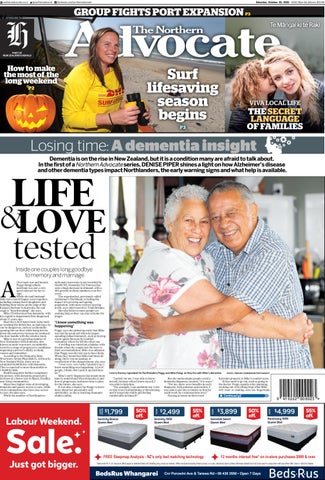
tested Inside one couples long goodbye to memory and marriage
with mate wareware is not recorded by Health NZ, Dementia Tai Tokerau has seen a huge increase in demand, with a 40% growth in client numbers over five years. The organisation, previously called Alzheimer’s Northland, is feeling the impact of a growing and ageing population, with more retirees moving north, says chief executive Trudi Bridges. She also believes more people are seeking help so they can stay at home for longer.
‘I knew something was happening’
Love is the key ingredient for Northlanders Peggy and Mike Rangi, as they live with Mike’s dementia.
“Luckily for me, I was able to know myself, because when I knew myself, I was able to help him. “For example, I can modulate my voice so that it isn’t intimidating or threatening, and it keeps him stable and feeling comfortable in himself.”
Serenity Breeze Queen Bed
Kaiwaka property is Mike’s comfort zone. If they need to go out, such as going to the doctor, Peggy spends a day planning, working out everything from what Mike will wear to making sure his fingernails
2,499
$
$
Serenity 1935 Queen Bed
FREE Sleepmap Analysis - NZ’s only bed matching technology
■ Continued p2
3,899
Swisstek Select Queen Bed
50% off.
NOW
50% off.
PHOTO / MICHAEL CUNNINGHAM PHOTOGRAPHY
But she understands people avoid a dementia diagnosis, because “it is scary”. “For me, there were benefits in early diagnosis, with patterns and routine. I was able to get into a routine so that he could work on a subconscious level.” Staying at home on their rural
FROM NOW
1,799
$
FROM NOW
FROM
Peggy says she picked up early that Mike was not his usual self when he began spending indiscriminately, such as buying a new spade because he couldn’t remember where he left his other one. A red flag was raised on a holiday with friends when the couple lost the keys to their accommodation. Mike was adamant that Peggy was the last one to have them. When they found that Mike had them all along, there was no apology or recollection of the disagreement, she says. “I was very, very lucky I picked it up. I knew something was happening. A lot of people, I think, don’t pick it up until later on.” Mike’s early diagnosis has meant more time to understand what dementia is and how it progresses, and more time to plan for the future, she says. It was also a chance for Peggy to learn more about her personality and spirituality, as she is learning shamanic studies online.
FROM NOW
A
t her most raw and honest, Peggy Rangi admits marriage was not a very good contract for her to sign. While she and husband Mike have had 50 happy years together, including raising three daughters and building their house on the edge of the Kaipara Harbour in Kaiwaka, the end stage is “heartbreaking”, she says. Mike (Tūwharetoa) has dementia, with his cognitive impairment first diagnosed about 15 years ago. Most days, he forgets basic tasks such as washing the dishes but, on bad days, he can be dangerous, such as accidentally opening the car door while being driven down the motorway because he confused the door handle with the window knob. Mike is one of a growing number of New Zealanders with dementia, also known as mate wareware, an umbrella term for a range of progressive conditions impacting a person’s ability to think, reason and remember. According to the Dementia Mate Wareware Action Plan 2026-31, written by New Zealand NGOs, there are an estimated 83,000 Kiwis with dementia. This is expected to more than double to 170,000 by 2050. Health inequities further complicate the picture, with dementia projected to increase at a faster rate in Māori, Pasifika and Asian communities. Māori face higher risks of developing dementia and poorer access to care, while rural communities also have less access to care, the plan says. While the number of Northlanders
4,999
$
Sanctuary 1935 Queen Bed
50% off.
12 months interest free* on in-store purchases $999 & over.
*Sale ends 04.11.25. Discount offers apply to selected beds and bedding only, prices as marked. Offers exclude Everyday Dream prices, run outs, clearance stock (unless otherwise stated) and not to be used in conjunction with any other offer. See in- store for details
BedsRus Whangarei
Cnr Porowini Ave & Tarewa Rd • 09 438 3550 • Open 7 Days