
![]()


“To bring to Light”
Edition 31


Matt Pryor
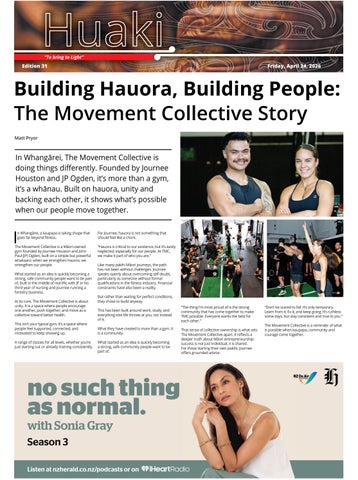
In Whangārei, The Movement Collective is doing things differently. Founded by Journee
Houston and JP Ogden, it’s more than a gym, it’s a whānau. Built on hauora, unity and backing each other, it shows what’s possible when our people move together.
In Whangārei, a kaupapa is taking shape that goes far beyond fitness.
The Movement Collective is a Māori-owned gym founded by Journee Houston and John Paul (JP) Ogden, built on a simple but powerful whakaaro: when we strengthen hauora, we strengthen our people
What started as an idea is quickly becoming a strong, safe community people want to be part of, built in the middle of real life, with JP in his third year of nursing and Journee running a forestry business
At its core, The Movement Collective is about unity It is a space where people encourage one another, push together, and move as a collective toward better health
This isn’t your typical gym, it’s a space where people feel supported, connected, and motivated to keep showing up
A range of classes for all levels, whether you’re just starting out or already training consistently
For Journee, hauora is not something that should feel like a chore.
“Hauora is critical to our existence, but its easily neglected, especially for our people At TMC, we make it part of who you are.”
Like many pakihi Māori journeys, the path has not been without challenges Journee speaks openly about overcoming self-doubt, particularly as someone without formal qualifications in the fitness industry Financial constraints have also been a reality
But rather than waiting for perfect conditions, they chose to build anyway
This has been built around work, study, and everything else life throws at you, not instead of it
What they have created is more than a gym It is a community
What started as an idea is quickly becoming a strong, safe community people want to be part of


“The thing Im most proud of is the strong community that has come together to make TMC possible Everyone wants the best for each other ”
That sense of collective ownership is what sets The Movement Collective apart It reflects a deeper truth about Māori entrepreneurship: success is not just individual, it is shared
For those starting their own pakihi, Journee offers grounded advice:

“Don’t be scared to fail It’s only temporary Learn from it, fix it, and keep going Its ruthless some days, but stay consistent and true to you ”
The Movement Collective is a reminder of what is possible when kaupapa, community and courage come together


4-10 May 2026
Anyone can be a Road Safety Hero, so join us on our walk/run around the Hātea Loop to show your commitment to road safety. The walk/run will be followed by refreshments and prizes at Putahi Park. Dress up in your most creative hero costume and be in to win great prizes!
Friday 8 May at 1pm Canopy Bridge, Town Basin


Last week, members of the Whāriki Māori Business Network team had the privilege of attending the TRMA 2026 Regional Māori Health & Safety Conference at Waitangi Treaty Grounds.
From the pōwhiri through to the closing reflections, it was clear this was far more than a conference It created space for meaningful kōrero about how we can better protect and support our people across our workplaces, businesses and communities
A key takeaway for our team was the reminder that health and safety is ultimately about people It is about relationships, responsibility and leadership. While these conversations are often framed through policies and processes, the day reinforced the importance of taking a more people-centred approach
Through a te Ao Māori lens, values such as manaakitanga, whanaungatanga and kaitiakitanga help shift health and safety from being transactional to relational It encourages us to think beyond compliance and ask deeper questions about how we create environments where people feel safe physically, culturally and emotionally
As an organisation that exists to supp business growth and connection acro Tokerau, these conversations strong with our kaupapa Strong businesses on strong people, and creating safe, environments is an important part o
There was something especially pow about having these discussions at Wa It served as a reminder that partners protection and participation remain j relevant today and should continue t how we lead within our organisation communities
Ngā mihi to the organisers, speakers everyone who contributed to such an day of learning and connection


As Northland faces increasing environmental pressures – from climate change and biodiversity loss to flood and natural hazard risks – growing local capability has never been more important
Northland Regional Council’s Tū i te ora Scholarships are one way to help build strong foundations and empower future environmental leaders
Now open for applications, the scholarships are designed to support Northlanders studying in environmental fields while creating potential pathways into work here at home
Council Chair Pita Tipene says the scholarships provide meaningful benefits for both students and council
“Being able to empower our future environmental leaders by providing some financial relief and offering summer paid work experience is a good thing in the current climate.”
Each scholarship provides $5,000 to help with study costs, as well as paid, full-time summer work experience with NRC from mid November 2026 to mid February 2027

Recipients will have the opportunity to intern with Climate Action, Biodiversity & Science, Rivers and Natural Hazards & Civil Defence or Te Tiriti Partnerships & Engagement teams
The scholarship provides opportunities to apply learning in real-world settings and build skills that directly support the region
“These scholarships celebrate the council vision of Tiakina te taiao, tuia te here tangata - Nurture the environment, bring together the people This is an incredible opportunity for students who whakapapa to Taitokerau ”
Two scholarships set aside specifically for Māori, reflecting NRC’s commitment to building enduring relationships with tangata whenua and supporting Northland youth into tertiary study

The programme also helps students to “get a foot in the door”, strengthening the pipeline from study into future employment.
For more information and to apply, visit www nrc govt nz/scholarship
Applications close Monday 11 May
Pictured:FormerTūiteoraScholarshiprecipientHuiaClarke gainedworkexperiencewiththeNRCHydrologyteam.


Ruth Wong
Across the motu, whānau are beginning to feel the ripple effects of global tensions that have reached all the way to Aotearoa
Although Australia remains one of the world’s major exporters of coal and gas, its oil reserves are now extremely limited, and New Zealand is in much the same position As nations positioned at the end of a long and fragile supply chain, we are vulnerable to disruptions occurring far beyond our shores
One of the most significant pressure points is the Strait of Hormuz - a narrow but vital passage through which around 20% of the world’s oil supply travels

Recent conflict in the region has slowed shipping, increased risks to vessels, and tightened global trade
These international shifts are now being felt locally: rising fuel prices, increased costs for farmers and transport operators, and growing strain on whānau already navigating the high cost of living
For many these impacts are real and immediate Households already under pressure with health, housing, and financial challenges are now facing the added burden of rapidly increasing petrol and diesel costs
For some, the weekly budget is stretched
beyond breaking point
Despite this, it is not a time for panic It is a time for steady, calm, and sensible leadership
Most global oil supply continues to move, governments are releasing reserves to stabilise markets, and some of the price spikes we are seeing are driven more by speculation than genuine shortage While we cannot control global events, we can control how we respond
Practical steps can help us stay grounded:
• Stay informed through reliable sources
• Avoid panic buying
• Strengthen local networks and check in on kaumātua and neighbours
• Plan essential travel carefully
• Support local growers and producers, or grow your own produce
• Keep vehicles above half a tank and maintain basic supplies
• Uphold manaakitanga, kotahitanga, and whanaungatanga
These principles are not new
They are the same values our tīpuna used to navigate uncertainty and change Our strength has always come from our ability to awhi one another, stay informed, and move forward together


“Biscuits! Army Biscuits! Consider the hardness of them Remember the cracking of your dental plate, the breaking of this tooth, the splintering of that ”
(From “Army biscuits” by Ormond Burton in “The ANZAC book”)
Does this bring to mind images of our troops at Gallipoli eating the Anzac biscuits we know and love today? Contrary to popular belief there were no Anzac biscuits at Gallipoli The standard Army biscuit at this time was a rock-hard tooth breaker, also called a ship’s biscuit
Although its a myth that Anzac biscuits were sent and eaten by troops in Gallipoli, some evidence suggests a rolled oats-based biscuit was sent to troops on the Western Front, although this is not widespread
The majority of rolled oats biscuits were in fact sold and consumed at fetes, galas, parades and other public events at home, to raise funds for the war effort This connection to the troops serving overseas led to them being referred to as “soldiers’ biscuits” Fundraising was coordinated by local Patriotic Funds, raising 6 5 million pounds for the New Zealand war effort
The basic ingredients for a rolled oat biscuit were rolled oats, sugar, flour, butter with golden syrup, not eggs, used as a binding agent This made them not only nutritious and full of energy but also long-lasting
After WWI, the most popular rolled oat biscuit had the name and association of Anzac applied to it, and thus the legend of the Anzac biscuit began
Source: National Army Museum


Ngāti Hine


ARE


au , haer m
gāti ine He lth T us now a doctor
Wa n tr et i Wha

r ’ s clinic (G ngārei ai!

ic (GP services) at i


lled patients en y afford amariki aged 6 to1 - ea

I ou d li t join ur cl nic book a vis A
T mar f m 4 to 17-yea
āk ke / Adults: 19 for a n

CC v s ts ar sup o te to , no tamariki and red ced


dable fees: ars: Free rs: From $1 ā dard GP co with lo o o fees for ad
Yo f s p intme nc udes a f l n ollowed by a onsultation with our G


om $12 cons lt o or or a ults

i nurse healt e P, Dr Amy e sit, simply


e th c ck Walpole. mply giv us ca :


Wa to Street, W 0 00 62


Whangār


ng r i

