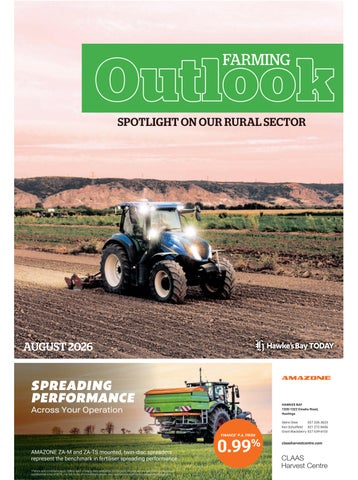
Outlook FARMING
SPOTLIGHT ON OUR RURAL SECTOR
AUGUST 2026
SPREADING PERFORMANCE
HAWKES BAY 1320-1322 Omahu Road, Hastings
Across Your Operation
FINANCE* P.A. FROM
AMAZONE ZA-M and ZA-TS mounted, twin-disc spreaders represent the benchmark in fertiliser spreading performance. *Terms and conditions apply. Offers valid on equipment settled by 15/10/2026 or while stocks last. Finance requires an establishment fee of $295. For full terms and conditions please see claasharvestcentre.com. Images illustrative only.
0.99
%
Glenn Dear 027 226 3623 Ken Scholfield 021 272 0606 Grant Blackberry 027 539 6103
claasharvestcentre.com
E
Pest control benefits the economy and environment
Contractor filling bait station with the Ruahines in the background.
We’re passionate about our region. Find us online: www.mcia.co.nz
ffective possum control is an important tool that can help landowners push back against the devastation the opportunist omnivores can wreak on farmland and bushland alike. The Possum Control Area (PCA) programme has been helping landowners and Hawke’s Bay Regional Council manage possum densities since 2000. It is a great example of how regional biodiversity programmes can work to support the economy overall, by keeping land productive, says Regional Council Chair Sophie Siers. “Farmers had to deal with the consequences of a lack of control and exploding possum numbers in the 70s and 80s, and then the spread of bovine tuberculosis. “These days, once OSPRI’s Tb-focused control operations are done, properties automatically transfer to our PCA programme and we start working with landowners on pest management. “I would describe this programme as one of Regional Council’s success stories, because we’ve worked with property owners both in the country and in towns, to significantly reduce the region’s possum population.” Effective control lessens the risk of crops and pasture being damaged, and gives native plants and birds a greater chance of survival. The PCA programme builds a picture of current possum population densities, estimates how many are left, identifies any trends, and highlights where additional control is needed. Over the next three years, Regional Council will be monitoring approximately 150,000 hectares per annum of the 700,000 hectares currently in the programme. Possum control remains the responsibility of landowners of properties greater than 4ha
in size. Regional Council strongly encourages landowners to engage one of the Councilapproved contractors if they do not want to do possum control themselves. All landowners/occupiers in the areas selected for monitoring will be contacted by Regional Council’s contractor, to arrange access, discuss timings, health and safety and any other relevant matters. The monitoring determines whether each property remains below or at four percent Residual Trap Catch Index (RTCI). The latest monitoring data, for 2025/26, shows those in the PCA programme achieving an average of 2.3 percent RTCI. Regional Council’s Hawke’s Bay urban and semi-urban possum programme currently covers approximately 24,000 hectares. The programme has focused on key locations including Waipukurau, Waipawa, Havelock North, Pakipaki, Waiohiki, Poraiti, Meeanee, Awatoto, Clive, Wairoa, and Napier Hill. HBRC has funded the initial control for these projects while encouraging the community to follow up with all possum maintenance going forward. Regional Council also provides an urban and semi-urban possum advisory service. Possumrelated concerns in these areas are referred to the Council’s preferred contractor, who will provide landowners or occupiers with up to one-and-a-half hours of advice and support. • For more information about the programme, possum control methods or to update your contact details, visit hbrc.govt.nz #farmpests or #pesthub • Contact the biosecurity team about possums or any other biosecurity matters – plant pests or animal pests – by phoning 06 8359200 or emailing biosecurity@hbrc.govt.nz
YOUR HOME & LIFESTYLE NEXT ISSUE OUT THURSDAY 24 SEPTEMBER 2026
Be part of this trendy publication filled with diverse topics from across the region BOOKINGS CLOSE 14 SEPTEMBER 2026 shirley.randell@nzme.co.nz
➔ Tax Preparation ➔ Business Planning ➔ General Accounting
Would you u know whatt to do if someone is injured?
BE SEEN. EVERYONE'S HERE. Introducing Links First Aid Public Classes
Or Links can come to your workplace*
Limited time introductory offer Foundation First Aid only $150.00 Revalidation only $120.00
• Workplaces • Schools • Aged Care Facilities • Processing Plants • Tourism Ventures All enquiries welcome!
Napier: Friday 25 September Hastings: Friday 23 October Napier: Monday 30 November
Simply phone us today on 0508 487 246 * Minimum numbers apply
N.B. Businesses are welcome to attend our Public Classes, all NZQA Accredited! Book online at: www.links-ltd.co.nz
Freephone: 0508 487 246
training@links-ltd.co.nz
www.links-ltd.co.nz
Calf Rearing 101 The non-negotiables in any calf rearing system are quality genetics and colostrum.
T
he non-negotiables in any calf rearing system are genetics and colostrum. This is according to Professor Rebecca Hickson who says while rearing systems vary, the quality of genetics and colostrum were vital in a successful calf rearing operation. Genetics Speaking on a recent B+LNZ webinar, Rebecca, who is both a scientist and calf rearer, said genetics drive rearing and finishing
performance and set the ceiling for what the animal is capable of. Numerous trials, including B+LNZ’s long-running Dairy Beef Progeny Test, have reinforced the value of superior beef genetics. She said it is impossible to tell a calf’s genetic make-up by looking at it and added that there was as much variation within breeds as between breeds. This highlighted the value of buying calves
SPRING STARTS IN THE WORKSHOP The busy season is just around the corner. Get your tractors, balers and machinery serviced now, so they’re ready to go when you are.
GET AHEAD BEFORE SPRING HITS PREVENTATIVE MAINTENANCE = LESS DOWNTIME IDENTIFY ISSUES BEFORE THEY BECOME BREAKDOWNS REDUCE FIRE RISK FROM DEBRIS & BUILD-UP GENUINE PARTS & ADVANCED DIAGNOSTICS EXPERIENCED CASE IH & NEW HOLLAND TECHNICIANS
READY FOR SPRING? BOOK YOUR SERVICE TODAY. 06 858 6041 Hastings & Waipukurau
directly from dairy farmers as they will know the genetic background of each calf – and how the calf was looked after in its first four days of life. “Ask you potential suppliers about colostrum – good colostrum practices are critical to get the calf off to a good start – in addition, ask about navel care, cow nutrition, calf nutrition and the frequency of pick-ups, particularly in bad weather.” Calves should be a minimum of 96 hours old
when they are moved to a rearer, although the older the better, said Rebecca. Housing Calf sheds must be warm, dry and well ventilated- without being draughty. Ventilation should be above the height of the calf. Most importantly, they need to be well set up before any calves arrive. Feeding Rebecca said there is no right or wrong way to rear calves to weaning and she outlined both a high and low milk system. While the high milk system was more expensive, the calves grew faster than those on the low milk system. A 40 kg bull calf on a low milk system should be reaching 100 kg by 12 weeks of age. To aid rumen development, calves should have unlimited access to meal from day one up to a maximum 2-3kg/head/day. Initially the meal is a substrate for rumen development rather than a source of nutrition. Straw or hay should make up no more than 10 percent of the calf’s diet To help calves adjust to calf milk replacer (CMR) Rebecca suggests offering a 50/50 mix of cow’s milk and CMR. If the calves have had a long day being transported, it is a good idea to give the calves electrolytes upon arrival at the rearing unit and milk at least two hours later. CMR should be mixed in either cold or warm water. Hot water will denature some of the proteins in the CMR. The quality of the CMR is important- as is consistency- cheaper products can be more costly in the long run. Sick calves Sick calves are a reality of rearing, hence the need to set up a care plan right from the outset. If death rates are over four percent and hospitalisation above 10 percent, Rebecca recommends rearers seek advice from their vet or advisor. Courtesy of Beef + Lamb
From mum of four to vet nurse K
Kayleigh Oakham has finally achieved her long-held dream of becoming a vet nurse after graduating from EIT.
ayleigh Oakham always wanted to be a vet nurse, and in her early 30s, the motherof-four decided to make that goal a reality through EIT. Originally from the United Kingdom, the now 38-year-old graduated with the New Zealand Diploma in Veterinary Nursing (Level 6) in April. “It was always in the back of my mind. Animals have always been a big passion of mine.” It was only after moving to Napier in 2019 that Kayleigh decided to work towards becoming a vet nurse. Before enrolling at EIT in 2023, Kayleigh had mainly worked in childcare and elderly care while raising her four children. “My youngest was four months old when I started at EIT, and now she’s four, so all she’s known is me studying.” Rather than entering directly into the diploma, Kayleigh chose to begin with the New Zealand Certificate in Animal Care (Companion Animals) (Level 4). “I don’t think you have to do it that way, but I wanted to start at the lower certificate first so I could get a feel for it and ease back into study after such a long time.” She says being an older student also helped her manage the demands of study and family life. “Being older definitely helped with time management. I made sure I stayed ahead all the time, and it was a lot easier that way for me.” Studying at EIT confirmed she had made the right decision. “The course was fun. Terrifying at times, but good.”
During the diploma, Kayleigh completed placements at several veterinary clinics. It was her placement at CareVets Napier that eventually led to employment, first on reception while studying and now as a Vet Nurse. She says one of the highlights of studying at EIT was the support from tutors and classmates. “The tutors are amazing. They’re really supportive.” Kayleigh says she would recommend EIT to others considering tertiary study. “You make a lot of friends, and everyone’s really supportive.” Now graduated, she says she is enjoying working in the industry she had always hoped to be part of. “I love it.” Vet Nursing Programme Coordinator Sarah Subritzky says: “Kayleigh’s journey is an excellent example of what can be achieved through determination, hard work, and a genuine passion for animal care”. “Throughout her studies, she demonstrated resilience, professionalism, and a strong commitment to her learning while balancing the demands of family life. “It has been incredibly rewarding to see her progress from our Level 4 Animal Care programme through to graduating with her Diploma in Veterinary Nursing and securing employment within the industry. We are very proud of her achievements and look forward to seeing her continue to grow as a veterinary nurse.”
From holiday job to Hawke’ss Bay Young Grower champion
A
t just 26, Maddi Sheridan has claimed the 2026 Hawke’s Bay Young Grower title, proving that a willingness to embrace opportunities can take you a long way in the horticulture industry. The Quality and Compliance Manager - Growing at T&G Global took out the regional title on June 19 after competing against seven other contestants. She will now represent Hawke’s Bay at the National Young Grower of the Year competition in Cromwell on August 27-28, where she will compete against six other regional winners from around New Zealand. Remarkably, this was Sheridan’s first time entering the competition. Her win continues T&G Global’s strong track record, with the company producing regional winners since 2018. Sheridan’s journey into horticulture began while studying for a Bachelor of Horticultural Science at Massey University in Palmerston North. After receiving a T&G scholarship in her first year, she worked with the company during university holidays. Following graduation with a B.Hort Science, she joined T&G full-time, spending two years with the business before travelling and working in Canada. On her return to New Zealand, she resumed her career with T&G. Working across a variety of areas within the business has given her broad industry knowledge, something she credits with helping her succeed in the competition. The Hawke’s Bay Young Grower competition featured a series of practical and theoretical challenges. Sheridan won five of the competition stations and also finished runner-up in the leadership panel and the speech. She said it was not until the
second day that she realised just how well she had performed. Competitors were also required to deliver a threeminute speech. Sheridan’s topic was: “Are robots in orchards saving farming or replacing people?” While she found the speech and leadership panel the most challenging aspects of the event, she particularly enjoyed the practical tasks. In her current role, Sheridan leads a team of quality assessors who carry out field assessments across orchards. During the post-harvest period she works closely with packhouse teams, while winter is spent reviewing compliance requirements and registering orchards with New Zealand Apples & Pears. The variety is one of the aspects she enjoys most about her job. As she prepares for the national final, Sheridan is reviewing feedback from the judges and identifying areas where she can improve. She is looking forward to meeting contestants from other horticultural sectors, including kiwifruit and vegetable growing, and learning more about their industries. Sheridan hopes her story will encourage others to consider a career in horticulture. “You don’t have to grow up on an orchard to succeed in this industry,” she said. Her advice to young people is simple: put your hand up for every opportunity. Orcharding offers far more than pruning and thinning, with careers available in areas such as compliance, quality assurance and packhouse operations. Looking ahead, Sheridan has no fixed career destination in mind, but she is passionate about the industry and wants to make a positive impact while encouraging others to join New Zealand horticulture.
Above: Maddi competing in the regional competition. Inset: Maddi leads a team of quality assessors who carry out field assessments across orchards.
BUSINESS ADVISORS AND ACCOUNTANTS
Kelly Millar Kate Laugesen Melissa Horsefield
Farming for every Generation ... Tailored Support, Brighter Futures BM Accounting Ltd, Havelock North 06 8767159, Waipukurau 06 857 8901
Chardonnay takes centre stage in Hawke’s Bay
H
awke’s Bay will once again cement its deeper examination of how quality is defined, reputation as one of New Zealand’s achieved and communicated. Delegates premier wine regions this September will hear from keynote speakers, take part in when it hosts the third Aotearoa Chardonnay tastings and panel discussions, and review Symposium. Bringing together leading research findings that explore every stage winemakers, viticulturists, wine writers and of the Chardonnay journey, from vine to industry experts from around New Zealand and bottle. Benchmark wines from New Zealand overseas, the two-day event will be held at Toitoi and international regions will also feature Hawke’s Bay Arts and Events Centre in Hastings throughout the programme. on September 17 and 18. The symposium is Among the keynote speakers is dedicated to exploring Chardonnay, one of the internationally respected wine writer and world’s most celebrated and versatile grape Master of Wine Julia Harding, senior editor at varieties. JancisRobinson.com and co-author of several The event is a natural fit for Hawke’s Bay, influential wine publications. Harding will a region recognised internationally for its provide a global perspective on Chardonnay wine heritage and quality. As a member of and offer insights into the characteristics that the prestigious Great Wine Capitals Global distinguish world-class wines. Network, Hawke’s Bay The programme also stands alongside some of includes presentations the world’s leading wine and case studies from “Exploring what destinations. Hosting some of the industry’s makes exceptional most respected names, the symposium provides another opportunity to including Michael Chardonnay.” showcase the region’s Brajkovich MW, Warren vineyards, expertise and Gibson, Helen Masters hospitality to a national and international and acclaimed Australian winemaker Virginia audience. Willcock, the 2026 Halliday Wine Companion At a time when New Zealand Chardonnay Winemaker of the Year. is enjoying growing recognition on the world Beyond the conference sessions, delegates stage, the symposium offers a forum for the will gather for networking events that celebrate industry to reflect on its achievements and both Chardonnay and Hawke’s Bay hospitality. explore future opportunities. The theme for A welcome event at Peak House and a 2026 is “Quality”, with discussions centred Chardonnay Celebration in Hastings will provide on the factors that contribute to exceptional opportunities to share ideas, reconnect with Chardonnay, from vineyard management colleagues and continue discussions in a more and site selection to winemaking philosophy relaxed setting. and regional expression. Organisers say the For Hawke’s Bay, the symposium is more event will examine the unique combination than an industry gathering. It is a celebration of whenua, climate and craftsmanship that of a region that has played a defining role in enables New Zealand producers to create wines the story of New Zealand Chardonnay. As with balance, texture and a strong sense of wine professionals converge on Hastings this place. September, the event will further strengthen Building on the success of previous Hawke’s Bay’s reputation as a world-class wine symposiums, this year’s programme expands destination and a leading voice in the future of the conversation from “sense of place” to a New Zealand wine.
WE DOMINATE ON EVERY FIELD. PLUMBING
Rural ural drainage drainage, hot water and septic systems
pumping
Bore pumps pumps, stock water water, irrigation and frost fighting
electrical
Farm buildings buildings, switchboards and machinery
solar
Farm m solar solar, batteries an and system monitoring
FZP060853
Keeping Hawke’s Bay farms moving takes more than one trade.
&
From borehole water security, stock water and irrigation to rural plumbing, electrical infrastructure and solar, Isaac’s can plan, install and service the whole job through one coordinated team.
One call. One team. Talk to Isaac’s today. isaacshb.co.nz
ENGINEERIN NG
Hydraulic Pneumatic Parts, Sales & Service
Agricultural | Commercial | Industtrial ce Service, Repairs & Maintenanc
Hydraulic Specialists • 24/7 Mobile Fast Fix Service 0800 80 66 66 • 0275 744 705 1216 Omahu Road, Hastings
Water testing confirms constructed wetland delivering impressive results
From left: Willie White landowner and Tukipo Catchment Care Group member, Colin Tyler Chair Tukipo Catchment Care Group, Richard Wakelin Hawke’s Bay Regional Council, Philippa Fourie Fonterra, Larry White and Ed White landowners.
A
nalysis of water quality monitoring at a constructed wetland in Ashley Clinton has confirmed what many had hoped: constructed wetlands can make a significant difference to water quality while delivering wider environmental benefits. Funded by Fonterra and Hawke’s Bay Regional Council (HBRC) in partnership with the National Institute of Water and Atmospheric Research (NIWA) and the Tukipo Catchment Care Group (TCCG), the 1.6 hectare White Wetland aims to improve water quality and biodiversity in the catchment while also providing valuable data on how effective constructed wetlands are in
removing nitrogen and other cont Recognising the importance of measuring outcomes, Tukituki Land Care (TLC) funded 24 months of independent water quality monitoring. WaterSense collected monthly samples from both the wetland inflow and outflow, with the results analysed by Dr Andy Hicks, Principal Ecologist at Stradegy Ltd. The findings are impressive. On average, dissolved inorganic nitrogen (DIN) concentrations were reduced by 73 percent as water passed through the wetland. Dissolved reactive phosphorus concentrations were reduced by an average of 82 percent, while
E. coli levels also showed generally strong reductions. “One of the standout findings from the White Wetland is that water entering the wetland exceeded nitrogen targets, while water leaving the wetland was meeting those targets,” said Dr Hicks. “Results like this show the potential for constructed wetlands to become an important part of the solution to improving water quality, while also delivering biodiversity and flood management benefits that complement productive farming.” Dr Hicks also stressed the importance of strategic placement to achieve the best results. “Constructed wetlands are most effective where they intercept water with elevated nutrient concentrations and where water can be retained long enough for treatment processes to occur,” said Dr Hicks. The White Wetland was built on a former marginal paddock donated by the White family and now includes 24,000 native plants alongside
a seven-hectare remnant bush. Using NIWA’s modular design, it treats runoff from around 180 hectares through a series of treatment cells that naturally remove contaminants before water returns to the catchment. Annabel Beattie, Catchment Management Lead, Biodiversity at Hawke’s Bay Regional Council, says wetlands also provide benefits well beyond water quality. “Wetlands provide habitat for some of New Zealand’s most threatened species, absorb nutrients, filter sediment, slow floodwater and have important cultural and recreational values,” she said. “Despite this, only around four percent of Hawke’s Bay’s historic wetlands remain.” The White Wetland demonstrates how one well-designed project can improve water quality, enhance biodiversity and support resilient farming systems. The full report and monthly water testing results are available on the Tukituki Land Care website.
Power Farming Hawke’s Bay built on rural relationships
P
ower Farming Hawke’s Bay continues to strengthen its commitment to local farmers, growers and contractors combining locally owned leadership with access to some of the world’s leading agricultural machinery brands. The business is proudly locally owned and
operated by joint venture partners Aaron White and Ben Munford, who joined the Power Farming family over ten years ago. Since then, they have remained focused on supporting Hawke’s Bay farmers with quality equipment, reliable service and strong after-sales support. Aaron and Ben are also celebrating
recognition for their business partner, Geoff Maber, founder of the Power Farming Group, who was appointed an Officer of the New Zealand Order of Merit in this year’s King’s Birthday Honours. The award acknowledges Geoff’s lifetime contribution to agribusiness, the rural sector and the wider community. From humble beginnings with Maber Motors in Morrinsville during the 1960s, Geoff helped grow the family business into what is now one of New Zealand’s largest privately owned agricultural equipment and machinery companies. Farmers will also have noticed some significant developments in the machinery market this year. In March, Väderstad, a global leader in high-performance seeding, planting and tillage equipment, entered a new partnership with Power Farming. The move strengthens Power Farming’s machinery offering and provides local farmers with access to a world-renowned range of cultivation and planting equipment. Interest remains high in the JCB range, with JCB Ag telehandlers, tractors and wheel loaders proving popular across the region. A standout addition is the new JCB Fastrac 6300, recently introduced to the New Zealand market. The tractor joins the established 4000 and 8000 series and brings a range of enhancements, including a new engine, upgraded operator environment and the option of a central tyre inflation system. With 300 horsepower and a top speed of
60km/h, the Fastrac 6300 offers the versatility needed for both fieldwork and transport duties. Aaron and Ben are looking forward to delivering one of the first units to a local client and are happy to discuss the machine’s capabilities with interested farmers. Away from the machinery yard, Power Farming Hawke’s Bay is continuing to invest in the local community. The company has committed to a three-year sponsorship of junior rugby in Hawke’s Bay and also supports the Hawke’s Bay Magpies. The wider Power Farming Group also enjoyed a strong presence at Fieldays, recording its best event yet in 2026, reflecting continued confidence across the rural sector. As winter continues, the workshop team has been busy servicing and maintaining machinery to help customers avoid the traditional spring rush. Supporting farmers when they need it most remains a key focus for the business. People are equally important to the company’s future. Power Farming Hawke’s Bay currently employs three apprentices who are progressing through their training and building long-term careers within the industry. The business is also looking to expand its team and currently has a vacancy for a technician. Alongside brands such as Deutz-Fahr, JCB, Kioti, McHale, Kverneland and Väderstad, Power Farming Hawke’s Bay remains committed to helping local farmers access the equipment, expertise and support needed to keep their operations running efficiently and profitably.
3
THE MOST EXTENSIVE SPECIALTY RANGE IN THE WORLD
.95%
INTEREST *
With best in class fuel economy, the best safety options (true four wheel braking) and three different tractor widths, the specialty range is worth a demonstration.
The grass g is greener. g
Ben Munford B Sales S Manager / Co-Owner 0 027 801 2217
Regan Kalmancsi R Sa ales Representative 021 228 4212
ed nd oper
at
da
y all
A Aaron White Dealer Principa al / Co-Owner 0 2 027 442 6532
o w ne
Proud to sponsor the Magpies and Junior Rugby throughout the Bay
ly l oud oc
pr
*Terms and conditions apply. Finance is for 36 months, 30% deposit, GST in the 3rd month.
Sa ale En Ends ds M March arch 2 28th 8th 2 2024
Power Farming Hawkes Bay
Why working dogs need high-performance care
T
hey are the backbone of the New Zealand agricultural sector. A single, well-trained Heading Dog or Huntaway can run upwards of 40 kilometres a day across steep, unforgiving terrain. Yet, New Zealand production animal veterinarians and researchers are urging farmers to change how they view these animals. According to findings from Massey University’s longitudinal TeamMate working dog study, these are not just farm tools they are elite athletes. Like any sports star, their career longevity depends entirely on high-performance care. Fuelling the Engine One of the most common issues rural veterinarians see on New Zealand farms is severe weight loss during peak seasonal workloads. Feeding a hard-working dog purely on home-kill meat and bones is no longer best practice. While fresh meat provides protein, a diet relying solely on carcasses often leaves dogs deficient in calcium, iodine, and vital vitamins. Furthermore, splintered bones carry a high risk of life-threatening gut blockages. To maintain condition, vets recommend a high-calorie, low-bulk diet. For a dog working hard through mustering, the ideal ration consists of roughly 30% high-quality protein for muscle repair and 20% fat for sustained
endurance. High-performance commercial kibble ensures they get concentrated energy without overloading their digestive systems. The 30-Day Rule Preventive healthcare is where the battle for longevity is won. Because working dogs are constantly exposed to livestock, strict parasite control is an operational necessity. To prevent Sheep Measles (Taenia ovis), veterinarians mandate treating every farm dog with a praziquantelbased tapeworm medication every single month. Failing to hit this strict 30-day window disrupts the lifecycle and risks costly carcass downgrades at the processing plant. Beyond worming, booking your pack in for an annual veterinary “Warrant of Fitness” (WOF) is vital. These checks focus heavily on dental health and early-stage lameness. A broken tooth or a root abscess causes chronic pain,
leading to rapid weight loss and a refusal to work. Warmth Equals Performance Care does not stop when the sun goes down. Massey University research emphasizes that kennel design plays a massive role in physical recovery. When a dog is housed in a damp, uninsulated kennel on a freezing winter night, it burns massive amounts of energy just trying to stay warm. That is energy stolen directly from muscle repair and immune function. Vets advise opting for insulated kennels with raised beds and dry bedding to ensure dogs wake up fully recharged. Our working dogs give us everything they have on the hill. Data shows that lameness doubles a working dog’s risk of being lost from the farm prematurely. By treating them like the elite athletes they are, we can keep them happy, healthy, and on the job for years to come.
“Despite New Zealand’s harsh winters, vet checks revealed that only 14% of Kiwi working farm dogs are provided with an insulated kennel.” — The TeamMate Working Dog Study
WE HARVEST WOODLOTS
• Servicing Hawke’s Bay for 22 years • Proven track record • Safe, Reliable, Trustworthy • Mechanised harvesting crew • Fixed log prices for stability
HB Forestry is a local logging and log marketing specialist
0800 HBFORESTRY
Opening more doors to Kiwi homes
) % !
! !
% !
! % !
' 6 44 2 2-0 " '52 6 ' 635 1' 2 2-0 453 '66
' 4 - - 2 3 5 13"' 6' '- 25' 3- 3 5 2623-
' 6 44 2 2-0 " '52 6 3 635 1' 2 2-0 453 '66
' 3"4 ' ' 1' 2 3// 62 ' - ' 2 '5 3 3 13 '
# !! # ! # ! # % # ) % # # ! # # ! % " ! # " # ! # ! # Contact what we can offer. Katie to find ! out more about # !!
Katie Wood.(# 027 ( . 283 $ $& 2263 | ! ! * ! sales.hawkesbay@A1homes.co.nz www.A1homes.co.nz 0 + + ! , | *** ! ,
Get Top-Grade Belly Prep Before the Works!
Fast, professional, and works-ready results – book Four Kings today!
Haydn Crispin 027 422 4398