AUGUST 2026
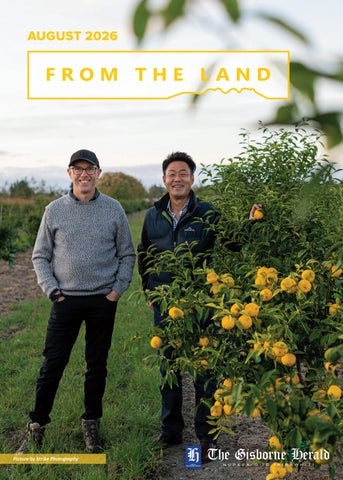
Picture by Strike Photography
2
FROM THE LAND 2026
Gisborne farmers win one back from forestry Supplied by Federated Farmers
I
n a region where plenty of productive farmland has disappeared into pine trees, two farming couples are doing something uncommon – turning a forestry block back into a working farm. Sam and Gemma Hain, and Matt and Kate Long, have just taken ownership of a 400ha property planted almost entirely in young pines. “We’ve put 650 cattle in to get rid of the trees and restore it to what it was,” Sam said on The Federated Farmers Podcast. “We’ve seen a lot of land go into pines down here and it’s pretty nice to take a little bit back. “We all hate blanket pine forestry, so the chance to convert this land back into good farming country was just too tempting.” The Hains and Longs have bought the farm through their farming partnership, Taimoti Station Ltd. It’s 4km from their 1090ha Taimoti Station in the Hangaroa district, which was the epicentre in Cyclone Gabrielle, with bridges, roads, farms and stock all severely hit. The farm was sold in 2016 to an Auckland family, who farmed it for six years before planting half the property in pines in 2022 and the remainder in 2024. “They thought it would be easier to sell once it was planted, but we were
competitive enough to beat forestry,” Sam says. For the two couples, restoring the farm is about much more than economics. “We have an opportunity here to convert back to productive farmland,” Matt says. “Blanket pines have not worked in this area, and it was pretty clear during Gabrielle how much damage they can do. “This will be a challenge for us, but it’ll give us a whole lot of satisfaction.” The country is mostly easy rolling, with some steeper faces that may remain in trees or eventually be replanted in poplars, willows or allowed to regenerate in native bush. Fortunately, the pines are still young enough for the conversion to be possible, although it won’t be easy. The Hains and Longs plan to drill and poison some of the trees, and will attempt to graze the others to the ground. “We won’t cut many of them down because they’ll smother the ground, create a haven for weeds and make access difficult,” Sam says. “By injecting them and leaving them standing, they’ll rot down. “A lot of it we’re going to have a crack at getting rid of by putting cattle in to graze them. The trees are still small enough that they should chew them out.” The project is only possible because they acted before the carbon liability became overwhelming.
For the Hains and Longs, putting cattle back on the farm was a career highlight.
It’ll be hard work but Matt Long (left) and Sam Hain are looking forward to drilling and poisoning the older pines and using cattle to graze the others to the ground.
Because the property is registered in the Emissions Trading Scheme, the partners will have to surrender carbon credits before converting it back to pasture. They say they acted just in time. “The carbon liability would have become too great. On 400ha, two years later, it would have been about $1.2 million we’d have to pay back,” Sam says. Matt says he had the opportunity to graze a piece of the property a while ago, which got the cogs turning. “We were able to graze a small bit of it – the council-owned part they’d bought to put the new road through. “So, we whacked cattle in there and they quite quickly went about eating and smashing the young pine trees. “It did fire up the imagination, and, with Sam and Gemma, we started talking about the idea of taking the whole property out of pines.” Matt says he’d tried to buy a few other farms before the Taimoiti partnership, but he’d been outcompeted every time by carbon farmers. “I just kept getting forced out of the
ENTERPRISE MITSUBISHI
market not by production foresters but by offshore carbon farmers. “I have an issue with offshore carbon investors because they extract long-term income from the New Zealand economy, while contributing very little to local jobs, production or regional prosperity. “This block is largely good productive sheep and beef country. Yes, there are some steep faces we’ll need to manage for erosion with the right trees – which we all know aren’t pines. “What we’re trying to do here is only a drop in the bucket, but with new technologies coming along like Halter and drones, converting pine blocks back into productive farmland looks a bit more feasible.” Hain isn’t sure they’d have bought the property if it hadn’t been planted in pines. “Maybe not. We just wouldn’t have had the same motivation.” He hopes others will follow their example. “We’ll be documenting it all and we hope it makes other people think, ‘I can do this too’.”
STEVEN SHIELDS Ph: 0274839666 steven.shields@enterprisemg.co.nz
FROM THE LAND 2026 3
Stronger Together The Value of Catchment Groups Supplied by Allegrow
I
f there’s one thing farmers have always understood, it’s that a job is easier when you’ve got a good community of neighbours and mates willing to lend a hand. Whether it’s docking lambs or clearing slips after a storm, lending a hand has always been part of rural life. It’s simply what we do. So, it’s no surprise that catchment groups have become one of the strongest forces for positive change in our region. They’re built on something farmers have always known - we’re all connected. Water doesn’t recognise fence lines. Neither does sediment, erosion or pests. What happens in the hills eventually reaches the flats and the sea. Looking after our own patch has always mattered, but looking after the wider catchment and working together makes even more sense. The Mōtū Matawai Catchment Communities (MMCC) Group, formerly the Mōtū Catchment Group, is a great example of what’s possible when people come together with a common purpose. Nestled between Gisborne and Ōpōtiki, it’s rugged, beautiful country with its share of challenges. Rather than waiting for someone else to solve those challenges, local landowners decided to tackle them together. They’re fencing waterways, planting stream edges and creating habitat for native wildlife while continuing to run productive sheep and beef farms. They’re proving that environmental stewardship isn’t separate from farming, it’s part of being a good farmer. The best ideas in farming don’t come from reports or regulations. They come from having a yarn, catching up at a BBQ or dare I say the local squash club ball. Farmers trust other farmers, and seeing something work on a neighbour’s place often carries more weight than hearing about it at a meeting. That’s where catchment groups really come into their element. They bring people together to share resources and knowledge, to solve problems and celebrate success. Instead of everyone figuring things out alone, good ideas spread across the whole catchment.
"
The Mōtū Matawai Catchment Communities (MMCC) Group image supplied by Hayley Redpath.
Possum trap. Image supplied by Hunt and Harvest.
The MMCC Group at a river health field day a couple of years ago.
Catchment groups aren’t about compliance they’re about local people taking ownership of local issues. They demonstrate that the best environmental solutions are often developed by the people who know the land best. For too long, the public conversation around farming has often focused on problems rather than progress. Catchment groups are changing that
narrative. They showcase farmers as environmental stewards, innovators and community leaders. They demonstrate that productive agriculture and environmental care are not opposing goals, they are complementary ones. The MMCC Group has shown that when people share a vision, remarkable things can happen. Protecting waterways, restoring biodiversity and maintaining
! #
profitable farming businesses need not be competing priorities. Together, they become part of the same story. As rural communities continue to navigate uncertainty, perhaps the greatest lesson from catchment groups is this: the best outcomes come from working as a community – we are stronger together. And that is something worth celebrating.
4
FROM THE LAND 2026
The Essence of Yuzu By Sophie Rishworth
E
ight years ago, Gisborne men Elliot Callender and Masa Takahashi planted ten trees. One tree died, and with that came the name of their new venture: Ninetrees. Today, that modest beginning has grown into nearly 3,000 yuzu trees spread across two orchards on the Poverty Bay flats, along with 300 finger lime trees. It’s a weekend side-hustle for the duo and has become one of Gisborne’s most intriguing horticultural success stories. For Elliot, the land carries history. Some of the yuzu trees now stand on soil farmed by four generations of his family, with his children set to become the fifth. Masa, born in Japan, was raised on the flavours of yuzu and has lived in Gisborne for 20 years. The pair have known each other for more than 16 years, working side by side in the squash export business. They spent years serving growers, helping others succeed, before deciding they wanted to grow something of their own – something unique. “We wanted to contribute,” said Masa. Elliot added he wanted an excuse to buy a tractor. They didn’t have the capital for a high value crop, or large tracts of land, but they had curiosity, determination, and a shared desire to try something different. Masa suggested yuzu - a rare, very aromatic citrus fruit almost unknown in New Zealand. He said it was important to them that people who bought their products experienced the true yuzu flavour. And Masa is the guy who knows taste, said Elliot.
Elliot and Masa Picture by Strike Photography
129 Aerodrome Rd. / 867 99 99
We work on all sizes and makes of trucks and trailers. Servicing, COF work and repairs. We hold a wide range of parts to suit all makes of trucks and trailers. If we don’t stock it, we can find it for you including new, aftermarket or second hand.
Come and see us for all your Isuzu truck needs.
FROM THE LAND 2026 5 “We wanted to get something out there that the average joe can actually taste yuzu and be like – that’s the essence of yuzu,” said Elliot. Their venture is also a bit educational as very few people have heard about the fruit. It’s very rare and not something you’ll come across in a mainstream supermarket. It’s also not the prettiest fruit in the bowl, and very little juice comes from one yuzu. After eight years their trees are producing three tonnes of fruit a year, but production is ramping up, and it’s estimated they’ll be at 30 tonnes of fruit in a few years. Their first products were freeze-dried yuzu and finger lime powders, created to provide the authentic flavour of the fruit in applications where moisture isn’t suitable. The powders have since found their way into products made by food manufacturers, artisan producers, and restaurants across New Zealand.
However, it was their Yuzu Juice Soda, launched last October, that proved to be a sell-out success. The award-winning beverage, which received a Gold Medal at the 2026 Outstanding Food Producer Awards, has been embraced by consumers, with Elliot and Masa crediting the incredible support of the Gisborne community for its success. Their first batch of sodas, 5,500 cans, sold out in two months - most of it in Gisborne. The second batch of 15,000 cans is on track to sell out too. The soda is refreshing, and pairs well with gin, while the powder goes well with honey, mayonnaise, can be used in cooking, and is a great addition to any cocktail. Remarkably, they haven’t spent a cent on marketing. Their website, designed by Elliot’s wife Lauren, and word of mouth, have been enough. “If you have a very good product, that’s the best marketing,” said Masa. Both have full time jobs, so they work on their orchard on the weekends.
Yuzu powder packaged
Elliot likens the orchard to the equivalent of owning a big fishing boat and they’ve invested about that much too. The hobby has been expensive, but they’re inching toward break even. Elliot reckons next year they’ll finally make enough to buy themselves an ice cream each. All picking and pruning is done by the two of them, with help from Elliot’s family. It’s exactly the family centred, hands on approach they want. Masa said the work never feels stressful and they never disagree.
Award winning Yuzu Juice Soda
Production is a cross regional relay with the fruit trucked to Wairoa where it’s juiced, then frozen, before it’s sent to Auckland and turned into soda. Each can contains 10 percent yuzu juice, one of the highest proportions
0% FINANCE 30% DEPOSIT OVER
36 MONTHS ON
*
18Z, 19C & 25Z MINI
EXCAVATORS *T&Cs apply. Valid till 30/09/26 and only while stocks last
Power Farming Gisborne
65 Main Road, Mataraka, Gisborne 4010 | 06 868 8908
*
in any yuzu drink gllobally. The powder is created and packag ged in Auckland too. Compliance was one of their biggest hurdles. Food safety, packaging, nutrition labels, shelf life testing all required significant investment. Product development was another challenge but they’ve enjoyed the process. And what does it taste like? “Yuzu tastes like yuzu,” said Masa. Their products can be found at www.ninetrees.nz with the Yuzu Juice Soda stocked by many cafés, eateries and retail outlets across Gisborne. Pictures by Strike Photography
6
FROM THE LAND 2026
Wine consumption slumps worldwide, forcing major vineyard removal in Gisborne By Sophie Rishworth
A
global drop in drinking alcohol has contributed to the removal of hundreds of hectares of grape vines across Gisborne. GisVin general manager Hamish Jackson estimated at least 600ha has been pulled out, based on his conversations with grape growers. “We still don’t know the full amount pulled at present,” he said. Poverty Bay Flats grape grower Fraser Briant said it had been an extremely tough time for the past three to four years. “There’s no clear path forward, we’re just taking it one day at a time and not trying to think too far into the future. “Things have happened before and it’s corrected itself, but this does feel deeper and longer this time.” Briant owns DW Briant Ltd, a family run orchard in Patutahi. He said they were considering other crops for the land not needed by grapes, “but kiwifruit comes with a huge capital requirement up front and you also must have access to water. “Apples is a bit of a roller coaster as well, it depends on the variety, but it’s a tricky
Matawhero Wines, pictured, owner Kirsten Searle said their replanting strategy has been driven by opportunity and changing demand across their portfolio. “We are fortunate to have been able to anticipate these shifts and respond proactively.” Searle will be championing Gisborne wines at a ProWine event in Mumbai, India, towards the end of this year. Image by Strike Photography.
crop to grow and not a given. “Other than that, there’s not a clear land use for the Poverty Bay Flats. “If all the grapes come out of Gisborne, it will affect jobs.” Thompson’s Horticulture vineyard manager Anita Ewart-Croy said one third
of the company’s own vineyards had been removed, and half of the remaining vineyards had been mothballed. “We are growing to crop only those blocks we know have a home. “Our management of other vineyards has reduced to less than half as well,
which impacts company income significantly.” Last year Statistics NZ reported wine volumes fell 11 percent to 85 million litres. “The growers here are having a really hard time,” said GisVin’s Jackson. “Growers are facing their fourth difficult year, with
FARM MA AINTENANCE
FROM THE LAND 2026
demand continuing to deteriorate despite strong wines produced in the latest vintage.” Overseas markets are saturated because the change in drinking habits is global. According to the International Organisation of Vine and Wine, 2024 and 2025 had the lowest worldwide wine consumption since 1961 (and the world had 40 percent less population back then). Beer and spirits are also down. Jackson said alcohol appears to have become “a dinosaur industry”. “More people are trying to be healthy and clean.” But he noted a lot of conversations and deals were still made over a bottle of wine. Oversupply is widespread, with France, Australia and the USA removing vineyards as well as destroying wine. Jackson said growers here who’ve removed vines were considering alternative horticultural crops, where water was available, while others were keeping infrastructure in place in case the market rebounds.
There is hope. “We’re a small speck on the international scene but there are some wineries in NZ still doing well,” said Jackson. “We’re really trying to push the brand Gisborne. Marlborough has done it well. “We’re the first to see the light in the world and Gisborne’s sustainability strengths, particularly being the only NZ wine region that doesn’t require irrigation, remain key selling points.” Jackson recently came back from San Francisco on a sales trip and will travel to Mumbai in November to promote Gisborne wine following the India–New Zealand Free Trade Agreement (FTA) signed in April. GisVin, GroCo and Matawhero Wines will all be at the ProWine event in India alongside NZ Wine Growers and NZ Trade and Enterprise to do a promotion of Gisborne wine. Matawhero owner Kirsten Searle said they were excited to be part of the delegation of NZ wineries participating in the NZ Pavillion at ProWine. “With the FTA now signed, it will
7
Gisborne wine growers are struggling as an oversupply of wine in the global market has resulted in hundreds of hectares of grape vines being pulled out across this region.
be a unique opportunity to visit and understand how the Indian wine market is evolving, where the real opportunity for NZ wine lies and how to position Gisborne for long-term success. “It will be fantastic to attend this event with another Gisborne winery, GroCo, so we can champion the region together.” Searle said market conditions remained challenging but demand for premium
branded Gisborne wines continued to grow for Matawhero, particularly for varieties such as Chardonnay. “Consumers are drawn to the region’s vibrant fruit, fine acidity, and distinctive texture. “Our priority is to keep championing Gisborne and strengthening demand for the exceptional grapes grown here.” Pictures by Strike Photography
8
FROM THE LAND 2026
Reliable irrigation critical for seasonal crop success Supplied by Tairāwhiti Growers Association
W
ith intense El Niño conditions declared in July 2026 and expected to peak in late spring or early summer, Tairāwhiti’s horticulturalists are expecting a hot, dry, windy summer for the coming growing season. During a dry summer a key concern for growers is reliable access to irrigation water. This access to irrigation is essential, not only to maintain commercial crop yields but also to ensure the survival of plants that take 3-5 years to establish and underpin Tairāwhiti’s valuable horticultural sector. The Waipaoa River is a water source that is relied upon by many of the regions’ growers and is susceptible to seasonal variability. Once the river drops below a defined flow rate, irrigators must cease taking water until the river flow exceeds the low flow rate again. The current El Niño conditions are the strongest in recorded history. Historic river flow conditions from previous intense El Niños may give us an indication of the conditions we could expect to see this summer. Daily Waipaoa River flow records from the last 60 year’s show that February and March are the most common months that the river begins to fall below the low flow rate. The longest consecutive period the river would have been unavailable for irrigators to take water was 32 days in 1983 while in 1981 the river would have
only been available for 16 out of 74 days from the start of February. This length of time without water could be devastating for orchards and crops. The obvious solution is to store water when it is plentiful, so it is available for use when it is needed. Since the 1950’s aquifer recharge has been used to solve water scarcity problems around the world. This is where a water bearing stratigraphic unit, usually a gravel or sand layer, is used like a huge underground tank. Filtered water is either injected under gravity or pump pressure and is then abstracted when required.
Trials by the Gisborne District Council have shown that Tairāwhiti’s Makauri aquifer is suitable for recharge. This aquifer underlies 7,000 hectares of Tairāwhiti’s most productive land and could be used to irrigate crops when the Waipaoa river is in a low flow state. Both the environment and water users would be better off in a system where water was drawn from the rivers when there are ample water flows and then aquifers when the rivers reach a low flow state. With aquifer recharge, there is the opportunity to increase Tairāwhiti’s total
irrigation water availability and security. This should lead to more high value horticulture being developed on the fertile Turanga flats with an associated increase in jobs and economic growth. The predicted hot, dry summer could have a devastating impact on the regions orchards, but it could also be the catalyst to improve the regions water storage systems. Hopefully, a lesson on the importance of water security is learnt with minimal disruption to Tairāwhiti’s horticulturalists.
Local Action, National Impact: Keeping our sheep sweet and sheep measles free. Sheep measles continues to cost farmers across the country. The solution is simple - dose all dogs who reside near sheep or goats with Praziquantel™ monthly, or at least 48 hours before heading near grazing areas.
Find out more.
0800 222 011 www.sheepmeasles.co.nz @sheepmeasles @sheepmeaslesnz
FROM THE LAND 2026 9
Four generations of breeding excellence Supplied by Turihaua Angus
R
unning the oldest Angus stud in Australasia gives the Williams family an advantage of proven bloodlines and quality genetics – but they’ll never take those assets for granted, say Paul and Sarah, the fourth generation managing Turihaua Angus, in Gisborne. “Our philosophy around the type of cattle we produce is evolving, but the breeding program hasn’t changed,” says studmaster Paul, who runs the operations day-to-day, and whose great grandfather founded the stud in 1906. “The fundamentals are still fertility first and foremost, good temperament, and sound structural integrity. The bulls need a good constitution with the ability to recover quickly after being out with the cows or after experiencing a tough winter or dry summer.” The upcoming Spring Bull Sale on September 22 will feature 30 yearlings and 10 rising two-year-olds. According to Paul, the selection process is rigorous: “To make the cut, they have to stand out within the mob and show excellent growth leading up to the sale. Because they are chosen specifically for mating, our primary focus is on calving ease and birth weight, without compromising on the strong growth and fertility traits we are known for. “The yearling bulls are covered by a three-year guarantee. Having fully taken over the ownership of the station and stud five years ago and the recently purchased neighbouring Puanga Station, Paul and Sarah are excited about the expansion of the business. Across the now 1300-hectare property, total stock units are currently 10,000 -
70% of which are stud cattle, 20% sheep, and 10% commercial cattle. “The expansion’s an exciting opportunity, and gives us more selection pressure, because we’ve got more numbers to select from for our sales. A bigger cow herd allows us more depth in the breeding programme allowing us to move faster on genetic gains” Currently the stud calves down around 400 stud cows, including 120 yearling heifers and roughly 50 embryo transfer cows. While the Turihaua herd’s genetics have been refined with the help of natural
selection on hard hill country without supplementary feed, the Williams are just as eager to embrace the role technologies present to further improve their animals, for example, tags are currently being trialled to identify puberty in heifers. Paul’s background in zoology brings him a wealth of additional knowledge in animal physiology, behaviour reproduction, and genetics, which is applied to the day-to-day running of the studs’ genetic programme. The couple, who have three sons aged seven, 10 and 12, make a great team, with Sarah – whose background is in hydrology
- focuses on the stud administration, accounting and marketing aspects. Both are passionate about the environmental stewardship with an ongoing focus on pest control and restoring the Turihaua stream, wetlands, bush blocks across the property. Ultimately, the true measure of success for Turihaua Angus is how their bulls perform for the commercial buyers who purchase them. “The most rewarding part of our job is hearing excellent pregnancy scanning results which means the bulls are working and the cows are fertile”.
Turihaua
yearling bulls
are your heifer mating specialists.
SPRING SALE
1pm, Tuesday 22 September 2026 28 yearling and 10 2-year old bulls on offer
021 189 4114
PAUL & SARAH WILLIAMS
paul@turihaua.co.nz
www.turihaua.co.nz
10 FROM THE LAND 2026
EIT student wins Ahuwhenua Young Maori Grower Award Supplied by EIT
A
n EIT horticulture student has been named the winner of the 2026 Ahuwhenua Young Māori Grower Award in recognition of her leadership and contribution to New Zealand’s horticulture sector. Te Rina Joe (Ngāti Pāhauwera, Ngāti Kahungunu), who is completing her Horticulture Apprenticeship Programme (Level 4) through EIT, is the third EIT learner to receive the honour since the horticulture category was introduced. The award was presented on June 5 at a gala dinner in Whangārei attended by more than 700 people from across New Zealand’s primary sector, government and Māori communities. Each finalist received a $5,000 scholarship, with Te Rina receiving an additional $5,000 as the winner. The horticulture category was introduced in 2020 and is contested once every three years as part of the Ahuwhenua Young Māori Grower Award programme, which rotates between the horticulture, dairy, and sheep and beef sectors. The 27-year-old works as a supervisor and orchard hand at Pakuratahi Orchard in Tangoio for Ngāti Pāhauwera Commercial Development Ltd, where she oversees teams of up to 60 workers across a 55-hectare apple operation. Te Rina’s horticulture journey began
at the age of 15, working seasonally in orchards and packhouses in Central Hawke’s Bay alongside her siblings, cousins and other members of her whānau. She later secured permanent employment in the industry before taking up the opportunity to work for her iwi on iwi-owned land. She began studying with EIT in 2022 through the NZ Certificate in Primary Industry Operational Skills (Level 3), completed the Horticulture Apprenticeship Programme (Level 3) in 2023 and is now in the second year of her Level 4 studies. “Horticulture is such a big part of my life, and just having the chance to be part of the competition has been an amazing experience,” Te Rina said. She acknowledged fellow finalists Larissa Wooding-Ngata and Robert John Manuel and said it had been a pleasure sharing the journey with them. EIT Horticulture Tutor Clare Buckner said Te Rina’s success reflected years of commitment to both her studies and career progression. “She is incredibly deserving of this award. Te Rina has been a fantastic student and continues to be an inspiration to everyone who comes into contact with her. “Over the past five years we have seen her grow in confidence and responsibility
PGG WRIGHTSON EAST COAST LIVESTOCK TEAM For your on-farm livestock inspection, paddock sale/ purchases, prime stock drafting or any livestock business requirement your may have, please do not hesitate to contact one of our experience teams.
Helping grow the country
EIT student Te Rina Joe (Ngāti Pāhauwera, Ngāti Kahungunu) has been named the winner of the 2026 Ahuwhenua Young Māori Grower Award. Photo/Alphapix.nz and Ahuwhenua Trophy.
as she has progressed through her qualifications and taken on leadership roles in the workplace.” Looking ahead, Te Rina hopes to one day manage the orchard she works on and create opportunities for friends and whānau to build careers in the horticulture industry. Ahuwhenua Trophy Management Committee Chair Nukuhia Hadfield says Te Rina’s story is one of real purpose. “She had the opportunity to work for her iwi, on their land, and she took it. The connection between a person, their
people, and place is exactly what this award is about. “This competition continues to show us is that the talent is there, young Māori who are grounded in who they are, serious about their craft, and ready to lead, quietly shaping what Māori horticulture looks like for the generations ahead.” Te Rina joins previous winners Maatutaera Tipoki Akonga (2020) and Grace Rehu (2023), both of whom also studied through EIT.
FROM THE LAND 2026 11
Frothy Bloat in Cattle Written by Bas Van Luijk, Head Veterinarian at East Coast Farm Vets
B
So what can we do to minimise the risk of developing frothy bloat? • Control grazing on high-risk pastures. Hungry cows are more likely to gorge themselves on high-risk spring pastures, especially during quick rotation when feed is limited. • Ensure adequate fiber intake. Supplementing the diet with hay or silage provides additional fiber, which not only reduces bloat risk but also enhances rumen function. • Avoid high-risk paddocks as the first feed in the morning. . Wait until pasture has dried up before putting cows on (afternoon); alternatively graze highrisk pastures with poorer-quality pastures. • Use rumen modifiers. Products like Rumensin
MAKE LIFE ON THE FARM EASIER WITH A NEW CAN--AM FROM GISBORNE MOTORS. Call in and inspect the new models and campaigns that Can--Am are offering.
capsules help alter the rumen’s microbial balance, promoting efficient energy-producing bacteria while reducing gas-producing types. • Administer bloat detergents. Modern products such as Bloatenz help break down the foam that traps gas in the rumen. If you notice a cow showing early signs of bloat, drench it with bloat oil or, if unavailable, 250-500ml of vegetable oil (depending on the size of the cow). Quickly remove the herd from the problematic pasture and offer hay or mature grass/silage. Severely affected animals require urgent veterinary attention. Discuss bloat management with your vet in advance to ensure you’re familiar with the signs and well-prepared.
Guaranteed effective animal health advice. 349 Childers Road (Cnr Childers Rd & Carnarvon St)
GISBORNE MOTORS Grey Street PH 867 6759
© 2026 Bombardier Recreational Products Inc. (BRP). All rights reserved.®, TM and the BRP logo are trademarks of BRP or its affiliates. tAII other trademarks are the property of their respective owners. BRP reserves the right to discontinue or change specifications, prices, designs, features, models or equipment without incurring obligation. Some models shown may include optional equipment. Product performance may vary depending on external factors. Always ride responsibly and safely. See your authorised BRP dealer for details.
51237-01
loat is a common condition in cattle, particularly during spring when pastures are lush. It predominantly affects cattle due to the unique structure of their stomach, specifically the rumen, which is home to a thriving population of microorganisms. When all is well, the microorganisms will thrive and multiply breaking down fibrous material, converting it into digestible nutrients for the cow, with gas as a by-product. Typically, cows release this gas by belching approximately twice every five minutes. However, certain conditions can disrupt this process, leading to potentially serious consequences. Cattle on a high-fiber diet produce large amounts of saliva, which aids digestion and helps maintain a stable rumen pH. During spring, pastures are often rich in carbohydrates and protein but low in fiber. After a cold night and heavy dew, the low fibre grass eaten mixed with very little saliva (the cow’s own anti-bloat agent) can set the stage for developing frothy bloat. When this happens, air bubbles are trapped between layers causing the rumen to swell dramatically and a large bulge in the abdomen will develop rapidly, showing in the left flank. A cow with frothy bloat will stop eating, become restless, and will try frequently to urinate or defecate. As the distension becomes worse, the animal will show severe breathing difficulties and may groan and grind her teeth because of pain and discomfort. Without timely intervention, the pressure from the bloated rumen can lead to heart or lung failure, resulting in death.
12 FROM THE LAND 2026
Celebrating the people behind East Coast farming Supplied by Alice Scott
T
he Ballance Farm Environment Awards are about recognising the people, ideas and commitment behind the region’s farms – and sharing the positive stories of farming in the East Coast. Next year’s awards will be held at The Vines in Gisborne on March 17, bringing farmers and supporters together to celebrate the people who are finding ways to build productive, resilient and sustainable farming businesses. For this feature, we caught up with Evan Potter, Chair of the East Coast Ballance Farm Environment Award Committee. Evan knows the awards from both sides of the table. He was an East Coast Regional Supreme Winner and also the National Ambassador for the Ballance Farm Environment Awards in 2021. Evan now plays a key role in encouraging farmers across the East Coast to get involved. We asked Evan why entering is worthwhile, what farmers can take from the experience, and why you don’t have to be chasing a trophy to have a story worth sharing. Q: You entered the awards yourself and went on to become a National Ambassador in 2021. What would you say to farmers who are considering entering the awards this year?
Last year’s Awards night was a chance to put the gumboots aside, get off the farm and enjoy a great night with fellow farmers and friends.
Evan: Give it a go. You have nothing to lose and everything to gain. You’ll likely be surprised by how much the experience can enrich your life. Worst case, you’ll get a free feed and some
advice you can bin if you disagree with it! It’s also about telling the positive farming stories out there. At the end of the day, if we, as primary producers, don’t tell our story the way we want it told, someone
else will fill that vacuum with their version. I believe we have an obligation, when we play in this space, to help ourselves. That’s why we got involved with the Awards.
GOAT BUYER
BUYING ALL GOATS - ALL YEAR ROUND Prompt pickup & payment. Experienced musterers can be arranged Contact Brian Hutchings. Ph 022 069 5212 E briansplace1@hotmail.com
31 Bright Street, Gisborne 06 867 7648 team@clarityit.co.nz
Looking to improve your business systems? Need a better way to store, share, and access your files? Need a backup solution for your data? Or just a general overhaul on your IT systems? ClarityIT can help with all that and more. Business email systems, backup solutions, file storage and security management, laptop and desktop computers... Get in touch and see how we can help make your IT clear.
SERVICING THE GISBORNE & EAST COAST REGION Specialising in Agriculture Application More than 15 years experience Mike M Wilson | p: 021 3311 40 e: e mike@gisborneheliworx.co.nz www.gisborneheliworx.co.nz w
FROM THE LAND 2026 13 Q: What do you think makes entering the Ballance Farm Environment Awards worthwhile? Evan: The people you meet, the ideas that are shared, the alternative perspectives and the thoughtful, individually tailored feedback you receive for your business. Q: From your experience as both an entrant and now as Chair, what do you think farmers can gain from opening their farm up to the judging process and sharing what they’re doing? A: It’s a positive, low-stress three-hour experience that can enable personal growth, create lifelong connections with like-minded people, and give you an opportunity to reflect on what you’ve achieved to date. It also provides a comprehensive, holistic review of your business from a fresh perspective. Q: What would you say to farmers who might think they “aren’t doing enough” to enter? Evan: It’s not about what you’ve done; it’s all about the journey - where you’ve come from and where you’re going. Tell people your story in your own words and let others share in the learnings from your journey so far. Q: If you could encourage one farmer who is sitting on the fence about entering this year to put their hand up, what would you say? Evan: Just go for it. I’ve never met a farmer or grower who feels they are ready or finished. The mindset these Awards showcase is a lifelong journey - one that highlights people, their connection to the land, and the communities they live in.
Linda and Evan Potter
David Todd and Catherine Wedd
Growth starts outside your comfort zone. The Ballance Farm Environment Awards give you access to experienced judges who take a deep dive into your business. Fresh perspective. Honest feedback. New opportunities. Our entrants say the insights alone make entering worthwhile.
ENTER NOW
ENTER your region’s Awards or NOMINATE someone who should.
bfea.org.nz
Megan McBain and Pixie Seligman
Sarah Von Dadelszen and Tania Kerr
14 FROM THE LAND 2026
Calf Rearing 101 Supplied by: Beef + Lamb New Zealand
T
he non-negotiables in any calf rearing system are genetics and colostrum. This is according to Professor Rebecca Hickson who says while rearing systems vary, the quality of genetics and colostrum were vital in a successful calf rearing operation. Genetics Speaking on a recent B+LNZ webinar, Rebecca, who is both a scientist and calf rearer, said genetics drive rearing and finishing performance and set the ceiling for what the animal is capable of. Numerous trials, including B+LNZ’s long-running Dairy Beef Progeny Test, have reinforced the value of superior beef genetics. She said it is impossible to tell a calf’s genetic makeup by looking at it and added that there was as much variation within breeds as between breeds. This highlighted the value of buying calves directly from dairy farmers as they will know the genetic background of each calf – and how the calf was looked after in its first four days of life. “Ask you potential suppliers about colostrum – good colostrum practices are critical to get the calf off to a good start – in addition, ask about navel care, cow nutrition, calf nutrition and the frequency of pick-ups, particularly in bad weather.” Calves should be a minimum of 96 hours old when they are moved to a rearer, although the older the better, said Rebecca. Housing Calf sheds must be warm, dry and well ventilatedwithout being draughty. Ventilation should be above the height of the calf. Most importantly, they need to be well set up before any calves arrive. Feeding Rebecca said there is no right or wrong way to rear
The non-negotiables in any calf rearing system are quality genetics and colostrum
calves to weaning and she outlined both a high and low milk system. While the high milk system was more expensive, the calves grew faster than those on the low milk system. A 40 kg bull calf on a low milk system should be reaching 100 kg by 12 weeks of age. To aid rumen development, calves should have unlimited access to meal from day one up to a maximum 2-3kg/head/day. Initially the meal is a substrate for rumen development rather than a source of nutrition. Straw or hay should make up no more than 10 percent of the calf’s diet To help calves adjust to calf milk replacer (CMR) Rebecca suggests offering a 50/50 mix of cow’s milk and CMR.
If the calves have had a long day being transported, it is a good idea to give the calves electrolytes upon arrival at the rearing unit and milk at least two hours later. CMR should be mixed in either cold or warm water. Hot water will denature some of the proteins in the CMR. The quality of the CMR is important- as is consistencycheaper products can be more costly in the long run. Sick calves Sick calves are a reality of rearing, hence the need to set up a care plan right from the outset. If death rates are over four percent and hospitalisation above 10 percent, Rebecca recommends rearers seek advice from their vet or advisor.
AFFCO
We specialise in the transportation of General Cartage, Fruits and Household Water Supplies.
PROUDLY SUPPORTING OUR COMMUNITY
At Harvest Transport, we are committed to providing solutions to our clients by providing exceptional service and ensuring consistent results for our customers.
CALL AFFCO FOR A COMPETITIVE PRICE ON YOUR STOCK FROM A 100% NZ-OWNED COMPANY
Find us on Facebook
AFFCO.CO.NZ
YOU NEED IT, WE’VE GOT IT! At Larsen’s, we’ve got the practical sttuff, the “where’d you get that?!” stuff and the hard-to-find stuff. If it’s made of timber, feeds the animals or keeps them out of tro ouble, you’ll find it here.
Outdoor Dunnies
Chook Houses
Dog Kennels
Dog Runs
Stock & Pet Feed: Horse, Cow, Pig, Sheep, Chicken, Dog and Cat
Biggest range of fencing gear in the region
Macrocarpa sleepers and slabs
Oddball packets for oddball jobs
erious, We are s stock! we have we’re Told you n just a a h t e r o m sawmill!
P 867 7135 • Main Road, Makaraka • www.larsawn.co.nz rsawn n.c co.n nz
save $75
fs 38 PETROL LINETRIMMER
NOW
$220
save $50 bg 50 PETROL BLOWER
26 8-20 201
NOW
$345
re 80 x CTRIC ELECTRIC WATERBLASTER
se 62 WET AND DRY VACUUM CLEANER
save $30 NOW NO O
$229
re 90 plus s ELECTRIC WATERBLASTER
save $50 NOW
$375
save $50 NOW
$425
save $50 ms 172 c-be (14”) PETROL CHAINSAW
NOW
$445
FATHER’S DAY SAVINGS ON NOW AT STIHL SHOP
Ga rd e ols n P o w er To
STIHL SHOP Gisborne Cnr Palmerston Road & Carnarvon Street P. 06 868 8045 www.stihlshop.co.nz/gisborne
OPEN 7 DAYS
Valid on selected products from 26 August – 07 September 2026 or while stocks last. Terms and conditions apply. See in store or online for details.