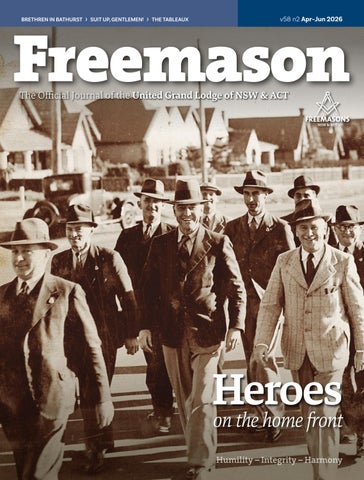
Freemason NSW & ACT - April 2026

Page 1


The Official Journal of the United Grand Lodge of NSW & ACT

The Official Journal of The United Grand Lodge of New South Wales and Australian Capital Territory of Ancient, Free and Accepted Masons

This issue of the Freemason is produced under the direction of:

Interim Editor: Bro Richard Dawes

Chairman: Bro Geoff Williams

Committee: Bros Richard Dawes, Simon Pierce, Derek Robson, Max Katz-Barber, Kim Nielsen, Rick Atkinson, Owen Sandry, Peter Stoneman and Mrs Lynne Clay

Design & Production: Bro Simon Pierce, Megan Baumann and Pam Gill

Freemason is published in January, April, July and October. Deadline for copy is 1st of the month preceding month of issue.

All matters for publication in the journal should be addressed to:

The Secretary

Freemason Editorial Committee

The United Grand Lodge of NSW & ACT PO Box A259, Sydney South, NSW 1235 Telephone: (02) 9284 2800 Email: freemason@masons.org.au

Published articles do not necessarily reflect the policies or opinions of The United Grand Lodge of NSW & ACT.

Publication of an advertisement does not imply endorsement of the product or service by The United Grand Lodge of NSW & ACT.

Advertising enquiries should be addressed to:

Bro Simon Pierce

APM Graphics Management 16 Springwood Street, Blackwall, NSW 2256 Telephone: (02) 4344 5133 Email: freemason@apmgraphics.com.au

Freemason is proudly designed and produced by APM Graphics Management 16 Springwood Street, Blackwall NSW 2256

Printed by Spotpress

Distributed to all NSW & ACT brethren and sister Grand Lodges in Australia and worldwide. Electronic versions of FREEMASON can be viewed or downloaded at www.FreemasonNSW.com

EDITORIAL POLICY

Aims of the Freemason magazine

R To uphold and promote those values, morals and virtues which Freemasonry believes are universal and enduring.

R To foster a better understanding of Freemasonry within the general community.

R To provide a forum for discussion on masonic issues.

R To publicise the charitable works of Freemasonry.

R To provide articles of interest and education and to disseminate masonic news and views.

R To recognise masons who make significant contributions to the Craft and the wider community.

ISSN 1836-0475 or ISSN 1836-0513 (Online)

Print Post Approved 100007316

© 2026 Copyright: It should be noted that copyright for all text, photographs and illustrations (except where otherwise indicated) rests worldwide with Freemason

INDEMNITY: It is the responsibility of the advertiser to ensure that advertisements comply with the Trade Practices Act 1974 as amended. All advertisements are accepted for publication on the condition that the advertiser indemnify the publisher and its servants against all actions, suits,

With profound regret…

I must advise that our editor, RW Bro Terry McCallum, has recently passed to the Grand Lodge Above. My fellow committee members and I are mourning the loss of our esteemed colleague and friend.

This morning (2 March) RW Bro Tony Maiorana phoned to inform me that RW Bro Ted Simmons, our Editor Emeritus had joined Terry in the Grand Lodge Above. Our sense of loss has been deepened and we extend our condolences to the families of both Terry and Ted.

Prior to my accepting the position of editor, none of the Publication Committee could remember a time when Terry or Ted was not editor of the magazine. The loss of so much experience has had a severe effect on our editorial process.

In a perfect world, as the Immediate Past Editor I would step back into the role. Unfortunately, I am now the full time Chairman of a Community Radio station, and I have limited time for editorial work, so we need your help to create a more robust committee.

We ask any brother with editorial, creative writing or proof-reading talents who may wish to volunteer, to contact us at freemason@masons.org.au with details of their experience and availability.

Remembering Terry McCallum

‘When I first met Terry, he said something to make me laugh. Fortunately, he had more than one joke and I think that he shared them all. When he took over as editor it was clear that he had more to offer than a sense of

...we extend our condolences to the families of both Terry and Ted.

humour. His life was colourful and rich (as a photographer he would like to hear that) and Freemason magazine will miss him; it will continue, but it won’t be the same. Some of the laughter we enjoyed will be gone.’

‘Terry McCallum was a mate, a kindred spirit. We would talk together for ages, starting off on one subject then traversing through many more to arrive back where we started. His early life in England, commercial art, design and photography background, his fascination with history and the guitar mirrored my own life, so our conversations were always comfortable, like reminiscing with an old school friend. His mannerisms, his outlook, his love of learning and his interest in everything was infectious and I feel the world is a little less interesting now he’s not in it.’

‘As editor, Terry contributed a wide range of professional graphic design and photographic skills, along with a subtle humour and sharp intellect … not to mention an uncanny depth of knowledge of the history of English and Scottish

royalty! Terry was a passionate volunteer and First Aid/CPR teacher with the Royal Life Saving Society of NSW and also tutored mature-age students in photography at the U3A. His role as Chieftain of Clan McCallum in Australia was the natural link to his popular delivery of the Address to the Haggis at numerous Robbie Burns’ events. Indeed, a man of many talents.’

Remembering Ted Simmons

‘From the start he intrigued me! His knowledge of journalism was almost overwhelming but his life apart from journalism was so full of variety that he seemed a man for all seasons. He guided me as I developed my interest in journalism, and he taught me a lot about the merits of ocean cruises. I told him that going on a cruise was like being locked up in an RSL Club for a week. He soon set me straight! I will miss his guidance but most of all I will miss his friendship. Farewell mate.’

‘I met Ted long before I became a mason. The first time we met, it was like we’d known each other for years, but I believe that was how he made everyone feel. His wisdom and gentle presentation demanded one’s full attention. As soon as I started asking questions about Freemasonry, Ted became my unofficial mentor. He introduced me to several masons at Grand Lodge and the Grand Librarian and finally sent me off to a local lodge to talk to the brethren. Later that year he was sponsor at my initiation.’

‘Our paths first crossed 30 years ago covering various sports at national and international events. Ted not only wrote about sport, he was also an active participant – as an athlete, coach, administrator and talented commentator. He received a host of awards including the Order of Australia Medal (OAM) in 2006 for 50 years’ service to journalism, sport and the community. I was delighted to collaborate with Ted to achieve his goal of publishing a highly acclaimed book chronicling the history of Soccer in Australia – launched at his then remarkable age of 95! A long life, well lived!’

Vignettes of the VDC

As Anzac Day approaches we turn our minds to our armed forces past and present, and reflect on their courage and sacrifices made to enable us to live the life we enjoy today.

But while the brave soldiers of land, sea and air were fighting overseas, who was looking after the safety of their homeland?

These fascinating vignettes presented by Owen Moorhouse show us just what was happening in Australia to safeguard against and prepare for any threats that may come to our shores. Many could not enlist in the overseas forces for such a wide range of reasons, but that didn’t mean they couldn’t play their part here.

In Britain, these volunteers were affectionately known as ‘Dad’s Army’. In Australia they were the Volunteer Defence Corps (VDC).

Have a read and be amazed.

During World War II, the Volunteer Defence Corps emerged in response to the looming threats faced by Australia.

This collection of stories captures my own experiences as a young teenager growing up on the South Coast of New South Wales, where residents banded together to form a civilian army. With limited resources and outdated equipment, VDC members demonstrated commitment and ingenuity, adapting to the demands of defence on the home front. Similar events occurred all over Australia, where residents trained in guerrilla tactics and devised strategies to safeguard their communities.

For the most part, the events recorded here occurred along the South Coast, between Gerringong and Bateman’s Bay, especially around Nowra, where I grew up. The stories highlight not only the historical significance of the VDC but are an attempt to preserve events unlikely to have been

recorded in official histories. They honour the spirit of cooperation and camaraderie that reflected the deep sense of duty, during this time of crisis.

A war a world away

Initially, the war in Europe seemed a world away, even though I distinctly recall listening over the crackly short-wave radio to Adolf Hitler’s rants, the reassuring tones of Neville Chamberlain and the stern reaffirming oratory of Winston Churchill … all seemingly without consequence. Not until militia members were called up for training in Goulburn and at the Nowra Showgrounds, did the reality of the crisis come into focus.

The initial plan for local defence involved reforming the old Australian Light Horse regiments of WWI, into motorised units using Ford and General Motors vehicles, often requisitioned from the civilian population. Additionally, local high school graduates and young men who sought to enlist in the Royal Australian Air Force (RAAF) were given

The VDC was also trained in the art of camouflage.
Photo courtesy of the National Archives of Australia

preparatory night classes to achieve the academic standards required by the Empire Air Training Scheme (EATS). This helped build capability quickly among Commonwealth countries. To fully qualify as aircrew, subsequent training was often conducted in Canada.

Though unbeknown to we local South Coast residents at the time, these young trainees would go on to become some of the troops, sailors and airmen who would fight the battles of the Western Desert, Mediterranean and the Battle of Britain.

When the wreckage from sunken shipping began washing up on the Australian coastline – the work of ships like the German Auxiliary Cruiser, Kormoran – it suddenly became apparent that Europe’s war had arrived on our doorstep.

With the bulk of Australia’s fighting forces already in the Northern Hemisphere, the Returned and Services League of Australia (RSL) began lobbying the Curtin Government to establish a volunteer civilian army of men too old, too young or unfit to enlist in the regular armed forces. The concept was modelled on the British Home Guard, fondly known as ‘Dad’s Army’.

In February 1940, the Australian VDC was established and attracted some 40,000 members, under the command of retired WWI AIF Light Horse General, Harry Chauvel. The VDC had few uniforms, almost no equipment and what little they did receive was either home-made, Boer War or WWI vintage. As a young teenager not old enough to take part, even I was taught to use an Enfield 310 single round bolt action rifle. Designed in an era predating the Boer War, it had been standard issue to train army cadets. Rifle Clubs were also called upon to relinquish all suitable firearms to the VDC, yet they were undersupplied with ammunition, meaning target practice was strictly limited. The VDC’s training focus became that of weekend drills and nighttime parades after work.

In June 1940, 33,000 British and Allied forces were miraculously withdrawn across the English Channel from Dunkirk. Aside from the shock as to why

With limited resources and outdated equipment, VDC members demonstrated commitment and ingenuity...

a withdrawal was necessary in the first place, the War still seemed distant to us in Australia. Then months later, sobering news trickled in by sea mail, where we learned that my mother’s cousin, a retired British Naval Warrant Officer and Yeoman of Signals, had survived multiple channel crossings to evacuate troops. Alarmed, my reading habits promptly changed from the locally produced Ginger Meggs comic strips, to the British boys’ magazine called The Boy’s Own Paper. It seemed more current and contained insights to British life during the Blitz and training ideas directed at youthful members of the British Home Guard. Though the publications were months old by the time we received them, as a young teenager those articles were engrossing and dovetailed into current events unfolding locally.

The Japanese surprise attack on Pearl Harbour in December 1941 instantly propelled the USA into the war, meaning Japan was now a direct threat to Australia’s largely unprotected shores. This suddenly made the VDC very relevant, if not tactically impotent, against this looming threat. In Southeast Asia, our 17,000-strong Australian Army was soon largely lost in Singapore. Against the wishes of Winston Churchill and at the insistence of Prime Minister Curtin, the 7th Division in the Middle East was returned to Australia. In an extraordinary exercise in logistics, they were redeployed by sea from Suez to

The author’s father was RW Bro Frank Osborne Moorhouse OAM PDGM, who was involved in the VDC during World War II.

RW Bro Moorhouse was initiated into Lodge Halcyon 565 on 19 July 1926, passed to the second degree on 18 October 1926 and raised on 17 October 1927, He was a member of:

R Lodge Halcyon 565 from 19/07/1926 to 28/02/1929

R Lodge Abercorn 60 from 05/06/1928 to 11/04/1994 (his passing)

R Lodge Shoalhaven 840 from 20/10/1951 to 11/04/1994 (his passing)

R Lodge Albert C. Petrie 954 from 07/04/1962to 11/04/1994 (his passing)

In 2005 Abercorn and Shoalhaven consolidated to form Lodge Nowra Unity 60.

He served in the progressive offices, serving as Worshipful Master in 1935/36.

He filled the role of District Grand Inspector of Workings (District 99) during 1952/54, and Regional Grand Counsellor 1979/81.

Grand Lodge Honours:

R Past Junior Grand Warden

PJGW (conferred) 03/1966

R Past Assistant Grand Master

PAGM (conferred) 03/1980

R Past Deputy Grand Master

PDGM (conferred) 09/1991

RW Bro Moorhouse was awarded the Medal of the Order of Australia (OAM) on 13 June 1988 for Service to the Community.

Fremantle in Western Australia, before being transported by rail to Far North Queensland. They were promptly sent on to New Guinea, together with all their equipment, often transported in open rail wagons. There, the Imperial Japanese Army met with Australian conscripted forces and largely untrained militia – a gallant force that would become the Kokoda ‘Ragged Army’. By absolute necessity, they had first call on supplies, leaving the VDC even further under-supplied.

From an out-of-date edition of The Boy’s Own Paper, I studied instructions on how to make an extended noose and how to neutralise an enemy sentry from behind in the dark. At the time, these tactics were considered entirely appropriate, as the VDC swung into being an opposing force against a possible Japanese attack. The biggest concern locally was how to deny the invading enemy access to transport, services and food supplies, should they land on Australian soil. The tactics studied were inspired by the Russian Army which had effectively stretched German supply lines to breaking point and subsequent defeat. This strategy was within the ability of the aged ranks of our local VDC.

Training in guerrilla tactics

In a concerted effort to up-skill VDC members in guerrilla tactics, dedicated camps were established to train section leaders. Special focus was given to techniques to be deployed to destroy rail and road bridges. Senior members then passed these learnings on to their platoons. Guerrilla training demonstrations involved the use of gelignite and match-lit fuses, to clear trees or

...the exercise provided a terrifying glimpse of things to come...

blow-up unwanted rock features, usually on the farm of a VDC member. As these were times of national emergency, most exercises were carried out without medical support, as regimental first-aid orderlies were also in short supply.

A shortage of hand grenades prompted the production of Molotov cocktails; hand-thrown incendiary bombs that VDC members made from glass beer bottles. They were filled with petrol, ignited with a cloth wick, to be thrown against an enemy tank with potentially devastating results. The VDC also made grenades from jam tins for use as anti-personnel bombs. They packed a tin with a partial stick of gelignite, surrounded it with nails or nuts and bolts, and embedded it in clay. The gelignite was ignited with a match-to-fabric fuse.

During a Sunday morning training course, one of these lethal weapons exploded prematurely in the right hand of Arthur Booth, a Nowra public accountant. It was only by good fortune that no shrapnel had been added to the device, saving his life. That said, he sustained severe injury and a lifelong handicap.

The plan for food and cattle

In the event of an invasion of Eastern Australia, a major initiative was planned to drove all cattle inland from the coastal plains via a few mountain passes, with the help of the VDC. By mining these mountain passes with explosives, the strategy was to deny invading forces the ability to live off the land.

An explosive-packed roadblock was built and manned by the VDC on Clyde Mountain, along the King’s Highway, that is also a direct route from Bateman’s Bay to the national capital. Now known as Pooh’s Corner, it is still visible today and a memorial has been erected at Nelligan to record this wartime strategy.

Anti-aircraft defence

Even before Japan entered the War, the horrors of the German blitzkrieg in Europe had chilled public anticipation. Aerial bombing had been trialled some years earlier during the Spanish Civil War and by Mussolini. Britain had also used great nets suspended from barrage balloons with some success. This might have been partially effective in southern England or to protect Australia’s urban areas, but certainly not practicable for columns of fleeing civilians. Without anti-aircraft artillery, the possibility of employing such tactics on the vast Australia shores was next to negligible.

In the early war years, joint exercises or drills were called to test the viability of riflemen combating strafing aircraft. On the South Coast, men from Kiama to Nowra formed a new and largely unarmed Home Guard (soon to be known as the VDC), together with local militia platoons

VDC platoon in attack through a smoke screen at Braybrook, Victoria.
Photo courtesy of the National Archives of Australia

yet to be called up for service. Their mission was to trial anti-aircraft tactics.

In the long grass on the hills overlooking the sea at Gerringong, they successively laid themselves out in lines of perhaps six or so riflemen. Each line laid across the presumed direction of the approaching aircraft. The men were then required to jump to their feet and fire as the aircraft approached. The RAAF had organised one Wirraway and an Avro Anson aircraft to play the role of enemy planes, even though they bore no resemblance to the Stukas or ME 109s already in combat in Europe. Nor were they anything like the soon to be deployed Japanese Zeros, in appearance or speed. Yet the outcome of the drill would have probably been the same.

The aircrafts’ direction of approach was either planned or predicted, and as they flew in from the sea at low altitude, the noise alone was sufficiently demoralising. However, it proved a daunting mission. The ability of the young men to get to their feet, aim at the planes overhead, reload their 303s, and then fire more imaginary shots before the aircraft disappeared from range was not practicable. Rather, the exercise provided a terrifying glimpse of things to come, despite the relatively slow speed of the demonstration aircraft.

Even if the riflemen were ready at right angle to the flight path, the drill in Gerringong demonstrated its ineffectiveness, and highlighted the risk of casualties through the formation of a ‘shooting gallery’ of men for attacking aircraft.

Sudden Increase in numbers

On 7 December 1941, news of the surprise attack on Pearl Harbour was chilling, and contributed to a sudden enlargement of the VDC. Ranks quickly grew from about 40,000 to 100,000. An acute shortage of uniforms, arms and ammunition was complicated by the fact that most new recruits were veterans of WWI and or even the Boer War, and the uniforms were made for much younger and more lithe men. The VDC was initially issued with earlier style army uniforms that followed the familiar ‘Digger’ pattern and were olive green in colour. For some reason, these were

suddenly recalled, and a more regular design was issued. At the time, it was rather implausibly explained that these Digger style uniforms were to be reassigned to Italian and German prisoners, arriving from the North African Western Desert, so they could be readily differentiated from their guards. I’m not sure whether this was true, but certainly nothing was heard of those uniforms again. Food, clothing and petrol were all severely rationed, but VDC members who attended the Wednesday night parades, and Sunday exercises were provided with tea, milk and sugar.

Boiling water was provided on site using one of my father’s locally manufactured ‘Moorhouse Dairy Boilers’, stoked by George Holland, a veteran of the WWI Western Front. Supplies of these rationed staples were a small relief to households struggling with restrictions. Because food supplies were reserved for our forces and beleaguered forces in Britain, all local VDC members were required to bring their own meals. It wasn’t until 1943 that armaments became more readily available, boosting morale. Bren guns and rifles slowly appeared, together with munitions, but for transport, the VDC still depended entirely on private transport with members using their own limited rations of petrol.

White Jackets, Briefcases, Case Covers & Name Plates, PM Jewels, Centenary Jewels, Term Bars & Engraving, Grand Lodge Regalia, Aprons, Collars, Gauntlets & Jewels, Collarettes,
MAKERS OF FINE REGALIA SINCE 1947

MARCH QUARTERLY COMMUNICATION

Past Grand Masters, brethren, it is great to be with you today which is the first Quarterly Communication in 2026 and in regional NSW, during my term.

The standing invitation for brethren to come together, not as witnesses but as co-creators of Freemasonry in NSW & ACT continues to receive support and is very much evident in the number of attendees at our Grand Lodge today. It is superlatively pleasing especially, as both the Quarterly Communication and the banquet that follows have filled the venue to capacity. I trust today heralds another very productive and fulfilling year for many lodges in the jurisdiction and for our Grand Lodge.

On behalf of your Grand Lodge, I thank you brethren, for your continued generosity and support which

OUR NEXT COMMUNICATION

The next Grand Lodge Quarterly Communication and dinner will be held on Wednesday 10 June 2026 at 7:00pm.

The Communication is open to all members of Grand Lodge, which includes all Master Masons. Other brethren are invited to attend as observers.

encourage an attitude of gratitude. You can continue to rest assured that I know that you know that I know who you are.

Departed brethren

However, brethren, we have also farewelled some of our number. Let us remember our brethren who are no longer able to join us in our milestones and celebrate our wins having passed to the Grand Lodge Above.

Brethren, you have been provided with a page in your agenda pack listing the names of 28 brethren whom the GAOTU has been pleased, in His infinite mercy, to take unto Himself since our December Communication. You may notice 25 of them were between 70–90 years old and 15 of them had laboured in the Craft for over half a century when they dropped their working tools.

Let us make a sincere effort to extend condolences and any assistance, if required, to their nearest and dearest. Please be mindful of our obligations to our brethren’s widows and orphans from whom we benefitted by the countless hours our departed brethren spent in the service of our Craft.

In particular, you will recognise the names of three brethren whom we have seen labour in our Grand Communications in previous years.

R We recall RW Bro Edward Israel Simmons OAM PDGM. Known to many of us as Ted, he was initiated, passed and raised in 1956. RW Bro Simmons was 97 years old and had

been a mason for 70 years when he passed to the Grand Lodge above on 2 March 2026. He was a Worshipful Master of four lodges, served as DGIW in 1970–72, a Grand Representative to two Sister jurisdictions and was an Editor of our Freemason magazine.

R We also remember RW Bro Robert Drysdale PJGW who passed to the Grand Lodge above on 4 February 2026 aged 78. Initiated, passed and raised in 2006, RW Bro Drysdale was a mason for 20 years with five of those years as a Worshipful Master in two lodges and our Grand Chaplain from 2022 to last year when he fell ill and unable to labour in our quarries.

R We also remember RW Bro Terry McCallum PJGW who was a very prolific photographer who covered recent Grand Installations and Proclamations since his initiation in 2007. At the time he laid down his working tools in January 2026, he was 75 years old and had been a mason for 19 years. He was the Editor of our Freemason magazine when he passed to the Celestial Lodge Above.

We remember the labours and contributions of our brethren to our Grand Lodge with gratitude.

Brethren, please stand. The Grand Chaplain will offer prayer for all our departed brethren. (The Grand Chaplain offered prayers.) Be seated, brethren.

Brethren, you may all be familiar with the saying, ‘if you build it, they will come’.

The quarter since we last met in December has been pleasing as it has been a time of continuous building of the Craft – a very productive period in craft-as-usual activities and initiatives, as well as public-facing developments.

In addition to the regular meetings, degree work and installations which are staple labour in our quarries, numerous events transpired or were especially organised that provided opportunities for the brethren to build and celebrate Freemasonry with their brethren, their families and the community.

R As Grand Master, I share in the pleasure and pride of the brethren in noting our brethren who represent our Craft in their public and private avocations.

R First, I congratulate the recipients of the 2026 Australia Day Honours;

R I also congratulate RW Bro Dr Abraham Constantin for having been elected World President of the World Lebanese Cultural Union. The WLCU is the organisation which links the resident Lebanese people and the Lebanese diaspora across the world;

R And I applaud the heroism of Bro Cesar Barraza in December. He was identified as the plainclothes officer firing at the terrorists during the Bondi shootout. Bro Barraza was captured on footage exposing himself to danger by moving into position next to a tree and firing toward the bridge from about 40 metres away. I had the honour of speaking to him to express admiration, gratitude and support on my own behalf and yours, brethren. His humble reply was, ‘It may sound like a cliche but, I was just

ON THE HORIZON

Victorian Freemasons Convention 2026

22–24 May

Join Freemasons from across Victoria, interstate, and overseas for a weekend of learning, inspiration, and connection.

Key speakers include Arturo de Hoyos, Kathleen Aldworth Foster, Dr Mike Kearsley, Dr David Taylor and Dr Roly Wettenhall.

Masonic Ambassador Bro Phil Bateman will be doing an ‘Open Night’ presentation for non-masons. Partners and friends are welcome to particiapte in Sunday’s events.

Tickets: www.trybooking.com/DIXWL

Grand Master’s

Sleepout 2026

13 June

Uniting lodges across NSW & ACT for a night of awareness and action.

Experience and raise awareness for homelessness – more information on how you can participate is available through your Regions and lodges.

Region 3 Gala Night

11 July

This wonderful event will commence with canapés and drinks on arrival followed by a 3 course meal including drinks in the Main Banquet Hall. Dancing to the accompaniment of a live band will provide the after dinner entertainment. All tickets will be entered into a monster raffle with many great prizes. Sponsorships at the Gold, Silver and Bronze level are sought and all funds raised will be donated to a charity to be announced soon.

This event will be launched soon and all details will be published on the Grand Lodge website and facebook page.

Carrington Gala Dinner and Masonic Awards Night

7 November 2026

Brethren are invited to join us at the Sydney Masonic Centre for a night that serves two purposes: to honour the legacy of Lord Carrington, the first Grand Master of the United Grand Lodge of NSW & ACT as well as a Masonic Awards Night to celebrate charitable acts and achievements of lodges and brethren across our jurisdiction.

Mark this event in your diaries, further details and booking links will be made available closer to the date.

doing my job.’ I might add my personal delight, when I introduced myself to him, Bro Ces said, ‘I know who you are, Most Worshipful Grand Master’.

R I was also gifted to have attended lodge activities overflowing with attendance of brethren and their families and participate in memorable moments such as the Christmas parties of Sydney St George 269, Blacktown Kildare 393, Jose Rizal 1045, Sir Walter Scott 123, The Cedars 1041 and Education 814 among others. Practical examples of the saying, ‘if you build it, they will come’. These lodges’ gatherings keep getting bigger, their activities becoming more inclusive of community and curiously, or I submit, inevitably, their membership has grown in parallel.

R The fundraiser events that brought impressive numbers of brethren to the annual Charity Gig of Blacktown Kildare in January and District 35 in February are also very pleasing as we saw the community engaged in raising substantial amounts at both events in support of Masonicare in the delivery of its objectives and statutory obligations. I commend the brethren to continue their collaboration with Grand Lodge and Masonicare to raise and distribute proceeds of charitable work conducted by brethren.

And on and on, brethren, regular meetings transformed into special events – the third edition of the annual Grand Master’s Raising Under the Stars in Lachballin in Cowra, the annual luncheon of The Prince Charles Edward Stuart Lodge, the installation in Gowrie of Canberra held on Valentines Day… I was honoured and pleased to have been invited, involved and to have participated in these fields of dreams in the company of brethren who continue to prove that ‘If you build it, they will come’.

Brethren, consistent with, and mindful to be constantly co-creating a harmonious member-centric Masonic organisation, true to its impressive traditional customs and usages operating in the contemporary world with good corporate governance and tight fiscal management, your Grand Lodge leadership continues to explore and effect initiatives that bring value to the lodges and brethren.

Your agenda pack includes reports of the work that the various offices, committees and boards are engaged in. What are not specified are details of works-inprogress, commercial negotiations and other items under review pertaining to ceremonies and portfolios of your Grand Lodge. You will be pleased to note the following appointments of brethren who will continue the Grand Lodge business-as-usuals and initiatives:

1. First, I seek to cover Item 10 in the agenda regarding the appointment of a casual vacancy to the Board of Management. Brethren, in accordance with (Clause 8.1.8) of the BoC, I appoint RW Bro Todd Shadbolt to the casual vacancy.

2. RW Bro Geoff Williams is appointed as the Chairman of the Freemason Magazine Committee. I request that you support the magazine with articles and updates of your ongoings. We also note that the sudden passing of RW Bro Terry McCallum may result in some articles which were sent to him previously may not have been shared with the committee. If you have sent an article that is not time-sensitive and has not yet been published, kindly consider resending it for review by the committee.

3. W Bro Hamish Stitt and W Bro Anthony Bazouni are also appointed to reinforce the Grand Registrar’s Committee currently comprised of RW Bro Greg Grogin, RW Bro Robert Sutherland DGR, W Bro Andrew Stewart, RW Bro David Adams, Bro John Sutton and MW Bro Les Hicks. Brethren are encouraged to please continue to employ the mindset of not overtasking the GRC officially.

On your behalf, I thank the Secretariat led by MW Bro Hicks, who continue to serve the brethren to the best of their abilities and who have reviewed corporate processes and identified cost efficiencies in their operations that are protecting value as well as creating value that enable numerous initiatives in Grand Lodge and the jurisdiction.

And I encourage the brethren to explore ways to create value for their members and their masonic centres. We have shared the wins of the masonic

centres in Bondi, Collaroy and others that have gained commercial tenants in the last year who are generating the resources that allow them to maintain their buildings and create an environment in which members and candidates would be proud to meet and be proud to belong. Inquiries have been sent to our Building Management Committee led by VW Bro Hutchings for more locations such as, but not limited to, Canada Bay, Strathfield, Five Dock, Burwood, Croydon where the same setup at Concord Masonic Centre is already established, as well as in Hurstville, Kogarah and Rockdale.

If you build it, they will come. The concept is not new. There is a Zen proverb, ‘when the student is ready, the teacher will appear’ that implies that guidance or knowledge arrives exactly when a person is prepared to learn, understand, or accept it. I submit to you that the reverse is also true – when the teacher is ready, the student will appear.

We enjoy the inheritance of membership in an ancient fraternity of good and noble men who aim to make good men better. In so being, we are bequeathed the asset of an organisation with beautiful traditions, ceremonies, ritual and the structure that supports it. We have the advantage of membership of good and noble men such that even monarchs have deemed it acceptable to exchange their sceptre for trowels to belong.

Let us continue to build strong lodges that our communities can be proud of and to which good men wish they could belong. We are in the most competitive times in the history of our Craft when it comes to capturing the attention and retaining the interest of men in the midst of modern family commitments, easy access to information on the internet, network television, social media and the like.

But we have the advantage of a history of an ancient fraternity of good and noble men who aim to make good men better in the company of like-minded men. When we show humility and exercise integrity by continuing to conduct memorable ancient ceremonies done exceptionally well that provide value to those seeking personal growth and meaning in well-organised meetings and pleasing festive boards… when we demonstrate

harmony among brethren who, even when disagreeing, are respectful of the dissenting views of others… when we are able to demonstrate how we have created value in the lives of men in history and continue to do so in the present times, we are being true to our values and ready to attract interest, receive inquiries and

process applications of candidates –good men who wish to join our ranks.

When the student is ready, the teacher will appear. It goes both ways, brethren: when the lodge is ready, the members will appear; and when a candidate is ready, the lodge will appear for them. The Volume of the Sacred Law

SNIPPETS FROM BOARD REPORTS

The following are extracts of interest from the various reports submitted at the March Quarterly Communication. The full reports are available on the UGL website and Lodge Secretaries and Worshipful Masters are urged to read them.

The following are extracts of interest from the various reports submitted by Grand Lodge Boards at the March 2026 Quarterly Communication held in Bathurst on 7 March.

The full reports are available in the ‘Members’ section of the UGL website and lodge secretaries and other officers are encouraged to read the full reports.

Executive Council

The executive council met during the quarter and received reports, extracts of which follow.

Board of Management

The Board has approved a Craft-wide social media policy which will be available soon on the UGL website.

Progress has been made on the webbased reporting for RBOs, DGIWs and RMMs. Changes have been made to how new candidates move through the joining process.

Various matters relating to the masonic centres at Bondi, Collaroy, Bulli, Narooma, Twin Towns, Byron Bay and Broken Hill were presented.

Discussions are underway for some District and Regional re-alignment for the 2026-2028 DGIW term. This may see some changes to Region 2, region 3

and Region 4, with Region 1 remaining unchanged.

Ritual Advisory Committee

The committee considered changes and additions to the Masonic Funeral Service following a recent passing of a distinguished mason. Whether or not these changes will or indeed can be adopted throughout the jurisdiction is still to be determined.

The committee is in discussion with the Board of Masonic Studies for some additions to the presentation of the First Tracing Board. The ritual is to be followed when first presented to a candidate but changes may be allowed for subsequent presentations.

Brethren are reminded that the three degrees of Freemasonry, the Mark Man ceremony and Installation/ Re-installation are the only approved ceremonies. Demonstration of any other ceremony requires a dispensation from the Grand Master.

Masonicare

The Board has approved a five-year plan that will see a total of $250,000 donated to sponsor a family lounge on level 11 of the Children’s Cancer Centre of Westmead Hospital. This facility will be known as ‘Freemasons NSW & ACT Lounge’.

promises, ‘ask and you shall receive, seek and you shall find, knock and it shall be opened unto you’.

Be a lodge that is ready, when the candidates appear.

Continue to build it, brethren, and they will come.

As of the date of the report a total of $516,547.08 has either been paid out or promised for the 2025–26 financial year.

The 2026 edition of the Grand Master’s Winter Sleep Out is scheduled for 13 June 2026, and brethren and more especially masonic centres are encouraged to participate in this event. More details will be supplied to all lodges closer to the event.

Preliminary planning is underway for the Masonicare Awards Night/ Carrington Gala Dinner for the SMC later in the year. This will be Masonicare’s gala event for 2026.

Board of Masonic Studies

Work on the Certificate Course in Masonic Studies continues with discussion on methods of presentation and IT integration within existing frameworks.

Fees and Dues 2026–27

A new schedule of fees and dues for 2026–27 was adopted at the Communication, full details will be forwarded to all lodges in due course.

The main line item affecting all brethren and lodges is the increase in annual capitation dues to Grand Lodge to $200.00 per member.

Like other years capitation dues will be based on the members roll held by UGL at midnight on 30 June 2026, so all lodges are encouraged to check their records regularly and submit LMRs promptly.

The ‘early bird’ discount of $5.00 per member applies until 31 August 2026. All capitation accounts must be paid by 31 October 2026. In the case of non-payment, the lodge may be requested to explain to the Grand Registrar’s Committee why payment has not been made.

Frivolity, friendship, fraternity, formality and food

The Quarterly Communication of Grand Lodge was held in Bathurst on 7 March. The venue for the communication and associated banquet was the original Bathurst Masonic Centre, now known as Keystone 1889.

The foundation stone to this historic building was laid by Lord Carrington, the first Grand Master of the UGL. Since 1983 it has been in private hands as an entertainment centre after Bathurst lodges moved to a more modern building in Kelso.

The weekend started as it finished, with brethren, friends and their partners meeting at the local RSL Club on Friday evening to share food and friendship. About 35 people joined the bistro queue and some banter with others as orders were placed. The Grand Master and a few others helped to close the club around 11:00 pm.

Meanwhile in Sydney early on a Saturday morning, the bus trippers were gathering for their story-filled trip to Bathurst with Mount Victoria Pass still being open for westbound traffic.

A stop at a well-known fast-food outlet in Lithgow featured in the social media feed of the ‘bus people’. Elsewhere a private plane was being fuelled and prepared for another group of attendees.

The venue prepared, the Grand Director and his team practised, and the gathered brethren clothed, the Grand Communication was up and rolling by 2:03pm. The Grand Master asked for a ‘show of hands’ for how many were attending their first ever Grand Communication, and along with at least two EAFs, quite a few hands could be seen. Next was how many people considered themselves ‘country’ brethren and between one third and one half of the audience responded. One of the Grand Master’s stated aims in coming to Bathurst on a Saturday was to give ‘country brethren’ an opportunity to attend a Grand Communication, a

chance not normally available to them for a weekday night in the SMC.

W Bro Will Amer provided some vocal interludes along with the Grand Director of Music. W Bro Amer has been on sabbatical and only rejoined the fraternity on Thursday evening, so he was back into the fray with vim and vigour almost immediately.

Close-up of the eponymous keystone
Detail of the stonework above the entrance

To the appreciation of the Keystone 1889 staff the Grand Communication wrapped up about 20 minutes before its allotted time, allowing just that extra few minutes to turn the hall from a meeting room to a banquet space.

Meanwhile at the Kelso Masonic Centre, the ladies were being entertained by a visual/virtual tour of Bathurst led by Elizabeth Stoneman, who is a member of the local National Trust and a former planner with the then Bathurst City Council, so the stories were contemporary and mixed with humour. The tour finished with a visual ‘hot lap’ of Mount Panorama race circuit in a Mercedes AMG GT-3 race car. Each attendee received a small tourist gift pack prepared by the Information Centre of Bathurst Regional Council before a hearty afternoon tea sponsored by Lodge Barham No 561, Lodge Bathurst United No 79 and the Kelso Masonic Hall Society.

Finally, under a setting sun and leaden skies, the communication banquet announced the conclusion of Saturday’s proceedings. The evening had been sold out for weeks and we all quickly found out why! Ms Trish Carr (Owner/Manager) of Keystone 1889 and her staff quietly

and efficiently provided a menu of well prepared and presented food while we were entertained by The Band of Brothers led by RW Bro Peter Goodridge… the bar was there for those with a thirst!

The tour finished with a visual
‘hot lap’ of Mount Panorama race circuit...

The Grand Master presented each of his special guests, Mr Greg Mortimer OAM and Mr Chris Morgan with a memento of the evening. Mr Mortimer is a mountaineer of renown and Mr Morgan the owner of Abercrombie House. Both have masonic antecedents. Apologies were received from Mr Andrew Gee MP (Federal member for Calare) and Mr Paul Toole MP (State member for Bathurst).

Finally, as the witching hour approached the bus left for its lengthy return to Sydney and the plane disappeared into the dark of the eastern sky, as the rest of us moved off to our residences or overnight accommodation.

However, this wasn’t the end! Sunday morning dawned and 15 to 20 brethren and their ladies assembled at Abercrombie House for a sit down, fully catered breakfast, which was enjoyed by all. A feature of the breakfast was the presentation of a full set of PSGW’s regalia to RW Bro Brian Harvey by RW Bro Peter Stoneman. This regalia had been purchased in 1921 and has been worn by several distinguished masons, one of the last being RW Bro George Stoneman, who was a firm and lifelong friend of the father of RW Bro Harvey. The passing along of regalia is a longtime habit in District 46.

It took the concerted effort of a lot of brethren in Bathurst and in Sydney to move an entire UGL Grand Communication and associated events from the SMC to Bathurst, but I’m sure that each and every one of those brethren were repaid by the overwhelming success of the weekend.

Grand Communication attendees

So there’s this candidate...

He’s a 28 year old recent ex-pat from England and the Aide-de-camp for the Governor, Sir Henry Rawson. He seems quite a focussed and keen chap.

While chatting with him in the South, you find he fought in the Royal Marines and was wounded in the Second Boer War, receiving the Queen’s South Africa Medal and the Distinguished Service Order, achieving the rank of captain.

Your lodge initiates him, subsequently passes and raises him in the coming months. He remains an active member for four years, then returns to England.

What happened to him?

On his return to London, he married Winifred May, eldest daughter of Charles Smith, a Sydney merchant, then stands for Parliament – the seat of Reading in the House of Commons. Didn’t get in.

Undeterred, he stood again in 1913, and was successful. With the outbreak of war, he returned to service in the Royal Marines as a temporary lieutenant-colonel, serving in Gallipoli then France, where he was severely wounded. He became a parliamentary secretary and later chief government whip. In 1923 he was appointed Knight Grand Commander of the Order of the Indian Empire and governor of Bombay. In 1928 he completed his office and was appointed Knight Grand Commander of the Order of the Star of India.

On 13 June 1932 he was sworn in as Governor of Queensland.

He affiliated with Lamington Lodge, No 110 UGLQ in 1933. He served as Grand Master of the United Grand Lodge of Queensland from 1934 to 1945.

From 1932 to 1942, he was the Chief Scout of the Boy Scouts Association’s Queensland Branch, resigning in 1943 when he disagreed with the decision to make the Chief Commissioner a paid position. His scout name was ‘Hawk’, for his association with the Hawke Battalion.

He was awarded a Knight Grand Cross of the Order of St Michael and St George in 1937. He served for 14 years, through WWII, then retired to England in 1946.

In 1955 he was severely injured in a road accident and passed to the GLA.

Who was this chap?

Sir Leslie Orme Wilson, GCSI, GCMG, GCIE, DSO, PC (1 August 1876 – 29 September 1955), initiated into Lodge Ionic 65 in Sydney on 17 June 1904.

R A Lodge in Pune, India was named for him: Leslie Wilson Lodge No 4880 EC in 1926. They are having their centenary this year. Celebrations include musical programs, a quiz contest, a stage show, golf and mini-cricket tournaments, a souvenir book and a visit by the Pro Grand Master of the United Grand Lodge of England.

R Wilson locomotive: A WCG-1 class Indian locomotive of the GIPR (locomotive plate No 4502), which is on display at the National Rail museum is named after Leslie Wilson.

R Wilson Garden: A locality in Bangalore, is named after Leslie Wilson.

R Sir Leslie Wilson Homes: Yeppoon, Emu Park, Townsville, Redcliffe, Torquay.

R Wilson Point: The highest point in Mahabaleshwar is named after Wilson. Standing at 1439m, it is a popular view point and attracts a large number of tourists, especially during sunrise.

R Leslie Wilson Outback Centre: Royal Queensland Bush Children’s Health Scheme (BUSHkids) was founded in 1935.

The next time you meet a candidate at your Festive Board, consider that he may be destined for great achievements and contributions.

This mason’s portrait hangs in the United Grand Lodge of Queensland.
Photo courtesy of UGLQ / Poulsen Studio Brisbane
Sir Leslie and Lady Winifred May Wilson

DONATION APPEAL

For more than 145 years, RFBI has provided financial support to assist individuals and families in need, fund important research and health programs that help people to live well.

Help us, help others by donating to RFBI’s Benevolence Program and Annuities Scheme.

In March, RFBI launched our new Benevolence Grant Program, an important milestone that will allow RFBI to extend our impact even further.

Our Grant Program will provide up to $200,000 each year between now and 2030 to support community-led initiatives that improve the health and well-being of older people, particularly in areas where RFBI operates, helping services grow, adapt and deliver meaningful outcomes.

This new program and indeed all our benevolent work are only possible because of the generosity of our benefactors. Your ongoing support enables RFBI to respond to real need, helping people maintain dignity, security and connection at some of life’s most vulnerable moments. As we enter our Appeal Quarter, we warmly invite you to continue standing with us so we can, together, keep helping those who need it most.

Donations of all sizes are gratefully received and will support RFBI’s ongoing Benevolence and Annuities program.

To make a donation, please visit rfbi.com.au or use the envelope provided.

Your donation directly helps us to help others.

For all enquiries regarding donations and bequests, please contact 02 8031 3200 or email admin@rfbi.com.au

RFBI is a registered charity. As such, donations of $2 and over are tax deductible.

RFBI Basin View Masonic Village Fundraiser Volunteers

A Freemason pays it forward

Warwick Penrose, A Start in Life alumnus, fifth-generation Freemason and now owner and CEO of one of Australia’s leading organisations in counter-threat solutions and protective capabilities for hazardous environments, is a great example of what can be achieved when early support fosters purpose, and shows that one person’s journey can light the way for others.

Agroup of A Start in Life students recently boarded their first-ever flight – to Brisbane where they visited EPE Trusted to Protect and discovered so much more than just robots and technology. They learned, through sharing Warwick’s story, that early support can light the path forward, offer new experiences; and that career pathways aren’t simply something for abstract classroom discussion, rather they can open the way to hypothetical futures and endless possibilities.

The students were welcomed by Warwick who introduced them to places and concepts most people will never get to

see or even realise exist. The students explored advanced robotics laboratories; examined bomb disposal and protective technologies; watched demonstrations that exist for the simple purpose of keeping people safe; the Boston Dynamics robotic dog wasn’t just impressive technology but a practical answer to keeping people out of dangerous situations and replacing them with innovation.

Warwick shared his journey openly with the students; he’s walked the pathway they are beginning. What stands out for him are those at A Start in Life who believed in him, the guidance he received, the mentors who nurtured his potential and the practical support

Warwick shared his journey openly with the students; he’s walked the pathway they are beginning

he received that helped him take those crucial first steps. He credits A Start in Life, and the values he learned through Freemasonry and his subsequent military service with underpinning his path in life.

Service in the Defence Force for Warwick entailed specialising in mine warfare, explosive ordnance disposal, high risk search and CBRNE (coordinated responses to threats or incidents involving Chemical, Biological, Radiological, Nuclear, and Explosive materials) operations. During a NATO deployment in Bosnia, he established the SEARS Foundation to help clear landmine threats and make local swimming areas safe so children could play without fear of being maimed or losing their lives to the remnants of war.

All these were challenging roles that further built the character, discipline and resilience that would later define

Warwick Penrose at high school
Students from A Start in Life learning how the Boston Dynamics Spot robot works.

Warwick’s leadership when he transitioned to civilian life and the opportunity arose for him to purchase and develop EPE. What began as just two people has grown into a team of over sixty, delivering and supporting worldclass protective solutions to defence forces, the police, government agencies across Australia, New Zealand and our allied nations.

Warwick’s commitment to service runs through everything he does. Today, through EPE he clearly follows this by employing veterans and building a workplace grounded in leadership, integrity and respect – and that dedication has not gone unnoticed. EPE was named a finalist in the Prime Minister’s National Veterans’ Employment Awards, and Warwick a finalist for Veteran Entrepreneur of the Year.

Warwick’s journey demonstrates so much of the values and assistance championed by A Start in Life and fostered by the wider masonic community: good character, personal growth, moral discipline, charity, service – not simply ideals to be talked about, but as real foundational forces that can genuinely shape lives, open doors to opportunity and positive, contributing futures.

The masonic ideals in Meditations

‘The

world will be at peace when philosophers become kings and kings become philosophers.’ These words of Plato, found in The Republic, are not just politics, they are an initiatic vision.

Plato did not speak of kings who excelled in the art of rhetoric, nor did he speak of kings who excelled in the art of war. He spoke of kings who excelled in wisdom, kings who were tempered in reason, kings who were imbued with virtue. He understood that peace was not just the absence of war, but the presence of inner harmony, an inner harmony that was reflected in the outside world. The king had to conquer himself before he could conquer others.

History does not often present us with an example of this ideal type, but in the monarchs of the ancient world, there is one individual who stands out in terms of his regal bearing, the ruler of the Roman Empire, known for his philosophical treatise, Meditations, Marcus Aurelius. In him, monarchy and philosophy were combined. He was a ruler over vast lands and armies; but in his philosophical musing, he sought to control his passions before controlling others. In Marcus Aurelius, we find the embodiment of Plato’s ideal of the philosopher-king.

Freemasonry recognises this ideal within the very foundation of Masonry’s teachings. Masonry does not seek to gain political power but must have moral power. A mason must first learn to control his own thoughts, words, and deeds before he can hope to make any worthwhile contributions to harmony within his lodge or society. The symbolic working tools of Masonry silently preach this message: the gavel chips away at superfluities of character; the square controls behavior; the compasses control

desire. Marcus Aurelius was a man who practiced this inner discipline. ‘You have power over your mind—not outside events [sic],’ he wrote to himself. This is the very same discipline taught within Masonry: power is not found in outside events but within controlling one’s response to them.

Marcus ruled during a period of plague, war on the Danube frontier, civil disturbance, but always returned to justice, temperance, courage, and wisdom. He saw himself as having a trust to fulfill under the higher law of morality. This is exactly what Freemasonry teaches about ruling in the lodge or the world—ruling is a trust under the higher law of morality. Wisdom without power is impotence; power without wisdom is tyranny; wisdom with power is balanced ruling. Plato’s philosophy was not a dream of a utopia; it was a challenge to join wisdom with responsibility. A ruler from a distant past, Marcus Aurelius, shows us that it can be done.

Plato’s words still represent a challenge to each and every age. The world may never accept the notion of the philosopher king, but Masonry does quietly produce men who aspire to rule over their own lives through wisdom. In this regard, every mason is called to become the philosopher king, but over their own passions, not nations; over their own consciences, not territories. For peace to rule in the world, it first must rule in the hearts of men, and the emperor Marcus Aurelius is an ancient exemplar of this truth, where the union of thought and rule, reflection and action, philosophy and kingship, is the foundation of peace.

One of the students tries his hand at a remote-control unit
Marcus Aurelius, author of Meditations
Photo courtesy of Photothèque du musée Saint-Raymond

The Tableaux

Bro Mitch Savage-Charman bent his talents to create modern interpretations of the Tracing Boards. This is the fascinating journey of their creation.

Disclosure up front – I know the author, Bro Mitch SavageCharman, and can vouch for his sincerity and passion. He is a deep thinker and an impressive young man who is certainly determined to get the most out of his journey in Freemasonry, but also to make a contribution using his field of expertise: visual art. Among other things, Mitch has been a visual effect artist for a long-running and globally recognised television series, various movies, advertisements, and art exhibitions. (If you’ve been to the movies or watched Netflix, you’ve seen his work.) His book is visually stunning but also a window into the

musings and spiritual interpretations of a young man who is an ardent seeker of the truth.

At the October 2024 conference of the Australian & New Zealand Masonic Research Council Mitch delivered a Kellerman Lecture* entitled The Tableaux: Alternative Perspectives of the Tracing Boards, which not only launched the book, but captivated the audience.

I must also confess that, despite being older and having been involved in Freemasonry for longer than Mitch, The Tableaux provided two major revelations for me that I was previously unaware of – a bit like being struck by metaphorical lightening: twice. For me, reading The Tableaux was well worth it for that alone. When interviewing the author he said, ‘Hearing about your revelations makes the whole thing worthwhile’, and to my mind makes The Tableaux essential reading for any mason seeking to push further into deep subjects for inspiration and greater learning. Enough gushing and flattery – to the point.

The book can be considered as two parts, with the first half providing an introduction, history and visual guide into the various well-known tracing boards which are commonly used as teaching aids in the different degrees, with many examples to examine, and some insightful commentary – accompanied by Mitch’s own versions.

The second half of the book provides a commentary on the design and fabrication of the various artistic components that make up the different tracing boards, the associated challenges encountered,

and some interpretations which should provide a better understanding and education for the reader and which are thought provoking and entertaining. I found the second half of the book to be something akin to a nexus between insight from deep Bible research, an enquiring mind, and a modern artistic interpretation. By way of example, Mitch went to great effort to recreate an accurate visual representation of Solomon’s Temple using 3D design software, referencing Biblical sources, which at times also required researching other temples of that era to help provide a guide for some visual design aspects where the Biblical accounts were inconclusive or totally silent.

Rather than provide an entire description of the book, and steal the author’s thunder, it’s more appropriate in the context of Freemason magazine to drill down into a few specific subjects of masonic interest which The Tableaux examines.

Of central interest is the Winding Stair. According to the author, the thing that got him started on this journey was dissatisfaction and frustration with the winding stair in the common Harris emulation board of the Second Degree which is seen in most modern lodges; the winding stair doesn’t wind, it just has a single turn. I’m sure many among us have wondered the same. In order to really understand what the Winding Stair looked like, a complete reconstruction

Mitch SavageCharman’s new book

of the Temple was required in order to visually represent the interior according to Biblical accounts, and see where an actual winding stair would be placed and oriented. According to the author, this was ‘a sizeable undertaking’. To my mind, the result was what most would likely imagine how it would have been, both in design and orientation. In fairness to the Harris version, he was working in the mid-1800s (released in 1849) with only paints and brushes to create a two-dimensional teaching aid which required cramming everything into a single perspective, whereas Mitch is using the latest 3D software almost two centuries after Harris. In The Tableaux, the purpose wasn’t to create a teaching aid, but rather to solve a mystery through very practical means. The result is stunning, but according to the author it presented yet another frustration; the winding stair meant that when climbing, it was only possible to see a few steps ahead. I’d suggest that continuing his masonic journey will resolve that frustration, just as will examining Mitch’s seemingly accurate

recreation of the Temple interior resolve the curiosities of many as to how the stairs in the Temple must have been. Without recommending or advocating for the removal of the Harris Tracing Boards, I’d suggest that displaying Mitch’s version of the Second Degree Tracing Board somewhere would bring a fresh perspective to every Freemason.

Through this process of recreating the interior of the Temple, Mitch made another startling observation: ‘There’s so much gold – describing most objects and surfaces as plated in gold conjures a glamourous mental image, but rendering it physically shows a monotonous sea of yellow, loses all visual contrast, and undermines gold’s transcendent allure. It doesn’t look impressive or create an atmosphere of awe or splendour. Such excess appears to lack temperance, beauty, balance and, collectively, wisdom; all things revered by both King Solomon and Freemasonry.’ He makes a good point because, as many would know, reading about the Temple is almost like perusing a catalogue of the gold inventory of that

• 3,000+

The Second Degree Tracing Board

region of the world in Solomon’s lifetime. When discussing this, the author speculates that the passages in the Bible must have taken some creative licence to impress a stronger mental image, rather than a physical description. There was surely some definition and exposed wooden surfaces to accentuate the splendour of the interior, though likely heavily accented by gold.

One of the main takeaways from discussing the details of how he went about recreating the Temple was encountering inconsistencies in the Biblical details regarding certain dimensions: ‘One place will state that the interior of the Temple was 20 cubits wide, then somewhere else it’ll say that the exterior of the temple was 20 cubits wide, but the walls can’t have been a thickness of zero.’ The author’s conclusion is that these inconsistencies may provide a hint toward a deeper meaning: ‘Perhaps these passages were not intended to be taken literally, but metaphorically. Maybe it’s less about a blueprint for a physical building and, among other things, subtly pointing towards the temple of oneself. For example, the Holy of Holies is a perfect cube and the whole interior is formed from three perfect cubes. There’s a lot of significance that can be drawn from this. I wouldn’t have found myself investigating it in any depth if it hadn’t been brought to my attention by the mystery of the zero-thickness walls.’

Accuracy is a complicated word in this context.

Another key takeaway from the book was the difficulty involved with making accurate visual representations of the two pillars. Freemasons would be (or will become) familiar with the Biblical accounts of how and where the pillars were made and their various dimensions. But the Biblical account raised another inconsistency, identified by Mitch during the recreation process: there is no possible way the Temple portico, as described in the Bible, would have stayed up without pillars supporting it.

So, were the two huge pillars at the entrance to Solomon’s Temple freestanding or did they provide support for the portico’s roof? I was taken aback by the author’s insight and challenged at the same time because I’d always assumed that the pillars were freestanding, and from a masonic perspective Mitch agreed. However, from their Biblically described height, the portico’s size, and other

architecture of the period, it appears to be unlikely. This reinforced the author’s perspective: ‘The longer I spent recreating the Temple literally, the more certain I became that it shouldn’t be taken literally. Freestanding pillars that hold up the Celestial and Terrestrial globes and represent what we are taught serve a far more useful symbolic function.’

When asked about the most difficult aspect in making the pillars accurate, the author said: ‘I wanted to discover something new or add my artistic perspective to the Temple. Other designs show basic Corinthian capitals to the pillars, but the granular descriptions in the Bible could be interpreted in many different ways. Initially, the references to their bowl shape, leafy design, and network and pomegranate detailing suggested a very Egyptian style, but that felt deeply inaccurate culturally and historically. My second design looked a bit too much like pineapples for my liking. A lot of research went into finding records and studying temples of Phoenicia and from that era. Ultimately, the most difficult aspect of designing accurate pillars was the disheartening experience of arriving at the same Corinthian design used by so many other depictions of the Temple.’

The Tableaux contains examples and re-creations of Emulation, Ancient and Accepted Scottish Rite (AASR), and Rectified Scottish Rite (RER) Tracing Boards. To my eyes, my favourite is a version of the 3rd Degree Emulation Board where three features were supplanted with three lit candles – when I asked Mitch about why he did this, he said:

‘Working in 3D space, lighting the scene is motivated by practical sources. Daylight scenes like the 1st or 2nd Emulation Tracing Board are well lit by a virtual sun (or something brighter, but that’s a conversation for another time). However, for the already dark setting of the 3rd Emulation Board, I wanted to lower the objects below ground level for an extra layer of symbolic significance (apparent to any Master Mason). That made it either too dark to see anything,

Mitch’s reconstruction of Solomon’s temple.

or so bright it lost the sombre atmosphere! So I took inspiration from the three central candles in a Craft Lodge of the Rectified Scottish Rite. The placement of these candles is relevant to the Craft, holds symbolic significance, and also helped me practically light the objects just enough to see them, while bathing them in mystery and shadow.’

I agree. When I asked him, between the Emulation, the AASR, and the RER, which were the most accurate, he said: ‘Accuracy is a complicated word in this context. There’s very little literature to define what does and does not constitute a Masonic Tracing Board as opposed to, say, the rituals themselves. So long as it includes a certain set of symbols, it could serve as a Tracing Board. Each evolution and each artist’s interpretation, stands alone and they all have their strengths and weaknesses. In saying this, I do feel some things have shifted and, although they haven’t been lost, perhaps they have been buried in time. As the position of some symbols change, like the Sun and Moon swapping positions, some deeper layers of meaning have become muddled. I think the RER and AASR Boards maintain their heritage to the first Tracing Boards that were drawn on the lodge room floor in chalk or sand at the beginning of each lodge meeting. But the emulation boards add a level of atmosphere and depth. I’d like to think my nine Boards strike some balance between all their strengths, but I wouldn’t dare go so far as to say my boards are more or less accurate than any other.’

When asked how the writing and researching the book affected him as a mason, Mitch said: ‘Great question! Making the Boards raised a lot of questions and seeking their answers has deepened my understanding and appreciation for the Craft (and life itself) quite considerably. I’m also very moved by the positive effect it’s had on people around me. I’m honoured to have received so much feedback from people telling me how much one part or another has entirely changed their perspective on life or the Craft for the better. Charity is the highest good we can do as a human and as a mason, but plugging in your card details and wiring money into the internet abyss can sometimes feel detached

Studies of pillar capitals

from the spirit of charity. Being able to meaningfully benefit people’s lives using a skill set I’ve developed my whole life and then being able to witness the fruits of this labour manifest through the actions it prompts people to take (in some cases, giving to charity themselves) is a very fulfilling and worthwhile exercise of charity. It has opened a different avenue of the craft of giving, or bestowal, which I look forward to exploring further.

What I took from that was the original Tracing Boards in lodges has come a long way and evolved since they were drawn in sand on the floor, or with chalk on a wall, and then removed when the ceremony concluded; but ultimately through the process of creating them in order to teach, the one who gains the most from it is the one creating the Tracing Board.’

When I asked Mitch what he hoped people would gain from reading the book and seeing his designs, he said: ‘I’d love to inspire people to create their own Tracing Boards. The approximately 200 pages of the book were all written in response to the process of making the boards, the act of creative writing revealed insights, and raised questions that gnawed away at me until I found the answer. You never know what will jump out at you! Creation as an act of bestowal draws one closer to the Creator and reveals things about His creation. I would personally love to hear every brother’s insights on, and see their own versions of, the Tracing Boards.’

In conclusion, even though lack of artistic skill may prevent me from making my own Tracing Boards, I feel enriched from having followed Bro Mitch Savage-Charman’s journey in making them and absorbing his insights along

the way. I’d recommend that The Tableaux find a place on every mason’s bookshelf and in every lodge library, and that Mitch releases a second edition of his large, framed Tracing Board artwork (I can see one on my office wall already).

The Tableaux is available at ionicpublications.com.

If you’d like to acquire framed artwork or arrange a Tracing Board presentation for your lodge by Mitch Savage-Charman, you can email him at mitch@savagecharm.com.

Kellerman Lecturer: awarded by the ANZMRC to lecturers who have presented at an ANZMRC Conference.

Artwork © Copyright Mitch SavageCharman. All rights reserved.

CLASSIFIED ADVERTS

MILNE Group Travel & Tours

Casual Tourist Drivers

Urgently Sought

Blacktown, Hills & Hawkesbury

The perfect opportunity for semiretired or small business owners available to work flexible hours. Enjoy meeting new people and driving them safely to a variety of destinations. It is preferred that you already have an MR/HR licence. Contact Damian on 02 8856 5629 or email operations@milnetours.com.au

List a Classified Ad for as little as $25 per issue Email freemason@ apmgraphics.com.au for details.

Home at last!

For more than 100 years, the Apron of MW Bro Sir Robert William Duff – our third Grand Master – was displayed almost 17,000 kms from Sydney in the Museum of the Grand Lodge of Scotland in Edinburgh.

Why it was there, and how it was returned is an interesting tale with a happy ending … (well, not quite an ending … it’s back in Sydney indefinitely!)

MW Bro His Excellency the Right Honourable Sir Robert William Duff, PC, GCMG was born on 8 May 1835 in Kincardineshire, Scotland. The only son of a Scottish landowner, he joined the Royal Navy at age thirteen and served for over twenty years, ultimately attaining the rank of commander. He was elected to the House of Commons as the Member for Banffshire and was knighted prior to his departure for Australia, arriving in Sydney in May 1893 to take up is duties as 18th Governor of New South Wales.

Described as ‘… handsome, bearded, with a luxuriantly curling moustache and high forehead …’, Duff carried out

his duties as Governor with great dignity. He was installed as Grand Master of the United Grand Lodge of New South Wales soon after his arrival.

However in February 1895, during a visit to Hobart he became ill and returned by ship to Sydney where he died just weeks later at Government House. He was the first New South Wales Governor, and first Grand Master to die in office when he passed to the Grand Lodge Above on 15 March 1895.

Following his burial at Waverley cemetery in an impressive military ceremony with Anglican and Masonic rites, his wife Louisa returned to Scotland and donated his NSW regalia to the Grand Lodge of Scotland in Edinburgh.

Over a century passed until our Grand Organist VW Bro Simon Nieminski (former Grand Organist of the Grand Lodge of Scotland) sent an informal

Sir Robert Duff, by Francois Verheyden, 1883
Photo courtesy The National Portrait Gallery
L–R: VW Bro Bruin Hutchings RW Bro Joe Corrigan, RW Bro Ian Hogan, Bro William Semple, MW Bro Khris Albano, MW Bro Les Hicks and RW Bro Robert Drake

enquiry to Bro Bob Cooper, the long-time Grand Archivist in charge of the Grand Lodge of Scotland Museum in Edinburgh asking whether MW Bro Robert Duff’s apron was still in their care.

And the response was unequivocal and intriguing ’Yes, his NSW regalia is in the GLoS Museum … GLoS did not, and do not, have anything so fancy in the Scottish Constitution!’

MW Bro Khris Albano takes up the story:

‘VW Bro Simon Nieminski then (unofficially) wrote to the Grand Master Mason Ramsay McGhee, informing him of my intended visit to Edinburgh in June 2025, raising the possibility of borrowing MW Bro Duff’s regalia for our upcoming Grand Proclamation in September 2025.

‘Grand Master Mason Ramsay McGhee’s reply indicated that this may be possible and when I visited in June 2025, accompanied by MW Bro Les Hicks, RW Bro Ian Hogan, RW Bro Joe Corrigan, RW Bro Robert Drake and VW Bro Bruin Hutchings, we met with the Grand Secretary of the GLoS, Bro William Semple.

‘On broaching the subject of MW Bro Duff’s apron, he displayed it for us to admire and we then proposed that they loan it to the UGL NSW & ACT for our Grand Proclamation, adding that if GLoS attended the ceremony, they could make the presentation to our Grand Lodge.

‘He then asked when the Grand Proclamation was scheduled and when did we need the apron on loan. He asked when we thought we could give it back.

‘Smiling, I replied with a question of my own, “When do you need it back?” He paused, and thought, and then added, “Oh, keep it as long as you need it; we’re fine as long as we know where it is.”

‘We then signed a loan document for the regalia on special vellum paper with beautiful calligraphy prepared by VW Bro Brodie Taylor from UGLQ – the line for “On loan until” being kept blank.

‘And that is how it came to be that the apron of MW Bro His Excellency

The Right Honourable Sir Robert William Duff, Grand Master of UGL NSW 1893–95

was brought home for display in the Museum of Freemasonry at the Sydney Masonic Centre.’

Newspaper reports on Sir Robert Duff’s funeral

The funeral took place on Sunday, and was the most impressive public ceremony ever held in New South Wales. An immense number of carriages were assembled in the Domain, and there was a muster of all the available troops. Added to these were thousands of private citizens. The procession was of such length that it took fully an hour to pass, and two hours and a half elapsed before it reached the cemetery.

– Ovens and Murray Advertiser, 23 March 1895

As a mere sight the cortege was the most striking spectacle of that character this city has known; and of the crowds that thronged the streets and choked up every thoroughfare on the line of route, many thousands were moved by mere curi- osity alone, no doubt. The ferry steamers and trains had brought their thousands to the city, and it is estimated that during the afternoon, when the proces- sion was slowly moving along it took an hour to pass a given point- there were 200,000 people in the streets.

– Clarence and Richmond Examiner, 23 March 1895

The illuminated loan agreement by VW Bro Brodie Taylor from UGLQ, note the absence of a return date!
Sir Robert William Duff’s grave at Waverley Cemetery
Photo courtesy of SiohmTacos

A century in stone

On Friday 20 February, the NSW Masonic Club commemorated a significant milestone in its history, marking 100 years since the Club’s foundation stones were laid on 20 February 1926.

Set into the Castlereagh Street entrance and still visible today, the original stones record a defining moment in the Club’s growth in the heart of Sydney.

On that day in 1926, the ceremony was conducted with the full dignity of tradition. One stone was laid by MW Bro John Goulston, 11th Grand Master of

the United Grand Lodge of New South Wales, and the other by W Bro Francis H Scott, President of the NSW Masonic Club who presented the Grand Master with a golden trowel as part of the traditional ritual of stone-laying.

Reflecting the close ties that continue between the NSW Masonic Club and the UGL, Club President Bro Peter Zeilic

Albano, past Grand Master MW Bro Lesley Hicks and past Grand Master and Club Patron MW Bro Dr Gregory Levenston OAM to participate in a ceremonial ribbon-cutting ceremony. Dr Levenston wore the armbands that belonged to MW Bro John Goulston which were worn at the original ceremony 100 years earlier, having been carefully preserved for posterity.

Honorary Club Member RW Bro

Lieutenant Colonel John Moore AM RFD delivered an engaging commemorative address, sharing fascinating stories from the Club’s past and recalling many of the personalities and moments that have shaped Club life over the decades.

The beginning of an extraordinary chapter

The new Club building that rose above Castlereagh Street became one of Sydney’s distinctive inter-War landmarks. Notably, the building is still operating for its original purpose and remains owned and run by the NSW Masonic Club – few buildings in Sydney can claim such continuous use and stewardship by the same organisation that created them.

Founded in 1893 as a music and literary society, the NSW Masonic Club has always welcomed members from across the spectrum of Sydney society, and maintains that tradition as an inclusive club open to men and women from all walks of life.

The Club continues to honour its heritage while welcoming new generations through its dining, events, accommodation and community life. The centenary provided an opportunity to celebrate the Club’s enduring presence in Sydney – and the remarkable vision laid down in stone a century ago.

invited Grand Master MW Bro Khris
One of the NSW Masonic Club two foundation stones
Photo courtesy of Stephen Blake
The club building in its early days Photo courtesy of the State Library of NSW
L–R: Club President Bro Peter Zeilic, MW Bro
Lesley Hicks, Grand Master MW Bro Khris Albano, and Club Patron MW Bro Dr Gregory Levenston
Photo courtesy of Stephen Blake

Have your say

Keep them interested

Upon joining a lodge it always takes time to understand the ramifications of progression and requirements to become a good mason and make a contribution to the lodge

Some will aspire to become the Worshipful Master and spend six or seven years occupying each position in the progression, some will just be ‘knife & forkers’, some will find a notch in the charity work undertaken by the lodge, some will drop out. My concern is that we spend a lot of time with each and every new candidate and help him through the Mentoring Program, only to lose a potential good mason; this should not happen and we should be able to use our time and our experience to assist him.

Having completed about five mentoring courses and been a mentor to some new masons in my lodges, I cannot help but think this is the path to a long term success, to retain all new masons and to guide them with personal support. We cannot leave the new mason in the wilderness and expect him to understand Freemasonry and progress to become a useful member of a lodge.

In determining the correct path I am reminded of a visit to my early Central Coast lodge, ‘Saratoga’ by RW Bro Richard Dawes, when he gave a very inspiring talk about the progression of members towards the chair. At this meeting I asked what about all the other activities within a lodge and how can we promote special interests. I went on to talk about these responsibilities. Richard replied, ‘Yes, a great thought, and we should be conscious that not every mason will become a WM.’

I am thinking about some of these responsibilities and positions that would suit some members and keep them interested in Freemasonry. We should not be

complacent and expect every new mason to just fall into an unaccustomed situation and then progress towards a contribution to the lodge.

These are just a few of the possible official and unofficial positions that could be allocated to masons, after a short period of service to the lodge. Some will feel comfortable and make a success of their new responsibility and contribute to the lodge, either short or long term. Of course a few will not.

Caring Officer: Contacts all members who have not attended lodge or are sick.

Lodge photographer: Takes photos of all presentations and charity events, displays them on a Notice Board, and gives copies to the members and Publicity Officer.

Lodge Publicity: Writes articles about special events and the charity work of the lodge and arranges suitable local publicity, to attract new members, plus submits to Freemason magazine for potential inclusion. (Editor’s note: Please refer to the Submissions Checklist article published in the Jul–Sep 2025 issue for tips.)

Lodge News Letter: Produces a monthly activity report for members and visitors.

If we are to retain all masons, we must ensure their interest is paramount, take care to support each man with compassion...

Setup: Assists in setting up the lodge and South for each monthly meeting.

Charity Officer: Identifies suitable organisations that need some help and promotes Freemasonry as a helping hand.

Raffle Officer: Runs a fun raffle in the South with donated prizes etc.

Refreshment Officer: In conjunction with the Junior Warden takes responsibility to organize refreshments for the South.

Lodge Auditors: Checks the financial records of the lodge once a year.

These positions would help retain members by giving them some responsibility and keeping them interested in their lodge and Freemasonry.

If we are to retain all masons, we must ensure their interest is paramount, take care to support each man with compassion and not levy criticism or derogatory remarks, that might upset the member and force him to leave.

Success is demonstrated in the last pages of Freemason, where we acknowledge the long membership of many masons, recording their service of 40 years, 50 years, 60 years and up to 70 years. This is an acknowledgement of so many good and deserving masons. It is testament that Freemasonry is for many, a way of life and is an enjoyment of a lifetime of brotherhood.

Yours fraternally,

The Central Coast Lodge No 2001

Wrong one, wrong all… or not?

I write to comment on the article in the Jan–Mar 2026 issue of Freemason magazine entitled ‘Wrong one, wrong all’. I do not believe that there is any room for identity politics in our jurisdiction. On the contrary, I submit that this

doctrine is fundamentally divisive. It operates by categorising people into oppressors and victims using any number of traits including race, ethnicity, religion and sexual orientation to name but a few. I believe it is anathema to the morals, value and virtues we hold dear as Freemasons.

I have been in the Craft for over fifteen years and have only ever witnessed brethren treat each other with respect and as equals. I do not accept that there is any systemic issue of bias or discrimination of the kind this article portrays. On the contrary, our brethren overwhelmingly adhere most honourably to the Grand Master’s themes of Humility, Integrity and Harmony.

The notion of ‘white privilege’ is particularly difficult to accept. It postulates that those with pale skin somehow enjoy an easier path through life at the expense of their fellows of colour. It has no historical boundaries and invites us to feel guilt for events generations before our time. I submit that it is a racist concept at its core. My own story has my ex-Army father arriving at the Adelaide docks in 1960 as a ‘ten pound Pom’ with the promise of a teaching job and his small family in tow. We grew up in modest housing with little spare money and none of us ever enjoyed an advantage that was not available to all. I would like to know the unearned privilege that was seemingly bestowed upon us. There would be thousands of stories like this within the fraternity, no doubt many much more profound than mine.

Of significant concern is the notion that inactivity or silence must be support for the status-quo. It first pre-supposes that there is a ‘status quo’ in our fraternity of white privilege and systemic bias. There is not. Secondly, it displays the kind of logic that had Sir Thomas More brought to the executioner because his silence was interpreted as betrayal!

It is my hope that our leaders across the jurisdiction are vigilant in ensuring that identity politics never gains a foothold. I believe it is divisive, destructive and has no place in an institution so steeped in morality and virtue.

Fraternally,

Lorna Milgate Scholarship nominations

Freemasonry in NSW & ACT is very fortunate, through the Lorna Milgate Scholarship Trust, to continue to benefit young people by bringing tertiary education within the reach of those who may otherwise have been denied such an opportunity.

These young people have been represented at many Universities and TAFE Colleges and have graduated in a wide range of disciplines including Agriculture, Business, Nursing, Teaching, Engineering, Speech Therapy, Marine Science, IT, Plumbing and Vehicle Mechanics to name just a few.

Over the years there have been in excess of one hundred students who have benefitted from the foresight and generosity associated with the Trust.

On behalf of the Grand Lodge Trustees, I am pleased to invite preliminary nominations from lodges who wish to recommend suitably qualified students for the Lorna Milgate Scholarship Awards – 2026.

Preliminary Nominations close 30 April 2026.

Each nominee must be:

R an Australian citizen;

R a resident of New South Wales or the Australian Capital Territory;

R of suitable academic standing;

R attending a recognised institution of tertiary education;

R in need of financial assistance to assist in pursuing the course.

Please note that if an application does not meet all of these requirements it may still be considered.

Initial scholarships will be awarded to students who have successfully completed the first semester at an Australian University, TAFE College or other approved tertiary institution.

Following receipt of a preliminary nomination on the form at the QR code below, the nominee will be contacted directly and invited to make a formal application to the Trustees.

Lodge Secretaries will be advised of the success or otherwise of any formal application received once the Trustees have made their decision after an applicant’s Semester 1 results are known. Normally this does not occur before July or August of the nomination year.

What is the trust?

Lorna Milgate, widow of William Milgate (Lodge Fraternity No 405) left provisions in her will to form a Scholarship Trust. Originally exclusive to graduates of the William Thompson Masonic School, it was expanded in 1996 to include ‘any persons recommended by a masonic lodge’ and has been granted annually ever since.

Get the form:

Preliminary Nominations close 30 April 2026.

Wot’s all this then?

In 1987, Private Investigator Daniel Morgan was murdered in a pub car park. As a result, in 2025 the United Grand Lodge of England sued the London Metropolitan Police force. How did we get here?

The salacious killing of a man in Sydenham was big news at the time, but it was the fact that the police completely failed to successfully identify and prosecute the murderer which led to decades-long accusations of police corruption, coverups and incompetence.

The prime suspect, Daniel’s business partner Jonathan Rees, along with several other suspects were arrested but all were eventually released without charge. Among the arrested was the officer initially assigned to the case. In the intervening years, the police response has been widely criticised, leading to multiple police inquiries and the eventual collapse of the prosecutor’s case.

During the inquiries, it was uncovered that both the initial officer in charge, as well as ten other officers involved in the investigation were Freemasons, and it was further rumoured that Daniel was going to be invited to join by one of the officers he regularly worked with.

And therein lies the problem. While it is unlikely that those men being masons

affected the conduct of the case – there being far more serious allegations to contend with – the sensationalist press was quick to highlight the link. Since January 2025, at least 77 pieces have been published about this story by news outlets around the world. That’s a lot of digital ink spilled!

But the factuality of the connection isn’t necessarily a defence in this instance. As part of the UK’s Police Regulations Act 2003 states:

‘A member of a police force shall at all times abstain from any activity which is likely to interfere with the impartial discharge of his duties or which is likely to give the impression amongst members of the public that it may so interfere.’

As such, the matter of masonic membership was considered in the final Report of the Daniel Morgan Investigation Independent Panel, and while it wasn’t a substantial part of the report (the word mason/Freemason and similar occurs only 68 times in the 1,256 pages of the report) the panel came to the following conclusion:

‘The Committee did not find membership of the Freemasons to be “incompatible” with the holding of public office, but the Committee did conclude that the fact of membership should be known.’

The report was released in 2021, and in the years since, the London Metropolitan Police (Met) has been making policy changes in response. In late 2025 the Met proposed its most recent change:

‘All police officers and police staff should be obliged to register in confidence with the Chief Officer of their police force, either at the point of recruitment to the police force or at any point subsequent to their recruitment, their membership of any organisation, including the Freemasons, which might call their impartiality into question or give rise to the perception of a conflict of loyalties.’

While this policy was proposed in September as a point of consultation, it was enacted in December, without a proper consultation process as claimed by the United Grand Lodge of England (UGLE). The new rule adds ‘Membership of a Hierarchical Organisation’ to a list of

associations that officers must declare, and while the information is held in confidence, UGLE raises the concern that it is prejudicial and infringes their members’ rights. Other associations on the Declarable Association list include:

R Persons with non-minor criminal convictions

R Persons who have been dismissed from a police service whilst under investigation

R Persons who are members of, or have associations, with extremist groups or organisations.

And so on. It’s not difficult to see why UGLE objects to being listed amongst such company!

UGLE speaks

From the initial announcement of seeking consultation on this policy change, UGLE has been vocally opposed to the plan. Together with The Order of Women Freemasons and the Honourable Fraternity of Ancient Freemasons, they have published a series of press statements over the past few months. They oppose any requirement with the ‘potential to undermine public credibility of male and female Freemasons, or that could impact negatively on its members, or the contribution that they make to society’.

Adrian Marsh, Grand Secretary of UGLE, said:

‘Freemasonry has the highest moral and ethical standards – standards that have been a cornerstone of its identity since the earliest days of organised Freemasonry over 300 years ago. Our members embody our core values of integrity, friendship, respect and service – and this can be seen across London, the rest of the country, through tireless work within our communities to help those in need. Within individual Lodges, we enjoy the timeless traditions that make our organisation unique around the globe.’

They also challenge the Met’s assertion that the policy was enacted with suitable consultation, saying:

‘On the Met statement that “Senior officers have discussed the results of the staff consultation and our decision with the United Grand Lodge of England, which is the headquarters of Freemasonry in

England and Wales, as well as the Police Federation and other representative bodies”, the Met implies that effective consultation has taken place. This is not the case.’

After the announcement of the policy being enacted, UGLE resorted to suing the Met to prevent further rollout of the plan. Adrian Marsh said:

‘We do not take this decision lightly but feel that we are left with no other options, in order to defend the rights of those in our membership, both male and female, present and past, that serve the people of London loyally in any capacity under the banner of the Metropolitan Police.’

...at least 77 pieces have been published about this story by news outlets around the world.

Unfortunately, in mid-February the injunction was denied. Commenting on the decision, UGLE said:

“Although the judgment contains some legal and factual errors, after taking legal advice, UGLE does not believe that an appeal would be in the best interests of Freemasonry.”

A further inquiry into another case is expected to recommend additional

Read the press releases

changes to police officers’ disclosures in the future, and UGLE has encouraged the Inquiry to adopt the position that membership of all associations become declarable so as not to single out Freemasonry.

As a result of the court proceedings, the Met did reveal in more detail the security measures put in place around the data that was being collected, specifically that the information will be ‘stored confidentially and in such a manner that it is only accessible by five senior officers’. They also assured UGLE that the information would only be used at strict need, such as avoiding conflicts of interest or for the purposes of misconduct investigations.

The Met was also quick to point out that they do not forbid officers from becoming masons, nor would they discriminate against officers who continue masonic membership.

What does this mean for masons?

For masons serving in the Met, the answer is currently clear; UGLE is encouraging its members who are offers to comply with the declaration requirement now that the matter has been settled.

In a statement, the Grand Secretary said, ‘Having sought to address the discriminatory impact of the Met’s decision through court proceedings, we will now redouble our work on showcasing what Freemasonry is today, its positive effect on society and the work it does for improving the lives of others’.

As to whether this decision will help assuage the public’s concern with the Met remains to be seen. As it stands, the ruling appears to highlight Freemasonry as an organisation of potential concern, which may foster distrust instead. Either way, as governments around the world are increasingly finding scapegoating minority groups politically advantageous, the eyes of masons everywhere are focused on the fallout of this new policy and its ongoing effects.

The UGLE website covers the full story in a lot more detail. Scan the QR code or visit www.ugle.org.uk/about-us/media-centre/press-releases

Community services directory

This little blue book helps guide people towards the community services to help them in their time of need.

Bro Joe Scicluna, Freemason, Rotarian and well-known Central Coast character has been heavily involved with many local community services for much of his life. Acutely aware of the difficulty of finding current, accurate and location-specific help, he pitched the idea of a Central Coast Community Services Directory.

This directory, it was envisaged, would support and empower people through their journey no matter what type of adverse life event they are experiencing – bullying, domestic and family violence, elder abuse, homelessness, mental health challenges, poverty, prejudice and more.

To be made available for free online (and therefore easy to update), a printed version was also proposed – for when internet access was hard to come by, or as a discreet alternative if the person’s internet browsing wasn’t private.

This idea proved hugely popular with the services Joe spoke to – too often they find that the hardest part of their job is connecting with the people that need their help. And so, in early 2023, Joe began the exhausting task of collecting, collating and updating the contact information of all the community services available to residents of the Central Coast – more than 600 entries in all!

...nearly all the 5,000 copies had been distributed and community groups had started to ask if there were any more to be had.

The design and layout of the directory was handled by Bro Simon Pierce, who volunteered his expertise in graphic design and production. Working closely with Joe over more than 80 hours, the design was finally locked in and approved.

The online version was quickly published at tinyurl.com/directorycc and 5,000 hard copies were printed and delivered. Joe handled the distribution, making sure that the agencies all had copies – both for their reference and to hand out to those who needed them.

But what good is a directory if no-one knows to look for it? Joe enlisted the help of the Freemasons on the Central Coast (FotCC) who produced a sticker and flyer to be displayed throughout the community in a campaign to explain the aims of the directory and how to get it (including a QR code with a direct link to the online version).

At the launch event, it was very heartening to hear how well the project was being received. The community groups welcomed the printed copies and the online version was receiving thousands of visitors.

In the speeches, RW Bro Graeme Ingall from Freemasons on the Central Coast spoke of Joe’s enthusiasm and commitment to his project. Joe thanked those who helped him bring the project to life, and special thanks to Darleen Cooper, the artist who produced the stunning artwork used for the cover. Central Coast Community Council CEO Dr Jenny Newsom stressed how necessary a source of information the directory is for the community. To round off the accolades, Bro Simon received a Rotary Community Service Award in recognition of his work. Rotary Past District Governor Peter Ward said:

Print copies of the 2023 Central Coast Directory of Community Services.

‘This Directory is a resource for our community providing details of active services on the Coast… It presents available services (such as locating shelter or food), each with contact details and a short description. The intention is to show people that there is free and confidential help available to them.

‘This Directory should also be of help to service providers in understanding the availability of options they might not be aware of. We are trying to make it easy to seek suitable help by not having to navigate through complex websites.

‘Please help us to share this within your organisations and communities… and please contact the club should you know of information which is outdated.’

So, job done and dusted… right?

2026 Edition

You’ve probably noticed that all this happened nearly three years ago, so why are we writing about it now? Well, the directory has proved extremely popular, with the digital version being read by nearly 7,000 people and downloaded more than 600 times. But the most surprising demand was for the printed copies. In the intervening couple of years, nearly all the 5,000 copies had been distributed and community groups had started to ask if there were any more to be had.

Seeing an opportunity to do a major update, Joe once again set about contacting all the community groups in the area, updating contact information where necessary, and adding new services that had started in the meantime. Cue Bro Simon again!

At time of writing, both are hard at work on the 2026 edition, and it’s likely that this project will continue to be revisited every few years. To account for the unforeseen demand, the print run has been increased to 6,000 copies this year, and feedback will continue to be considered for future printings.

Above all, this has shown demand for a resource that didn’t previously exist for residents of the Central Coast. It makes one wonder what other community needs are out there that your lodge could meet!

Associated Orders By MW Bro Stephen Hayne

A new era of collaboration

For the first time, Masonicare and a non-Craft organisation joined forces to raise funds.

At the recent Grand Installation, the Order of the Secret Monitor (OSM) once again demonstrated that the principles of Brotherly Love, Relief, and Truth extend far beyond the walls of Freemasonry.

In a moving presentation, a cheque for $30,000 was presented to support the Prostate Cancer Foundation of Australia’s Specialist Nurse Program. Representing the Prostate Cancer Foundation of Australia (PCFA) was Mr Gary Hughes, who delivered a thoughtful reply, expressing gratitude for the donation and providing valuable insight into the Prostate Cancer Specialist Nurses Program.

‘This is more than just a cheque – it is a symbol of our Order’s commitment to caring for others, and of the difference Freemasonry can make when we extend the hand of friendship into the wider community.’

This remarkable contribution reflects the combined generosity of OSM members across New South Wales and the Australian Capital Territory, who raised $15,000 for the cause — with Masonicare matching the amount dollar for dollar.

The Grand Master, MW Bro Khris Albano, also confirmed that similar applications

from groups made up of Freemasons and recognised Orders (including Demolay/ Rainbows/OES) will also be considered for fund-matching provided the recipient is a Deductible Gift Recipient.

The funds will directly support the Prostate Cancer Specialist Nurses Program, ensuring that men and their families across Australia have access to vital care, guidance, and emotional support during one of life’s most challenging journeys.

Through this shared act of benevolence, the Order of the Secret Monitor and Masonicare continue to strengthen the masonic family’s proud tradition of service, demonstrating that Brotherly Love remains the foundation of all we do.

A Prostate Cancer Specialist Nurse (PCSN) has undertaken additional training through the Prostate Cancer Foundation of Australia. This specialised training equips them to provide expert, personalised care for men diagnosed with prostate cancer and their families.

PCSN Nurses operate within a national framework to ensure that every patient receives consistent, high-quality support, both medical and emotional when it is most needed.

L–R: RW Bro Dr Raul Amor of Masonicare; MW Bro Khris Albano, Grand Master; MW Bro Stephen Hayne PGSR, OSR; Mr Gary Hughes, of the PCFA; and MW Bro Kevin Allan, OSR Grand Supreme Ruler

Suit up, gentlemen!

In a world of increasingly casual dress standards, it can sometimes come as a shock to new masons that masonic events nearly uniformly require exacting standards of formal wear. For many, it might be the first time since their high-school formal!

So they trot along to their nearest suit retailer and tell the assistant they need a cryptic set of garments called a ‘phooldinnahsoot’ and are guided through a baffling series of seemingly random choices until they stagger out with full bags and a light wallet.

But the world of suits is a surprisingly deep and complex one, full of small signifiers and opportunities to express your taste and style, should that be of interest to you.

History

Men’s suits have their origins in the court dress of the 17th and 18th centuries. Fashion was typically dictated along a strict class hierarchy and influenced by the whims of the monarch. In earlier centuries, menswear was a display of wealth and power, full of bright colours and fanciful shapes.

In England, none embodied these trends more than members of the ‘maccaroni club’ – young men who had spent

years travelling in Europe and had developed a taste for the ‘foreign’. They loved wearing vibrant colours, colourful stockings and flamboyant wigs. This androgynous style of dress coupled with their scandalous reputation led to them being widely mocked in polite society.

By the late 18th century, such styles of dress were increasingly seen as out-oftouch and effeminate. Industrialism was on the rise and practicality was starting to be prioritised above all else. In a movement called the ‘Great male Renunciation,’ luxury fabrics were replaced with hard-wearing material and bright colours gave way to the dark and sombre. But when fashion trends towards the uniform, there are those who still want to stand out. Enter the British Dandy.

Whilst the term today carries a negative connotation, at the time, a dandy was a man who sought to express himself through his dress, but within the bounds of fashion rather than against it. They favoured impeccable tailoring, quality materials and a care

and attention to personal hygiene that would make the most over-coiffed TikTok ‘looksmaxxer’ appear slovenly and ill-kempt by comparison.

The most famous dandy was Beau Brummell, a man so dedicated to his appearance that he was rumoured to take five hours a day to dress himself. Brummell had the ear of the Prince Regent and a cutting wit, making him a terror of Regency England’s social pages and perhaps the first social media influencer!

So renowned was his taste in clothing, Brummell is often ‘credited’ with inventing modern men’s fashion. While this isn’t true, he did popularise and helped cement the already-growing ideals of formalwear as it developed over the next two centuries.

Suits for masons

All that is the long way to say that there are two suits that should form the basis of every mason’s sartorial armoury. These are the business (or lounge) suit and the dinner suit. If one advances far enough, a third suit (white-tie) may become necessary, but that’s another level of formality altogether, and possibly worth an entire article of its own.

We sat down with Morris from Rembrandt to draw on his years of experience in the suit business and sort through the wealth of sartorial informatin out there.

A business suit is the one with which most men are familiar. It consists of a

By Bro Simon Pierce and Morris Farah
Beau Brummell, Regency fashion icon

Need a new suit?

Mention this advert and receive a 25% discount on any full price suit –includes made to measure.

matching (or sometimes complimentary) jacket and trousers of the same fabric, worn with a collared shirt, necktie and dress shoes. Lounge suits were once a distinctly different style, but they have cross-pollinated to such an extent that the term is more or less interchangeable. Suffice it to say, nearly any plain, dark suit is appropriate.

However, if you’re attending a masonic event after 6pm (or after dark, whichever is earlier) you will be expected to wear a dinner suit. UGL’s Approved Masonic Dress, Aprons, Gauntlets, Collars and Jewels of Rank guide specifies the following:

R Black dinner suit;

R White dinner shirt with black buttons or studs;

R A black bow tie;

R black shoes and socks; and

R White gloves (optional).

Which, though it may seem restrictive at first glance, allows a surprising amount of possibility for personalisation. Let’s break it down.

The Dinner Suit

A dinner suit is a black two or threepiece suit, typically wool, with peak or shawl lapels in satin or grosgrain. The jacket can be either a dinner or tuxedo jacket, with the tuxedo being the slightly more formal of the two. Both single- and double-breasted styles are common.

Simply shocking!

Polyester as a material has much to recommend it – it’s inexpensive, lightweight, relatively durable and resists wrinkles. One downside is that, as a thermoplastic with excellent insulation properties, it’s great at maintaining a static charge if the conditions are right.

The author had this driven home to him while conducting an initiation during precisely those conditions, where the unfortunate new mason made quite the impression as he proceeded to deliver a mild shock to each of his brethren in turn!

At some lodges and in hot weather it may be permissible to wear a white ‘Eton’ style jacket instead – a single-breasted military-style jacket that ends at the waist. Check the guide to see when and where it’s appropriate.

The dinner jacket should be wide enough to hug your shoulders and fall naturally to your arms. The bottom of the jacket should hang somewhere around level with your knuckles and the sleeves should allow your shirt cuffs to peek out a little when relaxed at your sides. A dinner jacket should classically always be worn with a cummerbund or low-cut waistcoat – either is perfectly acceptable, they are designed to conceal where the trousers meet your shirt.

Speaking of trousers, they should be made of the same material as the jacket, and you’ll usually buy them together. It’s a good idea to get an extra pair if you can afford to do so, as they’ll wear out faster than the jacket. Unlike a business suit, formal trousers don’t come with belt loops, so unless you’re blessed with a very specific body type and a very good tailor, you’ll likely also need a pair of braces.

Dress trousers often feature a strip of fabric running down the sides of the legs, often in the same contrasting material as the lapels. Called a ‘galon,’ this feature evolved from military dress and any visible tailoring. These days galons are a classy touch that serve to emphasise the wearer’s height. The final thing to consider is the length. The key thing to look for is called the ‘break’ – where the front of your trouser leg meets your shoe, forming a horizontal crease. This is a matter of personal taste, but a good rule of thumb is if you’re taller, more break looks good.

You can purchase an appropriate dinner suit from most suit retailers, though it’s usually advisable to approach one with masonic knowledge if possible, as they can help answer specific questions you may have. Keep in mind that a higher-quality suit typically allows more options for tailoring the fit, should you choose to do so at time of purchase or further down the track.

The dinner shirt

The dinner shirt is a white (always), stiff, often pleated shirt that helps give

structure to your overall look – it should sit neatly under your jacket without being baggy. They come in a variety of styles, but the most important choices are the collar and cuffs.

The collar can either be turn-down or wing, with wing being the more formal choice. However, unless you’re wearing a self-tied bow tie, always choose turn down, as the fastening will be visible with a wing collar. Cuffs have many fewer rules, and can be a way to show off your personal style.

Broadly speaking, cuffs are either barrel (including one or more buttons, as in most business shirts) or French (which are rolled back on themselves and secured with cufflinks). Both styles can be angled, rounded or square in shape.

Your shirt may or may not have buttons – if not, you will need to invest in a set of studs. The guide specifies black studs, but even with that limitation there are still plenty of options to customise your look. Just avoid plastic if you can, as they won’t last.

The rest

That’s a lot to take in, so let’s quickly go over the rest. Your bow tie should be black, though whether you go self-tied, adjustable pre-tied or clip on is up to

Turn-down collar
Wing collar
Keep in mind that a higher-quality suit typically allows more options for tailoring the fit, should you choose to do so...

you. Self-tied is the most classic choice, but we must recognise the usefulness and accessibility of the alternative options. Your shoes should be classic black patent leather and without too much extra detail that detracts from the look. Socks should be black and should fit well enough that they won’t sag over the course of the evening. Calf-length is recommended, but if you aren’t flashing any ankle, you’ll be fine!

Accessories and Regalia

As a mason, if you’re wearing your suit to an event, you’ll typically also be wearing your apron. It should be worn over the jacket of a business suit but under the jacket of your dinner suit. Either suit can be complemented with the addition of a pocket square, unless you’re wearing medals or miniatures.

It is permitted to wear appropriate masonic jewels at lodge meetings –consult the guide to determine the specifics of where, when and how many are permitted.

Finally, there are cufflinks, if your dress shirt requires them.They’re a chance to add a touch of personal flair to your suit, and indeed specialty masonic cufflinks are widely available and are a popular choice.

Care and feeding of your formalwear

Now you’ve invested in your suits, there are some simple tips to keep them looking their best. This assumes your suits are made of wool – if yours isn’t some of the specific advice may not apply, so double-check that label!

Let your suit air out – wool is semi self-cleaning, and by allowing your suit to be exposed to air for 24–48 hours will prevent the growth of odour-producing bacteria.

Invest in a suit brush and use it! This is a hand-held brush whose bristles are soft enough not to damage the fabric but stiff enough to remove particulates. Brushing after wearing helps maintain the suit’s natural fibres and texture.

Hang it on a sturdy wooden hanger. Suits are heavier than most plastic hangers will handle, and a thin wire hanger will deform your suit over time. Any broad (3–5cm) hanger will do, but consider getting a dedicated suit hanger,

Do’s and Don’ts

R Consider leaving your wristwatch behind, as it can disturb the lines of your cuffs; wear a pocket watch instead, especially if you’re wearing a waistcoat.

R If you’re wearing braces, don’t be seen without your jacket. Visible braces is an extremely informal look!

R Avoid putting things in your jacket pockets – it will disturb the fit! Things in your trouser pockets will be much less visible.

R Many dinner jackets will only have one button, but if yours has two or more, never fasten the bottom button, it’s considered ‘stuffy’ and will change the fit of the jacket for the worse. If your dinner jacket is double-breasted, be aware of the jigger! That’s the inner button that helps secure the overlap.

R While we’re talking buttons, make sure to unbutton your jacket when you sit down – it’s more comfortable and your jacket will fit better. Just remember to fasten it again when you stand up!

as they will usually also incorporate one or more special trouser bars to keep it all together.

Never wash your suit! Suits should be dry-cleaned, and then only sparingly as the chemicals used in dry cleaning will degrade your suit over time. And you should always get your jacket and trousers cleaned together (both pairs, if you have them) so that the whole suit wears in the same way.

Same for your dinner shirt! Unless you are a much more accomplished laundry-person than the author, the difficulty in maintaining the stiff, pleated fabric is best left to the professionals.

It may be wise to invest in a good handheld garment steamer. Even a carefully-stored suit can develop wrinkles and a steamer is a gentler (and more foolproof) way of smoothing the

fabric than an iron. (Never use an iron on your suit unless you’re confident that it won’t cause damage!) Steaming also helps clean and remove bacteria at the same time.

Spot cleaning can be done with a clean, undyed cloth and a mild detergent. Some people suggest vodka in a spray bottle, but if you’re unsure, ask the retailer. When spot cleaning, always test in an inconspicuous area first, and lightly dab, never rub! Rubbing at a stain might damage the fabric or worse, spread the stain!

Finally, we must address the malady that will affect us all in time. That’s right, Shiny Suit Syndrome. You’ve probably noticed that suits sometimes develop unsightly shiny patches, or even the whole garment develops a slight sheen. SSS is caused when the fabric is crushed and the fibres flattened with repeated wear and tear, but there are steps you can take to significantly delay the onset of this condition:

R Some fabrics, like wool, are naturally more resistant to SSS than others, so choose your suit carefully!

R Regular brushing after wear helps restore the nap of the fibres, lifting and resetting them.

R Choose your dry cleaner carefully! The most common cause of SSS is incorrect cleaning processes (too much heat and pressure). If possible, choose a dry cleaner that specialises in formal wear, or ask around your lodge for recommendations.

Apron cleaning

The lambskin of a masonic apron will naturally discolour over time. A lot of masons regard this natural ageing as a sign of respect and dedication to the Craft, and if your apron is inherited, as evidence of the masonic lineage it represents.

But what if your apron is accidentally dirtied or stained? There are a few things you can do to try cleaning simple stains.

First, remove any decorative elements to avoid them getting accidentally damaged. Water will irreparably damage silk and other chemicals may tarnish metal elements.

If it’s simply dirt or debris, try a soft brush, working in a circular motion to try and avoid working the particles deeper into the grain. You can also make a gentle cleaner from a small amount of distilled water and saddle soap. Be sure to work from the edges in to avoid spreading the dirt.

For more stubborn organic stains, you can try an enzyme-based leather cleaner. Be sparing, and allow plenty of time for the enzymes to do their work. As always, be sure to test somewhere inconspicuous and follow all directions carefully.

After any cleaning, it’s imperative to dry your apron properly to prevent cracking or water stains. Lay your apron flat on clean absorbent towels away from direct heat or sunlight. Change the towels periodically to prevent the moisture being reabsorbed. It may take a day or two for it to dry fully, so be patient!

...allowing your suit to be exposed to air for 24–48 hours will prevent the growth of odour-producing bacteria.

Finally, application of a good lightcoloured leather conditioner after any cleaning is essential to restore its suppleness and help protect from future staining. In fact, it’s a good idea to do this regularly to prolong the life of your apron.

And if you’ve got an old stain that’s set in, or an ink stain, you’ll need to seek professional help. Try asking leather restoration services and see if they’ll help you out.

And if all else fails, treat it as an honourable scar earned in service, doing its job of protecting your clothes from the rigours of masonic life!

Is Your Financial Future On-Track?

Is Your Financial Future On-Track?

Clarity, Insight, and Partnership for Over 25 Years For

$500).

A cairn off main street

Nestled between the main western rail line and busy Main Street in Lithgow is one of the few masonic monuments on the Australian Monuments Register. Here on a strip of mown grass, along with a flagpole, is the Freemason’s Ashlar.

Hewn from a block of black granite and in the form of a double cube the ashlar was prepared by McMurtrie & Co, who are monumental masons, in Orange NSW and installed in 2004.

The masons primarily involved in the project were RW Bro Basil Lemcke and W Bro Geoff Fergusson of Lodge Independent Lewis then number 592.

The principal side of the cairn outlines the evolution and history of Masonry in the Lithgow valley but essentially this history revolves around Lodge Independent No 8 as the mother lodge for the region including Oberon and to a lesser extent Bathurst.

Lodge Independent was originally The Independent Masonic Lodge of the Great Western District of New South Wales No 904 (EC). It was formed in Bathurst in 1853 and first met on 7 June 1854. Later it would be renumbered as No 621 (EC). This happened in 1863.

In 1878 the lodge moved to Lithgow and held its first meeting there on

21 September of that year. In about 1883 the lodge amalgamated with Royal Albert Lodge No 2023 (EC) and then with Lodge Lithgow Kilwinning No 638 (SC) to form Lodge Independent No 621 (EC).

In 1889 the lodge petitioned the newly formed UGL of NSW for a new Warrant.

The newly warranted lodge became Lodge Independent No 8 and held its first meeting on 24 June 1889 in Lithgow.

Two of the more noteworthy members of Lodge Independent were VW Bro Sir Joseph Cook and MW Bro Harold Coates.

Joseph Cook, a coalminer, was initiated into Lodge Independent No 8 on 12 February 1892 and remained a member until his death on 29 July 1947. He was Australia’s sixth Prime Minister from 1913–14 and afterwards High Commissioner for Australia in London (1921–27), where he affiliated with a London lodge and eventually

became Senior Grand Deacon of the GL of England.

The National Archives of Australia has this to say about Joseph Cook:

R He ‘was one of the “Australian Lincolns” – those prime ministers whose early poverty meant they had left school early to work

R Was a founding member of New South Wales Labor Party, then a member of the other 3 major parties from 1901 to 1921

R Lost government in the first double dissolution of Commonwealth parliament in 1914

R Was dubbed ‘the most humourless’ of the prime ministers.’

The Freemason’s Ashlar and Flag Pole in Lithgow

MW Bro Harold Coates OBE PGM was initiated by his father W Bro George Coates on 8 August 1935. He was WM of Lodge Independent in 1941–43.

Always involved in his community, he served as Lithgow mayor on three occasions, the longest term being from 1954–57. In 1965 he was elected to the NSW Legislative Assembly and served there until 1976.

In 1980 he was elected as the 28th Grand Master of the UGL of NSW & ACT and served in that position until 1985.

In his condolence speech to the legislative assembly following MW Coates’ death in 2002, the then member for Bathurst noted, ‘He was a mason and he held the highest office of Grand Master of the United Grand Lodge of New South Wales for a record term. In that capacity he did a great deal of charitable work. As honourable members know, masonic lodges are famous for such work, particularly the Frank Whidden Homes. For many years Harold was very much involved with that organisation

What3Words

What3words is a different way to describe your position on the earth’s surface. Every three square metres of land and sea has been given a unique three-word identifier, more than 1,500 trillion combinations in fact.

It was launched in the UK in 2013, by an event co-ordinator and some of his mates who were having difficulty getting equipment delivered to various venues with similar names/addresses or even to different doors at large venues. It is a closed commercial system that is free for the public to use but has a subscription scheme for commercial users.

The system attempts to limit the use of homophones and to a lesser extent plurals. Where this happens the two sets are usually so geographically separate that any mistake is easy to pick up. As an example, ‘///table.chair.lamp’ is in New South Wales but ‘///tables.chair.lamp’ is in Minnesota USA.

As each set of three words is already assigned then the impact of the

and its spread throughout New South Wales. He was one of the people in Lithgow who was responsible for the masonic brethren and the St Vincent de Paul Society getting together and working at charitable events’.

As can be seen from the inscription on the ashlar, Freemasonry flourished in the Lithgow valley. Unfortunately, however, Masonry in the Lithgow valley has contracted and now Lodge Independent Lewis No 346 is the last lodge still meeting in the area. It meets on the second Thursday of the month at the 104-year-old and newly restored masonic centre in Portland.

Of further interest …

R There is a flagpole associated with the site, but the draught from the nearby trains and the almost relentless wind associated with the site’s exposed position meant that flags were being shredded within a few months of being hoisted, so a flag is no longer flown.

R In 1912 authority was granted by the Supreme Grand Chapter of Scotland for the operation of The Order of the Eastern Star (OES) in New South Wales. On 13 March 1913, Hartford Chapter No 34, was one of the first two Chapters to be instituted in the State. Under the authority of the Grand Chapter of NSW & ACT, Lithgow No 39 continues the traditions of the OES in the valley.

R Interestingly the piece of land where the cairn is situated has no street address! If you read the entry in the Monuments Register it is listed as being in ‘Main Street, Park opposite Tyrepower, Lithgow, 2790’. This address works whilst ever Tyrepower continues to trade but after that there may be a problem, or more precisely its location is; ‘Latitude: –33.482488 and Longitude: 150.149753’.

If you are familiar with the Apple/Android Application called What3Words, then the address is ‘Spices.Sings.Reflect’.

Geographical Names Board is nullified, as is any re-development of a site.

It can be useful when there is potential conflict with a street address e.g., 127 Parramatta Road Camperdown (puppy.coin. ballots) and 127 Parramatta Road Annandale (oldest.pots.gains) are only a few kilometres apart and for someone not familiar with Sydney, ‘What3Words’ might be an easier direction than the street address.

It is particularly useful for the off-road adventurer or where there is no definitive street address, or for inland waterways.

What3words is available for both Apple and Android platforms and as a desktop platform (www.what3words.com). It does link to say Google Maps and is recognised by emergency service providers in Australia. Whether or not What3Words becomes another part of geolocation or whether like Esperanto, it becomes a useful idea sidelined to geeks will be interesting.

The author has no links of any type with What3Words apart from being an occasional user of the program.

On the level

Supporting Soul Hub

Members of Lodge Benjamin Pryor recently made a significant community contribution during a visit to Soul Hub, a vital organization dedicated to supporting Newcastle’s homeless population.

The lodge’s representatives were photographed during a presentation at Soul Hub, a centre that provides essential services such as meals, hot drinks, haircuts, washing facilities, medical and legal advice, and more. In the photo, WBro Graham Warden-Lovell, Worshipful Master of Lodge Benjamin Pryor, stands on the left. VW Bro Colin Webber is seen peering over an enormous cheque, which drew attention due to its impressive size — ordered in millimeters but manufactured in centimeters, making

it notably large. VW Bro Mike Blane, Lodge Secretary is on the right.

The lodge’s donation of $6,000 was raised through various community efforts, including a trivia evening and a Bunnings sausage sizzle, with additional support from Masonicare.

Visiting Soul Hub proved to be an eye-opening experience for the lodge members, revealing the extensive scale of support provided to those in need. It was inspiring to witness the dedication of numerous volunteers working tirelessly to improve the lives of Newcastle’s homeless, offering not only essential services but also hope and dignity.

A young mason at 76!

Lodge Vaucluse held a unique and memorable meeting on Tuesday 10 February. The lodge initiated Brother Neville Thomson who, at 76 years, had decided to become a Freemason! This was a very special and emotional night for Neville and all in attendance.

Neville approached Grand Lodge looking for companionship and fulfillment through Freemasonry and to honour his father's legacy as a mason. To join the Craft meant a great deal to him. Brethren present were visibly moved by the tears in his eyes when he responded so beautifully to the toast in his honour.

Our newly-initiated brother shows that no matter your stage in life, Freemasonry offers a path without equal and an opportunity to grow and learn in the company of good men. Welcome Brother Neville Thomson to our wonderful fraternity, and may you enjoy many years of happiness.

A young mason indeed!

Lodge Vaucluse No 266
L–R: RW Bro Randall Wilson, Bro Neville Thomson and W Bro Simon Welburn
Lodge Benjamin Pryor No 709

The Central Coast Lodge No 2001

Just Perfect – First Degree attracts 7 EAFs

On Wednesday 28 January 2026 The Central Coast Lodge presented an exemplification of the First Degree Tracing Board, in the very capable hands of RW Bro Graeme Ingall PJGW.

Not only is this a special occasion to inform newly initiated masons about the further mysteries and allegories in the first degree but, when our RW Bro presents, he adds his own touches, leading the listener on a colourful and magical journey, delving further into the history and traditions of what the First Tracing Board represents.

Included in this extended presentation was the explanation of the signs and symbols briefly mentioned in the First Degree ritual identifying and explaining office bearer jewel symbols, the design of the tessellated pavement, the purpose of an ashlar, the Egyptians, the Romans, and the origins of our current calendars! You really need to be there to hear it yourself.

Whilst aimed at Entered Apprentice Freemasons, every other mason who sat in the lodge that night learned something

new and interesting. The beauty of Bro Ingall’s First Tracing Board is that it changes every single time! He loves to include new facts that he’s uncovered or borrowed during discussions with other experienced and knowledgeable masons. So, even if you’ve heard Graeme presenting the First Tracing Board before, there will still be new things to learn next time.

The evening was a great success being our first Regular Meeting for 2026. There was a positive and friendly atmosphere throughout the evening as brethren caught up with each other after the Christmas break.

Furthermore, a total of seven Entered Apprentice Freemasons (EAFs) were in attendance on the night to witness the presentation – the most that many masons had ever seen in a lodge.

Other presentations were made to Bros Catalan, Lang and Broom, on their recent initiation into Freemasonry – a personalised booklet compiled by W Bro David Walker with a brief history of The Central Coast Lodge and its members and Officers.

Bro Jake Bright was also presented with his Master Mason Certificate after being raised at our last meeting.

There were many members from our Lodge and some regular members from our District in attendance on the night, and we were especially pleased to receive a brother from Durham, England. His presence greatly enhanced our meeting and brought much humour to the festive board. In his reply to the visitors toast he commented that this was the first time he’d ever seen seven EAFs in a lodge and then praised Bro Ingall for his unique, enthusiastic and professional delivery of the First Tracing Board, which was very well received by all the brethren.

I think we all felt very proud of our Lodge that night and I’m sure the EAFs went home craving more. More Masonry, more knowledge, more mateship.

A truly remarkable evening to kick start 2026 for The Central Coast Lodge.

EVENTS & NOTICES

International Order of the Rainbow for Girls Rainbow Girls meetings

Now meet at 2.00 pm on the second Sunday of each month at the Blacktown Masonic Centre: 5/1 Carnegie Place, Blacktown

For further details please phone Lorraine on 0417 082 631 or email: rainbowgirls74@gmail.com

All masonic brethren welcome!

Lodge Aviation No 688 Aviation flying high!

Join Lodge Aviation at our upcoming events:

30 May 2026: Election of Officers for the ensuing two years

August 2026 : Ballina Meeting – TBC

All masons welcome!

Contact Clive Lipscombe at c.b.lippy@gmail.com or 688aviation@gmail.com

List in What’s On for as little as $25 per issue ($100 for four listings) or $25 for a classified ad. Email freemason@apmgraphics.com.au for all the details.

L to R: RW Bro Ingall (DoC) TCCL 2001, Bro Mountain (JD) TCCL 2001, Bro Graeme (EAF) TCCL 2001, Bro Catalan (EAF) TCCL 2001, Bro Lang (EAF) TCCL 2001, Bro Broom (EAF) TCCL 2001, Bro Yeo (EAF) Lodge Rudyard Kipling 143, Bro Nevalasca (EAF) Lodge Woronora 414, Bro Trozado (EAF) Lodge Woronora 414, VW Bro Steve Hart (WM) TCCL 2001
Photo by W Bro David Walker

Coffs Harbour Daylight Lodge No 1016

Quick thinking saves a life

Australia Day 2026 marked the first time Mid North Coast resident Lesley McDonald met the man who saved her life.

Inspired to nominate her rescuer, David Cole from Coffs Harbour, for Senior Citizen of the Year, Mrs McDonald was delighted when he was selected as a final nominee and invited to attend the awards ceremony.

She made sure she arrived early at the event, and the pair met, consciously, for the first time.

The last time they met, she was unconscious and unaware.

‘We never got to meet when I had the accident, so it is amazing to be face-toface with David now and I can say thank you properly,’ she told News of the Area

The accident happened in 2025 as Mrs McDonald was driving home from Coffs Harbour on the Pacific Highway near the Windmill.

‘I’d been to the doctor for a procedure and didn’t feel too good; I felt faint.

‘I thought I’d go off to the left but in fact I must have fainted, pressed my right foot down on the accelerator and veered off across the meridian with my right foot still down.’

Mr Cole was driving past in his truck when he saw the alarming sight of a car accelerating with the woman driver slumped over the steering wheel.

With quick thinking, he accelerated to get in front of Mrs McDonald’s car.

‘Once I had my truck in front of her car, I lined the two vehicles up with my side mirrors and slowed down to allow her car bonnet to go under the back of my truck,’ he recounted.

‘I pulled her up, her tyres were smoking, I got into the car where she was still unconscious, turned the ignition off, put the handbrake on.’

Ambulances quickly arrived at the scene.

Mr Cole, who was driving his work truck for Faircloth & Reynolds, said the ambulance attendants repeatedly commented, ‘That’s unbelievable man’.

Mr Cole later presented Mrs McDonald with the bouquet of flowers he had received as a nominee.

Editor’s Note: The above article was published in the 30 January 2026 Coffs Coast News of the Area and written by Andrea Ferrari. Brother David Cole is a member of Lodge Fitzroy No 241 and Coffs Harbour Daylight Lodge No 1016. He has been a Freemason for 52 years, supporting the community of Coffs Harbour through Masonicare on a regular basis.

A noble gesture

Canowindra is a small town in Central West NSW, known for its winding main street, its bushranger history, and the renowned ‘Age of Fishes’ Museum.

It is also home to a proud masonic tradition. Lodge Canowindra has served the town for many years and, in recent times, has enjoyed a welcome resurgence in membership through both affiliations and new candidates.

A couple of years ago, the lodge was approached by Cabonne Shire Council with a request. While the town’s public library was undergoing reconstruction, the Council sought temporary premises so that the community would not be left without access to library services. Lodge Canowindra readily agreed to make its rooms available.

In return, the Council undertook a number of maintenance works and improvements to the building, including upgraded lighting, air conditioning, and painting – enhancements that will benefit the lodge for years to come.

For the past 18 months, the brethren have been meeting in the local CWA rooms, carefully setting up and packing away their furniture and regalia at each meeting. Despite these temporary arrangements, the lodge has continued its regular work. During this period, W Bro Justin Verran was installed as Master, and more recently Bro Joe Costello was initiated as the newest mason in Canowindra.

The arrangement has required patience and organisation from the brethren, but it stands as a quiet example of Freemasonry’s commitment to community life.

At the March meeting, the brethren and their visitors were finally able to return to their permanent lodge room.

Congratulations to the brethren of Lodge Canowindra for this public-spirited gesture, demonstrating once again that Freemasonry remains a living and active part of the communities it serves.

Well done, brethren – and welcome home!

David Cole with Lesley McDonald
Photo by Coffs Coast News of the Area
Canowindra Library née Masonic Lodge
Lodge Canowindra No. 478

Freemasons on the Central Coast

13 years of support

It may be unlucky for some, but Surf Life Saving Central Coast didn’t think so as they marked the thirteenth season of support from Freemasons on the Central Coast (FotCC) this year.

The two organisations partner to run the Rookie Program, a unique initiative that provides U13 and U14 members with invaluable hands-on experience by placing them on Life Saver patrols. Under the guidance of experienced lifesavers, these young members learn the fundamentals of beach safety and patrol operations before undertaking their Surf Rescue Certificate when they turn 14.

A highlight of the program is the annual Freemasons Rookie Challenge, which this year gathered young lifesavers from thirteen Central Coast clubs for a day of theoretical and physical challenges. Hosted by Toowoon Bay SLSC, the teams assembled for a safety briefing, then it was off to the beach to demonstrate their skills.

The competition included relay races divided between running, rescue boards, body boards, swimming, boards with two Rookies, more swimming, and more running. It ended with a rescue exercise, contestants discovering what their roles would be by drawing lots from a hat.

Though the day was hard-fought, when all points were tallied Lakes SLSC emerged victorious. Afterwards the hungry Rookies were treated to a well-earned sausage sizzle!

FotCC representatives W Bro Jim Noble, W Bro Leigh Pollard, Bro Simon Pierce and RW Bro Graeme Ingall attended the event to support the participants and assist with the presentation ceremony.

Michael Hyslop, CEO of Surf Life Saving Central Coast, said Freemasons have become an integral part of the organisation.

‘Our 13-season relationship with the Freemasons on the Central Coast represents so much more than financial support – they’ve truly become part of the SLSCC family. They understand that sustainable programs require sustained partnerships, and their unwavering commitment to our

Rookie Program has helped shape countless young lifesavers who go on to protect our beaches for years to come.’

W Bro Jim Noble, President of Freemasons on the Central Coast, expressed pride in the partnership and the young participants.

‘It’s absolutely brilliant to see so many young people enthusiastically participating in events like the Rookie Challenge. Freemasons on the Central Coast are extremely proud of our relationship with Surf Life Saving Central Coast and the important work they do in our community. We’re always happy to support community service organisations on the Central Coast, particularly those that are developing the next generation of volunteers who will help keep our beaches safe.’

Freemasons on the Central Coast has donated over $620,000 to Surf Life Saving Central Coast since 2013.

Hunter Valley Freemasons Districts 14-15-16

RUN DIPG Luncheon

In November, Dr Evangeline (Evie) Jackson from the University of Newcastle’s Dun Lab, and Jo Bennett, CEO of RUN DIPG, were honored to attend the Hunter Valley Freemasons Lunch at the spectacular Sunset & Vine venue at Bobs Farm.

The afternoon was an opportunity to connect with Freemasons from across the region, share their mission, and speak about the vital research underway in the Hunter Region to help children diagnosed with Diffuse Intrinsic Pontine Glioma (DIPG), also known as Diffuse Midline Glioma (DMG), the most aggressive and fatal childhood brain cancer.

RUN DIPG, founded in 2019 in memory of Josie Dun, is a charity dedicated to improving outcomes for children and families impacted by DIPG/DMG. RUN DIPG has now invested over $6 million into cutting-edge research through awareness, advocacy, and community-based research funding.

Evie shared her personal and professional journey, explaining how her family’s experience with cancer led her to pursue a career in medical research. Her presentation gave guests an insight into the challenges of this disease and the promising breakthroughs emerging from the lab in Newcastle.

Dr Evangeline expressed her thanks to the Hunter Valley Freemasons, especially the Grand Master MW Bro Khris Albano, organiser VW Bro Bro Michael Thompson, the Widow Sons and all who attended and donated on the day.

The relay leg was a nail-biting highlight
Dr Evie Jackson speaking at the luncheon

Welcome to our new members

ABDOLI, Armin Lodge Horizons 1032

ARIF, Ali Sekandar Lodge West Epping 390

ASMAR, George Lodge Honour 1054

BEAVAN, Lachlan The Lodge Federation 196

BESENIO, Abraham Jr Lodge Canoblas Lewis 806

BRACKEN, Patrick Lodge Courallie 235

BROTHERS, Sean The Hills Lodge 359

CABIDES, Joneil Joseph Lodge Education 814

CALBRIX, Leo-Paul Lodge Harold Herman Unity 428

CHAN, Wing The Schools Lodge 639

CLARKE, Clayton Lodge Ionic 65

COSTELLO, Joseph Lodge Canowindra 478

COX-NUGENT, Harrison Lodge Army and Navy 517

DENVER, Mason The Queen’s Lodge 229

DERBAS, Ayman Lodge Sir Joseph Banks 300

DESHAYES, Ludovic Lodge Kiama 35

DHALIWAL, Harsimardeep Lodge Ionic 65

DOS SANTOS LOPES, Luca The Hills Lodge 359

EISSA, Bachar Lodge Toxteth 1052

ENTATANO, John Rey Lodge Bulli Thirroul 1040

GABRIELLE, Shane Lodge Sir Joseph Banks 300

GOODGER, Grant Lodge Frenchs Forest United 249

GRASSI, Deakin Lodge Dawn 511

GUERRA, Russell Lodge Ku-Ring-Gai 1033

HARTMEIER, Maximillian The Mountain Lodge 190

HUIDEN, Mark Anthony Lodge Ku-Ring-Gai 1033

JANGAO, Edgar Riverina Thompson 104

KHAWAJA, Razi Lodge Edinburgh St John 38

KILOWSKY, Ian Lodge Cooma Monaro 164

KING ELPHICK, Alex Lodge Canoblas Lewis 806

KUMAR, Nikhil Balmain Lodge 23

MAXWELL, Anthony Australian Lodge of Harmony 5

McDERMID, Brett Lodge Fitzroy 241

McEWAN, Todd Lodge Scone 183

McWHIRTER, Hamish Union Lodge 28

MINTON, Alexander Lodge Horizons 1032

NEAL, Michael Lodge Army and Navy 517

O’CONNOR, Jonathon Lodge Independent Lewis 346

PAPPON, Damien Lodge Sutherland 585

PETRYSZYN, Damian Lodge Wyong Tuggerah Lakes 247

PORLANTE, Alexander Jr Lodge Liverpool 197

RATNAYAKE, Ravindu Lodge Wahroonga 674

RICHARDSON, Brock Lodge Resurgo 223

Deepwater Cup

Each year, the Deepwater Jockey Club invites Glen Innes Masonic Lodge to attend the annual Deepwater Cup Race Meeting to provide soft drinks and water for racegoers. This year’s event, held on 24 January, turned out to be a very hot day – perfect conditions for our stall.

We arrived early, set up, and immediately began serving a steady stream of thirsty patrons. As the day progressed, many who had been enjoying drinks at the bar soon sought out our cold water instead.

It was entertaining to watch the welldressed crowd competing for best-dressed prizes, and the contrasting reactions of winning and losing punters during the day.

Our location next to an ATM and the Westpac Helicopter BBQ trailer presented Glen Innes Masonic Lodge No 44

At the races with (L–R) W Bro Bob Arthur, RW Bro Ken Michell, RW Bro Dr Ross Haron, and W Bro David Thomas

Photo courtesy of RW Bro Karl Toovey

both opportunities and distractions, but neither slowed our efforts.

The day proved highly successful, exceeding all expectations and becoming our most profitable Deepwater Cup to date, with over $1,600 raised for our local lodge charity.

Thanks go to RW Bro Dr Ross Haron and W Bro David Thomas for their work before and during the event. We thoroughly enjoyed the day’s fundraising, camaraderie, and good-natured banter, and look forward to next year’s event.

RICHARDSON, Mitchell Lodge Benjamin Pryor 709

ROMERO, Marvin The Sir Walter Scott Lodge 123

SAMSON, Roderick The Queen’s Lodge 229

SAUL, Byron Lodge Nepean 29

SHAW, Phillip Lodge Kiama 35

SHAYESTEHKHOOY, Seyedmohammadhossein Australian Lodge of Harmony 5

SMART, James Lodge Milton 63

SOLIMAN, Rene The Baden-Powell Lodge of NSW 1051

SPILLETT, Nicholas The Hills Lodge 359

STASSEN, Sandor Lodge Cooma Monaro 164

TAJIK, Nima Lodge Toxteth 1052

THOMSON, Neville Lodge Vaucluse 266

VOWLES, Tobyn Lodge Wyong Tuggerah Lakes 247

YU, John Lodge Bulli Thirroul 1040

ZANBILBAF, Arian Lodge Horizons 1032

A coded tribute

If you wish to place an advert and support your magazine, phone 1800 806 930, email freemason@apmgraphics.com.au, or visit advertise.freemasonnsw.com

This issue we honour two long-time contributers to Freemason magazine. To decipher this masonically-encoded text, see our article in the March 2020 issue (or the Apr–Jun 2024 issue, if you’re a cipher afficionado). Answer in the next issue.

Answer:

Translation: Freemasonry in Russia started in the eighteenth century and has continued to the present day.

Congratulations to our masons

YEARS SERVICE

LECKIE, James Wilson Lodge Ku-Ring-Gai 1033

70

YEARS SERVICE

BILBOW, Raymond William Lodge Cooma Monaro 164

The Broken Column

Remembering those brethren who have passed to the Grand Lodge Above.

With solemn hearts we record the passing of the following distinguished members of our masonic fraternity who have entered the Grand Lodge Above. We honour their years of dedicated service to the Craft and the invaluable contributions they made during their masonic journeys.

May they rest in peace, and may their memory inspire future generations of Freemasons to continue their good work.

CASLEY, William Sydney Lodge Woronora 414

FIELD, Victor Ross Lodge City of Newcastle 170

SIMMONS OAM, Edward Israel Lodge Kensington 270

60

YEARS SERVICE

BEAL, Donald William Lodge Allan Stuart 416

CARDWELL, Noel Robert Charles Riverina Thompson 104

DADD, Philip Lindsay Reuben Lodge Pennant Hills 905

FRAME, Ronald Leslie The Prince Charles Edward Stuart Lodge 1745

GRIEVE, Errol Frederick Lodge Edinburgh St John 38

50

YEARS SERVICE

DALTON, Stephen John Lodge Sylvania 853

HUGHES, Douglas George Tweed Daylight Lodge 136

LEGG, David James The Hills Lodge 359

O’CONNOR, Terrence John Lodge Eastern Suburbs 1050

WEBB, Trevor Raymond The Lodge Federation 196

WILLIAMS, Peter Frederick Coffs Harbour Daylight Lodge 1016

40

BATTLE, Robert Ephraim Port Macquarie Daylight Lodge 991

LETFALLAH, Androas Lodge Allan Stuart 416

SIMS, Anthony George Union Lodge 28

WHIPPS, Trevor Ross The Lodge Federation 196

WILKINSON, Leonard Lodge Pacific 298

Scholars

and robots

On 19 January, Freemasons on the Central Coast (FotCC) presented scholarships to two Year 5 Students at Brisbania Public School on the Central Coast. The scholarship program, which has run since 2009 is awarded to two Year 5 students to assist their Year 6 education.

FotCC works with the school to identify those who would benefit most from the scholarship, with the award this year going to Chace and Isla.

But the scholarship is only one of the ways that FotCC has supported Brisbania over the years, with material and financial support totalling $34,000 to date. Most recently, that included helping with travel costs for the school’s RoboCup team. Robocup is an inter-school competition that challenges students to design, build

and program robots that can compete in 2v2 soccer matches.

This is the second time Brisbania has entered, and the two teams of Year 4 students placed first and third at Regionals, first and third at State and fourth and sixth at Nationals – A fantastic result!

These students and more were recognised at the presentation event, which

FotCC attended together with the local State Member of Parliament, Adam Crouch, President of the P&C, and representatives from Erina High School and Rotary Australia.

RW Bro Graeme Ingall presented the scholarship awards and Robocup certificates, wishing the team even greater success next year.

Bro. Alex Ivanoff
Bro. Shaun Van Leeuwen
Freemasons on the Central Coast
Chace and Isla, Scholarship recipients
Team Brisbania at the Robocup event

Advertising

Cowra
Photos courtesy of Renan Legaspi Photography

Turn static files into dynamic content formats.

Create a flipbook
Freemason NSW & ACT - April 2026 by APM Graphics Management - Issuu