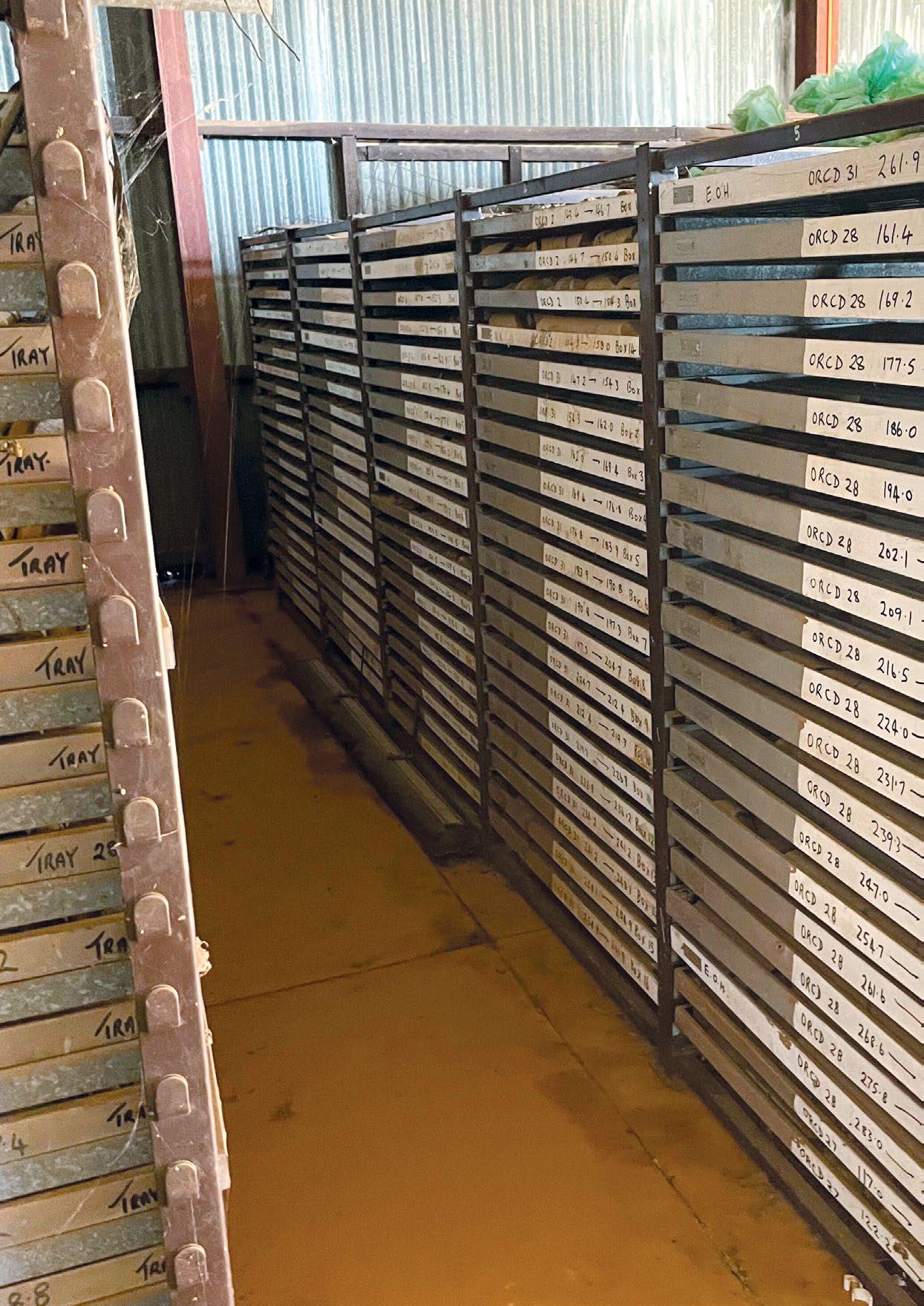
a Feedstock supply agreement for the Kwinana Cobalt Refinery signed with Glencore International AG
a Production of cobalt sulphate meeting target specifications for Kwinana Cobalt Refinery partners
a Major project status for Broken Hill Cobalt Project extended for a further 3 years
a Received Works Approval for the Kwinana Cobalt Refinery from Western Australia’s Department of Water and Environmental Regulation
a Entered into an earn-in agreement for a 51% interest in the Halls Creek Project with an option to increase that interest to 75%
a Completion of Scoping Study for the Halls Creek Project outlining a 10-year staged development opportunity
“The invention of cobalt blue allowed the explosion of bright colour and creativity that we see in Impressionist and Post-Impressionist paintings.”
– Dr. McKever, The Origin of Cobalt Blue Claude Monet’s Haystacks series are amongst his most notable explorations of light and colour – 25 paintings of the same scene that showcase the artist’s ability to capture light and texture. Here, Haystacks, End of Summer uses cobalt blue to capture the turn of the seasons, adding a subtle chill to the piece that hints at the coming autumn.
Table of Contents
report contains forward-looking statements, including timetables that relate to our activities, plans and objectives. Actual results may differ from these statements, depending on a variety of factors. By their nature, forward-looking statements involve risk and uncertainty because they relate to events and circumstances that will occur in the future and may be outside Cobalt Blue Holdings Limited’s control. Given these risks and uncertainties, undue reliance should not be placed on forward-looking statements.
Chairman and CEO Review
Dear Fellow Shareholders,
We are pleased to report strong progress over the past year, as we position for a final investment decision (FID) on the Kwinana Cobalt Refinery.
Our strategy comprises four building blocks for the business, namely: (1) Kwinana Cobalt Refinery (KCR) (2) Broken Hill Technology Centre (BHTC) (3) Broken Hill Cobalt Project (BHCP), and (4) the Halls Creek Project
In April 2025, we executed an agreement with Iwatani Corporation outlining the milestones required prior to reaching FID on the Kwinana Cobalt Refinery. The team have diligently been working towards achieving each of these goals. In May a binding feed supply agreement was finalised with Glencore for purchase of cobalt hydroxide. In September, the Works Approval permit was issued by the Department of Water and Environmental Regulation, WA. Discussions continue with Tier 1 counterparties to convert non-binding letters of interest for offtake of cobalt sulphate and cobalt metal, into binding agreements. Likewise, Cobalt Blue Holdings Limited (COB) continues to seek financing support from the Australian Federal Government.
Underpinning the progress on the Refinery, the technical team have delivered outstanding results at the Broken Hill Technology Centre. Perseverance was rewarded, when the team produced cobalt sulphate conforming with the high-purity specifications demanded by battery cathode manufacturers in Japan and France. The achievement was based on innovative solvent extraction techniques, utilising limestone. Efforts were also directed to designing and operating a cobalt electrowinning cell, a vertical pyrolysis kiln for pyrite, and an autoclave leaching circuit for battery black mass. Each of these technical breakthroughs, provide COB with leverage to evaluate a wide range of opportunities for commercially processing minerals and intermediates. Namely, the team are evaluating the re-purposing of the BHTC into a facility for processing recycled materials from batteries and other industrial by-products.
During FY23 COB executed the Critical Minerals Accelerator Initiative (CMAI) grant agreement with the Australian Government. The grant totalled $15m and was payable over time, with instalments between December 2022 and March 2025. COB received a total of $14.4m, with $0.9 million received this calendar year. The CMAI grants were used to fund BHCP and KCR work packages.
The COB strategy is to bring KCR into operation first, and engage with the downstream offtake markets. Once the new product (cobalt sulphate and metal) has gained market acceptance and validation, BHCP will be significantly de-risked from an offtake revenue perspective. In preparation, COB continues to seek to optimise capital and operating costs, through improved equipment selection and design. This is supported by ongoing testwork at the BHTC.
In early 2025, we entered into an earn-in agreement for the Halls Creek Project with Auking (ASX:AKN). The copper-zinc-silver asset provides optionality for commodity diversification for the Company. The initial 51% interest in the project was purchased for a deemed value of $200,000 of COB shares. Minimum expenditure thresholds are required to retain the interest, and COB can increase the interest to 75% by spending in aggregate $2m prior to June 2028. To date we have spent $0.3m.
Chairman’s Review
In June 2025, the team released a desktop Scoping Study for the Halls Creek Project, outlining a 10.5 year, two-stage project. The mineral resources are split over two Mining Leases, with Onedin hosting an indicated resource of 4.8Mt at 0.7% Cu, 3.1% Zn and 38g/t Ag, and Sandiego hosting an indicated and inferred resource of 3.7Mt at 1.4% Cu, 4.2% Zn and 25g/t Ag. The first five years is planned to be an open-cut mine and heap leach operation from Onedin, with the second five years an underground mine and flotation concentrator from Sandiego. The C1 cash costs, after by-product sales, were estimated to be US$1.33/lb Cu for Stage 1, and US$1.11/lb Cu for Stage 2. The Company is now undertaking work programs to seek additional uplift in the project value through increasing silver recovery from the heap leach (where there is 3.6 million ounces of contained silver in the first five years), and increasing the mineral resources through exploration.
We continue to position COB as a company actively engaged in cutting-edge minerals processing technology. This year we entered into a partnership with the ARC Training Centre in Critical Resources for the future (CCRF), and hosted a team from the Sustainable Minerals Institute (SMI) from the University of Queensland. One of the specific research projects is the application of COB’s patent for pyrite processing (developed as part of the BHCP work program), and how this technology may be applied at other mine sites and/or tailings treatment projects. Separately, we have been contracted by Freeport McMoran to undertake evaluation of the technology to samples from the Grasberg mine in Indonesia, focusing on copper and gold recovery.
At the end of April, Joe Kaderavek retired from the CEO position, and Dr Andrew Tong was appointed to that role. We would like to thank Joe for his leadership of the Company over the 8 year period. Joe continues to be an actively involved with the Company through his position on the Board. Andrew brings a wealth of corporate and technical experience from over 20 years in the industry, and has been with COB since 2017.
The Company completed a successful capital raise of just over $2.5m in September. This comprised an institutional equity placement of $1m, and a placement agreement of $1.5m to Lind Partners. The Company would like to thank Pamplona, Shaw and Partners, and Cloudbreak for supporting the equity raise.
During 2025, the Company met all the obligations to American Rare Earths (ASX:ARR) in respect of the $3m promissory notes related to the BHCP. We thank ARR for their support over many years.
The Company continues to operate within fiscal limits, with staff remuneration comprised of 70-75% cash and 25-30% script, compared to remuneration levels in 2024.
Finally, we note that the sentiment for cobalt continues to strengthen, with metal prices lifting from $11/lb in January to $16/lb in September. This was largely due to the export ban imposed by the DRC government on cobalt hydroxide affecting the supply side, and renewed buying of cobalt metal for strategic stockpiles and defence applications on the demand side. We remain positive on the cobalt market outlook and believe that a more balanced market lies ahead.
Robert Biancardi
Dr Andrew Tong Chairman Chief Executive Officer
Dated 26 September 2025
Dated 26 September 2025
Review of Operations and Activities
Progress, Innovation, Diversification
Cobalt Blue Holdings Limited and its subsidiaries (Cobalt Blue or the Group) are focused on development of the Kwinana Cobalt Refinery in Western Australia, the Broken Hill Cobalt Project near Broken Hill in NSW and the Halls Creek Project in the Kimberly region of Western Australia.
The 2025 financial year was a transformative period for Cobalt Blue. The Company remained firmly focused on advancing the Kwinana Cobalt Refinery (KCR) toward a final investment decision, making significant progress and achieving a series of key milestones that bring the project closer to realisation.
Substantial progress was also achieved in the processing of recycled battery black mass. This initiative delivers dual benefits: producing critical minerals from secondary sources and establishing a pathway to secure locally sourced feedstock. In doing so, Cobalt Blue is contributing to the development of Australia’s battery recycling industry and supporting the growth of the circular economy.
The offtake market also evolved significantly during the year, with increased interest from industrial and defence sectors in alloygrade cobalt metal products. At the Broken Hill Technology Centre, Cobalt Blue successfully produced cobalt metal from a variety of feedstocks, further underpinning these emerging market opportunities.
Complementing all of this, the acquisition of the Halls Creek copper-zinc-silver project in Western Australia has provided strategic optionality in commodities beyond cobalt.
Kwinana Cobalt Refinery (KCR)
During the financial year, Cobalt Blue made substantial progress in advancing the Kwinana Cobalt Refinery (KCR) toward a final investment decision. Key milestones included the appointment of an engineering group, the initiation of the permitting process, and the completion of extensive testwork at the Broken Hill Technology Development Centre to optimise the refinery’s production flowsheet further.
Engineering Partner
In July 2024, Cobalt Blue announced that Tetra Tech Coffey Pty Ltd (Tetra Tech) had been selected to conduct detailed engineering work for the KCR. Importantly, Tetra Tech has worked with Iwatani Australia on various projects over the last 10 years and knows the proposed KCR site and personnel well. The company’s technical expertise and previous experience are invaluable in bringing the KCR through the stages of concept and detailed design. Tetra Tech has significant expertise in complex plant development, including Iluka’s Eneabba Project (Phase 2) and Arafura’s SX Plant Detailed Design.
Review of Operations and Activities
Pre-FID consortium Deed
In April 2025, Cobalt Blue announced the execution of a binding pre-Final Investment Decision (‘FID’) Consortium Deed (‘the Deed’) with Iwatani Australia Pty Limited (IWA). The purpose of the Deed was to formalise the conditions necessary to permit each party to seek a FID to continue the Project from their respective boards of directors. The material conditions to be satisfied were detailed as:
a Samples meeting customer specifications, produced by Cobalt Blue at its Broken Hill Technology Centre using commercial process plant conditions;
a Finalising a suite of Project related agreements covering: a joint venture relationships and operational plans;
a feedstock supply and offtake; and a intellectual property licencing;
a The completion of technical studies, and independent due diligence reviews;
a Agreement on a financing plan to cover Project funding, including each party’s funding commitments; and
a IWA obtaining Foreign Investment Review Board approval.
A FID decision is targeted for 31 December 2025.
Permitting Process
ABEC Pty Ltd and Green Values Australia Pty Ltd were engaged to prepare a Works Approval application for submission to the Department of Water and Environmental Regulation (DWER) in Western Australia. The application was lodged in November 2024 and was approved, after the end of the financial year, in September 2025.
Testwork at the Broken Hill Technology Centre
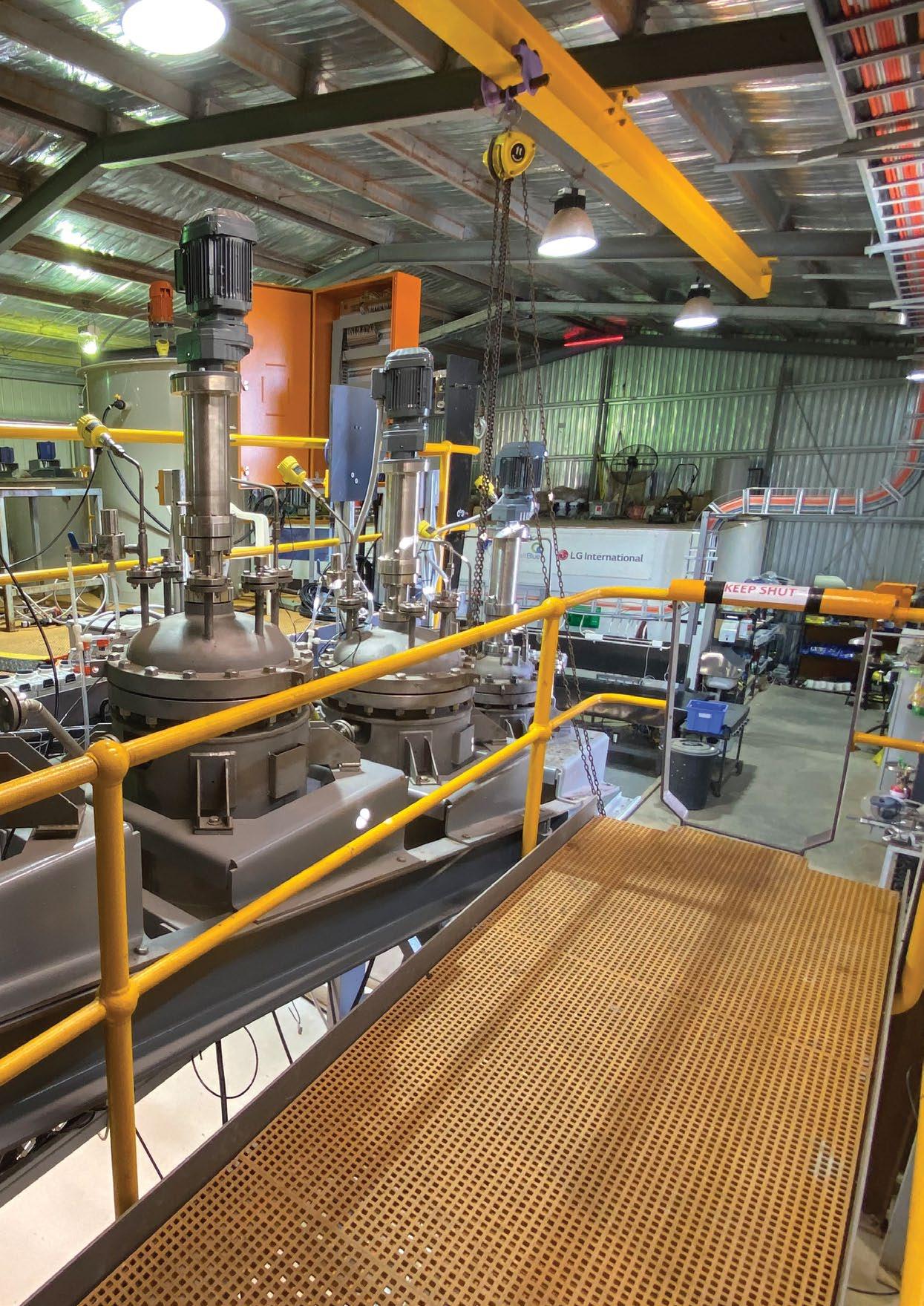
Cobalt Blue’s Broken Hill Technology Development Centre (BHTC), formerly the Demonstration Plant, continued to advance optimisation of key unit operations, undertake testwork on third-party feedstock, and generate supporting data for the detailed engineering of the proposed KCR.
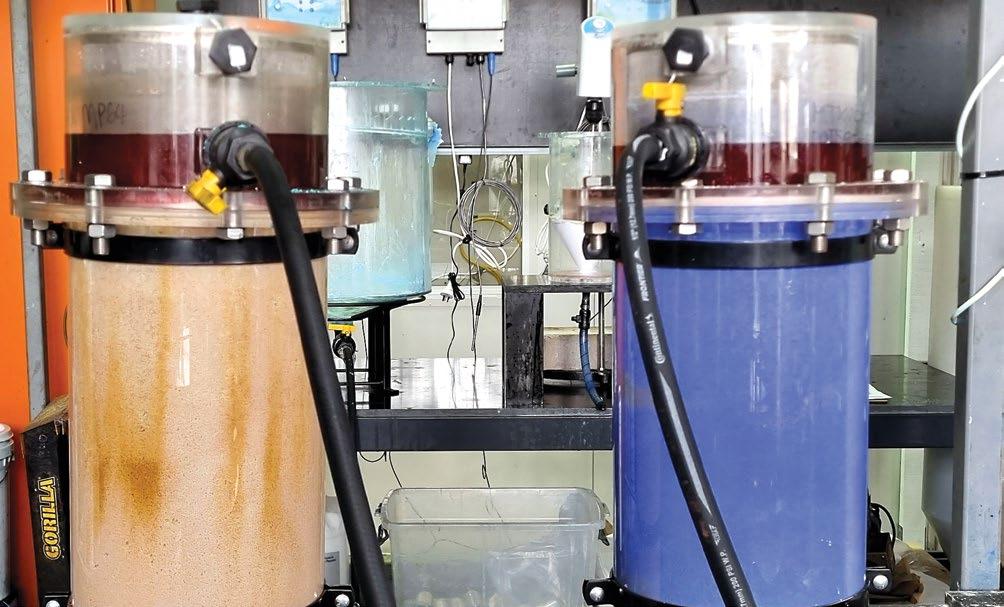
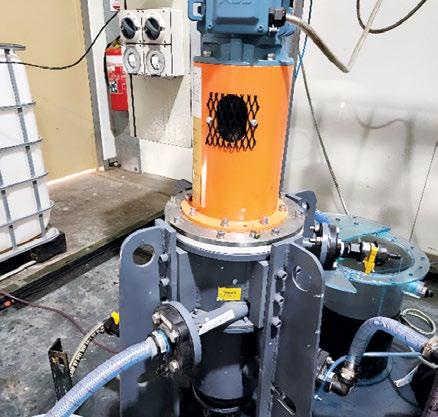
In the first half of the year, activities centred on the installation and operation of the solvent extraction circuit using centrifugal extractors. This equipment provides advantages over conventional mixer-settlers, including reduced capital costs, a smaller footprint, and enhanced automation of liquor processing. In parallel, progress was also achieved in optimising trace metal removal through the application of ion-exchange resins.
Figure 1 – Ion exchange circuit
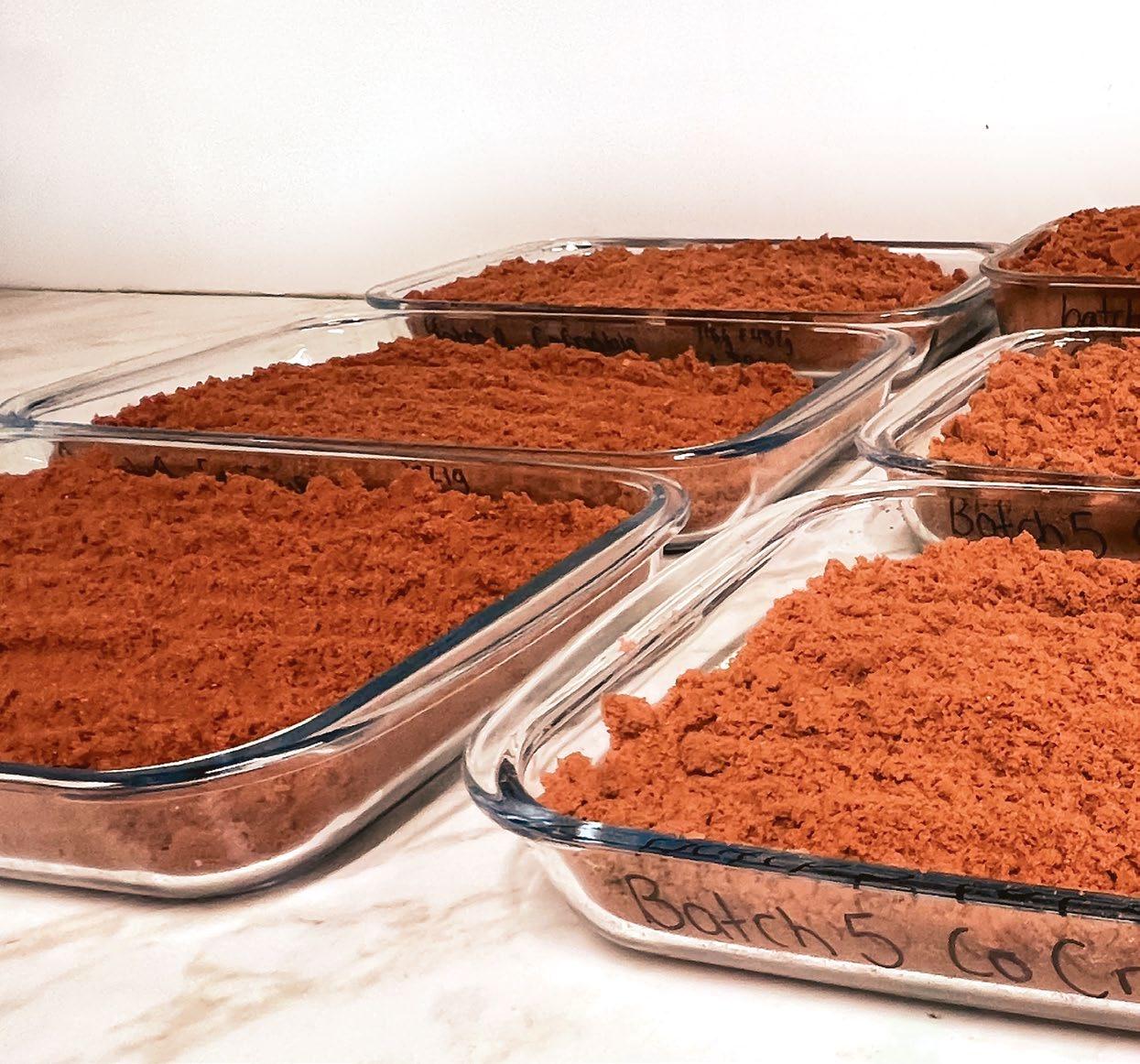
Following these plant and process adjustments, Cobalt Blue commenced cycle testing to produce cobalt sulphate in a consistent and repeatable manner aligned with commercial specifications. Batch processes were undertaken in a controlled sequence, allowing additional time to validate each step and ensure effective liquor purification prior to crystallisation. Samples produced through this program were subsequently submitted to the Queensland University of Technology (QUT) for analysis.
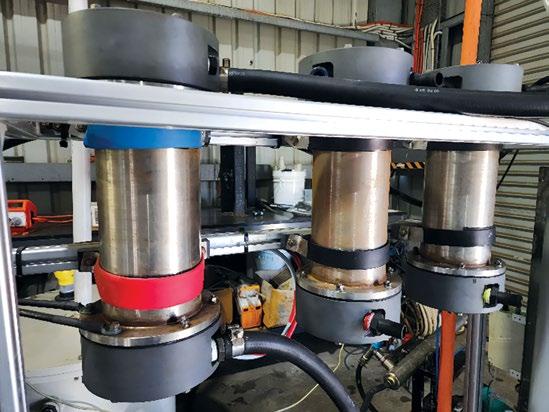
In parallel with cobalt sulphate production, additional work programs were undertaken, including the operation of a second solvent extraction circuit to generate liquor for nickel electrowinning, followed by pilot trials of nickel metal production. Nickel metal remains the designated by-product within the KCR flowsheet.
Figure 3 – Electrowinning cells used for testing (LHS) and Centrifugal extractor (RHS)
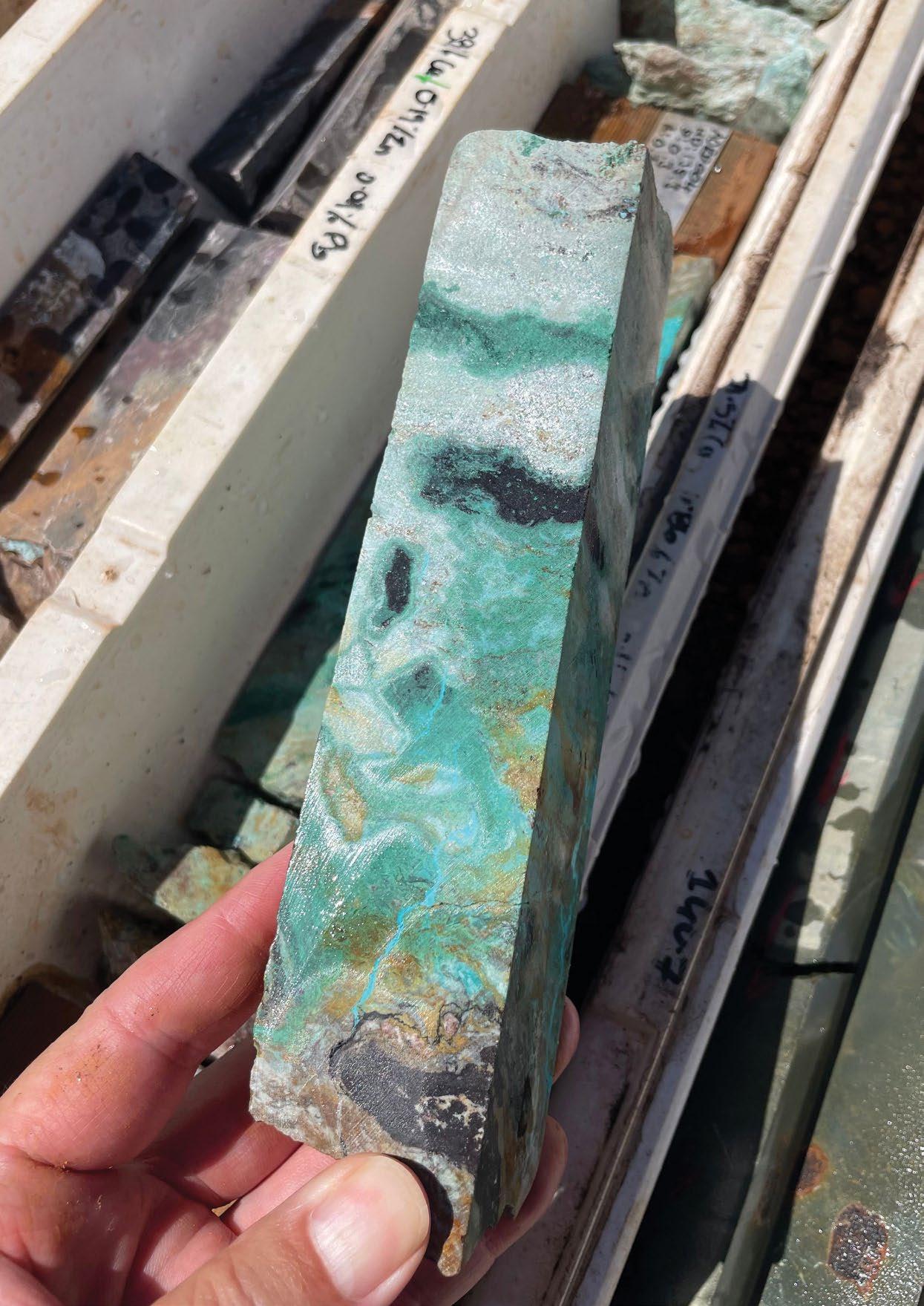
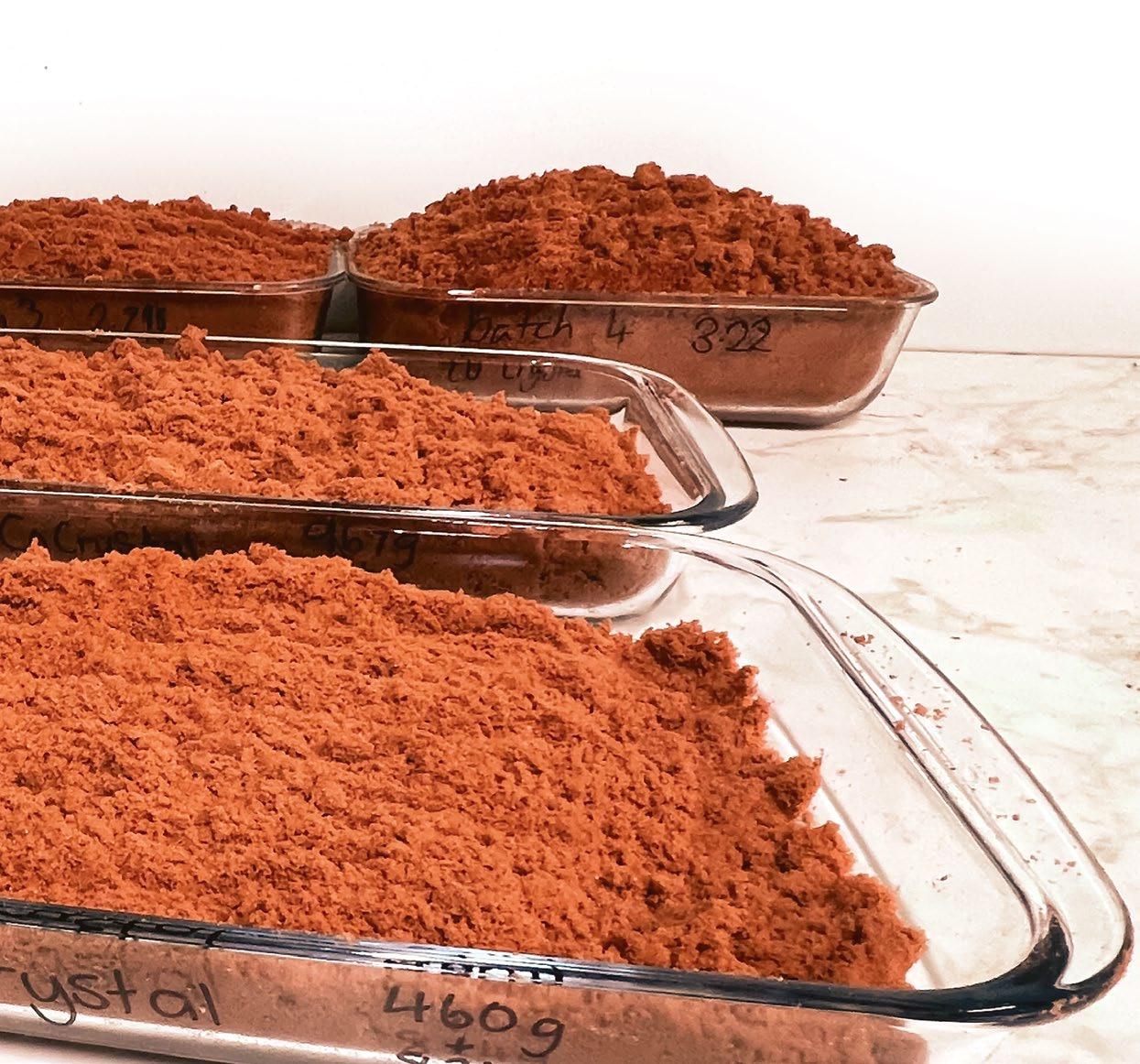
Figure 2 – Cobalt sulphate crystals
Review of Operations and Activities
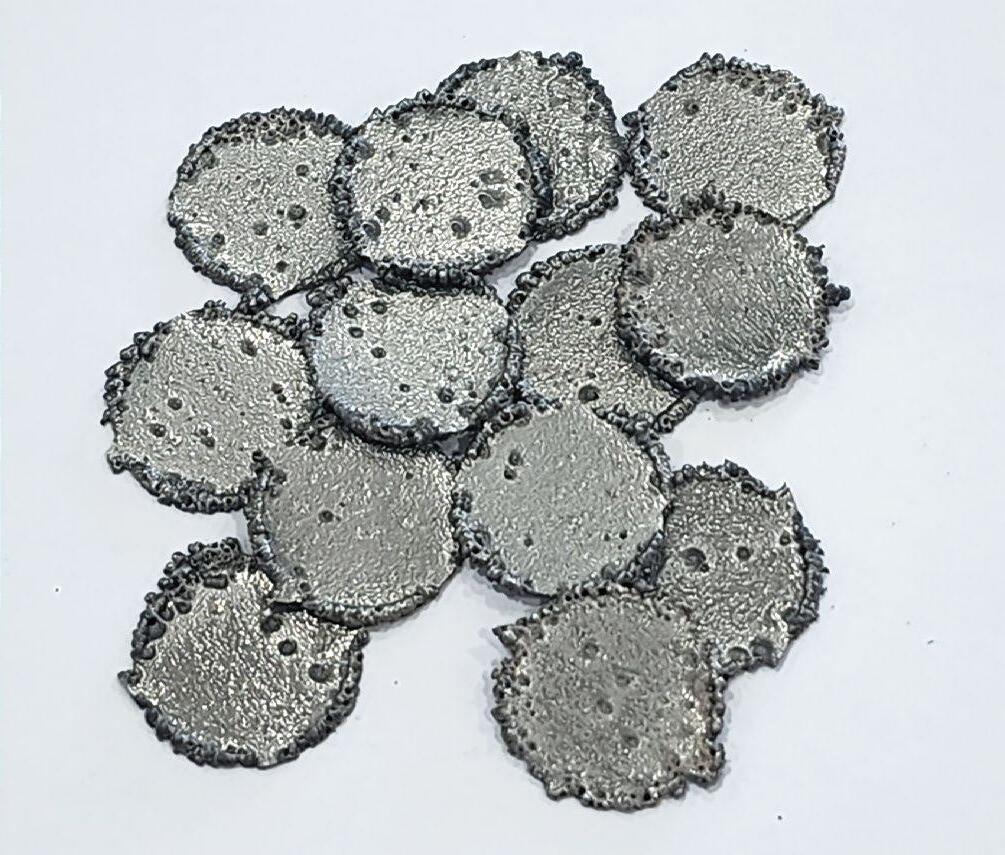
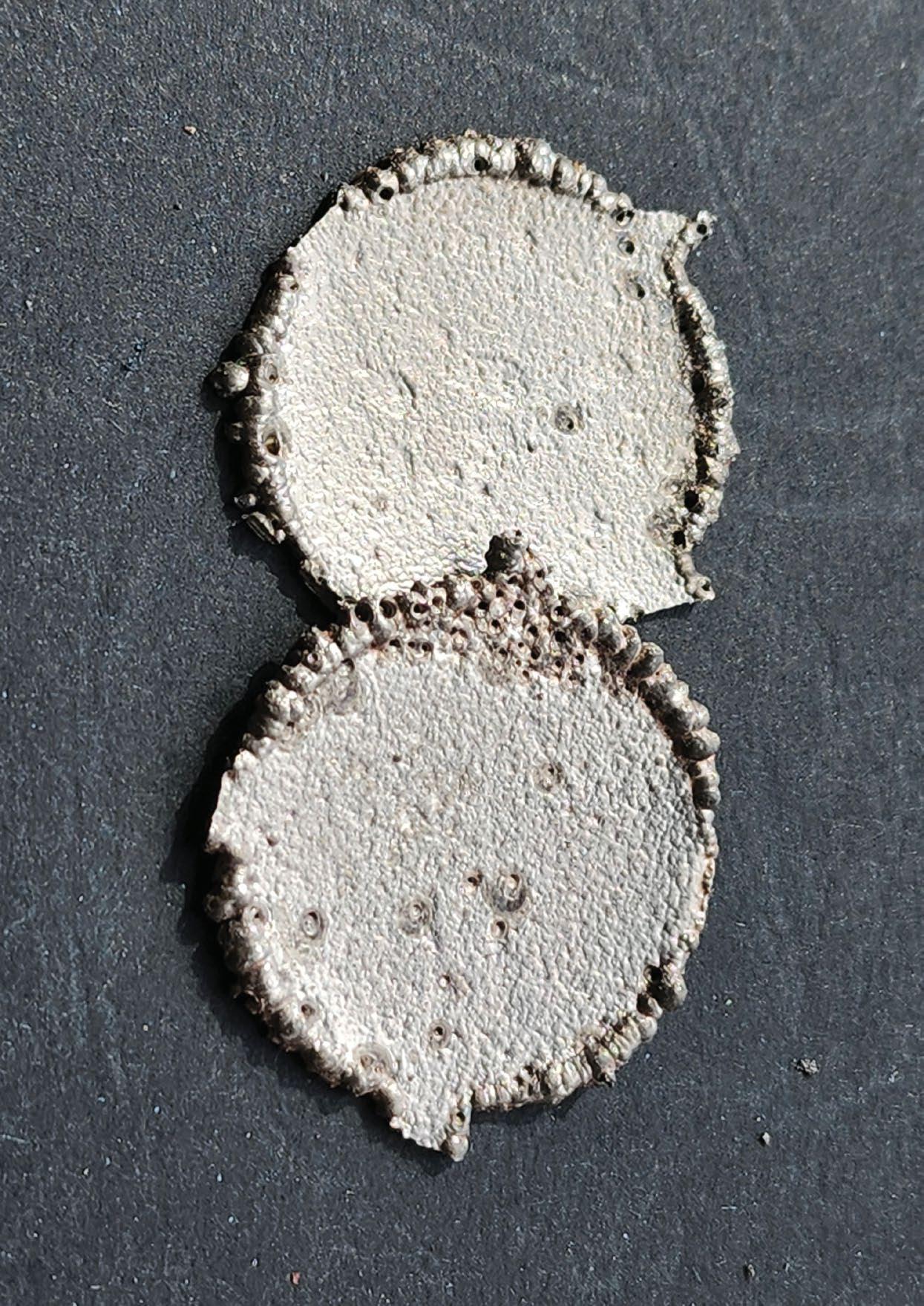
Testwork has also successfully demonstrated the production of high-purity cobalt metal from cobalt sulphate liquors. Importantly this option requires no change to upstream purification, differing only in the final recovery step, and offers additional flexibility for the proposed KCR’s offtakers.
4 – Cobalt metal rounds recently produced at the BHTC
Feedstock sources
While Cobalt Blue prioritises the purchase of cobalt hydroxide feedstock from Australian projects, current market dynamics require the Group to extend its focus. Consequently, Cobalt Blue remains in advanced discussions with suppliers of cobalt feedstock both in Australia and internationally to fulfill the refinery’s remaining requirements.
Ecobatt: In December 2024, Cobalt Blue announced that it had entered into an MOU with Ecocycle Pty Ltd (Ecobatt) to evaluate the feasibility of treating black mass from battery recycling within Australia. Ecobatt is the pre-eminent battery recycling company in Australia. It manages a national collection system to recycle and process battery products, based on proven world-class battery recycling technology.
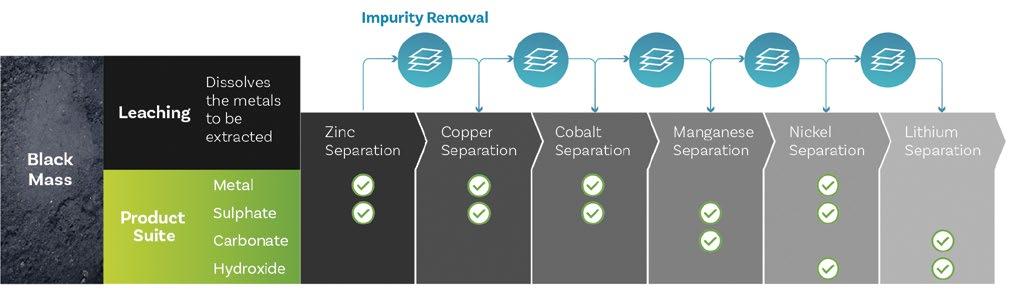
Black mass is an intermediate product derived from recycling lithium-ion batteries (LiBs) from consumer electronics, mobile devices, and electric vehicles.Currently, only a small fraction of lithium-ion battery (LiB) waste is recycled in Australia. Ecobatt estimates that the national recycling rate for household batteries is just 10%—one of the lowest rates in the OECD. Most batteries end up in potentially hazardous stockpiles or in landfill. By advancing downstream battery reprocessing, Cobalt Blue is helping to build a self-sustaining domestic recycling market. Recovering critical minerals from recycled batteries will not only strengthen supply chain resilience but also reduce reliance on traditional mining.
Figure
The two companies have agreed to collaborate to explore and evaluate opportunities around processing black mass into critical minerals to re-enter the battery supply chain. This partnership is built on the expectation that the result of the complementary functions will contribute to the growth of Australia’s battery recycling ecosystem.
Cobalt Blue has successfully tested samples of black mass provided by Ecobatt to extract cobalt, nickel and manganese. The testwork program is now expanding to cover the production of suitable forms of these critical minerals for onward sale for lithium-ion battery cathode manufacturing. A next-stage phase will evaluate options for the recovery of lithium, which highlights the potential to expand into broader battery material recycling.
Glencore hydroxide: In May 2025, Cobalt Blue announced the execution of a contract with Glencore to provide cobalt hydroxide feedstock to KCR. The contract guarantees supply of a minimum of 3,750 tonnes of cobalt hydroxide (750mt in year one, 1,500mt in years two and three), representing 50% of KCR’s initial feedstock requirements.
The feedstock will be sourced from Glencore’s world-class Kamoto Copper Company SA (KCC) and Mutanda Mining SARL (Mutanda) operations in the Democratic Republic of Congo (DRC). The company has a comprehensive governance framework and related programmes to ensure responsible and transparent operations. The KCC and Mutanda operations have been independently assessed and both received The Copper Mark, a rigorous, voluntary assurance process on responsible mining. Both operations also hold Responsible Minerals Assurance Process (RMAP) Conformant status, which focuses on risks related to the OECD Guidance for Responsible Minerals from Conflict-Affected and High-Risk Areas.
Offtake
During the financial year, Cobalt Blue advanced offtake discussions with a range of international counterparties across Asia, Europe, and the United States.
Interest from a number of EU- and US-based parties has centred on cobalt metal products rather than cobalt chemicals, prompting detailed discussions in this area. As outlined in the KCR section, COB successfully produced cobalt metal from a variety of feedstocks during the year, further supporting these market opportunities.
KCR Project cost and revenue analysis
In October 2024, COB released updated project cost estimates and revenue analysis for the KCR.
In summary, the project is estimated to generate (on a 100% owned basis):
a NPV8 (post-tax): A$90m, IRR (post-tax): 23%
a Average Annual EBITDA: A$24m
a Project payback: 5.2 years
Updated capital cost estimates were prepared based on:
a Equipment quotes covering all major items of equipment – tanks, pumps, agitators, bins, solvent extraction vessels, crystalliser, product drying and bagging
a Installation estimates – concrete + steel + piping from 3D model
a Electricals and instrumentation from quotes and estimates from vendors/partners
a Process plant shed quote from construction/fabricator
a Site works for total footprint inclusive of container receivals/storage – estimated by Tetra Tech
a EPCM estimate by Tetra Tech
Figure 5 – Cobalt Blue’s black mass flowsheet
Review of Operations and Activities
Broken Hill Cobalt Project
Following the Group’s decision in 2024 to pause development of the Broken Hill Cobalt Project (BHCP) in response to challenging cobalt market conditions and broader macroeconomic factors, only limited activity was undertaken during the financial year. The Group remains confident that market conditions will improve in the year ahead.
In early July 2025, COB was granted a three-year extension to Major Project Status for BHCP. This designation provides additional Commonwealth Government regulatory support for projects deemed of national significance due to their contribution to strategic priorities, economic growth, employment, and regional development. Recognition of BHCP as a nationally significant project is expected to enhance Cobalt Blue’s ability to progress investment discussions with both international funding sources and domestic investors. It also reinforces the Company’s partnership with Iwatani, underscoring the Project’s importance as a national priority for the Australian government.
Halls Creek Project
In February 2025, Cobalt Blue announced its entry into an earn-in agreement with AuKing Mining Limited (ASX: AKN) for the Halls Creek Project (the ‘Halls Creek Project’), a large-scale copper-lead-zinc-silver asset with significant cobalt potential.
The Halls Creek Project is favourably located within the Kimberley region of Western Australia; just 15km southwest of Halls Creek and 320km south of Wyndham port. The area has historically supported a number of gold, nickel and cobalt operations. The Halls Creek Project hosts two major deposits with existing Mineral Resources containing a combined 89kt copper, 69kt lead, 326kt zinc, 9.2Moz silver and 45koz gold1
In June 2025, Cobalt Blue announced the completion of the Halls Creek Project Scoping Study (the “Scoping Study”), which provided a fresh look at the historical resources and associated metallurgical data, with a new mine plan, and 2025 costings for capex and opex.
The Scoping Study reflects a staged mining and processing operation to minimise start-up capital requirements and prioritise early cash flow:
a Stage 1: an open-cut mine at Onedin, with material to be processed via heap leaching to produce copper cathode and zinc sulphate monohydrate; and
a Stage 2: an underground mine at Sandiego, with material to be treated in a flotation plant to produce separate copper and zinc concentrates.
Key outcomes of the Scoping Study:
a 10.5-year project life
a Pre-tax NPV 8% (real) of A$172m
a Pre-tax Internal Rate of Return of 28%
a Start-up Capex of A$73m
a Stage 1: 5,000 tpa copper metal, and 15,000 tpa zinc sulphate
a Stage 2: 7,300 tpa copper in concentrate, and 13,300 tpa zinc in concentrate, and 85,000 oz pa silver in concentrate
a Onedin open pit C1 costs of US$1.33/lb net of by-product credits
a Sandiego underground C1 costs of US$1.11/lb net of by-product credits
1 A complete summary of the Mineral Resource estimate by classification is provided on page 18
Cobalt Blue subsequently provided an update identifying multiple value engineering initiatives that have the potential to significantly enhance the already robust economics outlined in the Scoping Study. These included:
a New Revenue Streams - Silver and Cobalt Upside Identified: The potential inclusion of silver at Onedin and cobalt at Sandiego offer high-value revenue streams and align with the Kwinana Cobalt Refinery strategy.
a Strategic Hub Concept to Expand Project Scale: Centralised hub model under review to integrate nearby deposits, extend mine life, and boost production scale.
a Exploration Pipeline Activated: Sandiego North confirmed as a high-impact near-mine target; regional pipeline also advancing to drive long-term discovery.
Cobalt Trends
Structural Shift
During the first half of the period, cobalt prices trended lower before a significant market shift occurred. In February 2025, the Democratic Republic of Congo (DRC), the world’s largest cobalt producer, implemented a minimum four-month export ban. The DRC’s mineral regulator cited years of illegal mining and oversupply that had suppressed prices, emphasising that “exports must align with global demand”.
The announcement triggered an immediate price response, with cobalt rising approximately 60% over the following four weeks. Prices then stabilised, supported by existing inventories, as the DRC-to-China supply chain typically operates on a 4–6 month cycle.
Subsequent to the end of the financial year, the DRC announced that it will lift the suspension on exports and replace it with a quota system to remain in effect until at least 2027. This new system allocates less than 50% of the normal traded volume, which will likely push the global cobalt market balance from surplus to deficit in 2026.
While this marks the early stage of a structural shift in cobalt market dynamics, the DRC has clearly positioned itself to manage both producer and consumer inventories – and by extension, price stability. The “sweet spot” for pricing will be one that maximises government revenue without undermining demand.
Source: Fastmarkets
Financial Review
Cobalt Blue’s net loss for the 2025 financial year was $6.099 million (2024: $37.595 million).
Total revenue and other income increased this financial year to $2.864 million (2024: $1.401 million), reflecting $2.710 million in government grants (2024: $1.031 million) and interest income of $154,000 (2024: $295,000). Government grants were recognised as Other Income as they compensated for expenditures recorded in the profit or loss (with the balance of government grants received being recognised as a reduction in the carrying value of exploration and evaluation expenditure).
Total expenses decreased by $30.033 million to $8.963 million in the current financial year. Much of the decrease was due to a $30.533 million non-cash impairment charge in the prior financial year. Excluding this impairment charge, total expenses increased by $500,000 (2024: Nil), mainly due to a $1.204 million increase in KCR project costs offset by a $277,000 decrease in employee benefits expense and a $440,000 decrease in corporate costs.
Review of Operations and Activities continued
During the 2025 financial year, the Group issued 23,097,230 new shares, raising $520,000 (net of costs). In addition, the Group received $3.352 million in Government grants and incentives from the following sources: a $973,000 (2024: $6.000 million) from the Australian Government’s Critical Minerals Accelerator Initiative (CMAI); and a $2.379 million (2024:6.841 million) in research and development tax incentive refunds.
Key external and business risks
Key external and business risks which could impact the Group’s ability to deliver its strategy are:
Availability of Finance – The Group has no material operating revenue. It is unlikely to generate any material operating revenue unless and until the KCR, BHCP or Halls Creek is successfully developed and production commences, the Group’s Black Mass processing opportunities are commercialised, or the Group acquires a revenue-generating asset. Therefore, the Group will be required to raise additional capital or enter alternative development structures to meet its obligations and implement its strategy.
Cost escalation – The Group is exposed to cost escalation and inflationary pressure, which may be above budgeted or forecasted levels across all elements of our cost base. If the Group cannot offset these cost pressures, this could adversely affect cash flow and financial performance.
Partner arrangements – The Group’s key projects are subject to non-binding agreements with a third party, establishing the basis on which the parties intend to proceed. There is no guarantee of entry into binding terms.
Commodity prices – The global cobalt market (along with other commodities) is subject to demand and supply fluctuations. These fluctuations and fluctuations in the A$: US$ exchange rate will affect the economics of the Group’s projects. Climate change risk may create additional demand for lithium-ion batteries to store renewable energy as part of global ‘decarbonisation’ strategies. Such additional demand may create upside pressure on cobalt prices in the future. Adverse changes in commodity prices can also affect the supply and/or source of feedstocks for the proposed KCR.
Management retention – The Group relies on its employees and consultants. There is a risk that the Group may not be able to retain key personnel or promptly find effective replacements. The loss of such personnel or any delay in their replacement could negatively impact the Group’s ability to achieve its strategy. To address this risk, the Group continues to refine its remuneration framework to provide competitive remuneration to retain key personnel.
Metallurgical recoveries and processing risks – The economic viability of cobalt recovery depends on several factors, such as developing an economical process for treating pyrite ore. Further, changes in mineralogy may result in inconsistent recovery of cobalt. To address this risk, the Group constructed a Pilot Plant to demonstrate cobalt sulphate can be produced at a much larger scale than completed to date and, following successful operations at the Pilot Plant, commissioned and operated a Demonstration Plant to treat pyrite ore on a more extensive and continuous basis. The Group is also executing a raw materials testing program as part of the KCR to, amongst other reasons, confirm capabilities to produce high-purity cobalt sulphate from intermediate products sourced from third parties.
Government approvals/environmental standards – Advancing the KCR (or BHCP and Halls Creek) will require approvals from government agencies. With increasing government and public sensitivity to environmental sustainability, environmental regulation is becoming more stringent. The Group could be subject to higher environmental responsibility levels and liability, including laws and regulations dealing with air quality, water and noise pollution, plant and wildlife protection, greenhouse gas emissions and waste storage, treatment and disposal.
Water supply – The BHCP is near Broken Hill, New South Wales (NSW). Broken Hill has a hot, arid desert climate with minimal rainfall. The project’s water requirements are currently estimated at 1.2–1.5 GL per annum, which are expected to be supplied from Essential Water’s trunk main on the western outskirts of Broken Hill, which is supplied via a pipeline from the Murray River at Wentworth, NSW. If this water cannot be supplied or supplied at lower levels, whether due to climate change or not, the project would be significantly affected. If Essential Water cannot provide water to meet BHCP’s requirements, the company can utilise existing subsurface water rights to potentially source up to 0.70 GL per annum.
Power Supply – The Group’s proposed projects require significant power use. Increased electricity pricing would increase project operating costs. Cobalt Blue is working on power-related studies to reduce this risk, seeking to optimise waste heat capture and reuse, optimise the daily load profile, and evaluate distributed energy generation and storage.
Mineral Resources and Ore Reserves
Mineral Resources Summary as at 30 June 2025
Broken Hill Cobalt Project (BHCP)
The Mineral Resource estimate for the BHCP at 30 June 2025 remains unchanged from last year. The estimate was reported in accordance with the guidelines of the 2012 edition of the Australasian Code for the Reporting of Exploration Results, Mineral Resources and Ore Reserves (2012 JORC Code). The Mineral Resource estimate comprises 126.5 Mt at 867 ppm cobalt-equivalent (CoEq) (690 ppm cobalt, 7.5% sulphur and 134 ppm nickel) for 87 kt contained cobalt, 9,510 kt sulphur and 17 kt nickel (at a 275ppm CoEq cut-off).
The estimate is summarised below by classification.
Table 1 – The Mineral Resource estimates for the BHCP as at 30 June 2025 (at a 275 ppm CoEq cut-off) detailed by Mineral Resource classification. Note minor rounding errors may have occurred in compilation of this table.
BHCP (inclusive of Pyrite Hill, Railway & Big Hill)
The Mineral Resource has been reported at a cut-off of 275 ppm CoEq based on an assessment of material that has reasonable prospects of eventual economic extraction. In addition to cobalt, the cut-off grade incorporates revenue streams from elemental sulphur and nickel; economic by-products of the processing pathway defined through progressive technical studies including the 2018 BHCP Preliminary Feasibility Study (PFS), 2020 BHCP Project Update (also completed to a PFS level) and the Definitive Feasibility Study (DFS) which was paused in February 2024 in consideration of depressed commodity pricing and an inflated capital cost environment.
The cobalt equivalent grade has been derived from the following calculation; CoEq ppm = Co ppm + (S ppm × (S price / Co price) × (S Recovery / Co Recovery)) + (Ni ppm × (Ni Price / Co Price) × (Ni Recovery / Co Recovery)). Assumptions derived from the assessment of modifying factors considered to date have been used to inform the cobalt equivalency calculation with the equivalency formula equating to CoEq = Co + S % × 18.1398 + Ni ppm × 0.3043 (see Table 2)
Mineral Resources and Ore Reserves
Table 2 – Assumptions used for the calculation of the cobalt equivalency formula.
Cobalt Price
Sulphur Price
Nickel Price
US$60,186/t (AU$85,980)
US$145/t (AU$207)
US$18,317/t (AU$26,167)
The Company confirms all elements included in the metal equivalence calculation have reasonable potential to be recovered and sold.
Halls Creek Project
The Mineral Resource estimates for the Halls Creek Project were independently prepared by ERM Australia Consultants Pty Ltd (‘ERM’, formerly CSA Global) and are reported in accordance with the 2012 JORC Code. The Halls Creek Project is inclusive of two Mineral Resources including:
a Sandiego – 4.1Mt at 1.4% Cu, 0.4% Pb, 4.2% Zn and 25g/t Ag for 56kt contained copper, 18kt lead, 175kt zinc and 3.3Moz silver.
a Onedin – 4.8Mt at 0.7% Cu, 1.1% Pb, 3.1% Zn and 38g/t Ag for 33kt contained copper, 51kt lead, 151kt zinc and 5.9Moz silver.
The estimates are summarised below by classification.
Table 3 – Mineral Resource estimate for the Sandiego deposit detailed by classification. Note minor rounding errors may have occurred in compilation of this table.
Sandiego (Copper zone reported at
0.8% copper cut-off grade)
Sandiego (Zinc
Table 4 – Mineral Resource estimate for the Onedin deposit detailed by classification. Note minor rounding errors may have occurred in compilation of this table.
Onedin (Copper zone reported at
0.4% copper cut-off grade)
Onedin (Zinc zone reported at a 1% zinc cut-off grade)
Ore Reserves Summary as at 30 June 2025
Nil
Annual Review of Mineral Resources and Ore Reserves
Mineral Resources
BHCP
There were no changes to the Mineral Resource estimate from 2024 to 2025.
Halls Creek Project
The Halls Creek Project is subject to a Joint Venture Agreement (JVA) between Halls Creek Project Pty Limited (HCPPL), a wholly owned subsidiary of Cobalt Blue Holdings Limited (COB) and Koongie Park Pty Limited (KPPL), a subsidiary of AuKing Mining Limited (AKN). The JVA was signed on 17 February 2025 and formation of the Halls Creek Joint Venture occurred on 5 March 2025 being the date on which the last of the Conditions Precedent were satisfied or waived in accordance with the JVA. Consequently, the Halls Creek Mineral Resources, comprising the Sandiego and Onedin deposits, are included in the Company’s Mineral Resources Statement for the first time.
Ore Reserves
There were no changes to the Ore Reserves from 2024 to 2025.
Summary of governance arrangements and internal controls in place for the reporting of Mineral Resources
Mineral Resources are estimated by suitably qualified consultants in accordance with the 2012 JORC Code, using industry-standard techniques and guidelines for the estimation and reporting of Mineral Resources. These estimates and the supporting documentation were reviewed by suitably qualified Competent Persons prior to inclusion in this Annual Report. The Company’s Board approves revisions to Mineral Resources prior to public release.
Competent Persons Statement
The Mineral Resources and Ore Reserves Statement (Statement) is based on and fairly represents information and supporting documentation prepared by Competent Persons. The Statement as a whole has been approved by Dr Andrew Tong, a Competent Person who is a Member of the AusIMM. Dr Tong is an employee of Minerals and Residues Pty Ltd and is engaged full-time by the Group as Executive Manager. Dr Tong has had sufficient experience relevant to the style of mineralisation and type of deposit and the activity being undertaken to qualify as a Competent Person as defined in the 2012 JORC Code. Dr Tong consents to the inclusion in this report of the matters based on his information in the form and context in which it appears.
The Mineral Resources have been estimated and reported in accordance with the guidelines of the 2012 JORC Code.
Directors’ Report
The Directors present their report, together with the financial statements of the consolidated entity, consisting of Cobalt Blue Holdings Limited (referred to hereafter as “COB” or the “Company”) and the entity it controlled (referred to hereafter as the “Consolidated Entity”) for the year ended 30 June 2025.
Directors
The following persons were Directors of the Company during the whole of the financial year and up to the date of this report, unless otherwise stated:
a Robert Biancardi Chairman, Non-Executive Director, Independent
a Joe Kaderavek Chief Executive Officer & Executive Director (until 30 April 2025) Deputy Chairman, Non-Executive Director (from 1 May 2025)
a Hugh Keller Non-Executive Director, Independent
Principal Activities
The Company’s focus is on developing the Kwinana Cobalt Refinery in Western Australia, the Halls Creek Project in Western Australia and the Broken Hill Cobalt Project in New South Wales.
Review of operations, financial position, business strategies and prospects
A detailed discussion of these matters is set out within the ‘Review of Operations and Activities’ section on pages 7 to 14
Likely developments and expected results of operations
A detailed discussion of future developments is set out within the ‘Review of Operations and Activities’ on pages 7 to 14.
Significant changes in the state of affairs
During the financial year:
a issued capital increased by $1,328,000 net of capital raising costs, (2024: $5,353,000) due to share issues, of which $365,000 was received in cash with the balance reflecting non-cash share-based payment transactions. Details of the changes in share capital are disclosed in Note 21 to the financial statements; and
a the Group acquired a 51% interest in the Halls Creek Joint venture, a copper-zinc-silver asset located in the Kimberly region of Western Australia.
Dividends
There were no dividends paid, recommended or declared during the current or previous financial year.
Directors’ Report
Information on Directors
The following information is current as at the date of this report.
Name: Mr Robert Biancardi
Title: Chairman, Independent, Non-Executive Director
Qualifications: B. Com (Management and Marketing) (Wollongong University) Diploma Corporate Management (AGSM – University of NSW)
Experience and Expertise:
Mr Biancardi is an experienced executive with more than 35 years’ commercial experience across the finance, IT, healthcare and services sectors. Mr Biancardi has previously held senior roles at IBM, Citibank and Westpac. His recent roles include director of Evolution Healthcare, a leading private hospital operator. He has been a director and chief executive officer of a number of companies, including Rockridge Group (Private Equity) and Hutchisons (Child Care Services) Limited, previously an ASX listed services company.
He has served as a director and president of the Restaurant & Catering Association of NSW for 13 years and has been a board member of the Heart Foundation of Australia (FIPOC) for over 7 years. Mr Biancardi is also currently chair of the Diabetes Research Foundation. He has extensive corporate advisory and capital management experience with a specialisation in corporate marketing and substantial public/private board experience.
Other current directorships: None
Former directorships (last 3 years): None
Special responsibilities: Member, Audit and Risk and Remuneration and Nomination Committees
Interests in shares: 5,256,611
Interest in performance rights: –
Name: Mr Joe Kaderavek
Title: Executive Director & Chief Executive Officer (until 30 April 2025)
Deputy Chairman, Non-Executive Director (from 1 May 2025)
Qualifications: B.Eng (Aeronautical Engineering) (University of Sydney)
G.CertEng (Reliability Engineering) (Monash University) Master of Business Administration (MBA) (Deakin University)
Experience and Expertise: Mr Kaderavek commenced his career as an RAAF Engineering Officer before transitioning to PricewaterhouseCoopers, where he was responsible for preparing operational reviews and examining strategic options for mining, processing, railway, and port facilities throughout Australia, North America, and Europe.
During the course of his career he has been involved in equities/investment research (including senior roles with Deutsche Bank and Five Oceans Asset Management) focused on mining, minerals processing and energy storage technologies. Most recently, he held an international consulting role with a focus on renewable energy and battery storage technologies.
Mr Kaderavek has significant experience in managing investments in the global resources and minerals processing industries, and in managing turnaround projects supporting corporate targets, merger and divestment activities. He also has a detailed understanding of the energy storage market and battery technology.
Other current directorships: None
Former directorships (last 3 years): None
Special responsibilities: Chairman of the Remuneration and Nomination Committee
Interests in shares: 8,959,939
Interest in performance rights: 4,287,589
Name: Mr Hugh Keller
Title: Independent, Non-Executive Director
Qualifications: LLB (University of Sydney).
Experience and Expertise:
After graduating with a law degree, Mr Keller had a successful career as a solicitor in Sydney and became a partner at Dawson Waldron (now Ashurst) in 1976 and remained a partner in its successor firms for 34 years until retirement from full time legal practice in 2010. During his time at the firm, Mr Keller served as joint national managing partner, Sydney office managing partner, chairman of the staff superannuation fund, one of the practice leaders and as a board member.
Mr Keller was a non-executive director of ASX listed Thakral Holdings Limited and a member of its Audit Committee until the company was acquired in a public takeover by Brookfield. Mr Keller was also a non-executive director of LJ Hooker Limited and a member of its audit committee. He has also served as chairman of a large private investment company, several small investment companies and a private small exploration company. Mr Keller currently provides consulting services to several companies and is, and has been for over 10 years, a non-executive director of a charity and chairman of its audit committee.
He has extensive legal experience and expertise in the review of commercial contracts and arrangements, as well as experience in public company audit committee procedures and requirements and hands on experience in the dynamics of managing people and resources in long term large projects.
Other current directorships: American Rare Earths Limited
Former directorships (last 3 years): None
Special responsibilities: Chair Audit and Risk Committee and member, Remuneration and Nomination Committee.
Interests in shares: 3,408,414
Interest in performance rights: –
Company Secretaries
Kelvin Bramley GradDipAppFin, BCom
Grahame Clegg ACG, CA, BCom
Mr Bramley serves as the Company’s Chief Financial Officer and a company secretary and has over 20 years of commercial experience, principally in the resources industry.
Mr Clegg serves as a company secretary and has extensive experience in company secretary and corporate governance practices within Australia.
Meetings of Directors
The number of meetings of the Company’s Board of Directors and of each Board Committee held during the year ended 30 June 2025, and the number of meetings attended by each director were:
Held: represents the number of meetings held during the time the Director held office or was a member of the relevant committee.
Directors’ Report
REMUNERATION REPORT (AUDITED)
The audited remuneration report outlines the company’s Director and executive remuneration arrangements in accordance with the requirements of the Corporations Act 2001 and Regulations. Remuneration is referred to as compensation throughout the Report.
The Remuneration Report is set out under the following main headings:
1. Remuneration Policy
2. Remuneration
3. Contractual Arrangements
4. Other statutory information
5. Reconciliation of shares, options and performance rights held by KMP
1. Remuneration Policy
The Company has a Remuneration and Nomination Committee. The Committee comprises:
Joe Kaderavek Non-Executive Director
Robert Biancardi Independent, Non-Executive Director
Hugh Keller Independent, Non-Executive Director
The Board’s policy is to remunerate non-executive directors at market rates for comparable companies for time, commitment, and responsibilities. The Committee determines payments to the non-executive directors and reviews their remuneration annually, based on market practice, duties and accountability. Independent external advice may be sought when required.
The Company’s remuneration objective is to attract high-calibre executives and reward them for performance that results in both short and long-term growth in shareholder wealth.
The compensation structures take into account:
a the capability and experience of the key management personnel
a the key management personnel’s ability to control their relevant assigned activities
a the Company’s performance, including earnings, share price growth, and achievement of objectives.
Key Management personnel (KMP) have authority and responsibility for planning, directing, and controlling the activities of the Company. Key Management personnel, as identified for the purpose of this report by the criteria set out above, are:
Robert Biancardi Chairman, Independent, Non-Executive Director
Hugh Keller Independent, Non-Executive Director
Joe Kaderavek
Andrew Tong
Danny Morgan
Kelvin Bramley
Chief Executive Officer & Executive Director (until 30 April 2025) Deputy Chairman, Non-Executive Director (from 1 May 2025)
Executive Manager (until 30 April 2025)
Chief Executive Officer (from 1 May 2025)
Chief Financial Officer & Company Secretary (until 31 January 2025)
Chief Financial Officer & Company Secretary (from 1 February 2025)
Relationship between Remuneration Policy and Group Performance
COB’s remuneration policy includes short-term and long-term incentives. These plans seek to align management performance with shareholder interests. The LTI is linked to an increase in total shareholder returns over an extended period, and the STI is linked to individual and company operational performance.
The following table shows key performance indicators:
Key Performance Indicators 2021–2025
year ended 30 June
Executive Remuneration
COB offers fixed and variable (at-risk) pay for employees that incentivise both short-term and long-term performance as follows:
a Fixed remuneration
Fixed remuneration consists of base compensation (calculated on a total cost basis and including any fringe benefits tax charges related to any benefits provided), leave entitlements and employer contributions to superannuation funds.
Compensation levels are reviewed annually by the Board/Remuneration and Nomination Committee through a process that considers the individual and overall performance of the Company.
a Performance-linked remuneration
Variable remuneration comprises short-term and long-term incentives.
Short-Term Incentives (STIs) are a variable performance-based remuneration strategy to strengthen the link between pay and performance over the short to medium term. STIs consist of cash bonuses and/or the issues of shares to employees.
Long-Term incentives (LTIs) are designed to align employee interests directly with shareholders by linking employee remuneration to the Company’s share price performance over the medium to long term. Historically, the Company has issued LTIs in the form of share options/performance rights.
Under the Company’s remuneration framework executives are assigned a remuneration level that reflects their seniority, responsibility, and industry-wide remuneration practices. This level determines an executive’s participation in STI and LTI plans, and therefore, the proportion of their total remuneration which is linked to performance. Senior executives will receive a higher proportion of their total potential remuneration at risk. The applicable maximum annual STI and LTI metrics are detailed below.
Percentage of Total Fixed Remuneration Level 1 (CEO)
The Board retains the right to apply higher incentive metrics.
Long-term performance and LTI outcomes
During the year, the Company issued the 2024 LTI award to senior executives1. These performance rights have a nil cost both at the time of grant and vesting. These performance rights have a vesting period expiring on 1 July 2027. Vesting is contingent on the Company meeting performance hurdles over the vesting period. The following table sets out the percentage of performance rights that may vest based on the Company’s Total Shareholder Return (TSR) ranking over the performance period:
Company’s TSR ranking in the comparator group
TSR below 50th percentile
TSR at 50th percentile
TSR between 50th and 75th percentile
TSR above 75th percentile
1 See table 4 (ii) for further details.
Percentage of Performance Rights available to vest
Nil
50%
Between 50% and 100%, increasing on a straight-line basis
100%
Directors’ Report
The number of performance rights issued to senior executives was based on their total fixed remuneration, their maximum LTI opportunity and the value-weighted average share price of COB shares over the 10 trading days preceding the start of the 2025 financial year.
The percentage of performance rights that vest and become exercisable (if any) will be determined by the Board and will depend on the achievement of the Company’s TSR relative to two comparator groups as set out below:
1st Comparator Group (ASX companies) (50% weighting)
2nd Comparator Group (ASX 300 Metals and Mining Index companies) (50% weighting)
a Sheffield Resources Ltd (SFX)
a Sunrise Energy Metals Ltd (SRL)
a Jervois Global Ltd (JRV)
a Australian Vanadium Ltd (AVL)
a Ardea Resources Ltd (ARL)
a 5E Advanced Materials Inc (5EA)
a Aeon Metals Ltd (AML)
a Rex Minerals Ltd (RXM)
a Arafura Resources Ltd (ARU)
a Havilah Resources Ltd (HAV)
a KGL Resources Ltd (KGL)
a Liontown Resources Limited (LTR)
a Peel Mining Ltd (PEX)
a Hillgrove Resources Limited (HGO)
a Poseidon Nickel Ltd (POS)
a Greenwing Resources Ltd) (GW1)
a Queensland Pacific Metals Ltd (QPM)
a Lake Resources NL (LKE)
a Lithium Australia NL (LIT)
a Develop Global Limited (DVP)
ASX listed mining companies making up the ASX 300 Mining and Metals Index (Mining Index) on 1 July 2024, plus any company that enters the Mining Index within 12 months (together ‘peers’) if the peer has survived through to at least 1 July 2026).
No performance rights vested during the current financial year and accordingly no performance testing was undertaken.
In the previous financial year, the relative TSR hurdle for the 2021 LTI award was tested following the end of the performance period on 30 June 2024. The result (an absolute TSR over the period 1 July 2021 to 30 June 2024 of -73%) was at the 50th percentile for the 1st Comparator Group and at the 14th percentile for the 2nd Comparator Group. The 2021 LTI award vested as follows:
1st Comparator Group (50%) 2nd Comparator Group (50%)
Voting and comments made at the Company’s 29 November 2024 Annual General Meeting (AGM)
The Company received 82.91% of votes ‘for’ in relation to the remuneration report for the year ended 30 June 2024. The Company did not receive any specific feedback at the AGM regarding its remuneration practices.
Equity Settled share-based payment expense
These amounts represent the expense related to the issue of ordinary shares and/or participation of KMP in equity-settled benefit schemes as measured by the fair value of the options/performance rights granted on the grant date and the fair value of shares issued.
Remuneration
The following tables show details of the remuneration expense recognised for the Company’s KMP for the current and previous financial year, whilst as a KMP.
Directors
Executives
1 Ceased as Executive Director on 30 April 2025, Non-Executive Director from 1 May 2025
2 Ceased as Director on 21 May 2024
3 Ceased as KMP on 31 January 2025
4 Commenced as KMP on 1 February 2025
5 Reflects the value of shares issue in lieu of cash fees or salary and therefore not considered performance related
2. Contractual Arrangements
(i) Executives
3 months’ notice except in the case of serious misconduct. In the case of serious misconduct, employment can be terminated summarily.
1
notice except in the case of serious misconduct. In the case of serious misconduct, the agreement can be terminated summarily.
1 Dr Andrew Tong provides his services through Minerals and Residues Pty Limited
(ii)
Non-executive Directors
Non-executive directors receive a board fee and fees for chairing board committees.
The board reviews fees annually, considering comparable roles and market data. The maximum aggregate directors’ (cash) fee pool is $450,000 per annum, which was approved by shareholders approved at the Company’s 2020 AGM.
Non-executive
To preserve the Company’s cash reserves, the Directors took a voluntary 30% reduction in their cash salaries with effect from 1 January 2025. The Directors also received part of their remuneration in the form of shares in the Company. The non-executive cash director fees were therefore as follows:
1 From 1 May 2025
2 Until 21 May 2024
In addition to the 2025 cash remuneration noted above, at the Company’s 2024 AGM, Shareholders approved the issue of 306,323 ordinary shares to each of the then Non-Executive Directors as an additional payment of their Directors’ Fees for the year ended June 2025.
At the 2021 AGM, Shareholders approved the issue of 1,000,000 performance rights to each of the non-executive directors. The performance rights were issued for nil consideration and with nil consideration payable upon vesting. The performance rights have the following milestones (VWAP refers to valued weighted average price):
Upon satisfaction of the milestone criteria each performance right automatically converts into one ordinary share. The performance period ends on the earlier of the date of a change in control of the Company or 28 November 2024. The performance rights will automatically lapse if the milestone criteria attached to the performance rights has not been satisfied by the end of the performance period.
Tranche 1 vested on 17 January 2022, Tranche 2 vested on 1 April 2022 and Tranche 3 lapsed on 28 November 2024.
All non-executive directors enter a service arrangement with the Company in the form of a letter of appointment. The letter summarises the board policies and terms, including remuneration, relevant to the office of the director. Non-executive directors are not entitled to receive retirement allowances.
Non-executive directors are entitled to be reimbursed for certain expenses incurred and may be paid additional amounts as fees as the Board may determine where a non-executive director performs extra services or makes any special exertions that, in the opinion of the Board, are outside the scope of the ordinary duties of a non-executive director.
Non-executive directors are encouraged to hold shares in the Company to align themselves with the interests of the shareholders.
3. Other statutory information
(i) KMP performance-related remuneration granted & forfeited during the year.
The table below shows for relevant KMP how much of their STI was awarded and how much was forfeited. It also shows the value of options and performance rights granted or exercised. The number of options or performance rights and percentages vested/ forfeited for each grant are disclosed in sections 5(ii) and 5(iii) of this report.
1 Commenced as a KMP on 1 February 2025
Directors’ Report
(ii) Terms and conditions of the share-based payment arrangements
The terms and conditions of each grant of performance rights over ordinary shares affecting the remuneration of KMP in this financial year or future reporting years are as follows:
Notes
1. Automatically vest if the 10-day volume weighted average price (VWAP) of the Company’s fully paid ordinary shares on the Australian Stock Exchange is $1.00 or more. If the performance rights vest, the holder is entitled to one ordinary COB share for each performance right that has vested. If a holder ceases to act as a director of the Company, whether through retirement, death or incapacity, the Board will have the discretion to determine the number of performance rights of those that have not vested, that will vest to that holder or their estate.
2. The performance rights automatically vest according to the terms set out under the Performance Linked Remuneration section of the remuneration report on page 25, save for the performance rights tranches, having different expiry dates. If a holder’s employment is summarily terminated by the Company prior to the expiry date of the performance rights any unvested performance rights will automatically lapse, unless the board determines otherwise. The board has discretion to determine a different treatment if the holder’s employment ceases due to death, redundancy, retirement, incapacity, or other circumstances where the board determines good leave treatment is appropriate.
4. Reconciliation of shares, options and performance rights held by KMP
(i) Ordinary Shares
The table below shows a reconciliation of ordinary shares held by KMP during the financial year.
1 These shares were issued to Directors as payment for $24,000 of their Directors’ Fees.
2 These shares were issued in lieu of cash salary for the period 1 January 2025 to 30 June 2025.
3 Relates to changes resulting from ceasing to be a KMP during the period.
4 Relates to changes resulting from commencing to be a KMP during the period.
5 Balance at the start and end of the year does not include 9,380 shares held by a close family member.
(ii) Options
The table below shows a reconciliation of options held by KMP during the financial year. Name
R Biancardi
J Kaderavek
1 Relates to changes resulting from ceasing to be a KMP during the period.
(iii) Performance
Rights
The table below shows a reconciliation of performance rights held by KMP during the financial year. 2025 Performance Rights Name and Grant Date
R Biancardi
J Kaderavek
H Keller
D Morgan
A Tong 26/11/2021
K Bramley
1 Relates to changes resulting from ceasing to be a KMP during the period.
END OF REMUNERATION REPORT
Directors’ Report
Corporate Governance
The Company’s Corporate Governance Statement and Appendix 4G checklist are released to ASX on the same day the Annual Report is released. The Corporate Governance Statement, corporate governance policies, and charters can be found at https://cobaltblueholdings.com/resources/corporate-governance/.
Shares under option
Unissued shares
Unissued ordinary shares of the Company under option at the date of this report are as follows:
No option holder has any right under the options to participate in any other share issue of the Company or any other entity.
Shares issued on the exercise of options
No ordinary shares were issued by the Company during the year ended 30 June 2025 and up to the date of this report on the exercise of options granted.
D & O Insurance: Indemnification of Officers or Auditor
The Company has agreed to indemnify and keep indemnified the Directors and Company Secretary against all liabilities incurred as directors and officers of the Company and all legal expenses incurred as directors and officers of the Company.
The indemnity only applies to the extent and in the amount that the directors and officers are not indemnified under any other indemnity, including an indemnity contained in any insurance policy taken out by the Company, under the general law or otherwise.
The indemnity does not extend to any liability:
a to the Company or a related body corporate of the Company; or
a arising out of conduct of the directors and officers involving a lack of good faith.
No indemnities have been given or insurance premiums paid during the year for any person who is or has been an auditor of the Company.
During this financial period, the Company paid insurance premiums of $155,480 in respect of directors’ and officers’ liability insurance and corporate reimbursement, for directors and officers of the Company. The insurance premiums relate to:
a any loss for which the directors and officers may not be legally indemnified by the Company arising out of any claim, by reason of any wrongful act committed by them in their capacity as a director or officer, first made against them jointly or severally during the period of insurance; and
a indemnifying the Company against any payment which it has made and was legally permitted to make arising out of any claim, by reason of any wrongful act, committed by any director or officer in their capacity as a director or officer, first made against the director or officer during the period of insurance.
The insurance policy outlined above does not allocate the premium paid to each individual officer of the Company.
Environmental Regulations
The Company’s operations are subject to Commonwealth and State laws. As far as the directors are aware, the Company has not breached any environmental regulations.
Proceedings on Behalf of the Company
As far as the directors are aware, no person has applied for leave of a Court to bring proceedings on behalf of the Company or to intervene in any proceeding to which the Company is party for the purpose of taking responsibility on behalf of the Company for all or any part of those proceedings.
Rounding of amounts
The company is of a kind referred to in instrument 2016/191, issued by the Australian Securities and Investments Commission, relating to ‘rounding-off’. Amounts in this report have been rounded off in accordance with that Class Order to the nearest thousand dollars, or in certain cases, the nearest dollar.
Auditor’s Independence Declaration
A copy of the auditor’s independence declaration as required under Section 307C of the Corporations Act 2001 is set out on page 35 and forms part of the Directors’ Report for the year ended 30 June 2025.
Non-audit Services
Details of the amounts paid to the auditor for non-audit services provided during the year are set out below:
Audit of Commonwealth grant income and expenditure & grant terms compliance – BDO Audit Pty Ltd
The directors are satisfied that the provision of non-audit services during the financial year is compatible with the general standard of independence of auditors imposed by the Corporations Act 2001. The directors are satisfied that the provision of non-audit services by the auditor did not compromise the auditor independence requirements of the Corporations Act 2001 for the following reasons:
a All non-audit services were reviewed by the audit committee to ensure they do not impact the impartiality and objectivity of the auditor.
a None of the services undermine the general principles relating to auditor independence as set out in APES 110 Code of Ethics for Professional Accountants, including reviewing or auditing the auditor’s own work, acting in a management or decision-making capacity of the Company, acting as advocate for the Company or jointly sharing economic risks and rewards.
Matters subsequent to the end of the financial year Placement
On 24 September 2025, the Company issued 22,844,444 fully paid ordinary shares by way of a placement to sophisticated and institutional investors at an issue price of $0.045 per share. In addition, for every 3 fully paid ordinary shares issued under the placement, investors received 1 attaching option. The options are exercisable at a price of $0.08 per share and expire on 24 September 2028.
Equity Placement Agreement
On 12 September 2025, the Company announced that it had entered into an Equity Placement Agreement (Agreement) with Lind Global Fund III LP (Lind). In accordance with the terms of the Agreement:
a the Company issued 22,500,000 fully paid ordinary shares and 11,110,000 options to Lind on 18 September 2025 (the options are exercisable at a price of $0.08 per share and expire on 18 September 2028); and
a on 18 September 2025, Lind made an advance payment of $1,500,000 to the Company in return for fully paid ordinary shares in the Company to the value of $1,800,000 to be issued during the 24-month term of the Agreement.
Other than the matters set out above, no other matter or circumstance has arisen since 30 June 2025 that has significantly affected, or may significantly affect the Company’s operations, the results of those operations or the Company’s state of affairs in future financial years.
Signed in accordance with a resolution of the Board.
Robert Biancardi Chairman
Dated 26 September 2025
Tel: +61 2 9251 4100
Fax: +61 2 9240 9821 www.bdo.com.au
Tel: +61 2 9251 4100
Parkline Place
Level 25, 252 Pitt Street
Sydney NSW 2000
Australia
Auditor’s Independence Declaration
DECLARATION
Fax: +61 2 9240 9821
www.bdo.com.au
Parkline Place
Level 25, 252 Pitt Street
Sydney NSW 2000
Australia
Tel: +61 2 9251 4100
Fax: +61 2 9240 9821
Parkline Place
Level 25, 252 Pitt Street
As lead auditor of Cobalt Blue Holdings Limited for the year ended 30 June 2025, I declare that, to the best of my knowledge and belief, there have been:
www.bdo.com.au
Sydney NSW 2000
Australia
1. No contraventions of the auditor independence requirements of the Corporations Act 2001 in relation to the audit; and
2. No contraventions of any applicable code of professional conduct in relation to the audit.
DECLARATION OF INDEPENDENCE BY GARETH FEW TO THE DIRECTORS OF COBALT BLUE HOLDINGS LIMITED
This declaration is in respect of Cobalt Blue Holdings Ltd and the entities it controlled during the period.
As lead auditor of Cobalt Blue Holdings Limited for the year ended 30 June 2025, I declare that, to the best of my knowledge and belief, there have been:
Gareth Few Partner
DECLARATION OF INDEPENDENCE BY GARETH FEW TO THE DIRECTORS OF COBALT BLUE HOLDINGS LIMITED
1. No contraventions of the auditor independence requirements of the Corporations Act 2001 in relation to the audit; and
2. No contraventions of any applicable code of professional conduct in relation to the audit.
As lead auditor of Cobalt Blue Holdings Limited for the year ended 30 June 2025, I declare that, to the best of my knowledge and belief, there have been:
BDO Audit Pty Ltd
This declaration is in respect of Cobalt Blue Holdings Ltd and the entities it controlled during the period.
Sydney, New South Wales, Australia
1. No contraventions of the auditor independence requirements of the Corporations Act 2001 in relation to the audit; and
26 September 2025
2. No contraventions of any applicable code of professional conduct in relation to the audit.
Gareth Few Partner
This declaration is in respect of Cobalt Blue Holdings Ltd and the entities it controlled during the
BDO Audit Pty Ltd
Gareth Few Partner
Sydney, New South Wales, Australia
26 September 2025
BDO Audit Pty Ltd
Sydney, New South Wales, Australia
26 September 2025
BDO Audit Pty Ltd ABN 33 134 022 870 is a member of a national association of independent entities which are all members of BDO International Ltd, a UK company limited by guarantee, and form part of the international BDO network of independent member firms. Liability limited by a scheme approved under Professional Standards Legislation.
What’s
in a name?
‘Cobalt Blue’
Cobalt blue is a pigment of cobalt oxide-aluminium oxide, was a favourite of Auguste Renoir and Vincent van Gogh. It was very stable but extremely expensive. Van Gogh wrote to his brother Theo, ‘Cobalt [blue] is a divine colour and there is nothing so beautiful for putting atmosphere around things ...’
Van Gogh described to his brother Theo how he composed a sky: ‘The dark blue sky is spotted with clouds of an even darker blue than the fundamental blue of intense cobalt, and others of a lighter blue, like the bluish white of the Milky Way ... the sea was very dark ultramarine, the shore a sort of violet and of light red as I see it, and on the dunes, a few bushes of prussian blue.’
Financial Statements
Consolidated Statement of Profit or Loss and Other Comprehensive Income
Consolidated Statement of Financial Position
AS AT 30 JUNE 2025
The statement of financial position should be read in conjunction with the notes to the financial statements.
Consolidated Statement of Changes in Equity
FOR THE YEAR ENDED 30 JUNE 2025
The statement of changes in equity should be read in conjunction with the notes to the financial statements.
Financial Statements continued
Consolidated Statement of Cash Flows
FOR THE YEAR ENDED 30 JUNE 2025
The statement of cash flows should be read in conjunction with the notes to the financial statements.
Notes to the Consolidated Financial Statements
1 Statement of Material Accounting Policies
The financial statements cover Cobalt Blue Holdings Limited group as a Consolidated Entity, consisting of Cobalt Blue Holdings Limited (COB or the Company) and its subsidiary (‘Consolidated Entity’).
Basis of preparation
These financial statements are general purpose financial statements, prepared in accordance with Australian Accounting Standards and Interpretations issued by the Australian Accounting Standards Board (AASB) and the Corporations Act 2001. The Company is a for-profit entity for the purpose of preparing the financial statements.
These financial statements also comply with International Financial Reporting Standards (IFRS) as issued by the International Accounting Standards Board (IASB). Material accounting policies adopted in the preparation of this financial report are presented below. They have been consistently applied unless otherwise stated.
The financial statements have been prepared under the historical cost convention unless otherwise described in the accounting policies.
The financial statements are presented in Australian dollars, which is the Company’s functional and presentation currency.
The financial statements were authorised for issue on 26 September 2025 by the Board of Directors.
(a) New and amended standards
No new or amended accounting standards adopted by the Consolidated Entity for the first time for its annual reporting period commencing 1 July 2024 had a material financial impact.
Any new or amended Accounting Standards or Interpretations that are not yet mandatory have not been early adopted and the impact is currently being assessed.
(b) Going Concern
The financial report has been prepared on the going concern basis, which assumes continuity of normal activities and the realisation of assets and the settlement of liabilities in the ordinary course of business. For the year ended 30 June 2025 the Consolidated Entity reported:
a a loss of $6,099,000 (30 June 2024: loss of $37,595,000), after a non-cash impairment charge of $0 (30 June 2024: $30,533,000); a net cash outflow from operating activities of $6,848,000 (30 June 2024: outflow $5,667,000): and a net cash inflow from investing activities of $351,000 (30 June 2024: outflow $5,706.000).
As at 30 June 2025, the Consolidated Entity had a working capital deficit of $1,568,000 (30 June 2024: surplus $2,639,000) and cash of $1,224,000 (30 June 2024: $8,742,000).
Notes to Financial Statements continued
The cash flow forecast prepared for the assessment of Going Concern factors in a number of estimates and judgements in relation to cash flows including the timing and quantum of expenditure, debt repayments, and grant income, and contemplates the need to raise capital either by way of equity funding, income through grant applications, or a partial sale of licence interests along with a reduction of costs. The above matters give rise to a material uncertainty that may cast significant doubt over the ability of the Group to continue as a going concern.
The Directors regularly monitor the Company’s cash position on an ongoing basis and have demonstrated a successful track record of raising capital and other funding when required. The directors are confident the Consolidated Entity can continue to access further grant and equity funding to meet ongoing capital requirements.
Subsequent to 30 June 2025, the Consolidated Entity raised $2,528,000 (before costs) by way of a placement to sophisticated and institutional investors and entry into an Equity Placement Agreement with Lind Global Fund III LP.
On the basis of the above and the ability of the Consolidated Entity to scale back planned activities if required to preserve cash, the directors are satisfied that at the date of signing the financial report, there are reasonable grounds to believe that the Consolidated Entity will be able to meet its debts as and when they fall due and that it is appropriate for the financial report to be prepared on a going concern basis.
However, should the Company be unable to secure additional grant or equity funding, or rationalise costs sufficiently then the Company may be required to realise assets at different amounts to those recorded in the Statement of Financial Position and settle liabilities other than in the ordinary course of business.
(c) Principles of consolidation Joint operations
A joint operation is a joint arrangement whereby the participants that have joint control of the arrangement have rights to the assets, and obligations for the liabilities, relating to the arrangement.
The Company recognises assets, liabilities, revenues and expenses according to its share in the assets, liabilities, revenues and expenses of a joint operation or similar as determined and specified in contractual arrangements (joint venture agreements). Details of major joint operation interests and the sum of the Company’s interests in joint operation assets, liabilities, revenue and expenses are set out in Note 31.
Where part of joint operation interest is farmed out in consideration of the farmee undertaking to incur further expenditure on behalf of both the farmee and the entity in the joint operation area of interest, exploration expenditure incurred and carried forward prior to farm-out continues to be carried forward without adjustment, unless the terms of the farm-out are excessive based on the diluted interest retained. An impairment provision is then made to reduce exploration expenditure to its estimated recoverable amount. Any cash received in consideration for farming out part of a joint operation interest is recognised in the profit and loss.
(d) Other income Government Grants
Grants that compensate the Consolidated Entity for expenditure expensed are recognised in the profit or loss as other income on a systematic basis consistent with the periods in which the underlying expenditure is recognised. Grants that compensate the Consolidated Entity for capitalised expenditure are progressively recognised as a reduction in the carrying value of the asset when there is a reasonable assurance that the Consolidated Entity will satisfy the conditions associated with the grant.
R&D
tax incentive income
Research and Development tax incentives are recognised in accordance with AASB 120: Accounting for Government Grants and Disclosure of Government Assistance. The Research and development tax incentive is recognised when there is reasonable assurance that the grant will be received, and all conditions have been complied with.
(e) Fair Value
When an asset or liability, financial or non-financial, is measured at fair value for recognition or disclosure purposes, the fair value is based on the price that would be received to sell an asset or paid to transfer a liability in an orderly transaction between market participants at the measurement date; and assumes that the transaction will take place either: in the principal market; or in the absence of a principal market, in the most advantageous market.
Fair value is measured using the assumptions that market participants would use when pricing the asset or liability, assuming they act in their economic best interest. For non-financial assets, the fair value measurement is based on its highest and best use. Valuation techniques that are appropriate in the circumstances and for which sufficient data are available to measure fair value, are used, maximising the use of relevant observable inputs and minimising the use of unobservable inputs.
(f) Plant and equipment
Plant and equipment are stated at cost less accumulated depreciation and accumulated impairment losses. Subsequent expenditure is capitalised only when it is probable that the future economic benefits associated with the expenditure will flow to the Consolidated Entity. Ongoing expenses and maintenance are expensed as incurred.
The carrying amount of plant and equipment is reviewed annually by Directors to ensure it is not in excess of the recoverable amount from these assets. The recoverable amount is assessed on the basis of the expected net cash flows that will be received from the assets’ employment and subsequent disposal. The expected net cash flows have been discounted to their present values in determining recoverable amounts.
Depreciation and amortisation
The depreciable amount of all fixed assets is depreciated on a straight-line basis over their useful lives to the Consolidated Entity commencing from the time the asset is held ready for use. The amounts reflecting the consumption of assets used in exploration and evaluation activities are recognised in the exploration and evaluation asset.
The estimated useful lives for each class of assets are as follows for the current and preceding financial year:
Plant 3 – 10 years
Furniture and office equipment 2 – 4 years
Buildings 25 years
Leasehold improvements 4 years
Right-of-use Assets 3 – 4 years
The assets’ residual values and useful lives are reviewed, and adjusted if appropriate, at each balance sheet date. Depreciation and amortisation rates and methods are reviewed annually for appropriateness.
An asset’s carrying amount is written down immediately to its recoverable amount if the asset’s carrying amount is greater than its estimated recoverable amount.
Gains and losses on disposals are determined by comparing proceeds with the carrying amount. These gains and losses are included in the statement of comprehensive income.
(g) Exploration and Evaluation assets
Exploration and evaluation expenditure is accumulated in respect of each identifiable area of interest. Such expenditures comprise net direct costs and an appropriate portion of related overhead expenditure but do not include overheads or administration expenditure not having a specific nexus with a particular area of interest. Transactions involving the acquisition of an individual exploration and evaluation asset or a group of evaluation and evaluation assets, that do not constitute a business, are treated as asset acquisitions. Asset acquisitions are measured at their fair value or in those instances where the fair value cannot be measured reliably, the assets are measured at the fair value of the consideration offered and liabilities assumed. Exploration and Evaluation costs are only carried forward to the extent that they are expected to be recouped through the successful development of the area, or where activities in the area have not yet reached a stage which permits reasonable assessment of the existence of economically recoverable reserves and active or significant operations in relation to the area are continuing, or sale.
Exploration and evaluation expenditure is classified as either tangible or intangible according to the nature of the assets acquired. Where a tangible asset is consumed in developing an intangible asset, the amount reflecting that consumption is part of the cost of the intangible asset.
A provision is raised against exploration and evaluation assets where the Directors are of the opinion that the carried forward net cost may not be recoverable or the right of tenure in the area lapses. The increase in the provision is charged against the results for the year. Accumulated costs in relation to an abandoned area are written off in full against profit or loss in the year in which the decision to abandon the area is made.
When development commences, the accumulated costs for the relevant area of interest are reclassified to development assets and amortised over the life of the area according to the rate of depletion of the economically recoverable reserves.
(h) Impairment of Assets
At each reporting date, the Consolidated Entity reviews the carrying amounts of its assets to determine whether there is any indication that those assets have been impaired. If any such indication exists, then the asset’s recoverable amount is estimated.
For impairment testing, assets are grouped together into the smallest group of assets that generate cash inflows from continuing use that are largely independent of the cash inflows of other assets or cash generating units (CGUs).
The recoverable amount of an asset or CGU is the greater of its value in use and its fair value less costs to sell. Value in use is based on the estimated future cash flows, discounted to their present value using a pre-tax discount rate that reflects current market assessments of the time value of money and the risks specific to the asset or CGU.
Notes to Financial Statements continued
An impairment loss is recognised if the carrying amount of an asset or CGU exceeds its recoverable amount.
Impairment losses are recognised in profit or loss. They are allocated first to reduce the carrying amount of any goodwill allocated to the CGU, and then to reduce the carrying amounts of the other assets in the CGU on a pro rata basis.
An impairment loss is reversed only to the extent that the asset’s carrying amount does not exceed the carrying amount that would have been determined, net of depreciation or amortisation, if no impairment loss had been recognised.
(i) Provisions
The Consolidated Entity recognises a provision for the estimate of the future costs of restoration activities on a discounted basis at the time of exploration disturbance. The nature of these restoration activities includes dismantling and removing structures and the restoration, reclamation and re-vegetation of affected areas. When the liability is initially recognised, the present value of the estimated costs is capitalised by increasing the carrying amount of the related assets to the extent that it was incurred by the exploration and evaluation asset. If a change to the estimated provision results in an increase in the rehabilitation liability and therefore an addition to the carrying value of the related asset, the Consolidated Entity considers whether this is an indication of impairment of the asset. If the revised assets, net of rehabilitation provisions, exceed the recoverable amount, that portion of the increase to the provision is charged directly to the income statement.
(j) Share-based payments
Equity-settled share-based compensation benefits are provided to Directors, employees and third parties that provide services to the Consolidated Entity. There were no cash settled share-based payments during the financial year.
Equity-settled transactions are awards of shares or options over shares or performance rights that are provided to parties in exchange for the rendering of services.
The cost of equity-settled transactions is measured at fair value on grant date.
Fair value is determined using either option pricing models, Monte-Carlo simulation valuation models or available market prices The models take into account the exercise price, the term of the option, the strike price of the option, the share price at grant date and expected price volatility of the underlying share, the expected dividend yield and the risk-free interest rate for the term of the option, together with non-vesting conditions that are not dependent on whether the Consolidated Entity receives the services that entitle the party to receive payment.
No account is taken of any other vesting conditions. When the services received or acquired in a share-based payment transaction do not qualify for recognition as assets, the cost is recognised as an expense with a corresponding increase in equity over the vesting period. The cumulative charge to profit or loss is calculated based on the grant date fair value of the award, the best estimate of the number of awards that are likely to vest and the expired portion of the vesting period. The amount recognised in profit or loss (or as an asset where applicable) for the period is the cumulative amount calculated at each reporting date less amounts already recognised in previous periods.
Market conditions are taken into consideration in determining grant date fair value. Therefore, any awards subject to market conditions are considered to vest irrespective of whether or not that market condition has been met provided all other conditions are satisfied.
If equity-settled awards are modified, as a minimum an expense is recognised as if the modification has not been made. An additional expense is recognised, over the remaining vesting period, for any modification that increases the total fair value of the share-based compensation benefit as at the date of modification.
If the non-vesting condition is within the control of the Consolidated Entity or grantee, the failure to satisfy the condition is treated as a cancellation. If the condition is not within the control of the Consolidated Entity or grantee and is not satisfied during the vesting period, any remaining expense for the award is recognised over the remaining vesting period, unless the award is forfeited.
If equity-settled awards are cancelled, it is treated as if it has vested on the date of cancellation, and any remaining expense is recognised immediately. If a new replacement award is substituted for the cancelled award, the cancelled and new award is treated as if they were a modification.
A share-based payments reserve is used to recognise the grant date fair value of options or performance rights issued to employees and contractors.
(k) Intangibles
Costs associated with patents are deferred and amortised on a straight-line basis over the period of their expected benefits, being up to 20 years.
(l) Borrowings
Borrowings are initially measured at fair value, net of transaction costs incurred. Borrowings are subsequently measured at amortised cost.
The fair value of the liability portion of a convertible note is determined using a market interest rate for an equivalent non-convertible note. This amount is recorded as a liability on an amortised cost basis until extinguished on conversion or maturity of the note. The remainder of the proceeds is allocated to the conversion option. This is recognised and included in shareholders’ equity, net of income tax.
Borrowings are classified as current liabilities unless the Consolidated Entity has an unconditional right to defer settlement of the liability for at least 12 months after the reporting period.
Interest related to the financial liability component is recognised in profit or loss, except when capitalised to a qualifying asset in accordance with AASB 123 Borrowing Costs.
(m) Rounding of amounts
The Consolidated Entity is of a kind referred to in instruments 2016/191, issued by the Australian Securities and Investments Commission, relating to ‘rounding-off’. Amounts in this report have been rounded off in accordance with that Legislative Instrument to the nearest thousand dollars, or in certain cases, the nearest dollar.
(n) Critical accounting estimates and judgements
The Directors evaluate estimates and judgements incorporated into the financial statements based on historical knowledge and best available current information. Estimates assume a reasonable expectation of future events and are based on current trends and economic data, obtained both externally and within the Consolidated Entity. Management has identified the following critical accounting policies for which significant judgements, estimates and assumptions are made. Further details of the nature of these assumptions and conditions may be found in the relevant notes to the financial statements.
Impairment
The Consolidated Entity assesses impairment at the end of each reporting period by evaluating conditions and events specific to the Consolidated Entity that may be indicative of impairment triggers. When required, recoverable amounts of relevant assets are reassessed using the higher of fair value less cost to sell and value in use calculations which incorporate various key estimates and assumptions. Changes in these estimates and assumptions as new information becomes available, may impact the assessment of the recoverable amount.
Exploration and evaluation asset
As set out in Note 1(g) exploration and evaluation expenditure is capitalised for an area of interest in respect for which the rights of tenure are current and where it is considered likely to be recoverable from successful development, future exploitation or sale. The accounting policy requires management to make certain estimates and assumptions as to future events and circumstances, including estimates and assumptions as to ore reserves, the timing of expected cash flows, exchange rates, commodity prices and future capital requirements. Changes in these estimates and assumptions as new information becomes available, may impact the assessment of the recoverable amount of exploration and evaluation assets. If, after having capitalised the expenditure under the accounting policies, a judgment is made that the recovery of the expenditure is unlikely, an impairment loss is recorded in the profit or loss.
Project expenses
During the period the Consolidated Entity advanced engineering and design for the Kwinana Cobalt Refinery. This activity was determined to be development activities outside the scope of AASB 6 Exploration for and Evaluation of Mineral Resources. Accordingly, expenditure associated with this activity is expensed to the profit and loss as ‘project expenses – Kwinana Cobalt Refinery’ under AASB 116 Property, Plant and Equipment. Expenditure associated with this activity is expected to meet the criteria for capitalisation in AASB 116 at or around the time a final investment decision is reached and firm financing arrangements are in place.
Borrowings
Lease payments are discounted using the interest rate implicit in the lease if that rate can be determined or the Consolidated Entity’s incremental borrowing rate. Borrowings, including the liability portion of Promissory Note liability are measured at fair value using market rates for comparable transactions. Judgement is required in determining market/comparable borrowing or discount rates.
Share based payment transactions
The Consolidated Entity measures the cost of equity-settled transactions with Directors, employees or third parties by reference to the fair value of the equity instruments at the date on which they are granted. The fair value is determined using option price models or market valuations. The related assumptions are detailed in Note 23. The accounting estimates and assumptions relating to equity-settled share-based payments would have no impact on the carrying amounts of assets and liabilities within the next annual reporting period but may impact expenses and equity.
Notes to Financial Statements
6 Income tax benefit
The components of the tax benefit comprise:
tax – origination and reversal of temporary differences
income tax expense
Numerical reconciliation of income tax expense and tax at the statutory rate: Loss before income
at the statutory rate of 25% (2024: 25%)
Tax effect amounts which are not deductible/(taxable) in calculating taxable income:
(37,595)
The benefit of deferred tax assets and tax losses will only be obtained if the Consolidated Entity derives future assessable income of a nature and of an amount sufficient to enable the benefit from the deductions for the losses to be realised; continues to comply with the conditions for deductibility imposed by the tax legislation; and there are no changes in tax legislation adversely affecting the Consolidated Entity in realising the benefit from the deductions for the losses.
Notes to Financial Statements
7 Auditor’s remuneration
8 Earnings per share
Earnings/(Loss) for the year used to calculate basic and diluted earnings per share ($’000)
average number of shares outstanding during the year used for the calculation of basic and diluted earnings per share
and diluted earnings/(loss) per share
The Company’s potential ordinary shares, being its options and performance rights granted, are not considered dilutive as their conversion to ordinary shares would result in a decrease in the net loss per share and are therefore excluded from the weighted average number of shares used in the calculation of diluted loss per share. 9
Property, plant and equipment
Notes to Financial Statements
13 Intangibles
14 Exploration and evaluation expenditure
Impairment of exploration and evaluation
assets – Broken Hill Cobalt Project
On 26 February 2024, the Consolidated Entity announced that the BHCP, in its current form, was unlikely to attract financing due to prevailing battery minerals pricing and an inflated capital cost environment. Consequently, completion of the DFS was paused to undertake a review to assess the viability of a condensed, higher margin project.
Following the pause to the DFS, the Consolidated Entity assessed that the BHCP may be impaired. After recoverable amount testing, the recoverable amount of BHCP was estimated with the assistance of an external valuer as $48,400,000 (2024: $30,000,000) based on fair value less costs to sell, resulting in an impairment loss of $Nil (2024: $30,533,000), reflected in the consolidated statement of profit and loss and other comprehensive income under the line ‘Impairment losses – exploration and evaluation assets’. The adjusted valuation is based on temporary factors such as price changes due to a restricted supply of cobalt from the DRC (as noted in the Director’s report) rather than fundamental changes in the project with the period.
The fair value was determined by reference to implied transaction multiples for mineral resources of actual and comparable asset sale transactions, which were then applied to the current defined mineral resources of BHCP, after allowance for current commodity prices. The fair value measurement was categorised as a Level 3 fair value based on the following key assumptions:
Cobalt price: A$51,115/t (2024: A$40,808/t)
Nickel price: A$22,906/t (2024: A$26,321/t)
Sulphur price: A$443/t (2024: A$125/t)
The current BHCP mineral resource statement is set in the Mineral Resources and Ore Reserves section of the 2025 Annual Report.
Notes to Financial Statements
19 Leases
(i) Amounts recognised in the statement of financial position
2025 additions to leased assets: $404,000 (2024: $6,000).
The lease terms are industry standard for the assets involved.
20 Borrowings
In January 2020, the Consolidated Entity moved to 100% ownership and legal title of the Broken Hill Cobalt Project (BHCP) by acquiring American Rare Earth Limited’s (ARR) interest in the BHCP. As part of the acquisition, a $3,000,000 five-year Promissory Note (PN) was issued to ARR. The PN is interest free for years 1,2 and 3 and in years 4 and 5 interest of 6% per annum is payable in arrears. On 7 January 2025 the PN was amended to provide for the repayment of principal and interest in two tranches. The first tranche of $2,000,000 (originally $3,000,000) plus interest of $180,000 fell due on 17 January 2025, with the second tranche of $1,000,000 due on 1 October 2025. Interest is payable on the second tranche at 6% per annum. The PN is secured over the title to the tenements. The PN can be repaid at any time in whole or in part, without penalty. Once the PN is repaid in full, the security over the tenements will be extinguished.
R&D finance facility
On 27 February 2025, the Consolidated Entity secured a $700,000 advance on its forecast Research and Development Tax Incentive (R&DTI) refund for the 2025 financial year. The advance was provided under a short-term loan facility with Radium Capital. The advance accrues interest at 1.44% per month with repayment timed to coincide with receipt of the 2025 R&DTI refund, expected no later than 31 December 2025. The facility matures on 31 December 2025, and early repayment may be made without penalty. Interest in the event of default will accrue at 1.94% per month.
21 Share Capital
Shares issued to Non-Executive Directors in lieu of Directors’ fees at $0.07/share (2024: $0.285/share).
(at $0.115/share)
Terms and Conditions of Ordinary Shares
Ordinary shares have the right to receive dividends as declared and, in the event of a winding up of the Company, to participate in the proceeds from the sale of all surplus assets in proportion to the number of shares held. Ordinary shares entitle their holder to one vote, either in person or by proxy, at a meeting of the Company. The Company does not have a limited amount of authorised capital and ordinary shares have no par value.
Capital Management
Management effectively manages the Consolidated Entity’s capital by assessing the Consolidated Entity’s financial risks and adjusting its capital structure in response to changes in these risks and in the market. These responses include the management of share issues and debt levels. Capital refers to total shareholders’ equity. There has been no change to capital management objectives. The Consolidated Entity is not subject to externally imposed capital requirements.
22 Share-Based Payments Reserve
The share-based payments reserve recognises the grant date fair value of options or performance rights issued to employees and contractors.
Notes to Financial Statements
Terms and Conditions of Options and Performance Rights
The options outstanding at 30 June 2025 have the following material terms and conditions:
Exercise price: $0.20 per option
Expiry date: 23 April 2027
Conversion rate: For every option exercised, the holder will be allotted one ordinary fully paid share.
The terms and conditions for the performance rights are set out in Note 23.
23 Share-based Payments
The Company has issued options and performance rights to the Consolidated Entity’s Directors, employees, consultants and third parties.
Options
Set out below is a summary of share-based payment options^ outstanding:
Options outstanding at the beginning of the financial year
Options exercised
Options outstanding at the end of the financial year –
2,330,000
(2,330,000)
Total expense or asset recognised from share-based payments $Nil $Nil
^ 43,478,261 options issued in 2024 are not share-based payments as they were issued to shareholders as part of a capital raising rather than for the payment for goods and services.
Performance rights
Set out below is a summary of outstanding performance rights:
Rights outstanding at the beginning of the financial year 4,630,609 7,078,715 Rights granted 5,316,525 2,408,067 Rights exercised (381,310) (3,712,231)
Rights forfeited during the period (999,999) (1,143,942)
Rights outstanding at the end of the financial year 8,565,825 4,630,609
Rights exercisable at the end of the financial year – 381,310
Total expense or asset recognised from share-based payments^^ $447,646 $457,891
^^ $60,371 of this amount was capitalised to Exploration and Evaluation Assets (2024: $138,077).
Set out below is a reconciliation of outstanding performance rights.
Grant Date Expiry Date Vesting and other conditions Balance at the start of the year
Notes to Financial Statements continued
Vesting and other conditions are summarised below:
i. All performance rights have a $Nil exercise price.
ii. Vesting conditions
A Automatically vest if the 10-day volume weighted average price (VWAP) of the Company’s fully paid shares on the Australian Stock Exchange is $1.00 or more.
B Vests on expiry and is contingent on the Company meeting performance hurdles over the performance period (1 July 2021 – 30 June 2024).
The following table sets out the percentage of performance rights that may vest based on the Company’s Total Shareholder Return (TSR) ranking over the performance period:
Company’s TSR ranking in the comparator group
Percentage of Performance Rights available to vest TSR below 50th percentile Nil
TSR at 50th percentile
TSR between 50th and 75th percentile
TSR above 75th percentile
50%
Between 50% and 100%, increasing on a straight-line basis
100%
The percentage of performance rights that vest and become exercisable (if any) will be determined by the Board and will depend on the achievement of the Company’s TSR relative to two comparator groups as set out below:
1st Comparator Group (ASX companies) (50% weighting)
2nd Comparator Group (ASX 300 Metals and Mining Index companies) (50% weighting)
a Sheffield Resources Ltd (SFX)
a Sunrise Energy Metals Ltd (SRL)
a Jervois Global Ltd (JRV)
a Australian Vanadium Ltd (AVL)
a Ardea Resources Ltd (ARL)
a 5E Advanced Materials Inc (5EA)
a Aeon Metals Ltd (AML)
a Rex Minerals Ltd (RXM)
a Arafura Resources Ltd (ARU)
a Havilah Resources Ltd (HAV)
a KGL Resources Ltd (KGL)
a Liontown Resources Limited (LTR)
a Peel Mining Ltd (PEX)
a Hillgrove Resources Limited (HGO)
a Poseidon Nickel Ltd (POS)
a Greenwing Resources Ltd) (GW1)
a Queensland Pacific Metals Ltd (QPM)
a Lake Resources NL (LKE)
a Lithium Australia NL (LIT)
a Develop Global Limited (DVP)
ASX listed mining companies comprising the ASX 300 Mining and Metals index on 1 July 2020. The Board has the discretion to make changes to the Comparator group (for example if there is a corporate action at a comparator organisation).
C As per B, save for a 1 July 2022 – 1 July 2025 performance period and the ASX 300 Mining and Metals Index constituents as of 1 July 2022, plus any company that enters the ASX 300 Mining and Metals Index within 12 months (together ‘peers’) provided that peer has survived through to at least 1 July 2024.
D As per B, save for a 1 July 2023 – 1 July 2026 performance period and the ASX 300 Mining and Metals Index constituents as at 1 July 2023, plus any company that enters the ASX 300 Mining and Metals Index within 12 months (together ‘peers’) provided that peer has survived through to at least 1 July 2025.
E As per B, save for a 1 July 2024 – 1 July 2027 performance period and the ASX 300 Mining and Metals Index constituents as at 1 July 2024, plus any company that enters the ASX 300 Mining and Metals Index within 12 months (together ‘peers’) provided that peer has survived through to at least 1 July 2026.
Non-Executive Director performance rights were valued using a barrier option pricing model. The Executive performance rights were valued in a combined Monte Carlo simulation and a trinomial lattice option model. The valuation model inputs used to determine the fair value of the performance rights granted during the current and prior financial year at the grant date are as follows:
24 Capital and other Expenditure Commitments
These commitments relate to obligations contained in exploration licence work programs.
Notes to Financial Statements
25 Financial instruments
Financial Risk Management
The Consolidated Entity’s financial instruments consist of deposits with banks, accounts receivable, borrowings and payables.
Liquidity Risk Management
Liquidity risk arises from the possibility that the Consolidated Entity might encounter difficulty in settling its debts or otherwise meeting its obligations related to financial liabilities. The Consolidated Entity manages this risk through the Board which meets on a regular basis to review financial risk exposure and to evaluate treasury management strategies in the context of current economic conditions and forecasts. The Board’s overall risk management strategy seeks to assist the Consolidated Entity to meet its financial targets while minimising potential adverse effects on financial performance. The following tables detail the Consolidated Entity’s remaining contractual maturity for its financial liabilities at the reporting date. The amounts are gross and undiscounted.
Contractual cash flows
30 June 2024
Financial Risk Exposure and Management
The main risk the Consolidated Entity is exposed to through its financial instruments is interest rate risk. This risk is considered low risk given the low rate of interest paid on deposits. Interest rate risk is managed with a mixture of fixed and floating rate deposits. It is the policy of the Consolidated Entity to keep generally surplus cash in higher yielding deposits.
Credit risk
Exposure to credit risk relating to financial assets arises from potential non-performance by counterparties of contract obligations that could lead to a financial loss to the Consolidated Entity. Credit risk is managed through the maintenance of procedures ensuring to the extent possible that customers and counterparties to transactions are of sound credit worthiness. The maximum exposure to credit risk at the end of the reporting period is equivalent to the carrying amount and classification of those financial assets as presented in the statements of financial position. Receivables represent GST and bank interest receivable. The maximum exposure to credit risk at balance date in respect of these receivables is therefore considered to be nil. The Consolidated Entity’s exposure to interest rate risk and the effective interest rate on financial assets and liabilities at reporting date are set out below:
Net Fair Value
The net fair value of financial assets and liabilities at balance date approximates their carrying amount.
Notes to Financial Statements continued
Interest Rate Sensitivity Analysis
At financial year end, the effect on profit and equity as a result of changes in the interest rate, with all other variables remaining constant would be as follows:
Change in profit and equity:
26 Cash Flow Information
(a) Reconciliation of loss after income tax to net cash inflow/(outflow) from operating activities
(b) Non-Cash financing and investing activities
27 Related Party Transactions
Key Management Personnel Compensation
Disclosures relating to directors and key management personnel, including remuneration and equity instruments disclosures, are provided in the Remuneration Report contained within the Directors’ Report.
28 Operating Segments
A. Description of segments
The Group has identified its operating segments based on the internal reports reviewed and used by the Chief Executive Officer and Leadership Team to assess performance and determine the allocation of resources.
The Consolidated Entity is currently organised into three operating segments:
a Broken Hill Cobalt Project – a proposed cobalt mining project forming part of a broader tenement holding comprising five Exploration Licenses and two Mining Leases; and
a Kwinana Cobalt Refinery Project – a proposed cobalt/nickel refinery located in Western Australia producing battery ready sulphates as feedstock for electric vehicle batteries.
a Halls Creek Project – a proposed copper/zinc mining project located in the Kimberly region of Western Australia.
These operating segments are managed separately because they have different production processes, risks and returns.
In prior year, the Consolidated Entity organised into two operating segments:
a Broken Hill Cobalt Project – a proposed cobalt mining project forming part of a broader tenement holding comprising five Exploration Licenses and two Mining Leases; and
a Kwinana Cobalt Refinery Project – a proposed cobalt/nickel refinery located in Western Australia producing battery ready sulphates as feedstock for electric vehicle batteries.
B. Geographical segments
Geographically, the Consolidated Entity operates in Australia.
C. Operating segment information
Notes to Financial Statements continued
29 Parent Entity Information
Set out below is the supplementary information about the parent entity.
As at 30 June 2025, the parent entity had commitments and obligations contained in the exploration licence work program for EL8891 totalling $102,080 (30 June 2024 – $103,040). These commitments and obligations are included in the capital and other expenditure commitments set out in Note 24.
30 Interest in Subsidiary
Hill Cobalt Project Pty Ltd
Creek Project Pty Ltd
31 Interest in Joint Operations
Halls Creek Project Pty Limited has a 51% interest in the Halls Creek Joint Venture and must incur $500,000 in expenditure prior to 30 June 2027 to retain that interest. The Consolidated Entity has an interest in the assets and liabilities of this joint operation. The Consolidated Entity’s share of the current assets and liabilities of the joint operation is included in the consolidated statement of financial position in accordance with the accounting policy described in Note 1(c) under the following classifications:
32 Subsequent Events
Placement
On 24 September 2025, the Company issued 22,844,444 fully paid ordinary shares by way of a placement to sophisticated and institutional investors at an issue price of $0.045 per share. In addition, for every 3 fully paid ordinary shares issued under the placement, investors received 1 attaching option. The options are exercisable at a price of $0.08 per share and expire on 24 September 2028.
Equity Placement Agreement
On 12 September 2025, the Company announced that it had entered into an Equity Placement Agreement (Agreement) with Lind Global Fund III LP (Lind). In accordance with the terms of the Agreement:
a the Company issued 22,500,000 fully paid ordinary shares and 11,110,000 options to Lind on 18 September 2025 (the options are exercisable at a price of $0.08 per share and expire on 18 September 2028); and
a On 18 September 2025, Lind made an advance payment of $1,500,000 to the Company in return for fully paid ordinary shares in the Company to the value of $1,800,000 to be issued during the 24-month term of the Agreement.
No other matter or circumstance has arisen since 30 June 2025 that has significantly affected, or may significantly affect the Company’s operations, the results of those operations or the Company’s state of affairs in future financial years.
Consolidated Entity Disclosure Statement
Cobalt Blue Holdings Limited
Halls Creek Project Pty Limited
Broken Hill Cobalt Project Pty Limited
N/A
corporate JV participant1
1 JV participant in mineral exploration tenements in Australia
Basis of preparation
This Consolidated Entity Disclosure Statement has been prepared in accordance with section 295(3A)(a) of the Corporations Act 2001. It includes certain information for each entity that was part of the consolidated entity at the end of the financial year.
Determination of tax residency
Section 295(3A) of the Corporation Acts 2001 defines tax residency as having the meaning in the Income Tax Assessment Act 1997. In determining tax residency, the consolidated entity has applied current legislation and judicial precedent, including having regard to the Tax Commissioner’s public guidance in Tax Ruling TR 2018/5.
Directors’ Declaration
In the directors’ opinion:
(a) the financial statements and notes set out on pages 37 to 63 are in accordance with the Corporations Act 2001, including:
(i) complying with Accounting Standards and the Corporations Regulations 2001; and
(ii) giving a true and fair view of the Consolidated Entity’s financial position as at 30 June 2025 and of its performance for the year ended on that date;
(b) there are reasonable grounds to believe that the Company will be able to pay its debts as and when they become due and payable; and
(c) the information disclosed in the consolidated entity disclosure statement required by section 295(3A) of the Corporations Act is true and correct.
Note 1 confirms that the financial statements also comply with International Financial Reporting Standards as issued by the International Accounting Standards Board.
The directors have been given the declarations by the chief executive officer and chief financial officer required by section 295A of the Corporations Act 2001.
This declaration is made in accordance with a resolution of the directors
Robert Biancardi Chairman
Dated 26 September 2025
Tel: +61 2 9251 4100
INDEPENDENT AUDITOR'S REPORT
To the members of Cobalt Blue Holdings Limite d
Independent Auditor’s Report
Report on the
Tel: +61 2 9251 4100
Fax: +61 2 9240 9821
Audit of the Financial Report Opinion
INDEPENDENT AUDITOR'S REPORT
INDEPENDENT AUDITOR'S REPORT
Parkline Place
Level 25, 252 Pitt Street
www.bdo.com.au Parkline Place Level 25, 252 Pitt Street Sydney NSW 2000 Australia
Sydney NSW 2000 Australia
We have audited the financial report of Cobalt Blue Holdings Limited (the Company) and its subsidiaries (the Group), which comprises the consolidated statement of financial position as at 30 June 2025, the consolidated statement of profit or loss and other comprehensive income, the consolidated statement of changes in equity and the consolidated statement of cash flows for the year then ended, and notes to the financial report, including material accounting policy information , the consolidated entity disclosure statement and the directors’ declaration.
To the members of Cobalt Blue Holdings Limite d
INDEPENDENT AUDITOR'S REPORT
To the members of Cobalt Blue Holdings Limite d
Report on the Audit of the Financial Report
In our opinion the accompanying financial report of the Group, is in accordance with the Corporations Act 2001, including:
Report on the Audit of the Financial Report
Opinion
To the members of Cobalt Blue Holdings Limite d
(i) Giving a true and fair view of the Group’s financial position as at 30 June 2025 and of its financial performance for the year ended on that date; and
Opinion
Report on the Audit of the Financial Report
(ii) Complying with Australian Accounting Standards and the Corporations Regulations 2001 Basis for opinion
Opinion
We have audited the financial report of Cobalt Blue Holdings Limited (the Company) and its subsidiaries (the Group), which comprises the consolidated statement of financial position as at 30 June 2025, the consolidated statement of profit or loss and other comprehensive income, the consolidated statement of changes in equity and the consolidated statement of cash flows for the year then ended, and notes to the financial report, including material accounting policy information , the consolidated entity disclosure statement and the directors’ declaration.
We have audited the financial report of Cobalt Blue Holdings Limited (the Company) and its subsidiaries (the Group), which comprises the consolidated statement of financial position as at 30 June 2025, the consolidated statement of profit or loss and other comprehensive income, the consolidated statement of changes in equity and the consolidated statement of cash flows for the year then ended, and notes to the financial report, including material accounting policy information , the consolidated entity disclosure statement and the directors’ declaration.
In our opinion the accompanying financial report of the Group, is in accordance with the Corporations Act 2001, including:
In our opinion the accompanying financial report of the Group, is in accordance with the Corporations Act 2001, including:
We have audited the financial report of Cobalt Blue Holdings Limited (the Company) and its subsidiaries (the Group), which comprises the consolidated statement of financial position as at 30 June 2025, the consolidated statement of profit or loss and other comprehensive income, the consolidated statement of changes in equity and the consolidated statement of cash flows for the year then ended, and notes to the financial report, including material accounting policy information , the consolidated entity disclosure statement and the directors’ declaration.
(i) Giving a true and fair view of the Group’s financial position as at 30 June 2025 and of its financial performance for the year ended on that date; and
We conducted our audit in accordance with Australian Auditing Standards. Our responsibilities under those standards are further described in the Auditor’s responsibilities for the audit of the Financial Report section of our report. We are independent of the Group in accordance with the Corporations Act 2001 and the ethical requirements of the Accounting Professional and Ethical Standards Board’s APES 110 Code of Ethics for Professional Accountants (including Independence Standards) (the Code) that are relevant to our audit of the financial report in Australia. We have also fulfilled our other ethical responsibilities in accordance with the Code.
(i) Giving a true and fair view of the Group’s financial position as at 30 June 2025 and of its financial performance for the year ended on that date; and
In our opinion the accompanying financial report of the Group, is in accordance with the Corporations Act 2001, including:
(ii) Complying with Australian Accounting Standards and the Corporations Regulations 2001 . Basis for opinion
We confirm that the independence declaration required by the Corporations Act 2001 , which has been given to the directors of the Company, would be in the same terms if given to the directors as at the time of this auditor’s report.
(i) Giving a true and fair view of the Group’s financial position as at 30 June 2025 and of its financial performance for the year ended on that date; and
(ii) Complying with Australian Accounting Standards and the Corporations Regulations 2001 Basis for opinion
We believe that the audit evidence we have obtained is sufficient and appropriate to provide a basis for our opinion.
(ii) Complying with Australian Accounting Standards and the Corporations Regulations 2001 . Basis for opinion
Material uncertainty related to going concern
We conducted our audit in accordance with Australian Auditing Standards. Our responsibilities under those standards are further described in the Auditor’s responsibilities for the audit of the Financial Report section of our report. We are independent of the Group in accordance with the Corporations Act 2001 and the ethical requirements of the Accounting Professional and Ethical Standards Board’s APES 110 Code of Ethics for Professional Accountants (including Independence Standards) (the Code) that are relevant to our audit of the financial report in Australia. We have also fulfilled our other ethical responsibilities in accordance with the Code.
We conducted our audit in accordance with Australian Auditing Standards. Our responsibilities under those standards are further described in the Auditor’s responsibilities for the audit of the Financial Report section of our report. We are independent of the Group in accordance with the Corporations Act 2001 and the ethical requirements of the Accounting Professional and Ethical Standards Board’s APES 110 Code of Ethics for Professional Accountants (including Independence Standards) (the Code) that are relevant to our audit of the financial report in Australia. We have also fulfilled our other ethical responsibilities in accordance with the Code.
We draw attention to paragraph 1(b) Going Concern in the financial report which describes the events and/or conditions which give rise to the existence of a material uncertainty that may cast significant doubt about the group’s ability to continue as a going concern and therefore the group may be unable to realise its assets and discharge its liabilities in the normal course of business. Our opinion is not modified in respect of this matter.
We confirm that the independence declaration required by the Corporations Act 2001 , which has been given to the directors of the Company, would be in the same terms if given to the directors as at the time of this auditor’s report.
We conducted our audit in accordance with Australian Auditing Standards. Our responsibilities under those standards are further described in the Auditor’s responsibilities for the audit of the Financial Report section of our report. We are independent of the Group in accordance with the Corporations Act 2001 and the ethical requirements of the Accounting Professional and Ethical Standards Board’s APES 110 Code of Ethics for Professional Accountants (including Independence Standards) (the Code) that are relevant to our audit of the financial report in Australia. We have also fulfilled our other ethical responsibilities in accordance with the Code.
We confirm that the independence declaration required by the Corporations Act 2001 , which has been given to the directors of the Company, would be in the same terms if given to the directors as at the time of this auditor’s report.
We believe that the audit evidence we have obtained is sufficient and appropriate to provide a basis for our opinion.
International Ltd, a UK company limited by guarantee, and form part of the international BDO network of independent member firms. Liability limited by a scheme approved under Professional Standards Legislation.
We believe that the audit evidence we have obtained is sufficient and appropriate to provide a basis for our opinion.
We confirm that the independence declaration required by the Corporations Act 2001 , which has been given to the directors of the Company, would be in the same terms if given to the directors as at the time of this auditor’s report.
Material uncertainty related to going concern
Material uncertainty related to going concern
We believe that the audit evidence we have obtained is sufficient and appropriate to provide a basis for our opinion.
Material uncertainty related to going concern
We draw attention to paragraph 1(b) Going Concern in the financial report which describes the events and/or conditions which give rise to the existence of a material uncertainty that may cast significant doubt about the group’s ability to continue as a going concern and therefore the group may be unable
We draw attention to paragraph 1(b) Going Concern in the financial report which describes the events and/or conditions which give rise to the existence of a material uncertainty that may cast significant doubt about the group’s ability to continue as a going concern and therefore the group may be unable to realise its assets and discharge its liabilities in the normal course of business. Our opinion is not
Independent Auditor’s Report
We conducted our audit in accordance with Australian Auditing Standards. Our responsibilities under those standards are further described in the Auditor’s responsibilities for the audit of the Financial Report section of our report. We are independent of the Group in accordance with the Corporations Act 2001 and the ethical requirements of the Accounting Professional and Ethical Standards Board’s APES 110 Code of Ethics for Professional Accountants (including Independence Standards) (the Code) that are relevant to our audit of the financial report in Australia. We have also fulfilled our other ethical responsibilities in accordance with the Code.
We confirm that the independence declaration required by the Corporations Act 2001 , which has been given to the directors of the Company, would be in the same terms if given to the directors as at the time of this auditor’s report.
We believe that the audit evidence we have obtained is sufficient and appropriate to provide a basis for our opinion.
Key audit matters
Material uncertainty related to going concern
Key audit matters
Key audit matters
We draw attention to paragraph 1(b) Going Concern in the financial report which describes the events and/or conditions which give rise to the existence of a material uncertainty that may cast significant doubt about the group’s ability to continue as a going concern and therefore the group may be unable to realise its assets and discharge its liabilities in the normal course of business. Our opinion is not modified in respect of this matter.
Key audit matters are those matters that, in our professional judgement, were of most significance in our audit of the financial report of the current period. These matters were addressed in the context of our audit of the financial report as a whole, and in forming our opinion thereon, and we do not provide a separate opinion on these matters. In addition to the matter described in the Material uncertainty related to going concern section, we have determined the matters described below to be the key audit matters to be communicated in our report.
BDO Audit Pty Ltd ABN 33 134 022 870 is a member of a national association of independent entities which are all members of BDO International
Valuation and classification of exploration and evaluation assets
Professional Standards Legislation.
Key audit matters are those matters that, in our professional judgement, were of most significance in our audit of the financial report of the current period. These matters were addressed in the context of our audit of the financial report as a whole, and in forming our opinion thereon, and we do not provide a separate opinion on these matters. In addition to the matter described in the Material uncertainty related to going concern section, we have determined the matters described below to be the key audit matters to be communicated in our report.
Key audit matter
Key audit matters are those matters that, in our professional judgement, were of most significance in our audit of the financial report of the current period. These matters were addressed in the context of our audit of the financial report as a whole, and in forming our opinion thereon, and we do not provide a separate opinion on these matters. In addition to the matter described in the Material uncertainty related to going concern section, we have determined the matters described below to be the key audit matters to be communicated in our report.
How the matter was addressed in our audit
Our procedures included, but were not limited to the following:
Valuation and classification of exploration and evaluation assets
Per note 14, the Group has capitalised exploration and evaluation expenditure totalling $29.987 million (2024: $30.0 Million) as at year end.
Valuation and classification of exploration and evaluation assets
Key audit matter
The Group carries exploration and evaluation expenditure in accordance with the Group’s accounting policy for exploration and evaluation assets, as set out in Note 1(g).
Per note 14, the Group has capitalised exploration and evaluation expenditure totalling $29.987 million (2024: $30.0 Million) as at year end.
Per note 14, the Group has capitalised exploration and evaluation expenditure totalling $29.987 million (2024: $30.0 Million) as at year end.
The valuation and classification of exploration and evaluation expenditure is a key audit matter due to:
• The significance of the total balance;
The Group carries exploration and evaluation expenditure in accordance with the Group’s accounting policy for exploration and evaluation assets, as set out in Note 1( g).
The Group carries exploration and evaluation expenditure in accordance with the Group’s accounting policy for exploration and evaluation assets, as set out in Note 1(g)
• Reviewing the Group’s tenement licenses to assess the rights to tenure are current through an independent search and corroboration to the Government registry.
Our procedures included, but were not limited to the following:
Our procedures included, but were not limited to the following:
• Reviewing the Group’s tenement licenses to assess the rights to tenure are current through an independent search and corroboration to the Government registry.
• Reviewing the Group’s tenement licenses to assess the rights to tenure are current through an independent search and corroboration to the Government registry.
The valuation and classification of exploration and evaluation expenditure is a key audit matter due to:
The valuation and classification of exploration and evaluation expenditure is a key audit matter due to:
• The significance of the total balance;
• The significance of the total balance;
• The level of judgement and estimation applied in evaluating management’s application of the requirements of AASB 6 –Exploration for and Evaluation of Mineral Resources for the classification of costs as exploration and evaluation assets and the existence of any indicators of impairment
• The level of judgement and estimation applied in evaluating management’s application of the requirements of AASB 6 –Exploration for and Evaluation of Mineral Resources for the classification of costs as exploration and evaluation assets and the existence of any indicators of impairment
• The level of judgement and estimation applied in evaluating management’s application of the requirements of AASB 6 –Exploration for and Evaluation of Mineral Resources for the classification of costs as exploration and evaluation assets and the existence of any indicators of impairment
• Making enquiries of management with respect to the status of ongoing exploration programs in the respective areas of interest and assessing the Group’s cash flow forecast for the level of budgeted spend on exploration projects and held discussions with management as to their intentions and strategy.
• Making enquiries of management with respect to the status of ongoing exploration programs in the respective areas of interest and assessing the Group’s cash flow forecast for the level of budgeted spend on exploration projects and held discussions with management as to their intentions and strategy.
• Making enquiries of management with respect to the status of ongoing exploration programs in the respective areas of interest and assessing the Group’s cash flow forecast for the level of budgeted spend on exploration projects and held discussions with management as to their intentions and strategy
• Enquiring of management, reviewing ASX announcements and reviewing directors’ minutes to ensure the Group had not decided to discontinue activities in any applicable areas of interest and to assess whether there are any other facts or circumstances that existed to indicate impairment.
• Enquiring of management, reviewing ASX announcements and reviewing directors’ minutes to ensure the Group had not decided to discontinue activities in any applicable areas of interest and to assess whether there are any other facts or circumstances that existed to indicate impairment.
• Enquiring of management, reviewing ASX announcements and reviewing directors’ minutes to ensure the Group had not decided to discontinue activities in any applicable areas of interest and to assess whether there are any other facts or circumstances that existed to indicate impairment
• Obtaining an understanding of the key processes associated with management's review of the carrying value of capitalised exploration and evaluation expenditure and challenging management's assertion that the carrying amount of the capitalised expenditure was likely to be recovered in full from successful development or sale.
• Obtaining an understanding of the key processes associated with management's review of the carrying value of capitalised exploration and evaluation expenditure and challenging management's assertion that the carrying amount of the capitalised expenditure was likely to be recovered in full from successful development or sale.
• Obtaining an understanding of the key processes associated with management's review of the carrying value of capitalised exploration and evaluation expenditure and challenging management's assertion that the carrying amount of the capitalised expenditure was likely to be recovered in full from successful development or sale
How the matter was addressed in our audit
Ltd, a UK company limited by guarantee, and form part of the international BDO network of independent member firms. Liability limited by a scheme approved under
Key audit matter
How the matter was addressed in our audit
Key audit matters
• Obtained management’s valuation of the Broken Hill Cobalt Project critically analysing the valuation methodologies adopted and assumptions applied.
Key audit matters are those matters that, in our professional judgement, were of most significance in our audit of the financial report of the current period. These matters were addressed in the context of our audit of the financial report as a whole, and in forming our opinion thereon, and we do not provide a separate opinion on these matters. In addition to the matter described in the Material uncertainty related to going concern section, we have determined the matters described below to be the key audit matters to be communicated in our report.
• Engaged our internal valuation specialists to review and assess the valuation methodologies, assumptions and reasonableness of management’s experts valuation on the Broken Hill Cobalt Project.
• Assessed the competency, objectivity and independence of management’s experts
Valuation and classification of exploration and evaluation assets
Key audit matter
Per note 14, the Group has capitalised exploration and evaluation expenditure totalling $29.987 million (2024: $30.0 Million) as at year end.
Other information
The Group carries exploration and evaluation expenditure in accordance with the Group’s accounting policy for exploration and evaluation assets, as set out in Note 1(g).
How the matter was addressed in our audit
• On a sample basis, agreeing capitalised exploration expenditure during the year to supporting documentation and assessing whether it meets the recognition criteria under AASB 6
Our procedures included, but were not limited to the following:
• Reviewing the Group’s tenement licenses to assess the rights to tenure are current through an independent search and corroboration to the Government registry.
The directors are responsible for the other information. The other information comprises the information in the Group’s annual report for the year ended 30 June 2025, but does not include the financial report and the auditor’s report thereon.
The valuation and classification of exploration and evaluation expenditure is a key audit matter due to:
Our opinion on the financial report does not cover the other information and we do not express any form of assurance conclusion thereon.
• The significance of the total balance;
In connection with our audit of the financial report, our responsibility is to read the other information and, in doing so, consider whether the other information is materially inconsistent with the financial report or our knowledge obtained in the audit o r otherwise appears to be materially misstated.
• The level of judgement and estimation applied in evaluating management’s application of the requirements of AASB 6 –Exploration for and Evaluation of Mineral Resources for the classification of costs as exploration and evaluation assets and the existence of any indicators of impairment
• Making enquiries of management with respect to the status of ongoing exploration programs in the respective areas of interest and assessing the Group’s cash flow forecast for the level of budgeted spend on exploration projects and held discussions with management as to their intentions and strategy.
If, based on the work we have performed, we conclude that there is a material misstatement of this other information, we are required to report that fact. We have nothing to report in this regard.
Responsibilities of the directors for the Financial Report
The directors of the Company are responsible for the preparation of:
a) the financial report that gives a true and fair view in accordance with Australian Accounting Standards and the Corporations Act 2001 and
• Enquiring of management, reviewing ASX announcements and reviewing directors’ minutes to ensure the Group had not decided to discontinue activities in any applicable areas of interest and to assess whether there are any other facts or circumstances that existed to indicate impairment.
b) the consolidated entity disclosure statement that is true and correct in accordance with the Corporations Act 2001, and for such internal control as the directors determine is necessary to enable the preparation of:
i) the financial report that gives a true and fair view and is free from material misstatement, whether due to fraud or error; and
• Obtaining an understanding of the key processes associated with management's review of the carrying value of capitalised exploration and evaluation expenditure and challenging management's assertion that the carrying amount of the capitalised expenditure was likely to be recovered in full from successful development or sale.
Independent Auditor’s Report
ii) the consolidated entity disclosure statement that is true and correct and is free of misstatement, whether due to fraud or error.
Key audit matters
In preparing the financial report, the directors are responsible for assessing the ability of the group to continue as a going concern, disclosing, as applicable, matters related to going concern and using the going concern basis of accounting unless the directors either intend to liquidate the Group or to cease operations, or has no realistic alternative but to do so.
Auditor’s responsibilities for the audit of the Financial Report
Key audit matters are those matters that, in our professional judgement, were of most significance in our audit of the financial report of the current period. These matters were addressed in the context of our audit of the financial report as a whole, and in forming our opinion thereon, and we do not provide a separate opinion on these matters. In addition to the matter described in the Material uncertainty related to going concern section, we have determined the matters described below to be the key audit matters to be communicated in our report.
Valuation and classification of exploration and evaluation assets
Key audit matter
Our objectives are to obtain reasonable assurance about whether the financial report as a whole is free from material misstatement, whether due to fraud or error, and to issue an auditor’s report that includes our opinion. Reasonable assurance is a high level of assurance, but is not a guarantee that an audit conducted in accordance with the Australian Auditing Standards will always detect a material misstatement when it exists. Misstatements can arise from fraud or error and are considered material if, individually or in the aggregate, they could reasonably be expected to influence the economic decisions of users taken on the basis of this financial report.
Per note 14, the Group has capitalised exploration and evaluation expenditure totalling $29.987 million (2024: $30.0 Million) as at year end.
How the matter was addressed in our audit
Our procedures included, but were not limited to the following:
A further description of our responsibilities for the audit of the financial report is located at the Auditing and Assurance Standards Board website ( http://www.auasb.gov.au/Home.aspx ) at: https://www.auasb.gov.au/media/bwvjcgre/ar1_2024.pdf
This description forms part of our auditor’s report.
The Group carries exploration and evaluation expenditure in accordance with the Group’s accounting policy for exploration and evaluation assets, as set out in Note 1(g).
Report on the Remuneration Report
Opinion on the Remuneration Report
The valuation and classification of exploration and evaluation expenditure is a key audit matter due to:
• The significance of the total balance;
• Reviewing the Group’s tenement licenses to assess the rights to tenure are current through an independent search and corroboration to the Government registry.
We have audited the Remuneration Report included in the directors’ report for the year ended 30 June 2025
• The level of judgement and estimation applied in evaluating management’s application of the requirements of AASB 6 –Exploration for and Evaluation of Mineral Resources for the classification of costs as exploration and evaluation assets and the existence of any indicators of impairment
• Making enquiries of management with respect to the status of ongoing exploration programs in the respective areas of interest and assessing the Group’s cash flow forecast for the level of budgeted spend on exploration projects and held discussions with management as to their intentions and strategy.
In our opinion, the Remuneration Report of Cobalt Blue Holdings Limited, for the year ended 30 June 2025, complies with section 300A of the Corporations Act 2001 . Responsibilities
The directors of the Company are responsible for the preparation and presentation of the Remuneration Report in accordance with section 300A of the Corporations Act 2001. Our responsibility is to express an opinion on the Remuneration Report, based on our audit conducted in accordance with Australian Auditing Standards.
Gareth Few Partner
Sydney 26 September 2025
• Enquiring of management, reviewing ASX announcements and reviewing directors’ minutes to ensure the Group had not decided to discontinue activities in any applicable areas of interest and to assess whether there are any other facts or circumstances that existed to indicate impairment.
• Obtaining an understanding of the key processes associated with management's review of the carrying value of capitalised exploration and evaluation expenditure and challenging management's assertion that the carrying amount of the capitalised expenditure was likely to be recovered in full from successful development or sale.
BDO Audit Pty Ltd
Additional Information
The information set out below was applicable as at 9 September 2025.
Quoted Ordinary Shares
The number of shareholders holding less than a marketable parcel (a parcel of securities with a value of less than $500) 6,815 20,556,072
Unquoted Performance Rights
^ Mr Joe Kaderavek has a relevant interest in 3,936,534 performance rights. Dr Andrew Tong has a relevant interest in 2,209,715 performance rights. No other person has an interest of 20% or more of these securities.
Unquoted options
No person holds 20% or more of the unquoted options on issue.
Additional Information continued
Equity security holders
Substantial holders
Substantial holders in the Company, as disclosed in substantial notices to the ASX and Company, are set below:
On market buy-back
There is no current on-market buy-back.
Voting rights
On a show of hands every member present at a meeting in person or by proxy shall have one vote and upon a poll each share shall have one vote. Option and performance rights holders have no rights until these securities are exercised.
Securities Exchange Listing
Cobalt Blue Holdings Limited securities are listed on the ASX under the code COB.
Corporate Governance Statement
The Company’s Corporate Governance statement for the financial year ended 30 June 2025 is available for members to download and access from https://www.cobaltblueholdings.com/resources/
Corporate Directory
REGISTERED OFFICE
Suite 12.01
Level 12,213 Miller St North North Sydney NSW 2060
Telephone: +61 2 8287 0660
DIRECTORS
Name Position
Robert Biancardi Chairman, Independent, Non-Executive Director
Joe Kaderavek Deputy Chairman, Non-Executive Director
Hugh Keller Independent, Non-Executive Director
COMPANY SECRETARIES
Kelvin Bramley
Grahame Clegg
AUDITOR
BDO Audit Pty Limited
Level 25, Parkline Place 252 Pitt Street Sydney NSW 2000
SHARE REGISTRY
Computershare Investor Services Pty Limited Level 4 44 Martin Place Sydney, NSW 2000