AGP Guide to visual quality of Commercial glass & Insulating Glass Units (IGUs) V1.1 13/04/2026
It is important to understand that although our Glass & Insulating Glass Units (IGUs) are particularly good, they will not be everyone’s idea of perfect. There are national & international standards about quality for the manufacture & processing of both glass & IGUs.
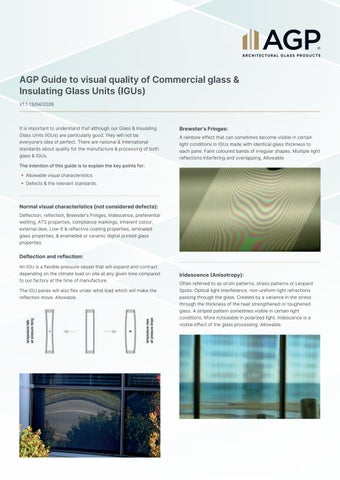
Brewster’s Fringes: A rainbow effect that can sometimes become visible in certain light conditions in IGUs made with identical glass thickness to each pane. Faint coloured bands of irregular shapes. Multiple light reflections interfering and overlapping. Allowable.
The intention of this guide is to explain the key points for: Allowable visual characteristics Defects & the relevant standards.
Normal visual characteristics (not considered defects): Deflection, reflection, Brewster’s Fringes, Iridescence, preferential wetting, ATS properties, compliance markings, inherent colour, external dew, Low-E & reflective coating properties, laminated glass properties, & enamelled or ceramic digital printed glass properties.
Deflection and reflection: An IGU is a flexible pressure vessel that will expand and contract depending on the climate load on site at any given time compared to our factory at the time of manufacture. The IGU panes will also flex under wind load which will make the reflection move. Allowable.
Iridescence (Anisotropy): Often referred to as strain patterns, stress patterns or Leopard Spots. Optical light interference, non-uniform light refractions passing through the glass. Created by a variance in the stress through the thickness of the heat strengthened or toughened glass. A striped pattern sometimes visible in certain light conditions. More noticeable in polarized light. Iridescence is a visible effect of the glass processing. Allowable.