FLORIDA PLANNING A publication of the Florida Chapter of the American Planning Association
HEALTH AT HOME & AWAY - Summer 2022
florida.planning.org
Planning for Public Health
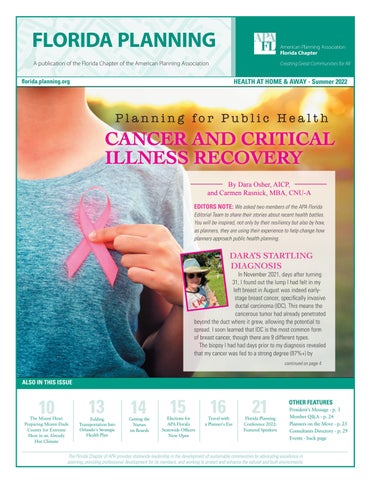
CANCER AND CRITICAL ILLNESS RECOVERY By Dara Osher, AICP, and Carmen Rasnick, MBA, CNU-A EDITORS NOTE: We asked two members of the APA Florida Editorial Team to share their stories about recent health battles. You will be inspired, not only by their resiliency but also by how, as planners, they are using their experience to help change how planners approach public health planning.
DARA’S STARTLING DIAGNOSIS
In November 2021, days after turning 31, I found out the lump I had felt in my left breast in August was indeed earlystage breast cancer, specifically invasive ductal carcinoma (IDC). This means the cancerous tumor had already penetrated beyond the duct where it grew, allowing the potential to spread. I soon learned that IDC is the most common form of breast cancer, though there are 9 different types. The biopsy I had had days prior to my diagnosis revealed that my cancer was fed to a strong degree (87%+) by continued on page 4
ALSO IN THIS ISSUE
10
The Miami Heat: Preparing Miami-Dade County for Extreme Heat in an Already Hot Climate
13
Folding Transportation Into Orlando's Strategic Health Plan
14
Getting the Nurses on Boards
15
Elections for APA Florida Statewide Officers Now Open
16
Travel with a Planner's Eye
21
Florida Planning Conference 2022: Featured Speakers
OTHER FEATURES President’s Message - p. 3 Member Q&A - p. 24 Planners on the Move - p. 25 Consultants Directory - p. 29 Events - back page
The Florida Chapter of APA provides statewide leadership in the development of sustainable communities by advocating excellence in planning, providing professional development for its members, and working to protect and enhance the natural and built environments.
[CANCER & CRITICAL] ILLNESS RECOVERY
continued from cover
the estrogen and, to a lesser extent, the progesterone in my body. In the breast cancer world, we call this estrogen receptor/ progesterone receptor-positive (ER/PR+). I was negative for HER2, another protein in the body that promotes the growth of cancer cells. HER2+ breast cancer is far more difficult to treat and guarantees chemotherapy as part of the treatment plan. My treatment plan evolved over two months, though it felt like years. It was to be informed by genetic testing to determine if I had a hereditary mutation for breast cancer, and another test, called OncotypeDX, to determine how receptive my cancer would be to chemotherapy treatment. As I waited, my oncologist immediately put me on the medication Tamoxifen, which basically tricks cancer cells into bonding with fake estrogen which, ideally, does not allow the tumor to grow. In January 2022, I learned that I had no genetic mutations for cancer and that my cancer type would not benefit from chemotherapy. My treatment plan was finalized: I would have a lumpectomy to remove the 1.9 centimeter tumor from my left breast and the first few lymph nodes the fluid in my breast drains to, to determine if the cancer had spread through my lymphatic system. In total, I had four lymph nodes removed, followed by 20 treatments of radiation therapy. My first lumpectomy revealed that there had been no spread, but my surgeon did not get clear margins, meaning a margin of healthy tissue surrounding the tumor. One of my margins had enough microscopic cancer cells remaining that, two weeks to the day later, I had a second surgery to clear them out. PUBLIC HEALTH AND THE BUILT ENVIRONMENT It is not easy to receive a diagnosis such as this at any age, but the privilege of my environment has had a significant impact on my recovery and personal health maintenance. As a multimodal planner, mobility enthusiast, avid international traveler, and now a young cancer survivor, it is difficult for me to ignore the impacts of the physical environment on my quality of life. I believe that the ability to safely use our bodies to transport ourselves where we need and want to go is of vital importance to public health. For decades, we have been building car-oriented communities and cities, at the expense of shaded sidewalks, connected bicycle networks, dense and walkable land uses, and quality mass transit. While personal vehicles provide a crucial mobility option, especially in Florida, it is unfortunate that the ability to live somewhere walkable, bikeable, and with quality infrastructure has become a privilege reserved for those who likely own a personal vehicle and are not reliant on other modes for transportation. In the areas that have denser urban neighborhoods, mobility is less restricted than in suburban areas but that does not mean the maintenance of historic infrastructure has remained a priority. Also, living in suburban areas does not always equate to easy access (I would know, I grew up in the suburbs of northeast Broward County). 4 Summer 2022 / Florida Planning
Some to no shade on sidewalks makes it difficult for slow strolls around any neighborhood.
More shady parks are needed, with benches, to help residents of all ages, abilities and ailments enjoy their community.
Jacksonville redlining map shows neighborhoods citywide that are at risk, as Dara explains below. continued on page 5
[CANCER & CRITICAL] ILLNESS RECOVERY
continued from page 4
It is essential to also invest in crucial amenities that make walking, biking, and taking transit (which starts with a walking or biking trip) safe and enjoyable, such as ensuring there is adequate shade from the elements and enough parks and green space in the vicinity to reduce urban heat indexes, especially in the summer. Every day I take walks around my neighborhood, sometimes twice a day. When you have surgery and/or when lymph nodes are removed, it is one of the few activities that you can do. For months, I had limited mobility in my left arm and could not lift weights. I am still trying to understand what lymphedema is and what it means to be at risk for it for the rest of my life. I walk for my mental health, to relieve stress, for transportation or to access transit, to take in the beauty of my environment, and to achieve crucial blood flow and movement to reduce the likelihood of developing blood clots, a higher risk for me now. I live in the urban neighborhood area of Riverside in Jacksonville, close to downtown. To the east of me are several square miles of urban neighborhoods bisected by commercial strips every few blocks. To the southeast is the St. Johns River, to the north is a rail corridor and Interstate-10, and to the west is the US-17 / Roosevelt Blvd ramp to get on Interstate-10. The historical decisions made in urban design, land use, and transportation are clearly demarcated in the built environment here. HISTORIC DECISIONS IMPACT TODAY’S BUILT ENVIRONMENT In 1933, the U.S. Government created the Home Ownership Loan Corporation (HOLC) to help Americans purchase homes and help stimulate economic recovery after the Great Depression. Cities and communities were mapped out based on financial and racial considerations to determine lending risk for home mortgages. Low-risk neighborhoods (labeled A and colored green or labeled B and colored yellow) had no difficulty getting access to financing but areas predominantly home to black and minority communities were redlined and deemed “high risk” (labeled D and colored in red). Banks would not lend to the people in these areas, which led to the devaluation of land in these neighborhoods. The redlining map of Jacksonville from 1937 (see Figure xx) reflects this historical decision-making. The area circled in orange shows where the Interstate-95 corridor was built, bifurcating black neighborhoods where land was the least expensive, thanks to redlining. The yellow circle represents the East-West alignment of the Interstate 10 corridor, which is currently being widened from 4 to 5 lanes in each direction. During urban renewal, devalued black and minority housing and green spaces were paved over for parking lots to support
commuting and commerce needs. Downtowns across the United States were carved up by high-speed roads and ramps designed to funnel white folks from the suburbs to and from their jobs in the urban core. Jacksonville’s Downtown is still recovering from this historical decision-making. This is obvious to anyone with a keen eye when you venture from one part of town to another and especially when driving, walking, or biking around the gridded street networks northeast and northwest of downtown. These areas are also the ones that have food deserts, low vehicle ownership, high crime rates, low home ownership, and lower median household incomes than many other parts of the city. I live in a part of the city, circled in blue in the redlining map above, that is situated between neighborhoods with no risk and some risk. One of the least pleasant aspects of where I live is the uncomfortable proximity to US-17 / Roosevelt Blvd, the highspeed roadway that separates the neighborhoods of Riverside and Avondale from Murray Hill. The “best” areas, colored green in the map above, were never subject to large infrastructure projects that divided communities. The number of trees and parks (big and small); the old but somewhat maintained nature of the neighborhood street network; the amount of shade; the walkable access to coffee shops, bars, restaurants, pharmacies, and more reflects the systematic favoring of and investment in white communities over black communities. CRITICAL ILLNESS - RESOURCES When I was diagnosed with breast cancer, I sought out community in digital spaces, where I have always felt most comfortable expressing myself. For me, that community came from the Breast Cancer Support and Information online forum that is housed on Reddit, a user-based digital discussion platform. The individuals who responded to my posts, answered my questions, and gave me a sense of hope and solidarity after my diagnosis have absolutely changed my life and are some of the most accepting, kind, and loving persons I have known. Historic Decisions and the Built Environment Impact Public Health It is impossible for me to share my story without also highlighting the historical inequities and decision-making that have made the lives of so many more difficult. The ability to walk safely and comfortably around the low-speed, low-stress street network of my neighborhood has been key to my ability to recover—mentally, emotionally, and physically—from the trauma of a critical illness diagnosis. Walking allows me to take in my community on the human scale, decompress from my anxious thoughts, carve out continued on page 6
Local Initiatives Support Corporation (LISC). (2021). Introduction to Redlining: What is “Redlining” and how has it impacted Jacksonville? Retrieved from: https://www.lisc.org/jacksonville/regional-stories/introduction-to-redlining-what-is-redlining-and-how-has-it-impacted-jacksonville/.
1
Summer 2022 / Florida Planning 5
[CANCER & CRITICAL] ILLNESS RECOVERY
continued from page 5
space for myself, and enjoy nature while listening to music, allowing my body and mind to wander. This summer has been incredibly hot, but my health still calls for walking. My walks have shifted to the early morning and late evening, but sometimes my mental health demands mid-day movement. Shade and sidewalks make for a far more pleasant experience in the outdoors but are severely lacking, even where I live. There is an undeniable connection between mobility, access, and public health, and we as planners, and as human beings, must shape the decision-making of today to promote comfortable, shaded, safe walking and biking environments for everyone.
CARMEN’S ENDOMETRIOSIS AND SURGICAL RECOVERY A HIDDEN DISEASE For two decades I unknowingly battled a hidden disease that was damaging my internal organs, causing musculoskeletal issues, and would ultimately end in infertility and early onset menopause. Endometriosis affects 1 in 10 individuals assigned female at birth, which equates to an estimated 200 million women worldwide . Because very little is known about the disease, many symptoms are dismissed or misdiagnosed as gastrointestinal or reproductive issues, and sometimes cancer. This results in a 7 to 9-year delay in diagnosis for those suffering from endometriosis . Meanwhile, the disease rages on destroying vital organs and negatively impacting the life of the patient.
Source: Anti-Discrimination Center
6 Summer 2022 / Florida Planning
Statistics indicate that women living with endometriosis lose 6.3 hours of work a week because of the disease . The only way to put endometriosis in remission is to perform surgical excision of the tissue, lesions, and adhesions associated with the disease. In July 2020, I underwent surgery to remove a 10 cm mass on one of my ovaries. A high CA-125 test pointed to cancer, but the oncologist was skeptical due to the presence of inflammation in my abdomen. My recovery was short-lived in that nine months later I was admitted to the hospital for internal bleeding and what doctors thought was an abscess in my abdomen. An MRI diagnosed DIE or deep infiltrating endometriosis present throughout my entire abdomen binding organs together and freezing all the muscles in my pelvic area. In August 2021, expert surgeons at the Center for Endometriosis Care in Atlanta performed a five-hour surgery to excise endometriosis from my diaphragm, muscles, and vital organs throughout my abdomen, and removed an 11 cm endometrioma (mass) that fused my remaining ovary to my intestine and ureter. This surgery resulted in complete infertility and surgical menopause at the age of 37, but it allowed me to keep my left kidney and eliminate the risk of losing part of my intestines to the disease. PUBLIC HEALTH AND THE BUILT ENVIRONMENT Part of my choosing a career around planning was to advocate for better use of the built environment that encourages holistic and organic interaction at all stages of life. Personally, I’ve always been a very active person who loves to swim, bike, surf, hike, and run while also feeling at home in an urban environment. continued on page 7
2 ,2,3
Society for Women’s Health Research
[CANCER & CRITICAL] ILLNESS RECOVERY
continued from page 6
As my disease progressed, I was unable to participate in any physical activity other than walking due to chronic pain and inflammation. At times, even walking was a challenge due to the debilitating effects of the disease. Making matters even worse was the fact that I was hitting the pinnacle of the disease during the pandemic. Endometriosis is an inflammatory disease, and I could not subject myself to any of the risks of COVID without adding serious complications to my health and wellbeing. This meant I had to find places to walk with ample open space for social distancing. Shortly before my first surgery, my husband and I moved from Winter Park to downtown Orlando. Much like Dara, we wanted to find a location that was walkable and provided multimodal transit options. We found a home in the historically disadvantaged neighborhood of Parramore on the west side of downtown. While we were grateful to be in a more centrally located and built environment, we experienced challenges finding sufficient access to park/open space within a 5-, 10-, or 15-minute walk from our home that allowed me to walk and remain safe from exposure to COVID. We do have one small park close to our home, but it serves as a base camp for homeless individuals utilizing services at the Salvation Army intake across the street. Additionally, it borders one of the busiest roadways in Central Florida, Colonial Drive/SR 50, with no separation or protection from the roadway. This meant my husband and I had to drive to parks/open space areas on the east side of downtown Orlando. We acknowledge that we have the privilege and access to a car to be able to drive to another area of town to utilize parks/open spaces, whereas many families in our neighborhood do not. While we do not live in an area that was redlined by one of HOLC’s Residential Security maps that Dara highlighted, in 1924 the Orlando City Council approved two “Negro Zones” on the west side of Division Avenue in downtown Orlando just two blocks south of the street we live on. Much like Dara points out in her assessment of Jacksonville, the area of Orlando that I live in has been separated from the Central Business District and east side of Orlando by several lines of demarcation including Interstate-4 and Division Avenue. Impacts of this historic decision-making are still seen and felt in Parramore today. They are manifested in ways such as lack of access to parks/ open spaces and grocery stores, low vehicle ownership, high crime rates, and low rates of home ownership. Walking and access to nature are vital to public health at any stage, but these two aspects were extremely important before and after my surgeries. Dara points out in her experience the importance of walking after surgery. In my experience, if I could approach these intense surgeries by having integrated walking and peaceful meditation into the process, my recovery was more productive. More importantly, the directive provided by medical professionals following surgeries such as these is to WALK, WALK, WALK!!!
Photos Above: One of Carmen's healing spaces, Cherokee Park in downtown Orlando.
continued on page 8
Summer 2022 / Florida Planning 7
[CANCER & CRITICAL] ILLNESS RECOVERY
continued from page 7
Walking assists in recovery, decreases the onset of scar tissue in the core/abdomen, and protects against life-threatening complications such as blood clots which are a very common and sometimes fatal side effect of abdominal surgery. In the weeks and months following my surgeries, I would walk laps on the hour-every hour in our nearly 100-year shotgun-style home. In the evenings when it was cooler outside, my husband would drive me to the east side of town and we would check several parks to see which one was less crowded so I could walk on softer surfaces, take in nature, and breathe fresh air. We frequented Langford Park, Lake Davis Park, Cherokee Park, and Al Coith Park. What made these parks vital to my recovery were the long stretches of soft grass that I could walk in until I got tired. Access to shade and benches were also important as I would tire very easily and need to rest before walking again. As I advanced in my walking exercise, Lake Davis provided a nice, even sidewalk with many benches to stop at around the lake. The beauty and tranquility of these spaces should not be underestimated, as they provided a distraction from the overwhelming emotions I was processing resulting from my medical trauma. It was important for me to have access to park spaces close to home as I could not endure car rides for more than 7-10 minutes. To ride in a car post-surgery, I would need several pillows to decrease strain on my core and substantial help getting in and out. Each time we drove to a park on the east side of downtown, I would grow frustrated because of the process to ride in a car and the drive itself. This sparked analysis in my mind of how important it is for one’s health to have access to parks/open spaces without having to undertake car rides, parking, and other transportation barriers. As we work to remedy the damaging patterns of outdated zoning codes and discrimination, it is important that we carve out and preserve park/open spaces in our urban environments and neighborhoods. These two articles show that these spaces are not a matter of form or function: but of recovery, healing, and care. CRITICAL ILLNESS - RESOURCES If you or anyone you know is struggling with endometriosis, please refer them to the links below. These physicians and healthcare professionals are qualified to provide proper counseling and treatment of the disease. • Nancy’s Nook Learning Library • The Center for Endometriosis Care • Then Endometriosis Summit Dara Osher, AICP, is a Planner II with Michael Baker International. She can be reached at dara.osher@mbakerintl.com. Carmen Rasnick, MBA, CNU-A, is Fiscal Manager with the City of Orlando. She can be reached at carmen.rasnick@gmail.com.
8 Summer 2022 / Florida Planning
Carmen was lucky enough to have shaded parks and paths, such as Langford Park, to help her while recovering.