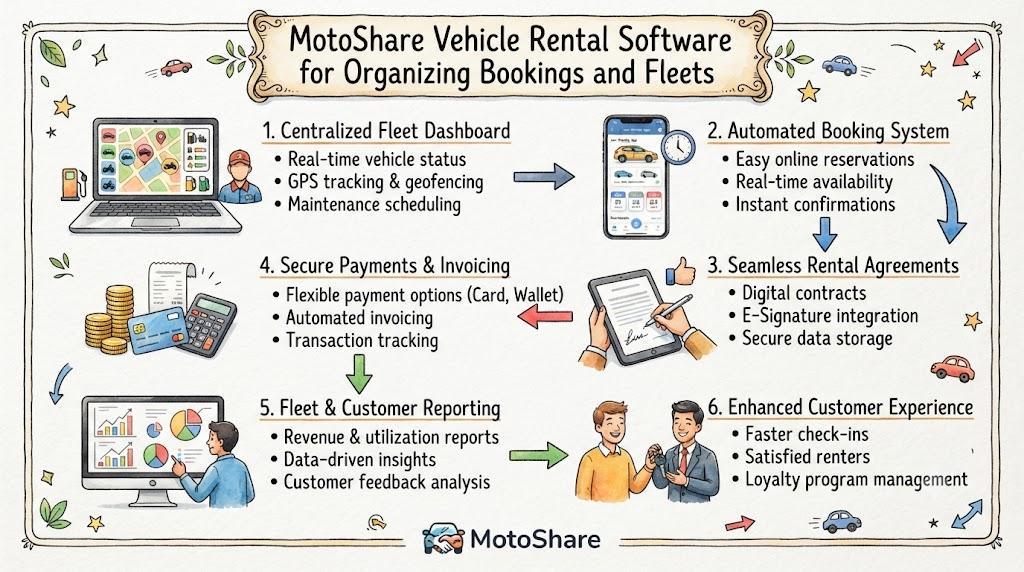
MotoShare Vehicle Rental Software for Organizing Bookings
and Fleets
Introduction
Running a vehicle rental business involves more than giving a customer a car or bike and collecting payment. Operators must manage enquiries, booking dates, vehicle availability, pricing, customer details, returns, and fleet records. When this information is spread across notebooks, spreadsheets, phone calls, and messaging apps, mistakes become more likely.
Vehicle rental management software creates a more organized way to handle these daily tasks. It helps rental businesses keep booking information, vehicle listings, customer records, and fleet activity in one structured system.
MotoShare is designed to support these practical requirements for car rental companies, bike rental operators, individual vehicle owners, rental partners, and growing agencies.
Understanding Vehicle Rental Management Software
Vehicle rental management software is a digital tool used to organize the activities involved in renting vehicles. Depending on the business, it may support cars, bikes, scooters, commercial vehicles, or a mixed fleet.
A rental management platform can help organize:
• Vehicle listings and specifications
• Customer enquiries and bookings
• Pick-up and return dates
• Vehicle availability
• Rental pricing
• Reservation status
• Customer information
• Partner or owner details
• Fleet usage records
Imagine a startup managing eight cars and fifteen bikes. Customers contact the business through phone calls, social media, and messaging apps. Without a central system, staff may forget to update a spreadsheet or accidentally confirm the same vehicle for two customers.
A structured vehicle reservation system gives the team a clearer view of which vehicles are available, reserved, currently rented, or temporarily unavailable.
Common Challenges in Traditional Rental Management
Scattered Booking Records
Customers may contact a rental business through several channels. When booking information is stored in notebooks, spreadsheets, chat messages, and staff phones, important details can be missed.
Employees may also record customer names, rental dates, or vehicle details differently, making the records difficult to review.
Double Bookings
Double bookings often happen when availability is not updated immediately. One employee may confirm a vehicle without knowing that another staff member has already reserved it.
This can result in customer complaints, last-minute vehicle replacements, and additional operational pressure.
Unclear Vehicle Availability
Rental businesses need to know whether each vehicle is:
• Available for booking
• Currently rented
• Reserved for a future date
• Waiting for customer pick-up
• Temporarily unavailable
Checking this information manually takes time and often depends too heavily on staff memory.
Pricing and Communication Errors
Rental rates may vary according to vehicle type, rental duration, weekday, weekend, season, or location. Manual calculations can produce inconsistent quotations.
Unorganized records also make it harder to give customers accurate updates about availability, pricing, pick-up instructions, or return schedules.
Limited Fleet Visibility
As a rental fleet grows, owners need to understand which vehicles are frequently booked and which remain unused. Scattered records make it difficult to review vehicle performance and plan future fleet requirements.
How Software Simplifies Daily Rental Operations
Centralized Vehicle Listings
Vehicle details can be maintained in one place, including the category, model, price, and availability status. Staff do not need to search through several files whenever a customer asks about a car or bike.
Organized listings also make it easier to maintain consistent vehicle information across the business.
Structured Booking Management
Vehicle booking software helps staff record customer details, rental dates, selected vehicles, pricing, and booking status.
Instead of handling each enquiry differently, the business can follow the same booking process for every customer.
Better Availability Tracking
When booking and availability information are connected, staff can check whether a vehicle is free before confirming a reservation.
This reduces scheduling conflicts and helps employees suggest another vehicle when the customer’s first choice is unavailable.
Organized Customer Records
Customer contact details, rental information, and booking history can be stored in a consistent format.
Organized customer records reduce repeated data entry and help staff provide clearer communication during confirmation, pick-up, and return.
Easier Pricing Management
Rental prices can be organized by vehicle type or rental duration. Staff can review current pricing instead of relying on memory, old messages, or outdated spreadsheets.
Improved Fleet Coordination
Rental fleet management software gives owners and staff a clearer view of current bookings, upcoming reservations, and available vehicles.
It also helps different team members work from the same operational information.
How MotoShare Supports Rental Operations
MotoShare can be used to organize cars, bikes, bookings, vehicle availability, pricing, and customer information. It is relevant to small rental agencies, startups, fleet operators, rental partners, and individual vehicle owners.
A small rental business can follow a consistent booking process instead of depending entirely on phone calls and handwritten notes. An individual owner can keep enquiries and rental dates organized. A growing operator can maintain clearer records as its number of vehicles and customers increases.
MotoShare can also support coordination between rental businesses, vehicle owners, and operating partners. Users can organize vehicle details, customer requests, reservation information, pricing, and availability through one system.
The usefulness of any rental platform depends on accurate data and regular updates. Software supports operations, but businesses must still maintain vehicles, verify customer information, follow clear rental policies, and communicate responsibly.
Car Rental Management
Car rental businesses may offer hatchbacks, sedans, SUVs, luxury cars, commercial vehicles, or self-drive options. Each category can have different pricing, seating capacity, fuel policies, and booking demand.
Car rental management software helps operators organize these differences. Staff can check which cars are available for selected dates, record customer requirements, and manage the reservation from enquiry to return.
Consider a company with twelve cars serving local customers and airport travellers. During a busy weekend, six vehicles may already be rented while three are reserved for the following morning.
A centralized system helps staff avoid confirming an unavailable car. It also allows them to suggest another suitable option without checking several spreadsheets or contacting multiple employees.
Organized booking records can also show which vehicle categories receive the most demand, helping the business make informed fleet decisions.
Bike Rental Management
Bike rental operators often manage a large number of short-duration bookings. A customer may rent a scooter for a few hours, a commuter bike for one day, or a touring motorcycle for several days.
Bike rental management software helps operators record these fast-moving reservations, customer details, vehicle categories, and expected return times.
For example, an operator with twenty-five two-wheelers may receive ten same-day enquiries. Some customers may need automatic scooters, while others want motorcycles.
An organized system helps staff identify available options quickly and coordinate vehicle preparation, pick-up, or delivery.
Vehicle Booking and Reservation Management
A structured reservation workflow may include:
1. Receiving the customer enquiry
2. Checking vehicle availability
3. Selecting the vehicle and rental period
4. Recording customer information
5. Confirming the reservation
6. Coordinating vehicle handover
7. Updating the booking after return
This process reduces confusion because staff know what information to collect and what action should happen next.
Accurate booking management also improves the customer experience. Customers receive clearer information about the selected vehicle, rental price, duration, pick-up location, and return process.
Rental Fleet Management
Fleet management involves more than counting the number of vehicles. Rental operators also need to understand how every vehicle is being used.
Rental fleet management software can help monitor:
• Vehicles currently on rent
• Vehicles available for booking
• Upcoming reservations
• Frequently rented vehicles
• Low-demand vehicles
• Rental duration
• Vehicle information
• Partner or owner records
Suppose a rental business manages its own vehicles along with cars and bikes supplied by partners. The company needs to know who owns each vehicle, when it is reserved, and what information must be shared with the partner.
A centralized platform helps reduce communication gaps and keeps these operational records easier to review.
Manual Rental Management vs Digital Rental Software
Management Area
Manual Process
Booking records Notebooks, chats, or spreadsheets
Vehicle availability Checked manually
Customer details Stored in different places
Reservations Phone or message based
Digital Rental Software
Centralized booking records
Updated availability information
Organized customer records
Structured reservation workflow
Management
Area
Manual Process
Rental pricing Calculated separately
Digital Rental Software
Organized pricing records
Fleet monitoring Difficult as the fleet grows Clearer fleet visibility
Team coordination Depends on verbal updates
Record review Requires manual collection
Shared operational information
Easier review of rental data
The main benefit of digital rental management is consistency. When every booking follows the same process, staff are less likely to miss important information.
Practical Checklist for Choosing Rental Software
Use this checklist before selecting a vehicle rental management platform:
• Supports the types of vehicles your business rents
• Handles both cars and bikes when required
• Provides simple booking management
• Shows vehicle availability clearly
• Organizes customer records
• Tracks reservation status
• Supports rental pricing management
• Helps organize fleet information
• Has a simple interface for staff
• Works on commonly used devices
• Supports partner coordination when needed
• Offers suitable affordable or free access
• Matches the actual rental workflow
The best vehicle rental management software is not always the platform with the longest feature list. It is the one that matches the size, team, vehicle categories, and daily processes of the business.
Common Mistakes to Avoid
Choosing Software Without Understanding Business Needs
Rental operators should first understand how enquiries arrive, who confirms bookings, and what information staff require.
The selected platform should support the existing rental workflow rather than create unnecessary complexity.
Ignoring Availability Updates
Availability should be updated after every confirmation, cancellation, return, or booking change.
Outdated availability records can still cause double bookings, even when a digital system is being used.
Using Multiple Disconnected Tools
When employees use different spreadsheets, messaging apps, and notebooks, records can quickly become inconsistent.
One central system should become the main operational reference for bookings and availability.
Failing to Train Staff
Staff should know how to add bookings, update vehicle status, record customer information, and correct errors.
Without basic training, employees may avoid using the platform or enter incomplete information.
Entering Inaccurate Information
Incorrect rental dates, missing customer details, and outdated prices reduce the value of the software.
Businesses should decide which information must be entered for every confirmed reservation.
Selecting Complicated Software
A small rental agency may not need a complex enterprise system. Overly complicated tools can slow down staff and encourage them to return to manual processes.
Practical Rental Business Example
Consider a local operator managing ten cars and twenty bikes. The business receives enquiries from tourists, office workers, and local customers.
Previously, car bookings were stored in one spreadsheet, bike bookings in another, and customer requests remained inside messaging apps. During busy periods, staff
struggled to confirm availability, and updated prices were not always shared with everyone.
After organizing vehicle, customer, booking, and pricing information in one system, the team introduced a standard process. Every enquiry was checked against availability, confirmed reservations were recorded, and returned vehicles were marked as available again.
The software did not solve every issue automatically. Staff still needed to inspect vehicles, verify customer information, and update records. However, it created a clearer structure for daily operations.
Frequently Asked Questions
1. What is vehicle rental management software?
Vehicle rental management software is a digital system used to organize vehicles, bookings, customer information, pricing, availability, and rental records through one structured platform.
2. How does rental software manage bookings?
It records the selected vehicle, rental dates, customer details, pricing, and booking status. Staff can review pending, confirmed, active, and completed reservations.
3. Can one platform manage cars and bikes?
Yes. A platform that supports different vehicle categories can manage both cars and bikes, making it useful for businesses operating mixed rental fleets.
4. What is a vehicle reservation system?
A vehicle reservation system provides a structured process for checking availability, recording customer requests, selecting vehicles, and confirming rental dates.
5. How can software reduce double bookings?
It provides a central availability record that staff can review before confirming a reservation. This works best when every team member updates the system regularly.
6. Is free rental management software useful for small businesses?
Free vehicle rental management software can help startups and small operators organize basic bookings, customer records, and fleet information. Businesses should confirm that the available features match their requirements.
7. What should car rental software include?
Useful features include vehicle listings, availability tracking, booking records, customer details, pricing management, reservation status, and fleet organization.
8. How does bike rental management software work?
It helps operators record short-term bookings, bike categories, rental duration, expected return times, customer details, and vehicle availability.
9. Can individual vehicle owners use rental software?
Yes. Individual owners can use rental software to organize enquiries, rental dates, prices, customer details, and vehicle availability.
10. How does fleet management software improve rental operations?
It provides a clearer view of vehicles that are currently rented, available, frequently used, or reserved for future dates. This supports better coordination and planning.
Key Takeaways
• Manual rental management becomes difficult as bookings and fleet size increase.
• Centralized records help reduce availability confusion and repeated data entry.
• Digital tools can support both car and bike rental operations.
• A structured reservation process improves booking accuracy.
• Fleet visibility helps owners understand current and upcoming vehicle usage.
• MotoShare can organize vehicle, booking, customer, pricing, and partner information.
• Rental software works best when staff maintain accurate and updated records.
Conclusion
Organized rental operations depend on accurate bookings, clear vehicle availability, consistent customer records, and reliable fleet coordination. Vehicle rental management software brings these activities into one structured workflow, making it easier to handle enquiries, confirm reservations, update vehicle status, and review operational information. Car rental companies, bike operators, individual owners, and growing agencies can benefit from replacing scattered records with a centralized process. MotoShare offers a practical way to manage vehicle listings, bookings, pricing, customer details, and partner coordination without adding unnecessary complexity. The strongest results come when rental businesses combine suitable software with regular updates, trained staff, clear policies, and responsible vehicle management.
#VehicleRentalSoftware, #CarRentalManagement, #BikeRentalManagement, #FleetManagement, #BookingSoftware, #MotoShare