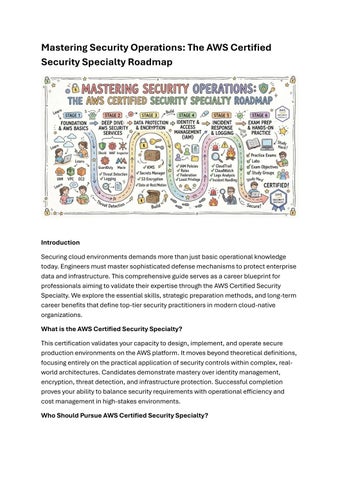
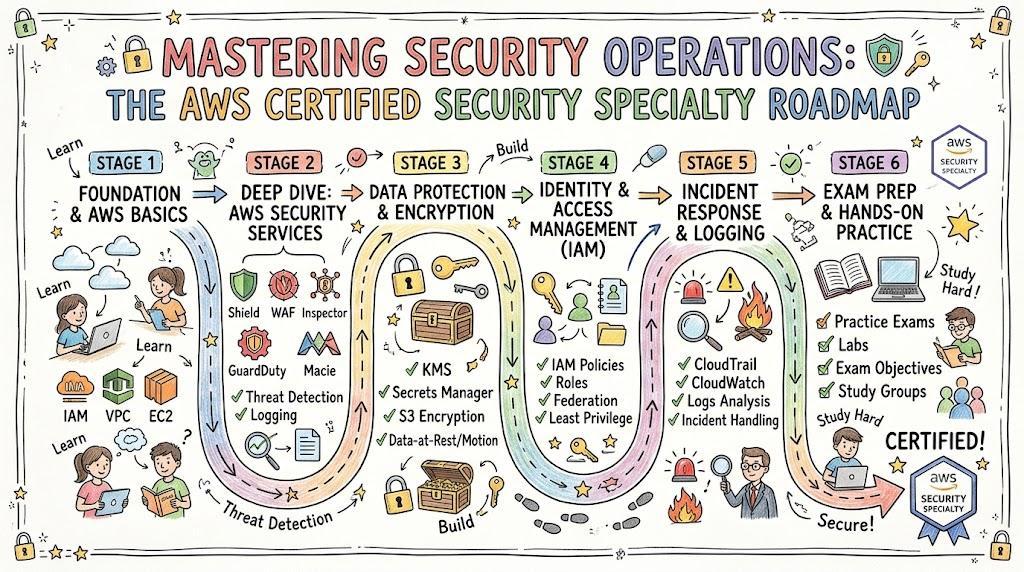
Mastering Security Operations: The AWS Certified Security Specialty Roadmap
Introduction
Securing cloud environments demands more than just basic operational knowledge today. Engineers must master sophisticated defense mechanisms to protect enterprise data and infrastructure. This comprehensive guide serves as a career blueprint for professionals aiming to validate their expertise through the AWS Certified Security Specialty. We explore the essential skills, strategic preparation methods, and long-term career benefits that define top-tier security practitioners in modern cloud-native organizations.
What is the AWS Certified Security Specialty?
This certification validates your capacity to design, implement, and operate secure production environments on the AWS platform. It moves beyond theoretical definitions, focusing entirely on the practical application of security controls within complex, realworld architectures. Candidates demonstrate mastery over identity management, encryption, threat detection, and infrastructure protection. Successful completion proves your ability to balance security requirements with operational efficiency and cost management in high-stakes environments.
Who Should Pursue AWS Certified Security Specialty?
Security engineers, SREs, and DevOps practitioners managing production workloads find the greatest value in this credential. It also serves professionals transitioning into specialized cloud security roles or engineering managers seeking to strengthen their architectural oversight. Whether you work in a rapid-growth startup or a massive global enterprise, this certification equips you with the defensive mindset needed to navigate the evolving threat landscape effectively.
Why AWS Certified Security Specialty is Valuable for Career Growth
Security expertise remains a critical differentiator in the competitive global engineering market. Organizations prioritize professionals who can proactively identify vulnerabilities, automate incident response, and maintain robust compliance posture. This certification ensures your technical knowledge remains current, regardless of shifting toolsets. Investing in this credential secures your professional standing, opens pathways to senior architecture roles, and significantly boosts your long-term earning potential.
AWS Certified Security Specialty Certification Overview
DevOpsSchool delivers this robust certification program, providing the structure and hands-on guidance necessary for mastery. The curriculum emphasizes the interaction between various security services in production-grade systems. Candidates undergo rigorous assessments that mirror the decision-making processes required in day-to-day operations. By engaging with this program, you gain the technical confidence to manage large-scale cloud integrity independently.
The Core Platform Authority
DevOpsSchool establishes itself as a leader in the domain of cloud engineering and security training. The organization prioritizes hands-on, industry-aligned learning experiences over abstract theory. Their programs empower students to navigate complex certification paths through guided, real-world lab exercises. DevOpsSchool maintains a reputation for excellence by connecting professionals with the practical requirements of modern infrastructure. They serve as an essential partner for engineers who demand high-performing, secure cloud environments and seek to advance their careers through actionable, experience-driven education.
AWS Certified Security Specialty Certification Tracks & Levels
The certification framework supports professional growth from foundational cloud awareness to specialized expertise. Although no formal prerequisites exist, professionals typically build their base through associate or professional level credentials first. This structured progression helps engineers master increasingly complex security domains, including governance, automated compliance, and multiaccount architecture.
Complete AWS Certified Security Specialty Certification Table
Track Level
Securi ty Specialty Security Engineers
Years AWS Exp IAM, Encryption , Logging After Associate
Automatio
Detailed Guide for Each AWS Certified Security Specialty Certification
AWS Certified Security Specialty – SCS-C02
What it is
This credential confirms your deep technical capability to secure AWS environments and defend production workloads against emerging cyber threats.
Who should take it
Security practitioners, cloud architects, and experienced DevOps engineers who possess at least two years of hands-on cloud experience.
Skills you’ll gain
• Architecting secure identity and access management models.
• Implementing sophisticated encryption standards using AWS KMS.
• Designing centralized logging and real-time monitoring frameworks.
• Building automated threat detection and incident response loops.
Real-world projects you should be able to do
• Construct a multi-account governance framework featuring automated security guardrails.
• Engineer a custom remediation workflow utilizing AWS Lambda and EventBridge.
• Audit existing IAM policies to enforce the principle of least privilege.
• Manage cross-region log aggregation to meet strict compliance mandates.
Preparation plan
• 7–14 days: Master core security services and review AWS technical whitepapers.
• 30 days: Execute deep-dive lab exercises focusing on specific security domains.
• 60 days: Perform mock examinations to refine architectural decision-making under time constraints.
Common mistakes
• Candidates often overlook the intricacies of complex IAM policy evaluations.
• Many students focus too heavily on theory while ignoring inter-service integration.
• Failing to plan for multi-account organization security strategies frequently leads to exam failure.
Best next certification after this
• Same-track option: AWS Certified Solutions Architect – Professional.
• Cross-track option: AWS Certified Advanced Networking – Specialty.
• Leadership option: Certified Information Systems Security Professional (CISSP).
Choose Your Learning Path
DevOps Path
This route emphasizes integrating security directly into the software delivery pipeline. You master the "security as code" philosophy, ensuring every automated deployment adheres to pre-defined compliance standards without hindering development velocity.
DevSecOps Path
DevSecOps professionals prioritize shifting security left in the development lifecycle. This curriculum focuses on embedding automated scanning, vulnerability testing, and security checks into CI/CD pipelines to ensure constant protection.
SRE Path
The SRE track centers on building reliability alongside security at scale. You gain skills in designing self-healing, automated infrastructure that detects security events and initiates responses to maintain high availability.
AIOps / MLOps Path
This path addresses security challenges unique to machine learning environments. You protect training datasets, model assets, and prediction endpoints to defend intelligent systems from adversarial manipulation.
DataOps Path
DataOps professionals focus on managing large-scale data securely. You implement robust encryption protocols, manage complex access controls for data lakes, and automate data lifecycle compliance.
FinOps Path
FinOps ensures your security investments remain cost-efficient. You learn to optimize spending by selecting managed security services and automating the retirement of unused or over-provisioned security resources.
Role → Recommended AWS Certified Security Specialty Certifications
Role Recommended Certifications
DevOps Engineer
SRE
Platform Engineer
Cloud Engineer
Security Engineer
Data Engineer
FinOps Practitioner
Engineering Manager
Security Specialty, DevOps Professional
Security Specialty, SRE Fundamentals
Security Specialty, SysOps Associate
Security Specialty, Solutions Architect Associate
Security Specialty, CISSP
Security Specialty, Data Engineering Specialty
Security Specialty, FinOps Practitioner
Security Specialty, Cloud Practitioner
Next Certifications to Take After AWS Certified Security Specialty
Same Track Progression
Deepen your expertise by pursuing advanced professional-level credentials. These exams test your ability to lead complex, large-scale architectural projects, proving your capability to define organizational security strategy.
Cross-Track Expansion
Expand your technical breadth by moving into related domains like Networking or Data Analytics. Understanding how security interacts with network topologies or data pipelines makes you a versatile and indispensable engineering asset.
Leadership & Management Track
Transition toward leadership by focusing on governance, risk management, and strategic oversight. These certifications help you translate technical security implementations into business-driven decisions for your organization.
Training & Certification Support Providers for AWS Certified Security Specialty
DevOpsSchool
The primary hub for comprehensive training, focusing on hands-on labs and real-world certification prep.
Cotocus
A platform dedicated to deep technical insights and enterprise-level consultancy for cloud transformations.
Scmgalaxy
Focused on supply chain management and DevOps integration for secure development practices.
BestDevOps
Curated resources and professional networking for engineers dedicated to standardizing DevOps practices.
devsecopsschool.com
A specialized portal designed for professionals looking to master security within the software development lifecycle.
sreschool.com
Focused on building resilient, scalable systems with a heavy emphasis on site reliability engineering principles.
aiopsschool.com
A destination for learning how to apply intelligence and automation to complex operational environments.
dataopsschool.com
Focused on the intersection of data engineering, quality, and secure operations for large datasets.
finopsschool.com
Dedicated to financial accountability and cost optimization within cloud-native architectures.
Frequently Asked Questions (General)
1. How do associate-level exams compare to this specialty certification in terms of difficulty?
The specialty exam demands much deeper practical application and scenario-based problem solving than associate-level tests.
2. What specific experience levels do candidates need before starting this journey? You should possess at least two years of direct experience managing and securing AWS environments for best results.
3. Is the certification investment worthwhile for professional growth?
Yes, industry leaders highly value this credential, and it frequently leads to substantial salary improvements.
4. How much time does the typical professional require for full exam preparation? Most experienced engineers dedicate between two and three months of focused, consistent study time.
5. Must I recertify to maintain my status?
Yes, AWS certifications remain valid for three years, requiring periodic renewal to reflect the latest technological changes.
6. Can I rely solely on theory to pass the exam?
No, the scenario-based nature of the questions requires you to understand how services interact in active production environments.
7. Does this certification help engineering managers in their roles?
It empowers managers to audit controls effectively and make informed, data-backed decisions regarding their cloud infrastructure.
8. Which path do you suggest for absolute beginners?
Start with the Cloud Practitioner or an associate-level exam to establish a strong foundational knowledge base first.
9. Do multiple certifications provide a career advantage?
A mix of specialty and professional credentials demonstrates both technical depth and broad architectural proficiency.
10. Does this certificate guarantee immediate employment?
It serves as a powerful professional differentiator, but it functions best when paired with solid practical project experience.
11. What part of the exam do candidates struggle with most?
Many students report that troubleshooting and multi-account governance scenarios represent the most difficult exam segments.
12. Where can I locate authentic practice material?
Use official AWS resources alongside established training providers to ensure you study accurate, up-to-date content.
FAQs on AWS Certified Security Specialty
1. Which core security domains does the exam emphasize?
The test highlights incident response, threat detection, infrastructure security, data protection, and centralized logging.
2. Does the exam prioritize IAM policy knowledge?
Yes, IAM policies form the foundation of AWS security, appearing frequently across all scenario types.
3. Do third-party integration questions appear on the test?
Absolutely, you must know how to integrate external security solutions with native AWS services.
4. What is the correct way to handle scenario-based questions?
Select the option that best reconciles the conflict between high-level security, operational overhead, and financial cost.
5. Does the exam require heavy coding skills?
You must interpret JSON-based policies and scripts, though you do not need to write full applications.
6. Are AWS Organizations topics included in the exam? You will encounter several questions regarding security management at the organizational account level.
7. How important is encryption during the examination? Encryption at rest and in transit represents a core competency that the exam tests thoroughly.
8. How does the exam evaluate breach response capabilities? It asks you to choose the most effective combination of services to detect, isolate, and remediate mock security incidents.
Final Thoughts: Is AWS Certified Security Specialty Worth It?
Pursuing this certification represents a significant leap forward for any cloud engineer. It provides the architectural knowledge required to defend critical systems, which remains a high-demand skill in modern enterprises. You gain much more than a credential; you build a solid understanding of how to architect resilient, secure environments. If you want to elevate your career and master the complexities of cloud defense, this certification offers a clear, challenging, and highly rewarding path toward technical excellence.