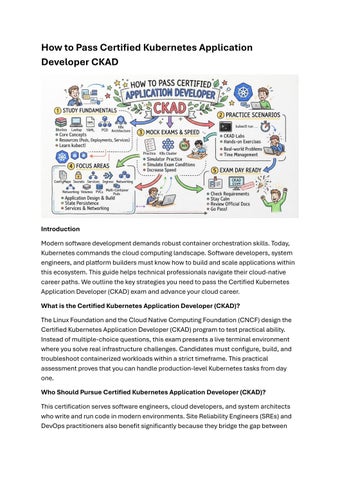
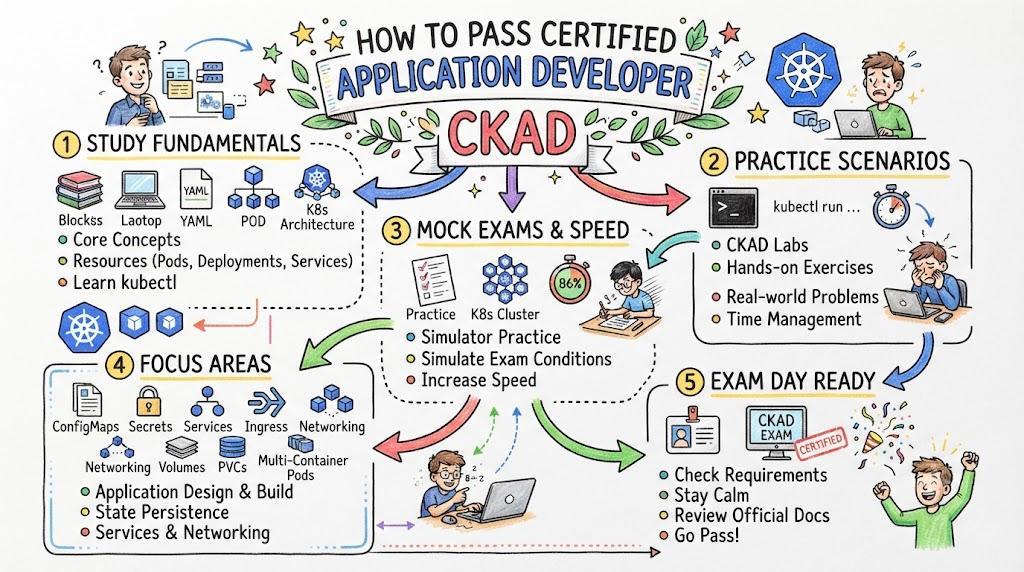
How to Pass Certified Kubernetes Application Developer CKAD
Introduction
Modern software development demands robust container orchestration skills. Today, Kubernetes commands the cloud computing landscape. Software developers, system engineers, and platform builders must know how to build and scale applications within this ecosystem. This guide helps technical professionals navigate their cloud-native career paths. We outline the key strategies you need to pass the Certified Kubernetes Application Developer (CKAD) exam and advance your cloud career.
What is the Certified Kubernetes Application Developer (CKAD)?
The Linux Foundation and the Cloud Native Computing Foundation (CNCF) design the Certified Kubernetes Application Developer (CKAD) program to test practical ability. Instead of multiple-choice questions, this exam presents a live terminal environment where you solve real infrastructure challenges. Candidates must configure, build, and troubleshoot containerized workloads within a strict timeframe. This practical assessment proves that you can handle production-level Kubernetes tasks from day one.
Who Should Pursue Certified Kubernetes Application Developer (CKAD)?
This certification serves software engineers, cloud developers, and system architects who write and run code in modern environments. Site Reliability Engineers (SREs) and DevOps practitioners also benefit significantly because they bridge the gap between
application code and cluster management. Technical managers and team leads find value here too, as the training helps them estimate project timelines more accurately. Globally, and within India's booming IT sector, hiring managers actively seek professionals who hold this practical credential.
Why Certified Kubernetes Application Developer (CKAD) is Valuable in 2026 and Beyond
Organizations worldwide continue to migrate legacy systems to containerized platforms, driving consistent demand for cloud experts. Kubernetes remains the industry standard, ensuring that your skills will not become obsolete. By mastering container lifecycles, you build a resilient technical foundation that outlasts fleeting software trends. Employers pay a premium for engineers who can immediately optimize cluster resources and reduce operational downtime.
Certified Kubernetes Application Developer (CKAD) Certification Overview
The Linux Foundation and CNCF deliver this exam through a performance-based online testing platform. Candidates get a terminal window and a set of practical tasks to solve within two hours. The test validates critical operational skills including application deployment, configuration management, security parameters, and service networking. Because the exam evaluates hands-on execution, passing it demonstrates true engineering competence.
Why Choose DevOpsSchool
DevOpsSchool provides a robust, hands-on training ecosystem that prepares engineers for real production challenges. They design their courses around active learning, avoiding simple slide-deck lectures in favor of deep terminal labs. Instructors who actively architect enterprise cloud platforms lead every single session. Students receive extensive mock exams, direct engineering mentorship, and comprehensive study guides that guarantee deep comprehension of container orchestration.
Certified Kubernetes Application Developer (CKAD) Certification Tracks & Levels
The learning path divides container expertise into logical developmental tiers to support long-term career growth. The foundation tier teaches basic container creation, YAML syntax, and simple pod deployments. The professional tier elevates your skills by introducing complex configurations, ingress routing, stateful applications, and persistent storage management. Finally, the advanced tier challenges engineers to secure multi-tenant clusters, extend the Kubernetes API, and manage large-scale enterprise deployments.
Complete Certified Kubernetes Application Developer (CKAD) Certification Table
Track Level
Applica tion Core Foundati on
Who it’s for Prerequis ites
Skills Covered
Cloud Workloa ds Professi onal
Recomme nded Order
Software Developer s Basic Linux Comman d Line Pod creation, basic containeriz ation First
DevOps & Cloud Engineers Core YAML, Docker Basics Deploymen ts, Networking, Storage Second
Operati ons & Reliabili ty Professi onal SREs, Systems Administr ators Cluster Fundame ntals Troublesho oting, Probes, Logging
Advanc
ed Integrati on Advance d Solutions Architects Extensive Professio nal Skills API extensions, Custom Resources
Third
Fourth
Detailed Guide for Each Certified Kubernetes Application Developer (CKAD) Certification
Certified Kubernetes Application Developer (CKAD) – Professional Level
What it is
This credential validates your capability to design, build, and configure secure, multicontainer applications within a live, active Kubernetes cluster environment.
Who should take it
Software engineers, DevOps practitioners, and SREs who actively deploy microservices and want to prove their operational engineering speed.
Skills you’ll gain
• Building multi-container pod designs including sidecars and adapter configurations.
• Setting up liveness, readiness, and startup probes to automate application selfhealing.
• Injecting application configurations using ConfigMaps and sensitive Secrets.
• Directing traffic flow within the cluster using network policies and services.
Real-world projects you should be able to do
• Deploying a zero-downtime microservices application with automatic rollbacks and blue-green deployment strategies.
• Implementing strict network isolation rules to secure sensitive backend database systems.
Preparation plan
• 7-14 Days: Master rapid terminal commands, utilize command-line generators, and configure custom environment profiles.
• 30 Days: Work through detailed laboratory exercises covering storage volumes, service configurations, and network settings.
• 60 Days: Solve timed mock exams to build muscle memory and verify configuration accuracy.
Common mistakes
• Generating resource manifests from scratch instead of running rapid imperative commands.
• Forgetting to switch cluster context before creating new application components.
• Configuring incorrect probe endpoints, which triggers endless container restart loops.
Best next certification after this
• Same-track option: Certified Kubernetes Administrator (CKA)
• Cross-track option: Certified Kubernetes Security Specialist (CKS)
• Leadership option: Certified Kubernetes Platform Lead
Choose Your Learning Path
DevOps Path
You start your journey by mastering local container builds and deploying applications inside local development environments. Next, you construct robust deployment pipelines to automate application releases and handle cluster state management. You then integrate configuration files and run automated rollout policies across your cluster environments. Finally, you coordinate full infrastructure lifecycles, ensuring fast, stable releases across multiple testing and production stages.
DevSecOps Path
This trajectory embeds security practices into every phase of your container development lifecycle. You begin by scanning application images for vulnerabilities and checking your deployment configurations for security flaws. Once your containers run, you configure strict runtime access controls, secure network policies, and drop root privileges. Finally, you integrate secrets managers, monitor runtime system calls, and automate threat responses to protect sensitive production clusters.
SRE Path
Site Reliability Engineers focus on maintaining high availability, system performance, and application observability across clusters. You start by configuring monitoring tools, gathering system metrics, and aggregating logs from running containers. You then set up horizontal and vertical scaling policies to handle sudden traffic spikes. Finally, you troubleshoot cluster disruptions, recover failing pods, and optimize system resource requests to guarantee uptime.
AIOps Path
You leverage advanced analytical models to predict cluster performance trends and prevent potential system outages. First, you collect telemetry data, logs, and performance metrics from your distributed application components. You then feed this data into automated models that identify infrastructure anomalies before they impact end users. Finally, you build closed-loop automated workflows that scale resources and resolve common operational issues.
MLOps Path
This specialized track manages the unique deployment, training, and scaling lifecycles of machine learning models. You begin by deploying distributed model training environments and managing system hardware resources. You then build automated deployment pipelines that serve models to end users with minimal response latency. Finally, you monitor models for data drift, manage feature stores, and orchestrate automated model re-training jobs.
DataOps Path
Data Operations specialists orchestrate high-throughput data processing systems and manage complex, stateful database platforms. You start by mounting persistent storage arrays and deploying clustered, stateful application workloads. Next, you build automated data pipeline jobs that extract, process, and load massive operational datasets. Finally, you coordinate distributed computing engines that scale dynamically according to incoming data volumes.
FinOps Path
You establish financial transparency, cost controls, and resource efficiency across all your active container environments. First, you implement tracking tags and divide resource costs across development teams using namespaces. You then analyze application resource utilization to identify over-provisioned pods and reduce unnecessary spend. Finally, you build automated shutdown schedules and costtracking systems to keep cloud investments on budget.
Role → Recommended Certifications
Role Recommended Certifications
DevOps Engineer
SRE
Platform Engineer
Certified Kubernetes Application Developer, Certified Kubernetes Administrator
Certified Kubernetes Application Developer, Certified Kubernetes Administrator
Certified Kubernetes Application Developer, Certified Kubernetes Administrator
Cloud Engineer
Security Engineer
Data Engineer
Certified Kubernetes Application Developer, Professional Cloud Architect
Certified Kubernetes Application Developer, Certified Kubernetes Security Specialist
Certified Kubernetes Application Developer, Enterprise Data Engineering Architect