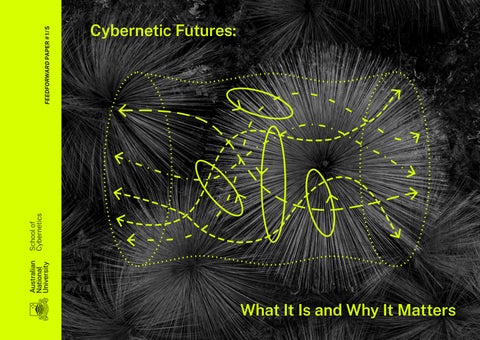
FEEDFORWARD PAPER # 1/5
Cybernetic Futures:
What It Is and Why It Matters
2
ps
Cybernetic Futures: What It Is and Why It Matters
Perha
FEEDFORWARD PAPER #1/5
th
e best
a dvic
e
t
o
an ybod
DESIGN BY
Eden Payne PHOTOGRAPHY BY
Prof. Andrew Meares
mp
Prof. Andrew Meares Dr Jessica Herrington Thomas Biedermann
y c o n te
AUTHORS
la
ti n g
th e
fu
tu r
Kenneth E. Boulding [1]
surprised.
be
e is th is : prepare
to
3 3
4
Cybernetic Futures offers us generative and critical ways of thinking and doing to navigate future actions, informed by the past, by governing in the present, for the hopeful re/imagination of systems. Prof. Andrew Meares, Dr Jessica Herrington, & Thomas Biedermann.
5
6
INTRODUCTION
Our seemingly tumultuous present was perhaps once considered somebody’s “future”. At this moment, we hold social, cultural, political, and economic concerns about artificial intelligence (AI) applications and the associated narratives of technological peril, tensions over governance and regulation, and implications for dignity and job displacement. Increasing global-scale energy demands and environmental costs are unfolding against a backdrop of climate crisis, rising inequality, economic and geopolitical uncertainty, and supply chain dependencies and disruptions. There is ongoing attention surrounding escalating living costs, stagnant productivity growth, media polarisation, algorithmic amplification, and ongoing hybrid warfare and sovereignty conflicts. These challenges have varying degrees of impact—some inform our daily experiences, while others subtly influence broader societal and environmental structures including national security, democratic stability and economic resilience.
7
Where did these futures come from? People and organisations are all constantly confronted with choices in the present. The outcomes of these choices are futures; futures made by who is making those choices and for whom the choices are made. How might we best approach the choices we make today to better inform the future of tomorrow? How might we think about, describe, and visualise our futures and enact them in the present? Futures research, futures studies, futuring, foresight, and strategic forecasting (broadly defined), and their associated methods, attempt to do this. They comprise a constellation of pre-histories, cultural interpretations and applications that are sometimes effective, sometimes unproductive, and sometimes even exclusionary and harmful. As a complementary way in, we offer Cybernetic Futures as a primer through a series of papers titled Feedforward: A Guide to Creating Hopeful Futures. This initiative, underpinned by a cybernetic
8
perspective on navigating uncertainty to enhance the capability to act, aims to foster skills for an anticipatory outlook, inspired by cybernetic principles, methods, tools, and examples. We propose that Cybernetics Futures offers a way to think about futures as a system. Our work is indelibly informed by Ngunnawal and Ngambri Country (land, living, sky, water and kin) on which the ANU School of Cybernetics is situated in Kambri (Canberra). This is a place that has always been somewhere people meet, learn and build hopeful futures informed by Country. And we also acknowledge Country across the continent where we have been fortunate to travel to and learn from. By sharing these explorations, we aim to equip decision makers, industry leaders, researchers, and community advocates with new tools and knowledge they can deploy in their own contexts. Each Feedforward paper serves as an invitation.
9
10
Welcome to Feedforward: A Guide to Hopeful Futures We chose Feedforward as the title for its entanglement with cybernetics, its focus on anticipatory awareness, and its promise. Cybernetics developed and popularised the term “feedback” by theorising and demonstrating how a system can be controlled, or steered, when an output becomes a new input when it is “fed back” into the system. This cycle can then affect the subsequent behaviour of the system. This “control-by-error”, or evaluated difference, enables us to compare how things are going with how we want them to go in the context of a defined goal. This feedback-informed cycle influences what can be described as steering. We make adjustments based on new information, then evaluate how well those adjustments align with the desired goal, and then make adjustments based on that new information. And so on.
However, waiting for a measurable and necessarily retrospective output to become the new partial input before an action can be considered and applied can be limiting, given the many feedback cycles with differing temporalities inherent in dynamic complex systems. This applies widely, from evidence-based policymaking, to autonomous cars, to all manner of systems. Designer and educator Paul Pangaro, writing on cybernetics and design, said: “… design is not just steering towards a goal… design is also a process of discovering goals, a process of learning what matters…”[2]. Building on Pangaro’s and others’ insights into cybernetics and design, Cybernetic Futures does not just set an objective to steer towards or avoid, but offers a process of contextually understanding systems connected to pasts and futures, and confidently developing and making informed choices and actions in the present. The word “feedforward”, as applied in cybernetics, was introduced by a theorist of literature and communication, Ivor Armstrong Richards (known as
11
CYBERNETIC FUTURES: WHAT IT IS AND WHY IT MATTERS
I.A. Richards), in 1951, at the 8th Macy Foundation Conference on cybernetics [3]. These conferences, which were held in New York between 1946 and 1953, building on earlier interdisciplinary discussions through the 1940s, were titled “Cybernetics: Circular Causal and Feedback Mechanisms in Biological and Social Systems” [4] and were convened to explore a future with increased human and machine functions and interactions. The concept of feedforward was one of many to be developed and discussed by the group. Feedforward is now applied in multiple areas, including engineering, education, leadership, performance management, and programming. In 1976, I.A. Richards expanded further on his application of feedforward [5]: Feedforward, as I see it, is the reciprocal, the necessary condition of what the cybernetics and automation people call ‘feedback’. Whatever we may be doing, some sort of preparation for, some
design arrangement for one sort of outcome rather than another is part of our activity… The point is that feedforward is a needed prescription or plan for a feedback, to which the actual feedback may or may not conform. To put it another way, feedback reacts; feedforward prepares. They are connected, cyclical, and combine to enable agency, or the capability to act in the evaluative present, informed by a contextual past and oriented towards a projective future. These Feedforward papers seek to embrace the spirit and application of “feedforward” as described by I.A Richards, articulated through what he described as “political, poetic, and pragmatic” pursuit of “one sort of outcome rather than another” to better prepare us to create hopeful futures [5].
12
Cybernertic Futures We opened this introductory Feedforward paper with a reflective epigraph from a systems-thinking founder, Kenneth E. Boulding, who said when contemplating the future: “prepared to be surprised”. In the 1960s and subsequent decades, Boulding and his sociologist wife, Elise Boulding, dedicated their lives as activist scholars helping people to see more nuanced and sophisticated images of the world and what could be. Elise Boulding asked, “If negative imagery about a feared future can produce positive action, what will positive imagery about a desired future produce?” [6]. The Bouldings encouraged the development of new research methods and theoretical approaches focused on dealing with the complexity of global social systems. At the ANU School of Cybernetics, we are tapping into the futures orientation of cybernetics, imagining and creating hopeful futures to address the evolving challenges of the 21st century. Cybernetic Futures offers us generative and critical ways of thinking and doing to navigate future actions, informed by the past, by governing in the present, for the hopeful re/imagination of systems.
13
Cybernetic Futures unfolds into the following three principles:
The future is not a destination but an invitation: we build it every day in the present.
Navigating uncertainty requires diverse perspectives and an awareness of systems, which are comprised of people, technologies and ecologies.
Creativity, community and hope enable us to think, act and adapt in the present.
14
Fe e d b a c k r e a
ct s Why cybernetics? Cybernetics has many origins over time and place. We have been attentive to the Macy Conferences on cybernetics that took place in New York at a time of upheaval, change and hope post-World War II. These discussions brought together a range of thinkers from across the disciplinary spectrum, “where every participant was open to learning from others, where they held their knowledge lightly, and permitted it to be shaped by others’ expertise” [7]. The deliberate disciplinary diversity of the people involved helped cultivate a shared curiosity to apply knowledge-building through action. We believe this approach serves us well as we reimagine our futures in our present.
s
e r pa
Fe e d f o r wa r d p r e
15
CYBERNETIC FUTURES: WHAT IT IS AND WHY IT MATTERS
Since its founding, the ANU School of Cybernetics has produced various outputs that link hidden histories, contemporary uncertainty, and futures. These include The New Cybernetics: Lessons from the Last Great Redesign (2020) [7] and Australian Cybernetic: A Point Through Time (2024) [8]. We have sought to (a) introduce a cybernetic perspective to leadership in Redefining Leadership in the 21st Century: the View From Cybernetics (2022) [9], (b) understand cybernetic and potential future systems with Custodians & Midwives: The Library of the Future (2022) [10], Backbones and Blueprints: Cybernetic Approaches to the Metaverse (2023) [11] and (c) innovate new, lifelong ways of connecting, learning, making, and instigating positive systems change through ANU School of Cybernetics education and engagement initiatives. Building on this work, we are also introducing a new body of futures-focused knowledge and practice in academic settings through our research projects, workshops,
symposia, and residencies, as well as through the design and delivery of a research-informed and internationally and nationally recognised education initiatives, including a Master’s program, PhD program and the Learning Experiences program. These partnerships and conversations align to an attitude and an application of cybernetics that British historian Andrew Pickering describes as “performative experimentation – trying things out to find out how the world will respond, and then responding to that – a kind of looping and spiralling back and forth I call a dance of agency” [12]. Cybernetic Futures embodies the robust reflexivity that Pickering describes, where we combine critical thinking with critical doing.
16
CYBERNETIC FUTURES: WHAT IT IS AND WHY IT MATTERS
What comes next? Feedforward comprises five papers. This paper offers an introduction. In paper two, we will outline a cybernetic approach to futures. Papers three and four will present two complementary tools we developed to support this work: the Cybernetic Futures Framework and the Cybernetic Futures Compass. In the fifth and final paper, we will cover the specific role of hope in effecting systems change. We do so to offer an opportunity to develop a different type of futures thinking and doing, by governing in the present.
We believe the future is an invitation, so please join us. Sign up at cybernetics.anu.edu.au for updates from the ANU School of Cybernetics.
REFERENCES
1.
Boulding, E., & Boulding, K. E. (1995). The Future.
17
9.
(2022). Redefining Leadership in the 21st Century:
Thousand Oaks, California: SAGE Publications. 2.
the View from Cybernetics. Canberra: ANU School
Dubberly, H., & Pangaro, P. (2015) How
of Cybernetics.
cybernetics connects computing, counterculture, and design. In A. Blauvelt (Ed.), Hippie Modernism:
3.
10.
Cooper, N., O’Brien, E., Reid, K., & Ruster, L.
Walker Art Center.
(2021). Custodians & Midwives: The Library of The Future. Canberra: National Library of Australia &
Logan, R.K. (2014). Feedforward, I.A. Richards, Connecting Catter, Life, Culture and Technology, 2(3), 177–185. Pias, C. (2016). Cybernetics: The Macy Conferences 1946-1953. The Complete Transactions. C. Pias, (Ed.). Zürich, Switzerland: Diaphanes AG.
5.
Richards, I. A. (1968, February 3). The Secret of “Feedforward”. Saturday Review. (pp. 14–17).
6.
Boulding, E., & Boulding, K. E. (1995).
7.
Bell, G., & A. McLennan. (2020). The New Cybernetics: Lessons from the Last Great Redesign. In M. Schrader & V. Martens (Eds.) The Great ReDesign: Frameworks for the future. 2020, (pp. 192-209). Next Factory Ottensen.
8.
Bell, G., Zafiroglu, A., Assaad, Z., Bradley, C.,
The Struggle for Utopia (pp. 126-141). Minneapolis:
ANU School of Cybernetics.
Cybernetics and Marshall McLuhan. Systema:
4.
Gould, M., Daniell, K.A., Meares, A., & Bell. G.
Meares, A., McLennan, A., & Pegram, C. (2024). Australian Cybernetic: A Point Through Time. Canberra: ANU School of Cybernetics.
Gould, M., O’Brien, E., and Bell, G. (2023)
11.
Backbones and Blueprints: Cybernetic Approaches to the Metaverse. Canberra: ANU School of Cybernetics. 12.
Pickering, A. (2024). Cybernetics in Britain. In
Y. Hui (Ed.) Cybernetics for the 21st Century Vol. 1 Epistemological Reconstruction. (pp. 111-126). Hanart Press.
18
We believe the future is an invitation, so please join us. cybernetics.anu.edu.au @anucybernetics