JANUARY - FEBRUARY 2026 | VOLUME 70 NO. 1
THE
WORD SAINT NIKIFOROS THE LEPER & WONDERWORKER FINDING STRENGTH IN THE HUMBLE PLACES THEOPHANY AN EXPOSITION OF THIS COSMIC FEAST
LET US GIVE THANKS AND REJOICE
CONTENTS.
Volume 70 No. 1 January - February 2026
2 January - February 2026
03
EDITORIAL - LET US GIVE THANKS AND REJOICE by His Eminence Met. Saba
06
DEEP CALLETH UNTO DEEP by Fr. Peter Kavanaugh
08
FINDING STRENGTH IN THE HUMBLE PLACES by Fr. Joshua Makoul
11
SAINT NIKIFOROS THE LEPER & WONDERWORKER by Fr. Michael Shanbour
16
SPIRITUAL WORDS by Met. Ephrem Kyriakos
18
THEOPHANY-AN EXPOSITION OF THIS COSMIC FEAST by Fr. Jeremiah Vollman
23
ARCHDIOCESAN OFFICE
26
LIVING NOW IN THE KINGDOM by Charles Ajalat
29
WHEN FAITH FINDS ITS FOOTING IN COLLEGE by Randa Karadsheh Anderson
32
COMMUNITIES IN ACTION
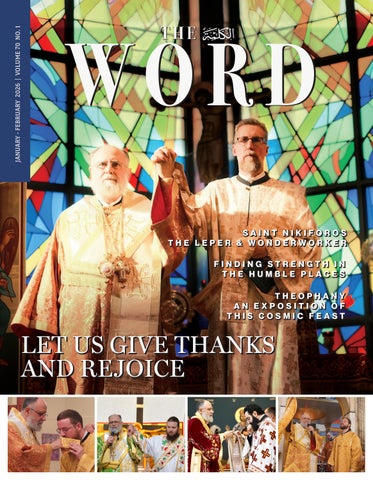
C OV E R : Late fall 2025 Ordinations by His Eminence Met. SABA in NY, NJ, and PA.
E D I TO R I A L
Let Us Give Thanks and Rejoice
G
ratitude, my dear friends, is a
quintessential Christian virtue. A person who appreciates God’s grace and understands the importance of His blessings in their life is always grateful. The Holy Scriptures repeatedly urge us to always give thanks without ever growing weary of it. Grateful persons rejoice in what they have, whether much or little. They are content with what they have, whether great or small. They are satisfied with what they possess and calmly seek better things, without fuss, without agitation, without inner turmoil. They are filled with their Lord and look to Him first and foremost, and from Him they draw every other gift. As long as God, the source of life, is with them, they never feel lacking.
His Eminence Metropolitan Saba
Joy has become rare in these troubled times. Moments of delight may be available from time to time, but true joy is far away. Why? Because the desire for what we need—or what we think we need—is stronger than the joy of enjoying what we have. In one of his letters, the Evangelist John warns us that everything in this world is driven by the lust of the eyes, the lust of the flesh, and the pride of life (1 John 2:16). The Apostle Paul urges believers to beware of and avoid these desires (Gal. 5:19– 21). Why? Because the desires of this world are
When we grumble, when we complain, when we are not satisfied with what we have, and when we are troubled because we want more, we are expressing, indirectly, that we have not yet had enough of our Lord, and that we have not yet grasped, as we should, the purpose of the Christian life. Our era, my dear friends, is a consumerist era par excellence. As you know, it compels us to work harder to earn more money so that we can spend more. The cycle continues in a closed loop, and we remain in a frantic pursuit of more work, more earnings, more spending, and so on. But the real tragedy lies in the fact that the further we progress on this economic journey, the more possessions we feel we need, and so we remain dissatisfied, constantly demanding, forgetting even to appreciate what we have and what we possess. The The Word Word 3
The Apostles were f irst called Christians in Antioch. Acts 11:26 The Most Reverend Metropolitan SABA The Right Reverend Bishop THOMAS The Right Reverend Bishop ALEXANDER The Right Reverend Bishop JOHN
Founded in Arabic as Al Kalimat in 1905 by St. Raphael (Hawaweeny) Founded in English as The WORD in 1957 by Metropolitan ANTONY (Bashir)
The Right Reverend Bishop ANTHONY The Right Reverend Bishop NICHOLAS
Editor in Chief
Bishop JOHN
Assistant Editor
John Abud
Design Director
Dn. Ephraim Awad
Editorial Office: The WORD 2 Lydia’s Path, Westborough, MA 01581-1841 wordmag@aol.com Subscription Office: 358 Mountain Road Englewood, NJ 07631-5238 Theword@antiochian.org Submissions for “Communities in Action” must be approved by the local pastor. Both may be edited for purposes of clarity and space. All submissions emailed and provided as a Microsoft Word text or editable PDF. Please do not embed artwork into the word documents. All art work must be high resolution: at least 300dpi. ANNUAL SUBSCRIPTION: U.S.A. and Canada, $40.00 Foreign Countries, $50.00 Single Copies, $3.00 Checks should be made payable to THE ANTIOCHIAN ARCHDIOCESE. The WORD (USPS626-260) is published in September, November, January, March, and May, by the Antiochian Orthodox Christian Archdiocese of North America at 358 Mountain Road, periodicals postage paid at Englewood, NJ 07631-5238 and at additional mailing offices. Postmaster send address changes to The WORD, 358 Mountain Road, Englewood, NJ 07631-5238 ISSN 0043-7964
Antiochian.org
Canada Post Publication Agreement No. 40043404 Return Canada address to American International Mail, STN A – BOX 697, Windsor ON N9A 6N4, Canada
4 January - February 2026
endless, never truly satisfying, and consequently, they drive us to constantly seek them. Experience teaches us that the disappointment that follows is immeasurably greater than the pleasure of indulging in them. The pursuit of desires leads from one disappointment to another. The fountain of life is within us, yet we go, as the prophet Jeremiah says, to dig broken cisterns that cannot hold water (2:13). We have “the way, the truth, and the life” ( John 14:6), yet we neglect it and pursue a glittering allure that captivates our hearts and deceives us with the illusion of attaining fulfillment. We forget what He has given us and forget this ever-flowing, inexhaustible fountain, and instead seek polluted waters in different places. The tragedy of our modern world is that it makes us forget gratitude, and consequently, all the blessings we enjoy. Our world constantly tries to open our eyes to new, deceptive, and illusory things, making us believe they are essential and indispensable. This is why the wise, guided by the Gospel, rejoice in what they have and thank God for it. We enjoy good health, but we only appreciate it when we fall ill! We can see. Isn’t sight a blessing? We only truly appreciate it when we see a blind person! We can walk. Well, that too is a blessing. But we don’t give thanks for it, nor do we recognize its value, until we see a person with disabilities! There are countless things in our lives that should make us give thanks joyfully and gratefully, and we must truly see them. One of our contemporary spiritual fathers said, “If we were to give thanks for everything, we would have no time to complain.” Complaining means not being thankful, not being grateful, and not being content with the good things the Lord has given us. It also means that we are not satisfied with our Lord and that we are not content with our situation. Someone might ask: Should we be content with what we have and not strive for better? Doesn’t a Christian have the right to be ambitious? Don’t we, as Christians, have the right to ask for the best? Yes, certainly. We have all these rights, but with a spirit of gratitude, a spirit of contentment and joy, a spirit of thankfulness for what we have. We ask for the best quietly, not noisily. We
E D I TO R I A L
ask for the best knowing that the very best is to be in the Lord’s presence, and from there, by the Lord’s grace, we improve not only ourselves but the whole world around us. This is not only a right, but also our duty. It is our duty to make our world a reflection of the Kingdom of Heaven. But if we are always angry, always complaining, always resentful, always sad, always restless, always agitated, how can we improve ourselves and improve our world? Once there was a priest thrown into solitary confinement during the days of communist religious persecution in Russia. He spent many years in his solitary cell. There was only a small window at the top of the room through which light entered. Every day, he would recite a prayer of thanksgiving, which he had written on the walls of his cell. It was a prayer overflowing with gratitude to God, thanking Him that there were people who could see the light of heaven and rejoice, that there were people who
could hear the birds chirping and rejoice, that there were people who could eat and drink whatever they wanted and rejoice. He, deprived of everything, thought of others who had been given what they needed, and he rejoiced for them and thanked God for giving it to them. Where are we in relation to such a contemporary example? This example encourages us to rise to the required Christian spiritual level, and teaches us to give thanks at all times, not just with our lips, but with our hearts. Let us learn well and remember today that true joy is found in Christ. “I bring you good news of great joy: to you a Savior has been born” (Luke 2:10–11). Does not the Gospel begin with this good news? Let us not forget, beloved, that the greatest joy is within us; we only need to open our eyes and see it. May God perpetuate joy in your lives, in your hearts, and in your homes, always. Amen.
The Word
5
Deep Calleth Unto Deep Fr. Peter Kavanaugh
T
“Deep calleth unto deep” (Ps. 42:7)
he island of Cyprus echoes in the sound of waves. The sea is exceptionally blue and vibrant, and the people delight in taking long, deep swims. A monk on this island once described God like the sea: “Imagine some people diving in the water ... in the depths of the sea. They feel the waters of the depths embracing them, engulfing them, and enveloping them. They feel like they’re swimming in the boundless waters of the sea. This is similar to the Divine Light, when a man is accounted worthy to enter into it. It’s an endless, infinite light, having no beginning. As the Lord has neither beginning nor end, so His Light. When a man enters into this Light, he feels with his entire body how the Light embraces and envelops him.” “I bow my knees before the Father,” St. Paul confesses,“that he may grant you to be strengthened with power through His Spirit in your inner being, so that Christ may dwell in your hearts ... [that you] may have strength to comprehend with all the saints what is the breadth and length and height and depth, and to know the love of Christ that surpasses knowledge” (Eph. 3:17–19).
6 September - October 2025
The depth of God! The only real tragedy, the only grave sin, is to never know the depth of God. We fail to understand what Christ wants from us. Christianity is not a religion about being nice. It is
6 January - February 2026
not a faith about social justice or moral superiority. It is a faith about knowing God—knowing him in your gut, knowing him in your breath, as a living person, as an all-consuming fire, loving Him, fearing Him, diving into Him in all his depth and majesty. When the Church talks about sin, it is talking about the mistake of falling for pettiness. Sin is sin, because it means choosing dirt over beauty. Sin is sin, because it means spending your life chasing mud pies, rather than delighting in the wonder of God. “Distraction is the beginning of all evil,” St. Ignatius Brianchaninov has taught. “As a moth flutters from flower to flower, so the scattered man passes from one earthly pleasure to the next, from one useless activity to another.” Sin is serious simply because it keeps us trapped in delusion and silliness. But holiness—holiness
D E E P CA L L E T H U N TO D E E P
is something utterly different—holiness is a life of seeking intimacy with God. Holiness is a dive into the depths. Long ago, our Lord climbed into a boat with Simon Peter. He told the disciple to put out from the shore, and began to teach the crowds. “When He had finished speaking,” the Gospel accounts, “He said to Simon, ‘Launch out into the deep water and let down your nets’” (Lk. 5:1–4). Launch out into the deep. Throw off your shackles, reject your addictions, stop making excuses, and move forward. “Where Lord?” “Launch out,” He enjoins. “Launch out into the breadth and length and height and depth of God.” What is Orthodoxy? In a nutshell, it is the acceptance of our Lord’s invitation: the deep dive. A bishop in the 19th century wrote a little book called How to Live a Holy Life. Metropolitan Gregory Postnikov was his name, and he described in a strikingly straightforward way how a Christian ought to live out one, given day. His first words: “Upon awakening.” Reflect to yourself, do you even notice your first awakening moment? Do you even consider it? What are your first thoughts? How do you launch out from the start? We regard spirituality as something grand and lofty, but spirituality is as simple as this. How do you awake? How do you breathe? How do you eat? How do you brush your teeth? “Upon awakening, try first of all to direct your thoughts to the Lord God. Directing our thoughts to the Lord God should be our most natural activity at every time of the day ... turn first of all to the Lord God with some heartfelt appeal: ‘Glory to Thee, O Lord! Glory to Thee.’” This is the Christian life. What a wonder! Is there anything we can grumble about? God has given us
Himself, even in the first breath of the day. Who is more rich, more affluent, more blessed, than a man that communes with God at his waking moment? “Getting out of bed quickly ... wash immediately, dress immediately in a way that befits a respectable person ... We never are completely alone; always and everywhere our guardian angel, if we ourselves do not drive him away from us, is always with us, and the Lord God ... immediately stand before the Lord God.” “My friend,” Bishop Postnikov continues, “Spend the morning in prayer and in the holy guidance of your life. Put a high value on the morning of every day.” Launch into the deep. All our fears and worries for each day—how do they compare with the weight of God’s presence in each passing moment? The turmoil in the news, the politics, and crimes—what does this amount to, beside the beauty of God? Our squabbles over different theological opinions, methods for arranging coffee hour, parish council discussions— what are these to the grand reality of being in Christ. All our hurt and anxiety—we can let it go, when we live in God intentionally. When we wake up, first thing, and meditate on God, our guardian angel is with us, heaven is with us, God is with us. “‘Simon, launch out into the deep water and let down your nets for a catch.’ ‘Master, we have worked all night long but have caught nothing. Yet if you say so, I will let down the nets.’ When they had done this, they caught so many fish that their nets were beginning to break.” Christ sees us. Christ knows our struggles in this troubling world. He watches the news far more than any of us. What of it? What of the challenges? He is here now and waits for us to follow: launch out into the deep, into the depth of God.
The Word
7
Finding Strength in the Humble Places
O
ne of the most common experiences in today’s world is a growing disillusionment with humanity. No doubt this was exacerbated by the pandemic and the increased polarization of politics (for which neither side is solely responsible). However, it is also driven by something increasingly in short supply: awareness. We are facing a potential extinction of awareness. By awareness, we mean personal insight, self-reflection, a balanced understanding of ourselves in relation to others, the ability to distinguish opinion from reality, and the capacity for healthy hopes rather than rigid, ego-driven expectations. It is no secret that humanity is becoming more self-centered and egocentric as each generation passes. An awareness that our actions affect others—and that reasonableness requires considering both our needs and the needs of others—is becoming rare. Listening and empathy may soon become perceived as naïve and odd. The ego-driven life has become more prevalent. With this reality comes one of the most dangerous 8 January - February 2026
Fr. Joshua Makoul
spiritual traps of our time: an enlarged ego that prevents us from differentiating between God and self. We know we have fallen into this when we function as though our thoughts and opinions are immediate facts and reality; when we believe we are worshipping God, but are in fact worshipping an extension of our own ego. Indeed, our selfimportance and self-love can become so great that without realizing it, we regard no authority other than our own. Is this not the great trap that led to the evil one himself falling from grace? Yet this trap is prevalent today with very little discussion of it. It is imperative that this phenomenon be addressed more in the church. Nevertheless, as a result of all of these things, we can often feel discouraged and alone. Yet all is not lost. There is hope. There are indeed those souls who yet bear witness to the love of God and who serve as sanctuaries for weary souls. These are souls that are readily accessible to us and that can dispel our discouragement. We speak of humble souls. Those for whom humility is their way of life, not something that they have to strive for, but rather it is part of their spiritual fabric and
being. It comes to them as readily as breathing. The presence of humble people gives us hope. They are an oasis of peace and a refuge for those who are weary from feeling existentially alone. In this world we can be surrounded by people and yet feel alone. This is because if we are ego driven and have poor awareness, we might have room for others in our lives physically, but not emotionally or spiritually. To put it bluntly, our ability to see past our own noses is limited. There simply is no room due to our ego blocking any true awareness of the other. When this is operating, others can feel alone even when in our presence. This manifests itself in dominating conversation time, not ever asking about others or knowing their lives, never giving a thought to how our actions affect others. These are just a few examples. In contrast, the humble soul leaves room for others. Their sense of
self is of the right proportion, which has allowed room for the grace of God and the Holy Spirit. Healthy boundaries come so naturally to the humble. The invisible boundary between our space and their own is always in awareness. The idea of encroaching upon others is unfathomable. One of the reasons why the humble soul is a source of peace and refuge is because they are predictable. When we are ego driven, or as the adage goes “legends in our own minds,” we are spiritually volatile, moody, and unpredictable. This is due to being fixated on protecting our selfimportance, craving constant affirmation, and being ruled by rigid expectations. When these are not met, it leads to crises. The humble soul is perpetually content. They possess a rare and profound acceptance of the life they have been given. They desire and yearn for no more than The Word
9
F I N D I N G ST R E N GT H I N T H E H U M B L E P L AC E S
what God has given them. They have embraced the universal calling to be no bigger than what God wants any of us to be, and as a result, they reject the calling of the world to be important and exceptional. The humble also possess simplicity. Their simplicity lies in the fact they have no need for defense mechanisms, as there is no or little ego to defend. They are free souls, liberated from the burdens of the ego and the pride-filled messaging and urgings of this world. They have a direct and clear connection with God. Indeed, their prayers ring out with little static or interference.
AFTER SPENDING TIME WITH A HUMBLE SOUL, WE MAY FEEL AS THOUGH WE HAVE TASTED SOMETHING OF GOD HIMSELF
We know the Holy Spirit stops at each heart seeking a place to dwell and for us to be a vehicle of God’s grace. However, the ego takes the place of the Holy Spirit. The bigger the ego, the less room for grace. After spending time with a humble soul, we may feel as though we have tasted something of God Himself. This is because we have been in the presence of a vessel where the Holy Spirit reigns rather than the ego. The presence of the 10 January - February 2026
Holy Spirit can be felt and emanates from those who possess humility. These individuals are often described as restful and safe to be around, and we often leave their presence feeling loved. Just knowing that these souls exist gives us strength and courage. They serve as icons reminding us of what is right—that what is good and holy still exists in this world. When feeling weary and discouraged, just bringing the humble to mind can remind us what our faith and spiritual lives are all about. This leads to renewed hope. So where do we find these humble souls? The good news is they are everywhere but often not where we think to look. They are easy to miss and often overlooked. They do not speak too much and do not draw attention to themselves. Their opinions are rarely heard unless they are asked. They accept limits and have healthy boundaries. They also rarely complain unless there is an injustice or the dignity of themselves or others is threatened. They incline towards positivity rather than negativity. They are good listeners and have left room in themselves to have empathy for others, for they are just as interested in the life story of another as that of their own. They are also found among the shut-ins, the homeless, and the poor—whose circumstances have, in many cases, protected them from an ego-driven life. These are the souls where God takes up his dwelling through the Holy Spirit. Indeed, they serve as lights guiding us through an increasingly darkened world that grows ever dimmer due to the fading of awareness. So when feeling discouraged and disconnected from God or others, look to the humble places and seek out the humble of heart for refreshment. Their absence of ego provides us with a wellspring of grace.
Saint
Nikiforos W The Leper & Wonderworker
Fr. Michael Shanbour
hile we have come to know this saint of recent times as “the leper,”1 he bore another name, received in monasticism, that is more defining of his life and character—Nikiforos, “victory-bearer.” The “outer man” was perishing (2 Cor. 4:16), yet his martyric endurance and sincere love for God resulted in a renewal of the inner man that ultimately transcended and transfigured his difficult bodily struggle. Leprosy eventually left the holy monk blind and almost paralyzed. Yet he saw and contemplated God in his heart, and he was always moving in and through the Lord by unceasing prayer. Like Christ, he became victorious through his cross, attaining to a state of resurrection even before death. Despite the disfigurement of his body, his soul was made beautiful by the Holy Spirit. Those who would normally be repulsed by the disease were ineffably attracted to this vessel of God’s grace. And St. Nikiforos, the sufferer, 1 The patron saint of lepers is St. Zoticus of Constantinople, the feeder of orphans, who is commemorated on December 31.
became consolation, joy, and encouragement for the suffering faithful who came into contact with him.
Early Life The future St. Nikiforos was born Nicholas Tzanalakis in 1890 on the island of Crete in a beautiful mountainous village called Sirikari, forested with a wealth of chestnut trees, adorned by rich lakes and rivers, and spotted with gorges and caves. The village is uniquely divided into 11 neighborhoods named after the founding families. Each family built a church in honor of their patron saints. To this day, Sirikari boasts 13 churches, three of which are in the neighborhood where Nicholas was born. However, life in this idyllic earthly and spiritual paradise was interrupted early and suddenly in Nicholas’s childhood, when his pious and loving parents died, leaving him and his siblings orphans. Nicholas was taken to live with his grandfather
The Word
11
S A I N T N I K I FO R O S T H E L E P E R & WO N D E R WO R K E R
who raised him as best he could. He completed an elementary education. At age 13, Nicholas was sent to Chania to learn a trade as a barber. He didn’t know at the time that he would never again see his village or his siblings.
confided in a hierarch who, by God’s providence, was from the island of Chios. The bishop received him with great love and understanding, having already become acquainted with Nicholas’s purity of life and impeccable spiritual character.
Not long after he began his work he noticed a small spot on his skin, encircled by a ring. This was the first sign that he had contracted leprosy, a condition that, at the time, promised a life of isolation and marginalization fueled by the fear of contagion. There was no cure for what is now known as “Hansen’s disease,” named after the physician who in 1873 discovered the bacteria that causes it. Until 1947, when a cure was discovered, it meant a humiliating removal from normal community and an eventual, painful death.
In compassion, the bishop contacted Fr. Anthimos Vayianos (now St. Anthimos) who served at the leper colony on Chios, the first of its kind, founded in 1378 and restored in 1909. St. Anthimos provided Nicholas with a beautiful letter of recommendation and paid for his ticket and expenses. He also provided an extra required payment of 30 gold coins—which he had collected to build a monastery—to allow Nicholas, who was not from Chios, to enter the facility. Nicholas arrived in 1914 at 24 years of age. This would be his home until his repose, 43 years later.
The sociable teenage boy, handsome and intelligent, who loved people and was loved by them, was now left utterly alone to bear with his terrible secret. His normal laughter was now forced and feigned. He did his best to conceal his symptoms. He feared being “exiled” to the small island Spinalonga near Crete, which had previously been called “the grave of the living dead.”
St. Anthimos had been assigned as the priest to the leper colony two years prior. He quickly
And so, as the disease became more visible, Nicholas left Crete for Egypt in 1906 at age 16. He was able to find work at a barbershop in Alexandria. He found himself loved and supported there, among the people and the clergy of the Patriarchate. He was even given the opportunity to fulfill a dream to visit the Holy Land.
Life as a Leper By his early 20s the sores were becoming increasingly noticeable, especially on his hands and face. Concerned about being exposed, he finally 12 January - February 2026
S A I N T N I K I FO R O S T H E L E P E R & WO N D E R WO R K E R
transformed the drab and depressing environs to an earthly paradise, planting shade and fruit trees, vines and fragrant flowers, and updating the facilities. In a way, Nicholas had now returned to his childhood village in Crete. There were 35 homes for the residents, each with a large living room, spacious kitchen, fireplace, and bedrooms. The small but lovely chapel of St. Lazarus was surrounded by the director’s house, the pharmacy, and refectory. St. Anthimos—who shared his spiritual father, Elder Pachomios, with St. Nectarios of Aegina— became Nicholas’s mentor and spiritual guide. After two years, he tonsured Nicholas into the monastic schema as Fr. Nikiforos and kept him by his side as a son for the next 15 years. The new monk witnessed many miracles of St. Anthimos, and sent a written testimony after his death: many were released from demonic possession, the sister of an abbot was healed of breast cancer, a young child received his sight. The saint worked many of these through a miracleworking icon Panagia of Obedience that the Mother of God herself revealed to him in a vision. Nikiforos no longer lived in fear of his illness. His focus was on Christ and obedience to his spiritual father, who advised and encouraged him in his struggle for purity of heart, nurtured by fasting, prayer, vigil, innumerable prostrations and battle with thoughts and passions. Fr. Nikiforos, with the virtue of meekness, never argued with anyone. He was a chanter and, while he eventually lost his sight, he would sing or chant the hymns and Epistles from memory.
A New Chapter When the Chios leper colony was closed in 1957, Nikiforos was transferred to the St. Barbara
treatment center in Athens. The holy monk was now 67 years old. Leprosy had deformed and disfigured every part of his body. There, he met a monk Sophronios only recently diagnosed with the disease. With early diagnosis and modern treatment, he was completely healed. Yet Sophronios chose to stay at St. Barbara’s with his ailing brothers for the rest of his life. Sophronios became the caretaker and spiritual son of the severely disabled St. Nikiforos, whom he lovingly referred to as “Papouli.” He attended to his every need with great devotion and sacrificial love. He cooked his simple meals, fed him, bathed and dressed him. In turn, Nikiforos fulfilled the monk’s long-sought desire by instructing him in unceasing prayer, which he had acquired from St. Anthimos.2 St. Nikiforos was patient, meek, and humble. He had risen to great spiritual heights over the years. Once, when Sophronios could not sleep, thinking he had forgotten to do something for his spiritual father, he went back into Papouli’s cell. He did not give the usual prayer before entering, but opened the door slowly and quietly. He was amazed by what he saw: Fr. Nikiforos was raised about a meter above the floor with hands raised in prayer. His face shone radiant with divine light. Sophronios quickly closed the door, ran back to his room and fell on the floor weeping in holy fear. The next morning, he begged forgiveness of the saint, who asked him not to reveal this until after his death. Another witness and confidant of Elder Nikiforos in his last years revealed the intensity of his battle with the demons. The devils would attack him fiercely, sometimes physically (he once revealed 2 When St. Nikiforos was transferred to St. Barbara’s in 1957, St. Anthimos sent a closed letter with him for Fr. Sophronios, asking him to “take care of this treasure, this priceless pearl.”
The Word
13
S A I N T N I K I FO R O S T H E L E P E R & WO N D E R WO R K E R
scratches on his arm from one such clash). But Nikiforos would scourge them with the sign of the cross and force them to tell him how they were tempting others. “Tell me, you scoundrel, where were you last night?” He would rejoice if he found out the demon had been defeated, but grieve and pray if the evil one had succeeded in his task. During this period, a multitude of people were drawn to St. Nikiforos: both simple Orthodox Christians looking for God’s solace from pain, grief, and despair, and well-known figures including metropolitans and abbots coming for his blessing and guidance. He also became a light and encouragement to his fellow patients. The once desperate youth had become a grace-filled holy elder. He who had been brought low by the anguish and pain of his illness was now lifting souls up by his likeness to the One who said: “Come to Me, all you are weary and heavyladen, and I will give you rest” (Matt. 11:28). Despite his body being full of sores and his experience of intense pain, he never complained or grumbled. It is said that his “divine smile never faded from his trembling lips until his last breath.”
Blessed Repose The greatly suffering monk Nikiforos reposed peacefully on January 4, 1964, at age 74. His funeral was held the next day in the Church of the Holy Unmercenaries at the treatment facility. It was described as a “mystical experience.” The patients and visitors who attended the funeral sensed that this was the funeral of a saint. Fr. Nikiforos was buried in the cemetery reserved for the patients just next to the church. Three years later, when his relics were exhumed they were found to be fragrant. They came into the possession of his spiritual child and faithful servant, 14 January - February 2026
Sophronios (since his ordination in 1975 known as Fr. Evmenios). He kept them reverently in a little chest in his room and would often bring them out for veneration, saying, “I have my Papouli here; he’s right here.” And the holy relics continued to exude a glorious fragrance.
Miracles After Death As is sometimes the case, the saint3 worked more wonders after death than in his earthly life. Some of these came about as a result of the publishing of his life in 2003, without which our saint might not be known to us. The book was written in the Greek language by the Monk Simon of the Athonite Skete of Mount Athos.4 Among the written testimonies of those who encountered the saint, are those who experienced an extraordinary fragrance while reading the book. In one case, a man who lost his sense of smell due to nasal polyps, regained it while reading. Some were visited by St. Nikiforos himself. Once when Elder Evmenios was alone in his cell overwhelmed with sadness, he saw the door open by itself and in walked his elder, Nikiforos, who had reposed years earlier. The saint came to him and said, “Come now, my blessed child, don’t cry, 3 Nikiforos the Leper was officially glorified as a saint by the Holy Synod of the Patriarchate of Constantinople on Saturday, December 1, 2012. 4 The Monk Simon began visiting the Leprosy Treatment Center of Athens, where he developed a spiritual relationship with the holy Elder Evenios, a spiritual son of St. Nikiforos. It was with the blessing of Elder Evenios that Fr. Simon eventually took on the task of collecting the life of St. Nikiforos, completing and publishing it in Greek in 2003. Many who knew the saint had since reposed, so it was with much effort and travel that Fr. Simon managed to find a chain of those who knew the saint personally. We owe a debt of gratitude to this monk, without whom, St. Nikiforos might still be hidden from us. The book was translated in English by the sisterhood of the Holy Monastery of the Theotokos of the Lifegiving Spring, Dunlap, CA, with the prayers blessing of Abbess Markella.
S A I N T N I K I FO R O S T H E L E P E R & WO N D E R WO R K E R
don’t be miserable,” patting him on the head. Fr. Evmenios began to feel a “breeze”—it was the Holy Spirit. As the saint continued to caress his head, the breeze increased until it entirely filled him and his grief disappeared. To a man who had read the book and desired to be instructed in the Jesus Prayer, the saint appeared as he was sleeping on his right side. He took him by the hands and raised him up so that he was now sitting on the edge of his bed. The man now feeling perfectly rested and joyful, understood that St. Nikiforos wanted him to say the Jesus Prayer, and indeed he sat praying for a long time. A student at the Athonite Ecclesiastical Academy testifies about going to say prayers in the school chapel. He saw a monk off to the side with a large prayer rope and went to get his blessing. When asked his name, the monk replied, “I am Nikiforos, my child, and I am from the Holy Unmercenaries.” He then began to answer questions the student had been anguishing over, reading his thoughts, and advised him to pray the Jesus Prayer and practice patience and humility. When the student, with tears in his eyes, thanked him, the monk embraced him and said, “Don’t cry—I will always be beside you.” The student left the chapel, but something urged him to return about 30 minutes later. The monk was gone but there was an intense fragrance. A few days later someone gave him a copy of the book. When he saw the icon of Elder Nikiforos on the cover, he burst into tears, knowing that this was the monk he had met in the chapel earlier.
One final example: A man, Anastasios, broke his neck diving into the ocean and was completely paralyzed. One of his father’s clients, Maria, asked to bring a relic of St. Nikiforos the Leper to the hospital. When Anastasios venerated the relics, he smelled a beautiful fragrance. The others present also venerated. Maria left the relics by the paralytic’s pillow for three days. The third evening, Anastasios opened his eyes and asked his father, “Who is the papouli rubbing my legs?” “There’s no one there,” his dad replied, “Go back to sleep.” “But he’s right there!” insisted Anastasios, pointing toward his feet. Then the papouli left. As his father explains, “Our little Tasos became well with the help of St. Nikiforos.” Through the prayers of St. Nikiforos the Leper, O Christ our God, heal the leprosy of my soul and save me!
Through St. Nikiforos’ intercessions, there have also been healings: from terminal cancer, diabetes, depression, and many other illnesses and difficult circumstances.
The Word
15
The Monk
Metropolitan Ephrem Kyriakos of Tripoli, Koura, and dependencies
T
he true monk follows Jesus and clings to His word. Monasticism is not merely about performing good deeds; it involves detachment from all transient worldly things—most importantly, money— through the voluntary embrace of poverty, selfdenial, and a life of self-effacement (aphaneia), ultimately becoming as though non-existent (anyparxia). All of this is primarily for the sake of living with the Lord Jesus and attaining eternal life: “This is eternal life, that they may know You” ( Jn. 17:3). Man’s greatest problem is death. The monk transcends death through his faith and life in Christ, trusting that death delivers him from the fleeting earthly life to eternal life. This faith in Christ demands a continual renunciation of the ego, leading to humility and the chastening of one’s passions. This is what is called white martyrdom in today’s world—a world consumed by man’s destructive desires. Therefore, the monk flees worldly entertainment. He forsakes many human consolations in order to receive divine consolation. For the Lord, through His word, overturned the Jewish belief once prevalent— that life was found in simply doing good 16 January - February 2026
deeds. He taught us that while good deeds help man to live, they do not lead him to perfection: “If you want to be perfect, go, sell what you have and give to the poor, and you will have treasure in heaven; and come, follow Me” (Mt. 19:21). This is precisely what the first apostles did— they sold everything and followed Him. The monk is one who flees the world in order to be united to all. St. John Climacus writes: “The monk is he who has kept his fervor unabated, and to the end of his life has not ceased daily to add fire to fire, fervor to fervor, zeal to zeal, love to love” (The Ladder of Divine Ascent 1:27). Spiritual progress is not measured by the quantity of one’s prayers, but by the depth of humility. Humility is the true death of the ego. The monk avoids celebrations, always seeks the counsel of his spiritual father, and asks for his prayers. What is essential is that the monk continues to love selflessness (philotimia) and non-possession. In conclusion, we can say that the monk engages with everything but is attached to nothing, interacts with everyone but clings to no one. He must remain detached from all things.
Sin Is Madness
Metropolitan Ephrem Kyriakos of Tripoli, Koura, and dependencies
S
in stirs up harmful desires in a person: “And those who are Christ’s have crucified the flesh with its passions and desires” (Gal 5:24).
happened and came to Jesus, and found the man from whom the demons had departed, sitting at the feet of Jesus, clothed and in his right mind” (Luke 8:35).
There is a connection between the evil spirit, desire, and sin. The book of Genesis illustrates how Satan tempted Adam and Eve to eat from the tree. Humans are created free, yet an external satanic force can move them toward sin.
God is infinite love. We must act according to His will and commandments. God sometimes allows Satan to act in the world, ultimately for our salvation.
Through faith and free will, a person can reject Satan’s whispers and push them away through the power of Jesus Christ, who conquered Satan by His cross, death, and resurrection. A person subject to the evil one and to evil desires is deprived of God’s grace. Outside of God’s grace, man is foolish and crazy.
Sin is nothing but a satanic power acting through our will when we permit it due to pride. The demonic spirit can take hold of man. Sin is madness. A mad man has an evil spirit within. Only Jesus can heal man through the power of His divine Spirit. There is an ongoing battle between the Spirit of God and the spirit of evil.
Sin deprives man of his freedom. He becomes intoxicated with sin and base desires. The demon-possessed man was healed and restored to sound mind. Truly, the one of sound mind is balanced in spirit and free from passions and desires. Madness, illness, and Satan belong to the same family. Fear, mental illness, and even Satan himself vanish through the grace and power of Christ: “Then they went out to see what had The Word
17
Theophany
An Exposition of This Cosmic Feast A homily for the feast of Holy Theophany
Τ
Fr. Jeremiah Vollman
oday, I have to share some beautiful words about the feast of Holy Theophany with you.
Either title is appropriate, Theophany is more specific, which is why I believe we tend to favor this title over that of Epiphany.
The meaning of the feast is summed up in its title—known as both Epiphany and Theophany.
The theme of the manifestation of God is prevalent in this feast—also known as the feast of lights, by way of the frequent use of the symbolism of light. If you pay close attention, you begin to notice this theme even in the subtleties of the language of the feast—in the apolytikion we hear the word (“…Thou hast appeared and enlightened the world…”) because this is the day of celebrating the appearance of Christ who Himself is the Light of the world (the antitype to all lights) It’s also then the feast of the celebration of the illumination of the world—the candle, the Light, that illumines all appears today, and everything else of seeming importance becomes a bit dim in comparison. Fix your eyes on this Light, beloved ones, and don’t divert them, for this is the light produced by a flame that ignites but does not consume, but rather refines, illumines, and sanctifies.
The term epiphany means, generally,“appearance”or “manifestation”and finds it origin in the passage from Titus 2:11, “…the grace of God that brings salvation has appeared to all men” (in Greek: “ἐπεφάνη γὰρ ἡ χάρις τοῦ θεοῦ σωτήριος πᾶσιν ἀνθρώποις”). The term Theophany calls to mind the passage from 1 Timothy 3:16, “God was manifested in the flesh, justified in the Spirit, seen by angels, preached among the Gentiles, believed on in the world, received up in glory.” We know that the word Theos. means God, therefore the word Theophany, more specifically, indicates that today’s feast is a manifestation of God. And among the hallmarks of this feast is the revelation of God as Trinity—we hear this in the troparion for the feast, “When Thou, O Lord, was baptized in the Jordan, worship of the Trinity was made manifest…” 18 January - February 2026
Along with these themes of manifestation and illumination is a third—that of renewal, regeneration, re-creation. The baptism of Christ is a renewal of human nature, serving as a prelude
T H EO P H A N Y-A N E X P O S I T I O N O F T H I S C O S M I C F E A ST
to the primary and initial means of our entry into the life of Christ, our own baptism. So today in celebrating the baptism of Christ, we acknowledge such a renewal, but not only one that is limited to the renewal of humanity, but—as we mentioned on Friday after the Royal Hours—this is a cosmic feast, that is, a feast of proclaiming the effect of the incarnation on the material world as well. Christ came not only to renew mankind, but to reclaim all of creation. Let’s consider this question—the perplexing question addressed repeatedly in the hymns of the feast: Why was Christ baptized? It makes sense that a man—any man—would be baptized, sinful, in need of repentance, seeking cleansing from sins. But what of the sinless one? What do the waters have to offer to Him who is their very source? Let alone the clay ( John the Baptist) placing its hand upon the potter in order to plunge the source of all life into the waters of the Jordan!
that it might be put to death on the cross. Likewise at his baptism, He who knew no sin, the Perfect One, the New Adam, carried the sins of humanity down with Him into the waters and cleansed humanity, and arising from the waters raised us up as regenerate, renewed, restored. In Christ’s baptism at the hands of John, our own baptismal regeneration is already accomplished by anticipation. The many celebrations of the Eucharist are all participation in the single and unique last supper; and in a similar way all our individual baptisms are a sharing in the baptism of Christ—the baptism of each person is a means by which the “grace of Jordan” is extended, so that it may be appropriated by each of us personally.
Of course—as is most often the case—the explanation is found in the beautiful hymns of the feast, they state: “Though as God He needs no cleansing, yet for the sake of fallen man He is cleansed in the Jordan,” and, “As man He is cleansed that I may be made clean.” We begin to see that Christ plunged into the waters in His humanity (yes, always as the God-man), summing up all of humanity in Himself as the second Adam, accomplishing for humanity what it had failed to accomplish for itself—and providing the means by which to do it. When He was crucified, Christ, “…who knew no sin [became] sin for us, that we might become the righteousness of God in Him” (2 Cor. 5:21); He took upon Himself this sin of all humanity so
The Word 19
T H EO P H A N Y-A N E X P O S I T I O N O F T H I S C O S M I C F E A ST
You have heard me, in recent days, continue to use nuanced speech in this regard, always emphasizing that in Christ the salvation of humanity has been accomplished, while it is yet being accomplished in each of us—we, who represent the humanity that has been saved, are yet being saved as we live according to the baptismal reality of our life in Christ, and continue to, until the end. He who endures to the end will be saved—we could likewise say “he who preserves (and renews) his baptism to the end will be saved.” (Introduction to the Festal Menaion, “The Background and Meaning of the Feasts”) You may have noticed the very close connection between the prayers of the Great Sanctification of Water and the prayers said over the baptismal font in the service of baptism. We can see in this an indication of the close connection between Christ’s baptism and ours. I must emphasize here, though, participation in the baptismal rite is by no means an indication of one’s “right” to salvation, no more than physical circumcision would automatically make someone a child of Abraham under the old covenant. We first recall the words from Deuteronomy 10:16, “Circumcise the foreskin of your heart, and be stiffnecked no longer”—a challenging word during this era in which the outward sign was the most drastic indication of one’s membership in the covenanted people of God. We also recall the challenging words of the Holy Apostle Paul: “…he is not a Jew who is one outwardly, nor is circumcision that which is outward in the flesh; but he is a Jew who is one inwardly; and circumcision is that of the heart, in the Spirit, not in the letter; whose praise is not from men but from God” (Rom. 2:28–29). And again the Holy Apostle Paul: “…In Him you 20 January - February 2026
were also circumcised with the circumcision made without hands, by putting off the body of the sins of the flesh, by the circumcision of Christ, buried with Him in baptism, in which you also were raised with Him through faith in the working of God, who raised Him from the dead” (Col. 2:11–12). In each of these passages, we see that circumcision is a mode of being, a disposition, much more than an outward sign, and in the last passage we see that the sign of circumcision has been replaced with the baptism of Christ—identification with Him in His death and resurrection. But to be baptized isn’t enough, beloved ones. While we trust that the waters of regeneration are of great power, the power of cleansing, the power of them only continues inasmuch as we appropriate the reality that we entered into as those who have “put on Christ,” and who never seek to divest of this garment! Hear the beautiful words of Fr. Dumitru Stăniloae, which I cannot resist sharing: The mystery of Baptism isn’t only a momentary realization of a mystical death and resurrection by the one who is baptized; it is also the inauguration of a process in which this death and resurrection continue until perfection. This death is again the negative aspect of asceticism. It is the struggle against the old man of sin; the resurrection is the positive aspect. It is the raising of the new man of the virtues. Death is joined with suffering. We stifle and cut away from us a kind of life which has become our own. But then we realize that the Lord too died suffering and by our suffering we too take part in what He suffered. In this sense asceticism is our participation in the death and Resurrection of the Lord, in the continuation and actualization
T H EO P H A N Y A N E X P O S I T I O N O F T H I S C O S M I C F E A ST
of Baptism, by our personal efforts. Christ as the source of the power which sustains the effort of asceticism, is the force, the “nature,” both of the virtues, as the positive side of asceticism, as well as of the struggle against the old man, of sin. Christ directs the work of the slaying of the old man of sin in us, not only by the power which He gives us, from the inside out, to fight willingly against sinful habits, but also by troubles and afflictions of every kind which He permits to come to us. If we accept these troubles, they gradually purify us; if we revolt, they sink us deeper in sin. Christ is the one who gives us the power to endure them, to suffer afflictions. In this sense, He participates with us in our sufferings, and in this sense too He is humbled with us, burying Himself in a kenosis, an emptying, in a death which He repeats in each
of our lives. It is the death which, at the same time, is an exaltation… (Orthodox Spirituality) We are inspired when serving as witnesses to baptisms of those who are newly illumined in the faith. I am nearly lifted to heaven when celebrating the baptisms each time, the earth shaking and the demons trembling, knowing that they cannot follow the newly enlisted soldiers of Christ into the reclaimed waters, in which death is transformed into life. We are all the more emboldened by seeing the God-man subject himself to them as a slave— this One who would command the waters, and walk upon them. In speaking of the reclaiming of the waters, I want to conclude on this point. Not only do we hear about the effect of baptism in the hymns of the feast, but we hear about the effect of Christ
The Word 21
T H EO P H A N Y-A N E X P O S I T I O N O F T H I S C O S M I C F E A ST
on the water itself—we are told that “Christ has appeared to sanctify the waters.” We know of the tragedy of the fall of humanity, and we know also that the invitation of death and corruption by man plagued the creation with the fate of corruptibility. In today’s feast we find the uncircumscribable one—who was once contained in the womb—now circumscribed in the waters of the Jordan, and by entering into water transfiguring it into a means of healing and grace. So we could say that if water acts as a means of grace pre-eminently in the sacrament of baptism, it is also used as a means of sanctification on other occasions as well. This is why we are encouraged to drink from the water that has been sanctified at Theophany, to sprinkle ourselves, our families, our homes, with it. When we do this, we are proclaiming the cosmic implication of the incarnation—we are using the primal element of water, this fluid substance that all living things depend on—we are invoking the Holy Spirit to accomplish what was accomplished in the waters of the Jordan even here, even now, and we are inviting God to accomplish in our homes, from floor to ceiling, the proclamation of His dominion. When we reclaim the waters and invoke the grace of the Holy Spirit upon them, God employs them as a means of healing, a means of exorcism, a means of increasing our faith—the redemptive and transforming grace of the Savior extends to all things—our essential proclamation here can be found in the words of the psalmist: “The earth is the Lord’s, and the fullness thereof ” (Ps. 24:1). For this reason, beloved ones, we can say that “matter” matters; beginning with our very flesh and bones, all the way to the door we walk through at 22 January - February 2026
the end of the day. All things, beloved, all things may become again a mode and means of God’s holiness, His purity, and His love. Today, the all-perfect Savior entered into the waters of the Jordan that we might be saved. Today, the one who formed all things from nothingness allowed the flow of the Jordan to surround him to demonstrate that He is the God of, and in—not only over—creation. Today, we’re invited to celebrate the renewal of the human race with joy, and we resolve—again, and again—to live a life worthy of the baptism with which we have been baptized—a life of true repentance, for the Kingdom of heaven is at hand. Let us not shy away from it any longer. Let us die with Him that we may live with Him.
ARCHDIOCESAN OFFICE ORDAINED JEKEL, Fr. Nathan to the holy priesthood by Bishop THOMAS on November 20 at the Church of St. Philip in Souderton, PA. Fr. Nathan is completing his third year at St. Vladimir’s Orthodox Theological Seminary in Yonkers, NY. AULTMAN, Fr. Nicholas to the holy priesthood by Metropolitan SABA on December 5 at Virgin Mary Orthodox Church in Yonkers, NY. Fr. Nicholas is completing his third year at St. Vladimir’s Orthodox Theological Seminary in Yonkers, NY. WHITESIDE, John to the holy diaconate by Metropolitan SABA on December 7, 2025, at St. George Orthodox Church Little Falls, NJ. He is completing his second year at St. Vladimir’s Orthodox Theological Seminary in Yonkers, NY. STRICKLAND, Sophrony (Scott) to the holy diaconate by Metropolitan SABA on December 6, 2025, at St. Nicholas Antiochian Orthodox Cathedral in Brooklyn, NY. He is completing his second year at St. Vladimir’s Orthodox Theological Seminary in Yonkers, NY.
ASFOURA, Paisios (Fadi) to the holy diaconate by Metropolitan SABA on December 5, 2025, at Virgin Mary Orthodox Church in Yonkers, NY. Dn. Paisios assists Sayidna Saba at the Archdiocese Headquarters in Englewood, NJ. JOHNSON, Porphyrios (Nathan) to the holy diaconate by Metropolitan SABA on November 30, 2025, at St. George Antiochian Orthodox Church of Allentown, PA. He is completing his second year at St. Tikhon’s Orthodox Theological Seminary. NEEL, Andrew to the holy diaconate by Metropolitan SABA on November 23, 2025, at St. Stephen the Protomartyr Antiochian Orthodox Church in South Plainfield, NJ. He is completing his second year at St. Vladimir’s Orthodox Theological Seminary in Yonkers, NY.
REPOSED Khouriyeh Carol M. Alberts, 78, of Monessen, PA, on Monday, Nov. 10, 2025. She was born Dec. 15, 1946, in Minneapolis, MN, a daughter of the late John and Susan (Brinda) Michalov. For 52 years, she was married to V. Rev. Fr. George Alberts. Together, they served Jason Catanese Antiochian parishes in New York, New Jersey, California, Michigan, Pennsylvania, Quebec, Connecticut, and finally at St. Mary Church in WilkesBarre, PA, where Fr. George retired from active ministry earlier this year.
ELEVATED NICOLAS, Dn. Elias to the dignity of archdeacon by Metropolitan SABA on December 5, 2025, at Virgin Mary Orthodox Church in Yonkers, NY. LAICIZED HINDE, Robert (Silouan) of Santa Cruz, CA.
Prior to her retirement from the workforce, Kh. Carol had worked as a certified surgical technician in various hospitals across the country and was a member of the Association of Surgical Technicians. She had also taught surgical technology The Word
23
ARCHDIOCESAN OFFICE classes at Westmoreland County Community College and worked for the Orthodox Campus Commission and the Dept. of Christian Education of the Antiochian Archdiocese. Kh. Carol also had worked as the cook for St. Vladimir’s Orthodox Theological Seminary as well as at the Antiochian Archdiocese Headquarters. She was a member of the Antiochian Orthodox Christian Women of North America and served as a church school director and teacher for most of her life. Kh. Carol especially enjoyed teaching arts and crafts at the Antiochian Village Summer Camp and the Christian Education Institute. At the time of her passing, she was a member of St. Michael Church in Greensburg, PA. In addition to her husband, Kh. Carol is survived by her son, David Alberts (Anna); two daughters, Christina AlbertsSurdyn ( Jeff ) and Sarah Goldie (Christopher); six grandchildren, Damien, Jacob, Noah, Morgana, Penelope, and Illeana; her brother, Charles Michalov; her sister, Cheryl Andrew (Fr. Jonah); brother-in-law, Michael Alberts (Mary); and several nieces and nephews.
24 January - February 2026
Archpriest George Kevorkian, 72, in our Lord Jesus Christ on Sunday, Oct. 19, 2025. He was the founding pastor of St. Ignatius Church of Florida, NY. Fr. George was born in Brooklyn, NY, on March 15, 1953. He was baptized at St. Nicholas Cathedral, the mother cathedral of the Archdiocese. In his 34 years there, he served in many capacities at the local and regional levels.
Fr. George and Kh. Hend Kevorkian
In 1987, Fr. George and his family became members of St. George Church in Little Falls, NJ. He served as advisor to the Eastern Region Teen SOYO from 1996–2004. He was ordained to the holy diaconate in 1996 and to the holy priesthood on Palm Sunday, April 8, 2001. 10 years later, he was elevated to the dignity of archpriest.
“Fr. George is a son of our parish but, more importantly, a father to us all,” said V. Rev. Fr. Nicholas Belcher, pastor of St. George Church. “There are no words to describe the legacy he has left us through his compassionate love, wise counsel, and sacrificial service. The countless lives he has touched and brought closer to Christ will be a legacy that echoes into eternity in the Kingdom of God.” In 2002, Fr. George earned a master’s degree in applied Orthodox theology from the University of Balamand in cooperation with the Antiochian House of Studies (AHOS). His thesis was titled “An Orthodox Christian Pastoral Approach to Counseling Depression.” For years, he served as coordinator of directed projects for the students of AHOS. In addition to his theology degree, Fr. George held degrees in electrical engineering from Polytechnic Institute of Brooklyn. He worked as a software engineer from 1974–2002, until His Eminence Metropolitan Philip The Word 24 called him to be his hierarchal assistant at the Archdiocese headquarters in Englewood, NJ, a position he held from 2002– 16. During that time, in 2004, he founded St. Ignatius Church. The Word
24
ARCHDIOCESAN OFFICE During his pastorate, Fr. George conducted numerous Orthodox Christian workshops on pastoral communications, church history, morality and ethics, and spiritual growth. Fr. George is survived by his wife, Kh. Hend, whom he married in 1976; their two sons, Daniel (Ashley) and Christoher (Shannon); grandson Steven (Rebecca); and granddaughters Hanneh, Elena, and Ava. He is also survived by his sister, Donna Stephan, as well as many nieces and nephews, including Fr. Joseph Hazar, the pastor of St. Thekla Church in Richmond, TX. Samuel Ezra Newey, 101, on Oct. 18, 2025. A dear friend and mentor to many, a man of remarkable grace, presence, and kindness. He doted on his family and friends with joy, love, and passion. His spiritual strength and exuberance were an example for all who knew him. Sam was a man of superb intellect, humility, and devotion to God and his church. He put faith and family first and gave generously of himself to his friends. His generosity was a keystone of his character. Born in Chicago to Assyrian immigrant parents, Ezra and
Katherine Newey attended Knickerbocker Elementary School and graduated from Waller High School where he was the salutatorian of his class. He attended Northwestern University as a pre-dental student. During World War II, he volunteered for the U.S. Army and became a combat medic with the infantry. While serving with the 28th Infantry Division in eastern France during the Battle of the Bulge, he was severely wounded. His recovery was long and painful and left him with scars for the rest of his life. He was awarded the Bronze Star and Purple Heart for his actions. Following his recovery, he attended Georgetown University receiving a B.S. degree in foreign service, then an M.A. degree in political science from George Washington University’s School of Government.
Mr. Samuel Ezra Newey receiving the St. Raphael Gold Medal from His
Eminence Metropolitan Saba at St. George Church of Jacksonville, FL, in Jan. 2024.
Sam returned to Chicago and became a federal narcotics agent for the U.S. Treasury Department. He met the love of his life, Julienne Rahal, at a Syrian-Lebanese convention in Pittsburgh. They were married in St. Petersburg, FL, andCatanese enjoyed Jason life together with their loving daughter, Pam. They moved to Jacksonville where Sam worked in Julienne’s family business in communications. Sam followed his interest in real estate and became one of the premier commercial real estate developers in Jacksonville for 50 years. His family was a priority as well as his Christianity. He and Julienne were founding members of St. George Church in Jacksonville, where he also served as parish council chairman. Sam was also a member of the Archdiocese Board of Trustees and a life member of The Order St. Ignatius of Antioch. He was awarded the Antonian Silver Medal of Merit and the St. Raphael Gold Medal for his devotion. He was a member of the American Legion and the Disabled American Veterans.
The Word The Word
25 25
LIVING NOW IN THE KINGDOM:
CULTIVATING COURAGEOUS ORTHODOX LEADERS FOR THE LIFE OF THE WORLD
O
rthodox Vision Foundation (OVF) was formed 25 years ago to help the Orthodox Church. Among its many activities,in early 2025, it began two initiatives— lay leadership development and parish growth— which were later combined into one comprehensive program to foster thriving, united parishes. OVF produced a video for YouTube distribution (youtube.com/watch?v=rtW80ymIIic) about the basics of the faith, leadership characteristics, and a call to action to implement acts of evangelism, social action, and generosity. OVF also held a miniconference November 21–22 with a dozen experts, implementers, and philanthropists to help find church-growth solutions. The mini-conference recognized that we are in a time of many thousands of catechumens coming to the Church, we have a priest shortage, overburdened clergy, and insufficiently developed lay leadership. Yet, as Fr. John Fenton has said, “Because of this God-given increase, we are in this moment— God’s moment—and we must not squander [God’s] moment” (The WORD, May–June, 2025). We must not let the God-given increase become a wave that ultimately crashes as waves do, but a mighty stream, transforming the lives of millions. In the next 10–20 years it is possible there could be 20 million committed Orthodox Christians on
26 January - February 2026
Charles Ajalat
this continent: 6% of the total U.S. population and 15% of the 130 million U.S. families. We witnessed this type of growth when the Methodists who in a short period by 1850 grew to be the largest denomination in the U.S. from 1.2% of the population to 5.4%. The mini-conference was amazing. On a Friday afternoon, evening and Saturday morning, participants were able, through God’s providence, to come to a consensus on the challenging plan outlined below: OVF will select five parish clergy who will recruit and later hire two persons for training: 1. a fulltime paid church growth director who would form committees (see below) to implement the experiment, and 2. a stipend-paid ($2,000–$3,000/ mo.) lay catechist director who would also be a trainer of trainers. Both would undergo the required St. Vladimir’s Seminary virtual training and then be hired to implement the program; with funding for the training and hiring provided by OVF, others, and the church. Except for the two directors, the other committee chairs would be volunteers.
L I V I N G N OW I N T H E K I N G D O M
Director Characteristics Needed Basic theological and pastoral knowledge, a pious and humble, yet dynamic person, willing to be a full-time employee at fair compensation, trainable and able to train, willing to fundraise.
Training St. Vladimir’s has a lay catechism course and is likely to expand it to include, in addition to catechism, subjects helpful to church growth (leadership traits: inspiring others, virtuous living, bold problem-solving, clergy-laity relationships, leveraging resources, persevering over obstacles, succession planning, and fundraising).
Experiment Suggestions Regarding
churches would each commit to at least nine parish committees (which would do the following): 1. Implement a catechism or catechism programs and continuing education. 2. Develop an increased parish evangelistic mentality. 3. Develop a mentoring/Godparent program for catechumens. 4. Increase parish social action activities and catechumen participation. 5. Have good internal and external communication for the parish. 6. Have programmatic and financial stability as to the experiment, over time.
Committees and Specific Ideas
7. Balance the need for priestly attention to catechumens and the existing faithful.
Supervised by the church growth director, who will be supervised by the priest, the five experimental
8. Develop the best plan for their church to deal with space constraints.
The Word
27
L I V I N G N OW I N T H E K I N G D O M
9. Develop a plan for smaller churches who have less financial resources. 10. Optional: Establish a burial ministry committee. 11. Optional: Establish a grief and support committee. 12. Optional: Other parish needs, for example, multiple languages parishes; and Mother Church needs. Metrics of success would be developed for each committee as it is formed. Some of the specific ideas on key subjects are as follows:
Evangelical-Minded Outlook Prayer instituted in parishes directed toward growing the parish have had amazing effects. A strong program assigning mentors to catechumens or cohorts of them, who have strong family lives and whose job is to help newcomers participate in the faith community (and perhaps become Godparents to them) could be transformative. Other implementable ideas to increase parish social action are small group dinners or spiritual retreats. Also the help of an OCMC regional evangelical directors program may be possible.
Stability Programmatically and Financially
Solutions as to a 5-year plan that will have donors finance the programs. If the committee programs are successful, experience shows this may not be hard to do.
28 January - February 2026
Solutions to Space Considerations and Sizes of Churches
Possibilities: separate missions for over 200–250 parishioners; branch campuses (one board and budget); overflow facilities; starting missions with a small chapel, renting; a deacon serving a presanctified Eucharist; moving to a new property.
Balancing Attention Given to the Parish Faithful as well as Catechumens
With lay catechists, an active assigned mentoring/Godparenting program and additional lay participation, the overburdened priest will hopefully have some respite during the time more clergy are being ordained.
Future Special Attention to Smaller, Less Affluent Churches.
A smaller church’s lack of funds can perhaps be solved by major national or local philanthropists’ increased giving, increasing the number of donors and their amounts, and developing other funding sources. If the suggested experiment is successful, experience shows subsequent years funding can fall into place. FOCUS centers’ years 2 and 3, for example, show it is possible. This article will hopefully stimulate the thinking of others who want to meet the challenges of church growth, and if the experiment is successful, to expand it to many other churches. May God’s moment be not a wave that crashes but a mighty stream for the salvation of all!
WHEN FAITH FINDS ITS FOOTING IN COLLEGE:
A PARENT’S REFLECTION ON OCF
W
hen Orthodox Christian students begin college, they face a world full of opportunities and challenges. Amid late-night study sessions, complex ideas, and newfound independence, their faith can either grow deeper roots or begin to fade. For students like Elias Anderson, Orthodox Christian Fellowship (OCF) became a steady source of guidance, community, and growth during those pivotal years. Dr. Randa Karadsheh Anderson, mother of Elias and a longtime supporter of OCF, knows firsthand the value that this campus ministry brings. “One of the best things that happened to my son during college was his involvement in OCF,” she reflects. “It didn’t just shape him spiritually. It helped him become a better leader and a better person.”
Randa Karadsheh Anderson
Her husband, then a graduate student at Northwestern, had a similarly profound experience. Though not Orthodox at the time, he was curious. A local priest who served as the OCF chaplain met with him regularly. That relationship led to his baptism into the Orthodox Church, surrounded by fellow students who welcomed him with open arms. “We’re still friends with many of them today,” Dr. Anderson says. This family history made it natural for them to encourage Elias to find his local OCF chapter when he went to college. But even as a parent who believed in the mission, Dr. Anderson was initially skeptical when Elias considered joining the national Student Leadership Board. “I remember thinking, ‘Elias, you do not have time to do anything else!’” she laughs. “But I was wrong. Turns out, when you don’t have time to waste, you don’t waste time.”
A Family Foundation in Faith Before Elias even entered college, the seeds of OCF had already taken root in the Anderson household. Dr. Anderson recalls how her own experience in graduate school at the University of Chicago was transformed by an active Orthodox student group. “We had guest speakers, liturgies on campus, and real fellowship,” she says. “That community helped anchor me during a formative time when I was far from home.”
2023 NYE at the Andersons’
The Word
29
W H E N FA I T H F I N D S I TS FO OT I N G I N C O L L EG E
Leadership That Shapes a Lifetime Elias learned to manage his time more effectively than ever before through the leadership training that OCF provided. He took on real leadership responsibilities, helped plan national events like College Conference, and worked with staff, clergy, and peers from across the country, all while staying on the dean’s list in both his engineering and music majors. “He learned how to lead with purpose and how to serve with humility,” Dr. Anderson explains. “Now, he works for a company that values those leadership skills. He leads interns and manages projects.” The experience, she believes, was not simply extracurricular. It was transformational. For many Orthodox parents, one of the biggest concerns during the college search is whether their child will stay close to the faith. Dr. Anderson encourages families to make that concern part of their decision-making.
“If we want our kids to stay close to the Church, we have to make it accessible and easy for them.” According to Dr. Anderson, proximity to Orthodox life matters. Without it, she says, it’s far too easy to drift away. “It’s too easy to sleep in on a Sunday morning. But with a good OCF on campus, students have the opportunity to go to church together or to meet and talk about things that really matter.” This proved to be a life-changing blessing for Mitry, Dr. Anderson’s older son. When he was a sophomore in college, he met his future wife on the train to the local Orthodox Church, riding with other Orthodox students. One of Mitry and Julia’s close OCF friends was recently a bridesmaid in their wedding.
Lifelong Community and Lasting Impact
“Particularly for parents of high school students going through the college search process, I would look carefully at whether a campus has a local OCF chapter or, at the very least, a nearby parish,” she advises.
This shared experience is not limited to liturgy and lectures. One of the lasting benefits of OCF is the community it fosters. Elias, like many OCF alumni, has maintained deep friendships formed through the organization. These are people who
NU OCF at Keith’s baptism 1992
Anderson wedding, Peoria, IL
30 January - February 2026
W H E N FA I T H F I N D S I TS FO OT I N G I N C O L L EG E
walked with him through some of the most formative years of his life, who stood by him in prayer, and who have remained in his life long after graduation. “Some of his closest friendships today are with people he met through OCF,” says Dr. Anderson. “They’ve supported each other through weddings, job changes, and life’s transitions. It’s a real blessing.” Another powerful aspect of OCF is its studentled structure. The national Student Leadership Board partners with OCF staff and clergy, but the ideas and initiatives originate from the students themselves. For Elias, being part of this leadership structure gave him agency and purpose. It taught him how to collaborate, how to make decisions, and how to live out his faith in action. So when he had the idea to bus 120 college conference students from a retreat center in Wisconsin to a monastery in Illinois to venerate the relics of St. Mardarije, he figured out how to make it happen with full support of the staff. “We sometimes want to protect our kids from taking on too much,” Dr. Anderson admits. “But when it comes to OCF, I would encourage parents to let them lead. Yes, it takes time. But it is time well spent.”
husband into the Church. It’s where Mitry found his wife. It shaped Elias into the man he is today.” That gratitude is what drives her continued support of the organization. “We want to make sure the next generation of Orthodox students has the same opportunities we did. We want more parents to know the joy of seeing their child grow in faith and confidence.” She encourages other parents to get involved, whether by supporting their local OCF chapter, encouraging their children to attend a retreat or College Conference, or by making a financial gift to help expand the ministry to more campuses. “Raising Orthodox children in today’s world is not easy,” she says. “But we’re not alone. There are people and programs out there that want to walk with our kids as they grow into adulthood. OCF is one of the best I’ve seen and experienced myself.” For students navigating the complexities of college life, OCF offers something rare and essential: a place where they can be fully Orthodox and fully themselves. For parents, it offers peace of mind, knowing that their children are not walking that journey alone.
The rewards, she believes, are far-reaching. Students develop real-world skills that serve them in their careers. They become confident in their faith. And they walk away with friendships and experiences that will serve them for a lifetime. Gratitude is a word that comes up often in Dr. Anderson’s reflections. “Looking back, I’m filled with gratitude for the role OCF has played in our lives,” she says. “It helped form me. It led my
OCF Real Break Puerto Rico
The Word
31
C O M M U N I T I E S I N ACT I O N
Growing the Outreach Ministry at Pittsburgh’s Saint George Antiochian Orthodox Cathedral
A
Robin Khorey
lmost a decade ago our Outreach Ministry, called the Homeless Ministry at the time, was born from the heart of our beloved Fr. Joshua Makoul. Blessed with a small allocation from our parish, we began to feed those in need. We did not know that our ministry would blossom to the extent that it has. We started slowly, investigating the needs of our local brothers and sisters in Christ and how we could serve them. We found the greater need to be in the shelters and from those unhoused on the streets in Pittsburgh. As the ministry grew over the years and need grew exponentially with it, we reached out to the Food for Hungry People and Charitable Outreach for assistance. Our initial grant was $5,000, then $8,000. For the past two years, it’s been $10,000.
The allocation and blessing from the FFHP&CO and our parish, combined with partnerships with local businesses and the hard work and generosity 32 January - February 2026
of our fellow parishioners, has allowed us to make a greater impact than we could have imagined. So far in 2025, we have served over 5,000 unhoused people and 500 of our brothers and sisters in four shelters, many of whom have been touched by disaster, illness and death. Our main focus is on providing meals and necessities. At shelters, we serve protein-enriched meals that include chicken, vegetables, starch and salad. On the streets, we provide the same, as well as health and beauty items like shampoo, deodorant, bodywash, and pillows along with tuna, water, fresh fruit, bread, and any usable food we can supply. We prioritize hydration and recently acquired a 5-gallon water dispenser that allows us to offer hot and cold drinks. In the winter, we hand out backpacks full of army blankets, hand and feet warmers, and other warm essentials. We’re also grateful to be able to go beyond fulfilling basic needs to deliver added celebration and joy. Throughout the year we offer Valentine treats, Pascha and harvest candy bags, and full Christmas and Thanksgiving meals. We strive not to judge and to treat all our brothers and sisters as our family members. We never ask questions. Instead, we listen to their stories. We eat with them as we serve them; we have conversations with them. The children we serve on the street are our special little angels. Many have lost a parent or parents from illness, addiction, or other causes. Outreach like this is not for the faint of heart. We encounter much suffering in the shelters and on the streets. We constantly pray for strength and the love of Christ in our hearts to push forward, to be a beacon of light and hope in our fallen world for our loved ones who are less fortunate in life. Yet, we have also been blessed to see the effect of our efforts. We have often watched our
C O M M U N I T I E S I N ACT I O N
brothers and sisters from the shelters blossom to find jobs and housing and go on to fulfill their life’s mission as well. As we journey on God’s glorified path of serving our community, healing falls not only on the souls of those who are in need, but our own souls as well. Our outreach team is composed of many parishioners whose love of serving shines brightly with God’s glory. Through Him, all things are possible. Still, all of this would not be possible if it were not for the Archdiocese FFHP&CO and our parish allocations. If it were not for them, we simply could not serve at our current capacity. The FFHP&CO and our parishioners are our unsung angels. We thank God for this in all our daily prayers. In our journey of faith, we recognize that serving with love is the foundation of our Christian calling. When we embrace compassion and care in our acts of service, we embody the essence of God’s love in the world. As we serve with genuine love, we not only uplift those around us but also grow closer to God in our faith.
Clergy Wives Meet For Fellowship, Learning, and Renewal
O
The CWW Planning Committee
On a beautiful, sunny, and unseasonably warm October weekend (17–19), 16 clergy wives and wives of seminarians from across the country met at the Antiochian Village for the Annual Clergy Wives Weekend (CWW ). This weekend was
initially established by Kh. Stefanie Yazge in 2009, in memory of Kh. Joanne Abdallah (+2008), as a supportive and edifying weekend gathering for current and future clergy wives. After Stefanie’s passing in 2017, the weekend has continued, almost every year since, and was even offered as a two-day Zoom event in 2021. Thanks be to God, through the generosity and care of His Grace Bishop John, the V. Rev. Fr. Anthony Yazge, and the faithful women of AOWNA, many clergy wives have been able to gather and benefit from time spent together in worship, education, and fellowship. This year was no exception. After arrival and checking in on Friday afternoon, attendees were treated to a delicious Lenten supper, prepared by and under the direction of Kh. Janet Shadid, who expertly and lovingly provided meals and managed the kitchen throughout the weekend. Friday evening, everyone gathered with His Grace Bishop John for a group conversation about our experiences—metaphors drawn from our lives of service as clergy wives or as wives of seminarians preparing for ministry in Christ’s Holy Church. We also established goals and aspirations for the weekend, generated by the attending women, including what we hoped to take away in addition to the provided topic, “The One Thing Needful.” Saturday morning, after breakfast and following the arrival of Mother Christophora and Mother Paula from Holy Transfiguration Monastery in Ellwood City, we gathered for an inspirational presentation on the life and recent Glorification of St. Matushka Olga of Alaska, prepared and given by Kh. Rachel Thurman of St. Luke the Evangelist Church in Bainbridge, OH, and Sh. Margaret Ashton, from St. Luke Church in Erie, CO. There The Word
33
C O M M U N I T I E S I N ACT I O N
was much to learn about the life of St. Olga and the impact she has had on the lives of so many beyond those blessed to have lived with her in her parish and village. We learned and reflected on the reality that healing can come through the simplest gestures of faith. We prayed the Akathist to St. Olga, led by Sayidna John, Mother Christophora, and Mother Paula, then began our first session with Mother Christophora. Throughout the session, Mother Christophora and Mother Paula invited participation, encouraged us with their words and wisdom, and gave us practical guidance and strategies for remaining faithful and grateful in what we do. Drawing on Holy Scripture, the Divine Liturgy, and various Orthodox writings—including those of the Very Rev. Alexander and Mat. Juliana Schmemann, and Mat. Lyn Breck—we explored many facets of life as clergy wives. We were encouraged to exude life and consider our continuous mission not only as clergy wives, but as baptized Orthodox Christians, constantly keeping Christ present in our lives. Following lunch, we reconvened as a group, continuing our discussion and sharing. After Mother Christophora and Mother Paula returned to the monastery, time was set aside for personal reflection, walks along the meditation path, or small-group conversations and catching up. We then gathered in St. Ignatius chapel to celebrate Great Vespers presided over by Sayidna John and served by Fr. Chris Shadid, followed by dinner and fellowship in the dining hall. Saturday evening we were treated to the musical stylings of Kh. Rachel Thurman on her autoharp, and were invited to sing along. Black-line coloring icons of St. Olga were available, thanks to Sh. Margaret
34 January - February 2026
Ashton, along with materials for coloring. As the music enveloped us, those with creative talents were able to leave with their own colored depiction of St. Olga, surrounded by the aurora borealis. Sunday morning, Sayidna John and Fr. Chris celebrated the Divine Liturgy, with our responses led beautifully by Kh. Suzanne Murphy and Sh. Margaret Ashton. Following Liturgy, there was a Trisagion service for our departed and beloved sisters in Christ. Finally, we all enjoyed a fortifying brunch, said our goodbyes, and left for our various homes—renewed, refreshed, and recharged. We are grateful to all who attended, to Fr. Chris and the staff at the Antiochian Village for their hospitality, to Mother Christophora and Mother Paula, and to Sayidna John for their wise counsel and supportive words. Our thanks to the women of AOWNA for their love and financial support. We hope to see more of our number next year. Please be on the lookout for a savethe-date notification, and help us spread the word. In the meantime, if you have not already done so, send your contact information to Clerg yW ivesWeekendTogether@gmail.com so that we can expand our contact list and keep everyone posted about next year, God willing.
C O M M U N I T I E S I N ACT I O N
2026 DR. JACK G. SHAHEEN MASS COMMUNICATIONS SCHOLARSHIPS Scholarship award amount $5,000 Established 1997 111 previous scholarship recipients!
Purpose: Recognize and award Arab-American university students who excel in media studies.
Eligibility: University students enrolled in the September 2026–2027 academic year. Juniors, seniors, and graduate school students majoring in journalism, television, radio, and/or film.
Applicants: Mail and include the following items to ADC’s Research Institute c/o ADC V. P. Nabil Mohamad. 1. Two letters of recommendation signed by your mass communications professors. 2. Print copies and/or email links of your relevant work. 3. Share how Dr. Jack Shaheen’s work has influenced you (note: Dr. Shaheen’s Arab Stereotype
Collection is at NYU). Include this in your onepage statement explaining your goals. 4. State that you are a U.S. citizen of Arab heritage. 5. Confirm what academic year you will be in 2026–2027 (junior, senior, or graduate school). If attending a different university in 2026–2027, please attach an acceptance letter and verify you will attend. 6. Submit official academic transcripts (minimum 3.5 GPA is required). 7. Permanent home address, mobile number, and email address.
Application Deadline: Sunday, April 12, 2026
ALL 7 of the above requirements MUST be in your application. Incomplete or late applications will not be accepted. The above requirements are firm. Please do not apply unless you meet all requirements. Thank you.
Submit all materials to: ADC Research Institute Attention: Mr. Nabil Mohamad, ADC Vice President 910 17th NW Suite 1000 Washington, DC 20006 https://jackshaheen.wixsite.com/ drshaheenscholarship Should you have further questions, call (202) 244 2990 or email nmohamad@adc.org. Dr. Jack G. Shaheen Scholarship Awards will be presented at an 2026 ADC event.
The Word
35
THE WORD 358 Mountain Road Englewood, NJ 07631-5238