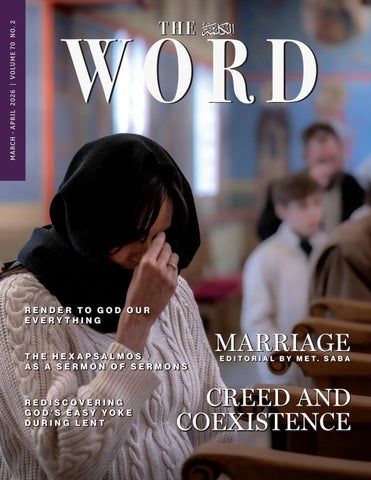
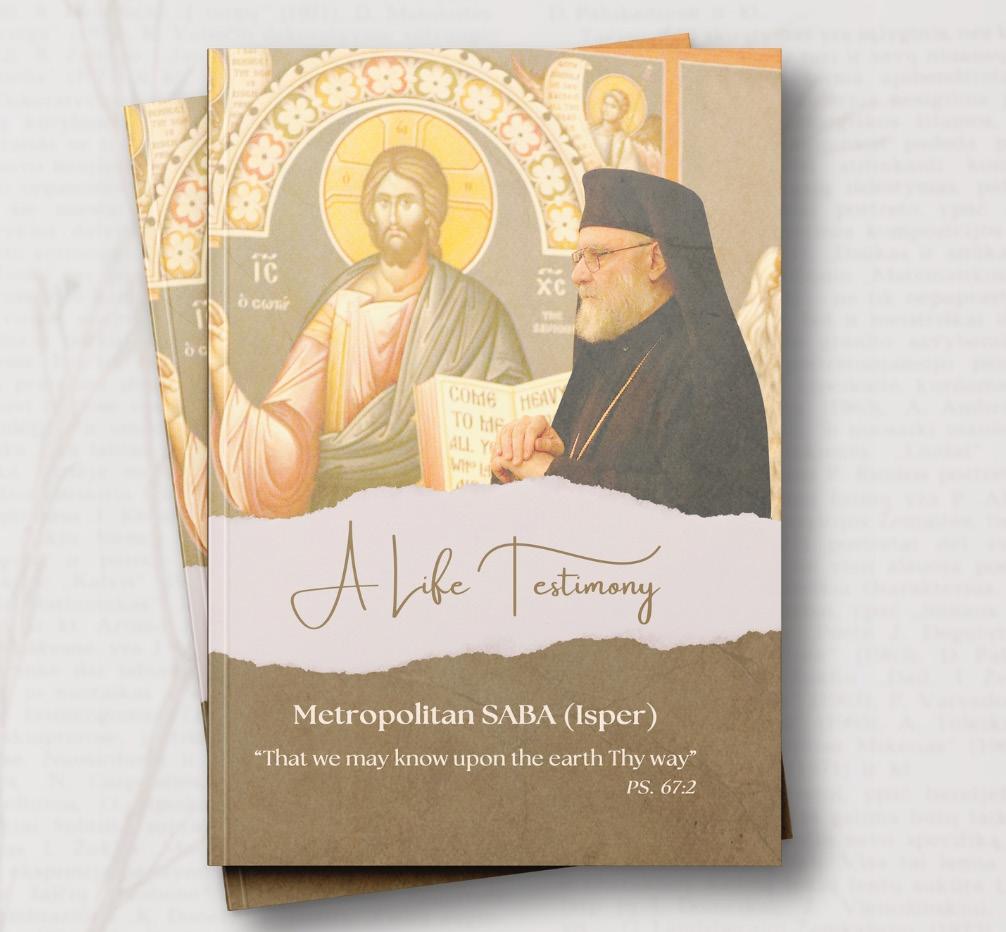
THE HEXAPSALMOS AS A SERMON OF SERMONS REDISCOVERING GOD’S EASY YOKE DURING LENT
EDITORIAL BY MET. SABA
EDITORIAL BY MET. SABA
CREED AND COEXISTENCE CREED AND COEXISTENCE
Marriage
In 2019, His Beatitude Patriarch JOHN X and the Holy Synod of Antioch released an important pastoral letter entitled Family, the Joy of Life. This important letter was blessed, authorized, and published by the Patriarch and Holy Synod and proclaims the teaching of our Orthodox Faith on family life. As such, it is a great help to all Orthodox faithful to understand the teaching of the Holy Church with regards to family life and so many of the issues that we face in the world today.
There is much confusion in contemporary culture about sexuality, marriage, and parenthood. The most basic assumptions of morality and religion about the relationship between man and woman are being called into question severely. In order for Orthodox Christians to live faithfully in today’s context, we must remember how the Lord often used the wedding feast as a sign of the heavenly kingdom (e.g., Matt. 22:1–14) and also turned water into wine at the wedding feast in Cana of Galilee (John 2:1–11). As St. Paul taught, the relationship between husband and wife is a sign of the relationship between Christ and the Church (Eph. 5:21–33). Marriage is so spiritually profound that the consummation of the heavenly kingdom is described as the wedding feast of the Lamb in St. John’s Apocalypse (Rev. 19:6–9).
The use of such marital imagery is not accidental, for the original “one flesh” union of man and woman in Paradise was shattered by their disobedience as a
paradigmatic sign of the fall. The narratives of the Old Testament, the pastoral challenges addressed by St. Paul, and common human experience to this day all bear witness to the tragic brokenness of this relationship. As the New Adam, the Lord made possible the healing of this troubled union at the request of the Theotokos, the New Eve, at the wedding feast in Cana of Galilee. With His blessing, marriage has been restored as a path for man and woman to return to Paradise and as a sign of the salvation of the world.
His Eminence Metropolitan Saba
The Apostles were first called Christians in Antioch. Acts 11:26
The Most Reverend Metropolitan SABA
The Right Reverend Bishop THOMAS
The Right Reverend Bishop ALEXANDER
The Right Reverend Bishop JOHN
The Right Reverend Bishop ANTHONY
The Right Reverend Bishop NICHOLAS
Founded in Arabic as Al Kalimat in 1905 by St. Raphael (Hawaweeny)
Founded in English as The WORD in 1957 by Metropolitan ANTONY (Bashir)
Editor in Chief Bishop JOHN
Assistant Editor John Abud
Design Director Dn. Ephraim Awad
Editorial Office:
The WORD
2 Lydia’s Path, Westborough, MA 01581-1841 wordmag@aol.com
Submissions for “Communities in Action” must be approved by the local pastor. Both may be edited for purposes of clarity and space. All submissions emailed and provided as a Microsoft Word text or editable PDF. Please do not embed artwork into the word documents. All art work must be high resolution: at least 300dpi.
ANNUAL SUBSCRIPTION:
U.S.A. and Canada, $40.00 Foreign Countries, $50.00 Single Copies, $3.00 Checks should be made payable to THE ANTIOCHIAN ARCHDIOCESE.
The WORD (USPS626-260) is published in September, November, January, March, and May, by the Antiochian Orthodox Christian Archdiocese of North America at 358 Mountain Road, periodicals postage paid at Englewood, New Jersey 07631-5238 and at additional mailing offices.
Postmaster send address changes to The WORD, 358 Mountain Road, Englewood, NJ 07631-5238
ISSN 0043-7964 www.antiochian.org.
Canada Post Publication Agreement No. 40043404
Return Canada address to American International Mail, STN A – BOX 697, Windsor ON N9A 6N4, Canada
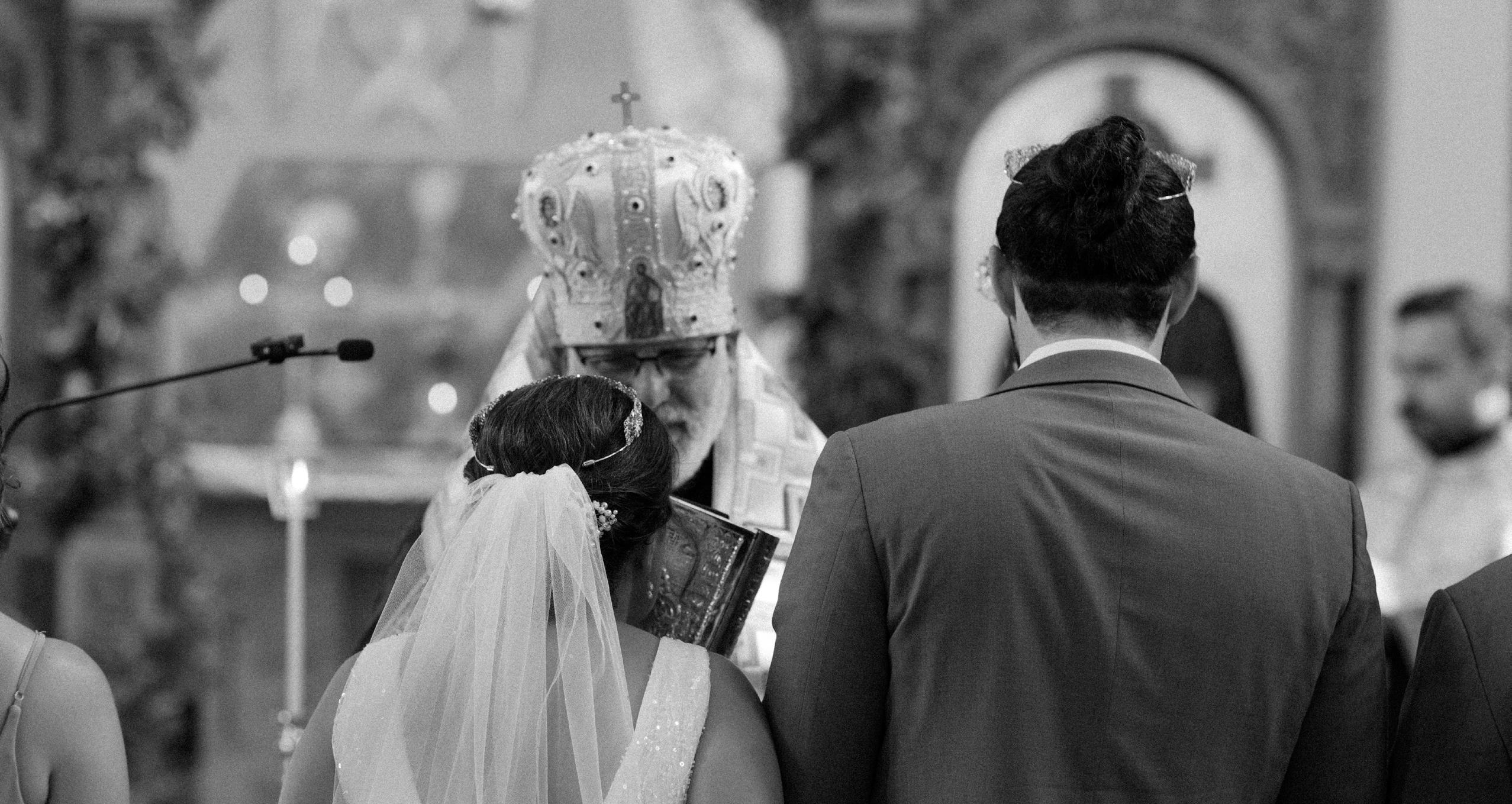
In the Orthodox wedding service, the bride and groom are crowned in the Name of the Holy Trinity. Their union is not merely a legal contract or social institution, but a vocation to grow in communion with Christ in every aspect of their common life. Joined together as “one flesh” in the Body of Christ, they are called to the martyrdom of dying to the slavery of their passions through their sacrificial, faithful love for one another. The desires of their hearts are purified as they learn to love and serve Christ through and in one another. The many petitions for the blessing of children in the marriage ceremony reflect the expansive nature of the love of God in which they participate as embodied persons. The opportunities for healing from the passions through the ascetical struggles of submitting to one another, caring for their children, putting the interests of the family before their own, and conveying the hospitable mercy of the Lord to their neighbors are virtually endless. As the pastoral letter of our Antiochian Patriarchate Family, the Joy of Life states, “Conjugal love is not exclusively expressed in sexual relations, but in everyday mutual love and respect and self-giving that touches upon every aspect of life, bestowing upon it its glorious splendor” (para. 33). St. John Chrysostom taught that husbands and wives who respond faithfully to the opportunities for growth in holiness through marriage may attain a level of “perfection [that] will rival the holiest of monks” (Homily 201).
As implied by the petitions for childbearing in the marriage service, Orthodoxy does not teach that sexual marital intimacy is in any way sinful. Neither does the Church teach that intercourse in matrimony is merely tolerated for the sake of conceiving children, as does the Augustinian tradition of western Christianity. Nowhere in the New Testament does one find a denigration of sex in marriage or the view that it requires justification through procreation. St. Paul does warn, however, against excessive abstinence from marital relations: “Do not deprive each other, except by mutual consent and for a time, so you may devote yourselves to prayer. Then come together again,
1 Popular Patristics Series, vol. 7, pages 61–62.
so that Satan will not tempt you through your lack of self-control” (1 Cor. 7:5). The discipline of marital fasting in Orthodoxy should be embraced freely by mutual agreement between the spouses in light of their current state of spiritual maturity, not as a matter of rigid law. Especially in this most intimate dimension of married life, misguided ascetical strictness may have disastrous consequences that are counterproductive to the healing and wellbeing of all concerned.
While children are certainly one of the great blessings of marriage and the Church encourages couples to “be fruitful and multiply,” there are no canons in the Church that forbid the use of nonabortifacient means of birth control by married couples—and some barrier method contraception was known in antiquity. The canons of the Church have detailed descriptions of sexual offences, but none limiting births apart from the condemnation of abortion. What some identify as the rare patristic condemnations of contraception reflect the identification of them with abortion considering
the limited medical knowledge of those times. As Family, the Joy of Life teaches concerning family planning, “each family prayerfully makes its own decision in consultation with the family’s spiritual father or parish priest on the basis of its spiritual, health, economic and social circumstances” (para. 33). Doing so reflects the freedom of the spouses as persons who together offer themselves to God as best they can in light of their spiritual maturity and the practical challenges that they face.
Through their free cooperation with the gracious blessing of the Lord, every dimension of the relationship between husbands and wives may become an epiphany of the salvation of the world. With a common life oriented to the heavenly kingdom, spouses journey together along a path for the healing of their souls and the fulfillment of God’s gracious purposes for their children and their family members and neighbors. Those who embrace the struggles and joys of marriage in this way will prepare themselves to accept the invitation to become guests at the wedding feast of the Lamb.
Creed and Coexistence: Living What We Believe in the Marketplace of Ideas
If America dips toward decline, if respect for human dignity runs cold, if public discourse is coarsening, if hospitality sprawls withering under turfdefending individualism, if contemporary Christianity bleeds credibility, if moral anemia increasingly infects our laws and institutions, if sexual confusion—even brash perversity—streams into our homes as the new and seductive norm, can such cultural deterioration be seen as a gift?
In a certain slant of light, maybe. Key to such optimism may be to understand that as modernity slides toward depravity, we also slip closer toward the conditions in which the early Church thrived. Cultural deterioration may not be an inherently good development, and Christian citizens do not encourage or ignore it in the naïve hope that a renewal of early Church conditions will necessarily produce a corresponding renewal of early Church piety. We do not sin so that grace may abound (cf. Rom. 6:1). But should dark times darken hope, the quiet-butconsistently bold, culture-influencing Faith of our early brothers and sisters may provide encouragement.
The
“Foolishness”
of the Fullness of Time
How to make sense of the Providence of God— “emptying Himself and taking on the form of servant” (Phil. 2:7) at a time in history most dangerous to do
so? Fascinating that the Incarnation should unfold at a time in which the success of any birth was far from certain. The Christ Child is born into a society where Roman law granted to the paterfamilias of any family a full eight days to decide whether that child should even live. Joseph’s priorities were different, as we know, and we are all beneficiaries.
How to make sense of the Providence of God— “becoming flesh, dwelling among us, full of grace and truth” (John 1:14) at a time when any sermon stating that only one true God exists could be silenced by the edge of a sword? Curious that the scandal of monotheism should mature at a moment in history when, because of Rome’s ever-growing reach, polytheism was essential to maintaining social order.
How to make sense of the Providence of God— conceived in the flesh by a virgin within a culture of such sexual confusion that what was the more deviant was the more celebrated? Strange that the glory of chastity—on radiant display in Christ, His mother, and His Forerunner—should be featured at a time in history when prostitution, orgies, homosexuality, abortion, contraception, pedophilia, male infidelity, and so on, were commonplace.
Yet, all those deviancies—the infanticide, the polytheism, the sexuality—lay tangled around what St. Paul calls the “fullness of time” (Gal. 4:4) of the Incarnation. Strange is the Providence of God.
Fr. John Oliver
But what was the alternative? If the Christ had been born into a world in which a pro-life king would never have slaughtered 14,000 innocents trying to get to Him, or in which a pro-monotheistic culture would never have martyred Christians for their exclusivist claims, or in which a pro-chastity society would never have resisted the sanity of either the monastic movement or chaste marriage, what would have happened to Christianity’s core of transcendence? If Christ had known not a cross but comfort, would the Church have emerged as the radical, counter-cultural, heaven-pointing, Spiritfilled, other-worldly, theanthropic organism she is?
“You are from below, I am from above; you are of this world, I am not of this world” (John 8:23). If He had enjoyed the favor of the world, would these words of our Lord, referring to Himself but echoing through His Church, have meant anything to us? It was precisely this perverted ecosystem into which the seed of the early Church was planted which clarified her identity and quickened her purpose. Converts were freely choosing the Church out of exhaustion with their former excesses, or frustration with their former devaluation, or inspiration of what their lives could become, even though conversion meant widespread ridicule and real threat of danger. They just knew this Gospel was different, and not merely “the empire at prayer.”
At its emergence in the Mediterranean world of the first century, the Christian creed was a belief that the immanent—impressive, yes, but so classdriven, so power-mad and pleasure-moist—could somehow give way to the transcendent—so divine and other, yet so interior and available!
But what becomes of anyone’s search for the transcendent if the immanent is so likable? Who wants to come out of a warm bath or a warm bed?
In The Rise of Christianity, Rodney Stark famously estimates a growth rate of 40% per decade for Christianity in its first 300 years, precisely at a time when Christians had no recourse to pass a law in our favor or elect a politician to our cause. Converts were wooed not by force but by persuasion.
As America ails, Christians do not greet this decline with a shrug or some stupefied skyward gazing for the return of Jesus. Neither do we act from carnal or politicized anger, for “the wrath of man does not produce the righteousness of God” (James 1:20). Acquire the spirit of anger and a thousand souls around you will be stressed.
Instead, we temper our current urgency—and our legitimate outrage—with a 2,000-year witness that the Church may be at her best when she is most irrelevant to culture, most out-of-step with its seething depersonalization and deicide, its illogicality and crude art. It’s the saints who make the Church relevant in any culture: do they not emerge in greater numbers from within the Church when she stands in lesser esteem with the State?
Humanizing God, Deifying Man
There may always be the temptation for Jerusalem to copulate with Athens—to dance and wink with worldliness to the point of compromise. For ruining Christian witness, seduction works better than persecution. Modern Christianity, unmoored from this early history, may always feel a tug to humanize God—to filter the central mystery of Christian life through popular culture to improve its presentation, digestion, accessibility. To “humanize God” is to adopt the art forms, and thought categories, and doctrinal priorities of cosmopolitan sensibilities, for the purpose of “speaking the language” of those one is trying to reach.
But humanizing God has already been done, hasn’t it? In the Person of “Christ Jesus,” who “emptied Himself, taking on the form of a servant, made in the likeness of men” (Phil. 2:7). God has already come down; all that remains is for each man to be lifted up. Consider that sweeping reference in the Anaphora of the Liturgy of St. Basil: “Though He was God before all the ages, yet He appeared upon earth and dwelt among men and was incarnate of a holy virgin and emptied Himself, taking on the form of a servant, becoming conformed to the body of our lowliness, that He might make us conformable to the image of His glory.”
The glorious motion of Christ—lowering down in order to lift up—has already been accomplished: “It is finished” (John 19:30). If there is a work, then, a purpose, a goal for each local Christian community, surely it is not to humanize God but to deify man. We speak here of an attitude, a frame of mind, a way of walking through the world that sees the Church as the organism, the one fully trustworthy repository and conduit, of truly transfiguring grace; a still place of ceaseless motion toward the singular goal of deathless life in Christ. Not simply a calendar item for Sundays, not a social organization nor a shop for moral tune-ups, each parish or monastic community is to be in sweet and shattering confrontation with God. Divinity expressed through physicality: when
describing the Church, the Apostle Paul ties “the truth” (John 14:6) to the tangible touchstones of “pillar and foundation” (1 Tim. 3:15).
This, then, is the abiding creed of the Christian: God is God and I am not. “Thou alone art holy” (Rev. 15:4). We are from below, He is from above; we are of this world, He is not of this world; He assumed human nature, yes, but did not stop there, like some paratrooper who descends behind enemy lines not to rescue the captives but only to commiserate with what it feels like to be one. No, He assumed human nature so that we may become “partakers of the divine nature” (2 Pet. 1:4).
Creed and Coexistence
In his 1936 essay “The Crack Up,” F. Scott Fitzgerald—not a father of the Church but a father of good prose—wrote this: “The test of first-rate intelligence is the ability to hold two opposed ideas in mind at the same time, and still retain the ability to function.” Christians can walk through this world both close-fisted around the scandalous exclusivity of their creed, and open-handed in charity toward all who do not profess it.
Genuine coexistence is not the suppression of differences that divide creed from creed, but an open marketplace where differences exist within a shared
presumption that citizens will not kill each other because of them. And Christians are not troglodytes who fearfully keep to our caves with a plea to the world not to hurt us. Instead—with passion tempered by peacefulness—we participate. We engage: the salt spreads forth from its shaker, the light shines forth from its flame. We are beggars sharing with other beggars where to find Bread. Noteworthy that when unjustly struck in the face, Christ replied, “Why do you strike Me?” (John 18:23)—as if appealing to some shared higher humanity in His enemies, some common values of fraternity, liberty, and reasonableness upon which healthy civilizations are built.
Genuine coexistence means that ideas are allowed to rise and fall on their own merits—a liberality which was not always afforded to Christians in those early centuries and arguably is eroding now. But since Christianity is a good idea with a core of transcendence, it rose up in just over 300 years—amid hostile conditions and maybe even because of them— to become the dominant faith of an empire. History aside, it’s modern man whom we must tend to now. By “modern man,” we mean an understanding of the human being dominant since the Enlightenment—that 18th-century European intellectual and philosophical movement favoring reason over faith, skepticism over belief, rationalism over religion, the science book over the Good Book. Rejected was not so much God as God’s nearness. Unsurprisingly, God now was felt to be very far away; and the new existential crisis that filled that void within man—for how can we who are made live apart from our Maker?—has been called despair.
Yet, this despair might be where the Christianity of yesterday can make its greatest impact today— an imprint that, while not opposed to favorable laws and friendly politicians, is not dependent upon them. Even as we grieve the downward spiral of the kinds of values we believe to be good for the
citizenry, don’t we also have something healing to offer those nauseated by the fall?
The United States is suffering from a frightening uptick in “deaths of despair”—death by drug overdose, alcoholism, suicide. What is a Christian contribution to be brought to this troubled marketplace? To cry out, “Wait! Something good and worth living for can emerge from your despair; your pain deserves a voice.” The Gospel of Christ can help us cope with the reality from which we all occasionally want to escape: we learn to see ourselves as His crucified gaze sees us, to make peace with our lives the way they are, and with the spouses and families they are with. A Christian contribution to coexistence involves a radical realigning with reality, humbly accepting an immanence that, by the grace of God, can be transformed or transcended.
To the dazed patrons of the marketplace of ideas comes the firm but gentle voice of Christian history: “You are not your passions; your sin is not your future; you are not trapped; what you have done is not the sum total of who you are. Your problem, modern man, is not that you think too highly of yourself, but that you think of yourself too poorly.”
Surely curious to those who use the Bible as the weapon of choice in the culture wars is the fact that the early Christian evangelists did not quote Scripture extensively to potential converts (unless, perhaps, conversing with Jews). Tertullian put it succinctly: “No one turns to our literature who is not already Christian.” Instead, there just seemed to be something self-evidently beautiful about the pure Christian message. Why can the Christian peacefully coexist with the neighbor who’s having trouble peacefully coexisting with him? Because it’s not about forcing a conversion but about unveiling the beauty of Christ, Who loved His enemies to the end.
The Hexapsalmos as a Sermon of Sermons
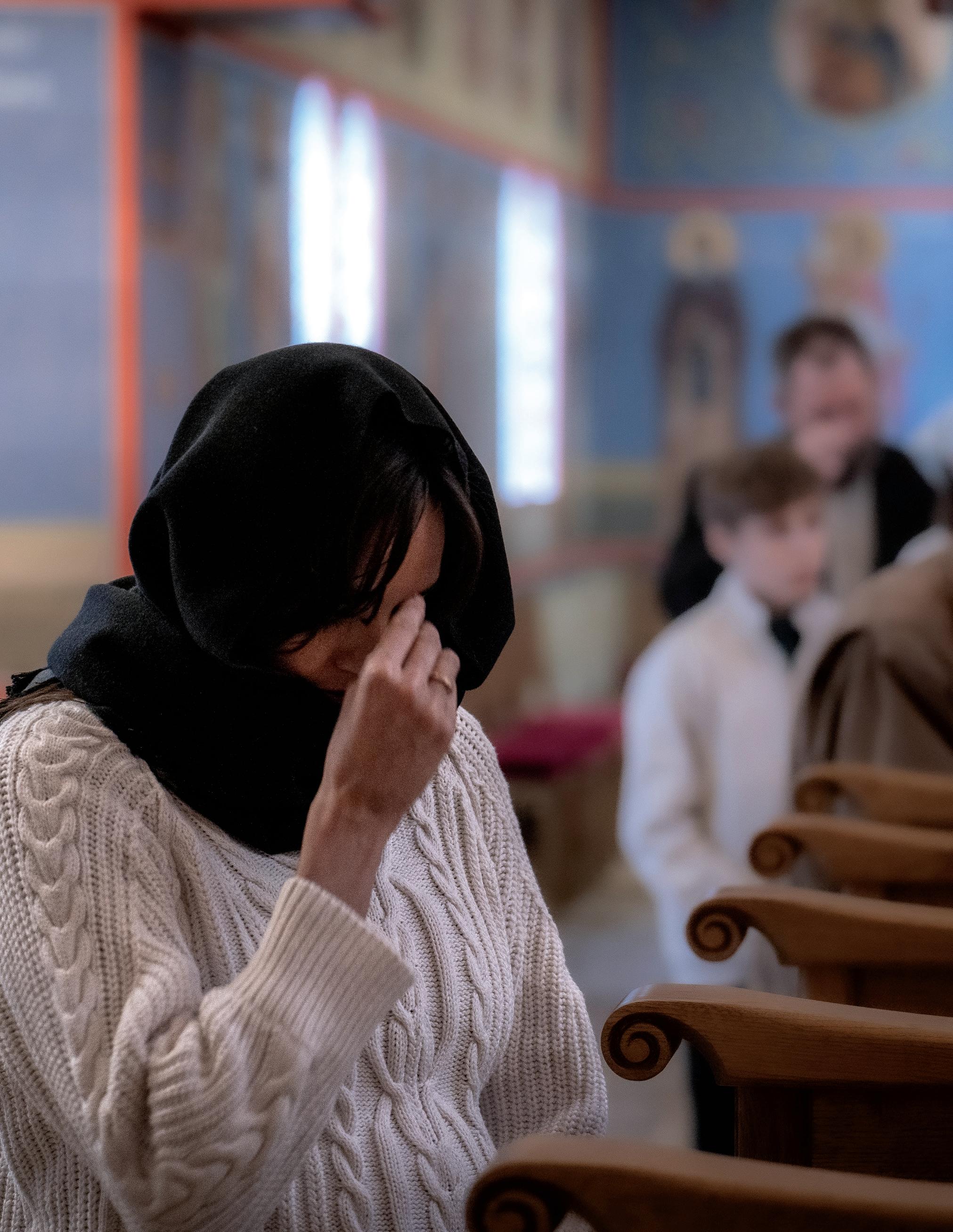
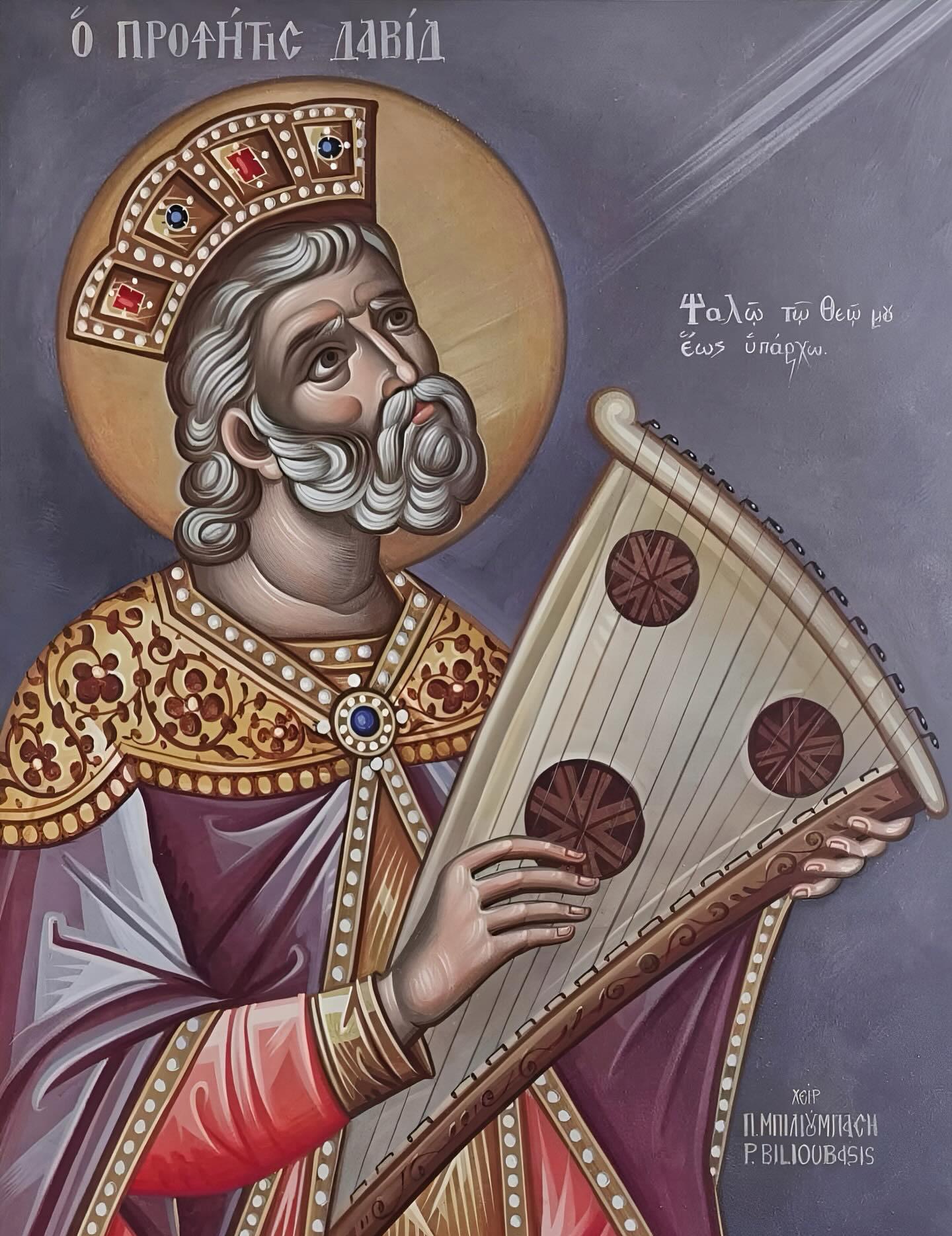
Historically, the Orthodox morning service, the Orthros, goes back to early Christian all-night vigils in which the Psalms of David played a central role. This service commences with the reading or chanting of a particular set of six psalms, the Hexapsalmos, known already in the fifth century.1
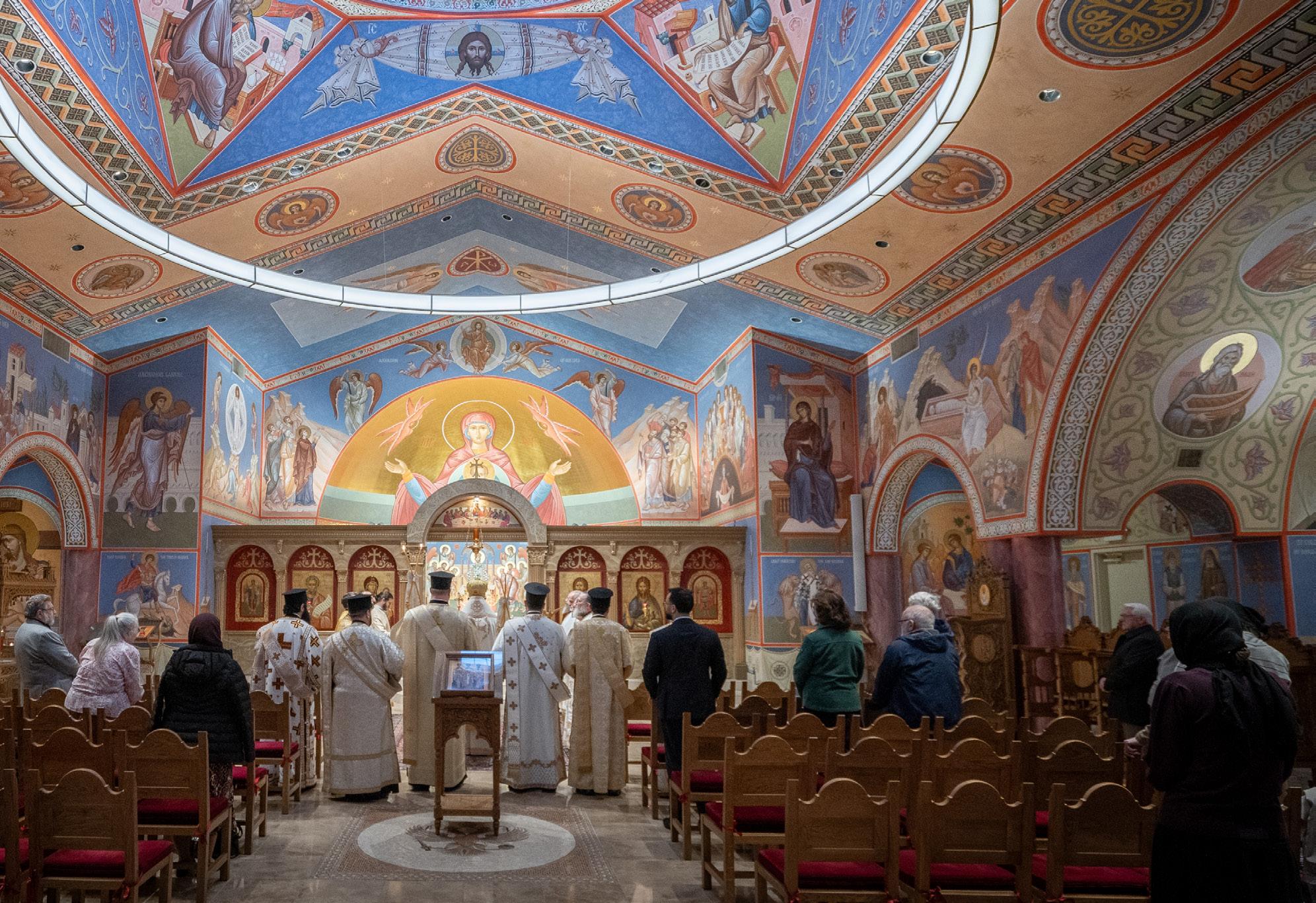
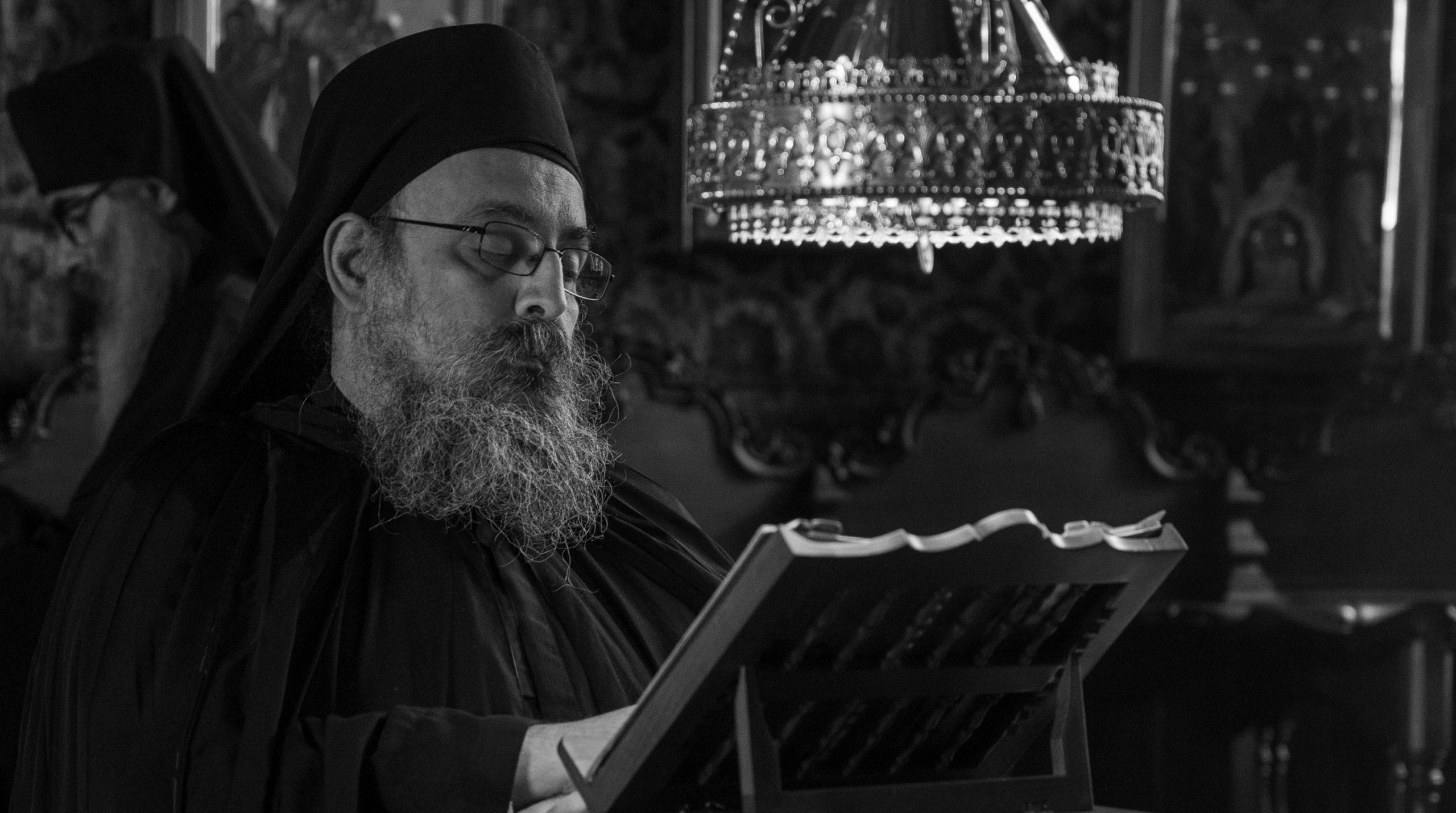
The church customs surrounding these psalms, 3, 37, 62, 87, 102, and 142, suggest that they bear significant meaning.2 The Typicon rules that they be read in a dimly lit church, with the reader’s candle being the only source of light. If a bishop or an igumen is present, he should be the reader. If not, then even an ordinary reader will do. There is also a rule, though not always respected, that whoever enters the temple and hears these six psalms being read, should immediately stop moving. Those present should not cross themselves before the reader has finished.
This tradition seems to echo the saying of some elders that the guardian angel of each person will read these six psalms while that person hears their judgment. Thus each personal judgment will last
1 Robert J Taft’s The Liturgy of Hours East and West - The Origins of the Divine Office and Its Meaning for Today (The Liturgical Press, Collegeville, MN 1985) p. 195–199, 274.
2 This is the Septuagint numbering. The more common Hebrew numbering of these psalms is 2, 38, 63, 88, 103, and 143.
exactly as long as the reading itself. According to certain elders this will also be so for the whole final judgment.3
Despite the fateful tone of these traditions, it is almost impossible to find a written interpretation of the Hexapsalmos, at least in English. This short article is a first attempt, trusting others will follow.
The first of these six psalms, Psalm Three, says the following:
O Lord, why do those who afflict me multiply? Many are those who rise up against me. Many are those who say to my soul, “There is no salvation for him in his God.” But You, O Lord, are my protector, my glory and the One who lifts up my head. I cried to the Lord with my voice, and He heard me from His holy hill. I lay down and slept; I awoke, for the Lord will help me. I will not be afraid of ten thousands of people who set themselves against me all around. Arise, O Lord, and save me, O my God, for You struck all those who were foolishly at enmity with me; You broke the teeth of sinners. Salvation is of the Lord, and Your blessing is upon Your people.
This psalm expresses very strong faith in the face of life-threatening opposition. Introducing the Hexapsalmos, it clearly reminds one that whoever “comes to God must believe that He is, and that
3 See e.g. the prophecy of the Elder Amrose of Dadiou at johnsanidopoulos. com/2010/07/elder-ambrose-of-dadiou-prophecies-and.html
Johannes Pulkkanen
He is a rewarder of those who diligently seek Him” (Heb. 6:1).
David’s fearlessness reminds of the fact that faith is in many ways an unfair exchange. His assurance and joy convey that he knows for certain that the Lord God himself has taken David’s life upon Himself to the degree that he really has nothing to worry about, even when facing the worst of storms. The exchange behind this is “unfair” in the sense that God takes upon himself David’s woes, while David’s assurance rests upon God’s perfect ability to bear them. This is a picture of what salvation in Christ is about, when sinners through faith partake in God’s nature (2 Pet. 1:4) according to His design.
The following Psalm 37 indicates that this unequal exchange exists through conversion and confession:
O Lord, do not rebuke me in Your wrath, nor chasten me in Your anger. For Your arrows are fixed in me, and Your hand
rests on me; there is no healing in my flesh because of Your wrath; there is no peace in my bones because of my sins. For my transgressions rise up over my head; like a heavy burden they are heavy on me. My wounds grow foul and fester because of my folly. I suffer misery, and I am utterly bowed down; I go all the day long with a sad face. For my loins are filled with mockeries, and there is no healing in my flesh. I am afflicted and greatly humbled; I roar because of the groaning of my heart.
O Lord, all my desire is before You, and my groaning is not hidden from You. My heart is troubled; my strength fails me, and the light of my eyes, even this is not with me. My friends and neighbors draw near and stand against me, and my near of kin stand far off; and those who seek my soul use violence, and those who seek evil for me speak folly; and they meditate on deceit all the day long. But I am like a deaf man who does not hear, and I am like a mute who does not open his mouth. I am like a man who does not hear, and who has no reproofs in his mouth. For in You, O Lord, I hope; You will hear, O Lord my God. For I said, “Let not my enemies rejoice over me, for when my foot was shaken, they boasted against me.” For I am ready for wounds, and my pain is continually with me. For I will declare my transgression, and I will be anxious about my sin. But my enemies live, and are become stronger than I; and those who hate me unjustly are multiplied; those who repaid me evil for good slandered me, because I pursue righteousness; and they threw away my love as though it were a stinking corpse. Do not forsake me, O Lord; O my God, do not depart from me; give heed to help me, O Lord of my salvation.
This psalm is clearly both a confession of sin and a prayer of mercy. As such it is a rather detailed one, reminiscent both of a person’s first general confession before the priest, and of continued awareness of sin and failure in the face of God’s mercies and His holiness. Its agony of failure is not just any agony, but the particular agony of first experiencing God’s graces, and then losing them by sinning.
These graces and the thirst for them is fittingly the very topic of Psalm 62:
O God, my God, I rise early to be with You; my soul thirsts for You. How often my flesh thirsts for You in a desolate, impassable, and waterless land. So in the holy place I appear before You, to see Your power and Your glory. Because Your mercy is better than life, my lips shall praise You. Thus I will bless You in my life; I will lift up my hands in Your name. May my soul be filled, as if with marrow and fatness, and my mouth shall sing praise to You with lips filled with rejoicing. If I remembered You on my bed, I meditated on You at daybreak; for You are my helper, and in the shelter of Your wings I will greatly rejoice. My soul follows close behind You; Your right hand takes hold of me. But they seek for my soul in vain; they shall go into the lowest parts of the earth. They shall be given over to the edge of the sword; they shall be a portion for foxes. But the king shall be glad in God; all who swear by Him shall be praised, for the mouth that speaks unrighteous things is stopped.
This psalm clearly connects with the two previous ones by its reference to the “desolate, impassable, and waterless” land of both enmity and sin. The solution is to enter the holy place, i.e., the temple of God,where the soul tastes God
to discover that His grace is “better than life.” Seen from the perspective of Orthodox worship, this is naturally a reference to the Eucharist, the Divine Liturgy, the other divine mysteries, and inspired services.
What follows in this psalm is a description of the benign consequences, the central one of which is intimacy with God, i.e., the ability to follow so close behind Him that His right hand can take hold of one’s very being: “My soul follows close behind You; Your right hand takes hold of me.”This psalm also lays forth that this intimacy dissolves both enmity and sin, and satisfies completely, even to the very marrow of one’s bones. This means that, taken together, the first three psalms of the Hexapsalmos clearly describe both the entry into divine graces and the life in and through them in the Church. In this sense this sequence of three psalms appears to be complete. It says almost all that needs to be said. Yet the very fact that three more psalms follow, suggests otherwise.
Photos by: Rafail Georgiadis-ope.gr
The following Psalm 87 is one of the most striking among the Psalms of David. In it there seems to be no hope:
O Lord God of my salvation, I cry day and night before You. Let my prayer come before You; incline Your ear to my supplication, O Lord. For my soul is filled with sorrows, and my soul draws near to Hades; I am counted among those who go down into the pit; I am like a helpless man, free among the dead, like slain men thrown down and sleeping in a grave, whom You remember no more, but they are removed from Your hand. They laid me in the lowest pit, in dark places and in the shadow of death. Your wrath rested upon me, and You brought all Your billows over me. You removed my acquaintances far from me; they made me an abomination among themselves; I was betrayed, and did not go forth. My eyes weakened from poverty; O Lord, I cry to You the whole day long; I spread out my hands to You. Will You work wonders for the dead? Or will physicians raise them up, and acknowledge You? Shall anyone in the grave describe Your mercy and Your truth in destruction? Shall Your wonders be known in darkness, and Your righteousness in a forgotten land? But I cry to You, O Lord, and in the morning my prayer shall come near to You. Why, O Lord, do You reject my soul, and turn away Your face from me? I am poor and in troubles from my youth; but having been exalted, I was humbled and brought into despair. Your fierce anger passed over me, and Your terrors greatly troubled me; they compassed me like water all the day long; they surrounded me at once. You removed far from me neighbor and friend, and my acquaintances because of my misery.
The tone of this psalm is not of jubilant trust, or being empowered to love God in the temple and obey Him in everyday life. The author does not even find hope and meaning in the self-scrutiny of confession, as in Psalm 37. Instead, his words convey a sense of hopelessness and undeserved suffering. Indeed, his language resembles that of the righteous Job the Long Sufferer.
The sense of undeserved suffering is the reason why commentators usually interpret this psalm in terms of the Lord’s innocent suffering. It is said to be a prophetic reflection of His innocent agony of separation while being made sin for the sake of the salvation of all (2 Cor. 5:21).
Yet a one-sided application of a “Christ in the psalms” exegesis in this case can tempt one to forget the obvious fact that all the psalms describe authentic human experiences, however prophetic and spiritually significant they may also be. Thus this psalm’s being about Christ’s suffering does not preclude that it is about our suffering as well.
It is actually the dual nature of this psalm that indicates that it is about the cross the Lord exhorts his disciples to take upon themselves when following in his footsteps (Matt. 16:24–26). For many this is and has been persecution and martyrdom. This is also about being disciplined and even ascetical for Christ’s sake. Yet more generally, the cross is a reference to the suffering that the disciple encounters despite having participated in what the previous three psalms describe. This must even apply to whatever damage was done by already confessed sin that does not appear to be healing without causing turmoil and pain.
There is an element of martyrdom in this too. Everyone suffers to some degree, both of their own doing and by circumstances. Yet the author of this psalm remembers God and His graces in such a vivid way that it actually causes him to suffer greatly in the depth of his being. Outwardly the despair may look the same, but inwardly the difference is crucial. Indeed, if the first three psalms had been complete without the fourth, the cross would be absent. Yet the cross is obviously where the story culminates and turns towards its very apex both for Christ
and His every follower. This means in turn that the way of faith through repentance, confession, and other life-giving mysteries of the temple actually transforms ordinary human suffering into the cross that points towards the resurrection.
Another key theme in this psalm is the prayer that focuses on the divine Name with the kind of penetrating constancy that does not exist apart from the experiences of the cross. This manner of prayer allows one to rise above the constant bombardment of thoughts in a way that also becomes a source of spiritual discernment. In becoming pure, it easily distinguishes between thoughts that give life and those that do not.
Thus this psalm, which is definitely about the way of the cross, is also about the vast themes of hesychasm, the Jesus Prayer, and spiritual discernment known, for example, through the Philokalia. 4 Yet, ultimately, it is not particular practices or doctrines, but faith which manifests itself through the cross that makes one’s prayer pure through the grace of the Holy Spirit. It is this grace, the divine energies which deify to a degree here already, and completely so in the world to come.
This is also what the following Psalm 102 echoes:
Bless the Lord, O my soul, and everything within me, bless His holy name. Bless the Lord, O my soul, and forget not all His rewards: who is merciful to all your transgressions, who heals all your diseases, who redeems your life from corruption, who crowns you with mercy and compassion, who satisfies your desire with good things; and your youth is renewed like the eagle’s. The Lord shows mercies and judgment to all who are wronged. He made known His ways to Moses, the things He willed to the sons of Israel. The Lord is compassionate and merciful, slow to anger, and abounding in mercy. He will not become angry to the end, nor will He be wrathful forever; He did not deal
4 The Philokalia is a widespread collection of Orthodox church fathers’ spiritual texts written between the 4th and 15th centuries.
with us according to our sins, nor reward us according to our transgressions; for according to the height of heaven from earth, so the Lord reigns in mercy over those who fear Him; as far as the east is from the west, so He removes our transgressions from us. As a father has compassion on his children, so the Lord has compassion on those who fear Him, for He knows how He formed us; He remembers we are dust. As for man, his days are like grass, as a flower of the field, so he flourishes; for the wind passes through it, and it shall not remain; and it shall no longer know its place. But the mercy of the Lord is from age to age upon those who fear Him, and His righteousness upon children’s children, to such as keep His covenant and remember His commandments, to do them. The Lord prepared His throne in heaven, and His Kingdom rules over all. Bless the Lord, all you His angels, mighty in strength, who do His word, so as to hear the voice of His words. Bless the Lord, all you His hosts, His ministers who do His will; bless the Lord, all His works, in all places of His dominion; bless the Lord, O my soul.
The repeated exhortation “bless the Lord” (evlogeo) reveals that the author’s worship of God has now become personal and spontaneous in a way that only pure prayer can make possible. This is because the ability to “see” and experience God in a more direct and personal manner is clearly behind the process that these five psalms describe. Yet this psalm also conveys that the personal element of worship is by no means the opposite of common worship in the temple. Indeed, this psalm which begins with a personal “bless the Lord,” nevertheless ends with a reference to the heavenly liturgy itself. In it, His angels, hosts, ministers, and works bless the Lord without end.
Thus the sequence of five psalms actually links together the earthly and heavenly worship through living spiritual experience. It manifests their fundamental spiritual unity. It points towards and reveals the work of the Spirit. Once again the series of psalms thus far feels complete. Yet what is left is
Psalm 142, which at first glance may not seem to be connected:
O Lord, hear my prayer; give ear to my supplication in Your truth; answer me in Your righteousness; do not enter into judgment with Your servant, for no one living shall become righteous in Your sight. For the enemy persecuted my soul; he humbled my life to the ground; he caused me to dwell in dark places as one long dead, and my spirit was in anguish within me; my heart was troubled within me. I remembered the days of old, and I meditated on all Your works; I meditated on the works of Your hands. I spread out my hands to You; my soul thirsts for You like a waterless land. Hear me speedily, O Lord; my spirit faints within me; turn not Your face from me, lest I become like those who go down into the pit. Cause me to hear Your mercy in the morning, for I hope in You; make me know, O Lord, the way wherein I should walk, for I lift up my soul to You. Deliver me from my enemies, O Lord, for to You I flee for refuge. Teach me to do Your will, for You are my God; Your good Spirit shall guide me in the land of uprightness. For Your name’s sake, O Lord, give me life; in Your righteousness You shall bring my soul out of affliction. In Your mercy You shall destroy my enemies; You shall utterly destroy all who afflict my soul, for I am Your servant.
The prayer “do not enter into judgment with Your servant, for no one living shall become righteous in Your sight” means simply that nobody can actually become pure in the absolute sense of the word. Thus even more than any of the previous psalms, this one makes it explicit that the whole spiritual journey that the Hexapsalmos lays forth, rests on God’s personal will in a way that utterly transcends anything that might seem like a system to follow.
Thus the actual role of Church worship and traditions is to enable participation in their heavenly archetype in the heart of each worshiper. So in terms of both God willing and his people responding, it is the personal element that transcends everything. Services, doctrines, traditions, hierarchies, etc.
all depend on the same will that decides to show mercy personally, and in the Church, despite no person being righteous in His sight. Through this mercy it is possible to be fully “in the system” and fully “above it” simultaneously. This is why it is so easy to love the Church and everything about it, in spite of her earthly imperfections.
“I meditated on all your works.” Remembrance is also a theme this psalm shares with the previous ones. They show that remembrance can be both the kind that fills one with “marrow and fatness” and the kind that borders on martyrdom. Yet this psalm adds a key element: the final triumphal hope of God acting to destroy the enemies of righteousness.
The special thing about this hope is that it presupposes a very clear vision of the final divide between good and bad and the future judgment of every responsible being.This indicates, paradoxically, that in Christian worship the remembrance (anamnesis in Greek, zikaron in Hebrew) of the past is ultimately about the future being already active here and now as a redeeming force.
Furthermore, the reality of the final judgment in the last words of this psalm is a reference to the final seal of meaning in the divine plan of salvation. The judgment sums up what has actually taken place, identifying the cross-bearers as the eternal kingdom of God, and putting an end to whatever hated the Cross.
Finally, in the light of the sixth psalm, the whole Hexapsalmos clearly appears as a sermon or a divine meditation that places every soul before the whole scope of salvation, showing God’s children to be the joy of His eyes, the very meaning of history. It is indeed truly right to read and recite these psalms with utmost reverence.
Render to God Our Everything
Fr. Peter Kavanaugh
“Render to God the things that are God’s” (Matt. 22:21).
One day, the holy Abbot Philaret heard a commotion outside his window. Two swallows were caught up in a fierce battle. The larger was pummeling the smaller, and pulling feathers left and right. The abbot’s soft heart was pained to see it, and chased off the assailant. Then he took and nursed the wounded bird back to health, and
the bird remained a faithful devotee ever since. The swallow waited outdoors for the abbot while he slept and prayed. He fluttered about him whenever he was in sight, singing and chirping. One particularly long day, the Abbot sat down and nodded off. Instantly, he jolted, awoken by Mr. Swallow screeching. It was just in time. There on the floor was a slithering serpent, and the bird had saved him as he once saved the bird. In this way, and all the days ahead, the bird’s one joy was to render to his master love and gratitude. We too should offer up our days to this purpose, and render to God the things that are God’s.
What do we owe to God? It is impossible to list everything God has given us. Where can we start? Just look up at the night sky at the stars in heaven. I once had the opportunity to visit an exhibition of Fabergé and Russian art. There were crowns and decorations of gold, diamonds, emeralds, and jewels of every color woven in the most delicate patterns. It looked like something from a fairytale, and people travel all over the world to see the jewels of monarchs. But none of them ever begin to compare with the beauty of the stars. Man builds museums as big and bigger than football fields. God builds a museum as large as the universe. He hangs his art for everyone to see.
St. John Damascene once wrote this about creation:
“Since, therefore, God, Who is good, and preeminently good, was not satisfied with contemplation of Himself, but in His exceeding goodness willed that certain things should come into existence which would enjoy His benefits and participate in His goodness, He brought all things, both invisible and visible, out of non-being into being and created them—including man, who is a compound of the visible and the invisible.”
God created the heavens and the earth to share His beauty and goodness. Atoms and molecules exist because God’s love overflowed, like water in a spring, gushing over the brim, and nourishing everything. Creation itself is enough for us to live in overwhelming, incessant gratitude.
God places us in a garden, and how have we responded ever since? We grumble. We become bitter. We get angry at him and one another. Our lack of love cripples us, deforms us, and we get worse and worse. So how does God respond? He
gives us the universe, and we reject him. So He gives us His only-begotten Son. We reject Him and kill Him. Then He resurrects His Son. He restores Him to life so that He can be offered to us even more. He gives us His Son every Liturgy, breaking and pouring out His body and blood to heal us.
How can we respond to all this?
“All we are and have we owe to God, Holy God of Israel, our King!” (Ps. 89).
“Render to God the things that are God’s” (Matt. 22:21).
How can we possibly render to God what belongs to God? There is no way we can even begin to give back in any way what we owe. We are as unequipped and minuscule as a little swallow who might try to serve an abbot. What could a little bird do to honor a man of importance. He can give himself in homage, and his little talents. He can flutter about. He can sing and chirp. He can even pray, in his little way, in times of trouble. We must become like the little swallow.
“Thou desirest no sacrifice, else would I give it thee; but thou delightest not in burnt-offerings. The sacrifice of God is a troubled spirit: a broken and contrite heart, O God, shalt Thou not despise” (Ps. 51:16-17).
“Thinkest thou that I will eat bulls’ flesh, and drink the blood of goats? Offer unto God thanksgiving, and pay thy vows unto the Most Highest. And call upon me in the time of trouble; so will I hear thee, and thou shalt praise me … Whoso offereth me thanks and praise, he honoreth me; and to him that ordereth his way aright, will I show the salvation of God” (Ps. 50:13-15, 23; Coverdale Translation).
The man that thanks God and praises God, pleases God. Is this all that God wants from us? It is so simple. It is so joyful. Then why do we suffer so much? Why do we grumble? Why do we become irritated at one another, in so many little, trite things? We fail to get the point. God owes us nothing. Our friends and family owe us nothing. We are in debt. We owe everything to God, to our fellow men, and to creation. How can we pay this debt? We can offer up a life of gratitude.
So we come to our little parish. We come to Liturgy in our local church. What do we carry in our hearts, to offer up in this building?
Orthodoxy is not an easy religion. This is not a “come and go as you are” church. We are not here to provide a concert, with entertaining music and fun programs, or a message about how God is nice and you are nice. The Church asks everything from us, a sacrifice of our time, energy, money, friendships, even lifestyles and beliefs.
Orthodoxy is growing in America. Our churches are packed. Everyone is experiencing growth pains. Men, women, and children are starved spiritually in the world around us, and are flooding into our sanctuaries because they are the one place that offer solace. There are not enough priests to keep up with it either, and this means only one thing. We, together, need to step up. We all share in the royal priesthood.
God does not ask that we tithe only 10% of what we have. He asks that we tithe 100%. It has always been this way. St. Irenaeus once explained the radical spirit of Christian giving: “The Jews had indeed the tithes of their goods consecrated to Him, but those who have received liberty [the Christians] set aside all their possessions for
the Lord’s purposes.” “We who valued above all things the acquisition of wealth and possessions,” St. Justin Martyr records, “now bring what we have into a common stock and share with everyone in need.”
WHAT DO WE NEED TO GIVE UP TO BE A CHRISTIAN? ALL OF IT.
“I appeal to you therefore, brothers, by the mercies of God, to present your bodies as a living sacrifice, holy and acceptable to God, which is your spiritual worship” (Rom. 12:1).
“Render to God the things that are God’s” (Matt. 22:21).
This is the height to which God calls us, but is it so heavy, after all? That little swallow didn’t find it hard to render back thanks to the abbot. It was his great joy. It was his everything, to sing and chirp and whistle, to praise and honor the man that had saved him, as a devotee, as a lover. We can become like that little bird too. We can render to God what is God’s, our everything.
Rediscovering God’s Easy Yoke During Lent
The onset of Great and Holy
Lent is commonly met with a mix of reactions. This is normal.
The negative reactions are often concealed internally, as most do not want to overtly groan about something that is supposed to be holy. However, there are those who eagerly welcome Lent as a time to get our diets under control and clean up unhealthy habits. Yet some might receive the start of Lent with indifference and only mark our calendars for the Wednesday evening meals. However, very commonly, many of us feel a bit of dread and groaning at the perceived increase to our workload, schedule, and impact on our diet and home menu. Yet in all those reactions, one reality that often gets lost and misunderstood is that Lent is a universal call to return to paradise, i.e., we are to rediscover being and living as we were meant to before the fall of humanity. This is the one Lenten end that we all strive for. However, as we shall see, the means to that end may contain some welcome surprises.
The Lenten path to that return may be a bit different for each of us. Lent allows for this. God allows for this. We all strive for the same
Fr. Joshua Makoul
Lenten end, but there might be some variation in the means to that end. The Kingdom of God is indeed a place of joy, love, radiance, and peace. If Great and Holy Lent is a return to this paradise, to live how we were meant to live before the fall of humanity, then why do so many live under the misconception that Lent is a time that is gloomy, heavy, sorrowful, filled with struggle, and oppressive? The Kingdom of God is none of those things. If our Lenten experience is marked by those oppressive traits, then we would do well to evaluate if we are engaging Lent the right way.
Many misunderstand what God seeks from us during Lent. For example, if there is someone who all year long, every day, and most of each day scrutinizes themselves, engages in constant and consistent repentance, battles with toxic shame, maintains a serious and sober spirit, and lives at an intense spiritual pace (often invisible to others) then how can they increase those things during Lent? What then should Lent be for that soul? Is it possible that Lent could actually be a time of spiritual rest for some?
Perhaps for such a soul, their means to returning to paradise is to ease off the intensity during the 40 days of Lent in the form of less time scrutinizing themselves, taking more prayerful walks with God (and themselves), reflecting more on God’s mercy and compassion, and practicing some self-compassion. Is this not Godly? Is this not consistent with the Kingdom of God? Indeed, for that soul, that is the path to their return to paradise. Truly, should that soul have tried to go anymore intense, it could lead to despondency and a dread of Great and Holy Lent. When we start going to the gym there is the universal end of getting into shape. However, not everyone goes right to running
5 miles or lifting 100 lb. weights. Each person has a different path to that universal end of getting into shape. Great and Holy Lent is no different. It is the great spiritual gym of our souls, and the regimen for each will be different largely based on the condition of our souls entering Lent and also our labors and experiences of the past year.
However, in the instance of a soul who is lax most of the year, who really does not scrutinize themselves, neglects the unseen warfare, lacks insight, and really doesn’t repent too much, then their return to paradise is different than the aforementioned example. The one who has neglected unseen warfare will need to turn it up a notch and increase the intensity and consistency of their spiritual life. Their means to that universal Lenten end is more intense with repentance and accountability; but even then, only with the intensity where peace, hope, and joy are found and maintained.
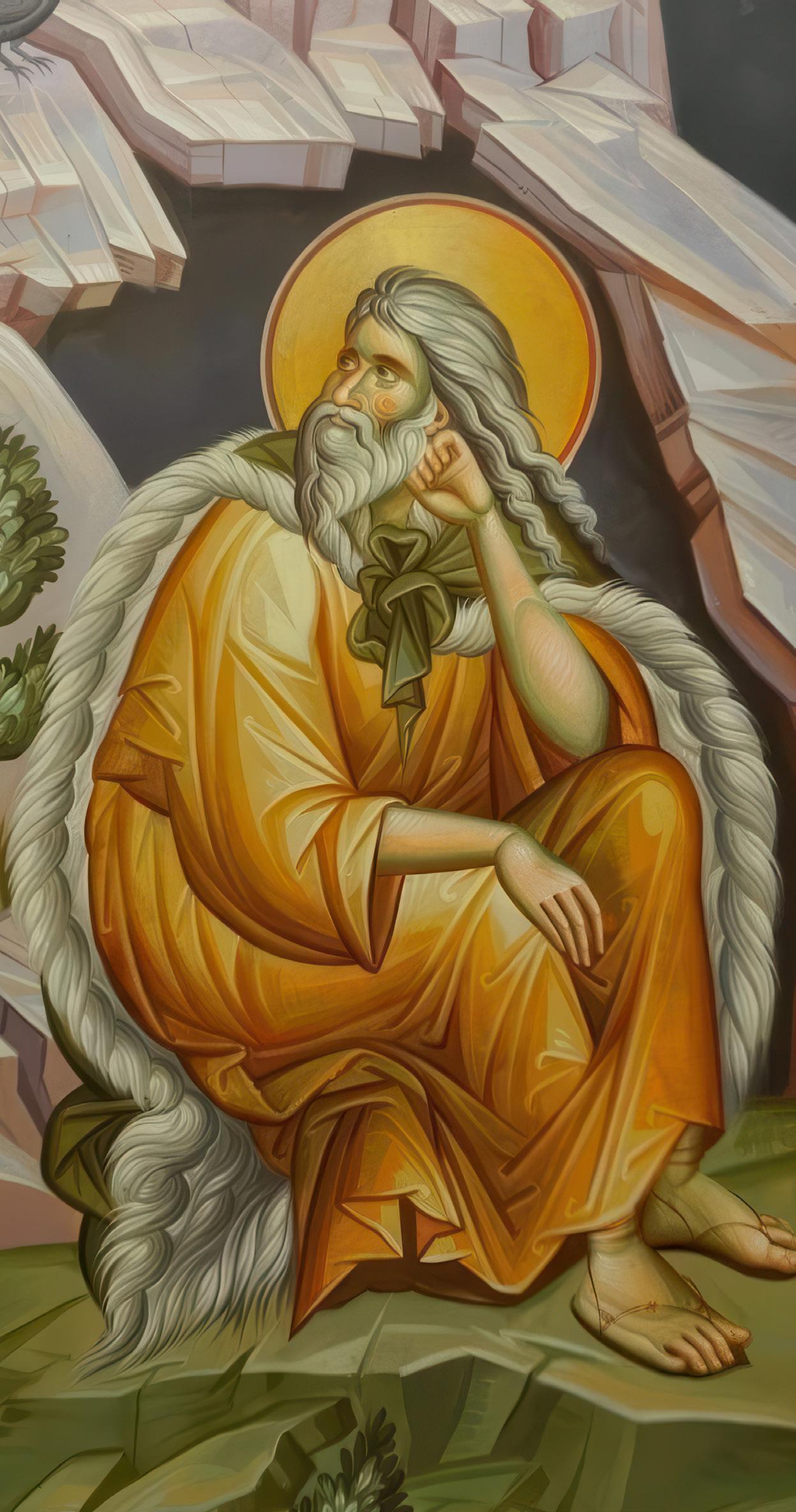
All of this to say, each of us must find our own path to the return of paradise. There is a quality to it that is deeply personal and that no one else can nor should judge. Whatever we may have been short of spiritually throughout the year needs to be increased during Lent. All year long we battle with the world, cannot Lent be our time of rest just as the Prophet Elijah rested in the wilderness? God allowed him this rest. So if someone has been too hard on themselves throughout the year, then Lent might be a time to take a prayerful and holy rest from that activity and just bask in the contemplation of God’s love and mercy, to discover God’s easy yoke. As our Lord stated in Matthew 11:
“Come to Me, all you who labor and are heavy laden, and I will give you rest. Take My yoke upon
you and learn from Me, for I am gently and lowly in heart, and you will find rest for your souls. For My yoke is easy and My burden is light.”
How could it be any other way? Lent is not meant to break nor harm. Nor is it to be a heavy burden. So often we worry about the judgments of others or the proverbial invisible audience during Lent. How tragic.
Finally, a note on fasting. Some nowadays eat such healthy diets, where meat is a rarity and vegetables and grains are abundant, that a foodfocused fast is of not much effect. The goal of fasting is to have a sober mind, heart, and soul. We mean fasting from impure thoughts, narcissism (developmental/generational and also the kind that is the norm of our time), anger, resentments, gossip, jealousy, self-centeredness, egocentric thinking, foul talk, and an ego-driven life. Without this fast, the food fast is in vain.
Finding our path to paradise during Lent means thinking outside the proverbial box and finding the route that will bring us closer to God. The route being based upon our own unique life history, crosses we carry, and needs. Let none of us judge the path our brother or sister has chosen to take. To do so is a profound form of spiritual trespassing. The path to the Lenten return to paradise is indeed personal and unique. Our Lenten goal should be simple. Our goal should be to navigate Lent so that with the arrival of Bright Week we have become closer to God and more at peace. Where we discover that for all of God’s power and might, He is a patient, gentle, and merciful God who yearns for us to be humble, depend on Him, love, and be loved. If we do these things, then we should not worry about too much else. The introduction of other expectations and rigid rules that we impose on ourselves that create so much stress are coming from somewhere else, not from God. So, this is good news. God’s yoke is easy. Lent can indeed be a spiritual vacation where we rediscover God’s easy yoke and remove the weeds of our ego and our self-imposed pressures and expectations from our relationship with Him.
ARCHDIOCESAN OFFICE
ORDAINED
BENEFIELD, Matthew to the holy diaconate by Bishop THOMAS on Jan. 11 at St. Nicholas Church in Beckley, WV, where he continues to serve.
HART, Seraphim (Seth) to the holy diaconate by Metropolitan SABA on Jan. 27 at St. Ephraim Church in San Antonio, TX. He will serve at St. John the Baptist Church in Cedar Park, TX.
KLEIN, Gerasimos (Gerald) to the holy diaconate by Bishop NICHOLAS on Dec. 20 at St. Ignatius Church, Franklin, TN.
MATHIS, Mark (Theron) to the holy diaconate by Metropolitan SABA on Jan. 4 at St. Michael Church in Louisville, KY.
MCGEE, Dn. Habib to the holy priesthood by Metropolitan SABA on Feb. 2 at St. George Church in Houston, TX. He will continue to assist His Eminence at the Archdiocese Headquarters in Englewood, NJ.
MOUSA, Elias to the holy diaconate by Bishop ANTHONY on Feb. 8 at St. George Church, Phoenix, AZ.
PROAÑO, Christian to the holy diaconate by Bishop NICHOLAS on Feb. 1 at St. Elias Church, Atlanta, GA.
RYERSON, Dn. William to the holy priesthood by Bishop JOHN on Jan. 18 at St. Peter Church in Fort Worth, TX, where he is assigned second priest.
STEVEN, Luke (Adam) to the holy diaconate by Bishop ANTHONY on Dec. 13 at St. Andrew Church, Arlington, WA.
WILSON, Irenaeus (Christian) to the holy diaconate by Bishop THOMAS on Dec. 24 at Holy Cross Church in Linthicum, MD. He is continuing his theological education at St. Tikhon’s Orthodox Theological Seminary.
ZASTANY, John to the holy diaconate by Metropolitan SABA on Feb. 2 at St. George Church in Houston, TX, where he continues to serve.
ELEVATED
BALLARD, Fr. John to the rank and dignity of archpriest by Metropolitan SABA on Jan. 17 at St. Anthony Church in Spring, TX , where he is assistant pastor.
BURNETT, Fr. Joshua to the rank and dignity of archpriest by Bishop THOMAS on Dec. 24 at Holy Cross Church in Linthicum, MD, where he is pastor.
RICE, Fr. Lucas to the rank and dignity of archpriest by
Metropolitan SABA on Jan. 4 at St. Michael Church in Louisville, KY, where he is pastor.
THOMPSON, Fr. Nathan to the rank and dignity of archpriest by Bishop ANTHONY on Jan. 17 at St. Anthony Church in San Diego, CA, where he is attached.
REPOSED
Archimandrite Daniel James Keller, 85, of Huntington, WV, reposed Jan. 5.
Born on Aug. 9, 1940, Fr. Daniel was raised Irish Catholic in Baltimore, MD. As a member of the Melkite Greek Catholic Church, he attended Holy Cross Greek Orthodox School of Theology in Brookline, MA, where he converted to Holy Orthodoxy.
Fr. Daniel became a member of St. Mary Church in Hunt Valley, MD, when it had just started as a mission. After his ordination to the holy priesthood, he served at St. George Church of Cleveland,
Jason Catanese
ARCHDIOCESAN OFFICE
OH; St. George Church of Upper Darby, PA; and St. John Chrysostom Church of Fort Wayne, IN, where he taught high school and lectured at Concordia Theological Seminary. Fr. Daniel also served Holy Spirit Church of Huntington, WV; and Our Lady of Walsingham Western Rite Church of Mesquite, TX.
He was an active and beloved member of the Western Rite Vicariate. With his extensive liturgical background, Fr. Daniel was one of the very few priests in the Archdiocese able to celebrate the divine services in both the Byzantine and Western Rites. He was a mentor to mission communities and new pastors. He was also a candidate for auxiliary bishop of the Archdiocese in 2004 and 2011.
Fr. Daniel’s successor at Holy Spirit Church, Archpriest John Dixon, recalled that “he stressed the importance of the parish as a true community of believers. The parish’s services were expanded with daily Vespers and several allnight Vigils, making it necessary to renovate and double in size.”
After his retirement from active ministry, Fr. Daniel moved back to Huntington and led the church’s weekly Bible study, and when able, filled in for Fr. John when he was out of town.
Fr. Daniel is survived by one sister and two brothers, as well as several nieces and nephews.
NEWS
Archpriest
James Purdie Appointed New Chairman of Missions and Evangelism
The V. Rev. Fr. James Purdie has been appointed by His Eminence Metropolitan SABA to succeed the V. Rev. Fr. John Finley as chairman of the Department of Missions and Evangelism following Fr. Finley’s retirement, effective Jan. 15.
Fr. James’s enthusiasm for missions, along with his experience participating in shortterm mission trips and working to establish new Orthodox churches, equips him well to lead the Dept. of Missions and Evangelism as it faces new challenges and needs.
When St. Raphael, Bishop of Brooklyn, arrived in New York on November 2, 1895, the Antiochian Archdiocese had no official presence or designated place of worship. The first priority at that time was to locate and minister to the Orthodox faithful who had come to these blessed shores and to respond to their most immediate needs.
Today, with more than 275 parishes and additional missions in development, the Dept. of
Missions and Evangelism must expand its focus and efforts. It is imperative to respond to the new challenge of equipping those newly received into Orthodoxy with the necessary tools to live their newly embraced Christian faith with faithfulness and piety.
Accordingly, the Dept. of Missions and Evangelism is expanding into two branches. The first, with the assistance of the V. Rev. Fr. Gabriel Karam, will focus on supporting missions and new parishes. The second will focus on supporting the personal and spiritual growth of the newly received faithful.
Archdiocese Convention to Return to Canada in 2029
The Department of Conventions and Conference Planning is pleased to announce that the hosting of the 2029 Biennial Archdiocese Convention, with the blessing of His Eminence Metropolitan SABA, has been awarded to St. Elias Cathedral of Ottawa, Ont., CA. The DCCP wishes the community of St. Elias much success and God’s blessings! But before that, the 2027 Archdiocese Convention will be hosted in Anaheim, CA, by St. Andrew Church of Riverside. Mark your calendars for both conventions now!
THE WORK OF WITNESSING:
A REFLECTION ON MY YEAR IN THE ORTHODOX VOLUNTEER CORPS
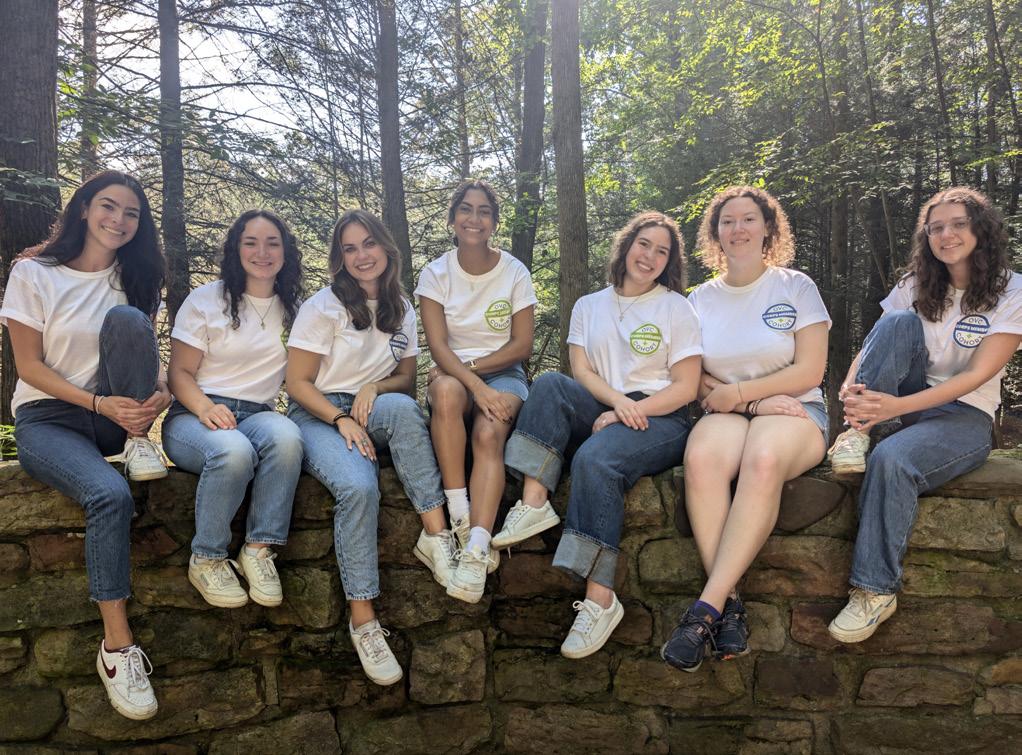
This past year as a member of the Orthodox Volunteer Corps (OVC), I was given a chance to learn the joy and the hard work of witnessing, the work of sharing in someone else’s experience. My 10 months in Boston started back in September 2024. There were many struggles I faced throughout my year in OVC, and among them was my service placement with Habitat for Humanity Greater Boston. For a majority of the time I served there, I wondered if I was making a difference at all. The first few months, while our housing applications were closed, were bleakly filled with general phone calls, breaking the news to people desperate for secure housing that there was nothing I could do to help them right now. Despite my grief with the unpleasant task, most people were polite, pleased even, just to share a conversation and receive a call back for the voicemail they had sent to the void of social services.
During our OVC weekly seminars, my facilitator, cohort, and I would reflect on the Orthodox theology of service or community-based leadership and how we could each apply these concepts into our lives and placements. For months I had been sharing with my fellow cohort members that my work felt a bit hopeless, as though all I could do was sit and listen to people, but not actually offer them the help or resources they were seeking me out for. So I spent those months trying to also convince myself that listening had to be worth something. But my fellow corps members were actively providing support and direct care within
homeless shelters and refugee housing programs, serving as literal case workers for pregnant women and instituting food drives in free health clinics. I couldn’t help comparing myself and, like the saying warns, my comparison was a brutal thief, stealing my ability to find joy and purpose in my work.
Around February, things at my placement changed dramatically as our affordable Homeownership Program applications finally became available. Now able to offer some type of resource and tangible hope, I had assisted hundreds of people to submit applications by the end of March.
Tesfa must have been one of the first people to come in person to our office. Tesfa is an incredibly kind, Ethiopian man and has to be around his mid 30s. When he first came in he simply looked me in the eyes and said over and over again, “Please, help me.” I was relieved to actually be able to offer him
Cecelia Olson
something and assisted him with the paperwork needed for our program. As he was walking out, he continued to share his housing situation with me and again pleaded saying, “Please, help me. If you were to see where I live now, you’d cry.” I believed him.
Tesfa came in several times after that, often to check on his application status or see if he could do anything else to help his chances in our ultimate lottery draw. Tesfa taught me a lot about dedication and enduring hope. We often had the same exchange every time where he would come in pleading, and I would listen earnestly before explaining there was nothing more he or his family could do except wait and hope a little bit longer.
As our application process went on, we received 285 submissions within 30 days. Only 50 families qualified with our policies and were able to continue on to our virtual interview. My supervisor and I conducted these interviews and got to know the applicants and why they had applied to our program on a more personal level. Many families are currently at risk of being priced out of their apartments. Some confided in us about aggressive landlords and environments, one applicant even shared they saw someone shot dead in the parking lot across from where his family currently lives. Other people had shared their creative solutions for dealing with the roach and rodent infestations their landlords refused to address. And of course some of the applicants were simply hard-working people attempting to climb the socioeconomic ladder and pursue the American dream of homeownership.
For months I had been wrestling with whether or not my work made a difference, but as we began to interview these families, a new layer emerged and I began to struggle deeply with a more demanding question: why would God sustain this much suffering, let alone allow it in the first place?
At the time, I was reflecting on the recent Pentecost Gospel I had heard, and the answers became a bit clearer to me. A journal entry of mine reads: I’ve been trying to write a piece about the honest effort of good, if we move the needle at all in the work we [my OVC cohort members and I] do. Are we getting any closer to Heaven on Earth when the poverty of the world—in material, in heart, in integrity—seems to have grown so much?
This is a hard piece to write but I think I’ve found some answers, first in my heart and adjacently in the Gospel. The first answer seems to be: “Does it make a difference?” is the wrong question to ask. In this life, when we are somehow in the middle of Heaven and Hell, maybe it is not for me to worry if we are getting closer to sanctifying the world or destroying it. My charge is to give an honest effort at being a loving witness to the people God has set in front of me.
The Gospel for Pentecost helps articulate things a little bit more clearly in John 21:14–25. This passage is where Jesus asks Peter, “Do you love me?” three times. Finally Peter says grieved, “Lord you know everything. You know that I love you,” to which Jesus replies, “Feed my sheep.” Go out into the world and love your neighbor, do a year of service in Boston and have your eyes opened and your heart broken. And when the poverty and pain and greed and evil remain, when it seems the Lord could so easily alleviate it all, and I ask a bit desperately, “Lord, why?” I am surprised at what He says to us: “If it is my will that he remains until I come, what is that to you? Follow me.” (John 21:22).
On the last day of my placement, Tesfa came into the office and surprised me with a farewell gift: a beautiful Ethiopian coffee set. When giving it to me, he mentioned the coffee ceremony in Ethiopia and the importance it has within his culture. After doing some of my own research on the ceremony, I
found that this gesture is much more about sharing community than it is about getting a caffeine boost.
I’m not entirely sure why he gave me a coffee set, but I had seen him about a week before when he came to submit his mortgage pre-approval to us. He caught me by surprise while I was walking from the office kitchen munching on my salad. Happy to see him I smiled, gave him a hug, and invited him in, asking how he was. He explained that he was nervous about the pre-approval letter, which is common for many of our applicants. So I listened as Tesfa shared his concerns with me, searching for some reassurance that he has done everything he can. He was interrupted by multiple yawns during all this. He apologized and explained he was coming from his first job and had to go to his second job after our conversation. “Can I make you some coffee?” I offered. “Oh yes, please,” he nodded. I went and made him a cup from our office Keurig machine, which I’m sure was a bit bleak and burnt but was all I had to offer. We sat at my desk while he sipped on his coffee and I ate my salad, continuing to listen to him say the same things he always does. We started to talk about the lottery that officially selects which families will receive the four homes available, and would happen well after my time with OVC and Habitat for Humanity would end. “Tesfa,” I said in between bites, “I have to give you some bad news…I’m leaving Habitat next week because my program is ending. I have to tell you that you probably won’t see me again after this.” His whole body seemed to sink into his chair at this news. He shared with me how he always felt lighter after seeing me and coming into the office, how he doesn’t often share with people here in America what he is going through because it seems everyone has a problem they are going through themselves.
When he came in on my last day with his gift, I would have loved again to share a cup of coffee with
him then and there, but he was once again stopping by in between his two jobs and doctor appointments, receiving three different phone calls during the 10 minutes he was in our office. So I thanked him, gave him a hug, told him I would pray for him and his family, and let him carry on with his day.
I started the year thinking I could boil service down to being dedicated to solving other people’s problems, deconstructing my neighbor into a chart of needs and “feeding the flock” with tangible, conclusive solutions. But food isn’t a solution, it’s sustenance. The most important thing about food— about love, community, faith, and hope—is that we need it every day. This is our designed nature, to be hungry for our daily bread. After meeting Tesfa and hundreds of other families that applied, I’ve witnessed just how hungry God’s sheep are. The Orthodox Volunteer Corps told me serving for a year would help prepare me for a lifetime. For this lifetime, I will do my best to follow Christ’s call to feed His sheep, to share with others the bread He shares with us, and be a witness to the love of God.
Cecelia is originally from St. Nicholas in Grand Rapids, MI, and is moving soon to Pittsburgh, PA, to continue her service work in a non-profit there doing fundraising and event planning.
FOLLOWING IN THE FOOTSTEPS OF THE MYRRH BEARERS
We’ve all been reading and hearing about the latest media catchword, “orthobros,” and the number of men coming into the Holy Orthodox Church. This month, March is Antiochian Women’s Month in the Archdiocese and we turn our attention to the women, past and present, who labor in service to Christ and His Church.
In the earliest days of Christ’s ministry, we read about the Holy Myrrhbearers in the scriptures. These were the women that traveled and financed Christ’s earthly ministry. First and foremost is His mother, Mary the Theotokos, the first believer and first disciple. Later we read about Mary Magdalene, Mary the wife of Cleopas, Salome, Susanna, Joanna, and Mary and Martha. We know that Mary Magdalene was considered an equal to the apostles and that she carried the Gospel to parts of Greece and eventually to the Roman Emperor Tiberias.
Along the way many women gave their lives in service to Christ and the spread of the Gospel throughout the known world. They raised their families in the Faith, bearing many who would eventually become the great saints of the early church. For example, St. Emilia is the mother of five saints: Basil the Great, Macrina the Elder,
Gregory of Nyssa, Peter of Sebaste, and Theosebia. We know the story of St. Monica, mother of St. Augustine, whose prayers for her son brought him back to Christ and the true faith. On January 12, we commemorate St. Tatiana of Rome who used her wealth and influence to serve the sick and needy in Rome. Space does not permit me to list the women who offered their prayers and their
Sheryl VanderWagen
possessions to those in need. Read more about myrrhbearing in our featured book of the year, The Art of Myrrhbearing: Encountering Christ Through Serving Others by Elissa Bjeletich Davis.
In the modern day, we have examples of saints such as St. Maria of Paris, who gave up her life to save others from Nazi concentration camps during World War II. She also gave her life to save another woman at Ravensbruck in 1945. She spent the days before her imprisonment feeding the poor and hungry of Paris. St. Xenia of St. Petersburg lived in the 18th century, and was known as a “fool for Christ.” She wandered the streets of St. Petersburg having given away all her earthly possessions, sleeping in an open field and devoting her life to prayer. God blessed her with the ability to discern future events and with answers to her prayers for those with illnesses and other maladies. And we cannot forget St. Olga of Alaska, our most recently canonized female saint and the first woman saint of North America! St. Olga devoted her life in service to her community, feeding and clothing the poor, delivering babies and serving as the hands and feet of Christ in a broken world.
As Antiochian Women, this is our calling, to be the hands and feet of Christ in a world that is broken both spiritually and physically. Like St. Emilia, St. Xenia, and St. Monica, we are called to pray for our children, our churches, our communities, and the world. We pray that our children and our godchildren are raised up to become powerful voices for the Faith in a world that is desperately seeking meaning and truth. We pray that God will continue to grow our churches and raise up godly priests to minister to the faithful. We pray for our communities and the world that God will grant relief to those who are suffering.
Along with those prayers, we are called to be faith in action, offering ourselves and our service like St. Maria and St. Olga. The Antiochian Women have many opportunities to give of our wealth and our service during this month. We continue to raise funds to support the Widowed Clergy Wives Endowment Fund. Established two years ago, to provide financial help to the women who selflessly ministered alongside their priest husbands in our churches, but who now find themselves needing ministry from us. We also have a shared act of mercy providing necessities to Casa Cuna Infant Orphanage at Project Mexico. Through the Antiochian Women Scholarship/Grant program we provide financial support to women who are members of our churches seeking to continue their education and improve the lives of their families.
Each diocesan Antiochian Women organization and each parish Antiochian Women chapter have ministries to serve the needs of others, financially and physically. They support many ministries including FOCUS, OCF, OCPM, OCMC, and IOCC programs, local food pantries, local women’s shelters, housing ministries, baby pantries, and much more. During Women’s month, you will see women actively participating in church services, ushering and reading the Epistle. Many women serve on parish councils, sing and direct choirs, lead and teach in Sunday School programs, serve as Teen Soyo Advisors and in other leadership positions. There are women in leadership at every level of the Archdiocese. We are grateful to them for putting their faith into action in service to their local churches and to the archdiocese at large. We continue to be “a sisterhood, serving Christ through serving others.” Put your faith into action and join us today as we strive to become future saints.
Oratorical Festival
JUDGES’ CHOICE 2025
Sophia Griffith, Age 18
All Saints, Raleigh, North Carolina
The Diocese of Miami and the Southeast
Raise your hand if you remember where you were at 14 years old?
Some of us may have blocked that awkward age from our memories. But it wasn’t too long ago that I was 14 years old and in middle school, making plenty of mistakes as I struggled to figure out who I was. When Mary was 14 years old, she had to make the greatest decision of her life. A decision that would not only change Mary’s world forever, but would impact the lives of people for every generation to come. A decision greater, I’m sure, than any of us will ever have to face in our lifetimes.
When the Archangel Gabriel appeared to her and announced that she would bear a son, Mary didn’t hesitate. She didn’t demand explanations. Well … sort of. She did ask, “How can this be, since I do not know a man?” (Luke 1:34). But her question wasn’t one of doubt; it was one of wonder.
She wasn’t resisting—she was marveling. What she was really asking was: “How could something so extraordinary be happening to me?” And without hesitation, she answered the angel with one of the most powerful sentences in scripture: “Behold the maidservant of the Lord! Let it be to me according to your word” (Luke 1:38).
In a single sentence, Mary gave herself entirely to God. She accepted the calling to bear His only begotten Son, the King of all creation, who died and rose from the dead, trampling down death by death for the remission of sins. To anyone else, this would sound like unimaginable pressure. How could a 14-year-old girl be expected to carry such a responsibility all by herself? But at such a young age, Mary had unwavering faith. She knew that, however great the responsibility seemed, God’s love for her was even greater. She was handpicked by God to bear His precious son, the Savior of the universe.
The first words the angel speaks to Mary when he appears to her are: “Rejoice, highly favored one, the Lord is with you; blessed are you among women!” (Luke 1:28). Likewise, when Mary visits Elizabeth in Judah, Elizabeth exclaims, “Blessed are you among women, and blessed is the fruit of your womb!” (Luke 1:42). Mary is venerated by angels and humans alike, as she was chosen and found favor with God through her humility and devotion to Him. This is why the Virgin Mary is the perfect example of who we are called to be as Orthodox Christians.
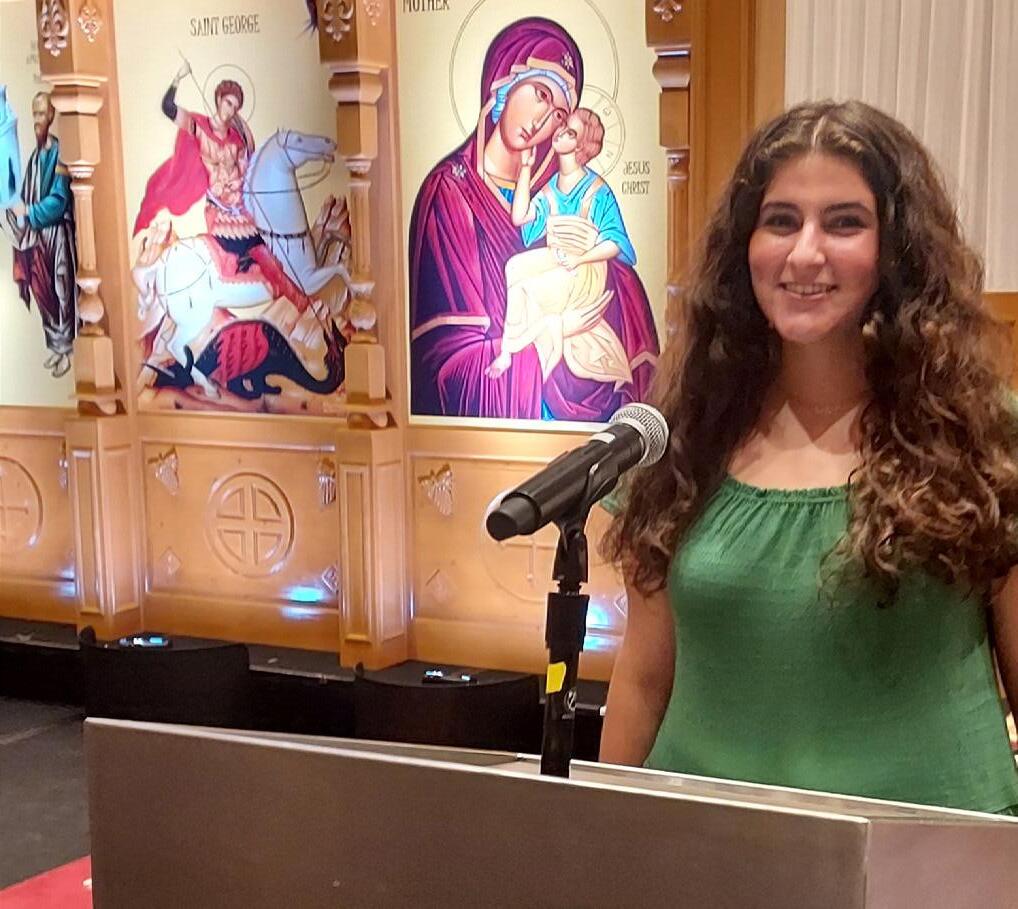
In offering herself to God, Mary became the first person to receive Him as her Savior. That is why she is known as “the first of the redeemed.” The icon chosen to represent this year’s theme is the Platytera ton Ouranon, which translates from Greek to “Wider than the Heavens.” In this icon, the Virgin Mary is depicted with her arms outstretched, and an icon of Christ is placed over her heart. In the booklet, “Facing Up to Mary,” Fr. Peter Gillquist recalls the words told to him by a Christian scholar when he saw this icon for the first time. He writes: “What you see is the Christ living as Lord in Mary’s life, and her outstretched arms are an invitation to you and me to let Him live in our lives as He has in hers.”
In my Sunday school class, we discussed the verse that is this year’s theme: “Behold the maidservant of the Lord! Let it be to me according to your word” (Luke 1:38). We learned that when Mary refers to herself as the “handmaiden of the Lord,” what she really means is that she is the slave of God and that He is her master. She humbles herself completely before God, allowing Him to fully rule over her heart, just as we see depicted in this image of the Virgin.
In the Magnificat, Mary continues to magnify this humility and devotion. She sings: “My soul magnifies the Lord and my spirit has rejoiced in God my Savior. For He has regarded the lowly estate of his maidservant; for behold, henceforth all generations will call me blessed” (Luke 1:46–48).
Mary’s strong faith is displayed throughout scripture. At the wedding in Cana, when the wine had run out, Mary turned to the servants and said, “Whatever He says to you, do it” (John
2:5). She did not doubt that Jesus would act— and indeed, He did, performing His first miracle by turning the water into wine.
At the crucifixion, Mary does not protest. She mourns her Son silently, with a heart full of pain and yet full of faith. Even in the face of His death, she trusted completely in the promise of His Resurrection. So much so that she did not go to the tomb with the Myrrh-Bearing Women. She knew—without a shadow of a doubt—that He had already risen. This unwavering faith in the Lord is what we are called to emulate as Orthodox Christians.
Mary is also our role model in Christian service. At the Annunciation, she faced a choice—one that would change the course of her life forever. And yes, it was a choice. Like all of us, Mary had free will. She may not have understood how she could be with child before being married, or that years later she would witness her only Son suffer the cruelest of deaths. What mother could ever be prepared for that kind of pain? But she did know this: she trusted God completely. She believed the words of the angel, “For with God, nothing will be impossible” (Luke 1:37). And so, she accepted Jesus—not only as her Son, but as her Savior and her God.
For nine months, Mary carried Christ in her womb. Hey! All the moms out there! I am sure you can relate. Carrying a child takes immense strength—physically, emotionally, and spiritually. And yet, Mary bore Him with love, obedience, and faith.
Just like Mary, we are called to be Godbearers. To carry Him in our hearts. To humble
ourselves before Him and bring His presence, His love, and His light into the world around us.
My grandfather’s favorite theologian, St. Gregory Palamas, writes: “If a tree is known by its fruit, and a good tree bears good fruit, then is not the mother of goodness itself, she who bore the eternal beauty, incomparably more excellent than very good, whether in this world or in the world above?” Mary bore the eternal beauty of Christ, and we are invited to do the same.
Jesus tells us in John 15:5: “I am the vine, you are the branches. He who abides in Me, and I in him, bears much fruit; for without Me you can do nothing.” If we allow Christ to take root in us—if we live with the same humility, faith, and courage as Mary—then we, too, can bear good fruit. My parents frequently quote their spiritual father, Fr. George Rados of memory eternal, who once reminded them that Christ not only lives in our hearts, but we live in His. His love is so immense that it fully engulfs and embraces us. We are each a single branch in His endless vine, a mere speck in His infinite heart.
I am now 18 years old, and I still do not possess the depth of faith, humility, grace, or wisdom that the Theotokos had at 14 when she carried Jesus in her womb. Though I’ve grown since middle school, I continue to stumble and fall as I navigate life. But the example of the Virgin Mary—the greatest woman who ever lived—inspires me to rise each time, striving to love more deeply, trust more fully, and surrender more completely to God’s will.
Through the prayers and intercessions of the Most Holy Theotokos, O Lord, have mercy on us and save us. Amen.
The Order of St. IGNATIUS
Mission:
Rooted in our Lord, God, and Savior, Jesus Christ and inspired by St. Ignatius of Antioch, the second-century bishop and martyr,
The Order cultivates unconditional love and generosity of spirit by engaging all Antiochian Orthodox Christian faithful in the work of the Archdiocese. The Order is devoted to charitable acts and financial support for youth, clergy, seminarians, and our neighbors in need.
Vision Elements:
1. Clergy and Seminarian Support
2. Youth Education and Retention for the Archdiocese
3. Young Adult Recruitment and Membership Growth
4. Charitable Acts and Teaching Philanthropic Spirit
The Order’s Governing Council responds to requests for financial support for charitable projects, seeking guidance from the MetropolitanArchbishop. The Governing Council sets annual goals to increase The Order’s support for new and existing projects.
Become a laborer of our Lord’s plentiful harvest (Luke 10:2) and help those in need. Levels of annual memberships are available based on an individual’s means and ability to give.
Stunning Photographs of Our Churches!
of our Antiochian parishes—from California to Quebec and everywhere in between—are now represented in a beautiful photographic display in the hallways of the Antiochian Village Conference Center. And these are just the first group of photos received thus far!
The goal of this project, proposed by His Eminence Metropolitan SABA last year, is to eventually have a photo of every church in our Archdiocese displayed in the hallways of the Antiochian Village Conference Center.
Members of our Archdiocese Board of Trustees were seen admiring the colorful photographs during their spring 2025 meetings at the Antiochian Village, and Parish Life Conference (PLC) participants from last summer enjoyed spotting their parishes among the photos. One visitor remarked that viewing the photos is a bit like listening to variations on a theme in music: each one uniquely individual, yet clearly and consistently a reflection of the whole that is our beloved Archdiocese.
The project was carried out through a collaboration between Village Council Chair Dimitri Zeidan and Antiochian Village Museum & Library Director Julia Ritter, with the cooperation of all the churches who submitted their digital photographs. Some sent in views of their church building from the street, others chose photos of their interior/iconostasis, and a few sent breathtaking aerial photographs. All photos were framed to a consistent frame size of 18'' x 22'', and a small plaque with gold lettering was added to each frame, identifying each church’s name, city, and state or province.
It is time for a second round of photo submissions, which are due Oct. 1, 2026! If your parish has not yet submitted a photo for this display, please do so now, following the guidelines included here.
Thank you for your participation in this exciting project!
We look forward to seeing all the photos on display.
To view 2026 Photo Submission Guidelines, just scan this QR code:
Book Review: The Life of the Hieromartyrs
Nicholas and Habib of Damascus
A Testament to Faith, Courage, and Sacrifice
The Life of the Hieromartyrs Nicholas and Habib of Damascus examines the lives, spiritual legacy, and martyrdom of two Antiochian priests. The book is particularly of interest to me because these martyrs were father and son martyred 31 years apart, and contemporaries of my grandfather and father. Drawing on their devotion and historical context, the book provides a wide-ranging narrative that not only recounts their story but also highlights the migration of many Antiochians to America.
The narrative focuses on Nicholas and Habib Khasha, whose lives involved significant acts of devotion and sacrifice amid persecution. Through valid research, the author traces their journey from their beginnings to their rise to spiritual prominence and eventual martyrdom. The book goes beyond a biography; it examines the virtues they championed and their courage.
The text includes historical context, incorporating personal anecdotes, ecclesiastical records, and the socio-political environment of their time. Readers gain insight into a world where faith provided both solace and motivation during adversity. The author emphasizes the spiritual significance of their actions and how their legacy continues to influence contemporary believers.
Several themes are present in the book, contributing to its depth:
A central theme is the strong faith demonstrated by Nicholas and Habib Khasha. Their belief in the divine and commitment to spiritual duties persisted despite persecution and martyrdom, highlighting the strength faith can offer during challenging times.
The book reflects on the ultimate sacrifice made by Nicholas and Habib Khasha, focusing on the nature of courage. Their willingness to face martyrdom rather than renounce their beliefs illustrates the conviction’s transformative power and the lasting impact of such acts.
The author discusses how Nicholas and Habib Khasha’s lives and martyrdom continue to inspire generations of believers, emphasizing the importance of preserving spiritual and historical heritage.
The book encourages readers to reflect on their own faith, courage, and legacy, providing a neutral examination of Nicholas and Habib Khasha’s story. This book deserves our attention.
A Life Testimony
by Metropolitan SABA
A Profound Reflection on Faith, Leadership, and Selflessness
Metropolitan SABA’s A Life Testimony is a poignant exploration of faith, leadership, and the selflessness that defines a life dedicated to spiritual service. Written with profound sincerity and wisdom, this book provides readers with an intimate glimpse into the experiences, reflections, and principles that have shaped Metropolitan SABA’s journey. It is not merely a memoir; it is a testament to the transformative power of faith and an inspiring call to live with purpose.
Several themes emerge prominently throughout A Life Testimony, enriching its depth and resonance:
At its core, the book is a fervent celebration of unwavering faith. Metropolitan SABA shares how his reliance on divine guidance has sustained him through trials and triumphs alike. His reflections on perseverance serve as a beacon of hope for readers facing their own spiritual or personal struggles.
A recurring motif in the text is the notion of servant leadership. Metropolitan SABA emphasizes that true leadership is rooted in humility, compassion, and a willingness to serve others selflessly. His own experiences as a shepherd of his flock illustrate the profound impact of leading with love and integrity.
Metropolitan SABA does not shy away from addressing contemporary challenges. He reflects on the role of the Church in a rapidly changing
world, discussing topics such as cultural shifts, the importance of spiritual heritage, and the need for the Church to remain a source of solace and guidance.
A Life Testimony is a work of enduring relevance. It speaks to clergy and laypeople alike, offering inspiration and practical guidance for living a life grounded in faith. Its universal themes transcend denominational boundaries, making it accessible to a wide audience seeking meaning and purpose.
The book also serves as a historical and cultural document, shedding light on the experiences of the Christian community in the Middle East and the global challenges faced by the Church. Its call to preserve spiritual heritage and uphold enduring values resonates deeply in today’s world.
Metropolitan SABA’s A Life Testimony is a profound and moving work that invites readers into a deeper understanding of faith, leadership, and the human spirit. It is both a personal testament and a universal guide, filled with insights that inspire reflection and action. For anyone seeking to enrich their spiritual journey or gain wisdom from a life lived with purpose, this book is a must-read.