SEPTEMBER - OCTOBER 2026 | VOLUME 70 NO. 6
WORD THE
T H E FA M I LY M E A L
TEN YEARS LATER:
TRUE MANLINESS OUR HOME IS I N H E AV E N
A L O O K B AC K AT T H E C O U N C I L O F C R E T E The Word 1
CONTENTS.
Volume 70 No. 6 September - October 2026
2 September - October 2026
03
EDITOR'S LETTER by His Grace Bishop JOHN
05
ST. RAPHAEL OF BROOKLYN by His Eminence Met. Saba
08
THE FAMILY MEAL by Fr. Peter Kavanaugh
11
OUR HOME IS IN HEAVEN by Fr. Michael Shanbour
16
CONVERTS, CRADLES, AND CHANGES by Fr. James Purdie
19
TRUE MANLINESS by Arch. Jeremy Davis
21
BATS, BOOKS & BACKSTORY by Fr. Joseph Huneycutt
23
TEN YEARS LATER Interview by Fr. Peter Samore
29
ARCHDIOCESAN OFFICE
34
ARCHDIOCESAN NEWS
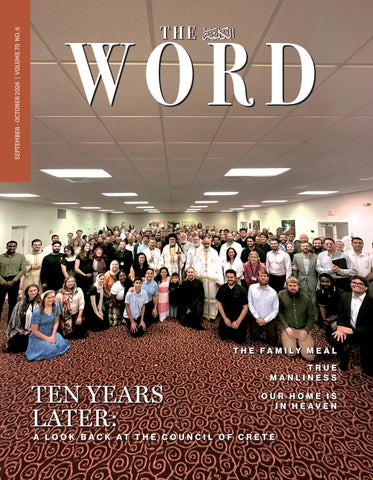
C O V E R : f r o m t h e Vo c a t i o n s R e t r e a t a t t h e A n t i o c h i a n V i l l a g e C o - s p o n s o re d b y Metropolitan SABA and Ancient Faith.
H
EDITOR'S LETTER
istorically situated at the crossroads of Western and Oriental empires, trade, thought, languages, and peoples, the Church of Antioch could be said to be the first cosmopolitan, multicultural, and multinational Church. It was here that one community was forged from those of many backgrounds by her founders, the Holy Apostles Peter and Paul themselves. Throughout its history, Antioch has often been called to be the bridge-builder, mediator, and peacemaker, because she has learned to understand and express God’s word in divergent forms. This aspect of her life uniquely positioned her to bear witness to the one, true Orthodox Faith to an educated—at times, skeptical—and spiritually thirsty world, which she has continued to do for two millennia, through her great Fathers (such as St. John Chrysostom and St. John of Damascus) and life of faithfulness to Holy Tradition, sustained by the Eucharist, her bishops and all the faithful. From her beginning, Antioch has been a missionary Church and she continues to be such, by God’s grace, even to our own day.
Bishop JOHN
Toumi, Fr. Peter Kavanaugh, Fr. Greg Abdalah, Dn. Ephraim Awad, and John Abud. Having been established by St. Raphael, reestablished by Metropolitan Anthony, and maintained as a priority by Metropolitan Philip, The WORD has been part of the life of our faithful from the beginning, and remains the official communique of the Antiochian Archdiocese of North America. The WORD was founded to teach, inform, support and build up Christ’s faithful in the New World. Today she stands as one of the last such media to witness to a quickly changing and confused world—a world that needs the Truth, direction, and inspiration. To better witness and practice our Faith,
Recognizing this heavy responsibility to witness to the modern world, Metropolitan SABA gathered a group of media experts for discussion and direction. To begin the work envisioned, Sayidna has appointed what I call a “blue ribbon” editorial board for The WORD. Included are Metropolitan SABA, Bishop JOHN, Archimandrite Jeremy Davis, Archimandrite Calinic Berger, Archimandrite Nicholas Belcher, Fr. Michael Shanbour, Fr. Luke The Word 3
PA S T O R A L The Disciples were first called Christians in Antioch. Acts 11:26 Editorial Board: The Most Reverend Assistant to Editor Metropolitan SABA Fr. Greg Abdalah Editor-in-Chief Bishop JOHN
Assistant Editor John Abud
Archimandrite Jeremy (Davis)
Design Director Dn. Ephraim Awad
Archimandrite Calinic (Berger) Archimandrite Nicholas (Belcher) Fr. Michael Shanbour Fr. Luke Toumi Fr. Peter Kavanaugh Editorial Office: The WORD 2 Lydia’s Path, Westborough, MA 01581-1841 wordmag@aol.com Subscription Office: 358 Mountain Road Englewood, NJ 07631-5238 theword@antiochian.org Submissions for “Communities in Action” must be approved by the local pastor. Both may be edited for purposes of clarity and space. All submissions emailed and provided as a Microsoft Word text or editable PDF. Please do not embed artwork into the word documents. All art work must be high resolution: at least 300dpi. Article contributions should be sent to: frjpa@aol.com ANNUAL SUBSCRIPTION: U.S.A. and Canada, $40.00 Foreign Countries, $50.00 Single Copies, $3.00 Checks should be made payable to THE ANTIOCHIAN ARCHDIOCESE. The WORD (USPS626-260) is published in September, November, January, March, and May, by the Antiochian Orthodox Christian Archdiocese of North America at 358 Mountain Road, periodicals postage paid at Englewood, New Jersey 07631-5238 and at additional mailing offices. Postmaster send address changes to The WORD, 358 Mountain Road, Englewood, NJ 07631-5238 ISSN 0043-7964
www.antiochian.org.
Canada Post Publication Agreement No. 40043404 Return Canada address to American International Mail, STN A – BOX 697, Windsor ON N9A 6N4, Canada
4 September - October 2026
members of our Archdiocese need to be well informed and given tools to do God’s work. Under Sayidna SABA’s guidance, The WORD will take on a new-look offering, feature articles which focus on specific areas of ministry and Christian life through designated columns, such as building Healthy Families, Parish Life, Orthodox Thought, and Spiritual Life. The editorial board will write, edit, and solicit articles as well as help authors develop ideas that they bring to us. All contributions will continue to be vetted and edited by The WORD. If God is calling you to write, contact a member of the editorial board. I look forward to working with the new editorial board and team, and will strive to continue the excellence of this publication. It is our prayer that it continues to provide a dependable and profitable resource for all of our faithful.
St. Raphael of Brooklyn
W
His Eminence Metropolitan Saba
hat can we learn from America’s first Orthodox bishop? What can we learn from America’s first Orthodox bishop?
“I am an Arab by birth, Greek by primary education, American by residence, Russian at heart, and Slav in soul.” – St. Raphael of Brooklyn
Many saintly, dedicated, and faithful servants helped plant the seeds of Orthodoxy in America, but few were as well-prepared for such labor as St. Raphael of Brooklyn. As the quotation above suggests, St. Raphael embodied the evangelical and missionary spirit needed in his own time which is all the more needed in ours as we mark the 250th anniversary of our nation. Before reflecting further on St. Raphael and his example, I would like to mention a photograph that struck me in the hall of our St. Nicholas Cathedral in Brooklyn, NY. Taken at the consecration of our current Cathedral on State Street in 1920, the photograph shows a massive crowd gathered outside. What covered the cathedral’s façade was not, as one might expect today, a mix of American flags and those of the immigrants’ countries of origin. Rather, the façade was completely draped in the flags of the United States of America alone. That image left a profound impression on me and speaks volumes to the mindset of those early immigrants. They loved the cities, villages, and families they had left behind, yet they knew they were here to stay in America. They desired to be full participants in their adopted land while preserving their ancient faith and traditions. It was into this context that St. Raphael, then Archimandrite Raphael Hawaweeny, arrived to New York in 1895.
The Word 5
PA STO R A L A R T I C L E S
ST. R A P H A E L O F B R O O K LY N
Prior to arriving in the United States, St. Raphael lived in several centers of Orthodoxy, from his native Damascus, to Constantinople and the island of Halki where he studied, and to Kiev and Moscow. It is in this way that, through his extensive travels and his acquisition of multiple languages in both colloquial and liturgical contexts, St. Raphael, by God’s providence, was well-prepared to undertake his mission in this new land: to help establish parishes for newly arrived Orthodox immigrants of various ethnic backgrounds. Although his primary calling was to serve Arabic-speaking immigrants from Greater Syria—that is, modern-day Syria and Lebanon—through the newly formed Syro-
Arab Mission of the Russian Orthodox Church, St. Raphael became a respected and beloved figure among Orthodox immigrants more broadly, especially in the New York area. His tireless missionary efforts took him across the United States, Canada, and even Mexico, where he baptized, married, and served memorials for faithful people living in remote areas. In each locale, he also encouraged the faithful to found parishes and promised them priests once they committed themselves to this holy task. As the mission grew, the then-head of the Russian Orthodox diocese in North America, St. Tikhon of Moscow, recognized that St. Raphael
St. Nicholas Antiochian Orthodox Cathedral in Brooklyn, 1920. Photo courtesy of St. Nicholas Cathedral archive.
6 September - October 2026
should be made a bishop to oversee the young mission parishes throughout the United States expanding work, with the agreement of both the Patriarch of Moscow and the Patriarch of Antioch. On March 13, 1904, St. Raphael was elevated to the episcopacy at St. Nicholas Cathedral in Brooklyn, New York, becoming the first Orthodox bishop of any background to be consecrated on American soil. Without his missionary zeal and steadfast dedication to serving the faithful, many Orthodox immigrants might well have been religiously assimilated as they pursued the American dream in their new homeland. St. Raphael’s ability to move between cultures and to draw on the best of Orthodox customs makes him a model for our own time. He could speak to people in their own language and understood their traditions because of his life experiences, while also encouraging them to adapt to their new homeland. He upheld the teachings of the Church with vigor and protected his flock from ravenous wolves, while adapting to the realities and norms of the American experience without compromising the faith. What, then, can we learn from St. Raphael’s life as we celebrate 250 years of the American democratic experiment? We should be deeply grateful for figures like St. Raphael who cultivated the seeds of Orthodoxy in America. Just as American citizens look to the founding fathers of our nation and to the sacrifices they made to -build a stronger and better country, so 7 September October 2025 too should we should look to our own “founding fathers,” of Orthodoxy in America, learn from their witness, and make it our own. We must continue to nurture what has grown from their
early labors, even as we welcome those who now embrace the Holy Orthodox Faith by choice. Just as America has been called “the great melting pot,” so too does the Orthodox faith gather into one those who seek to embrace Jesus Christ within the ark of the Church, where “there is neither Jew nor Greek, there is neither slave nor free, there is neither male nor female; for you are all one in Christ Jesus” (Gal. 3:28). To Him be all glory and honor forever and ever. This article is published as part of the America at 250: Orthodoxy in a New Homeland media initiative co-organized by the Orthodox Observer and the Department of Inter-Orthodox, Ecumenical, and Interfaith Relations of the Greek Orthodox Archdiocese of America to honor the contributions and experience of Orthodox Christianity in America and celebrate 250th anniversary of America’s founding.
St. Raphael, seated third from left, with fellow clergy. Photo: Orthodox Church in America (OCA).
The Word 7
SPIRITUAL LIFE
The Family Meal
A
family united in prayer before a meal, honoring God as their Heavenly Father and source of all blessings, is a truly beautiful sight. When the head of the household gives thanks to God for the food, it brings a sacred spirit to the table.” – St. John Kronstadt. The dining table is the most sacred icon in the Orthodox faith. There was once a traveling monk spending a few days at a parish. After liturgy, the parishioners bustled about to prepare coffee hour, when someone spotted a broken light. In an instant, a kind fellow climbed up onto a small table to replace the lightbulb. The monk gasped. “Oh no! Please don’t step on the table. Tables are sacred. They are icons of the holy altar.”
Fr. Peter Kavanaugh
From the beginning, God’s covenant with man was symbolized in the sacred meal spread across the dining table. Thou shalt prepare “a feast of rich food for all peoples,” Isaiah prophesizes. “A banquet of aged wine—the best of meats and the finest of wines.”2 The prophecy was fulfilled in the Holy Eucharist. Agriculture, art, science, and all the poetry of man’s heart raise and ferment crops. We take the fruit of our labor, bread and wine, bring it to God’s table and offer it up. The dew of heaven drops down and changes that bread and wine into the presence of God. “This is my body. This is my blood,” the minister incants. The congregation falls down in adoration. Never forget, the sacrament does not end here. It flows out from the altar into our day to day.
The dining table is the holiest object in a house. It is the focal point of a Christian’s life; a place for reverence, communion, and peace. It is the symbol of God’s love for family. It is the Eden given us to guard and protect, where we must nurture seedlings of holiness. We Orthodox Christians love to celebrate the beauty and symbolism of our exotic icons. We would do well to also reconsider the significance of the more basic building blocks of holiness: the family dinner.
Ps. 23:5
8 September - October 2026
If the family meal is the symbol of Christianity, modern dining is the symbol of anti-Christianity. Overwhelming studies show that family meals are increasingly rare, the dining table is cluttered, and food is consumed in the midst of interruptions, noise, television, and iPhone scrolling. In such households, children are more likely to have low self-esteem, lower grades at school, poor health, increased psychological problems, and a higher likelihood of drug use and social failure. 3 On December 29, the Church commemorates the Holy Innocents. Two events transpire, one beautiful and the other tragic. The holy family shines in majesty, and the anti-family cries out with ferocity. A child is born and the holy innocents are murdered. Christmas arrives with mirth and wonder. It is a time for feasting together, caroling, and dancing. We bow before the Nativity crèche, and we contemplate the holiness of family. In the same breath, the Church reminds us: behold, the anti-family. “When Herod the king had heard these things, he was troubled, and all Jerusalem with him. And when he had gathered all the chief priests and scribes of the people together, he demanded of
“Thou preparest a table before me in the presence of mine enemies: thou anointest my head with oil; my cup runneth over.” 1 1
In Orthodoxy, sacred things merge into and transform ordinary things. The sacrament of our Lord’s Supper pours out into all of our food and drink. Every table becomes sacramental. All food shared between Christian people takes on the sweetness of heaven. Every feast day and every coffee hour becomes a participation in our eternal feasting together. The family act of gathering at the dining table, praying, and giving thanks is the pinnacle of a Christian household.
2
Isa. 25:6
3 Department of Psychology, Brigham Young University, Provo, UT 84602, USA 9 March - April 2026
them where Christ should be born. And they said unto him, In Bethlehem of Judaea … [Herod] was exceeding wroth, and sent forth, and slew all the children that were in Bethlehem.” 4 God saves us with a baby. The devil lashes out to murder babies. God elevates the family. The world desecrates it. “In Rama was there a voice heard, lamentation, and weeping, and great mourning, Rachel weeping for her children, and would not be comforted, because they are not.”5 Even in the midst of our Christmas jubilee, the Church calls us to be sober. Remember the sacredness of family. Remember the holiness of the dining table. “A great sign appeared in heaven: a woman clothed with the sun, with the moon under her feet and a crown of twelve stars on her head. She was pregnant and cried out in pain as she was about to give birth. Then another sign appeared in heaven: an enormous red dragon … The dragon stood in front of the woman who was about to give birth, so that it might devour her child the moment he was born … [and] the woman fled into the wilderness” 6 We are in a war. It is a war between good and evil. It is a war between those who hate family life and those who cherish it. It is a war expressed with such lucidity in the contrast between these two scenes: a peaceful, loving meal, over which a family prays, shares, and reflects, and a disordered, chaotic “grazing” in the blare of TV and frantic texting. 4
Matt. 2:3–15
6
Rev. 12:1–4
5
Matt. 2:18
The Word 9
SPIRITUAL LIFE Christmas arrives with a wonderful invocation. Celebrate the simple, old-fashioned things. Return to family meals. We conquer the devil by celebrating what is good and beautiful. So remember, in the months ahead, this timeless message: the Kingdom of God is at hand with the breaking of bread. The Christian parish and the Christian family are most real and vibrant, when loving souls are dining together and giving thanks. “There is nothing more pleasant than divine teaching,” St. John Chrysostom instructs. “Listen to what the prophet says about it: ‘How sweet to my throat are Thy words, more than honey and the honeycomb to my mouth’ (Ps. 118:103). Put this honeycomb on the evening table, so as to fill all of it with spiritual gladness.” “When we have returned home, let us offer a double meal—one of food, the other of [divine teaching]; let the husband pass on what was said, and let the wife learn; let the children also listen
… let there be offered at your house a spiritual repast together with the bodily one.” “Sing hymns … especially at the table. Since the devil constructs his crafty designs mostly at times of banqueting with the help of intoxication, overeating, indecent laughter, and emotional relaxation, it is especially then, and before the meal and after the meal, that one must protect oneself from him with a fence of psalms, and, having risen from the table, together with wife and children, sing holy songs to God.” 7 Was the monk wrong, who shuddered when a man stepped on a table? There is much to learn from the traditions of old. Our grandparents passed down something sacred, often in little rituals as small and unnoticeable as table manners and family gatherings. Surely, the dining table is the holiest object in our house. It is the place for reverence, communion, and peace. It is our connection with God. It is a return to Eden. 7
St. John Chrysostom, Expositiones in psalmos.
Our Home Is in Heaven The Fiery Missionary Priest and Martyr Daniel Sysoev (+2009)
A
martyric death comes not only at the moment of death, but is born from the whole will of man.” This saying, sometimes attributed to St. John Chrysostom, reveals a profound truth that relates to the life of the contemporary Russian priest and martyr, Fr. Daniel Sysoev. Fr. Daniel was not merely an unfortunate victim of circumstances that ended in his murder. Rather, his whole life and orientation was characterized by a burning love for Christ, for the Truth, and for bringing as many others as was possible into this holy and “consuming fire” (Exod. 24:17; Deut. 4:24, 9:3; Heb. 12:29).
Fr. Michael Shanbour
by life or by death” (Phil. 1:20). Death did not “take” Fr. Daniel by surprise, rather he lived in a way that was already overcoming its power (cf. John 5:24). His martyric death was preceded by a martyric life. As the monastic saying goes, “If we die before we die, when we die we will not die.” Fr. Daniel was like a fiery comet, burning and flying through the atmosphere with urgency, in haste to bring himself and others into the fullness of life found in the Church, “the fulness of Him who fills all in all” (Eph. 1:23). And so, the words he spoke to his daughter not long
In the Lives and Sayings of the Desert Fathers, we read the following: Abba Lot went to Abba Joseph and said to him, “Abba, as far as I can I say my little office, I fast a little, I pray and meditate, I live in peace as far as I can, I purify my thoughts. What else can I do?” Then the old man stood up and stretched his hands toward heaven. His fingers became like ten lamps of fire and he said to him, “If you will, you can become all flame.” As was the case for St. Paul—Fr. Daniel’s favored example of piety—his fuel was a yearning for Christ and for the heavenly Jerusalem, “whether 10 September - October 2026
The Word 11
S P I R I T UA L L I F E A R T I C L E S
O U R H O M E I S I N H E AV E N
before his martyrdom at age 35 should not surprise us: “When they kill me, don’t cry for me, but pray for me.”
His Youth Daniel Sysoev, was born in Moscow in 1974, the oldest son of a Russian, Alexei Nikolaevich Sysoyev, and Anna Midhatovna Amirova, a Tartar. Both were artists. The theme of burning for God began early. Daniel was baptized in 1977 at the age of three,1 together with his parents, only after grave illness threatened his life. (His parents had delayed his baptism due to the threats issued by his grandmother, a devoted communist.) As the newly illumined was led around the baptismal font, he saw a man in a fiery garment standing near the baptismal waters. Only the young Daniel saw this angel, an experience he spoke about often later in life. According to his mother, Fr. Daniel grew up a very weak boy, and was near death three times, showing none of the energetic, fighting nature he later had as a priest. He was a very bookish person, always reading, which led to him needing glasses. From his early years, Daniel dreamed of becoming a priest. Often, instead of playing games he played at preaching sermons. When his father became an acolyte in a church outside of Moscow, he began both assisting in the altar and singing in the choir, in addition to reading, listening to the lives of saints, and painting. But this proclivity was not in line with the atheistic system of education. Once, when Daniel was at home sick, his teachers visited him. They were shocked and outraged to 1
Some sources say age five.
12 September - October 2026
Fr. Daniel and his Matushka Julia. Photo: pravmir.ru
see icons and Christian books in his room. When he returned to school, one of his teachers sat him in the midst of the class and began mocking him, asking, “Do you believe in God and do you know any prayers?” His fellow students, formed by communism, burst into laughter and joined in on the taunting. Some mentioned how the Russian astronaut Yuri Gagarin had been to space and had not seen God. The seven-year-old Daniel, paused briefly, and stated firmly: “Yes, I believe in God, and I know many prayers by heart.” This became the first of many occasions on which he boldly confessed his faith. In the aftermath, his teachers began to publicly pressure him to read atheistic books.
Ordination and Missionary Work Nothing could dissuade Daniel from his “first love” (Rev. 2:4) and his desire to serve his Lord, “the Way, the Truth, and the Life” ( Jn. 14:6). Already married, he entered the Moscow Theological Seminary in 1991. To make ends meet he helped pay his way by tutoring less gifted students. According to fellow students, because he was so well read in Orthodoxy he sometimes didn’t pay attention to the lectures of his professors but read books under his desk.
Daniel was ordained a deacon on May 13, 1995, not long before his graduation from seminary. He was assigned to the Church of Sts. Peter and Paul in Yasenevo, Moscow, and began his missionary activity in earnest the following year, beginning a weekly Bible study with explanations from the Holy Fathers on the Old and New Testaments. These teachings would continue to the time of his death. From the start the zealous deacon’s teaching was geared to reach the non-Orthodox as well as baptized Orthodox Christians weakened in their faith. It was at this time that he was blessed by His Holiness Patriarch Alexy II to teach missionary Bible classes at the Krutitsy Patriarchal Metochian, designed to help people who had been influenced by various sects and the occult. In January 2001, the future martyr was ordained to the holy priesthood in 2001 by Patriarch Alexy. During this period, he also taught liturgics and missiology (missions) at the Theological Seminary at St. Nicholas Monastery of Pererva. In 2003 Fr. Daniel established a mission parish in an area of Moscow consisting primarily of non-Orthodox. By 2006 a small temporary wooden church dedicated to the Apostle Thomas had been erected. Plans for a more permanent temple named after his patron St. Daniel would not come to fruition. Fr. Daniel had a great love and reverence for the divine services of the Church, which energized and reinforced his evangelistic efforts. He preached, not only at Divine Liturgy, but at every service. A gifted speaker, his sermons were direct, bold and compelling, moving and challenging to the heart of the listener. His preaching was inspired by his love and sense of urgency to
reach Christ’s lost sheep. This zeal to reach lost and searching souls led Fr. Daniel to craft an educational course—12 three-hour teachings— to train “street missionaries” who would foster dialogue about the Faith in the public square. This ministry reached not only Protestants, but atheists, satanists, and “skinheads.” In addition to his street evangelism, Fr. Daniel would participate in public discussions with various sectarian and pagan groups and was invited on many television and radio shows. He had a special fervor for reaching hearts among those of the Islamic faith. To this end, he attended Muslim festivals where he would distribute pamphlets he himself wrote. He was also invited to public dialogue with Islamic groups. From 2007–2009, Fr. Daniel took missionary trips to Muslim-dominated regions, such as the Republic of Tatarstan and the country of Kyrgyzstan. His efforts bore fruit, as he personally baptized more than 80 former Muslims into the bosom of the Orthodox Church.
Martyrdom Fr. Daniel’s activities, along with his unapologetic and enthusiastic presentation of the gospel of Jesus Christ, made him a target of harsh criticism and eventually drew the ire of some more extreme societal elements. He received at least 14 death threats before his life was actually taken. On November 19, 2009, Fr. Daniel celebrated the Divine Liturgy, baptized a child, and received back into the Church an Orthodox Christian who had fallen into occultism. That evening he held his Bible teaching and answered questions into the night. Finally, when almost everyone had left, he went into the altar to hear a confession.
The Word 13
S P I R I T UA L L I F E A R T I C L E S
It was then that a man burst into St. Thomas church, wearing a surgical mask, holding a gun, and demanding to see “Sysoev.” Part of a North Caucasus Islamic extremist group, he had vowed to “execute the damned Sysoev.” The man began shooting, wounding but not killing the choir director who remained in the nave. At that moment, Fr. Daniel came out of the altar and fearlessly walked toward the assailant, who shot the priest and ran out of the temple. The new martyr, married with three daughters, died a few hours later at 35 years of age. Fr. Daniel’s funeral took place at Sts. Peter and Paul Church, Yasenevo, his first parish, on Monday, November 23, with 200 priests and deacons and hundreds of Orthodox believers in attendance. His Holiness Patriarch Kyrill served the memorial and gave the eulogy for the martyred priest and now canonized saint, Daniel. He was laid to rest in the cemetery behind the Church of the Icon of the Savior Not-Made-By-Hands in Moscow. Providentially, his 40-day memorial fell on December 30, the feast of his heavenly patron, the Holy Prophet Daniel. Many non-Orthodox continue to find the Faith through his books and recorded talks.2
Spiritual Life and Teachings3 We have already noted the martyr’s love for and devotion to the liturgical services. This devotion to the corporate worship of the Church was enhanced by his own personal ascetic life. As attested by one of his parishioners, on fast days 2 One can find books and booklets in English (and Russian) at danielsysoev.com.
3 For more on Fr. Daniel’s views, see one of his last interviews here: orthochristian.com/125676.html 14 September - October 2026
O U R H O M E I S I N H E AV E N
he would abstain from food until 3pm. During Great Lent, he would read the entire Bible. And he was intimately familiar with the writings of the Holy Fathers, the lives of the saints, the Church canons and her hymnography. Fr. Daniel’s asceticism was not fueled by a desire to fulfill external rules but by a real sacrificial love for God and for people, for whom he desired salvation. He taught that we should never identify a person by their sin, but separate the person from their sin. We also receive this benefit and grace through Holy Confession and repentance. He emphasized that we are to love all people, but not the delusions with which they might be infected. He often taught: “We love people as the image of God, despite their evil, not together with it.” For example, we must love murderers but not their evil acts. We must discern but not condemn. Fr. Daniel viewed this life from the perspective of the world to come, which has been inaugurated here and now by God through Christ in the Church. This orientation was reinforced by his own personal experience. Around the time of the fall of communism, he underwent a clinical death. At that moment he saw his soul leave his body and an angel commanded him to return again to his body. Commenting on Ecclesiastes 2:17, he said, “the people who bind their lives to this world are foolish. Man’s place is not here! … Do you see? It’s not bad for a fish in the water, but it’s bad for man on Earth. Why? Because his homeland is not here.” Fr. Daniel used a Greek patristic term, a compound word, to drive home his point: uranopolitan (uranos meaning heaven, and polis,
city). Orthodox Christians are to be uranopolitans, citizens of heaven, the new Jerusalem. We are “strangers and pilgrims on the earth” (Heb. 11:13). For this reason, he preached against Orthodox nationalism and nationalism in general. The Church is the true “nation” which belongs to all ethnicities and peoples. Therefore, Fr. Daniel believed, any Orthodox Christian who opposes the need for evangelism shows a “disregard for the judgment of God” by not “rendering help to the perishing.” He believed every Orthodox community should produce missionaries out of a sense of love for their neighbor.
Legacy and Reach Although Fr. Daniel Sysoev has not been formally glorified as a saint by the Holy Synod of the Russian Church, he is venerated in Russia and around the world. The following testimony is taken from an article written by the Monk (now Hieromonk) Madai (Maamdi), a graduate of Fr. Daniel’s missionary course and the first ethnic Kurd ordained as an Orthodox priest:4 I am amazed that although no one specially “promotes” the veneration of Fr. Daniel, it has nevertheless spread very broadly even to countries far from Russia. His first icon was painted in Macedonia at the request of Bishop David of Stobi; in Serbia a missionary center was founded in Fr. Daniel’s name; in the USA an icon has been painted and there is even an initiative to build a church dedicated to him. In Romania an Akathist has been written. In Georgia monks have translated almost all of his books. In Greece, in the monastery of the Annunciation of the Mother of God in Ormylia (one of the largest Orthodox 4
See orthochristian.com/75392.html.
monasteries in the world), founded by the great Athonite elder Emilianos (Vathidis), they pray to Fr. Daniel as to a saint, and say, “It is time for you to pray not for Fr. Daniel but to him.” According to the hieromonk, due to missionaries influenced by Fr. Daniel, Orthodox Christianity is set to become the dominant faith among the Kurds. Like a flaming comet shooting through the darkness, the holy martyr Daniel Sysoev gave himself completely as a living sacrifice to God. Even as a six-year-old boy, his sights were set very high. When asked if he would like to be a married priest or a monk, he answered, “No, neither. Patriarch!” Single-minded and fully focused on “the one thing needful” (Luke 10:42), he burned with faith and love in order to bring the light of Christ into an increasingly dark and confused world. And now that light shines through him upon us by his example and intercessions. And indeed, he reached a height even greater than Patriarch. For in his last book he wrote: “The best end, which only a Christian can imagine, is a martyric death.”
The funeral of Fr. Daniel Sysoev
The Word 15
H E A LT H Y PA R I S H
Converts, Cradles, and Changes L
Fr. James Purdie Chairman, Dept. of Missions & Evangelism
ately the Church in North America has been receiving numerous people into her fold, so we should expect changes; not changes in tradition or theology, but in demographics and composition. To foster unity and fellowship during this influx, one change we could make is moving away from certain distinctions and code words that inadvertently create division and obscure relationships within the Church.
I am of course talking about the distinctions between those born into the Orthodox faith, “cradles,” more recent immigrants, “newcomers,” and those who have come into the Church later in life, “converts.” Yes, such categories are convenient. They help us speak, process, and organize matters in an efficient way. Convenience and efficiency, however, can work against us. Terms such as “newcomer,” “convert,” and “cradle” are loaded with negative connotations.
16 September - October 2026
A “convert” is one who was not born into the Church but joined later in life.1 If that’s all the term meant it might be helpful, but we must admit that the word “convert” carries negative connotations. Some use “convert” to suggest that a person is still not quite Orthodox, lacks the ethos, or doesn’t understand the culture (not faith) of those who are employing the term. Oftentimes the source of the imperfection is Protestantism, Roman Catholicism, or perhaps it references that
a person’s cultural background is not from an Orthodox “old country.” 2 Moreover, “convert” is a timeless category. A person who has been Orthodox longer than a “cradle” has been alive is still defined by that cradle as a convert. When will that convert cease to be a convert? There is no limit. A convert priest who has been ordained 20 years longer than a cradle priest is still a convert, with all the implied deficiencies of suffering from a Protestant mindset, or a Western mentality.
has been outed as such the other cannot help but view them henceforth as a convert, albeit a “good” convert, which implies that many converts aren’t. Now, apart from suffering from a lingering Protestantism and a prevailing Western mind, the code also suggests that converts also do, well, convert things. It’s implied that they try to make more converts or do zealous “Ortho-bro” 3 things. They may learn a foreign language, dance, recipe, or other things that they consider to be the Greek, Syrian, or Russian way.4
True, some converts seem to have risen above the stereotypes implied in the code. They are spoken of with awe and surprise. We hear such phrases as, “Can you believe they are converts?!” and “even though they are converts …” Those who express such admiration are simultaneously implying that the majority of converts’ Orthodoxy is lacking. Then, not surprisingly, once the convert
The convert sometimes does something else as well. They frequently look down upon themselves, precisely because they are converts. This may be part of the conversion process, but the code implied by the term may contribute to their expending noticeable energy in highlighting the shortcomings of Protestantism, Roman
2
4
Another somewhat unhelpful code.
3
Another word with baggage.
These are cultural markers, not faith makers.
1 Of course, by virtue of baptism he or she is in fact born into the Church just as much as a cradle was when they were baptized as an infant.
The Word 17
H E A LT H Y PA R I S H Catholicism, and/or Western culture. The convert discovers their culture to be heretical. They learn that their language and music are inadequate for theological and liturgical expression. They might put a picture of the tzar in their living room or fly the Greek flag instead of the Stars and Stripes.
in life, but I have also met cradles who are equally zealous. Some converts still seem Protestant, and some cradles do Protestant things. If we unquestionably use these terms as codes we will find that we are setting up division and misunderstanding in the house of God.
Now, the convert can apply the code to themselves in contradistinction to “cradle.” When that happens, “cradle” too becomes a code and stereotype. A “cradle” is judged for taking the faith for granted. “Cradle” implies not knowing the teachings, history, and liturgics of the Church, of adhering to a folk piety, of being too socio-politically liberal, or not understanding American culture. In this situation such phrases are projected toward the cradle as, “They are so Greek (Syrian, Russian, etc.),” or “This isn’t Byzantium,” and “Don’t they know this isn’t the old country.” Cradle is then seen as deficient in the eyes of the convert, just as the convert is deficient in the eyes of the cradle.
Much to my shame, I have used these terms as stereotypes. I doubt we will stop calling one another “convert” or “cradle,” but if we are cognizant of what we sometimes imply with our code words we might be able to mitigate any disunity, and thus better face the changes that have come and are coming to the Church in North America.
Not surprisingly, the “cradles” can get down on themselves, too. I have heard the phrase said with a regretful sigh, “Thank God for the converts! They breathe life into us and awaken us,” or “We don’t know our theology like the converts do.” I have even heard a cradle clergyman disparagingly remark that the “old country” approach to the faith was not as good as the convert way. What these code words imply obscures reality and risks alienating ourselves from each other. I have met converts who have been in the Church for years, but who lack a basic understanding of our teachings and the life in Christ. Conversely, I have met plenty of so-called cradles whose knowledge and piety puts me to shame. I have met zealous people who became Orthodox later 18 September - October 2026
In Kingdom come, all people will be gathered into and unto Christ and these categories won’t exist. The Church gathers all people. As the Spirit hovered over the waters of creation, the Church spreads her wings over all the people of the earth too. In her, diverse people become one in Christ. Only in the Church can we be one flock under one Shepherd, in a fold where “there is neither Jew nor Greek, there is neither slave nor free, there is neither male nor female, [there is neither convert nor cradle]; for you are all one in Christ Jesus.”
True Manliness
T
Archimandrite Jeremy Davis
oday, a whole generation of young men is intently focused on what it means to be a man and how to become more manly. Unfortunately, much of their attention is devoted to externals. Their social media is filled with gym selfies, body-transformation videos, and looksmaxxing tips. Some devote hours each day to striving after these physical ideals, while others just flip through posts with a growing sense of inadequacy. St. Cyril of Alexandria (the ancient Church Father) teaches us an entirely different take on masculinity in his book Adoration and Worship in Spirit and Truth.1 He describes the spiritually vigorous, disciplined, courageous, and productive life as truly manly. Over and over again, he urges his readers to “act like men” by overcoming the passions and doing the hard things we know to be right. 2 Why is he so intent on this vision of spiritual masculinity? In his day, masses of pagan men were converting to Christianity. Their conversion required them to abandon the ancient Greco-Roman vision of masculinity they had grown up with, which urged them to pursue physical and social dominance aimed at worldly forms of success. These new Christians were instead taught to pursue meekness, 1 This work (Gr: Peri tēs en pneumati kai alētheia proskunēseōs kai latreias) is found in volume 68 of J.-P. Migne’s Patrologiae Graecae (to which the references below refer). No translation has yet been published in English, but I am working on one. 2 E.g., 893b, 1016a, 1028d, 1064b.
The Word 19
H E A LT H Y PA R I S H humility, poverty, and patient suffering, in imitation of our Lord Jesus Christ. Many probably wondered whether becoming a Christian thus required them to renounce their masculinity. In response, St. Cyril sets forth a higher vision for them, emphasizing the interior manliness of the ascetic life. He dismisses pagan masculinity as a counterfeit. Physical strength, social dominance, and material success may give the appearance of manliness, but when one’s soul is captive to habitual sins, they are worthless—mere window dressing on a truly pathetic and weak life. To rise above the passions is to be truly manly, even if this makes one appear weak and unimpressive to worldly eyes. This is the manliness exemplified when “Jesus came out, wearing the crown of thorns and the purple robe, [and] Pilate said to them, ‘Behold the man!’” ( John 19:5 RSV). It is why St. Paul exhorts us, “Act like men!” (andrizesthe, 1 Cor. 16:13). In one passage, St. Cyril depicts the worthlessness of external manliness in the starkest terms. He begins with an obscure rule from the Law of Moses: “One with crushed testicles and one whose genitals have been cut off will not enter into the Lord’s assembly” (Deut. 23:23 ). He explains that this is not just historical trivia but, in fact, a warning for all who wish to be close to God. “The male parts,” he writes, “are a symbol of manliness.” These are crushed in one whose inward masculinity, although “not completely removed from his soul and mind,” is “in a crushed state.” Such people “marvel at selfcontrol and sometimes engage in clear attempts at this, but they are terrified by the battle and, not bearing the assault of their lusts for pleasure, incline toward weakness.” Others are like men with their male part cut off, “who [have] totally cast it 3
Verse 1 in some translations.
20 September 20 March - April - October 2026 2026
away and [are] bereft of the things most proper to men.” These “have fallen back into fleshly desires, giving up the reins totally (as it were) to passion, abandoning their unsound and unmanly mind to the pleasures of licentiousness.”4 In light of this symbolism, the obscure rule from the Law of Moses is a symbolic warning to us: men who are captive to worldly pleasures and even those who half-heartedly seek the better things are excluded from the Lord’s assembly, being spiritual eunuchs, bereft of the dignity of true manhood. We need this perspective, lest we get swept away in the internet’s obsession with masculine externals. Regardless of how chiseled and confident the influencers look, their outward manliness is a mirage. For “what is masculine as far as its nature but cannot achieve the things characteristic of males”— that is, the manly feats of self-denial and righteous life—“is worthless.”5 The façade of physical strength cannot long hide weakness of character, and God is certainly not fooled. So let us focus instead on becoming men of God. 4 5
893b–c. 956d.
BATS,
BOOKS
& BACKSTORY Fr Joseph Huneycutt
This article is not about bats. But more on that later…
G
reat day to be a bookman, the best day I know. Great day to be a bookman, everywhere I go. Goodbye, no never. Goodbye, doubt and fear. Great day to be a bookman, and be of good cheer!”
The summer of my freshman year of college, after a week of intensive training in Nashville, the Southwestern Book Company sent me to sell books door-to-door in the Northwoods of Wisconsin. It was both a challenge and a learning curve. It tested one’s mettle, so to speak. The lyrics, above, were sung with great zeal during our weekly Sunday gatherings. The Bookman Cheer was designed to boost confidence, shake off rejection, and get college sales reps ready to hit the neighborhoods another week. Only my manager had a car. He would drop me and a roommate off in our respective territories each
morning, and pick us up in the evening. Knock on the first door by 8am; the last knock around 6pm. About midway through that summer, dropped off by my manager at my area, the beauty of the day tempted me. I walked into a wooded area, found a pleasant hilltop above a two-lane road, and sat down on my sales box. Sometime later, lo and behold, I saw my manager drive by, the convertible top of his Honda Prelude down, stereo blaring. I thought to myself, “Welp. Guess I have the day off.” So I walked into this little Northwoods town for lunch. Busted! My sales manager was there at the bar. We laughed about it, enjoyed our time together, and headed back to our boarding house. On the way we noticed what we’d call sales territory curb appeal—houses with toys and swing sets in the front yard. “Let’s go sell books,” he said. “What? No way!” “You sell anything today?” he asked. “Well, honestly no. But I’m not about to now!” “Come on. I’ll pretend to be in training; show me how you do it,” he said. Y’all? I really was not into this. But I knocked on the first door of this eight-house suburban side street. “Mrs. Jones” answered the door and before I could start my pitch, she said: “Are you from the Southwestern Book Company?” “Um … yes, ma’am … we’re just …” “Well, come on in,” she said, “I’ve been waiting on you for three years.”
The Word 21
B A L A N C E D O R T H O D OX T H O U G H T
Ten Years Later:
A Look Back at the Council of Crete Interview by Fr. Peter Samore
A few years earlier, one of the moms on that street had purchased educational books from a Southwestern salesperson. The other moms often borrowed these books to aid their children’s homework. There was no internet. You could only purchase from a door-to-door college kid. That day, that kid was me. I sold books to four houses in a row that evening, boom, boom, boom. Many years later, I preached a sermon wherein I used a story about my childhood fear of bats to set up the rest of the homily. Forgive me, I thought it was a very good sermon. You know what everyone seemed to recall? Bats! Fr. Joseph is afraid of bats. The message of the homily was not about bats! Neither is this article about books. While Seekers and Inquirers aren’t waiting on us to knock on their doors, they sure are flooding through ours! Most heard about Orthodoxy not from us, or even a neighbor, but from podcasts on the internet. The internet serves both salespeople and customers. However, the Faith is not digital, it’s incarnational. It can be talked about, for good or ill, online—but
22 September - October 2026
our calling, Brothers and Sisters, is to open the door and welcome these seekers Home. Once and for all, warts and all. Like “Mrs. Jones,” today’s seekers—many timid and scared, others digitally convinced and bold— have been waiting for years, at least since 2021. For Christ. For Salvation. For Orthodoxy. “There is such a thing as a true American: an honest, forthright, normal person for whom Holy Orthodoxy is quite natural; and the harvest of these true Americans is only beginning.” 1 These days, I strap on my seatbelt, head to church, and somewhere along the way find myself singing an old ditty I learned almost 50 years ago. May the Lord take our unworthy efforts and fashion them to His glory. “Great day to be a bookman …”
“
THE FAITH IS NOT DIGITAL, IT’S INCARNATIONAL.
“
Backstory
1 Father Seraphim Rose: His Life and Works (St. Herman Press, Platina, CA, 2014)
Introduction In June of 2016, His All-Holiness Ecumenical Patriarch Bartholomew of Constantinople convened what had been promoted as “The Holy and Great Council” on the island of Crete. The primates of the world’s mutually recognized autocephalous Orthodox Churches were invited to address the following topics:
the Antiochian Church in the preparatory work of the Council. Mr. Ghandour accepted our invitation to answer questions about the state of inter-Orthodox relations after Crete.
• The Mission of the Orthodox Church in Today’s World • The Orthodox Diaspora • Autonomy and the Means by Which It Is Proclaimed • The Sacrament of Marriage and Its Impediments • The Importance of Fasting and Its Observance Today • Relations of the Orthodox Church with the Rest of the Christian World On behalf of The WORD Magazine, Fr. Peter Samore, Director of Communications for the Antiochian Archdiocese, interviewed Mr. George Ghandour, an expert in international Orthodox affairs. An attorney by profession, he represented
Mr. George Ghandour
The Word 23
B A L A N C E D O R T H O D OX T H O U G H T A R T I C L E S
T E N Y E A R S L AT E R
1. Thank you for giving me this interview. A decade after the Council of Crete, how would you assess the current state of the Orthodox world? Does global Orthodoxy still function as a genuine ecclesial communion, or are we witnessing the emergence of a new era of fragmentation?
The Church has always lived through disagreements. The real danger is that we begin to lose a common ecclesial memory and a common language of communion. When every Church begins to tell the story only from its own perspective, communion slowly becomes coexistence rather than shared life.
Ten years after Crete, I believe we must distinguish between the Church and the way we currently live our ecclesial communion.
The future of Orthodoxy will not depend on which Church becomes stronger. It will depend on whether we recover the courage to listen to one another again.
Orthodoxy remains one Church in faith, sacramental life, and apostolic tradition. But our ability to express that unity has become weaker. The crisis is not simply institutional; it is spiritual. We have become better at defending our own positions than at discerning together the mind of the Church. Crete did not create this crisis. It revealed it. Today, the greatest danger is not disagreement.
2. Did anything positive come out of the Council of Crete? What conclusions did it reach on the six aforementioned items? The Council of Crete was an important event because it was the first gathering of many Orthodox Churches at this level in many centuries. Even though not all the autocephalous Churches participated, it showed that Orthodoxy still had the desire to meet together and discuss common
challenges. At the same time, the absence of several Churches limited the Council’s authority and its reception across the Orthodox world. The Council produced a number of valuable theological and pastoral documents that offered guidance on important issues facing the Church and reaffirmed key aspects of the Orthodox tradition. In my view, however, the most significant text was the “Message of the Holy and Great Council to the Orthodox People and to All People of Good Will.” More than any other document, it expressed the Council’s pastoral vision, speaking about peace, human dignity, freedom, solidarity, and the Christian witness in the modern world. It remains, in my opinion, the Council’s most lasting contribution. So, my assessment is balanced. The Council of Crete produced valuable theological and pastoral documents and reaffirmed the importance of conciliar dialogue. However, it did not create the mechanisms needed to manage future crises. Nor did it address some of the most difficult questions facing the Orthodox world, such as how Churches should resolve disputes, how primacy should function at the universal level, or how to respond to growing geopolitical tensions. As a result, when the Ukrainian crisis emerged only a few years later, the Orthodox world had no agreed process for resolving the conflict, and the divisions became even deeper. 3. To what extent has the Ukrainian crisis reshaped relations within the Orthodox Church worldwide? Do you see the conflict primarily as a theological and canonical dispute, or has it become deeply intertwined with nationalism and geopolitics?
24 September - October 2026
Ukraine has become much more than a dispute about one local Church. It has become the prism through which almost every fundamental question of contemporary Orthodoxy is now viewed: primacy, conciliarity, autocephaly, canonical territory, national identity, and even the relationship between the Church and political power. It would be a mistake to reduce this crisis to canon law alone. Canonical questions are real and important, but they no longer exist in isolation. They have become intertwined with war, nationalism, historical memory, and geopolitical confrontation. This is precisely why the crisis has lasted so long. It is no longer one conflict waiting for one solution. It is several layers of unresolved tensions that have accumulated over decades. The real challenge today is not simply finding a canonical solution for Ukraine. It is rebuilding trust between the Churches themselves. 4. Many observers speak today about the weakening of conciliarity in Orthodoxy and the rise of forms of unilateral authority or even a kind of “Eastern papalism.” How do you respond to this characterization? Is the Orthodox Church still capable of resolving its disputes through authentic synodal processes? I would avoid slogans, whether “Eastern papalism” or its opposite, because they often simplify a much deeper problem. The real question is this: can Orthodoxy still make decisions together? No local Church can replace the whole Church. But neither can the Orthodox world survive if every Church behaves as though it is entirely independent from the others. The Word 25
B A L A N C E D O R T H O D OX T H O U G H T A R T I C L E S
The crisis we face is not simply an excessive understanding of primacy. It is also the weakening of conciliar responsibility. Conciliarity is more than gathering bishops around a table. It is the spiritual willingness to discern together, to accept mutual accountability, and sometimes to limit one’s own authority for the sake of communion. Without humility, synodality becomes procedure. Without communion, primacy becomes power. 5. So, is it unfair to limit criticism to the Ecumenical Patriarchate, or the Patriarchate of Moscow, while at the Council of Crete and since then, in spite of what may be viewed as Greekcentric conclusions that were reached? I think it would be unfair to place the responsibility on one Church alone. The current crisis did not emerge because of the actions of a single Patriarchate. It reflects a broader failure of the Orthodox world to preserve a culture of common responsibility. The Ecumenical Patriarchate, the Patriarchate of Moscow, and indeed all the local Churches have made decisions that have contributed, in different ways, to the present situation. Some have acted unilaterally. Others have remained silent when leadership was needed. Still others have preferred to protect their own interests rather than seek a common Orthodox solution. The deeper problem is that Orthodoxy has not yet developed effective mechanisms for resolving disputes between the local Churches. When disagreement arises, there is no widely accepted process for dialogue, mediation, or common decision-making. As a result, every crisis quickly becomes a crisis of communion.
26 September - October 2026
T E N Y E A R S L AT E R
So, rather than asking which Church is to blame, I believe the more important question is what this crisis teaches us about the weaknesses of our ecclesial structures. If we limit ourselves to assigning blame, we will repeat the same conflicts. If we strengthen conciliar institutions and rebuild trust among the Churches, then the present crisis may still become an opportunity for renewal. 6. Questions of ethnicity and nationalism have returned forcefully to the center of Orthodox life, whether in Ukraine, the diaspora, or disputes over language and identity. Has Orthodoxy truly overcome phyletism, or do national identities still dominate ecclesial life? The Council condemned phyletism. History tells us that overcoming it is much more difficult. National identity is not the enemy. Every Church naturally lives within a language, a culture, and a historical experience. These are gifts, not obstacles. The danger begins when national consciousness becomes the primary way
we understand the Church. Whenever ecclesial communion becomes secondary to national interest, the Church risks speaking more the language of history than the language of the Gospel. Perhaps the greatest challenge today is not to abolish national identities, but to ensure that baptism remains stronger than ethnicity, and Eucharistic communion stronger than political borders. 7. What are the greatest spiritual and pastoral challenges facing the Orthodox Church today, particularly in the context of secularization, migration, cultural transformation, and the growing distance of younger generations from church life? I believe our greatest challenge is not secularization itself. The deeper challenge is that many people, especially young people, no longer experience the Church as a place where their deepest questions can be heard. Modern society changes rapidly, but the human heart has not changed. People still search for meaning, truth, forgiveness, hope, and communion. The Church must therefore avoid two temptations. The first is to retreat into nostalgia. The second is to dilute its identity in order to appear relevant. Its mission is neither to preserve a museum nor to follow every cultural trend. Its mission is to transmit the living Tradition in a language that today’s world can understand without reducing its depth. 8. Where does the Church of Antioch stand within this increasingly polarized Orthodox landscape? Can Antioch still play a balancing and bridge-building role among the Orthodox Churches?
Antioch occupies a unique place within contemporary Orthodoxy. It is not one of the major geopolitical centers of influence, and perhaps this is precisely its vocation. For centuries, Antioch has learned to live as a Church of witness rather than a Church of power. Its historical experience of coexistence, suffering, dialogue, and cultural diversity gives it a particular responsibility today. Antioch should not become another pole within Orthodox polarization. Its vocation is something much more demanding: to preserve an ecclesial memory that remains free enough to hear every voice, faithful enough to speak the truth, and humble enough to seek communion before victory. 9. The Church of Antioch has often been described as a Church of witness, openness, and dialogue. How can Antioch embody this mission today and offer a different model in an Orthodox world marked by division, mistrust, and competing ecclesial visions? I believe Antioch has something unique to offer, not because it is stronger than others, but because its history has taught it that survival does not come through domination but through witness. The Orthodox world does not need another
The Word 27
ARCHDIOCESAN OFFICE center competing for influence. It needs Churches capable of rebuilding trust. Antioch can remind us that dialogue is not compromise, humility is not weakness, and patience is not passivity. Above all, Antioch can remind us that the Church does not exist to win historical battles. It exists to bear witness to Christ.
Above all, trust is rebuilt through daily faithfulness. It grows when priests serve with integrity, when theologians seek truth rather than ideology, when the faithful remain engaged in the life of the Church, and when everyone remembers that unity is not achieved by silencing differences but by learning to carry them together in love.
Correction on Page 19, first paragraph of the special edition of The WORD: Robert Andrews, is still with us at 97 years old. In fact, he called the editor suggesting some improvements on the article about the Order!
If we begin measuring success only by jurisdiction, influence, or recognition, we will all become poorer. If, however, we recover communion as the highest expression of truth, then even our present crisis may become the beginning of a genuine renewal. For me, this is the real hope of Orthodoxy—not that one side will prevail over another, but that the whole Church may rediscover how to walk together again.
In the end, the future of Orthodoxy will not depend only on decisions taken in synods. It will also depend on whether our communities recover the habits of listening, humility, patience, and shared responsibility that make genuine conciliar life possible.
ORDAINED
10. What can clergy and believers outside of the episcopacy do to assist in rebuilding trust, dialogue, humility and patience? I believe the renewal of the Orthodox Church cannot come from bishops alone. Conciliarity is certainly expressed through the episcopate, but it is lived by the whole People of God. Clergy and lay people can make an important contribution by creating a culture of dialogue instead of polarization. They can refuse the language of hostility, avoid turning every disagreement into a struggle between winners and losers, and encourage respectful discussion even when opinions differ. They also have a responsibility to strengthen the institutions of the Church. Healthy institutions create transparency, accountability, and participation. They help ensure that authority is exercised as a service to communion rather than as personal power.
28 September - October 2026
ABDALAH, Dn. Gregory to the holy priesthood by Bishop JOHN on May 31, 2026, at St. George Church in Phoenix, AZ. Fr. Gregory is appointed as pastor of St. John of Damascus Church in Dedham, MA, effective August 1, 2026. ASHANIN, Michael to the holy diaconate by Bishop THOMAS on August 8, 2026, at St. Barnabas the Apostle Church Sunbury, OH. DIBS, Dn. John to the holy priesthood by Bishop ANTHONY on July 4, 2026, at the Parish Life Conference in San Diego, CA. FORMAN, John to the holy diaconate by Bishop JOHN on May 31, 2026, at St, George Church in Phoenix, AZ, and attached to St. Peter Church in Fort Worth, TX. FREVE, Joseph to the holy diaconate by Bishop JOHN on July 12, 2026, at All Saints
Church in Chicago, IL. He is attached to that parish. LEWIS, John (Fisher) to the holy diaconate by Bishop NICHOLAS on June 13, 2026, at St. Nicholas Church Springdale, AR. MURPHY, Adam to the holy diaconate by Bishop ANTHONY on June 13, 2026, at St. Mary Basilica in Livonia, MI. MURPHY, Eliad (Adam) to the holy priesthood by Metropolitan SABA on July 20, 2026, at Antiochian Village. MELLOR, Timothy to the holy diaconate by Bishop ANTHONY on July 4, 2026 at the Parish Life Conference in San Diego, CA. NUNU, Dn. Nicola to the holy priesthood by Bishop ANTHONY on June 13, 2026, at St. Mary Basilica in Livonia, MI. VANTAGOLI, Nicholas to the holy diaconate by Bishop THOMAS on August 9, 2026, at St. Barnabas the Apostle Church Sunbury, OH. ELEVATED BELCHER, Fr. Nicholas to the rank and dignity of
archimandrite by Metropolitan SABA on May 9, 2026. Fr. Nicholas serves as pastor of St. George Church in Little Falls, NJ, and is also chairman of the Archdiocese’s Department of Youth and Young Adult Ministries. LANDINO, Fr. Joseph to the rank and dignity of archpriest by Bishop THOMAS on May 31, 2026. CHAGNON, Fr. John to the rank and dignity of archpriest by Bishop ANTHONY on June 21, 2026 at St. Ignatius of Antioch Church in Fitchburg, WI. LAICIZED SAHADY, Mark returned to the ranks of layman. REPOSED Fr. Timothy Barkley, 61, the pastor of St. James Church of Taneytown, MD, on April 5, 2026. Fr. Timothy and his family were received into Holy Orthodoxy in 1999 at Holy Cross Church in Linthicum, MD. He and his family were blessed to be part of the founding of St. James Church in 2006. He served as a member of the choir and a chanter, Sunday School teacher and The Word 29 The Word 29
ARCHDIOCESAN OFFICE superintendent, and member and chairman of the parish council. He also served as an acolyte, subdeacon, and deacon. His Grace Bishop THOMAS ordained Fr. Timothy to the holy priesthood on July 19, 2019, and he became the pastor of St. James Church.
Fr. Timothy was ordained to the priesthood in 2019. In his secular profession, Fr. Timothy was an attorney in a small-town law practice in Mount Airy, MD. He earned his Juris Doctor degree and Master of Arts in public policy from the Regent University School of Law. He served as a member of the Maryland State Bar and the Bar of the Commonwealth of Virginia. He is survived by his wife, Kh. Anna; their children Joy, Sister Nina (Caroline), Timothy Jr., Margaret, and Sbdn. Michael ( Joseph); and all his spiritual children at St. James Church. 30 September - October 2026 30 September - October 2026
Fr. Michael Heningham on May 15, 2026. He served as pastor of St. Stephen Church of Ludlow, MA, as well as a pastoral counselor throughout western Massachusetts. A priest of the Western Rite Vicariate, Fr. Michael was Benedictine Oblate.
Fr. Michael graduated from Richard Stockton University, earning a B.A. in medieval history under the tutelage of Fr. Demetrios Constantelos of blessed memory. He completed the master’s program at Liberty Theological Seminary with a dual major in divinity and pastoral counseling. Fr. Michael also graduated the St. Stephen’s Program of the Antiochian House of Studies, also earning a master’s degree in applied Orthodox theology from the University of Balamand’s St. John of Damascus Institute of Theology, authoring a thesis featuring the Eastern Orthodox influences on monasticism and
Church identity in the West. In addition to his priestly and pastoral ministry, Fr. Michael served as affiliate advisor for Orthodox Christian Ministry at Amherst College. He also taught at the junior high school and high school levels, the Gaelic College in Cape Breton, Nova Scotia, and at St. Athanasius Academy. He is survived by his wife of 35 years, Kh. Miriam (Carrie), their five children, and their grandchildren. Kh. Carla Zell, 71, on May 14, 2026. For years, she and her husband, Archpriest Thomas Zell, worked in Orthodox Christian publishing and built up St. James Church of Modesto, CA.
ARCHDIOCESAN OFFICE at Big Basin State Park building bridges and making trails. In 1978, she started attending St. Athanasius Academy in Isla Vista, CA, where she met her husband, Fr. Thomas. They married in 1980, and headed back up north to Boulder Creek, where they raised her nephew, Till. Kh. Carla immediately started working for Conciliar Press, the predecessor to Ancient Faith Ministries. Fr. Thomas joined her in 1985, and through thick and thin, they served side by side. In 2001, Fr. Thomas was ordained to the holy priesthood, and, in 2003, he was asked to help a mission in Modesto which became St. James Church. In 2006, he retired from Conciliar Press when he became the church’s pastor. Archpriest Leo Friedrich (Fred) Schelver, III, 81, of Madison, MS, reposed May 25, 2026, at his home in Madison.
Kh. Carla was born in Hawaii on May 16, 1955. A military kid, she traveled here and there, landing in Santa Cruz, CA, where Fr. George Washburn led her to Christ. She worked
Fr. Leo was born on May 10, 1945, to Leo and Nancy (Yancey) Schelver in Atlanta, GA. He attended St. Pius High School in Georgia and later graduated from St. Bernards College in Cullman, AL. He was still close with many of his
former classmates and valued their long-standing friendships. In 1970, Fred, as he was known then, was drafted into the U.S. Army and served honorably in Vietnam as a communication specialist stationed in Saigon. It was also during this time that he began to trust in God and dedicated his life to the service of others and the Church.
Following his return to this country that he loved so much, he enrolled at Reform Theological Seminary in Jackson, MS, where he met his future wife Frances (Be’Be’) Briscoe from Kosciusko. In 1974, he received a Master of Divinity degree, married, and began an entrepreneurial enterprise with his partner establishing “Schelver and Root” painting contractors. For nearly 20 years, the partnership was a flourishing small business serving the Jackson area. Around that same time, a group of close friends founded
a small church in Jackson that set out to find the historical Christian church. In 1987, St. Peter Orthodox Church in Madison was born, which Fr. Leo served and led faithfully as an assistant priest until he was mercifully called to be with the Lord. For over 50 years, Fr. Leo gave willingly of his time, skills, and energy for the betterment of the church and the community. His friends at church, both old and new, knew well Fr. Leo’s love, dedication, and good humor. Fr. Leo loved the outdoors and hard work. He knew that God can speak to us through our time spent appreciating the wonder of God’s creation. He loved to go camping and was always up for a trip to the lake near Louisville, MS. Most importantly, Fr. Leo gave freely of his knowledge and time to his many friends and anyone around him. He was a loving and dedicated husband; a generous and knowledgeable father; and a caring and sweet Papa to his grandchildren. Fr. Leo is survived by his devoted wife, Kh. Frances (Be’Be’) Schelver; his sons, Stephen Friedrich Schelver and his wife Amy of Madison, Justyn Thomas Schelver of Jackson, and Jeffrey Allen The Word 31 The Word 31
ARCHDIOCESAN OFFICE Schelver of Madison; his brother, Stewart R. Schelver of Hammond, LA.; and his adored grandchildren, Elizabeth Ann Schelver and John Friedrich Schelver of Madison, and Ella Catherine Schelver of Jackson. Fr. Leo was preceded in death by his parents and his brother, Philip Yancey Schelver. Warren Farha, 70, on May 25, 2026.
Born on Oct. 4, 1955, Warren was a devout member of St. George Cathedral of Wichita, KS. In 1988, he established Eighth Day Books, a bookstore that featured not only Orthodox Christian titles, but also classics in religion, philosophy, history, literature, the arts, and children’s literature. “I see my work as an extension of my baptism,” he explained in an interview last year with Orthodox Youth Ministries. “As an Orthodox Christian, my faith 32 September - October 2026 32 September - October 2026
is at the core of who I am, and my work reflects that—hopefully in a meaningful way.” Tributes on social media praised Warren for guiding countless souls to Holy Orthodoxy. They also described him as speaking little, but when he did, he spoke volumes. “When I was a kid, my dad would tell me, ‘Warren doesn’t say many words, but listen to every word he says, because he’s full of wisdom,’” said Matthew Namee of The Orthodox Studies Institute. “At that point, Warren was still in his 30s. He got wiser as the years went by, and every interaction with him left me edified.” He was predeceased by his parents, Bus Farha and Ruth Farha; his first wife, Barbara; his son, Matthew; and his sister, Karen Bratude (Richard). He is survived by his wife, Chris; his children, Rachel Chrisman (Mark), Nathan Farha (Vanessa), and Timothy Farha (Danielle); his siblings, Glen Farha (Valerie) and Lori Kirby; and his grandchildren, Lucas, Lila, Sophia, Lucia, Raphael, Roman, Isabelle, and Juliana. Kh. Susan Idell Eklund on July 18, 2026, in Omaha,
NE. She was born September 4, 1960, in Littleton, CO, to Wayne and Zellah Mae Upton. She and Fr. Theodore have served the Antiochian Archdiocese since they converted to Orthodoxy in 1991 from the Episcopal Church. They served at St Mark’s Orthodox Parish in Denver until his ordination to the priesthood by His Grace Bishop BASIL (Essey) at St. George Cathedral in Wichita on the feast day of St. Theodore of Canterbury, 2004. He was then assigned to St Vincent’s. They have had a particular ministry to people with physical handicaps and expressed God’s compassion. Susan is survived by her husband, Fr. Theodore Eklund; siblings Christopher ( Joan) Upton and Jane ( James) Upton; and by many nieces and nephews. She was preceded in death by her infant son Dunstin Edward Miles Eklund, brother Wayne Upton, and by her parents. Kh. Christina Tassos of St. Luke Church in Garden Grove, CA, beloved wife of pastor emeritus Archpriest Michael Tassos. A devoted servant of Christ and His Holy
ARCHDIOCESAN OFFICE Church, Kh. Christina lived a life defined by deep faith, joyful hospitality, and unwavering commitment to the Orthodox Christian tradition.
In the late 1980s, during a retreat in Charleston, WV, Kh. Christina attended a talk by the dynamic Archpriest Jon Braun. His words resonated deeply within her soul, lighting a fire that transformed the course of her life. Driven to immerse herself in the study of the Church, she enrolled in the St. Athanasius Academy in Goleta, CA, and later furthered her theological education at St. Vladimir’s Orthodox Theological Seminary. It was at St. Vladimir’s that she met her life partner and fellow laborer in Christ, Fr. Michael. Following their marriage, Fr. Michael and Kh. Christina embarked on a lifetime of ministry, bringing warmth,
leadership, and care to several parish communities in the archdiocese over the decades, including St. Nicholas Church in Beckley, WV, where she faithfully served alongside her husband for the past 16 years. One summer, she served as a nurse at the Antiochian Village Camp. She also served as the scholarship coordinator from 2005–07 for the Antiochian Women, Diocese of Los Angeles and the West. Kh. Christina is also survived by a daughter Caitlin and sonin-law Taylor, daughter Juliana, son Nicholas, and granddaughter Anastasia. Archpriest John Ocana, 84, pastor of Orthodox Church of the Redeemer of Los Altos Hills, CA, from 1975–83, and founding priest of St. Herman of Alaska Russian Orthodox Church in nearby Sunnyvale, reposed in the Lord Jesus Christ on July 21, 2026.
A lifelong resident of Sunnyvale, Fr. John was born on May 18, 1942. Graduating from Sunnyvale High School, Fr. John entered St. Peter Chanel Seminary in San Rafael. During his studies there, he became interested in Eastern Orthodoxy, and after graduating from the seminary in 1962, he pursued a degree in pastoral theology from Santa Clara University. He married Eileen Sullivan in 1969 who predeceased him in 2008. He was ordained as an Orthodox priest on July 19, 1970. During his tenure at Church of the Redeemer, Fr. John led the transition of church worship from Western Rite to Eastern Rite. He founded St. Herman Church in 1984 with the blessing of Archbishop Antony (Medvedev) of the Russian Orthodox Church Outside of Russia (ROCOR). He faithfully and successfully served this community for over three decades until health issues forced him to retire. After a long illness, Fr. John peacefully reposed and is survived by his four children: Dymphna, Sean, Tony, and Joel.
The Word 33 The Word 33
ARCHDIOCESAN NEWS
ARCHDIOCESAN NEWS
decisions were met with great appreciation New Antiochian Bishop Ordained andThese joy by our brothers and sisters in Christ in southern Turkey. for Southern Turkey Prior to the election, southern Turkey—the ecclesiastical territory of the Church of Antioch from antiquity—with the blessing of His Beatitude, had been lovingly shepherded by the metropolitans of the nearest archdioceses in northern Syria: Their Eminences ATHANASIOS (Fahd) of Latakia and EPHREM (Maalouli) of Aleppo and Alexandretta.
Historical Overview
His Eminence Metropolitan SABA, on behalf of the clergy and faithful of the Antiochian Archdiocese of North America, congratulates His Grace Bishop PAUL (Ordologlou) upon his ordination to the holy episcopacy on April 25 at Archangels Michael and Gabriel Church in Mersin, Turkey. His Beatitude Patriarch JOHN X of Antioch and All the East, along with metropolitans and bishops of the Patriarchate, ordained the new bishop to serve the newly created Diocese of Tarsus, Adana, and the Region of Alexandretta (Hatay). The Antiochian Orthodox Christians living in Southern Turkey— historic Antioch—now have a local hierarch to more effectively provide archpastoral care. Bishop PAUL is a native son and a resident of the new diocese. In October, the Holy Synod of Antioch, under the presidency of His Beatitude Patriarch JOHN X, established a new diocese to more directly and effectively minister to Antiochian Orthodox Christians living near the historic city of Antioch (Antakya) in southern Turkey. 34 September - October 2026
In what is known today as the Republic of Turkey, and up until World War I, the Patriarchate of Antioch had three dioceses, in addition to the city of Antioch itself. In the 14th century, the Patriarchal See was moved to Damascus following an earthquake that destroyed the city. At that time, southeastern Turkey was part of Greater Syria which, like the entire East, was under Ottoman rule. Then, the dioceses were emptied of their inhabitants as a result of the massacres that Christians suffered before and during World War I, while a small portion remained near the city of Antioch. In 1939, the region of Antioch (Hatay) was joined to the Turkish state, so care for the Orthodox communities there became distributed between the archdioceses of Latakia and Aleppo in Syria, while the cities of Antioch and Mersin remained under the Patriarch’s direct jurisdiction. No bishop was able to visit those communities until the late 1970s. The faithful continued their presence under indirect pastoral care from the archdioceses to which they belonged.
With improved conditions over the past 30 years, the Patriarchate, in coordination with the aforementioned archdioceses, was able to resume pastoral care in that region and work toward preparing it psychologically and practically to become a single diocese shepherded by a bishop residing among his people. These efforts, which began during the tenure of the thrice-blessed Patriarch Ignatius IV and continued through the endeavors of the current Patriarch, His Beatitude JOHN X, in cooperation with the Metropolitans of Aleppo and Latakia, culminated successfully in the most recent synodal session. The Fathers of the Synod decided to establish one diocese in collaboration with the faithful of those parishes, their priests, and parish councils, encompassing all Antiochian Orthodox Christians living in southwestern Turkey, under the name: The Diocese of Tarsus, Adana, and the Region of Alexandretta (İskenderun District). This new diocese will encompass the provinces of Adana, Mersin, and Alexandretta (Hatay), excluding the city of Antioch, which remains the historical See of the Patriarchate of Antioch. The decision was made with the blessing of His Beatitude JOHN X, Patriarch of Antioch and All the East, and with the agreement of Their Eminences: Metropolitan ATHANASIOS of Latakia and its dependencies, and Metropolitan EPHREM of Aleppo, Alexandretta, and their dependencies—who acted out of a deep sense of pastoral responsibility.
Archdiocese Welcomes New Youth Protection Program Administrator Dr. Anne Thomas, Director of Human Resources, welcomes Mrs. Mary Charles as the new Youth Protection Program Administrator. Mary is from St. George Church in Portland, OR, and brings over 13 years of experience in youth protection and compliance. Her professional experience includes conducting background screening analyses, training teams responsible for screening companies and individuals against thousands of global watch lists and sanctions, training team members on screening methodology, research practices, escalation judgment, and documentation standards. She is currently the Youth Protection Coordinator for her church as well. “Mary will be contacting our Youth Protection Coordinators to develop a network to support the work in our churches, setting up the YPP in Canada and handling the day-to-day operations of the program,” Anne said. “Mary can be contacted at youthprotection@ antiochian.org. She works for the Archdiocese on a part-time basis so please be patient in allowing ample time for her to respond to inquiries.”
Consequently, the name of the former “Diocese of Aleppo, Alexandretta, and Dependencies” has been amended to “Diocese of Aleppo and Dependencies.”
The Word 35
THE WORD 358 Mountain Road Englewood, NJ 07631-5238