being huma n
s p r i n g | s u m m e r 2026
A n t hrop osoph y & A m er ica Now S eedi ng t he F u t ur e
T H E 2 0 2 6 A N N UA L C ON F E R E NC E o f
T he A nt h r op o s oph ic a l S o c ie t y i n A me r ic a j
S p r i n g Va l l e y, N e w Yo r k | O c t o b e r 9 - 1 1 , 2 0 2 6 F e a t u r i n g C l i f f Ve n h o | To m O ’ K e e f e | M e g a n D u r n e y r e g i s t e r a t a n t h r o p o s o p h y. o r g ©2 0 2 6 T h e A n t h r o p o s o p h i c a l S o c i e t y i n A m e r i c a
CONTENTS 4 Introduction to this issue from Mary Stewart Adams
Fe at u re s 14 The Stone House By Robert Black 14 Onward Upward Poem by Peter Rennick 16 The America Verse and Sacred Conversation By Christopher Schaefer 19 Thinking Beyond Materialism By Arthur Zajonc 20 Finding the Buried Light By Bruce Donehower 23 Excerpt from Novalis’ Hymns to the Night 24 Visible Music, Visible Speech By Michael Howard 29 A Chalice of Anthroposophical Study By Luke Goodwin
Research
32 The Egyptian Odyssey By Pat Gans 34 The Gate of the Light God By Oliver Ray 37 Karl K Ö nig’s Healing Impulse By Deborah Grace and Richard Steel
News 38 From the Portal of Initiation to the Trail of the Soul By Barbara Renold 39 Threefold at 100 By Daniel Bieber 42 Commemorating Emil Molt By Tomáš Zdražil 44 The Joy of Collaboration By Virginia Hermann 47 Courage: From Idea to Initiative By Adeline Lyons
Books & Reviews 48 Life Stories of a Conscious Generation Review by John Beck 52 The Question Poem by Rosemerry Wahtola Trommer 53 Seeing with the Soul Review Andrew Linnell
In Memorium
56 Memoriam for Joseph Savage By Tampa Bay Branch Friends 57 Memoriam for Stephen Usher By JohnScott Legg 57 Memoriam for Matias Baker 58 Honoring Members Who Have Crossed the Threshold of Death 59 Welcoming New Members of the Anthroposophical Society in America
Of Note
60 The 52 Colors of the Soul By Monika Leitz 62 August 2026 Eclipse and Meteor Shower By Mary Stewart Adams 63 Calendar of Soul By Herbert Hagens CORRECTIONS
For her article on Mary Lee Plumb-Mentjes in the Fall 2025 issue, Margaret Runyon is indebted to Mary Lee’s brother, Tom Plumb, and Mary Lee’s friends Sally Lindfors, Jenny Masur, and Sandy Booth. The two images by Emily Fecsko that appeared with Adeline Lyons’ article Futuring Now were mislabeled. The first image (shown here) is titled “East of Eden.” The second image in the centerfold is titled “Imminent Truths.”
O N
T H E
C O V E R
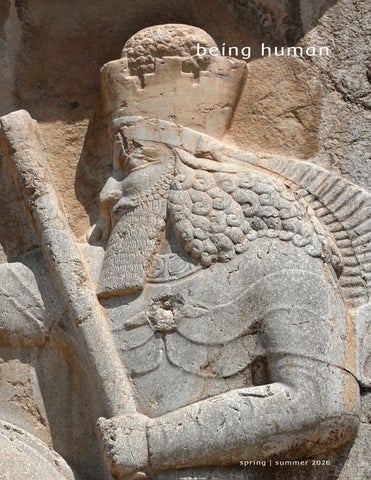
Sassanid-era relief of Ahura Mazda presenting the diadem of sovereignty to Ardashir I, founder of the last empire of Ancient Iran, 3rd c. AD. This relief is at Naqsh-e-Rostam, where a collection of ancient Iranian rock reliefs are cut into the face of the mountain. Image by Wojciech Kocot, 2018. In January 1910, Rudolf Steiner first began speaking about the True Nature of the Second Coming of the Christ. One year later, he identified five critical turning points in the process leading to the culmination of the Christ’s incarnation, beginning with the individual Zarathustra. Zarathustra urged his disciples to turn their eyes upon the great periphery of existence… within the body of the sun, there dwells the great Solar Spirit ~ Ahura Mazda ~ The Spirit of Light. On page 34, Oliver Ray draws our attention to this mystery in relation to current events, especially in the geography that bears the name of this mighty, ancient being, the Strait of Hormuz.
spring | summer 2026
• 3
The Anthroposophical Society in America
L et ter f rom the Genera l Se cret a r y
GENER AL COUNCIL Gerneral Secretar y & President Mar y Stewar t Adams Treasurer, At-large Charles Burkam Secretar y, Central Region Mar y Mer tz Chair, at-large Ezra Sullivan Western Region Christine Burke Eastern Region Lucas Dreier At-large Margaret Runyon At-large Gino Ver Eecke At-large Eduardo Yi
being human MAGAZINE
is published by The Anthroposophical Society in America 2240 Pontiac Trail Ann Arbor, MI 48105 Design Patricia DeLisa Past issues are online at www.issuu.com/anthrousa Submissions, questions, comments: editor@anthroposophy.org or to the postal address above being human is sent free to ASA Members anthroposophy.org/join To request a sample copy editor@anthroposophy.org
©2026 The Anthroposophical Society in America. Resposibility for the content of the ar ticles is the authors’
4 • being human
Strait of Hormuz
I
n this 250th year since the signing of the Declaration of Independence, we have placed an ancient god on the cover of our magazine (see Oliver Ray p. 34), to draw attention to the evolving stream of human consciousness, especially in relation to the activity and deeds of the Christ Being at this moment in human history. In seven years, the Anthroposophical Society in the US will celebrate 100 years since its incorporation, on March 27, 1933. The date was almost exactly eight years after Rudolf Steiner died. Eight years is a Venus rhythm, and the time during which the dynamic form of the pentagram is woven about the Earth by Venus and the Sun. In giving a dodecahedral shape to the Foundation Stone, with its relationship to the pentagon, and by referring to it as a stone of love laid into human hearts, Rudolf Steiner may have pointed at this mystery of Venus. From here it’s possible to imagine that those gathered in 1933 to incorporate the Society in the US had this in mind as well, for they were certainly active well before the actual moment of incorporation that day in March. This lends itself to a consideration of the spiritual nativity of the Society in the US, which can yield insight into how anthroposophy has taken root and blossomed across the continent during its first century here. It is this that we are celebrating in this issue of being human magazine, and at this year’s Annual Conference in Spring Valley, NY October 9-11, 2026. The year 1933 is also significant in that it marked one of the dates Rudolf Steiner pointed to in relation to the great mystery of our era, regarding the true nature of the Second Coming. This makes of the year 2033 a convergence point: 100 years since the incorporation of the Society in the US; 100 years since the Christ reappears in the etheric; and two millennia since the Mystery of Golgotha. It will be a potent time, marked by a Total Solar Eclipse on the anniversary of Rudolf Steiner’s death, March 30, 2033, and a Total Eclipse
And the day came when the risk to remain tight in the bud was more painful than the risk it took to blossom. - Anais Nin of the Moon during the Holy Week that will cast its shadow over Jerusalem, as it did 2000 years earlier. With all of this as context, we bring this current issue of being human magazine, in which we introduce the membership to our new headquarters through the eyes of the architect Robert Black (page 14); we do a comparative contemplation of the America Verse with Chris Schaefer (page 16), an article Chris was inspired to by Virginia Sease’s piece from the Fall/Winter 2025 issue of being human. With Bruce Donehower we follow the path of Novalis into the Earth through consideration of the new Orphic Mysteries, which includes the fascinating idea that miners are “astrologers in reverse” (page 20). In a serendipitous way, many of this issue’s authors point to the reverse ritual, to the activity of a community of people freely associating out of a shared striving that lifts one into spiritual encounter (see articles by Schaefer, Donehower, Lyons, Beck, Linnell). This demonstrates how anthroposophy is thriving in America now. And while there are many among us who can speak to the deep, storied, and esoteric roots at the founding of the US, our emphasis in this issue is on the way forward, mirroring the period of evolving human consciousness that found its exoteric expression in the art and architecture of ancient Egypt, where the mightiness of the gods is evidenced behind human beings as they stepped into the physical world (see Egyptian Odyssey and Ramses page 32). Now it is we who must realize a similar mightiness, though now as an inner force, as we step consciously into the spiritual world. A contemplation on the dynamic of this turn is beautifully described in Michael Howard’s essay on his work, an inspiring distillation of a life spent engaging with deep mysteries (page 24). Luke Goodwin ennobles and makes practical a community practice of anthroposophy through his description of the College Imagination in relation to his Waldorf School community and to the principles of the Association of Waldorf Schools in North America (page 29). We are also pleased to celebrate Emil Molt in this issue, with 2026 marking 150 years since his birth, and 90 years since his death (page 42). As founder of the first
Waldorf School Molt said: For me, the decisive thing is that I feel obliged to Dr. Steiner and toward the spiritual world. In this issue we both announce and celebrate several significant upcoming events, including Threefold at 100 (page 39), the Karl König Institute’s history and next steps (page 37), the staging of Rudolf Steiner’s second Mystery Drama The Trial of the Soul (page 38), and this year’s Youth Conference (page 47). We are thrilled to share that the Eurythmy Association of North America will do a rare staging of all 52 Verses of the Calendar of the Soul in Spring Valley this August (page 60). And, with regard to the articles here that further augment the mood of this moment, we turn to Virgina Hermann’s piece on the joy of collaboration (page 44), celebrating the creative, healing forces of the human soul that find highest expression in relationship, one with another. All of this culminates in the 22 voices included in Chris Schaefer’s new book, Moved by Destiny, reviewed by John Beck on page 48. Through this work the voices resound, out of lifetimes of experience, with an unwavering commitment to anthroposophy and social reform ~ true inspiration for the way forward. Andrew Linnell wraps it all in the sublime mystery of color with his thorough review of Kees Veeman’s Color Meditation, an high expression of contemporary humanity’s journey into reality. It is always a pleasure to sit back and reflect on the magazine once an issue is ready for print, and often I am struck by how the pieces weave together, revealing something at work beyond my basic skills as an editor. Perhaps it serves here to note that I received my undergraduate degree from the University of Michigan in literature and communications, because a journalism degree was not on offer then. To get at my goal, I also worked as an editor at the entirely student-run newspaper The Michigan Daily, where I was responsible for the daily Arts and Entertainment pages and the weekly Weekend Magazine. Though destiny stepped in to send my life in another direction, my academic striving was here. I am grateful for the opportunity to use this experience in this work, and in how it can serve our publication.
spring | summer 2026
• 5
The Nature Institute Life in Context
“The knowledge [we] seek is not meant for controlling the world, but, rather, for unlocking it and letting a mute world become one that speaks to us in a thousand places.” — Erwin Straus Research Education Publications
Ghent, NY natureinstitute.org
May my soul bloom in love fo r a l l e x i s t e n c e . Rudolf Steiner
Economics Conference of the Goetheanum Summer School, 26 July – 1 August 2026 Spring Valley, New York A journey from Hibernia of old through St Gallen’s mission and the reopening of the West to the awakened I-being and the Anthroposophical Society in America . Registration is by invitation | Fee: $100.00 | Food and lodging on one’s own account SEE https://economics.goetheanum.org/meetings-and-events/2026-summer-school Hosted by the Economics Group of the Anthroposophical Society. Please indicate your interest by contacting Kim Chotzen at economics@goetheanum.ch.
Steiner Health Retreats Two-Week Life Force Intensive Health Retreat
A restorative two-week residential retreat designed to support deep renewal and healing. Patients receive individualized medical care, anthroposophical therapies, therapeutic remedies, and educational sessions in a nurturing healing environment. October 26th – November 8th, 2026
Inspiring Education Since 1967
One-Week Patient Session
A focused week of therapeutic care, Monday–Friday, 9:00 AM–5:00 PM. Includes personalized medical care, anthroposophical therapies, and a nourishing organic vegetarian meal. The cost is $1800. July 7th – 13th, 2026 New patients must schedule an initial intake appointment prior to attending (not included).
Register: steinerhealth.org/retreats
Low-Residency Programs in Waldorf Early Childhood,
Elementary, World Languages & High School Teacher Education
APPLY NOW to start this summer Financial aid available, including Diversity Fund Scholarships
SUNY MEd or MALS option available
•
REGISTER for an online Summer Series 2026 Course
www.sunbridge.edu
STEINERBOOKS
New Books The Destinies of Individuals and Nations THE COLLECTED WORKS OF RUDOLF STEINER (CW 157) isbn 9781855846791, 324 pages, paperback, $35 The Riddle of Humanity THE COLLECTED WORKS OF RUDOLF STEINER (CW 170) isbn 9781855846784, 310 pages, paperback, $35
Rosicrucian Wisdom THE COLLECTED WORKS OF RUDOLF STEINER (CW 99) isbn 9781855846807, 208 pages, paperback, $28
The Social Challenge THE COLLECTED WORKS OF RUDOLF STEINER (CW 328) isbn 9781855846777, 222 pages, paperback, $30
Apocalypse of the Modern Mind Covid and the Dialectic of Enlightenment DANIEL J. POLIKOFF isbn 9781938685637, 496 pages, paperback, $35
Far Beyond Our Ordinary Consciousness Rudolf Steiner’s Final Courses, Dornach, September 1924 PETER SELG isbn 9781621484080, 112 pages, paperback, $14.95
Man with a Mission Bernard Lievegoed in His Own Words FRANZ LUTTERS isbn 9781621484028, 432 pages, hardcover, $49.95
Moved by Destiny Life Stories of Social Engagement CHRISTOPHER SCHAEFER,PhD isbn 9781621484042, 288 pages, paperback, $29.95
The Representative of Humanity Experiencing Rudolf Steiner’s Group Sculpture Through Drawing CAROLINE CHANTER / J. GEORG MÜLLER isbn 9781621484103, 136 pages, paperback, $28.95
The Mystery and Magnificence of Mary in Paintings and Poems NEILL REILLY isbn 9781621484066, 104 pages, hardcover, $25
order phone: 703-661-1594 • www.steinerbooks.org
FACETS
Painting Drawing Sculpture Architecture
An intensive Art Course in English
In three six-week blocks starting February 2027
at the Rudolf Steiner Painting School, Dornach, Switzerland
The three six-week blocks of study integrate various facets of the impulses for art arising out of anthroposophy through the work of Rudolf Steiner. The main subject is painting accompanied by drawing, sculpture, plant colour making, architecture and eurythmy. STUDY PERIODS Module 1 1 FEBRUARY - 12 MARCH 2027 Module 2 10 MAY - 18 JUNE 2027 Module 3 11 OCTOBER - 19 NOVEMBER 2027 Details at rudolf-steiner-paintingschool.ch c.chanter@iriscolor.ch Or write or call for a paper brochure: Caroline Chanter, Brosiweg 41,
4143 CH-Dornach
Tel: + 41- (0) 61 702 14 23/701 10 23
L egacy C ircle Leaving a Legacy of Will The Anthroposophical Society in America
Thank You to those members, who support the Society’s future through a bequest or planned gift. Erika V. Asten*
Seymour Lubin*
Betty Baldwin*
Greg Martens*
J. Leonard Benson*
Barbara Martin
Susannah Berlin*
Beverly Martin
Hiram Anthony Bingham Virginia Blutah*
Helvi McClelland Robert & Ellen McDermott
Iana Questara Boyce*
Robert S. Miller*
Marion Bruce*
Ralph Neuman*
Robert Cornett
Martin Novom
Helen Ann Dinklage*
Carolyn Oates
Irmgard Dogegge*
Mary Lee Plumb-Mentjes
The ASA invites you to join the
Michael Support Circle
Raymond Elliot*
Norman Prichard*
Lotte K. Emde*
Paul Riesen*
Hazel Ferguson*
Joan Roach*
Marie S. Fetzer*
Mary Rubach*
Linda C. Folsom*
Margaret Runyon
Gerda Gaertner*
Ray Schlieben*
Susanna Gaertner
Lillian C. Scott*
Ray German
Fairchild Smith*
Ruth Geiger
Patti Smith*
Association of Waldorf Schools of North America
Harriet S. Gilliam*
Hannah Sohnrey*
Chuck Ginsberg
Doris E. Stitzer*
Hazel Archer-Ginsberg Agnes B. Granberg* Alice Groh
Gertrude O. Teutsch* Katherine Thivierge Jeannette Van Wiermeersch*
Bruce L. Henry*
Catherine Vanden Broek*
Ruth Heuscher*
Randall Wadsworth
Richard Hicks*
Pamela Whitman
Christine Huston
Thomas Wilkinson
Ernst Katz*
Patricia Turner*
Cecillia Leigh
Anonymous (22)
Anna Lord*
* indicates past legacy gift
Legacy giving is an excellent way to support the work of the Society far beyond a person’s current living capacity. There are a variety of ways to make a legacy or planned gift. If you would like to learn more please contact us: info@anthroposophy.org 734-662-9355
w w w. a nt h ro p o s o p hy. o rg / le ga c y
Our major donor circle. Thank You to the 45 individual members, and to these organizations for their gernerous and on-going support:
Camphill School - Beaver Run Carah Medical Arts Council of Anthroposophical Organizations Great Lakes Branch House of Peace Michael Support Circle members pledge gifts of between $500 and $5000 per year for five or more years. They help to Society to grow in capacity and vitality - the basis for increased membership, new learning opportunities, and greater impact in the world. To learn more about how you can support the strength and sustainability of our movement, contact us: info@anthroposophy.org
Connect to the Spiritual Rhythms of the year... A sacred service. An open esoteric secret: The Consecration of the Human Being A celebration of the Festivals Renewal of the Sacraments Services for Children Religious Education Summer Camps Study Groups Lectures
The Christian Community is a movement for the renewal of religion. It is centered around the seven sacraments in their renewed form and seeks to open the path to the living, healing presence of Christ in the age of the free individual. Learn more at www.christiancommunity.org
Bring your speech to life!
U n lo c k i n g a r i c e x p r e s si o n ... tist
Now accepting applications!
Deepen your sense of self, and strengthen your capacity for engagement in the world through work with the spoken word, based on the insights of Rudolf and Marie Steiner. The Steiner School of Speech Arts offers an in-person, four-year training program, as well as shorter workshops, within the embrace of the Threefold Educational Center (Chestnut Ridge, NY), also home to many and varied anthroposophically-inspired initiatives. Barbara Renold, Jennifer Kleinbach, & Helen Lubin
Visit our website for more information:
www.steinerspeecharts.org
Fe a t u r e
T he Stone Hous e
of the A nthroposophical Societ y in A merica From Robert Black | April 2026
A
i
s Architect of both the Steiner High School and the move of the Society HQ from Chicago to 1923 Geddes some years ago now, I feel that this transition is particularly timely and important to the future of the movement and its place in the shift of the world zeitgeist.
cleared old disruptive energies of the land, called in new aiding spirits and opened a powerful channel to build on the legacies of the site’s indigenous ancestors, the Moehrle family’s presence, and the many years of graduates who learned and passed through the inner and outer spaces of that magical place.
1923 Geddes Avenue, originally built as a Masonic Fraternity in 1923, became a strong heart-center for the Society (also Great Lakes Branch), aligned with its timely evolution. The building’s proximity to the U-M Arboretum and to where the Katz’s lived around the corner was the right energy for that time. The building was transformed through creative imagination of a good team of folks that I worked with, including Arthur Zajonc and many others. The rework of the interior (opening of the entry space, etched art glass doors into the main room, lazure work (John Stolfo, others) on the walls, exterior site work by Walter Kudnohufski/Landscape Architect (friend of Arthur’s and future colleague of mine at the Hartsbrook Waldorf School) aligned the building’s architectural presence with the Society’s purpose for many years.
We are living in serendipitous times, and I believe that the Michael Spirit and that of anthroposophy itself are rising, along with several other very positive forces to help heal the world and move humanity into its next chapters of destiny...so valuable and helpful for our mutual well-being and the new souls of Waldorf students who will benefit from this noble work.
The Steiner School Stone House, built in 1938 (another auspicious year) by German immigrants (the Moehrle family) set the stage for honoring the land’s ancestors, and for creating a lasting work ethic that built the adjoining factory building that became our high school. The Moehrle’s son, Otto, Jr. was born in that house and grew up in the northwest room (original garage). Later in life, Otto took over the family’s business and eventually sold the building to the Steiner School. Mr. Moehrle also did annual “living history” lectures for my History through Architecture class that I taught for many years from the inception of the High School. The stones that make the walls of that house, along with the stones we built into the column foundations of the High School front entry porch, came from the geology of the land there and imbued a special spirit into the architecture. Special spirit work by Merri Walters, Robin Grosshuesch and myself 14 • b e i n g h u m a n
Onward Upward
Heaven is not yet Heaven The earth is not yet Earth And the doorway moon Creaking on its hinges Ever in need of repair How hard the sun strives To become Sun one day And the stars like children Still rushing off to school How could we all not Have so much more to be To say to do to touch Eternity just our potential For an actual life PETER RENICK
spring | summer 2026
• 15
Fe a t u r e
The America Verse and Sacred Conversation
The America Verse and Sacred Conversation: Ref lect ions on the Reverse R it ual By Christopher Schaefer Ph.D.
W
i
hen considered in relation to several significant verses by Rudolf Steiner, the America Verse yields insight into sacred conversation, or to what Rudolf Steiner described as the reverse ritual, the process by which a group of spiritually striving individuals can raise their mutual consciousness to experience spiritual presence. Through this consideration we may gain a deeper appreciation and understanding of the social and spiritual promise of sacred conversation, of spiritual community. Most of us have had experiences of what I would call spiritual presence when in conversation with one or more people. This experience of grace, of what I think of as a star-filled space, can be quite fleeting, a kind of blessing, where those present sense a sudden deepening of mood, of awareness and of spiritual presence. I have had such experiences in meetings and in conversation with friends, and at times in smaller or larger groups. What is it that happens in such moments? Rudolf Steiner compared and contrasted this experience of spiritual community with that of religious communities in the following way: I would put it thus, the community of the cultus (Church Service), seeks to draw the angels of heaven down to the place where the cultus is being celebrated so that they may be present in the congregation, whereas the anthroposophical community (Spiritual Community), seeks to lift human souls into supersensible realms so that they may enter the company of angels. 1
In the Church Service the priest acts as the mediator or facilitator between the spiritual world and the community, following a prescribed set of acts and rituals. The service can be experienced as a powerful act of community building reminding us of our divine origin and of our membership in the brotherhood and sisterhood of Christ. Rudolf Steiner suggests that the service of the Christian Churches invites the angelic 16 • b e i n g h u m a n
realm down into the community of believers whereas, within a sacred conversation or within spiritual community, the members of the community create a soul and spirit space in which they are able to raise their consciousness into the spiritual domain, becoming aware of the spiritual hierarchies. The question naturally arising for all spiritually-striving individuals and groups is, are there qualities and stages to the process of building spiritual community which help us to experience the guiding presence of spiritual beings? In pondering this question over many years, I have come to feel that such experiences are first of all moments of grace, gifts of the spiritual world given to us as spiritually-striving individuals. I would also say that there is no fixed technique or set time sequence to bring about such experiences of a heightened spiritual consciousness, because it is an artistic process. It is more a question of what are the soul and spirit qualities needed to awaken the interest and presence of spiritual beings, while at the same time helping us to have an awareness of their activity within the group? The America Verse does this simply and beautifully by asking us to focus our feeling on our heart, being aware of our common purpose and striving, on that which unites us, not on what separates us, while also carrying an awareness of the guiding and helping activity of spiritual beings. It asks us to have both a horizontal awareness -- our colleagues and friends, whom we can learn to appreciate and love -- and a vertical awareness of what lives spiritually in the space between us -- those beings who can strengthen and illuminate our work. It seems to me that the verse points to the essential core of sacred conversation, of the reverse ritual, by asking us to be aware of both the human and the spiritual dimension of conversation, thereby helping us to build a sacred space. I think that both the Teacher’s Imagination, given by
The America Verse and Sacred Conversation
Rudolf Steiner to the teachers of the first Waldorf School, and the Motto of the Social Ethic, can further add to our understanding and practice of sacred conversation, of building spiritual community. The Teacher’s Imagination (see article p. 29) describes how, when we gather together in service to the spirit, our angels lend strength to our individual striving, while the circling archangels connect us with each other, uniting our souls, giving us courage, and forming a chalice for our common work. Into this chalice the Archai can then add a drop of light, of inspiration, to serve the children and the good spirit of the school. 2 If the America Verse describes what needs to happen between us in creating a chalice for the spirit in uniting our hearts in love, and the Teachers Imagination describes what is happening between us and the beings of the third spiritual hierarchy, then the Motto of the Social Ethic provides a foundation for creating spiritual community. Rudolf Steiner gave this motto to Edith Marion, his collaborator in creating the Sculpture of the Representative of the Human Being. The verse states: The healing social life is only found (Heilsam ist nur) when in the Mirror of the Human Soul the whole Community finds its reflection, and when in the Community the virtue of each one is living. 3 It asks us each to take an interest in the other, in all of the members of the group, and then to have the whole community value the uniqueness, the virtue, and strength of each one. To have this be the case we need to develop a deep interest in the other, to overcome our normal likes and dislikes, and to objectively perceive and value this karmic friend who is our sister or brother on the road of mutual development. In Awakening to Community, and in many of his lectures on social themes, Rudolf Steiner states that the road out of our isolation in these anti-social and egotistical times starts with our learning to have an interest in the other. The social element “must be acquired consciously, in working with our own soul forces, while formerly it was felt instinctively. What is necessary and must be actively acquired is the interest
of one person in another. This indeed is the foundation of all social life.” 4 I have suggested that the Motto of the Social Ethic points to the basis, the foundation of building spiritual community through developing our mutual interest in the other; the America or Threefold Verse describes the essential soul and spirit dimension of unifying our hearts toward our common striving, our karmic connection, in awareness of the presence of the spiritual hierarchies; while the Teacher’s Imagination describes in more detail the spiritual working of the third hierarchy with and through us in sacred moments of inspiration. I think Rudolf Steiner had the expectation that many groups within the Anthroposophical Movement would both practice and experience the co-working with spiritual beings described by him in his lectures on the reverse ritual, as these lectures were often given to recently established branches of the Anthroposophical Society. Whether this becomes our experience depends on whether we make sacred conversation our aim and a central part of our inner journey. The importance of making such an effort for the future of humanity and the earth is revealed in these extraordinary statements by him: “These new (spiritual) beings, however, are compatible with man’s complete freedom and individuality. Indeed, in a certain respect, we may say they support their existence on human harmony; it will lie in the souls of human beings themselves whether or not they give as many of such higher beings the opportunity of descending to man…The more that associations are formed where feelings of community are developed in complete freedom, the more lofty souls will descend and the more rapidly the earth planet will be spiritualized.” 6 The America or Threefold Verse and the other verses described are compelling aids to make such an effort in this divisive and difficult time. 7 Christopher Schaefer Ph.D. is a retired adult educator, having taught at Emerson College and Sunbridge College for many years. He is the initiator of the Social Science Section work in North America, a former Council member, and was for many years an organization and community development director. He lives in the Berkshires of Massachusetts.
1.R. Steiner, Awakening to Community, Anthroposophic Press, Spring Valley, N.Y. 1974, p.157. | 2. See Holly Koteen-Soule, The Artistic Meeting: Creating Space for Spirit, Research Bulletin of AWSNA, Spring, 2012, Vol.17, No. 1. | 3. R. Steiner, Verses and Meditations, Rudolf Steiner Press, London, 1961, pp.116-7. | 4. R. Steiner, Social and Anti-Social Forces in the Human Being, Lecture 12.12.1918 | 5. R. Steiner, The Work of the Angels in Man’s Astral Body, Lecture 10.9.1918, Rudolf Steiner Press, London, 1988. | 6. R. Steiner, The Influences of Spiritual Beings on Man, Rudolf Steiner Press, p.156. | 7. I have found two books particularly helpful is developing these reflections, Gary Lamb, On the Wings of Words: Conversations and Human Relations, Steiner Books, 2024, and Athys Floride, Human Encounters and Karma, Steiner Books, 1990
spring | summer 2026
• 17
M ay our feeling penetrate Into the center of our heart, and seek, in love, to unite itself with human beings seeking the same goal With spirit beings who, bearing grace, Strengthening us from realms of light And illuminating our love, Are gazing down upon Our earnest, heart-felt striving. Verse for America | Rudolf Steiner | Translated by Frederick Heckel
ART | Rudolf Steiner House
18 • b e i n g h u m a n
Thinking Beyond Materialism
Thinking Beyond Materialism: A Contemplative Manifesto
Since the 17th century science and spirituality have been viewed as irreconcilable. But this is a conflict based on a profound misunderstanding. The obstacle is not science itself but its strict adherence to scientific materialism, a philosophy that I argue has been dismantled by the discoveries of 20th-century physics. The book takes the reader on a journey through the implications of relativity and quantum mechanics, revealing a universe built not on inert matter but on the inner dimensions of human experience, relationship, quantum holism, and a productive, existential ambiguity from which we learn of love as a way of knowing. Thinking Beyond Materialism is not intended as merely a criticism of scientific materialism but provides a path forward to a new science that sustains the ambiguity inherent in the world. Arthur Zajonc is Emeritus Professor of Physics at Amherst College, the former General Secretary of the Anthroposophical Society and the former President of the Mind & Life Institute. His previous books include Catching the Light: The Entwined History of Light and Mind; Meditation as Contemplative Enquiry: When Knowing Becomes Love; and, with George Greenstein, The Quantum Challenge: Modern Research on the Foundations of Quantum Mechanics. ArthurZajonc.org SUNY Press, 2026 | Arthur Zajonc | arthurzajonc@amherst.edu
The time has come to realize that supersensible knowledge has now to arise from the materialistic grave. Rudolf Steiner spring | summer 2026
• 19
Fe a t u r e
Finding the Bur ied Light By Br uce Donehower
Orpheus and Eurydice | Edward Poynte | 1862
I
n chapter five of Novalis’s unfinished novel Heinrich von Ofterdingen, the novel’s young poethero Heinrich boldly enters a cave and explores the underworld. Heinrich is accompanied by an old miner who has many years’ experience working underground and exploring subterranean realms. As the old miner guides Heinrich, he praises the mining profession and the profound secrets that lie hidden deep inside the darkness of the earth. To their surprise, the two adventurers encounter a hermit. When this venerable old man hears the miner describe his sub-earthly profession, he enthusiastically declares that miners are “astrologers in reverse”—they are astrologers with a very different orientation and point of view. “Astrologers gaze unceasingly at the heavens and wander through its immeasurable spaces, but you turn your gaze to the earth and explore its interior. Astrologers study the forces and influences of the stars, but you examine the forces of rocks and mountains and the manifold effects of layers of earth and stone. For astrologers, the heavens are the book of the future, while for you, the earth shows monuments of the primeval world.” This chapter in Heinrich von Ofterdingen is just one example among many German romantic tales that 20 • b e i n g h u m a n
concern themselves with mines and underground domains. Mines were viewed as creative, transformative sites in which precious stones and metals regenerated and flourished like living, growing things. This belief in the regeneration of metals was so firmly held that exhausted mines were occasionally shut down to give the ores, crystals, and minerals opportunity to renew themselves. Mines and caves exerted a very strong attraction on the imagination of poets such as Novalis, and this special fascination for the underworld that we find in Novalis is something quite new in European literature. Just as the old hermit in chapter five of Heinrich von Ofterdingen exclaims that a miner is an astrologer “in reverse,” so, too, does Novalis sing like an Orpheus, but in a different way. Orpheus plumbed the darkness to lead his dead lover back to the light; Novalis seeks the light that is concealed in darkness—fallen starlight, we might call it. Novalis is a poet of the new Orphic mysteries in that respect. And to explain briefly what I mean and to characterize how these new Orphic mysteries are a lemniscate-reversal of antique Orphic mysteries, it is helpful to call to mind a familiar poem that Rudolf Steiner wrote for his partner-collaborator and muse, Marie Steiner-von Sivers.
Finding the Buried Light
Now here’s Willi Sucher:
The stars once spoke to Man. It is world-destiny
That they are silent now. To be aware of the silence Can become pain for earthly Man. But in the deepening silence There grows and ripens What Man speaks to the stars. To be aware of this speaking Can become strength for Spirit-Man.
This poem exemplifies a term that we use quite often in anthroposophy: “reverse ritual.” Since this verse for Marie concerns stars and constellations, what better person might we turn to than astrosopher Willi Sucher to help us contextualize “reverse ritual”? The words that I will share next by Willi Sucher, written in 1938, along with the poem that Rudolf Steiner wrote for Marie, provide many clues how to read Novalis as a new Orpheus of a newly dawning Age of Light. “Age of Light” might surprise you, but it is a phrase that Rudolf Steiner emphasized when he began his tasks for Anthroposophia. He used this phrase to characterize the new mysteries—a great world-turning point in our human-spiritual history that he located at the beginning of the 20th century. We might hear “Age of Light” as a misstatement, considering the outer and inner catastrophes that have afflicted human souls since 1900, and which deservedly make us feel that we are prisoners locked in some darkened fastness underground. We might rightly object: Where is the light? But Rudolf Steiner characterized the beginning of the 20th Century in just that way—as a great world-turning point, the end of Kali Yuga—as though our task at hand, like some “reverse” Orpheus, is not to carry light into darkness but to find light that the darkness seemingly conceals.
“When we recall how the people of the Middle Ages looked up to the starry heavens, we have the impression that the stars at that time spoke a language we were still able to understand. Slowly, however, the language of the stars was reduced to silence; even during the Middle Ages it was partly so. Increasingly, the sublime wisdom of the stars of olden times died into mere tradition, to the mere handing-down of old and, to some extent, newly added rules. This is the point of utter silence we have reached today. “On the other hand, as we have seen, through the constellations of death a new relation to the stars has been explored. Fresh spiritual substance is carried out into the cosmos by the human being; the world of stars is thereby, in a certain sense, rejuvenated. Manifold, richly colored, shot through and through with Earth-reality, human destinies are written now into the heavens. We now speak to the stars—at least, we begin to speak— even as once upon a time the stars spoke to us. “This is the great world-turning-point through which humanity is passing, affecting, as it does, all aspects of human life. We must learn to face it with clear consciousness.” Poet Heinrich’s journey into the underworld in chapter five of Heinrich von Ofterdingen is a journey through this “great world-turning point” that Willi Sucher and Rudolf Steiner characterized. But of course, the text that most poetically and mysteriously speaks about this initiation-journey through the “great world-turning point” is not the novel Heinrich von Ofterdingen, it is rather the poem Hymns to the Night, which was written at about the same time. And the two together, novel and poem, find their culminating summary in The Fairytale of Eros and Fable, which Novalis drafted sometime just after the experience at Sophie’s grave. Here, on Sophie’s grave at the entrance to the underworld, Hardenberg became Novalis by undergoing an initiation at the “great world-turning point”—an initiation that Rudolf Steiner tells us we all will experience, or perhaps we are experiencing right now. Here on Sophie’s grave, Novalis wrote the spring | summer 2026
• 21
Fe a t u r e
Finding the Buried Light
lines that became almost verbatim the third section of Hymns to the Night. Here he began a description of “reverse ritual”—and the full description of that “great world-turning point” initiation can be read as the entire poem, Hymns to the Night. Novalis, as the herald of Anthroposophia, understood that the new Orphic mysteries had changed our relationship to the underworld and to death—to darkness and to light. This is the substance of Hymns to the Night and of everything else that he wrote as Poet of the new Orphic mysteries. The light that formerly shone upon us from starry heavens must become the light that shines from within ourselves.
Consoled and comforted, life To eternal life continues On - brightness of mind Transforming and renewed. The stars shall dissolve As quickening golden wine. Enjoy! Drink deeply with resolve! Become what you are: starlight! Hymns to the Night; Translation by Bruce Donehower
22 • b e i n g h u m a n
Novalis
Exer pt from Hymns to the Night NOVA LIS
I.
i
WHAT liv ing thing, gifted with sense -understanding, does not love above all else the world ’s miraculous expanse? Joy f ul light! A nd all its streaming weav ing colors! Its gentle presencing—here, there—a beautif ul sunrise! How the light—the secret soul of life—is inhaled by restless stars! The wide - open world! How it swims and dances upon blue waters! How the spark ling ever- quiet stone so deeply inhales it! The plant, so pregnant with meaning, that suck s the ample breast of mother earth! The wild, feverish, f ier y, formative animal! But above all, the magnif icent stranger with meaningf ul eye and musical gait—whose lips, richly colored, suggestive of melody— repose so gently. Sovereign like a k ing—erect above earthly nat ure—powerf ully light conjures endless transformations—forges and dissolves relentless alliances—displays a heavenly countenance to ever y sentient thing. Its gaze and presence disclose a miraculous world, a glorious k ingdom. Downward I t urn to myster y—to holy, unspeakable night! The world lies far away— deep -sunken, buried—desolate, bereft. From the heartstrings of the chest, a threnody! I want to go under—I want to drown! To abandon myself to tears and ashes. Distant memories, youthf ul dreams, fantasies of childhood, may f ly ambitions! Vain imaginings arrive in gray cloth f uneral mist of sunset. In other places, light has pitched its happy tents. Suppose the light never ret urns? Suppose the light abandons us? We who wait like orphans, so faithf ully innocent! Tr a n sl ate d by Br uc e Done hower for t he 2 025 C on ferenc e of t he Nor t h A mer ic a n S e c t ion for t he L iter a r y A r t s & Hu m a n it ie s of t he S c ho ol for Spi r it u a l S c ienc e. Av a i l a ble on A m a z on. T h i s c omple te E n g l i s h-l a n g u a g e t r a n sl at ion of Hy mn s t o t h e Night b y Nova l i s w i l l b e p er for me d at t he fou r- d ay 2 02 6 Pente c o s t C on ferenc e at t he G o e t he a nu m. T he c on ferenc e t it le i n E n g l i s h i s: Nova l i s: Wor l d a s Poe t r y.
spring | summer 2026
• 23
Fe a t u r e
Vi sible Mu sic , Vi sible Sp e e ch The Evolving Role of A rt and the A rtist By Michael Howard
Evolutionary Sequence 1II
I
n what way can a work of art be experienced as visible speech and music? How might this direction ref lect the evolving role of art and the artist in serving the cultural and spiritual needs of our time? I borrowed the terms Visible Music and Visible Speech from Rudolf Steiner when I realized the two aspects of eurythmy he describes with these terms could be applied to two dimensions in my paintings and sculptures.
V i si ble S p eec h | My journey with Visible Speech in the visaul arts began in 1971 when I read the following in Theodor Schwenk’s book, Sensitive Chaos: “In the abundance of possible movements in the organ of speech, certain ever-repeated characteristic archetypal movements, which we know as the vowels and consonants, can be singled out... it is these archetypal movements of the vowels and consonants that give birth to all manner of forms.” Schwenk goes on to quote Rudolf Steiner in a lecture to eurythmists on June 24, 1924: “What is it that my Creator, working out of original, cosmic being, does in me as a man? If you would give me the answer to this question, you must make movements of 24 • b e i n g h u m a n
eurythmy. God makes eurythmy movements, and as the result of His eurythmy, there arises the form of man...” These words struck a chord in me that changed the direction of my work as a visual artist, as well as my path as a human being. At the time, I had no idea how the human form might be shaped by the sounds of speech. And yet, something in me felt this was a question for a sculptor to explore. I said to myself: “If all the speech sounds create the human form, what form would arise from a single speech sound? What would a ‘B’ look like? What form would an ‘M’ or ‘K’ take?” In a playful spirit, I began to explore such questions by making simple forms in clay. I would not have been able to begin such an exploration, however, if I had not already discovered another fundamental aspect of sculptural form. I had spent two years at Emerson College in England, where the curriculum included a wide spectrum of arts and crafts. After a few months, it dawned on me that there was a common element in the way all these arts and crafts were approached. Rather than expressing ourselves through color, form, music, and movement, we were invited to open ourselves to what was being expressed though these mediums. It became evident that the various artistic media were not merely physical materials to be manipulated as we please,
Visible Music, Visible Speech
FIGURE 1
but rather, clay, wood, pigment, and even our moving body, allowed a world of non-physical qualities to become visible, and thus experienced, as the warmth or coolness of colors, the rise and fall of melodies, and the expansion or contraction of movement. This led me to make clay sketches of the basic elements of sculptural form--convex/concave, round/ angular, wide/narrow--not once but again and again. I soon discovered that roundness evoked a different quality than angularity, as did convexity compared to concavity, and even how wide or narrow effects the weight or levity of a form, as in Figure 1. It was in learning to feel the living qualities of these basic elements of form that a foundation was layed for creating forms that reflected sounds of speech. For example, if I wanted to create ‘M’ in contrast to ‘K’, which would be angular, and which would be curvilinear? Flat angularity has the crisp clarity of 2. ‘K’, whereas the living mobility of convex and
2. K
3.M
double-bent curves have the gentle fluidity of 3.‘ M’’. After some years of making single forms related to single sounds of speech, I was ready to create forms that expressed multiple sounds. This developed in two different ways. The first approach was to combine a few speech sounds as we do to form words. Living Form was the name of my studio, so I set out to create a relief sculpture that wove together the sounds: L / F / R / M as in Figure 4. The second approach was to create a sequence of 12 forms related to what in eurythmy is known as the evolutionary sequence: B / M / D / N / R / L / G / Sch / F / S / H / T. see, 5. Evolutionary Sequence 1997-99, cast stone, 16” x 144” Drawing on my experience with single sounds, I began developing a ‘B’ form in plastecine. After some time, I moved on to ‘M’ and eventually ‘D’. It was only as I began to work on ‘D’, that I realized I was approaching each sound as a form in itself. Suddenly, I saw how the ‘B’ form metamorphosed into ‘M’, and ‘M’ into ‘D’. Unexpectedly, my work on the evolutionary sequence led to insights and experiences about metamorphosis. The following three images show how certain form qualities can be introduced to correspond with the sound qualities of ‘B’, ‘M’, and ‘D’. By entering into these form sequences, we can also experience how they metamorphosis from one form quality into another. 6. Becoming ‘B’ 7. Becoming ‘M’ 8. Becoming ‘D’
4. L I V I N G F O R M : L / F/ R /M
Vis ible M us ic | My exploration of Visible Music arose through a convergence of several factors. Shortly after 9/11, I was moved to draw and paint on black rather than white surfaces. I realized that placing yellow on white is a darkening of light, whereas purple on black is a lightening of darkness. spring | summer 2026
• 25
Visible Music, Visible Speech
And when building up white on black, light emerges from darkness. Around the same time, I was perplexed to realize that as a visual artist, I was often more deeply moved by music. With some confusion and annoyance, I set myself the task of evoking something like a musical experience through color and form. One starting point was to build up small dots or dashes of color on the black ground so that dynamic lines and forms appeared through felt experience. In coming to life as qualities of movement, I felt moved by colors and forms as I was moved by musical tones and rythyms. In building up dynamic lines that echoed or wove over each other, I strove to make each mark to be in harmony with
6 . B E CO M I N G ‘ B ’
7. B E CO M I N G ‘M’
8 . B E CO M I N G ‘ D ’
26 • b e i n g h u m a n
every other mark. And yet, as some harmony developed in one area, inevitably, other areas felt chaotic and disharmonious. Every drawing and painting is a journey in the agony and ecstasy of trying to bring thousands of marks into a harmonious whole. The very challenge of creating a living and dynamic whole makes the process meaningful in itself, even when typically, I feel only partially successful. 9. Trinity, 2024, 9 x 36 10. Between Sun and Moon, 2024, 9, x 36
Th e E vo lv in g Ro le of A r t a n d t he A r t i st Surely, the themes of visible speech and visible music are more than enough for one artist to work on. And yet there is another dimension of my work that underlies the other two. Simply put, before I am an artist, I am a human being. Indeed, being an artist is simply a way of realizing my human potential. One of the most significant experiences I have had as a human being is to discover through art the capacity to feel inner qualities of color, form. This capacity, known as artistic feeling, requires only that I hold in check my personal feelings of like/ dislike so that I become conscious of the ever-present world of qualities sounding through my life of feeling. Through the perception of qualities, I transcend the duality of outer and inner; I experientially know the inner reality of all outer reality, including the inner reality of other individuals. Over time, I came to appreciate that I value artistic feeling, not only as an artist, but as a human being. Artistic capacities are essential human faculties that can be developed in every human being, and applied in every walk of life. Art, along with Science, Religion, and Philosophy, has always played a role in shaping human consciousness, as well as human society and civilization. Different cultures in different periods have developed different aspects of our humanity. We need only consider why Renaissance artists like Leonardo Da Vinci painted in perspective, while artists before did not. Perspective and realism arise not through greater skill, but when human consciousness becomes more identified with the physical body and the physical forces of the world.
Visible Music, Visible Speech
5 . E v o l u t i o n a r y S e q u e n c e 1 997- 99, c a s t s t o n e , 1 6 ” x 1 4 4”
Previously, human beings were more identified with soul and spiritual realities, and thus, were more attuned to the inner, qualitative dimensions of outer nature. Owen Barfield refers to this earlier form of consciousness as original participation. By contrast, as humankind came to identify ever more with physical reality, we lost our innate capacity to participate in the realities of soul and spirit. This loss of participation in soul spiritual realities is often referred to as onlooker consciousness. Perspective is to art what quantitative observations and analytical/mechanical thinking are to science—as exemplified by Leonardo in both spheres. Even those who do not consider themselves scientific or mathematical are shaped by scientific and technological thinking and methods. Our education and ways of working are permeated by these scientific, left-hemispheric ways of seeing and thinking that are hallmarks of modern consciousness. Without entering into the whole evolution of human consciousness, I wish to draw attention to an emerging
consciousness beyond modernism and post-modernism that a growing number of thinkers refer to as metamodern or integral consciousness. If not identical to what Rudolf Steiner calls the consciousness soul, and Barfield refers to as final or regained participation, they are certainly related, and offer a valuable basis for a wider discussion about the evolution of human consciousness. Using the terms metamodern and regained participation, I ask: If seeing in perspective is symptomatic of modern onlooker consciousness, is there an artistic capacity that is symptomatic of the emerging metamodern/participatory consciousness? Artistic feeling comes immediately to mind. In perceiving the quantitative attributes of the world, we develop the modern capacity to know physical reality through our own inner activity. In learning to perceive the qualitative attributes of the world through artistic feeling, we develop the metamodern capacity to regain participation in soul and spiritual realities. Only now, instead of original participation that is given to
9. T R I N I T Y | 2 0 24 | 9 X 3 6
1 0 . B E T W E E N S U N A N D M O O N | 2 0 24 | 9 X 2 6
spring | summer 2026
• 27
Fe a t u r e
Visible Music, Visible Speech
1 1 . R I C E D R AW I N G A S S O C I A L S C U L P T U R E | 2 0 2 6 | 4 8 x 96
us as a natural capacity, we now regain participation through self-initiated inner activity. Artistic feeling, and related artistic faculties, will allow us to know and live in a more harmonious relationship with the living, soul, and spirit dimensions of the whole earth. Artistic feeling is synonymous with the capacity for empathy, and thus foundational to transforming human relationships, and the way we shape our social, political, and economic institutions. Artistic capacities will allow us to develop community founded on individuality rather than commonality. No less significantly, artistic perception is a key to self-knowledge and self-directed inner development. We will discover new meaning and direction for our individual and collective lives in recognizing the need to build a culture that expands our human faculties to include artistic capacities as much as scientific ones, to cultivate the right hemisphere mind in each human being as we presently emphasize the left hemisphere mind. I appeal to my fellow artists to recognize the great cultural 28 • b e i n g h u m a n
task before us that will give new meaning and purpose to our activity as artists. I appeal to those who may not think of themselves as artistic to open themselves to developing their innate artistic potential as an integral aspect of their full humanity, and thus essential to meeting the dire challenges of our time. A new relationship between artists and the wider public will emerge as we see the need for cultural activism as the prerequiste to social-political activism. Cultural activism is to advocate for and facilitate the development of every human being’s full potential, that includes artistic capacities as much as scientific. Without cultural activism we will lack the capacities to fully realize the valid aspirations of our social and political activism.
i
A Chalice of Anthroposophical Study
A Cha l ic e of A nt h rop o s oph ic a l St ud y in a School Communit y By Luke Goodwin
I
i
f as teachers we wish to devote ourselves to the education needed for this fifth cultural epoch, we may live in the awareness that the Beings of the Third Hierarchy are ready to unite themselves with our work.
Behind each single member of the evolving College of Teachers we see his hands upon the head of the earthly Man entrusted to him. And with this bearing and this gesture he enables strength to stream forth. This strength endows the work to be done with the Imaginations that are needed. The Angel stands behind each single one to awaken creative Imaginations full of strength. If we raise our gaze, we see a group of Archangels sweeping along above the heads of the evolving body of teachers. As they circle around and return, they carry from one individual to the other what is coming to birth through the spiritual meeting of each individual with his Angel. They then bring back to the single member the strength which has been enhanced through uniting with all the others. Within this circling, which works like a spiritual sculpturing, a chalice is formed about the heads of those who are united in a common striving. This chalice is composed of a very special substance: it is fashioned out of courage. At the same time, the circling Archangels who unite the teachers, allow creative forces of Inspiration to stream in to their moving and shaping. They open up the springs, whence the Inspirations we need for our work well forth. If our gaze is raised to penetrate still further, it reaches up into the sphere of the Archai. These do not present themselves as a totality, but from out of the sphere – the sphere of light – they allow a drop to fall into the chalice of courage. We can become aware that this drop of light is given to us by the Good Spirit of our Time, who stands behind the founder and the founding of this new school. In this gift of light creative forces of Intuition are at
Angel in Connection with Light | @atelierexler.nl
work in order to awaken the Intuitions needed for our new educational tasks. In this way, the Third Hierarchy – bringing gifts of strength, courage, and light – takes part in what has now been founded. These beings have the will to unite themselves with our earthly deeds, working through Imagination, Inspiration, and Intuition. 1 After shifting into administration after a decade of class teaching, the presence of rich anthroposophical study in a school community held great importance spring | summer 2026
• 29
Fe a t u r e
A Chalice of Anthroposophical Study
to me. As a former Administrative Director, one important meeting I held each week was the oneon-one with our Board of Trustees chair. In one of these conversations she reflected her admiration of the College of Teachers study and of the group’s consistent holding of the students of the school. I shared with her the picture of Rudolf Steiner’s College Imagination 2 and the impact of a collegium of faculty and staff circled together as a collective, each with their Angel standing behind them, and collaboratively sculpting a chalice of courage through our work. This Imagination grounds our work with the students each and every day. AND, I shared, you and the Board of Trustees actively participate in this sculpting as well. Each time you gather together with your intentions on serving the health and well-being of the school, you too call on your Angels to form this chalice of courage. In a school community our sacred responsibility is to be open to the Imaginations given to us from anthroposophy and the Core Principles of Waldorf education. 3 This becomes, as a matter of destiny, the responsibility of each teacher, not only those with Waldorf training or of the most experience. In a robust school community, a wider circle of adults can take up this responsibility as well. Our chalice is formed out of the courage of the collective school community. In my current position as the Dean of Pedagogy at High Mowing School in Wilton, New Hampshire, I strive to be anchored by the College Imagination and have endeavored to bring this collective spiritual activity to our school community. This circle of adults, united in our common educational-based work, comprises our faculty of teachers, our administrative staff, our Board of Trustees, our parents, and our alumni and friends. At times I have even experienced our oldest students also joining this circle – as when a group of 11th and 12th grade students asked us to facilitate a student anthroposophical study group over a weekly breakfast. Our chalice is sculpted by everyone surrounding our school, putting the children of the school at the center of their spiritual intentions. At High Mowing School our various anthroposophical study groups are a means to focus our gaze on this work. Most recently these studies have been grounded in our deep observations of the students and on the intentional reflections of the relationships we form with each other as adults in the school community. These anthroposophical studies widen our circle while also refining our Inspirations. 30 • b e i n g h u m a n
In our school community our faculty-focused anthroposophical studies are numerous. Providing as many opportunities and entrance points as possible for the faculty is important. Some of those faculty have been teaching for 30 years and others for 30 days, yet we all have an individual role and responsibility as part of a collegium surrounding the students. One sacrosanct activity in our weekly faculty meetings is child studies (our administrative staff members join these meetings as well). Guided by class teachers or advisors we will spend several weeks observing one student and discussing student needs. Those discussions can foster an insightful intuition about the incarnating child. Our connection to Waldorf education Core Principle One -- the image of the human being as a spiritual being – is deepened through this intentional and collective anthroposophical study. We also hold a monthly College meeting – optional and open to all faculty and staff members. This year we are exploring the Six Basic Exercises and the Meditative Life of the Educator (we are all educators in a school, regardless of our individual responsibility on behalf of the school). Additionally, we hold two anthroposophical lecture studies, one for the lower school and one for the high school. These weekly groups are studying Steiner’s The Child’s Changing Consciousness, 4 again focusing our observations of the students. At times these groups swell to include many different faculty and staff. At other times it will be just two of us reading and discussing. The important gesture is to create the invitation, opportunity, and continuity, and thus welcome more individuals into the spiritual sculpting activity. Finally, for newer-toWaldorf teachers, we also offer a “foundation studies” of basic educational texts. These are guided readings and discussions focused on student observations. This year we are studying child developmental stages and the 12 senses. This foundational study also strengthens our understanding of Waldorf education Core Principle Three - an anthroposophical understanding of child development guides the educational program. High Mowing School is fortunate to have a long and rich history, this year marking the 83rd year of the school. With that school biography comes a deeply connected and committed parent and alumni parent group. The school’s Parent Association anthroposophical
A Chalice of Anthroposophical Study
study group is quite strong and intentionally serves the mission of the school. This year the group has studied Steiner’s Karmic Relationships I lectures 5 and the Metamorphosis of the Soul series. 6 To be conscious of how we relate to each other as adults while calling on our Angels to encircle the group demonstrates our commitment to modeling healthy adult interactions. Through this active study the parent group also joins our collective sculpting, and while these parents have not explicitly spoken about the College Imagination, I sense that each week we are fashioning the chalice that holds the children. This deepening supports their own inner development and actively reminds us of the vital importance of Waldorf education Core Principle Six – spiritual development in support of professional growth is an ongoing activity for faculty, staff, board [and parents!]. 7 Taking up anthroposophical study about reincarnation and karma, or of the mission that anger, love, and truth play in our daily lives can be daunting topics. Not all parents, especially those new to Waldorf education, find that they can give the time to these school study groups. Thus, in an attempt to bring as many opportunities and entrance points as possible, we have created a weekly parent education series. Each Friday morning after student drop-off, our Parent Association provides coffee and we have conversations about the anthroposophical and educational foundations of Waldorf education. Topics have included the Fourfold Human Being, Thinking, Feeling, Willing & the Three-fold Morning Lesson, the Temperaments, the 12 Senses, and the Importance of Warmth. We find that the parents who drop in for coffee and these discussion sessions are appreciative and feel more deeply connected to the education and the school. While not expressly stated, they too are joining the collective forming of the chalice. The Board of Trustees study enhances the strength of our chalice yet further. This influential group is deeply committed to its supportive efforts and resource development on behalf of the school. Each
board meeting begins with an inspirational quote or verse, setting the intention for the group’s work. The meeting is then grounded by sharing from the faculty and staff, each giving a picture of their work with the students. Through this study we give our Trustees an opportunity to intuit and support the school’s needs, and in doing so also join the collective anthroposophical sculpting. Anthroposophical study and the College Imagination in a school are not only for the initiated few. They are not only for those trained or experienced faculty that sit on a special council. In a school community formed by students, faculty, staff, parents, alumni and friends, we all have our Angels standing behind us. Through anthroposophical study we all bring our collective Imaginations, Inspirations, and Intuitions together in a spiritual chalice that holds our students in its center.
Jennifer Bundey | Return to Center
1. Steiner, Rudolf. “Recollections from Herbert Hahn written in 1967.” Towards the Deepening of Waldorf Education: Excerpts from the work of Rudolf Steiner, Essays and Documents, Compiled by H.R. Niederhauser, H. von Kugelegen, S. Leber, J. Tautzt, Pedagogical Section of the School of Spiritual Science, 1991, p. 53-54. | 2. Ibid 3. AWSNA. “AWSNA Principles for Waldorf Schools - AWSNA.” Waldorf Education - North America, 24 Mar. 2026, www.waldorfeducation.org/about-waldorf-education/ awsna-principles. | 4. Steiner, Rudolf. The Child’s Changing Consciousness and Waldorf Education. Rudolf Steiner Press, 1988. | 5. Steiner, Rudolf. The Karmic Relationships: Vol. 1: Esoteric Studies. Rudolf Steiner Press, 2013. | 6. Steiner, Rudolf. Metamorphosis of the Soul: Paths of Experience, Vol. 1. Rudolf Steiner Press, 1983. | 7. AWSNA. “AWSNA Principles for Waldorf Schools | AWSNA.” Waldorf Education - North America, 24 Mar. 2026, www.waldorfeducation.org/about-waldorf-education/awsna-principles.
spring | summer 2026
• 31
Research
h T he Eg y pt ia n O dys s e y h
A tour ex plor ing sa cre d myster y pla c e s Organized and guided by Gillian Schoemaker with Alan Thewless | By Pat Gans
Egypt, once the greatest and longest lasting civilization on Earth, still holds a magic. We recently spent three weeks exploring this mysterious land and civilization whose epoch is mirrored by our own present time. Egypt is an enigma which defies explanation. Her massive works of granite obelisks standing 68 feet tall, temples built of stone blocks weighing individually as much as 80 tons interspersed with colossal hieroglyph carved pylons, 3,800 year old pyramids stretching over 400 feet into the heavens, their polished white stone sides once gleaming in sun and moonlight, tombs carved deep into bedrock piled high with golden treasures and walls carved with instructions for the successful transition to the afterlife as well as reminders of the joys of Earthly existence all seem beyond human capacity to create. Here Gods dwelled on Earth amongst the people and murals told the stories of their lives and their loves and their battles in the world of men. We stood in these places peering into sacred rooms still spellbound by ancient times when words and pictures were known to hold the power to create reality. One feels surely the Gods did have a hand in all of this. The Sun God Ra makes his journey across the heavens every day. The Goddess of the starry heavens Nut consumes the sun every night and births him again every morning. The people of ancient Egypt saw every new day as a new birth—a new world emerging from the chaos through which Ra traveled every night. This new day\new-world-remaking continues today in the Egyptian culture where we were often told that everyday one must “re-make” themselves, that every day every one must grow. “Allah shows his love by challenging us.” The hard times gifted us are when we grow. At Sekem, a growing ever-evolving Egyptian biodynamic model farm community, they laugh and say “Allah must love us best of all,” referring to the constant striving required to overcome the Earth poisoning status quo. At Sekem a desolate desert was transformed into an oasis which in turn transforms the lives of the surrounding community and perhaps, someday, the world. The stewards of Sekem work in 50 year 32 • b e i n g h u m a n
increments of goals for change. They acknowledge that their longterm success absolutely depends on their willingness to re-evaluate and re-invent their process every day. Familiar themes of light and dark, chaos and form, good and evil, birth and death, life between birth and death, and life after death are carved into murals on stone walls of tombs and temples in intricate precision and beauty. Humans worship and serve their Gods and Goddesses devoutly promising lawfulness and in return the Gods dispense wisdom and power. Perhaps most touching is the intimate connection of the humans with their Gods who are seen reaching out to touch the King’s hands or arms, cradling the King tenderly on their lap or whispering wisdom into his ear. What would we give today to have this physical experience with our Hierarchical beings whom we study and know well in our intellect but long to meet? The Egyptian people themselves must be numbered among some of the most gracious and friendliest in the world. Every where we were greeted with warmth and a combination of humility and pride in their country and heritage. Egyptians also know how to have fun and seem to take joy in any possible occasion, which is contagious. Their music and dancing and beach shore campfire with boiled tea invited our participation and warmed our hearts. Our Egyptian guide answered our often biased and ignorant cultural questions without reserve, with earnestness and often humor. She was often “herding cats” as we wandered wide eyed and overcome by the majesty of our surroundings yet she managed us with a forgiving smile. Alongside the inherent wonder of our Egyptian odyssey was the surprising effect we as a group had upon each other. We came from a variety of backgrounds, professions, and life experiences, but as our guides led us deeper and deeper into what lay beneath the surface of our journey, as we sang together, shared verses, stories and mythology together, peered into starry heavens and drifted down the life giving Nile, we became dear and heartfelt comrades. In truth, together we were all in the Egyptian way “re-made”.
The Egyptian Odyssey
hR a ms e s T he Gra nd E g y pt ia n Mu s eu m
spring | summer 2026
• 33
Research
T he Gate of the L ight- Go d A n Essay on Light, Darkness, and the Sacred Chokepoint Ahura Mazda, the Christ Being, and the Strait of Hormuz By Oliver Ray
T
i
here is a narrow strip of water between Iran and Oman, roughly 21 miles wide at its tightest point, through which flows approximately one-fifth of the world’s seaborne oil and a significant fraction of its liquefied natural gas. Strategists call it the world’s most important chokepoint. Geographers call it the Strait of Hormuz. What almost no one remembers is that this waterway bears the name of a god - and not just any god, but the supreme deity of Zoroastrianism, the ancient Persian religion that gave Western civilization some of its deepest spiritual architecture. Hormuz is a corruption of Ormuzd, itself a Middle Persian rendering of Ahura Mazda: the Lord of Wisdom, the Great Sun Spirit, the Wise Lord of Light. That petroleum - the distilled residue of ancient organic life, the fuel of materialism itself - must pass through a strait named after the god of spiritual light is one of the stranger ironies available to the contemplative mind.
I. The Sun Behind the Sun The Austrian mystic Rudolf Steiner devoted a remarkable body of lectures, preserved in the Rudolf Steiner Archive, to Ahura Mazda’s significance in the evolution of human consciousness. Steiner’s point of departure is Zarathustra, the ancient Persian prophet who founded Zoroastrianism perhaps four thousand years ago. Where the Indian sages of his era taught disciples to withdraw from the outer world as illusion as maya - Zarathustra made the opposite gesture. Look outward, he said. Look at the sun. But do not stop at the physical light. Behind the radiant body of the sun lives a vast spiritual being, the Great Aura, the Ahura Mazda. Just as the human spirit might be called the little aura - a personal luminous field - Ahura Mazda is the Great Aura: the all-encompassing spiritual Sun behind the physical one. Zarathustra’s revolutionary 34 • b e i n g h u m a n
teaching was that matter is not the enemy of spirit but its garment - that if you truly understand the physical, you see through it to the divine. This insight carried a moral corollary. Opposing Ahura Mazda in the cosmos is Angra Mainyu, better known in Steiner’s usage as Ahriman - the Spirit of Darkness, the principle of falsehood and materiality who would have humanity believe that the physical world is all there is. Ahriman does not tempt through passion or ecstasy - that is Lucifer’s domain. Ahriman tempts through reduction: through statistics, mechanism, and the dogma that only what can be measured deserves to be called real. In Zarathustra’s cosmos, every human moral act participates in this cosmic battle between Ahura Mazda and Ahriman, between the light that integrates and the darkness that diminishes.
II. Ahura Mazda as the Pre-Christian Christ Steiner’s most astonishing claim - and the hinge around which his entire Christology turns - is that Ahura Mazda, the Vedic Vishva Karman, the Egyptian Osiris, the Hebrew YHWH revealed in the burning bush, and the Christ of Golgotha are all names for the same cosmic being at different stages of its approach to Earth. From deep within the spiritual cosmos, this Sun Being was always present but not yet incarnate. Different cultures glimpsed it through their most advanced initiates: the Rishis saw it as beyond their sphere; Zarathustra identified its dwelling as the sun itself and prophesied its earthly descent; Moses received its name as the great “I AM;” and finally it incarnated in the body of Jesus of Nazareth and passed through death and resurrection at Golgotha. That event, for Steiner, was the central act of all earthly evolution: the Sun Spirit entered the Earth and transformed its very spiritual substance. This is not syncretism in the casual sense - a blurring
The Gate of the Light God
AHURA MAZDA
VISHVA KARMAN
OSIRIS
YHWH - THE WORD OF GOD
CHRIST
Steiner’s most astonishing claim - and the hinge around which his entire Christolog y turns - is that Ahura Mazda, the Vedic Vishva Karman, the Eg yptian Osiris, the Hebrew YHWH revealed in the burning bush, and the Christ of Golgotha are all names for the same cosmic being at different stages of its approach to Earth.
spring | summer 2026
• 35
Research “Zarathustra spoke to his chosen pupils of Ahura Mazda who dwelt spiritually behind the sunlight, and said: Behind the sun is something not yet united with the earth, but which will one day stream forth into earthly evolution and descend to earth.” Rudolf Steiner, GA 123
of traditions for comfort. It is a precise evolutionary claim: each civilization received exactly the revelation appropriate to its stage of development. The Persians, as farmers and warriors engaged with the physical world, needed a teaching that sanctified matter rather than fled it. Ahura Mazda gave them that: a framework in which tilling the earth, cultivating crops, and resisting the lying power of Ahriman were all sacred acts. The spiritual was not elsewhere - it was here, embodied in light and soil and honest labor.
III. The Three Incarnations and Earth’s Destiny Steiner situates Ahura Mazda within a vast arc of three cosmic incarnations: Lucifer in human flesh during the third millennium before Christ, the Christ incarnation at the turning point of time, and the coming incarnation of Ahriman in the West within the third millennium after Christ. Lucifer - the lightbearer in his fallen mode - gave humanity premature spiritual illumination, inflaming mystical and fanatical tendencies. Ahriman has been steadily tightening his grip since the Renaissance, encouraging the worldview that matter alone is real. The Christ stands between them as the balancing principle - and humanity’s task is to consciously hold that equilibrium. Steiner’s Christ is not meek but is the supreme equilibrist of cosmic forces, the being who, in the famous Dornach sculpture, stands with one hand redirecting Lucifer’s flight and the other restraining Ahriman’s crystallizing power. What makes the Hormuz connection so charged is that petroleum - the substance flowing through the strait - is, in esoteric terms, a deeply Ahrimanic force. It is the concentrated residue of ancient life, hardened into matter, burned to drive mechanical civilization. The industrial economy built on oil is precisely the kind of world Ahriman would design: quantified, efficient, 36 • b e i n g h u m a n
spiritually opaque, and deeply addictive. That this economy’s jugular vein passes through a strait named after the principle opposing Ahriman - named, literally, after the Sun Spirit who would become the Christ suggests something that resists easy categorization as mere coincidence.
IV. The Sacred Passage The name Hormuz traveled a long road from ancient Persia. Ahura Mazda became Hormazd in Middle Persian Pahlavi, then Hormuzd, then Hormuz - the name of a medieval island kingdom that controlled trade between India, China, and the Persian Gulf. Marco Polo visited twice. The Portuguese seized it in 1507. A joint Persian-English force expelled them in 1622. Empires came and went, but the name persisted on every map in the world - the name of the Lord of Light, attached to the world’s most strategic commercial passage. Today, with Iran and regional powers regularly invoking the strait’s closure as a geopolitical weapon, the waterway oscillates between its two mythic poles: the Light it is named for, and the Darkness that would use it as a lever. Steiner might have observed that this is precisely the nature of the Ahrimanic age - that the most sacred geographical names become attached to the most materially consequential sites, as if history itself were leaving a coded commentary on the spiritual stakes beneath the surface of events. The strait named after the god of order and wisdom has become the hinge on which global disorder swings. What Zarathustra proclaimed across the ages - that the spiritual is present in the physical, that matter is the garment of the divine - finds a strange contemporary echo here. The question Steiner would likely press is not geopolitical but inward: will humanity approach this vulnerable point with the consciousness that its name demands? Can the Gate of the Light-God be navigated with wisdom rather than merely with warships? The ancient Persian prophet saw the whole universe as a moral drama. Standing at the Strait of Hormuz, it is not difficult to see why.
i
Oliver Ray is a poet, writer, and musician. He lives in Tucson, Az. His book of poems, Source Vagrant, was just published by Sonorous Anchorite.
Karl König’s Healing Impulse
K a r l K ö n i g ’ s He a l i n g I m p u l s e i n T i m e s o f D a r k n e s s T he K a r l K ön i g I n s t it ut e S e e k s Ne w L e a d e r s h ip i n Nor t h A me r ic a D e b o rah G rac e , A dm i n i st r a t o r i n N o r t h A m e r i c a | R i c h a r d St e e l, CEO
W
hen looking to the future of an organization with spiritual roots, it is crucial to see what the roots were, and when they were planted. It was a cold night in March 1938 when the roots of Camphill were laid in the earth. Karl KÖnig and his students were gathered to study Rudolf Steiner’s last lecture to ‘The Younger Generation’. Suddenly, Nazi boots clattered on the cobblestones below KÖnig’s Vienna home. Hitler’s troops goosestepped through the streets bearing swastikas as the Anschluss of Austria played out. Karl KÖnig and his students knew they must immediately flee the Third Reich. Yet he asked them to complete their study of the lecture before facing the turning point of no return. Karl KÖnig asked this knowing that in the last lecture Rudolf Steiner called to the young people around him, “The age of Michael who conquers the dragon must now begin – for the power of the dragon has become great!” Rudolf Steiner implored them to build a chariot through which Michael could work into earthly civilization. He spoke the word heart nine times in the last two paragraphs as he beseeched them to let their hearts be penetrated by the living spirit of Michael. Through this, he said, they would remain united, also with him, even when they were apart. On that portentous world night, Karl König and his students vowed to make Rudolf Steiner’s call the founding impulse of the healing community they would create. And after escaping by different routes they came together in the north of Scotland. Under Karl König’s guidance they strove to apply anthroposophy to all aspects of the new community’s life and work. Thus Camphill began, and 85 years later the Camphill Movement encompasses more than 100 communities in 25 countries around the world. In these communities people of differing abilities continue striving to live together in love, honoring each person’s true humanity, renewing the social realm, and caring for the earth upon which they live. The Karl KÖnig Institute shares this story because it is vital to recognize the spiritual significance of the original impulse, when asking decades later what the next step for that impulse should be. This quote from Karl KÖnig 60 years ago provides a moral compass of his vision for today. “A so-called welfare society that starts to forget its humanity – a human race that denies racial problems and has at the
same time invented means of mass destruction that can kill millions in a few minutes – a social order which forgot the divine order and searches for new ethics that cannot be found anymore because of the loss of belief in God – these generate a new array of tasks: to help persons who are frail, disabled, lame and sick, and those who have become defenseless and depressed, so that they gain once more their human dignity…. This ‘curative educational approach’ should express itself in every field of social work – in spiritual welfare, in the care for the elderly, in the rehabilitation of mental patients, as well as those who are disabled, and in the guidance of orphans, and refugees, and of the desperate and suicidal, and wherever similar needs exist.” The Karl KÖnig Institute’s mission is bringing his healing impulses to serve the needs of our time. The Institute supports and collaborates with the many centers of the Camphill Movement around the world. And as new and aligned initiatives arise, it supports them to apply Karl KÖnig’s vision to the needs of today. The Institute’s work encompasses lectures and teaching, newsletters and art exhibitions, publications and book sales, audiobooks and films, research and conferences. Two central themes of recent years are bringing a renewing impulse to the Calendar of the Soul, and awakening understanding for what Kaspar Hauser means for human existence. The Karl KÖnig Institute is seeking new leadership to carry its work in North America into the future! The Institute’s main office is in Berlin, where the work is centered and the archiving and publishing happen. The administrator of the North American office works closely with the main office and is responsible for communication with English speakers around the world. The Institute aims to find the new person or team for North America by Michaelmas 2026. The position is half-time and with initiative could become full-time. If you are interested, please write for a job profile, including current duties, competencies and compensation: karlkoeniginstitute@camphill.org To learn more about the Karl KÖnig Institute, please see our website: www. karlkoeniginstitute.org and also our English newsletters which offer a wider picture of our work: https://www.karlkoeniginstitute.org/en/newsletter.asp Thank you for your interest! We look forward to hearing from you! spring | summer 2026
• 37
News
F r o m t h e Po r t a l o f I n i t i a t i o n t o t h e Tr i a l o f t h e S o u l :
Jou rne y i ng f rom t he Fi rst to t he Sec ond My ster y Dra ma By Barbara Renold In the Portal of Initiation we experienced the inner journey of the painter, Johannes Thomasius, from deepest despair to spiritual initiation. Through the help of his close friend Maria, and the spiritual teacher Benedictus, he was able to traverse soul places and enter the realm of the lower spiritual world (Devachan, sc. 7). Here he perceived the eternal spiritual part of his friend, Maria, and heard of a former incarnation in which a spiritual karmic bond was active and a seed force of their present earthly connection was made. The further karma of Johannes, experiencing the uniting of all the characters in the play as parts of himself, was seen in the final temple scene (sc. 11). This first Mystery Drama of Rudolf Steiner, first produced in Munich in 1910, has some character of a ‘happily-ever-after’ fairy tale ending. Where/how could one possibly go on? What might be the sequel to such mighty events?
The gifts and human connections brought over from former incarnations become karmic challenges to the present incarnation.
I am reminded of the true ‘glory of unfolding’ that can take place for people when, in a healthy manner, the life period of age 21-28 is traversed. One can often experience then how something of newly unleashed capacities can shine ‘in glory’, how something of what is brought into this incarnation from former incarnations, can radiate. Huge inner and outer steps are often able to unfold. There can be a kind of ‘glory’ during this life cycle.
This will be performed on Saturday, September 12 at the Rose Hall of the Green Meadow Waldorf School in the Threefold Community, Chestnut Ridge, NY.
Then the 30s hit (or come tumbling down!). One might experience that perhaps things are not as worked through as one first perceived at a younger age. Different, more challenging personal, soul experiences come rushing toward one. The naïve ‘goodness’ of earlier times might reveal a different face. One’s inner development isn’t perhaps as advanced as one thought. 38 • b e i n g h u m a n
This is one characterization of the experiences which now need to be faced by the characters of Rudolf Steiner’s Mystery Dramas in the second-of-four plays, Trial of the Soul. The spiritual players within the biographies become more tangibly perceptible. Truly facing the many facets of one’s inner being is no longer avoidable. Not everything is quite so ‘nice and neat’ or as obvious, as it looked earlier. The karmic group around you, that isn’t only from this life, presents you with more struggles. People who have achieved quite high spiritual and vocational goals can plummet into unworthy situations/actions. This is one perspective of looking at the movement from the Portal of Initiation to The Trial of the Soul. After producing The Portal of Initiation, Rudolf Steiner’s first Mystery Drama, in October 2025, the same group of people, many from the Millenial and GenZ generations, are again coming together to work on The Trial of the Soul, the second Mystery Drama.
Surrounding the performance will be a small conference Thursday evening, Sept.10 – Sunday noon, September 13, Encountering the ‘Trial’. Registration will be open in May at: threefold.org/trial We are pleased to announce that Daniel Hafner will be joining us for our conference. We hope many people will take advantage of seeing these important, though rarely performed, works of art!
Threefold at One Hundred
T h r e e f o l d a t O n e Hu n d r e d By Daniel Bieber
H
ow do you celebrate 100 years of existence? At Threefold Educational Foundation and School we have been working actively with this question, as 2026 marks a century after Charlotte Parker, Ralph Courtney, Louise Bybee, and Gladys Hahn purchased a tiny farm out in rural Spring Valley, in April of 1926. In a conflict-filled, datadriven, anxiety-laden world searching for meaning, this question grows especially apt. What does it mean to celebrate a centennial in our times, as an institution that prioritizes the human being as consisting of more than matter, and which works to manifest anthroposophy in practical life and work? When I began my new role as Executive Director in July, 2025 (following the steadfast tenure of Eric Silber), the first thing I did was embark on a ‘listening tour’. I interviewed numerous Threefold employees, residents, and institution leaders to ask, simply put, ‘What challenges and opportunities are present for Threefold?’ Answers were numerous yet remarkably cohesive. They boiled down to a simple image of two counter gestures: one of a deepening taproot drawing continued wisdom from anthroposophy, the other of a widening crown of branches and foliage reaching out to bring new life, people, and interest to the Threefold community. As the community has gathered this centennial year to celebrate the lives and impulses of Threefold’s founders, it has been a remarkable comfort to learn how young and bold these founders were. They weren’t comprehensively planning a durable, anthrososophical
institution that would nurture the many offspring of Rudolf Steiner’s work - Waldorf Schools, curative and therapeutic education, Biodynamic farming, eurythmy, speech formation, and fiber arts - they were trying to turn a philosophy into reality, and by the seat of their pants. It is easy to see a centennial as two points along a line - you began 100 years ago and now you’ve reached 100 years of institutional existence. More interesting and true is the view of a centennial as a midway marker in time, a fulcrum between 100 years ago (founding) and 100 years ahead (future). With this picture, what seeds are we planting now at Threefold that will grow into the Foundation’s next hundred years? How we choose to celebrate our centennial and remember our beginning can impactfully inform how we move forward into the future. In chaotic current times, when the relevance of the human being is in question, we at Threefold can return to our root - the anthroposophical wisdom of the human being in connection with the cosmos. We can do so while looking outward as well, extending branches to those beyond anthroposophical inner circles. While community life within Threefold is far from ideal, it remains real, and full of purpose and struggle. This struggle first starts inside oneself, engaging with one’s own thinking on a path of inner development through the lens of anthroposophy. It extends to our work with the other, and the juggling of sympathies and antipathies arising in our day-to-day encounters spring | summer 2026
• 39
News
Threefold at One Hundred
with community members with whom we live and work. It reaches as far as our deeds and interactions with the whole, meaning the communities outside of our 200 acres in Spring Valley – the wider, national and international anthroposophical community, the Hasidic, Haitian, and Latinx communities around us, and our relevance to the world in our time. Founded 100 years ago by anthroposophists from New York City looking for room to grow biodynamic vegetables for their burgeoning vegetarian restaurant near Carnegie Hall, Threefold grew quickly into a center for anthroposophy in America. Summer conferences inaugurated in 1933, summer homes were modified into year-round residences, and a libertarian spirit guided those inspired by Rudolf Steiner to manifest anthroposophy in practical life. Today Threefold feels both old and new, straddling the heritage of an established institution sensing its way into the future. Approximately 125 people live on campus in 36 residential buildings, and approximately 180 people are employed among various Threefold organizations. Thirteen institutional buildings provide homes for the manifold work that occurs on campus. Currently Threefold supports seven separate institutions, some operating quite independently and some still closely connected to the ‘parent’ organization. Green Meadow Waldorf School, currently celebrating its 75th anniversary, is the largest institution under Threefold’s auspices. Close to 300 students ranging from nursery through grade 12, as well as approximately 85 faculty and staff, give life to an anthroposophicallyrich Waldorf curriculum (‘anthroposophical’ and ‘Waldorf curriculum’ being themes that don’t pair together automatically in contemporary education). The Otto Specht School is the other Waldorf school within Threefold, pioneering Waldorf education for children with developmental delays, social and sensory sensitivities, and learning challenges. To witness the work that happens at Otto Specht on a daily basis is a heart-opening experience – children with needs that have been labeled as ‘unmeetable’ being truly seen by caring adults, through the lens of anthroposophy. Eurythmy Spring Valley is the leading eurythmy training program and premier performance ensemble in the western hemisphere, anchoring adult education at Threefold. We here are spoiled by the frequency 40 • b e i n g h u m a n
with which we witness excellent eurythmy, with the performing ensemble and its members gracing many a stage for numerous festivals and community events. Just being able to live and work in proximity to Dorothea Mier, grand dame of eurythmy and our community, is a privilege. The Steiner School of Speech Arts, now in its seventh year of existence, brings Rudolf and Marie Steiner’s art of speech formation to a core of dedicated adult students, through the expertise of teachers Barbara Renold, Jennifer Kleinbach, Helen Lubin, and Carley Horan. Having a thriving speech program that brings the living Word into the Waldorf schools on campus and into community festivals and events rivals our exposure to eurythmy. The Fiber Craft Studio, which trains Waldorf handwork teachers and offers workshops and classes based on Rudolf Steiner’s indications related to the fiber arts, is in the midst of a revival, looking at how it too can nurture its anthroposophical roots while reaching out to a new and broader base of constituents. Threefold Community Farm (also known as the Pfeiffer Center) lives dearly in the hearts of community members and friends of Threefold. Biodynamic stewards of the land and of agricultural education, the farmers provide the community with life-sustaining vegetables and dairy products (from the only dairy herd remaining in Rockland County!). The Farm takes its educational role seriously, working to teach biodynamic farming practices in a world where our relationship to the land has become corporatized. The cultivated spaces maintained by the Threefold Community farmers shine as destinations for all those walking through campus, living as examples of healthy human engagement with the natural world. The Threefold Youth House is the youngest community initiative, pioneering numerous conferences connected to the School for Spiritual Science and the Youth Section. Besides fixing up the house built long ago by Richard Kroth as the home for their initiative, members of the Youth House have been hosting a speaker series illuminating aspects of the School for Spiritual Science; hosting evenings to share art, poetry, and music; facilitating exchanges of religion and ideas between local Hasidic youth and Threefold community members; running the Listener (the newsletter of the Threefold community); and facilitating midnight runs to support unhoused people in New York City.
Threefold at One Hundred
Threefold in its current existence is rounded out by the Threefold Pond, a community hub from June through August; Holder House, the campus dormitory that provides affordable housing for adult students active in various Threefold trainings as well as a place for guests to stay while attending conferences and events; and the Threefold Cafe, a central pillar of the community that feeds residents, guests, and hundreds of conference attendees each year. Sister institutions working on or adjacent to Threefold include the Rudolf Steiner Fellowship Foundation, an anthroposophical elder care facility; Sunbridge Institute, the Waldorf teacher training school; Endeavor 21 +, which offers educational, vocational, and life-skills opportunities for adults with differing abilities; the Hungry Hollow Co-op, our natural foods market corner store; the Spring Valley branch of the Christian Community Church; the Waldorf Early Childhood Association of North America; and the Nature Place Day Camp, a non-competitive, natureoriented camp for children.
to the being of Threefold as readily as to the human being. On a historical campus, the physical health of our buildings and grounds is a priority which needs care in order to grow future-bearing fruit of soul and spirit - initiatives and conferences, social, educational, and practical endeavors that carry anthroposphy into the world. Over October 9th - 11th, 2026, Threefold will host the annual meeting of the Anthroposophical Society in America, as well as celebrate our centennial with a culminating party and performances by Threefold institutions. I hope many of you reading this edition of being human can join us at that time, to help us here at Threefold sow seeds that can grow both deeply and outward, helping to bear the future of anthroposophy in America.
Remembering how and why Threefold began, and feeling if and how those founding impulses live in the present (and if so, to what purpose in relation to the world), can lead us toward the next 100 years of enlivened anthroposophy at Threefold. An imminent key in Threefold’s near future is the construction of a new building for the Otto Specht School. Otto Specht students currently inhabit spaces throughout campus, including rooms in the Main House and the Auditorium. This new building in the heart of campus (across from Orchard House and near the Main House) will have classrooms for each grade, therapy rooms, a vocationally oriented kitchen, and space for assemblies. It will provide a dedicated home for the increasingly necessary kind of Waldorf education provided by Otto Specht, which meets students with differing developmental needs who have been unmet elsewhere, and it will free up the Threefold Auditorium to receive much needed renovations. At the beginning of Threefold’s next hundred years, the new Otto Specht building is an example of an institutional area where we will focus our attention on the physical body of our organization. As a former Waldorf teacher (blessed to take a class from grades one through eight at Green Meadow before starting as Threefold’s Director), I understand the primacy of bodily health to support soul and spirit, and this applies spring | summer 2026
• 41
News
Emil Molt
Berta and Emil Molt | Photo:Verlag Freies Geistesleben
T
Commerorating Emil Molt | By Tomáš Zdražil
o mark the 150th anniversary of the birth of Emil Molt, founder of the first Waldorf School in Stuttgart, our author pays tribute to this significant individual whose vision continues to have a lasting impact around the world to this day. The first Waldorf School emerged from both Molt’s business enterprise as well as from his educational initiative aimed at the workforce. At the beginning of July 1919, a letter from Stuttgart arrived in Montagnola in the Swiss canton of Ticino: “We here continue to work faithfully. In one respect, we have now taken a serious step; while some time ago we established a school for workers – I include the timetable – we are now proceeding to found an independent Waldorf school. It will be a unified school in the best sense of the word, because the children of employees and workers will sit side by side, both sexes and different denominations will be taught by carefully selected teachers. By chance, we have acquired the beautiful Uhlandshöhe estate on Kanonenweg, so that we will probably be able to begin in September.” The recipient is Hermann Hesse; the author is his childhood and school friend Emil Molt. Some time later, Hesse sends a longer reply to the Stuttgart entrepreneur, in which, among other things, he writes with regard to the Waldorf school: “I read about your splendid school with great interest and a loud cheer!” It is an almost unique constellation that enables a school to grow out of a business enterprise—and this in a double sense: on the one hand through the request 42 • b e i n g h u m a n
and longing of the workers for education, and on the other through the parallel reflections and plans of the entrepreneur Emil Molt, himself, to found a school. Molt would have liked to win Hesse as a kind of public relations representative for his plans, but he fails. Hesse feels connected to literature, not to business, politics, or public life—quite differently from Molt. Molt was, in many respects, an extraordinary person, a striking personality: “The small, stocky, corpulent figure with the beautifully shaped, large, hairless head revealed a man of strong will. His small blue eyes were lively and had an intelligent, penetrating, energetic gaze. His large mouth with thin lips and a strong chin gave the very attractive face a decisive character.” (R. Grosse). After a difficult school life and having become an orphan at the age of 14, he works his way up as a self-made man and builds a company with nearly a thousand employees. He is deeply rooted in the economic, social, and political circles of Stuttgart and knows everyone of importance at the time. He is able to obtain an appointment with a government minister quite easily and is friends with the then foreign minister Simons. But he is also interested in art and culture, and around 1900 he encounters theosophy and shortly thereafter Rudolf Steiner. He joins the group around Adolf Arenson and Carl Unger and studies anthroposophy with them. In retrospect, Molt notes the connection between the many anthroposophical initiatives of a practical nature in Stuttgart and their thorough and
Emil Molt
epistemologically solid foundation. Shortly thereafter, he also meets the first two Waldorf teachers, the 21-year-old Karl Stockmeyer in Malsch and the 18-year-old Herbert Hahn in Heidelberg. He sees his special task as maintaining contact with the so-called “outside world” and implementing anthroposophical impulses in practical life. Thus, he soon becomes treasurer of the Stuttgart Anthroposophical Society, works on the board of the joint-stock company Der Kommende Tag in Stuttgart and the Swiss company Futurum, and is appointed curator of the Goetheanum building project. At the school he is called “father” and “guardian,” and in his company “Father Molt.” He succeeds time and again in raising considerable sums of money for all projects. He finances the school building as well as the large property privately. Herbert Hahn recalls: “The department heads and assistant directors of the factory tapped their foreheads with meaningful expressions when, in the absence of the boss, they spoke of his fantastic plans for founding a school. I do not know how often I saw this gesture at that time.” Molt is not deterred by this; he possesses a unique capacity for intuition, from which he draws the certainty and courage for his decisions: “One had the impression that a part of his soul—like in an intense daydream—was immersed in important plans, in fundamental considerations.” (H. Hahn) When making important decisions, Molt never calculates in a petty monetary way. He has a heart that is always ready to give—on a large scale as well as in small ways. On the occasion of his silver wedding anniversary, he collects considerable sums for the school; at Christmas he gives gifts to teachers, if necessary simple ones such as bread and cigarettes. (His son Walter seems to imitate this generosity by distributing cigarettes among classmates—to the great displeasure of the teachers.) Graduates receive a copy of Steiner’s The Philosophy of Freedom from Emil Molt; there are also gifts for students in connection with the first youth service Jugendfeier. The activities of the independent religious lessons are a particular concern of his. In all his activities, his wife Berta stands by him as an indispensable support—“the soul of his life,” as he calls her. At the school she is revered as the “school mother” and she herself works modestly as a handicrafts teacher. Without her, his life’s work would hardly have been conceivable. The school becomes their shared “child.” Their son Walter is a pupil, but often causes difficulties
and is frequently discussed critically in teachers’ conferences. It is all the more painful for Molt when Walter leaves the school in the 10th grade. Courageously and resolutely, Molt also confronts the attacks directed against Rudolf Steiner in Stuttgart, for example in the campaign of Major General Gerold von Gleich. As early as December 1919, Dietrich Eckart— an ideologically key figure in the circle around Adolf Hitler and co-founder of the NSDAP—attacks Molt and the founding of the school sharply: “What a witches’ sabbath this is! A world opens up before one that almost makes one shudder. The good ‘school father’! If he continues his ‘Steiner-ing’ much longer, I fear that one summer night he will rush through the air to the Brocken, with the doctor of the black art at his side.” Molt remains largely unimpressed by this. Internal conflicts weigh more heavily on him: his commitment arouses envy and resistance, and the burden of responsibility brings much personal suffering. When, at the end of the first school year, the teaching staff wanted to limit his dominant role in the school and demoted him to “advisor on economic matters,” this affected him deeply, so that Rudolf Steiner had to mediate. In his final years, he also struggles with serious health setbacks. What are the sources and foundations of his determination and courage? There are few individuals about whom Rudolf Steiner speaks more clearly: Through his devoted attitude, higher spiritual beings were able to unite with his actions. Molt possesses an unshakable trust in the effectiveness of a spiritual world. “For me, the decisive thing is that I feel obligated to Dr. Steiner and toward the spiritual world … The Waldorf school is a gift from the spiritual world …” Molt speaks these words on February 6, 1936, a few months before his death, in a dispute with a small but active group of National Socialist-minded parents at the Uhlandshöhe. As chairman of the school association, he defends the school one last time—against dissolution and against adaptation to the regime: “One cannot separate pedagogy from anthroposophy!” Here, too, he shows himself to be clear, factual, and courageous. Overall, this makes understandable what Herbert Hahn, the first Waldorf teacher who truly knew Molt from personal experience, emphasizes: “It should become … a spiritual custom within the entire Waldorf school movement—to keep alive, alongside the image of Rudolf Steiner, the image of Emil Molt in the consciousness of teachers as well as students.” spring | summer 2026
• 43
News
T he Joy of C ol la b or at ion: Grigory Smirnov’s Invaluable Compositions for the Eurythmy Stage By Vi rg i n ia He r ma n n
G
“Grigory!-- what was that beautiful melody you were just playing?” is a question frequently heard in the presence of Eurythmy Spring Valley’s resident composer and pianist, Grigory Smirnov. “Oh, I don’t know, just something I was trying out,” he usually responds, followed immediately by exhortations of the listener to please not forget it, write it down, and hopefully turn it into a full composition. Smirnov’s exhaustive and kaleidoscopic ability to generate, modulate, and blend melodies and harmonies sometimes seems like something more than just composing. Like a sculptor, he slowly coaxes and shapes the body of the music into form; like a painter he mixes hues, layering fine shades of color and luminosity; or like a poet he delicately hinges one 44 • b e i n g h u m a n
note to the next as if they were each artfully chosen words. And then there are moments when the music simply appears out of his fingertips as if born out of nothing, from a world beyond, right into the moment, bringing something invisible and intuitive to life. A kind of modern romanticism, elements of Brahms, Sibelius, and Chopin, hints its way into the melodies and harmonic structure through which Smirnov’s music moves, all the while unfolding new territories within a contemporary musical lexicon. The space in and around Smirnov’s music invites a ‘chamber’ collaboration between musician and the spatiallysinging movement artists onstage. Each time a composition of Smirnov’s is brought to visibility through eurythmy, the audience never fails to experience the music more poignantly. Captivated,
The Joy of Collaboration
people frequently want to know what the music is and who composed it. Among the regular audience goers in Spring Valley there is a growing excitement and appreciation for the privilege of witnessing a living composer’s work translated into movement before their eyes. Beginning with Grigory Smirnov’s Credo in 2020, a eurythmy solo by Vijayta Singulari, his works have been increasingly selected by eurythmists for solo or group pieces. In 2023, Sea-Anna Vasilas, long-time faculty and Ensemble member of Eurythmy Spring Valley, created the first group piece to Smirnov’s Aura, followed in 2024 by a brand new composition, Light and Dark. In 2025, eurythmist Juila Toro Schubert created a solo for Smirnov’s Elegy, which was also performed abroad in Dornach, Switzerland; and in 2026 Nadya Thompson, another member of the ESV Ensemble, performed one of Smirnov’s most recent pieces, Prelude No.10. The results of this collaborative partnership have also produced a growing collection of programmatic compositions, specifically tailored for eurythmy stories and fairytales. In 2021 Smirnov embarked on composing for his first eurythmy fairytale, The White Dove. The composition entailed a comprehensive arrangement of musical themes, passages, interludes, and incidental fragments, to frame and flow throughout the entirety of the story. Smirnov has since created music for four more fairytales, each one a unique and similarly comprehensive world of musical accompaniment. In addition to The White Dove, Smirnov composed music for The Crystal Ball and The Frog Prince in 2022, for Mother Holle in 2023, and for Rapunzel in 2025. Two new fairytales with Grigory Smirnov’s music will be forthcoming in 2026 and 2027. Each fairytale features a signature theme, which
The Frog Prince, Eurythmy Spring Valley Ensemble
encapsulates the mood and inner journey of each story in a remarkable way, setting the stage for the unfolding of the story. Between scenes, Smirnov’s music helps create shifts and transitions, and is especially adept at elevating moments of magic, transformation, and dramatic tension. For instance, in the story of Mother Holle, the loaves of bread that call to be taken out of the oven, or the apples that beg to be picked from the tree, are accompanied by musical interludes which allow the eurythmists to show a living tableau of the activity that has just been spoken about. This revelation of the spoken, pictorial word suddenly coming to life through music greatly delights and inspires children, allowing their imagination to come alive with, for instance, the dancing bread or the falling apples. Similarly, in Rapunzel, a eurythmist appears on stage each time the flowing locks of hair fall down from the tower, embodying the tumbling and cascading movement of the falling hair to a composition of enchanting arpeggios. In this case, Smirnov specially composed parts of this music from observing the movement of the eurythmists themselves. Then, rather brilliantly, when the witch cuts Rapunzel’s hair using it to trick the prince, the beautiful arpeggios become ominous and threatening. These tumbling hair passages, as well as Rapunzel’s opening theme music, were beloved by all, bringing so much more to the experience of the story. Most recently, Grigory Smirnov and the Eurythmy Spring Valley Ensemble collaborated on a special project for middle school students: a rendition of Joan of Arc, with large sections told from a first person account in Joan’s own voice. Embarking on such a significant and historical program, situated in the pageantry of Medieval times, proved to be an exciting
The Storm, Eurythmy Spring Valley Ensemble
spring | summer 2026
• 45
News
The Joy of Collaboration
and fruitful stylistic exploration. As with the fairy tales, a signature theme was needed at the outset to frame and carry both the arc and essence of Joan’s life and deeds. The challenge was to find a balance between young girl and hero of war, between the gravity of the historical drama and the wish to bring an inspiring tale for adolescent children. Once again Smirnov was able to draw out the essence of what was needed, capturing a melody that immediately transports the audience back in time. Along with tuning into an unmistakable flavor of the Medieval period, the slightly haunting melody wove together the innocence and depth of Joan, with a shade of the underlying tragedy of her death. A second motif, harkening to the bittersweet clanging of Joan’s beloved church bells, seems to further dole out the destiny we all know awaits her, and serves to remind us that the events in this story really happened. Smirnov‘s themes for the appearance of the angels in Joan’s prayers, for her transformation into a soldier, and for the return of her angels when she is condemned to burn at the stake, are similarly poignant. They all demonstrate Smirnov’s subtle and refined ability to translate the inner pulse of the story into a musical atmosphere that elevates and enlivens the whole production. Smirnov’s willingness to enter into a collaborative artistic process with the eurythmy director and eurythmists is part of what makes his music so integral and successful to each production: as his ideas evolve from abstract overview to concretely realized passages, the process gains creative momentum and the compositions emerge more and more out of the collaborative moment. For some of Smirnov’s most beloved compositions in recent years, however, a very different approach was taken. Asked to compose a sequence of interludes for Eurythmy Spring Valley Ensemble’s 2023 debut evening program, ‘A Shovel of Stars Overhead-- Where to, What next?’ Smirnov worked on his own to produce Interlude I for unaccompanied cello and Interlude II for cello and piano. These two compositions, used in various parts throughout the program, were crucial for the whole fabric of the production, creating important transition moments between poems and the other pieces of music being performed in eurythmy. Smirnov primarily drew inspiration from the words and moods of the program’s poetry, including the 46 • b e i n g h u m a n
voices of Langston Hughes, Walt Whitman, Joy Harjo, and Denise Levertov. The results were exquisite. The compositions not only fit into the arc of the program with uncanny perfection, but infused the overall experience of the program with dimensions of meaning beyond words. Over the past three years ‘A Shovel of Stars Overhead-Where to, What next?’ has been performed countless times around the United States and in Europe, with Smirnov’s compositions consistently garnering awe and great praise. By request, Interlude I has now been taken-up as a solo eurythmy piece to be performed in Spring of 2026, and both compositions have been reconfigured to great effect in The Storm, the Ensemble’s new story-based evening program. Grigory Smirnov has been a resident pianist and composer for Eurythmy Spring Valley since 2019. He began performing for the professional eurythmy training in classes and on stage, and became the Ensemble’s pianist the following year. In addition to Ensemble tours and year-round performances, Smirnov gives his own concerts regularly, showcasing both his own compositions, and music from a vast array of other composers. In 2023, he both performed and premiered new pieces for the Eurythmy Association of North America’s national conference, ‘I Hear America Singing.’ New works are currently being prepared for the Association’s August 2026 conference, centered around Rudolf Steiner’s 52 Verses for the Calendar of the Soul; and in April 2026, a special event will be held in honor of Smirnov’s collaborative compositional work with eurythmy, featuring many of the eurythmy pieces thus far created for his compositions. Grigory Smirnov is a graduate in composition from The Juilliard School of Music in New York and originally hails from Siberia, Russia. In addition to composing and performing, he gives public lectures and presentations about spiritual aspects of music.
i Virginia Hermann is a member of the Eurythmy Spring Valley Ensemble, which she joined in 2013.
Courage
COU R AGE: From Idea to Initiative Annual Conference of the North American Youth Section Out of the future Adeline Lyons, on behalf of the organizing team
F
We must eradicate from the soul - All fear and terror Of what comes toward man - Out of the future...1 rom August 3 - 7, 2026, at the Meristem Campus (former
of the human soul, namely, thinking, feeling, and willing. On the
Rudolf Steiner College) in Fair Oaks, California, the North
“thinking day,” we will hear a good,“heady,” epistemological,
American Youth Section will host its annual conference.
dialogical lecture. On the “feeling day,” some of our organizing
We will take up the theme of courage and how we can
team will lead a creative writing & visual art exercise, co-creating
engage our ideas with initiative. After the rollicking Light Between
a book together. On the “willing day,” we will be outside, working,
conference of 2025, where we gathered over 170 young adults
building, and tending.
between the ages of 18 and 35 together in upstate New York, there is a mighty wind beneath our wings to fly onward, to the West Coast, and continue our work. This time around, we will work with the structure of the Sections within the School of Spiritual Science, bringing together individuals working out of the impulse of each Section, and spend our afternoons workshopping our ideas in that context. These representatives of the Sections introduce intergenerationality and mentorship, two themes that are deeply relevant to Youth Section work. Individuals who will be present as representatives include Harold Hoven, Lilith & Sebastien Dupuis, Emma Wade, Bruce Donehower, Timothy Kennedy, John Bloom, Delmar and Carin McComb, Liz Beaven, Andrew Sullivan, Matthew Segall, Dr. Daciana Iancu, Gopi Krishna, Michael Draskovic, and more. The last night of the conference will host an Initiative Cafe, somewhat along the lines of an open mic, but with the freshly-wrought ideas and initiatives from the last few days as the main event. The Initiative Cafe evening will be entirely open to the public. The program will also include four morning sessions during which we incorporate the reverse ritual into group conversations. The reverse ritual is, in short, a sacred conversation in which listening and speaking rise from the realm of the material, the profane, through a creative activity connected with the spiritual world. In this, we will the thinking of another, exercising radical acceptance, and offering our attention as a sacramental gift. We are inspired to bring this impulse into a Youth Section conference setting because it is a source of strength for idealistic community building and renewal, as Rudolf Steiner indicates in the lecture series Awakening to Community, and because these conferences are about spiritual initiative as much as they are about sense-perceptible, practical work. The conference days will also work through the three faculties
Please visit nayouthsection.org/courage to read more and to register. We are also actively seeking financial support in the form of sponsorships or donations via our GoFundMe. To support in either of those ways, visit nayouthsection.org/donate.
B
eyond the practical arc of this conference, which is important to lay out as evidence of its legitimacy, there is the living reality of the spirit of the Youth Section, which is the ultimate source of this organizing work. To
be a member of the Youth Section, one need not yet be a member of the School of Spiritual Science, nor of the Anthroposophical Society. This leaves young people very free. There is no obligation to “join” any entity other than perhaps that of striving, of seeking, and of creative collaboration. These annual summer conferences might serve as doorways through which some young people who have never heard of anthroposophy can enter out of their own free will, and perhaps in a new way. In this sense, these conferences are threshold work—where the world-at-large crosses the world of anthroposophy. Then, Rudolf Steiner’s gifts can abound in new, 21st-century ways. Alongside the Youth Section’s relationship to the School of Spiritual Science, there is also the reality that the School, manifesting in initiatives such as Waldorf Schools, biodynamic farms, artistic trainings, and more, benefits by the will and interest of young adults on its way into the future! How can the work of the School, then, which has taken place in various parts of the world over the last 100 years and continues to do so, be made known to young people? How can institutional life reinstate the nobility of the human soul? We hope that this conference serves as a way, and that the incarnation of new spiritual ideals into raw initiative can happen in an evermore human, integrous way.
T hat good may become - What from our hearts - We are founding, What from our heads - We direct - With focused will . 2 1 Rudolf Steiner Verse | 2 From the fourth panel of The Foundation Stone Meditation by Rudolf Steiner spring | summer 2026
• 47
Book Review
Life Stories of a Conscious Generation A Review of Christopher Schaefer’s Book Moved By Destiny: Life Stories of Social Engagement By John Beck
T he real message behind all of this must be filled with Hope for the Future of All... Bart Eddy
i 48 • b e i n g h u m a n
Moved By Destiny
T
his new book from editor Christopher Schaefer is something very great, both in itself and for the anthroposophical/Steiner movement. Emerson contrasted several nations’ attitude toward ideas, finding the Germans of his day wanted to enter deeply in an idea, while Americans were most concerned with what could be done with it. What can be done with Rudolf Steiner’s work? Moved By Destiny is the practical survey Americans need. It is also a biography workshop writ large, a self-revelation of the doers toward the end of their current earthly careers, where the lives and motives of the persons behind actions and activism gain their proper importance. With Moved By Destiny, the thoughts of the head and the thoughts of the heart come together in a very powerful way. And that is the very foundation of Steiner’s work: his realization that the intellectual knowledge based on our physical senses doesn’t reveal the true being of the world, the “things in themselves,” but that we have a second knowledge, of the heart, which can bring a living “who” to meet the intellectual “what”. By way of review, all that Moved By Destiny really needs is some sampling from the various sections, which include Responsible Business Communities, Biography and Healing Conversation, Waldorf Education, Peace. As in a biography group, its many voices with their trust and sincerity are a balm, while their stories and observations, and the guiding principles they find in Steiner or from others or draw out of themselves, become a cosmos. Our confidence in being human is rebuilt, after these decades (and centuries) of erosion. As Joseph Rubano observes, “The picture of the human being given by Steiner is so extensive and complex that I can’t possibly say that I fully know or understand it all. This does two things—it gives me the feeling of being within a living system or reality that is much bigger than me, that I am part of and it is part of me.” Similarly, Moved By Destiny unfolds a highly stimulating panorama of experiences and insights around me as I read, and it touches me deeply around questions of my own goals and efforts in life. As he moves into late life, Chris has had the wisdom to invite 21 others to speak with him from a similar vantage point (was it a
conscious choice to present 22 voices—the number of the Hebrew alphabet, the structure of the first group of David’s Psalms?). Moved By Destiny also reveals a great many other fruitful and formative connections beyond those flowing from Steiner. It reminds me how he urged his friends to “merge with the world”. As Karen Gierlach observes, “Progress is not gained by the mere preaching of universal love . . . but by interesting ourselves increasingly in souls with widely different characters, racial and national characteristics, and holding widely differing religious and philosophical views, and to approach them with understanding. Right interest, right understanding, call forth from the soul the right moral action.” Karen’s life story is a flowing image of the cosmopolitanism which is part of the true spirit of our times. Open it anywhere. Twenty-two journeys await, and the human interest of each is as tasty and nutritious and marvelously formed as a nut-seed with its meat. Chiaki Uchiyama wakes up another culture for us, “where collective harmony takes precedence over individual desires, fostering a deep sense of respect and responsibility...” while being immersed subsequently in American self-determination. Standing “between East and West, above and below,” awakens a true soul force of the heart. “Yet, I must acknowledge that the vast, empty space in which I stand—between all things—can be a lonely place. This deep loneliness shatters dreams, expectations, material security, and earthly identities. It is a space unnoticed, even denied by contemporary people, at any cost. And yet, it quietly awaits discovery.” From this she unfolds a series of deeply informed insights. “Love is higher than opinion. If people love one another the most varied opinions can be reconciled—thus one of the most important tasks for humankind today and in the future is that we should learn to live together and understand one another. If this human fellowship is not achieved, all talk of development is empty.” Rudolf Steiner Paul Gierlach “was not an activist, as the word is usually understood. One of my many goals as a teacher was to socialize the students, in the best sense of course: that is, to prepare each one to be an active and informed individual in a community of other spring | summer 2026
• 49
Book Review
Moved By Destiny
individuals. I had to identify and respond to the students’ readiness to take up their destinies. This implies that we teachers ready ourselves, and that we identify the many levels of readiness that exist in the students who are in front of us. This short essay attempts to show how this can be done.” And “I am not sure that any history teacher actually ever finishes teaching grade 12. Just like no parent actually finishes a relationship with their children.” “I continue to struggle to comprehend why people are willing to cause harm or resort to violence in an effort to solve problems. I wonder at the persistent power of fear and ignorance to provide the basis for human cruelty and greed even in the face of disastrous results. I continue to look toward pathways to support myself and others in aligning with a higher purpose, centered in an understanding of, and harmony with, divine cosmic forces.” Marti Stewart Some essay titles are worth savoring, like “Attempting a Whole-Cloth Life” by Lisa Mahar. All the essays add great dimensions to life stories which we thought we knew, as when Signe Eklund Schaefer characterizes the soil she grew up in: “Questions of wholeness and balance have been with me since childhood. For example, it never occurred to me that boys were superior or should have more rights than I could have. My parents supported my rather quirky confidence and my independent spirit. My father was a polar explorer, and a mood of ongoing discovery, experimentation, learning, and personal responsibility permeated our family life.” There is so much practical knowledge for one’s own life and social work: models, templates, inspirations. Bart Eddy gives us the “Developmental Pathway of Work” and four levels of activity that exemplify stages of development: Apprentice, Journeyman, Master, and Entrepreneur. There is Alice Groh’s valuable story of how the first CSA (community supported agriculture) developed. “You need to want the farm, not just its products.” There are deep and repeated intersections with engaged impulses like the Catholic Workers’ Movement. And little moments of challenge like “I feel I went from Loving Kindness meditation to Engaged Buddhism to anthroposophy. Now I’m wondering what an engaged 50 • b e i n g h u m a n
anthroposophy would look like.” “From the perspective I have now, after some years of anthroposophical study and practice, work for good in the world clearly has to do with inner work, with accessing my ‘I’ and living from it with heart awareness, with prayer, meditation, and exercises (such as the six subsidiary exercises), and with coming together with people of similar interests. I also became interested in conversation as a way toward illumination and a way to impregnate action with holiness.” Neil Golder Expect moving life moments. Gary Lamb: “When I went to visit the Waldorf School of Garden City, Ina Barton, a school administrator, gave me a tour of the classrooms from kindergarten through high school. I was awestruck and devastated at the same time. I realized what I had missed in my own education. When she asked me whether I wanted to enroll in the teacher training program, I said, ‘No, I want to enroll in the kindergarten.’” “One day while driving on one of the 12 lanes of highway 401 in Toronto, I was overcome with a feeling of euphoria. Why am I feeling so good? Why is it so intense? And then a line from the back cover of Steiner’s Knowledge of Higher Worlds and its Attainment flashed in my mind (‘discover true self-confidence’), and this was exactly what I was experiencing in this moment—a true confidence! This was not a confidence I had in a particular expertise or skill; it was much more of a foundation of confidence— for meeting what comes toward me and actively engaging in life!” Gordon Collins All kinds of practical insights! “Employees volunteered to participate as a coach, or a learning partner and we provided developmental learning paths for both roles. The coaching process essentially moved through four phases and would tend to last from 16 - 20 weeks. 1. Warmth | Building trust and relationship 2. Light | Inviting insight through enlivened thinking 3. Movement | Exploring the horizon of possible actions 4. Form | Committing to a course of action and following through to achieve a desired outcome “It was clear to me that the age of singular inspired leadership is past and evolving to the age of inspired
Moved By Destiny
collaboration. It was the huge paradigm shift that Rudolf Steiner pointed us to 100 years ago. It is what Waldorf schools have been practicing (more or less successfully and more or less consciously) for 100 years. It was what was emerging in new thinking and writing across the globe.” Michael Soulé Chris Schaefer’s own essay is of course highly informative, with practical observations as well as his own course of life. “I find myself increasingly and haltingly asking the question in daily life, Is this the path of love? as Rosemerry Wahtola Trommer does in her poem ‘The Question.’ It is the path we all must travel, as the social world is a modern mystery school in which we are called to be awake, to be interested, and to learn to love.” The gut-twisting year 1968 is mentioned repeatedly. In thinking over the course of our times, we should give the same weight to this year as to 1933 and the double-zero century-turners. This collection works up through warm, rich stories of discovery, good will, and remarkable service, to an intense meeting with “the challenges of the time.” At the start of the whole project, and to obtain their accounts, Signe Schaefer and Chris respectively interviewed The House of Peace’s Carrie and John Schuchardt. Carrie Schuchardt’s story, a path beginning in girlhood in sisterly service, is just as remarkable as might be imagined. And John Schuchardt’s story follows, invoking Jonah and the Whale. “The House of Peace has lived life in community with the terrorized families from 30 some countries fleeing for their lives; attended to the burned and dismembered children maimed by US bombing of Viet Nam, Iraq, Syria, El Salvador, and so much more. Between 80 to 95 percent of all victims of US bombing are defenseless mothers and their children. “The whale is the unitary state, with its ideology, law, and murderous exploitation of peoples and resources. It’s possible that not many anthroposophists have been in the Belly of the Beast. Everything looks different if you are secure and benefiting from the top, or if you are the victim on the bottom. If you’re enjoying income, education, and opportunity the world looks all right. But it looks quite different when you’re a prisoner or an innocent family being bombed.”
John’s truth-warrior account stands out fiercely. “Given that Steiner enlightened us in the truth that unmasking, naming, and transforming evil is the central task of the Consciousness Soul age, I believe it should be evident that anthroposophy is a revolutionary movement for the abolition of war and prisons, a radical witness to the necessity to overturn the tables of the money changers and create a society where the use of money as power and usury is named as Ahrimanic and creates parasitic tumors in our society. ... ‘Moral passivity is the greatest danger of our time,’ Thomas Merton observed.” And he calls out “Anthroposophical Prison Outreach, a bright torch of warmth, justice, and healing in a dry, cold season...If anthroposophy is not recognized as a committed peace, economic justice, and environmental movement, why would it be of any interest to the rising generation? Why would the public consider it even relevant in our current choking atmosphere of lies?” Rosemary McMullen follows, reflecting both the Schuchardts. “‘Know evil, grow love’ have now become guiding principles, intertwined and strongly alive in me. Rudolf Steiner stressed these capacities as particularly important working in the social realm.” Sixty-plus years of activism unfolds for knowing evil, and the other principle meets it, displaying how a polarity of contraries opens a field of experience. Steiner again: “Today, when a little over a fifth of the epoch of the Consciousness Soul has run its course, man still shows little inclination to see his fellow man as he will have to learn to see him in the course of the epoch of the Consciousness Soul, up to the fourth millennium. Men still ignore the most important element in others, they have no real understanding of their neighbor.” And Rosemary: “Preparing this autobiography, I realized that in the second half of my life I kept encountering groups engaged in therapeutic social healing, creative witness involving inner work, conscious heart exertion. I did not call these practices ‘social arts’ or ‘new kinds of agape’ then, but I do recognize them as such now. I can also testify that they did work effectively for me and my fellow participants.” And then for social healing there is poetry, and Family spring | summer 2026
• 51
Book Review
Moved By Destiny
Constellation work. And MysTech. And ULab. “Early forms of the ‘Royal Art of the future which will be a social art.’” The last account is from Olivia Stokes Dreier. Her work has been to facilitate, on-site, the necessary reconciliation in the aftermath of civil wars and genocide. Peacebuilding. Again, a well-shared personal evolution twines around practical insights and moments of revelation and intuition. Olivia’s work in retirement? Democratic resilience.
The Question
A ll day, I replay these words: Is this the path of love?
I think of them as I rise, as I wake my children, as I wash dishes,
“With democracies under pressure worldwide, I’ve found that the same principles that heal divided communities after war can strengthen democratic institutions during polarized times. In both contexts, people must learn to dialogue across differences, build trust through joint efforts, and develop narratives that overcome dehumanization. The Democracy Lighthouse platform we’ve created connects over 300 institutes globally that are reimagining democracy for the 21st century.”
as I drive too close behind the slow
The short biographies of authors at the end of the text brings the oddly pleasant feeling of a reunion. Yes, I know all these people now, including a number I knew before, but only slightly. Rudolf Steiner said that nowadays a book could be one’s teacher. This is such a book. It is even a community, a community of teachers. Practical social magic.
quickly six words become compass,
The ripening of a proper life, a real soul life, is a deeply positive force in our confusing times. In my 20s I met the poet Archibald MacLeish late in his life; he had written “three definitions of old age,” almost haiku. I never forgot this one where I myself am now arrived: old age / level light / evening in the afternoon / love without the bitterness / and so good night The night is good. The darkness is deep but we can bring forth inner light. One generation’s harvest is mostly gathered. To these 22 friends one can say, “Well done, you good and faithful servants of humanity!” Which brings us back to the book’s fine title: Moved By Destiny: Life Stories of Social Engagement. Every one of us has, in fact, a destiny. Just to embrace that thought starts a life-change, away from the sterile modernist ideals. So buy this book, give copies, set it out where others can see it. It says: we do not live in vain. 52 • b e i n g h u m a n
blue Subaru, Is this the path of love? Think of these words as I stand in line at the grocery store, think of them as I sit on the couch with my daughter. Amazing how
the new lens through which to see myself in the world. I notice what the question is not. Not, “Is this right?” Not, “Is this wrong?” It just longs to know how the action of existence links us to the path of love. And is it this? Is it this? All day, I let myself be led by the question. All day I let myself not be too certain of the answer. Is it this?
Is this the path of love? I ask as I wait for the next word to come. R o s e m e r r y Wa h t o l a Tr o m m e r
Book Review
Seeing with the Soul
Seeing w ith the Sou l:
A Review of Kees Veenman’s Color Meditation By Andrew Linnell as a researcher working within the anthroposophical tradition founded by Rudolf Steiner. This book draws deeply from that lineage - most immediately from Goethe’s phenomenological approach to color that Steiner embraced and extended. Although Color Meditation can awaken spiritual insights, it does not violate academic foundations; rather, it extends them. It is written with warmth, clarity, and genuine passion, and it speaks as much to the practicing artist, therapist, or meditant as to the philosophically inclined reader. The book’s foreword is by an anquaintance, Christine Gruwez, who is not only a leading researcher of Mani but also a philosopher and longtime faculty at Emerson College and the Goetheanum. She frames the work beautifully: this is a “journey into reality” — the reality of color as a living, spiritual phenomenon.
An Invitation to Look Again
W
hat does it mean to truly see a color? One can name it, or measure its wavelength, or reach for the nearest metaphor - but can you actually encounter a color? What would it mean to let it speak? This is the question that illuminates Kees Veenman’s remarkable book Color Meditation. Originally published in Dutch as Kleurmeditatie in 2015, the book arrives with both the depth of mature reflection and the freshness of a discovery still being made. It is, in the finest sense, a work of invitation: an invitation to transform the way we normally perceive the world of color, and through that transformation, to then perceive ourselves anew. Veenman has been a physics and math teacher as well
The book’s central argument may at first seem radical to the scientist: colors are not merely optical data, not simply neural events in the brain triggered by electromagnetic frequencies, they are phenomena with content — gestures, and intentions. We come to realize that colors are spiritual beings, and with the right kind of inner work, this can be consciously experienced. Veenman acknowledges Newton’s physics and grants it its proper domain, but he positions Goethe’s color theory as a complementary lens, one better suited to what he calls the “gesture-language” of color. Just as text message is not reducible to its carrier wave, a color is not reducible to its wavelength. It contains meaning. This book becomes a guide to learning to read it. Structure, Method, and Phenomenological Rigor Color Meditation is organized with impressive pedagogical care. The book moves through its subject in concentric circles, each chapter deepening what came before. An opening prelude introduces the phenomenological attitude through the contrasting moods of spring-gold and autumn-gold — the delicate, additive light-mixing of emerging spring leaves set against the richer, pigment-saturated golds of autumn decay. These two “golds” are not just aesthetically distinct; they reveal that color carries what Veenman spring | summer 2026
• 53
Book Review
Seeing with the Soul
calls a “biography,” a quality of becoming rather than simply being. That any color can be approached as something arising, developing, and concluding is the germinal insight from which everything else in the book unfolds. Chapters 2 and 3 lay the phenomenological groundwork with meticulous attention. Drawing on Goethe’s foundational insight that color arises at the border between light and darkness — rather than being already latent within white light — Veenman guides the reader through prismatic colors, atmospheric colors, complementary afterimages, and the color circle. He introduces the concept of “color gesture”: the distinctive dynamic character of each color as it emerges from the interplay of lightness and darkness. The chapter on complementary color and totality is particularly enlightening. Veenman explains how the eye’s tendency to generate an afterimage — to “complete” any strong color impression with its complement — reveals something profound: that the human perceptual organism participates actively in color phenomena, striving for wholeness. The complementary pair is not merely a visual trick but an expression of what Goethe called “intensification”. This totality is what Veenman identifies as a spiritual dimension latent in color itself. Magenta, as the culmination of both the yellow-to-red and cyan-toviolet sequences, stands as the resolution of opposites: what Goethe named the “pure red,” the harmonic meeting of poles. This analysis is illuminating and gives the subsequent meditation chapters their structural foundation. Meditation Practice: The Way Inward and the Way Outward The heart of the book lies in Chapters 4 and 5, which provide both the theoretical framework and the practical exercises for color meditation. Veenman draws on Rudolf Steiner’s description of a “new yoga” appropriate to the modern Western consciousness. As the ancient yoga was based on controlled breathing of air, Steiner indicated that a new yoga needs now to arise through an inhalation of the four ethers during sensory perception and an exhalation of thoughts that are inhaled by the Third Hierarchy. He called this breathing of the ethers “Refined Breathing”. Just as our soul once came to conscious experiences through yoga, so shall it through this new yoga. Perception is 54 • b e i n g h u m a n
inhalation and pure thinking its exhalation. These can be integrated into a meditative path. Veenman names two complementary practices: the “way inward,” which leads through symbolizing, multi-sensory imaging, and artistic processing toward imaginational perception of a color’s spiritual qualities; and the “way outward,” in which the meditant returns to direct observation of the phenomenon with faculties refined by inner work, and gradually learns to “hear” the inspirational gesture that the color expresses. These descriptions are among the most practically useful in the genre of spiritually-oriented phenomenology. Veenman does not simply instruct the reader to meditate; he explains why each step matters, what pitfalls attend each practice, and how the various preparatory exercises — Steiner’s “basic exercises,” projective geometry, the rose cross meditation — build the inner capacities needed to enter the dynamic world of color without being overwhelmed by it. He writes: “As soon as we begin to meditate deeply on color, we enter a very dynamic realm — one that can easily run away with us.” Chapter 5 brings the methodology to bear on each of the six primary colors in turn: red, yellow, cyan, violet, green, and magenta. For each, Veenman traces the connection between the color’s phenomenological gesture and specific aspects of the human organism — the relationship of yellow to pure, wakeful thinking; of red to the warming force of the will; of cyan to the open spaciousness of feeling; of violet to the transformative inward radiance of meditative devotion. These correspondences are offered not as dogma but as fruits of long meditative practice, and the author invites the reader to discover and refine them independently. There is something genuinely enlivening in reading these descriptions: they suggest that the color world is far richer in meaning and moral resonance than our culture typically acknowledges. From Rainbow to Christ: The Spiritual Culmination Chapters 6 and 7 represent the book’s highest ambition and will be its most challenging territory for readers unfamiliar with anthroposophical thought. Chapter 6 explores the rainbow as both a natural phenomenon and a meditative path — the arc that appears between creation and dissolution, between the heavens and the earth, as a sequence of color gestures moving through the full spectrum.
Book Review
Seeing with the Soul
Chapter 7, which explores what Veenman calls “the activity of Christ in the colors,” will require openness and patience from the general reader, but it rewards careful attention. Drawing on Steiner’s Christology and on personal meditative experiences, Veenman develops a view of Christ as the being whose activity can be discerned in the moral-spiritual dimension of both dark and light colors. Red has the quality of unselfishness; violet, sacrifice; and green, the Creative Word. These are connected to experiences of sacrifice, condensation, and compassion. With the “light colors:” magenta, yellow, and cyan, we have indications of resurrection, openness, and healing. Thus, Christ words: the “I Am” for magenta, the “Light of the World” for yellow, and the “Bread of Life” for Cyan. Magenta, as the synthesis of all, is described as the “octave of totality” and associated with love as the encompassing spiritual reality.
dimensions further. The book will appeal most immediately to those working within or sympathetic to the Anthroposophical tradition — students of Waldorf education, practitioners of Goethean science, artists working with watercolor and color dynamics, therapists interested in the healing potential of color, and meditants seeking new ways to engage with the natural world. But it deserves a wider readership than those communities alone. Anyone who has felt that our culture’s reduction of color to wavelengths and brand palettes leaves something essential unsaid; anyone who has stood in autumn sunlight and felt, inexplicably, that the gold of the leaves was trying to communicate something; anyone who has wondered whether beauty is merely subjective or might disclose something real - this book is for you.
Practical Applications: Therapy, Fairytales, and the Cycle of the Year The final two chapters demonstrate the breadth of Veenman’s practice by turning the meditative insights to practical applications. Chapter 8, on colored light therapy, and chapter 9, on colors in the seasons and in fairytales, is a beautiful way to close. Veenman connects the cycle of color moods through the year — the spring-gold of germination, the summer greens of fullness, the autumn golds and reds of ripening and release, the winter darkness of waiting — with an inner cycle of soul development corresponding to the twelve-monthly virtues in the anthroposophical tradition. A Singular and Necessary Work Color Meditation is a rare book: simultaneously scholarly and accessible, practically grounded and spiritually ambitious. Veenman writes with the lucidity of someone who has made long, patient acquaintance with difficult ideas and found a way to present them without diluting their depth. The translation by Laura Liska is admirably clean and natural; there is no sense of the Dutch original pressing through awkwardly. The book is well designed and produced, with helpful figures illustrating the prismatic and atmospheric phenomena discussed, and the appendices - including a mathematical derivation of the rainbow and an experiment with yellow — add welcome supplementary material for those who wish to pursue the scientific
“A s soon as we begin to meditate deeply on color, we enter a very dynamic realm ~ one that can easily run away with us. ”
i
spring | summer 2026
• 55
In Memoriam . Joseph Savage . JUNE 19, 1947 - JANUARY 12, 2026 . Fr o m T h e Ta m p a B ay B r a n c h
School), working each summer to build a new classroom as the school grew, while serving as the second class teacher, carrying his students from 1st through 8th grade. Joe loved working with others. No matter how hard work became, he never complained. He would say, “Steiner said we have to do the things we don’t want to, and the things we think we can’t.” Joe believed deeply in people, but not in governments or rigid institutions. He questioned social norms and was always determined to find his own path. He worked with the Schumacher Society to develop Steiner’s threefold economic ideas including alternative currencies, community land trusts, and worker ownership business.
Joseph Savage: striving for freedom and connection. Joe lived his life by way of his own striving for self-verified truth and freedom, and Rudolf Steiner was the man whom he trusted as his guide. “How do you know what you know?”—a phrase like a baseline rhythm that poured out of many encounters with Joe. The meaning of life is not in the answers, but in the questions. Joe had an endless curiosity about how everything functioned, and a natural mind for fixing things. Born in 1947 in California, Pennsylvania, Joe came from strong immigrant roots: his mother from Italy, his father from Lithuania. He grew up the youngest, with two sisters 18 and 20 years older. In high school, he felt called to become a Jesuit priest, drawn by faith, learning, and deep questioning. He spent two years in the Jesuit order, but his curiosity and need for honest answers ultimately led him to chart a different path. He changed his focus to philosophy because of his quest to understand big world questions.
Joe was fascinated by alternative energy and committed to inventing new systems in his backyard shed (a motor that runs on water!). His dream was to create a more efficient motor or a freeenergy machine that could provide energy to the entire world. For him, it was never about money—he believed access to energy was a human right. In mid-life, Joe and Anne moved to Florida and were once again part of founding another school called the Sarasota Waldorf School, held two on-going anthroposophical study groups in his home, and became a First Class reader. Storytelling was one of his great gifts to his students and family. While teaching at Lewis-Wadhams, he and Anne were elected as resident house parents for the ‘difficult’ students who invariably became ‘healthy’ students. He was famous for his multi-day ongoing stories that included his listeners’ lives. Later on, he would do the same with his grandchildren who loved to partake in the tales with the added rhythms of music from his accordion. He could bring anyone along on an amazing journey.
Joe finished college in Saint Louis, where he met the love of his life, Anne, in an astronomy class where they came close under the stars. Together, they began their journey as science teachers at Lewis-Wadhams in New York, an experimental school modeled after Summerhill School in England. There, he was given a book by Rudolf Steiner that started a lifelong passion to understand life spiritually.
Joe helped us all work on the health of our soul. His last lesson that he prepared for his study group was on Chapter 4 of Theosophy, when we find that inner calm and emotional balance in our spiritual investigation, then the waves of joy and suffering will begin to form eyes and ears into the spiritual world. As we grow thus into the higher development of our personality, we come together into the all-embracing spirit of life—but in a way that we are not lost in the One. We remain free and bring our own distinct shades of color without losing the fullness of our individual strength.
After three years, they moved to the Berkshires, where Joe became a builder—learning by doing, solving problems, and creating with his hands. He was a fast learner with an extraordinary ability to visualize complex ideas and understand how things worked. He had a gift for problem-solving and was never afraid to take on big jobs, even when he started with little knowledge. There, he helped create the Great Barrington School (now Berkshire Waldorf
This was a man who baked pizza, bread, and pies starting with grinding his own pristine biodynamic grain and picking his fruit and vegetables... He loved assisting Anne with her garden, cooking, and making everything from scratch whenever possible. He was a big eater, and we often joked that he ate too much—but food was his joy and his way of caring for others. And he loved Florida, its heat, its warm water, and its sugar sand beach. Thank you brother.
56 • b e i n g h u m a n
In Memoriam . S t e p h e n U s h e r . FEBRUA RY 11, 19 4 9 - O C T O B E R 4 , 2 0 25 . B y J o h n S co t t L e g g
Stephen Usher the son of an American diplomat, and of
Louise
L.
Gross
Usher
of Boonville, was born in Washington, D.C. in 1949 and saw much of the world as a youth. He studied mathematics as an undergraduate, held a doctorate in economics, and worked as a young man at the Federal Reserve Bank in New York City, for Paul Volker, President of the bank at that time and later the Chairman of the Federal Reserve under Presidents Carter and Reagan. He first left the world of central banking to serve as the Director of the Anthroposophic Press from 1981 to 1988. Steve was, above all, a thoroughly devoted lifelong student of Dr.
correspondent. It was Steve who asked Bellow for a foreword to Steiner’s then newly translated lectures, The Boundaries of Natural Science, to which the novelist agreed. Steve was also for many years an advocate for the study and performance of Rudolf Steiner’s Mystery Dramas. I am grateful to have worked with him once in this capacity when a group of us, directed by Steve, staged three scenes from the second Mystery Drama in Austin in 2007. It is thus a poignant mark of destiny that he crossed the threshold in Austin, Texas, while at the same time the first full performance of a Mystery Drama in North America since 2014 was taking place miles away in Spring Valley, New York. As Steve may have himself noted: he rose and departed as the archetype of the first Mystery Drama was descending to spend a day on earth, embodied in performance. He is close still, and we hold him close, and dearly, wishing him wakefulness and Light on the journey he has begun and is well prepared for.
Rudolf Steiner. He was one of a very few I’ve known with both a formidable grasp of the Complete Works as a whole and an uncanny recall not only for what Dr. Steiner said, but where and when he said it. This was experienced as a helpful gift, offered sincerely, always apropos of the moment and topic of discussion, never at all pedantically. It was as an undergraduate at the University of Michigan that he first met the work of Rudolf Steiner, through the late Dr. Ernst Katz, the Dutch-American physicist and anthroposophist. Steve had recognized that behind Katz’s lectures lay something different, as though they were informed by an as-yet-unknown insight that suggested something far deeper than mere theoretical physics. So he asked him what it was, what made his lectures different. Katz’s answer, which involved a reading list of basic spiritual-scientific texts, helped to instigate his lifelong relationship, or reunion, with Rudolf Steiner. Another lifelong relationship was established at the University, as it was there he met his wife Beth, whose devotion to the work of Rudolf Steiner proved to be as great as Steve’s. This has been experienced by many over the years, most especially through their ceaseless dedication to the group study of anthroposophy, hosting or otherwise participating in weekly study groups for decades, wherever they were living. Steve wrote numerous articles over the years, and edited and introduced a valuable collection on Rudolf Steiner’s social thought, now published as Social Threefolding. He also wrote a small personal memoir concerning his involvement with the Nobel Laureate Saul Bellow’s earnest, if somewhat brief, engagement with the work of Rudolf Steiner in the early 1980s, to which Steve was a witness and
Matias (Matthew Todd) Baker Age 48, died on April 23 after a long battle with cancer, surrounded by the love of his parents, Jonathan and Donna Baker, and his partner, Svava Carlsen. His strong faith carried him through the difficult times to experience the joy and ultimate healing with Christ and the host of angels. Matias was an alchemist, artist, consultant in biodynamic farming, and creator of natural medicinal products. He carried a deep vision for the healing of the earth through biodynamic farming and devoted his life to creativity, transformation, and care for the natural world. Those who knew him will remember his remarkable artistic spirit, his searching mind, and his passion for helping people and the earth live in greater harmony. He is survived by his beloved partner, Svava Carlsen, and her three children, Johann, Tristann, and Soley; his sister, Elizabeth Zlotkowski, and her three children, Baylee, Carlee, and Karmina; his parents, Jonathan and Donna Baker; and his Pappy, Bob Klinger. Matias’s life was a gift of imagination, healing, and love. His memory will continue to live in the people he touched and in the earth he so deeply cherished.
We m u s t le a r n t o s e e t h e de a d n o t a s de c e a s e d b u t l i v i n g a m on g u s h u m a n b e i n g s w h o s h a r e o u r l i fe a n d w or k .
spring | summer 2026
• 57
In Memorium HONOR ING MEMBERS
W ho Have Cros se d T he T hre shold Of Death JOINED
DIED
Eleanor M. Adams Fort Bragg CA
05/03/2000
01/04/2024
Michael S Alberts Albuquerque NM
01/01/2016
10/26/2025
Matias Baker Fair Oaks CA
01/14/2011
04/23/2026
Madeline J. Blumbek Chestnut Ridge NY
07/28/1994
04/01/2024
John A. Carlson Chatham NY
03/10/2003
12/19/2025
08/21/1963
12/10/2021
Margaret Ursula Daniel Bethel VT
10/21/1965
11/10/2022
Brittney P Hannah Inman SC
02/28/2020
07/03/2024
Joanna Ingham Waban MA
04/07/1964
11/12/2025
Robert Gary Koerber Peterborough NH
12/29/1971
12/09/2025
Lisette Lentine Akron OH
03/03/2006
01/18/2023
05/08/1974
04/27/2024
02/17/1993
09/30/2025
03/02/1999
07/20/2022
06/14/2013
10/01/2025
Rita W. Robson West Pawlet VT
06/19/1975
09/25/2024
Joe Savage Sarasota FL
04/25/1977
01/12/2026
Katrina E Schultz Sacramento CA
04/08/2011
08/16/2025
Stephen Usher Dripping Springs TX
01/11/1973
10/04/2025
David Valbracht Newtonville MA
12/13/2024
12/28/2025
Hartmut Junge Paso Robles CA
06/1/1960
03/9/26
Eugene Crane Culver City CA
Shirley Lubin Chestnut Ridge NY Elisabeth Koelln MacCormick Aurora NY Cynthia C. McClelland Charlotte NC Don Mohler Mount Pleasant SC
A
i ll historical life, all social life, all ethical life,
58 • b e i n g h u m a n
proceed by virtue of co-operation between the so-called Living and the so-called Dead
Welcome
NEW MEMBERS 10.03.2025 - 1.1 4.202 6
Hilde Paz ON Jane Williams BC
Sarah Franklin
NY
Randie Fraser TX
Alynn Nelson OR Hsiao-hui Ning
CA
John Vitell II CH
Sonja Friedbauer
FL
Gary Osborne
MA
Jamie Adams CA
Tina Galgon-Herr
CO
Barbara Pake
NC
Christina Adshade TN
Mary Garcia
NY
Rudolph Palacios CA
VA
Carlos Garcia-Aranda
CO
Maprem Peterson MA
Ruth Alden ME
Leukos Goodwin
NH
Lisa Pitillo MD
NH
Hanna Graham
ME
Stephanie Probst IL
Diego Baeza OK
Lori Alaniva
Caitlin Argotsinger
Marta Hammel
OR
Jeremy Radcliffe TX
Karthik Bala
CA
Selah Healy
NC
Jessica Reagan
Gargi Balasubramanian
CA
Timothy Heckler
IL
Jennifer Bluth FL
Brit Ison WA
NY
Scott Rice FL Alan Rodrigues NY
Brett Bowe
WI
Jeneal Johns
CA
William Roth
WI
Seneca Brand
PA
Nicholas Joseph PA
Carrie Anne Roy
NH
Kerry Bryan Brokaw CO
Haeja Kang
KY
Courtney Ryan NY
Cleo Brown CT
Marion Kanour
VA
Sara Schoch MI
Sean Brown
OH
Snetu Karania UT
Martha C Shepp NM
Martin Brugger
CA
Benjamin Kibby
NY
Amber Smith
Krissy Lee Brunner
AZ
William Kildow
IL
Donna J Smith OH
Catherine Buchinsky
MI
Mireille Lagow
TX
Kathleen Soler
WA
IL
Rogene Kay Buhrdorf
TX
Audrey Landgren
NY
Ami L. Spangler NM
Tracy Capasso
LA
Elizabeth McKenzie Lazar VA
David Stripling CA
Grace Carswell KY
Roman Lepekha FL
Emily Thompson
NM
Phillip D Carswell KY
Cara Lisco
CA
Roman Torrano
KY
Francesco Cavarretta AR
Ernest James Loizon
MI
Lynn Turner MD
Jeannette Long CA
Brett Walters ID
Laura Kaye Clearman NM Aaron Crighton
NV
Stephen Deahl WV
Bruce Alexander Marchand
CO
Jessie Whitaker PA
Erin McArthur AK
Emma Willich AP
Joshua Dreggors TN
Kristen J McArthur
AL
Joshua Dunaitis OH
Thomas Melvin
IL
Andrew Wilson
MD
Emily Merchant UT
Ashley Wilson
FL
IL
Nathan Merritt
Clifford Wilson
WA
Shannon Foby
OR
Samuel Mirkin NY
Tyler Wolsky FL
Jason Ford
NM
Julie Mulzer
MI
Cecilia Zurita VA
Rebecca Murray FL
Mark Zweifel CA
Elijah Egbert CA Caitli Flannery
Laura L France CA
IL
Stacy Willis TX
i spring | summer 2026
• 59
Of Note
The 52 Colors of the Soul For the Organizing Team at EANA Monika Leitz
Into our inner being T he r iches of t he senses pou r T he Cosm ic Spi r it f i nds itsel f Ref lected in t he hu m a n eye W h ich ever must renew its stren g th From out t h at spi r it sou rce Spr ing
T
i
he Eurythmy Association of North America (EANA) is again stirring in preparation for a 2nd North American Eurythmy Festival. In 2023 we produced “I Hear America Singing”, a survey of artistic eurythmy on this continent. It was a celebration of human connection after the COVID years and gave us courage for the future. As I am writing this article Spring is in full force in California and in the organizing team we are filled with the riches of possibility for a festival of the soul calendar this coming August. The inspiration for the 2nd festival came already two years ago, during one of the many 100 year anniversaries in preparation then. In this case for the publication of the Calendar of the Soul. Barbara Renold made us aware of this occurrence. Inspired, we began with our visioning, taking our time to grow the seed. Then Richard Steel made the rounds with his profound presentations connected to Karl König’s work with the soul calendar and for a while it seemed that perhaps we had missed the moment and everything was already said about the soul calendar? Of course there is never really a last word and hence we persevered and developed the plan for a North American premier, to have all 52 verses performed in eurythmy, consecutively, in the English language. For not only did Rudolf Steiner compose
60 • b e i n g h u m a n
the 52 verses, he also created eurythmy forms for them for groups of varying size. While the concept of a run through has been tested in Dornach and perhaps other places, it will happen for the first time here in the U.S. this summer. Eurythmists all over the continent are currently practicing different verses in preparation of coming together in Chestnut Ridge, NY between August 12-16, 2026 to unfold and explore this gem for our work with the seasons, in color, eurythmy, and speech. We invite, nay, encourage everybody who has an interest in this progression of verses to come join us and participate in the festival. In addition to the festival, with its performances and workshops offered to everyone, the event also serves as an opportunity to bring together professional eurythmists from all over the continent to deepen their work in specifically designed classes for trained eurythmists. In the Eurythmy Association we want to create an experience of these verses through artistic pursuits, to open our perception. Neighboring disciplines such as speech, painting, and plant dying are offered to create a mood of exploration into the particular dimension these
The 52 Colors of the Soul
verses create. In designing the sequence for eurythmy, Rudolf Steiner uses the colored veil over a white dress as the distinguishing feature. Different color experiences are created from one week to the next. So in addition to eurythmy classes we will have the opportunity to explore with Laura Summer through the art of painting the moods of different weeks with color and work with speech artists on ways to bring them to life in the spoken word. The Fiber Craft Studio opens its doors to those curious about the alchemy of color and cloth. In a conversation group you will have the chance to deepen the topic of the morning presentation with our two morning presenters. All these pursuits are framed in the morning with keynote addresses by Daniel Hafner and Mac Mead in the auditorium and in the evening with performances in Rose Hall at Green Meadow WS. The tenor of these evening performances will be with the verses. Performed in segments and with some tone eurythmy added to create balance to the emphasis on the spoken word. The closing highlight will come on Sunday morning with the performance of all 52 verses insequence. A full year unfolding in its soul breath. This will last for about 2-3 hours and be punctuated by original music from Grigory Smirnov. The festival opens on the 12th with a presentation, relating the verses and seasons to art and the stars as only Mary Stewart Adams can do, and will then be followed by an evening performance.
For the early arrivals and those curious about the connection of the soul calendar to the romantic poets and ideas, there is the opportunity to catch a lecture by Daniel Polikoff. Feeling hungry already from reading about all this? Consider the Threefold Cafe as your ‘go-to’ meal place. Jesse is preparing a delectable menu to keep us all well fed and happy. In closing I would like to state that screen saturated as our culture is, eurythmy is one of the most significant antidotes to the gradual dissociation of humankind at this point in time. EANA is committed to creating opportunities to meet in person and do eurythmy together to refresh and enliven this being human. For those interested in combining the festival with other eurythmy opportunities please consider arriving in time for the final performance of the youth week Y.E.S. on Tuesday evening August 11. High school and college students will offer their final performance of the summer week. An event not to be missed! And/or stay on to join the public class offered right after the festival. Go to eurythmy.org and find out more. Registration for the festival is accessed through threefold.org/52colors/ August will be named eurythmy month after 2026 and the world will be a better place!
In secret to encompa ss now Wit h memor y wh at I h ave newly got S h a l l b e m y s t r i v i n g ’s f u r t h e r a i m . T h u s e v e r s t r e n g t h e n i n g s e l f h o o d ’s f o r c e s Sh a l l be awa kened f rom w it h i n A nd g row i n g, g ive me to mysel f. # 1 9 - A u g u s t 1 1-1 7 , 1 9 1 2 .
i spring | summer 2026
• 61
Of Note
timeanddate.com
O
n August 12, 2026, a Total Solar Eclipse will sweep south from Greenland, just touching the western shore of Iceland as it skips along the Atlantic to make landfall in Northern Spain, exhausting itself in the Mediterranean, just off the east coast of Spain. It will be a short eclipse, with a maximum totality of only two minutes, 18 seconds, but it’s the date that is so intriguing. August 12 is the peak of the Perseid Meteor Shower every year, which radiates through the night from near the star that marks the helmet and raised sword hand of the ancient Greek hero Perseus, son of Zeus, who was conceived in a shower of golden stars. The Perseids are one of the year’s most prolific showers, and because it will be amplified by eclipse this year, we’re offering here ideas for study, whether you travel to see the eclipse or not. In June 1922, Rudolf Steiner described that a solar eclipse can be imagined like a safety valve that opens to release unbridled human will forces and evil that spreads over the Earth in order that it may work havoc in a wider, less concentrated sphere. 1
Then in 1923, Rudolf Steiner spoke about the majestic display in cosmic space that comes in August each year, describing how the Perseid Meteor Shower reveals how the gods with their meteors wage war on the spirit who would like to radiate fear over all the earth through his coiling serpent-form. And further, These showers take form from the power that streams out from Michael’s heart;
they are welded together into the sword of Michael, who overcomes the Dragon with his sword of meteoric iron. 2 In his book Astrological Mandala, humanistic astrologer Dane Rudhyar (1895-1985) followed the ancient practice of meditating on each degree of the zodiac as a way to find insight into phenomena. For the degree of Sun at its August 12th eclipse point, he describes a reversal of socialized activity, (opening) for us the way to the deepest release of our long-denied root energies. And further, it is a degree that holds the mystery of linking ourselves consciously with the source of all life on earth. 3 The elements of this meteor shower eclipse event include the fact that the Sun is darkened at eclipse, the Moon is at New Phase and does not give its light, and during a meteor shower, the stars fall through the sky. In the Gospel of Matthew 24:29, such a combination of phenomena indicates a time of tribulation: Immediately after the tribulation of those days shall the sun be darkened, and the moon shall not give her light, and the stars shall fall from heaven, and the powers of the heavens shall be shaken. It helps to bear in mind that this time of tribulation can be met by the conscious awareness of the Christ Being, as described in the John Gospel 16:33: In the world ye shall have tribulation: but be of good cheer; I have overcome the world. Food for thought as we wend our way. Mary Stewart Adams
1 Sunlight, Moonlight, Eclipses and Man’s Life of the Soul (GA 213) Rudolf Steiner, June 25, 1922 | 2 The Michael Imagination~Four Seasons and the Archangels (GA 229) Rudolf Steiner, October 5, 1923 | 3 Astrological Mandala~The Cycle of Transformations and Its 360 Symbolic Phases, Dane Rudhyar, 1974
62 • b e i n g h u m a n
Ca lender of the Sou l 2 02 6 - 2 027 By Herber t O. Ha gens
April 05
#1 Easter Mood
October 04
#27
April 12
#2
October 11
#28
April 19
#3
October 18
#29
April 26
#4
October 25
#30
May 03
#5 Light
November 01
#31 Light
May 10
#6
November 08
#32
May 17
#7 Lucifer
November 15
#33 Ahriman
May 24
#8 W hitsun
November 22
#34
May 31
#9
November 29
#35
June 07
#10
December 06
#36
June 14
#11
December 13
#37
June 21
#12 St. John
December 20
#38 Christmas Mood
June 28
#13
December 27
#39
July 05
#14
January 03
#40 | #41
July 12
#15
January 10
#42
July 19
#16
January 17
#43
July 26
#17
January 24
#44
August 02
#18
January 31
#45
August 09
#19
February 07
#46 Ahriman
August 16
#20 Lucifer
February 14
#47
August 23
#21
February 21
#48
August 30
#22
February 28
#49
September 06
#23
March 07
#50
September 13
#24
March 14
#51
September 20
#25
March 21
#52
September 27
#26 Michaelmas Mood
March 28
#1 Easter Mood
Palm Sunday
Rudolf Steiner first published the 52 mantric verses we know as
Rudolf Steiner composed 52 verses and the dates presented here
the Calendar of the Soul in 1912 and again in 1918. They commence
include the adjustments that will fit the whole meditative year.
with verse number one on Easter Sunday and continue through until the following Easter. Since the Easter observance shifts cosmically every year, an adjustment in the sequence becomes necessary. There are never exactly 52 weeks between Easters. The dates presented here correspond to the practice of meditating a new verse each week, Sunday through Saturday. This formula is based on the original 1912 edition. The idea is to ponder the verses
The Calendar of the Soul incorporates the cycles of nature, the activity of the senses, the influences of Lucifer and Ahriman, the cultivation of one’s inner life and much more. The verses can also be further understood in relation to the planets and zodiac. Exploring the polarities, starting with verses 1/52, 2/51, 3/50, etc. provides deep insight into the overall dynamics of the Calendar. We come to treasure the verses as an essential tool for nurturing
in harmony with the seven-day astral rhythm of the soul from
the soul on our pathway to self-knowledge.
one Easter (April 5, 2026) to the next Easter (March 28, 2027). A
Herbert O. Hagens, Princeton, NJ
second consideration is to keep the corresponding “mood” verses in sync with the major Christian festivals.
spring | summer 2026
• 63
There behind the physical sun lies the Spiritual M a s t e r - T h e C r e a t o r - ‘A h u r a M a z d a o’ o r ‘A u r a M a z d a’, a n d f r o m ‘A h u r a M a z d a o’ c a m e t h e n a m e , ‘ O r m u z d ’, o r , ‘ T h e S p i r i t o f L i g h t ’. R u d o l f S t e i n e r | Tu r n i n g Po i n t s o f S p i r i t u a l Hi s t o r y ( G A 6 0 ) Ju n e 1 9 , 1 9 1 1
Join Us w w w. a n t h r o p o s o p h y. o r g 64 • b e i n g h u m a n