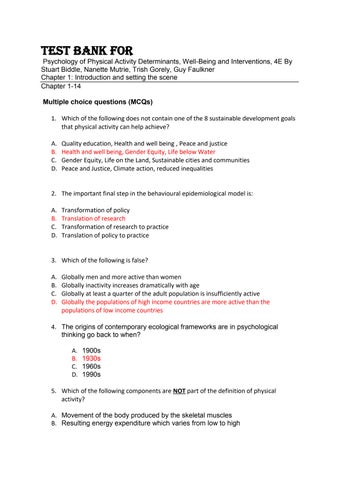
Test Bank For Psychology of Physical Activity Determinants, Well-Being and Interventions, 4E By Stuart Biddle, Nanette Mutrie, Trish Gorely, Guy Faulkner Chapter 1: Introduction and setting the scene Chapter 1-14 Multiple choice questions (MCQs) 1. Which of the following does not contain one of the 8 sustainable development goals that physical activity can help achieve? A. Quality education, Health and well being , Peace and justice B. Health and well being, Gender Equity, Life below Water C. Gender Equity, Life on the Land, Sustainable cities and communities D. Peace and Justice, Climate action, reduced inequalities
2. The important final step in the behavioural epidemiological model is: A. Transformation of policy B. Translation of research C. Transformation of research to practice D. Translation of policy to practice
3. Which of the following is false? A. Globally men and more active than women B. Globally inactivity increases dramatically with age C. Globally at least a quarter of the adult population is insufficiently active D. Globally the populations of high income countries are more active than the populations of low income countries 4. The origins of contemporary ecological frameworks are in psychological thinking go back to when? A. 1900s B. 1930s C. 1960s D. 1990s 5. Which of the following components are NOT part of the definition of physical activity? A. Movement of the body produced by the skeletal muscles B. Resulting energy expenditure which varies from low to high