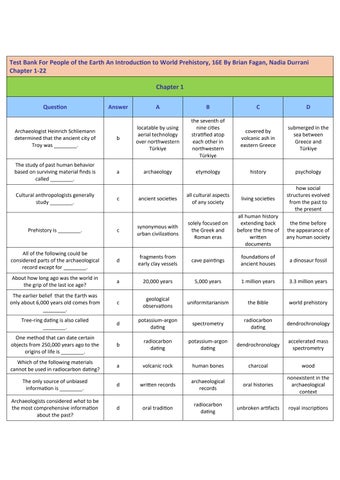
Test Bank For People of the Earth An Introduction to World Prehistory, 16E By Brian Fagan, Nadia Durrani Chapter 1-22 Chapter 1 Question
Answer
A
B
C
D
Archaeologist Heinrich Schliemann determined that the ancient city of Troy was ________.
b
locatable by using aerial technology over northwestern Türkiye
the seventh of nine cities stratified atop each other in northwestern Türkiye
covered by volcanic ash in eastern Greece
submerged in the sea between Greece and Türkiye
The study of past human behavior based on surviving material finds is called ________.
a
archaeology
etymology
history
psychology
ancient societies
all cultural aspects of any society
living societies
how social structures evolved from the past to the present
all human history extending back before the time of written documents
the time before the appearance of any human society
Cultural anthropologists generally study ________.
c
Prehistory is ________.
c
synonymous with urban civilizations
solely focused on the Greek and Roman eras
All of the following could be considered parts of the archaeological record except for ________.
d
fragments from early clay vessels
cave paintings
foundations of ancient houses
a dinosaur fossil
About how long ago was the world in the grip of the last ice age?
a
20,000 years
5,000 years
1 million years
3.3 million years
The earlier belief that the Earth was only about 6,000 years old comes from ________.
c
geological observations
uniformitarianism
the Bible
world prehistory
Tree-ring dating is also called ________.
d
potassium-argon dating
spectrometry
radiocarbon dating
dendrochronology
One method that can date certain objects from 250,000 years ago to the origins of life is ________.
b
radiocarbon dating
potassium-argon dating
dendrochronology
accelerated mass spectrometry
Which of the following materials cannot be used in radiocarbon dating?
a
volcanic rock
human bones
charcoal
wood
The only source of unbiased information is ________.
d
written records
archaeological records
oral histories
nonexistent in the archaeological context
Archaeologists considered what to be the most comprehensive information about the past?
d
oral tradition
radiocarbon dating
unbroken artifacts
royal inscriptions