Test Bank For Nursing A Concept-Based Approach to Learning, Volume 2, 4th edition Pearson Chapter 22-51
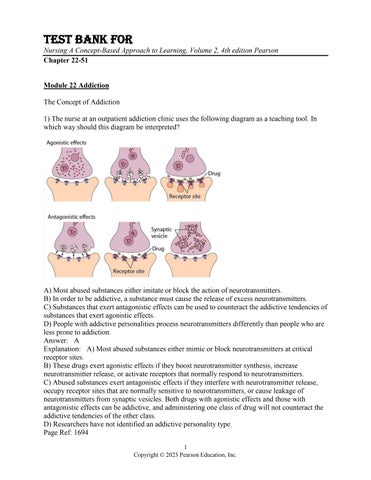
Module 22 Addiction The Concept of Addiction 1) The nurse at an outpatient addiction clinic uses the following diagram as a teaching tool. In which way should this diagram be interpreted?
A) Most abused substances either imitate or block the action of neurotransmitters. B) In order to be addictive, a substance must cause the release of excess neurotransmitters. C) Substances that exert antagonistic effects can be used to counteract the addictive tendencies of substances that exert agonistic effects. D) People with addictive personalities process neurotransmitters differently than people who are less prone to addiction. Answer: A Explanation: A) Most abused substances either mimic or block neurotransmitters at critical receptor sites. B) These drugs exert agonistic effects if they boost neurotransmitter synthesis, increase neurotransmitter release, or activate receptors that normally respond to neurotransmitters. C) Abused substances exert antagonistic effects if they interfere with neurotransmitter release, occupy receptor sites that are normally sensitive to neurotransmitters, or cause leakage of neurotransmitters from synaptic vesicles. Both drugs with agonistic effects and those with antagonistic effects can be addictive, and administering one class of drug will not counteract the addictive tendencies of the other class. D) Researchers have not identified an addictive personality type. Page Ref: 1694 1 Copyright © 2023 Pearson Education, Inc.