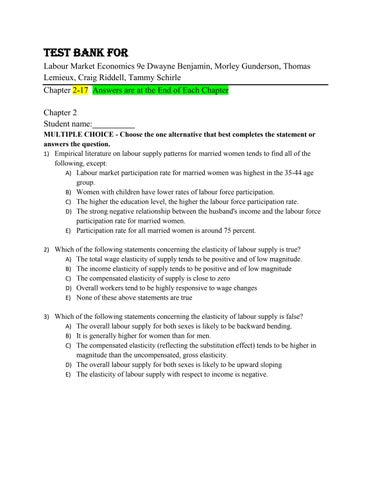
Test Bank for Labour Market Economics 9e Dwayne Benjamin, Morley Gunderson, Thomas Lemieux, Craig Riddell, Tammy Schirle Chapter 2-17 Answers are at the End of Each Chapter Chapter 2 Student name:__________ MULTIPLE CHOICE - Choose the one alternative that best completes the statement or answers the question. 1) Empirical literature on labour supply patterns for married women tends to find all of the following, except: A) Labour market participation rate for married women was highest in the 35-44 age group. B) Women with children have lower rates of labour force participation. C) The higher the education level, the higher the labour force participation rate. D) The strong negative relationship between the husband's income and the labour force participation rate for married women. E) Participation rate for all married women is around 75 percent. 2) Which of the following statements concerning the elasticity of labour supply is true? A) The total wage elasticity of supply tends to be positive and of low magnitude. B) The income elasticity of supply tends to be positive and of low magnitude C) The compensated elasticity of supply is close to zero D) Overall workers tend to be highly responsive to wage changes E) None of these above statements are true 3) Which of the following statements concerning the elasticity of labour supply is false? A) The overall labour supply for both sexes is likely to be backward bending. B) It is generally higher for women than for men. C) The compensated elasticity (reflecting the substitution effect) tends to be higher in
magnitude than the uncompensated, gross elasticity. D) The overall labour supply for both sexes is likely to be upward sloping E) The elasticity of labour supply with respect to income is negative.