hospice care play an essential role in providing physical, emotional, and spiritual support for patients and their families.Symptom Management: Nurses in palliative care work closely with patients to manage symptoms such as pain, nausea, and shortness of breath. They often collaborate with physicians, social workers, and chaplains to provide holistic care.Advance Directives and Ethical Considerations: Nurses help patients and families navigate decisions about end-of-life care, including advance directives, do-not-resuscitate (DNR) orders, and other ethical considerations related to life-sustaining treatment.________________________________________Information Technology (Continued)Digital Transformation and IT IntegrationAs businesses continue to adapt to the digital age, integrating IT systems and technologies is critical to ensuring efficient operations and staying competitive.Enterprise Integration: Many businesses now employ enterprise resource planning (ERP) systems to integrate key functions like finance, HR, supply chain management, and customer relations. ERPs help ensure smooth data flow across departments and increase operational efficiency.System Interoperability: Interoperability refers to the ability of different IT systems to communicate and exchange data seamlessly. In industries like healthcare, financial services, and government, system interoperability is critical for improving service delivery, reducing redundancy, and enhancing decision-making.Cybersecurity in the Age of Digital TransformationAs businesses increase their digital presence, the risk of cyber threats continues to rise. Cybersecurity is a priority for organizations seeking to protect their data, networks, and users from malicious attacks.Data Encryption: Data encryption is a critical security measure that ensures sensitive information is unreadable by unauthorized individuals. This is especially important when handling personal, financial, or medical data.Zero-Day Vulnerabilities: These are flaws in software that are unknown to the vendor and thus unpatched, leaving systems vulnerable to cyberattacks. Cybersecurity experts work to identify and mitigate these vulnerabilities as quickly as possible.Incident Response: When a security breach occurs, an incident response plan is crucial to minimize damage. This includes identifying the threat, containing the breach, assessing the impact, and communicating with affected stakeholders.The Future of IT with Quantum ComputingQuantum computing is an emerging field with the potential to revolutionize industries by solving problems too complex for traditional computers to address.Quantum Algorithms: These are algorithms
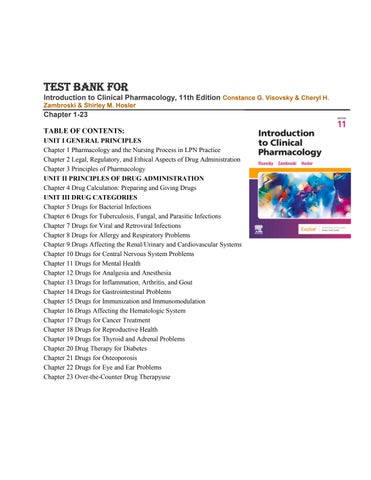
Test Bank For Introduction to Clinical Pharmacology, 11th Edition Constance G. Visovsky & Cheryl H. Zambroski & Shirley M. Hosler
Chapter 1-23 TABLE OF CONTENTS: UNIT I GENERAL PRINCIPLES Chapter 1 Pharmacology and the Nursing Process in LPN Practice Chapter 2 Legal, Regulatory, and Ethical Aspects of Drug Administration Chapter 3 Principles of Pharmacology UNIT II PRINCIPLES OF DRUG ADMINISTRATION Chapter 4 Drug Calculation: Preparing and Giving Drugs UNIT III DRUG CATEGORIES Chapter 5 Drugs for Bacterial Infections Chapter 6 Drugs for Tuberculosis, Fungal, and Parasitic Infections Chapter 7 Drugs for Viral and Retroviral Infections Chapter 8 Drugs for Allergy and Respiratory Problems Chapter 9 Drugs Affecting the Renal/Urinary and Cardiovascular Systems Chapter 10 Drugs for Central Nervous System Problems Chapter 11 Drugs for Mental Health Chapter 12 Drugs for Analgesia and Anesthesia Chapter 13 Drugs for Inflammation, Arthritis, and Gout Chapter 14 Drugs for Gastrointestinal Problems Chapter 15 Drugs for Immunization and Immunomodulation Chapter 16 Drugs Affecting the Hematologic System Chapter 17 Drugs for Cancer Treatment Chapter 18 Drugs for Reproductive Health Chapter 19 Drugs for Thyroid and Adrenal Problems Chapter 20 Drug Therapy for Diabetes Chapter 21 Drugs for Osteoporosis Chapter 22 Drugs for Eye and Ear Problems Chapter 23 Over-the-Counter Drug Therapyuse of financial information for planning, control, and process financial data. These systems help businesses maintain accurate financial records, generate reports, and support decision-making.ERP (Enterprise Resource Planning): ERP systems integrate various business functions, including accounting, supply chain, human resources, and inventory management. Popular ERPs include SAP, Oracle, and Microsoft Dynamics.Automation and AI in Accounting: Automation is increasingly being used in accounting to perform repetitive tasks like data entry and reconciliations. AI and machine learning algorithms can help detect fraud, automate financial forecasting, and improve audit processes.________________________________________Nursing (Continued)Nursing Education and Advanced PracticeNurses continue their professional development through various educational paths, from associate degrees to advanced practice roles that require further education and specialization.Doctor of Nursing Practice (DNP): This advanced degree focuses on the application of research to clinical practice. DNP nurses often hold leadership roles and may specialize in fields such as nurse anesthesia, nurse education, or healthcare policy.Nurse Practitioners (NPs): NPs are advanced practice registered nurses who diagnose and treat medical conditions, prescribe medications, and provide comprehensive care. They often work in primary care and can serve as primary care providers in underserved areas.Continuing Education: Lifelong learning is crucial in nursing due to the rapid advancements in medical science, technology, and patient care practices. Nurses must stay current with new treatment protocols, technologies, and regulatory changes.Patient-Centered CarePatient-centered care emphasizes treating the whole person, considering not only their medical needs but also their psychological, emotional, and social needs. It focuses on building a partnership between patients, families, and healthcare teams to improve patient outcomes.Holistic Care: Holistic care includes addressing a patient’s physical, emotional, spiritual, and social well-being. Nurses play a central role in providing this type of care by building trust and maintaining open communication with patients.Care Coordination: Nurses often serve as care coordinators, ensuring patients receive the necessary services across different healthcare settings. They ensure timely follow-ups, provide patient education, and assist in navigating the healthcare system.Nursing InformaticsNursing informatics is the use of information technology to improve patient care and nursing practice. This includes using electronic health records (EHRs), telemedicine, and data analytics to enhance patient outcomes and reduce healthcare costs.EHR Implementation: The use of electronic health records has become standard in healthcare